My Husband Dumped My Purse After Mom’s Funeral—The Banker Stopped His Transfer
Chapter 1: The Purse on the Table
My husband emptied my purse across the Easter table.
Coins struck the serving bowl and scattered between plates.
My tissues landed in the butter.
The packet from Mom’s funeral slid onto my napkin.
Evan held my brown purse upside down over dinner.
“Quit stalling. Give her your phone.”
Dana reached between the coins toward my phone.
I picked it up before her fingers touched it.
My chair shifted behind me as I stood.
I caught the table edge with my free hand.
“That money came from my mom.”
Evan dropped the empty purse beside my plate.
“You already said yes.”
I looked across Elise’s dining room at him.
He was wearing the solid navy shirt I’d ironed.
I had smoothed its collar before we left home.
Now he was pointing at the phone against my dress.
“Unlock it, Leah.”
“I didn’t approve anything.”
Dana withdrew her hand but stayed close to him.
“I can help you find the message,” she said.
“I didn’t ask you to.”
It was April 20, 2025, Easter Sunday in Boise.
Mom had been buried eleven days earlier.
Her funeral packet still smelled faintly of my purse.
I picked it off my napkin and checked it.
There was butter along the edge of the paper.
I wiped it with the clean part of my napkin.
Nobody offered to take it from me.
Across the table, Elise folded her napkin into a square.
“Please just approve it,” she said.
“We’ve had enough sadness. Don’t ruin Easter too.”
I looked at the tissues in her butter dish.
“He just dumped my purse over my dinner.”
“I saw what happened.”
“Then why are you asking me?”
She looked toward Evan instead of answering.
I put the funeral packet inside my empty purse.
My shoulder-length brown hair kept falling across my face.
I pushed it behind my ear with my wrist.
My phone stayed pressed against my solid green dress.
Evan extended his hand as though I owed him something.
“You’re making everybody uncomfortable.”
“You dumped my purse.”
“We were trying to finish a simple confirmation.”
The confirmation concerned $57,000 of my inherited savings.
Until dinner, he hadn’t even told me the amount.
He had waited until everyone started eating.
Then he said I needed to finish the loan.
When I asked which loan, he frowned at me.
“The one we talked about. Don’t start this again.”
I had asked him who needed help.
He had never given me a straight answer.
Now he was treating that question as my agreement.
Dana had put down her fork before he answered.
She watched me instead of looking surprised.
That was what I kept noticing.
She seemed ready for every part except my refusal.
She was 39, introduced that afternoon as his coworker.
Evan had brought her while we were setting plates.
“She didn’t have anywhere to go,” he’d said.
I moved a serving spoon to make room.
She sat beside him rather than beside Elise.
“Your husband’s been wonderful,” she told me.
I thought she meant something about their work.
Now I could see her watching my locked phone.
“I understand grief makes decisions harder,” she said.
“You don’t know anything about my decisions.”
Elise reached for the serving bowl, then stopped.
The spoon rested against its edge.
Nobody was eating anymore.
I had nearly stayed home that afternoon.
Elise had said I needed a proper meal.
“Come sit down somewhere you don’t have to cook.”
So I had carried a bowl into her kitchen.
Ruth was already there, arranging the serving dishes.
Seeing her made me cry beside the refrigerator.
She had known Mom long before becoming her banker.
“You don’t have to apologize,” she told me.
I wiped my face with a paper towel.
“I’m tired of crying in other people’s kitchens.”
“Then we’ll call it the onions.”
There weren’t any onions on the counter.
That little exchange had helped me stay.
I had thought dinner might be manageable after all.
Now Ruth had put her fork beside her plate.
She was watching Evan’s outstretched hand.
He finally lowered it and looked at her.
“Tell her this isn’t complicated.”
Ruth did not answer him.
“Leah, did you authorize a transfer?”
“No.”
“Have you spoken to anyone at the bank about this?”
“No. I haven’t requested any loan.”
Evan gave an impatient little laugh.
“She’s forgotten what we discussed.”
“I remember asking for details,” I said.
“You said we could help.”
“I asked who needed help.”
“That’s the same conversation.”
“No. It isn’t.”
I was 42, and I scheduled medical appointments for work.
I spent my days checking names, permissions, and requests.
I knew asking a question wasn’t giving approval.
But at that table, I kept touching the funeral packet.
Its damp corner had curled inside my purse.
Evan was 44, and he knew me well enough.
He knew I hated making people wait.
He knew I usually cleared dishes during uncomfortable conversations.
He looked toward the kitchen as if expecting that.
I stayed beside my chair.
“You’ve got money sitting there doing nothing,” he said.
“It belongs to me.”
“We’re married. Stop acting like I’m a stranger.”
Dana shifted her chair away from the scattered coins.
I bent to retrieve a tissue near my shoe.
When I straightened, Evan was watching the phone again.
He had become careful with his own phone lately.
He kept it facedown even beside our coffee cups.
When I asked about working late, he got irritated.
He said I was looking for trouble.
I had stopped asking during Mom’s last difficult weeks.
There were medicines to sort and clothes to wash.
After the funeral, I was too tired for arguments.
Now he was using that tiredness in front of everyone.
Ruth moved her napkin away from her plate.
“There is a pending request,” she said.
I pulled my chair closer to the table.
The word “pending” made me look directly at her.
Nothing had left yet.
At least, that was what I needed to know.
“Can you check it?”
“With your permission.”
“You have it.”
Evan turned toward her before she could move.
“There’s no reason for bank business at Easter.”
I tightened my fingers around my phone.
“Ruth, show him.”
Chapter 2: The Phone Beside My Plate
Ruth came around the table and stood beside me.
Her short gray bob brushed the collar of her dress.
She kept her work phone low while opening it.
I moved my plate to clear space.
A coin rolled into the damp mark underneath.
Ruth glanced at me before touching the screen again.
“I’ll look at the pending request.”
“Please.”
Evan pushed his chair closer to the table.
“You shouldn’t encourage this while she’s grieving.”
Ruth kept the screen turned away from him.
I set my locked phone beside my plate.
Then I gathered the tissues out of the butter.
My fingers smelled like the dinner I hadn’t eaten.
Ruth’s presence wasn’t an accident or a bank visit.
Elise had invited her to Easter as a friend.
At 61, she had known our family for years.
She had sat in Mom’s kitchen drinking ordinary coffee.
She knew which cupboard held the chipped mugs.
She had also handled Mom’s deposit accounts.
After the funeral, she helped with my beneficiary claim.
That was why I trusted her answer.
It was also why Evan wanted her to stop looking.
Mom had died on March 30, 2025.
Her name was Jean, and she was 73.
Until then, my Sundays belonged partly to her kitchen.
From April 2021 through March 2025, I went every Sunday.
Each visit took three hours.
There wasn’t a paycheck or a bill afterward.
I brought my brown purse and set it nearby.
Then I washed my hands and opened her medicines.
The blue pill organizer usually waited beside her place.
On the last Sunday I helped her dress, it stuck.
A tablet caught against the edge of a compartment.
I pressed it flat before closing the little lid.
Mom stood near the table with her blouse half on.
A sleeve had twisted backward around her wrist.
“Will you fix this before you go?”
“I’m not going yet, Mom.”
I put the organizer down and went to her.
She held her arm stiff while I loosened the fabric.
“We’ll get you dressed before lunch.”
“Don’t pull the cuff.”
“I won’t.”
I eased her hand through and straightened the seam.
Then I fastened the buttons she couldn’t manage.
She patted my wrist when I finished.
I returned to the table and checked the compartments.
She sat down and watched my hands.
“Did you bring your lunch?”
“I’ll eat when we’re done.”
She pulled the empty chair out with her foot.
I sat while she adjusted her sleeves.
Those visits weren’t afternoons when somebody else did everything.
I knew which lids needed extra pressure.
I knew which blouse pinched under her arm.
At Easter, I kept smoothing my own cuff.
Ruth noticed my hand and paused beside me.
Then she returned her attention to her phone.
Evan tapped his fingers against the table.
“Are we really doing this here?”
“You brought it here,” I said.
Elise looked down at the spoon beside her plate.
I remembered sitting across a different desk with Ruth.
That was after Mom’s funeral on April 9, 2025.
I had brought the paperwork for the beneficiary claim.
The funeral packet was still tucked inside my purse.
Ruth checked the deposit account’s beneficiary designation.
Mom had named me payable-on-death beneficiary.
The $84,000 did not need to pass through probate.
Ruth explained that while I stared at Mom’s name.
“This claim is yours,” she said.
I asked where the money would go.
We arranged a new account solely in my name.
On April 14, 2025, the inherited $84,000 entered it.
There was no household paycheck mixed into that account.
Evan wasn’t an owner, signer, or agent.
I hadn’t added him to anything.
At home, I told him the amount over breakfast.
He put down his cup and asked me to repeat it.
I did, because he was my husband.
I left the beneficiary confirmation with my papers.
It had the account number on it.
I didn’t think I needed to hide it from him.
Soon he began calling the money “our cushion.”
I told him I hadn’t made plans for it.
He mentioned helping somebody through a rough patch.
He called it a family loan.
“Whose family?” I asked.
“I’ll explain when you’re not so upset.”
He said that while I was folding funeral clothes.
I kept folding because I couldn’t manage another argument.
At Elise’s table, he used the same tone.
“This is a small final confirmation.”
“It’s $57,000,” I said.
“The amount isn’t the point.”
“It is to me.”
Ruth finished reading and looked up from her phone.
She did not hand it across the table.
“I received a pending-request notice before today,” she said.
“In the course of my work.”
“Then you know it’s normal,” Evan said.
“I know it requires the owner’s verification.”
He shifted toward her, trying to see past me.
She kept the screen angled toward herself.
I asked if anything had been sent.
“No wire has been approved or released.”
My fingers loosened around the damp tissues.
I put them on the edge of my plate.
Ruth looked at Evan.
“I watched Leah come every Sunday.”
He glanced at Elise, who kept her eyes down.
“She filled Jean’s medicines and helped her get dressed.”
“That doesn’t have anything to do with this,” he said.
“This account belongs to Leah,” Ruth answered.
“Her permission isn’t something you can supply for her.”
I moved closer so I could see what she meant.
Evan started talking about marriage and shared decisions.
Ruth raised her phone to chest height beside me.
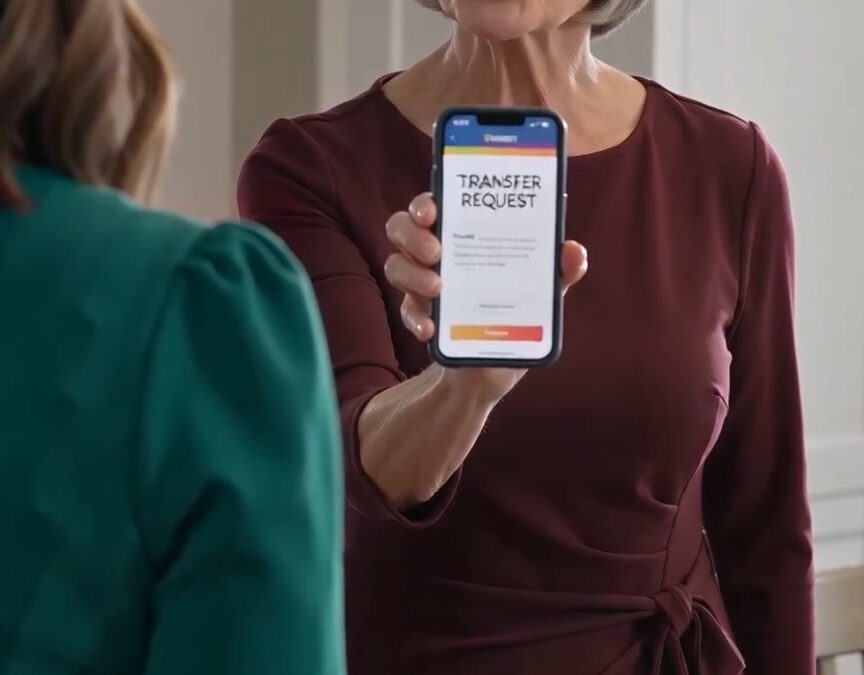
The heading was clear: “TRANSFER REQUEST.”
Below it, she had opened a record I hadn’t seen.
Evan bent toward the screen as if checking a mistake.
His mouth stayed open, but he stopped speaking.
Then he backed into his chair.
Chapter 3: Who Actually Gave Consent
Ruth kept the phone beside me, not toward the table.
Evan gripped the back of his chair.
I could see the pending request beneath the heading.
I could also see that it wasn’t my authorization.
“What did he tell the bank?” I asked.
Ruth looked at me before answering.
“May I explain the consent record here?”
“Yes.”
She turned slightly so we stood together.
“Evan, that’s your voice, not hers.”
He jerked backward against his chair.
“You kept that call?”
“The bank recorded its intake call,” Ruth said.
“Under its ordinary disclosed recording procedure.”
She hadn’t played anything through the dining room.
There was no voice coming out of her phone.
She was telling us what the bank’s record contained.
Evan looked from her screen to my face.
I picked up my own phone and locked it again.
I wanted him to see that small, deliberate movement.
“Which call?” I asked.
“The intake call on April 18, 2025.”
That was when he had requested the wire.
I had not called the bank that day.
I had not sat beside him during a call.
I hadn’t known he was making one.
Ruth lowered her phone enough for me to read privately.
“The verification record identifies third-party consent as unverified.”
“Meaning him?”
“Yes. He claimed you had agreed.”
“Did the bank hear me?”
“No.”
“Did it receive authorization from me?”
“No.”
Evan pulled his chair forward and sat down.
“I explained what we discussed.”
“That wasn’t her authorization,” Ruth said.
“The request stayed pending for owner verification.”
He rubbed his thumb along the table edge.
I watched him choose his next words.
He didn’t deny making the call.
He had seen enough to know that wouldn’t work.
Instead, he turned his chair toward me.
“Leah, spouses handle errands for each other.”
“This wasn’t an errand.”
“I wasn’t pretending to be you.”
“You said I consented.”
“Because you said we could help.”
“I asked a question.”
Elise lifted her water glass without drinking.
Dana kept her hands below the table.
Ruth stepped back slightly to give me room.
I sat down because my knees were pressing the chair.
The purse lay open beside my plate.
Its lining was turned halfway inside out.
I pushed it back into place with my fingers.
“How could he request anything from my account?”
“He supplied information identifying the account,” Ruth said.
“Knowing it didn’t make him an authorized signer.”
I looked at Evan.
“The beneficiary confirmation.”
He watched the serving bowl instead of answering.
I remembered leaving that paper at home.
It had felt like ordinary paperwork in our house.
He had used the number to start this request.
He had used my grief to explain my silence.
Then he had brought the supposed final step to dinner.
“Was there ever an approved wire?” I asked.
“No,” Ruth said.
“The intake request was queued for owner verification.”
“On the next business day?”
“Yes.”
That was why it was still waiting on Easter.
Not because I owed Evan a final favor.
Not because the money was already committed.
The bank still needed me to say yes.
Evan leaned forward with his palms against the table.
“Then there’s no problem. Nothing happened.”
“My purse is over my dinner,” I said.
He glanced at the empty purse as though annoyed.
“I shouldn’t have done that.”
He said it quickly, then returned to the bank.
“But nobody took your money.”
“Because they needed my authorization.”
“Exactly. You still control it.”
Ruth did not interrupt that admission.
I picked another coin from beside the serving bowl.
Then I put it in the purse pocket.
The small zipper caught on the lining.
I worked it loose while Evan watched me.
“I was going to explain everything,” he said.
“Before or after I unlocked my phone?”
“We were all sitting here.”
“Yes.”
Dana moved her water glass closer to her plate.
She still hadn’t asked what the call contained.
I noticed that, too.
If this had surprised her, she didn’t show it.
Ruth asked if I wanted to review more privately.
I nodded, but stayed seated for the moment.
“What exactly did the bank record?”
“His request and his statement that you’d approved it.”
“And the bank marked that unverified?”
“Yes. It was not accepted as owner authorization.”
Evan took a breath through his nose.
“I called because you haven’t been handling things.”
“I processed Mom’s beneficiary claim.”
“You know what I mean.”
“I don’t.”
He looked toward Elise for help.
She pressed the folded napkin against her lap.
I had handled Mom’s appointments while scheduling other people’s appointments.
I had organized medicines and dealt with funeral papers.
I had opened the account and kept it separate.
But I didn’t list any of that for him.
Ruth had already answered the question that mattered.
He couldn’t supply my consent.
He hadn’t supplied my consent.
The bank’s own record showed the difference.
I took a clean tissue from inside my purse.
It had survived in the zipped pocket.
I wiped butter off the corner of my phone case.
Evan watched me do it without speaking.
Then he tried a quieter voice.
“We can talk about the loan at home.”
“You brought Dana to help finish it.”
“She understood the paperwork.”
Dana looked up at that.
For the first time, she seemed unsure what to say.
Ruth kept her work phone in her hand.
I turned toward her.
The amount was no longer my only question.
The call had been Evan’s.
The account was mine.
But somebody else had expected that money.
“Where was the $57,000 going?”
Chapter 4: The Mortgage Nobody Mentioned
Ruth leaned closer instead of answering across the table.
“Let’s review the destination privately.”
I stood and picked up my purse.
This time, Evan didn’t reach for it.
Ruth and I moved into Elise’s kitchen.
We stayed near the counter, away from the doorway.
The dining room was quiet behind us.
Ruth angled her phone so only I could read.
She showed me the requested destination information.
It was a mortgage servicer.
The payment details connected the request to Dana’s mortgage.
I read it, then read it again.
I had expected some explanation involving a relative.
Maybe that was foolish, but Evan had said “family.”
He had never said “mortgage arrears.”
He had certainly never said “Dana.”
“Has anything gone there?” I asked.
“No.”
“Could this request be changed without my approval?”
“It cannot be released without proper owner authorization.”
I rested my purse against the counter.
The strap had twisted when Evan emptied it.
I untwisted it while Ruth waited.
“Can I ask him about this?”
“It’s your request to dispute,” she said.
“I won’t discuss more than you authorize.”
I thanked her for taking me out of the room.
She locked her work phone before we went back.
Evan had turned toward Dana while we were gone.
When I entered, he faced me immediately.
“Now you understand what it’s for.”
“I understand it’s going to a mortgage servicer.”
He looked at Dana before he answered.
“It’s temporary help.”
“For Dana’s mortgage.”
Dana drew her elbows away from the table.
Evan put his hand flat beside her plate.
“She’s had a rough patch.”
“You called this a family loan.”
“She works with me. You know that.”
“I know how you introduced her.”
Elise looked up sharply at that.
She glanced from Dana to Evan, then back.
I stayed beside my chair with the purse strap held.
Dana brushed a coin away from her place.
It rolled toward the center of the table.
“I’m behind,” she said.
“I heard the destination. I’m asking about the explanation.”
“My mortgage payments are behind.”
“And you expected my inheritance to cover them?”
“Evan said you knew.”
Evan turned toward her.
“I said I would handle the conversation.”
“You said she’d agreed to help.”
He drew his hand back from beside her plate.
I could see why he wanted my phone unlocked.
A short confirmation could have made his story true afterward.
Then he could describe dinner as an unpleasant misunderstanding.
Except I had not given that confirmation.
I set my purse upright beside my chair.
“How long have you been helping each other?”
Dana looked at him, not me.
“Leah,” he said, “this isn’t the place.”
“You chose the place.”
“Elise invited us for dinner.”
“Elise didn’t empty my purse.”
He pressed his lips together.
I looked directly at Dana.
“Are you his coworker, or are you his girlfriend?”
She lowered her eyes to her untouched food.
Evan shifted toward her.
“Don’t answer while she’s upset.”
Dana lifted her head.
“I am his girlfriend.”
The serving spoon slipped against the bowl as Elise moved.
She caught its handle and laid it down.
I looked at Evan.
He didn’t tell Dana she was wrong.
He didn’t look surprised that she had said it.
He pulled his chair back enough to stand.
“This is more complicated than that.”
“No,” I said. “That answer was clear.”
Dana folded her hands on the edge of the table.
“I thought you knew things weren’t working.”
“You thought I knew about you?”
“He said you were discussing your future.”
“I was discussing my mother’s funeral.”
Evan rubbed his forehead.
“Don’t twist what she’s saying.”
“I’m asking what you told her.”
He looked toward Ruth, who stood near my chair.
“This isn’t bank business anymore.”
“The destination was bank business,” I said.
“The rest is what you brought with it.”
Ruth didn’t add anything.
She didn’t need to explain my marriage to me.
She had shown me where my money was supposed to go.
Dana had supplied the part missing from Evan’s explanation.
Elise pushed back from the table but stayed seated.
“I didn’t know,” she said.
I turned toward her.
“What did you know?”
“He said there was a family loan.”
“Whose family?”
“He didn’t explain it like this.”
“Did he say I agreed?”
“Yes.”
“And when I said I hadn’t?”
Elise looked down at her folded napkin.
“I thought you were arguing about doing it today.”
“I said I never agreed.”
“I heard you.”
That answer made me press my purse against my leg.
I had spent the entire meal trying to be understood.
My sister had heard me.
She simply wanted dinner to continue.
Evan reached toward his water glass.
“We should have handled this privately.”
“You should have asked me privately.”
“I tried.”
“You didn’t name Dana. You didn’t explain the mortgage.”
Dana pulled her chair farther from the table.
“I don’t want this turned into me demanding money.”
“Then don’t reach for my phone,” I said.
She sat still.
I was surprised how easily that sentence came out.
There was no explanation I needed to add.
She had reached.
I had seen her.
Evan looked between us, then chose another approach.
“The mortgage problem is real, regardless of everything else.”
“I haven’t said it isn’t.”
“She needs help.”
“That doesn’t make my account yours.”
“We could write proper loan terms.”
“You requested the wire before offering terms.”
He stopped with his glass halfway to his mouth.
Elise looked toward the kitchen, then at the food.
Nobody suggested reheating anything.
I checked that Mom’s funeral packet was inside my purse.
Then I took out my phone.
Not to unlock it for either of them.
I wanted to be ready to leave.
Ruth moved beside me.
“Leah, the request is still pending.”
I looked at the work phone in her hand.
“What do I need to do to dispute it?”
Chapter 5: The Request I Disputed
Ruth asked me to come into the kitchen again.
I carried my purse instead of leaving it behind.
She stood beside the counter with her work phone.
“Tell me clearly what you want recorded.”
“I did not authorize the $57,000 wire.”
She waited while I finished.
“I do not approve it now. I dispute the request.”
Ruth entered the dispute through her authorized work portal.
She read the substance back without adding anything.
I listened until she finished.
“That’s correct.”
She submitted the flag and checked its status.
“This puts the dispute on the pending request.”
“Is it canceled?”
“The wire team will formally handle it Monday.”
“April 21, 2025?”
“Yes.”
She made the distinction carefully, and I appreciated it.
I did not want a comforting answer that wasn’t accurate.
“Nothing has been released,” she added.
“There is no completed transfer to recover.”
I put my palm flat on the counter.
For the first time since the purse overturned, I exhaled.
Ruth kept working while I stood beside her.
“Please ask them to preserve the call,” I said.
“And the verification record.”
“I’m adding that request to the internal message.”
She recorded the preservation request with the dispute.
The bank already had the intake recording and log.
We weren’t making a new recording at dinner.
We weren’t asking anyone to alter the old one.
I watched until her message had been submitted.
“What should I bring tomorrow?”
“Identification and the account information you have.”
“I’ll bring a written statement.”
“That will help document your position.”
She locked the phone and put it away.
Then she looked at the purse against my hip.
“Do you have everything?”
I glanced into it.
There were tissues, coins, my phone, and the funeral packet.
But most of my purse contents still covered the table.
“I need to collect the rest.”
We returned to the dining room together.
Evan was standing behind his chair.
Dana was still seated beside the place he had occupied.
Elise had removed the butter dish.
The damp tissues sat on a small plate now.
She had not cleared my dinner.
I put my purse upright and opened the inner pocket.
Then I started gathering what Evan had spilled.
He watched me pick coins from beside the serving bowl.
“Can we stop treating this like a crime scene?”
“I’m getting my things.”
“I mean what you’re doing with the bank.”
“I disputed a request I didn’t authorize.”
“You could have told me before involving everyone.”
“You emptied my purse in front of everyone.”
He glanced at Ruth.
She didn’t answer for me.
Dana stood and straightened her chair.
“Evan, I need to know what happens now.”
He turned toward her automatically.
I put the last loose coin into my purse.
That movement of his was answer enough for me.
He was worried about her mortgage and her reaction.
He still hadn’t asked about the funeral packet.
Elise came close carrying a clean napkin.
“There’s something on the side of your bag.”
She wiped a smear from the leather.
I held it still while she worked.
“I can do that,” I said.
“I know.”
She folded the dirty part inward and stepped away.
Evan moved around his chair toward me.
“We need to discuss this at home.”
“Not tonight.”
“Leah, you can’t just refuse to talk.”
“I’m not debating this at dinner.”
“There are things you don’t understand.”
“I understand the request.”
He glanced toward Dana before answering.
I had noticed that glance enough times now.
I pulled the purse zipper closed.
Ruth asked whether I wanted her to stay beside me.
“Yes, please.”
Evan stopped advancing.
He looked annoyed by how ordinary the question sounded.
Nobody was shouting at him now.
Nobody needed to.
I checked the purse pocket containing my phone.
It was zipped shut.
Then I checked the funeral packet once more.
I hated that I needed to look again.
Elise stood near the doorway into the kitchen.
“I can put your bowl aside,” she said.
“Thank you.”
“Do you want food to take?”
“No.”
She opened her mouth, then closed it.
I pulled the strap onto my shoulder.
Dana spoke from beside Evan’s chair.
“I didn’t mean for it to happen this way.”
I looked at her.
“You reached for my phone.”
“I thought I was helping.”
“I told you no.”
She dropped her gaze.
I did not ask how they met.
I did not ask what he had promised her.
The answers would not change Monday at the bank.
Evan tried a softer voice.
“Your mother wouldn’t want us fighting over money.”
I held the purse strap where it crossed my shoulder.
“Don’t use Mom in this.”
He looked away first.
Ruth moved toward the front door with me.
Elise followed us out of the dining room.
She stopped beside the coat hooks.
“I didn’t mean you should let him do that.”
“You asked me to approve it.”
“I wanted everybody to calm down.”
“I was saying no.”
She rubbed the clean edge of her napkin.
“I know.”
I wasn’t ready to help her feel better about it.
I opened the front door.
The ordinary afternoon light made my eyes ache.
I had arrived carrying food, expecting to sit and eat.
I left checking the zipper on my own purse.
Ruth paused beside me before we separated.
“The bank can secure the account tomorrow,” she said.
“But secure your personal device access, too.”
I looked down at the purse against my coat.
For years, Evan had known my everyday passcode.
“I’ll start there.”
Chapter 6: Monday at the Bank
On April 21, 2025, I went to the bank.
My brown purse stayed on my lap while I waited.
Inside were identification, account papers, and my written dispute.
I had written it plainly at the kitchen table.
I had not authorized the request.
I had not spoken during the intake call.
I did not want the pending wire released.
At the desk, Ruth asked what I wanted handled first.
“Please confirm the wire’s status.”
She checked through the proper internal process.
The wire team had formally canceled the pending request.
No funds had left my account.
She let me review the cancellation information privately.
I read it slowly, holding the edge of the paper.
Then I checked the account balance.
The inherited money was still there.
I put my written statement on the desk.
“Please include this with the dispute.”
Ruth reviewed it with me for accuracy.
We kept the facts separate from what I suspected.
I had seen Evan empty my purse.
I had heard him claim I already agreed.
I had not witnessed the intake call itself.
The bank had its own recording of that.
The verification log documented how it treated his statement.
I didn’t need to fill the gaps with guesses.
“Do you want to add anything?” Ruth asked.
“Only that I never authorized him to act for me.”
She made sure the statement reflected that.
I signed it and kept a copy.
Then we worked on access.
Evan had never been an account owner.
There was no signer authority to revoke.
But he knew information he should no longer have.
I changed the online banking credentials.
I replaced the password and reviewed the recovery details.
I checked where verification messages would go.
They were going to my device, under my control.
I removed saved sessions through the available security settings.
I asked how to sign out anything still connected.
Ruth walked me through the process without rushing.
I did each step myself.
She did not need to know the new password.
Neither did Evan.
I had already changed the passcode on my personal phone.
I reviewed its access settings again at the desk.
Anything I didn’t recognize, I checked before leaving it.
The phone that Dana reached for stayed in my hand.
It did not pass across the desk.
It did not pass to anybody else.
“Can he call and change this?” I asked.
“He cannot authorize transactions on your individual account.”
“What if he knows the account number?”
“That is not enough.”
I asked how to report any further attempt.
Ruth gave me the bank’s ordinary reporting process.
I put the instructions with my copy of the dispute.
Then I asked about the intake recording.
“The bank retains its own records,” she said.
“I want my preservation request documented.”
“It is.”
She checked that the request covered the existing call and log.
I did not ask her to send confidential work files.
She did not offer to slip me a copy.
If my attorney needed records, there was a process.
That mattered to me.
Evan had created trouble by treating permission as optional.
I wasn’t going to solve it by doing the same.
Before leaving, I looked at the beneficiary paperwork again.
The source of the deposit was written there.
Mom’s payable-on-death account had funded my new individual account.
My wages had gone elsewhere.
Household payments had not passed through the inheritance.
I kept the papers together instead of scattering them.
At home, that habit had made Evan’s access easy.
Now I needed the same papers for a different purpose.
Ruth walked with me toward the lobby.
“I’m sorry this happened at Elise’s,” she said.
“I’m glad you checked.”
“You asked me to.”
I nodded.
I had, and the request had mattered.
Outside, I sat before opening my purse again.
I put the cancellation information behind the dispute copy.
Then I made sure my phone had locked.
That afternoon, I consulted a divorce attorney.
I brought the same folder.
I did not begin with Dana’s explanation.
I began with the inherited account and the canceled wire.
Then I explained the marriage and the Easter dinner.
The attorney asked whether any marital funds had entered it.
“No.”
“Have you paid shared expenses from it?”
“No.”
“Keep the source documents.”
I took out the beneficiary confirmation and deposit record.
The attorney examined them without promising an automatic result.
Idaho property questions required the facts and the records.
My account title mattered, but tracing mattered, too.
We discussed preserving the inheritance without mixing it.
We discussed financial communication through counsel.
I asked about the bank’s recording.
My attorney would request relevant records through proper channels.
With my authorization, the bank could respond appropriately.
Nothing depended on Ruth sending a secret file.
Nothing depended on making Dana answer more questions.
I wrote down what I needed to keep.
The attorney asked what I wanted to do.
I looked at the purse beside my feet.
There was still a faint mark near its zipper.
“I want to end the marriage.”
The words sounded less dramatic in that office.
They sounded like an instruction someone could follow.
We discussed the process and the papers required.
When the consultation ended, I put everything back carefully.
I did not call Evan from outside.
I did not send him the new balance screen.
That evening, his message arrived while I checked my settings.
He wanted me to call the bank again.
He wanted the dispute described as a misunderstanding.
I read the message and saved it for counsel.
Then another message appeared.
He said there was still a way to help Dana.
Chapter 7: What Evan Tried Next
Evan stopped claiming that the wire had been approved.
The bank’s record made that argument useless.
Instead, he wanted me to change how it was described.
He wrote that he had misunderstood our conversation.
He wanted me to tell the bank the same thing.
I read the message at my kitchen table.
My purse sat beside the folder from the bank.
I did not type an answer while I was angry.
I sent the message to my attorney.
Then I put the phone facedown and made dinner.
When I returned, Evan had written again.
He said I was making an administrative mistake into something worse.
He said nobody had lost any money.
He asked why I wanted a permanent record of it.
I saved that message with the others.
The record already existed.
My statement did not make his call happen.
My statement explained that I had not authorized it.
Through counsel, I answered the financial part.
The dispute was accurate.
I would not withdraw it or change it.
I would not authorize a payment to Dana’s mortgage servicer.
My attorney kept the response brief.
There was nothing in it about revenge.
There was nothing promising criminal charges.
It addressed the request and my money.
Evan’s next approach sounded more reasonable.
He proposed a smaller private loan instead.
There was no new amount I agreed to consider.
He said written terms could protect me.
He offered to handle repayment arrangements.
He presented it as a way to avoid further conflict.
I read the proposal with the original papers nearby.
The first request had been called a family loan.
Now the label had changed to private loan.
The destination and the person asking had not changed.
I told my attorney I would not lend the money.
Counsel communicated that refusal.
I did not explain my grief to Evan again.
I did not send photographs of Mom’s pill organizer.
He knew what Sundays had required.
He had watched me leave with my purse.
He had heard me remind Mom about lunch.
Knowing those things hadn’t stopped him at Easter.
I kept the inherited account separate.
My wages continued into the account used for ordinary expenses.
I did not transfer inheritance money to cover groceries.
I did not move a portion into a shared account.
When I checked the savings, I used my own device.
Then I signed out.
I filed the statements with the beneficiary documents.
The routine was dull, which helped.
Open the statement.
Check the source and activity.
Save the record.
Close the account session.
At work, I still answered scheduling calls.
I still checked availability and explained appointment instructions.
Sometimes I would reach for my phone between tasks.
Then I would remember the message waiting there.
I started leaving it tucked inside my purse.
I checked it when I could respond carefully.
Evan eventually asked for a direct financial conversation.
He said attorneys made ordinary decisions expensive and difficult.
He suggested we could settle the loan question ourselves.
I sent that request to counsel, too.
My response remained the same.
Financial discussions would go through my attorney.
There would be no loan from my inheritance.
He could discuss the divorce through the appropriate channel.
He did not like that answer.
But he stopped receiving access just because he asked.
He no longer knew the passcode to my phone.
He could not use my saved banking session.
He could not stand beside me and call it confirmation.
I checked those settings again after his message.
Then I put the phone in my purse.
The funeral packet was still in the inner pocket.
I took it out and flattened the curled edge.
A faint butter stain remained along the corner.
I did not try scrubbing the paper.
I placed it with Mom’s other papers instead.
The blue pill organizer sat nearby in a small bag.
I had brought it home after her death.
I wasn’t ready to decide where it belonged.
So I closed the bag and returned to the account folder.
There were decisions I could finish that evening.
I could confirm no new requests had appeared.
I could make sure the dispute copy was filed.
I could answer counsel’s question about the source deposit.
I did those things before washing my dinner plate.
Elise called while I was drying it.
I let the call finish and listened to her message.
She wasn’t asking about Evan’s loan.
She said she needed to apologize about Easter.
I held the plate against the dish towel.
Until then, her messages had stayed practical and careful.
This sounded different.
I called her back after putting the plate away.
“I want to talk about what I said,” she told me.
“Which part?”
“When I told you to approve it.”
I sat at the kitchen table.
The purse strap had fallen across the chair beside me.
I moved it out of the way.
“I’m listening.”
She took a breath.
“I heard you say no, Leah. I chose dinner anyway.”
I looked at the folder from the bank.
For once, I didn’t need to prove what I’d said.
Elise had finally named it herself.
Then she asked if she could come over.
Chapter 8: What My Sister Chose
Elise came while I was putting away clean dishes.
She waited until I moved my purse from the chair.
Then she sat at the kitchen table.
At 45, my sister still twisted napkins when uncomfortable.
This time, she had no napkin to fold.
She pressed her fingers against her knees instead.
“I’m sorry I told you to approve the transfer.”
I stayed beside the counter.
She looked directly at me as she continued.
“You said you hadn’t agreed. I heard you.”
“And you asked me again.”
“Yes.”
“After he emptied my purse.”
“Yes.”
I set a dry cup into the cupboard.
I wanted her to keep going without my helping.
“I wanted an uninterrupted dinner,” she said.
“I wanted everybody to eat and stop arguing.”
“So I was supposed to pay for that.”
She looked down, then back up.
“That’s what I was asking. I didn’t admit it then.”
I sat across from her.
The bank folder was no longer on the table.
I had put it away before she came.
I didn’t want to spend the visit displaying proof.
She had been there.
She knew exactly what she’d watched.
“I didn’t know about Dana,” she said.
“I believe you.”
“Evan told me it was a family loan.”
“I believe that, too.”
“But that doesn’t excuse what I said.”
“No.”
She rubbed her fingertips together.
“I should have told him to put your purse down.”
I looked toward the chair where it hung now.
She followed my glance but didn’t touch it.
We sat quietly until she asked about practical things.
Did I need help organizing Mom’s remaining papers?
Did I want company while sorting the kitchen items?
Was there anything she could bring from her house?
“My bowl,” I said.
She gave a small, embarrassed nod.
“I’ll get it back to you.”
“And you can help me sort the papers.”
She asked what I wanted kept separate.
I showed her the folder holding inheritance documents.
“That stays as it is.”
“Okay.”
We moved to the counter where Mom’s papers waited.
Elise read labels while I chose what to keep.
She did not open the bank folder.
She asked before moving anything with account information.
That small change made the work possible.
When she found the funeral packet, she stopped.
The stained corner was still visible.
“I should have picked that up,” she said.
“I picked it up.”
“I know.”
She handed it to me by the clean edge.
I slid it into the folder with the funeral papers.
Then we kept working.
The blue pill organizer was still inside its bag.
Elise lifted the bag and waited.
“Do you want this with the kitchen things?”
“Leave it with me.”
She set it beside my elbow.
I opened the bag after she returned to the papers.
The compartments were empty.
I pressed the lid that used to stick.
It shut without anything caught underneath.
Mom used to watch my hands when I filled it.
Now Elise was watching me from across the counter.
I put the organizer back in the bag.
“I’m not sorting that today.”
“You don’t have to.”
We finished the stack we had started.
Then Elise asked if I wanted food.
We made something simple in my kitchen.
I took the plates down myself.
My purse stayed on the chair without being moved.
Over the meal, she mentioned Evan.
Not the bank request or the mortgage.
She asked whether there was any chance of reconciling.
I set my fork beside my plate.
“No.”
“I’m not saying you owe him that.”
“Then don’t ask me to consider it.”
She looked at her food.
“I thought I should ask.”
“You’ve asked.”
“I won’t ask again.”
I picked up my fork.
We finished eating without discussing him further.
When she left, she took the papers I’d agreed she could sort.
She left the bank documents where I had put them.
I checked the folder afterward anyway.
Everything was still in place.
Over time, my days took on a separate routine.
I went to work as a medical scheduling clerk.
I came home and made the food I wanted.
I checked my messages after putting down my work things.
Financial questions went to counsel, not into arguments.
Sunday was the hardest day to arrange.
For years, I had known where those three hours went.
I would reach for the calendar and stop.
There was no medicine visit to confirm.
There was no blouse sleeve waiting for my hands.
I started doing the grocery shopping on Sundays.
I made a list at my kitchen table.
I put my phone in my purse before leaving.
When I came back, I unpacked before checking messages.
It was an ordinary routine, not a special outing.
That was what I needed.
Elise returned my bowl clean and dry.
She didn’t bring Evan’s name into the kitchen.
She asked where I wanted the bowl.
“In that cupboard.”
She put it exactly where I pointed.
Later, she helped me sort another stack of Mom’s papers.
She asked before throwing away even an empty envelope.
I appreciated the help.
I still did not change my answer about the marriage.
Accepting her company did not require that.
When my attorney asked for the complete deposit trail, I was ready.
The beneficiary confirmation was together with the account statements.
The written dispute was behind the cancellation record.
I carried the folder to the table and opened it.
Then counsel asked for my authorization to obtain the bank records.
Chapter 9: The Account Stayed Mine
I read the authorization before signing it.
It allowed my attorney to request the relevant bank records.
I checked the account information against my own papers.
Then I returned it through counsel.
The bank responded through the proper channels.
Ruth did not bring anything to my kitchen.
She did not send confidential material from her personal phone.
The records came as part of the legal work.
My attorney reviewed the intake call and verification log.
They showed what Ruth had explained at Easter.
Evan had claimed I consented.
I had not spoken on the call.
The bank had treated his statement as unverified third-party consent.
It had not accepted that statement as owner authorization.
The pending request had been flagged after my dispute.
The wire team had formally canceled it.
No released funds needed to be recovered.
I sat with those facts laid out in order.
There was less drama on paper than at Elise’s table.
No serving bowl.
No butter dish.
No one telling me to stop ruining Easter.
There were dates, account records, and a canceled request.
My attorney asked whether I saw any factual error.
“No.”
“Anything you authorized that isn’t reflected here?”
“No.”
I signed what required my confirmation.
Then we reviewed the inheritance trail.
Jean’s payable-on-death designation identified me as beneficiary.
The beneficiary proceeds entered my individual account.
That deposit was $84,000.
The date was April 14, 2025.
No marital funds had entered the account.
The statements supported what I had been saying.
I had not moved the money through a shared account.
I had not used it to pay Dana’s mortgage.
I had not approved any smaller private loan afterward.
Counsel explained how those records supported separate-property treatment.
They did not rely only on my account being titled individually.
They showed where the money came from.
They showed that it had stayed traceable.
I had kept each statement even when I hated opening mail.
Now I was glad I could hand over a complete set.
Evan did not return to claiming the wire was authorized.
The call and log had settled that issue.
His later financial requests had come through the legal process.
I did not negotiate with him on my phone.
I did not answer explanations about Dana’s needs.
The divorce involved a property settlement, not a dinner argument.
My attorney handled the language with his side.
I reviewed the proposed treatment of the inheritance.
If I did not understand a sentence, I asked.
I had spent enough time being told something was simple.
I wanted to know what each provision actually did.
At my kitchen table, I read the draft with a pencil.
I marked the section describing the inherited savings.
Then I compared it with counsel’s explanation.
The traceable inheritance would remain my separate property.
It would not fund a loan to Dana.
It would not become Evan’s account.
He would have no authority to direct transfers from it.
I asked my attorney to confirm what remained unresolved.
Then I put the draft away until there was an answer.
That waiting was unpleasant, but it was ordinary legal work.
There wasn’t a judge ordering Dana out of a house.
There wasn’t a criminal conviction in my divorce papers.
I did not know what happened with her mortgage.
I stopped asking.
The outcome I could document concerned my marriage and money.
Evan had sought $57,000 from my individual inherited account.
He received none of it.
He no longer had access to my personal devices.
He could not use marriage as bank authorization.
The settlement would preserve what I had kept separate.
When the agreed language was ready, I read it again.
My attorney answered the questions I had written down.
I checked the inheritance provision before signing.
The paper felt ordinary under my hand.
I had expected the moment to feel larger.
Instead, I noticed my pencil needed sharpening.
I put it aside and signed where instructed.
On September 18, 2025, the divorce became final.
The agreed property settlement preserved the traceable inheritance as mine.
When counsel confirmed completion, I asked for the final documents.
I wanted the actual order, not merely a reassuring message.
Once I had it, I read the relevant pages.
Then I placed it behind the settlement copy.
There was no reason to call Evan.
There was no reason to explain the result to Dana.
The documents already said what had been resolved.
I told Elise it was final.
She asked whether I wanted company.
“Not tonight.”
“Do you need anything?”
“No. I’m going to make dinner.”
She accepted that without offering another solution.
I washed vegetables at the sink.
My phone stayed on the counter, locked between messages.
I ate at the kitchen table.
Afterward, I opened the account myself.
The canceled wire had never reduced the inheritance.
I checked the activity and saved the statement.
Then I signed out.
For a while, I sat with the closed folder.
Mom’s name appeared on the beneficiary paperwork inside it.
I touched the folder edge, then put it away.
The purse was on the chair beside me.
I moved it onto the table to find my keys.
I didn’t look toward the doorway first.
After the keys came out, I left the purse there.
Then I opened the kitchen drawer that still held Mom’s things.
Chapter 10: My Purse on My Table
The drawer needed sorting before anything would fit properly.
I took out folded papers and an unused measuring spoon.
Mom’s blue pill organizer was still inside its bag.
I set the bag on the kitchen table.
My brown purse rested beside it.
For months, I had checked that purse without thinking.
Phone pocket closed.
Keys where I expected.
Papers not showing.
I still did some of that out of habit.
But nobody stood over my shoulder anymore.
Nobody asked me to unlock the phone for somebody else.
I opened the bag and took out the organizer.
The blue plastic had small scratches around the lids.
I recognized the compartment that used to catch a tablet.
I pressed it shut and opened it again.
There were no medicines inside.
I had no reason to keep it on the counter.
I washed it gently and let it dry.
Then I returned to the papers from my attorney.
The divorce was completed, not waiting on another conversation.
The final date was September 18, 2025.
The agreed settlement preserved my traceable inheritance separately.
I read that section once more.
Then I placed the final order in its folder.
I did not leave the account number exposed on the table.
I put the folder where I kept private financial records.
That was a regular place, not a hiding place.
Only I needed to know how to reach it.
The inheritance was still in my own account.
The proposed $57,000 wire had never been released.
I had not lent a smaller amount afterward.
I had not moved inherited money into household spending.
The original $84,000 remained intact.
I checked the account when I needed to.
I used my own credentials on my own device.
If a setting needed review, I reviewed it myself.
There was no message to Evan before making decisions.
There was no screen turned toward him for approval.
I could leave the money where it was.
I could consider plans without explaining them at dinner.
For now, leaving it untouched suited me.
My regular wages paid my regular expenses.
I kept those transactions separate from the inheritance.
When a statement arrived, I saved it.
Then I put the phone down and continued my evening.
The routine stopped taking up the whole night.
That mattered more than I had expected.
I could check an account without remembering every spilled coin.
I could see a banking notice without opening an argument.
I could answer a question because it was mine to answer.
Evan’s part in those finances was finished.
The divorce had not given him access to the inheritance.
The bank had not released the wire he requested.
His proposed private loan had not happened.
I did not receive updates about Dana’s mortgage.
I did not seek them from Elise or Ruth.
Whatever they did next was not an instruction for me.
Ruth remained Mom’s old friend as well as a banker.
When I saw her, we could speak about Jean.
We did not have to begin with the pending request.
Sometimes we remembered Mom’s insistence on fixing a crooked sleeve.
Sometimes I laughed before I expected to.
Then I would find myself reaching for a tissue.
Ruth never acted as if either response needed explaining.
Elise kept her promise about not asking me to reconcile.
When she came over, she asked what would help.
Sometimes the answer was carrying something from the kitchen.
Sometimes it was leaving the papers alone.
She followed the answer I gave.
Our conversations did not erase Easter.
But I no longer had to argue about what happened.
She had admitted hearing my refusal.
She had admitted choosing an uninterrupted dinner.
That apology let us work on ordinary things together.
It did not put Evan back into my life.
On Sundays, I still noticed the time I once reserved.
Three hours could feel strangely empty.
I would finish shopping and expect another errand.
Then I would remember there were no medicines to organize.
I began putting the groceries away before making any plans.
Milk into the refrigerator.
Fruit into the bowl.
Receipts into the place where I kept them.
The little actions helped the afternoon move along.
When the blue organizer was dry, I checked every compartment.
I ran a clean towel around its edges.
Then I placed it in my kitchen drawer.
Not beneath the bank papers.
Not inside the folder about the divorce.
It belonged with the small things I kept from Mom.
I could reach it without opening a financial record.
I stood at the drawer for a moment.
I remembered easing her hand through that twisted sleeve.
“We’ll get you dressed before lunch.”
I could still feel how carefully I’d held her wrist.
I closed the drawer without moving the organizer again.
Then I made my own lunch.
I carried the plate to my table and sat down.
My purse was taking up part of the space.
For a moment, I reached to move it onto the chair.
Then I left it where it was.
There was room for my plate.
There was room for the purse.
After eating, I took out my phone to check something.
I unlocked it myself and finished what I needed.
Then I put it back in the zipped pocket.
I did not check the doorway.
I did not listen for somebody coming closer.
I carried my plate to the sink.
The kitchen drawer stayed closed, with Jean’s blue organizer inside.
The account stayed under my control.
And on my own table, I left my brown purse.
You Might Also Enjoy




