My Husband Humiliated My Son At His Academy Banquet, So I Checked The Mail He Handled
Complete story · 10 chapters · about 42 minutes · ending included
Chapter 1 · Chapter 2 · Chapter 3 · Chapter 4 · Chapter 5 · Chapter 6 · Chapter 7 · Chapter 8 · Chapter 9 · Chapter 10
Chapter 1: The Look Across The Ballroom
“Real fathers only. His real father’s in a cemetery. Sit down, Cade.”
Dusty’s voice carried past our table into the next one.
Then the table beyond that went quiet.
My stomach tightened.
He had said cemetery like it was somewhere Cade’s father had chosen to go.
The emcee had just asked the cadets and their badge pinners to stand.
Cade had pushed back his chair at table 14 and turned toward Dusty.
My husband hadn’t moved.
There were 300 guests in that college ballroom, and my son stood waiting beside his chair.
Cade was twenty-three, with his collar pressed flat and a smile still on his face.
I watched that smile disappear.
Dusty had been making little comments for years, usually when Cade couldn’t answer without sounding disrespectful.
About his classes.
About the uniform.
About how a photograph couldn’t teach a boy to be a man.
I had argued with Dusty in the kitchen and asked him to stop.
Then I had gone back to setting supper on the table.
Now strangers were watching my son find somewhere to put his hands.
Cade sat.
I still wore my work lanyard over my blouse.
I laid my hand on Cade’s arm.
“Not here,” I said.
I kept it there.
Cade kept his eyes on the napkin folded by his plate.
My fingers rested against his sleeve, but his arm had gone stiff.
I wanted him to turn toward me.
I wanted to take back those words before they settled into him.
Across the ballroom, chairs scraped as other families stood.
A woman near the aisle straightened a young man’s collar.
Someone behind us clapped.
The program kept going because most of the room hadn’t heard.
That hurt, too.
Our table had stopped breathing, and somebody else’s mother was taking a picture.
Dusty reached for his water.
He looked comfortable.
I had taken emergency calls through screams, barking dogs, and people who couldn’t remember their own addresses.
I could make my voice stay level when everything around me wasn’t.
That didn’t mean my hands stayed still under a table.
Cade glanced down at my lanyard.
“You came straight from work?”
I nodded.
He pressed his lips together, then smoothed the napkin onto his lap.
My son was trying to give me something ordinary to talk about.
After what had just happened to him.
“You eat anything?” he said.
“Some.”
It wasn’t true.
My roll was untouched, and the chicken had cooled beneath its sauce.
Dusty lifted his fork.
The man at the next table looked away when I caught his eye.
Shame hit me first, and I hated that anger came second.
Cade hadn’t done anything shameful.
He had stood when someone asked him to stand.
I should have been able to watch that without preparing to protect him.
The emcee thanked the families and asked us to face the screens.
The ballroom lights dimmed.
A projector hummed above the sound of silverware being set down.
Cade shifted his chair toward the front.
My hand slid from his arm, and he caught my fingers briefly before letting go.
That small squeeze nearly undid me.
He was comforting me.
I looked toward the screen because I couldn’t keep looking at his face.
The memorial slideshow began with a department crest, then an officer’s photograph.
Names appeared beneath the pictures.
Conversations stopped farther back in the room.
I knew Tommy would be included.
Knowing hadn’t prepared me for his face filling that screen.
He wore the uniform I remembered hanging behind our bedroom door.
His hair was cut too short at the sides.
He had complained about that photograph when he brought a copy home.
I remembered the complaint more clearly than whatever I had said back.
Then the words appeared beneath him.
Badge 417 — End of Watch June 17, 2011
My throat hurt.
Tommy had died after being struck during a traffic stop.
Cade had been eight.
I had been left with a child who watched the driveway whenever tires sounded outside.
Now that child sat beside me in a ballroom, trying to celebrate becoming a police officer.
Dusty had reduced his father to a place in the ground.
I looked at Cade.
His eyes stayed on the picture.
He sat straight, his hands flat against his knees.
I didn’t tell him to be strong.
I had heard that often enough when Tommy died.
People sometimes asked for strength because tears made them uncomfortable.
Chief Tolbert stood near the front beside the emcee’s lectern.
The light from the screen caught his face when he turned.
He looked directly toward our table.
I thought he was looking at Cade.
Then his eyes met mine.
I started to nod, the small polite gesture people exchanged at these ceremonies.
The chief didn’t return it.
His gaze moved to Dusty.
It stayed there.
Dusty’s eyes were fixed on his plate.
I watched the chief’s mouth tighten before he faced the screen again.
My pulse picked up.
I feared he had somehow heard Dusty’s words.
He had been too far away.
I wanted to know why he had looked at me like that.
There had been recognition in it, but something else, too.
I couldn’t name it.
The photograph changed.
Cade kept watching.
I looked toward the chief once more, but an academy staff member had stepped beside him.
They spoke quietly.
Nothing in their faces explained what I had seen.
When the lights came up, Cade reached for his water.
“You ready, Mom?”
“If you are.”
He nodded.
Dusty finished what was in his glass before standing.
Cade pushed my chair back for me.
I lifted my purse and slipped the lanyard into it.
At the ballroom doors, Cade stopped to let a couple pass.
The young man wore the same careful haircut as my son.
An older man walked beside him with an arm around his shoulders.
Cade held the door until they were through.
I felt proud of him.
I felt furious that pride had to fight for room that night.
Outside, the parking lot lights shone on rows of windshields.
Cade walked a few steps ahead while I searched my purse for my keys.
Dusty came beside me.
I stopped with my hand still inside the bag.
“You heard what that did to him,” I said.
Dusty glanced toward Cade.
You may also like
My Stepdaughter Locked Me Out Of My Own Cabin Bedroom, So I Read Her Group Text Out Loud
My Son-in-Law Sent Me To A Motel For Christmas, So I Came Back With A Pie And His Own Texts
My Daughter-in-Law Trashed Sunday Lunch, So I Brought Proof That Silenced Her Celebration
Then my husband laughed.
“Your boy can pin his own tin.”
Picking up where the Facebook post left off
Chapter 2: The Empty Place
The parking lot felt colder after Dusty’s laugh.
“Cade, wait,” I said.
My son stopped beneath a light, his keys hanging from one finger.
I caught up with him.
His mouth pulled into a small smile meant to reassure me.
I hated that he felt responsible for my face.
“You don’t have to do that,” I said.
“Do what?”
“Pretend it didn’t hurt.”
Cade looked down at his keys.
Behind us, Dusty’s truck unlocked with a chirp.
“I know, Mom,” Cade said.
He didn’t say anything else.
By Friday morning, Dusty had found another way to make his point.
I stood at the kitchen counter with coffee when he lifted Tommy’s flag case from the mantel.
The triangular frame left a pale outline against the wall.
Dusty held it under one arm like a shelf he planned to move.
“Where are you taking that?” I said.
“Garage.”
“Put it back.”
He kept walking.
“My house, my walls.”
My coffee slopped against the rim.
I felt anger first, then a sick fear that Cade had heard.
That flag had been folded for a boy whose father wasn’t coming home.
Dusty was carrying it past a basket of laundry.
Cade stood in the hallway.
He had a clean shirt over one shoulder and an empty hanger in his hand.
Dusty went through the kitchen door into the garage.
I followed him.
He set the case on a shelf beside a box of roofing nails.
“That’s not where it belongs,” I said.
“It’ll be fine.”
He turned the frame toward the wall.
I felt that small movement in my stomach.
He hadn’t simply wanted space on the mantel.
He wanted Tommy’s face, Tommy’s name, anything that reminded him, out of sight.
I turned the case around.
Dusty watched me, then went back inside.
The glass was intact.
I checked the corners with my fingers because I needed something my hands could do.
When I returned to the kitchen, Cade was standing beside the table.
The hanger lay in front of him.
Dusty opened the refrigerator.
“You’ll quit in a year and come roof for me at eighteen an hour.”
Cade looked at him.
“I’m graduating next week.”
“I know when it is.”
My jaw hurt from holding it shut.
Cade had finished classes, training, and examinations to reach that stage.
Dusty talked about it like a hobby Cade would outgrow.
I wanted to list what my son had done.
I knew Dusty would make him stand there through the argument.
Cade picked up the hanger.
“Yes, sir,” he said.
It wasn’t agreement.
It was the voice he used when he wanted a conversation over.
Dusty shut the refrigerator with his elbow.
Cade walked down the hall.
I followed a moment later.
His duffel lay open on the bed.
He folded the clean shirt, placed it inside, and reached for another.
“What are you doing?” I said.
“A guy from class has a couch.”
“For how long?”
“A few nights.”
He said it lightly.
My chest hurt.
My son was measuring out how little room he needed somewhere else.
A couch.
A bag.
Enough distance to finish something important without being laughed at.
“You don’t have to leave,” I said.
“I need to sleep.”
I stood beside his dresser.
There wasn’t an answer I could give that would make him believe this house would be quiet.
I had asked Dusty to stop before.
Cade knew that.
Love wasn’t much shelter if I kept leaving the door open to the person hurting him.
“Do you have somewhere for your uniform?” I said.
“He cleared a closet.”
I nodded.
Cade tucked socks into the side of the bag.
I wanted to empty it.
Instead, I picked up a shirt from the chair and handed it to him.
He took it without looking at me.
“Granddad doesn’t even have a seat,” Cade said.
His voice had changed.
He could joke around his own hurt.
Virgil’s was harder for him.
“Who told you that?”
Cade pulled the zipper halfway closed.
“Ask Dusty.”
I went back to the kitchen.
My husband sat at the table eating toast.
He had left crumbs on the place mat I had shaken out that morning.
“Why doesn’t Virgil have a seat?” I said.
Dusty kept buttering another piece.
“Virgil said he’s too old for the drive.”
I looked toward the hallway.
Virgil lived in Big Spring.
He was seventy-eight, and I knew the drive could tire him.
But he had talked about seeing Cade graduate.
He had asked about the uniform, the ceremony, whether Cade had learned his father’s habit of polishing his shoes.
“When did he tell you that?” I said.
“We talked.”
Dusty took a bite.
The answer gave me nothing I could hold.
I felt foolish standing there asking permission to understand my own family.
Dusty had handled the mail and the arrangements while I worked nights and slept days.
I had mistaken a task being handled for a task being handled honestly.
Cade appeared with the duffel over his shoulder.
“Mom, come here a minute.”
He waited until I followed him to the front door.
Then he set his bag down and took out his phone.
“I saved this,” he said.
He tapped the screen.
Virgil’s voice came through the little speaker, rough and familiar.
“Tell your mama I understand about the seats.”
The message ended.
Cade watched me.
I stared at the dark screen.
What seats?
Not his knees.
Not trouble driving.
Seats.
Virgil sounded embarrassed, as though he were trying to spare me an explanation.
I hadn’t refused him a place.
You may also like
My grandson skipped my 70th birthday for Vegas. Monday he stormed into my bingo night, furious his truck payment bounced, but the truck was in my name.
My Son-in-Law Called Me Forgetful On Mother’s Day, So I Took Notes And Exposed His Plan
My Cousin Called Me A Thief At Thanksgiving, So I Checked The Log And Found What He Hid
I hadn’t asked Dusty to refuse him one.
I had never said one word to Virgil about seats.
Chapter 3: The Certified Letter
The phone screen went dark between us.
“Did he say anything else?” I said.
Cade shook his head.
“That was the whole message.”
His duffel rested against his ankle.
I looked toward the kitchen, where Dusty’s knife scraped across his plate.
“Go get settled,” I said. “I’ll talk to your grandfather.”
“Don’t make him feel bad.”
Those words hurt.
Cade was leaving his own bedroom, and he was worried about Virgil being embarrassed.
“I won’t.”
He picked up the bag.
I waited beside the door until his car reached the corner.
Then I went inside and put my coffee cup in the sink.
I didn’t ask Dusty another question.
Not yet.
After my next shift, I slept badly and woke with the bedroom curtains glowing around the edges.
For a few seconds, I listened for Cade.
A drawer closing.
The shower running.
His voice asking whether I’d seen his keys.
Then I remembered the duffel.
I stayed seated on the mattress until the ache in my chest settled enough to move.
Dusty was outside talking on his phone.
Through the window, I could see him beside his truck, nodding as he spoke.
He sounded cheerful.
I went to the kitchen and looked at the empty place beside the microwave where Dusty usually left my mail.
Bills landed there.
Advertisements went into the trash.
Anything that looked important was supposed to wait for me.
I had never thought I needed to check his work.
By Saturday, I still hadn’t found anything about the guest tickets.
I walked out when I heard the mail truck stop near our box.
Rosa was sorting envelopes through the open window.
She had delivered to our street long enough to know which dogs barked and which gates stuck.
“Rosa, can I ask you something?”
“Sure.”
“Did anything come from the academy about graduation tickets?”
She paused with a white envelope in her hand.
“Not that I remember.”
My stomach sank.
Then Rosa looked toward our house.
“I had your husband sign for a certified one from Midland PD.”
I stared at her.
“Certified?”
“Yes.”
My hands went cold.
“I never saw it.”
Rosa’s expression changed.
She didn’t gossip.
That was one thing I liked about her.
She simply nodded toward the house.
“It was addressed there.”
“To me?”
“I don’t remember the name, Lesley. I remember the department and the signature.”
I stood beside the mailbox with my fingers curled around the metal door.
A certified letter.
From Midland police.
Dusty had signed for it.
I had never seen it.
The ballroom came back to me.
Chief Tolbert looking across the room.
His eyes moving from my face to Dusty’s.
At the time, I had wondered whether he’d heard my husband insult Cade.
Now I wondered whether he had expected something from me.
An answer, perhaps.
I couldn’t know without the letter.
But I could ask where it had gone.
“Thanks, Rosa.”
“You’re welcome.”
She drove to the next house.
I stayed beside the mailbox another moment.
My heart was beating too hard for a piece of information that should have been ordinary.
Mail came.
Someone signed.
An envelope got opened.
Except the envelope had my name on it.
And I had never touched it.
When I went inside, Dusty was in the kitchen.
He sat at the table with a plate in front of him.
I didn’t take off my shoes.
“Rosa said you signed for a certified letter from Midland police.”
Dusty cut a piece of chicken.
“It was a parking pass. I tossed it.”
He kept eating.
My face grew hot.
He had opened something meant for me and decided I didn’t need it.
Then he gave the answer without even putting down his fork.
Like I had asked about a grocery receipt.
“It had my name on it?”
“We’ve got parking.”
“That wasn’t what I asked.”
Dusty reached for the salt.
“You want me to save junk now?”
I felt the old pull to soften my voice.
To explain that I wasn’t trying to start anything.
I was tired of proving that a question was harmless before he would answer it.
“A certified letter from the police department isn’t junk,” I said.
Dusty looked at me then.
“I told you what it was.”
I held his gaze.
There was no envelope for me to open.
Nothing on the table except his lunch.
No paper.
No explanation.
Just Dusty’s word.
That had been enough for me too many times.
He went back to eating.
I took my phone down the hall and lowered myself onto the bed.
The chair beside Cade’s dresser had been cleared before he left.
That empty chair made me stop.
My son had needed a place in this house.
His grandfather needed a place at the ceremony.
I could start with the thing I knew how to ask for.
I found the academy coordinator’s email address in an earlier message about graduation.
Then I wrote that Virgil, Cade’s grandfather, needed a family seat.
I asked how to add him.
I included my phone number.
Before sending it, I removed an apology from the opening sentence.
I hadn’t done anything wrong by asking.
The message disappeared into my sent folder.
There was no immediate reply.
I hadn’t expected one, but I checked anyway.
Then I set my phone beside me.
I still didn’t know what had been inside the certified envelope.
I knew Dusty had signed for it.
I knew it had come from Midland police.
And I knew Virgil had spoken as though I had made a decision about him.
A phone call would be easier.
I could hear his voice and ask what he meant.
But Virgil could make himself sound fine when he wasn’t.
Cade had just done the same thing beside our front door.
I opened the alarm on my phone and chose an hour after my Sunday sleep.
I was going to Big Spring.
To hear from Virgil what Dusty had told him.
You may also like
My Son-in-Law’s Mother Locked Me Out On MEA Weekend, So I Photographed What She Left Behind
My Son-in-Law Banished Me At Christmas Dinner, So I Checked The Papers He Thought I’d Ignore
My Daughter Mocked My Seventieth Birthday, So I Checked A File That Changed Her Party
I looked toward the kitchen, where Dusty’s fork touched his plate.
Why would a parking pass need a signature?
Chapter 4: The Message On His Phone
The alarm icon glowed in the quiet bedroom.
“I’ll come after I sleep,” I said when Virgil answered.
“You know where I’ll be.”
His welding shed.
He had retired from the oilfield, but he still kept a workbench cleared.
I put my phone beside the bed.
When I woke, I dressed and drove to Big Spring.
Virgil had the shed door open.
A vise held a strip of metal beside a mug of cold coffee.
He wiped his hands on a rag when I stepped inside.
“Cade doing okay?” he said.
“He’s staying with a classmate.”
Virgil folded the rag.
I could see him deciding whether to ask why.
“I need to know about the seats,” I said.
He looked toward the yard.
“Wasn’t going to bring it up.”
“I know. That’s why I came.”
Virgil reached into his shirt pocket and took out his flip phone.
He pressed the buttons with one thick finger.
Then he handed it to me.
Dusty’s name appeared above a message dated October 22.
Only 4 family seats and they’re full. Lesley asked me to tell you. Don’t make the drive.
My hand tightened around the phone.
Dusty hadn’t misunderstood me.
He had used my name.
I pictured Virgil standing in this shed, reading that sentence and putting his phone away.
“Virgil, I never asked him to tell you that.”
His eyes stayed on my face.
“I didn’t know he’d sent it,” I said.
The older man rubbed a spot on the workbench with his thumb.
“I figured you’d moved on. I didn’t want to be in the way.”
My throat hurt.
Moving on had meant marrying somebody.
It had never meant removing Tommy’s father from Cade’s life.
Yet Virgil had believed I could do that.
Dusty had made the lie sound like it came from me.
“You aren’t in the way,” I said.
Virgil lowered himself onto the stool beside the vise.
I pulled a chair closer.
“He said you were too old for the drive.”
“I still drive.”
“I know.”
Virgil looked at the phone in my hand.
“I wasn’t going to beg for a chair.”
I understood his pride.
I also understood the hurt beneath it.
He had lost Tommy, too.
He shouldn’t have had to ask whether there was room to watch Tommy’s son graduate.
“Can I take a picture of this?” I said.
Virgil nodded.
I photographed the screen with Dusty’s name and the message visible.
Then I handed the phone back.
“Keep it,” I said. “The message.”
“Wasn’t planning to erase it.”
We sat beside the workbench for a while.
Virgil asked about Cade’s training.
I told him what I knew, including how carefully Cade pressed his uniform.
That brought a small smile.
Before I left, I said I had asked the academy coordinator about a seat.
Virgil stood in the doorway.
“I’ll wait to hear from you.”
“I’ll call.”
He nodded once.
I drove home feeling angrier than when I’d arrived.
I also felt ashamed.
Virgil had been carrying a rejection I hadn’t even known about.
That night, the coordinator’s reply arrived while I stood at the kitchen counter.
An attachment appeared beneath a short explanation about the family seating request.
I opened it.
The form showed that it had been submitted from Dusty’s email.
I scrolled to the seating section.
Family Seats Allowed: 6
Family Seats Requested: 4
I stopped with my thumb against the screen.
There had been room.
Dusty hadn’t chosen who would fill a limited space.
He had left space empty.
Below that were the requested guests.
Dusty Cantrell
Butch Cantrell
Butch’s Wife
Lesley Briscoe
I read the names aloud.
The kitchen was empty, but I needed to hear them.
Dusty had included his brother and his brother’s wife.
He had excluded Cade’s grandfather.
Then he had told Virgil I wanted it that way.
My stomach turned.
The form didn’t tell me what Dusty had said to Butch.
It told me enough about what he’d done.
I saved the attachment beside the photo of Virgil’s phone.
A photograph of a text.
A seating request.
Things I could point to when Dusty told me I had misunderstood.
My phone buzzed before I could write back to the coordinator.
Cade.
I’m walking the stage with no pinner, Mom.
Another message followed.
I don’t want anybody’s pity.
I leaned against the counter.
My son had decided that standing alone would hurt less than waiting for someone to refuse him.
I wanted to tell him about the empty seats.
I wanted him to know Virgil hadn’t chosen to stay home.
But I couldn’t hand him another piece of this until I knew what I could fix.
Your grandfather wants to be there.
Cade’s answer came quickly.
I want him there. Just don’t make him feel like he has to fix anything.
I pressed my fingers against my forehead.
How could I repair this without making Cade stand through more hurt?
I typed a promise that I would handle it.
Then I deleted it.
I had promised enough while Dusty kept making the decisions.
I hear you. I love you.
Dusty’s boots sounded in the hallway.
He stopped beside the counter, holding his phone.
“You went to Big Spring.”
“Yes.”
“Your phone showed you there.”
My skin prickled.
While I had sat with Virgil, Dusty had checked my location.
I set my own phone down.
“Virgil showed me your message,” I said.
Dusty looked at the seating form still open on the screen.
For a second, neither of us spoke.
You may also like
My Son Called Me His Dependent At Thanksgiving, So I Stopped Paying And Found His Family’s Secret
My Stepmother Demanded My Guest Cottage, So I Locked The Gate And Let Her Story Unravel
On Thanksgiving, my daughter told 31 relatives I was too confused to handle money and had filed for guardianship. In June she’d had me co-sign her $38,000 car loan.
Then he pointed toward the phone.
“Bring that old man Friday and I’ll make a scene in front of everybody.”
Chapter 5: The Badge They Kept
The kitchen had gone still.
“Cade earned his graduation,” I said.
Dusty put his phone in his pocket.
I watched him walk away without answering.
My hands were shaking, but I left the seating form open.
I wasn’t deleting what he’d done because he threatened to do something worse.
At my next night shift, I tucked my lanyard under my headset cord and took my station.
Voices came through the room in separate, steady streams.
Addresses.
Unit numbers.
A coworker asking someone to stay on the line.
I could work inside that noise.
I knew what to do when somebody called for help.
It was harder when nobody in my own house would say they needed it.
The dispatch clock showed 11:20 p.m. when Sgt. Ginger Prater’s call came through.
A coworker covered my position while I took it.
“Lesley Briscoe?”
“Yes.”
“Sergeant Prater, Midland police honor guard.”
I straightened in my chair.
“Is Cade okay?”
“This isn’t about an emergency.”
My fingers stayed tight around the receiver.
“We never got your answer on badge 417. Certified, signed for October 21 by D. Cantrell.”
I looked at the blank corner of my desk.
Badge 417.
Not a parking pass.
Tommy’s badge.
“What answer?” I said.
“The chief’s letter asked whether you’d accept the badge for Cade at graduation.”
I pressed my palm flat against the desk.
“I never got that letter.”
Ginger paused.
“Are you somewhere you can talk?”
“Yes.”
“The reply deadline passed. I’m on nights, too, so I thought I’d try you at work.”
“Rosa, our mail carrier, told me my husband signed for something from your department,” I said. “He told me it was a parking pass.”
“The green return receipt is in our department file.”
Her voice stayed brisk.
Mine had become very small.
“What does the letter say?”
Ginger explained that the department had kept Tommy’s badge for Cade.
The chief planned to present it at graduation.
My throat tightened around the question.
“The memorial plaque says retired.”
“The chief can authorize it for his child. He’s giving that order.”
I pictured the badge behind glass at headquarters.
I had stood in front of that case believing it was where Tommy’s number would stay.
Now I pictured it on my son’s uniform.
My eyes filled.
Ginger waited while I found a tissue.
“The badge is in the chief’s safe,” she said. “We need your written acceptance as next of kin.”
“I’ll sign.”
“And the family names the pinner.”
I didn’t have to think.
“His grandfather.”
“Virgil Briscoe?”
“Yes.”
I heard paper move.
“I’m adding him in seat five, row C.”
An actual place.
A row he could find.
A chair nobody had to beg Dusty to surrender.
I wiped beneath my eyes.
“Cade doesn’t know?”
“He mustn’t know. We keep these presentations confidential until the ceremony.”
“He won’t hear it from me.”
Ginger gave me the instructions for returning the acceptance.
Then I told her about Dusty’s threat.
I used his words.
I felt ashamed saying them at work, where people knew my voice as the calm one.
Ginger didn’t interrupt.
“If he causes a disturbance before the presentation, the chief will move it to a private room,” she said.
“Cade won’t be standing up there while we argue over him.”
“No.”
I looked across the dispatch floor.
A coworker raised a hand to signal that my station was still covered.
I nodded back.
“I understand,” I said.
We ended the call, and I stayed seated for another moment.
Dusty had received something that could have given Cade the happiest surprise of his life.
He had let the deadline pass.
Then he had sat in a ballroom and told my son his father was in a cemetery.
I felt sick.
I also felt angry enough to be careful.
A threat didn’t need to become an announcement.
Dusty wouldn’t hear about the badge from me.
During my break, I completed the acceptance Ginger sent.
I named Virgil as the pinner.
Before returning it, I checked the name against what I’d entered.
No guessing.
No message passed through my husband.
This decision came from me.
When I got home, Dusty’s work boots stood beside the back door.
He was in the kitchen, talking to Butch on speaker.
“I’ll make a toast at the reception,” Dusty said.
I stopped with my hand on my purse strap.
He sounded pleased.
He was planning where to stand and what to say.
My son had packed a duffel, and Dusty was preparing to raise a glass.
“Lesley’s home,” he said.
“Morning, Lesley,” Butch said.
“Morning.”
I went to the bedroom before either man could ask me anything.
My phone showed a notification from Dusty’s page.
He had posted his roofing logo above a short caption.
Proud of our boy
I stared at the words.
Our boy.
He could claim Cade in front of customers, but he couldn’t stand beside him in a ballroom.
My face burned.
I wanted to put the seating form beneath that post.
I wanted people to hear the sentence Cade had heard.
Instead, I closed the page.
I had something more important to protect than Dusty’s audience.
Ginger had given me a way to honor Cade.
Dusty had already told me how he could spoil it.
I put my phone down and changed out of my work clothes.
There was still Virgil.
He had shown me the message and waited for me to explain.
I had promised to call.
Would he come now, after being told not to make the drive?
I pictured his hands working the buttons on that flip phone.
I couldn’t let him hear another invitation through somebody else.
I called him.
You may also like
My Ex Stole My Ring For His Wedding, So I Went Home And Found What He Forgot
My Daughter-in-Law Excluded Me From Christmas Eve, So I Made A Delivery She Never Expected
My Daughter-in-Law Soaked My Dress With Wine At Her Fundraiser, So I Read What She Wanted Hidden
He answered with my name.
“Wear your good shirt. You’re pinning it.”
Chapter 6: The Man Who Stood
The line stayed quiet.
“Tommy’s badge?” Virgil said.
“Yes.”
I heard his chair scrape.
“They kept it for Cade,” I said. “The chief wants you to pin it.”
Virgil didn’t answer right away.
“Does the boy know?”
“No. He can’t know yet.”
“I’ll be there.”
He didn’t ask whether Dusty had changed his mind.
I pressed the phone against my ear until we said goodbye.
By Friday at 10:00 a.m., Dusty sat in row C with his arms crossed.
There were 300 guests in the college auditorium.
Programs rustled around us.
I kept mine folded over the seating form in my purse.
Virgil reached our row wearing his good shirt.
He stepped past the occupied chairs and stopped at seat five.
Dusty’s head turned.
“Who invited the welder?”
His voice carried.
A woman in front of us looked back.
My stomach tightened.
Dusty had found another room full of people to use against someone I loved.
I watched Virgil’s hand settle on the chair back.
He had driven here knowing Dusty didn’t want him.
I wasn’t letting him stand there wondering whether I did.
“I did,” I said.
Virgil sat.
Butch looked from his brother to me.
Butch’s wife held her program against her knees.
Nobody offered Dusty a laugh.
I faced the stage.
Cade stood with his class, his eyes forward.
He hadn’t seen Virgil come in.
I wanted to wave.
I wanted him to know his grandfather had a place.
Instead, I kept my hands together in my lap.
Ginger stood near the side of the stage.
When she looked toward our row, I gave her a small nod.
Dusty stayed seated.
That was enough for now.
The ceremony moved through names, handshakes, and applause.
I listened, but I kept watching Cade.
He straightened his shoulders whenever the line advanced.
Then his name came through the microphone.
“Cade Briscoe.”
My son stepped forward.
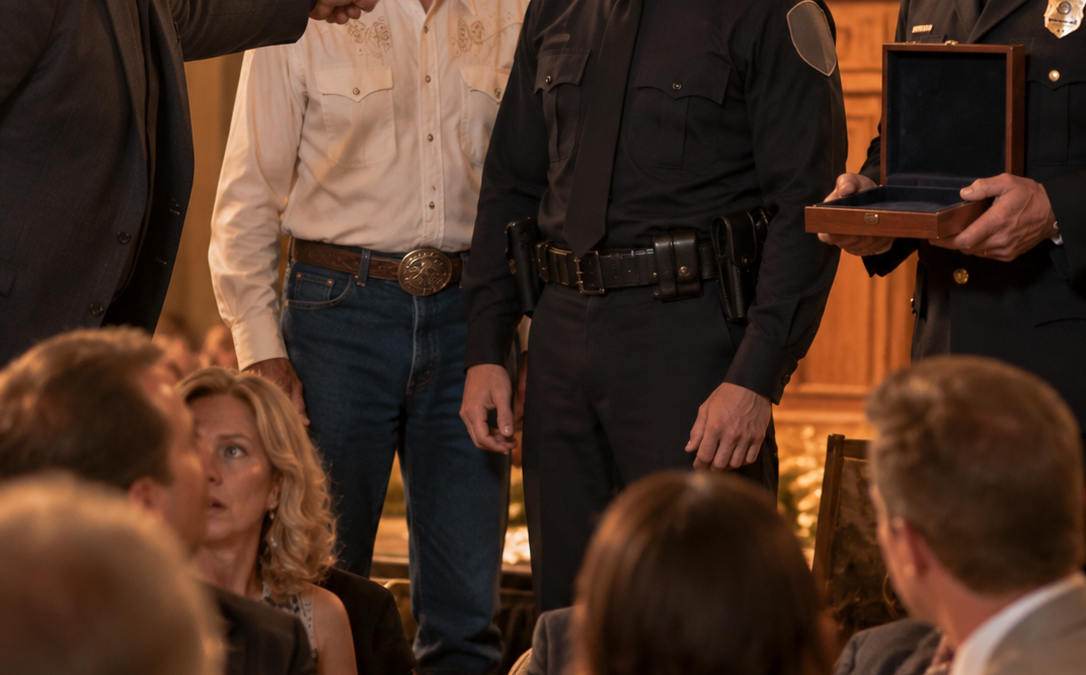
Chief Tolbert came from the side of the stage carrying a shadow box.
The light caught the glass.
I saw the badge before Cade did.
My eyes filled, and I bit back a sob.
Virgil leaned forward beside me.
The chief set the box on a small table near the lectern.
“Officer Tommy Briscoe wore badge 417,” he said.
Cade looked at the box.
Then he looked at the chief.
“Tommy died in the line of duty after being struck during a traffic stop.”
The room went still around us.
I felt the familiar hurt in my chest.
But this time I didn’t have to watch someone hurry past Tommy’s name.
The chief let it stay in the room.
“The department has held his badge,” he said. “By my order, it will now be worn by his son.”
Cade’s mouth opened slightly.
He looked toward our row.
I nodded.
He pressed his lips together, the same way I had.
The chief opened the shadow box.
“Pinned by Tommy’s father, Virgil Briscoe.”
Virgil stood.
Dusty’s arms came uncrossed.
For a second, I thought he might speak.
I watched his face, frightened that he could still take this from Cade.
But Dusty stayed in his chair.
Virgil walked to the aisle.
He climbed the steps without help.
I knew his knees troubled him.
He took his time, and nobody hurried him.
The chief placed the badge in his hand.
Cade lowered his eyes while Virgil fastened it.
My son’s chin trembled.
I had seen that same effort when he was small and determined not to cry.
Virgil checked the clasp, then pressed his palm briefly against Cade’s shoulder.
Cade stepped back.
He saluted.
I covered my mouth.
Around me, people began to clap.
Dusty sat frozen.
He had told Cade to sit down in front of strangers.
Now strangers stood while Cade wore his father’s badge.
I got to my feet.
I wanted my son to see me standing.
At the lobby reception, Cade was stopped by classmates before he reached us.
He kept glancing down at his chest.
That little movement hurt in the best way.
He was making sure it was real.
Virgil stood beside a cluster of chairs with his hands loose at his sides.
Butch approached him, then turned when Dusty came up behind us.
“Didn’t think you were coming,” Butch said to Virgil.
Dusty answered before Virgil could.
“Virgil said he’s too old for the drive. The academy only gave us four seats.”
My face grew hot.
He was still saying it.
With Virgil standing close enough to touch.
With the badge already pinned.
For years, I had tried to settle these things quietly.
Quiet had given Dusty room to repeat himself.
I opened my purse.
“No,” I said.
Dusty looked at the paper I unfolded.
“This is the seating form.”
Butch stopped moving.
I read the printed entries aloud.
Family Seats Allowed: 6
Family Seats Requested: 4
Then I read the names.
Dusty Cantrell
Butch Cantrell
Butch’s Wife
Lesley Briscoe
“The form came from your email,” I said to Dusty.
Butch leaned closer to see it.
His wife stood beside him without speaking.
Dusty reached toward the page.
I held it where Butch could keep reading.
“You requested four,” I said. “There was room for Virgil.”
Virgil took out his flip phone.
He opened the message and held the screen toward Butch.
I read Dusty’s words from it.
Four family seats, all full. My name, used as his excuse. Then the last line: Don’t make the drive.
“I never asked him to send that,” I said.
Virgil kept his arm steady.
I could see anger in his face now.
He had spent days believing I no longer wanted him there.
Dusty had made him carry that hurt alone.
Now the message was open where his brother could see it.
I watched my husband’s face.
What explanation could he give with his own words between us?
You may also like
My Son-in-Law Trashed My Retirement Lunch, So I Went For Ice And Found His Secret
At my 68th birthday in the church hall, my son-in-law informed 40 guests I had skipped paying the caterer. My grandson’s phone video showed him canceling my $1,200 order.
My husband left his son the $1.2M lake house and me his old feed store. At the funeral lunch, my stepson laughed, not knowing the lake road crosses my lot.
Dusty looked past the phone, toward Cade’s badge.
“I was protecting the boy from living in a dead man’s shadow.”
Chapter 7: The Green Receipt
The lobby voices thinned around us.
“Then why didn’t you give me the chief’s letter?” I said.
Dusty looked away from Cade’s badge.
“It was a parking pass. I tossed it.”
My stomach tightened.
He had used that answer while eating lunch in my kitchen.
Now he was using it beside the son he’d tried to cheat.
I didn’t need to argue with him.
I needed the person holding the file.
Ginger had come through the auditorium doors.
She stopped beside us with a department folder against her uniform.
“The letter concerned badge 417,” she said.
Dusty looked at the folder.
Ginger opened it and lifted a green card inside a clear sleeve.
“The certified-mail return receipt.”
She turned it toward him.
I could see the signature and date.
D. Cantrell, 10/21
My hands began shaking.
I had known what Ginger would show us.
Knowing wasn’t the same as seeing his handwriting on something he’d denied me.
There was proof that the envelope had reached our house.
Proof that it hadn’t simply disappeared between the mailbox and the kitchen.
Dusty barely glanced at it.
“Anybody could have signed that card. Half of Odessa is named Cantrell.”
My face burned.
He expected us to pretend his name meant nothing.
He expected me to doubt the paper while trusting him.
Ginger lowered her eyes to the receipt.
Then she read the house address beneath the signature.
Our number.
Our street.
The house where Dusty collected my mail while I slept.
Ginger held the card still.
“This was delivered to Lesley Briscoe at that address,” she said.
Dusty rubbed his jaw.
I watched him look toward Butch, as though his brother might offer another explanation.
Butch was still holding the seating form.
His wife stood close enough to see the names.
Neither spoke.
Across the lobby, someone laughed near the refreshments.
A camera flashed.
The celebration was continuing around us, but Dusty had stopped looking comfortable.
Ginger returned the receipt to the folder.
I thanked her.
She stayed nearby while Virgil lowered himself onto a chair.
He rested his flip phone on his knee.
I hated how tired he looked.
He had climbed those steps without help and kept his hand steady for Cade.
Now he had to sit through another lie about why he shouldn’t have been there.
Butch handed me the seating form.
“You told me the old man didn’t want to come, Dusty.”
He said it slowly.
Dusty opened his mouth.
Butch didn’t wait.
He lifted his chair and moved it beside Virgil.
The legs scraped across the lobby floor.
Then he sat.
I felt tears gathering again.
Butch hadn’t made a speech.
He had simply chosen where he would sit.
Virgil looked at him and gave a small nod.
Butch’s wife pulled another chair close.
Dusty stood facing a space where his brother had been.
I folded the form along its original crease.
My fingers had steadied enough to manage that.
Cade came toward us from the refreshments.
He looked at Ginger’s folder, then at me.
“You okay, Mom?”
I nodded.
This time, it wasn’t a lie meant to keep him from worrying.
I was hurt.
I was angry.
But I knew what I was going to do.
“Your grandfather’s been saving a seat beside him,” I said.
Cade looked toward Virgil.
The older man lifted a hand, and Cade went to him.
I watched my son bend so Virgil could speak without raising his voice.
They looked down at the badge together.
Dusty followed my gaze.
He took his truck keys from his pocket and dropped them onto an empty chair.
“Are we finished?”
I felt the familiar pressure to say yes.
To collect my purse.
To get through the drive home without another argument.
That was how he’d expected this to end.
I looked back at him.
“No.”
Dusty stood still.
I kept my voice low enough that Cade wouldn’t have to turn around.
“At the banquet, you said, ‘Real fathers only. His real father’s in a cemetery. Sit down, Cade.’”
Saying it hurt my throat.
I could still see Cade’s smile disappearing.
I could still feel his arm stiff beneath my hand.
But I wasn’t going to soften Dusty’s words for him.
“You told him that where people could hear,” I said.
Dusty looked toward the chairs.
Butch was watching us.
So was his wife.
I waited until Dusty faced me again.
“His grandfather drove forty miles, Dusty. You couldn’t even stand up.”
His jaw tightened.
I didn’t feel triumphant.
I felt tired of trying to make a decent family moment out of whatever Dusty allowed.
Cade had received his father’s badge.
Virgil had stood beside him.
I wanted those memories to stay whole when we left this building.
I put the folded form into my purse.
Dusty reached toward me, then stopped when I stepped aside.
“Let’s go home,” he said.
The words sounded ordinary.
That frightened me more than shouting would have.
He thought there would be supper.
A television playing.
My son sleeping somewhere else while we returned to our places.
I looked at the keys on the chair.
I didn’t know where Dusty would sleep that night.
He had a truck.
He had a business.
He could make those arrangements himself.
For once, his comfort wasn’t the problem I had to solve.
I looked at Butch.
Then at Ginger, still holding the department file.
Dusty followed my eyes.
You may also like
My late husband’s brother charged his wife’s 17 relatives $2,400 to spend Thanksgiving at the hunting cabin I inherited. I found the rental listing with my porch on it.
On Christmas Eve, my dad thanked my brother for paying his $31,400 knee surgery and gave him Grandpa’s watch in front of 22 relatives. His card was in my purse.
At Mom’s 75th birthday dinner, my brother told 22 relatives I let scammers take her $40,000. Then Mom called the number that texted her, and his jacket started ringing.
I faced him.
“I’m filing for divorce Monday.”
Chapter 8: The Deed On The Table
Dusty stared at me.
“You mean that?”
“Yes.”
Butch looked down.
Ginger held the department file against her uniform.
I didn’t follow Dusty toward the doors.
I stayed beside the chairs until Cade finished talking with Virgil.
Saturday morning, I opened the garage door.
Tommy’s flag case stood beside the roofing nails, facing the room where Dusty had left it.
I brushed dust from the top edge with my sleeve.
Then I carried it into the Odessa kitchen.
The glass felt cool against my forearm.
I had passed that garage door knowing the flag was behind it.
I hadn’t realized how much that knowledge hurt until I brought it back.
The pale outline still showed above the mantel.
I set the case inside it.
Then I stepped back.
Nothing about Tommy had changed.
I had finally changed what I was willing to leave alone.
A truck door slammed outside.
My stomach tightened.
Dusty walked through the kitchen door.
Butch came in behind him.
Dusty’s eyes went straight to the mantel.
“You put that back.”
“Yes.”
He looked at me.
Butch stayed near the door with his hands in his jacket pockets.
I had seen him move his chair beside Virgil in the lobby.
He had heard the lies.
He had seen Ginger’s green receipt.
Dusty pointed toward the flag case.
“You planning to erase me now?”
The question hurt more than I wanted it to.
Ten years of marriage couldn’t be erased by moving one object.
Neither could the things he had done.
“I put Tommy’s flag where it belongs,” I said.
Dusty gave a short laugh.
Then he looked around the kitchen.
“You think this house is just yours?”
My hands went cold.
He had called it his house while carrying Tommy’s flag into the garage.
Now he wanted me afraid of losing it.
“I’ll take half,” he said.
He said it loudly.
Butch looked at him.
I didn’t argue.
I walked to the table.
A folder lay beside my purse.
I opened it and took out the deed.
Then I placed my signed divorce petition beside it.
Dusty’s face changed.
“This is the deed,” I said.
He came closer.
I pointed to my name.
Lesley Briscoe
“I bought this house in 2013,” I said. “Before we married.”
Dusty looked at the page longer.
The house had cost $148,000.
I had bought it with Tommy’s line-of-duty benefit.
That money had come because Tommy hadn’t come home.
It had given Cade a bedroom and me a place to keep raising him.
Dusty wasn’t going to turn it into another thing he claimed by speaking first.
“Your name isn’t on it,” I said.
He looked at the other paper.
“And what’s that supposed to be?”
“My divorce petition.”
My voice stayed steady.
I had signed it.
Monday, I intended to file it.
Dusty rubbed his jaw.
“You think papers settle everything?”
“No. They show what I’m doing.”
My fingers trembled against the table.
I hated that my body still reacted to his anger.
Fear had habits.
So did silence.
Butch stepped farther into the kitchen.
“Get your bags, Dusty.”
Dusty turned.
“What?”
“You heard me.”
Butch’s voice was slow.
Fair.
The same voice he had used in the lobby before moving his chair beside Virgil.
Dusty stared at his brother.
“You taking her side now?”
Butch looked toward Tommy’s flag.
Then at the deed.
“I saw what happened yesterday.”
Dusty’s face hardened.
Butch didn’t add a speech.
He didn’t need one.
Dusty looked back at me.
I expected another threat.
Instead, he walked down the hallway.
A closet door opened.
Then a drawer.
I stayed in the kitchen.
I didn’t follow him.
I didn’t choose what he needed.
I didn’t carry anything.
Dusty packed his own bags.
He made several trips through the kitchen with clothes, boots, and work things in his arms.
Butch stood aside each time.
Nobody helped him.
Nobody stopped him.
When Dusty carried the last bag outside, he paused at the door.
“I’ll be in the trailer at the roofing yard.”
I nodded.
He waited.
I knew that pause.
He expected me to say he could stay.
That we could talk later.
That I had made my point.
I had already made my decision.
Dusty closed the door behind him.
Through the window, I watched him load his own truck.
Then he drove away toward the yard.
The house went quiet.
I could hear the refrigerator running.
I could see the flag case from where I stood.
Butch looked at the signed petition on the table.
“You okay?”
“Not yet.”
He nodded.
That answer was enough for him.
After he left, I called Cade.
“Your room’s here whenever you want it.”
He was quiet for a moment.
“Okay, Mom.”
I didn’t ask him to come immediately.
He deserved to believe it would stay true after the phone call ended.
By Tuesday, the consequences had reached Dusty’s business.
Ginger called while I was awake before work.
“The officers’ association removed Cantrell Roofing from its member-discount list,” she said.
She explained that families from the banquet had complained.
People who had heard Dusty.
People who had watched Cade sit down.
I rested my elbow on the kitchen counter.
I had spent that night feeling exposed while strangers looked away.
Some of them had been listening.
“The association made its decision,” Ginger said.
“I understand.”
I hadn’t asked anyone to cancel a roof.
I hadn’t needed to.
Dusty had put his company logo above his claim of pride.
The people reading it knew what he had said to my son.
Later, Dusty sent photographs of cancellation notices to my phone.
Booked roofs.
Customers withdrawing.
At the end, he sent the total.
$38,400
Then another message.
Hope you’re happy.
I felt a familiar pull in my stomach.
His anger still made my body prepare to explain itself.
But I looked toward the mantel.
He had carried that flag away.
He had signed for the letter.
He had sent Virgil the message.
I put the phone down without answering.
That evening, I wondered what Butch would do.
He had moved his chair beside Virgil in the lobby.
He had told Dusty to pack his own bags.
That had mattered.
But Dusty was his brother.
There would be phone calls I didn’t hear and pressure I couldn’t see.
I wanted Butch to stay fair when nobody was watching.
I didn’t know whether he would.
My phone rang beside the folder holding the deed.
You may also like
At my 71st birthday lunch, my son-in-law told 18 relatives I’d signed a power of attorney online to sell my $640,000 lake house. That Tuesday I was in surgery.
At my granddaughter’s wedding, my daughter-in-law told 120 guests the $8,000 dress came from a Philadelphia boutique. I’d sewn every stitch of it myself.
At my 70th birthday, my son told 40 guests I’d outlived my usefulness. That morning a realtor had emailed me photos of my own house, listed for $289,000.
Butch’s name filled the screen.
“I’m coming to Virgil’s for Thanksgiving. If you’ll have me.”
Chapter 9: The Scratch On The Four
The phone felt warm against my ear.
“There’s room,” I said.
Butch was quiet for a moment.
“We’ll bring a pie.”
“Virgil likes pecan.”
“I know.”
After we hung up, I stood beside the kitchen counter.
I had been prepared for Butch to explain why he couldn’t come.
Instead, he had asked whether we would have him.
I called Virgil to tell him.
“Better find another chair,” he said.
I could hear him moving something across his kitchen.
He was already making room.
By the holiday, his table stood farther into the kitchen.
The extra chairs stood close together, with folded napkins beside the plates.
I carried a bowl of potatoes through the kitchen.
Cade followed with a bag of rolls tucked under his arm.
“Where do you want these, Granddad?”
“Where I can reach them.”
Cade grinned.
It was an easy grin.
I hadn’t realized how carefully I’d been watching for one until it appeared.
Butch and his wife arrived carrying a pecan pie between them.
Butch held the bottom of the carrier while his wife lifted the lid.
“Made it this morning,” Butch’s wife said.
Virgil cleared a space beside the stove.
“Coffee’s ready.”
Nobody asked where Dusty was.
I felt relieved, then guilty about feeling relieved.
I had spent years checking his mood before deciding whether a gathering could stay pleasant.
Now I could put down a bowl without listening for his next remark.
Cade took our coats to the bedroom.
Butch washed his hands at the sink.
His phone buzzed on the counter.
Dusty’s name appeared on the screen.
Butch dried his hands, picked it up, and looked at the message.
I kept my eyes on the potatoes.
I didn’t want to watch him choose.
“He’s eating alone at the yard,” Butch said.
My stomach tightened.
I pictured the trailer and the bags he had packed himself.
For a second, I felt responsible for the empty chair across from him.
Then Cade came back into the kitchen.
He asked Virgil whether the turkey needed carrying.
Butch set his phone facedown.
He didn’t type an answer.
“Let me get that,” he said to Cade.
They lifted the platter together.
I took my place at the table.
Dusty’s loneliness hurt to think about.
It still wasn’t a reason to put Cade back beside him.
We ate while Virgil told Butch about a gate hinge that kept catching.
Butch asked what kind of hinge.
Cade reached for another roll.
The conversation was so ordinary that my eyes stung.
Nobody had to defend a job.
Nobody had to laugh at something cruel to keep supper moving.
When the plates were nearly empty, Virgil pushed back his chair.
“Got something for the boy.”
Cade looked up.
“Pie?”
“Better than pie.”
“That depends on the pie.”
Virgil gave him a look and went down the hallway.
I started gathering plates.
Butch’s wife took them from me and carried them to the sink.
“You sit,” Butch’s wife said.
I sat.
Virgil returned holding an envelope with worn corners.
He slid a photograph out and placed it in front of Cade.
His finger rested against the edge.
“That’s your dad.”
Tommy stood in uniform beside a younger Virgil.
Tommy’s face was turned slightly toward his father.
He looked proud and a little impatient, as though he wanted to see what had just been fastened to his shirt.
Virgil was pinning on his badge.
Cade leaned closer.
“You pinned Dad’s?”
“Yes.”
“When was this?”
Virgil turned the photograph over.
A year was written on the back.
1998
“His graduation,” Virgil said.
I reached for the picture when Cade offered it.
Tommy was younger there than the man I carried in my head.
Before the tired mornings.
Before Cade.
Before a uniform folded into a box because I couldn’t bear to leave it hanging.
My hands trembled against the photograph.
I missed him.
I wanted him at that table so badly that I couldn’t speak.
Virgil tapped the image.
“Look at the number.”
Cade took the photograph back.
Then he went to his coat and returned with his badge wrapped in a soft cloth.
He opened it carefully.
Nobody reached for the pie.
Cade held the photograph beside the metal badge.
He tipped it toward the kitchen light.
“Right there,” he said.
A small scratch crossed the four.
He moved the picture closer.
The same mark showed beneath Virgil’s fingers in the photograph.
“It was already there,” Cade said.
Virgil nodded.
My son looked from the badge to the picture.
His grandfather had fastened that marked piece of metal onto Tommy’s uniform.
Then he had fastened it onto Cade’s.
I had watched the ceremony believing I understood what Virgil was giving him.
I hadn’t known how much history those hands remembered.
Butch leaned forward.
“Same scratch,” he said.
Cade smiled without looking up.
“Yes, sir.”
Virgil settled back in his chair.
I reached across the table and covered his hand with mine.
His fingers curled around mine briefly.
I had no words ready.
For once, I didn’t need them.
Butch’s wife brought small plates for the pie.
Cade kept the photograph beside him while Virgil cut the first piece.
I watched my son trace the edge of the picture.
I wondered what he wanted to do with the badge before work and ordinary days began.
He folded the cloth around it, leaving the number visible.
Then he looked at Virgil.
“Granddad, on Peace Officers Memorial Day in May, will you come to Dad’s grave with me?”
Virgil’s hand stopped beside the pie server.
You may also like
On Thanksgiving, my daughter threw wine in my face in front of 14 guests. The $38,000 piano she brags about is still in my name.
At my grandson’s 18th birthday dinner, my son told 22 relatives the $41,000 college fund I built would go to his stepson instead. He forgot whose name is on it.
At his brother’s food truck opening, my husband thanked our $60,000 home loan in front of 40 people. I never signed it because I was in surgery that day.
Cade touched the badge through the cloth.
“I want you to pin it on me again.”
Chapter 10: The Same Badge Again
The cemetery grass bent beneath a steady west Texas wind.
Cade stood beside Tommy’s headstone in his dress uniform.
A sergeant stepped forward with a clipboard.
It was Saturday, May 15, 2027.
Peace Officers Memorial Day.
Six months had passed since graduation.
I stood beside Virgil while other officers gathered with their families.
Some held flowers.
Some carried framed photographs.
Cade kept his hands at his sides.
Badge 417 was not on his uniform yet.
Virgil had it wrapped in the same soft cloth Cade used at Thanksgiving.
The sergeant looked down the line.
“When I call your officer’s name, I’d like each pinner to stand.”
My stomach tightened.
I had heard words like those in the college ballroom.
I could see Cade beside table 14 again.
Turning toward Dusty.
Waiting.
Then sitting down after Dusty refused to stand.
I pressed my fingers against my purse.
Cade looked at Virgil.
The sergeant called his name.
“Officer Cade Briscoe.”
Virgil rose.
Unaided.
No hesitation.
No hand reaching for him.
He stood beside his grandson with the wrapped badge in his palm.
My eyes filled.
Cade’s mouth tightened.
Virgil opened the cloth.
Badge 417 caught the morning light.
He reached into his jacket pocket and pulled out a white handkerchief.
“Hold still,” he said.
“Yes, sir.”
Virgil rubbed the badge slowly.
Across the face.
Around the number.
Then along the edge.
His fingers weren’t as quick as they had been in the photograph from 1998.
Cade waited.
Nobody hurried either of them.
I watched Virgil’s thumb pass over the small scratch on the four.
He had touched that same mark when Tommy was young.
Now his grandson stood in front of him.
Virgil folded the handkerchief into his palm.
Then he pinned badge 417 onto Cade’s uniform.
He checked the clasp.
Cade looked down.
“Straight?”
Virgil adjusted it with one finger.
“Now it is.”
Cade smiled.
That smile hurt my chest.
It was the same son who had tried to joke after being humiliated.
The same boy who had packed a duffel because home no longer felt peaceful.
Now he stood beside his father’s grave with his grandfather’s hands still near his collar.
The sergeant moved to the next family.
Virgil lowered himself onto a folding chair.
Cade remained beside Tommy’s stone.
I stepped closer.
The granite was cool beneath my palm.
Tommy’s name was carved above the dates.
I traced the edge of one letter with my thumb.
Cade stood on my right.
Virgil sat behind us with the handkerchief folded across one knee.
I looked down.
“June 17, 2011,” I said.
My voice shook.
“Friday.”
Cade reached up and straightened the badge.
The metal flashed once between his fingers.
I remembered the memorial slideshow.
Tommy’s photograph filling the ballroom screen.
Chief Tolbert looking toward our table.
Dusty looking at his plate.
Back then, I hadn’t known why the chief kept staring at us.
I hadn’t known there was a certified letter.
I hadn’t known Dusty had signed for it.
So many things had been happening around me while I worked nights and trusted him to handle the mail.
I rested my hand flat on the headstone.
“I still miss you,” I said.
Cade lowered his eyes.
Virgil looked toward the grave.
Nobody answered for Tommy.
Nobody needed to.
The wind moved Cade’s uniform sleeve.
He touched the badge once more.
“I wish Dad could’ve seen this.”
“I know.”
Cade looked at the number.
“Granddad did.”
Behind us, Virgil cleared his throat.
Cade turned.
“You okay?”
“I’m sitting down, ain’t I?”
Cade smiled.
“Yes, sir.”
The ceremony continued farther along the row.
A woman placed flowers beneath another marker.
Someone’s little boy chased a paper program before his mother caught it.
Virgil unscrewed the top of his thermos.
Coffee steam rose briefly before the wind took it.
“You want some?” he said.
“After,” Cade said.
I kept my hand on Tommy’s stone.
Six months earlier, I had worried whether Virgil would even have a chair.
Now he had one beside his grandson.
I opened my purse to find a tissue.
My wallet shifted against my hand.
A small piece of paper stuck from one of the inside pockets.
I pulled it halfway out.
Seat 5.
Row C.
I had never thrown the ticket away.
The edges had softened from living in my wallet.
I touched the printed number with my thumb.
Virgil had sat there in his good shirt while Dusty asked who invited the welder.
Then he had walked to the stage.
No help.
The same way he had stood here.
I slid the ticket back into its pocket.
Cade stepped closer to the headstone.
His hand rested beside mine.
He didn’t say anything.
Neither did I.
The sergeant finished the last name and thanked the families.
Folding chairs scraped against the grass.
People began walking toward their cars.
Virgil capped the thermos and started to stand.
Cade reached for it before he could bend.
“I’ve got it, Granddad.”
Virgil handed it over.
Cade carried the thermos in one hand.
With the other, he checked badge 417.
You may also like
Eleven days after I gave birth, my husband’s sister moved into my nursery and told 9 relatives she’d raise the baby. My doorbell camera heard what she said at my door.
At their housewarming, my son-in-law told 35 guests they bought the house with zero help and I came for the free food. I hold their mortgage.
My ex-husband’s new wife sat in the mother-of-the-bride seat and told 120 guests she paid for the wedding. Every one of the 14 vendor receipts has my name.
The scratch across the four caught the sun.
My wallet pressed against my purse, seat 5 still tucked inside.
THE END
More stories
At her school board fundraiser, my daughter-in-law poured red wine on my cream dress before 300 guests. Her filing listed my house as hers.My son-in-law dumped my lunch in the trash at my retirement party and told 14 guests he pays my mortgage. My bank statement said otherwise.At my 68th birthday in the church hall, my son-in-law informed 40 guests I had skipped paying the caterer. My grandson’s phone video showed him canceling my $1,200 order.My husband left his son the $1.2M lake house and me his old feed store. At the funeral lunch, my stepson laughed, not knowing the lake road crosses my lot.At Mom’s 75th birthday dinner, my brother told 22 relatives I let scammers take her $40,000. Then Mom called the number that texted her. His jacket started ringing.At my 71st birthday lunch, my son-in-law told 18 relatives I’d signed a power of attorney online to sell my $640,000 lake house. That Tuesday I was in surgery.
You Might Also Enjoy




