My Husband Locked Me Outside Pregnant And Demanded My Signature — Then His Father Appeared
Chapter 1: Outside During Thanksgiving
My husband locked the front door and said, “Sign first.”
I was 32 weeks pregnant, standing outside my own house.
Derek stood directly behind the glass, watching my face.
I reached for the handle before understanding what he meant.
It turned, but the door stayed against its frame.
Inside, the potatoes steamed in my blue ceramic serving bowl.
I had carried them out before he sent me outside.
The serving spoon still leaned against the bowl’s rim.
My empty place was beside a folded dinner napkin.
There were twelve Thanksgiving guests inside, including his mother.
Several had started eating while I finished carrying food.
Nobody had needed the porch chair Derek wanted brought inside.
It stood against the wall beside the front window.
I had turned it toward the doorway without lifting it.
Then he shoved the door shut behind my back.
“Open the door, Derek, because I’m still out here.”
He looked straight at me without reaching for the lock.
“Sign first.”
He meant the paperwork he had left on our counter.
He meant the house I called my inheritance.
He meant putting it into our joint names.
I pressed my palm against the cold door handle.
“I’m not signing anything because you locked me outside.”
Derek glanced toward the table behind him.
A relative had risen halfway out of a chair.
“We’re having a private conversation, so finish your dinner.”
He said it over his shoulder without moving aside.
The relative stayed standing, holding the back of the chair.
I could see a fork resting across an untouched plate.
Another guest looked toward the kitchen, then toward me.
Nobody seemed sure whether he would immediately unlock it.
I expected that, too, during those first moments.
I thought he wanted me frightened enough to agree.
Then he would open the door and call it settled.
I waited for his hand to move.
Instead, he spread his feet and watched me.
The hallway behind him was bright and warm.
I could see the sleeve of my sweater reflected faintly.
I had not put on a coat to fetch furniture.
My shoes had pressed against my ankles since breakfast.
I shifted my weight, trying to ease the pressure.
“Derek, I need to come back inside.”
“You know what I need.”
“That isn’t what I asked.”
He looked toward the table again, checking who was listening.
He had been asking for eight months by then.
At first, he had called joint ownership sensible.
Lately, he had called my refusal an obstacle.
His equipment-repair business needed a place to start.
According to him, our marriage needed my signature first.
I leaned my upper body against the porch wall.
The siding felt cold through the back of my sweater.
I wiped beneath my eye with the heel of my hand.
Through the window, Joyce kept eating.
She had the seat nearest the glass.
I had noticed that when arranging places before dinner.
It meant she could see me without turning far.
She looked toward the porch while chewing her food.
Then her eyes went down to her plate.
“Joyce, would you please tell him to let me inside?”
Her fork stopped above the potatoes.
I watched her face, waiting for her answer.
She set the fork down and pushed back her chair.
For a moment, I thought she was coming.
I stepped closer to the window so she could see me.
Instead, she picked up another plate.
She carried it past the glass without opening the door.
I followed the plate with my eyes until she disappeared.
I had fed that woman when she could not feed herself.
Now she carried food past me while I stood outside.
I put my palm beneath my belly and turned away.
A guest said something I could not make out.
Derek answered without taking his eyes off me.
Then someone spoke loudly enough for the porch.
“Derek, she needs to come inside.”
He took a broad step sideways, blocking the doorway.
“You know how to settle this.”
He was 34, and I was 31.
We were married, expecting our child, hosting Thanksgiving.
He had chosen this moment because everyone was here.
The unsigned deed was inside with my phone.
I could not reach either of them from the porch.
My phone sat beside the kitchen outlet, charging.
I pictured its cord curled beside the counter.
That morning, I had used it to save something important.
Now I could only look through the glass.
“Please stop doing this while everyone is watching us.”
“You’re the one making this harder than it needs to be.”
Behind him, a guest lifted a phone from the table.
I saw the guest move away from the dining room.
I did not know who was being called.
I hoped someone would tell him to turn the lock.
Derek watched me look past his shoulder.
“Leave everybody else out of this.”
“You brought everybody else into it.”
His mouth tightened, but he did not move.
I slid the porch chair back against the wall.
Then I lowered myself onto it carefully.
The front edge pressed beneath my belly.
I adjusted my sweater and planted my feet apart.
I had wanted to sit beside my dinner.
Instead, I sat where he could watch through glass.
The blue bowl moved along the table behind him.
Someone passed it without looking toward the window.
I watched the spoon disappear into the potatoes.
My own plate remained where I had left it.
There was still no reason for that porch chair inside.
I stopped asking Joyce for help.
I stopped pulling at a handle that would not open.
I watched the driveway instead, breathing through my mouth.
The guest with the phone returned to the dining room.
Derek turned briefly when the guest spoke to him.
I could not hear the answer through the closed door.
Then his face turned back toward me.
I had been outside approximately ten minutes when I saw movement.
Calvin was coming toward the front steps.
He carried a letter-size document flat in his hands.
I stood and steadied myself against the chair.
Derek had not noticed him yet.
His father was already walking up the steps.
Chapter 2: What I Had Asked Him to Bring
I had asked Calvin for that document that morning.
Not for a confrontation, and not for an audience.
I wanted somebody to explain what Derek wanted signed.
My aunt Lydia died on February 18, 2025.
She was 72, and Calvin had been her longtime friend.
He was also the retired bookkeeper who handled her trust.
I knew there were documents concerning the Dayton house.
I did not yet understand how their provisions worked together.
After her death, I kept her papers in their envelope.
I had been careful with them without being properly informed.
When Calvin discussed the house, I listened for practical things.
Could we live there, and who handled necessary paperwork?
He told me I could make it my home.
I understood that much, and I needed that much.
Derek and I moved in on March 1, 2025.
I unpacked dishes while he looked through the garage.
He talked about shelving, paint, and space for equipment.
At the kitchen table, he spread his hands across the surface.
“We can actually plan something here.”
I thought he meant living there together.
I put my blue ceramic serving bowl into a cupboard.
Lydia had left a house where I could raise my child.
I wanted to make supper in its kitchen.
On March 27, 2025, Derek began asking about joint ownership.
He brought it up beside the same kitchen table.
“We should put both names on it.”
“I need the inheritance documents explained before we do anything.”
“You already know you inherited it.”
“That doesn’t mean I know what I can sign.”
He treated that answer as a delay, not an answer.
The house’s current appraised value was $286,000.
Once he learned that figure, his questions became more specific.
He wanted joint names before seeking a business loan.
His proposed equipment-repair business would need equipment and supplies.
He wanted to keep his earnings available for it.
I worked as a dental-office scheduler and paid ordinary household expenses.
Over eight months, those expenses totaled $8,400.
Groceries came from my wages, along with the regular bills.
I kept the records because our arrangement required watching expenses.
None of those payments bought ownership in the house.
They were what it cost us to live there.
When I asked about sharing them differently, Derek mentioned the business.
“If we drain what I’m saving, we can’t get started.”
I paid the bills and kept asking for proper advice.
He kept returning to the deed.
By September, his mother had heard him discuss it.
She never asked what the documents actually allowed.
On September 14, 2025, I went to help her.
Joyce was recovering from wrist surgery and needed lunch.
Derek dropped me off, then went back home.
Her wrist rested on a cushion beside her chair.
I put cooked chicken on a board in her kitchen.
I pulled it apart until the pieces were small.
Then I stirred it into the broth warming nearby.
Joyce watched me carry the bowl toward her.
“I don’t want to spill that on myself.”
“I’ll hold it until you’re comfortable.”
I moved her chair and put a towel across her lap.
I cooled the soup before offering the spoon.
“Let me cool this before you try another spoonful.”
She leaned forward, and I held it steady.
I asked what Derek had been making her to eat.
“He likes sandwiches better than anything you have to cook.”
“I meant what you wanted while your wrist gets better.”
“Oh, this is nice, and the chicken is soft.”
I stayed until she finished, then cleaned the kitchen.
Later, I warmed more soup and fed her again.
She asked me to move the cushion under her wrist.
I did that before washing the bowl.
The afternoon was gone by the time I left.
I remembered her accepting the spoon without embarrassment.
It made her plate passing the window harder to watch.
On Thanksgiving morning, Derek left a proposed deed on the counter.
The page assumed I held title in my individual name.
I did not know enough then to identify that error.
I only knew he wanted me signing without advice.
There was no signature, no notarization, and no completed transfer.
I photographed the unsigned document before moving anything.
Then I messaged Calvin about Derek’s demand.
I asked him to bring a copy of the trust.
His answer came while I was preparing dinner.
He had an existing dinner commitment, but would come afterward.
I saved that message and set my phone to charge.
Later, Derek approached while I scraped potatoes into my bowl.
“We can finish that paperwork after everybody eats their dinner.”
“I’ve already told you I need advice before signing.”
A relative came through asking where I kept the napkins.
Derek waited until the relative had gone.
“Today, Rachel, because I’m tired of waiting on this.”
I carried the potatoes out rather than answer again.
Then he told me to fetch the porch chair.
Now Calvin stood at the bottom of those steps.
He was 63, carrying exactly what I had requested.
A guest had reached him before he arrived.
He already knew I had been locked outside.
“Rachel, are you locked out here while they’re having dinner?”
“Yes, and he won’t open it unless I agree.”
He looked through the glass at his son.
“Open the door, Derek, and let her come inside.”
Derek stayed in place with the same small smile.
“She fed your mother when she couldn’t feed herself, Derek.”
Joyce stopped beside the table, still holding the other plate.
“Now she belongs inside eating, not standing on this porch.”
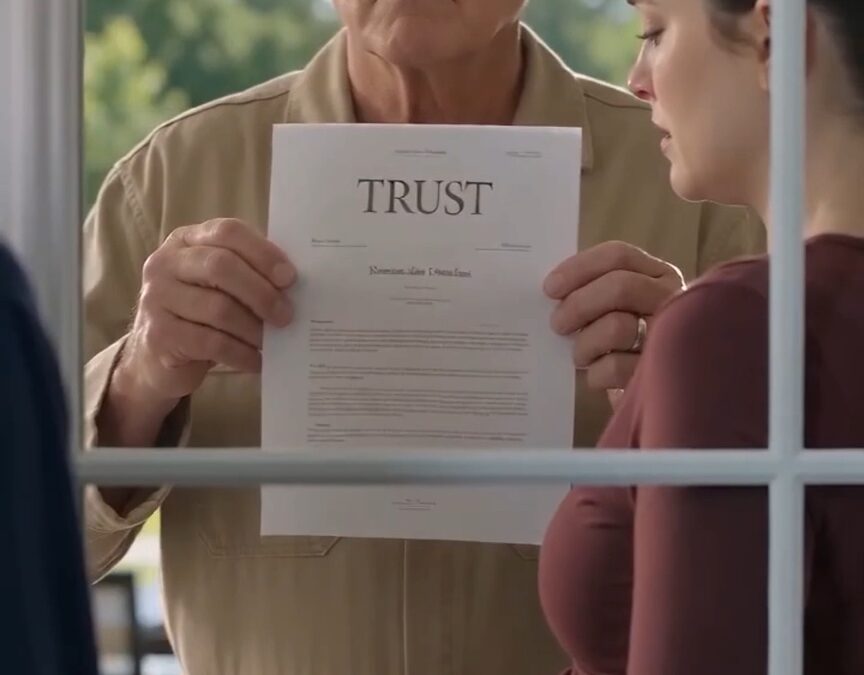
Calvin stepped beside me and unfolded the document fully.
He held it flat with both hands, facing the glass.
The plain cover read only “TRUST.”
Derek looked from the document to his father.
His smile disappeared, and he stepped back from the door.
Chapter 3: The Provision He Had Never Read
Derek stepped back, but he did not unlock the door.
Calvin kept the document raised until his son looked up.
Then he lowered it enough to turn the cover.
“What did she tell you?” Derek asked.
“She told me you wanted her signature.”
“That’s between my wife and me.”
“I’m the acting trustee of the property you’re discussing.”
A guest came closer behind Derek, stopping in the hallway.
Calvin waited until Derek looked at the document again.
The cover had been all he could read before.
Now Calvin turned to an interior page.
He held the copy close enough for Derek to examine.
“This is the provision you need to read.”
Derek leaned toward the glass without touching the lock.
His eyes traveled across the page Calvin held steady.
I could see his face, but not the words.
“Read it to me,” I told Calvin.
He angled the document so I could follow him.
He explained the language without skipping what mattered.
Lydia had established and funded the irrevocable trust on June 12, 2020.
The deed had been recorded in Calvin’s name as trustee.
The house was mortgage-free when placed into that trust.
It had not passed into my individual name afterward.
Lydia’s death had not changed that arrangement.
I had inherited benefits, not unrestricted personal title.
“You have lifetime occupancy,” Calvin told me.
“You can live here under the trust.”
Derek touched the glass near the page.
“That doesn’t mean we can’t change the names.”
Calvin moved his finger to the next provision.
“Her beneficial interest cannot be assigned.”
I looked at the words he indicated.
I had wanted someone to explain them at my table.
Instead, I was reading them on my front porch.
Calvin continued before Derek could answer.
“The house cannot be conveyed or pledged to her spouse.”
Derek’s eyes moved back across the same lines.
He had never read the trust before that evening.
He knew his father had handled Lydia’s affairs.
He had not known what those affairs included.
“So she can live here, but can’t own it?”
“She has the rights the trust gives her.”
Calvin kept his voice at the same level.
“She cannot transfer title she does not hold.”
Derek glanced toward the dining room.
The relative in the hallway had not gone away.
Behind that relative, another guest stood beside a chair.
The conversation was no longer something he could call private.
“Rachel inherited the place,” he said.
“I call it my inherited house,” I answered.
“That doesn’t make me the person who signs deeds.”
Calvin showed me the page concerning trustee authority.
Only he could execute conveyances permitted under the trust.
That authority did not let him ignore its restrictions.
He could not simply give Derek the house himself.
He could not pledge it for Derek’s proposed business.
He said each part plainly, then let us read.
I pulled my sweater down over my belly.
Derek looked past the document at me.
“You asked him to bring this here?”
“I asked for advice before signing.”
“You could have told me he was coming.”
“You could have opened the door.”
His jaw moved before he answered.
“I didn’t know what this paperwork said.”
“That is why I asked for it.”
Calvin turned back to the trust’s identifying pages.
He pointed out the date and his trustee designation.
Then he showed the property information tied to the recorded deed.
These were not instructions Lydia had scribbled informally.
They were provisions governing property already held in trust.
Derek studied them without speaking.
I had watched him argue over invoices and business plans.
When a number did not work, he looked for another route.
I saw that same calculation in his face.
He stopped claiming I could sign the proposed deed.
Instead, he looked at his father.
“What about a different document?”
Calvin did not answer immediately.
Derek pointed toward the hallway behind him.
“The deed on the counter might not be right.”
“It assumes Rachel holds title individually,” Calvin said.
“She doesn’t.”
“Then I’m asking about something that does work.”
I watched a guest lower an untouched glass to the table.
Nobody returned to eating.
Derek continued, choosing his words more carefully.
“If the trustee handles the conveyance, there’s another way.”
“Not to her spouse,” Calvin answered.
“That restriction is here.”
He indicated the provision again, without raising his voice.
Derek looked where his father pointed.
His proposed shortcut had met the same written restriction.
He changed the question rather than repeat it.
“Could the trust be part of a financing arrangement?”
Calvin kept the page in place.
“Not one pledging this house to support your interest.”
“I’m talking about a business, not giving me a gift.”
“The house still cannot be pledged that way.”
I looked through the glass toward my kitchen.
The unsigned deed lay somewhere beyond the hallway.
Nothing about its appearance could overcome those pages.
My signature would not make me the legal owner.
It would not give Derek authority over the trustee.
I had been afraid to refuse something I barely understood.
Now the actual document was being read aloud.
Derek pressed his lips together and looked toward Joyce.
She still stood beside the table with the plate.
She did not offer another explanation for him.
Calvin closed the interior pages against the cover.
“That answers the property question,” he said.
“It does not excuse keeping her outside.”
Derek’s hand finally moved toward the lock, then stopped.
“If that deed doesn’t work, what can she sign instead?”
Chapter 4: Getting Back Inside
“Nothing under these conditions,” Calvin told him.
Derek kept his hand beside the lock.
“I’m asking about an agreement between married people.”
“Then you can ask through proper advice.”
Calvin tucked the document beneath his arm.
“Right now, open the door.”
Derek looked at me rather than his father.
“Are you coming in to talk, or make a scene?”
“I’m coming in to get my phone.”
The lock turned before he answered.
He pulled the door inward and stepped aside.
I crossed the threshold without touching his arm.
The warm air made my cheeks feel prickly.
I stood on the entry rug and adjusted my shoes.
Nobody applauded or rushed toward me.
A guest moved a chair out of the hallway.
Someone asked whether I wanted to sit.
“I need my phone,” I said.
Calvin came inside behind me and closed the door.
He did not take Derek’s keys or order him out.
He set the trust copy on a clear surface.
Derek watched him do it.
“You don’t get to decide who lives here.”
“I’m not issuing an eviction,” Calvin answered.
“I’m telling you what the trust allows.”
“That’s what this is turning into.”
“No. You locked her outside.”
Derek glanced toward the guests, then lowered his voice.
“She wasn’t going to be left out there.”
I turned from the kitchen doorway.
“You wouldn’t let me in unless I agreed.”
He looked away from me.
A guest near the table nodded without saying anything.
I walked to the kitchen outlet.
My phone was still charging where I had left it.
I unplugged the cord and checked the screen.
The photograph of the proposed deed remained saved.
So did my messages to Calvin from that morning.
I put the phone into my sweater pocket.
Then I looked for the actual paper.
The unsigned deed was still on the counter.
Its signature area was blank.
No notary had been present, and nobody had delivered anything.
Derek had brought a proposed paper and demanded my cooperation.
He had not acquired a piece of the house.
I left the page where it was.
The photograph was already in my phone.
Joyce came into the doorway carrying the plate.
“You should eat something before you get upset again.”
I looked at the food, then at her.
“I asked you to help me come inside.”
“I didn’t know what you wanted me to do.”
“I said it through the window.”
She shifted the plate into her other hand.
“Derek was handling it.”
“He was keeping me out.”
She glanced past me toward her son.
I did not take the plate.
I opened the cupboard and got a glass of water.
My mouth had become dry while I was outside.
I drank standing beside the sink.
The blue bowl sat on the dining table beyond Joyce.
There were potatoes around its inner edge.
I had bought groceries, cooked, and set places there.
I did not want another argument over my own dinner.
Calvin asked whether I wanted to leave with him.
He asked quietly, where I could answer without performing.
I nodded and set the empty glass beside the sink.
“I’m leaving with Calvin tonight.”
Derek came to the kitchen entrance.
“You can stay here. I opened the door.”
“I know.”
“Then why are you leaving?”
“I’m choosing somewhere else for tonight.”
He looked toward his father.
“This isn’t your decision.”
Calvin held his hands away from his sides.
“She just told you her decision.”
I went to get my coat and what I needed.
Derek followed as far as the hallway.
He did not grab me or block the doorway again.
I kept my phone in my pocket while gathering my things.
The guests had begun moving plates away from the table.
The scrape of dishes sounded unusually loud.
I did not apologize for leaving them with dinner.
As I came back, a relative approached me.
“I saw what happened through the window.”
I stopped with my coat folded over my arm.
“I heard what he said, too.”
Derek stood near enough to hear that.
“It was a disagreement,” he said.
The relative looked at him, then back at me.
“If you need it written down, I’ll do that.”
I had not thought as far as written accounts.
I had only wanted to get inside.
Calvin did not answer for me.
“Yes,” I told the relative.
“Please write what you saw and heard.”
The guest agreed without asking what conclusion to reach.
I wanted the account to stay that way.
Not a family argument retold to favor somebody.
Just the door, the demand, and where I stood.
Derek rubbed a hand across his mouth.
“So now we’re collecting statements?”
“I’m keeping what happened,” I said.
He looked toward the trust copy on the nearby surface.
Calvin picked it up before we left.
I put on my coat and fastened it carefully.
The porch chair remained against the wall outside.
I passed it without trying to bring it in.
In Calvin’s car, I pulled out my phone.
I checked the photograph again, enlarging the proposed deed.
The document looked ordinary on the screen.
Its assumptions were not ordinary to me anymore.
Calvin waited before starting the car.
“Do you want to talk about what happens next?”
“I want somebody who represents me.”
He nodded and waited while I saved the messages again.
I did not need another family vote about the house.
I needed advice about being married to Derek.
By the time we left the driveway, I had decided.
“I’m contacting a divorce lawyer.”
Chapter 5: My Own Appointment
On December 1, 2025, I sat across from counsel.
I had brought the documents instead of describing them loosely.
My phone held the photograph of Derek’s unsigned proposed deed.
I had the trust copy Calvin brought on Thanksgiving.
I had our messages about his demand and promised arrival.
The guest’s voluntary written account was with those papers.
I laid everything on the desk without arranging an argument.
“I want to know how I can live at home.”
Counsel asked me to begin with the lockout.
I explained the porch chair, the locked door, and his demand.
I said my phone had remained inside.
I described Joyce eating and carrying another plate past me.
Then I stopped talking long enough to drink some water.
“Were you physically injured?”
“No.”
“Did he let you enter?”
“After Calvin intervened.”
“Who decided you would leave afterward?”
“I did. I left with Calvin.”
Counsel wrote those distinctions down.
I was glad nobody asked me to make them larger.
What had happened was enough to explain.
The guest’s account described what the guest actually witnessed.
It did not claim knowledge of every conversation in our marriage.
The photograph showed a proposed deed without my signature.
My morning messages showed I had requested advice before dinner.
Together, those records put the evening in order.
Counsel asked why Derek wanted joint ownership.
“He wants to apply for a business loan.”
“Has he told you a loan was approved?”
“No.”
“Has anyone told you a lien exists?”
“No.”
Counsel marked that issue for further investigation.
We did not turn an unanswered question into a fact.
Then we went through the trust.
I explained that Calvin was Derek’s father and acting trustee.
I also explained his longtime friendship with Lydia.
Counsel read the occupancy and transfer provisions carefully.
The recorded ownership would need to match the trust information.
I had called it my inherited home for months.
Counsel understood what I meant without using that as legal title.
“Your occupancy rights and your divorce are related issues.”
I leaned forward and moved the water aside.
“But Calvin can’t just make Derek leave?”
“Not by declaring it at Thanksgiving.”
The answer was plain and useful.
The trust protected against the transfer Derek wanted.
It did not replace the court process in my marriage.
I could ask the court for temporary exclusive occupancy.
Derek would receive notice and have an opportunity to contest it.
A judge would decide after considering the request and evidence.
Until then, I could not treat a hoped-for order as issued.
I looked down at the phone beside my papers.
“I don’t want to go back and find the door locked.”
“That concern belongs in the request.”
I had spent so long answering Derek’s property demands.
Now somebody was asking how I would safely use my kitchen.
We discussed where my belongings were and what I needed.
Counsel asked about the pregnancy and my work schedule.
I explained the scheduling desk at the dental office.
I took calls, moved appointments, and kept the day organized.
At home, I had been paying the ordinary expenses.
Counsel asked me to bring the records supporting that.
The total over eight months was $8,400.
It was not a purchase price for the house.
It showed the household arrangement while Derek retained his earnings.
I did not want it presented as something it wasn’t.
“I paid bills because we lived there,” I said.
“I didn’t agree to buy him ownership.”
Counsel made a note beside the expense records.
We discussed divorce without promising a quick final result.
There would be temporary issues and later property determinations.
The trust documents would matter throughout.
So would the difference between a marriage ending and property transferring.
I asked the same question in another way.
“If I file, does that stop him from claiming the house?”
“Filing starts the case. Evidence resolves the claims.”
I put my hand over the corner of the trust copy.
I wanted a guarantee somebody could not honestly give me.
Instead, we prepared what could actually be requested.
I reviewed the account of Thanksgiving before signing.
I corrected wording that made it sound like Calvin ordered me away.
He had offered, and I had chosen to leave.
I checked the statement about being outside.
Approximately ten minutes was what I could support.
I did not say hours because it had felt longer.
I checked the proposed deed description against my photograph.
No signature, notarization, delivery, or recording had occurred.
Those absences mattered as much as Derek’s demand.
On December 1, 2025, we filed for divorce.
We also requested temporary exclusive occupancy of the home.
Counsel explained how notice would reach Derek.
There would be a hearing, not a surprise removal.
I took copies of what had been filed.
Outside the office, I stopped before putting them away.
The papers did not look like the ones Derek had presented.
Nobody had stood over me while I reviewed them.
Nobody had tied my housing to an immediate signature.
I called Calvin to tell him the request was filed.
He asked whether counsel needed more trust records.
“Yes, but through the proper process.”
“That’s how I’ll provide them.”
He did not ask what I planned to say about his son.
He asked where the documents should go.
Later, I supplied the household records counsel had requested.
I saved the witness account with the deed photograph.
I kept the originals separate from my everyday papers.
The case now had an orderly place for each thing.
Then counsel contacted me about the next disputed issue.
“We need the records concerning Derek’s proposed financing.”
Chapter 6: His Loan Inquiry
I expected Derek’s business plans to be mostly estimates.
That was how he had discussed them at home.
Equipment, customers, workspace, and what a lender might accept.
I had never seen an approved application or loan papers.
The records produced in discovery showed something different from approval.
They included a preliminary lender inquiry Derek had already made.
Counsel put the relevant page in front of me.
I read the property description without understanding it immediately.
Then I read it again, following the line with my finger.
Derek had described the house as jointly owned.
I looked up from the page.
“He wrote that before I signed anything?”
“He made that representation in the preliminary inquiry.”
I pulled the trust copy closer across the desk.
There had never been joint title for him to describe.
There had not even been individual title in my name.
The house was still held by Calvin as trustee.
I thought about Derek calling my caution unnecessary.
He had already presented the result he wanted as existing.
Counsel let me finish reading before explaining the limits.
This was an inquiry, not proof of an approved loan.
No application had been approved, and no lien existed.
I needed those facts said clearly.
“Can they take the house because he wrote this?”
“Not on these facts.”
The inquiry had not conveyed anything to Derek.
It had not created signing authority he lacked.
It had not made the house available as collateral.
I let go of the edge of the paper.
My thumbnail had left a pale mark on my finger.
Counsel described what needed to happen next.
Accurate ownership information would go through appropriate channels.
Trust counsel could provide the governing documents and title information.
I would not contact a lender pretending to speak for the trustee.
Calvin would not try to solve it through a family argument.
The records would identify who actually held the property.
We went back through the proposed deed photograph.
Its false assumption matched the result Derek had wanted.
It treated me as someone able to transfer individual title.
The lender inquiry went further and called ownership joint.
They were different documents serving the same business plan.
Neither one changed the recorded ownership.
“He was counting on me doing it,” I said.
Counsel did not speculate about what he had privately expected.
“We can address what the records show.”
That sentence kept the discussion useful.
I did not need to prove every thought in his head.
His demand, the proposed deed, and the inquiry were documented.
Later, Calvin reviewed the ownership issue with trust counsel.
I was not asked to turn that into a family meeting.
He supplied the trust and the recorded deed information.
The materials identified the June 12, 2020 funding and ownership.
They also identified the restrictions relevant to Derek’s plan.
Only Calvin could execute permitted trustee conveyances.
He could not convey or pledge the house to my spouse.
My beneficial interest could not be assigned around that restriction.
The accurate documentation closed the proposed house-backed financing route.
It did not erase Derek’s ability to pursue a business generally.
It meant this house was not his available collateral.
That distinction mattered when he shifted his argument again.
Once the title claim failed, he focused on occupancy.
He contested my request to live there without him.
His position no longer depended on the defective proposed deed.
He was my husband, he said, and it had been our residence.
The trust did not itself decide temporary marital living arrangements.
Counsel had already told me that was true.
I could not win that issue by repeating the transfer prohibition.
The court would have to decide the temporary request.
I listened while counsel explained his response.
He described Thanksgiving as a marital disagreement that ended.
He emphasized that he had opened the door.
He said I had chosen to leave.
Those statements contained pieces of what happened.
They left out why I needed somebody to intervene first.
They left out the condition he put on coming inside.
I looked at the guest’s written account again.
The words were ordinary, describing positions and spoken demands.
There was no need to dress them up.
“Do I explain that I left voluntarily?”
“Yes.”
“And that he eventually let me in?”
“Yes.”
I would not hide facts because he used them selectively.
I would place them beside everything that came before.
The lockout had happened while I was 32 weeks pregnant.
My phone had been inside, and dinner guests were watching.
He had conditioned entry on agreement about the house.
That was why future access could not depend on his mood.
I gathered what counsel needed for the hearing.
The photograph remained clear enough to show the unsigned proposal.
The messages remained in their original conversation.
The trust copy stayed with the title materials.
The witness account stayed with the account of Thanksgiving.
I did not ask the guest to make it harsher.
I did not ask Calvin to threaten his son.
Instead, I reviewed the chronology until I could follow it.
Counsel warned me that Derek could disagree in court.
He could question my reasons and offer his explanation.
The hearing was not a place where I controlled his words.
I could control whether mine were accurate.
At night, I opened the saved photograph once more.
I remembered photographing it beside Thanksgiving food preparations.
I had wanted information before touching a pen.
That small decision now had a place in the file.
Counsel confirmed the hearing arrangements with me.
Derek had notice and would be able to appear.
The date was December 12, 2025.
I laid out my clothes and put the documents beside them.
Chapter 7: The Hearing
On December 12, 2025, Derek appeared for the hearing.
I saw him before we went into the courtroom.
He looked at my folder, then at my face.
I kept the folder closed across my lap.
There was nothing I needed him to approve beforehand.
Counsel sat beside me and reviewed the order of things.
This was the temporary exclusive-occupancy request.
It was not the final divorce trial.
It was not a criminal proceeding about Thanksgiving.
It was a request for workable housing while the case continued.
I repeated that distinction silently while waiting.
When the matter began, both sides had an opportunity to speak.
Derek did not have to accept my account without contest.
He said the situation had gotten out of hand.
He said he had ultimately opened the door.
He emphasized that I left voluntarily with his father.
I heard those words without trying to interrupt.
They were the points we had prepared to address.
When it was my turn, I explained the sequence.
“He asked me to bring in a porch chair.”
I described turning the chair toward the doorway.
Then I described the shut door and the locked handle.
“What did he say?”
“He said, ‘Sign first.’”
I looked toward the person asking, not toward Derek.
I explained what he wanted signed and why.
The proposed deed concerned a house held in trust.
He wanted it jointly owned before pursuing business financing.
I had asked for advice instead of agreeing.
That request had begun before the guests arrived.
The morning photograph and messages supported that timing.
I had not invented the request after leaving dinner.
I had saved the unsigned deed before the lockout happened.
The guest’s account supported what occurred in front of witnesses.
I explained where my phone had been.
I explained that twelve guests were inside.
I said Calvin arrived after a guest alerted him.
I did not say he had witnessed the beginning.
He had not.
The account stayed with what each person actually knew.
Derek’s position shifted toward the brevity of the lockout.
It had been approximately ten minutes, not an entire evening.
There had been no medical injury.
Those facts were accurate, and I acknowledged them.
But the request did not depend on an invented injury.
I needed dependable access to the home during pregnancy.
I needed to know a disagreement would not leave me outside.
I needed to use the kitchen, bathroom, and bedroom normally.
I could not arrange ordinary life around obtaining his cooperation.
“You could have stayed when he opened the door?”
“Yes.”
“Why did you leave?”
“I did not want another confrontation that evening.”
“Did Calvin make you leave?”
“No. I chose to go with him.”
My answer did not change when the question was repeated differently.
I had chosen to leave after being denied entry.
Both things were true.
Counsel put the proposed deed in its proper place.
It was evidence of the demand and pressure.
It was not a completed conveyance.
The trust documents established the ownership structure.
They were not presented as an automatic eviction order.
The requested exclusion came from the court’s authority in the divorce.
I watched Derek as that distinction was discussed.
He could not defeat the request merely by saying Calvin lacked authority.
Nobody was claiming Calvin had removed him.
He had opened the door and remained in the house.
Now a noticed hearing was addressing who would stay temporarily.
The court asked about the practical arrangements if relief were granted.
Derek needed time to remove belongings in an orderly way.
I needed to return without another doorway dispute.
A scheduled collection could separate those tasks.
I listened carefully because the dates would govern what happened next.
The court granted me temporary exclusive occupancy.
Derek was directed to vacate on December 15, 2025.
The order allowed a scheduled collection of his belongings.
I looked down and wrote the date before trusting my memory.
This was not final ownership being awarded to either spouse.
It was a temporary order governing occupancy during the case.
The trust remained relevant, but the court order controlled departure.
Derek looked toward his counsel and spoke quietly.
He did not argue directly with me in the courtroom.
I was grateful for that distance.
Outside afterward, I sat before calling Calvin.
I wanted to repeat the order correctly.
“The court granted exclusive occupancy,” I told him.
“Derek has to leave December 15, 2025.”
Calvin asked whether there would be a belongings arrangement.
“Yes. It will be scheduled.”
“Then we follow that.”
He did not celebrate being proved right about his son.
He asked what help I needed returning home.
I asked him to be available while I checked the house.
I did not ask him to enforce something beyond the order.
Counsel reviewed what I should and should not do.
I should not turn an arranged collection into another argument.
I should not withhold Derek’s ordinary belongings to settle grievances.
I should keep communications about logistics clear.
The locksmith would come after he vacated.
Not before, and not because Calvin carried a trust document.
I put the hearing papers into the folder with the rest.
The guest’s account had served its purpose without becoming family gossip.
The photograph had shown the demand without becoming a signed deed.
The trust had answered title without pretending to answer everything.
I left with an order I could actually follow.
Before I put my phone away, a message arrived.
Derek wanted the scheduled belongings collection confirmed.
Chapter 8: The Scheduled Collection
We confirmed the belongings arrangement through the proper communications.
I did not negotiate it through Thanksgiving relatives.
The court had set the requirement and departure date.
The collection needed to follow that arrangement.
On December 15, 2025, Derek vacated the house.
His things were gathered for the scheduled removal.
I stayed focused on what belonged to him.
Clothes, personal papers, and belongings were not bargaining tools.
The point was for him to leave as ordered.
Calvin was available, but he did not direct the process.
He was the trustee, not a substitute for the court.
When I entered, I paused beside the front door.
The glass looked exactly as it had on Thanksgiving.
I could see the porch chair against the wall.
Inside, the dining table was clear.
I put my bag down without immediately taking off my coat.
Derek looked toward it, then toward the hallway.
“I’m taking what’s mine.”
“I’m not stopping you.”
He returned to gathering the remaining belongings.
There was no need to revisit the proposed deed.
It had not transferred anything and could not do so.
The temporary order did not need his approval to operate.
I checked only the practical details that required checking.
Was anything of his still in the room he had used?
Were the agreed belongings ready to go?
Was there something that needed to be handled through counsel?
I did not follow him through every doorway.
I stayed where I could sit when I needed to.
The pregnancy made standing through an argument harder than before.
I kept water on the kitchen table.
He passed the cupboard where my blue bowl belonged.
For a moment, he looked toward the kitchen counter.
The proposed deed was no longer waiting there for a signature.
My phone was beside me, not charging beyond my reach.
He did not ask me to sign another version.
That route had closed in front of witnesses and documents.
When the collection was finished, he looked around the entry.
“This isn’t the final property decision.”
“I know.”
He seemed to expect more from me.
I had no reason to offer it.
The final divorce was still ahead.
The temporary occupancy order was already in effect.
Both facts could remain true without a hallway argument.
Derek left, and I waited until the departure was complete.
Then I closed the front door from the inside.
I did not lean against it or test it repeatedly.
I checked that it latched, then returned to the kitchen.
Calvin asked whether I wanted him to stay while I settled.
“Yes, while I make the locksmith arrangements.”
I authorized the locksmith after Derek had vacated.
The work was for the home I was now exclusively occupying.
It was not an attempt to bypass the hearing.
I kept the service information with my house papers.
When the work was finished, I checked the key myself.
It opened the door from the porch.
I stepped inside and put it with my own keys.
Calvin did not take a key as payment for helping.
He asked where I wanted the trust copy stored.
I chose a place I could reach and remember.
It did not need to stay hidden beneath unrelated mail.
Then I went into the kitchen to see what needed doing.
There were ordinary things to handle.
The refrigerator needed checking, and the sink needed wiping.
I opened the cupboard and moved a stack of dishes.
The blue bowl sat behind them.
I brought it forward and washed it.
Potatoes no longer clung near the rim.
I dried it with a towel and left it on the counter.
I did not need to cook a family dinner immediately.
I needed food I could eat while sitting down.
I made something simple and carried it to the table.
Calvin asked whether I wanted company while I ate.
“Yes.”
He sat without discussing Derek’s business.
We talked about what groceries I needed.
That conversation was easier to finish than the others.
Later, Joyce contacted me about visiting privately.
She said she wanted to come without a family discussion.
I read the message before answering.
I remembered her putting down the fork on Thanksgiving.
I remembered thinking she was coming toward the door.
Then I remembered the plate passing the window.
“I’m not ready for a private visit,” I wrote.
She said it would help to talk face-to-face.
I did not argue about whether she meant well.
“Please don’t come without an arrangement.”
She suggested bringing family so nobody misunderstood the conversation.
That was not the private visit she had first requested.
“I’m not hosting an unannounced gathering.”
I left the message there.
I did not add accusations about the soup.
She had been there; she knew what I had done.
The written answer was about what would happen now.
Calvin did not try to persuade me to reconsider.
His marriage and his relationship with his son were his.
My front door did not need to host those discussions.
That evening, I put household papers into their proper places.
Bills went beside the expense records.
Court papers went into their own folder.
The trust copy stayed separate from both.
I wanted to find what I needed without searching through arguments.
Before bed, I walked through the rooms slowly.
I checked the kitchen light and put away the water glass.
I laid out what I needed for the following morning.
The next workday still required schedules and telephone calls.
The baby would require different preparations soon.
I stood in the room where Owen would sleep.
There were things to arrange before his arrival.
For the first time since Thanksgiving, I could leave them set out.
Then I sat at the kitchen table with the divorce papers.
The temporary order was settled; the final property question was not.
Chapter 9: After Owen Arrived
Owen was born January 20, 2026.
When I brought him home, the house was ready for ordinary use.
His things were where I had arranged them.
I did not need to clear away business papers first.
I carried him inside and paused to adjust his blanket.
Then I shut the front door behind us.
The key was in my pocket, where I expected it.
Those early days were made of small, repeated tasks.
I fed him, changed him, and washed what needed washing.
I put a glass of water beside the chair before sitting.
Sometimes I remembered only after he was settled.
Then I waited until I could get up comfortably.
My work leave had paperwork of its own.
The dental office needed the necessary information about my absence.
I kept those communications separate from messages about the divorce.
I knew how easily a day disappeared into answering people.
Owen needed me before a folder needed sorting.
When he slept, I chose what could actually be finished.
I washed dishes rather than beginning an entire cupboard.
I returned a necessary call instead of opening every envelope.
I ate at the kitchen table with him close beside me.
No one asked whether supper fit around a business plan.
No one stopped me from sitting before everything was served.
Calvin visited when we arranged it.
He asked before arriving and waited for my answer.
He was Owen’s grandfather, but he remained the acting trustee.
He did not mix those roles to obtain access.
If he needed a trust document signed for administration, he explained it.
If he wanted to see Owen, he asked about visiting.
He did not bring a trust folder to a family visit.
That separation made it easier to answer him honestly.
“I’m tired today,” I told him during a call.
“Then we’ll arrange another time.”
He did not tell me what I owed him.
On a later visit, I warmed food while he waited.
Owen stirred before I could sit down.
I turned off the heat and went to him.
Calvin moved my plate to the table without comment.
When I came back, the chair was pulled out.
I sat and ate while the food was still warm.
We did not discuss Joyce unless there was a practical reason.
He did not report every conversation with Derek.
I did not ask him to choose words for my court filings.
The trust had duties regardless of the family conflict.
That had been true when Lydia chose him.
It remained true when his own son disliked the result.
I kept thinking about Lydia when handling papers now.
Not in long speeches, but in ordinary habits.
I put the trust copy back after using it.
I checked dates before sending a document.
I asked what authority a signature actually carried.
When counsel needed information, I supplied what was requested.
I did not sign something merely because it looked routine.
The divorce continued while Owen learned the house’s daily noises.
He slept through the soft clatter of dishes sometimes.
Other times, a cupboard closing woke him immediately.
I learned which tasks I could finish while holding him.
Legal correspondence waited on the table until I could read it.
I would not review a property description while half-listening.
The issue remained what interest, if any, Derek could claim.
The trust records showed the ownership before our move.
The house had been funded into the trust on June 12, 2020.
It had remained there after Lydia’s death.
Our residence there had not turned it into jointly titled property.
My household spending had not purchased title for either of us.
Derek’s retained earnings had not changed the recorded deed.
The proposed business loan had not supplied a new ownership basis.
There had been no approved loan and no attached lien.
Counsel kept those points tied to actual records.
I was not promised the court would punish Derek through the house.
There was no invented forfeiture to collect.
The case needed an accurate final determination.
I wanted to remain in the home under the trust.
I wanted the decree to reflect what Derek did not own.
Those requests were enough without adding another demand.
During a call, counsel reviewed the property materials with me.
I sat at the kitchen table with Owen nearby.
The blue bowl was on the counter, waiting to be used.
I had taken it out more often since returning.
It was simply a useful bowl I liked.
Counsel asked me to confirm that no conveyance had occurred.
“Nothing was signed or transferred.”
“And the title remains with the trustee?”
“Yes.”
“And you understand your occupancy comes from the trust?”
“Yes.”
The questions sounded almost plain enough to be unnecessary.
I answered each one anyway.
Plain facts had been missing from Derek’s version at Thanksgiving.
I did not want them missing from mine.
After the call, I put the papers away before picking up Owen.
He had begun making a small, insistent sound.
I knew that sound better than any message notification.
I settled him against me and reached for the cloth nearby.
There was no custody dispute added to the property case.
The house question did not require inventing one.
I managed the routines in front of me.
Feeding him, taking leave, answering counsel, and keeping the household running.
Some evenings, I left dishes until morning.
The table no longer had to look ready for an audience.
As the final property determination approached, counsel sent another update.
The records were ready for the decree’s treatment of the trust property.
I read the message while Owen slept beside me.
Then I placed my phone down and checked the date.
The divorce would become final June 18, 2026.
Chapter 10: Supper at My Table
On June 18, 2026, the divorce became final.
I read the decree at my kitchen table.
Owen was beside me, moving his hands against his blanket.
I stopped to settle him before finishing the property provisions.
The decree awarded Derek no ownership interest in the trust property.
I read that portion again without rushing to the next page.
The home remained held by Calvin as trustee.
My lifetime occupancy continued under Lydia’s irrevocable trust.
There had been no transfer into our joint names.
There had been no pledge of the house for Derek’s business.
No lender had obtained a lien through his preliminary inquiry.
The proposed deed had stayed exactly what it was.
An unsigned proposal based on title I did not individually hold.
Counsel confirmed what the decree meant and what it did not.
It resolved the divorce without awarding Derek the trust house.
It did not turn my beneficial interest into unrestricted ownership.
The trust’s provisions continued to govern.
Calvin’s duties continued as well.
I could not assign my interest simply because I was divorced.
The house remained held for my benefit on the stated terms.
I was comfortable hearing the limitations now.
They were part of the same document that protected my occupancy.
I did not need them softened into something else.
“What else do I need to do?” I asked.
Counsel reviewed the remaining practical matters with me.
I listened, made notes, and checked anything I did not understand.
Then I put the final decree with the other court papers.
The temporary occupancy order remained in that folder, too.
It showed how I had returned before the divorce ended.
The noticed hearing had mattered.
So had the date Derek was required to leave.
He had vacated December 15, 2025, and collected his belongings.
Only afterward had I authorized the locksmith.
I wanted that sequence preserved accurately in my own records.
Nothing about the trust had authorized an instant porch eviction.
Nothing about my decision to leave Thanksgiving had surrendered occupancy.
There had been steps between the locked door and this table.
I had followed them with help and documents.
Derek’s proposed house-backed financing could not proceed.
The trust property was not available for that purpose.
His business plans would have to stand without this house.
I did not receive an invented payment for the pressure he applied.
He was not given a piece of the property because he wanted one.
The decree ended the marriage without either of those stories.
I called Calvin after finishing with counsel.
“It’s final,” I told him.
He asked whether the property provision was as expected.
“Yes. Derek has no ownership interest in the house.”
“And your occupancy remains under the trust.”
“Yes.”
There was a short pause while Owen made a sound.
Calvin heard him and asked whether I needed to go.
“I’m making supper soon.”
“Then I’ll let you get to it.”
He did not ask to come supervise the papers.
He did not turn the call into an account of Derek’s reaction.
I put the phone away and lifted Owen.
His blanket had worked loose near his feet.
I tucked it back and carried him into the kitchen.
The room needed the same ordinary attention as always.
A dish waited in the sink, and vegetables needed preparing.
I cleared the table before starting supper.
Not because guests were coming.
Not because somebody expected the house to look a certain way.
I needed room for my plate and what Owen required.
I opened the drawer for a clean cloth.
Then I set what I needed within reach.
That habit had become part of the evening.
I arranged the chair before sitting with him.
I checked the food before answering any messages.
If something could wait, I left it until after eating.
At the dental office, scheduling still required making room for people.
At home, I no longer treated my own meal as optional.
I washed the vegetables and put them on to cook.
Steam gathered briefly above the pan.
I reached into the cupboard for my blue ceramic serving bowl.
My fingers rested on its rim before I brought it down.
At Thanksgiving, it had held potatoes while I stood outside.
I remembered seeing its spoon move behind Derek’s shoulder.
I remembered my untouched place beside the napkin.
I did not set an empty place for him now.
I set my own plate where I wanted to sit.
Owen was beside me, close enough for me to reach.
I checked him before returning to the stove.
The vegetables were ready.
I drained them carefully and filled the bowl.
Then I wiped a little water from its outside.
The same serving spoon fit against its curved rim.
I carried it to the table without calling for anyone’s approval.
There was no discussion about whether I could sit yet.
There was no paper waiting beside my plate.
The trust copy was put away where it belonged.
The final decree was in its folder.
My keys lay where I could find them before work.
I sat down and adjusted Owen’s blanket again.
He looked toward the movement of my hand.
I touched his foot through the fabric and checked his face.
Then I served vegetables onto my plate.
The kitchen window reflected the table as daylight faded.
I could see myself seated, not standing on the other side.
I reached for my water and took a drink.
Owen made another small sound, and I turned toward him.
Supper could pause while I settled him.
It could resume without asking anybody’s permission.
I picked up my spoon, drew the vegetables closer, and ate.
Beside my plate sat my blue ceramic serving bowl.
You Might Also Enjoy




