My Husband Pushed Me Into A Pool After Dad’s Funeral — Then I Called His Lender
Chapter 1: Beside the Shallow Steps
My husband pushed me into the swim school pool.
His mistress laughed before the parents stopped talking.
“Quit grieving. You’re embarrassing me.”
Brent said it while his arms were still extended.
I landed sideways, with my mouth open.
Pool water went up my nose and down my throat.
My palm hit the bottom before my feet found it.
The water was shallow enough to stand in.
That did not help me get upright immediately.
My teal jumpsuit twisted around my legs.
I pulled at the wet fabric beneath the water.
Above me, Nora’s coral dress stood against the bright deck.
Her laugh stopped when she noticed the watching parents.
Brent remained at the edge, looking down at me.
He wore the navy clothes he had selected that morning.
There was no water on him.
I coughed against my wrist and found my footing.
My brown hair had come loose from its bun.
Wet strands stuck across my mouth.
I pushed them aside and looked toward the steps.
The folding table stood beside them.
My printed page was still there, face down.
Before he pushed me, I had been standing near it.
I had placed the paper carefully beneath nothing.
There were no plates or cups covering it.
I wanted to know exactly where it was.
Brent had not noticed me setting it down.
He had been introducing Nora to arriving families.
She was helping plan his proposed second location.
She was also sleeping with my husband.
I had learned that before the picnic.
I had not planned to announce it over lunch.
I had planned to speak about the expansion paperwork.
Then I heard her explaining what she would change.
She stood near the pool, beside Brent.
“I want smaller classes at the new location.”
A parent asked about scheduling.
Nora answered without looking at Brent for approval.
He watched her with a smile I recognized.
He used to watch me that way.
I had been seated near the napkins when she started.
Elise had found me that chair.
“You look tired,” she had said.
“I am.”
“Have you eaten?”
I shook my head.
She moved a paper plate toward me.
I had picked up a napkin instead.
Children were eating watermelon at the picnic tables.
Towels hung over the backs of chairs.
Beyond them, the chain-link fence enclosed the school’s outdoor pool.
This was a staff family picnic in Columbus, Ohio.
Employees had brought their families.
Lesson families had been invited, too.
Brent wanted all of them to see his business growing.
He had asked me to come for that reason.
I had agreed to stay through lunch.
I was 37, and I knew how to attend work gatherings.
I knew how to refill napkins and greet parents.
I had done those things for this school before.
Usually, nobody needed to tell me where to stand.
That afternoon, I kept finding myself beside supplies.
Brent was 40.
He owned the swim-school business and liked saying so.
Nora was 32.
He introduced her as part of his expansion team.
Nobody introduced me.
I watched her reach across him for a plate.
Her shoulder brushed his, and neither moved away.
Then she returned to describing the proposed location.
I set my unused napkin down.
When I approached, Brent’s smile stayed in place.
“Is there something you want to tell me?”
“Not here, Mara.”
“You brought her here.”
“She works with me.”
“I read the messages.”
His eyes moved toward the nearest picnic table.
A mother stopped folding her son’s towel.
Brent lowered his voice without lowering it enough.
“Don’t start this in front of everybody.”
“I asked you a question.”
Nora folded her arms.
She looked past me toward the fence.
Brent said I had been impossible since the funeral.
I looked down at the front of his polo.
There was a small crease beside a button.
I stared at it while I pressed my lips together.
Dad’s funeral had been eight days earlier.
There was still a damp tissue in my pocket.
“Please don’t use my dad for this.”
“You’ve made everything about him.”
A parent picked up an empty plate.
She stayed beside the table, holding it.
Brent noticed her watching.
Then he looked back at me.
“This is my school.”
I could feel the paper waiting behind me.
I could also see people trying not to stare.
“You never built anything here,” he said.
“My night work helped open it.”
He gave a short laugh.
I had heard that laugh in our kitchen.
Usually, it meant he was done answering questions.
I stayed where I was.
I had not touched him.
I had not stepped toward Nora.
Brent moved into my space and shoved with both arms.
Now I was standing in his teaching pool.
My eyes were watering from the chlorine and crying.
He extended a hand over the edge.
“Come on. It was a joke.”
I looked at his fingers.
He was still waiting for me to take them.
If I did, he could pull me onto the deck.
Then he could put an arm around my shoulders.
I could already hear how he might describe it.
A misunderstanding.
An upset wife.
A husband helping her out.
I turned away from his hand.
The broad shallow-end steps were beside the folding table.
I could reach them without going near him.
My jumpsuit dragged as I moved through the water.
I kept my eyes on the rail.
Behind Brent, the employees had stopped eating.
Nobody was asking Nora about smaller classes anymore.
Elise moved toward the steps.
She was Brent’s sister, and she had seen everything.
I reached for the rail with my wet hand.
My fingers slipped before they closed around it.
I put my foot against the lowest step.
Brent was still waiting at the pool’s edge.
“Mara,” he said.
I tightened my grip and started climbing.
Chapter 2: The Towel Beside Me
“My night work paid that deposit.”
I said it as I climbed.
The words came between breaths I could not steady.
Brent pivoted toward me but kept his feet planted.
“This school is mine.”
I pulled myself onto the deck.
Water ran from my sleeves onto my hands.
“Then read this.”
The paper was within reach, but Elise reached me first.
She put a towel around my shoulders.
“Are you hurt?”
I shook my head and wiped my mouth.
Nothing hurt except where I had swallowed water.
My legs worked.
I could stand without holding the rail.
That seemed important to establish before anyone explained me away.
Elise kept the towel against my back.
She was 38, and her children took lessons here.
I had watched her bring their towels through this gate.
I knew why the school mattered to her.
Then she leaned closer.
“Please don’t cancel the loan.”
I pulled the towel away from my ears.
“What?”
“My kids take lessons here, Mara.”
I stared until she looked down.
She had watched her brother shove me.
She had heard him tell me to quit grieving.
Now she was asking about his loan.
“You saw what he did.”
“I know.”
Her hand stayed on the towel.
“I’m asking you not to decide everything right now.”
I looked toward the folding table.
The paper had not moved.
That morning, I had sat in my own kitchen.
My blue mug was beside the sugar bowl.
Dad’s funeral program lay beside it.
I had smoothed its folded corner with my thumb.
Dad died at 69 on May 30, 2025.
His funeral was June 6, 2025.
The picnic was June 14, 2025.
I had been counting ordinary tasks between those dates.
Wash the mug.
Answer a message.
Put away the funeral clothes.
Brent came downstairs already dressed for the picnic.
“You’re coming, right?”
“I don’t think I can do cheerful today.”
“Nobody’s asking you to make a speech.”
He said the employees expected to see us together. Their children were coming, along with lesson families. I agreed to stay through lunch. Then I put Dad’s program inside the kitchen drawer.
I had spent years making room for school events.
We married in February 2017.
From March 2017 through August 2018, I worked overnight caregiving shifts.
That work supplied the school’s opening deposit.
I could still remember an elderly client calling for me.
Her pillowcase was damp beneath her cheek.
I helped her sit upright and eased the pillow away.
“Let me get the cool side underneath you.”
She held my sleeve while I changed the case.
“Have you slept, honey?”
“Not yet. You get comfortable first.”
I settled the clean pillow behind her shoulders.
She kept hold of my sleeve until she relaxed.
I stayed beside her until her breathing settled.
Then I rinsed the damp pillowcase in the bathroom sink.
I wanted sleep badly enough to lean against the counter.
But she needed me awake.
That was the work Brent had dismissed beside the pool.
The school opened in September 2018. I kept taking overnight shifts afterward. Brent wanted money left in the business, so I covered our household bills. Eventually, he called my work “your little night job.”
He had once asked whether I could manage another shift.
He had watched me fall asleep over breakfast.
“I’ll handle things once we’re established,” he used to say.
The business became established.
My overnight schedule remained.
By spring, he wanted a $210,000 expansion loan.
He brought home plans and discussed the proposed location.
Nora’s name came up more often than the building.
“She understands what I’m trying to do.”
“I understand it, too.”
“You worry about every little thing.”
There were preliminary papers and conversations.
On May 12, 2025, I gave him narrow written permission.
He treated it as permission to stop explaining things.
Then Dad died, and I stopped following the expansion chatter.
Brent attended the funeral but left afterward.
He said the school needed him.
On June 12, 2025, I found the messages.
They described his affair with Nora.
They also described her expected management role.
I read them sitting on the edge of our bed.
I did not confront him that night.
I went downstairs and made an appointment.
On June 13, 2025, I took the paperwork to a lawyer.
I wanted the documents explained before I spoke.
By the picnic, my signed revocation was printed.
My direct notification emails were prepared.
I had not sent them yet.
The printed page lay beside the shallow-end steps.
I had put it there before approaching Brent.
Now Elise was holding a towel against my wet shoulders.
“Nothing has happened to your children’s lessons,” I told her.
She looked toward her brother.
Brent started coming toward us, smiling again.
“See? Everybody wants you to calm down.”
I slipped the towel from my shoulders.
I folded it onto the table beside the paper.
My fingers left wet marks on the towel.
I picked up the page by its dry edge.
“What are you doing?” Brent asked.
I turned it over.
He started saying the school belonged to him.
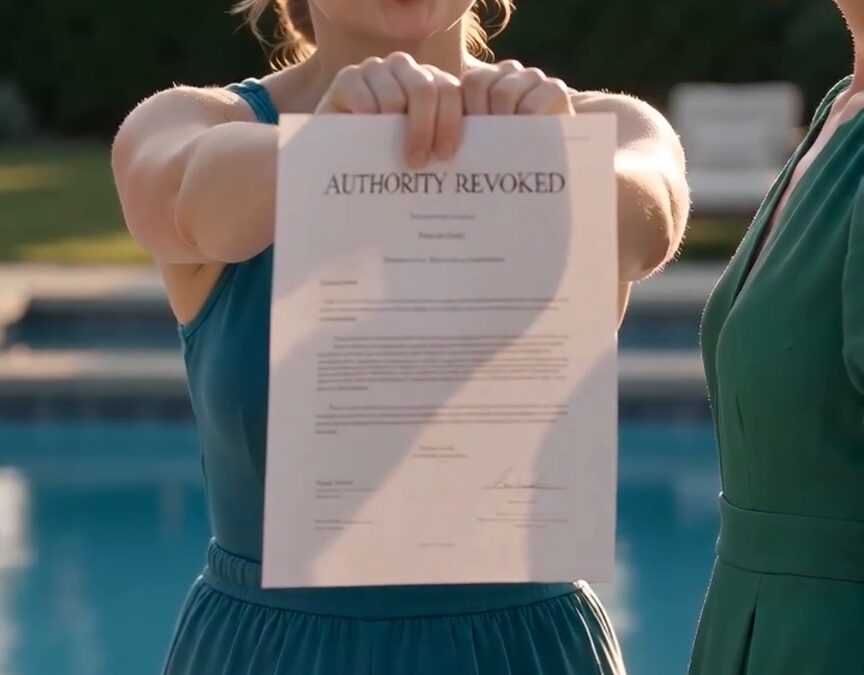
I lifted the printed revocation against my wet shirt.
“Brent, your loan needs my house.”
He looked at the large heading.
AUTHORITY REVOKED.
His grin disappeared before I read anything beneath it.
He stepped backward.
“Wait. Not here.”
Chapter 3: What He Could Not Sign
“Here,” I said.
I moved the page away from my wet clothes.
The bottom edge had begun to curl.
Elise stood beside me, looking between us.
Brent glanced toward the picnic tables.
People were close enough to hear without moving closer.
“You don’t need to show everybody our paperwork.”
“You pushed me in front of them.”
“That isn’t what we’re discussing.”
“It happened before I picked this up.”
He pressed his lips together.
Nora stood near the pool, no longer answering questions.
Her arms were still folded across her coral dress.
I held the paper where Brent could see it.
He had never seen the revocation before this moment.
Recognizing its heading was not the same as knowing its contents.
He reached toward it, then stopped.
“Let me read it first.”
“I’m going to read the relevant part.”
I looked down at the words I had checked.
My name was on the page.
So was the permission I was withdrawing.
I read my revocation of Brent’s written authority.
Then I read what that authority had covered.
“Exchanging information and coordinating preliminary lender and title discussions.”
I paused to take a breath.
“It did not allow you to sign for me.”
Brent looked toward Elise.
She was staring at the document now.
I continued reading the limits.
“Notes, mortgages, deeds, or other binding documents.”
I lowered the page slightly.
“You could discuss a proposal. You could not pledge my house.”
“I know what the permission says.”
“Then you know what I’m withdrawing.”
He rubbed his thumb along the side of his hand.
He had wanted to move this conversation away from witnesses.
I stayed beside the table.
The loan application required more than his business income.
The lender wanted my house as additional collateral.
Not the leased school building.
Not a property Brent owned.
My mortgage-free house in Columbus.
Elise turned toward me.
“Your house?”
“Yes.”
“I thought this was a business loan.”
“It was proposed for his business. It required my property.”
Brent answered before she could ask anything else.
“That’s how expansion financing works.”
“That is what this lender required,” I said.
“There’s nothing unusual about it.”
“I’m not agreeing to it.”
The house came from my grandmother in 2016.
I owned it before we married.
Its title had remained solely in my name.
I had never transferred it to Brent.
I had never transferred it to his business.
He lived there with me.
That did not authorize him to mortgage it.
Paying household expenses did not give him my signature.
Neither did being my husband.
“I wasn’t hiding the expansion,” he said.
“You knew I was arranging financing.”
“I knew you were arranging discussions.”
“You signed permission.”
“For discussions.”
I held the page steady.
He stopped referring to the permission after that.
Instead, he looked toward the watching families.
“This makes it sound like something happened already.”
“Nothing closed.”
The answer surprised Elise enough that she turned again.
I made myself say the rest clearly.
“No loan has closed. No lien has been signed.”
I looked directly at Brent.
“Nothing was delivered or recorded against my house.”
There was no existing expansion debt to erase.
There was no mortgage waiting for me to remove.
What existed was a proposal requiring my consent.
I was refusing that consent before any closing.
Brent could continue owning his original business.
He could not make me provide its expansion collateral.
“You could have told me privately.”
“I prepared notices for the lender and title company.”
“Prepared?”
“I haven’t sent them yet.”
His eyes moved from the paper to my face.
For a moment, he stopped looking at the witnesses.
“Then we can still sit down.”
“I’m sending them.”
“You’re upset. You haven’t thought about the consequences.”
“I checked the proposal with a lawyer.”
He looked at the page again.
This time, he looked below the heading.
I adjusted my grip so the damp edge would not tear.
The page held more than the revocation language.
It also carried an attributed quotation.
He had not read that part yet.
“What did you tell the lawyer about the school?”
“The truth.”
“That doesn’t answer me.”
“I took the documents.”
Elise moved a paper plate away from the wet towel.
It was a small movement.
I watched because looking at her was easier than looking at him.
Then I returned to the page.
“I gave permission on May 12, 2025.”
I read the reference aloud.
“Today, June 14, 2025, I withdraw it.”
Brent tilted his head toward the building.
“You understand people work here.”
“Yes.”
“Parents depend on us.”
“The original school is not this proposed loan.”
“We were building something bigger.”
“You needed my consent.”
He let out a breath through his nose.
Nora shifted her weight but did not come closer.
I remembered her describing her plans for the new location.
She had spoken as if the financing were settled.
I did not know what Brent had promised her.
I knew what I had never signed.
He could argue about timing.
He could argue about whether I should be upset.
He could not supply my consent by explaining my mood.
I held the page higher so the wet bottom stayed clear.
Brent looked at the parents again.
Then he changed the subject.
“You’re talking like you built this business.”
“I helped fund its opening.”
“No,” he said. “You never put money into this school.”
Chapter 4: His Own Acknowledgment
I looked down at the quoted paragraph.
I had brought it because I knew that denial.
Brent had not seen this page before the picnic.
He had not known which older document I kept.
“The next paragraph quotes your acknowledgment,” I said.
“What acknowledgment?”
“The one you signed in September 2018.”
He stopped moving his hand.
I read the attribution before I read his words.
I wanted nobody to mistake them for mine.
Then I read the sentence exactly.
“The $18,000 opening deposit came from Mara’s overnight caregiving wages.”
A parent set a paper cup on the table.
I could hear it touch the plastic surface.
Brent stared at the page.
I kept my thumb clear of the quotation.
“That is what you signed.”
“You brought old marriage paperwork to a picnic?”
“You said I never contributed.”
“That isn’t the original.”
“No. The original is safe at home.”
He looked toward the building again.
There was nowhere private to take the words back.
The parents had heard the amount.
They had heard where it came from.
Elise had heard it, too.
“Did you sign that?” she asked.
Brent rubbed the back of his neck.
“I signed an acknowledgment when we opened.”
I let the page lower to chest height.
The people nearest us heard his answer.
He did not have to like the document.
He had acknowledged signing it.
“That was money coming through our household,” he said.
“The document identifies the source.”
“We were married.”
“Yes.”
“It wasn’t a loan agreement.”
“I haven’t said it was.”
He looked at me then.
I had checked that distinction before bringing the page.
The acknowledgment documented my contribution.
It did not automatically make him owe me a debt.
It did not transfer ownership of the school.
It did not give me control over his employees.
I would not claim those things just to embarrass him.
“It says where the deposit came from,” I said.
“That is what you denied.”
He looked away.
I remembered the opening paperwork spread across our kitchen.
The school’s premises were leased.
There had been a deposit to fund before opening.
Brent had talked about the school as our shared undertaking.
I had taken the overnight work seriously because of that.
From March 2017 through August 2018, I accumulated the money.
I did it shift by shift.
There was nothing small about staying awake in somebody’s house.
There was nothing small about another person depending on me.
I could still feel that client’s fingers around my sleeve.
Her damp pillowcase had needed changing.
She needed help sitting upright before I could change it.
I did not rush her because I wanted sleep.
I stayed until she settled.
Later, I would go home and put my shoes away quietly.
Brent would ask whether I could work again.
Sometimes he asked while I was eating breakfast.
Sometimes I answered before finishing what was in my mouth.
I did not describe all that beside the pool.
The sentence on the page was enough.
“My work supplied that deposit,” I said.
“You acknowledged it when the school opened.”
Brent pulled at the hem of his navy polo.
“Fine. You helped at the beginning.”
It was not an apology.
It was a change in his argument.
“But look at what happens if you stop this now.”
He turned toward the employees.
“There are people counting on this expansion.”
I could see why he chose that argument.
It was harder to dismiss than his ownership claim.
These were people with jobs.
These were families who trusted the school.
He wanted them looking at me instead of him.
“The original school is open,” I said.
“That doesn’t mean there aren’t consequences.”
“I know there are consequences.”
“Then think about somebody besides yourself.”
Elise’s hand moved against the towel.
I looked at her before answering him.
“My house is not available for this loan.”
He stepped closer, stopping short of the table.
“You don’t understand the arrangements already being made.”
“I understand the collateral requirement.”
“Nora has been working on schedules.”
I glanced toward her.
She looked at Brent, not at me.
“She can’t manage a location that isn’t financed.”
“That doesn’t give you permission to use my house.”
Nobody interrupted after that.
The picnic had not stopped existing around us.
Children still needed towels and places to put their plates.
Parents were managing those things while listening.
I wanted to leave before I started crying harder.
But leaving without sending notice would leave another argument waiting.
Brent might say we had paused the decision.
He might say we were still discussing it.
I could not control what he said later.
I could control what I sent directly.
I set the revocation on the dry part of the table.
The heading faced upward now.
Elise kept her hand near it so the breeze would not lift it.
“You made your point,” Brent said.
“You can put that away.”
“I still have to notify them.”
“Not standing here.”
“Yes. Standing here.”
He glanced at my wet jumpsuit.
Then his voice became quieter.
“Come inside. We can work this out privately.”
Chapter 5: Sending the Notices
“I’m not coming inside.”
I said it without moving from the table.
Brent looked toward the school door.
He wanted a room without parents listening.
I wanted the prepared notices sent without interference.
My phone had stayed out of the water.
I retrieved it from the belongings I had left dry.
Elise remained beside the revocation.
Brent watched me open the prepared messages.
“You don’t need an audience for an email.”
“I don’t need your permission to send it.”
He drew his lips inward.
I checked the recipients before touching anything else.
The lender.
The title company.
Not Brent as an intermediary.
Not an address he would forward when convenient.
The lawyer had made that distinction clear.
On June 13, 2025, I sat with the paperwork arranged before me.
The proposed loan documents were separate from my written permission.
I had brought the original contribution acknowledgment, too.
I kept it inside its own folder.
The lawyer read the permission before discussing the affair.
“What did you authorize him to do?”
“Coordinate the preliminary conversations.”
“Did you sign any mortgage or note?”
“No.”
“Any deed or other binding closing document?”
“No.”
The lawyer returned to the wording.
It allowed exchanges of information and preliminary coordination.
It did not let Brent execute documents for me.
It was not blanket authority over my property.
I had needed to hear that plainly.
After the messages, I distrusted my own reading.
I kept wondering what I had overlooked.
The lawyer checked the proposal against the permission.
The lender required my separately owned house as additional collateral.
My consent was therefore necessary for that proposed transaction.
Refusing it would stop this application from proceeding as proposed.
It would not undo a loan that already existed.
There was no closed expansion loan.
There was no signed lien to unwind.
The lawyer explained what to send.
A clear refusal.
A signed revocation.
Direct notice to the lender and title company.
I asked about the old acknowledgment.
“Does this mean he has to repay me?”
“Not by itself.”
I looked at Brent’s signature.
The answer disappointed me, but it helped.
The document established where the contribution came from.
Any repayment obligation would need its own legal basis or agreement.
I could use the acknowledgment without pretending otherwise.
Before leaving, I checked the proposed notices again.
At home, I saved the messages and printed the revocation.
I put the original acknowledgment away.
Only its attributed words appeared on the printed page.
Now that page lay beside a damp towel at the picnic.
The consultation had been private.
Sending the notices did not need to be.
Brent came closer while I opened the lender’s message.
“Let me at least call them first.”
“I’m notifying them directly.”
“You’ll make the whole application look unstable.”
“I am refusing the required collateral.”
“Use different wording.”
“The wording is accurate.”
I checked the attachment.
It was the signed revocation, not a photograph of wet paper.
I had prepared it before leaving home.
The message stated that I did not consent to pledging my house.
It withdrew the preliminary coordination permission.
It requested acknowledgment of receipt.
I read it silently before sending.
Then I pressed send.
Brent watched my thumb.
He did not reach for the phone.
Elise saw the message leave.
“The lender has it,” I said.
“That doesn’t mean anybody has read it,” Brent replied.
“It means I sent it directly.”
I opened the title company’s notice.
Its purpose was equally clear.
No one was to rely on the withdrawn permission.
I had never authorized Brent to sign binding property documents.
I did not consent to the proposed lien.
I checked the attachment again.
Then I sent that message, too.
“The title company has the notice.”
Brent looked toward Nora.
She had moved no closer.
Her proposed job depended on a location that did not exist yet.
I had not promised her that position.
I was not going to secure it with my house.
“You could still tell them to hold off,” he said.
“I’m not doing that.”
“Until we talk.”
“We have talked.”
“Not reasonably.”
I put the phone away.
“I’m going home.”
He looked at the wet towel and then at Elise.
For the first time since the push, he seemed to notice her involvement.
“You’re taking her side?”
“I’m getting her home,” Elise said.
He did not answer immediately.
She picked up the towel and held it out.
This time, she asked nothing about the loan.
I wrapped it around my shoulders.
My clothes had begun to feel cold against my skin.
I picked up the printed revocation.
The bottom had curled, but the words remained readable.
I folded it carefully away from the wet edge.
Nora looked toward the school entrance.
Brent stayed near the table.
“You’re walking away from everyone who helped build this.”
I looked at him.
“I’m leaving after you pushed me.”
He did not offer his hand again.
Elise gathered what I needed to take.
I followed her toward the gate.
Behind us, somebody moved a picnic bench.
The ordinary scrape made me want to cry again.
I kept walking beside Elise.
At the gate, she stopped and looked at me.
“Mara, I didn’t know they wanted your house.”
Chapter 6: The Drive Back Home
“I know you didn’t.”
I could answer that part honestly.
Elise knew an expansion loan was being arranged.
She did not know its collateral requirements.
That did not make her request easier to remember.
She opened the car so I could sit down.
I kept the towel under the wettest fabric.
The folded revocation rested on my lap.
Elise settled behind the wheel and looked toward the school.
Through the fence, people were returning to their children.
Brent remained inside the grounds.
He did not come to the car.
“I thought canceling it meant the school might close.”
“The existing school isn’t closing because I refuse collateral.”
“He kept talking about what the school needed.”
“He wants another location.”
She nodded but did not start driving immediately.
“My kids are happy here.”
“I know.”
“I was thinking about their lessons.”
“I was standing there soaking wet.”
She lowered her eyes toward the steering wheel.
“Yes.”
I pulled the towel closer beneath my chin.
I had no interest in making her defend the request.
I wanted her to stop explaining it.
She started the car.
For a while, we watched the road without speaking.
Water collected in the fabric near my knees.
I pressed the towel there and looked out the window.
The neighborhood streets looked ordinary.
People had no idea what had just happened.
That helped more than I expected.
Elise eventually spoke again.
“I saw him push you.”
“Yes.”
“It wasn’t an accident.”
“No.”
“He said it was a joke.”
“I heard him.”
She kept her eyes on the road.
“I should have said something before the loan.”
I smoothed the towel over my lap.
“You can say that now.”
“I’m sorry.”
I nodded.
I did not tell her everything was fine.
Nothing about the ride required me to do that.
At my house, she waited while I unlocked the door.
The house had belonged to my grandmother before me.
I had inherited it in 2016.
The front door opened into a place I knew well.
I had never signed it over to anyone.
I stepped inside and put the revocation on the kitchen table.
Elise stayed near the doorway.
“Do you want me to stay?”
“I want dry clothes first.”
“Of course.”
I changed out of the jumpsuit.
Its wet weight landed heavily when I set it down.
I washed my face and rinsed my mouth.
Then I returned to the kitchen.
Elise had not moved the documents.
She had placed the folded towel where I could reach it.
My blue mug was by the sink.
I touched its handle before filling a glass instead.
I did not want tea yet.
I wanted something cool after the pool water.
Elise sat only after I pulled out a chair.
“The original school is leased,” I told her.
“Yes.”
“His business can keep operating there.”
“So the loan was only for the expansion?”
“The proposed borrowing was for that expansion.”
“And your house was additional security.”
“Yes.”
She rubbed her forehead.
“He made it sound like everything depended on moving forward.”
“He needs my consent for this proposal.”
“Could he have signed without you?”
“Not lawfully under the permission I gave him.”
I took the revocation from the table.
I showed her the description of the old permission.
She read it slowly.
The exclusions were not hidden.
No notes.
No mortgages.
No deeds or other binding documents for me.
“He never had the authority to pledge it,” I said.
“Today, I withdrew even the preliminary permission.”
She handed the paper back.
“I understand now.”
My phone lit up while we were sitting there.
It was Brent.
He wanted me to return to the school.
He said we should speak without the picnic audience.
I read the message before replying.
“I’m home. I’m not returning today.”
Another message followed.
He wanted to know whether I would reconsider signing.
He framed it as protecting what had already been planned.
I placed the phone flat on the table.
Elise watched my face.
“What is he asking?”
“For me to come back and sign.”
“After all that?”
“Yes.”
I picked up the phone.
“I will not sign loan or lien documents for this expansion.”
I read the sentence before sending it.
There was no explanation of Nora.
There was no argument about Dad.
There was no invitation to negotiate at my kitchen table.
Brent replied that I was throwing away an opportunity.
I did not answer that message.
Elise rose and carried her glass to the sink.
“Do you need anything before I go?”
“No. Thank you for driving.”
She turned back toward me.
“I’m sorry about what I asked.”
“I’m not ready to talk more about it.”
“All right.”
She left without asking again.
I closed the door and returned to the kitchen.
The printed revocation lay beside my phone.
I opened the sent messages.
Both notices were there, with their attachments.
I checked them instead of rereading Brent’s replies.
The lender had not responded yet.
Neither had the title company.
I put the phone down beside the page.
What I needed next was written confirmation.
Chapter 7: The Replies Arrive
On June 16, 2025, I opened the lender’s reply.
I was sitting at my kitchen table.
The revocation lay in its folder beside me.
I read the message without touching my tea.
The lender acknowledged receiving my refusal and revocation.
The required property-owner consent was not available.
The proposed expansion application was being closed.
I went back to the beginning and read it again.
There was no expansion loan to cancel after disbursement.
There were no loan funds to return.
The application had stopped before closing.
I saved the acknowledgment with my sent notice.
Then I opened the title company’s reply.
It confirmed receipt of my notice, too.
I read that message slowly.
My earlier permission could no longer be relied upon.
In any case, it had never allowed binding signatures for me.
I asked for clear confirmation about the proposed lien.
I did not want vague reassurance.
I wanted the transaction’s actual status.
The answer matched what the lawyer had checked.
No new lien had been signed, delivered, or recorded.
There was nothing new to remove from my title.
I wrote those details down beside the printed notice.
Then I compared them with the lender’s closure message.
I wanted the words to agree across the file.
They did.
My phone was quiet while I did that.
For the first time since the picnic, I finished my tea.
The house had not become collateral.
It remained the house I had owned before marriage.
That did not resolve the marriage.
It resolved the immediate proposal.
I forwarded the confirmations to my lawyer.
I included my sent notices in the same file.
I did not crop out dates or remove the earlier wording.
I wanted the complete exchange preserved.
Later, Brent called.
I answered because the lender’s status was no longer uncertain.
“They closed the application,” he said.
“Yes.”
“You got what you wanted.”
“I refused the collateral.”
He exhaled hard enough for me to hear.
“They won’t proceed without it.”
“I read their confirmation.”
He did not argue that he could sign for me.
That claim had no use left.
He did not deny the contribution either.
People had heard him acknowledge the signature.
Instead, he spoke about the business arrangements.
“There isn’t another acceptable property I can offer.”
I looked toward the folder on the table.
“No replacement collateral?”
“Not anything they’ll accept for this proposal.”
That matched what the lender’s requirement had meant.
He could not replace my consent with his preference.
He could not close this proposed loan without acceptable security.
He had wanted my house because he needed it.
“I’m not changing my refusal,” I said.
“I know you keep saying that.”
“Because you keep asking.”
There was a pause.
Then he mentioned Nora.
“She was counting on managing the second location.”
“There is no second location for her to manage.”
“She’s put work into planning it.”
“That doesn’t make my house available.”
He did not answer immediately.
I could picture him looking for another way to frame it.
A business opportunity.
An employment promise.
A family obligation.
Every version ended with the same property requirement.
I kept my response on that requirement.
“The original school can keep operating,” I said.
“It is operating.”
“All right.”
“You’re making this sound simple.”
“I’m separating the school from the proposed expansion.”
He said the plans could not proceed this way.
I did not argue with that.
The lender had closed the application.
No acceptable alternative collateral was available to him.
Nora’s promised management position did not exist.
Those were consequences of the proposal requiring consent I refused.
They were not a transfer of the school to me.
They were not a court shutting its doors.
After the call, I wrote down what Brent had confirmed.
The original school remained open.
He had no acceptable replacement collateral.
The second-location job was gone.
I placed that note behind the lender’s confirmation.
Then I put the folder away.
I had been carrying papers from table to counter.
Now they had a place.
Later, Elise contacted me about the confirmation.
I told her the application was closed.
“Are the lessons affected?”
“The original school remains open.”
“Thank you for telling me.”
I did not revisit her towel request.
She did not ask me to reconsider.
That was enough conversation for then.
I returned to the kitchen drawer holding Dad’s funeral program.
I took it out and placed it beside my mug.
The paper still had the corner I had smoothed.
I had spent days thinking about signatures instead of him.
I sat with the program open.
There was no business plan beside it this time.
Before putting it away, I looked toward the house folder.
The financing problem had an ending in writing.
The marriage still needed one.
I opened a message to my lawyer.
“I need to discuss divorce.”
Chapter 8: Separate Households
I began the divorce proceedings with the documents organized.
Not every page belonged to the same issue.
I separated the house records from the expansion correspondence.
The contribution acknowledgment went in another folder.
I wanted my lawyer to see what each document proved.
The deed showed ownership.
The permission showed its limits.
The notices showed refusal and withdrawal.
The lender’s reply showed the application had closed.
The old acknowledgment showed where the opening deposit came from.
None of those pages could do every job.
The lawyer asked me to bring the original acknowledgment.
I retrieved it from where I had kept it safe.
Brent’s signature was still clear.
So was the sentence above it.
“The $18,000 opening deposit came from Mara’s overnight caregiving wages.”
I had read those words in front of parents.
Now I placed the original on the lawyer’s desk.
“This is the one I quoted at the picnic.”
The lawyer checked it against the copy.
I watched without speaking.
I had spent years knowing what I contributed.
It was different to have someone examine the proof.
“Do you understand what we can claim from this?”
“It establishes the source of the contribution.”
“Yes.”
“It doesn’t automatically make it a debt.”
“Correct.”
I wanted repayment included in the negotiations.
I did not want the agreement built on an inaccurate claim.
The distinction mattered because Brent understood paperwork.
If I overstated the acknowledgment, he could challenge that instead.
I wanted the actual issues addressed.
My separately owned house.
Any asserted marital claims.
The documented contribution.
The terms for ending the marriage.
At home, I moved the school’s papers away from my work things.
I no longer wanted expansion plans beside my caregiving schedule.
I still worked nights.
Clients still needed help while other people slept.
Household bills still arrived.
I sorted those at the kitchen table after resting.
The house felt different without ongoing loan discussions.
I could leave a page where I wanted it.
I could close a folder without Brent reopening the subject.
But messages still came through the settlement process.
Brent wanted renewed consent for the expansion considered in negotiations.
He was no longer relying on the withdrawn permission.
He wanted a new agreement.
That was a smarter request than pretending the old authority remained.
It was still a request to use my house.
My lawyer explained the proposal.
I asked whether the terms changed the basic risk.
The house would still secure business borrowing if I agreed.
I put my pen down.
“No.”
“We can communicate that clearly.”
“Do that.”
I did not need to discuss Nora to answer.
I did not need to describe the pool again.
I would not use my house for his expansion.
That answer stayed the same in settlement discussions.
Brent’s position shifted toward the other financial issues.
He questioned whether my opening contribution should be repaid.
We had been married when the wages were earned.
I understood that was something the settlement had to resolve.
The acknowledgment did not erase the legal questions.
It prevented him from pretending the money came from nowhere.
My lawyer placed it beside the other financial documents.
I was asked what outcome I wanted.
“The house stays mine.”
“And the contribution?”
“I want the $18,000 addressed in the agreement.”
I did not ask for his business.
I did not ask for control of his school.
I wanted a negotiated resolution I could read and enforce.
The original school continued operating while the discussions went on.
That mattered when Brent spoke about losing everything.
He had not lost the original location.
He had lost the proposed financing secured by my house.
Those were different things.
I kept them different when answering questions.
At home, I found an old stack of school planning papers.
I sorted out the records that belonged in my legal file.
The rest no longer needed a place on my kitchen counter.
I put my work schedule there instead.
I still reached for my blue mug after overnight shifts.
Sometimes I sat with it before opening any messages.
I did not always finish the tea.
There were days when the legal correspondence took my appetite.
On those days, I put the mug in the sink.
Then I answered only what needed an answer.
Elise contacted me less during that stretch.
I did not make her a messenger between us.
She was his sister.
She had also driven me home.
Both facts could remain true without giving her my settlement papers.
When she asked how I was doing, I answered briefly.
“I’m working. The lawyers are handling the rest.”
She accepted that.
As the negotiations moved forward, my lawyer sent proposed language.
I read the house provision before anything else.
I checked that it did not include a future collateral promise.
Then I read the contribution provision.
This time, repayment would not depend on interpreting an old sentence.
It would be an express settlement obligation.
I marked a question beside the payment wording.
Then I called my lawyer.
“I want to understand exactly what he’ll be required to pay.”
Chapter 9: The Settlement Papers
The repayment language was part of a negotiated agreement.
My lawyer walked me through it without rushing.
The contribution acknowledgment remained supporting evidence.
It was not being treated as an automatic promissory note.
The settlement would create the payment obligation.
I read that provision with my finger under the line.
Brent would pay me $18,000 from business funds available to him.
The agreement would resolve the marital claims.
The house would remain solely mine.
There was no requirement that I revive the expansion proposal.
There was no promise to provide collateral later.
I asked the lawyer to confirm that distinction again.
“The house is not part of any future financing.”
“Correct.”
“And this payment comes from the settlement.”
“Yes.”
I looked down at the draft.
For months, I had been separating one document from another.
Now the separation appeared in the agreement itself.
The house was addressed as property.
The contribution was addressed through negotiated repayment.
The failed expansion application remained closed.
The original business remained Brent’s operating school.
I did not have to call the contribution a loan.
I did not have to claim the school belonged to me.
I did not have to accept another financing discussion.
Before signing the final agreement, I reviewed the whole thing.
I did not stop after finding the amount.
I checked the property language.
I checked the resolution of claims.
I checked the payment obligation.
Then I asked questions where I needed plain language.
I was tired of pretending I understood things immediately.
The lawyer answered without telling me I worried too much.
That helped me keep reading.
Brent had continued to operate the original school.
Its leased premises did not become mine.
Its employees did not become mine.
The divorce was not a business forfeiture.
He remained responsible for running what he owned.
Nora had received no second-location management job.
There was no second location under this proposal.
I did not need anything else to happen to her.
I did not need the original school closed to make the agreement work.
I needed the terms on the page honored.
December 12, 2025, was the date of the settlement and decree.
I read the decree when it became available.
Then I read the agreement beside it.
The house remained in my sole ownership.
The negotiated agreement resolved the marital claims.
Brent was obligated to pay the documented contribution amount.
I let my lawyer confirm the next practical step.
The payment was still something to receive.
A signed obligation was not money in my account.
I had learned not to skip over that difference.
At home, I placed the decree with the house records.
The revocation stayed in the expansion file.
The original acknowledgment stayed in its protective folder.
I did not throw away the curled picnic page.
Its bottom edge still showed where it had gotten damp.
I did not display it, either.
It went behind the clean copy.
I opened the kitchen drawer and saw Dad’s funeral program.
The corner was bent again from being handled.
I straightened it and put it back carefully.
The divorce papers did not change what I missed about him.
They did stop the expansion dispute from occupying every surface.
I could put the legal folder away.
I could leave my work schedule on the table.
I could make a meal without moving loan documents first.
Brent’s communications about the settlement stayed with the legal process.
There was no reason for him to discuss signing at my house.
There was no return trip to the school.
He had his original business to operate.
I had my home and my own work.
That was the arrangement the papers now reflected.
When I checked the payment provision again, I did it calmly.
Not because I trusted a promise.
Because I knew where the obligation was written.
The old acknowledgment had helped establish the facts.
The settlement supplied the enforceable repayment requirement.
I placed both documents back where they belonged.
Elise contacted me after the decree.
She did not ask about the school’s plans.
She asked whether I was all right.
“The settlement is finished,” I said.
“I’m glad the paperwork is done.”
“The payment still has to arrive.”
She did not tell me to be patient with Brent.
She did not explain his position.
She simply said she hoped it would be settled soon.
I could answer that.
“So do I.”
Afterward, I looked at my overnight schedule.
I had kept working through the negotiations.
I was still able to do the work.
I was also tired of arranging every week around exhaustion.
The repayment would not replace an income indefinitely.
It would give me room to reduce my shifts.
I took a pencil and considered the schedule.
I did not change it yet.
I wanted the payment received before changing my work.
I set the pencil beside my blue mug.
Then I closed the folder and waited for confirmation.
Chapter 10: My Own Kitchen Again
On December 19, 2025, the $18,000 payment arrived.
I checked the amount before doing anything else.
Then I checked that it was actually received.
It matched the obligation in the settlement.
I saved the payment confirmation with the agreement.
I sent it to my lawyer.
There was no need to describe it as a favor.
It was the required settlement payment.
There was also no need to send Brent a speech.
The financial term had been met.
I sat at the kitchen table for a while.
My work schedule was still beside the blue mug.
I picked up the pencil.
This time, I made the changes I had considered.
I reduced my overnight schedule.
I did not quit caregiving.
I still wanted to do the work.
I wanted to do less of it while exhausted.
That was a change I could make now.
I contacted the people who arranged my shifts.
I kept the conversation about availability.
I did not explain my marriage to justify needing rest.
When the revised schedule was confirmed, I printed it.
I placed it where the expansion plans used to sit.
There were nights I would still be away from home.
There were also nights I would spend in my own bed.
I looked at the open spaces before putting the pencil away.
After my next shift, I came home without rushing.
I put my work things in their usual place.
I washed my hands and filled the kettle.
The house was quiet enough to hear it warming.
I opened the kitchen drawer for a spoon.
Dad’s funeral program was still there.
I took it out and looked at his photograph.
I did not hide it before anyone came downstairs.
Nobody was coming down to tell me to hurry.
I placed it on the table while the tea steeped.
I could miss him without explaining why.
I could be tired without defending my work.
I could sit at my own table without discussing collateral.
I took my blue mug by its handle.
The tea was too hot, so I waited.
For once, waiting did not mean losing sleep before another shift.
I had time to let it cool.
Elise and I resumed contact gradually.
She asked about my revised schedule.
I told her I was working fewer nights.
“Are you getting more sleep?”
“I’m giving myself the chance.”
“That sounds good.”
She did not mention the expansion.
She did not ask whether I regretted sending the notices.
I did not ask her to choose between her brother and me.
I did need her to stop carrying his requests.
She had stopped.
That made ordinary conversation possible again.
When she came to my house, I opened the door.
There was no wet towel between us.
She stood in the kitchen while I put the kettle on.
“Tea?”
“Yes, please.”
I gave her a cup and took my blue mug.
We sat at the table with my schedule nearby.
She asked how work had been.
I told her about being tired without being overwhelmed.
I did not give details about my clients.
I said the reduced schedule was helping.
She looked toward the paper beside my mug.
“You really changed it.”
“Yes.”
“I’m glad.”
We did not revisit the pool.
We did not revisit her request to preserve the loan.
She had apologized.
I had not forgotten.
Those facts did not require another argument over tea.
We talked until the cups were empty.
When she left, she thanked me for having her over.
I told her to drive safely.
Then I closed the door and returned to the kitchen.
The house had not changed owners.
It had not become collateral and then been rescued.
It had remained mine because no valid pledge was made.
My refusal had reached the people who needed it.
The lender had closed the application before any funds existed.
The title company had confirmed there was no new lien.
The original school remained open under Brent.
He had not received the expansion borrowing he wanted.
Nora had not received the proposed management job.
The divorce settlement was complete.
The required repayment was received.
I did not keep those facts posted on the refrigerator.
They were filed where I could find them.
What stayed visible was my work schedule.
I moved it away from the edge of the counter.
Then I checked when I needed to leave for my next shift.
There was enough time to eat.
There was enough time to sleep first.
I put something simple on a plate.
I sat down instead of eating over the sink.
Afterward, I carried the dishes over.
Elise’s cup went on the drying rack.
I rinsed the spoon and put it beside the plate.
Then I picked up my blue mug.
A tea mark showed near the bottom.
I washed it with the soft side of the sponge.
I rinsed the handle and ran my thumb around the rim.
There was no reason to hurry through it.
My shoes could stay by the door until I needed them.
The legal folder could stay closed.
I dried the mug and checked the revised schedule again.
Then I set my blue mug beside it, in my own kitchen.
You Might Also Enjoy




