My late wife’s niece toasted my 79-year-old father as ‘our basement tenant’ at Thanksgiving. She ran a daycare in his living room.
Complete story · 7 parts · about 28 minutes · ending included
Part 1 · Part 2 · Part 3 · Part 4 · Part 5 · Part 6 · Part 7
Part 1 of 7
“And thank you to Clyde, our basement tenant — rent’s due Monday!”
Shawna held her glass high enough for everyone at the crowded table to see it.
Laughter ran past a bowl of mashed potatoes and came back from the people squeezed along the wall. My father had a fork halfway to his mouth. He lowered it without taking the bite.
“Happy Thanksgiving,” Dad said.
Nobody answered him. Someone was still laughing.
Across from me, Garrett kept his eyes on his dinner. His wife stood beside him, waiting for the last chuckle before taking a drink. Cheryl, Shawna’s mother, sat with a napkin pressed flat beneath her palm and said nothing.
There were sixteen of us at Clyde Lindgren’s table that Thursday, November 26, 2026. His 1958 brick ranch in Hillyard had held Thanksgiving dinners longer than Shawna had been alive.
Dad eased his chair back.
“Dad, where are you going?” I said.
“Downstairs.”
With a thumb hooked over the edge of his plate, he lifted his dinner and waited for someone to tuck in a chair so he could pass.
Shawna turned toward the other end of the table.
“Who still needs gravy?”
My father was seventy-nine. After thirty-eight years as a railroad carman at the Hillyard yard, his right hand still closed a little crooked around things. Tonight that hand held turkey, stuffing, and a biscuit while everybody made room for him to leave.
I picked up my own plate.
Garrett looked at me then, briefly, before studying the food in front of him again.
Nobody asked where I was going.
A paper sign on my father’s old bedroom door said NAP ROOM in rounded blue letters. Beside it stood six cubbies, each marked with a child’s name.
Those were familiar. On Sunday visits, I had passed that door on my way to get a clean towel from the hall closet. Once I had moved a little sneaker out of the walkway with my boot.
Dad always met me upstairs for coffee. The daycare was closed, the house quiet, a folding cot tucked against a basement wall when I went down to check a light for him.
By phone, he had said he “liked the quiet downstairs.”
Working twelve-hour storm shifts, I had accepted that answer and asked whether he needed groceries.
Tonight, carrying my Thanksgiving dinner past those names, I stopped beside the door where my father used to sleep.
Behind me, a serving spoon struck a bowl.
“You coming, son?” Dad called.
“Right behind you.”
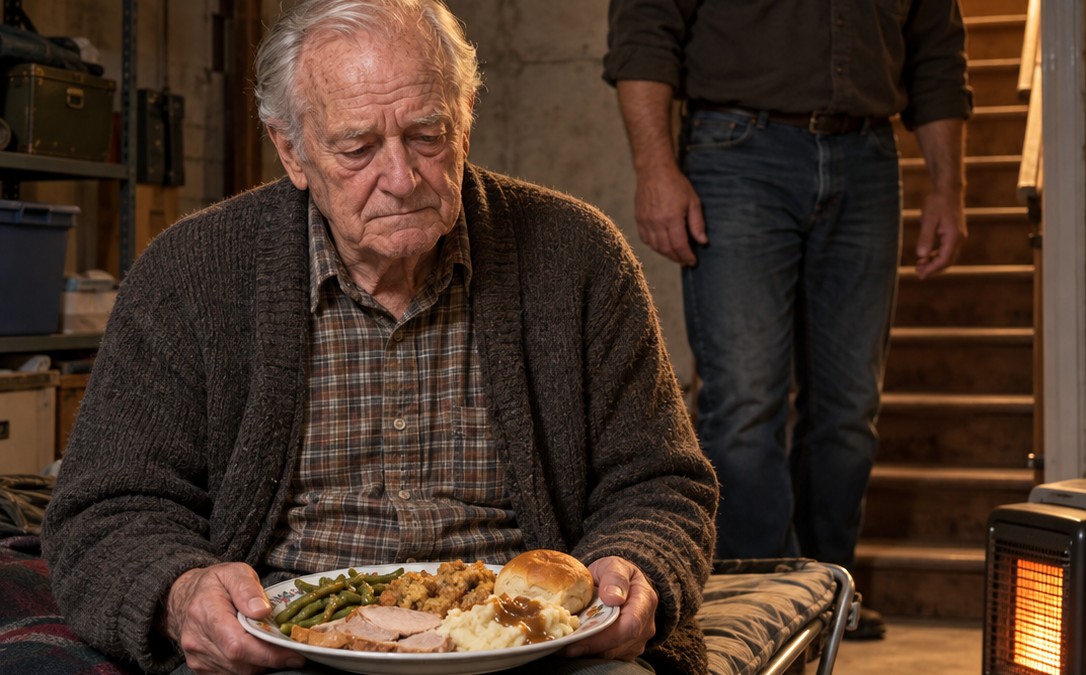
At the foot of the stairs, he turned toward the cot.
It was open now.
A thin mattress sagged between its metal rails. A blanket covered part of it, folded back just far enough to leave room for him to sit. His shoes stayed flat on the floor as he lowered himself, careful to keep his dinner level.
The canvas gave a short creak.
Dad settled the plate on his knees.
Gravy had thickened around the turkey. A pale square of butter sat on the biscuit without melting, and the stuffing had lost its steam. Upstairs, his meal had looked like mine.
Down here, I could see how little he had eaten.
A space heater ran beside him, its orange bars bright behind a wire grille. Warm air reached one trouser leg. The other was close to a painted concrete wall.
His left hand supported the china. The crooked right one held his fork, tines pointed down, touching nothing.
Overhead, somebody laughed hard enough to cough.
Dad glanced up.
A chair scraped across the floor above his head. Another voice joined in, too muffled for words, followed by the low, comfortable sound of people talking with food in their mouths.
He turned the utensil over in his fingers.
At fifty-four, I had spent most of my working life as an electrician, kneeling in crawl spaces and bringing light into rooms people barely used. Standing there, I kept looking at the short legs of the thing my father slept on.
“Dad.”
His thumb rubbed a dry spot along the edge of his plate.
“She needed the room for the little ones. It’s fine, son.”
“Then I’ll eat down here too,” I said.
I sat on the bottom step with my own plate.
For a while, neither of us ate. My father watched me get settled, as if I were a visitor he hadn’t prepared for.
“You don’t have to sit on the stairs.”
“I’m all right.”
“There’s room upstairs.”
Dad looked down after saying it.
From the ceiling came the clatter of dropped silverware and a woman’s quick apology.
“I know,” I said.
My father cut a piece of turkey with the side of his fork. It took more pressure than it should have.
“Want me to warm that up?”
“Still good.”
A bite waited halfway to his mouth.
“Your biscuit’s cold.”
“Always liked them that way.”
He had split them open straight from the oven my whole life. I took a mouthful of stuffing and let him finish the bite.
Shawna was Julie’s niece. Since my wife died in 2023, I had kept showing up for her family’s birthdays and holidays. Julie’s sister was sitting directly above us now.
Dad brushed a crumb from his trousers.
“Cheryl make the sweet potatoes?”
“I think so.”
“Your mother used to put pecans on hers.”
“You picked them off.”
“Saved them till the end.”
His mouth moved at one corner. I rested my fork against the rim and waited until he had swallowed.
“You could come stay with me tonight.”
“Got my things here.”
“I can bring you back tomorrow.”
Dad reached toward the heater, then stopped short of the grille and held his palm in the warmth.
“Eat, Wendell.”
Upstairs, Shawna called for somebody to help clear the table.
Neither of us moved.
After a moment, Dad lowered his hand and nodded at a fireproof box under the basement stairs.
“Everything that matters is still in there. My name’s on it. Yours too.”
Picking up where the Facebook post left off
Part 2 of 7
Shawna was waiting in the driveway when I pulled up on Saturday, November 28.
A blue folder rested against her coat. Before I had my truck door shut, she stepped around it and held out her free hand.
“Good. You can take care of this.”
“What is it?”
“Fingerprints. Every household member has to have them done.”
Her gaze went toward the house, then back to me.
“Your dad’s the one holding things up.”
I left my keys in my palm.
“Have you asked him?”
“You know how he gets about appointments.”
From where we stood, I could see the front window. Dad used to sit beside it with his coffee. Now a row of paper leaves hung across the lower glass.
“Get him there by December 11, honey, or six working moms lose their daycare, and that’s on you.”
The last words came out louder than the rest.
Behind her, the garage door was shut. There was room to walk around me, but Shawna stayed between my truck and the path to the porch.
“That’s on me?”
“They have jobs, Wendell. People depend on me.”
She pushed the folder into my hands.
It was open, with a DCYF letter on top. A corner had caught beneath the metal fastener. My thumb went over it before the breeze could lift the sheet.
“What does the letter say?”
“The state license is approved — it’s just the printout we’re waiting on.”
Shawna tapped the cover with a fingernail.
“Get the fingerprints taken care of. That’s what you need to worry about.”
I closed it against my coat.
“Parents’ night is Thursday,” she said. “I’d like to have some good news for them.”
“December 3?”
“Yes. This coming Thursday.”
Her voice had gone bright again. She smoothed the front of her sleeve and looked toward the street.
“Your dad listens to you.”
A minute earlier, she had made him sound impossible to talk to.
“I came to see him,” I said.
“Well, he’s inside.”
Shawna stepped aside then.
I carried the paperwork through the front door. The house smelled of floor cleaner. At the end of the hall, the NAP ROOM sign was still taped to the bedroom door, one corner curling away from the wood.
Dad stood at the kitchen counter with a mug.
“Coffee?” he said.
“Sure.”
He took down another cup. I set the blue cover beside the sink and watched him pour.
“Shawna catch you outside?”
“She wants me to take you for fingerprints.”
His wrist stopped over the rim. A drop fell onto the counter before he set the pot down.
“By December 11,” I said.
Dad tore a square from the paper towel roll and wiped up the spill.
“That’s her date.”
“She says the license is approved.”
My father folded the damp scrap in his hand.
“I won’t be fingerprinted as somebody’s tenant in my own house.”
He said it at the same volume he’d offered me coffee.
From the hallway came the sound of Shawna moving something across the floor. Dad looked toward the doorway but didn’t take back a word.
“Did you tell her that?”
“Yes.”
I pulled out a chair.
He stayed at the counter for another moment, then brought his drink to the table. The handle faced his left hand.
“She told me six mothers would lose their daycare.”
“Asked you to make me do it?”
“Pretty much.”
Dad rubbed a finger along a chip in the glaze.
“I’m sitting right here.”
“I know.”
We drank without talking for a while. Somewhere down the hall, a cabinet opened and shut.
The packet lay where I’d put it. Shawna had sent me in carrying her instructions, expecting me to come back with his agreement.
My father watched me over his cup.
“You going to ask me again?”
“No.”
He lowered his shoulders and took another sip.
Before I left, I picked up the folder. Dad walked me to the front door, stopping beside the cubbies to let me pass.
“Call when you get home,” he said.
“I will.”
That night, after our call, I sat in my kitchen with my phone plugged into the outlet beside the stove.
Shawna’s name was near the top of my messages.
I opened the conversation and scrolled past the holiday arrangements. My thumb kept moving through older exchanges, stopping when a date caught my eye.
By the time I reached April 2025, the screen had dimmed. I touched it to keep the words lit.
Wednesday, April 2, 2025.
“Thank you for letting us stay at Clyde’s rent free while we save for our own place.”
The message fit on the screen with space beneath it.
Our own place.
I had been standing in Dad’s driveway that afternoon, listening to Shawna make his cooperation my responsibility. Here, in her own words, she had thanked me for a place to stay.
Clyde’s.
Her name was above the message. Nothing about it depended on what I could remember of a conversation.
At Thanksgiving, she had raised a glass and called my father her basement tenant.
This afternoon, she’d put a state agency’s letter in my hands and told me which part to worry about.
My phone cable had caught around the chair leg. I bent to free it, then sat with the screen resting on my knee.
What had Shawna actually told the state?
The answer might be in the paperwork I’d carried out of that house.
I took a screenshot of her text, laid the folder on my kitchen table, and opened it.
Part 3 of 7
By Sunday morning, November 29, the blue folder was still on my kitchen table.
The DCYF letter lay across the open cover. I moved my coffee out of the way and flattened the corner beneath the fastener.
November 20, 2026.
The packet had arrived November 9. The words describing it were “incomplete” and “returned.”
Farther down, the agency said review “begins when a complete packet is received.”
Shawna had put that page in my hands and said the license was approved.
I turned it over. The back was blank.
There was no license. Children had been coming to the house since September 8.
That was a Tuesday. By then, my father’s bedroom had already become the place where they took their naps.
Under the letter was a household page.
“Clyde Lindgren, 79, tenant (separate unit).”
My finger stopped at the parentheses.
The stairs I’d sat on at Thanksgiving connected his sleeping space to the rest of his house. He came up them to get coffee from his own kitchen.
A handbook followed. The daycare’s name was Little Acorns.
“Little Acorns is in our own home, which Garrett and I own.”
I set that sheet beside Shawna’s message on my phone.
She had thanked me for letting them stay at Clyde’s. Now she had written him down as a tenant.
At Dad’s that morning, I found him folding his blanket in the basement.
He smoothed the edge with the flat of his hand.
“You eat?” he asked.
“Before I came.”
“There’s coffee upstairs.”
I held up the paperwork.
“Can we look in your box?”
Dad set the bedding aside and sat on the cot.
“Bring it over here.”
The fireproof case was heavier than it looked. I carried it from beneath the stairs and put it on the floor between us.
He took a key from his pocket.
Inside, papers lay in a large envelope. My father drew them out and handed me the trust certificate, then the recorded deed.
The house had been in the Clyde Lindgren Revocable Trust since March 2020. Dad was trustee. My name appeared as successor trustee.
I knew what we’d arranged. Seeing the documents beside the forms Shawna had filled out, I laid them farther apart.
“She says you rent down here,” I said.
His mouth tightened.
“Never paid me a dollar.”
“The state hasn’t approved her.”
Dad rested his hands on his thighs. From above us came the sound of water running through a pipe.
“You need to be upstairs,” I said.
He glanced toward the steps.
“My knees hurt on those every night.”
The heater clicked off.
“Why didn’t you say?”
Dad picked at a loose thread on the blanket beside him.
“You were working.”
I waited. He pulled the thread free and let it fall.
“Do they hurt coming down too?”
“Some.”
My father kept his eyes on the floor while I slid the certificate back into its envelope.
That afternoon, I went to Cheryl’s for coffee.
Julie’s sister had put a saucer under my cup. She asked whether I’d seen Shawna’s preparations for Thursday.
“She’s getting things ready,” I said.
“The parents will like that. Makes people comfortable, seeing where their children spend the day.”
I left my drink alone.
“Could you show me the parents’ group?”
Cheryl reached for her phone.
“She’s put so much work into it.”
With her reading glasses low on her nose, she opened the group and scrolled. Her finger slowed over a photograph.
“Here. This was when she got the nap room ready.”
The date was Monday, August 17, 2026.
Dad’s recliner sat on the basement stairs, tilted back against a tread. I knew the worn patch on its arm.
Above the picture, Shawna had written:
“Nap room is READY! Finally got the old man’s stuff downstairs 😂”
Cheryl held the screen toward me, waiting.
I kept my hands beside the saucer.
“Can you send me a screenshot of that?”
“The room?”
“The whole post. With the date and what she wrote.”
Her smile faded while she looked down. A crease formed between her eyebrows.
After a few taps, my phone chimed.
“Did it come through?”
I checked the image.
“Yes. Thank you.”
Cheryl was still frowning at the display when I put mine away.
Back at Dad’s, I spread the documents on his kitchen table.
He stood beside me while I brought up the picture. His finger touched the chair in the photograph, then moved away.
“I saw that chair downstairs,” I said. “Didn’t ask how it got there.”
Dad pulled out a seat and lowered himself into it.
Across the table lay the handbook, opened to the sentence about whose home it was. The agency’s letter rested beside it.
Julie’s niece had handed me enough to contradict her own story. Her mother had supplied the photograph without my having to explain why I wanted it.
Would Dad let me act, or ask me to keep the peace with my wife’s family?
I turned my phone facedown.
“You want me to leave these with you?”
My father reached past the application and picked up the deed. For a moment, he held it close, as if the type were too small.
Then he lowered it enough to look at me.
“Call the lawyer who wrote this. I’ll sign whatever’s true.”
Part 4 of 7
Laura Higgins turned the trust toward Dad and put her finger beneath his name.
It was Monday, November 30. My father had brought his papers in the envelope from the fireproof box.
She read the paragraph aloud before looking up.
“As trustee, Clyde, you decide who lives there.”
Dad rested his forearms on the edge of her desk.
“And Wendell?”
“Successor trustee. Right now, this is your decision.”
I sat beside him with the blue folder on my lap. My work boots had left damp marks beneath the chair.
Laura took a pen from beside her keyboard.
“Did they ever pay rent?”
“Not one dollar.”
The tip stopped above her notes.
“How long have they been living with you?”
“Since April 2025.”
She wrote that down, then pulled a clean sheet toward her.
“I’m drafting a 60-day notice to vacate.”
Dad watched her type. When she turned the monitor so he could see, the end date was Monday, February 1, 2027.
“That gives them longer than any minimum,” Laura said.
My father leaned forward to read the line beneath it.
“And if they won’t go?”
“Then it goes to Spokane County Superior Court. You come back to me.”
His fingers closed around the edge of the envelope.
“No changed locks,” she said.
Dad looked up.
“Even after that date?”
“Even then. If they refuse to leave, we use the court.”
Laura tapped the space where his signature would go.
“This gives notice. You don’t enforce it yourself.”
My father sat back. The wall clock ticked while she finished entering the information.
“Can I take it home?”
“Yes. Read it. If something is wrong, call me before you sign.”
The printer started behind her.
Nobody reached for the pages until Laura collected them and checked the date.
I opened the folder across my knees.
“I need to report the daycare.”
Dad looked at the DCYF letter on top.
“Yes,” he said.
By the time we reached the parking lot, he had the unsigned notice inside his coat. He pressed his palm against it before getting into my truck.
From beside the driver’s door, I called the DCYF 24/7 line.
When someone answered, I gave my name and the address of Dad’s house in Hillyard.
“I’m reporting a home daycare operating without a license.”
The person on the line asked me to explain. I put the paperwork on the hood, holding it down with my wrist.
Children had been coming since September 8. Shawna had told me the state had approved her, but the agency’s own letter said the application was incomplete and returned.
Through the windshield, Dad watched a woman cross the lot carrying a grocery bag against her hip.
“A licensor will follow up within days,” the voice said.
I wrote that on the back of an old work receipt.
“Do you need anything else from me?”
There were questions about the provider and who lived in the house. I answered from what I knew.
After the call, I put my phone away and climbed in.
Dad turned toward me.
“They took the report,” I said. “A licensor will follow up within days.”
“All right.”
He pulled his seat belt across his chest.
That afternoon, Cheryl forwarded an invitation Shawna had posted in the parents’ group.
Thursday, December 3. Parents’ night. Come ready to sign the 2027 contracts.
I opened the message while standing at my kitchen sink. Before I put the device down, another notification appeared.
Shawna.
“If your dad isn’t fingerprinted by Friday, I’ll tell every parent you two are sabotaging six working moms.”
On Saturday, she had given me until December 11. Now she wanted it done by Friday.
I set the screen beside the dish rack and dried my hands before picking it up again.
Dad answered when I called.
“What’s she saying now?”
I read him the text.
“You make that report?”
“Yes.”
For a few seconds, I heard only the small sounds of his kitchen.
“Good,” he said.
The next morning, when I stopped by before work, the notice lay beside his coffee. His reading glasses rested across the signature space.
“Anything wrong with it?” I asked.
Dad moved them onto the table.
“Names are right.”
“The date?”
“Right too.”
He put the pages back into their envelope.
Thursday would put him in front of Julie’s family. Shawna’s mother would be there. So would people who had laughed while he carried his Thanksgiving dinner downstairs.
I checked the time and reached for my coat.
“Want me here early?”
“Wouldn’t hurt.”
By Thursday afternoon, December 3, folding chairs were going up in the living room.
A coat hung over the back of the couch. Shawna moved it to the closet when she saw me come in.
“You’re early.”
“Came to see Dad.”
“He’s around.”
She bent to straighten a seat, sighting along its edge until it lined up with the one in front.
Near the window, my father stood with his hands in his pockets.
I went over to him.
“Got what you need?” I said quietly.
He touched the envelope tucked against his side.
Shawna opened another chair. The hinges snapped into place.
On the dining table, she had stacked the new contracts with pens laid beside them. There was room at the far end for someone to sit and fill them out.
Dad watched her arrange the supplies.
Would he put his name on the notice with Julie’s family watching, or carry it back downstairs unsigned?
I stayed beside him while Shawna inspected the rows.
Her eyes went to the dining table. She pulled my father’s chair out from the head and turned it sideways to clear the doorway.
The legs knocked against the trim.
Without looking at him, Shawna carried it into the hallway and put it beside the basement door.
Part 5 of 7
“Welcome to our home.”
Shawna stood beside the dining table with a stack of contracts against her blouse.
It was seven o’clock on Thursday, December 3. Twenty people had gathered in Dad’s living room, their coats draped over knees and chair backs.
I went into the hallway.
My father’s chair stood beside the basement door, where Shawna had left it that afternoon. I lifted it by the back and carried it past the rows of folding seats.
“Wendell, we have those arranged,” she said.
I set it at the head of the dining table.
Dad came over slowly. His hand rested on my shoulder while he lowered himself onto the seat.
Cheryl moved her purse out of his way.
Garrett stood near the kitchen doorway, rubbing a thumb along the seam of his trousers.
Shawna passed a contract to the mother sitting nearest the table.
“We’ll go through these, and then you can ask questions.”
The woman accepted the pages but left her pen capped.
“Can I get your license number first?”
“The state license is approved. It’s just the printout we’re waiting on.”
Shawna reached toward the next parent.
I opened the blue folder.
“That isn’t what the letter says.”
Her hand stopped.
“Your dad’s background check is what we’re waiting for.”
I took out the DCYF notice and held it where the mother could see the agency’s name.
“This is dated November 20.”
A coat slipped off someone’s lap. Its owner caught it before it reached the floor.
“The packet was received November 9,” I said. “It says ‘incomplete.’ Then it says ‘returned.’”
Shawna put the remaining contracts down.
“Every provider gets one of those letters, honey. It’s paperwork.”
I kept reading.
“Review ‘begins when a complete packet is received.’”
The mother’s pen stayed in her hand.
“So you don’t have a license number?”
“We’re getting everything finalized.”
“Children have been here since September 8,” I said.
Shawna looked toward Garrett. He lowered his eyes.
I laid the notice on the table with the wording facing the parents.
Underneath it was the household page.
Shawna reached across, pressing her palm over the edge of the folder.
“Garrett and I own this house. Clyde rents our basement.”
Dad sat with his hands resting beside the envelope he had brought upstairs.
I took out my phone.
“On Wednesday, April 2, 2025, you sent me this.”
Shawna’s fingers lifted from the cover.
I read the part about their arrangement aloud: “rent free while we save for our own place.”
The mother nearest me leaned forward to see the date.
“That was a private conversation,” Shawna said.
“You sent it to me.”
I held the screen steady until the woman sat back.
Across the room, Cheryl had stopped adjusting the strap of her purse.
My father watched Shawna. She picked up a pen and put it down without writing.
I brought up the screenshot Cheryl had sent me.
“This was posted in the parents’ group on Monday, August 17.”
Dad’s recliner was wedged on the basement stairs in the photograph. The worn arm faced the camera.
I held up the image and read the words above it.
“Nap room is READY! Finally got the old man’s stuff downstairs.”
Shawna stepped closer.
“Clyde agreed to all of this. Tell them, Clyde.”
My father’s lips parted.
Before he spoke, Cheryl stood.
Her purse fell sideways against the empty seat. She left it there.
“He didn’t agree, Shawna. He asked me in October to help him get his room back.”
Dad turned toward her.
Cheryl looked at him, then lowered her gaze to the envelope beneath his hand.
October.
I had been coming for Sunday coffee while my father waited for help he had already asked for.
Shawna’s mouth stayed open for a moment.
“Mom.”
Cheryl walked past her daughter and moved behind Dad’s chair. Her hand settled on its wooden back.
Garrett shifted away from the kitchen doorway, then stopped.
I put the recorded deed on the table beside the household page.
“The house is in the Clyde Lindgren Revocable Trust. Dad is the trustee.”
Shawna looked down at his name.
My father drew the notice from its envelope. The paper caught at one corner, and he eased it free instead of pulling.
I moved a pen within reach.
Dad read the date at the bottom, set his crooked right hand against the page, and signed.
Nobody interrupted him.
With the cap back in place, he laid the pen beside his elbow.
Then he slid the signed notice down the table to Shawna.
“Tenants don’t sign the notice, Shawna. Owners do.”
She caught it before it reached the edge.
The end date faced her: Monday, February 1, 2027.
For a few seconds, the only sound was someone working a zipper on a coat.
My father stayed seated. Cheryl stood behind him, and the contracts remained where Shawna had stacked them.
What would the parents do on Monday, when they were supposed to bring their children back?
The mother who had asked for the license number looked down at her unsigned agreement.
She took hold of the top edge and tore it in half.
The sound made Shawna look up.
“I want my $700 for December back.”
Part 6 of 7
On Monday, December 7, someone knocked while Dad was pouring my coffee.
Shawna came out of the living room with a plastic cup in her hand.
“Are we expecting somebody?” she asked.
My father set the pot down.
“Wasn’t expecting anyone.”
The woman on the porch showed identification and said she was a DCYF licensor.
Shawna kept one hand on the door.
“I didn’t know you were coming today.”
“This is an unannounced visit.”
A child called from inside. Shawna stepped back to let the woman enter, then set the cup on the hall shelf.
I stayed at the kitchen table.
The licensor asked to speak with the provider and see the paperwork. Her voice carried clearly from the doorway.
Shawna opened a drawer too far. It stopped against its runners with a knock.
Dad brought my drink over and sat beside me.
“Need to get to work?” he asked.
“I’ve got a little time.”
From the living room came the scrape of a small chair. My father held his mug between his palms while the visitor asked her questions.
By Friday, December 11, all six families had moved their children elsewhere.
The cubbies were empty. No little jackets hung from the hooks, and the front walk stayed clear during the afternoon pickup hour.
Shawna sat at the kitchen table with her phone and a list of names. Garrett stood behind her.
When I came in, she looked up.
“You got what you wanted.”
Dad was at the sink, rinsing his cup.
“Are the parents getting their money?” I asked.
“That’s what I’m doing.”
Garrett followed the list with his finger while she sent the refunds.
Each family had paid $700 for December. When Shawna finished, she had returned the full $4,200.
Her husband checked the names against the completed transfers.
“That’s done,” he said.
Shawna pushed her chair back hard enough to catch the edge of the rug.
Nobody helped her straighten it.
She withdrew her application after that.
I was there when she showed Garrett the confirmation on her screen. He bent to look, then went back to the apartment listings spread across the counter.
“We could still get approved somewhere else,” she said.
Garrett kept reading.
“If people hadn’t made such a production of this, we wouldn’t be—”
“Stop talking, Shawna.”
She stared at him.
He picked up his pen.
The lease was for an apartment in Spokane Valley. Garrett signed at the bottom, turned the page, and added his initials where they were required.
Dad stood a few feet away, waiting to reach the cupboard.
Garrett moved the papers so my father could get a plate.
A few days later, Cheryl posted in the family group chat.
I was sitting in my truck outside a supply house when the notification appeared.
“Clyde paid the household bills. Shawna and Garrett paid no rent and contributed nothing toward those bills. He was sleeping on a folding cot in the basement with a space heater. His bedroom was being used as the daycare nap room.”
Her name appeared above the message.
I stayed parked until the screen went dark.
That evening, Dad put on his reading glasses while I enlarged the text for him.
He read it without moving his lips.
“Cheryl wrote that?”
“Yes.”
My father handed the phone back and took off his glasses.
For a while, he worked at a spot on one lens with the hem of his shirt.
“She should’ve said it sooner,” he said.
I put my device away.
By January, cardboard boxes lined the spare room. Packing tape rasped through the house on weekends.
Shawna wrote on the lids with a thick marker. Garrett carried loads out to the car and came back for more.
Dad kept using the same kitchen cupboard. His coffee stayed beside the stove.
The move-out date on the notice was Monday, February 1, 2027.
They left on Saturday, January 30.
I arrived while Garrett was fitting a laundry basket into the back of their vehicle. He lifted a bag off the seat to make room, then shut the door.
Inside, Shawna checked the outlet beside the couch for a charger.
My father waited near the front window in his cardigan.
“Anything else?” Garrett called from the porch.
“Coming.”
She walked through the kitchen, opened a drawer, and closed it without taking anything.
Then Shawna removed her key from its ring and laid it on the counter.
The metal made a small click against the surface.
Dad looked toward the sound.
His house key stayed where she had put it while she pulled on her coat and went outside.
Garrett came back to the threshold.
“We’re out,” he said.
My father nodded.
The front door shut. Through the glass, I watched them get into the car and back down the driveway.
Dad remained beside the window until the vehicle had turned out of sight.
What would he do first with his house back?
I picked up the abandoned key and put it in the kitchen drawer.
From the hallway, my father looked into the room that still had NAP ROOM taped across its door.
“Want that taken down?” I asked.
“In a minute.”
The cubbies stood along the wall, their labels still showing the children’s names. I took hold of the nearest section to move it out of his way.
One foot caught against something behind it.
I eased the shelving forward and looked into the gap. A rail ran along the wall, with a leg tucked close against the baseboard.
“Dad.”
He came to stand beside me.
Behind the cubbies stood his old bed frame, stored upright in one piece.
Part 7 of 7
I carried the back of Dad’s recliner upstairs first, its fabric brushing against my coat.
It was Sunday, February 7, 2027. My father held the door open while I turned sideways through the frame.
“The base is heavier,” he said.
“I noticed.”
He stepped aside at the top and waited while I went down for the rest.
Coming up, I stopped on a tread to adjust my grip. Dad reached toward me.
“Just the door,” I said.
He held it wider.
I set the chair by the front window and fitted the back into place. The familiar worn patch faced the room again.
“Farther left,” Dad said.
I moved it.
“There?”
“A little.”
When he nodded, I straightened up and rolled my shoulders.
His coffee table was within reach. Through the glass, he would be able to see the driveway without getting out of his seat.
“Want to try it?”
“Get your tools first.”
The old bed frame was waiting in the hall, clear of the cubbies. I loosened the corner bolts so I could turn the rails through his bedroom doorway.
Dad stood beside me with a shallow dish for the hardware.
“Don’t lose that washer.”
“Got it.”
“That one’s been on there a long time.”
“So have you.”
His mouth moved at one corner.
Inside, I knelt where the bed used to stand and rebuilt the frame. My father handed me the pieces from the dish as I needed them.
A bolt resisted near the foot. I backed it out, lined up the holes, and started again.
Dad watched until the threads caught.
“That’s it.”
With the mattress back in place, he pressed his palm into the middle and leaned on it.
Nothing moved.
I brought the sheets over. My father took the opposite corner, and we worked around the bed without having to tell each other where to go.
He tucked the blanket beneath the mattress, then pulled it free.
“Too tight?” I asked.
“Like room for my feet.”
I left the end loose.
The bedside lamp was still on the dresser. Dad plugged it in, switched it on, and moved it closer to the edge.
His glasses went beside it.
I gathered my wrench and the empty dish.
“Anything else in here?”
He looked around the room.
“Leave the door open.”
By the time I put my tools in the truck, the roast was ready to come out of the oven.
Cheryl arrived carrying a pie beneath a clean dish towel.
Dad opened the front door for her.
“Where would you like this?” she asked.
“Kitchen counter.”
She followed him through the living room, slowing beside the window.
“That looks right there, Clyde.”
My father glanced at his recliner.
“Always did.”
Cheryl set down the dessert and folded the cloth. She kept it in her hands until I asked her to bring the potatoes over.
“Of course.”
I set three plates on the dining table and went back for the serving dishes.
At the head, Dad’s chair stood close enough that he could reach without leaning. Nothing had been placed there for him to move.
My father came out of the kitchen with a trivet.
“Hot pan,” he said.
I lowered the roast onto it.
He reached toward the drawer, but I already had the carving knife. I handed it to him with the handle toward his crooked right hand.
Dad closed his fingers around it.
“Thin or thick?” he asked.
“Your choice.”
Cheryl took the seat beside mine.
My father sat at the head of the table, drew the platter closer, and began to carve.
The first slice folded away from the blade. He set it on his plate, then served us.
I passed the potatoes.
For a moment, Dad rested his fork against the rim while Cheryl reached for the gravy.
“Go ahead,” I said.
She stopped passing it and set the boat within his reach.
My father took a bite while steam still rose from his dinner.
I watched him chew, then cut another piece.
Across from me, Cheryl buttered a roll.
“Potatoes could use pepper,” Dad said.
I slid the shaker toward him.
He added some, tasted them, and nodded.
We ate slowly. A car went past the front window with music playing behind its closed windows. Somewhere in the kitchen, the oven clicked as it cooled.
My father finished his roast before asking for more.
“Plenty left,” I said.
“Good.”
When Cheryl offered pie, he moved his plate aside himself.
“Just a regular piece.”
She looked at the knife.
“What’s regular?”
“I’ll tell you when to stop.”
He did, a little later than I expected.
After dinner, Cheryl helped me clear the table. Dad carried his own dish to the sink and rinsed it before putting it down.
I poured coffee while she found her coat.
At the front door, my father waited until she had buttoned it.
“Thank you for dinner, Clyde.”
“Thanks for the pie.”
Her car had pulled away when he turned toward the hallway.
The basement light was still on.
Dad stopped at the top of the stairs and looked down. I stayed near the kitchen with his mug.
He reached for the switch.
“You shouldn’t have had to say you were fine just to make us comfortable,” I said.
His hand paused against the wall.
Then my father switched off the basement light and shut the door at the top of the stairs.
I handed him his coffee.
He carried it to the front window and sat in his recliner. His fingers found the lever without looking.
The footrest came up.
I took the couch nearby while Dad settled the cup in his hand and watched the street.
THE END
More stories
My HOA president sent two men with shovels into my late husband’s memorial garden and fined me $2,400—Then her own financial records cost her the presidency.
You Might Also Enjoy




