My Manager Called Me A Cleaner At My Retirement Dinner, So I Asked For The Program
Complete story · 10 chapters · about 39 minutes · ending included
Chapter 1 · Chapter 2 · Chapter 3 · Chapter 4 · Chapter 5 · Chapter 6 · Chapter 7 · Chapter 8 · Chapter 9 · Chapter 10
Chapter 1: The Broom Joke
“You wasted twenty-eight years sweeping floors.”
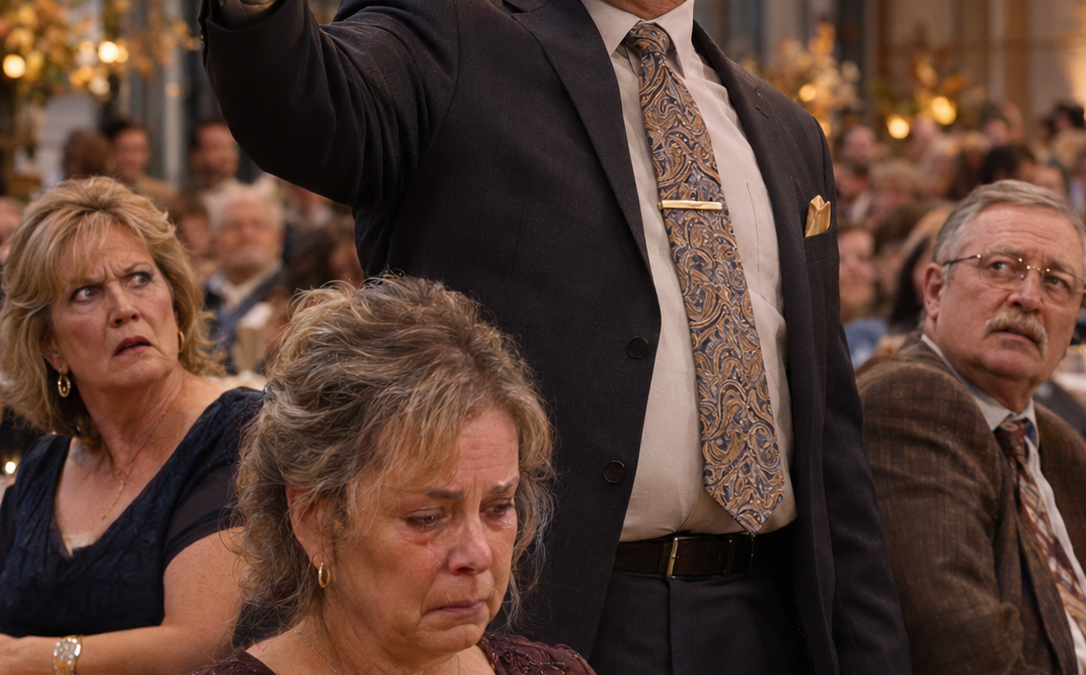
Alfred Boone raised his trophy during the welcome toast.
Seventy coworkers heard him.
My place card sat beside my plate with one name printed on it: Audrey.
I had worked at that depot for twenty-eight years.
I was the school-bus dispatch coordinator, not the woman Alfred liked to picture pushing a broom.
I had earned that title.
Dispatch was not a broom closet with a telephone.
I kept daily assignments straight, tracked changes, and answered drivers when a route went wrong.
A late bus could affect a whole morning.
A missed transfer could leave a child waiting where nobody expected.
I had spent years learning which details needed attention first and which could wait.
After a shift, I cleaned up with the rest of the crew.
We stacked cups, wiped tables, and put the room back in order.
That was ordinary teamwork.
It was never the job I had been hired to do.
For years, Alfred had made little jokes about my work whenever someone important visited.
He called route planning clerical help.
He called timing checks busywork.
He called the training I gave new drivers something anybody could do.
I had learned to keep my expression calm.
That did not mean the words stopped hurting.
My stomach tightened when he lifted the trophy.
I knew he was about to make my retirement dinner into another lesson about my place.
The yellow toy bus beside my plate was meant for the farewell display.
I had brought it because the drivers used that little shape when they talked about our route system.
I had set it beside my place card before the guests arrived.
I thought it belonged there.
Alfred glanced at it, then at me.
I folded my hands beneath the table.
“Say my job title,” I said.
Herbert Simmons laughed once.
It was a quick sound, almost a cough.
Then he straightened the yellow bus beside my plate, turning its front wheels toward the room.
Herbert had organized the dinner.
I watched his fingers leave the toy bus.
He looked at the table instead of me.
That small laugh hurt more than Alfred’s speech.
Herbert knew what I did.
He had driven routes I helped build, and he understood the care it took to keep them on time.
He knew dispatch depended on clear answers and careful timing.
But he had laughed when Alfred made me small.
Alfred lowered the trophy just enough to point it toward my place.
“Audrey has always been useful for tidying up,” he said. “Herbert, move her chair so we can make room at the front.”
The room seemed to hold still.
My cheeks grew hot.
I had spent twenty-eight years making sure buses left safely and drivers knew where to go.
Now my manager was presenting me as somebody useful after the real work was done.
Several coworkers studied their food.
Nobody corrected him.
They were waiting for me to make it easy.
If I smiled, the insult could pass as a joke.
If I objected, Alfred could call me difficult.
I was tired of being handed those choices.
Herbert stepped behind my chair.
He hesitated, then pulled it away from the front table.
The scrape crossed the floor louder than it needed to.
I did not argue with him.
I picked up my untouched plate and carried it to the side table.
My hands were steady enough to keep the fork from sliding.
My chest was not.
I felt hurt, then anger, then the familiar embarrassment of being made into a public example.
I wasn’t there to be praised for being pleasant.
I had come to say goodbye to the people I had worked alongside for twenty-eight years.
I set the plate down and asked Herbert for a program.
Herbert had a copy folded beside the stack of napkins.
He passed it to me without meeting my eyes.
The paper had a crease through the welcome remarks.
I opened it near the side table, away from the front-row chairs.
The first page listed the evening’s speakers.
Alfred’s name appeared beneath the route-system presentation.
I turned to the section about the paired-loop routes.
The program credited Alfred alone.
No mention of the years I had spent working through the timing.
No mention of the drivers who had tested the changes with me.
No mention of the transfer point we had adjusted until the buses met without leaving children waiting.
The wording suggested the system had appeared fully formed in Alfred’s office.
I felt my jaw tighten.
I knew the work I had done.
I also knew how easily a printed page could become the version people remembered.
The program was not a passing joke.
It would sit in people’s homes and staff folders after the dinner ended.
I looked toward the front table.
Alfred was accepting congratulations with the trophy held at chest height.
He had not even looked at the program.
Herbert stood near the serving counter, collecting empty glasses.
I walked over and held out the page.
“Did you see this?” I asked.
Herbert glanced at the route section.
His mouth tightened.
“I saw the program,” he said.
“That isn’t what I asked.”
He placed the glasses on the counter.
I waited, hoping he would finally say something useful.
Instead, he looked toward Alfred.
“I was told it was final,” he said.
I returned to the side table.
I did not want a scene before the closing presentation.
I wanted the printed record corrected while the people who had heard Alfred’s toast were still in the room.
I turned the page over, checking whether the route section continued.
A short handwritten instruction appeared beside the listing.
The note said:
Remove Audrey from route section. A.B.
I stopped.
I recognized those initials.
They belonged to Alfred Boone.
I lifted the marked program and carried it toward Traci Phillips.
I needed to know whether Traci would read Alfred’s editing instruction.
You may also like
My Father-in-Law Called Me The Handyman At His Anniversary, So I Checked His Camera And Everything Changed
My Brother Called Me a Thief at Dad’s Birthday, So I Opened His Messages and Exposed His Lie
My Sister Claimed My Cabin At The Association Meeting, So I Checked The Records And Found A Surprise
A.B.
Alfred had ordered my name removed.
Picking up where the Facebook post left off
Chapter 2: The Official Version
The room around Traci’s table seemed suddenly smaller.
“I need this corrected before the closing presentation,” I said.
I held out the program with the handwritten instruction facing up.
Traci Phillips took it by the edges.
She read the note without changing her expression.
“Who gave you this?” she asked.
“Herbert had the program.”
“Did he write the initials?”
“I don’t know. I know whose initials they are.”
Traci looked toward the front table, where Alfred was still holding his trophy.
Then she turned to the stack of programs beside the welcome table.
“Stop handing these out,” she told the coworker standing there. “Please collect the copies that are still here.”
The coworker nodded and began gathering them.
Traci kept my marked copy.
“I won’t let another one go out until we check this,” she said.
I felt my shoulders loosen, but only a little.
A correction was not the same as an apology.
It was not even a promise that the truth would be printed.
Still, somebody had finally stopped the paper from spreading.
Alfred came over before I could say anything else.
His smile was ready before he reached us.
“What’s the delay?” he asked.
Traci held the program at her side.
“Audrey has asked for a correction to the route section.”
Alfred looked at me, not at the paper.
“I designed those routes myself.”
His voice carried far enough for the people nearest us to hear.
My stomach tightened.
He had said it so easily, as if saying it in front of witnesses made it true.
I remembered the worktables covered in route maps.
I remembered drivers waiting while we checked transfer times.
I remembered the calls that came when one bus ran late and another had to adjust.
Alfred watched my face.
“You don’t need to make this uncomfortable,” he said. “Stand beside me for the photograph with the trophy, and we can leave the program alone.”
He tipped the trophy toward the photographer’s area.
The offer was meant to sound generous.
A place beside him. A picture. A little public kindness.
All I had to do was let him keep my work.
My throat felt tight.
I had spent years accepting small comforts in place of proper credit.
A thank-you after a long shift.
A nod when a driver repeated something I had taught him.
A place at the edge of a meeting where my own work was being discussed.
I did not want another token.
“No photograph,” I said.
Alfred’s smile thinned.
Traci turned toward me.
“What year was the route project?” she asked.
“2010,” I said. “Alfred was the route supervisor then.”
Alfred gave a short laugh.
I kept looking at Traci.
“The system used two loops,” I said. “They met at one transfer point. The timing had to work both ways, or the second loop left people waiting.”
I could still picture the route sheets spread across the dispatch table.
One loop brought buses in.
The other carried them back out.
The transfer point was where a few minutes could save an entire morning.
I had checked those minutes with the drivers.
I had worked through the changes until the connections held.
Alfred waved one hand.
“That was clerical work,” he said.
The word stung because it was familiar.
He used it whenever a task required patience but did not come with a microphone.
I felt anger rise into my face.
I wanted to list every late run we had prevented and every transfer we had repaired.
Instead, I kept my answer short.
“It was the route system.”
Traci folded the program closed.
“I want to check the request you made on Wednesday,” she said. “Come with me.”
I followed her through the doorway into the adjoining records office.
The dining hall noise softened behind us.
A desk lamp lit the folders stacked along one wall.
Traci set the program on the desk and opened the personnel folder with my name on its tab.
I remained at her shoulder as she reviewed the entries.
There were records of my position and service.
There was no recognition for the paired-loop project.
No project credit.
No entry explaining who had designed the routes or tested the transfers.
I felt the old frustration return.
I had asked for a correction before the dinner.
I had expected the personnel record to settle the matter.
Instead, it gave us nothing.
Traci closed the folder carefully.
“Your request mentioned the original recognition process,” she said. “This may not be in personnel records.”
She moved to the historical award index.
I watched her scan the headings.
The index was arranged by year, then by the kind of recognition.
Traci paused over the section for staff merit nominations.
“Do you remember which year the nomination was submitted?” she asked.
“2010,” I said. “It was the route project.”
She turned to the index and checked the filing instructions.
I could hear Alfred’s voice through the office door.
He was speaking to someone near the microphone.
I felt my hands tighten against the edge of the desk.
The dinner was moving on without us.
I had no idea what the index would show.
I only knew the personnel folder had not carried my work.
Traci traced a line in the index with one finger.
Then she stopped.
“Historical nominations are filed differently,” she said.
I leaned closer.
Under whose name had my work been filed?
The index did not organize nominations under the employee who received them.
It organized them under the person who submitted them.
You may also like
My Sister Shamed Me At Her Birthday, So I Asked To See Mom’s Caregiver Bill
My Sister Shamed Me At Mom’s Memorial, Then My Niece Played The Message She Hid
My Son Banned Me From The Cabin At Christmas, So I Made A Move He Never Expected
The nominator’s name came first.
Not the employee’s.
Chapter 3: The Name On The Sleeve
The office door stood open, and the dining hall sounded farther away.
“Alfred Boone,” I said.
Traci looked at the name under the 2010 heading.
“That is the nominator,” she said.
I nodded.
I knew Alfred had supervised routes that year.
I had not known he had submitted a merit nomination connected to the system.
Traci checked the index number, then crossed to the records cabinet.
The cabinet was locked.
She took a key from her ring and opened it.
I stayed beside the desk while she searched the section marked historical awards.
The binders were arranged by year and nominator.
She found the one with Alfred’s name on its spine.
“Here,” she said.
She carried it to the desk and set it down carefully.
The binder was thicker than I expected.
Its cover had a typed label for the staff merit nominations.
Traci opened it to the marked section.
A clear sleeve held a four-page document.
The cover page showed the project title and the names.
Audrey Hines appeared as the employee nominated.
Alfred Boone appeared as the nominator.
I felt my throat tighten.
My name was there.
Not in a program someone had changed at the last minute.
Not in a story I was asking people to believe.
It was on an original nomination filed years earlier.
I had never been given a copy.
I leaned closer, but Traci kept one hand on the sleeve.
“The pages are still together,” she said.
She did not pull them out.
I could see the edges of the remaining pages behind the cover.
The contribution paragraphs were inside.
I wanted to know what Alfred had written.
I also knew we had to be careful.
Traci checked the filing label against the index entry.
Then she compared the sleeve number with the original record in the binder.
“This is the correct file,” she said.
I looked at Alfred’s name again.
His name had followed the nomination into the archive.
He had submitted it.
I still did not know what he had written about my work.
The pages stayed inside the sleeve.
Traci was still checking the filing entry when a figure appeared in the open doorway.
Herbert stood there, one hand on the frame.
“Audrey,” he said. “You need to come back.”
My stomach tightened.
“What happened?”
“Alfred’s moving your things off the table.”
For a second, I forgot the binder.
My farewell belongings were still in the dining hall.
The yellow bus was on my table.
I had left it there when Traci asked me to come into the office.
I knew Alfred could make a point of moving it.
I had not expected him to do it while I was gone.
“I’ll be right back,” I told Traci.
I left the office immediately.
The dining hall was still full of coworkers.
Alfred stood beside my table, holding the yellow bus.
My farewell box had been pushed toward the serving counter.
I felt a sharp pinch in my chest.
“Put that down,” I said.
Alfred turned toward me.
“I was clearing the table,” he said. “The presentation needs the space.”
“My things stay where I put them.”
His smile was small and patient.
“It’s a shared room, Audrey.”
I picked up the box and moved it back beside my chair.
Then I took the yellow bus from his hand.
He released it without a fight, but his expression told me he disliked being stopped.
Herbert stood a few steps away.
He had followed me out of the office.
I looked at him.
“Why did you move my chair?”
Herbert’s eyes dropped to the floor.
“Alfred told me to.”
“Why did you follow the instruction on the program?”
He worried the folded corner of his program between two fingers.
“He said Traci had approved the change.”
I felt the room narrow around us.
“Traci approved removing my name?”
Herbert nodded once.
“That is what he told me.”
The office door was still open behind us.
Traci could hear the conversation.
I turned toward it.
“Traci, did you approve the change to the program?”
Her voice came clearly from the doorway.
“No, Audrey. I did not approve it.”
Herbert looked up.
His face changed.
I could see he had expected the answer to be different.
I wanted to ask why he had accepted Alfred’s word without checking.
I wanted him to say exactly what Alfred had told him.
The marked program was still in Traci’s hands.
The nomination was still inside its sleeve.
And Herbert had just repeated the excuse Alfred had used to make the erasure look official.
Would Herbert name who had really ordered it?
Alfred had used Traci’s name to authorize a change she never approved.
You may also like
My Daughter Made Me Her Free Camp Grandma At The Summer Kickoff, Then A Dad Handed Me Her Week 9 Envelope
My Supervisor Called Me A Cleaner At Christmas Dinner, So I Kept My Seat And Questioned Her Credit
My Adoptive Mother Pulled My Chair Away At My 50th Birthday, So I Called The Woman She Hid
He had made her the excuse.
And Herbert had believed him.
Chapter 4: One Last Useful Favor
Herbert’s eyes stayed on the floor.
Alfred turned back to my table and shoved my farewell box toward the serving counter.
“Since you’re over here, Audrey, you can clear these plates before my presentation,” he said.
My stomach tightened.
He had already moved my chair and tried to move my belongings.
Now he wanted me carrying dishes while he stood at the microphone.
I looked at the box sliding toward the counter.
The yellow bus was still beside it.
I stepped forward, caught the box, and brought it back beside my chair.
“No,” I said. “I’m not clearing plates during your presentation.”
Alfred gave me a patient smile.
“I was trying to make you useful.”
The words stung because he knew exactly what he was doing.
He wanted the room to see me serving while he received the credit.
I had spent years making sure other people got where they needed to go.
I was not going to spend my retirement dinner carrying his dirty plates.
Herbert came around the table.
He picked up my place card before it slipped beneath the edge of the box.
The card had been set near my plate earlier.
Herbert held it for a moment, then offered it to me.
I took it.
My first name was printed across the front.
Alfred watched the exchange.
“She never tested a single transfer,” he said to Herbert.
His voice was loud enough for the nearest tables.
I felt the familiar sting behind my ribs.
He had turned a piece of work I knew by heart into a claim nobody could check from the dinner program.
I looked at Herbert.
“Do you remember the Benton Street transfer stop?” I asked.
Herbert’s expression changed.
“The rainy morning when the first loop came in late,” I continued. “We stood by the curb and timed the second loop coming through. I asked you to hold until the other bus cleared the turn.”
The rain had soaked my sleeves that morning.
Herbert had been in the driver’s seat, watching the clock and the road.
We had checked the connection more than once because the first timing left too little room for a late bus.
I remembered the water running along the curb.
I remembered Herbert telling me the revised timing would work.
I remembered going back to dispatch and changing the schedule.
Herbert nodded, barely.
“I remember the stop,” he said quietly.
“Then you remember I tested it.”
He glanced toward Alfred.
“Please, Audrey. Keep this private.”
That hurt in a different way.
He knew the truth.
He was still asking me to protect the people who had made it difficult to say.
I felt anger rise, but I did not turn it on him.
“You don’t have to protect me,” I said.
Herbert lowered his eyes again.
Alfred picked up a stack of empty plates and set them near the serving counter.
“Let’s not turn a retirement dinner into a complaint session,” he said.
Heat crept up my neck.
He had insulted me in front of seventy coworkers, moved my chair, pushed my things aside, and now wanted to decide which words were allowed.
I kept my place card in my hand.
The little rectangle felt flimsy.
My name should not have been something people could move around at will.
The office door opened behind us.
Traci came back into the hall carrying the clear-sleeved nomination.
She walked directly to our table.
“I checked the original filing entry,” she said. “The binder and sleeve number match the historical record.”
I watched the document.
My name was visible on the cover.
Alfred’s name was there too.
The contribution pages remained inside.
I still did not know what he had written.
Traci held the sleeve against her side.
“I have verified that this is the original nomination,” she said.
Alfred looked at the document.
For the first time that evening, his smile disappeared.
Then he turned toward the microphone.
“I trained every driver on that system,” he announced.
He reached for the microphone stand.
Traci moved before his hand touched it.
“The closing remarks will be mine,” she said.
Her voice was calm.
There was no joke in it.
Alfred stopped with his fingers inches from the microphone.
I felt the room paying attention again.
The trophy was still on the table.
The yellow bus was beside my box.
My place card was in my hand.
And Traci had brought back the one document Alfred had never expected me to see.
I wanted to know what she had found inside it.
The pages were still covered.
Alfred stepped close enough that only the people around our table could hear him.
“Contradict me, Audrey, and that will be your final reputation at this depot,” he said.
You may also like
My Sister Knocked My Birthday Plate Down, So I Kept The Receipts She Signed
My Son Stranded Me Before Our Family Reunion, So I Called The Driver And Heard What He Sent
My Son Called My Gift Garbage At His Housewarming, So I Asked His Wife About The Bill
He was no longer asking me to be quiet.
He was telling me what he intended to take from me.
Chapter 5: The Signature
Alfred’s threat was still stinging when Traci turned toward me.
“Come with me, Audrey,” she said.
The clear sleeve was still in her hand.
I followed her into the adjoining office.
She crossed to the desk and immediately laid the original nomination flat.
“I want you to see exactly what was submitted,” she said.
She opened the sleeve and turned to the first contribution page.
I leaned over the desk.
The first paragraph was short.
Audrey Hines designed the paired-loop route system.
I stopped breathing for a second.
Beside the paragraph were Alfred’s initials.
A.B.
Traci turned the page.
The second contribution paragraph was directly below the heading.
Audrey personally tested the transfer timings.
Again, his initials appeared beside the words.
I felt my eyes sting.
I remembered the route sheets spread across the dispatch table.
I remembered the early mornings and the calls from drivers who needed a timing changed.
I remembered Alfred standing nearby while I worked through the details.
He had known exactly who did the work.
Traci turned to the next page.
Audrey trained every driver assigned to the rollout.
A.B. appeared beside that paragraph too.
I put one hand against the desk.
Three paragraphs.
Three clear descriptions of my work.
Three sets of initials from the man who had just told seventy coworkers I had wasted twenty-eight years sweeping floors.
I looked at the final page.
Alfred Boone’s signature was at the bottom.
His full name.
His handwriting.
I felt anger move through me, but something else came with it.
Relief.
I had spent years wondering whether I had failed to explain my contribution clearly enough.
I had asked for corrections.
I had tried to make the record accurate without embarrassing anyone.
I had even accepted his jokes because I thought keeping the peace might eventually help.
But he had already put the truth in writing.
He had signed it.
“Is this the original?” I asked.
“Yes,” Traci said. “I checked the filing entry, the binder, and the sleeve number.”
She kept one hand on the document.
“This was an unsuccessful internal staff merit nomination from 2010. It was filed separately from personnel records.”
I looked at her.
“I never saw it.”
“I understand,” she said. “I had never seen it either. The nominations were kept in the historical award archive, not in the employee files.”
That explained why my earlier requests had gone nowhere.
The personnel folder had nothing about the project.
The original recognition record had been somewhere else entirely.
Under Alfred’s name.
He had submitted the nomination himself.
The original had remained in the archive under his name while he later claimed the work as his own.
I looked back at the three paragraphs.
“Those two loops met at one transfer point,” I said. “The timing had to work for buses arriving from both directions.”
Traci listened.
“I tested those transfers because a few minutes could leave children waiting. Then I trained the drivers assigned to the rollout.”
I did not need another document to explain what those sentences meant.
I remembered the work.
I remembered the responsibility.
I remembered the drivers who depended on those routes being right.
Traci looked down at the nomination.
“I want to correct the record tonight,” she said.
My stomach tightened.
“Will you read it?”
“I will read only the three paragraphs about your work. I won’t discuss private personnel information or anything unrelated to the project.”
She was careful with her words.
She was not promising a public argument.
She was offering a public correction.
I looked toward the open office door.
The dining hall was still full.
Alfred was probably already preparing his closing presentation.
“I agree,” I said.
Traci waited.
I wanted to make one thing clear.
“All seventy coworkers need to hear it,” I said. “Not just the people sitting near us.”
She nodded.
“They will.”
I felt my hands settle against the desk.
For years, I had tried to get one person to acknowledge what I had done.
The coworkers who had heard Alfred diminish me deserved to hear the truth from Traci.
I did not want the correction passed around later as a rumor.
I did not want it softened into a private misunderstanding.
The same room that had heard his claim needed to hear the words he had signed.
Traci placed the nomination back inside its clear sleeve, keeping the signature page accessible.
“We should go back now,” she said.
I followed her out immediately.
The dining hall had not changed much.
The trophy still sat near the front table.
Alfred had positioned it carefully beside the place where the photographer was expected to stand.
He adjusted its angle and checked the space beside it, preparing to pose.
He looked pleased again.
That expression made my stomach turn.
He still believed the room belonged to him.
I walked to the front table.
My chair had been moved away earlier, but it was still nearby.
I took hold of its back and brought it to my place at the table.
Nobody stopped me.
I went back to the side table and picked up my untouched plate.
I carried it to the front table and set it down beside my place card.
Then I sat down.
My hands shook a little as I straightened the card.
I was not asking for a favor.
I was taking back the seat that should never have been taken from me.
Traci approached with the nomination in her hands.
Alfred noticed the document.
His eyes moved from the sleeve to her face.
Then he looked at me.
Would Alfred deny words bearing his own signature?
Traci reached the microphone before he could answer.
She opened it, holding the signature page ready for all seventy witnesses.
You may also like
My Husband Shamed Me At Our Anniversary, So I Called The Jeweler He Named
My Fundraiser Chair Sent Me To Eat By The Trash, So I Refused To Keep Serving
My Brother Accused Me Of Selling Mom’s China At Thanksgiving, So I Asked For The Buyer
Alfred Boone’s name faced the room.
And this time, it would be read aloud.
Chapter 6: The Original At My Plate
The microphone gave a small click.
Traci stepped to the front table and set the original nomination before me.
She kept one hand on its edge.
Alfred stood across from us, holding his trophy.
For a few seconds, nobody moved.
The trophy caught the overhead light.
The clear sleeve lay open beside my plate.
My name showed on the page, and Alfred’s signature waited below it.
Seventy coworkers watched from their seats.
I could hear someone shift a chair near the back.
Traci did not turn the page yet.
She looked at Alfred.
“Earlier, you said, ‘I designed those routes myself,’” she said.
Alfred lifted his chin.
“I did.”
Traci turned the page toward the room.
“Then explain this signature.”
She read the first contribution paragraph aloud.
Audrey Hines designed the paired-loop route system.
My stomach tightened as the words crossed the room.
I had heard them privately in the office.
Hearing them in front of the people who had listened to Alfred’s toast felt different.
This time, nobody could pretend the credit was unclear.
Alfred stared at the paper.
“I signed the nomination,” he said.
The admission came quickly.
He did not look at me.
“I was just being generous on an award form.”
A few people glanced at one another.
I felt anger rise into my throat.
Generous.
He had written my name because he knew I had done the work.
He had initialed the paragraph because he had agreed with it.
I had asked him to correct my credit before.
He had brushed those requests aside, each time making it sound as if I had misunderstood my own work.
Now he wanted the room to believe he had offered me a favor.
Traci kept her voice even.
“Your signature is on the final page, and your initials are beside this contribution.”
Alfred adjusted his grip on the trophy.
“I don’t remember every word on a form from sixteen years ago.”
I looked at the page.
I remembered the work from sixteen years ago.
I remembered the route sheets, the timing checks, and the drivers waiting for revised instructions.
Traci turned to the second contribution.
“Alfred also said Audrey never tested a single transfer,” she told the room.
Then she read the next paragraph.
Audrey personally tested the transfer timings.
The initials beside it were clear.
A.B.
I felt the old frustration return, but it had nowhere to hide now.
The man who had called my work clerical had documented that work himself.
I looked at Alfred.
“You wasted twenty-eight years sweeping floors.”
I repeated his opening insult exactly.
My voice shook, but I kept speaking.
“I did help sweep after coordinating routes. I cleaned up with the rest of the crew. I never did it instead of doing my job.”
My hands were trembling.
I wanted the room to understand that cleaning up after a shift was not shameful.
What hurt was being reduced to it.
I saw one of the drivers from the old morning shift look down at his hands.
Another kept his eyes on the page.
I couldn’t tell whether they were embarrassed for me or themselves.
I only knew the words had finally reached the whole room.
I had coordinated routes before I stacked chairs or wiped tables.
I had tested transfers before I carried a plate.
I had trained drivers before I helped put the room away.
Those jobs did not cancel one another out.
Alfred’s mouth tightened.
He shifted the trophy against his chest.
“She wrote it. I only signed where she told me.”
The room went quiet again.
That excuse was worse.
He was asking people to believe I had prepared a nomination praising my own work and then directed him to sign it.
I had never seen the nomination before that evening.
Nobody had shown me the form or asked me to approve its wording.
I had never known he had submitted it.
Traci did not argue with him.
She turned to the third contribution paragraph.
Audrey trained every driver assigned to the rollout.
His initials appeared beside it.
A.B.
Traci kept one finger near the sentence.
“This paragraph is also part of the original nomination,” she said. “It is not a later addition.”
Alfred looked toward the microphone.
I followed his glance.
He still held the trophy, but his fingers had tightened around its base.
Traci looked toward Herbert.
Herbert stood near the aisle, close enough to hear every word.
He had organized the dinner.
He had moved my chair.
He had asked me to keep the argument private.
I knew he had a reason to be careful.
Alfred controlled his shifts.
Would Herbert contradict the man who controlled his shifts?
Traci returned her attention to the page.
“The paragraph says Audrey trained every driver assigned to the rollout,” she said.
Then she looked directly at Herbert.
“Herbert Simmons was one of those drivers.”
His face changed.
He did not speak.
But the original had already placed him inside the sentence.
You may also like
My Husband Humiliated My Son At His Academy Banquet, So I Checked The Mail He Handled
My Mom Mocked My Job At Thanksgiving, So I Asked Questions And Uncovered My Brother’s Secret
My Stepdaughter Locked Me Out Of My Own Cabin Bedroom, So I Read Her Group Text Out Loud
Alfred himself had included Herbert among the drivers Audrey trained.
His initials stood beside the admission.
Chapter 7: The Driver Who Stood
Herbert stared at the page.
Traci kept her finger beside the training paragraph.
“Alfred’s nomination says Audrey trained every driver assigned to the rollout,” she said. “That includes the drivers who learned the system directly from her.”
Herbert shifted near the aisle.
I watched him.
He had laughed when Alfred insulted me.
He had moved my chair.
He had asked me to keep the argument private because he did not want trouble with his manager.
I knew he had a job to protect.
I also knew I had spent years helping him do it.
Traci waited.
Herbert looked at Alfred, then at the original nomination.
Slowly, he stood straighter.
“Audrey trained me. I let you take her name off tonight’s program.”
His voice was not loud.
But the room heard him.
My stomach tightened.
I had wanted him to tell the truth.
Hearing him admit he had helped erase me still hurt.
Alfred turned sharply.
“Sit down, Herbert.”
Herbert stayed where he was.
“I said sit down,” Alfred repeated.
For years, that tone had been enough to end a conversation.
Herbert looked toward me.
Then he faced the room again.
“Audrey taught me the Benton Street transfer,” he said. “The first loop was coming in late, and we had to keep the second bus from leaving too early.”
I remembered the rain.
I remembered standing beside the curb while Herbert watched the road.
“We checked the timing until the connection worked,” Herbert continued. “She showed me when to hold and when to move. I used that instruction on my routes afterward.”
His voice grew steadier.
“That wasn’t clerical work. I needed what she taught me.”
I felt my eyes sting.
He had finally said it in front of the people who mattered.
But his admission about the program still sat between us.
He had known what Alfred was doing.
He had followed the instruction anyway.
I was grateful he had stood.
I was not ready to pretend he had done nothing wrong.
Herbert stepped away from the aisle and returned the microphone to Traci.
Alfred’s face had tightened.
He looked at Herbert as if the driver had broken some private agreement.
Traci took the microphone.
“I am withdrawing the inaccurate commendation,” she said.
Nobody moved.
She continued.
“The project history will be corrected. Audrey Hines will be credited for designing the paired-loop route system, testing the transfer timings, and training the drivers assigned to the rollout.”
I felt my shoulders loosen.
Those were the contributions written on the original nomination.
Nothing exaggerated.
Nothing added.
The work had a name now.
Mine.
Traci looked toward Alfred.
“You will no longer present this project as your individual design.”
Alfred’s jaw moved.
He looked down at the trophy in his hands.
For a moment, I thought he might argue again.
Instead, he walked to the front table.
He lowered the trophy and set it on the wood himself.
The small sound of its base touching the table carried farther than I expected.
Nobody applauded.
Nobody laughed.
Alfred stood beside it without the smile he had worn during the welcome toast.
I looked at him.
“You signed my name into the truth.”
My voice was quiet.
I had no interest in shouting.
He had put the words on paper sixteen years earlier.
He had signed them.
He had initialed the paragraphs.
He had known what I contributed before he stood up that evening and called me a woman who swept floors.
Traci kept the original nomination with her.
The room remained still.
Then Herbert left the aisle and returned with a stack of leftover dinner programs.
He carried them carefully, holding the pages against his chest.
“I need to show you something,” he said to Traci.
She accepted the stack.
Herbert pointed to the route section.
“This is the version they handed out tonight.”
Traci nodded.
“We have stopped distribution of the remaining copies.”
Herbert hesitated.
“There’s another place this appears.”
I looked at him.
“What place?”
He glanced toward Alfred before answering.
“The new drivers’ orientation packets.”
My stomach tightened again.
Herbert placed one program beside the original nomination.
“They use the same route history when they explain how the paired-loop system was developed.”
Traci looked down at the printed section.
Herbert continued.
“I’ve seen the packets. They give Alfred the credit there, too.”
I felt cold in my hands.
The dinner program had been wrong.
That was bad enough.
But the false version had traveled beyond this room.
New drivers had been learning the history from material that erased my contribution.
They had been told who designed the system.
They had been shown whose name belonged beside the work.
And my name was missing.
I looked at the stack in Traci’s hands.
The people at this dinner had heard the correction.
The incoming drivers had not.
Would the correction reach people beyond this dinner?
The false history was still being handed to incoming drivers.
You may also like
My Son-in-Law Sent Me To A Motel For Christmas, So I Came Back With A Pie And His Own Texts
My Daughter-in-Law Trashed Sunday Lunch, So I Brought Proof That Silenced Her Celebration
My grandson skipped my 70th birthday for Vegas. Monday he stormed into my bingo night, furious his truck payment bounced, but the truck was in my name.
In their orientation packets.
Under Alfred’s name.
Chapter 8: The Corrected Page
Under Alfred’s name.
I looked at the programs Herbert had brought to Traci.
The printed route history was still wrong.
The original nomination had corrected what happened sixteen years ago.
But the orientation packets could keep repeating Alfred’s version for years.
I turned toward Traci.
“The current drivers need the correction too,” I said. “And the incoming drivers.”
Traci looked down at the stack.
“I’ll make sure the corrected history reaches both groups,” she said.
“Will it replace the version in the orientation packets?”
“Yes. The inaccurate copies will be withdrawn.”
I wanted something more definite than another promise.
Traci understood.
She took a note sheet from the desk and recorded the correction commitment.
She included the current staff, incoming drivers, and the orientation materials.
Then she signed beneath it.
I watched her put the sheet with the original nomination.
My stomach finally began to settle.
The truth was no longer limited to the people who had attended dinner.
Still, I knew the work was not finished.
A corrected page had to reach the people who had been given the wrong one.
On Monday, I returned to the depot to collect my belongings.
My retirement was official.
I had no reason to visit Alfred’s office or ask permission to take home my things.
I carried an empty box through dispatch.
My desk looked smaller without the papers and personal items I had accumulated over the years.
There was a photograph in one drawer.
A spare sweater hung behind my chair.
I found a pen I had been searching for during my last month.
I placed everything carefully in the box.
Traci came over carrying a single signed page.
“I wanted you to have this before you left,” she said.
I put down the photograph.
The heading read Project History Correction.
Below it, Traci had identified the paired-loop route system and credited my contributions.
The page named me as the designer.
It recorded that I had personally tested the transfer timings.
It also credited me with training every driver assigned to the rollout.
Traci’s signature appeared at the bottom.
I read the page slowly.
There was no inflated praise.
No grand description of my character.
Just the work, accurately recorded.
“This is your copy,” she said.
I took it with both hands.
“Thank you.”
I slipped it into the box, keeping it flat between the photograph and my folder.
Then Traci asked me to stay while she handled the project reassignment.
Alfred came into the office carrying the route-revision binder.
His presenter badge was clipped to his shirt.
He looked at Traci, then at me.
“This can wait,” he said.
“No,” Traci replied. “I need the route-revision binder and your presenter badge.”
Alfred glanced at the binder in his hands.
“Are you taking me off the project?”
“I’m taking project control,” she said. “The current history and revision work will be under my direction.”
His expression hardened.
He had spent the dinner claiming the system as his own.
Now the responsibility for its records was being taken out of his hands.
Traci held out her hand.
“Please put both items on the desk.”
Alfred hesitated.
Then he unclipped the badge and placed it beside the binder.
The plastic made a small tapping sound against the desk.
I watched him release the binder.
It was the same binder he had used to present route changes as his work.
Traci moved it to her side of the desk.
“I am also rescinding the inaccurate commendation,” she said. “Your pay and pension remain unchanged. This is a project reassignment and a correction to the recognition record.”
Alfred’s mouth tightened.
He did not apologize.
He did not look at me.
I felt no satisfaction in knowing his pay would remain the same.
I wanted the record corrected.
I wanted the work handled by someone who would not erase the people who did it.
Traci had made that decision.
That was enough for me.
I picked up my box and walked back through dispatch.
A fresh page had been placed beside the dispatch desk.
I stopped when I saw my name.
The corrected project history was posted where drivers could see it.
My full name appeared above the three contributions.
Audrey Hines.
Designer of the paired-loop route system.
Tester of the transfer timings.
Trainer of the drivers assigned to the rollout.
I stood there for a while.
Drivers passed the desk and glanced at the page.
One stopped to read it.
Another gave me a small nod.
Nobody made a speech.
Nobody needed to.
The record was finally where the work had happened.
I was reaching for my box when Herbert came through the doorway.
He carried a white cake box with both hands.
I recognized it immediately.
It was the cake saved after the interrupted retirement dinner.
The cake that had never made it to the table.
I looked at Herbert.
“You kept it?”
He nodded.
“I took it home after dinner.”
I felt a little ache in my chest.
He had helped organize the evening.
He had also helped Alfred make it something I would rather forget.
Now he was standing in dispatch with the cake box.
I did not know what to make of that yet.
“Why did you save it?” I asked.
Herbert set the box on the counter.
He looked uncomfortable, but he did not turn away.
“I didn’t want your retirement to end that way,” he said.
I looked at the white lid.
My name had been missing from the program.
My chair had been moved.
The cake had been left untouched.
I had gone home with a box of belongings and a retirement dinner that belonged to somebody else.
Herbert seemed to understand that saving a cake could not repair all of it.
He kept one hand on the box.
“There’s something else,” he said.
I waited.
Herbert explained that several coworkers had spoken to him after the dinner.
They had not wanted Alfred to arrange another event.
They wanted the farewell I should have had.
They had asked Herbert to organize it.
You may also like
My Son-in-Law Called Me Forgetful On Mother’s Day, So I Took Notes And Exposed His Plan
My Cousin Called Me A Thief At Thanksgiving, So I Checked The Log And Found What He Hid
My Son-in-Law’s Mother Locked Me Out On MEA Weekend, So I Photographed What She Left Behind
My coworkers had asked Herbert to arrange my farewell again.
This time, they wanted my name on the invitation.
Chapter 9: My Whole Name
This time, they wanted my name on the invitation.
I looked at Herbert and then at the cake box.
“Can I see it?” I asked.
He lifted the lid carefully.
The cake was still intact.
The white icing had been protected, and the lettering remained clear.
Audrey Hines — Twenty-Eight Years of Service.
I felt my throat tighten.
My name.
My years.
The service Alfred had reduced to sweeping floors.
I looked at the cake for a long moment.
Nobody had cut it.
Nobody had taken the first slice.
It had been waiting while the dinner went on without me.
Herbert kept his hands on the box.
“I should have stopped him,” he said.
I looked up.
“When Alfred told me to move your chair, I moved it,” Herbert said. “I did what he instructed.”
He looked down at the cake.
“I should have refused. When he changed the program, I should have refused that too.”
He paused.
“I let him turn your retirement into his own celebration.”
The admission hurt.
I had wanted Herbert to stand up for me that evening.
Instead, he had laughed, moved my chair, and asked me to keep quiet.
Now he was saying plainly that the chair had not moved by itself.
He had put his hands on it.
He had followed Alfred’s order.
“I know,” I said.
He nodded.
“I can’t change what I did.”
“No,” I said. “You can’t.”
I did not want to make his guilt easier.
He had been part of what happened.
If we were going to move forward, he needed to understand that.
Herbert reached into a folder and brought out several printed invitations.
“These are the corrected ones,” he said.
I took the top copy.
My full name appeared near the center.
The invitation described my twenty-eight years of service and invited coworkers to gather for coffee and cake.
It did not mention Alfred’s presentation.
It did not call the confrontation a misunderstanding.
I looked through the remaining copies.
“Are you delivering these?”
“Yes. I want everyone who was invited before to know about this gathering.”
He rubbed his hands together.
“Alfred asked me to call the dinner incident a misunderstanding.”
I looked at him.
“What did you tell him?”
“I refused.”
Herbert’s answer came without a joke.
“He wanted me to tell people you had taken his remarks the wrong way. I told him I wouldn’t.”
I felt something loosen in my chest.
It did not undo the part he had played.
Still, he had finally refused to repeat Alfred’s version of the story.
“He wasn’t confused about what he said,” I told Herbert.
“I know.”
“He knew my job.”
“I know that too.”
I folded the invitation and placed it beside the cake box.
Herbert explained that the coworkers wanted another gathering.
Nothing elaborate.
Just coffee, cake, and a chance to say goodbye properly.
He asked whether I would come to the depot for coffee in three weeks.
I hesitated.
The thought of returning to that room brought back the scrape of my chair.
I remembered Alfred lifting his trophy.
I remembered seventy people listening while he made my work sound worthless.
I also remembered Traci reading the original nomination.
I remembered the corrected page beside dispatch.
The room did not belong to Alfred.
Neither did my memories of the years I had worked there.
“Will Alfred be directing the speeches?” I asked.
“No,” Herbert said. “Traci will handle the gathering. Nobody is giving Alfred the microphone.”
I considered the invitation again.
“I’ll come for coffee.”
Herbert nodded.
“I’ll bring the cake.”
He looked down at the box.
“I should freeze it until then. The icing needs to stay intact.”
“Then freeze it.”
He smiled slightly.
“What about the yellow bus?”
I thought of the little toy beside my plate at the first dinner.
Alfred had picked it up while moving my belongings.
I had taken it back and kept it safe with my things.
“I’ll bring it from home myself,” I said.
Herbert nodded.
“I’ll make sure there’s room beside your plate.”
We talked a little longer about the invitations and who would receive them.
Herbert did not ask me to forgive him.
I appreciated that.
There were things that needed time.
When I left the depot, I carried my belongings home and placed the farewell box on my kitchen table.
I had not opened it since collecting everything.
The photograph was still inside.
So was my spare sweater and the pen I had thought I’d lost.
I took the items out one at a time.
At the bottom lay the place card.
The same card that had displayed only Audrey.
I remembered Herbert retrieving it after he moved my chair on Alfred’s instruction.
I remembered holding it while Traci brought the original nomination into the room.
I turned it over.
Something had been written on the back.
I brought it closer to the kitchen light.
The handwriting was Herbert’s.
I did not know when he had written it or how long the words had been there.
My full name was there.
Underneath it was my job title.
I felt my eyes sting.
For years, I had asked people to say what I actually did.
At dinner, Herbert had looked down.
Now the card carried the recognition I had waited years to receive.
Where would my place card stand this time?
School-Bus Dispatch Coordinator.
My full name.
You may also like
My Son-in-Law Banished Me At Christmas Dinner, So I Checked The Papers He Thought I’d Ignore
My Daughter Mocked My Seventieth Birthday, So I Checked A File That Changed Her Party
My Son Called Me His Dependent At Thanksgiving, So I Stopped Paying And Found His Family’s Secret
My proper title.
And Herbert’s handwriting beneath it.
Chapter 10: The Yellow Bus
Herbert waited beside the depot coffee table.
The thawed farewell cake sat in the middle.
Three weeks had passed since Traci signed the correction on Monday.
I walked over carrying my repaired place card and the yellow toy bus from home.
“Here,” I said, handing them to Herbert.
He took the card first and set it beside my plate.
Then he placed the yellow bus beside it.
The gathering felt different from my retirement dinner.
There was no podium.
No trophy waiting for a photograph.
No manager deciding who deserved the front table.
Just coffee, cake, and the coworkers who had spent years beside me.
I picked up the place card.
Herbert had repaired its bent edge and kept the writing on the reverse.
My full name faced the room.
The job title was underneath.
I smiled at him.
“You kept it safe,” I said.
“I figured it belonged with you.”
Herbert positioned a chair at the head of the coffee table.
He waited until I sat.
Then he rested one hand on my shoulder.
I studied the table as my eyes began to fill.
That small gesture meant more than a long speech.
At my retirement dinner, Herbert had moved my chair away from the front.
Today, he was making sure I had a place before anyone else sat down.
Traci arrived carrying the corrected project history.
She wore no presentation badge and brought no microphone.
She sat beside the drivers and placed the page on the table.
“The corrected history is now in the training materials,” she said. “The old version has been withdrawn.”
I looked at the page.
My name appeared beneath the project heading.
The three contributions were listed clearly.
I had designed the paired-loop route system.
I had personally tested the transfer timings.
I had trained every driver assigned to the rollout.
The credit was no longer hidden in a historical binder.
It was where current and incoming drivers would find it.
One of the senior drivers leaned toward the page.
“Would you sign this copy for our training binder?” he asked.
Another driver nodded.
“We’d like the new people to know who actually built the system.”
My throat tightened.
I picked up the pen.
For years, I had signed schedules, checked assignments, and corrected route sheets.
I had never imagined that signing my own contribution would feel so important.
I wrote my name beside the printed credit.
Audrey Hines.
School-Bus Dispatch Coordinator.
I put the pen down.
Nobody rushed to take the page away.
Traci looked at my signature and nodded.
“That belongs there,” she said.
I felt a quiet happiness I had not expected.
Alfred’s commendation had been withdrawn.
His route-project duties had been reassigned to Traci.
He would not present my work as his own anymore.
His pay and pension remained unchanged.
There had been no dramatic punishment.
There had been an accurate record and a clear change in responsibility.
For me, that was enough.
The drivers began cutting the cake.
Herbert had kept the icing intact.
My name and twenty-eight years of service were still written across the top.
A woman from dispatch placed a slice on my plate.
“I’m glad we get to do this properly,” she said.
I thanked her.
Then I remembered my personal box was still in my car.
“I’ll be right back,” I said.
I stepped outside for a moment.
The box was still tucked safely in the back seat.
The photograph was inside.
So was my sweater, my pen, and the place where I had kept the corrected project page.
I checked that everything was secure, then closed the car door.
For a moment, I stood beside it and looked back at the depot.
I had spent twenty-eight years entering that building before most people had finished their morning coffee.
I knew the sound of the dispatch phones.
I knew which drivers preferred their route sheets in a particular order.
I knew how much responsibility could sit inside one small change to a transfer time.
I was going to miss some of that.
I was not going to miss being made to feel small.
When I returned, Herbert was holding the yellow bus.
He moved it toward my plate, then stopped.
“Before you go,” he said, “I could always use another shift covered.”
I looked at him.
He grinned.
“I know. Terrible offer.”
I laughed.
“No more shifts, Herbert.”
“Not even one?”
“Not even one.”
He laughed too.
I sat back down and reached for my cake.
There was no schedule waiting for me.
No driver calling about a missed connection.
No route sheet that needed correcting before the next morning.
I could finish my coffee without watching the clock.
Traci sat across from me.
She asked about my plans for retirement.
I told her I wanted quiet mornings, time with people I cared about, and a few days when nobody needed anything from me.
She smiled.
“Sounds well earned.”
I looked around the table.
The drivers were talking about old routes.
Herbert was listening instead of organizing everyone.
The corrected project page was safely inside the training binder.
My name was printed where it belonged.
Being dependable should never have made me invisible.
I had spent years making room for everyone else.
This time, I kept my own seat.
You may also like
My Stepmother Demanded My Guest Cottage, So I Locked The Gate And Let Her Story Unravel
On Thanksgiving, my daughter told 31 relatives I was too confused to handle money and had filed for guardianship. In June she’d had me co-sign her $38,000 car loan.
My Ex Stole My Ring For His Wedding, So I Went Home And Found What He Forgot
My work had a name, and so did I.
The sunny window shone across my place card as Herbert rolled the yellow bus against my plate.
THE END
More stories
At Thanksgiving Mom told 19 relatives my brother the realtor ‘made it’ and I just ‘answer phones.’ Then his deed for Grandma’s house landed on my desk.My husband refused to pin my son’s police badge in front of 300 people, saying real fathers only. Then the chief carried badge 417 onto the stage.At my son’s housewarming, he called my handmade sofa garbage before 16 guests. Then his wife showed me the $2,400 bill he gave her.At our 35th anniversary, my husband told 40 guests I gambled away my wedding ring. The jeweler still had the pickup slip he signed.At our school fundraiser, the chair made me eat behind the dumpsters after 18 years cooking lunches. Then the treasurer opened her $6,800 catering invoice.At our school’s Christmas dinner, my supervisor called me the cleaner. Then a donor asked why she had signed my 14 repair estimates.
You Might Also Enjoy




