My Mother Expelled Me From Grandma’s Memorial Table, Until My Father Finally Stood Beside Me
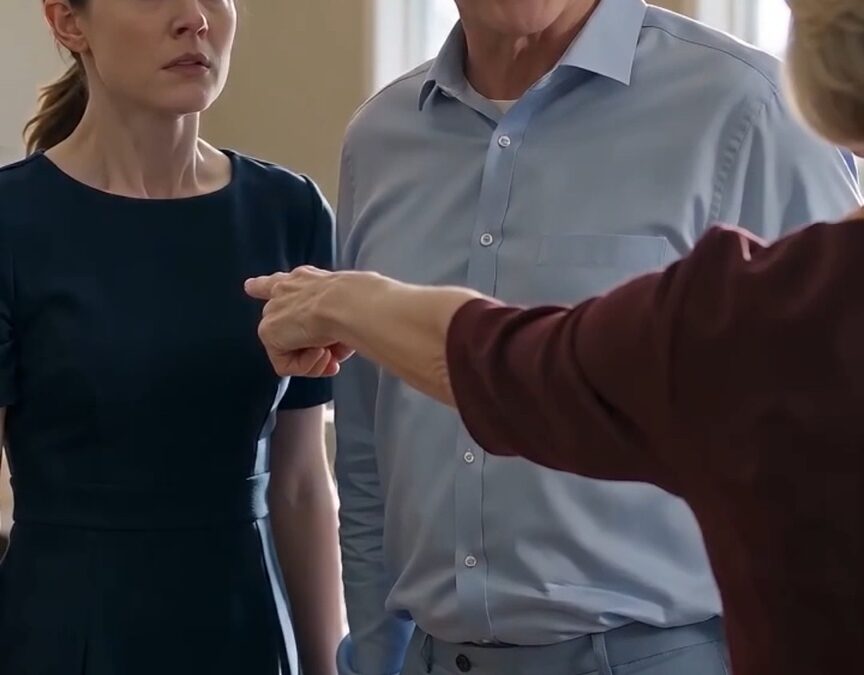
Dad stood beside me while Mom lowered her arm.
“Patricia, stop. I’m standing with Erin.”
She looked toward the table, waiting for somebody else.
“Dennis, don’t turn this into an argument.”
“You already did.”
His voice wasn’t loud.
The people near the coffee urn stopped moving anyway.
Dad looked at Paige, then back at Mom.
“The house we live in belongs to Erin.”
Paige’s face changed before Mom’s did.
“What are you talking about?”
“Erin bought it from us,” Dad said.
“She’s the only owner on the recorded deed.”
Mom reached for the back of a chair.
“That has nothing to do with today.”
“It has everything to do with what you just said.”
Dad stayed close enough that our sleeves almost touched.
“She bought it on June 1, 2021. She paid the appraised value. We signed the sale papers.”
Someone near the food table quietly set down a plate.
Nobody asked another question.
Dad answered the ones nobody was saying.
“The price was $164,000. The closing paid our mortgage. What was left went to us.”
Mom stared at him.
“We were going to keep that private.”
“We were,” he said. “Then you told everybody she doesn’t help.”
I could see Paige working through what he meant.
She looked at me instead of Mom.
“You bought their house?”
“Yes.”
“And they rent it from you?”
“They live there without paying rent.”
Mom made a small, impatient sound.
“It was a family arrangement.”
Dad nodded.
“It was. We signed an occupancy agreement.”
He looked around the room before continuing.
“Erin has also been sending us money every month.”
“Dennis,” Mom said.
“Not from Rose. Not from an inheritance.”
He turned toward me.
“From her paycheck.”
I hadn’t asked him to say any of this.
I had expected another request to smooth things over.
For years, Dad had thanked me privately.
Usually beside the car, where Mom couldn’t hear.
Now he was looking directly at her.
“She’s been paying $1,200 every month.”
Mom pulled the chair slightly away from the table.
“You’re making it sound worse than it was.”
“It isn’t an accusation. It’s what happened.”
Paige sat down without taking off her purse.
Her chair was still the chair Mom had given her.
“Then how am I supposed to move in?”
Dad turned toward her.
“What?”
Paige looked from him to Mom.
“You said there was room for me.”
Mom shook her head.
“This isn’t the time.”
“You said I could have the house eventually.”
I looked at my mother.
She wouldn’t look back.
Around us, the memorial reception had become completely still.
I wished we were anywhere else.
Grandma’s bowl sat on the food table behind Mom.
There was a cucumber slice caught against its rim.
“When did you promise her my house?” I asked.
“I didn’t promise anything like that.”
Paige leaned forward.
“You said it would be mine when you downsized.”
Mom pressed her lips together.
“I meant we would discuss it as a family.”
“You didn’t discuss it with me,” I said.
“You’re always so difficult about these things.”
“What things?”
“Helping your sister.”
Dad pulled out the empty chair nearest me.
I sat because my knees had begun to ache.
He remained standing beside it.
“Patricia, you knew the house wasn’t ours.”
“We lived there before any of this.”
“And we sold it,” he said.
“You signed the same papers I did.”
Mom looked toward the people near the kitchen.
“Could we have some privacy?”
A woman began gathering used plates.
Others turned toward the coffee or their coats.
They were giving us what space they could.
They had already heard enough.
I rested my purse on my lap.
The strap had twisted into a tight cord.
I worked it flat while Mom spoke.
“I never expected my daughter to hold paperwork over me.”
“I didn’t bring paperwork,” I said.
“You brought up my place in this family.”
“You know what I meant.”
“Yes. I think I finally do.”
Paige stood again.
“I didn’t know,” she told me.
Her eyes were wet, but she wasn’t crying.
“Mom said you were fine with it.”
“I was never asked.”
Paige looked at Mom.
“Why would you tell me that?”
“Because I thought your sister would want to help.”
Mom said it quickly, as though that settled everything.
I looked at Dad.
“Did you know about this?”
“No.”
He answered before Mom could interrupt.
“I knew about the money. Not the promise.”
That mattered, though it didn’t excuse his silence.
He had watched her minimize me for years.
He had let me keep pretending it didn’t hurt.
I looked back at Mom.
“The monthly money stops after May.”
Her head came up.
“What?”
“I’m not sending it anymore.”
“We count on that.”
“I know.”
“You can’t decide that because you’re upset.”
“It’s voluntary support. I can stop.”
Dad sat down beside me.
“We’ll make a budget,” he said.
Mom stared at him like he had joined a stranger.
“On what?”
“On what we actually have.”
I took a breath before continuing.
“And I want the house back.”
Paige moved away from the chair.
Mom’s fingers pressed against its padded back.
“You’re throwing us out at your grandmother’s memorial?”
“No. I’m telling you the arrangement is ending.”
“You just said you want the house.”
“I’ll have an attorney handle proper notice.”
Dad nodded slowly.
“No changing locks,” I added. “No surprises.”
I said it partly for him.
I also needed to hear myself say it.
I didn’t want an angry afternoon making legal decisions.
I wanted the arrangement finished properly.
Mom looked toward the door she had pointed at.
“We should go.”
“You can,” I said. “I’m staying to help clean up.”
She waited for me to soften that.
When I didn’t, she picked up her purse.
Paige followed her toward the hallway.
Dad remained seated beside me.
“I’m sorry I waited that long,” he said.
I looked at the empty place in front of us.
“So am I.”
He nodded without asking me to make him feel better.
After he left, I carried Grandma’s bowl into the kitchen.
The cucumber salad had barely been touched.
I scraped it into a container someone offered me.
Then I washed the bowl in the deep church sink.
My dress got wet against the metal edge.
I dried it with a plain kitchen towel.
Nobody asked me to explain anything.
That was the first kindness I noticed that afternoon.
At home, I put the bowl on my counter.
Then I opened the folder where I kept my closing documents.
My name was exactly where it had always been.
The house had never belonged to Paige.
It had stopped belonging to my parents at closing.
I hadn’t bought it for a secret bargain.
I hadn’t pressured them into a low price.
They had wanted relief from the mortgage.
I had obtained an independent appraisal before we agreed.
The closing had been ordinary and documented.
What wasn’t ordinary was how much followed it.
I paid the expenses that came with ownership.
They paid their household utilities.
The monthly allowance had begun as extra breathing room.
It had continued because I kept allowing it.
June 2021 through May 2025.
There had been 48 payments.
I added them carefully, then checked the total.
The amount was $57,600.
I sat at my kitchen table looking at that figure.
I thought about every time Mom called me distant.
I thought about Paige hearing I never made time.
Mostly, I thought about my next paycheck.
For the first time, I could decide where it went.
I met with a Michigan attorney afterward.
I brought the deed, closing papers, and occupancy agreement.
I also brought the payment records.
The attorney asked what result I wanted.
“I want them to leave legally,” I said.
“And I want to stop supporting their household.”
We discussed the occupancy agreement and the required procedure.
I wasn’t going to handle service myself.
I wasn’t going to leave an angry letter under their door.
The attorney prepared the termination notice.
It was properly served on June 2, 2025.
It required vacant possession by September 30, 2025.
That gave my parents more than the required minimum.
It also gave everyone a clear date.
The attorney explained what would happen if they stayed.
I would need the court process to regain possession.
A deed didn’t authorize me to put their belongings outside.
I already knew I wouldn’t do that.
Still, I appreciated having every step spelled out.
I didn’t shut off utilities.
I didn’t arrive with a moving truck.
I didn’t interfere with their use of the house.
I simply stopped agreeing to keep the arrangement forever.
Mom called after the notice arrived.
She began without saying hello.
“You had somebody serve your own mother.”
“I had the notice delivered properly.”
“You could have talked to us.”
“I did. At the reception.”
“That wasn’t a real conversation.”
“You heard what I said.”
She went quiet, then tried another approach.
“Your father is very upset.”
“Dad can call me.”
“He shouldn’t have to.”
“I’m not discussing his feelings through you.”
She inhaled sharply.
I could hear a television behind her.
“So this is who you are now?”
“This is the notice period, Mom.”
I put the phone down after we said goodbye.
Then I went back to folding my work clothes.
There was nothing else I needed to send.
Paige called separately.
She wanted me to know she wasn’t moving in.
“I understand,” I said.
“I really thought you’d agreed.”
“Did you ever hear me say that?”
“No.”
I let the answer stay there.
She didn’t ask for the house again.
Instead, she asked whether I would help Mom find an apartment.
“I’ll send listings if Dad asks,” I said.
“I won’t pay the deposit.”
Paige didn’t answer immediately.
Then she said, “Okay.”
That small word was easier to hear than an apology.
It meant she had understood the actual decision.
Dad called with questions about the move.
He didn’t ask me to withdraw the notice.
He asked whether they could leave before the deadline.
“Yes,” I told him.
“We’ll document when you surrender possession.”
He had started looking at apartments within their retirement income.
The places were smaller than their house.
Mom disliked the kitchens, the parking, and the closets.
Dad told me this without asking me to fix it.
“She wants somewhere with another bedroom.”
“Can you afford that?”
“Not the ones we’ve seen.”
“Then keep looking at what you can afford.”
“I am,” he said.
His voice sounded embarrassed.
I didn’t rush to fill the gap.
They still had their own financial decisions to make.
I had been treating every inconvenience like my emergency.
Now I listened without volunteering my savings.
Relatives called, too.
Some had been at the reception.
Others had heard Mom’s version afterward.
“She’s grieving,” someone told me.
“So am I.”
“Can’t this wait until things settle down?”
“They have until September 30, 2025.”
I didn’t argue about who loved whom more.
I repeated the notice date.
I repeated that the monthly support had ended.
Then I changed the subject or ended the call.
Nobody offered to replace the allowance.
Nobody offered Mom a house.
By the time my parents found an apartment, Dad handled most of the calls.
He arranged their movers.
He set up their utilities.
He asked me where to send their final mail.
I told him to submit a forwarding request.
He wrote it down.
That conversation lasted without either of us mentioning Mom.
It was ordinary, which made it unfamiliar.
They left the house on September 27, 2025.
I met them there for the final walk-through.
Mom stood in the empty living room.
The places where her furniture had been looked darker.
Without the rugs, the rooms sounded different.
Dad walked through with me and pointed out a sticking window.
“I should’ve told you about that sooner.”
“I’ll have it checked.”
The house was empty and reasonably clean.
They had removed their belongings.
There was no damage that needed an argument.
Dad surrendered the keys.
We documented that they had returned possession.
Mom stood by the front doorway.
For a moment, she looked like she might say something.
Then she asked, “Are you really selling it?”
“Yes.”
“You don’t even need to live here.”
“I know.”
“That makes this worse.”
I looked around the room I was responsible for.
“I’m not keeping it to provide free housing anymore.”
Dad stepped onto the porch.
Mom followed him without another question.
I stayed until their car pulled away.
Then I walked through the rooms again.
I didn’t feel like celebrating.
I checked the windows and made a repair list.
There was work to do before listing it.
I wanted the sale to be as ordinary as the purchase.
The house closed on October 24, 2025.
The sale price was $192,000.
After ordinary closing costs, the net proceeds went to me.
There was no family account to divide.
There was no inheritance payment owed to Paige.
There was no unsigned promise my mother could enforce.
Mom called when she heard the house had sold.
“Your father told me you got a good price.”
“It closed.”
“We put years into that house.”
“You were paid when you sold it to me.”
“I’m not talking legally.”
“I am.”
She asked whether I could help them get settled.
I asked what she meant.
“Something from the sale,” she said.
“No.”
“Not even for your father?”
“No, Mom.”
She ended the call soon afterward.
I left the money where I had put it.
Dad and I began talking more regularly after the move.
Not every conversation was comfortable.
I asked why he had let Mom tell people I didn’t help.
He rubbed his forehead before answering.
“I thought staying quiet kept things easier.”
“For who?”
He looked down.
“For me, mostly.”
I appreciated that he didn’t blame her for his answer.
He had made choices, too.
“I needed you before that reception,” I told him.
“I know.”
“I’m not ready to pretend it’s all fixed.”
“I’m not asking you to.”
He didn’t bring up money.
That helped more than he probably realized.
Mom still believed I had humiliated her.
I stopped trying to change that account.
I answered practical messages.
I declined conversations about restarting payments.
When she complained about the apartment, I let Dad respond.
Their lease wasn’t mine.
Their rent wasn’t mine.
Their next decision didn’t require my bank account.
I kept working the same payroll job.
I still packed lunch in the morning.
My days didn’t suddenly become extravagant.
But I stopped calculating my own needs around that allowance.
I scheduled things I had postponed.
I bought groceries without mentally subtracting their next request.
And I stopped checking my phone during dinner.
When Dad came over to eat, he arrived without paperwork.
He brought bread and asked where I wanted it.
“On the counter is fine.”
He stood there a moment.
Then he looked at the table.
“Your grandmother used to use that for everything.”
“I know.”
I had made the cucumber salad again.
This time, nobody had assigned my seat to somebody else.
Dad sat where I told him.
I took the chair across from him.
Between our plates sat Grandma’s blue serving bowl.
You Might Also Enjoy




