My Son-in-Law Ordered Me Out After My Husband’s Funeral, Until I Spoke at the Wedding
Chapter 1: The Chair Beside Audrey
Twelve days after my husband’s funeral, my son-in-law blocked me from the blue chair beside my granddaughter.
At her wedding reception, he told everyone his girlfriend belonged there instead.
He said I had spent years taking from their family.
I went around him and stood beside the bride.
Then he noticed what I had brought, and his smile disappeared.
Before that happened, I had only wanted to sit.
The reception was in a rented community-center ballroom in Dayton, Ohio.
I had arrived with tissues tucked inside my handbag.
Walter had helped me choose my blue dress before he died.
He said the sleeves looked comfortable.
That was how he judged dress clothes.
I was 68, and comfortable sleeves mattered to me too.
Audrey saw me coming and lifted her hand.
“Grandma, right here.”
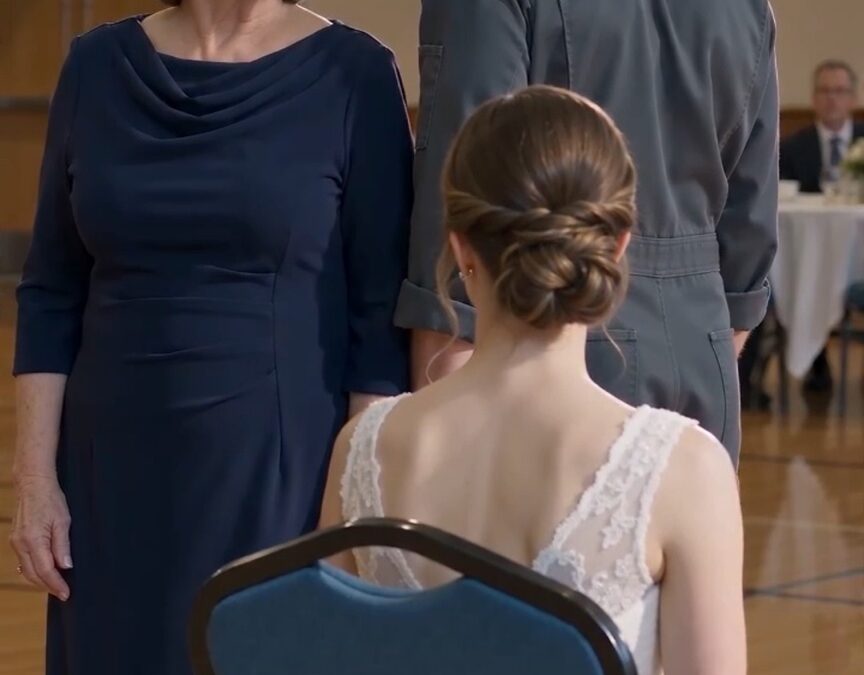
She pointed to the empty blue upholstered chair beside her.
“Are you sure?”
“I saved it.”
I put my handbag beneath it.
Then I went to the restroom to wash my face.
I had made it through the ceremony without crying loudly.
That had taken more effort than I expected.
Walter died on June 4, 2025.
His funeral was June 9.
Now it was June 21, and our granddaughter was married.
I stood at the restroom sink, pressing cool fingers beneath my eyes.
When I returned, Grant was waiting near the head table.
Beth stood behind him.
He stepped sideways as I approached.
“Beth belongs here. You don’t.”
I stopped with one hand against my skirt.
The chair was still empty.
My handbag was still underneath it.
“What did you say?”
“We changed the seating.”
“Then bring another chair.”
“That’s not what I mean.”
He glanced toward the ballroom doors.
I looked behind me, although I understood him.
There were guests carrying drinks past the entrance.
Someone was laughing near the meal tables.
I had not expected to need permission to remain.
“Audrey asked me to sit there.”
“She doesn’t understand everything Beth has done.”
Beth smoothed the front of her dress.
She was 45.
Grant was 47, old enough to know exactly what he was doing.
I had known him when he was younger.
I remembered him asking whether Leah liked chocolate frosting.
Leah had been my daughter.
Now her widower stood between me and her child.
“I’m sitting with my granddaughter,” I said.
“Don’t make this difficult.”
“I’m not making anything difficult.”
“Beth has done everything for this family.”
His voice carried beyond the head table.
At a nearby table, someone stopped reaching for bread.
I noticed the basket because I needed somewhere to look.
The rolls had been covered with a white napkin.
Everything around us looked ready for a pleasant evening.
“Beth deserves the family seat,” Grant continued.
“I haven’t said she can’t have a seat.”
“You always need something for yourself.”
That brought Audrey around.
She had been speaking to someone behind her.
Her veil was gone, and her hair had loosened near one ear.
“Dad?”
“Your grandmother is upset about the seating.”
“I told her to sit here.”
“We made a change.”
“Who did?”
He didn’t answer.
Instead, he looked at me.
“See what you’re doing?”
I had not moved.
My heel hurt inside my dress shoe.
I had worn the same shoes at Walter’s funeral.
The rubbed place had barely healed.
“Grant, please move.”
“There’s a door right behind you.”
Audrey pushed her chair back.
Several people turned at the sound.
“Grandma, don’t go.”
“I’m not going.”
Grant gave an irritated little laugh.
“She’s been leaning on this family for years.”
Beth looked at him then.
I couldn’t tell whether she expected him to continue.
“She takes and takes,” he said.
I pressed my fingers against the seam of my dress.
I had spent years avoiding public disagreements with him.
Usually, I would find another place to sit.
Usually, I would tell Audrey it was perfectly fine.
But she was standing beside the empty chair.
She was watching me decide.
I could picture her remembering this afterward.
Her father pointing toward the exit.
Me collecting my handbag.
That blue chair beside her staying empty.
I moved toward the wider part of the aisle.
Grant turned, but he did not touch me.
He would have had to step into Audrey’s space.
He stopped instead.
I walked around him and reached her.
“Are you all right?” she whispered.
“I need to sit down.”
“Then sit.”
First, I bent to retrieve my handbag.
Walter’s letter was inside, folded along three careful creases.
He had written it for her wedding.
I had thought I would give it to her privately.
Maybe before I left.
Maybe after the reception, when she could read alone.
I took it out and laid it beside her plate.
Grant looked down.
He recognized Walter’s handwriting on the outside.
His smile disappeared.
For several seconds, he stopped moving completely.
Beth noticed.
“What is that?”
He ignored her.
“Evelyn,” he said.
I rested my handbag against the chair leg.
“Your grandfather wrote something for you,” I told Audrey.
She looked at the folded paper.
“Can you read it?”
“Yes.”
Grant stepped closer, stopping short of the table.
“Not here.”
I picked up the letter.
Audrey remained beside me.
“Why not?” I asked.
“Because this isn’t the time.”
“You were just discussing what I’ve taken.”
He glanced toward the guests.
Then he lowered his voice.
“You don’t need to read that.”
Chapter 2: What Walter Wrote
Audrey pulled the blue chair back for me.
“Grandma, sit first.”
I sat, keeping the letter in both hands.
She moved her own chair closer.
Grant remained standing across the corner of the table.
Beth had taken a small step away.
Nobody had cleared a space for her anymore.
I unfolded the pages carefully.
Walter had written them at our kitchen table.
The date at the top was May 18, 2025.
He had been 70.
His illness had already made some ordinary tasks difficult.
Writing took longer than it used to.
I knew where he had stopped to rest.
Near the bottom, the letters became less even.
But the signature was his own.
He had insisted on finishing that himself.
“Your grandfather thought he might miss the wedding,” I said.
Audrey pressed her lips together.
“He didn’t tell me.”
“He wanted you to keep making your plans.”
Grant shifted beside the table.
“We can give her that later.”
Audrey looked at him.
“I want to hear it now.”
I began at the beginning.
“Dear Audrey, if your grandmother is reading this, please make sure she has somewhere to sit.”
Audrey looked at my chair.
Then she put one hand over mine.
I waited until she let go before continuing.
Walter had written about the day she was born.
He remembered being afraid to hold her.
He had made Leah sit close enough to help.
Audrey smiled at that.
“He always said I was slippery.”
“You were wrapped in a blanket.”
“He still said it.”
For a moment, we could speak about him normally.
I read the part about teaching Audrey to check her oil.
He had made her repeat every step.
She had complained that she understood it already.
“He wrote that you were very patient with him.”
Audrey laughed once.
“That’s generous.”
“I thought so too.”
Then I reached the paragraph I knew was coming.
I placed my thumb beneath the first line.
My thumb covered a small mark from Walter’s pen.
“Your grandfather wanted something made clear.”
Grant looked away from the paper.
“Evelyn.”
I continued.
“Your grandmother earned every dollar of the $36,000 sent toward your college tuition.”
Audrey’s hand slid off the table.
I read the next sentence.
“She worked extra shifts in the hospital laundry.”
Grant opened his mouth.
Audrey turned sharply toward him.
“Let her finish.”
I swallowed and looked down again.
“Her earnings were the only source of that assistance. Your father delivered the checks. Please don’t mistake delivery for payment.”
The nearby conversations had stopped.
I could hear someone setting down a fork.
I wished we were at my kitchen table.
I wished Walter were there to read his own words.
But I kept going.
“Your grandmother did not want you worrying about what she gave. That was her request. It was not permission for someone else to claim it.”
Audrey looked directly at me.
“All $36,000?”
“Yes, honey.”
“Not part of it?”
“All of it.”
Grant rubbed his forehead.
“It was family help.”
“It was Grandma’s money,” Audrey said.
“We all made sacrifices.”
I lowered the page.
“Walter helped me keep working,” I said. “But the tuition money came from my earnings.”
“You and Walter had money together,” Grant replied.
“We shared our household expenses. We kept separate savings.”
I did not want that confused either.
Walter had helped by covering what we had planned.
He made meals when I worked late.
He drove when I was too tired.
But those tuition checks came from my extra laundry shifts.
Audrey looked toward Beth.
“Dad said you both paid.”
Beth’s eyes dropped to the table.
“I thought he meant he paid.”
“You let me thank you.”
“I thought you were thanking us for helping.”
Grant spoke before Audrey could answer.
“Beth was there for you.”
“That isn’t what I asked.”
I put the letter flat for a moment.
Audrey’s face had gone red along her cheeks.
At graduation, she had thanked Grant and Beth.
She had believed she was acknowledging something generous.
I had not known what he had told her.
I learned the full wording only afterward.
By then, correcting it meant telling her that another family story was false.
I had waited.
Walter had not wanted the mistake to last forever.
“Why didn’t you tell me?” she asked.
“You worried about every expense.”
“I could have thanked you.”
“You did thank me. You called. You came over.”
“That’s not the same.”
“I know that now.”
Grant pulled a chair slightly away from the table.
He did not sit.
“I handled all the arrangements,” he said.
“You delivered the checks,” I replied.
“Yes. Because you wanted it private.”
“Private didn’t mean yours.”
Audrey looked back at the paper.
“Is there more?”
“Yes.”
“Please read it.”
So I finished Walter’s letter.
He had written about meals after long days.
About answering when the other person called.
About being kind when somebody was sick or tired.
I read his words without adding anything.
At the end, Audrey reached for me.
I placed the letter down and hugged her.
Her cheek pressed against mine.
“I thought you couldn’t afford to help,” she whispered.
I closed my eyes.
When she stepped back, she kept her hand on my shoulder.
Then she faced Grant.
“Why did you tell me it came from you?”
He looked toward the watching guests.
“Because somebody had to make up for everything I spent keeping your grandmother afloat.”
Chapter 3: The Blouse Before School
For several seconds, I looked at Audrey’s hand.
She had freckles across her wrist, like Leah.
Her fingers tightened against my shoulder.
I remembered those same fingers fastening a school cuff.
The cuff had still been warm from drying.
That morning came back before I answered Grant.
Leah was ill then.
Audrey had tried helping with a bandage before school.
A small blood spot marked her white blouse.
She came into my kitchen holding the sleeve away.
“Grandma, can you fix it?”
I took her wrist gently.
“Let me see.”
“Please don’t tell Mom.”
I turned on the cold water.
“She’ll feel bad,” Audrey said.
“I know.”
I put soap on the fabric.
Audrey stood beside me, watching the sink.
Her school things were piled near the back door.
I had toast waiting on a plate.
She hadn’t touched it.
“I should have changed first.”
“You were helping.”
“I made more work.”
“No. Hold this part up.”
She lifted the dry sleeve while I worked.
I rubbed the spot between my fingers.
The water carried away a little pink.
Audrey leaned against the counter.
“Is it coming out?”
“Yes.”
“Really?”
I showed her.
She bent close, checking the white cotton.
Then she let out the breath she’d been holding.
I gave her the toast while I rinsed.
She ate half a piece without looking at it.
I pressed the wet cuff inside a clean towel.
Then I dried the sleeve.
Audrey stood in the kitchen doorway in her undershirt.
She looked younger without the blouse.
“I don’t want to go today.”
“I know, honey.”
“Will you be here after?”
“I’ll be here.”
“What if Mom needs you?”
“Then we’ll work that out.”
She nodded, although she didn’t look convinced.
I held the blouse while she put her arms in.
Her hair caught beneath the collar.
I lifted it out.
Then I fastened the cuff she had been watching.
She looked down at the clean fabric.
“Thank you.”
I touched her cheek.
“Get your bag.”
That was one morning.
There were many others.
Before college, Audrey spent afternoons at our house.
I kept food she liked and washed forgotten school clothes.
Walter drove when my hospital shift ran late.
We helped with what needed doing.
Leah died in 2018.
She was 39.
Afterward, I kept expecting her to call about Audrey.
Sometimes I picked up the phone before remembering.
Grant accepted our help.
At first, that was a relief.
I wanted Audrey near us.
I wanted to know she had eaten.
She would sit at my table after school.
Some days she talked.
Other days she stayed quiet until supper.
I learned not to demand a report.
College papers arrived during that same hard year.
Audrey spread them across our kitchen table.
She kept sorting them into smaller piles.
“I can choose something cheaper.”
Walter asked what she wanted to study.
She answered, then began explaining another option.
An option that would cost less.
An option that would require less help.
After she left, I stayed at the table.
Walter gathered the cups.
“I can pick up shifts,” I said.
He stopped beside the sink.
“How many?”
“I’ll see what’s available.”
He put the cups down.
Then we went through our household expenses together.
I was still working in the hospital laundry.
Walter and I had separate savings accounts.
His savings could cover what we had already planned.
My extra earnings could go toward Audrey’s tuition.
He didn’t pretend the work would be easy.
He asked whether I was sure.
“I want her to finish.”
So I worked the shifts.
From 2018 through 2022, I supplied $36,000.
I earned it standing beside hospital laundry equipment.
I sorted linen and handled heavy loads.
I came home with lint caught at my cuffs.
Sometimes I ate supper after Walter had fallen asleep.
Sometimes he sat across from me until I finished.
He covered my plate when I called late.
He kept clean towels ready for my shower.
Audrey knew I was working.
She did not know those extra hours funded her help.
I had asked Grant to make delivery simple.
“She’s worrying about every dollar,” I told him.
“Let me handle it.”
“Don’t make her feel she owes anybody.”
“I won’t.”
I permitted discreet delivery.
I did not permit him to call my earnings his.
By then, Beth was openly part of his life.
Their relationship had begun during Leah’s illness.
I learned that after Leah died.
I did not ask Audrey to provide details.
I did not make her explain her father.
When Beth came to family occasions, I stayed polite.
I could pass a dish without discussing the affair.
Grant began describing Beth as the person who helped everyone.
I let some of those comments go.
Audrey had already lost her mother.
I didn’t want every gathering to include another argument.
But he kept adding to the story.
At the reception, he had finally made me the dependent one.
I looked up at him.
“You did not keep me afloat.”
He folded his arms.
“We’re really doing this here?”
“You started it here.”
Audrey’s hand left my shoulder.
I could see her waiting for an answer.
Grant looked down toward my handbag.
There were no other documents inside.
I had brought only Walter’s letter.
But I didn’t need paperwork in my hand to know what he owed.
“You know the actual money arrangement between us,” I said.
His face tightened.
“Don’t.”
Audrey looked from him to me.
“What arrangement?”
Chapter 4: The Money He Mentioned
I put Walter’s letter beside Audrey’s plate.
I wanted both hands free.
Not because I expected trouble.
Because I was tired of clutching something.
“In 2019, I made your father a business loan.”
Audrey stared at me.
Grant looked toward the ballroom doors.
“How much?” she asked.
“Originally, $48,000.”
“For the repair business,” Grant said quickly.
“Yes,” I replied. “For the repair business.”
I wanted that part stated correctly.
I had chosen to lend him the money.
He had signed an installment note.
The annual interest rate was 4%.
He had made his required payments.
I said all of that before saying anything else.
Audrey listened without interrupting.
“By today, he’s repaid $24,000 of the principal,” I said.
“So he still owes you $24,000?”
“Yes.”
“And he’s paying?”
“Yes. He’s current, including the required interest.”
Grant spread his hands.
“Then there’s no problem.”
“The problem is what you said about me.”
“I didn’t mean every dollar literally.”
“You told everyone you supported me.”
“You’ve needed help.”
“With what?”
He looked away.
There had been rides when Walter was ill.
There had been ordinary favors.
Those were not financial support.
They did not turn my savings into his generosity.
Audrey pulled out her chair and sat.
She faced her father across the table corner.
“You borrowed that much from Grandma?”
“It was a proper business arrangement.”
“Then why did you say she takes from us?”
He pressed his lips together.
Beth moved away from the blue chair.
She stood near the end of the table.
Her place there no longer looked certain.
Grant noticed her move.
Then he looked back at me.
“There was another discussion,” he said.
I knew which one.
Audrey waited.
“I had considered forgiving the remaining balance,” I explained.
Grant answered immediately.
“That was supposed to happen.”
“No. I considered it.”
“You said you wanted things easier for everybody.”
“I did want that.”
“You told me you’d look after it.”
“I said I would think about it.”
I remembered the conversation.
Walter had been ill.
I had appointments written on the calendar.
Grant brought up the balance while I was checking dates.
I did not want to discuss money then.
I told him I would think about forgiveness.
That was all.
No release had been signed.
No binding gift had been signed or delivered.
The note had no wedding-related forgiveness clause.
Audrey’s marriage did not cancel a business debt.
I explained that without pretending I was a lawyer.
“My attorney can confirm the details afterward,” I said.
Grant looked annoyed at the word attorney.
“You’re making it sound hostile.”
“I’m explaining an agreement.”
“On my daughter’s wedding day.”
I looked at the empty space where he had blocked me.
“You could have let me sit down.”
He didn’t answer.
I rubbed the back of my heel against my shoe.
That made it sting worse.
I stopped moving my foot.
Audrey noticed.
“Do you need different shoes?”
“No, honey. I need to stay seated.”
“Then you’re staying seated.”
She turned toward Beth.
“There are other places to sit.”
Beth nodded once.
“All right.”
Grant lifted his hand.
“Audrey, she helped with this wedding.”
“I know she helped with decorations.”
“She deserves to be recognized.”
“That doesn’t mean Grandma has to leave.”
Beth stepped back farther.
“I’ll find another seat.”
She did not argue with Audrey.
Grant stayed where he was.
He seemed to be waiting for someone to undo the moment.
Audrey straightened the napkin beside her plate.
Then she looked up.
“You’re not making the parent’s speech.”
His face changed.
“What?”
“I don’t want you giving it.”
“I’ve already prepared it.”
“I’m telling you now.”
“Audrey, I’m your father.”
“Yes.”
She said it quietly.
She did not add an insult.
She did not make a scene larger than the one he had started.
“I don’t want another version of this tonight,” she said.
Grant looked toward me.
I did not intervene.
That decision belonged to Audrey.
She had invited me.
She had heard what he said.
She could decide who spoke at her reception.
I touched her elbow.
“Sit properly and eat when the food comes.”
She turned back toward me.
“Are you really staying?”
“Yes.”
“For the rest?”
“If you want me.”
“I saved you this chair.”
I moved my handbag fully beneath it.
“I’m staying.”
A staff member approached from the side.
Audrey asked for meal service to continue.
Nothing was canceled.
The reception was paid through its separate arrangements.
I had no ownership of the ballroom.
I had no authority over its doors.
I was simply a guest in the seat Audrey wanted me to have.
The room slowly resumed its ordinary noise.
Water was poured.
Chairs shifted.
Someone lifted the breadbasket again.
Grant leaned toward me.
“Can we talk outside?”
I looked at Audrey.
She looked worn out already.
“Yes,” I said.
He glanced at the letter.
“Privately. Leave that here.”
Chapter 5: Outside the Ballroom Doors
I left Walter’s letter with Audrey.
She put one hand over it.
“I’ll keep it safe.”
“I know.”
I stood carefully.
My heel caught against the back of my shoe.
Grant was already walking toward the doors.
He expected me to follow quickly.
I went at my own pace.
Beth came behind us.
Outside the ballroom, the hallway seemed unusually bright.
There was a bench against the wall.
I sat before Grant began.
He looked at the bench, then at me.
“You humiliated me.”
I adjusted the hem of my dress.
“You told me to leave.”
“I told you the seating had changed.”
“You pointed toward the door.”
He looked at Beth.
She stayed beside the opposite wall.
“You could have waited until afterward,” he said.
“To correct you?”
“To bring up private matters.”
“You brought them up.”
“I didn’t mention amounts.”
“You mentioned me taking from the family.”
He rubbed his forehead.
I had seen him do that when Leah asked for help.
I had seen it when Audrey needed a ride.
Usually, somebody else would begin solving the inconvenience.
This time, I stayed seated.
Beth crossed her arms loosely.
“Did you tell Audrey I paid for college?”
Grant turned toward her.
“Can we not do this?”
“I need to know.”
“You were part of everything.”
“That isn’t an answer.”
He looked down the hallway.
Beth waited.
Finally, he said, “I said we helped.”
“With tuition?”
He didn’t reply.
Beth looked at me.
“I helped her with the wedding decorations.”
“I know.”
“That’s what I thought he meant inside.”
“I’m not disputing that.”
“I didn’t know about the checks.”
“I’m not saying you did.”
I could tell the truth without adding something unproved.
Beth had been involved with Grant during Leah’s illness.
I knew that.
But I did not know what he told her about tuition.
I wasn’t going to claim I did.
Grant looked irritated that we were speaking directly.
“We were all helping Audrey,” he said.
“Then why wasn’t Evelyn named?” Beth asked.
He shifted his feet.
“She didn’t want credit.”
“I didn’t want Audrey worrying,” I said.
“You told me to keep it quiet.”
“Yes. Keep it quiet. Not call it yours.”
“She kept asking where the help came from.”
“You could have told her.”
“You said not to.”
“I said I didn’t want her feeling indebted.”
He gave a long, frustrated breath.
“You’re splitting words.”
“No. Those are different things.”
A cart rolled across the far end of the hallway.
I watched it pass.
Grant waited until it was gone.
Then he spoke more quietly.
“She looked at me differently when she thought I paid.”
Beth lowered her arms.
I looked back at him.
“What do you mean?”
“She’d been angry with me.”
“About Leah?”
“About everything.”
He rubbed the back of his neck.
“I was still her father.”
“You were.”
“She needed to see I was doing something.”
“So you used my work.”
“I used the arrangement we had.”
“The arrangement was tuition help for Audrey.”
He looked away again.
I could not make that explanation better for him.
He had wanted his daughter’s gratitude.
He had accepted mine without naming me.
Then he had called me a burden.
Beth pushed herself away from the wall.
“I’m going back inside.”
Grant turned quickly.
“What are you going to say?”
“The truth if she asks me.”
He seemed about to reach toward her.
He stopped before doing it.
Beth opened the ballroom door and disappeared inside.
For a moment, I could hear music and conversation.
Then the door closed.
Grant looked at me.
“We can still settle the loan.”
“It already has payment terms.”
“I mean the balance.”
“You can keep paying under the note.”
“And the forgiveness?”
“I’m not forgiving it.”
His jaw tightened.
“Because of tonight.”
“Yes.”
I did not dress that answer up.
Forgiveness had been a possible gift.
I had not completed it.
I did not owe him that gift.
“You know how much that would help me.”
“I do.”
“Then why do this?”
“Because I need my savings.”
“You don’t need all that money right now.”
I looked at my handbag through the small doorway window.
It was tucked beneath my chair, beside Audrey.
At home, there were bills I would open alone now.
There were repairs I would arrange alone.
There were years ahead I could not price in advance.
“You don’t know what I’ll need,” I said.
He sat briefly at the far end of the bench.
Then he stood again.
“If you think I’m going to beg—”
“I haven’t asked you to.”
He stared at me.
I stood with one hand against the bench.
He moved away from the ballroom entrance.
This time, I did not have to ask twice.
At the door, I paused.
“The note stays as written,” I said.
“No penalty because you’re angry?”
“No.”
“No extra charges?”
“Only what the agreement requires.”
He nodded slowly.
“If I pay it off, I want it documented.”
“It will be.”
“And I want the exact amount.”
“My attorney can calculate the accrued interest.”
I reached for the door handle.
Grant said my name again.
I turned.
“Get me a written payoff.”
Chapter 6: Finishing the Wedding Supper
Audrey looked for me as soon as I returned.
I lifted my hand so she could see me.
Then I went back to the blue chair.
My meal had arrived.
The food was warm rather than hot.
I sat and unfolded my napkin.
Audrey watched me pick up my fork.
“Did he upset you again?”
“We discussed the loan.”
“What did he say?”
“I’ll tell you another day.”
She searched my face.
“Was he awful?”
“I’m here with you now.”
She nodded, but she kept watching.
I took a bite so she could stop worrying.
It tasted better than I expected.
I had eaten almost nothing before leaving home.
The morning had been filled with small tasks.
Checking the time.
Finding my tissues.
Putting Walter’s letter inside my handbag.
Looking at his chair before I left.
Now I was hungry.
Audrey poured some water into my glass.
“You don’t have to take care of me all night,” I said.
“I can pour water.”
“Yes, you can.”
She smiled for the first time since the letter.
I ate another bite.
Across the room, Grant was seated away from us.
Beth was no longer standing near the head table.
I did not count the spaces between them.
I did not need to know whether they were speaking.
For the rest of the meal, I faced Audrey.
She told me something about the flowers.
I asked whether she had eaten before the ceremony.
“Not enough.”
“Then start with your dinner.”
“You sound like Mom.”
I set my fork down briefly.
“So do you sometimes.”
She looked at me.
“Really?”
“When you’re trying not to laugh.”
Audrey looked down at her plate.
Then she smiled, and I saw Leah again.
We did not turn that into a longer conversation.
It was enough for that moment.
Later, the photographer approached the head table.
Audrey reached for my hand.
“One with Grandma.”
I stood beside her.
My dress had creased across the lap.
Her hair had loosened further.
She tucked one piece behind her ear.
Then she changed her mind and left it alone.
“Is my collar straight?” I asked.
She adjusted it with both hands.
“There.”
When the camera lifted, I looked toward it.
I did not check where Grant was.
I did not make myself smaller beside her.
Afterward, Audrey asked whether I wanted a copy.
“Yes.”
“A big one?”
“A regular one is fine.”
She laughed.
“I’ll choose.”
The reception continued.
There was music.
People moved between tables.
Nobody stopped the evening because Grant had lost his speech.
When it was time for remarks, Audrey kept hers brief.
She thanked people for coming.
Then she looked toward me.
“My grandmother helped me get here.”
I lowered my eyes to my napkin.
“She didn’t ask for public thanks,” Audrey continued.
“But I want her to have them.”
People applauded.
I pressed the napkin between my fingers.
I had not expected to find applause embarrassing.
For years, being useful had felt easier than being noticed.
Now there was nowhere else to look.
Audrey reached for my hand beneath the table.
I held hers until the applause ended.
Grant did not approach the microphone.
Beth did not return to the honorary place.
I was not asked to settle either decision.
Audrey had settled them herself.
Later, when I was preparing to leave, she brought the letter over.
“Do you need this back?”
“No. It’s yours.”
“Are you sure?”
“He wrote it for you.”
She ran a finger along the folded edge.
“I want to keep it properly.”
“Somewhere dry.”
She laughed softly.
“That sounds like Grandpa.”
“He’d also tell you not to spill tea on it.”
“I can hear him saying that.”
“So can I.”
We stood near the ballroom entrance.
She hugged me carefully, then held on tighter.
“I’m sorry about Dad.”
“You didn’t do it.”
“I know. I’m still sorry.”
I let her finish.
I didn’t tell her to forget it.
I didn’t ask her to make peace that night.
She had already done enough.
“Call me when you’re settled,” I said.
“I’ll call you directly.”
“Yes.”
“No asking Dad whether you’re busy.”
“No.”
She pulled back and looked at me.
“Promise?”
“I promise.”
At home, I put my handbag on the kitchen counter.
The house was quiet.
Flowers from Walter’s funeral still stood in a vase.
Some had begun dropping petals.
I took off my shoes by the back door.
The sore place on my heel had opened.
I cleaned it and covered it.
Then I sat at the kitchen table.
Walter’s letter was no longer in my handbag.
For several nights, it had rested beneath his lamp.
I looked toward the bedroom doorway.
I was glad Audrey had it.
I still noticed that it was gone.
The next morning, I put the loan papers together.
I did not write Grant an angry note.
I did not change the figures.
I found the signed installment note and payment records.
Then I called my attorney.
Before that appointment was finished being arranged, Grant sent a message.
He wanted me to tell the family that the reception had been a misunderstanding.
Chapter 7: What Needed Correcting
I read Grant’s message twice.
He said people were talking.
He said I had made him look dishonest.
He wanted me to explain what had really happened.
I set the phone beside the kettle.
Then I made tea.
I did not trust myself to answer immediately.
I wanted to write exactly what I meant.
When the tea was ready, I sat down.
I told him I would correct factual mistakes.
The loan was current.
He had made the required payments.
I had not paid for the entire wedding.
Beth had helped with the decorations.
Those were facts I would confirm.
I would not say he paid Audrey’s tuition.
I would not say I depended on him financially.
I would not call his order to leave a seating misunderstanding.
His answer arrived before I finished my tea.
“You know what I mean.”
I wrote back.
“Yes. I’m not saying that.”
Then I put the phone in another room.
Usually, I would have watched for his response.
I would have wondered whether I sounded too harsh.
I would have typed another paragraph to soften it.
Instead, I washed my cup.
Walter’s usual cup stood in the cabinet.
I took it down and washed that too.
It didn’t need washing.
I dried it carefully anyway.
When Grant called later, I answered.
The payoff still needed arranging.
He began with the reception.
“People think I stole money.”
“I haven’t said that.”
“You made it sound that way.”
“I said you owe money under a loan.”
“You could tell them I was paying.”
“I offered to.”
He was quiet.
Then he changed the subject.
“Audrey isn’t answering me.”
I looked toward the kitchen window.
“That’s between you and Audrey.”
“You could explain.”
“She heard what happened.”
“I mean explain that I’m still her father.”
“She knows you’re her father.”
“You know what I’m asking.”
“Yes.”
“And?”
“I won’t tell her how to feel.”
He seemed surprised by that.
For years, I had helped settle things after him.
I had explained that he was tired.
That business was difficult.
That he hadn’t meant the words exactly.
Sometimes I believed those explanations.
Sometimes I only wanted Audrey to have a calmer evening.
Now she was 25.
She had asked clear questions at her wedding.
I wasn’t going to answer them with another excuse.
At the attorney’s office, I placed the papers down.
I explained the tuition separately from the loan.
Those were different arrangements.
I did not want them mixed together because Grant had mixed them.
The attorney reviewed the note and payment history.
The remaining principal was $24,000.
The annual interest rate was 4%.
Grant was current.
Nothing that happened at the wedding accelerated the debt.
I could refuse voluntary forgiveness.
I could not invent new repayment terms.
“I understand,” I said.
She asked whether I had signed a release.
“No.”
Had I signed or delivered any binding gift?
“No.”
Was there a wedding-related cancellation clause?
“No.”
Then the existing note remained in effect.
That was what I wanted confirmed.
Not a punishment.
The actual agreement.
She would calculate a written payoff if Grant requested one.
The calculation would include interest through the payment date.
If he chose not to pay early, the installment schedule remained.
I asked whether I needed to contact him again.
She said the payoff could be handled through the office.
I was grateful for that.
I did not want every conversation to become a family negotiation.
Afterward, I put the copies in a folder at home.
I labeled it with the year.
I had kept records for years without imagining this scene.
There were tuition records elsewhere in my files.
There were deposits from laundry shifts.
There were checks and ordinary bank papers.
I did not photograph them for the family.
Audrey had asked me for the truth.
I had given it.
I would show her records if she wanted them.
I would not turn her wedding into a document contest.
She called that evening.
“I read Grandpa’s letter again.”
“I thought you might.”
“I keep missing little parts.”
“He worked on it slowly.”
“Did you know everything it said?”
“Yes.”
“Even the tuition paragraph?”
“Yes.”
She went quiet.
Then she asked why I hadn’t told her sooner.
I looked at Walter’s empty place.
“I thought I was protecting you.”
“From what?”
“Another disappointment.”
She took a breath.
“I would rather know.”
“I understand that.”
“I’m not saying you did something awful.”
“I know.”
“I just don’t want Dad explaining you to me anymore.”
I pressed my fingers against the table edge.
“All right.”
After we hung up, I checked my messages.
Grant had written again.
This time, he wasn’t asking me to call the reception a misunderstanding.
He was asking which facts I expected him to admit.
Chapter 8: The Balance in Writing
I answered Grant the next morning.
I kept the message short.
The $36,000 in tuition help came from my earnings.
He delivered the checks.
Beth did not supply that tuition money.
The business loan was separate.
He had been paying it as agreed.
The remaining principal was $24,000.
I had considered forgiveness but had not completed it.
I read the message before sending.
There was nothing about his character.
There was nothing about Leah’s illness.
Those matters were real, but they were not the requested correction.
He replied that my wording sounded legal.
I told him it sounded accurate.
For most of that day, I heard nothing more.
I put away laundry.
I opened mail.
I moved the funeral flowers off the table.
There were dried petals beneath the vase.
I wiped the table twice before they were gone.
That afternoon, Grant sent an acknowledgment to relatives.
He copied me.
It was not as complete as my message.
He said the college help had come from my earnings.
He said he had handled delivery.
He said he should have been clearer about the source.
He acknowledged the business loan.
He said he had been making payments.
He did not mention blocking me.
He did not mention the door.
He did not repeat what he had said about Beth belonging.
I read it slowly.
Then I saved it.
I did not send congratulations.
I did not argue about every missing sentence.
The main financial falsehood had been corrected in writing.
That mattered.
Audrey called after she saw it.
“Did you tell him what to write?”
“I told him the facts.”
“Did he apologize to you?”
“Not in that message.”
“He didn’t apologize to me either.”
I waited.
She sounded more tired than angry.
“I don’t know what he wants me to say.”
“You don’t have to decide immediately.”
“I know.”
I asked whether she had eaten.
She laughed.
“Grandma.”
“I’m allowed to ask.”
“Yes. I ate.”
Then we talked about something ordinary.
She told me about putting wedding cards away.
She had found one behind a stack of papers.
She wanted to know whether I had received a photograph.
We talked without using Grant to arrange it.
Nobody needed to report what the other had said.
When we finished, I realized we had spoken for nearly an hour.
I had not once wondered whether I should end the call before he became irritated.
The payoff request came through the attorney.
Grant chose to repay voluntarily rather than continue installments.
I did not ask where the funds came from.
I did not suggest that he sell anything.
I did not threaten the business.
The existing note did not need threats added to it.
The attorney calculated the amount for July 18, 2025.
It included the remaining $24,000 principal.
It also included the exact accrued interest due.
I did not calculate that figure myself.
I did not round it up.
I did not waive part of it to make Grant comfortable.
I let the agreement determine the amount.
Before payment, Grant called once more.
“If I do this, I want everything finished.”
“The loan will be finished.”
“I don’t want more complaints.”
“I’m not adding anything to the debt.”
“That isn’t what I mean.”
“I know.”
He paused.
Then he asked whether I would sign the satisfaction.
“After payment clears, yes.”
He sounded offended by the order.
I did not change it.
On July 18, the payment arrived.
The remaining principal was paid.
The exact accrued interest was paid with it.
After the funds cleared, the loan satisfaction was completed properly.
I received confirmation and filed it.
I did not keep the note active afterward.
I did not hold repayment over his head.
The debt was finished because he paid it.
Grant sent a short message.
“We’re done with that now.”
I answered, “The loan is paid.”
Then I put the phone down.
There were no more installments to discuss.
No proposed gift for him to press me about.
No reason to ask what I had in savings.
I could make decisions about my remaining money privately.
That evening, I cooked a proper supper.
I put it on a plate.
Since Walter died, I had sometimes eaten standing at the sink.
I did not always notice until I had finished.
That night, I sat at the table.
His usual chair was across from me.
Receiving repayment did not make that easier.
I still reached for my phone when I remembered something funny.
I still listened for him moving in the bedroom.
But I no longer had the loan tangled into those evenings.
The papers were filed.
The account was settled.
I washed my plate and left it drying.
When Audrey called, I answered before the second ring.
“Are you busy Sunday?”
“Not especially.”
“Can you come over?”
“I’d like that.”
She hesitated.
Then she added, “There’s something here I want you to see.”
Chapter 9: The Chair at Her Table
I brought a covered dish to Audrey’s home.
She opened the door before I knocked twice.
“You could come without bringing food.”
“I know.”
“You always say that.”
“I always mean it.”
She took the dish from me.
Then she stepped aside so I could come in.
There were still wedding things around the room.
A bag stood near the wall.
Cards were stacked on a side table.
Near the window was a photograph of us.
I stopped in front of it.
It was the reception picture.
My dress was creased.
Audrey’s hair had loosened around her face.
She had one hand against my back.
I had stayed beside her.
“I like that one,” she said.
“So do I.”
“I didn’t want to wait to put it out.”
I touched the bottom corner of the frame.
Then I followed her toward the dining table.
There was a blue upholstered chair at one end.
It was not the chair from the community center.
But it was the same kind.
A comfortable seat.
A plain back.
The same blue I had noticed across the ballroom.
I looked at Audrey.
She suddenly seemed unsure.
“Is it too much?”
“No.”
“I needed another chair anyway.”
I ran my hand along the back.
The fabric was smooth and new.
“You didn’t have to buy one for me.”
“I wanted you to like sitting here.”
I pulled it out.
It moved easily across the floor.
Then I sat down.
My feet rested flat.
The cushion was comfortable beneath me.
Audrey watched my face.
“Good?”
“Very.”
She sat beside me instead of across the table.
For a few minutes, we discussed supper.
She asked whether the dish needed heating.
I told her how long.
Then she asked how I had been sleeping.
“Some nights are better.”
“Do you want me to call in the evenings?”
“You can call whenever you want.”
“That isn’t what I asked.”
I looked down at my hands.
“Yes. Sometimes I would like that.”
“All right.”
We did not make a complicated schedule.
I did not want her worrying if she missed an evening.
She did not want me waiting for Grant’s permission.
We agreed to call directly.
If one of us was busy, we could say so.
If I wanted company, I could ask.
That would take practice for me.
Audrey seemed to understand.
She went to check the food.
I stayed in the chair.
From there, I could hear her opening a cupboard.
She asked which serving spoon I wanted.
“The bigger one.”
“Both are big.”
“Then surprise me.”
She laughed from the kitchen.
I hadn’t realized how much I missed ordinary visiting.
No hospital schedule.
No funeral arrangements.
No careful conversation about what Grant might hear later.
Just my granddaughter looking for a spoon.
After supper, she brought Walter’s letter to the table.
It was inside a protective sleeve.
“I didn’t want the folds getting worse.”
“He would approve.”
“I thought so.”
She placed it between us.
We did not read the whole letter aloud again.
She pointed to the opening sentence.
The one about making sure I had somewhere to sit.
“I keep thinking about that.”
“So do I.”
“Did he know Dad might do something?”
“No.”
“Then why did he write it?”
I looked at the blue chair beneath me.
“He knew I’d stay standing if somebody needed something.”
Audrey smoothed the edge of the sleeve.
“You can stay seated here.”
I rubbed a crease in my skirt.
“All right.”
She got up to make tea.
I began to rise.
She looked over her shoulder.
“I know where the cups are, Grandma.”
I sat back down.
She smiled and kept walking.
While the kettle heated, she told me she had spoken to Grant.
I listened.
She had told him not to begin visits with complaints about me.
She had told him not to send messages through her.
Those were her decisions.
I did not give her a list of additional demands.
“He says you’ve changed,” she said.
“I’ve had a difficult few months.”
“I know.”
“And I don’t want another loan discussion.”
She nodded.
“That part is finished.”
“Yes.”
Grant still had his repair business.
He had repaid the remaining debt rather than receiving forgiveness.
He had not given the parent’s speech.
He could no longer tell Audrey that my tuition help came from him.
I did not need anything else from the loan.
I did not need to supervise his relationship with her.
Beth’s decoration work remained something she had done.
I could acknowledge it without pretending she funded college.
I could remain polite without becoming close.
When Audrey mentioned her, I listened without starting an argument.
I did not need every visit to return to the reception.
Audrey brought the tea.
She set my cup within easy reach.
Then she sat beside me again.
For a while, we looked at Walter’s letter.
“I wish he’d seen you in your dress,” I said.
“Me too.”
“He would have liked the picture.”
“The crooked hair?”
“Especially that.”
She laughed, then wiped beneath one eye.
I reached for a tissue from my handbag.
She accepted it.
We stayed at the table until the tea cooled.
When I finally stood to leave, Audrey packed the leftovers.
I waited near the doorway.
Then she asked whether I wanted another cup.
I looked toward the window.
It was still light outside.
“I could stay a little longer.”
“Then sit back down.”
I did.
She put the food away again.
Then she came back and began telling me about her morning.
I listened without watching the clock.
When I eventually left, she walked me to the door.
She hugged me and asked me to call when I got home.
I told her I would.
Before she closed the door, I looked back.
Walter’s letter was protected on the dining table.
My cup stood beside it.
And beneath the table was the blue upholstered chair.
You Might Also Enjoy




