My Son-In-Law Shoved Me After I Emptied My Savings Helping Them — Then My Friend Spoke Up
Chapter 1: The Open Side Gate
My son-in-law ordered me through the side gate during the wedding toast.
I had stood up to move out of the sun.
My chair was beside the fence, beyond the shade. When I turned back toward it, Wade moved across the opening.
“I’m going back to my seat.”
He drove his shoulder into me and shoved me backward.
My heel slid against the concrete. I caught my balance without falling, then planted my feet.
He stayed between me and the tables.
“She’s always asking us for money.”
He said it toward the sixty guests watching his toast.
I wiped under my eye with my fingertip. My folded napkin was still beside my plate.
“Wade, I haven’t asked you for anything.”
“Don’t start, Lois.”
He held his position while people looked past him.
Behind his shoulder, I could see my chair. Nobody had moved it. My plate sat where I had left it.
I was 75, standing beside a gate I hadn’t intended to use.
“I emptied my savings for you.”
He stepped toward me with that same tight smile.
“Then sign, or leave our wedding.”
Celia stood near the latch in her wedding dress.
I looked at her instead of answering him.
She glanced down at the concrete, then toward the tables.
“Celia, tell him that’s not true.”
“Mom, this isn’t the place.”
“He said it here.”
She pressed her lips together.
A guest beside the fence lowered her fork. Farther back, someone set a glass beside a plate.
Wade turned slightly toward the tables, keeping his shoulder across my path.
“You bring up helping us every chance you get.”
“I answered what you just said.”
“Everyone came here to celebrate.”
“So did I.”
He looked toward the guests as if requesting their patience.
I rubbed my thumb along the seam of my dress. There was grit inside my shoe, pressing against my heel.
Celia came closer, gathering her skirt away from the latch.
“Let’s just step outside.”
“Why am I the one leaving?”
“Because you’re upset.”
“I was sitting down until he stopped me.”
She reached past me and lifted the latch.
The gate opened onto the narrow concrete passage beside their rented house.
I could see the strip leading toward the front yard.
Celia held the gate against the fence.
“Come on, Mom.”
I didn’t move through it.
Wade shifted toward the tables, but not enough to let me return.
He was 46 and owned an irrigation business. Some of the men watching us worked for him.
I recognized faces from the food pickups at my kitchen.
Their plates were in front of them now.
“Wade, you know where the money went.”
“Please don’t turn this into an accounting.”
“You called me a financial burden.”
“I said we’re trying to move forward.”
“You said I ask you for money.”
He looked away before I finished.
Celia touched my sleeve, then let go when I looked down.
“Can’t we discuss this somewhere else?”
“He can correct it right here.”
She glanced at her husband.
He adjusted his stance toward the guests.
I waited for him to say something different.
Instead, he asked me not to make the afternoon uncomfortable.
I looked at the open gate again. Celia still held it, with her body angled toward the passage.
There was room for me to leave.
There wasn’t room for me to reach my seat.
Anita sat immediately beside where I stood.
My oldest friend hadn’t returned to her food. Her hands rested low, near her lap.
She watched me, not Wade.
I took a breath and tried to ease my heel inside my shoe.
Wade noticed the movement.
“That’s right. Let’s give everyone some room.”
“I haven’t agreed to leave.”
“Lois.”
He stretched my name into a warning.
Celia pulled the gate farther back.
I could see the hinges and the scrape beneath its bottom edge.
Their backyard tables filled most of the space. I would have needed to pass Wade to reach any open chair.
“Let me sit down.”
“We’re not doing this again,” he said.
“We haven’t done anything except answer your accusation.”
He looked toward Celia.
She lowered her voice.
“Mom, please.”
My daughter was 48. She stood close enough to straighten my sleeve.
Instead, she kept her hand around the gate.
I had come to see her in that dress.
Now I watched her fingers tighten around the wood.
Wade turned back toward the guests.
“I have something good to announce.”
He paused, waiting for people to settle.
I stayed where I was.
He looked back at me.
“Don’t spoil this.”
“I didn’t start talking about money.”
“We can all see what you’re doing.”
“What am I doing?”
He didn’t answer that.
He told me I could leave now.
Celia moved aside, leaving the passage open.
I looked through it and then back at her.
She had not asked whether my shoulder hurt. She had not asked why he had shoved me.
She looked toward the men at the tables.
“They’re counting on this, Mom.”
“Counting on what?”
“More work.”
Wade’s mouth tightened.
“Celia, we don’t need to explain everything here.”
“You already explained me,” I said.
He lifted his chin toward the guests.
I kept my eyes on my daughter.
She smoothed the front of her dress with her free hand.
“I know you’ve helped us.”
“Then why are you holding that open?”
“Because we need to stop arguing.”
“You could ask him to let me sit.”
She looked past me toward my empty place.
For a moment, I thought she might do it.
Instead, she turned back toward the passage.
“Please don’t make everybody wait.”
My plate was still uncovered on the table. The sun had moved across the edge of my chair.
I couldn’t reach either without passing him.
Anita shifted beside me, but she didn’t interrupt.
I knew she was waiting for me.
Celia leaned closer.
“Just sign what he needs.”
I looked at her face to see whether she meant it.
She nodded toward the employees.
“He’s already promised them more work.”
“You want me borrowing against my house?”
“We wouldn’t ask if it weren’t important.”
“My house is important.”
She glanced at Wade before answering.
Then she pulled the gate steady again.
“Mom, you should sign.”
Chapter 2: Anita Gets To Her Feet
Celia kept her hand on the gate.
I looked from her wedding dress to Wade’s face.
They had married privately on May 14, 2022. This celebration in Phoenix had been postponed while ordinary expenses kept coming.
I had wanted to attend without discussing money.
Before leaving home, I had checked my dress for loose threads.
I wanted photographs with my daughter. I wanted to sit beside people we knew and watch her enjoy the afternoon.
Now my chair stood behind her husband.
“Can we not do this in front of everybody?” Celia asked.
“I asked him to correct what he said.”
Wade gave a short laugh.
“And now everyone has to hear about your help.”
Some of those people had eaten my cooking that week.
I recognized a man who had carried covered pans from my kitchen.
He looked down when I looked toward him.
The Thursday before the celebration had been May 15, 2025.
I had spent that morning portioning chicken and rice.
Steam rose into my face while I filled the pans.
Wade waited by my kitchen doorway, watching.
“Make them good and full.”
I spread rice into the corners with my serving spoon.
He said his crew had been working hard.
“Will that be enough?”
“Another scoop in each would help.”
I pulled more chicken apart and added it.
My blouse had dampened at the front. Between pans, I rested my hip against the counter.
Wade watched me wipe the rims before covering them.
“What are you making next?”
“I haven’t decided yet.”
“Something filling.”
I was still pressing the lids onto that day’s food.
Those lunches had been part of my week since May 2022. I cooked them twice weekly and paid for the groceries.
I had retired from cooking at a school.
My kitchen at home didn’t have the room or equipment I used there.
I moved the pans around to clear space.
Wade asked whether the lids were secure.
I pressed along the edges again.
At the wedding celebration, I could still feel the spot on my palm where the serving spoon had rubbed.
“I cooked for your crew on Thursday.”
“That isn’t what we’re talking about,” Wade said.
“You just told them I ask you for money.”
He looked past me.
Celia hadn’t released the gate.
Anita’s chair was close enough that I could see the corner of the paper resting below her hands.
She was 76, my oldest friend, and a retired payroll clerk.
She knew what I had given them.
She also knew what I had decided before the toast.
Wade straightened himself and faced the tables.
He was ready to resume.
I brought my feet together beside the gate.
“Tell him, Anita.”
Anita rose immediately beside me.
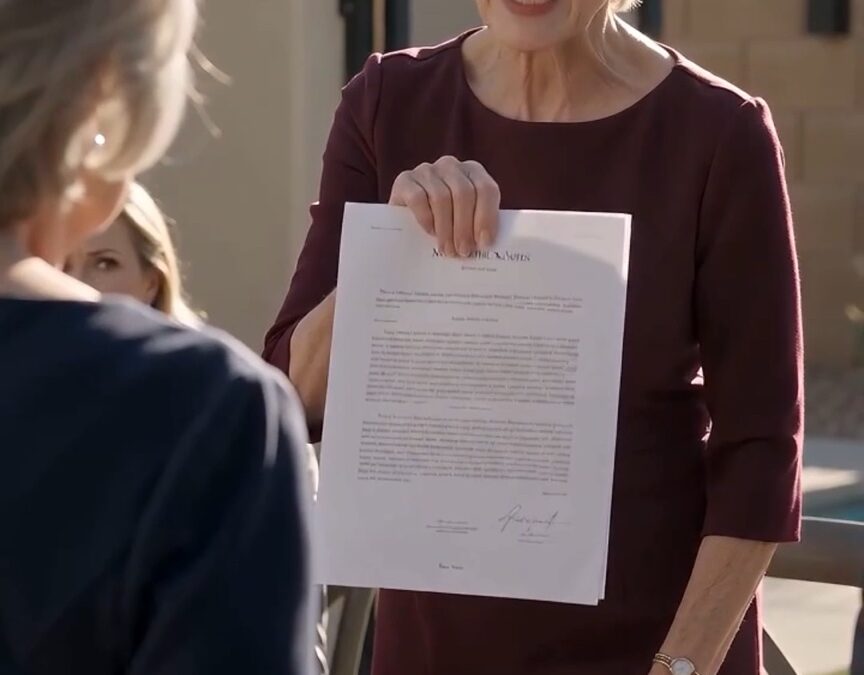
She lifted the document to chest height, facing Wade.
“Wade,” she said.
He turned toward her with his reception smile ready.
His eyes moved across the large print.
His smile disappeared.
Then he stepped backward.
The sentence on the page was plain.
“Lois will not borrow against her home.”
My signature was beneath it.
Wade had never seen that statement before.
He hadn’t signed it. Nobody had asked him to.
It recorded my decision about my own house.
Anita kept it facing him.
“Lois alone decides. She won’t borrow.”
He looked from the page to me.
“Wait. We need that.”
“I have her permission to speak,” Anita said.
Celia’s hand slipped lower on the gate.
Wade reached toward the paper without touching it.
“What exactly is this?”
“My signed refusal,” I said.
He looked back at my signature.
Anita didn’t hand it over.
“This isn’t somebody else’s ruling,” she explained. “It’s Lois’s decision, written down.”
I owned my home individually.
I had finished paying for it in 2016.
Nobody else had ownership or authority to borrow against it. Wade had no power of attorney, no account access, and no signed commitment from me.
Only I could approve borrowing against my home.
I had refused.
“You did this today?” Wade asked.
“Yes.”
“And you couldn’t discuss it with me first?”
“I agreed to listen. I didn’t agree to borrow.”
He pressed his lips together and looked toward the guests.
Anita lowered the page slightly, keeping the sentence visible.
“She asked me to show you,” she said.
I moved my hand away from the seam of my dress.
Wade had stepped far enough back that he was no longer close to my shoulder.
I stayed beside Anita.
Celia looked between us.
“Mom, we were supposed to talk about this.”
“We listened to his proposal.”
“But there were details.”
“I don’t need different details to refuse a loan.”
Wade rubbed a finger along his collar.
He studied the guests before speaking again.
“There’s been a misunderstanding.”
Anita waited.
He looked toward the men who worked for him.
“This isn’t the time to sort out private arrangements.”
“You made the accusation here,” I said.
His gaze returned to the paper.
It didn’t order him to do anything.
It didn’t stop a lender or cancel an application.
It made my answer visible to the same people who had heard him call me a burden.
Anita held it steady.
I could see my signature from where I stood.
Before the toast, I had written it slowly, keeping the page flat with my other hand.
Now Wade was reading it again.
Celia turned her face toward him.
“What misunderstanding?”
He didn’t answer her immediately.
Anita looked at me, checking before she continued.
I nodded.
She raised her eyes to Wade.
“Then we need to discuss what you told me.”
Chapter 3: The Promise I Never Made
Wade looked toward the tables before answering Anita.
“I told you we were expanding.”
“You told me Lois had agreed to finance it.”
I turned toward her.
Those weren’t the words she had used with me privately.
She had asked whether I had agreed to anything.
Until that moment, I hadn’t known what Wade was telling people.
Anita kept the statement against her chest.
“On May 16, you said she would borrow against her house.”
Celia let the gate rest against her palm.
Wade shifted his weight.
“We were discussing a plan.”
“You described her agreement as settled.”
He looked toward the employees again.
Anita followed his glance.
“Have you told them the same thing?”
He didn’t answer immediately.
A few guests looked toward the men at the table.
I watched Wade’s face while he considered what to say.
“I told people the funding was coming.”
“Relatives and employees?” Anita asked.
“Yes, because we were moving ahead.”
“With my house?” I asked.
He faced me.
“With the plan we discussed.”
I pressed my lips together until I could speak.
“I said I would listen.”
Anita had checked because his account didn’t sound like me.
She knew I had already emptied my savings helping them.
She also knew I still paid my own household expenses from regular retirement income.
An $85,000 loan wasn’t something I could add casually.
Before the toast, she had found a private moment with me.
We had stepped away from the tables, where we could speak without leaning across other guests.
“Have you actually agreed to anything?”
“I said I would hear him out.”
“Have you promised to borrow?”
“No.”
She asked whether I wanted more time to consider it.
I looked toward the yard where Celia was greeting people.
“No. I’m not doing it.”
Anita didn’t tell me what my answer should be.
She asked whether I wanted Wade told plainly.
“Yes.”
“Do you want me with you?”
“I want you to tell him if he brings it up.”
She suggested writing the decision down.
I had spent enough time being told I had meant something different.
I agreed.
We found a place to rest the paper.
Anita helped me keep the wording brief and plain.
There was no lender’s name, official seal, or legal command.
The visible sentence read, “Lois will not borrow against her home.”
I read it before signing.
“Is that exactly what you want?” Anita asked.
“Yes.”
“May I show Wade?”
“Yes. You can speak for me about this.”
She folded nothing over the sentence.
She kept the paper with her when we returned.
Now she held the same page before the guests.
Wade looked at the signature, then at Anita.
“You’re a payroll clerk, not her financial adviser.”
“Retired payroll clerk,” she said. “And I haven’t claimed any authority over her money.”
“She has no authority,” I said.
That brought his eyes back to me.
“I do.”
He opened his mouth, then looked toward Celia.
Anita lowered the document enough to avoid blocking her face.
“This records what Lois decided. Nothing more.”
I moved closer to my friend.
My shoulder still felt tender where Wade had pushed me.
I kept it turned away from him.
“You could have talked to me,” he said.
“You could have asked what my answer was.”
Celia looked at the paper.
“Mom, nobody said you hadn’t helped.”
“He just said I ask you for money.”
Wade tried to interrupt, but I continued.
“From May 2022 through April 2025, I gave you $62,000.”
I hadn’t brought receipts to the celebration.
I hadn’t expected to account for my savings beside a gate.
But I knew the total.
Anita knew it too.
Some gifts covered household shortfalls. Others paid expenses for Wade’s existing irrigation business.
I hadn’t loaned the money.
I hadn’t bought an ownership share.
When I gave it, I expected nothing back.
“You said you wanted to help,” Celia said.
“I did.”
“We didn’t force you.”
“No. Those were gifts.”
Wade nodded quickly at that.
“Exactly.”
“And they are finished,” I said.
His nod stopped.
I looked toward the table where my untouched plate waited.
I had wanted this afternoon to be about my daughter.
Instead, I was explaining that giving money before didn’t mean agreeing to borrow more.
Anita touched the edge of the page with her thumb.
“She was concerned enough to put her answer in writing.”
Celia frowned.
“Why didn’t you tell me before the toast?”
“You didn’t ask what my answer was.”
“I knew you were considering it.”
“I considered what he said.”
Wade took a small step toward the tables.
“Then let me explain the proposal properly.”
“I’ve heard it.”
“Not with everything together.”
I shook my head.
He looked irritated, but he kept his voice controlled.
“I thought we understood each other.”
The guests near us stayed in their chairs.
Nobody had to take my word about the refusal now.
They could read the sentence Anita held.
Wade couldn’t claim he had seen it earlier or misunderstood its wording.
He had read it while everyone watched.
Celia’s fingers tightened on the gate again.
“Listening usually means you’re open to something.”
“It meant I would hear him.”
I looked directly at Wade.
“Listening was never agreement.”
Chapter 4: The Men At The Tables
Celia glanced toward the employees again.
“They were promised more work.”
The men at the table watched her without speaking.
I recognized the way she said it.
She had used the same argument while holding the gate open.
Their expectations were supposed to change my answer.
“Who promised it?” I asked.
“Wade explained what was coming.”
“Then Wade needs to explain what isn’t.”
He drew a breath through his nose.
“There’s no reason to embarrass the crew.”
“I haven’t accused them of anything.”
“They’ve been looking forward to this.”
“I understand.”
Celia stared at me.
“Do you?”
I looked down at the latch beside her hand.
“I can understand without borrowing against my home.”
Wade moved so he faced both me and the tables.
His smile was gone, but he wasn’t shouting now.
“We should discuss terms privately.”
“There aren’t terms to discuss.”
“There can be safeguards.”
“I won’t take the loan.”
He glanced at Anita.
“You’re making it sound like I asked her to hand over the house.”
“You asked for an $85,000 loan secured by it,” I said.
Celia looked uncomfortable at the full description.
Wade rubbed his jaw.
“The business would use the proceeds.”
“I would owe the debt.”
“We could arrange how it’s paid.”
“The loan would still be mine.”
He looked toward the guests nearest us.
“I was trying to create more work.”
“Then tell them what you actually have arranged.”
Celia moved her foot away from the passage.
The gate shifted, and she caught it again.
I remembered her sitting at my kitchen table while I listened to the proposal.
Wade had described equipment and an additional service route.
I had kept my hands around my cup.
He spoke about being ready to grow.
Celia watched him and nodded.
When he finished, I had asked what he needed from me.
He said $85,000, borrowed against the house.
I set my cup down.
“I’ll listen to what you’re proposing.”
I had not offered my signature.
I had not given him permission to approach a lender.
Back in the yard, Wade tried a different explanation.
“I took your willingness seriously.”
“I was listening seriously.”
“You didn’t reject it then.”
“I hadn’t made a decision then.”
“So you can understand why I thought—”
“No,” I said. “You needed an answer.”
He stopped speaking.
Anita kept her eyes on him.
The paper rested against her chest now, my signature still visible.
Wade looked at Celia.
She asked him quietly whether they could move inside.
I answered before he did.
“You asked me to sign in front of everyone.”
“Mom.”
“I can refuse in front of them.”
Wade straightened his shoulders.
“All right. I treated listening as agreement.”
Anita didn’t react beyond a small nod.
I kept my feet still.
He continued before anyone else could speak.
“That doesn’t mean the proposal is bad.”
“I haven’t said your business is bad.”
“Then let’s separate that from the wedding.”
“You connected them when you told me to sign or leave.”
He looked toward my empty chair.
Celia followed his eyes.
I waited for either of them to offer it.
Instead, she said the employees had families.
I nodded toward Wade.
“They work for him.”
“They’ve been reliable,” she said.
“I haven’t questioned that.”
“They deserve consideration.”
“So does the person you’re asking to borrow.”
Celia looked down at her dress.
Wade lowered his voice.
“Lois, we can sit down afterward. No audience.”
Anita turned toward me without speaking.
I didn’t need her to answer this part.
“No. I refuse the $85,000 borrowing.”
Wade lifted a hand slightly.
“You’ve made that clear.”
“I want the people you told to hear it.”
“They’ve heard.”
“Then don’t describe it later as unfinished.”
He dropped his hand.
The guests could see the page. They had heard my answer directly.
A private conversation wouldn’t turn it into something else.
Celia leaned back against the fence, still holding the gate.
“What about everything already started?”
I looked at Wade.
“What has started?”
“The planning,” he said.
“What has been signed?”
He glanced toward the employees.
“This is getting unnecessarily technical.”
“You’re asking me to secure it with my home.”
He rubbed his collar again.
I could see him choosing what to explain.
Anita stayed quiet.
That helped me keep my own questions plain.
“Have I signed a borrowing document?”
“No.”
“Has anyone approved a loan?”
“We haven’t reached that point.”
Celia turned fully toward him.
“I thought you were ready.”
“I am ready to move when the funding is arranged.”
I looked from him to my daughter.
“Has anything been submitted using my name?”
He shook his head.
I wanted the answer spoken, not left as a gesture.
“Wade?”
He looked toward the people waiting for his business announcement.
Then he answered me clearly.
“No application exists.”
Chapter 5: The Unpaid Reservation
Celia stared at Wade.
“But the equipment is reserved.”
He nodded.
I looked at him.
“Is it purchased?”
“No.”
“Have you paid for it?”
“Not yet.”
He shifted his attention toward the employees.
“The reservation holds the equipment while I arrange the deposit.”
I waited.
Anita lowered the document to her side.
The sentence had done what I asked.
Now Wade needed to describe his own arrangements.
“How will you pay that deposit?” I asked.
He pressed his lips together.
“That’s what the funding was for.”
“Do you have the deposit without my money?”
“Not available for that, no.”
Celia released a breath and looked toward the house.
The gate moved against her hand.
Wade continued before she could speak.
“The existing operation isn’t the problem.”
“I didn’t say it was.”
“This is an expansion.”
“Then tell them that.”
He turned farther toward the tables.
“The equipment hasn’t been purchased. The additional route depends on getting the equipment.”
“And the deposit,” Anita said.
“Yes.”
I looked toward the employees.
Their lunches, schedules, and household bills weren’t mine to arrange.
But I wasn’t going to let him describe my refusal as closing his existing business.
“Does the current work continue?” I asked.
“Yes.”
“Are you shutting the business?”
“No.”
He said that firmly.
His existing irrigation operation remained open.
Nobody had been hired solely for the expansion.
No existing employee had guaranteed contractual hours from the additional route.
Wade acknowledged that when Anita asked him directly.
Celia looked back toward me.
“They were still expecting more.”
“Then their employer needs to correct that.”
Wade didn’t like the word.
He looked at me sharply, then toward his crew.
“I’ll handle the scheduling.”
I nodded.
“That belongs with you.”
He rubbed his palm against his trouser leg.
For the first time since the shove, there was space between me and the tables.
I could have reached my chair.
I looked at my plate and the folded napkin beside it.
I didn’t want to sit there now.
Anita glanced toward the gate.
She wasn’t directing me toward it.
She was checking what I wanted.
“I want to leave,” I told her.
Celia immediately stepped into the passage.
“Let me walk out with you.”
“Not yet.”
She stopped.
I turned back toward Wade.
“There will be no more gifts.”
He looked toward the guests.
“We can discuss family matters later.”
“I don’t want you planning around money from me.”
Celia folded her free hand against her waist.
“Mom, you don’t have to decide everything while you’re upset.”
“I decided about the house before the toast.”
“And now you’re adding things.”
“I’m telling you what I can provide.”
I had given them my liquid savings.
My ordinary retirement income still paid my bills.
That didn’t mean there was another account waiting behind the empty one.
“I won’t provide more financial support.”
Wade watched me without smiling.
“What about the food?”
I looked at him.
“The crew lunches stop too.”
Celia lifted her eyes.
“They have nothing to do with this.”
“They take groceries and work.”
“You’ve always liked cooking.”
“I cooked at a school before I retired.”
“You like helping.”
“I won’t keep buying and preparing your crew meals.”
Wade looked toward the men again.
“We can arrange something else.”
“Yes,” I said.
He seemed to expect another sentence.
I didn’t give him one.
Anita folded the paper carefully, leaving my signature inside.
She asked whether I wanted it back.
“Keep it safe until we’re home.”
She placed it where she could carry it securely.
Celia moved aside from the passage.
I took a step toward it, then stopped beside the latch.
Wade watched me as if I might reconsider.
“I won’t ask you to repay the gifts,” I said.
Celia looked up.
“They were gifts,” I continued. “I’m not changing that.”
Wade nodded once.
“But there won’t be more.”
He looked away.
I had wanted no accounting at the wedding either.
Now the total and the refusal had been spoken before the people he had addressed.
He couldn’t make my old help into a loan he resented.
He couldn’t make it a promise of future help.
Anita moved beside me.
I checked the concrete beneath my shoes.
My heel still hurt from the grit.
Celia touched the gate again.
“I’ll hold it.”
“I have it.”
She let her hand fall.
I took the wood near the latch and passed into the narrow passage.
Anita waited while I turned.
Through the opening, I could see the tables and my empty chair.
Wade stood near the place where he had blocked me.
He didn’t step toward me now.
Celia stood between him and the gate.
I had been ordered through it.
I had stayed long enough to answer.
Now nobody was deciding when my feet moved.
I drew the gate toward me.
The edge caught briefly against the uneven concrete.
I lifted it enough to clear the scrape.
Celia took a step forward.
“Mom.”
I looked at her through the remaining opening.
She glanced toward Wade, then back at me.
I pulled the gate shut and settled the latch.
Anita waited beside me in the passage.
We started toward the front yard.
Behind the closed wood, Celia called after me.
“Mom, please wait.”
Chapter 6: Monday At The Credit Union
I stopped in the passage, but I didn’t reopen the gate.
“What is it, Celia?”
“Please don’t leave like this.”
Anita stood beside me without speaking.
I could hear movement in the yard.
“I am leaving,” I said.
“We need to talk.”
“Not here.”
Celia didn’t lift the latch.
I waited long enough to know she had heard.
Then I walked toward the front of the rented house.
At home, I took off my dress shoes.
The grit fell onto the floor beside my chair.
I picked it up with a damp cloth.
Anita put the folded statement on my kitchen table.
“Do you want me to stay?”
“For a little while.”
She sat while I changed into clothes without buttons at the shoulder.
When I returned, she had left the paper where I could see it.
I opened it and smoothed the fold.
The sentence hadn’t changed because I had left the yard.
Neither had my answer.
I put it with my household papers.
On May 19, 2025, I went to my credit union.
I went alone.
Anita had helped me speak at the celebration.
She did not control my accounts or make decisions for me.
I wanted the credit union to hear directly from me.
At the counter, I asked to discuss borrowing authority and account access.
I kept my purse closed until I was seated.
Then I took out the identification and account information requested.
“I haven’t applied for a home-equity loan,” I said.
The staff member checked my information.
“I want to confirm there isn’t an application.”
There wasn’t.
There was no unauthorized loan to cancel.
No application had been submitted, and no lender had approved anything.
I placed my hands flat on my purse.
“My son-in-law has discussed me borrowing against my house.”
“Has he been given authority to act for you?”
“No.”
“Does anyone hold power of attorney for you?”
“No.”
I explained that the home belonged to me individually.
I had paid it off in 2016.
Nobody else owned a share.
The staff member confirmed that Wade had no access to my accounts.
He had no authority to begin borrowing in my name.
I didn’t describe Anita’s statement as a bank instruction.
It wasn’t one.
I had come to give my own instruction directly.
“Please don’t begin a loan application without my direct request.”
The staff member explained that my participation and authorization would be required.
I asked whether a relative discussing possible financing created any commitment.
It didn’t.
I listened to the explanation and asked for clarification where I needed it.
I had spent years reading food orders and kitchen schedules.
Financial paperwork took more time for me.
That didn’t mean someone else could decide what I signed.
I checked the information again before leaving.
My regular retirement deposits were unchanged.
My household payments weren’t affected by Wade’s plans.
The savings I had given away were gone.
My retirement income and home were still mine.
Outside, I stood long enough to put the papers securely in my purse.
I hadn’t recovered $62,000.
I hadn’t acquired new savings by saying no.
But I had confirmed that the $85,000 debt did not exist.
At home, I cleared a space on the kitchen table.
I put the credit union information beside my signed statement.
Then I returned both to my household papers.
I didn’t leave them where a visitor could handle them.
I made something simple to eat.
There were no lunch pans cooling across the counter.
I could use the whole sink.
When Anita called, I told her what the credit union had confirmed.
“Nothing had been started,” I said.
“Good.”
“And he has no access.”
“She explained that directly?”
“Yes.”
Anita didn’t suggest another document or another confrontation.
She asked whether I had eaten.
I looked at the plate in front of me.
“I’m eating now.”
We spoke about where I had put the statement.
She told me to keep it because it recorded the answer he had heard.
I already had.
After we hung up, I washed my plate.
I left it in the rack instead of making space for covered pans.
The kitchen looked ordinary.
That helped more than talking would have.
Celia hadn’t come to the house.
I didn’t call to ask whether the guests had enjoyed the rest of the celebration.
I wasn’t ready to hear about the toast as an unfortunate misunderstanding.
Wade contacted me after my credit union visit.
His voice was controlled.
“I understand the house is off the table.”
“Yes.”
“I don’t want to keep arguing about that.”
“Neither do I.”
He paused.
I kept my hand away from the household papers.
They were put away because I had finished with them.
He said the equipment reservation still needed attention.
“That belongs to your business,” I said.
“I know. I’m looking at other ways.”
I waited.
He didn’t mention borrowing against the house again.
Instead, he changed the request.
“What if you made a smaller contribution?”
Chapter 7: No Smaller Contribution
I stayed seated at my kitchen table.
“No.”
Wade paused.
“You haven’t heard what I mean.”
“I heard smaller contribution.”
“It wouldn’t involve the house.”
“I won’t provide more money.”
He made a low sound of frustration.
“I’m trying to find something workable.”
“You need to find it without my money.”
He didn’t accuse me of asking him for money again.
He had lost that claim before the guests.
Now he described the smaller amount as cooperation.
I didn’t ask how small.
I didn’t ask what equipment it might cover.
I had no savings left to volunteer, and I wasn’t going to bargain over my retirement deposits.
“You still have income,” he said.
“Yes. It pays my household expenses.”
“I’m not asking for all of it.”
“I’m not offering part of it.”
He went quiet.
I moved my cup away from the edge of the table.
My hand had left a damp mark beneath it.
I wiped the mark while he spoke about the reservation.
The supplier needed a deposit.
Without it, he couldn’t keep planning around the equipment.
I let him finish.
“That doesn’t change my answer.”
“You’re making a permanent decision over a bad afternoon.”
“I refused before the toast.”
He had no answer to that.
Anita’s statement had established the timing in front of witnesses.
My refusal hadn’t begun when he shoved me.
It hadn’t been written as punishment afterward.
“I need to know whether there’s any possibility,” he said.
“There isn’t.”
He ended the conversation without another proposal.
I set the phone down and carried my cup to the sink.
The counter was clear enough that I could put it anywhere.
I rinsed it and left it beside my plate.
Later, Wade told me he had canceled the unpaid equipment reservation.
He also canceled the planned additional service route.
I asked whether his existing work was continuing.
“Yes.”
That was the only business detail I needed confirmed.
His current operation remained open.
The expansion had depended on money he did not have.
Canceling the reservation wasn’t losing equipment he owned.
Canceling the additional route wasn’t dismissing people hired for it.
I didn’t pretend the change was pleasant for him.
I also didn’t offer to repair it.
“You understand why it couldn’t happen,” he said.
“I understand you didn’t have the funding.”
He exhaled.
“I thought you would come around.”
“I told you I wouldn’t.”
He didn’t dispute that.
I didn’t ask him to apologize during that call.
There were things he had done that no business explanation addressed.
But I wasn’t going to trade an apology for another discussion of money.
I ended the call after he confirmed the cancellation.
Then I took the empty lunch pans from the cabinet.
They were mine, bought and used in my kitchen.
I washed the ones that needed it and let them dry.
I didn’t put them on the counter for the next crew meal.
When they were dry, I nested them together.
The cabinet door closed without a lid sticking out.
Anita came by to check on me.
She sat at the table while I put the last pan away.
“He canceled it,” I told her.
“The reservation?”
“And the extra route.”
She nodded.
“I’ve heard.”
I sat opposite her.
Anita explained that Wade had corrected his funding claim to the people he had told.
Relatives and employees had been told the expansion wasn’t funded by me.
He could no longer describe my agreement as settled.
Too many of those same people had heard me refuse.
“What did he say?” I asked.
“That the financing he expected wasn’t available.”
“Did he say I had promised it?”
“No.”
I looked toward the cabinet.
I would have preferred a correction that admitted everything plainly.
But I didn’t need another public gathering.
I needed him to stop using a promise I had never made.
Anita had heard that correction.
His reservation was canceled.
My money wasn’t going into the business.
“That’s what I needed to know,” I said.
She didn’t ask me to feel better about him.
She asked whether I wanted the chair closer to the window.
We moved it where the light wasn’t in my eyes.
I sat down again.
She watched me stretch my shoulder carefully.
“Still sore?”
“Less.”
Neither of us called the shove a misunderstanding.
After Anita left, I put the chair back under the table.
I checked my ordinary grocery list.
There was no space marked for crew lunches.
I crossed out nothing because I hadn’t written them down.
That evening, Celia contacted me.
I expected another explanation about employees.
Instead, she asked how I was.
“I’m home,” I said.
“I know.”
I waited.
She didn’t put Wade on.
She asked whether we could talk without him.
“We’re talking now.”
“I mean in person.”
I looked around my kitchen before answering.
The counter was clear.
The pans were in the cabinet.
My household papers were put away.
“Are you asking to discuss money?”
“No.”
I didn’t answer immediately.
She spoke again, more quietly.
“Can I visit you?”
Chapter 8: The Empty Lunch Counter
I told Celia we could arrange a visit.
I didn’t offer a meal for the crew or money for the business.
She said she understood.
After the call, I checked what I already had in the refrigerator.
For so long, shopping had started with what would fill the lunch pans.
Now I looked at what I would eat myself.
I took my list to the grocery store.
I didn’t choose the larger package because Wade might ask for extra portions.
I didn’t stand comparing how much rice would stretch across the pans.
I bought groceries for my own kitchen.
At home, the bags fit on the clear counter.
I put the cold food away before sitting down.
There was no rush to get chicken cooked before pickup.
I washed what I needed for my supper.
Then I dried my hands and rested.
The quiet didn’t make me hungry for company immediately.
It made me notice how often I had eaten standing up while food for someone else filled my table.
I pulled out a chair and sat at it.
When my usual crew-cooking day came, I didn’t begin the preparations.
The pans stayed in the cabinet.
I made my own meal and left enough room to set down a cup.
Wade contacted me about the lunches.
He didn’t describe the request as financial support.
“The crew asked about the food.”
“I won’t be making it.”
“They liked what you sent.”
“I’m glad.”
“Could you keep doing it while I sort things out?”
“No.”
He paused, perhaps waiting for me to explain further.
I had already explained at the gate.
I wasn’t buying groceries and cooking for his employees anymore.
“If I handle groceries?” he asked.
“I won’t prepare the crew meals.”
That ended the practical question.
I didn’t argue about whether cooking counted as helping.
I knew what carrying pans and standing over steam required.
Wade knew too.
He had watched me do it.
After the call, I opened the cabinet for a small cooking dish.
The nested lunch pans stayed where I had put them.
I closed the door.
Celia brought up the meals when we spoke about visiting.
“Would you at least think about the employees?”
“I have.”
“They didn’t shove you.”
“I know.”
“They didn’t say what Wade said.”
“I know that too.”
“Then why should they lose the lunches?”
I put down the towel I was folding.
“Their meals and scheduling belong to their employer.”
“They’ve been through enough uncertainty.”
“Then he needs to tell them what he can provide.”
She sighed.
I waited without adding another defense.
The crew had eaten what I bought and prepared.
I didn’t regret feeding them.
But I had not signed up to provide meals indefinitely.
“Maybe he could bring the ingredients,” Celia said.
“He already asked.”
“And?”
“I won’t restart the lunches.”
She was quiet.
I could hear her breathing, but not Wade.
I hoped she was alone.
I didn’t ask.
“This isn’t about punishing them,” I said.
“I didn’t say it was.”
“You’re asking as if I owe them.”
“I just thought you might miss it.”
I looked at the dry towel in my lap.
“I miss cooking at school sometimes. That doesn’t mean I’m going back.”
Celia gave a small, unhappy breath.
“I suppose not.”
I folded the towel and put it beside me.
We discussed the visit again.
I told her I wanted her to come alone.
She agreed without arguing.
I said I wasn’t opening another conversation about financing.
She said she wasn’t asking for that.
I didn’t make her promise an apology.
If she had something to say, she needed to choose it herself.
After we hung up, I went back to my supper.
The food was ready when I wanted it.
There was no message asking for another scoop.
I ate at the table with both feet resting on the floor.
My shoe wasn’t pinching.
My shoulder no longer hurt when I lifted my cup.
I washed my dishes afterward.
The sink didn’t need clearing for an oversized pan.
Before the visit was settled, Celia called again.
She began by asking whether I had time.
“Yes.”
“I’ve been thinking about what you said.”
I stayed at the table.
“About the meals?”
“About the wedding.”
I let her continue.
She said she had wanted the argument to stop.
I looked toward my front door.
“That doesn’t explain why I was the person being sent out.”
“I know.”
“Do you?”
She didn’t answer quickly.
I remembered her hand around the gate.
She had been close enough to look at my shoulder.
She had chosen the latch.
“I thought if you signed, everything would settle down.”
“You knew I hadn’t signed a commitment.”
“Yes.”
“And you still treated listening as a promise.”
“Yes.”
I pressed my palm against the table.
There was no need to repeat the dollar amount.
She knew what had been asked.
Celia spoke again.
“I opened the gate, Mom.”
Chapter 9: My Daughter At The Door
On June 28, 2025, Celia arrived alone.
I saw her through the front window before answering.
Wade wasn’t beside her.
She wasn’t carrying lunch pans or papers.
I opened my front door.
“Come in.”
She paused on the threshold.
“Are you sure?”
“Yes.”
I stepped back enough for her to enter.
She looked toward the kitchen, then returned her eyes to me.
I closed the door after her.
We sat at my table.
For a moment, she smoothed her hands over her clothes.
I kept mine beside my cup.
She had asked to visit.
I wasn’t going to supply her words.
“I’m sorry I opened the gate.”
I looked at her.
She continued without me prompting.
“I should not have helped him send you out.”
I left my cup where it was.
“You watched him shove me.”
“I did.”
“And then you opened it.”
“Yes.”
She pressed her fingers together.
“I wanted the scene to stop. I treated you like the problem.”
I watched her face while she said it.
She didn’t call the shove accidental.
She didn’t say everybody had been upset.
“I was trying to go back to my chair,” I said.
“I know.”
“You could have asked him to move.”
“I should have.”
I nodded, but I wasn’t ready to make the conversation easier.
She looked toward the front door.
“I’m also sorry I pressured you about the house.”
I waited.
“I knew you hadn’t signed anything. I wanted you to act as if listening had obligated you.”
“Yes.”
“I shouldn’t have used the employees.”
“No.”
She lowered her eyes to the table.
“They weren’t your responsibility.”
I picked up my cup and took a drink.
It gave me something ordinary to do.
Celia didn’t ask whether I accepted the apology immediately.
She sat still.
I told her my shoulder had stopped hurting.
Her face changed.
“I’m glad.”
“I didn’t fall.”
“I saw you catch yourself.”
I put my cup down carefully.
“I wanted you to come stand beside me.”
She covered her mouth briefly, then lowered her hand.
“I know that now.”
We sat without speaking.
The refrigerator stopped running.
I could hear a vehicle pass outside.
Celia looked toward the kitchen counter.
It was clear except for what I used myself.
“The lunches really stopped,” she said.
“Yes.”
“I wasn’t asking you to restart them.”
“Good.”
She nodded.
I didn’t need to explain the arrangement again.
She knew there would be no more gifts, no loan, and no crew meals.
Her apology didn’t alter that.
“I won’t be supporting the business,” I said.
“I understand.”
“Or covering household shortfalls.”
“I understand that too.”
She didn’t mention a smaller contribution.
She didn’t describe an emergency.
I watched for the turn in the conversation, the point where regret might become a request.
It didn’t come.
Instead, she asked whether I was managing at home.
“My retirement income covers my household.”
“And the house?”
“Still mine. No new loan.”
She nodded, looking relieved.
I didn’t thank her for being relieved about something she had pressured me to risk.
But I let the conversation continue.
We moved from the table to the chairs nearby.
I chose the place where the afternoon light wouldn’t fall in my eyes.
Celia waited until I sat before taking her seat.
It was a small thing.
I noticed because she hadn’t asked me to sit at the wedding.
She asked whether I needed anything brought within reach.
“My cup.”
She got it from the table and handed it to me.
She didn’t rearrange my papers or open a cabinet.
We talked about my ordinary days.
I told her I bought what I could use without filling the refrigerator for a crew.
She listened.
When I said I no longer stood over the stove on their schedule, she didn’t tell me I liked cooking.
She asked what I was making for myself.
I told her about the simple food already prepared for my supper.
“That sounds good,” she said.
“It suits me.”
She smiled a little, then looked down.
I didn’t invite her to make up for the wedding with another celebration.
I didn’t ask her to persuade Wade to apologize.
Those weren’t decisions I could make for her.
What she did in my house was something I could see.
She stayed without asking for money.
She let a refusal remain a refusal.
When I stood to put my cup down, she didn’t jump into another subject.
She waited for me to return.
I sat again.
“I wanted to see you in your wedding dress,” I said.
Her eyes filled.
“I know.”
“I didn’t come to be part of a business announcement.”
“I’m sorry.”
I nodded.
There wasn’t another answer I could give her yet.
She wiped beneath her eyes with her fingertip.
We sat until she was ready to stand.
At the front door, she turned toward me.
“Would it be all right if I came back?”
Chapter 10: Supper In My Own House
“Yes,” I told Celia.
She stayed beside the front door.
“Alone?”
“For now.”
“All right.”
I wasn’t offering a return to the old arrangement.
She could visit without bringing Wade’s business into my kitchen.
She could sit with me without asking what I could spare.
I wanted to find out whether we could do that.
She looked toward the room behind me.
“I’d like that.”
“Then we’ll arrange it.”
She didn’t reach for her phone to set anything immediately.
She let the answer stand.
I noticed that too.
There had been so many moments when my willingness to talk became permission to plan around me.
This time she didn’t add anything to what I said.
She asked whether I wanted help putting away the cups.
“I’ll do them with my supper dishes.”
“Okay.”
The visit had stayed a visit.
I hadn’t signed anything.
I hadn’t handed over money.
I hadn’t opened my cabinet to send food home.
Celia had apologized for what she did, not merely for my reaction.
I could remember her words without changing them into something kinder.
She had said she opened the gate.
She had said she shouldn’t have pressured me about the house.
That was enough for her to come through my front door.
It wasn’t a reason to resume supporting them.
My home remained unencumbered.
The credit union hadn’t started a loan.
My regular retirement income still arrived and covered my household expenses.
I had less money saved than I wished.
Nothing about the afternoon restored the $62,000 I had given away.
But I didn’t owe an additional $85,000.
I could open my household papers without finding a loan payment I couldn’t safely carry.
Wade’s expansion remained canceled.
The unpaid equipment reservation was gone.
The additional route hadn’t begun.
His existing irrigation business continued.
He still had his own work to manage.
I had not demanded repayment of the gifts.
I had not offered another gift to soften my refusal.
Celia knew both facts.
She stood near my door without trying to change either.
“Thank you for letting me come,” she said.
“I wanted to hear you.”
“I should have said it sooner.”
I didn’t disagree.
She glanced at my shoulder, then back at my face.
“I’m glad you’re all right.”
“I am managing.”
She nodded.
It was a more useful answer than telling her everything was fine.
I was eating properly.
My bills were paid.
My home was quiet when I wanted quiet.
I still thought about the shove when someone moved suddenly near me.
I didn’t need to explain all of that at the door.
Celia opened her arms slightly, waiting.
I stepped toward her.
We hugged without talking.
When I moved back, she let go.
She didn’t hold me there until I reassured her.
I opened the front door.
The air outside was warmer than the room.
She stepped across the threshold, then turned.
“I’ll call before I come again.”
“Please do.”
She said goodbye.
I watched until she had gone from the doorway.
Then I closed my front door.
It latched without scraping.
I left my hand on the knob briefly.
At the wedding, I had stood outside a different door opening while my daughter held it for my removal.
That gate belonged to the yard they rented.
It had no authority over my home.
Still, I could remember every part of it.
The latch beneath her fingers.
The narrow passage.
The bottom edge dragging against the concrete when I pulled it closed.
I had left that yard after the truth was spoken.
Anita’s statement had gone home with me.
Wade’s claim of agreement had stayed disproved before his guests.
I hadn’t needed to return through the gate to collect an apology.
I had needed to get home.
Now I was here, after a visit my daughter had requested and completed without asking for money.
I returned to the kitchen.
My supper was waiting where I had put it.
There wasn’t a message asking me to make extra.
There were no covered pans lined along the counter.
I took out the plate I needed.
I ate at my table, sitting down.
When I wanted more water, I got it.
When I finished, I didn’t start packing portions for pickup.
I put the remaining food away for myself.
The refrigerator had room.
I wiped the table and carried my dishes to the sink.
The small amount of washing took little time.
I dried the plate, then the utensils.
The lunch pans stayed nested behind the cabinet door.
Celia had left through my front door after being welcomed inside.
She hadn’t asked for groceries, a check, or another discussion about the house.
I could let that visit be what it was.
I set my dry plate in the cabinet.
Then I put away the rest of my own supper dishes.
The counter was clear when I turned off the kitchen light.
I remembered leaving the wedding yard with Anita beside me.
Celia had called after me, but I hadn’t reopened anything.
I had lifted the dragging edge and closed the backyard side gate.
You Might Also Enjoy




