My Son-in-Law Trashed My Retirement Lunch, So I Went For Ice And Found His Secret
Complete story · 10 chapters · about 42 minutes · ending included
Chapter 1 · Chapter 2 · Chapter 3 · Chapter 4 · Chapter 5 · Chapter 6 · Chapter 7 · Chapter 8 · Chapter 9 · Chapter 10
Chapter 1: The Plate In The Trash
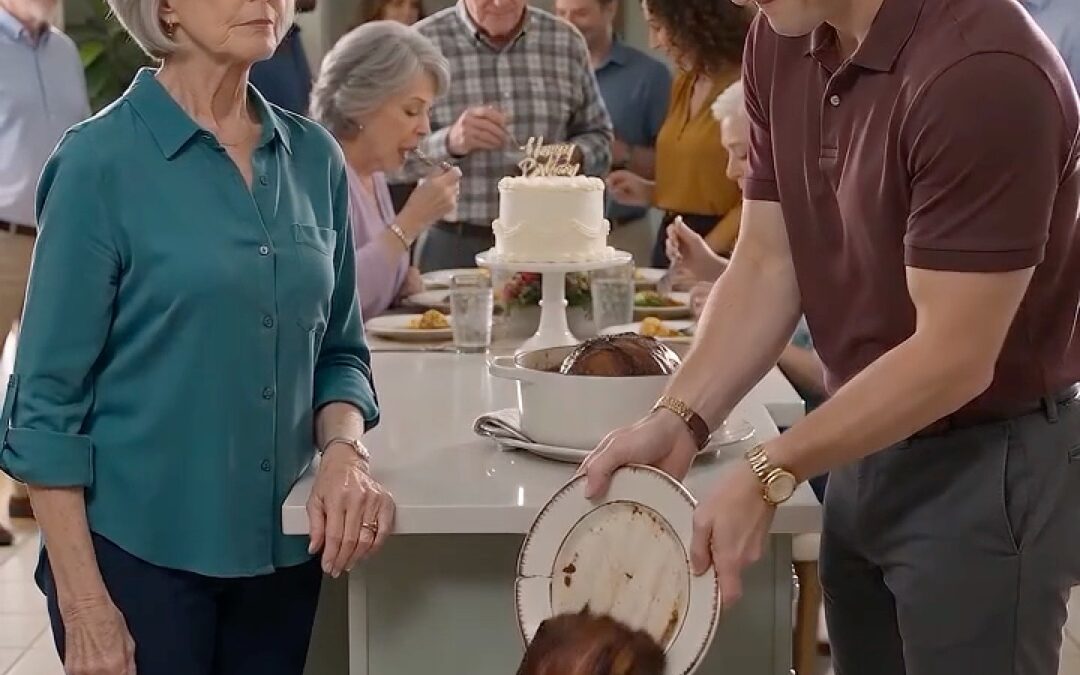
Preston pulled my mother’s ironstone plate from my hand and scraped my lunch into the trash.
“Preston, I wasn’t finished,” I said.
The plate slipped from his fingers and struck the bin’s inside edge.
Then it dropped into the potatoes and gravy.
I kept my hand out, still shaped around a plate I wasn’t holding.
I had gone back for seconds of my own pot roast.
“Every bite on that plate came out of my paycheck, Roz.”
He said it toward the dining room, loud enough to stop the forks.
My face burned.
I wanted to reach into the trash.
I wanted someone to tell him that was enough.
Nobody did.
Preston rested his palm on the counter.
“I pay her mortgage. Eleven fifty, every month, out of my check.”
Two guests clapped.
One gave a little approving nod.
My stomach tightened at that nod.
The applause made his story sound settled.
I was standing beside the trash in my own kitchen, being thanked for nothing.
The stove clock showed 11:50 a.m.
Fourteen guests had come to celebrate my retirement.
I had peeled the carrots before anyone arrived.
The roast had cooked until I could separate it with a fork.
Now a piece of it rested against a used napkin.
“Let’s leave enough for the people who are still hungry,” Preston said.
I looked at the serving dish.
There was plenty left.
That hurt, too.
He hadn’t even needed an excuse that would survive a glance.
I was sixty-four, and I felt embarrassed for wanting my lunch.
His little remarks had started after his family moved in.
At first, he had joked about my sewing supplies taking over the house.
Then he joked about my grocery list.
Then my age.
I had kept finding reasons to excuse him.
He was tired.
He liked an audience.
Tabitha hated an argument.
By then, I knew how to smile without moving much of my face.
It had become a household chore.
Tabitha stood near the end of the dining table, holding a serving spoon.
I looked straight at my daughter.
Tabitha lowered the spoon into the carrots.
“Mom, there are clean plates beside the stove,” Tabitha said.
I felt a sharp hurt under my ribs.
My daughter had seen where my mother’s plate went.
Tabitha was offering me a replacement before asking Preston to pick it up.
“I know where they are,” I said.
I had bought those plates.
I had chosen the cabinet they sat in.
Still, I kept my voice quiet, as though I were visiting.
Preston reached past me for a roll.
“See? We’ve got her covered.”
He smiled at the room.
I pressed my thumb into the side of my finger.
That smile was meant to make any objection look ungrateful.
If I got angry, I would spoil the party.
If I stayed quiet, he could keep talking.
Being quiet had never made him kinder.
A chair scraped in the dining room.
Someone asked for the butter.
The ordinary sounds made me feel worse.
People could watch that happen and return to eating.
I looked down at the bin again.
My mother’s plate lay tilted against the liner, its blue flowers smeared with gravy.
My mother had served Sunday dinner on that ironstone.
After I inherited it, I used it instead of saving it for company.
I liked the weight of it.
I liked knowing whose hands had carried it before mine.
Preston had handled it like a disposable tray.
I felt angry then.
Plain, hot anger.
I had worked twenty-two years at the uniform plant.
At the bridal alterations shop, I had stood pinning hems until my knees ached.
I had wanted this party to mark the end of standing for work.
A meal.
My family.
A chair I could stay in.
I hadn’t expected to defend my right to a second helping.
Preston brushed crumbs from the counter into his palm.
The bin was right beside him.
He could have reached down.
Instead, he dropped the crumbs over my mother’s plate.
My eyes stung.
I didn’t want to cry where he could turn that into another joke.
“I’ll get the ice,” I said.
I glanced through the doorway at the framed letter in the hallway.
Paid in Full.
Then I bent over the kitchen trash and lifted out my mother’s plate.
Gravy ran onto my wrist.
A piece was missing from the rim.
One chip.
I held the plate over the sink until the dripping stopped.
Behind me, Preston asked who wanted another roll.
His voice sounded cheerful again.
That frightened me a little.
He could do something cruel and carry on without a pause.
I turned on the faucet.
Warm water loosened the gravy from the blue flowers.
I washed the plate carefully, keeping my thumb away from the broken edge.
I took a clean dish towel off the oven handle.
I spread it on the counter and set the ironstone down.
Tabitha came into the kitchen carrying an empty bowl.
My daughter put it beside the sink.
“Mom,” Tabitha said quietly.
I waited.
I wanted an apology.
Even a small one would have helped.
Tabitha glanced toward the dining room, then leaned closer.
“I know about the home equity loan, Mom. Preston’s handling it.”
I stopped drying my wrist.
For a few seconds, I couldn’t fit those words to anything I knew.
Then I felt afraid.
“What home equity loan?” I said.
“Please keep your voice down,” Tabitha said.
My daughter’s eyes went toward the doorway.
That request hurt.
Preston had announced my supposed debt over lunch.
I was expected to ask about it in a whisper.
“Tabitha,” I said. “What loan?”
“We don’t have to do this in here.”
Tabitha picked up the empty bowl.
I watched my daughter hold it against her waist.
There was worry on Tabitha’s face, but no surprise.
My daughter believed there was a loan.
I felt sick.
This hadn’t begun with a plate or a joke about my appetite.
There was a story about my house that I had never heard.
Through the doorway, the framed letter was still visible.
I had put it there because paying off this brick ranch had mattered to me.
I knew what that paper meant.
I had never borrowed a dollar against this house.
You may also like
At my 68th birthday in the church hall, my son-in-law informed 40 guests I had skipped paying the caterer. My grandson’s phone video showed him canceling my $1,200 order.
My husband left his son the $1.2M lake house and me his old feed store. At the funeral lunch, my stepson laughed, not knowing the lake road crosses my lot.
My late husband’s brother charged his wife’s 17 relatives $2,400 to spend Thanksgiving at the hunting cabin I inherited. I found the rental listing with my porch on it.
No home equity loan.
No mortgage for Preston to pay.
Picking up where the Facebook post left off
Chapter 2: The Gift Beside My Fork
The kitchen felt smaller around Tabitha’s empty bowl.
“Roz, come in here,” Preston said. “We haven’t done your present.”
Tabitha turned toward the dining room.
I stayed beside the counter a moment longer.
My mother’s plate rested on the towel, its chipped edge facing me.
I wanted to finish asking my daughter about that loan.
Preston tapped a spoon against his glass.
“Come on. Your ice can wait.”
My shoulders tightened.
He had thrown away my food, then called me back for an audience.
I dried my hands and followed Tabitha.
Preston stood at the end of my dining table with his glass raised.
A wrapped rectangle lay beside my fork.
His brother leaned back in a chair, smiling before anything had happened.
“Here’s to the lady I carry,” Preston said.
I stopped behind my chair.
My cheeks went hot again.
I had pictured people wishing me a good retirement.
Instead, Preston was asking them to admire him for keeping me alive.
I looked at Tabitha.
My daughter reached for a stack of napkins and straightened the edges.
“Go ahead, Roz,” Preston said. “Open it.”
I sat down.
The paper had little gold stars on it.
Someone had folded the corners neatly and secured them with clear tape.
I worked a fingernail beneath a seam.
My hands were steady enough for that.
Inside was a budget planner with a stiff blue cover.
Preston rested his fingers on the back of my chair.
“For adult supervision,” he said.
His brother laughed.
I felt hurt before I felt angry.
A planner could have been a thoughtful present.
He had made it a warning label.
I kept my palm flat on the cover so nobody would see my fingers curl.
“Thank you,” I said.
The words tasted wrong.
I wished I had said nothing.
Preston lifted his glass higher.
“We’ll get her organized yet.”
I glanced around the table.
A guest lowered a fork.
Another studied the wrapping paper.
I wanted someone to look at me without waiting for Preston’s next line.
“I managed the alterations schedule at the shop,” I said.
My voice stayed level.
Preston gave a little nod, as though I had answered a simple question correctly.
“Then this ought to be easy.”
My stomach hurt.
He could take a plain fact about my work and make it sound childish.
I had spent years making sure a bride could walk down an aisle without tripping.
Now I was afraid of sounding difficult at my own table.
I slid the planner beside my napkin.
The cover caught on a damp ring left by a glass.
I wiped the spot with my thumb.
I still hadn’t eaten the lunch he had taken.
“Does anybody need more coffee?” Tabitha said.
My daughter lifted the pot without waiting for an answer.
The conversation loosened around the table.
Someone asked about the shop.
I said I would miss the women I worked with.
That much was true.
I would miss being asked for my judgment and having the answer matter.
Preston pulled out the chair beside mine.
“Paperwork’s been my department anyway,” he said.
I looked at him.
He spoke toward the guests.
“I’ve had her power of attorney since her hands quit.”
My fingers went cold against the planner.
He had turned surgery into surrender.
My hands had needed time to heal.
I had never agreed that the rest of me needed replacing.
“I had surgery,” I said.
Preston smiled.
“Same difference.”
I felt the familiar pressure to let it pass.
A small correction.
A little joke.
Another piece of my life explained for me.
He leaned forward, resting his forearms on the table.
“Roz can’t even log into a bank. I’ve never touched her accounts.”
His words stopped me.
He had just claimed he managed my paperwork.
Now he was saying he had never touched my accounts.
I looked at his face, trying to understand which part he expected me to believe.
“Then why bring up the power of attorney?” I said.
“Because somebody has to keep track.”
Preston reached for his glass.
That was his answer.
It left me feeling foolish for asking, though the question had been plain.
Tabitha set the coffee pot down.
“Mom, can we put these dishes away?”
I stood before Preston could turn that into another remark.
In the kitchen, I stacked a clean plate beneath the serving bowl.
The familiar weight helped.
I knew where things belonged.
I knew what I had cooked, what I had paid, what I had signed.
For the surgery, I had signed a durable financial power of attorney naming Preston.
I had wanted my bills handled while bandages covered my hands.
I remembered holding the pen.
I remembered believing I was being practical.
Needing help had not meant handing over my dignity.
Laney stood at the sink with the water running.
My granddaughter rinsed a fork, then set it carefully in the drainer.
Tabitha carried the coffee pot back into the dining room.
Laney watched the doorway until my daughter was gone.
“Grandma,” Laney said.
I moved closer.
“What is it?”
“Dad’s phone dings on the third. It says ‘transfer complete, mortgage.’”
The fork slipped against the metal sink.
I caught the handle before it fell.
“On his phone?” I said.
Laney nodded.
“I’ve seen it.”
I felt a tight pull beneath my breastbone.
My granddaughter was fifteen.
Laney should have been asking about the sewing machine, not watching bank messages.
“Do you know anything else?” I said.
“No. That’s what it says.”
I believed Laney.
My granddaughter had given me the words without dressing them up.
I rested my hand on the counter.
Mortgage.
A transfer.
The third.
I had no loan payment to make, yet something was happening regularly enough for Laney to notice.
I thought of the account I had left alone.
My roof fund.
Laney’s college money.
I lived on my shop paycheck from a different account.
I had meant to check the untouched one when I retired.
That day had arrived.
You may also like
On Christmas Eve, my dad thanked my brother for paying his $31,400 knee surgery and gave him Grandpa’s watch in front of 22 relatives. His card was in my purse.
At Mom’s 75th birthday dinner, my brother told 22 relatives I let scammers take her $40,000. Then Mom called the number that texted her, and his jacket started ringing.
At my 71st birthday lunch, my son-in-law told 18 relatives I’d signed a power of attorney online to sell my $640,000 lake house. That Tuesday I was in surgery.
My pension landed on the first.
And I hadn’t seen a statement since March 2025.
Chapter 3: The Name On The Transfer
The running water sounded too loud.
“Come with me,” I said.
Laney turned off the faucet.
“Where?”
“I need to check something.”
I took my sewing bag from the chair near the back door.
My wallet was inside, beneath a packet of needles.
The kitchen clock showed 12:20 p.m.
The credit union closed in forty minutes.
I lifted my keys from the hook.
Tabitha appeared in the doorway carrying a cup.
“Are you going somewhere?”
“For ice,” I said. “Laney’s riding with me.”
Tabitha stepped aside.
I hated giving my daughter only part of the answer.
But I needed facts before I put another question into that house.
Laney followed me to the car.
My granddaughter fastened the seat belt and looked toward the windshield.
Neither of us spoke as I backed out.
At the end of the street, I turned toward the branch.
“The ice place is the other way,” Laney said.
“I know.”
Laney looked at my sewing bag.
“Are we checking the mortgage?”
“We’re checking my account.”
Saying it made my hands tighten on the wheel.
I had put off a task that belonged to me.
Preston had told me they didn’t mail statements anymore while my hands were bandaged.
I had accepted that answer.
Then I had returned to work and kept leaving the pension money alone.
I had believed leaving it alone meant it would stay there.
The branch door was still unlocked.
Fifteen minutes had passed since we left the house.
I took my wallet from the sewing bag.
Laney walked beside me to the counter.
The teller looked up.
“What can I help you with?”
“I need my pension account history.”
I slid my identification across the counter.
“How far back?”
I thought about the bandages.
“Start before my surgery. I need the transactions since then.”
The teller checked my identification and brought up the account.
I watched the teller’s eyes move across the screen.
“Would you like a seat while I print this?”
“I’d rather stand.”
I was afraid sitting down would make me feel weaker.
My knees already felt uncertain.
The printer started behind the counter.
Laney stayed close without touching me.
The teller placed the pages between us.
“This covers nineteen months,” the teller said.
I looked down.
Deposits.
Withdrawals.
A line repeated beneath different months.
Recurring transfer: $1,150.00.
I put a finger beside the amount.
“What is that?”
“A transfer to another account here.”
The teller pointed to the next column.
Account ending 4471, P. Vanover.
My finger stopped moving.
Preston’s initial.
Preston’s last name.
Beside money leaving my account.
“The transfers posted on the third,” the teller said.
I followed the column down the page.
The same amount appeared under the next month.
Then the next.
I felt sick enough to press my palm against the counter.
“What does the memo say?” I said.
The teller turned the page toward me.
MORTGAGE.
I could hear Preston’s voice in my dining room.
Out of my check.
I had stood there feeling ashamed while he described taking my money.
My throat tightened.
“This is my son-in-law,” I said.
The teller waited.
“Is that destination account in my name?”
“No,” the teller said. “It’s in his name only.”
I looked at Laney.
My granddaughter’s mouth had drawn into a thin line.
I wanted to protect Laney from what was on that paper.
I couldn’t make the name disappear.
At the top of the printout, the statement delivery information caught my eye.
Electronic statements.
Below that sat an email address I had never seen before.
“That isn’t mine,” I said.
The teller checked the screen.
“It’s the address listed for your statements.”
I felt anger then.
My money had been leaving.
The statements had been going somewhere I wouldn’t see them.
I had been working, buying groceries, keeping the house running.
Preston had been calling it support.
“Who set this up?” I said.
The teller opened another record.
I waited with my identification still lying on the counter.
The teller printed a note and placed it beside the history.
Transfer created Thursday, March 27, 2025, by the agent on file: Preston Vanover.
I stared at the word agent.
The power of attorney.
The paper I had signed before surgery.
I had trusted him to help me through the weeks I couldn’t use my hands.
He had used that permission to arrange something that kept going after I healed.
“I want his authority stopped,” I said.
The teller brought over blank paper.
“You can give us a signed written revocation.”
I took a pen from my sewing bag.
My hands shook.
I held the paper still with my other palm.
I wrote that I revoked the durable financial power of attorney naming Preston Vanover.
I wrote my full name.
Then I signed it.
The signature looked like mine.
A little uneven.
Still mine.
The teller checked the page and made a copy.
“I’m cancelling the recurring transfer,” the teller said.
I watched the teller work at the keyboard.
“And I want these transfers reviewed,” I said.
“We’ll open a claim file.”
The teller asked questions.
I answered without softening anything.
I had not directed those payments.
I had no mortgage.
I had not agreed to give Preston that money.
The teller wrote down my answers and gave me a claim number.
Claim number: 61842.
I placed the revocation copy against the account history.
Laney held my sewing bag open.
I slid the papers inside, beneath the needle packet.
Outside, I stood beside the car until my stomach settled.
“Are we going home?” Laney said.
“Yes.”
I wondered whether Preston would still be smiling when he learned what I had done.
At the store, I bought two bags of ice.
Then I drove home.
You may also like
At my granddaughter’s wedding, my daughter-in-law told 120 guests the $8,000 dress came from a Philadelphia boutique. I’d sewn every stitch of it myself.
At my 70th birthday, my son told 40 guests I’d outlived my usefulness. That morning a realtor had emailed me photos of my own house, listed for $289,000.
On Thanksgiving, my daughter threw wine in my face in front of 14 guests. The $38,000 piano she brags about is still in my name.
With the printout in my sewing bag.
And Preston’s name beside the money he said was his.
Chapter 4: The Keys Off The Hook
The car felt too quiet as I turned into my driveway.
“I’ll carry the ice,” Laney said.
I parked and reached for my sewing bag.
My granddaughter lifted the bags from the back seat.
Through the kitchen window, I could see Preston standing beside the counter.
He was still holding court in my house.
I felt afraid of walking inside.
I went in anyway.
Laney carried the ice to the freezer while I hung my keys on the hook.
Glenna Akers stood near the sink, drying a serving spoon.
My neighbor looked at my face, then at the bag against my hip.
“You get what you needed?” Glenna said.
“Yes.”
I couldn’t manage anything longer.
The kitchen clock showed 1:05 p.m.
Preston’s phone dinged.
He pulled it from his pocket and lifted the screen.
Glenna glanced over his shoulder.
My neighbor’s hand stopped moving against the towel.
I was close enough to see the words.
Recurring transfer cancelled.
Preston turned the phone toward his chest.
He looked at me.
I felt my heartbeat in my throat.
The credit union had stopped it.
Now he knew.
“What took so long?” Preston said.
“I had an errand.”
His eyes moved to my sewing bag.
I kept the strap over my shoulder.
Laney shut the freezer.
Preston put his phone away and walked past me.
He took my keys off the hook.
“You shouldn’t drive with those hands.”
I held out my palm.
Taking my plate had left me helpless and angry; taking my keys brought that back.
He had found another thing to take.
This time, he was calling it care.
“I drove there and back,” I said.
Tabitha came in from the dining room.
“What’s wrong?”
“Your mother’s overdoing it,” Preston said.
He held my keys against his thigh.
Tabitha looked at my outstretched hand.
“Let Preston keep them for now, Mom,” Tabitha said. “Please. We’re having a nice afternoon.”
My chest hurt.
Tabitha had asked me to give up one more thing so nobody would argue.
I wanted my daughter to see whose hand held the keys.
Instead, Tabitha watched my face for a reaction.
“They’re mine,” I said.
“You’re home,” Preston said. “Relax.”
He slipped them into his pocket.
I lowered my arm.
I was angry enough to shake, and that would only help his story.
My fingers worked.
My judgment worked.
Still, I stood there without my keys.
Glenna placed the dry spoon in the drawer.
“Roz, show me that hem you mentioned,” Glenna said.
I looked at my neighbor.
Glenna’s expression stayed ordinary.
The invitation was a way out of the kitchen.
I took it.
We passed the dining room, where someone was gathering empty cups.
Tabitha stayed near Preston.
I wanted to turn and bring my daughter with me.
I wasn’t ready to hear Tabitha defend him over what I carried.
In the sewing room, Glenna pulled the door nearly closed.
“What happened while you were out?” Glenna said.
I put my bag on the cutting table.
The zipper caught against the needle packet.
I worked it loose, then took out the printout.
Glenna moved a pincushion aside.
My neighbor had spent years behind a bank counter.
I watched Glenna follow the columns with a fingertip.
“That came from your account?” Glenna said.
“My pension.”
“And it went to him?”
“His account. In his name only.”
Glenna drew the chair closer and sat.
I stayed standing.
Hearing myself say it made me feel foolish and furious together.
I had trusted Preston.
I hadn’t agreed to this.
Glenna turned to the teller’s note.
“Where’s your power of attorney?”
“In the drawer.”
I opened the bottom drawer beneath the sewing machine.
My copy was inside a folder with the papers from my surgery.
I laid it beside the account history.
Glenna began reading.
I watched the page instead of my neighbor’s face.
My signature sat near the bottom.
I remembered how much I had wanted the paperwork finished before the operation.
I hadn’t wanted to worry Tabitha.
That memory made my stomach turn.
“Did you give him permission to make gifts to himself?” Glenna said.
“No.”
“Then let’s see what this actually says.”
Glenna moved through the copy, checking the powers I had granted.
From the dining room came a burst of laughter.
I could still hear the party.
Inside this room, I was learning what my help had cost.
Glenna flattened the last page.
“There’s no gift power here,” Glenna said.
“What does that mean for this?”
“He can’t call it a gift. He can only be paid back for bills he can prove, and there is no mortgage.”
I pointed at Preston’s account name.
I sat on the edge of my sewing chair.
My knees had started aching.
Preston had talked about that document as if my signature settled anything he chose to do.
The paper on the table said otherwise.
“Get a lawyer to review it,” Glenna said. “Keep this copy with the history.”
“I revoked it at the counter.”
Glenna looked up.
“Good.”
I showed my neighbor the signed revocation and the claim number.
Glenna placed the pages in a neat stack.
Then my neighbor pushed the tissue box within reach.
That small kindness nearly undid me.
I pressed a tissue beneath my nose.
“Tabitha believes there’s a home equity loan,” I said.
“Have you shown Tabitha this?”
“No.”
I looked toward the door.
My daughter had spent the afternoon trying to keep the party pleasant.
The truth would hurt Tabitha.
I was afraid my daughter would blame me for saying it aloud.
Glenna rested a finger beside the transfer line.
“You didn’t make this happen, Roz.”
I stared at the name on the page.
Keeping it private would be easier for the room.
I couldn’t see how it would help me.
A shadow crossed the narrow opening beside the door.
Glenna lifted a hand from the papers.
You may also like
At my grandson’s 18th birthday dinner, my son told 22 relatives the $41,000 college fund I built would go to his stepson instead. He forgot whose name is on it.
At his brother’s food truck opening, my husband thanked our $60,000 home loan in front of 40 people. I never signed it because I was in surgery that day.
Eleven days after I gave birth, my husband’s sister moved into my nursery and told 9 relatives she’d raise the baby. My doorbell camera heard what she said at my door.
Preston stood on the other side, looking straight at the cutting table.
“Whatever you’re cooking up, do it after the cake. Don’t embarrass my wife.”
Chapter 5: The Envelope Beneath The Cake
The doorway stayed blocked.
“I heard you,” I said.
Preston looked from me to Glenna.
Then he stepped away, leaving the door open behind him.
I waited until his footsteps reached the dining room.
My hands were cold.
He had seen papers and told me to protect his wife.
I wondered how long he had counted on that being enough.
Glenna reached past the pincushion for my sewing calculator.
“Let’s put a number on this,” Glenna said.
I used that calculator for fabric costs and alteration charges.
A little corner of the display had gone cloudy.
Glenna pressed the clear button, then pulled the account history closer.
My neighbor entered an amount and moved a finger down the column.
The keys clicked beneath Glenna’s hand.
I watched the fingertip pass the lines I had brought home.
Another payment.
Another month I had worked without knowing.
Glenna reached the bottom and pressed the total button.
Then my neighbor turned the calculator toward me.
$21,850.
I gripped the edge of my chair.
That was money I had meant to keep for a roof repair.
For Laney’s education.
For the years when standing at a sewing table would be too much.
“How much did he think I wouldn’t notice?” I said.
Glenna left the calculator facing me.
“You noticed now.”
I looked at the printout beside it.
Preston had made me feel greedy for wanting more pot roast.
I had nearly apologized.
That hurt worse with the total in front of me.
I reached into the printer’s paper supply and took a blank page.
“What are you doing?” Glenna said.
“He’s moving out.”
The words frightened me after I said them.
Preston lived here.
My daughter was married to him.
I would have to see his face after he opened the note.
Still, I uncapped my pen.
I wrote Preston’s full name at the top.
Only Preston’s.
My daughter’s name did not belong on that page.
Neither did my granddaughter’s.
I wrote that I was asking him to move out.
Then I added the deadline.
Please be out of my house by November 17, 2026.
I kept the sentences plain.
No account of the lunch.
No argument about who had bought what.
I wanted the paper to say exactly what I intended.
Glenna watched me finish.
“Is this what you want?” Glenna said.
“Yes.”
I signed beneath the note.
My neighbor added a line identifying the signature as witnessed.
Then Glenna signed.
I put the pen down and pressed my palms against my knees.
My stomach was tight.
I had let Preston make decisions because arguing upset Tabitha.
That had become his way of keeping me from making my own.
A soft knock came against the open door.
Laney stood there with a dish towel over one shoulder.
“Mom wants to know if you need coffee.”
“No, honey.”
My granddaughter looked at the pages.
“Can I help?”
I picked up the signed revocation.
“Would you copy this for me?”
Laney came inside and set the towel on the chair back.
My granddaughter lifted the printer lid and laid the paper against the glass.
The machine hummed.
I watched the copy slide into the tray.
My signature appeared beneath the words ending Preston’s authority.
Laney handed me the original and the copy.
“Which one do you need?”
“Put the original here,” I said.
I tapped the account history.
“The copy goes in the envelope.”
Glenna found an envelope in the drawer beside my thread catalog.
I put the revocation copy inside with the claim information.
Laney stepped into the hall and picked up Preston’s dealership business card.
My granddaughter held it beside the printout.
“Grandma, look at these email addresses.”
I leaned closer.
They matched.
“The statements went to Dad,” Laney said.
I stared at the card.
Preston had been receiving every statement.
I felt anger settle deeper.
Then I added the note.
Laney watched me write Preston’s name on the front.
I didn’t ask my granddaughter to keep a secret.
Laney had already carried enough of the truth without help from an adult.
“Go be with your mom,” I said.
Laney lingered beside my chair.
Then Laney placed a palm on my shoulder before leaving.
I nearly reached up to hold it there.
Instead, I waited until Laney was down the hall before I wiped my eyes.
Glenna moved the tissue box closer.
“Keep the history separate,” Glenna said. “You’ll need to show where the money went.”
I placed those pages back in my sewing bag.
The envelope stayed in my hand.
For a while, we remained in the sewing room.
Voices passed the doorway.
Someone carried cups to the kitchen.
I heard Preston laughing and tried to picture saying the amount where those people could hear.
My mouth went dry.
Glenna stood.
“You don’t need to practice being calm,” Glenna said. “You need to keep hold of the papers.”
I closed the bag.
In the hallway, I could see Tabitha smoothing the tablecloth.
Preston stood beside my chair with his brother nearby.
He lifted his glass as we approached.
“Tab and I put every cent into this house. At four, Roz signs it over to us.”
I stopped walking.
My face burned.
He had announced a decision I had never made.
In front of people who had already applauded him.
I looked at Tabitha.
My daughter’s hand stayed flat against the tablecloth.
I couldn’t tell whether Tabitha believed him or was waiting for me to agree.
I wanted my daughter to say something.
I was afraid of what the words might be.
Preston smiled at me.
“You can put that bag down, Roz. You’re retired.”
I held the strap tighter.
He wanted me empty-handed.
I felt certain of that now.
Glenna stepped beside me without speaking.
I went into the kitchen, where the cake waited on its board.
My mother’s chipped plate still rested on the towel nearby.
I placed my sewing bag beneath the counter, within reach.
Then I slid the envelope under the cake board.
You may also like
At their housewarming, my son-in-law told 35 guests they bought the house with zero help and I came for the free food. I hold their mortgage.
My ex-husband’s new wife sat in the mother-of-the-bride seat and told 120 guests she paid for the wedding. Every one of the 14 vendor receipts has my name.
At our Labor Day cookout, my son-in-law called my gift pathetic in front of 12 relatives. The truck he drives to every job is leased in my name.
The revocation. The claim number.
And a note asking Preston to leave my house by November 17.
Chapter 6: The Cake And The Account
The kitchen had gone quiet.
“Ready for the table?” Glenna said.
I kept my fingertips against the cake board.
The envelope was tucked beneath it, out of sight.
“Yes.”
Glenna lifted the cake while I took my sewing bag from the counter.
I followed my neighbor into the dining room.
The clock showed 4:00 p.m.
Fourteen guests were there for the cake.
Preston stood behind my chair, one hand resting on its back.
I could see the shape of my keys in his pocket.
Glenna set the cake in the middle of the table.
The board settled without a sound.
I placed my sewing bag beside my chair and sat.
Tabitha brought over the cake knife.
My daughter laid it beside Preston’s plate.
I wanted Tabitha near me.
I wanted that without having to ask.
Preston looked around the table, smiling.
“Tell them who keeps the lights on, Roz.”
My face grew hot.
He had given me a line to say.
He expected me to thank him for supporting me, with his account name in my bag.
I rested my hands on my knees until the shaking eased.
Then I stood.
Preston moved back to give me room.
He still looked pleased.
I took the account history from my sewing bag.
The pages made a soft scraping sound against the zipper.
Glenna stepped clear of the table.
“I have something to read,” I said.
Preston’s smile tightened.
“You’re making a speech?”
I looked down at the page.
I felt embarrassed by how much I wanted someone to interrupt him.
I could wait for that, or I could speak.
I laid the printout beside the cake.
Then I read the lines aloud.
“From my pension account.”
My voice sounded thin.
I kept going.
“Transfer of $1,150 to account ending 4471, P. VANOVER.”
Preston looked toward Tabitha.
I held my finger against the last column.
“Memo: MORTGAGE.”
A fork touched a plate.
Someone at the other end of the table leaned forward.
I looked at Preston.
“That’s your account,” I said.
He drew his lips together.
I had heard him speak easily about money for years.
Now I waited for him to speak about mine.
“Nineteen transfers,” I said. “The same amount.”
Tabitha put a hand on the table edge.
My daughter was watching the printout.
I wanted to explain it gently for Tabitha.
I couldn’t find a gentle way to name where the money had gone.
I pointed through the doorway toward the framed letter.
“This house was paid off in July 2019.”
The letter hung where it had hung through his remarks about my mortgage.
A guest turned to look.
Then another chair shifted toward the hall.
Paid in Full.
I knew that heading without getting close to the glass.
I had framed the letter because I was proud of it.
The final payment had meant I could grow older here with less to worry about.
I had wanted retirement to begin in a house I owned outright.
From the doorway, I could see my chair and the cake waiting on the table.
Preston had put himself behind that chair as if he belonged in charge of it.
I went back and placed my palm beside the account history.
“There’s no mortgage on this house,” I said.
Preston straightened.
“That’s reimbursement. I front the house bills and she pays me back.”
I looked directly at Preston.
“Then show us the receipts for those house bills,” I said.
Preston glanced toward his brother.
He had no receipts to put on the table.
He said nothing.
“I never agreed to pay you anything,” I said.
“The memo says MORTGAGE on a house I paid off in 2019.”
I felt anger climb into my throat.
He hadn’t asked to see the amount.
He hadn’t looked surprised.
He had simply found another name for taking it.
I let my hand fall to my side.
Glenna stepped closer.
“Roz pays her bills by check from her shop account.”
My neighbor said it plainly.
No raised voice.
No smile to soften the words.
Preston looked at Glenna.
“Family finances get complicated.”
My shoulders tightened.
He had been happy to explain my supposed debt to the room.
Now that someone had answered him, the money was private.
“My accounts are separate,” I said.
I pointed to the source of the transfers.
“This is where my pension goes.”
Then I touched the name beside the destination number.
“That’s where these payments went.”
Preston reached for his glass.
The base caught against the tablecloth before he lifted it.
I watched him drink.
I had spent the afternoon watching for signs that he might feel sorry.
I was done waiting for that.
Tabitha moved the cake knife away from the papers.
My daughter’s fingers stayed around the handle for a moment.
I felt a sharp sadness watching that small task.
Tabitha was still finding something to put in order.
I couldn’t put this marriage back where it had been before the printout.
I could only tell my daughter what had happened.
“I didn’t authorize those payments to you,” I said.
Preston set his glass down.
“You don’t understand what you’re looking at.”
My stomach tightened.
He was trying the same thing he had tried with my hands.
Make me incapable.
Make himself necessary.
I slid the page closer to him.
“Show me what I’ve misunderstood.”
Preston looked down.
His brother had stopped leaning back in his chair.
Nobody reached for the cake.
The refrigerator’s low hum reached me through the kitchen doorway.
The ordinary sound steadied me.
This was still my house.
I could take the time I needed to finish.
Preston touched the edge of the printout without picking it up.
I kept my finger beside his account name.
The header and the teller’s note waited beneath my hand.
You may also like
My son’s wife texted 22 relatives that Thanksgiving was “couples and kids only” this year. The lake lodge she rented for it was booked on my credit card.
At our 45th anniversary dinner, my son’s wife handed me a senior-living brochure in front of 14 guests. I’ve paid her $1,900 mortgage for six years.
For 4 Christmases my son-in-law said the table was full. This year I counted 22 guests through the window of the house I rent to him.
He pushed the pages back toward me.
“Anybody could fake a printout.”
Chapter 7: The First Slice Was Mine
The room had gone still around the cake.
“Then explain the header,” I said.
I drew the printout back toward me.
Preston kept his hand on the table, close to the pages.
I pointed to the statement delivery information.
Electronic statements.
I read the email address beneath it aloud.
Tabitha leaned forward.
“That’s Preston’s email,” Tabitha said.
My daughter looked at him.
I already knew the address belonged to Preston.
Tabitha had recognized it herself.
Knowing we both saw it made me feel sick.
Preston reached for the printout.
I moved it clear of his fingers.
“You said you’d never touched my accounts,” I said.
He looked toward Glenna.
My neighbor stayed beside my chair.
“Your phone gave you a message in the kitchen at 1:05,” Glenna said.
Preston’s jaw tightened.
Glenna repeated the words.
“Recurring transfer cancelled.”
I watched his face.
He had looked at me when that message came.
Then he had taken my keys.
The memory made my stomach tighten.
He had known I could stop him.
He had tried to keep me from driving again.
“You were looking over my shoulder?” Preston said.
“I was drying a spoon,” Glenna said. “The screen was right there.”
His brother lowered his eyes.
I wanted the people at that table to remember the things they had heard.
The mortgage.
My hands.
His paycheck.
I had been the same woman through those remarks.
Only the paper had changed what they were willing to see.
I turned to the teller’s note.
“This says who created the transfer,” I said.
I traced the space below his name and read.
“Agent on file: Preston Vanover.”
Tabitha pulled out a chair and sat.
My daughter’s face had gone pale.
Preston stopped reaching for the pages.
“She signed the power of attorney. She gave me the right.”
I felt anger so sharply that my fingers curled against the tablecloth.
He was using my signature against me.
I had signed because I trusted him.
Now he wanted that trust to excuse where the money went.
“I signed it so you could pay my bills. Not yourself.”
Preston looked at the cake knife.
Then he looked back at me.
“You needed help.”
“I needed help after surgery.”
My voice shook.
I let it.
Being hurt did not make the words less true.
Glenna laid my power of attorney copy beside the account history.
“There’s no gift power in this,” Glenna said.
Preston glanced at the document.
I waited.
No joke came.
Tabitha reached for the printout.
I took my hand away so my daughter could pull it closer.
Tabitha followed the destination line with a fingertip.
“Account ending 4471,” Tabitha said.
Then my daughter read the name.
“P. Vanover.”
Tabitha lifted her face.
“You told me Mom took out a home equity loan.”
Preston opened his mouth.
Tabitha looked through the doorway at the framed letter.
My daughter’s lips pressed together.
I wanted to put an arm around Tabitha.
I was still hurt by what my daughter had asked me to accept.
I could feel those things together.
Love did not erase the afternoon.
Tabitha rose and walked over to my chair.
My daughter took the place at my side.
Close enough that our sleeves touched.
I looked down at that small point of contact.
I had wanted Tabitha near me since the cake arrived.
Now my daughter had chosen where to stand.
Laney sat forward.
“So the ding on the third was Grandma’s money.”
My granddaughter said it without looking away from Preston.
“Yes,” I said.
That answer hurt.
I wished Laney had been wrong about the phone.
I wished the adults in this room had made it unnecessary for a child to notice.
Preston shifted his chair.
“Laney, stay out of this.”
My chest tightened.
I knew how easily a warning like that could make a girl swallow what she knew.
I had done enough swallowing myself.
“Laney told the truth,” I said.
My granddaughter stayed where Laney was.
I picked up the printout and held it against my chest.
Then I looked at Preston.
“At lunch, you took my plate,” I said.
His eyes moved toward his brother.
“Look at me.”
Preston did.
I repeated his words exactly.
“Every bite on that plate came out of my paycheck, Roz.”
My face warmed at the memory.
The trash.
The applause.
My mother’s plate beneath the food I had cooked.
I had carried that shame while he carried my keys.
I lowered the printout.
“Every bite came out of my pension, Preston. Every single one.”
Nobody clapped.
I didn’t need them to.
Glenna steadied the cake board while I drew the envelope from underneath.
Preston’s name faced him.
I held it out.
He stared at it before taking it from my hand.
“What’s this?”
“A copy of the revocation,” I said. “Your authority is ended.”
I pointed to the envelope.
“The credit union claim number is 61842.”
Preston looked at Glenna, then at Tabitha.
My daughter stayed beside me.
“There’s also a note from me,” I said. “I’m asking you to be out by November 17.”
My hands shook after I let go.
I had been afraid of saying it in front of people.
Now I feared his reaction once the guests were gone.
I kept standing.
Preston bent the envelope slightly between his fingers.
He didn’t open it.
I couldn’t tell whether he was planning to repay me or argue over my note.
Tabitha picked up the cake knife.
Then my daughter set it down and went into the kitchen.
I heard a plate lift from the counter.
Tabitha returned with my mother’s ironstone.
The chip was still there.
My daughter placed the plate beside the cake and picked up the knife.
Tabitha cut through the icing, slid the server underneath, and lifted the first slice.
You may also like
At my son’s engagement party, his fiancée told 30 guests I was too cheap to invest in their future. Her fund was under an Indiana cease-and-desist order.
At our Fourth of July cookout, my granddaughter asked why I’d stopped helping with nursing school. I’d sent $300 every month to the account her aunt set up.
At his company’s Fourth of July picnic, my granddaughter’s husband told his boss I was the relative they all pay for. I own 10% of that company.
Onto my mother’s chipped plate.
Then my daughter set it in front of me.
Chapter 8: The Demand Letter
The table stayed quiet around my plate.
“Eat, Mom,” Tabitha said.
I cut into the cake.
My hand shook enough to leave icing on the fork handle.
I ate anyway.
Before the guests left, I held my palm out to Preston.
“My keys.”
He took them from his pocket and put them beside my plate.
I closed my fingers around them.
I was relieved to have them back.
I was angry that getting them required asking.
By Monday, October 19, I had my papers spread across a lawyer’s desk.
The power of attorney.
The account history.
The revocation and claim number.
Glenna sat beside me with my sewing bag against the chair leg.
The lawyer read without interrupting.
I watched a fingertip move down the powers I had granted.
Then the lawyer checked the transfers against the teller’s note.
“Did you authorize payments to Preston personally?”
“No.”
“Did you agree that this was repayment for bills?”
“No.”
The answers came more easily in that office.
Nobody was waiting for me to keep a party pleasant.
The lawyer turned the power of attorney toward me.
“This document doesn’t give him authority to make gifts to himself.”
I looked at my signature.
I had been afraid that putting my name there meant I had caused this.
Hearing otherwise helped.
It didn’t make me feel less betrayed.
“What do I do about the money?” I said.
“We demand that he restore it.”
The lawyer prepared a letter.
I sat with my hands folded while the printer worked.
Glenna moved a cup of water within reach.
I drank some before looking at the page placed in front of me.
Demand for repayment: $21,850, plus fees, within thirty days.
The amount looked different in a lawyer’s letter.
At my sewing table, it had made me feel sick.
Here, it was something someone else would require Preston to answer.
“Thirty days,” I said.
“That’s the deadline in the demand.”
I checked the amount against the printout.
It matched Glenna’s total.
The lawyer signed the letter and had it mailed before we left.
I carried my copy in a folder.
Outside, Glenna paused beside my car.
“You doing all right?” Glenna said.
“I’m tired.”
“You can be tired and finish.”
I nodded.
There was another place I needed to go.
At the police station, I set the folder on the desk between me and an officer.
I had practiced a short explanation in the car.
When the officer asked what had happened, I began with the surgery.
I explained why I had signed the power of attorney.
Then I explained the account I had left untouched.
My roof fund.
Laney’s college money.
I told the officer where the transfers went.
Saying Preston’s name there hurt more than I expected.
This was my daughter’s husband.
I had given him a room in my house and trusted him around my family.
Now I was asking someone to record what he had done.
The officer made notes.
“How did you discover the transfers?”
“I went to the credit union and asked for my history.”
“Did anyone go with you?”
“My granddaughter.”
I gave Laney’s name when asked.
My stomach tightened.
I wanted to keep Laney away from the paperwork.
But my granddaughter had been at that counter.
Leaving Laney out would mean changing what happened.
The officer examined the transfer amounts.
“Each transfer is over a thousand dollars.”
“Yes.”
“And you’re reporting that you didn’t authorize these payments to him?”
“That’s right.”
The officer copied the pages and noted the revocation.
Then the officer said the report would be referred to the Commonwealth’s Attorney.
I repeated the title quietly to myself.
I wanted to remember where the report was going.
I wanted to understand what I had started.
The officer gave me the report information.
I put it with the lawyer’s demand.
Glenna waited while I arranged the papers inside the folder.
My neighbor didn’t hurry me.
In the parking lot, I leaned against my car for a moment.
My legs felt weak.
“I kept thinking I should stop,” I said.
“Why?”
“Because Tabitha will have to live through this.”
Glenna looked at me.
“Tabitha’s already living through it.”
I knew that.
My daughter had been living with a story about a loan I never took.
I couldn’t protect Tabitha by helping Preston keep that story.
At home, I set the folder on my cutting table.
The calculator still sat beside the pincushion.
I turned it off.
Then my phone rang.
The caller identified the credit union.
I pulled the claim paper from the folder.
“Your claim has been confirmed,” the caller said.
I checked the number.
The caller confirmed the transfers from my pension account into Preston’s account.
The setup under the agent authority was in the records.
So was the statement delivery address.
The recurring transfer remained cancelled.
I wrote down what I was told.
My handwriting grew steadier as I filled the page.
There would be no next payment to him from that instruction.
I set the pen down after the call.
The demand had been mailed.
The police report had been filed.
The credit union had confirmed the claim.
I had done the things I could do.
Preston still had to return $21,850.
I wondered where he would find it.
My phone lit up against the cutting mat.
A photo from Laney filled the message.
I tapped to enlarge it.
A boat sat on its trailer.
A sign had been fastened where a buyer could see it.
You may also like
On Thanksgiving, my daughter-in-law threw my late husband’s tackle box in the trash in front of 14 relatives. Inside was $31,000 in savings bonds for her kids’ college.
At her wedding, my daughter skipped our father-daughter dance in front of 150 guests. On Monday her lender needed my signature on the $40,000 gift letter.
At my 60th birthday dinner, my son toasted me in front of 20 relatives. That morning, an insurer emailed me about the $500,000 policy I never signed.
For Sale.
On Preston’s bass boat.
Chapter 9: The Last Box
The sewing room stayed quiet around the glowing phone.
“He put it out front,” Laney said when I called.
I looked at the sign in the photograph.
“Thank you for showing me.”
I saved the picture, then set my phone beside the folder.
A sign wasn’t repayment.
I still had money missing from my account.
On Thursday, November 12, Preston handed the lawyer a cashier’s check.
I sat across the desk from him.
He had sold the bass boat.
The lawyer checked the payment against the demand.
The $21,850 was covered.
I pressed my hands together in my lap.
I felt relieved.
I had been afraid I would spend my retirement trying to recover that money.
Now it was coming back.
Preston looked at me.
“You got what you wanted.”
My relief tightened into anger.
He made it sound like I had won a contest.
I had wanted to retire without discovering that someone I trusted was taking my pension.
“I got my money back,” I said.
The lawyer recorded the payment and gave me the paperwork.
Preston stayed seated.
“So this is finished?”
“The police report remains open,” the lawyer said.
Preston looked down at the desk.
I felt afraid of his anger, even there.
But I hadn’t promised to withdraw anything in exchange for repayment.
I had reported what happened.
Returning the money did not make that report untrue.
I put my copy of the payment record into my folder.
Preston left without holding the door.
I waited until I could trust my legs before standing.
At home, Tabitha was sitting at the kitchen table.
My daughter had a folder open beside a cold cup of coffee.
I put my papers on the counter.
“He paid it back,” I said.
Tabitha nodded.
“I filed for separation.”
I pulled out the chair opposite my daughter.
For a moment, I couldn’t find anything to say.
I was relieved Tabitha had made a decision.
I was sad that this was the decision my daughter had to make.
“Are you sure?” I said.
“Yes.”
Tabitha closed the folder.
“I kept thinking there had to be another explanation.”
I looked at my daughter’s hands.
Tabitha had worried at the skin beside a thumbnail.
“I wanted one, too,” I said.
“Even after the party, I wanted him to say something that made sense.”
My throat tightened.
I understood wanting the person in the house to be someone different from the person on the paper.
Tabitha looked toward the hook where I kept my keys.
“I watched him take those,” Tabitha said. “I asked you to let him.”
That hurt to hear.
It helped to know my daughter remembered.
“You did.”
“I’m sorry, Mom.”
I stayed quiet long enough to let the apology be an apology.
I didn’t rush to reassure Tabitha.
What happened still hurt.
“I needed you to listen to me,” I said.
Tabitha nodded.
“Laney and I would like to stay here.”
“You can.”
My daughter’s face crumpled.
Tabitha put a hand over her mouth, trying to keep the crying small.
I moved my chair closer.
“You don’t have to whisper in here,” I said.
Tabitha leaned against me.
I held my daughter until the shaking eased.
I was still hurt.
I still loved Tabitha.
There was room at my table for us to work through that.
We talked about the rooms and Laney’s things.
Nothing needed to be packed for my daughter or granddaughter.
They would stay in the house they already knew.
Preston would leave it.
On Saturday, November 14, he began loading his truck.
I stood in the hallway while he carried a box through the front door.
Tabitha stayed in the kitchen.
Laney sat at the table with a piece of fabric spread in front of my granddaughter.
The sewing lesson could wait.
Having the fabric there seemed to help.
Preston went back for another box.
I took the framed letter off its hook beside the door.
Dust had gathered along the top edge.
I carried it to the sewing room and found a soft cloth.
While I cleaned the glass, I could hear footsteps crossing the hall.
A box scraped against the doorframe.
I flinched.
Then I kept wiping.
I wondered how long I would keep bracing for a remark.
A knock came while Preston was outside.
Glenna stood on the porch with women from choir.
They were carrying casseroles.
“Where do you want these?” Glenna said.
“The kitchen.”
Nobody asked whether it was a bad time.
Nobody waited for Preston to welcome them.
I stepped aside, and the covered dishes came through my front door.
One of the women touched my forearm.
“We brought supper,” my choir friend said.
I felt tears gather.
There had been so much paperwork.
The warm dish pressed into my hands made me realize how tired I was.
“Thank you,” I said.
I carried it to the kitchen.
Tabitha cleared space on the counter.
Laney folded the fabric and put it safely on a chair.
For a few minutes, we talked about what needed warming and which dish went in the refrigerator.
The talk was ordinary.
I wanted more of it.
Preston came inside for his last bag.
The kitchen conversation stopped.
He set his house key on the counter.
I looked at it, then at him.
He picked up the bag and walked out.
I heard the truck door close.
Then the engine started.
Tabitha stood beside the sink until it pulled away.
I stayed near my daughter without asking for words.
Glenna began taking foil off a casserole.
The house was quiet, but people were still here.
That mattered to me.
I returned to the sewing room and picked up the clean frame.
My hands held it without trouble.
At the front door, I found the hook and lifted the letter into place.
You may also like
At the hospital’s 100th anniversary gala, my daughter-in-law told 300 guests I was just the family babysitter. Ten minutes later, the keynote speaker called my name.
At my son-in-law’s promotion party, he handed me a valet ticket in front of 40 coworkers and called me ‘just a trucker.’ My 8-truck order was on his desk.
While I was at my husband’s grave on our 40th anniversary, my son-in-law sold his 1971 pickup for $900. The title was in my purse.
I rehung it straight, where anyone entering could see.
Paid in Full.
Chapter 10: The Second Helping
The hallway felt warmer with the frame back in place.
“Come eat, Roz,” Glenna said.
I followed my neighbor toward the kitchen.
On Thanksgiving, Thursday, November 26, Glenna and the neighbors gathered at my dining table.
Coats covered the spare bed.
Serving spoons rested beside warm dishes.
Someone had brought rolls wrapped in a towel.
I stood in the doorway, listening to people ask one another what they wanted.
Nobody answered for me.
Glenna looked up.
“You sitting down, or inspecting the work?”
“Inspecting.”
“Turkey passed?”
“Looks good.”
Glenna pulled out a chair.
I smiled without having to arrange my face first.
Tabitha carried the gravy to the table.
My daughter had helped cook, stopping to ask where I wanted things.
Small questions.
Ordinary respect.
I noticed because I had missed it.
Laney came from the kitchen holding my mother’s ironstone plate.
My granddaughter set it at my place.
The little piece had been glued back into the rim.
I leaned closer.
A fine line remained beside the blue flowers.
“You fixed it,” I said.
Laney nodded.
“You can still see where it broke.”
“I don’t mind.”
My granddaughter touched the table beside the plate.
“I wanted you to have this one.”
I felt my throat tighten.
Laney had remembered which plate belonged at my place.
My granddaughter hadn’t reached for something newer.
“It’s the one I wanted,” I said.
Tabitha stopped beside my chair.
My daughter looked at the repaired edge, then at me.
“Mom.”
I lifted my face.
Tabitha took my right hand and kissed my fingers.
I began crying before I could say anything.
Those were the fingers Preston had used as a reason to take my keys.
My daughter held them carefully.
“Thank you for letting us stay,” Tabitha said.
“I’m glad you’re here.”
Tabitha squeezed my hand and let go.
I sat down while my daughter took the chair nearby.
Laney settled within reach of the rolls.
The room filled with the sounds of serving dishes being passed.
I could look through the doorway and see the framed letter.
It was straight.
The glass was clean.
Preston had moved out before the deadline.
His boat was gone.
The money he had taken was back.
The police report remained open.
I had stopped treating that report as something I owed him an apology for.
My current statement was in my desk.
I had checked it myself.
The pension deposit was there.
There was no transfer to Preston.
I was still getting used to how much that mattered.
I could make plans with money I actually had.
I could decide when the roof needed attention.
I could help Laney without asking someone who had been helping himself.
Across the table, Glenna passed me the potatoes.
“How’s retirement?”
“I’ve been busy.”
“That wasn’t the assignment.”
I laughed.
I had slept late one morning without rushing to make up for it.
I had mended a blouse because I liked the woman who wore it.
Laney and I had worked on a straight seam until my granddaughter was satisfied.
I was beginning to recognize the retirement I had wanted.
Tabitha asked a neighbor about the dish beside the turkey.
The conversation continued around me.
My daughter still had separation paperwork to finish.
There were difficult days ahead.
But Tabitha no longer asked me to pretend that an easy afternoon meant everything was right.
That helped me feel at home with my own family.
Glenna reached for the gravy.
“Looks like you’ve got things organized,” Glenna said.
I thought of the blue budget planner Preston had given me.
I had put it away.
I didn’t need to keep his joke beside my chair.
I went into the kitchen.
The roast waited on the counter.
I lifted it with both hands.
They stayed steady.
I carried it to the table myself.
Then I set it down in front of Glenna.
Tabitha offered me another roll.
I took it.
Laney began describing a dress my granddaughter wanted to learn to alter.
I asked about the fabric.
The question led to another, and soon Laney was explaining the sleeves with raised hands.
I listened.
There was time for that now.
When my plate was nearly empty, I looked at the serving dishes.
I was still hungry.
For a moment, I remembered standing beside the trash with my hand held out.
Then Tabitha passed the turkey toward me.
“More, Mom?”
“Yes.”
I took a second helping on my mother’s plate.
You may also like
For three years I sent Mom $400 a month. At the Fourth of July cookout, my sister told 25 relatives I’d never given Mom a dime, and Mom nodded.
At my son’s fire captain pinning ceremony, my daughter-in-law sent me to the back row in front of 50 firefighters. Then the chief read out my name.
At my son’s 40th birthday in a packed taproom, my daughter-in-law tied a server’s apron on me in front of 60 guests. She didn’t know I own the brewery.
Nobody reached to stop me.
The repaired rim caught the light beside my turkey, potatoes, and gravy.
THE END
More stories
At my 68th birthday in the church hall, my son-in-law informed 40 guests I had skipped paying the caterer. My grandson’s phone video showed him canceling my $1,200 order.My husband left his son the $1.2M lake house and me his old feed store. At the funeral lunch, my stepson laughed, not knowing the lake road crosses my lot.At my granddaughter’s wedding, my daughter-in-law told 120 guests the $8,000 dress came from a Philadelphia boutique. I’d sewn every stitch of it myself.At my 70th birthday, my son told 40 guests I’d outlived my usefulness. That morning a realtor had emailed me photos of my own house, listed for $289,000.At Mom’s 75th birthday dinner, my brother told 22 relatives I let scammers take her $40,000. Then Mom called the number that texted her. His jacket started ringing.At my 71st birthday lunch, my son-in-law told 18 relatives I’d signed a power of attorney online to sell my $640,000 lake house. That Tuesday I was in surgery.
You Might Also Enjoy




