My Son Twisted My Wrist To Get College Money — But My Adviser Knew Who Controlled It
Chapter 1: At the Ticket Counter
My son twisted my wrist at the airport ticket counter, two weeks after his father’s funeral, when I refused to release his daughter’s college money.
His wife said paying them directly was how families worked.
My adviser stood beside us holding the withdrawal form; she knew I had funded that account and still controlled every payment.
Scott had pressed his forearm across mine, forcing my arm sideways against the edge of the counter. He hadn’t grabbed me. He had used his weight, as though moving me would settle what I had refused to do.
“Quit making this difficult. Release the money.”
“My money?”
“It’s for Avery, not for you to control us.”
“I saved that college money.”
“Release it.”
“Listen to yourself.”
He swept his arm away, impatient with me.
I pulled mine against my stomach.
That was when the ticket agent stopped speaking.
Scott looked past me toward her.
“We’re going to miss our flight.”
That was his concern.
Not my wrist.
The agent was looking at the place where his arm had been. A traveler nearby stopped adjusting the handle of her suitcase.
I kept my elbow tucked in.
“Don’t touch me again.”
Scott glanced over his shoulder. He had noticed the attention.
“Then quit making this difficult.”
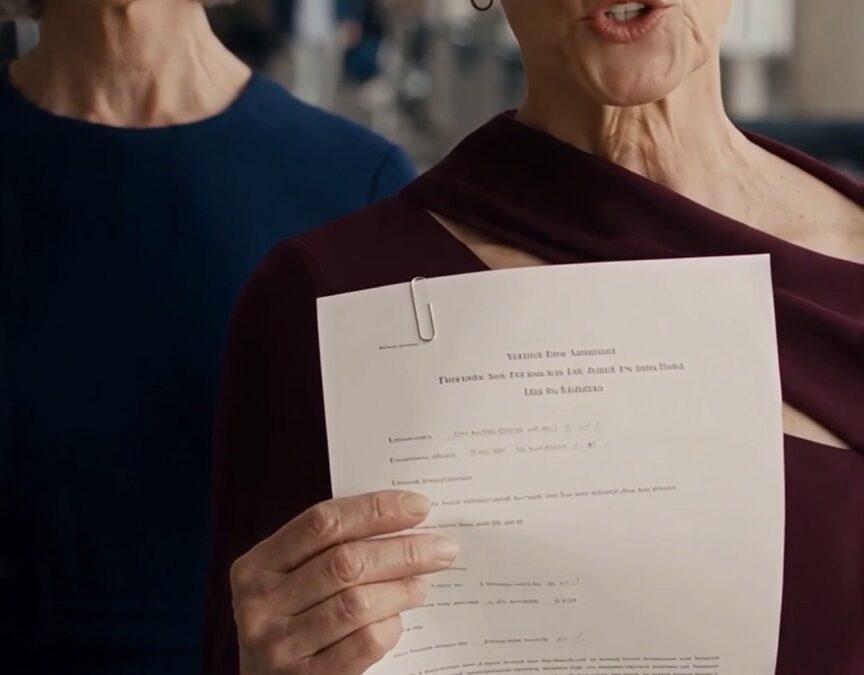
Judith stood to my left, the document held low against her travel bag. She hadn’t put it in front of me or offered me a pen.
Across the top were the words “WITHDRAWAL REQUEST.”
Nothing had been approved.
My son was acting as though all that remained was getting an uncooperative old woman to finish something she had already agreed to do.
I was 67.
I knew what I had agreed to discuss.
And I knew what I had not agreed to give him.
Avery was away from the counter. I looked toward the open area beyond us, making sure she wasn’t coming back into this.
She hadn’t seen him.
I wanted it kept that way.
Scott followed my glance.
“She’ll be back. Can we get this done?”
“The tickets aren’t the problem.”
“You know what I mean.”
Yes.
He wanted $24,000 sent to his checking account before we had even made the college visit.
No tuition bill existed.
He had given me no itemized charges.
I had asked what the money would cover, and he had answered with the general fact that college was expensive, as though I had spent seventeen years saving without knowing that.
The agent rested her hands beside her keyboard.
“Do you need a moment?”
“We’re fine,” Scott said.
“I need you to wait,” I told her.
She nodded to me, not him.
Scott shifted his carry-on closer to his leg. He worked in shipping supervision, and I had heard that clipped voice when he talked about delayed deliveries.
I had never expected him to use it on me.
“Mom, there are deposits. Other things.”
“Which deposits?”
“We don’t have every little thing in front of us.”
“Then we don’t have enough to approve this.”
Monica moved nearer.
She was 43, old enough to understand the difference between asking someone for money and telling them to hand it over.
Instead, she looked at the waiting agent.
“Elaine, this isn’t the place.”
“I didn’t bring this up here.”
“We agreed to handle it before the flight.”
“We agreed to talk.”
Judith’s fingers tightened around the bottom of the form. She stayed where she was, watching Scott, while I tried again to explain the same thing I had explained at home.
“When the college sends a bill, we can discuss paying the college.”
Monica let out an irritated breath.
“Do you realize how humiliating that would be?”
I looked at her.
“Humiliating for whom?”
“For us, Elaine.”
She said my name carefully.
“You paying the college directly tells everyone you don’t trust us.”
The ticket agent glanced toward the nearby travelers, then back at me. Nobody had asked Monica to announce our disagreement.
“Families pay each other,” Monica said. “They don’t make everything an inspection.”
Scott nodded.
“There. That’s what I’m trying to tell you.”
My wrist hurt when I moved my fingers.
I loosened the cuff of my sleeve with my other hand. Neither of them looked down.
“I asked what the money would pay for.”
“Avery’s education,” Scott said.
“Then show me the charges.”
Monica shook her head.
“Parents need some flexibility. You’re making a happy occasion uncomfortable.”
A happy occasion.
I had packed my black funeral shoes away before getting out the walking shoes for this trip. Paul’s coat was still hanging by our door.
I hadn’t managed to move it.
But apparently I was supposed to make this morning pleasant for everybody else.
“I haven’t said Avery can’t go to college.”
“Then stop acting like we’re stealing from you,” Scott said.
“I asked for a bill.”
“You’re making us beg.”
He said that louder.
A traveler turned away from the counter. Another looked directly at him and stayed where she was.
Scott noticed both.
He leaned closer without touching me again.
“It’s family money.”
“I put it there.”
“For Avery.”
“Yes.”
“Dad wouldn’t have put us through this.”
I pressed my elbow against my side.
“Your father isn’t here to answer that.”
“He wanted me handling things.”
Judith looked up sharply.
Until then, she had let me answer for myself. She was my adviser, but she was also my friend, and she knew how much I disliked having someone speak over me.
Scott mistook her silence for agreement.
“Dad understood that parents have expenses before a school sends some formal bill. He knew I’d take care of it.”
“Then you can tell me what those expenses are.”
“I just did.”
“No. You named a category.”
He looked toward Monica for help.
She folded her arms.
“This is exactly what we were trying to spare you, Elaine. All this back and forth.”
I looked at the unsigned form.
There was no instruction from me on it.
No approval.
Only a request Scott had decided should be enough.
Judith lifted it away from her travel bag.
Then she moved toward me.
Chapter 2: What I Had Saved
Judith came slowly enough that Scott had to notice she wasn’t heading for the ticket agent.
She was coming to stand beside me.
I had known her long before retirement, when I was still a payroll clerk and spent my working days checking hours, deductions, and whether the numbers matched.
She understood why I asked for a bill.
It wasn’t a habit I had developed after Paul died.
Scott stared at the paper in her hand.
“Can we just finish the request?”
Judith didn’t answer him yet.
“Elaine, are you comfortable standing here?”
“I’m staying here.”
I didn’t want to be moved somewhere private so my son could pretend the only problem was that strangers had overheard us.
She stopped at my left shoulder.
The document was still turned inward. Its heading showed, but the account information beneath it stayed covered.
That mattered to me.
Even then.
I had put money into that account every month for seventeen years. Paul knew about it, but I handled it myself, just as I had handled our household payments while he was alive. After his funeral, I almost canceled the college visit. Avery had been talking about the campus for months, though, and I wanted to hear her talk about something besides losing her grandfather. I told Scott I would still come. I did not tell him he could take over my savings.
The first contribution had been $200.
So had the next.
I had kept making them through ordinary months when there was nothing exciting to say about saving for a baby who wouldn’t need college for years.
Now Avery was 17.
I could picture her sitting at my kitchen table, leaning over the college information she had brought, moving a drinking glass so it wouldn’t leave a ring on the pages.
She had wanted me on this trip.
That was why I was standing in the airport in Pittsburgh, Pennsylvania, with a sore wrist and my husband’s absence still making every familiar task take longer.
Not because I had decided to surrender my account.
Scott tapped the edge of the counter.
“We discussed this.”
“The request,” I said.
“The money.”
“The request for money.”
His mouth tightened.
The evening before departure, he had made it sound like a kindness.
I had been beside my open travel bag, deciding whether I needed a heavier sweater. Paul had always wanted the hotel room cooler than I did.
I had caught myself thinking about packing for that.
Then Scott had called.
“Mom, you shouldn’t have to deal with this.”
At first, I had thought he meant the travel arrangements.
“What part?”
“The college money. Just have Judith send it to me.”
I had laid the sweater across the bag.
“How much are you asking for?”
“$24,000.”
“For what bills?”
“School costs. Deposits. Things we’ll need to handle.”
I had asked whether he had the charges available.
He hadn’t.
That was when he asked whether Judith could bring a withdrawal request to the airport.
Judith was already coming on the college visit. After Paul died, she had offered to travel with me as a longtime friend, not as part of her work.
She was paying her own travel expenses.
At 62, she had no interest in being treated as somebody’s unpaid travel escort. I hadn’t asked for that, and she hadn’t offered it.
She had offered company.
I had accepted.
Scott knew all of this when he asked her to bring the form.
“Bring it so we can discuss it,” I had said.
Not sign it.
Not submit it.
Discuss it.
At the airport, those distinctions had become an inconvenience to him.
“You knew why she was bringing it,” he said now.
“Yes.”
“So why are we standing here?”
“Because discussing a request isn’t approving one.”
Monica looked at Judith.
“Surely you understand that parents need access to education money.”
Judith adjusted the paper so the private information remained against the folder behind it.
“I understand how this account works.”
“That’s not what I mean.”
“It’s what we’re discussing.”
Scott rubbed his mouth, then lowered his hand.
He was 44. I remembered signing school permission slips for him at my kitchen counter, checking that he had brought everything home.
He had apparently decided our roles had reversed because I had buried his father.
I was still having trouble saying “my husband” and remembering I needed the past tense.
I wasn’t confused about my money.
“Dad wanted things simple,” Scott said.
I looked at Judith.
She had sat across from me when I opened Avery’s account. She had answered my questions about how I would approve payments when Avery eventually needed them.
I had kept those papers.
Scott had never asked to see them.
He had mistaken money saved for his daughter for money available to him.
Judith raised the document to chest height.
The heading faced Scott.
The rest stayed shielded.
“Scott, your mother owns and controls this college money.”
He looked at the form.
Then at her.
“I know who it’s for.”
“I’m telling you who owns it.”
Monica started to speak.
Judith continued.
“Elaine funded it. Elaine approves every withdrawal.”
“I approve every withdrawal,” I said.
Scott stepped back.
It wasn’t much distance, but he stopped leaning over me. His hand came off the counter.
The ticket agent watched him.
So did the traveler who had stopped beside her suitcase.
I remained where I was.
Judith didn’t wave the form or push it at him. She simply held it where he could see the words identifying it as a request.
Not a completed transfer.
Not his authority.
He looked from her to me, his mouth parting before he spoke.
“So you can just tell me no?”
Chapter 3: The Answer He Got
“Yes.”
Scott looked at Judith, waiting for her to soften what I had said.
She didn’t.
“I am not authorizing $24,000 to your checking account,” I told him. “There is no college bill to pay.”
Monica shifted her purse higher on her shoulder.
“Then what was the point of bringing the form?”
“To discuss your request.”
“We can put the purpose on it,” Scott said. “Education expenses.”
“That doesn’t tell me what is owed.”
He glanced at the ticket agent.
He had stopped claiming the money was already his. Now he was trying to make the transfer sound like a routine administrative step I was refusing to understand.
“Judith can document it.”
Judith lowered the form.
“I can process an authorized request through the account’s procedures. I cannot turn a general explanation into school charges.”
“Then have Mom authorize it.”
“I just answered,” I said.
My wrist was starting to throb.
I wanted to sit down. I wanted Paul beside me, annoyed about the airport coffee or checking whether we had all remembered our identification.
Instead, I was explaining ownership to our son.
I laid my unhurt hand flat on the counter.
“The account stays as it is.”
Scott stared at that hand.
“So Avery gets nothing.”
“Avery hasn’t lost anything.”
“You’re stopping the money.”
“I’m refusing your cash request.”
Those were different things.
I needed him to hear the difference, even if he disliked it.
Monica leaned toward him and spoke quietly, but not quietly enough to keep me from hearing.
“We can’t stand here all day.”
Judith tucked the unsigned request into its folder.
That small action settled something for me.
The money had not moved.
No one had needed to snatch a pen away or call a bank to undo an instruction. There had never been an instruction from me.
Scott had counted on pressure finishing what his explanation couldn’t.
He had been wrong.
“I’ll look at an actual college bill when there is one,” I said.
“And until then?”
“Until then, the money stays in the account.”
I did exactly that.
Four months later, the actual college bill was open on my desk at home. The room was quiet, and nobody was standing over my arm.
Avery had made sure I could see the school charges.
I placed the bill beside the account information Judith had helped me review. I read the charges instead of guessing what college might cost.
Then I called her.
“This is what I said I would pay.”
“We’ll verify what’s eligible,” she said. “Then you can approve payment directly to the college.”
I ran my finger down the bill.
There was finally something concrete to review.
An amount the school said was owed.
A destination that wasn’t Scott’s checking account.
An education purpose supported by the actual charges.
Judith checked the information through the ordinary process. I approved the eligible payment, and it went directly from the account to the college.
Scott received no cash.
The account had remained intact until an actual education payment was ready.
That was the part he had refused to believe at the airport: I could say no to him and still do what I had promised Avery.
When the payment confirmation was available, I saved it with the bill.
I didn’t write an angry note across it.
I didn’t send it around to embarrass anybody.
I checked that the payment had been credited and put the paperwork where I could find it.
Avery’s eligible college charges were paid.
That afternoon at my desk came later, though.
At the airport, we were still standing before security, and the ticket agent had moved away from her keyboard.
“Ma’am, would you come over here with me?”
She was looking at me.
Scott started to answer.
“She’s fine. We just need—”
“I’m asking her.”
I picked up my travel bag with my other hand.
Judith stayed close without taking hold of me.
“Do you want me with you?”
“Yes.”
Scott moved as though he might follow.
The agent held out an open hand, directing him to remain on the other side of the counter area.
“Please wait there.”
He stopped.
Monica’s lips pressed together. She looked toward the place Avery had gone, then back at the agent.
“Our daughter is coming back.”
“She can stay with you,” the agent said.
I was grateful for that.
I didn’t want Avery returning to find herself assigned to comfort me, explain her parents, or decide whose version she believed before she even knew what had happened.
Judith walked beside me to the space the agent indicated.
Only then did I let my sore arm hang down.
A red mark had begun to show.
Judith saw it.
“Can you move your fingers?”
I did.
It hurt, but I could move them.
“I don’t think I need an ambulance.”
“We can still have someone speak with you.”
I looked back toward Scott.
He was talking to Monica, one hand against his carry-on handle. He wasn’t looking at me now.
“Who?”
“Airport police,” the agent said.
I swallowed.
For years, I had been the person Scott called when something went wrong. I knew how to ask the useful questions and leave the scolding until he had gotten home.
Now an airport employee was asking whether I needed help because of him.
“Yes,” I said. “I’ll tell them what happened.”
The agent nodded and stepped away to arrange it.
Judith put the folder beneath her arm.
“Nothing is being submitted, Elaine.”
“I know.”
“You don’t need to deal with that part again right now.”
Across the counter area, Scott looked up as the agent returned.
His expression changed when she told him why we were waiting.
Chapter 4: Before Anybody Boarded
Staff kept space between us.
It wasn’t dramatic. Nobody shouted across the terminal or stopped the people checking in around us.
The ticket agent directed Scott and Monica to wait apart from where Judith and I stood.
That was enough.
For the first time since Scott had begun pressing me, he couldn’t lower his voice and lean close enough to make the conversation feel private again.
When airport police came to speak with me, I gave my name.
“Elaine.”
I explained that Scott was my son.
Then I described what he had done.
Not what I thought he might have intended.
Not the version that would make him sound better.
“He pressed his forearm across mine and forced my arm sideways. My wrist twisted. I pulled it back.”
“Did he do it again?”
“No.”
“Did you fall?”
“No.”
I showed where it hurt.
My sleeve caught at my wrist, and I eased it back instead of tugging.
Judith stood nearby.
“She saw it,” I said.
They asked her what she had observed.
Judith described the movement without adding anything. She explained that she had been standing to my left with the unsigned withdrawal request.
“Was the disagreement about that document?”
“Yes,” I said. “He wanted me to approve money going to his checking account.”
“Had you approved it?”
“No.”
I didn’t need to explain seventeen years of saving to answer that.
The ticket agent confirmed that she had noticed the contact and the way I pulled my arm against myself.
Nearby travelers had gone back to their own trips.
I was relieved.
I didn’t want a crowd.
I wanted enough room to finish a sentence without my son cutting in.
Scott was spoken to separately. I could see him gesturing toward the counter, but I couldn’t hear every word, and I didn’t try.
Monica stayed beside him.
When Avery returned, she looked first at the space where we had been checking in.
Then she saw me.
Her face changed.
“Grandma?”
“I’m over here.”
She approached with her travel things held close.
“What happened?”
“There was a disagreement,” I said. “I’m not going on the trip.”
Her eyes went to my wrist.
“Are you hurt?”
“It’s sore.”
She looked toward her father.
I didn’t follow her gaze.
“I’m talking with the airport police about what happened. You don’t need to handle it.”
Avery stood very still.
She was 17, getting ready to look at a place where she might begin her adult life. She shouldn’t have been standing before security trying to work out whether her grandmother needed protecting.
“Do you want me to stay?”
“No, sweetheart. Go see the college.”
“Are you sure?”
“I’m sure I’m not traveling today.”
That was what I could honestly promise.
I wasn’t sure how the rest of the afternoon would go.
Judith moved her bag beside mine.
“I’m staying with Elaine.”
Avery looked relieved to hear it.
I didn’t ask Judith to say that. She had paid for her own trip, and the choice was hers.
“Thank you,” I told her.
“We can deal with the travel arrangements after this.”
Scott came close enough to speak once staff allowed it, but he kept his distance.
“We need to know what we’re doing.”
“You’re continuing the visit,” I said. “I’m going home.”
“Mom, we’ve already planned everything.”
“Yes.”
“Avery wanted you there.”
“I wanted to be there.”
He glanced toward the police.
“Can we finish talking somewhere else?”
“Not privately.”
His jaw tightened.
He understood the difference.
I wasn’t refusing to speak because I lacked an explanation. I was refusing to be alone with him while he tried to obtain the same result.
Monica put her hand on Avery’s shoulder.
“We should go.”
Avery didn’t move immediately.
I reached for her with my unhurt hand. She bent toward me, careful of my other arm.
“Tell me about the campus afterward,” I said.
She nodded against my shoulder.
“I will.”
I let her go without asking her to carry a message.
No reminder about the money.
No request that she make her father apologize.
She had enough to carry already.
I finished giving my account to airport police. I asked how I could obtain information about the report and kept what I was given.
Nobody promised me an arrest.
Nobody promised a court outcome.
I didn’t make one up in my head.
I had told the truth about what happened in a public place, and Judith had confirmed what she saw.
That was what I could do that afternoon.
After Scott, Monica, and Avery headed toward security, Judith and I sat away from the counter.
I rested my sore wrist on my bag.
The skin had begun to darken.
“Do you want to call someone?” she asked.
I shook my head.
The person I would ordinarily have called was Paul.
I looked down before Judith could see how quickly my eyes had filled.
She opened the folder just enough to check that the unused form was still inside.
“Would you like me to keep this until we meet?”
“Yes.”
It wasn’t evidence of an approved transaction.
It was the opposite.
An unsigned request that had never become permission.
We dealt with our travel arrangements without pretending there would be no inconvenience. Then we made plans to get me home.
Before we left the airport, I took out my phone.
“I want to review the whole account,” I told Judith.
“We can do that.”
“Ownership. Contacts. Who can ask for information. Everything.”
She opened her schedule.
I watched her find a place for us to meet.
“Bring the original history,” I said. “I want to know exactly what Scott thinks his father could have given him.”
Chapter 5: What Was Already Mine
Judith put the account history on her office desk where I could read it without reaching across anything.
My wrist was bruised.
It had been sore while I dressed, but I could use my hand. I had no fracture, no hospital stay, and no lasting injury to add to what happened.
The mark was enough.
I set my purse beside the chair.
“Start at the beginning.”
Judith turned the first page toward me.
I recognized the account opening information. Avery had been a baby when I started saving, and I had asked practical questions even then.
Who owned the money?
How would payments work?
What would I need when school charges eventually arrived?
The answers hadn’t changed because Paul died.
“This is your account,” Judith said.
“And Avery receives the education benefit.”
“Yes.”
“Scott?”
“No ownership. No withdrawal approval.”
“Monica?”
“The same.”
I read it myself.
Judith waited.
She knew I wasn’t doubting her. I needed to see how little of the airport argument had anything to do with the account as it actually existed.
Scott had spoken as though an expected family arrangement could replace the arrangement already in place.
It couldn’t.
I moved to the contribution history.
$200 monthly for seventeen years.
$40,800 contributed.
I did not need to estimate what I had put in or reconstruct it from old checkbook notes. The history was there.
I remembered making those contributions while still working payroll, checking our household expenses before letting the transfer go through.
Some months I had thought about what else that money could buy.
I had sent it anyway.
Judith watched me trace the entries.
“You kept it regular.”
“That was the point.”
Paul had known.
Sometimes he had asked whether Avery’s college money had gone in, and I had told him it had.
Knowing about it wasn’t owning it.
I turned the next page.
“Show me where Paul appears.”
Judith brought the relevant history forward.
There was no ownership for him to pass on.
No control he had exercised.
No arrangement giving Scott a turn after his father.
I leaned back.
For all the certainty in Scott’s voice, he had never checked whether Paul had authority to give him what he was demanding.
“Was there ever an instruction from Paul that could change this?”
“No,” Judith said. “Paul didn’t own or control this account.”
“Not at the beginning?”
“No.”
“Not later?”
“No.”
I let the paper rest on the desk.
That was the other fact Scott had built his argument around.
He had assumed his father controlled the savings and wanted him to manage payments. But an assumption about what Paul wanted did not make Scott an owner.
It didn’t make Paul one, either.
Judith wasn’t interpreting my husband’s wishes.
She was showing me the account.
I asked to review the authorized contacts next.
We went through who could receive information, who could approve a withdrawal, and what happened when someone called with a question.
“Can Scott ask you to bring a form?”
“He can ask,” Judith said. “That doesn’t authorize a payment.”
“Can he fill one out?”
“A request still requires your approval and the normal review.”
“Write down that I want that distinction kept clear.”
She made a note.
I watched her read it back.
An unsigned request was not permission.
A conversation about a possible withdrawal was not permission.
Neither Scott nor Monica could approve a withdrawal for me.
I wasn’t trying to create some unusual rule just for my family. I wanted the ordinary rules followed, especially when a relative sounded confident.
Judith closed the history and reached for the folder she had carried at the airport.
The unused form was inside.
“Do you want this?”
“Yes.”
She placed it in front of me.
The heading looked ordinary now.
“WITHDRAWAL REQUEST.”
No one would know, looking at it, how Scott had spoken or how quickly I had pulled my arm away.
I checked that it was unsigned.
Then I slid it into my own folder.
At home, I put the account history on the desk where I used to handle our household payments.
Paul’s chair was still across the room.
I didn’t move it.
I opened the drawer and stored the unused form flat, away from the bills that needed attention.
Then I sat down with a sheet of paper and wrote the arrangement in words I could use without getting pulled into an argument.
No cash transfer to Scott.
Actual school charges reviewed when available.
Eligible payments made directly.
No account access for either parent.
I stopped there.
It wasn’t a speech.
It was what I intended to do.
My phone lit up while the paper was still on the desk.
Scott wanted to talk about what his father had said.
He didn’t mention my wrist.
He didn’t ask whether I had gotten home comfortably.
His message said Paul had expected him to take care of the family’s college expenses and that we needed to straighten out the misunderstanding.
I read it again.
Then I looked at the account history beside my hand.
I answered that Judith could be present for a discussion.
I would not meet him alone.
His reply came while I was putting the folder away.
“Fine. But you need to hear what Dad told me.”
Chapter 6: What He Said About Paul
Scott came to Judith’s office with Monica.
I had agreed to hear him there because Judith could answer questions about the account without guessing, and because I did not want another private argument.
The unused withdrawal form stayed at home.
The account history was what mattered now.
Scott sat across from me and kept his hands together.
“I’m not saying the account has my name on it.”
That was a change.
At the airport, he had acted as though ownership was an irritating detail. Now he knew he couldn’t win by denying it.
“I’m saying Dad wanted me handling everything.”
“What did he tell you?”
“That you shouldn’t have to worry about all this. That I’d take care of Avery’s expenses.”
Monica nodded.
“That’s what we understood.”
I let him finish.
It was difficult hearing Paul discussed as though he had left a set of instructions I had somehow failed to obey.
I wanted to ask why Scott hadn’t mentioned any of this while his father was alive.
Instead, I asked for what could actually settle the issue.
“Do you have an instruction from him?”
Scott frowned.
“A written instruction?”
“Anything showing what you’re claiming.”
“He was my father. We talked.”
“I know you talked.”
“You’re making it sound like I invented him.”
“No. I’m asking what gives you control of this account.”
He looked at Judith.
“This is what I mean. Everything turns into paperwork.”
Judith left the account history closed for the moment.
“I can’t interpret a conversation I didn’t hear.”
“Then tell her what a father would normally expect.”
“That isn’t my role.”
Monica leaned forward.
“Surely his wishes count for something.”
“They matter to us as his family,” I said. “They don’t give Scott access to money Paul never owned.”
Scott stared at me.
“What do you mean, never owned?”
Judith opened the history.
She placed the ownership information where both Scott and Monica could see it, keeping unrelated private details covered.
“This account was opened and owned by Elaine,” she said. “Paul did not own or control it.”
Scott looked down.
For once, he read before speaking.
“He knew about it.”
“Yes,” I said.
“He talked about Avery’s college fund.”
“Yes.”
“That’s what I’m telling you.”
“Knowing about it didn’t make it his to give.”
Monica looked at the page, then at Judith.
“Could there have been some arrangement after he died?”
“There was no ownership or control for him to transfer,” Judith said. “I’m confirming this account’s history, not giving an opinion about an inheritance.”
Scott sat back.
The paper was in front of witnesses now.
He couldn’t insist Paul had controlled the account without contradicting what we had all just seen.
So he changed his argument.
“Fine. You’re the owner. But Avery’s our daughter, and we’re responsible for making college happen.”
“I haven’t disputed that.”
“Then let us manage the expenses.”
“Send me the school charges.”
“We can’t ask permission every time something comes up.”
“You can decide what you pay. You cannot decide what I withdraw.”
He looked away.
Monica adjusted the strap of her purse, though it was resting on the floor.
I kept my hands in my lap.
The bruise was fading. I didn’t put it on display to make my answer stronger.
My answer did not depend on how bad the bruise looked.
Scott tried a more practical approach.
“If we pay something first, you can reimburse us.”
“I’m not agreeing to general reimbursements.”
“What about deposits?”
“Send the actual school information before assuming I will pay.”
“You want approval for everything.”
“For money from my account, yes.”
Judith turned the history back toward herself.
The discussion had reached the part she couldn’t solve for us.
She could identify the owner and explain how payments worked. She couldn’t make Scott accept that I remained the owner after telling him no.
I took out the short statement I had written at my desk.
“Future requests need to be in writing.”
Scott looked at it.
“We’re not going to email every time we speak.”
“You can contact me in writing about money. And for now, that’s how I want our communication.”
“For how long?”
“I’m not setting an end to it today.”
Monica spoke before he did.
“That’s going to make things difficult.”
“It will keep the requests clear.”
I didn’t list every reason.
Written messages would keep him from changing what he had asked for after I answered. They would also let me read without him standing over me.
I wanted both.
Scott stood when the meeting ended.
He hadn’t produced an instruction from Paul.
He hadn’t received account access.
He hadn’t received cash.
At the door, he paused.
“So this is how you want it.”
“This is how it will work.”
Judith stayed with me after they left. She gathered the account history and gave me the copies I needed.
I put them into my folder.
Outside her office, I checked my phone before arranging to go home.
Monica had already sent a message.
“If you’re withdrawing your support, Avery needs to know.”
Chapter 7: What Avery Needed to Hear
I read Monica’s message at my kitchen table.
Then I set the phone beside my water glass and stood up to rinse a plate that was already clean.
I didn’t want to answer while I was angry.
Withdrawing my support.
That was how she had chosen to describe my refusal to send Scott money without a bill.
When I sat down again, I kept my reply short.
“I have not withdrawn education support. Eligible school charges can be reviewed and paid directly.”
I read it before sending.
There was nothing in it about her marriage, her parenting, or what Scott had done.
Those were not points I needed to win through Avery.
Monica replied that their daughter was already upset and needed certainty.
I understood that part.
Avery did need certainty.
She also needed to hear the arrangement from me rather than through a disagreement between adults.
I contacted her directly and asked whether we could talk when she had time.
Not urgently.
Not secretly.
I didn’t want my name appearing on her phone to feel like another emergency.
When she called, I was at the same table where she had shown me her college information.
“How was the visit?” I asked.
She told me about walking around campus and trying to picture herself there. Her voice became more like itself as she described where students gathered between classes.
I listened.
I didn’t interrupt to ask what her parents had said about me.
When she paused, I told her there was something I wanted to make clear.
“The education money I saved for you is still there.”
She went quiet.
“Mom said you and Dad hadn’t worked it out.”
“Your dad and I disagree about sending money to his checking account. That doesn’t mean I’ve stopped helping you.”
“So you’re still going to help with college?”
“Yes. When the actual school bill is available, I can review the eligible charges and pay the college directly.”
She let out a breath.
I hadn’t realized she was holding it until I heard it leave.
“Okay.”
“You don’t need to settle the disagreement.”
“I wasn’t sure if I should ask.”
“You can always ask me what I’ve agreed to do.”
She hesitated.
“Are you still hurt?”
“My wrist is getting better.”
“Dad said everybody got upset.”
I looked toward the window.
There were things I could have said that were true and still wrong to hand to her in that moment.
“Your dad and I have adult matters to address,” I said. “You didn’t cause them, and you don’t need to fix them.”
“Did I make things worse by going on the trip?”
“No.”
I answered that quickly.
“I told you to go. I wanted you to see the college.”
She was quiet again, but not in the same way.
Then she began telling me about the visit.
I let her.
Later, Avery came to see me independently.
We sat at the kitchen table with the college information between us, much as we had before the trip.
This time, I didn’t keep looking toward the door to see whether Scott was coming behind her.
She had come to visit me.
That was allowed to be enough.
I put out something to eat and asked what she was thinking about the fall.
She moved a page closer.
“I like this part of the program.”
“Tell me why.”
She did.
I heard uncertainty, excitement, and the practical worries anyone would have before leaving home. None of them needed to become evidence against her parents.
When the conversation reached costs, I asked her to make sure I received the actual school bill when it became available.
“Not a list you have to make yourself,” I said. “The school’s bill.”
“Do you need my login?”
“We’ll use whatever ordinary way the college allows for sharing the billing information. You don’t need to give me more access than that.”
She nodded.
I wanted to pay eligible charges.
I didn’t need to inspect every part of her college life to do it.
After she left, I cleared the table and put her pages back in a neat stack.
I hadn’t asked whether Monica was angry.
I hadn’t asked what Scott said about Judith.
That took some effort.
I missed being able to talk to my son without first deciding which facts might become another argument. But Avery wasn’t a substitute for that conversation.
Scott’s next message came in writing, as I had required.
He asked what I had told her.
I answered.
“That education support remains available, that actual school charges will be paid directly when approved, and that she is not responsible for our disagreement.”
He replied that financial arrangements should go through the parents.
I looked at Avery’s empty chair.
“She can speak to me about her own college plans,” I wrote. “Requests for money still need supporting school information.”
I didn’t hear back immediately.
I washed the dishes, dried the table, and put the college pages in the drawer where I could find them when Avery returned.
For a while, the requests remained general.
Then, four months after the airport incident, Avery contacted me.
“The actual bill is available now.”
Chapter 8: The Bill on My Desk
I brought the college bill to my desk instead of reading it on my phone at the kitchen sink.
There was room there to set the pages beside the account information.
I put on my glasses.
For months, the argument had involved what might be needed, what parents usually handled, and what Paul supposedly would have wanted.
Now I had school charges in front of me.
I could read them.
I could ask a specific question and get a specific answer.
I checked Avery’s information and made sure I was looking at the school’s actual billing material, not a family estimate.
Then I contacted Judith.
“It’s here.”
“Do you want to go through it together?”
“Yes.”
I laid the account folder beside the bill.
The drawer beneath it still held the unused withdrawal form. I didn’t take it out.
That request belonged to a different transaction, one I had refused.
This payment would be reviewed on its own.
When Judith and I went through the charges, she explained what could be paid as eligible education expenses from the account.
I made notes beside the bill.
Not every phrase on a school statement was something I wanted to assume I understood. I asked when I needed an explanation.
That was familiar work for me.
During my payroll years, a confident answer had never replaced a correct entry.
I was comfortable asking again.
“Will the payment go straight to the college?”
“Yes, through the normal process once you approve it.”
“Not through Scott.”
“Correct.”
“And this doesn’t give anyone else account access.”
“No.”
I looked over the information before giving my approval.
No airport counter.
No suitcase against my leg.
No hand or forearm forcing me to move.
Just the bill, the account’s ordinary procedures, and my decision.
I authorized payment of the eligible charges directly to the college.
Judith processed the request as she normally would.
She didn’t bend a rule because we were friends. She didn’t call the airport incident a reason to skip any checks.
That mattered, too.
I wanted the money used correctly, not handled as a favor.
Afterward, I placed the payment information with the bill.
I waited for confirmation that the college had received and credited it.
When that was available, I checked it rather than assuming the task was finished because I had approved it.
Then I called Avery.
“The eligible charges we reviewed have been paid.”
“To the school?”
“Yes.”
“Thank you, Grandma.”
“You’re welcome.”
She started asking whether she needed to tell her parents.
“I’ll confirm the payment arrangement with your dad,” I said. “You don’t have to deliver it.”
She sounded relieved.
We talked about what she was getting ready for instead.
I didn’t make her thank me repeatedly. I hadn’t saved for seventeen years so she could spend her college years worrying about whether she had expressed enough gratitude.
When we finished, I opened the written conversation with Scott.
“The eligible charges on the college bill have been paid directly from the account. No cash reimbursement is included.”
I attached only the relevant confirmation.
Not my full account information.
Not the history of my contributions.
The college payment was his legitimate concern. The rest remained mine.
He replied with a question about expenses they had already covered.
I asked for supporting school information and reminded him that I had not agreed to general reimbursement.
He changed the question.
Would there be money available for future expenses?
I answered the same way I intended to handle them.
“Actual eligible school charges can be reviewed when available. I will approve payments from my account.”
He didn’t ask again for the original $24,000.
There was no reason for him to pretend that request had become necessary once the actual bill had been paid without it.
Instead, he asked whether future payment notices could come to him so he could coordinate matters.
I read that carefully.
Receiving an appropriate confirmation was different from controlling an account. I wasn’t going to confuse those simply because he used a practical word like coordinate.
“You may receive confirmation relevant to Avery’s school charges,” I wrote. “You will not have account access or withdrawal authority.”
His reply was brief.
He didn’t agree with me.
He acknowledged receiving it.
That was enough to finish the exchange.
I saved the messages with the payment records.
Then I put the college bill away and cleared the desk.
For the first time since the airport, there was a completed education payment in the file.
Not a promise used to pressure me.
Not a request waiting for my signature.
Money had gone where I said it would go.
The next time I spoke with Judith, I asked whether anything remained for me to do about that payment.
“No. Keep the records with the bill.”
I slid them into the folder.
My phone lit up as I closed it.
Monica was asking how she could get access to see the account herself.
Chapter 9: The Way We Communicated
I didn’t answer Monica’s message immediately.
I finished putting the college paperwork away, closed the drawer, and carried my empty glass to the kitchen.
Then I read her request again.
She wanted access so they could plan.
She said not knowing what was available made their job as parents harder.
It was a more reasonable-sounding argument than demanding cash at the airport.
It still asked me to give up control I had never promised her.
I replied that I would continue to discuss documented education needs and confirm approved school payments.
The account itself would remain under my control.
She answered that she wasn’t asking to take money.
I understood the distinction she was trying to make.
I also knew that access to private account information was not something she obtained simply by describing it as harmless.
“I’m not adding parental access,” I wrote.
I left it there.
There was no need to argue until she accepted the answer.
At my next account check, I confirmed with Judith that nothing had changed.
Neither Scott nor Monica had been added.
I remained the person approving withdrawals.
Judith went through the ordinary review with me. It was quiet work, and that suited me.
I wanted the account to become ordinary again.
A place I saved for Avery’s education and used for eligible school charges.
Not the subject of every family conversation.
Scott continued to write.
Sometimes the messages were practical, asking about timing or what information I needed.
I answered those.
Sometimes he included a sentence about how much easier everything would be if we could “just talk.”
I didn’t take that invitation.
I read his message when I was ready, checked any supporting information, and replied in writing.
He had once been able to make urgency part of his argument by standing in front of me.
That no longer worked.
If he said something needed attention, I could ask for the school notice and see what it actually required.
I wasn’t ignoring Avery’s needs.
I was separating them from Scott’s preferred way of handling my money.
The changes showed up in small habits at home.
I stopped carrying my phone from room to room because I was afraid of missing a call from him.
I checked messages when I sat at my desk.
I kept school records together.
When I wanted to speak with Avery, I contacted her instead of asking Scott to put her on.
We arranged visits independently.
I didn’t ask her to conceal them, and I didn’t ask permission for an ordinary conversation with my granddaughter.
As college approached, she came over with things on her mind that had nothing to do with the account.
What would it feel like to arrive?
Would she find people she liked?
Would she miss home more than she expected?
I had no official answers.
I could listen.
She sat at my kitchen table, moving her hands while she talked. I noticed I was no longer watching every movement because of my wrist.
The soreness had passed.
The change in how I dealt with Scott had not.
“Are you nervous?” I asked her.
“Yes.”
“About leaving?”
“About all of it.”
“That sounds about right.”
She smiled.
We had something to eat and talked about what she wanted to take with her.
I didn’t turn the conversation toward how much I had saved. I didn’t remind her what her father had asked for.
Her college beginning did not need to carry the airport incident with it.
When she left, I walked her to the door.
“Call me when you feel like talking.”
“I will.”
“You don’t have to have news.”
She hugged me.
That was the sort of arrangement I wanted with her.
Not a report.
Not an obligation to reassure me.
Just room to speak directly.
Scott’s messages stayed in their written thread.
There was no financial reconciliation hidden inside a pleasant exchange. He did not get access because he used a polite tone.
I could appreciate a practical message without undoing the decision that made it practical.
Monica stopped asking me directly for the account login after I refused.
She could send information about school charges.
She could ask whether a payment had been handled.
She could not enter the account or approve anything from it.
The distinction held.
When Avery began college, the eligible charges we had reviewed were paid. I checked the records and then stopped checking them again.
Nothing useful came from opening the same confirmation every morning.
I put it away.
That evening, my phone rang while I was clearing the kitchen.
Avery’s name appeared.
I dried my hands before answering, and she started talking before I could ask how she was.
“Grandma, I have to tell you what happened today.”
Chapter 10: The Form in My Desk
I sat down at the kitchen table and listened.
Avery was talking quickly, moving from something she had found on campus to a class she was looking forward to.
There were ordinary sounds behind her.
A door closing.
Voices passing.
She was there.
Not looking at college information on my table anymore. Not trying to picture where she might go.
She had begun.
“Did you get something to eat?” I asked when she paused.
“Yes, Grandma.”
I could hear her smiling at the question.
“Good.”
She told me about finding her way around and how different the place felt now that she was there as a student instead of a visitor.
I didn’t ask whether she had spoken to her parents.
That wasn’t my call to check.
I asked about her day.
When she thanked me again for helping with school, I told her I was glad the payment had been settled before she needed to worry about it.
“What happens when there’s another bill?” she asked.
“Make sure I receive the actual school information. We’ll review the eligible charges the same way.”
“Okay.”
No uncertainty.
No request that she negotiate with her father.
The support was continuing under the arrangement I had explained.
She knew what to send.
I knew what I could approve.
After we hung up, I stayed at the table a little longer.
Paul should have heard that call.
I looked toward the place where he used to sit while I talked on the phone, pretending not to listen and then asking for every detail afterward.
I put my hand on the back of the empty chair.
Then I carried my phone to the desk.
There was a written message from Scott about future education expenses.
It did not contain an apology.
I read the practical part and answered it.
“Send the actual school charges when they are available. I will review eligible payments and arrange them directly.”
I didn’t add anything about Avery’s call.
My conversations with her were not reports I owed him.
I also didn’t use her happiness to prove he had been wrong. The payment records already showed what I had done.
Scott had received no cash.
He had no account access.
Neither did Monica.
The money I had saved was still being used for Avery, under my approval, with actual school charges paid directly.
That was the arrangement.
It wasn’t temporary permission waiting to become his control once enough time passed.
I saved the message and put the phone aside.
The house was quiet, but it no longer felt as though I had to sit ready for another demand.
There were still things I hadn’t moved since Paul died.
His coat was no longer by the front door, though.
I had put it away when I was ready, without asking Scott what should happen to it.
My wrist had healed.
Sometimes I remembered the pressure of his forearm when I reached across a counter, but there was no lasting injury.
I could carry my groceries.
I could fasten my watch.
I could open the desk drawer without pain.
I did that now.
The education folder was near the front, where I could reach it without sorting through household bills.
I checked that the school bill and payment confirmation were together.
Behind them was the account history from Judith’s office.
It showed what had been true before Scott made his demand and what remained true afterward.
The account was mine.
I had put in $200 monthly for seventeen years, contributing $40,800 for Avery’s education.
Paul had known about it.
He had never owned or controlled it.
Scott’s claim about what his father wanted had not come with an instruction or an ownership arrangement because there wasn’t one supporting his access.
I didn’t need to keep reviewing that discovery.
But I kept the records.
At the bottom of the folder lay the unused withdrawal request.
I took it out and placed it on the desk.
The heading was still plain.
“WITHDRAWAL REQUEST.”
I thought about Judith holding it at chest height while Scott looked from her to me.
I remembered his step backward.
More than that, I remembered being allowed to remain where I stood.
Nobody moved me aside so he could get what he wanted.
The form had never become an authorization.
There was no signature to undo, no cash to chase, no college payment depending on Scott sending money back.
I had said no before any of that happened.
Then, when the bill arrived, I had paid the college.
I smoothed the edge of the paper with my palm.
My phone sounded from the kitchen table.
Avery had sent a message about something she had forgotten to tell me.
I went to read it.
There was nothing about money in it.
I answered her, asked what time would be comfortable for another call, and left the phone on the table instead of carrying it back to the desk.
Tomorrow I would handle whatever ordinary things needed doing.
If Scott wrote, I would read it when I was ready.
If a school charge arrived, I would check it.
If Avery wanted to talk, she could reach me directly.
I returned to the desk and put the account records in order.
The payment confirmation went beside the college bill.
The history went behind it.
Then I opened the drawer, laid the unused withdrawal form flat inside, and closed it.
You Might Also Enjoy




