My Son Used His Visits To Pressure Me Into Cutting Out My Granddaughter — Then I Answered
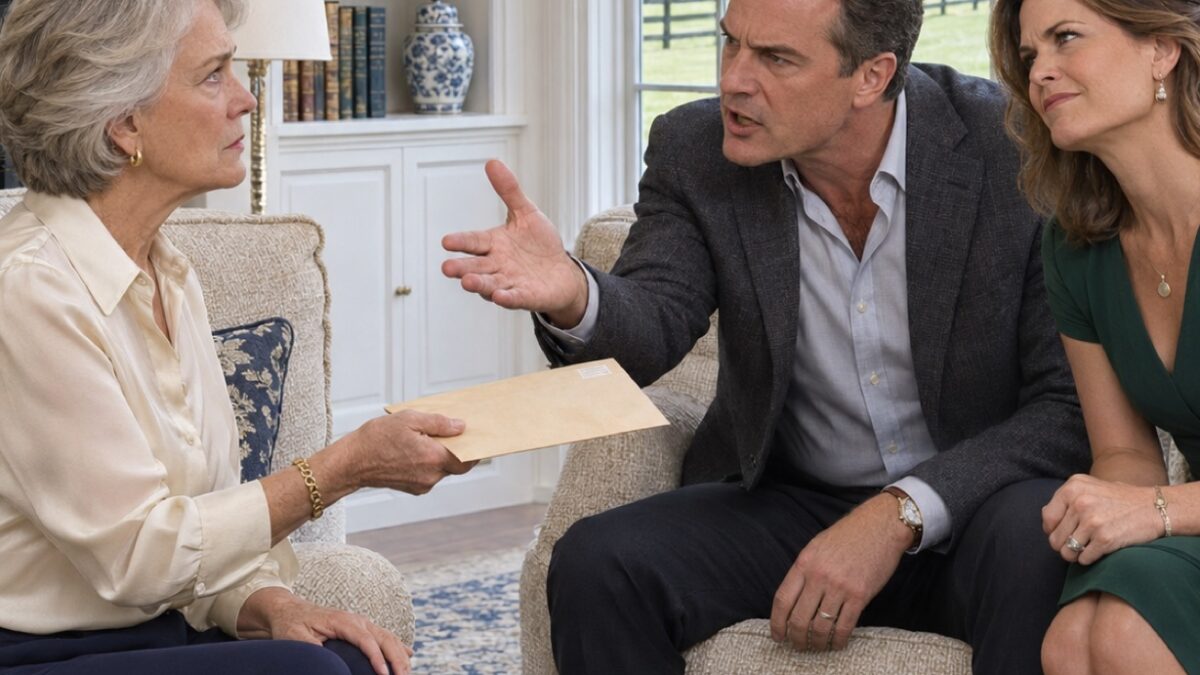
Part 3: The Letter in His Lap
“You are no longer named to handle my estate after my death,” Eric read.
He stopped and lifted the page toward the window, as though better light might change what I had written.
“Keep reading,” I said.
His eyes moved down.
“My completed instructions leave Brent and Tessa equal shares of what remains after expenses.”
Jill reached across his arm.
“Let me see that.”
He held on to it.
Behind my letter were copies of the instructions I had finished the week before. An independent professional would handle things after my death. Eric would not.
And he would not inherit the estate himself.
His name had been in my old arrangements. I had replaced those arrangements, not merely written him an angry note.
“You took me out altogether?”
“Yes.”
I moved my glass onto its coaster. There was water underneath it, and I wiped the little circle with my sleeve.
Eric watched that small movement.
“I’m your son.”
“I know.”
“And you did this without telling me.”
“I’m telling you now.”
Jill leaned closer to read over his wrist. Her lips moved through part of the letter, then stopped.
“Does this mean they own it already?”
“No. I own it.”
I let her look at me before continuing.
“Nothing here gives anybody my home while I’m alive.”
Eric laid the letter across his knee and pulled the copies free. He turned past a page, came back, and flattened it with his palm.
His old role had never given him present authority, either. He had been the person I expected to carry out my wishes after I died.
That was all.
He had never owned any part of the house or land.
Now he was looking at the difference between expecting something and having it.
*
I recognized the page he had stopped on.
I had sat at my kitchen table checking that same page before I put the copies into the envelope.
After his first demand, three weeks earlier, I had called my lawyer myself. I used the telephone beside the kitchen window, where I could see the beds I used to maintain for clients before I retired.
I had a pencil ready.
“I want to change who inherits,” I said. “And who handles things afterward.”
The lawyer asked what I wanted, separately from what my son wanted.
That mattered.
I said Brent and Tessa should be treated equally. I also said I did not want either of them depending on Eric to carry out instructions he had already opposed.
We discussed someone independent doing that job.
Nobody told me to punish my son. Nobody offered to make him visit.
The lawyer explained what could be changed, what needed to be signed, and how to finish it properly.
The week before this visit, I completed the replacement with the required witnesses. I checked the names and the equal shares before signing.
Then I checked again.
I was a retired landscape designer. I was used to looking carefully at something before agreeing it was finished.
The originals stayed safely with my lawyer.
At home, I arranged the copies on the kitchen table and wrote the letter Eric was now holding. I left out the sentences I had wanted to write about gratitude.
They would only have given him something else to argue about.
I explained what I had changed.
I explained that I still owned everything.
Then I put the letter and copies inside the large envelope, sealed it, and wrote “PRIVATE” across the front.
I had prepared it myself.
*
Eric tapped the stack against his knee.
“So this professional gets to decide what happens to our family property?”
“The instructions say what happens.”
“Some stranger carries them out.”
“Yes.”
Jill sat back.
“You could have chosen someone who knows the children.”
“I chose someone who won’t be taking sides.”
Eric looked toward the hallway, then back at the papers.
He could see that calling this an unfinished decision would not work. The copies showed that it was completed.
So he changed the argument.
“Brent won’t accept this.”
I set my damp sleeve away from my wrist.
“Has he told you that?”
“He doesn’t want to be tied to Tessa over this place. You’ve created something neither child can work with.”
Jill nodded.
“They don’t agree about everything, Darlene.”
“They don’t have to agree with me today.”
“You’re not listening,” Eric said. “Brent will refuse a shared inheritance. Then what have you accomplished?”
I looked at the copies in his lap.
Until that afternoon, neither grandchild had asked me what they would inherit. They asked whether I needed anything from town, or whether I would be home.
Eric was speaking with the certainty of someone delivering another person’s answer.
I wanted to hear that answer myself.
“Let’s ask him.”
Jill reached for her purse.
“There’s no reason to turn this into a family meeting.”
“I’m not inviting him over.”
Eric shifted forward.
“Don’t call him upset and make him responsible for calming you down.”
That made me put my hand flat on the table.
“I’ll ask what he wants.”
Nothing more.
*
My phone was beside the lamp.
I picked it up and found Brent’s name. Eric gathered the pages into a stack while Jill watched my thumb.
“You ought to let us explain it first,” she said.
“He can explain himself.”
I pressed the call button.
For a moment, I wanted Brent not to answer. I could have put the phone down and spared myself another unpleasant conversation.
Then he answered.
“Grandma?”
“I’m here, Brent.”
“Everything okay?”
“I need to check something your dad has told me. He and your mother are sitting here.”
Eric opened his mouth.
I held up my hand.
“I’d like you to hear each other clearly,” I told Brent. “May I put you on speaker?”
“Sure.”
I placed the phone on the table, away from the wet coaster.
Jill uncrossed her arms. Eric laid my letter faceup on top of the copies, covering part of the page he had been studying.
I said, “Your dad says you won’t accept sharing an inheritance with Tessa.”
There was a small sound from the phone, as though Brent had set something down.
I kept my hands away from it.
I wanted his answer without Eric interrupting, and I wanted Eric to hear that I had asked plainly.
“Brent, is your father right that you would refuse to share with your sister?”
Part 4: His Voice on Speaker
“No, Grandma,” Brent said. “I never asked you to leave everything to me.”
Eric lifted his hand toward the phone, then lowered it.
Brent kept talking.
“I already told them I wouldn’t do that to Tessa.”
I looked at my son.
He was staring at the table.
Until that moment, I had not known Brent had refused his parents before they came to my house. They had sat in front of me claiming to represent him anyway.
Jill leaned forward.
“Brent, that isn’t what we were discussing.”
“Yes, it was.”
His voice was clear through the little speaker.
“You said it would be easier if it all came to me. I said I wasn’t going along with leaving her out.”
Eric rubbed his mouth.
“Your grandmother has changed more than that.”
“I’m asking about what you told me,” I said.
He looked up.
“Were you speaking for Brent?”
“We were trying to prevent trouble.”
“That wasn’t my question.”
Brent spoke before Eric answered.
“They weren’t speaking for me.”
I pulled my glass farther from the phone. I did not need to move it, but I needed something to do with my fingers.
I had been prepared for Brent to want more than his sister.
I had not been prepared to hear that he had already said no.
*
Eric pushed the papers together.
“We thought if you made the decision, it would settle the disagreement.”
“What disagreement?” I asked.
“About how things should be handled.”
Brent let out a breath.
“Dad.”
Eric looked at the phone.
“You and your sister don’t see this property the same way.”
“That doesn’t mean I should get all of it.”
“No,” I said. “It doesn’t.”
Jill pressed a finger against the clasp of her purse. It clicked open, and she closed it again without taking anything out.
Eric faced me.
“I hoped your decision would settle it in Brent’s favor. Then they wouldn’t have to keep going over it.”
There it was.
He had not come to deliver Brent’s wishes. He had come hoping I would make his own preference permanent.
I smoothed the edge of my skirt beneath my knee.
“You wanted me to give you an answer he had already refused to give you.”
“I wanted the place kept together.”
“You demanded that Tessa get nothing.”
He did not deny that.
Jill said, “You make it sound ugly when you put it that way.”
“That was the request.”
The phone lay between us.
Brent had heard his father admit the difference between what Brent wanted and what his parents wanted for him.
I did not ask him to comment on it.
He was their son. He did not owe me a performance of loyalty.
“Thank you for answering,” I told him.
“Grandma, I still want to come over.”
“You can.”
“Not to talk about this.”
“That would be fine.”
Eric looked away toward the window.
*
Jill moved to the front edge of her cushion.
“Before this goes any further, Tessa doesn’t need to hear about this call.”
I turned toward her.
“Why not?”
“Because she’ll think she’s won something.”
Brent said, “Mom, she hasn’t even been part of this.”
“That’s enough,” Jill told him.
I picked up the phone but left the speaker on.
“He answered what I asked.”
Jill’s face tightened.
“I’m saying we should talk privately, without turning the children against us.”
“They’re not here arguing with you.”
“They will be if you repeat everything.”
Eric put the copies back into the envelope. The torn flap would not lie flat, so he pressed it down with his thumb.
He was not looking at me now.
Jill was.
“You can still reconsider. There’s no reason for Tessa to know what we discussed before you’ve had time to think.”
“I’ve had time.”
“Darlene.”
“I finished my instructions.”
She glanced at the envelope.
“This doesn’t have to become something everybody knows.”
I looked at the phone in my hand.
I had called Brent to check a statement about him. He had answered, and his answer had changed what I understood about that afternoon.
I would not keep him listening while his parents argued about his sister.
“Brent, I’m going to let you go.”
“All right.”
“You don’t need to do anything about this.”
“I wasn’t planning to.”
There was a little relief in his voice.
I took the call off speaker to say goodbye, then put the phone back beside the lamp.
*
Jill waited until the screen went dark.
“Promise me you won’t repeat this to Tessa.”
“No.”
Eric looked up then.
“You want her angry with us?”
“I want her to hear it accurately.”
“You could just leave her out of it.”
“She was already brought into it.”
Jill stood and straightened the cushion behind her. She pushed it into the corner harder than she needed to.
Eric stayed seated.
I waited.
I had spent enough of that afternoon answering questions he thought he had a right to settle.
He turned the envelope toward me.
“Do you want this back?”
“Yes. Those are copies, but they’re mine.”
He handed it over.
I pulled the pages out to make sure none had been left folded underneath his chair cushion. My letter was on top.
The originals were safe elsewhere.
He had read the proof, and Jill had read enough beside him to know what it said. They had also heard Brent contradict the claim that he wanted his sister excluded.
There was nothing left for me to produce.
Eric rose.
“I don’t know when we’ll be back.”
I put the pages on the table.
“That’s up to you.”
I wished it had been easier to say.
At the front door, Jill paused with her purse over her shoulder.
“You could keep some peace by not saying anything.”
“I won’t ask Tessa to fight with you.”
“That isn’t the same as keeping quiet.”
“No.”
Eric opened the door, and Jill stepped outside without looking back toward my chair.
After they left, I returned to the living room. The phone was where I had put it, beside the lamp.
I sat down before picking it up.
I did not want Tessa learning about that afternoon through a warning to stay away from me, or an accusation that she had caused it.
I opened her contact and pressed call.
When Tessa answered, I said, “Your parents made a demand about you today, and I need to tell you exactly what it was.”
Part 5: The Phone Beside My Chair
“What did they ask you to do?” Tessa said.
I tucked my feet beneath the edge of the chair and told her.
“They wanted me to leave the entire estate to Brent. Your dad said they wouldn’t keep visiting unless I agreed.”
She did not answer immediately.
I could hear her moving something near the phone.
“Because I still visit you?”
“Your mother said that was a reason to leave you out.”
“Oh.”
It was such a small word.
I looked at the cushion Jill had shoved into the corner.
“I’m not asking you to speak to them about it.”
“What did you tell them?”
“That I had already finished my plans.”
I explained the equal shares and that Eric would no longer handle things after my death. I did not read the letter at her.
She needed the facts.
She did not need to sit through every sentence that had hurt me.
“Did Brent know they were coming?”
“I don’t know. But I called him while they were here. He said he had already told them he would not take part in excluding you.”
“He told me he didn’t want that.”
I pressed my fingertips against my forehead.
Then I let my hand fall.
“I didn’t know until today.”
“Neither of us asked them to do this, Grandma.”
“I understand that now.”
*
Tessa asked whether I wanted her to come over.
“Not to settle anything.”
“I meant to see you.”
“Yes,” I said. “I’d like that.”
When she came separately afterward, she stayed near the living room doorway until I told her to sit wherever she liked.
She chose the sofa.
Not her mother’s place.
I went to the kitchen and brought back water. Tessa followed me instead of letting me carry both glasses.
“I can still come without you giving me anything,” she said.
“I know.”
“I mean it.”
“So do I.”
She set the glasses down and looked at the envelope beside my chair.
I had put the copies away. The envelope was empty, its flap bent where Eric had opened it.
“Is that what he read?”
“Yes.”
She did not reach for it.
We sat with our water, and she asked whether her father could undo what I had done.
“He has no authority over my property.”
“Even if he used to be the person handling it?”
“That job would only have begun after my death, with the proper authority. He never controlled it while I was alive.”
She nodded slowly.
I wanted that distinction clear.
Neither the old plan nor the new one made my home somebody else’s property while I lived in it.
*
Tessa turned her glass in her hands.
“I don’t want to be the person carrying things back and forth.”
“You won’t be.”
“If Dad asks what you said, I’m not repeating the visit.”
“That’s fair.”
“And if you want him to know something—”
“I can call him myself.”
She let her shoulders drop.
That told me more than a long explanation would have.
I had told her because she was being discussed, not because I needed her to stand beside my chair and argue for me.
“You can visit your parents,” I said. “You can visit me. You don’t have to report either visit.”
“I still talk to them.”
“I know.”
“I’m not choosing a household.”
“You don’t have to.”
She took a drink, then set the glass down carefully.
“What if they ask me about the estate?”
“You can tell them to ask me.”
Tessa looked at the empty envelope again.
“I’d rather they didn’t ask any of us.”
“So would I.”
There was something else I needed to say before we could leave the subject alone.
“An equal share later doesn’t mean either of you owns anything now. I may need to spend money. I may decide to sell. These are instructions for whatever remains.”
“I’m not waiting for your house.”
“I don’t think you are.”
“Good.”
She stood to carry our glasses into the kitchen.
I followed her.
At the sink, she asked about a bed near the back of the house, where the plants had crowded each other.
I told her what I planned to move.
She listened, and for a while we talked about something I actually knew how to fix with a shovel.
Before she left, she asked when I would be home again.
No message for her father.
No promise about money.
Just a visit.
*
Eric called after that.
I was at the kitchen table sorting the plant labels I kept in an old shallow dish.
I set a label down before answering.
“Mom, I’ve been thinking.”
“All right.”
“I’m not calling to argue about Brent and Tessa.”
I waited.
“If you insist on equal shares, I can accept that part.”
I did not tell him his acceptance was unnecessary. I wanted to hear the rest of the call.
He cleared his throat.
“But having someone outside the family handle everything doesn’t make sense.”
I put the dish farther from my elbow.
“It makes sense to me.”
“They won’t know the place. They won’t know what you meant when something comes up.”
“My instructions say what I mean.”
“Instructions can’t cover everything.”
His voice was quieter than it had been in the living room.
He was no longer demanding the entire estate for Brent. He was asking for the role that would put him between my instructions and the grandchildren.
I listened without interrupting.
“You know I can take care of practical things,” he said. “You trusted me before.”
“I did.”
“Then leave the shares how you want them. Keep that part.”
I looked toward the living room doorway.
The empty envelope was still beside my chair, but the pages that mattered were safely put away.
He had lost the inheritance he once expected. He was trying to regain the part he could still describe as helping me.
I did not accuse him of anything beyond what he had said and done.
I let him finish.
“Will you at least put me back in charge of carrying it out?”
Part 6: The Place Left Empty
“No, Eric,” I said. “I chose someone independent because I don’t want family pressure deciding how my wishes get carried out.”
He breathed into the phone.
“So you think I’d ignore you.”
“I think you disagree with what I’ve instructed.”
“That doesn’t mean I couldn’t do the job.”
“I’m not asking you to do it.”
The plant labels lay across the table. I picked one up, realized I was bending it, and put it down.
He was still my son.
Refusing him did not make the call pleasant.
“I could work with the professional,” he said.
“You haven’t been given a role.”
“I’m trying to find something we can agree on.”
“We can agree to visit without discussing inheritance.”
He went quiet.
I waited rather than explaining my answer again.
Finally he said, “You’ve made this difficult.”
“I’ve made my decision.”
He ended the call without arranging a visit.
I stayed at the kitchen table until I had sorted the labels properly. Then I put the dish back where it belonged.
*
I called my lawyer to confirm that nothing further was needed.
Not to begin another set of changes.
I wanted to be certain that my finished instructions remained the ones in place and that I had not left some old authority running beside them.
I used the notes I had kept from our earlier conversations.
“My son has asked to be put back in charge,” I said. “I refused.”
The lawyer confirmed that the completed replacement remained in place. My wishes had not changed, and no new authority had been given to Eric.
The originals were still secure.
The independent professional remained the person nominated to handle things after my death.
I asked the practical questions I needed answered, then wrote the answers beneath my earlier notes.
There was no emergency filing to make because Eric disliked my choice.
There was no present ownership for him to take away.
After the call, I checked my copies against the notes and put them back in their folder.
The envelope was too torn to reseal neatly.
I left it empty.
It sat beside my chair because I had not decided where else to put it, and eventually I stopped thinking it needed to be put anywhere else.
*
The following weeks were ordinary in ways I had worried they would not be.
Brent came by separately.
He knocked and waited.
When I opened the door, he held back long enough for me to step aside before coming in.
“Do you want to talk about what happened?” he asked.
“Not unless you need to.”
“I don’t.”
“Then tell me how you’ve been.”
He sat down, and I went to the kitchen for something to drink.
He followed to carry it.
At the counter, he started to say something about his parents, then stopped.
“You don’t have to give me a report,” I told him.
“Okay.”
He looked relieved.
We took our drinks into the living room. He asked about the work I wanted to do outside, and I showed him where I had marked the crowded plants in my notes.
He did not offer an opinion about inheriting the land.
When he left, he asked whether he could come again.
“Yes.”
That was the whole arrangement.
Tessa came on a different afternoon.
She brought laundry to fold while we talked, just as she had before any of this. She kept the basket by her feet and matched things while I complained about a stubborn patch beside the path.
She did not tell me what her parents thought of my refusal.
I did not ask.
When she finished, she brushed a bit of lint from her knee and offered to take my empty glass into the kitchen.
Both grandchildren still had homes and lives elsewhere.
Neither moved into Eric’s empty place.
That was not their job.
*
I still noticed his absence.
I would hear a car outside and look up before remembering that he had not said he was coming.
Sometimes I put something aside to tell him, then returned it to the drawer because it would keep.
I ate my lunch.
I worked outside when I felt like it.
I had bought this home long before his family needed it, and I kept using the rooms after they moved out.
The former bedrooms stayed bedrooms.
Nobody was being put out.
Nobody needed permission to retrieve belongings in the middle of a fight.
Their seven years here had ended six months before the confrontation, when they moved into their own home. I did not send a bill afterward or start adding up utilities on paper.
I had offered that help when they needed it.
It had not purchased my son’s company, any more than his company purchased the right to direct my estate.
I said that last part only to myself, once, while I put away clean towels.
Then I finished the cupboard.
There were afternoons I wanted to call and ask whether he was really going to stay away.
I did not make that call.
He knew how to reach me.
When his name finally lit my phone, I was beside the living room window, turning a small pot so it would grow evenly.
“Mom?”
“Yes.”
“Could I come over?”
I put the pot back in its saucer.
“To visit?”
“Yes.”
I waited for the condition.
He must have heard me waiting.
“By myself,” he added. “Jill won’t be coming.”
“You don’t need to explain her plans.”
“I don’t want another argument.”
“Neither do I.”
There was a pause long enough for me to look toward his usual chair.
I had not moved it or covered it with anything.
“I’m not discussing the estate as the price of a visit,” I said.
“I understand.”
“If you want to see me, you can come.”
He asked when I would be home, and I told him. My voice sounded ordinary to me, which was a relief.
Before he hung up, Eric said, “I want to come alone, Mom, and I won’t ask you to change anything.”
Part 7: The Coat on His Arm
“I came to see you,” Eric said when I opened the door.
He stood outside with his coat folded over his arm, and Jill was not behind him.
It was six weeks after the confrontation.
I stepped back.
“Come in.”
He waited for me to move before crossing the threshold. That was different from the afternoon he had arrived ready to tell me what I should do.
I noticed.
I did not praise him for it.
He stopped inside the living room doorway, still holding his coat.
“Where do you want me?”
“You can sit wherever you like.”
He looked at his usual chair but did not sit yet.
“Before I do, I need to say something.”
I stayed beside my own chair.
He rubbed a thumb over the folded edge of his coat.
“What I said about not coming was wrong.”
I looked at him.
He did not add that I had made him angry or that Jill had misunderstood.
“I shouldn’t have made seeing you depend on what you left anybody.”
“No,” I said. “You shouldn’t have.”
His eyes dropped to the floor.
I had wanted him to say it. Hearing it did not erase what had happened in this room.
But I heard him.
*
He moved farther into the room.
“I kept thinking we could get back to how things were if you would just—”
He stopped himself.
I waited.
“That’s what I kept doing,” he said. “Adding something you had to do first.”
I sat down.
“You can visit me without fixing my plans.”
“I know.”
“I need you to keep knowing it when you leave.”
He nodded.
I put my hand over the arm of my chair, covering the little seam I had pressed so hard during his demand.
Eric looked around the room.
The cushions were where I liked them. A glass sat on its coaster. My notes about the planting beds were folded beneath a book.
Nothing had been arranged to make him feel punished.
Nothing had been arranged to make him think the conversation was forgotten.
“Would you like some water?” I asked.
“I’m all right.”
He shifted the coat from his wrist to the crook of his elbow.
“I’m not staying long. I just didn’t want another phone call.”
“That’s fine.”
He had come for a brief visit.
I could accept a brief visit.
I did not need to turn it into proof that everything between us had been repaired.
*
Eric asked what I had been doing outside.
I pointed toward the window.
“Moving things I should have moved before they got so crowded.”
He came closer to look.
“The bed along the path?”
“Yes.”
“I remember you putting that in.”
“So do I.”
He smiled a little, then let it go.
For a while, he asked questions he used to ask when he wanted my opinion about an ordinary practical matter.
Did I think a plant should be cut back?
Would I leave something alone until it finished flowering?
I answered.
I was still a retired landscape designer with opinions about where people planted things. He was still capable of asking me about something other than what he expected to receive.
He did not mention Brent’s supposed wishes.
He did not ask whether Tessa had visited.
I did not offer an account of either grandchild’s time here.
Those visits remained their own.
Brent could sit with me without representing his parents. Tessa could come with her laundry without carrying a message back to their house.
They both knew what I had decided, and neither had tried to buy a different answer with more visits.
Eric rested his hand on the back of the chair.
“Is it all right if I call before I come next time?”
“Yes. Please do.”
“I will.”
There was no promise about every afternoon.
I did not ask for one.
A call before a visit was something I could believe when it happened.
He glanced toward the empty envelope beside me, then back to the window.
He did not reach for it.
*
Nothing about that visit changed my instructions.
The home and the 40-acre estate outside Lexington were still mine outright. I could keep them, sell them, or use what I needed while I was alive.
Brent and Tessa remained equally included in what would be left after expenses.
Eric was not restored to handling any of it.
The independent professional remained nominated for that work after my death, and the completed originals stayed safely with my lawyer.
I did not recite all that to him again.
He knew.
Accepting my son into the living room was not accepting a request he had stopped making.
He had lost the inheritance he previously expected. He had lost the role he assumed would remain his. Neither would return because he spent a little time looking out my window.
I was glad he had come anyway.
That was allowed to be true, too.
“Have you been eating all right?” he asked.
“Yes, Eric.”
He gave an embarrassed little nod.
I nearly said he could have called sooner.
Instead, I asked whether he had eaten.
He said he had.
We managed that ordinary exchange without either of us making it stand for more than it was.
His coat began slipping along his arm. He caught it against his side.
I looked at the place beside my chair.
The large envelope lay there empty. I had taken the papers out and put them away, but the torn flap still showed exactly where he had opened it.
The word on the front was plain.
“PRIVATE.”
Eric followed my glance.
Then he looked at me, waiting.
I pointed toward the hallway.
“Put your coat on the hook by the door, Eric. You don’t have to hold it while we talk.”
He went to hang it up, and I settled back beside the empty envelope marked “PRIVATE.”
You Might Also Enjoy




