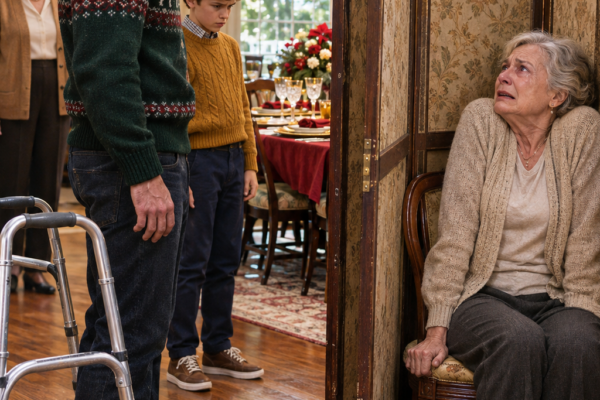
After I stayed through my grandmother’s recovery, my mother put my plate on the stairs at Christmas dinner instead of seating her 30-year-old daughter at the table.
Chapter 1 of 7
“Sit down there. Stop making trouble.”
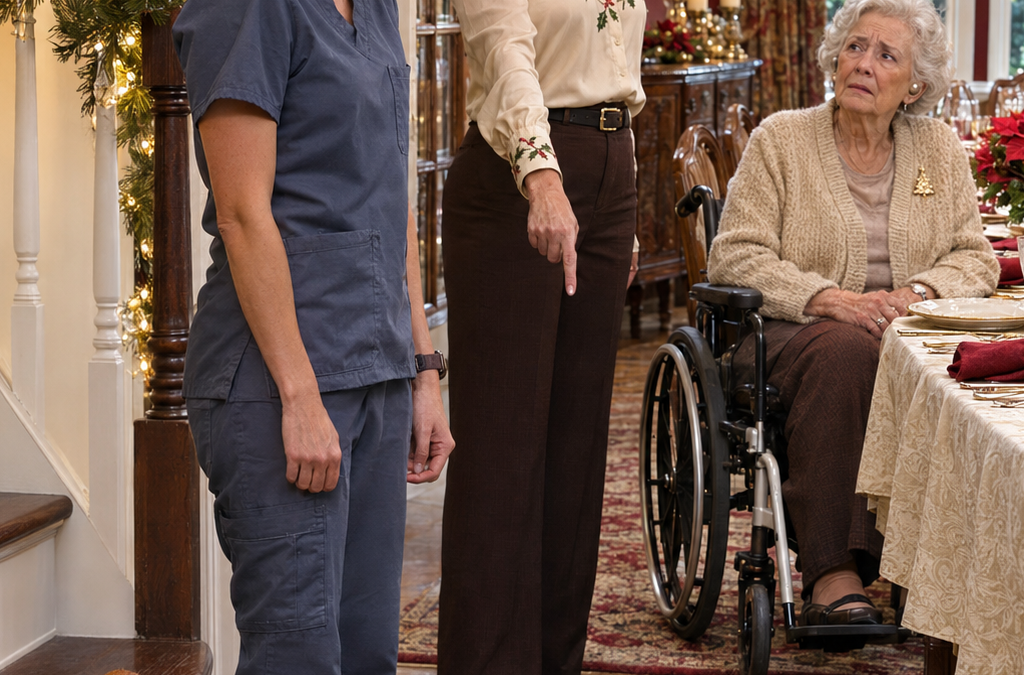
My mother, Patricia Grant, pointed below the dining room doorway. Turkey gravy had already soaked into the bread on my plate.
“There’s room beside Grandma. Why am I down here?”
My father, Robert Grant, examined his napkin while I stood in work scrubs beside the stairs, close enough to see the empty place at the Christmas table.
“Dad, are you going to let this happen?”
My aunt, Linda Hayes, answered instead. “Your mother has enough to manage tonight.”
Patricia’s phone lit up with Linda’s message: Same story if David asks?
Across the room, my grandmother, Eleanor Ellis, watched from her wheelchair. Her place was set. Mine was on the second step.
I’m Emily Carter. I’m thirty, and I’m Grandma’s full-time caregiver.
We lived in Dayton, Ohio. I worked as a nursing assistant, taking occasional shifts around Grandma’s recovery. Carter was the name I’d kept after my divorce.
My relatives called that drifting.
For eight months, I’d washed Grandma’s soft cotton pants, fitted her shower stool, and counted through the exercises she hated while she called the last repetition an accounting error.
And I’d laughed every time.
My apartment was gone. Most of my paid shifts were gone. Nobody asked what staying with her required.
Grandma was eighty-two, and she knew exactly where Patricia had put my dinner. She reached toward me, holding the little case for her hearing aids.
Her aids were still in her ears. My uncle, David Brooks, independently handled her care money, but Grandma made her own decisions.
Grandma gave me her hearing-aid case without letting go of my hand.
Her fingers were warm around mine. For a moment, I wanted to stay there until someone admitted how ugly this was.
Then Patricia came between us and lifted the spare place setting.
She carried it toward the kitchen while Linda folded the extra napkin, and I watched the space beside Grandma become bare wood as though nobody had expected me there.
“You can’t spend every holiday looking for credit.”
Those words hurt more than being sent to the stairs. Patricia knew which side Grandma slept on. She knew because I’d told her.
“You want me eating on the stairs while everyone watches?”
Patricia said yes, and Linda kept folding that napkin into a smaller square.
“STOP EMBARRASSING ME!”
The shout made my shoulders jump. Grandma released my hand, but she kept looking at Patricia.
“Just do what she asked for once,” Linda said.
“I heard you.”
But I didn’t sit down.
The plate on the stairs was still steaming. Everyone could see it from the table, and nobody offered to move it.
I kept making room until they stopped making room for me.
So I stepped into the adjoining pantry, where Patricia stored the roasting pans. Through the open doorway, I could still see Grandma’s wheelchair and my father’s bowed head.
My phone had David’s earlier message saying he was almost there. He was a college dean, but that had nothing to do with Grandma choosing him to handle her care money.
I called him once.
“Your mother’s been paid for the care you’ve been doing,” he said.
I asked whether Patricia had told him I’d left. David said yes; he had just pulled up outside.
The pantry shelves blurred. I’d given up sleep to stay with Grandma, and Patricia had made me sound absent.
Robert called everyone together for grace while I stood beside the potatoes.
David came through the dining room doorway with his coat still on. He went straight to Patricia’s empty chair.
“David, you’re disrupting dinner over nothing,” Patricia said.
He carried her chair to Grandma’s side without raising his voice.
“Emily did the care you said you were doing.”
I retrieved my plate from the stairs. David held the chair while I sat, with everyone watching me cross the room.
Patricia offered Grandma her hand, but Grandma refused it.
She wheeled herself closer to me instead, until I was beside her rather than below the doorway.
David placed his phone beside Patricia’s water glass.
Linda’s fork stopped halfway to her mouth, and the color drained from Patricia’s face.
David faced Patricia. “Whose words did Linda send me?”
“You told Linda I abandoned Grandma,” I said to Patricia.
Her mouth tightened. She looked at Linda instead of answering me.
David confirmed that Linda had sent him Patricia’s account of my leaving.
Linda lowered her fork until it struck the plate.
“Patricia told me,” she said. “I thought she meant the whole situation.”
She insisted she hadn’t understood it as every hour of every day.
Yet she had sounded certain enough when she told me to obey.
“I organized everything,” Patricia said. “Emily staying there doesn’t change that.”
She remained standing where her chair had been, with nowhere to settle.
I looked at Dad. He was watching her now, his expression changed.
“I didn’t receive any care money, Dad.”
I hadn’t expected to sound so calm with my knees shaking.
Patricia started explaining the expenses. David interrupted before she could finish.
He said expenses weren’t what I had just answered.
I thought of Grandma needing the bathroom at night, long after the others stopped checking.
Of the exercises that hurt, and the swelling we’d called about.
Dad looked back at me. Still nothing about the stairs.
I held my empty palm upward beside my plate.
Robert rose halfway and pushed his chair back from the table.
The scrape cut through Patricia’s explanation. Her lips stayed parted.
“Patricia, you told me Emily was getting paid.”
“Half,” he said. “You told me she was getting half.”
Patricia stared at him rather than answer. I could see him waiting for me to correct what he’d heard.
“I received nothing, Dad. She never paid me.”
He sat down again, awkwardly, catching the tablecloth against his knees. I hated how badly I wanted an apology from him.
Grandma turned her wheelchair enough to face her children.
“Nobody asked me who was there,” she said. “You talked around me. You could’ve asked.”
Linda began to answer, but David stopped her. “Let Mom finish.”
The repayment would take four monthly installments, but nobody promised me anything that night.
That night, I was still trying to understand eight months in which my mother had received $3,600 every month from Grandma’s private savings for care I’d been doing.
David said the agreement covered a year, $43,200 altogether. He didn’t announce a decision or demand any money back.
The numbers made me feel foolish. I remembered checking my balance before buying replacement nonslip shoes while Patricia asked whether I really needed new ones.
And Grandma had believed I was being helped.
“I’m tired,” Grandma said. “I want to talk when I can keep my eyes open. All of you can wait.”
David agreed. Robert asked whether she wanted him to bring her coat, and she said she wanted to finish eating first.
So we ate some of the cooling dinner. Linda didn’t look up. Patricia went into the kitchen and returned without anything in her hands.
My father tried once to catch my eye. I kept watching Grandma cut her turkey, ready to help if she asked.
Patricia waited until David was speaking to her before leaning close to me.
“I’ll come to Grandma’s bungalow tomorrow,” she said. “I’ll clear up why your father thought you were paid.”
Chapter 2 of 7
My mother arrived at Grandma’s bungalow the next morning after calling me four times.
“You need to stop talking over your mother.”
I hadn’t said anything yet. I’d opened the door wearing the sweatshirt I’d slept in.
She came into the kitchen, where Grandma’s oatmeal was cooling beside the stove.
“I told your father you were getting half.”
She said it while looking straight at me. Dad had known about the payments. He’d believed $1,800 reached me every month, because his wife had told him it did.
“Why would you tell him that? You knew I wasn’t getting anything.”
Patricia kept her coat on. She said I hadn’t answered my phone, as if that explained why we were standing there.
I’d watched those calls come in while helping Grandma wash and dress. Afterward, I’d wanted ten quiet minutes before hearing my mother’s voice. I was angry that even those minutes needed defending.
“You’re making this dramatic. Your father understood that we were sharing the support.”
I asked what part had been shared with me. She mentioned groceries, rides, and the time she spent arranging things.
Grandma was in the sitting room, finishing her morning exercises. Through the doorway, I could hear her counting backward to avoid doing the last three. Usually, I called her on it.
That morning, I let her cheat.
My mother had brought groceries. She’d scheduled some appointments, too. I knew that work existed because I’d thanked her for it.
But I’d paid for my own gas, clothes, and groceries when the bags she brought ran short. When Grandma couldn’t be left alone, I’d turned down shifts.
“I had $9,600 saved when I moved in. I have $1,200 now. Where was my half while I was spending that?”
“Grandma thought I was getting paid, too. Why did you let her believe that?”
Patricia said I couldn’t blame every expense on her. She asked whether I’d expected to live somewhere else for free.
That hurt. Giving up my apartment had been hard enough without hearing it described as a bargain.
I’d brought only what fit in Grandma’s spare bedroom. The rest had gone into storage, then out again when I couldn’t justify the bill. My mother knew that. She’d helped me decide which furniture to sell.
“Grandma thought I was getting paid, too. Why did you let her believe that?”
Patricia glanced toward the sitting room. Her voice dropped, but she didn’t move closer.
“Keeping her calm mattered more than explaining every little thing.”
I looked at the oatmeal. Grandma liked hers thick enough to stand a spoon in, a preference my mother still called stubbornness. I’d learned how she wanted it because I was there each morning.
There had been plenty of time to explain.
I asked whether paying me had ever been part of her plan. Patricia answered by telling me how much pressure she and Dad were under.
“Our house payment is $2,400. Your father’s paycheck doesn’t cover everything. That care money is already spoken for.”
I hadn’t known they depended on it. For a moment, the old reflex came back: work out what I could do without, then offer.
I hated how quickly I’d started solving her problem.
She said coordinating a family was work. Nobody thanked her for the shopping, the calls, or keeping everyone informed.
I acknowledged the groceries and appointments. I wouldn’t pretend she’d done nothing just because I was furious.
“I never agreed to work for free. I agreed to stay while Grandma recovered. You let me think there wasn’t money for help.”
Patricia said I’d wanted to be there. That was true, and it made answering harder.
I loved Grandma. I’d wanted her home instead of frightened in an unfamiliar bed. I’d also wanted sleep, paid work, and enough money to replace a tire without checking my balance first.
Wanting to stay hadn’t made those things disappear.
By then, David had confirmed that every payment went to Patricia. My phone already held care notes covering Grandma’s recovery, written so I wouldn’t forget exercises, appointments, or a rough night.
“I can give you $600. Tell your father the missing share was a misunderstanding, and we can get past this.”
For a few seconds, I couldn’t answer. Six hundred dollars would have helped me. I was ashamed of how clearly I knew what it would cover.
Then I pictured Dad accepting the explanation with relief. He wouldn’t have to ask me anything else.
I told her I wouldn’t say it. She insisted she was trying to help.
“You’re asking me to tell him you paid me. I won’t do that.”
Her expression changed. She stopped talking about help and told me I was enjoying having everyone upset with her.
I felt worn out, and it wasn’t even lunchtime. Grandma’s oatmeal had gone cold. I wanted my mother to leave so I could warm it, sit with Grandma, and stop arguing about whether my days counted.
“Your aunts deserve to hear what you’re doing.”
Grandma called from the sitting room before I could answer. She asked me to come where she could see me.
I stood in the doorway. She looked past me at Patricia, then back at my face.
“Don’t leave because of an argument, Emily. I want you here.”
I told her I wasn’t leaving. Patricia followed me as far as the hall, already dismissing my answer.
“I’m bringing Linda and Nancy here next time.”
Chapter 3 of 7
Patricia arrived with Linda and Nancy behind her. Before I could greet them, she turned toward her sisters.
“She’s threatening to walk out unless somebody pays her.”
My aunt Nancy Reed usually brought flowers from her shop when she visited. That morning, she came empty-handed and wouldn’t quite look at me.
“Your mother said you wanted a facility,” Nancy said. “So you could get back to your own life. Emily, we could’ve talked about that.”
I was still holding the door open. Behind me, Grandma called for everyone to come where she could see them.
It hurt hearing my wish for an afternoon off turned into that. I’d spent breakfast cutting Grandma’s toast into strips for dipping in her egg. She called them soldiers, though most collapsed before reaching the plate.
Patricia went down the hall while her sisters entered the sitting room. I heard the spare bedroom door scrape against the rug.
She returned carrying my overnight bag. Clothes bulged against the zipper. She’d packed it herself.
“Take your bag and stop upsetting your grandmother.”
She left it beside the front door, beneath Grandma’s coat. My clean scrub pants stuck out of one end.
I wanted to drag everything back down the hall. Instead, I stayed beside Grandma’s chair. Fighting over my clothes would have given Patricia something else to describe.
“This is my house, Patricia. I asked Emily to stay. Leave her things alone.”
Grandma owned the bungalow. My mother couldn’t send me away because she’d decided I should go.
Patricia said nobody was putting anyone out. She was giving me space to reconsider how I spoke to my family.
The bag remained by the door.
Linda sat on the edge of the couch. Nancy stayed standing, looking from Grandma to me. Neither asked who had packed it.
I was humiliated. My mother had gone through my bedroom while her sisters waited to discuss what was wrong with me.
“Ask Grandma what I asked for.”
I kept looking at Nancy. She’d come prepared to object to a decision I’d never made.
Grandma answered before Patricia could interrupt. I’d asked for one dependable afternoon off. I hadn’t asked her to move anywhere.
“An afternoon,” she repeated. “Long enough to go somewhere without worrying who’s coming. That’s what Emily asked me about.”
“She gets your mother upset, then makes us look cruel for stepping in.”
Linda looked at Patricia. Then she looked down at her knees.
I’d wanted that afternoon for ordinary things: a haircut, groceries, sitting in my car without answering a question. Asking for it had already made me feel guilty.
Now I had to defend it in front of three people.
“This is what she does,” Patricia said. “She gets your mother upset, then makes us look cruel for stepping in.”
Grandma told her she wasn’t upset with me. Patricia talked over her, telling Nancy I’d been difficult since Christmas.
I reminded her about my shift. She’d promised to stay with Grandma while I worked, and I needed to leave soon.
My scrubs had been laid out on the spare bed. I didn’t know where she’d put the rest of them.
“You can forget that. I’m not staying here to be treated like this. Find somebody else if you need somebody.”
I checked Linda’s face, then Nancy’s. Linda said she had somewhere she needed to be. Nancy hadn’t known anyone was expecting her to stay.
Grandma could manage more than she’d managed when she came home. But twelve hours alone still wasn’t safe for her.
I was furious that Patricia knew that as well as I did.
“You promised me this shift. I confirmed it because you said you’d be here. Are you really taking that back?”
Patricia said she wasn’t my employee. If I wanted favors, I needed to think about how I treated people.
My shift confirmation was still on my phone. I’d looked at it that morning with relief, glad to have a full day’s wages coming.
I called work from the sitting room. I told them my coverage had fallen through and apologized. I didn’t explain my mother to the person trying to fill a hole in the schedule.
Canceling meant losing $288. I’d already worked out what that money would cover.
When I finished, Grandma asked whether she could have done anything differently. That hurt worse than the call.
“No, Grandma. You didn’t cause this.”
Nancy finally sat down. She looked at Patricia rather than me.
“If Emily hardly does anything, why does she need somebody to cover for her? I thought you were here most of the time.”
Patricia answered quickly. I stopped by after work, she said, but she carried the responsibility. Being responsible didn’t mean sitting in the same room all day.
Nancy frowned. Linda looked toward my bag.
I didn’t open my care notes. I was tired of explaining each night and morning while Grandma sat there, able to tell them herself.
Grandma told Patricia to leave my clothes alone from then on.
Patricia asked once more whether I was coming with them. I said I was staying. She warned that she wouldn’t keep rearranging her life whenever I wanted to work.
Then she left. Nancy followed, pausing to tell Grandma she would call.
Linda stayed in the doorway. Her phone rang, and Patricia’s name showed on the screen. She let it ring out.
Through the window, I could see Patricia waiting beside her car. Linda’s phone rang again. She didn’t answer that call either.
“There’s something you need to see on my phone,” she said. “Messages from your mother. I can show you.”
Chapter 4 of 7
Linda came back the next morning and showed me her phone in Grandma’s sitting room. Grandma was resting in her bedroom, and we were alone.
“Patricia told me what to send. I never saw you leave her. I need you to know that before you read it.”
She held the screen where I could see it. Beneath my mother’s message was Linda’s reply, agreeing to pass it along.
Linda read the instruction aloud. “Tell David she left in May. Keep it simple.”
I read it again after she stopped speaking. There wasn’t much to misunderstand.
She’d seen me sleeping there. During one visit, she’d stepped over my shoes to reach the bedroom window. I remembered apologizing for leaving them in her way.
I felt ashamed of that apology now. She’d been careful with my shoes and careless with what she told people about me.
“Your mother said you were between apartments. That you stayed some nights, but you were mostly helping after work. I knew you were here sometimes.”
Sometimes. I’d been here when Grandma couldn’t pull up her own pants. I’d been here when she cried because she needed to ask.
Linda had visited while Grandma napped, then left before she woke. She hadn’t needed to see every hour. She could have asked me about one.
I asked whether she’d believed the message when she sent it. Linda said she’d believed Patricia knew more than she did.
That answer made me angry. My mother knowing more wasn’t the same as Linda knowing nothing.
“You saw my bag beside her bed.”
Linda said yes. For several nights, Grandma had been frightened of getting up without waking me. I’d slept close enough that she didn’t have to shout.
Linda remembered. She even remembered complaining that the little bedside lamp was too dim for reading.
From the bedroom, Grandma called to ask whether there were any good cookies left. In her opinion, oatmeal raisin didn’t count unless someone had made a mistake and used chocolate chips.
I told her I’d check. The ordinary question steadied me, though I still couldn’t look at Linda without feeling hurt.
“Patricia helped me when my marriage ended. She came every weekend. I couldn’t even choose a grocery store without crying in the parking lot.”
Linda’s voice cracked on the last part. I remembered that time, too. My mother had cooked for her and helped her find somewhere to live.
I didn’t want to pretend those things hadn’t happened. But Linda kept returning to them as though they changed what was on her phone.
I told her to stop explaining my mother’s good intentions. I needed her to tell me why she’d repeated something she knew didn’t fit.
“I owed her. That’s what I kept thinking. She asked me for one thing, and I thought questioning her would be—well. After everything she did.”
Linda looked down the hallway toward Grandma’s bedroom. She admitted she’d known asking Grandma would have been easy. She hadn’t wanted an answer that would put her between them.
I had been lonely for months without knowing people were being given a reason to stay away. Hearing that she’d chosen not to ask hurt more than her first explanation.
I didn’t offer forgiveness. I asked whether she would tell Patricia, to her face, what she’d just told me. Linda said she would.
By then, David had had someone check his agreement: he could end Patricia’s arrangement immediately for materially false reports, but couldn’t simply order disputed past money returned. He already had his copy and had confirmed the eight payments went to her.
“I’m not asking you to take my side because we’re sitting here. Will you still say it when she’s angry with you?”
Linda said yes again. Her phone rang before I could answer.
She let it stop, then ignored a second call while we listened to Grandma opening a drawer. Linda asked whether I needed to go help her. I said Grandma would call if she wanted me.
When Patricia called a third time, Linda told her I was there and put her on speaker.
“David says Emily did the daily care the whole time. He actually said the whole time. What have you been telling him?”
Linda answered that she’d been talking to me. Patricia demanded to know whether she’d shown me their messages.
I said I’d read them. My mother paused, and I could hear a television behind her. Then she told me staying with Grandma hadn’t made me entitled to decide what everyone else deserved.
“Your grandmother wanted me to keep that money. Emily offered to help her. Now she’s acting like we hired her and refused to pay.”
There it was: she no longer needed me to have left. She needed my staying to have been free.
I was furious, but I let Linda answer. This was the part she’d promised not to avoid.
Linda told Patricia she would attend the family conversation David had requested, but she wouldn’t forward another account for her. We settled it in one line: Tuesday, 6:30 p.m., at the Grants’ dining table, with me, Eleanor, David, Robert, Linda, and Nancy present.
Patricia told Linda to come early so they could talk alone. Linda said she would arrive with us.
“I’ll tell Eleanor you’re all calling her a liar.”
Linda looked at me and didn’t withdraw.
Chapter 5 of 7
“They’re saying you didn’t know what you wanted.”
My mother said it to Grandma at the Grants’ dining table. She stood close enough that Grandma had to look up at her.
Dad stopped beside me before I reached a chair. He spoke quietly, but Patricia could hear him.
“I told David not to come over so much. Your mother said you wanted fewer people interrupting. I thought I was helping you get her settled.”
I looked at him. For months, I’d wondered why nobody stayed long enough for me to leave.
He said David had offered to visit. Dad had told him we needed rest, that I’d call when company would help.
I felt sick with anger. He’d made my loneliness sound like something I’d requested.
“You could’ve asked me, Dad.”
He said he knew that now. Patricia cut in before he could say anything else. Recovery had required quiet, she said. Everybody had agreed about that.
I hadn’t agreed. I’d been grateful when someone knocked, even when it meant explaining Grandma’s exercises again.
David stood at the other end of the table. He watched Dad, then looked at me. Neither of us tried to make Dad feel better.
“David, I’m worried this is getting too much for Mom,” Patricia said. “She shouldn’t have to defend her decisions to her own children.”
Her voice was gentle with him. When I asked Grandma whether she was comfortable, my mother turned sharply toward me.
“Sit down and let your grandmother answer.”
I took an ordinary chair without apologizing. Grandma’s wheelchair fit at the end of the table, where she could see everyone without twisting.
“Do you want a break before we start, Grandma? We can wait. You don’t have to do this because we’re all sitting here.”
She told me she wanted to get it done. She’d rested before coming and didn’t need anyone announcing she was tired.
I was relieved she said it herself. I’d spent so long answering questions about her that I worried about doing it, too.
Linda set her phone faceup in front of her. Mine stayed in my pocket, with the notes I’d written through months of care.
David had already checked what he needed. There was nothing for me to spread across the table.
“But Mom wanted me to keep the care money. Emily offered to help.”
Nancy chose a place along the side where she could see both Grandma and Patricia. Dad remained standing near the empty chair beside my mother.
The table’s small wobble was still there. Dad had been promising to fix it since before my divorce. Every family dinner included somebody discovering it with a full glass.
That evening, nobody complained about the table.
“Emily stayed with her grandmother. Nobody’s denying that now,” Patricia said. “But Mom wanted me to keep the care money. Emily offered to help.”
I hated hearing her call it help. When she needed me there, it had meant all night, every morning, and don’t forget the laundry.
Grandma watched her without answering. Linda’s face reddened, but she stayed in her chair.
Patricia said the family had made an arrangement. Changing our minds now didn’t mean she’d done anything wrong.
I asked when Grandma had told her to keep everything. My mother answered David instead.
“She knew I was handling things. Shopping, appointments, keeping people informed. Emily wanted to stay with her. I didn’t force her to move in.”
David said he’d asked about what Grandma understood, not whether I’d been forced.
Patricia’s courteous expression held while she answered him. Of course Grandma understood. She’d always helped her children when she could.
I was furious at how easily she used that. Grandma had helped me through my divorce. She’d never asked for months of work in return.
Dad pulled out the chair beside mine and sat there. Patricia glanced at the empty place near her, then back at him.
It wasn’t an apology. Still, I noticed.
“Emily always refused help,” Patricia said. “You all know how she gets. Everything has to be done her way, and then she complains she’s doing everything.”
Dad looked at her.
“I heard her ask you for that afternoon.”
My mother said one afternoon wasn’t what she meant. He answered that it was the afternoon he’d heard me ask for.
I’d almost forgotten he’d been there. He’d been standing in Grandma’s kitchen, checking whether the heat was coming through the vent.
It hurt that he remembered. He’d heard me asking and left without offering anything.
I kept looking at Grandma rather than thanking him. He sat beside me with his shoulders bent, and I let him stay uncomfortable.
“You don’t know every conversation we had, Robert. Don’t start agreeing with her just because everybody else is.”
He said he was talking about one conversation he’d heard. Then he stopped.
Patricia turned toward Linda, but Linda wouldn’t supply an answer. Nancy asked Grandma whether she wanted to speak.
Grandma said yes. Slowly, she looked around the table until everyone was facing her.
I felt afraid for her then. My mother had made disagreeing seem like an act of cruelty, and Grandma still had to answer in front of us.
“Tell me again what you say I agreed to, Patricia. I want to hear you say exactly what you mean.”
Patricia leaned closer. She laid her hand over Grandma’s hand on the table.
“Tell David you wanted me to keep it.”
Grandma looked down at Patricia’s hand, then directly at me.
Chapter 6 of 7
Grandma withdrew her hand. I said, “Say it to Grandma.”
Patricia looked around the table, then back at her mother. “You wanted me to keep the money. Emily chose to help.”
Linda and Nancy watched her. Dad stayed beside me, and David waited at the other end.
I asked how Grandma could have agreed to that while believing I received half.
Grandma said she’d understood that my mother was paying me. Dad confirmed Patricia had told him the same thing.
I felt angry all over again. Even now, I wanted my mother to admit one thing without making us pull it out of her.
“I bought groceries. I handled appointments and managed this for months,” Patricia said. “Mom was exhausted. She could’ve misunderstood how we divided things.”
She mentioned her house expenses as though Grandma had agreed to those, too.
Grandma looked at her daughter. She didn’t look confused.
David asked, “Then why did you tell me Emily had left?”
Patricia said she’d meant responsibility, not whether I came through the door. She was officially responsible. I occasionally helped.
Occasionally was a hard word to hear. I remembered eating cereal over the sink because sitting down meant falling asleep.
Linda’s phone was still in front of her. The instruction I’d read on it hadn’t said anything about responsibility.
It had said I left.
I placed Grandma’s hearing-aid case within her reach. “Grandma, what did you hear when they thought you couldn’t?”
I hadn’t known what she would say. But she’d told me she wanted to speak, and I wanted everyone to let her finish.
“Tell him the story you practiced, Patricia.”
My mother stared at her.
Grandma said it had happened during Linda’s last visit. She’d been in her sitting room, resting with her eyes closed.
Then she repeated Patricia’s words.
“Tell David she left in May. If he asks about the scrubs, say she stopped by after work.”
I had never heard that before.
After work. Patricia had used those words with Nancy when she came to get me out of the bungalow.
I felt sick. They’d prepared an answer for anyone who happened to see me there.
Patricia pushed her chair back. “You couldn’t have heard that. Your hearing aids were put away.”
Grandma opened the case.
“You put the case away. I was wearing my hearing aids.”
For a moment, Patricia looked at Linda instead of her mother.
Linda said she’d checked that the aids were sitting properly in Grandma’s ears. Grandma had asked her to, before settling back.
I watched my aunt struggle to keep looking at Patricia. She stayed facing her.
“I heard you say it,” Linda said. “I sent what you told me to send. Emily hadn’t left. I never saw her leave.”
Grandma remembered asking Linda for water afterward. Linda confirmed she’d brought it in the blue plastic cup because Grandma disliked the heavy glasses.
That was such an ordinary thing. I’d washed that cup nearly every morning.
I was relieved, and hurt that we needed this much before Grandma could be believed.
Patricia turned toward David. “She’s mixing up different conversations. Linda, tell him we were discussing who was in charge.”
“You reported abandonment because the truth would have shown who was doing the care.”
Linda refused. The message on her phone said to tell him I’d left in May. Grandma had heard the fuller instruction.
My notes covered the nights I’d stayed. Grandma’s appointments placed me there, too. Neither needed to carry the whole story alone anymore.
David faced Patricia.
“You reported abandonment because the truth would have shown who was doing the care.”
He paused long enough for her to answer. She only repeated that she’d managed everything.
“I’m ending your $43,200 care arrangement now.”
Patricia’s mouth opened, but David continued. There would be no more $3,600 monthly payments. The four remaining payments, totaling $14,400, would not go to her.
What she’d already received would be addressed separately. He wasn’t deciding repayment at this table.
I felt shaky with relief. Nobody had promised to give me my months back. But my mother would no longer be paid to describe me as absent.
Patricia stood and reached for Dad’s sleeve.
“Robert, stop letting this happen. Tell your brother-in-law what this does to us.”
Dad freed his sleeve and released her hand.
He asked Grandma whether she wanted help moving away from the table. She said yes, beside Emily, please.
He helped guide her wheelchair beside me. Then he stayed there.
Patricia watched him, waiting. He didn’t return to her.
Linda turned her phone toward David rather than Patricia. Nancy took the hand Grandma offered and held it while Grandma caught her breath.
My mother told me we needed to speak privately. She sounded as though everyone else had interrupted a conversation that still belonged to her.
I was scared of what saying no would cost later. I said it anyway.
“You don’t get my silence with my work, not anymore, Mom.”
I wouldn’t go into the kitchen with her. Whatever she needed to say could wait until I wanted to hear it.
Grandma said she was ready to leave. Dad offered to bring her coat, and she accepted.
I didn’t promise another shift, another night, or a way to make the household bills work. I helped Grandma get comfortable for the ride home because she asked me.
David walked with us as far as the doorway.
Grandma stopped him there.
“Count what she kept. Don’t ask Emily to fix it.”
Chapter 7 of 7
The old payments took four months to settle. David’s decision had stopped the next payments; it hadn’t brought back what Patricia had already received.
On April 26, 2027, the parties signed a civil settlement. Patricia agreed to return $21,600 to Grandma’s care reserve in four monthly installments of $5,400. The compromise left her $7,200 for genuine coordination, shopping, and transport.
I read the amount twice. I was relieved, but I still wished my mother had stopped before anyone needed to bargain with her.
Help had started long before that. Shortly after the confrontation, Megan Price began coming through a home-care service.
“I want mornings covered,” Grandma told me. “You go to work. Megan can help me get dressed, and I’ll tell her myself how I like things.”
Grandma chose the schedule. Her reserve paid $2,800 monthly for 100 hours of support. Megan was forty-two, dependable, and comfortable letting Grandma do things slowly.
The first morning I left for a regular shift, I waited in the hallway. Nobody called me back.
“You forgot your lunch,” Megan said from the kitchen. “That’s all. Eleanor’s fine. Go before you have to explain being late.”
I laughed, then cried in the car. I was embarrassed by how frightening it felt to leave when someone had actually agreed to stay.
By the first installment, my parents had canceled a summer trip. Dad told me when he came to fix Grandma’s loose porch rail. Patricia called while he was there.
“Tell her why we aren’t going,” she said through his phone. “She ought to know we canceled it. We won’t be doing much this year.”
Dad said he wasn’t putting me on. He ended the call and told me they had cut restaurant meals and other extras, too.
For a moment, I felt guilty. Then Grandma asked whether the rail would be ready before lunch, and Dad went back outside.
He stayed afterward, standing near the kitchen doorway until I asked what he wanted.
“I believed the version that let me go home,” he said. “That’s what I did. Your mother said things were handled, and I stopped asking.”
I let him keep talking. He admitted he’d avoided my eyes at Christmas because looking at me would have meant doing something.
“If I’m not sure, I’ll call you. You don’t have to answer right away.”
“I saw where she put your dinner, Emily. I let you stand there asking me for help. I’m sorry. I should’ve answered you.”
It hurt hearing him say it plainly. I had wanted that apology for months, and receiving it didn’t make me want to hug him.
I told him he could visit and help when Grandma wanted him there. But he couldn’t tell anyone what I needed without asking me.
“I won’t speak for you again,” he said. “If I’m not sure, I’ll call you. You don’t have to answer right away.”
He kept that promise in small ways. He asked before offering rides. When relatives asked about my work, he gave them my number instead of an explanation.
Linda apologized to me without mentioning what she owed Patricia. I accepted the apology. I wasn’t ready to be close, and she stopped asking me to reassure her.
Nancy called Grandma directly from then on. David sent brief updates about the payments and asked Grandma about her care. None of them asked me to carry messages.
My mother still tried.
“Megan can’t be there every minute,” Patricia said once. “You could take a night now and then. We shouldn’t need all this scheduling for family.”
I told her I would visit when I chose, but I wasn’t the backup plan. If the service needed coverage, they could arrange it with Grandma.
I was afraid she would shout. She called me selfish instead. Afterward, I sat on my own bed until the shame passed.
Grandma decided when Patricia could visit. Sometimes she agreed to an afternoon. Sometimes she said she wasn’t ready. I didn’t attend those visits unless Grandma invited me.
“She asked if you’d come Sunday,” Grandma told me once. “I told her to ask you. I’m not arranging a reunion over your head.”
I thanked her. Then we talked about the grocery list.
My studio cost $850 a month. It had one closet, an uneven kitchen floor, and enough room for a little table.
The first week, I left my clean scrubs on a chair. They were still there when I got home. Nobody had packed them or decided where I ought to go.
I felt safe there. That surprised me more than the quiet.
“Can you pick up another shift?” the scheduler asked one afternoon. “We’re short tomorrow, but I know you’ve already worked a full week.”
I said no. Then I made myself dinner and ate it while it was hot.
Eight months after Christmas, David confirmed the final installment had cleared. The money was back in Grandma’s care reserve. My mother hadn’t apologized, and I no longer kept my phone close hoping she would.
That afternoon, I took Grandma out for groceries. She walked part of the store with her walker and used her wheelchair when she got tired.
“Get the peach preserves,” she said. “The good ones. Last time I bought the cheap kind, I had to spread them with both elbows.”
I laughed in the aisle. She looked pleased with herself and asked me to read the ingredients anyway.
Back at the bungalow, Megan had finished for the day. Grandma asked me to stay for toast before I went home.
I checked nothing before answering. I wanted to stay.
She handed me her hearing-aid case while I brought our food to the small kitchen table. I chose the chair by the window.
We ate toast with peach preserves and talked about whether she wanted to try the farmers market next time. Crumbs gathered beneath her plate. Outside, someone started a lawn mower.
I finished eating without watching the doorway. Grandma asked whether I wanted more, and I said I’d had enough.
Love didn’t require me to disappear.
I set Grandma’s hearing-aid case beside my plate.