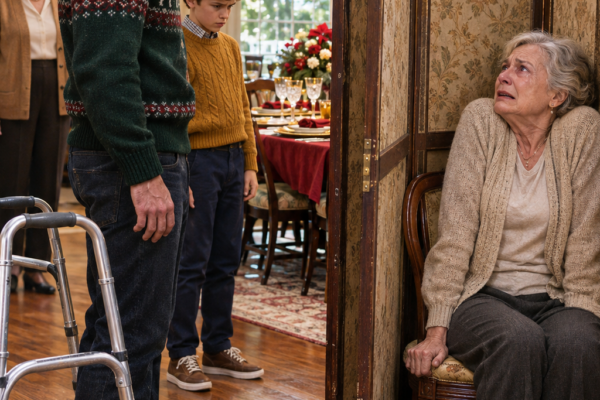
“Wait behind there. Nobody needs your whining.”—my stepfather screened my daughter and me off while our relatives opened my father’s keepsake box.
Chapter 1 of 7
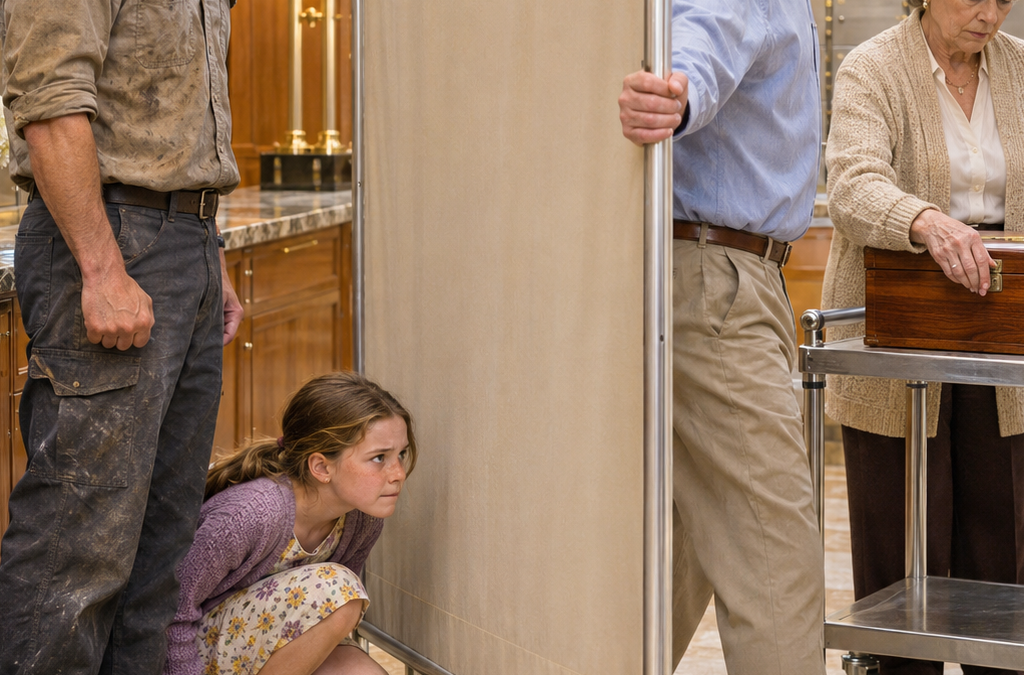
My stepfather, Frank Miller, rolled the privacy screen across my place at the bank’s inspection counter. My eight-year-old daughter, Lily Carter, crouched beside my work boots and looked underneath.
“She only wants to see her grandfather’s things,” I said.
Across the screen’s unfinished edge, my father’s sister, Ruth Bennett, reached toward the wooden box while my step-aunt, Carol Miller, watched Lily instead of stopping Frank.
“Are you really letting him hide her?” I asked Carol.
“Don’t make this harder for everyone.” Carol looked away. “Frank arranged this, so let him finish.”
Beside Frank’s elbow lay an envelope marked with his home-loan company’s name. It seemed misplaced among Dad’s belongings.
Lily straightened without asking again. That hurt more than Carol’s answer.
My name is Daniel Carter. I’m forty-two, and I’m raising my daughter alone. We lived in Conroe, Texas, in Frank’s house.
I had Dad’s recorded voice on the cassette Ruth had mailed me. The previous night, I’d learned that Dad had never rejected me. Frank had kept his letters from me.
How much else he’d hidden, I didn’t know.
After my wife died, Lily and I moved into Frank’s house, where I repaired the sagging kitchen cabinet doors while her school clothes occupied half our shared closet shelf.
I worked as an HVAC service technician. There was still insulation dust on my pants.
I kept accepting his version because arguing threatened the roof over Lily.
When Frank’s chair rocked, I started to offer to steady it. Then I stopped. Inside my open work bag, the portable player rested beside Ruth’s packet.
Ruth’s copied letters lay beneath the cassette addressed to me.
Frank dragged my chair to the relatives’ side of the screen. He told me I could sit there after they finished looking.
He’d invited us to a voluntary viewing of Dad’s keepsakes. Now he acted as though we’d wandered into a private gathering.
Lily stepped toward the gap, and Frank raised his voice.
“KEEP HER BACK THERE!”
Nobody touched her. She backed against my leg anyway.
“You’re hiding his granddaughter while you open his things?”
“Yes, and you can wait without making trouble.”
“We’ll stay together.”
And I moved with Lily to the counter’s far end, where I could see the box without leaving her alone behind the screen Frank had positioned across our chairs.
Ruth’s fingers hovered over the latch. She hadn’t opened it yet.
Frank had handled Dad’s affairs because I’d nominated him when he offered. Ten months after Dad’s death, I was still waiting for him to explain things without making me feel stupid.
But I wasn’t going to wait for permission to stand beside my child.
I called Elena Brooks from the counter’s edge, using the number she’d given me when we arranged the viewing. I gave her my name.
“Frank asked us to pay off his house with your father’s money,” she said.
“Did you tell her I agreed, Frank?” I asked across the screen.
Elena asked me to stay there. Lily pressed her shoulder against my thigh while Frank watched my phone and Carol studied Dad’s wooden box.
When Elena entered, she went straight to the cart and rolled it behind the screen. Dad’s unopened box stopped in front of Lily.
“I booked this room for the family,” Frank said.
“Daniel and Lily are part of this family,” Elena said. “Ruth asked us to include them, Frank.”
She kept hold of the handle. Ruth stepped around the screen and caught its corner.
Frank’s fingers rested against the latch, but the box stayed shut. I waited for him to answer me.
“Frank told me you refused your father,” Ruth said.
Ruth reached over and gripped my sleeve.
Frank’s fingers stopped against the latch, and his mouth tightened.
Ruth was watching Frank now, still holding on to me.
“You told Dad I wouldn’t let him meet Lily,” I said to Frank.
His mouth opened, but he looked at Ruth before answering me.
Frank said he had been protecting Dad from another disappointment.
“You didn’t get to decide that for us,” I said.
Ruth stayed beside me and confirmed what Frank had told her.
“He asked about her every time I saw him,” she said.
Lily watched Ruth, and I wished she could have heard that anywhere else.
Dad had wanted to meet her while I believed he’d rejected us both.
Six years earlier, Dad and I had argued and said ugly things.
I had believed Frank when he said Dad had forbidden me to call.
Apparently Dad had believed I wanted no contact with him, either.
Frank had supplied each of us with the other man’s refusal.
Elena said the requested house payment had not happened, and I nodded.
Frank turned back to Ruth and told her this wasn’t the place.
Carol started agreeing with him, then stopped before she finished.
I followed her gaze to the packet showing inside my work bag.
She looked from Ruth’s copied letters to Frank, keeping her mouth closed.
Carol touched his sleeve and caught his arm when he pulled backward.
His chair scraped across the floor, and his eyes snapped toward her.
“Frank, you told me Daniel had the letters.”
“I left them in his room,” Frank said. “What he did afterward isn’t my fault.”
He looked at me as though I might help him make that explanation hold.
I didn’t.
Instead, I briefly lifted the cassette case from my bag. The label read, “For Daniel James Carter.” Dad had used my whole name, just as he did when teaching me to mend an old radio.
Last night, I’d heard him identify a birthday letter, a letter asking us to put the argument behind us, and two requests to meet Lily, one in his offer to help after my wife died.
My father, Robert Carter, had left $267,400 after the estate’s expenses and debts. Frank had asked the bank to use $184,600 to pay off his own mortgage.
Those were separate facts. Frank had spent years making every kindness in his house feel connected to whatever he wanted next.
“Let me see that,” he said, looking at the case.
“No. It stays with me.”
His eyes moved toward Elena, and his voice softened as he asked whether we could finish the family viewing without all this upset.
Lily had stayed beside the cart. She wasn’t touching the box, although it was finally close enough to reach.
I felt ashamed that she still thought she needed his permission.
“She can look at her grandfather’s things,” I said. “We’re not voting on whether she belongs here.”
Carol didn’t argue. Frank told me I was making Lily uncomfortable, but Lily shook her head before I could answer him.
Ruth remained beside the cart, her face blotchy and wet. She looked at Lily, then back at me.
There was more she hadn’t said. I could see her struggling to make herself say it.
“Frank told your father Lily wasn’t allowed to know his name.”
Chapter 2 of 7
On Ruth’s porch the next afternoon, she admitted she had told Dad not to call me.
“Frank said Lily mustn’t hear from him. Your dad wanted to telephone anyway, and I talked him out of it.”
“Did Dad ask you to check with me?”
She said he had. This was after my wife died, when Dad wanted to offer help. Ruth had asked Frank instead of me, then carried his answer back to her brother.
I felt sick hearing that. Through her porch railing, I could see a little plastic slide in the neighbor’s yard.
“That wasn’t yours to decide,” I said. “You could’ve called me. Asked for my number somewhere else. You didn’t have to go through him.”
Ruth sat across from me in a faded lawn chair. She had brought out two glasses of iced tea, both nearly clear. Dad used to complain that she scared a tea bag with hot water and called it done.
I almost mentioned that. I wanted one easy thing between us.
“I believed him because you lived there,” she said. “I thought he knew what you wanted. Robert asked whether I’d heard it from you, and I said it didn’t matter. God, Daniel. I said that.”
Her phone rang from the chair beside her. She looked at the screen and let it stop.
That was Frank’s first call.
I asked about the four letters. I knew which ones Dad had described, but I needed Ruth to tell me what she had actually seen.
She had helped him with all of them. His handwriting had grown difficult to read, and he wanted clean copies.
“He’d write something, then ask whether it sounded angry,” she said. “Sometimes it did. I’d tell him, and we’d start again. He wasn’t pretending you two hadn’t fought.”
“Dad named those same letters in the recording,”
The first was for my fortieth birthday. Another asked whether we could talk about our argument. One offered help after my wife died. The last asked to meet Lily.
Ruth had kept copies with her own household papers because she had typed them for him.
The phone rang again. She watched the neighbor’s empty slide until it stopped.
“Dad named those same letters in the recording,” I said. “He said Frank promised to bring them to me. Did you ever ask Frank why I hadn’t answered?”
She had. Frank told her I had received them and wanted the subject left alone.
That hurt in a different way. I remembered coming home from service calls, too tired to cook, finding Frank watching television. I had thanked him for saving Lily some supper.
Dad had been waiting for an answer while I thanked the man who kept us apart.
“I should have come to your door,” Ruth said. “Even if you sent me away. I was afraid you’d be angry, and I let that be enough.”
The third call interrupted her. The fourth came before either of us spoke again.
I counted because I needed something plain to keep track of. Everything else made me want to get up and leave.
Ruth said Dad had worried that sending money would offend me, too. He thought I might see it as an attempt to buy his way back.
“He left you everything anyway,” she said. “He told me you could refuse to see him and still need help raising a child. He didn’t want Lily doing without because you two were stubborn.”
I pictured an ordinary afternoon Dad could have had with her. Lily asking why his television was so loud. Dad showing her how a radio worked, then forgetting she was eight.
I was furious about how small those lost things were. Nobody could give them back.
“You can be sorry,” I told Ruth. “I’m not saying you can’t. But I can’t make you feel better about this today.”
She nodded without asking me to try.
Her fifth call went unanswered. During the sixth, she began crying, quietly enough that I could hear the phone buzzing against the chair.
My old answer rose automatically: she hadn’t known, Frank had fooled everybody, none of this was her fault.
I nearly said it to stop watching her cry.
Instead, I told her the county record was available. Elena was checking the existing instruction about the remaining money.
That was all I knew to say about the money. What I needed from Ruth was harder.
“When we’re with the others, say what happened,” I said. “What Dad asked. What you told him. Don’t make it softer because Frank’s sitting there.”
She agreed. She didn’t ask whether that would make us all right.
On the seventh call, she answered and let me hear.
“Stop filling his head and come home,” Frank said.
“He asked me what you told me.”
The call ended before she could say anything else. She stared at the screen, then looked at me. I had heard no surprise in his voice, only irritation that she was still talking.
I was afraid of going home. I hated admitting that, even to myself, but Lily’s clothes were there. Her bed was there.
Ruth remained across from me when my phone sounded. Frank’s first message said he was waiting at the house. If I wanted Lily to keep her home, I needed to stop this.
Then another message appeared.
“Come home. We need to discuss whether Lily still lives here.”
Chapter 3 of 7
When I came home the next morning, Frank was waiting at the living-room doorway. Lily was at school.
“I already told Carol the money will pay for this house,” he said. “This is where Lily belongs.”
He spoke as though he’d arranged something generous. My daughter would keep her bedroom, and I would stop asking questions.
“You told her before you asked me?”
“I’m trying to give that child some stability.”
I stayed in the doorway. Behind him, Lily’s library book lay on the couch. She had left it open to a picture of a lizard that squirted blood from its eyes. We’d agreed that was excessive, even for a lizard.
I was grateful she wasn’t there to hear him.
Frank had the television on without sound. He’d been watching for my truck, not watching the program.
“I kept a roof over both of you,” he said. “Three years, Daniel. You think that didn’t cost me anything?”
It had cost him something. Two people used his water and electricity. Lily sometimes woke him early, and our things took up space.
I had never pretended otherwise. But I had bought groceries, driven him to appointments, and spent weekends fixing what broke. Those things had counted as helping until Dad’s money became available.
“I know you let us stay,” I said. “A place to stay wasn’t a sale of my future.”
His face reddened. I hated how quickly I wanted to soften what I’d said.
“Sit down and stop acting above this family.”
I remained standing. If I sat, he could keep me there through another explanation of everything I owed him.
He said the house needed paying off before his retirement became a disaster. The $184,600 came due in four months, all at once. He said “all at once” twice, watching me both times.
Until the bank gathering, I hadn’t known about that deadline.
Now I understood why he had become interested in where Lily belonged. He was scared of losing his house, and he expected me to be more scared.
“You could have told me you were worried,” I said.
“You picked me to handle your dad’s money. I can still sign for it.”
“You’d have started telling me what to do.”
“I would’ve wanted to know what you were asking.”
Frank glanced toward the couch, as though an audience might have helped him. There was nobody else to agree that I was being difficult.
“You picked me to handle your dad’s money. I can still sign for it.”
That was the part I couldn’t solve by walking away. My refusal mattered, but he still held the same access he’d had when he asked for his mortgage payment.
I felt stupid for having trusted him so completely. Dad had died, I’d been overwhelmed, and Frank had offered to take care of everything.
I had mistaken relief for safety.
He told me I could end the upset by cooperating. We could finish this, keep Lily settled, and stop dragging relatives into our business.
He never asked what I wanted Dad’s money to do for her.
“What happens if I don’t cooperate?” I asked.
“Then I’ll put it in writing. Thirty days to find somewhere else.”
He called our arrangement month-to-month. He wouldn’t throw our belongings outside, he said, but he wasn’t obligated to house someone who treated him this way.
I looked past him toward the hallway. Lily’s height marks were on the bedroom doorframe. She checked them after almost every bowl of broccoli, convinced somebody owed her measurable results.
I was afraid of telling her we had to leave.
Thirty days meant finding a place between service calls. It meant deposits, boxes, a truck, and explaining why her bed was moving again.
For a moment, I considered offering him a smaller amount. I could hear myself calling it a compromise. He hadn’t even named one, and I was already bargaining against myself.
Then I remembered that he’d threatened Lily’s home before asking whether I would help.
“Give me the notice if that’s what you’re doing,” I said. “I’m not signing anything new.”
He stared at me. I had never accepted one of his threats before. Usually, I worked until he stopped being angry.
This time I had no repair to offer him.
The refusal didn’t make me feel strong. My mouth was dry, and I was already wondering whether a landlord would let me bring Lily to a showing after work.
A certified copy from the county had been requested and would go directly to Elena as well as me.
Until then, saying no hadn’t ended Frank’s ability to act. I needed to keep showing up, however much I wanted to get Lily and disappear somewhere quiet.
He lowered the television volume, although it was already muted. Then he changed the subject.
“You’re acting like this is news,” he said. “Carol heard you say you’d help.”
I asked him what she had heard.
He said I knew perfectly well. His sister had been there when I made my promise, and now I wanted to change it because the money was close enough to spend.
I couldn’t remember promising him my inheritance. I could remember promising plenty of help.
That difference frightened me. Frank had built years of distance between Dad and me from words neither of us had checked.
“What exactly have you asked Carol to say?”
He stood straighter, relieved to have found firmer ground. He said he’d asked her to repeat it in front of everyone.
“Carol heard you promise. She’ll tell them herself.”
Chapter 4 of 7
In Carol’s parked car outside my workplace, she told me which promise she’d heard.
“You said, ‘I’ll help you take care of Dad.’ Frank had just offered to arrange the funeral. That’s what I remember.”
The engine was running, but the air barely reached the passenger seat. Through the windshield, I could see our service trucks lined against the fence.
I asked whether she had heard me promise him money. She said no, looking toward the trucks.
“Then why did he tell me you had?”
“He’s had you there three years, Daniel. After your wife died, he didn’t ask how long. I think he figured you’d want to help him when you could.”
I felt humiliated. Even alone with me, she was explaining why Frank deserved something I hadn’t offered.
Her phone rang from the console. She glanced at it and let it ring.
I remembered that funeral conversation. I had been worrying about calling Dad’s former coworkers. Frank had offered to make arrangements, and I had offered to help. We hadn’t discussed his house.
“He’s making her home the price of my silence,” I said. “He told me we could stay if I cooperated. Otherwise, thirty days.”
Carol said he wouldn’t put Lily out. She sounded certain, which made me angrier.
“He said it to me. You weren’t there for that conversation, either.”
She looked down. I let her sit with it instead of finding something gentler to say.
Carol’s car smelled like the wintergreen mints she kept in a coffee mug. She’d used that mug for years, though it said WORLD’S OKAYEST BOWLER. She had never bowled.
I used to tease her about it. That afternoon, I couldn’t remember how we got from those visits to this.
“I repeated what he told me about the letters,” she said. “To Ruth. I told her you’d received them and didn’t want to answer.”
I asked whether she had ever seen him deliver one. She hadn’t.
“At the bank, you said he told you I had them,”
She had known she was repeating Frank’s account. But when Ruth questioned it, Carol had said I lived under his roof and he would know.
That hurt worse than another excuse. She had helped make it sound confirmed.
Her phone rang a second time. Neither of us looked away from the other until it stopped.
“At the bank, you said he told you I had them,” I said. “Before that, you were telling people I had them. Did you ever say you didn’t actually know?”
She shook her head. She said Frank had sounded so annoyed with me that she hadn’t questioned whether there was a reason.
I thought about Dad waiting for answers. Carol had known me since I was a kid. She could have asked me over supper.
I was furious with her, and tired of wanting her to understand.
When the phone rang again, she answered on speaker. Frank asked whether she had talked sense into me yet.
“Daniel heard Robert’s recording,” she said. “Robert named the letters he gave you to deliver. Ruth saved the copies. He’s read those, too.”
For several seconds, I heard only Frank’s television.
Then he asked whether I was in the car. Carol said yes.
“You don’t get to turn my sister against me.”
“She told me what she heard,” I said. “That’s why I came.”
He said Dad had made that recording before he died, as though we had missed that. Whatever Dad had wanted then, Frank said, wasn’t the arrangement we had made afterward.
He sounded sharper now. He knew this reached beyond my saying he had hurt me.
“You agreed we’d keep the family home,” he said. “Carol knows you meant more than making funeral calls. Now you’re making me look like I stole something.”
Carol started to answer, but he talked over her. He told her to remember the whole conversation, not whatever parts I wanted her to remember.
She went quiet. I could see how badly she wanted this call finished.
“Ask her what I said,” I told him. “You keep telling her.”
He said we would discuss it with everyone present. Then the call ended.
I was afraid Carol would change her account before we met again. She had defended him for years; one uncomfortable afternoon hadn’t undone that.
The money was left to me, not to the version of me Frank described.
Elena had received the county’s certified copy. Our appointment was Tuesday, 10:30 a.m., in the same private inspection room.
Frank, Carol, Ruth, Elena, and I would be there. Lily would stay with the school program I trusted. She didn’t need another afternoon watching adults decide whether she belonged.
“I need you to say what you actually heard,” I said. “Even if he gets angry. Can you do that?”
Carol said she thought she could. I wanted a firmer answer, but pushing her into one would mean little.
I told her I wasn’t asking her to stop loving her brother. I needed her to stop agreeing that he knew what I meant better than I did.
She watched the windshield for a while. Then she said she hadn’t liked how he spoke to her on the phone.
I almost laughed. It wasn’t funny, but she sounded surprised by something I had lived with for years.
As I reached for the car door, her phone lit again. She read the message without turning it away from me.
Frank had texted Carol, “Tell them you heard me agree with Daniel about the house.”
Chapter 5 of 7
“He kept saying, ‘you heard me agree,’ like practice,” Carol told me. “He wanted the funeral talk to mean you’d offered to pay for his house. I told him I wouldn’t go over it again.”
We stood just inside the inspection room. Frank had brought her with him, but she had waited by the door while he greeted Ruth.
She hadn’t said she would contradict him. I noticed the difference, and it scared me.
The cart remained behind the screen, with Dad’s wooden box on top. The screen still divided the chairs. Without Lily beside me, I could see how little space Frank had left us.
“Ruth, you look better. Getting some rest?” Frank asked. Then he turned toward Elena. “Thank you for fitting us in. I know you’ve got a whole branch to run.”
He sounded like the man I used to trust with difficult conversations. I had heard that pleasant voice from the hallway at home, usually just before a visitor left.
Ruth gave him no answer about her sleep. She had brought the copied letters in the same packet I recognized.
My playback equipment was in my work bag. Elena had finished checking what she needed, and the county’s certified copy remained unread before her.
“Sit where I can see you and stop performing,” Frank told me.
I hadn’t said anything to him yet. Carol went to the chair beside his, while I sat near the cart.
I felt humiliated by how quickly I obeyed the first half. Then I reminded myself that sitting wasn’t agreeing.
Lily was at her school program. Before leaving her, I’d packed the sandwich she called inside-out because she wanted the cheese against the bread and the turkey in the middle. Apparently, I had been doing sandwiches wrong for years.
I wanted to be thinking about that instead.
“This ought to be simple,” Frank said. “Daniel gets what his father left him. Nobody’s arguing that. Then he does what he told us he would do.”
He looked toward Carol when he said “us.” She kept her eyes on the cart.
I had expected him to claim Dad wanted this. Instead, he was making me the man who had changed his mind.
He described the house as our home, using the word easily. At home, when anything broke or displeased him, it was always his house.
“Daniel agreed that money would keep our home,” he said. “Lily wouldn’t have to move again. I wouldn’t have that payment hanging over me. We’d all be better off.”
“Did you hear me promise him my inheritance?”
Ruth looked at me. That hurt, even though she said nothing. I wanted her to know without checking that I hadn’t agreed.
Frank settled back as though he had finally supplied the missing explanation. I could almost hear myself thanking him for clearing it up.
I had done that before, when his account sounded more certain than my memory.
“Did you hear me promise him my inheritance?” I asked Carol.
She looked at Frank first. I hated that I noticed, and hated how much depended on where she looked next.
Her chair stayed beside his. For several seconds, I thought she might ask us both to stop.
“I heard him promise help with his father,” she said.
Frank answered before she could add anything. He said she was afraid of upsetting me, now that I had made everyone choose sides.
She looked down, and I wanted to tell her not to. I couldn’t make her tell the truth by giving her orders, either.
The promise she remembered had been mine. The rest belonged to Frank.
“The funeral was where we started,” he said. “We talked afterward. You knew I couldn’t keep carrying everything. Don’t sit there pretending you didn’t understand.”
I remembered conversations about groceries, a leaking faucet, getting Lily from school when a service call ran late. I searched them anyway, frightened that some tired answer could have sounded like more.
None had included Dad’s money paying off his house.
I said I had understood that we needed somewhere to live. I had also understood that he expected help around the house, which I had given him.
“Let Daniel finish, Frank,” Elena said.
Frank stopped, but only after looking at her. When I had asked him to listen at home, he had turned up the television.
I was angry enough now that the words came without softening. I told him I had never offered my inheritance, and keeping Lily settled hadn’t meant he could decide what I owed.
He shook his head at Carol, as if she should be embarrassed for me.
Then he pointed toward my work bag. He knew what I had brought, and he seemed relieved to move away from Carol’s memory.
“Your dad saying he loved you doesn’t change our conversation,” he said. “Whatever he wanted back then, he wasn’t here when you and I worked this out.”
I brought out the player and the cassette. I knew the passage I wanted; I had listened closely enough at home to know where it began.
I was sad before I was ready to be. Dad’s voice should have been something I shared with Lily over supper, without Frank watching for an opening.
I set my finger over the play button.
“Go on. Let them hear what you think he promised.”
Chapter 6 of 7
“Play it for them,” I said, looking at Dad’s name, and pressed play myself.
The player hissed before his voice came through. Ruth leaned forward. Carol stayed beside Frank, her knees together like she was waiting outside a principal’s office.
“Daniel, I’ve started this twice. I keep sounding like I’m telling you off.”
He gave a small, embarrassed laugh. I had forgotten that laugh until the night before.
It hurt hearing it with people who could have helped us.
“Robert loving his son isn’t the question,” Frank said. “Daniel agreed afterward that we’d save the house. Carol knows that.”
He looked at his sister, then Ruth. Elena was there to carry out the payment, but those were the two people he needed to believe him.
I stopped the recording before he could speak over Dad again.
“Carol heard me offer help with Dad,” I said. “You told everyone she heard me give you my inheritance.”
Elena asked Carol what words she remembered.
“‘I’ll help you take care of Dad.’ Frank had offered to arrange the funeral. That was the conversation.”
Carol’s voice was low, but she didn’t look away this time. Frank said arrangements had only been the beginning.
I knew how easily he could stretch “help” until it covered everything he wanted. I had let him do it with my evenings and weekends.
This time, I started the player again.
Dad described the birthday letter first. Then the one asking whether we could talk about our argument.
“Frank said he’d bring them. The one after your wife passed, too. I wanted to help, Daniel. I didn’t know how to say it without making you mad.”
I stared at the wooden box while his voice filled that cramped space. There had been weeks when I ate whatever Lily left because shopping felt impossible.
“‘Did you get the other letters?’ Robert asked that because he’d had no answer.”
I had needed my father. He had wanted to come.
“I left those letters in your room,” Frank said. “I couldn’t make you read them. And your dad changed his mind about things plenty.”
Ruth laid her copies beside the player. She identified the last letter, the one asking to meet Lily, and read its first question aloud.
“‘Did you get the other letters?’ Robert asked that because he’d had no answer.”
She told Frank he had assured her I’d received them and wanted no contact. Her voice shook, but she finished.
Frank said she hadn’t been there when he delivered them. He was right about that much. She didn’t pretend otherwise.
I was angry that he still expected that gap to shelter him.
Dad’s voice continued, slower now.
“If somebody tells you what I decided, check for yourself. The papers are in Montgomery County. Your name, Daniel James Carter. Don’t just take somebody’s word for me.”
My full name was there on the case, in his handwriting. He hadn’t known what would happen in this room. He had known how readily I let someone else explain him.
I placed my certified copy in front of Elena, beside the counterpart she had already checked.
From the order in the Estate of Robert Carter, I read the direction aloud: the entire remaining balance, $267,400, was to be distributed solely to Daniel James Carter.
There was nothing set aside for Frank’s house. No family reserve.
Dad’s recording had brought me to his words in the county record. It hadn’t replaced them.
For the first time that morning, I felt relief. I could stop defending what Dad might have meant.
“Daniel, did you direct us to pay Frank’s mortgage?” Elena asked.
“No.”
Frank leaned toward her. He said he was still the signer, and three years of housing us ought to count for something.
“Your role lets you distribute his inheritance, not take it for your house,” Elena said.
She didn’t ask us to settle our family argument first. Everything she needed had already been verified.
“Frank, your access to $267,400 ends here. The full balance is going to Daniel.”
She completed the distribution on her computer and ended his signing access to the estate deposit. His proposed mortgage payment would not be made.
Carol stood, lifted her chair, and carried it behind the screen. She set it beside mine.
“He never promised you that money.”
Frank got up so abruptly that his chair caught the screen. One panel buckled inward before stopping against the counter.
“Put your chair back where it belongs, Carol.”
She sat down beside me. I felt ashamed of how much that small distance mattered. I had needed her to cross it when Lily was there.
Frank turned to Elena, his voice suddenly careful. He asked whether she could wait while we discussed this privately.
“The distribution is complete,” she said.
Ruth kept the wooden box beside me when Frank reached toward the cart. She told him it was going home with Daniel.
I put the player and the letters in my work bag. The box would take both arms to carry.
Frank said Dad wouldn’t have wanted us breaking up the family over money. Then he said Lily needed the house more than I needed to prove a point.
“You don’t speak for my father—or my daughter.”
I was frightened as soon as I said it. Lily would need somewhere to sleep that night, and I hadn’t arranged it yet.
Frank moved toward the doorway. He told me to come outside alone so we could work out something sensible.
I said we were finished talking about the money. I lifted Dad’s box, with my work bag hanging from my shoulder, and walked toward the door.
“Then don’t bring Lily back to live in my house.”
Chapter 7 of 7
Lily and I slept at Ruth’s house that night, and the next three. I didn’t go back to live with Frank.
He agreed by text that we could collect our possessions during the day. We took our clothes, Lily’s bed, my tools, and the kitchen things I’d bought.
“Are we staying here because you’re mad at Frank?” Lily asked at Ruth’s.
“We’re staying because we need somewhere while I find our own place. You didn’t do anything wrong. Neither did I.”
She asked whether her bed was coming. That was the question she needed answered twice.
Ruth gave us her bedroom and slept on the couch. I was grateful, and still angry with her. Neither feeling went away because she found clean sheets.
She didn’t ask me to forgive her. When Lily wanted help brushing a knot from her hair, Ruth looked at me before following her down the hall.
Four nights later, we moved into a rental in Conroe. I signed a twelve-month lease at $1,450 a month and paid the $2,900 security deposit.
Lily chose the bedroom facing the backyard.
“That one gets the birds,” she said. “You can have the driveway.”
I told her that seemed fair. I stood in my new bedroom afterward, looking at the bare window, and cried before carrying in another box.
Three weeks later, I received written confirmation that the estate deposit was closed and no money had gone to Frank’s mortgage.
I kept working my service calls. Dad’s money meant I could stop calculating how much trouble we could afford before agreeing to something that hurt us.
The first time our kitchen faucet dripped, I fixed it after supper. Nobody stood behind me explaining that I owed him the labor.
Carol came over without an invitation one afternoon. She called from the driveway instead of assuming she could come inside.
“I need to correct what I told Ruth,” she said. “I said you got those letters and wouldn’t answer. I never knew that. I only knew what Frank told me.”
I stayed on the porch with her. Lily was inside coloring, and Carol didn’t ask to see her.
“I need you to tell Ruth that yourself,” I said. “You told her I’d rejected Dad. She needs to hear you say you didn’t know.”
Carol called Ruth while she was still there. She used those same plain words, without explaining why her brother might have meant well.
It hurt to hear her correct it so easily. Years had passed while everybody treated asking me as the difficult option.
Before she left, I told her she could visit again. There could be no messages from Frank, and no asking Lily what I said about him.
“I won’t do that,” she said. “And if he asks me to, I’ll tell him no. I should’ve done that before.”
I didn’t tell her everything was fine. I said she could call the following week.
Ruth came for supper later that month. While Lily cleared her plate, Ruth began mentioning a fishing trip she’d taken with Dad, then stopped.
“Would it be all right if I told her about her grandfather? Just the fishing story. Nothing about what happened between you two.”
I said yes. Ruth asked Lily, too.
Lily wanted to know whether he’d caught anything. Ruth admitted he’d mostly caught the back of his own shirt.
I laughed before I could help it. For a moment, I could picture him turning around, trying to see where the hook had gone.
I still missed him terribly. At least Lily could hear about him now without someone deciding the memory belonged on the other side of a screen.
On October 19, 2026, Frank completed the sale of his house for $322,000. His own proceeds paid the $184,600 mortgage.
He had declined the refinancing available to him. Without the free payoff he’d expected from me, he chose to sell.
Carol told me only after I asked whether the house was sold. She didn’t carry an argument with the news.
Frank sent one message afterward. He said we could put this behind us if I “helped with what the sale cost.”
I felt the familiar urge to name an amount. I even started subtracting things from my savings before I stopped.
“I’m willing to talk,” I wrote. “Contact won’t involve money or housing, and you won’t ask Lily to explain either of us. If you have something to say, say it to me.”
He didn’t answer. I sent no money, and I didn’t send another message.
That evening, Lily and I ate supper on the living-room floor. We were deciding where to move the sofa, which had spent weeks facing the wrong wall.
“Frank said food stays at the table,” she said.
“We’ll clean up when we’re done. Keep your plate level, though. I’m not fixing gravy stains.”
She checked her plate with exaggerated care. We were eating chicken and rice; there wasn’t any gravy.
I laughed, and she grinned down at her supper. I was happy in a way that still caught me off guard.
After we cleaned up, she brushed her teeth and called me into her room. The player was on her dresser beside the cassette.
“Can we hear where he wanted to meet me?”
I knew the part she meant. I had played it for her before, after she asked what her grandfather sounded like.
“He died before you turned eight. He knew you were getting big.”
I sat beside her and started the short passage from the letter Dad had described. His voice was rough, hesitant about asking whether I might bring Lily.
She listened with her cheek against the pillow.
“Did he know I was eight?”
“He died before you turned eight. He knew you were getting big.”
She considered that, then asked me to play the part once more.
I did. There was no packet beside us, nobody waiting to challenge what he meant. I could listen to my father without preparing to defend him.
Lily fell asleep before the passage ended. I stayed beside her, watching her breathe, and let the player stop. For once, I wasn’t rehearsing an answer to Frank.
Love didn’t require us to live behind someone else’s permission.
I turned the cassette over and switched off the lamp.