My Sister-In-Law Sold My Late Mother’s Pumpkin Pie as Her Own for $38—Then I Opened a 1998 Cookbook on the Fair Stage
Complete story · 7 chapters · about 32 minutes · ending included
Chapter 1 · Chapter 2 · Chapter 3 · Chapter 4 · Chapter 5 · Chapter 6 · Chapter 7
Chapter 1: The $38 Pie With Mom’s Words
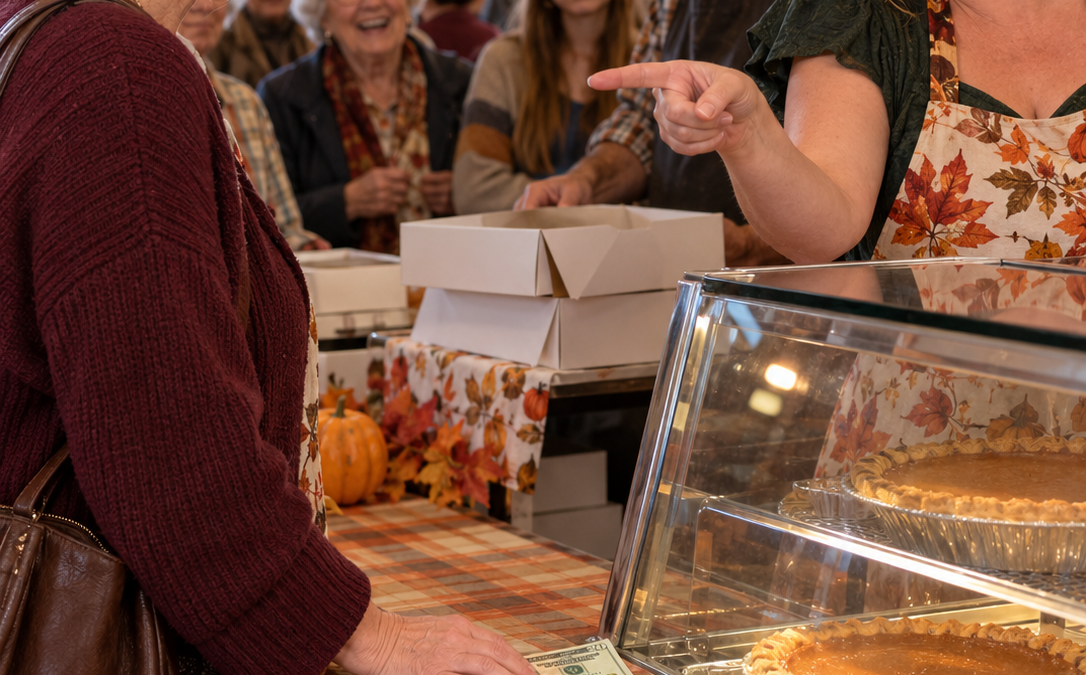
At 10:40 Friday morning, I put two twenties on the counter at booth 14 for a pie marked Kerri’s Own Heirloom Pumpkin and read my mother’s words off the tent card beside it.
“Fold it like you’re tucking in a baby.”
Kerri smiled at the line of customers behind me.
“My words. Thirteen years of trying.”
“No,” I said.
Her smile stayed put, but only because there were about thirty people packed along the aisle at the Bench Thanksgiving Fair, waiting to buy what she had labeled Kerri’s Own Heirloom Pumpkin.
I was fifty-two years old. I had heard those words before I was tall enough to see over my mother’s counter.
“I’m 52. Mom said that my whole life.”
Kerri’s eyes narrowed for half a second.
Then she turned that sweet public smile on the people waiting behind me.
“Shelly does hair, honey. She can’t bake a potato.”
A few people laughed.
Then a few more did, because laughter is easy when you don’t know who’s paying for it.
My brother Curt stood three feet from his wife, folding the flaps on pie boxes. He looked down at the cardboard in his hands and kept working.
That hurt worse than Kerri’s joke.
Kerri was forty-nine, three years younger than me, and she had been married to Curt long enough to know exactly how our mother talked. She also knew I rented a chair at a salon and had never claimed to be much of a cook.
That part was true.
I had ruined biscuits from a tube. I had burned frozen garlic bread. Once, years earlier, I had managed to make mashed potatoes with lumps hard enough to survive a fork.
But this wasn’t about whether I could bake.
It was about my mother’s words sitting on Kerri’s table under Kerri’s name.
Kerri picked up one of the pies from the cold case and slid it toward Curt without looking at me.
“Thirty-eight dollars,” she said.
I tapped the two twenties with one finger.
“Keep the two dollars.”
Curt’s hands stopped.
Only for a second.
Then he put the pie into a white cardboard box and closed the lid.
I watched him tape it.
He still didn’t look at me.
The booth was dressed up like Kerri had been selling pies for twenty years instead of being a dental receptionist who had started baking at home. Brown paper leaves were pinned around the tablecloth. A neat stack of boxes sat behind Curt. Small printed cards stood beside the cold case, all with Kerri’s name across the top.
People leaned around me to point at pies.
“Is that the one from the video?”
“I need two.”
“Do you have any more in back?”
Kerri answered everybody in the same warm voice.
“Yes, honey.”
“Absolutely.”
“We baked all night.”
She sounded like she was hosting Thanksgiving instead of selling dessert from a fair booth.
I picked up my box.
The price sticker on the side said $38.
Under it was a printed ingredient label.
Pumpkin.
Cream.
Eggs.
Brown sugar.
Spices.
I was already turning away when one word stopped me.
Fenugreek.
I looked closer.
Ground fenugreek.
My finger rested under the word.
When I was a teenager, I washed dishes at Dorothy’s Counter on State Street after school. My mother, Dorothy Simmons, had raised Curt and me alone and worked that counter until her feet swelled against her shoes. Her pumpkin pie cooled on racks near the back wall during the holidays.
I remembered cinnamon.
I remembered nutmeg.
I remembered maple.
That whole back room used to smell sweet and warm when she had pies in the oven.
I had never smelled anything there that I knew as fenugreek.
I stayed beside the booth longer than I meant to.
A woman behind me shifted her purse higher on her shoulder.
Kerri noticed where I was looking.
Her smile slipped.
It wasn’t much. Most people probably missed it.
I didn’t.
She reached across the table and turned the next pie box so its label faced away from the aisle.
Then she said, “Sunday’s $1,500 is already mine.”
The fair ran three days, and Best of Fair would be awarded Sunday. I knew there was prize money. I hadn’t known how much until she said it.
Fifteen hundred dollars.
Kerri gave the tent card beside the pies a little tap with one polished fingernail.
“People know good food when they taste it.”
I looked at the card again.
Fold it like you’re tucking in a baby.
My mother had said it while teaching me how to fold laundry, how to cover leftovers, how to wrap sandwiches in wax paper, and, yes, how to handle dough.
She said it because she said things like that.
Dorothy turned chores into instructions a child could remember.
Kerri had just told thirty strangers those were her words.
I should have walked away.
That would have been the easy thing.
I had paid my thirty-eight dollars. Curt had chosen cardboard over eye contact. Kerri had gotten her laugh.
I could have taken the pie home, thrown it in the trash, and gone back to cutting hair on Monday.
Instead I turned the box in my hands and looked at that label again.
Fenugreek.
I knew the word, barely. I couldn’t have told you what it tasted like. I couldn’t have picked it out of a spice rack.
But I knew my mother’s kitchen.
That was the part I trusted.
I knew the dented maple syrup bottle she kept near the stove. I knew how the neck got sticky no matter how many times she wiped it. I knew the smell that clung to my sweatshirt when I came home from the counter after a holiday shift.
Maple.
Not fenugreek.
A man farther back in line asked if the pies needed refrigeration.
Kerri turned away from me and answered him.
I watched Curt slide another box across the table.
“Curt.”
He kept his eyes on the tape dispenser.
“What?”
“You remember Mom saying that line?”
He finally looked up.
His face told me he did.
His mouth didn’t.
“Kerri’s busy, Shell.”
I held his gaze.
“That wasn’t what I asked.”
He glanced toward his wife.
Kerri was taking cash from another customer.
Curt lowered his voice.
“Don’t do this here.”
That answer gave me nothing I could use, but it told me plenty about him.
He wanted peace.
Curt had always wanted peace, even when peace meant somebody else swallowing the bad part.
I tucked the box against my hip.
“Fine.”
Kerri heard me anyway.
She looked over.
“Enjoy the pie, honey.”
I gave her a short nod.
“Sure.”
Picking up where the Facebook post left off
I walked out of the Grange hall with the box held level in both hands.
Outside, the November air hit my face hard enough to wake me up.
Cars filled the lot. People were still coming in carrying tote bags and folded coats. Somebody held the door for me, and I thanked him automatically.
I got into my car and put the pie on the passenger-side floor where it couldn’t slide.
The $38 sticker faced up.
Fenugreek sat in small black print beneath it.
I started the engine but didn’t move.
Why was there a spice on my mother’s pie that I had never smelled at my mother’s counter?
Maybe Kerri really had spent thirteen years changing things.
Maybe she had taken an old family idea and turned it into something else.
Maybe I was angry because I missed Mom, who had been gone since March 2021, and anger was easier than admitting how much I hated seeing her words on somebody else’s table.
All of that was possible.
But one thing kept bothering me.
Kerri hadn’t looked proud when she saw me reading the ingredient label.
She had looked worried.
I drove home through Boise with the heater blowing at my knees.
At every red light, I looked over at the box.
Thirty-eight dollars.
My mother’s line.
That strange ingredient.
By the time I pulled into my driveway, I knew I wasn’t going to taste the pie yet.
I carried it inside and set it on the kitchen counter.
Then I went straight to the garage.
The plastic storage tub was behind an old fan and a stack of flattened moving boxes. I knew exactly which one it was because I had written MOM across the lid in black marker after we cleared out her place in 2021.
I had not opened it since.
I moved the fan.
I pulled the boxes aside.
Then I crouched, grabbed both handles, and dragged Dorothy’s tub out onto the concrete floor.
The $38 tag was still stuck to the pie box in the kitchen.
And one word on that label had followed me all the way home.
Chapter 2: The School Cookbook in the Tub
That night, I opened the tub I had dragged out of the garage and found a spiral-bound cookbook under a stack of old papers.
Bench PTA Cooks.
Four hundred copies had been printed in 1998. I remembered Mom complaining about PTA fundraisers that year, but I didn’t remember the book itself.
I sat at my kitchen table and turned pages until I found page 41.
The heading stopped me.
Dorothy’s Counter Pumpkin Pie.
My mother’s name wasn’t on it, only the counter’s, but the first few lines were enough.
Then I reached the instruction near the bottom.
“Fold it like you’re tucking in a baby.”
I touched the page.
Same words as Kerri’s tent card.
Same order.
I went back to the ingredient list.
It called for 1 1/4 teaspoons ground fenugreek.
I stared at it.
The label on the $38 pie hadn’t just used some spice Kerri happened to like. The same strange ingredient was sitting in a school cookbook from 1998 beside my mother’s exact line.
That still didn’t tell me why.
Maybe Kerri had seen the recipe years ago and changed it.
Maybe Mom had used fenugreek before I paid attention.
But Kerri had stood in front of thirty people Friday morning and called the words hers.
I picked up my phone.
Kerri had posted a video on Facebook on November 14. I found it after scrolling through photos of pies lined across her kitchen counter.
She was holding a spice jar near the camera.
“The fenugreek came to me at 2 a.m. That’s all mine.”
I stopped the video.
Then I saved it.
Saturday morning, I went back to the Bench Thanksgiving Fair.
At 9:05, booth 14 already had customers.
Curt was there again, folding boxes. Kerri was behind the table with her hair pulled back, talking to a woman holding two pies.
She saw me before I reached the front.
Her mouth tightened.
I waited until the woman stepped aside.
“Where’d the recipe come from?”
Kerri’s eyes went to the cookbook under my arm.
Then back to me.
“I never opened that old school book.”
She said it loudly enough for the people nearest us to hear.
Curt looked down at the box he was folding.
I held the book against my side.
“I didn’t ask about a book.”
Kerri’s smile came back.
“You brought one.”
A man waiting behind me shifted closer to the cold case.
Kerri reached for another pie.
I looked around the booth and noticed a sheet of paper taped to the side post.
Fair rules.
I moved over and read them.
Rule 9 covered recipe challenges.
A challenge filed by 6:00 p.m. Saturday would be read on stage before the ribbon was awarded. A failed challenge cost the person filing it a $250 bond. A false entry was void and carried a five-year bar.
I read that part carefully.
Kerri leaned one hand on the table.
“You planning something, honey?”
I kept reading.
The rule referred to the contestant’s signed entry statement.
Kerri tapped the paper with one finger.
“Never printed anywhere. I signed for it.”
I looked at her.
She had just told me she never opened the school cookbook.
Now she was telling me she had signed a statement saying her recipe had never been printed anywhere.
Behind her, Curt tore off a strip of tape.
I said, “Page 41 has the same words.”
Kerri’s face hardened.
“Your mother’s dead, honey. I’m the one baking.”
For a second I couldn’t answer.
Mom had been gone since March 2021. I knew that every morning I woke up. I knew it when I passed State Street. I knew it whenever I thought of calling someone who would never answer again.
Hearing Kerri use it like a winning point made my stomach tighten.
I lifted my phone and photographed Rule 9.
Kerri watched me do it.
“So now you’re taking pictures?”
“Of the rule.”
“You always were dramatic.”
I put the phone away.
Curt still hadn’t looked at me.
I left before Kerri could give the line another joke.
Outside the hall, I sat in my car with Bench PTA Cooks open across my lap.
Page 41 looked ordinary.
That bothered me more than if somebody had scribbled stolen across it in red marker.
Pumpkin.
Cream.
Eggs.
Brown sugar.
Fenugreek.
And Mom’s baby line.
I needed somebody who knew that counter better than I did.
Betty Lowry lived in Nampa, about twenty miles west of Boise. She and Mom had run Dorothy’s Counter together for years. Betty was seventy-eight now, retired, and still answered her phone like she expected bad news to be funny.
She picked up on the fourth ring.
“Shelly, who broke what?”
“Nobody.”
“Then this is already a better call than most.”
“I found an old cookbook.”
“That sounds dangerous.”
“Bench PTA Cooks. Nineteen ninety-eight.”
Betty laughed.
A real laugh, loud enough that I pulled the phone slightly away from my ear.
“Oh, Lord. That thing.”
“You remember it?”
“I remember typing half of it.”
I looked down at page 41.
“I’m on Mom’s pumpkin pie.”
Betty went quiet enough that I checked the screen to make sure the call hadn’t dropped.
I started reading.
I read the heading.
Then the ingredients.
When I got to “1 1/4 teaspoons ground fenugreek,” Betty made a small sound that could have been another laugh.
I kept going.
I read the directions down the page.
Then I reached the line.
“Fold it like you’re tucking in a baby.”
Betty laughed again.
Then she stopped.
Fast.
“Wait.”
I sat straighter.
“What?”
“Read that line again.”
I did.
Nothing came from Betty’s end for a few seconds.
“Betty?”
“Where are you?”
“In my car at the fair.”
“You have the book with you?”
“Yes.”
“What’s wrong?”
Her voice had changed.
No joke in it now.
“Your mother never owned fenugreek in her life. Bring that book to Nampa.”
Chapter 3: The Card in Betty’s Recipe Tin
At noon, Betty Lowry set a dented metal recipe tin on her kitchen table in Nampa and pulled out a card with my mother’s handwriting on it.
“Before you say anything,” Betty said, “compare them.”
I put Bench PTA Cooks beside the card and opened it to page 41.
Dorothy’s Counter Pumpkin Pie.
Betty slid the card toward me.
Mom’s handwriting leaned slightly to the right, the way it always had on grocery lists and birthday cards. I knew it before I read a word.
I started at the top and checked the ingredients line by line.
Pumpkin matched.
Cream matched.
Eggs matched.
Brown sugar matched.
The amounts matched.
Then I reached the line that had bothered me since Friday.
The cookbook said 1 1/4 teaspoons ground fenugreek.
Mom’s card said maple syrup.
I looked at Betty.
“Maple.”
“Yep.”
“How much?”
Betty pointed.
I checked the amount, then kept going.
The rest matched closely enough that I stopped wondering whether page 41 belonged to some other pie.
It was Mom’s recipe.
Except for that one ingredient.
I turned the card over.
There were three lines on the back.
Oct. 1998. PTA gets the fenugreek. If you ever see it on a pie, they got it from the book.
I looked up.
“Mom did this on purpose?”
Betty sat across from me.
“She sure did.”
I put the card down carefully.
“Why?”
“That pie helped pay your rent.”
I knew Dorothy’s Counter had kept us going. I knew Mom had stretched money until Friday and stretched leftovers until they became dinner.
I had never known one pie mattered that much.
Betty tapped the cookbook.
“The PTA kept after her for that recipe. They wanted local favorites for the book. Dorothy kept saying no.”
“But her name ended up in it anyway.”
“Counter’s name. She gave them enough to shut them up.”
Betty gave a short laugh.
“Your mother wasn’t giving away the thing that helped feed her kids.”
I looked back at the note.
“So she changed one ingredient.”
“Only one.”
“Fenugreek.”
“Something she didn’t even keep in that kitchen.”
That explained why Betty had laughed on the phone.
It also explained the smell I remembered.
Maple.
Betty leaned back in her chair.
“I typed the page myself.”
“You typed the wrong ingredient?”
“She told me exactly what to type.”
“And nobody caught it?”
“Why would they? Looked like a spice. Sounded fancy enough.”
I ran my finger along the edge of the card.
Mom had left a trap in a school cookbook twenty-seven years earlier.
Not for Kerri.
Not for anyone in particular.
Just for the day somebody claimed the printed version as the real one.
At 2:30 that afternoon, I was back at the salon with my first client under the dryer when my phone started buzzing.
Then it buzzed again.
And again.
I checked it between appointments.
Kerri had made a public post.
She called me a “grieving, jealous hairdresser” who was harassing her booth because I couldn’t stand seeing somebody else succeed with a family recipe.
She didn’t mention page 41.
She didn’t mention fenugreek.
She didn’t mention telling customers she had never opened the book.
Within an hour, three clients canceled.
Then two more.
By the time I finished trimming a regular’s bangs, nine appointments were gone.
I sat at my station and added up what I had lost.
$1,140.
Holiday-week money.
Chair rent didn’t care why a client canceled. Neither did my electric bill.
I stared at the empty spaces on my appointment screen.
Kerri had gotten what she wanted from the post.
She had made the pie look like a family disagreement and me look unstable for bringing it up.
The salon door opened.
Isabella came in.
My niece was seventeen, quiet even on good days, and usually let her mother make enough noise for both of them.
“I need a trim,” she said.
I looked at my empty schedule.
“You’re in luck.”
She sat in my chair and kept her hands folded under the cape while I combed out the ends of her hair.
Neither of us mentioned Kerri.
I took off less than an inch.
When I finished, Isabella didn’t get up.
Instead, she pulled out her phone.
“Aunt Shelly.”
“What?”
She looked toward the front desk.
Then she opened a photo.
It showed another copy of Bench PTA Cooks lying open on a kitchen counter.
Page 41.
I leaned closer.
In the margin beside the recipe, somebody had written in pencil:
x12 for cold case.
My hand stopped on the back of Isabella’s chair.
“Whose book?”
“Our kitchen copy.”
“Who wrote that?”
Isabella swallowed.
“Mom.”
I looked at her in the mirror.
“You saw her?”
She shook her head.
“I know her writing.”
That wasn’t the same as seeing it happen, and I knew it.
But the photo mattered.
Kerri had told me in front of customers, “I never opened that old school book.”
Her kitchen copy was open to page 41 with a production note written beside it.
Twelve times the recipe.
For the cold case.
Isabella locked her phone.
“Don’t say it was me.”
“I won’t.”
“Promise?”
“Yes.”
She finally stood.
I didn’t ask her to send me the picture.
I didn’t ask her to confront her mother.
She had already done more than a seventeen-year-old should have needed to do.
After she left, I sat alone at my station.
On one side of the counter was my appointment screen with nine cancellations.
On the other was the photograph I had taken of Rule 9.
A failed challenge cost $250.
Kerri was my brother’s wife.
Thursday was Thanksgiving.
I could still stop.
I could tell Curt privately what Betty had shown me. I could tell Kerri to take Mom’s words off the booth and leave the fair alone.
That would be cheaper.
It would also leave Kerri’s signed claim untouched.
Never printed anywhere.
And Sunday, she would stand beside a $1,500 prize with my mother’s trap baked into her pie.
At 4:46, I opened my checkbook.
My pen hovered over the amount.
Two hundred fifty dollars was a lot to spend after losing $1,140 in appointments.
I thought about Mom’s note.
If you ever see it on a pie, they got it from the book.
I wrote the check.
I put the book and Rule 9 photo in my bag, locked the salon, and drove to file the $250 challenge before six.
Chapter 4: The Woman Who Wanted a Stage
At 5:20 Saturday afternoon, Norm Haskell took my $250 check across the fair office counter and clipped it to the challenge form.
He was seventy, a retired county clerk, and he handled every sheet of paper as if somebody might question it ten years later.
“You understand the bond is lost if the challenge fails?”
“Yes.”
Norm checked the clock, wrote the time on the form, and signed underneath it.
Filed before six.
Kerri stood near the office door with her arms folded. Somebody from the committee had called her over after I filed. She had arrived smiling.
Norm pulled out a printed copy of the fair rules.
“I’m going to read Rule 9 so nobody misunderstands what happens next.”
He read slowly.
A recipe challenge filed before 6:00 p.m. Saturday would be heard before the Best of Fair ribbon was awarded Sunday. The contestant’s sealed entry statement would be opened during the hearing. If the challenge failed, the challenger lost the $250 bond.
Then Norm reached the last part.
A false entry was void.
The contestant would be barred from entering for five years.
Kerri gave me a sideways look.
Norm lowered the paper.
“There is another option. If both parties agree, I can conduct the hearing behind closed doors with committee members present.”
I would have agreed.
This wasn’t why I had filed the challenge. I didn’t need an audience.
Kerri laughed.
“Do it on the stage. I want everybody to watch.”
Norm looked at her.
“You’re sure?”
“Absolutely.”
“The award program usually draws around two hundred people.”
“Good.”
She pulled out her phone.
I watched her type.
Norm gathered the paperwork.
“Kerri, understand that once you decline the private hearing, the challenge will be read before the award.”
“I understand.”
Her phone made a small sound.
She smiled at the screen.
“My grocery buyer is coming tomorrow. Three hundred pies.”
I looked at her.
She had never mentioned a grocery order.
Kerri kept typing.
“At twenty-two dollars each,” she said, mostly to herself.
Three hundred pies.
$6,600.
She sent another message.
“Sit in front,” she murmured as she typed.
Then she slipped her phone into her purse and looked at me.
“Anything else?”
I thought of Mom’s handwritten card sitting safely with Betty.
Kerri knew about my copy of Bench PTA Cooks.
She knew I had page 41.
She didn’t know what Betty had pulled from that recipe tin in Nampa.
“No.”
At 8:00 that night, I was back at the salon.
The place was closed. I had left the overhead lights off except above my chair, and Betty was supposed to call after she ate dinner.
Instead, somebody knocked hard on the glass.
Curt.
I unlocked the door.
He came inside but didn’t take off his coat.
“Mom’s gone. Drop it or don’t come Thursday.”
I stared at him.
Thanksgiving was five days away.
For years, whatever else happened in our family, Curt and I ended up at the same table on Thanksgiving. Kerri cooked. Isabella usually disappeared upstairs as soon as dessert was over. I brought something from a bakery because everybody knew better than to ask me to bake.
This year, apparently, I had been reduced to a condition.
Drop it.
Or lose the chair.
“You came here to tell me that?”
“I came here because you’re making this worse.”
“I filed a fair challenge.”
“Against my wife.”
“About Mom’s recipe.”
Curt rubbed one palm over the other.
“Kerri says you’re trying to ruin her business.”
“She started baking this year.”
“You know what I mean.”
I looked at his hands.
He had spent Friday and Saturday boxing those pies without once telling me where the recipe came from.
“Where’s your copy of the book?”
His hands stopped.
“What?”
“Bench PTA Cooks. Where’s your copy?”
Curt looked down.
Same as Friday.
Same as when Kerri laughed at me in that line.
I waited.
He could have said they didn’t own one.
He could have said he had never seen it.
He could have asked why I cared.
Instead, he looked at his hands.
“Shelly.”
“That’s not an answer.”
He turned toward the door.
I didn’t stop him.
Before he left, he said, “Think about Thursday.”
“I already am.”
Curt walked out.
A minute later, my phone rang.
Betty.
I locked the door again and put her on speaker.
“All right,” she said. “How are you doing this tomorrow?”
I spread everything I had across the salon counter.
The $38 pie label.
My copy of Bench PTA Cooks.
A note reminding me that Betty would bring Mom’s handwritten card herself.
“Label first,” I said.
“Good.”
“Then page 41.”
“Good.”
“Then your card.”
“Better.”
That was the order.
Kerri’s own label showed fenugreek.
The 1998 page showed the same ingredient and Mom’s exact baby line.
The card showed maple syrup and explained why the printed version was wrong.
Betty said, “What about that picture your niece showed you?”
“No.”
“You sure?”
“I promised Isabella.”
I had not asked her to send me the photo.
I had not photographed her screen.
I had not called her after she left.
And I wasn’t going to ask a seventeen-year-old to stand in a hall full of people and accuse her own mother.
“No photo,” I said. “No asking Isabella. No second witness.”
Betty was quiet.
“That leaves you thin.”
“I know.”
“You’ve got me.”
“You’ve got the card.”
“That too.”
I smiled despite myself.
What Isabella chose to do after leaving my salon was hers. I wouldn’t learn about it until Sunday.
For now, I had a label, a printed page, Mom’s card, and Kerri’s own video.
And I had no idea whether anyone else in that hall would stand beside me once Kerri started talking.
At 11:02 p.m., my phone lit up with a text from her.
Bring a tissue. After tomorrow nobody in this town lets you near their hair.
Chapter 5: The Label Beside Page 41
At 3:00 Sunday afternoon, Kerri stood beside an easel holding the blue ribbon and the $1,500 check like they already belonged to her.
About two hundred people filled the Grange hall.
Her grocery buyer sat near the front.
I stood on the other side of the stage beside the $38 pie, holding Bench PTA Cooks open to page 41.
Norm Haskell stepped to the microphone.
“This is a Rule 9 challenge filed before the Saturday deadline.”
The room settled.
Kerri smiled at me.
She still looked confident.
A dusty school cookbook wasn’t enough, and she knew it.
Norm nodded to me.
I picked up the pie box.
“I’m going to read the label first.”
I didn’t call Kerri a thief.
I didn’t say she had stolen from my dead mother.
I just read.
When I reached the ingredient, I slowed down.
“Ground fenugreek.”
I set the box beside the pie.
Then I held up the cookbook.
“This is Bench PTA Cooks, printed in 1998. Page 41 is Dorothy’s Counter Pumpkin Pie.”
Kerri shifted her weight.
I read the ingredient list until I reached the same line.
“One and one-quarter teaspoons ground fenugreek.”
A few people turned toward Kerri.
I continued down the page.
Then I read the instruction that had been on her tent card.
“Fold it like you’re tucking in a baby.”
Kerri’s smile disappeared.
I put the book down and took out my phone.
“This video was posted November 14.”
I played it.
Kerri’s own voice came through the speaker.
“The fenugreek came to me at 2 a.m. That’s all mine.”
Nobody laughed yet.
Kerri froze for half a second, then lifted her chin.
“Fenugreek’s an old trick. Your mother and I just had the same idea.”
I looked at Norm.
He gave one small nod.
Betty stood from her chair.
At seventy-eight, she took the steps slowly, one hand on the railing and the old recipe tin tucked under her other arm.
Kerri stared at it.
That was when I knew she hadn’t expected Betty.
Betty reached the stage and set the tin on the table.
“My name is Betty Lowry. I worked with Dorothy Simmons at Dorothy’s Counter.”
She opened the tin and took out Mom’s handwritten card.
Norm inspected it before handing it back.
Betty read the front.
The ingredients matched page 41 until she reached the one that mattered.
“Maple syrup.”
A murmur moved through the hall.
Betty finished the card.
Then she gave it to me.
I turned it over.
My throat tightened, but my voice stayed steady.
“Oct. 1998. PTA gets the fenugreek. If you ever see it on a pie, they got it from the book.”
Someone in the third row laughed.
“Two a.m.,” a man said quietly.
That got another laugh.
Kerri’s face went red.
Norm raised one hand, and the room settled again.
“Ms. Simmons,” he said to Kerri, “the challenge also concerns your signed entry statement.”
He walked to the easel.
A sealed envelope had been clipped behind the award paperwork.
Norm held it up.
“This entry form was signed November 3.”
Kerri looked toward the front row.
Her grocery buyer was no longer smiling.
Norm opened the envelope.
He unfolded the form and read the relevant line slowly.
“My own original recipe, never printed anywhere.”
The room went still.
Norm placed the form beside my cookbook.
Then he read page 41 word for word where the recipe matched Kerri’s label and the instruction on her booth card.
Kerri stepped toward him.
“Every recipe’s borrowed. She was my family too. I improved it.”
Norm looked at the signed form.
Then at her.
“That isn’t what this statement says.”
Kerri opened her mouth.
Before she could answer, somebody moved near the side aisle.
Curt.
My brother walked toward the stage carrying another spiral-bound copy of Bench PTA Cooks.
For a second, I forgot about the audience.
I had asked him Saturday night where his copy was.
He had looked at his hands and left.
Now he climbed the steps.
Kerri stared at him.
“Curt.”
He didn’t answer her.
He put the cookbook on the table and opened it to page 41.
There was pencil writing in the margin.
x12 for cold case.
My chest tightened.
It was the same thing Isabella had shown me at the salon.
I hadn’t asked for that photograph.
I hadn’t used it.
I hadn’t even known this book would come through the door.
Curt looked at the page for a long moment.
Then he said, “Isabella left this on my truck seat.”
Kerri stepped toward him.
“Don’t.”
Curt’s eyes dropped to the pencil.
He read it aloud.
“X twelve for cold case.”
Then he looked at his wife.
“I watched you write that, Ker.”
Kerri went completely still.
Curt’s hands were shaking.
I knew what that sentence cost him.
He had spent days looking down, boxing pies, trying to keep peace inside his own house.
Now two hundred people had heard him choose the truth instead.
Norm took the kitchen copy and compared it with page 41 in mine.
Then he looked at Kerri’s signed statement.
Nobody needed a speech after that.
Norm walked to the easel.
He lifted the $1,500 check away.
Then he removed the blue ribbon.
A committee worker came to booth 14’s display beside the stage and took down the Kerri’s Own sign.
Kerri watched all three disappear.
I looked at her.
“Mom printed one wrong thing. You copied it and signed it.”
Kerri didn’t answer.
Norm returned to the microphone.
“Under Rule 9, the entry is void.”
The grocery buyer stood and walked toward the aisle.
People near the back were already whispering about the pies they had bought for $38.
Kerri watched them instead of me.
That was when the question changed.
The fair ruling was finished.
But what would the lie cost once this hall emptied?
Norm folded the challenge paperwork, reached into the file beside him, and held out my check.
“Challenge sustained.”
I took my $250 back.
Chapter 6: The Order That Never Shipped
At 9:00 Monday morning, the grocery buyer called Kerri and canceled all three hundred pies.
I knew because Kerri was standing in the fair office when he did it.
She had put him on speaker for about two seconds before realizing that was a mistake.
“We’re not taking delivery,” he said.
Her face tightened.
“The order is confirmed.”
“Not anymore.”
Three hundred pies at twenty-two dollars each.
$6,600 gone before most people had finished breakfast.
Kerri turned off the speaker and walked into the hallway to finish the call.
Norm Haskell was behind the office counter with two committee members. He had already prepared the written ruling from Sunday.
When Kerri came back, Norm read it to her.
Her entry had been voided under Rule 9.
She was barred from the Bench Thanksgiving Fair competition for five years.
The runner-up would receive the $1,500 prize.
Kerri stared at the paper.
“So that’s it?”
“That’s the rule,” Norm said.
She looked at me as if I had written it.
I hadn’t.
I was there because the committee wanted a correction posted for the people who had bought pies from booth 14.
Norm slid a draft notice across the counter.
I read it.
It said buyers of the pumpkin pie sold as Kerri’s Own Heirloom Pumpkin could return to the fair office for a refund.
I picked up a pen.
Under the description, I added four words.
Dorothy Simmons’s pie.
Norm read what I had written.
Then he nodded.
I signed the notice.
Kerri watched my pen move.
“You really need her name on everything now?”
“Yes.”
That afternoon, the buyers started coming.
Sixty-one of them.
Kerri sat at a folding table inside the fair office with cash in front of her.
Every time someone handed over a receipt or showed the purchase record, she counted out thirty-eight dollars.
Two twenties came off the stack.
Then two dollars went back.
Thirty-eight.
Again.
Thirty-eight.
Again.
Some people said nothing.
A few asked whether the pies were safe to eat.
Norm explained that the issue was the false entry and the ownership claim, not a finding that the pies were unsafe.
One woman looked at the correction notice taped beside the door.
“Dorothy Simmons,” she read.
“That was my mother,” I said.
She nodded once and left with her refund.
Kerri heard me.
By the time the sixty-first buyer walked out, she had refunded $2,318 herself.
She gathered the remaining bills without looking at me.
Her public post disappeared sometime that afternoon.
The one calling me a grieving, jealous hairdresser was simply gone.
My phone started ringing before I had even left the fair office.
Seven of the nine clients who had canceled asked to get back on my schedule.
I found space for them where I could.
Two never called.
I didn’t chase them.
Late that afternoon, I was sweeping hair from around my chair when the salon door opened.
Kerri walked in.
No pie boxes.
No fair smile.
No “honey.”
She stopped beside my station.
“You could have come to me first.”
I rested the broom against the counter.
I thought about Friday morning.
Her tent card.
Mom’s words.
Thirty strangers laughing.
I thought about Saturday, when she told me she had never opened the book and then pointed to the rule herself.
“You could have asked her.”
Kerri’s face hardened.
“She was my family too.”
I didn’t answer.
She had already used that line on the stage.
Kerri looked at the empty chair beside mine.
“You think this fixed anything?”
“No.”
That seemed to bother her more than an argument would have.
She picked up her purse strap.
“Curt’s barely speaking to me.”
“That’s between you and Curt.”
“You put him on that stage.”
“He walked up.”
Her mouth opened.
Then closed.
She left without another word.
I watched the door settle behind her.
There was no quiet way back from Sunday now.
Maybe there never had been.
Near six, I was locking the salon when Curt’s truck went past the front windows.
Two duffel bags sat on the passenger seat.
I knew where he was going before he called.
“The shop’s got a cot,” he said.
His roofing shop wasn’t a home. It was a place with tools, paperwork, and enough room to sleep if a man didn’t want to go back to his own kitchen.
“You okay?”
“No.”
I waited.
Curt looked through the windshield instead of at me.
“I should’ve said something Friday.”
“Yes.”
He rubbed both hands over his jeans.
“I kept thinking it would blow over.”
“It didn’t.”
“No.”
He picked up one duffel and carried it inside the roofing shop.
Then he came back for the other.
I didn’t tell him what to do about Kerri.
He didn’t ask.
I drove back to the salon because Betty had told me to meet her there.
She arrived ten minutes later carrying the old metal recipe tin.
I let her in.
She set it on my counter beside the combs and spray bottles.
I looked at it.
“What are you doing?”
“Retiring from custody.”
“Betty.”
“You fought for the pie.”
“That doesn’t mean I can make it.”
She gave me the same look she had probably given Mom a thousand times across that lunch counter.
I had spent the whole weekend defending a recipe I had never successfully baked.
Kerri’s joke came back to me.
Shelly does hair, honey. She can’t bake a potato.
The worst part was that everybody in my family knew there was some truth hiding inside the insult.
I opened the tin.
Mom’s card was on top.
Maple syrup.
No fenugreek.
I could protect her name in a fair office.
I could read a rule on a stage.
But could the woman who couldn’t bake a potato make Dorothy Simmons’s real pie?
Betty pushed the tin across the salon counter.
“It’s yours. Now learn.”
Chapter 7: The First Pie With Maple
By Wednesday night, I owned my mother’s real recipe and still had no proof I could bake it.
Thanksgiving was the next day.
Betty had gone home to Nampa after making me buy what she called “ingredients even you can’t argue with.” I stood alone in my kitchen with Dorothy’s recipe card propped against the sugar bowl and my first pumpkin pie cooling on the counter.
A crack ran straight across the middle.
I called Betty.
“It split.”
“So?”
“It looks like somebody dropped it.”
“Did you overbake it?”
“I followed the time.”
“Your oven doesn’t know Dorothy.”
That sounded like Betty.
I cut into the pie after it cooled enough to stop steaming.
The center had gone heavy.
“Bad?” Betty asked.
“Bad.”
“Make another.”
“It’s ten-thirty.”
“Thanksgiving doesn’t move because you’re tired.”
I hung up and started again.
The second pie looked better when I pulled it from the oven.
For about five minutes.
Then the center sank.
I stared through the oven-door glass as if glaring might bring it back up.
It didn’t.
I called Betty again.
“You still awake?”
“I’m seventy-eight, Shelly. We don’t sleep. We wait for people to call us about pie.”
“The second one sank.”
“What did you do with the filling?”
“Mixed it.”
“How?”
“With a spoon.”
A pause.
“What does the card say?”
I looked at Mom’s handwriting.
“Fold it like you’re tucking in a baby.”
“And did you?”
“I folded it.”
“Like laundry?”
“Probably.”
Betty laughed.
“Gentle. From the bottom. Bring it over itself. Stop beating the poor thing to death.”
I looked at the two failed pies on my counter.
Kerri’s line from the fair came back to me.
She can’t bake a potato.
I had spent Saturday risking $250 over Mom’s recipe.
Sunday, I had stood in front of two hundred people defending it.
Monday, I had watched buyers collect $2,318 in refunds.
None of that made me good with an oven.
I washed the bowl.
Then I started a third pie.
This time, when I reached the filling, I slowed down.
I slid the spatula underneath, lifted, and brought the mixture over itself.
Once.
Again.
I could hear Mom saying it.
Fold it like you’re tucking in a baby.
I stopped when it looked smooth.
The third pie went into the oven after midnight.
I sat at the kitchen table with my hands around a mug of coffee and watched the clock.
When I finally pulled the pie out, the center barely moved.
No crack opened.
Nothing sank.
I left it alone.
Thursday afternoon, five places were set around my small table.
Betty sat closest to the kitchen.
Curt came in wearing the same tired expression he had worn since carrying those duffel bags into his roofing shop.
Isabella came with him.
Kerri did not.
Nobody said her name when we sat down.
I had made a simple Thanksgiving meal and put the pie on the counter where all three of them could see it.
Betty inspected it from her chair.
“You didn’t kill that one.”
“Thank you.”
“That was praise.”
My phone buzzed beside my plate.
I looked down.
Kerri.
Can you send me the real recipe? I need it to fix this.
I stared at the message.
Last Friday, she had stood at booth 14 calling Mom’s words her own.
Monday, she had told me I could have come to her first.
Now she wanted the one thing she had never asked Dorothy for.
The real recipe.
I turned the phone face down.
Betty saw me do it.
She didn’t ask.
Curt did.
“Kerri?”
“Yes.”
“What does she want?”
“The recipe.”
He rubbed his thumb across the edge of his fork.
I waited for him to defend her.
He didn’t.
After dinner, I brought the pie to the table.
Curt looked at it.
“If you sold these, what would you charge?”
I got up again.
On the kitchen counter sat Bench PTA Cooks.
The $38 tag from the fair was still tucked beside it.
I opened to page 41.
Dorothy’s Counter Pumpkin Pie.
I clipped the tag into the page.
Then I picked up a pencil.
The printed ingredient still said fenugreek.
I drew one clean line through it and wrote one word above it.
Maple.
Curt watched me.
“So what would you charge?”
“Nothing. Sit down.”
He did.
Isabella took the knife.
“Can I?”
“Please.”
She cut the first slice.
The crust held.
The filling stayed smooth.
She slid the piece onto Curt’s plate.
He took a bite.
Then another.
He didn’t say anything.
I didn’t need him to.
Betty reached for the knife.
“Move over, child. Some of us have been waiting since Wednesday.”
Isabella smiled and let her cut the next piece.
I took one for myself.
The maple reached me before I even lifted the fork.
That was the smell I remembered from Dorothy’s Counter.
The same smell that had sent me back to the garage tub when Kerri’s label said fenugreek.
The same pie that had cost thirty-eight dollars under somebody else’s name was sitting on my table for free.
My phone stayed face down.
Kerri’s place stayed empty.
Curt ate quietly.
Isabella asked Betty whether Grandma Dorothy really used to make dozens of pies before Thanksgiving.
Betty started telling her about the old counter, the sticky syrup bottles, and the way Dorothy could tell somebody had opened the oven from across the room.
I listened.
Then I closed Bench PTA Cooks on the $38 tag and sat down in a kitchen that smelled of maple.
THE END







