My Brother Sold Our 84-Year-Old Dad’s $18,000 Pickup at the Family Reunion—Then the Buyer Drove It Into the Veterans Day Parade
Complete story · 10 chapters · about 51 minutes · ending included
Chapter 1 · Chapter 2 · Chapter 3 · Chapter 4 · Chapter 5 · Chapter 6 · Chapter 7 · Chapter 8 · Chapter 9 · Chapter 10
Chapter 1: The Flatbed at the Family Reunion
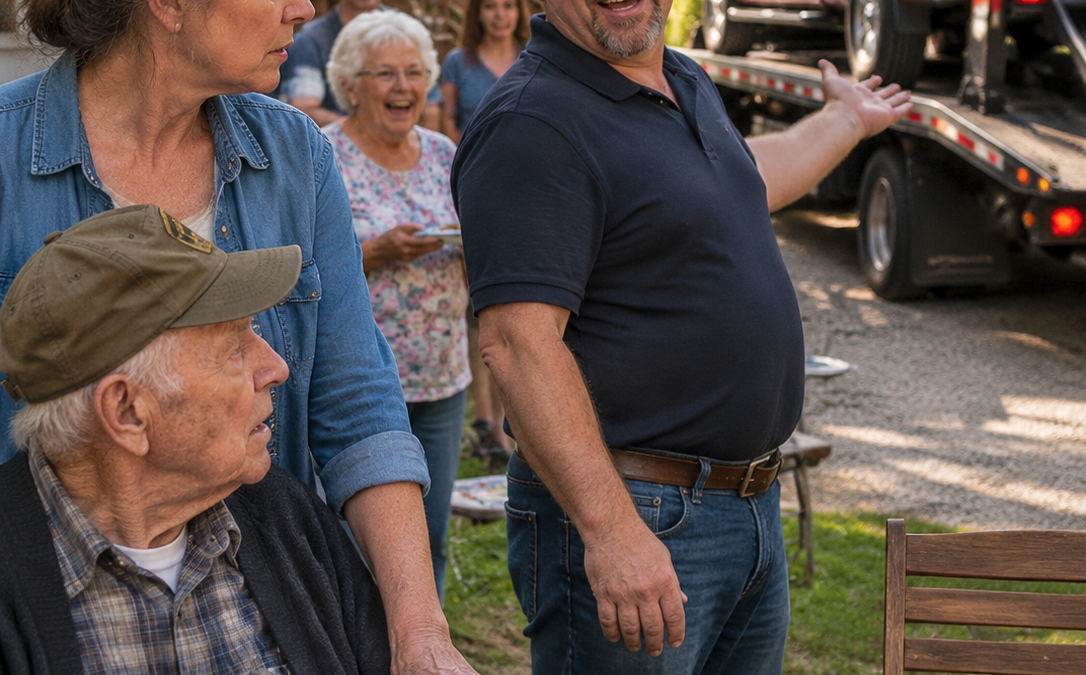
At 2:40 p.m., the flatbed backed up Carl Boggs’s driveway, and my brother Tim said, “Dad won’t know the difference.”
Thirty-five relatives stood around the yard with paper plates and plastic cups.
My aunt Beverly laughed.
“I hold his power of attorney,” I said.
Tim turned toward me, still smiling.
“Dad signed it over to me in June.”
Tim looked at Dad.
“He’s a body in a chair, Jennifer. A body doesn’t drive.”
I was fifty-six, Carl’s daughter, and the only person named in the durable power of attorney he had signed with a lawyer in 2022.
The document named me alone.
Now Tim stood between the picnic tables and the red 2016 pickup, talking as if the matter had already been settled.
Dad sat in his usual chair near the back steps.
At eighty-four, he could follow a conversation one minute and lose the thread the next.
His memory came in patches.
He still knew the sound of his truck starting, the way the steering wheel pulled, and the place where he had parked it every night.
He looked from Tim to the flatbed.
“Whose truck is that?” he asked.
Nobody answered.
I set my plate down and went to Dad.
A piece of chicken had slipped toward the edge of his plate.
I cut it into smaller pieces and moved the fork closer to his hand.
“Here you go, Dad.”
He looked at the food, then past me toward the driveway.
“That’s my truck,” he said.
“I know.”
Tim raised his voice enough for the relatives nearest the driveway to hear.
“We talked about this. Dad signed it over to me in June. It’s handled.”
He had a way of saying handled that made people feel foolish for asking another question.
He owned Boggs Floors and sponsored the Veterans Day parade.
His jokes were loud, and at family gatherings, people usually laughed before they asked what he meant.
I had spent years keeping Dad’s days in order.
I knew when he needed help with meals, when he needed a ride, and when he needed someone to sit with him while he searched for a word.
I worked as a nursing-home aide, then came home and helped him with the things he could no longer manage.
At family gatherings, people looked to Tim to explain things.
At home, I was the one who kept Dad’s days in order.
I wasn’t asking anyone to choose between us.
I wanted to see the paper.
“Then show me the signed title,” I said.
Tim gave a short laugh.
“You don’t need to make a scene, Jennifer.”
“I asked for the paper.”
Beverly lowered her cup.
She was Dad’s sister, seventy-nine, and usually happy to let Tim carry the conversation.
Her laugh had already given him what he wanted.
She looked down at the grass.
The flatbed driver stepped out of the cab.
He wore work gloves and carried a chain over one shoulder.
He glanced at Tim, then at the pickup.
“Ready?” he called.
Tim nodded.
I could have walked into the driveway and stood in front of the truck.
I thought about it.
Dad would have to sit there while his children fought over the truck he had kept for years.
I had said what my authority was.
I had asked for the document.
Tim had answered with a claim, not proof.
I chose the desk.
The driver lowered the flatbed and guided the pickup onto it.
The red truck rolled up the metal ramp with its familiar uneven rattle.
Dad leaned forward, his hands gripping the arms of his chair.
“Where’s he taking it?” he asked.
I stood beside him.
“I’m going to find out.”
The driver looped the chain through the wheel area and tightened it.
Tim stayed near the driveway, giving directions with one hand.
No one asked him to show the title.
No one asked Dad whether he wanted the truck to go.
The driver looked toward me while he checked the last chain.
“Sorry for your family’s loss, ma’am,” he said.
Then he climbed into the cab and pulled out.
The truck disappeared past the end of the drive.
A few relatives began gathering their plates.
Someone asked Beverly if she wanted more potato salad.
Tim went back toward the picnic tables as if the afternoon had returned to its proper order.
Dad kept looking at the empty space.
“Did I lend it to somebody?” he asked.
“No, Dad.”
“Then why’d they take it?”
“I’m checking.”
He nodded, accepting the answer because he had no better one.
I brought his plate inside and covered the food he had not finished.
Picking up where the Facebook post left off
When I came back, he was still in his chair, looking toward the driveway.
Tim was laughing with relatives beside the garage.
I walked past them without speaking.
I needed the title before I asked him another question.
If he was telling the truth, the paper would settle it.
Carl kept his important papers in a rolltop desk in the den.
He had used the desk for decades, even after the drawers became difficult for him to open.
I knew where he kept the insurance papers, the registration, and the folder for the truck title.
I had put things away there myself.
The den was cooler than the yard.
The family noise came through the open windows, softened by the screen.
I pulled down the rolltop and opened the middle drawer.
The folder was where it belonged.
I lifted it out and set it on the desk.
It was thin, but that did not worry me at first.
Dad had kept the title in a plastic sleeve inside.
I opened the folder and checked the pockets.
The sleeve was empty.
I checked the back pocket, then the papers beneath it.
There were old registration slips and a folded service receipt, but no title.
I searched the drawer, moving the envelopes aside one at a time.
I checked the shallow tray where Dad kept spare keys and rubber bands.
No title.
A shop pen lay near the back of the drawer.
The name Boggs Floors was printed along its side.
It was one of the pens Tim used at the shop.
This one had been placed beside the folder, not buried under the papers.
I picked it up.
The family was still outside.
I could hear Tim’s laugh through the window, followed by another burst from the cousins.
Dad called my name once from the den doorway, then asked if I had seen his truck.
I put the pen down and looked at the empty folder.
Tim had said Dad signed it over in June.
If that was true, there should have been a paper.
If there was a paper, why wasn’t it in the place Dad kept the title?
I closed the folder, but kept it on the desk.
If Dad signed in June, where was the paper?
Chapter 2: The Man Who Called It Handled
The title folder stayed open on Carl’s desk after the reunion.
I kept looking at the empty plastic sleeve, expecting some explanation to appear if I checked it again.
I was stacking the leftover containers when Tim walked into the kitchen.
“Who bought Dad’s truck?” I asked.
He opened the refrigerator and reached for a bottle of water.
“Every dime goes to Dad’s care.”
“That isn’t what I asked.”
“It’s what you need to know.”
Tim shut the refrigerator.
“You always make things harder than they are, Jennifer. It’s handled.”
He walked toward the counter, where I had left the folder.
I moved it out of his reach.
“Show me the paper Dad signed in June.”
Tim gave me the same impatient look he used when a customer questioned an invoice.
“He’s a body in a chair, Jennifer. A body doesn’t drive.”
“He asked where his truck went.”
“He’ll forget.”
I looked through the doorway.
Dad was still outside, sitting beside the back steps with his plate on his lap.
“Not today,” I said.
Tim twisted the cap off his water.
“You’re making this about the wrong thing. The truck was sitting there. Dad doesn’t use it. I got money for it, and the money is going toward his care.”
“Then tell me who has it.”
“I’m not giving you a name so you can start calling people.”
He left the kitchen before I could ask anything else.
On Tuesday, September 2, I went to the DMV.
I brought my identification, the power of attorney, and the registration papers I could find.
I explained that Dad’s pickup had been taken and sold, but the title was still supposed to be in his name.
The clerk checked the record.
“Carl Boggs is still listed as the owner,” she said.
“Has a transfer been filed?”
“Nothing has been accepted.”
I asked what I needed to do to stop the truck from being transferred without Dad’s permission.
She explained what the office could verify and what it could not decide from my account alone.
The record still showed Carl.
That was the only firm answer she could give me.
I called the sheriff’s office from the parking lot.
A deputy listened while I explained the flatbed, Tim’s claim about June, and the missing title.
“Do you have a copy of the signed title?” the deputy asked.
“No. Tim says Dad signed it over, but he won’t show me anything.”
“Do you have a bill of sale?”
“No.”
“Then, without paperwork showing what happened, this sounds like a civil matter.”
“He took my father’s truck.”
“I understand what you’re saying. I’m telling you what we can establish right now.”
I wrote down the deputy’s name and the time of the call.
I had learned at work that a conversation could disappear from memory, but a note stayed where I put it.
The next few days were spent asking Tim for the buyer’s name and getting the same answer.
“Handled.”
He stopped answering some of my calls.
When he did answer, he said the money was for Dad.
I kept the empty folder on the desk.
I checked the mail each afternoon, hoping for a title notice or some official letter that would tell me where the truck had gone.
Nothing came.
Dad asked about it every morning.
At first, he asked whether I had seen the pickup.
Then he began going to the front window after breakfast, looking down the driveway.
“Maybe he’s bringing it back,” he said one morning.
I stood beside him and watched the road.
“No one said they were bringing it back, Dad.”
“Tim took it?”
“Yes.”
“Why?”
“I’m trying to find out.”
He pressed his palm against the window glass.
I had no answer that would help him.
By the second week, I was taking extra shifts at the nursing home.
I came home tired, helped Dad settle in, and went through the bills after he went to bed.
His day-care balance had reached $4,300.
The invoices were stacked beside the rolltop desk.
I moved them into a neat pile, then added the amounts again.
The total did not change.
I was already behind.
The extra shifts kept the next bills from piling up as quickly, but they did not erase what was owed.
I could not cut Dad’s care to make the numbers look better.
He needed the routine, the people who knew how to help him through a difficult morning, and a safe place to spend the hours I was at work.
So I kept taking the shifts.
Six weeks passed that way.
My feet hurt when I got home.
I sometimes sat in the car for a minute before going inside, gathering enough energy to walk through the door and start the evening all over again.
Dad still went to the window.
“Is my truck coming today?” he asked one morning.
I set his coffee on the table.
“I don’t know, Dad.”
He looked at the driveway for a while.
“I liked that truck.”
“I know you did.”
He nodded and wrapped both hands around his cup.
I kept asking Tim for the buyer’s name.
He kept telling me the money was going to Dad’s care.
He never gave me a name, an address, or a paper.
Then, on Tuesday, October 14, my phone rang while I was in the kitchen.
The number began with a Ripley area code.
I didn’t recognize it, but I answered.
“Jennifer Boggs?” a man asked.
“Yes.”
“My name is Bruce Lemley. I’m calling from Ripley. I found a VA card in the glove box of a pickup I bought. It belongs to Carl Boggs.”
My hand tightened around the phone.
“Where did you get the truck?”
“I bought it from your brother.”
“Tim?”
“That’s right.”
I looked toward the den, where the empty title folder still sat on Dad’s desk.
“Did Tim tell you the truck belonged to my father?”
Bruce paused.
“He told me it was being sold by the estate.”
I heard a faint scrape from the next room.
Dad was moving his chair closer to the kitchen doorway.
“Did he give you a title?” I asked.
“I have the papers he gave me.”
“What papers?”
“I can explain when I see you. I thought you should know about the VA card.”
My mouth had gone dry.
I had spent six weeks trying to find the person who had Dad’s truck.
Now that person was on the phone, and he believed there was no living owner to call.
“What exactly did Tim tell you?”
Bruce’s voice softened.
“I’m sorry about your father, ma’am. I bought his truck from the estate.”
In the next room, Carl called toward the kitchen.
“Jennifer? Could I have some coffee?”
Chapter 3: The Blue Folder From Ripley
Bruce Lemley arrived the next morning with a blue folder tucked under his arm.
He had called ahead to make sure I would be home.
“I thought you should have these,” he said when I opened the door.
He was sixty-seven, a retired lineman from Ripley, and he spoke carefully.
His shoes were clean, his shirt was buttoned, and the folder had been handled enough to soften its corners.
“I’m sorry you’re having to deal with this,” he said.
He still believed he was bringing papers to a grieving daughter.
“Come in,” I said.
Dad was sitting in the living room near the window.
Bruce stepped inside and introduced himself.
“Bruce Lemley, sir. I bought your pickup.”
Dad reached out his hand.
Bruce shook it.
“Good to meet you,” Dad said. “That truck pulls left.”
Bruce looked at him, then at me.
“Yes, sir. I noticed that.”
Dad nodded as if they had settled an ordinary matter between two men who knew the same truck.
I offered Bruce a chair at the kitchen table.
Dad stayed in the living room, close enough to hear us but occupied with the television.
Bruce placed the blue folder between us.
“I didn’t know what else to do,” he said. “Your brother told me your father had passed. I thought the family should have these.”
I opened the folder.
Inside were two documents.
The first was the title assignment.
The second was the bill of sale.
Both were dated Saturday, August 30, 2025.
I started with the title.
The seller’s signature line did not contain Dad’s name.
It read:
Estate of Carl Boggs, deceased, by Tim Boggs, son and heir.
I looked at the bill of sale.
The same wording appeared there.
Tim had written his own name.
He had described himself as Dad’s son and heir, signing for an estate that supposedly belonged to a dead man.
I looked at the date again.
August 30.
The day before the flatbed took Dad’s truck out of the driveway.
The day Tim signed papers claiming Dad was already dead.
I looked at the date again.
“Did Tim write this?” I asked.
Bruce nodded.
“He filled everything out at his shop.”
I took my phone out.
“May I photograph these?”
“Certainly.”
I photographed the title assignment first.
Then I photographed the bill of sale, making sure the date and signatures were clear.
I took another picture of the complete wording.
Bruce watched without interrupting.
“Is something wrong with them?” he asked.
I placed my phone beside the folder.
“My father is alive.”
Bruce sat back.
“I know that now.”
“He was alive on August 30, too.”
“I didn’t know that.”
His voice had changed.
He looked toward the living room, where Dad was adjusting the television volume.
“I honestly thought I was buying it from an estate.”
“Why?”
“Your brother told me your father had died.”
Bruce rubbed his thumb along the edge of the folder.
“I asked about the title because I wanted everything transferred properly. The DMV wouldn’t accept it without a certified death certificate.”
I leaned forward.
“What did Tim say?”
“He said the county was behind. He told me the paperwork was delayed and that I shouldn’t worry.”
“Did he send that in a text?”
“Yes. He blamed the county delays by text. I kept the messages.”
Bruce reached for his phone, but I held up my hand.
“Keep those. Don’t delete anything.”
He nodded.
“I thought the title would come through eventually. When the DMV refused it, I figured somebody had missed a step.”
He glanced toward Dad again.
“I didn’t think your brother had told me something that wasn’t true.”
I looked down at the papers.
The date was August 30.
Tim had not simply sold the truck and promised to sort out the paperwork later.
He had signed documents claiming Dad was deceased.
“Did you pay him eighteen thousand dollars?” I asked.
“Yes. Cashier’s check.”
“Was it made out to the estate?”
Bruce shook his head.
“Tim told me to make it payable to him personally.”
I kept my expression still.
I wanted to ask why Bruce had agreed to that.
I also knew I had not been there when Tim made the sale.
Bruce had believed the man standing across the counter.
He had paid for a truck, received paperwork, and driven away thinking the transaction was legitimate.
“Where is the pickup now?” I asked.
“In my barn.”
“Have you been driving it?”
“No. Once the DMV refused the title, I parked it.”
He folded his hands on the table.
“It’s been sitting there ever since.”
I looked at him.
“I want my father’s truck back.”
Bruce didn’t argue.
“I understand.”
“I’m asking you to let us get it back.”
“I paid eighteen thousand dollars for that truck, Jennifer. That’s what I have tied up in it. I can’t give it away and lose the money.”
He spoke politely, but his answer was firm.
I looked again at the photographs on my phone.
“I understand.”
“I haven’t driven it since I found out about the title problem. It’s still in my barn, just where I parked it.”
“Please leave it there.”
Bruce nodded.
“I can do that.”
“I don’t want you losing your money any more than I want Dad losing his truck.”
He looked relieved, though not entirely.
“I’ll keep it parked. I won’t sell it or move it without letting you know.”
“Thank you.”
Bruce closed the folder and pushed it toward me.
I didn’t take the original documents.
“Keep those safe,” I said. “I’ll need the originals eventually.”
“I keep every paper,” he said. “You can count on that.”
I believed him.
He had brought the documents himself instead of throwing them away or pretending the problem belonged to somebody else.
For now, we each had something the other needed.
He had the original papers.
I had photographs showing exactly what Tim had signed.
After Bruce left, I carried the folder’s empty place in my thoughts into the den.
Dad was at the window.
“Did that man come about my truck?” he asked.
“Yes, Dad.”
“Is he keeping it?”
“For now.”
Dad looked down the driveway.
“Tell him I want it back.”
“I will.”
He returned to his chair.
I went to the rolltop desk and pulled out the power of attorney.
It was dated 2022.
Carl had signed it in front of the lawyer, and the document named me as his sole agent.
I knew what it allowed me to do.
I also knew when that authority ended.
At Carl’s death.
That was the part I had not understood when Tim first claimed Dad had signed the truck over in June.
If Dad was alive, Tim couldn’t sign for him.
He couldn’t use my authority.
He couldn’t simply call himself another agent.
But if Dad were dead, the power of attorney would no longer apply.
Tim had needed a different explanation for why he was signing Dad’s name to a sale.
So he hadn’t signed Dad’s name at all.
He had written that Dad was deceased and presented himself as the son and heir of an estate.
Why write deceased instead of forging Dad’s name?
Because Tim needed the paper to say Dad was dead.
He needed a dead man to sell the truck when the living man had given him no authority to do it.
I put the power of attorney beside my phone.
The empty title folder, the shop pen, the flatbed, and the driver’s condolences finally belonged to the same story.
Tim had told the buyer my father was dead.
I had spent six weeks asking my brother for a buyer’s name.
Now I had the buyer’s documents and Tim’s signature.
I picked up my phone and called him.
He answered before the second ring.
“What now, Jennifer?”
“I have the papers you signed on August 30.”
His voice went quiet.
Then he said, “What papers?”
Chapter 4: The Old Man Looking for His Truck
“I never told anyone he died. That guy got it wrong.”
Tim said it over the phone as if I had called to complain about a missed appointment.
I was standing beside Dad’s rolltop desk, holding my phone in one hand and the photographs in the other.
“Your signature says Dad was deceased.”
“I told you, Jennifer. That guy got it wrong.”
“You signed the title and the bill of sale.”
“I sold a truck. I didn’t write whatever story he’s telling you.”
“You wrote that you were his son and heir.”
Tim made a small clicking sound with his tongue.
“You always did like making trouble.”
“Dad is alive, Tim.”
“I know where Dad is.”
“Then why did you sign for an estate?”
“I didn’t sign Dad’s name.”
He ended the call.
I saved the photographs in a separate folder on my phone and wrote down the time of the call.
Later that afternoon, Bruce contacted me.
He had gone to his credit union to request a copy of the payment he made for the pickup.
He wanted a record of exactly where the money had gone.
The credit union provided a copy of the check, and Bruce texted me a photograph.
The payee line showed Tim Boggs personally.
The back showed Tim’s endorsement.
A bank stamp showed the money had been deposited into the Boggs Floors account.
I enlarged the photograph.
There was no estate listed as the payee and no reference to Dad’s care.
The eighteen thousand dollars had gone into Tim’s business account.
Bruce’s message said:
I thought you should have this. I’m keeping the original copy with my other papers.
I thanked him and saved the photograph beside the title and bill of sale.
The papers were beginning to tell a clearer story than Tim’s explanations.
But I still had no way to get the truck back without putting Bruce’s money at risk.
Then came Sunday, October 19.
At 4:10 that morning, Deputy Amber Tackett called me.
I was working a night shift at the nursing home.
On my night shifts, a neighbor slept on our couch so Dad wouldn’t be alone. That morning, Dad had managed to get past her while she slept.
“Jennifer Boggs?”
“Yes.”
“This is Deputy Tackett with the Wood County Sheriff’s Office. I have your father.”
My stomach tightened.
“Is he hurt?”
“He appears to be all right. He’s cold, though.”
“Where did you find him?”
“He was walking along the road in slippers. He said he was looking for his truck.”
“I’ll come home.”
“I’m taking him back to your address now.”
I told my supervisor I had an emergency and needed to leave.
Then I collected my things and drove home.
Deputy Tackett was standing beside her vehicle when I arrived.
Dad sat in the passenger seat with a blanket around his shoulders.
His slippers were damp, and his hair was flattened on one side.
“Good morning, Jennifer,” Tackett said.
“Thank you for bringing him home.”
“Of course.”
She opened the passenger door.
Dad stepped down carefully, accepting her offered hand.
“Thank you, ma’am,” he told her.
“You’re welcome, Mr. Boggs.”
He looked toward the driveway.
“Did you see my truck?”
Tackett glanced at me.
“No, sir. I didn’t.”
Dad nodded politely.
“It’s a red pickup. Sixteen model. Pulls a little left.”
“I’ll keep that in mind,” she said.
I helped him inside, changed his damp socks, and settled him in his chair.
He asked for coffee.
I made it and sat beside him while he drank.
He didn’t remember walking out.
He remembered looking for the truck.
After Dad settled down, I called Tackett.
I wanted to make a formal report about the sale and the documents Bruce had brought.
She arranged to meet me later that day.
I brought my phone, the photographs, and a written account of what had happened.
I included the reunion, the flatbed, Tim’s claim about the June signature, and Bruce’s name.
I also included my DMV visit and the earlier deputy’s response when I had no paperwork.
Tackett listened without interrupting.
“Do you have the original title assignment?” she asked.
“Bruce has it.”
“And the original bill of sale?”
“He has that, too.”
“Can he provide them?”
“Yes. He’s willing.”
She examined the photographs on my phone.
The wording was visible.
So was Tim’s signature.
I showed her Bruce’s photograph of the check.
She studied the payee line, endorsement, and deposit stamp.
“Keep these copies safe,” she said.
“I have them saved in two places.”
“Good.”
She explained that an investigator would need to examine the original documents.
The originals were scheduled for review on Monday, November 10.
Bruce would bring them.
Until then, Tackett could document what I had provided and what had happened with Carl.
I signed the report.
She gave me the information I needed to follow up.
When I left, I had a report number and a deputy who had met my father.
Carl Boggs was alive, and an officer had heard him ask about his truck.
But the truck was still in Bruce’s barn, and Dad still needed someone watching him.
I began checking the front door before bed.
I kept Dad’s shoes where he could find them and his coffee cup on the same side of the table.
None of it guaranteed he wouldn’t walk outside again.
At work, the consequences came a few days later.
My supervisor called me into the office.
A written warning lay on the desk.
It concerned my leaving the nursing home during my scheduled shift on October 19.
“I understand you had a family emergency,” she said. “But you can’t leave a shift like that.”
“My father had wandered outside. He was alone.”
“I understand that, Jennifer. But we still have to document it.”
I looked at the warning.
“I’ll sign it.”
She pushed a pen toward me.
I signed my name.
Then she added the part that made my hand stop.
“Another unauthorized departure, Jennifer, and you’re fired.”
I folded the copy and put it in my bag.
I still owed $4,300 in Dad’s day-care bills.
I was taking extra shifts to keep his care from falling behind.
Losing my job would take away the money I needed to keep him safe.
When I got home, Dad was sitting beside the window.
He had been looking down the driveway again.
“Any news about my truck?” he asked.
I put my bag on the chair.
“Not yet, Dad.”
He nodded and turned back toward the window.
The investigator wouldn’t receive the original papers until November 10.
My supervisor had made the cost of another emergency clear.
And Dad had already shown me he could get past someone sleeping on our couch.
I had three weeks to keep him safe without losing the job that paid for his care.
Chapter 5: The Email to the VFW Post
By Tuesday, October 28, I had a written warning at work, $4,300 in unpaid day-care bills, and an appointment with an investigator still nearly two weeks away.
I also had a father who kept looking down the driveway for a truck that wasn’t coming home.
I was checking his morning schedule when I thought about the Veterans Day parade.
Dad had ridden in eleven parades over the years. The local VFW post called each September to ask about the pickup and confirm his place.
I hadn’t heard from them that year.
I found the post’s number and called.
A man answered after the second ring.
“Veterans of Foreign Wars post. Ken Sherman speaking.”
“My name is Jennifer Boggs. I’m Carl Boggs’s daughter.”
“Carl’s daughter?”
“Yes. I’m calling about his place in the November 8 parade.”
Ken was quiet for a moment.
Then he said, “Ma’am, we were told he passed.”
I gripped the phone.
“Who told you that?”
“Your brother, Tim.”
“When?”
“Back in September. We usually contact the family about the truck and the parade arrangements. Tim handled the reply.”
“What exactly did he tell you?”
Ken hesitated.
“I have the email here.”
I heard papers moving on his desk.
Then Ken read the sentence aloud.
“My father passed in August.”
I sat down.
“Did he ask you to remove Dad from the roster?”
“He told us your father wouldn’t be participating anymore. I removed his name.”
I looked toward the living room.
Dad was sitting in his chair, folding and unfolding a paper napkin.
“Mr. Sherman, my father is alive.”
“I understand that now.”
“He’s been alive the whole time.”
Ken didn’t interrupt.
I told him about the pickup, the sale, and the paperwork Bruce had brought from Ripley.
I didn’t explain everything about Tim’s signature.
I didn’t need to.
Ken asked if Carl was still able to attend the parade.
“He wants to,” I said.
“Then I want to talk about getting him back on the roster.”
“Can you do that?”
“I can restore his place. I’ll need to make a few calls, but I can do it.”
I thanked him.
Before we hung up, I asked about the email.
“Could you print it and keep it?” I said. “Please don’t delete it.”
“I already printed it,” Ken replied.
“I’ll keep it with the post records.”
I wrote down his name and the time of our conversation.
When I hung up, I stayed at the table.
Tim had told a buyer Dad was dead.
Now I knew he had told the veterans’ post the same thing.
He had taken Dad’s truck and removed him from the parade in one stretch of September paperwork.
Dad looked over from his chair.
“Who was that?”
“Ken Sherman. From the VFW post.”
“Oh.”
“He asked about the parade.”
Dad straightened a little.
“Are they having it this year?”
“Yes, Dad. November eighth.”
He smiled faintly.
“Good.”
I didn’t tell him yet that Ken had removed his name because Tim said he had died.
I wanted to make sure Dad had a place before I gave him another reason to worry.
That afternoon, my phone buzzed while I was sorting the day-care invoices.
It was a text from Tim.
I can repay Bruce now. You sign a letter saying Dad agreed to the sale, and we put this behind us.
I stared at the message.
I read it once more, then set the phone beside the invoices.
Tim was offering to return Bruce’s eighteen thousand dollars.
All I had to do was sign a letter saying Dad had agreed.
A letter that would turn Tim’s claim into my statement.
It would also make the documents Bruce had shown me harder to explain.
I thought about the $4,300.
I thought about the warning at work and the possibility of losing my job if Dad wandered out again.
Eighteen thousand dollars returned would solve one problem for Bruce.
It might also give me enough room to catch up on Dad’s care bills.
For several minutes, I let myself consider it.
Then I looked toward Dad.
He was trying to remember where he had put his reading glasses.
“Jennifer?”
“On the side table, Dad.”
He found them and put them on.
I picked up the phone.
No. Dad did not agree to the sale. I won’t sign that letter.
Tim replied almost immediately.
You’re making this worse than it needs to be.
I didn’t answer.
Instead, I called Bruce.
He listened while I explained the offer.
“So he wants to pay me back if you say your father agreed?” he asked.
“Yes.”
“What do you think?”
“I think Dad didn’t agree. I won’t put my name on something that says he did.”
Bruce was quiet for a moment.
“Your father, your call, Jennifer.”
“I know you’ve got eighteen thousand dollars tied up in that truck.”
“I do. But I brought you those papers because I thought you deserved to know what happened.”
“I appreciate that.”
“I’ll keep the truck where it is until we know what comes next.”
“I appreciate that.”
We ended the call without an agreement about when Bruce would get his money.
I put the phone down.
The immediate relief Tim had offered was gone.
The day-care balance was still $4,300.
My job was still at risk.
And Dad still wanted his truck.
Later that evening, I called Ken again.
He confirmed that Carl’s place could be restored.
He also asked whether Dad would be able to ride in the red pickup.
“I don’t know how he’ll do in a crowd,” I said.
“Has he been having difficult days?”
“His memory comes and goes. He may recognize people, or he may not. He might get confused when everyone starts calling his name.”
Ken spoke gently.
“We can keep things simple.”
I looked at Dad.
He was sitting with his hands resting on his knees, watching a program he had seen several times.
“What if he has a bad day on Market Street?” I asked.
“Then we’ll give him the time he needs.”
I didn’t have a better answer.
The next call was to Bruce.
I explained that Ken had restored Dad’s place in the parade.
Bruce listened, then asked what I wanted to do about the truck.
“Would you bring it into Parkersburg on November eighth?”
“You mean on the flatbed?”
“Yes. We need to get Dad there safely.”
“I can do that.”
“Would you drive the pickup in the parade?”
Bruce paused.
“I’d be willing.”
“I’ll give you written permission as Dad’s agent. The power of attorney names me, and Dad is alive.”
“All right.”
“I don’t want you taking any risks with the paperwork. We’ll keep everything together.”
“That’s fine, Jennifer.”
He agreed to bring the truck on the flatbed and drive it himself.
I called Ken once more and confirmed the arrangement.
He told me Carl’s name was back on the parade line.
The following afternoon, I drove past the post.
Tim’s Boggs Floors banner was already hanging on the stand near the reviewing block.
His company had sponsored the parade for years.
The banner was clean and stretched tight, with Tim’s business name facing the street.
I slowed down long enough to see it.
Tim had no reason to believe anything was changing.
He thought the truck was gone.
He thought Dad was off the roster.
He thought I would eventually accept his offer and sign his letter.
I drove home.
Dad was waiting near the front window when I walked inside.
“Did you find out about the parade?”
“Yes.”
“Am I going?”
I put my purse down.
“Yes, Dad. You’re going.”
He smiled and reached for the arm of his chair.
“Good. I don’t want to miss it.”
I stood beside him, looking at the driveway.
On November 8, the red pickup would come back to Market Street.
Tim would be standing beneath his own banner.
And Dad would be riding beside Bruce, whether he recognized the crowd or not.
Chapter 6: The Truck That Came Back
On Saturday, November 8, 2025, Tim stood beneath the Boggs Floors banner handing out little American flags.
Market Street was crowded around the reviewing block. People filled the sidewalks, gathered behind the barriers, and leaned around one another to see the parade.
About four hundred people had come.
I stood near the curb with Dad’s written permission in my purse. My fingers kept finding the folded paper through the fabric.
Ken Sherman was near the microphone, checking the parade order with another post member. Deputy Amber Tackett was working traffic a short distance away.
Tim looked comfortable beneath his banner.
He wore a company jacket and kept a fistful of flags in one hand. Every so often, he passed one to a child or an older couple.
He had sponsored the parade. He knew people along the reviewing block, and they knew him.
From where I stood, he looked like a man who expected the afternoon to go exactly as planned.
Then the red pickup turned onto Market Street.
Bruce was driving.
Dad sat in the passenger seat wearing his garrison cap. His back was straight, and both hands rested near his knees.
For a second, the crowd seemed to move around the truck without understanding what it was seeing.
Then someone recognized the red paint.
I saw Ken turn toward the street. He stepped closer to the microphone and waited until the pickup reached the reviewing block.
“Sergeant Carl Boggs, U.S. Army, Vietnam.”
His voice carried down the street.
Dad lifted his chin.
Bruce kept the truck moving at parade speed, slow enough for people to see the passenger clearly.
I watched Dad’s face as he passed the reviewing stand. He looked toward the people along the sidewalk, searching one face at a time.
Some waved.
A man near the barrier raised his hand in salute.
Dad returned it with a small movement of his own.
Tim stopped handing out flags.
He stood beneath his banner with a fistful still caught in his hand. His mouth had opened slightly, but he didn’t call out.
Beverly was several feet from him.
She had been standing with relatives near the edge of the reviewing block. When she saw Dad, she stepped forward.
“Carl,” she said.
It wasn’t loud, but I heard it.
She said his name again, this time with more feeling.
“Carl.”
Dad turned toward her.
His face brightened when he recognized his sister. He lifted one hand from his lap and gave her a little wave.
Beverly lowered her own hand to her chest.
Tim finally moved.
He left the sidewalk and stepped toward the street, still holding the flags. His eyes stayed on the pickup.
“Get this truck out of here.”
Bruce eased off the accelerator.
The pickup slowed.
I moved closer to the curb, but I didn’t step into the street. I could see Tackett turning from her traffic position.
She walked toward Tim, keeping her attention on the truck and the people around it.
“Sir, stay out of the roadway,” she said.
Tim pointed toward Bruce.
“That truck doesn’t belong here.”
Tackett stepped between the curb and Tim’s path.
“What’s the problem?”
“This is a parade. He can’t just bring that truck through.”
Bruce brought the pickup to a stop where the traffic detail directed him. He waited with his hands resting on the steering wheel as Tackett approached.
Then he opened the driver’s door and stepped down.
“I paid this man $18,000,” Bruce said, pointing toward Tim. “He told me the owner was dead.”
The people nearest us had gone quiet.
A few heads turned from the pickup to Tim.
Tim’s flags were still clenched in his hand.
Tackett looked at Bruce.
“You have the paper?”
“Yes, ma’am. The title and bill of sale.”
“Do you have them with you?”
Bruce touched the blue folder under his arm.
“I have the originals right here in my folder.”
Tackett nodded once.
“Keep them available. Don’t hand anything to the crowd.”
She didn’t announce that anyone had broken the law. She didn’t tell Bruce the truck belonged to him or to Dad.
She asked for the documents.
That was all.
Tim took another step forward.
“This is a family matter. He doesn’t know what he’s doing.”
Tackett turned toward him.
“Sir, I need you to stay where you are.”
Tim looked past her at Dad.
Dad was still in the passenger seat. He had turned toward the commotion, but he seemed more interested in finding out why the truck had stopped than in understanding the argument.
I walked closer to the passenger side.
“Dad, everything’s all right,” I said.
He looked at me through the open window.
“Are we in the parade?”
“Yes.”
“Good.”
He looked ahead again.
Tim heard him.
“Jennifer, get him out of here.”
I didn’t answer.
The people along the curb were watching now. Some held their phones up. Others stood with flags lowered at their sides.
Ken remained by the microphone.
The microphone was still live.
Tim glanced toward the reviewing stand, then toward the banner above him. The company name stretched across the fabric behind his shoulder.
Bruce stood beside the pickup, waiting for Tackett’s next instruction.
I could see the strain in his face. He had paid eighteen thousand dollars for a truck he had been told belonged to a dead man’s estate. Now he was saying that in front of the people who had watched Tim sponsor the parade.
“I didn’t know Carl was alive,” Bruce said. “Your brother told me he had passed.”
Tim shook his head.
“I never told him that.”
Bruce didn’t raise his voice.
“I have the papers.”
Tackett held up one hand, asking them to stop talking over each other.
“I’m going to need to see those documents.”
The crowd remained close.
Ken looked from Tackett to Bruce, then toward the microphone. He didn’t interrupt.
Tim turned toward the reviewing stand. He was close enough to the live microphone that his next words carried farther than he seemed to expect.
“He doesn’t know what year it is. What’s the difference?”
I looked at Dad.
He was sitting in the passenger seat in his garrison cap, alive, listening to the street around him.
Bruce had the folder.
Tackett had asked for the paper.
And Tim had just given four hundred people another reason to hear what it said.
Chapter 7: The Words on the Bill of Sale
For a moment, the only sound near the pickup was the parade moving farther down Market Street.
Bruce stood beside the driver’s door with his blue folder in his hands. Deputy Tackett faced him, while Tim remained near the curb with the flags crushed in one fist.
The crowd had heard Bruce say he paid eighteen thousand dollars for the truck. They had heard Tim deny telling him Carl was dead. They had not yet seen the papers.
“Mr. Lemley, show me what you have,” Tackett said.
Bruce opened the folder and took out the title assignment and bill of sale. He held them where Tackett could read them without letting the pages go.
She started with the title assignment. Her eyes moved across the date, then stopped at the seller’s line.
“Estate of Carl Boggs, deceased, by Tim Boggs, son and heir,” she read.
She looked up at Tim.
“Is that your handwriting?”
Tim shifted the flags from one hand to the other.
“I filled out the paperwork.”
“Is it your handwriting?”
“Yes,” he said. “But I had a reason.”
Tackett looked back at the document.
“I’m asking about the handwriting.”
She checked the bill of sale, then returned both papers to Bruce. She made no announcement about who owned the truck. She only asked him to keep the originals safe and have them ready for the investigator.
Ken Sherman stepped toward the microphone.
“Before we continue,” he said, “there’s something the post needs to correct.”
He held up a printed page.
“This is an email we received from Tim Boggs on September 23.”
Tim turned toward him.
Ken read the message into the microphone.
“My father passed in August.”
The words traveled down the reviewing block.
Ken lowered the page enough to look over it.
“That email was the reason Carl Boggs was removed from our parade roster. Our post phones each September to confirm the truck and the rider. We were told he had died, and we acted on that information.”
A few people looked toward Dad.
He was still sitting in the passenger seat, watching the people around the pickup. His garrison cap sat squarely on his head.
Ken continued.
“Carl is alive. His place has been restored.”
Tim shook his head.
“You don’t know the whole story.”
Ken folded the email and held it against his chest.
“I know what you sent us.”
Bruce reached into the folder again.
“I have something else,” he said.
He showed Tackett the check copy from his credit union. The payee line was visible from where I stood.
Tim Boggs.
Bruce turned the copy so the endorsement on the back could be seen. Beneath it was the bank stamp showing the money deposited into the Boggs Floors account.
Tackett studied the copy.
“Is this the payment for the truck?”
“Yes, ma’am. Eighteen thousand dollars. Tim told me to make the check payable to him.”
Tim stepped forward.
“That money was for his care. Ask her what she’s spent.”
His voice carried across the curb.
People turned toward me.
I felt my face warm, but I didn’t look away.
“I owe $4,300 in Dad’s day-care bills,” I said. “I’ve been working extra shifts to keep his care going. I haven’t hidden that from anybody.”
Tim opened his mouth.
I kept my voice steady.
“That debt doesn’t make Dad dead. It doesn’t make the truck yours to sell.”
Nobody applauded. Nobody needed to.
The number was out in the open now, and I could not take it back. I had spent weeks worrying that someone would use the debt against me. Tim had done it himself, in front of the people who had watched him take the truck.
Beverly was standing near the opposite curb.
She looked at Tim, then at the place where the flatbed had stopped. She took one step into the street.
I saw her hesitate.
Then she crossed toward us.
“Beverly,” Tim said, warning in his voice.
She stopped a few feet from him.
“I heard you at the reunion, Tim. I laughed. God forgive me.”
Her hands were shaking. She pressed them together in front of her coat.
“I heard you say Dad wouldn’t know the difference. I laughed when Jennifer told you she had power of attorney. I should have spoken up.”
Tim stared at her.
“You don’t need to get involved.”
“I was involved,” Beverly said. “I was standing right there.”
She didn’t ask anyone to forgive her. She didn’t explain the laugh away. She stayed where she was, facing him.
Dad shifted in the passenger seat.
I moved closer to the open window.
“Are you all right, Dad?”
He nodded, then looked toward Tim. His expression was polite and uncertain, the way it often became when he couldn’t place someone.
Dad reached out one hand.
“You with the post?” he asked.
Tim looked at the offered hand.
For a second, he didn’t move. Then he lowered the flags and took Dad’s hand.
Dad gave it a small shake.
I watched Tim’s face, but I didn’t feel like smiling. Dad wasn’t trying to embarrass him. He was greeting someone he thought might belong to the veterans’ post.
I turned toward the people nearest us.
“He may not know the year,” I said. “He knows he’s not dead.”
My voice was quiet, but the microphone was still live, and Ken had not turned it off.
No one cheered.
The crowd had seen the title assignment, heard the email, and watched Bruce show the check. They had also heard Beverly admit what she had done at the reunion.
Tim’s company banner still hung from the reviewing stand.
I wondered what Tim would have left when the crowd went home.
Ken walked over to it. He reached up, unfastened the ties, and handed the banner down to a post member.
The fabric folded over itself, hiding the Boggs Floors name.
Tim watched it come down.
Deputy Tackett stepped closer to him.
“Mr. Boggs, I need you to come to the sheriff’s office Monday.”
Tim looked at the papers in Bruce’s hands.
“For what?”
“The investigator will want to speak with you about these documents and the report.”
Tim glanced toward the crowd, then toward me.
Tackett kept her voice even.
“Monday, nine o’clock. Bring a lawyer.”
Chapter 8: The Check on the Counter
On Sunday, November 9, I drove past Tim’s place and saw his boat leaving on a stranger’s trailer.
The boat was secured with straps, its nose pointing toward the road. A man I didn’t recognize stood beside the trailer, checking the chains.
Tim was near the driveway.
He had his hands in his jacket pockets and watched as the trailer pulled away.
I slowed down, then continued.
I knew what the boat meant. Tim had found a way to get the eighteen thousand dollars Bruce was owed.
I didn’t stop to ask questions.
The next morning, I would see whether Tim was finally prepared to pay.
Monday, November 10, was the date the investigator had given us.
I arrived at the Wood County Sheriff’s Office shortly before nine.
Bruce was already there with his blue folder. Deputy Tackett stood near the lobby counter, speaking quietly with another officer.
Tim came in a few minutes later.
He looked tired. His usual confident manner was missing, and he kept checking the entrance as if he expected someone else to arrive.
Nobody greeted him.
Bruce held the folder against his side.
Tackett looked at Tim.
“Do you have what we discussed?”
Tim reached inside his jacket and removed a cashier’s check.
He approached Bruce and slid it across the counter.
“Eighteen thousand,” he said.
Bruce looked at the check.
He didn’t pick it up immediately.
“It’s the full amount?” he asked.
“Yes.”
Bruce checked the payee and the amount before taking it.
For weeks, he had been carrying the cost of a truck he couldn’t legally register. He had bought it believing the seller had the right to transfer it.
Now the money was being returned.
Bruce pulled a receipt from his folder and wrote the date and amount.
He signed his name, then turned the paper toward Tim.
Tim signed beneath him.
Tackett watched them complete the exchange.
Bruce put the check away and kept the receipt.
“I appreciate you paying me back,” he said.
Tim gave a small nod.
He didn’t apologize.
The investigator came into the lobby and introduced herself. She asked Bruce to bring the original documents into the interview room.
He took out the title assignment and bill of sale.
The same papers I had photographed weeks earlier.
He handed them over carefully.
The investigator checked the dates and signatures before placing them in a file.
She then looked toward Tim.
“I want to make something clear. Returning the eighteen thousand dollars does not close this file.”
Tim shifted in his chair.
“I paid him back.”
“I understand. That doesn’t resolve the questions raised by these documents.”
“It was a family matter.”
“The report includes a title assignment and bill of sale identifying your father as deceased. It also includes information showing he was alive.”
Tim rubbed his forehead.
“I didn’t mean for things to get this far.”
The investigator didn’t respond to that.
She explained that the report would remain open and that the repayment would be included in the records.
She would review the original documents and the other evidence already submitted.
Tackett remained present.
Bruce sat quietly while the investigator finished recording the receipt and payment information.
When she asked whether he had anything else to provide, Bruce shook his head.
“I’ve given you the originals,” he said. “I kept copies for myself.”
She thanked him.
Tim looked toward the door.
I wondered whether he had expected the cashier’s check to end the matter. Perhaps he thought returning the money would put the entire sale behind him.
It wouldn’t.
The title still existed.
The bill of sale still existed.
And the email to the VFW post was still in Ken Sherman’s records.
After the investigator finished with Bruce, he came back into the lobby.
He had the truck keys in his hand.
He walked over to me.
“Jennifer, these belong with your father.”
He placed them in my palm.
I closed my fingers around them.
The metal was cool against my skin.
“Thank you, Bruce.”
“You’re welcome.”
“I know this wasn’t how you expected things to turn out.”
“No,” he said. “It wasn’t.”
He looked down at the keys.
“I bought that truck thinking everything was in order. I never expected to meet the family and find out the owner was alive.”
“I know.”
“I hope your dad gets to drive it again.”
“So do I.”
Bruce shook my hand.
He had received his money back, but he was giving up the pickup. He had kept it parked rather than risk making the paperwork problem worse.
I didn’t have a way to repay him for that.
I could only thank him.
Before leaving, I asked the investigator about the title.
She explained that the original transfer had not been accepted by the DMV and that the record still identified Carl as the owner.
As his agent, I could apply for a duplicate title.
I gathered the power of attorney and the paperwork I needed.
After leaving the sheriff’s office, I went to the regional DMV office.
The same office that had refused Bruce’s application on October 6.
This time, I was applying on behalf of the living owner.
I explained the situation and presented my identification and power of attorney.
The clerk reviewed the record.
“Carl Boggs is still listed as the owner,” she said.
“Yes.”
“I see the earlier attempt to transfer the title.”
“That transfer wasn’t accepted.”
She checked the documents I had brought.
I completed the application for a duplicate title as Carl’s agent.
I didn’t leave with a new title in my hand, but the application had been made.
For the first time in weeks, the truck’s paperwork was moving in a direction that didn’t depend on Tim’s promises.
I drove home with the keys in my purse.
Dad was sitting in his chair near the window.
He looked up when I entered.
“Did you find it?”
I took the keys out and held them where he could see.
He leaned forward.
“That’s mine.”
“Yes, Dad.”
He reached for them, and I placed them in his hand.
He turned the key ring over with his fingers.
“Where’s the truck?”
“Bruce has it parked. We’ll work on getting it home.”
Dad nodded.
He seemed satisfied with that answer.
I sat beside him and watched him hold the keys.
The investigator still had the original documents.
Tim had repaid Bruce, but the file remained open.
The family had heard what happened at the parade, and I knew some relatives would want to stay out of it.
Others might finally decide they couldn’t.
I didn’t know what the family would do now that the money had changed hands and the truth was no longer private.
When I stepped outside later, Beverly was waiting near the entrance.
She held a sheet of paper folded lengthwise and a pen.
“Jennifer,” she said.
I stopped.
“What is that?”
She unfolded the paper.
There were thirty-five names written down the page.
Every relative who had been in Dad’s yard on August 31.
Beverly held the pen out toward me.
“I think we need to talk to the family.”
Chapter 9: The Sister Who Stopped Laughing
By December, I had the truck keys, a duplicate title application, a written warning at work, and a father who still needed someone with him most days.
The investigator had kept the original documents.
Bruce had his eighteen thousand dollars back.
Tim had not called to apologize.
Then the prosecutor’s office contacted me.
The prosecutor had reviewed the evidence and charged Tim with financial exploitation of an elderly person.
The charge did not come as a surprise, but seeing it confirmed on paper made me sit down.
The title assignment was still part of the file.
So was the bill of sale, the check showing payment to Tim personally, and the email telling the VFW post that Dad had died.
Paying Bruce back hadn’t erased any of it.
A few days later, another piece of news reached me.
Tim’s bank had called the loan on Boggs Floors.
The shop had been carrying a past-due loan, and the bank was no longer willing to leave things as they were.
I drove past the building on my way home from work.
The Boggs Floors sign was gone.
The empty space above the entrance looked strange. For years, Tim had made sure people saw that name. He had sponsored the parade and handed out flags beneath his company banner.
Now there was nothing above the door.
I didn’t stop.
I had enough to manage at home.
Beverly’s list of thirty-five names turned out to be more useful than I expected.
She had started calling relatives after the parade. Some calls were uncomfortable. A few people said they hadn’t known what to believe. Others admitted they had seen things at the reunion but hadn’t wanted to get involved.
Beverly didn’t let the conversations end there.
She asked who could help with Dad.
The first arrangement was simple.
One cousin would take a Saturday.
Another would cover the following Saturday.
Other relatives volunteered for the weekends when they could manage it.
They came to the house, sat with Dad, helped with meals, and kept him company while I worked.
Some knew exactly how to talk with him.
Others needed a little time to understand that he might ask the same question several times.
Dad was polite to everyone.
He thanked people for bringing him coffee and asked about their families.
When one cousin helped him find his favorite chair, Dad shook his hand as if he were thanking a visitor at an important meeting.
The Saturdays gave me time to work without checking my phone every few minutes.
They also gave me a chance to catch up on the bills.
But the $4,300 day-care balance was still there.
Beverly brought up a collection among the relatives.
I didn’t ask her to do it.
She showed me the names of people who had offered to contribute and explained that nobody was being pressured.
I told her I could not promise to repay everyone.
She shook her head.
“That’s not what they’re asking, Jennifer.”
The collection grew over the following weeks.
Relatives who had been at the reunion contributed what they could. Some gave a little, others more.
By the time Beverly finished collecting, the full $4,300 had been covered.
I checked the final payment confirmation beside the stack of invoices.
The balance was zero.
I put my hands flat on the table.
“Thank you,” I told Beverly.
She reached across and touched my wrist.
“I should have spoken up in August.”
“I know.”
“I can’t change that.”
“No,” I said. “But you’re helping now.”
She nodded and gathered her list.
The cousins continued taking Saturdays with Dad.
My work warning remained in my personnel file, and I knew another unauthorized departure could cost me my job.
The help didn’t erase that risk.
It did mean I wasn’t carrying every responsibility alone.
The duplicate title arrived later in December.
I opened the envelope at the kitchen table and checked Carl’s name.
The DMV record still identified him as the owner.
I carried the document to the rolltop desk and placed it beside the power of attorney.
Bruce had kept the pickup parked in his barn while the paperwork was unresolved.
Now that the duplicate title had arrived, we could arrange to bring it home.
I called Bruce and thanked him again.
He said he was glad the title had come through.
He had already decided he would not keep the truck after getting his money back.
I understood.
He had bought it believing the transaction was legitimate. He had lost weeks dealing with the DMV and the sheriff’s office, and he had returned the money rather than make another person pay for Tim’s actions.
I was grateful he had kept the truck safe.
A few days after the prosecutor’s decision, Tim called.
I almost let it go to voicemail.
Then I answered.
“Jennifer, we need to talk.”
“About what?”
“The prosecutor.”
I leaned against the kitchen counter.
“What about the prosecutor?”
“You know what this looks like. You need to tell them it was family.”
I waited.
“Tell them I was trying to handle things for Dad. Tell them we had an agreement.”
“We didn’t.”
“You’re my sister.”
“I know.”
“You know how things work in this family. We don’t need to make this bigger.”
I looked toward the den.
Dad was sitting with his television on, waiting for the cousin who had volunteered that Saturday.
“Tim, you signed papers saying Dad was dead.”
“I paid Bruce back.”
“That doesn’t change what you signed.”
“I made a mistake. It was family business.”
I held the phone away from my ear for a moment.
Then I brought it back.
“I’ll tell anyone what happened. You can see him with me in the room.”
Tim didn’t answer immediately.
“I don’t need you supervising me with my own father.”
“Dad can see you here. I’ll be present.”
“You’re making me sound dangerous.”
“I’m telling you the arrangement.”
He gave a frustrated sigh.
“Fine. I guess that’s how you want it.”
He ended the call.
I put my phone on the counter.
I had lost the possibility of smoothing things over with my brother. Perhaps that possibility had been gone since August, but I had finally stopped pretending a different explanation would bring it back.
I wasn’t going to tell the prosecutor that Dad had agreed when I knew he hadn’t.
I also wasn’t going to prevent Tim from seeing his father simply because Tim had hurt us.
If he wanted to visit, he could do it with me present.
That evening, I told Dad that Tim might come by.
“Tim coming?” he asked.
“Yes, Dad.”
“Good. He can tell me about the truck.”
I didn’t correct him.
The truck was still parked in Bruce’s barn, but the title was home, and we were arranging its return.
Dad didn’t need another complicated explanation.
He needed to know that someone was working on it.
After supper, I brought the duplicate title into the den.
The rolltop desk was open.
I placed the document inside the folder with the other truck papers. The power of attorney went beside it, where I could find it without searching through the drawers.
I checked that Carl’s name was visible on the duplicate title.
Then I slid the folder into its place.
For months, that desk had held an empty sleeve and a shop pen.
Now it held the paper that showed whose truck it was.
I lowered the rolltop.
The lock turned with a small click.
I put the key in my pocket.
The title was home.
The family was helping.
The prosecutor had made the next move.
But one question remained, and it wasn’t about the paperwork.
Would Dad ever get to sit behind the wheel of his own truck again?
Chapter 10: The Oil Stain on the Driveway
On Saturday, April 18, 2026, the red pickup sat in its place beside the house, parked over the old oil stain.
Bruce Lemley arrived for supper in a used truck of his own.
He pulled into the driveway, stepped out, and looked toward the red pickup before coming to the door.
“Looks like it’s home,” he said.
“It is.”
He nodded.
“I figured I’d better come see it sitting where it belongs.”
I invited him inside.
Beverly arrived a few minutes later carrying a covered dish of potato salad. She had brought enough for everyone, as usual.
Dad was sitting in his chair near the living room window.
He looked up when Bruce entered.
“There’s the man who bought my truck,” Dad said.
Bruce smiled.
“Yes, sir. I’m glad to see you again.”
Dad held out his hand.
Bruce shook it and pulled up a chair.
“Did you get yourself another truck?” Dad asked, looking toward the driveway.
“I did. It’s used, but it gets me where I need to go.”
“Good,” Dad said. “A man needs a truck.”
Bruce laughed.
“I agree with you.”
We ate at the kitchen table that evening.
Beverly passed the potato salad. Bruce told us about the used truck he had bought and a little work he had been doing since retiring.
Dad listened, occasionally adding something about the mill or the Army.
He lost the thread of one conversation halfway through, then picked up another as if nothing unusual had happened.
Nobody hurried him.
Beverly asked whether he remembered the parade.
“I remember riding in my truck,” Dad said.
“You certainly did,” she replied.
He looked pleased.
After supper, I cleared the plates while Bruce helped Dad settle back into his chair.
Beverly carried the serving dish to the kitchen.
She had become a regular part of our Saturdays, sometimes bringing food, sometimes sitting with Dad while I finished errands.
The list of thirty-five names had turned into an actual schedule.
Cousins took Saturdays with him.
Some stayed for an hour. Others spent most of the afternoon.
The arrangement had continued after the collection cleared the $4,300 day-care debt.
I still worked at the nursing home.
The warning from October remained in my personnel file, but the relatives’ help meant I wasn’t leaving shifts to sit with Dad every time he needed company.
The prosecutor’s case against Tim remained separate from our family arrangements.
Tim had been charged with financial exploitation of an elderly person. His bank had called the shop loan, and the Boggs Floors sign had come down.
He hadn’t come to supper.
He hadn’t called to ask how Dad was doing.
I had accepted that there might never be an ordinary family evening with Tim again.
A few weeks before Bruce’s visit, a letter had arrived from Tim’s lawyer.
The envelope had my name on it.
I opened it at the kitchen counter and read the letter alone.
It concerned Tim’s position on the sale and asked me to consider resolving the family dispute without making further statements about what had happened.
I understood what was being requested.
They wanted me to respond.
They wanted something in writing that could be used to suggest we had reached an agreement.
I took the letter to the den.
The duplicate title was still in the rolltop folder, beside Carl’s power of attorney.
I placed the lawyer’s letter in the same desk, in a separate folder.
I didn’t write back.
I didn’t call Tim.
I didn’t send an explanation through anyone else.
I filed it unanswered.
After Bruce left that evening, Beverly helped me carry the dishes to the sink.
She dried a plate while I washed it.
“You’ve got a lot to manage,” she said.
“We’re doing all right.”
She looked toward Dad.
“He seems comfortable.”
“He is.”
Beverly folded the dish towel over the counter.
“I’ve thought a lot about that day at the reunion.”
I kept washing.
“I know.”
“I laughed when Tim said what he said. I knew it was wrong, but I laughed anyway.”
“You’ve told me.”
“I still feel ashamed.”
I turned off the water.
“Beverly, you came back. You admitted what happened. You helped get people involved.”
She looked down at the towel.
“I should have done it sooner.”
“Maybe. But I needed people to stand with me. Wanting to be counted isn’t ingratitude.”
She looked at me.
I continued drying the plates.
“I needed help, and you helped.”
Beverly nodded.
She didn’t say anything else about the reunion.
We finished the kitchen together.
Later, I checked the rolltop desk before going to bed.
The duplicate title was in its folder.
The power of attorney was beside it.
The lawyer’s letter was filed separately.
I locked the desk and put the key away.
The red pickup was home.
That was what mattered.
The following morning, Dad asked about going outside.
I helped him put on his jacket.
He looked toward the driveway.
“Is my truck out there?”
“Yes, Dad.”
“Can we go?”
I took the keys from the kitchen drawer.
“Let’s get you settled first.”
I opened the passenger door and moved the seat belt out of the way.
Dad walked slowly toward the truck, with me beside him.
The red paint caught the morning light.
The old oil stain was still beneath the place where the front tires had rested for years.
For months, that stain had been the only thing left after the flatbed carried the pickup away.
Now the truck was back over it.
I opened the passenger door wider.
Dad lowered himself into the seat.
I reached across, pulled the belt over him, and fastened it.
He looked down at the buckle.
“Got it?”
“Yes, Dad.”
I checked that the belt lay comfortably across his chest.
Then I closed his door and walked around to the driver’s side.
I got behind the wheel.
The keys turned in the ignition, and the engine started.
Dad looked toward the windshield.
I checked the mirrors and backed the truck off the oil stain.
The tires rolled over the edge of the driveway.
I eased onto the road.
Dad looked at the houses as we passed them.
For a while, he said nothing.
He didn’t know the year.
He didn’t know my name that morning.
When I asked whether he was comfortable, he nodded politely, as if I were someone helping him with an ordinary errand.
I had learned not to demand recognition from him.
I could still buckle his seat belt.
I could still bring him coffee.
I could still take him where he wanted to go.
At the end of the block, Dad lifted one hand and laid it against the dashboard.
He looked toward the steering wheel.
“She pulls left.”
I glanced at him and smiled.
“Yes, sir.”
I drove him down to the river.
THE END