My Niece the Nurse Read My Cancer Chart to 23 Relatives at Easter Dinner—Then a Stranger From Her Hospital Texted Me
Complete story · 10 chapters · about 47 minutes · ending included
Chapter 1 · Chapter 2 · Chapter 3 · Chapter 4 · Chapter 5 · Chapter 6 · Chapter 7 · Chapter 8 · Chapter 9 · Chapter 10
Chapter 1: The Phone at Easter Dinner
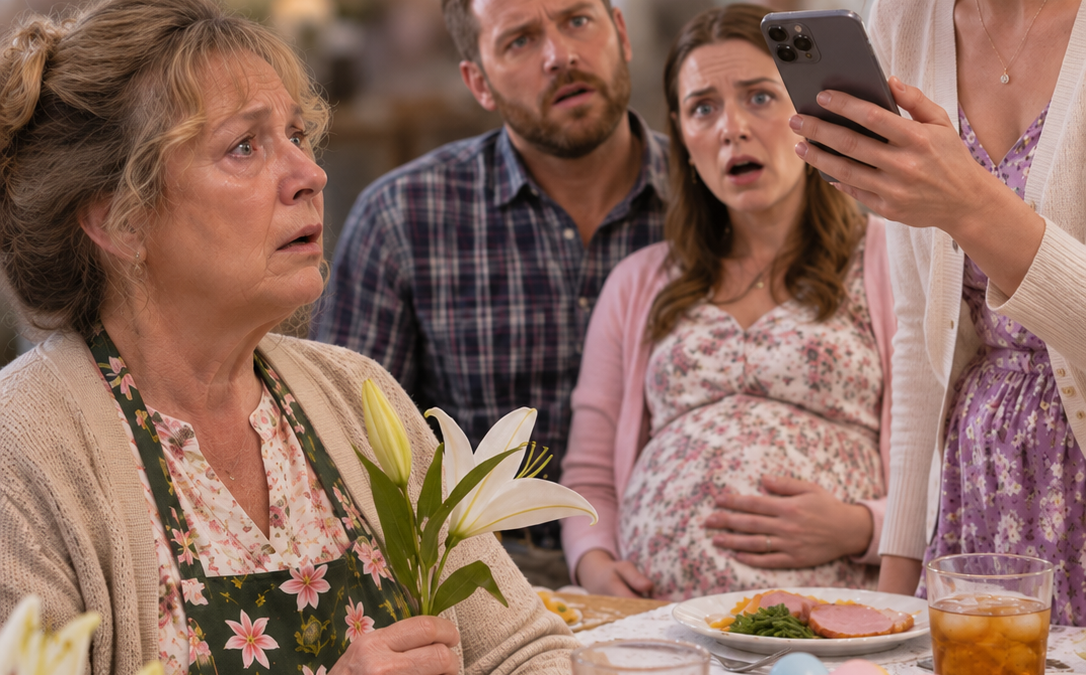
At 2:15 p.m. on Sunday, April 20, 2025, Jenna raised her phone over my Easter lilies and said, “Tell them about your cancer, Aunt Ruthie, or I will.”
“Not today.”
I kept my hand around my water glass.
The lilies stood in a low vase in the middle of Connie’s dining table, their white faces turned toward the windows.
I had brought them from my flower shop on Broadway that morning.
I had thought flowers were enough of a contribution.
Jenna held the phone at shoulder height.
She was my niece, twenty-seven, and an RN at Four Rivers Medical Center in Paducah.
She had a bright voice that could make a request sound like a favor.
Right then, she sounded pleased with herself.
“Stage three breast cancer,” she said, looking down at the screen.
“First chemo May sixth.”
The room stopped.
There were twenty-three relatives at my sister’s Easter dinner.
They all gasped.
Someone near the kitchen whispered, “Oh, Ruthie.”
A chair scraped the floor.
I did not move.
The lily stems showed through the clear vase.
My fingers had gone cold around the glass.
Dustin sat beside Kelsey, his wife, who was seven months pregnant.
He had been reaching for his fork.
He set it down.
“Mom?”
“It’s true.”
That was all I managed.
Connie stared at the ham.
She had spent the afternoon arranging food and making sure nobody’s plate was empty.
Now she stood at the end of the table with the serving spoon in her hand, looking at the meat as if she had forgotten what it was for.
Dustin looked at me.
He was thirty-five, a lineman, and usually the quiet one in a room full of people.
I had expected to tell him myself.
I had planned to wait until his baby arrived, when I could sit with him somewhere private and explain what the doctors had said.
I had not wanted the last weeks of Kelsey’s pregnancy to revolve around appointments and treatment.
I wanted those weeks to belong to them.
I wanted to tell Dustin when I could do it privately, without twenty-three people watching his face.
Jenna had chosen for me.
In February, she had asked me to co-sign a $38,000 loan.
I had refused.
I owned my flower shop and the building it stood in, and I was not signing for a loan that was hers.
I had told her no in my office, without an audience.
She had not taken it well.
Since then, she had brought up the building often enough that I knew she had not accepted my answer.
I had not connected those conversations to my diagnosis.
I had not told Jenna about the cancer.
I had not told anyone at that table.
Dustin’s eyes moved from Jenna’s phone to my face.
Kelsey had put one hand over the curve of her stomach.
She did not speak.
I turned back to Jenna.
“How do you know?”
“You left your visit summary on the kitchen counter when I watered your ferns.”
I knew I had not left a visit summary on any kitchen counter.
I kept my medical paperwork private.
I did not leave it where a customer, a delivery driver, or a relative could pick it up by accident.
Jenna was across the table from me.
Her phone was angled toward the room.
As she lowered it, the screen tilted toward me.
Beneath the blue header, I caught the words typed there:
Stage three and still won’t co-sign. That building’s mine by Christmas, lol.
My stomach tightened.
The words were plain enough, but I couldn’t tell where they had been sent.
Whatever picture sat above them was turned away from me.
I looked at the phone, then at Jenna.
She lowered it into her lap.
The blue header looked like something from Four Rivers, not anything printed on a paper visit summary.
Why was my chart on a hospital screen?
Jenna tucked a loose strand of hair behind her ear.
Her expression settled into concern.
“We’ll talk about the building after pie,” she said.
Nobody reached for the pie.
I looked at my sister.
Connie still had the serving spoon in her hand.
She did not look at me or tell Jenna to stop.
Picking up where the Facebook post left off
I waited for her to say my name.
She did not.
I wanted to know what else Jenna had told them and what was on that phone.
I wanted to tell the room that my cancer was not a family announcement and my building was not a family prize.
Instead, I set my water glass down.
Dustin pushed his chair back.
The legs dragged against the floor.
He did not look at Jenna or at the relatives watching him.
He crossed the kitchen and left by the back entrance.
I waited a few seconds, then stood.
My knees felt steady.
That surprised me.
Kelsey started to rise too, but I touched the back of her chair.
“Stay,” I said.
She looked at me, then toward the door.
Her hand rested on her stomach.
“I’m sorry,” I told her.
She nodded.
I could not tell whether she understood what I was apologizing for.
I passed the kitchen counter and stepped onto the porch.
Dustin was already beside his truck, one hand on the driver’s door.
He had not opened it.
The afternoon sun caught the metal roof, and he stood with his head lowered.
“Dustin.”
He looked over.
“You were going to tell me?” he asked.
“Yes.”
“When?”
“After the baby came.”
He looked down at the gravel.
“You thought I shouldn’t know until then?”
“I thought I could give you these last weeks without worrying about me.”
“I heard it from Jenna in front of everybody.”
“I know.”
He rubbed one palm over his jaw.
He looked tired, though the day was still young.
I wanted to reach for his arm.
I did not.
“I should have heard it from you, Mom.”
“You should have.”
He turned toward the truck again.
I stayed where I was, close enough to speak but not close enough to make him answer.
Behind me, the screen door opened.
Jenna had come out onto the porch.
I could hear her shoes on the boards.
I needed to know how Jenna had seen a chart I had never brought home.
I also needed to find a way to speak to Dustin without asking him to pretend this afternoon had not happened.
Dustin opened the truck door but did not climb in.
Jenna stopped behind me, on the porch.
“Somebody has to be the grown-up.”
Chapter 2: The Form Filled Out Early
By Monday morning, the family knew what I had kept to myself. Dustin was still hurt, and I had no answer that could undo Sunday.
I called him before opening the shop.
He answered on the fourth ring. I could hear a truck engine behind him.
“I should have told you,” I said.
“Yes.”
“I wanted to wait until the baby came. Kelsey had enough to think about, and I didn’t want your last weeks before the birth taken up with my appointments.”
“You could have let me decide what I could handle.”
I sat on the stool behind the counter. The cooler motor hummed through the wall.
“I thought I was protecting you.”
“I’d have driven you.”
He said it quietly. That made it harder to answer.
“I know.”
“No, Mom. You don’t.”
He ended the call before I could find another sentence.
I called again that afternoon. It rang until voicemail picked up. I tried the next day, then once more on Thursday. He did not answer.
I left one message, telling him I loved him and that I would wait until he was ready. I did not ask him to call back.
The phone stayed beside the register while I worked. I kept checking it between customers, even when I knew there would be no answer.
On Tuesday, I called Four Rivers Medical Center and asked for the Privacy Officer.
The woman who returned my call spoke in a careful, even voice. She asked me to confirm my name and date of birth, then asked what had happened.
I told her my niece had read details from my cancer chart at Easter dinner. I told her Jenna said she had found a visit summary on my kitchen counter. I also told her I had seen a blue hospital header on Jenna’s phone.
“Was the document a paper copy?” she asked.
“She said it was.”
“Do you have reason to believe someone accessed your electronic record?”
“I have reason to ask.”
There was a pause while she typed.
She explained that the hospital would open a privacy review. She could not tell me who might have accessed my record, and she could not give me employee names while the review was underway.
“Can you at least tell me whether someone looked?” I asked.
“We’ll review the access information available to us and contact you when we can share an update.”
I thanked her. The call ended without a name.
I went into the back office and unlocked the shop safe.
My paper visit summary was inside a sealed envelope. I had put it there after my appointment, away from the counter and the workroom. The envelope was still sealed. I checked the flap, then placed it back.
Jenna had not found that paper on my kitchen counter.
I closed the safe and turned the key.
The review had started, but it had not answered the question I needed answered. I could not see the hospital access record myself. I could only wait for someone there to tell me what they found.
The next few days were busy. Three wedding orders needed changes, and a delivery of roses arrived with two crushed boxes. I worked through the orders and called the supplier. My hands knew what to do even when my mind kept returning to Jenna’s phone.
On Saturday, April 26, I was trimming stems when the bell above the shop door rang.
Jenna came in first.
Six relatives followed her. They spread out between the display buckets and the front counter, leaving their coats on and their faces arranged in the same worried expression.
I set down my shears.
“What is this?”
“A care meeting,” Jenna said. “We need to talk about what happens next.”
“I didn’t ask for a meeting.”
“You haven’t been thinking clearly about everything.”
She placed a folder on the counter. The relatives stayed behind her, watching me.
I recognized Jenna’s handwriting on the first page before I understood what she had brought.
It was a power of attorney form.
Her name appeared in the section for the person being appointed. Mine was written in the section for the person granting authority.
I did not touch it.
“You filled this out?”
“It’s just paperwork so we can help.”
“You wrote it.”
Jenna looked toward the relatives, as if she wanted them to see how difficult I was being.
“It just came out at the table. I never planned anything.”
“You brought a form today.”
“I was trying to make things easier.”
“For whom?”
She pressed her fingertips against the folder.
“You’re going to have treatment. You can’t keep running around this shop like nothing is happening.”
“I ran it yesterday.”
“Who runs a flower shop from a hospital bed?”
One of the relatives shifted near the front window. Another looked down at a bucket of tulips.
I could feel the old instinct to smooth things over. I had spent years making arrangements for other people’s important days. I knew how to keep a room calm when somebody was upset.
This was my shop. My name was on the building. My diagnosis did not give Jenna permission to decide what happened to either one.
I lifted the form by its top edge.
There was a date near the bottom. I didn’t stop to study it with everyone watching.
“I’m keeping this,” I said.
“You don’t need to make it difficult.”
“I didn’t sign it.”
“You should think about what you’re doing.”
“I am.”
I folded the form once and slid it into the shallow drawer under the register. I did not tear it up. I did not hand it back.
Jenna stood still for a moment, then gathered the folder. The relatives followed her toward the door. Nobody asked whether I needed anything.
When the bell stopped moving, I locked the front door and returned to the counter.
The cooler light spilled through the open doorway to the workroom. I took the form from the drawer and carried it beneath that pale light.
April 19, 2025.
Saturday. The day before Easter.
I read the date alone under the cooler light.
Chapter 3: The Stranger Who Saved the Post
The date on Jenna’s form stayed in my mind all week.
April 19. The day before Easter.
I kept the form in the shop safe, separate from my own medical papers.
I had not signed it, and I had no intention of signing it.
Still, I wanted to know why Jenna had prepared it before she stood over my lilies and announced my diagnosis.
I called Dustin twice.
Both calls went unanswered.
I stopped after that.
I had already told him I was sorry, and I would not make him listen before he was ready.
The shop kept moving.
People came in for birthday arrangements, funeral sprays, and the small bunches they bought on their way home.
I took orders, trimmed stems, and checked the cooler.
When the phone rang, I answered it.
A bride getting married in June called on Wednesday afternoon.
She had ordered flowers months earlier and wanted to confirm the colors.
“Ruthie, I hope you’re doing all right,” she said.
“I’m working.”
“I saw the prayer request.”
I stopped writing on the order pad.
“What prayer request?”
“Jenna put something on the church chain. About your cancer. She said you were starting treatment.”
I looked through the glass toward the cooler.
A bucket of white roses stood beside the lilies.
“She had no business doing that.”
“Oh, I’m sorry. I thought you knew.”
I told her I appreciated the call and confirmed the flowers.
She was quiet before hanging up.
I could hear the worry in her voice, and I knew the order was no longer the only thing she had called about.
By then, Jenna had carried my diagnosis farther than the twenty-three people at Easter.
People who had never sat at Connie’s table knew about it.
I had not given her permission to tell them.
I did not call Jenna.
I had already seen what she did with a private conversation.
Thursday, May 1, was busy enough that I stayed at the shop after closing.
I finished a sympathy arrangement and cleaned the worktable.
I locked the front door, checked the cooler, and took the day’s receipts to the office.
At 11:06 p.m., an unfamiliar number appeared on my phone.
“I work with Jenna. Is this you?”
I stared at the message for a moment.
Then another notification appeared.
A photograph.
I opened it.
The picture showed a hospital monitor.
The blue header ran across the top, and beneath it was my name.
The screen clock in the corner read 9:52 p.m.
I enlarged the image.
The patient information was visible.
It was my chart.
Below the photograph was Jenna’s caption:
“Stage three and still won’t co-sign. That building’s mine by Christmas, lol.”
Above the photograph, the chat showed a message from Jenna at 7:14 p.m.
“clocked out, finally.”
I sat down at the office desk.
She had clocked out at 7:14.
The picture had been taken at 9:52.
The visit summary story had been a lie.
She had not found a paper on my kitchen counter.
She had taken a picture of my chart on a hospital screen after her shift, then sent it to a private chat.
I looked at the sender’s number again.
I typed, “Who is this?”
The reply came a minute later.
“My name is Bethany. I work on Jenna’s floor. I’m a nurse at Four Rivers.”
She asked if she could call.
I said yes.
Her voice was low and hurried when she came on the line.
She apologized before she said anything else.
“I saved that screenshot in March,” she said.
“I didn’t know who the patient was. I knew it was wrong, but I didn’t know how to reach you.”
“Why now?”
“Jenna was talking about Easter in the chat this week. She was bragging about telling her aunt in front of the family. She mentioned the building, too. I connected the name on the screen to what she was saying.”
I shifted the phone to my other ear and studied the photograph on my desk.
“You knew this was my chart?”
“I do now. I searched for your shop’s public number. That’s how I found you.”
“Why did you save it?”
“I thought somebody might need it. I should have done more.”
She sounded frightened.
Not confused.
Frightened.
“Will you tell the hospital what you saw?”
“I can give you the screenshot. I can tell you what I know.”
“Would you testify if the board asks?”
Bethany went quiet.
“I have two kids. I can’t.”
I looked at the office door.
Beyond it, the shop was dark except for the cooler light.
“I understand,” I said.
“I am sorry, Ruthie.”
I thanked her for sending the picture.
We ended the call without making any promises.
I saved the screenshot to my phone and printed a copy.
The printed page showed the blue header, my name, the time, Jenna’s caption, and the earlier message saying she had clocked out.
I placed it beside the form dated April 19.
One piece of paper had been prepared before Easter.
The other showed what Jenna had done after leaving her shift.
Neither one carried my signature.
I thought about the board complaint process.
A screenshot was evidence, but Bethany was the person who had saved it.
Without her willing to stand in a hearing room, Jenna could say the picture had been altered or passed along without context.
Was a screenshot enough by itself?
I could not answer that.
I could only decide whether to let it sit in my office.
I opened the hospital privacy review email and attached the image.
I wrote that I had received evidence showing my chart on a monitor at 9:52 p.m., after Jenna’s 7:14 p.m. message saying she had clocked out.
I included the caption and asked that the screenshot be added to the review.
Then I sent the message to the Privacy Officer.
After that, I opened the nursing board’s complaint page.
The first field asked for the nurse’s name.
I typed Jenna Payne.
Chapter 4: The Brides Who Called Back
On Monday, May 5, 2025, I submitted the complaint against Jenna Payne.
I sat alone in the back office of my flower shop, with the screenshot beside my keyboard and the power of attorney form inside the safe.
The nursing board’s online portal asked for Jenna’s name, her workplace, and a description of what had happened.
I attached the photograph Bethany had sent me.
I included the message showing Jenna had clocked out at 7:14 p.m., followed by the photograph taken at 9:52.
I explained what Jenna had said at Easter and how she claimed she had found my visit summary on a kitchen counter.
I also included the power of attorney form dated April 19.
Before submitting, I checked the attachments. The screenshot was clear. The date on the form was readable.
I knew what filing meant.
Jenna was my sister’s daughter. She was also a nurse with a job and a future she had worked toward.
But I had not taken her chart from a hospital monitor. I had not shared it with other nurses. I had not announced her private information at a family dinner.
I clicked Submit.
The portal gave me a confirmation number.
I printed the confirmation and put it with the other papers in the safe.
The following morning, I drove myself to my first chemotherapy appointment.
May 6 was Tuesday.
I arrived with my appointment papers in a folder and my purse on the passenger seat. The nurse checked my information, showed me where to sit, and explained what would happen.
I listened and asked the questions I had written down.
When the treatment began, I watched the clock on the wall.
I had spent years arranging flowers for people who were sick, grieving, celebrating, or starting over. I knew how to stand beside somebody without making them explain everything.
It was different sitting in the chair myself.
Nobody from my family came with me.
Dustin still wasn’t answering. Connie hadn’t called since Easter, and Bethany had stopped responding to my messages.
I had sent Bethany one message after filing.
I told her the screenshot had gone to the hospital and the board. I thanked her for helping me.
She did not answer.
I sent no second message.
The treatment took most of the morning. When I was finished, I collected my things and drove back to Paducah.
I still had Mother’s Day orders to prepare.
The shop was busy. Customers wanted arrangements delivered to mothers, grandmothers, wives, and women who had raised them when nobody else could.
I had promised three large wedding orders for the coming months. I kept their dates on the calendar and their deposits recorded in the books.
Then the cancellations started.
The first bride called and said she had heard about my diagnosis. She was worried I might not be able to fulfill the contract.
I told her I understood and offered to discuss the arrangements.
She declined.
The second cancellation came by email. The third bride called herself. She apologized several times but said she had decided to find another florist.
Together, the three canceled weddings represented $18,400 in business.
I sat at my desk with the cancellation notices spread in front of me.
That money had already been assigned in my mind. It was part of the shop’s expected income, money I counted on for supplies, building expenses, and the ordinary costs of keeping the doors open.
I couldn’t replace those bookings with a few Mother’s Day bouquets.
I called one bride to ask whether she had been told something specific about my ability to work.
She said she had heard I was seriously ill and that people were concerned about the shop.
I thanked her and hung up.
Jenna’s prayer-chain message had done more than expose my diagnosis. It had made my private medical business something customers felt entitled to judge.
Over the following days, treatment began taking its toll.
One morning, while I was tying ribbons around Mother’s Day arrangements, I noticed hair caught between my fingers.
I brushed it away.
A little later, more strands came loose when I touched the back of my head. By the time I finished the orders, enough had collected on my blouse that I stopped trying to ignore it.
I went into the back room and looked at myself in the small mirror.
I had always kept my hair neat for work. Customers saw me behind the counter, carrying arrangements to their cars, and standing beside the flowers I had made.
Now I could see the beginning of a change I hadn’t been ready to show anyone.
I removed the loose strands from my blouse and returned to the counter.
Connie came by that afternoon.
She did not bring flowers or ask how treatment had gone. She stood near the register while I finished an order.
“Ruthie, we need to talk.”
I put down my pen.
“About what?”
“Jenna.”
I waited.
“She got the board notice.”
I knew the complaint would eventually reach Jenna. I had not expected Connie to come to me about it.
“Then she knows.”
“She is terrified.”
I looked at my sister.
“I’m the one whose chart she photographed.”
“She made a mistake.”
“She posted it.”
“She’s twenty-seven. This could ruin her whole life.”
I took the finished arrangement to the pickup shelf.
Connie followed me with her eyes.
“Withdraw it, Ruthie. It’s her whole life.”
I returned to the counter.
“What about mine?”
Connie pressed her lips together.
“She was trying to help you.”
“By showing my cancer chart to other nurses?”
“She didn’t think it would get this far.”
I looked at the woman I had grown up with. Connie had spent years smoothing over arguments and making excuses when Jenna got into trouble. I knew she loved her daughter.
I loved my son, too.
That did not mean I could ask Dustin to pretend Easter hadn’t happened.
“I filed the complaint,” I said. “I’m not withdrawing it.”
Connie picked up her purse.
She didn’t hug me goodbye.
For several days, I heard nothing from her.
Then Jenna walked into the shop.
She had a folded document in one hand. I recognized the board’s notice when she placed it on the counter.
“You actually did it,” she said.
“Yes.”
She glanced toward the front window, checking whether anyone was nearby.
“They want a response from me.”
I said nothing.
“You know what happens when people make accusations like this?”
“I know what happened to me.”
Jenna leaned closer.
“Chemo patients get confused. I’ll say you signed that form.”
My fingers tightened around the edge of the counter.
“You know I didn’t.”
“You were sick. You might not remember everything.”
“I remember your handwriting.”
She looked toward the drawer where I had kept the first form.
Then she reached into her folder and pulled out another sheet.
It was a fresh power of attorney form.
She laid the document across the counter and nudged it in my direction.
I didn’t pick it up.
“You need someone to handle things while you’re going through treatment,” she said.
“I have someone.”
“Who?”
“Me.”
Her expression hardened.
She tapped the new form with one finger.
“By Friday.”
I looked at the paper between us.
The board had her complaint. I had her photograph. And now she was threatening to tell them I had signed something I had never agreed to.
Who would believe a sick woman over a nurse?
Jenna left the form on my counter and walked toward the door.
Chapter 5: The Sworn Statement She Forwarded
Friday came, and I did not sign Jenna’s new power of attorney form.
I left it where she had put it, on the counter. When I opened the shop that morning, the paper was still there. I folded it and locked it in the safe with the first form.
Jenna did not come back to ask for it.
Her next move came through the family.
Later that month, a letter arrived from Four Rivers Medical Center. The hospital confirmed that a privacy review had taken place. It stated that the employee involved “is no longer employed here.”
The letter did not give me a name.
It did not explain what had happened to that employee.
I folded it and put it beside the screenshot in my safe.
A few days later, Jenna told the family she had quit Four Rivers and taken a clinic job in Murray. Connie repeated the news when she called me.
“She wanted a fresh start,” my sister said.
“Good for her.”
“Ruthie, you don’t have to sound like that.”
I was standing behind the counter, sorting receipts.
“I don’t have anything else to say about her job.”
Connie sighed and changed the subject.
I didn’t tell her what the hospital letter said. I wasn’t going to argue over whether Jenna had quit or been dismissed. The hospital had confirmed that she no longer worked there. That was enough for me.
On May 29, Dustin and Kelsey welcomed their daughter, Annie.
I learned about the birth through a message from Dustin. There was a photograph attached. Annie was wrapped in a pale blanket, with her eyes closed and one tiny hand near her cheek.
I saved the picture.
I wanted to call immediately, but I waited until the next morning. Dustin answered that time, though our conversation was brief.
“How’s Kelsey?”
“She’s tired.”
“And Annie?”
“She’s good, Mom.”
I smiled at the photograph on my phone.
“She’s beautiful.”
“She is.”
He didn’t say much more, and I didn’t press him.
At my next chemotherapy appointment, Dustin appeared in the waiting area.
He had Annie’s photograph on his phone.
I stopped when I saw him.
“What are you doing here?”
“Thought I’d see you.”
He sat beside me.
For a while, we talked about the baby. He told me how Kelsey was recovering and how little Annie slept. He showed me another picture, this one with Annie’s face turned toward the camera.
Then he noticed the folder on my lap.
“Is that what you filed with the board?”
I brought up the screenshot on my phone.
Dustin studied the hospital monitor. He looked at my name, the clock, and Jenna’s caption. Then he scrolled up to the message sent at 7:14 p.m.
“Clocked out, finally,” he read.
He looked at the photograph again.
“She took this after she clocked out?”
“Yes.”
“And sent it to other nurses?”
“Yes.”
He lowered the phone.
I watched his face. He had heard about my cancer from Jenna at Easter. Now he was seeing what she had done with the information.
“Why didn’t you tell me about this sooner?”
“I didn’t have the screenshot until May first.”
He nodded.
“I should have been there.”
I didn’t answer right away.
“You had a baby coming,” I said.
“I still could have driven you.”
He stood and picked up my folder.
“I’m driving now.”
I let him take my purse.
It wasn’t an apology for Easter, and I didn’t ask it to be one. He had come to sit beside me, and he was taking me home.
That was enough for that morning.
On Tuesday, June 3, Jenna sent a message to the family group.
I was not part of every conversation in that group, but Dustin forwarded the message to me.
It contained Jenna’s sworn response to the nursing board.
One sentence stood out:
“I have never photographed any patient’s chart or screen.”
She had signed the response.
I printed the message and put it with the other documents. The screenshot showed her account, the hospital monitor, and the time. Her sworn statement denied the act entirely.
The board had also given her an opportunity to consider a settlement that required an admission.
Jenna refused.
She would not agree to a resolution that acknowledged what she had done.
That meant the complaint would proceed to a hearing.
I was no longer dealing with a private disagreement between an aunt and her niece. Her sworn denial had made the photograph something she intended to fight.
I thought about Bethany.
I had not heard from her since our phone call. I sent one short message asking whether she was all right.
No answer came.
I left her alone.
The board later sent the notice confirming an open hearing on Tuesday, September 16, 2025, in Louisville.
I called the office to ask what I needed to prepare. The woman who answered gave me the name of the board’s attorney, Lorna Young, and arranged a meeting.
Lorna was fifty-five, with a measured way of speaking. She listened without interrupting while I explained the timeline and showed her the documents.
She examined the screenshot, the hospital letter, the April 19 form, and Jenna’s sworn response.
“Without Bethany,” she said, “the screenshot is a fight.”
I looked at her.
“What does that mean?”
“It means the other side can challenge where it came from, who saved it, and whether the evidence can be authenticated. We need someone who can explain how this image reached you.”
“Bethany won’t testify.”
“Then we have a problem.”
I told her Bethany had two children and was afraid of losing her job. Lorna did not criticize her.
“I understand her position,” she said. “But the hearing will be open. We need to be prepared for questions about the evidence.”
I left the meeting with the hearing date written on a card.
For several days, I considered keeping the date to myself. If Bethany never appeared, I would have to face Jenna’s denial without the person who had saved the photograph.
The relatives who attended Easter would know I had filed a complaint. They would also know whether I could prove it.
I could already picture sitting in that room while Jenna’s lawyer questioned me about my memory, my treatment, and the form I had refused to sign.
Still, I decided not to hide the date.
I contacted every relative who had been at Connie’s Easter dinner. I told them the hearing would take place September 16 in Louisville and that it was open to the public.
Some acknowledged the message. Others said nothing.
Connie called that evening.
“You’re really going through with this?”
“Yes.”
“She’ll have to face everybody.”
“She made sure everybody knew about me.”
Connie didn’t answer.
I sent the date to Dustin, too. He replied that he would be there.
That left Bethany.
I did not know whether she would come voluntarily, whether the board could require her to appear, or whether she would stay silent.
On the evening of June 10, my phone lit up beside the register.
Bethany had finally answered.
Her message was short.
“Tell them to subpoena me. Then I never chose.”
Chapter 6: The Room That Was Open to Anyone
By the time the hearing began on Tuesday, September 16, 2025, Jenna was already seated.
She wore a dark jacket and had her hair arranged neatly behind her shoulders.
Her lawyer sat beside her, sorting papers into a straight stack.
She looked toward the relatives as they came in, giving a small, confident smile.
Dustin had driven me to Louisville.
The trip from Paducah took three hours, and he had not complained once.
He carried my folder when we entered the board office and stayed close while I found my seat.
There were thirty-one people in the hearing room.
Nineteen were relatives.
Two board members sat at the front with the hearing officer.
Lorna Young had a table near them, with the exhibits arranged in order.
I wore a scarf over my head.
I had chosen it that morning because I didn’t want to spend the hearing thinking about the hair I had lost.
The fabric felt warm against my neck.
I rested my hands on my knees until the hearing officer called the matter.
The hearing was open to the public.
That meant everyone could hear what happened next, including the people who had watched Jenna announce my diagnosis at Easter.
I was sworn in and took the witness chair.
Lorna began with the dates.
She asked when I had received my diagnosis, when I had first told my family, and what Jenna had said at Connie’s Easter dinner.
I answered each question as clearly as I could.
I explained that I had kept my diagnosis private because I wanted to tell Dustin myself.
I described Jenna raising her phone over the lilies and reading the stage and treatment date aloud.
Then Lorna asked about the visit summary.
“Did you leave a paper copy on your kitchen counter?” she asked.
“No.”
“Where was your paper summary?”
“In the safe at my flower shop. In a sealed envelope.”
She asked whether Jenna had ever been part of my care team.
I said she had not.
Jenna’s lawyer stood when Lorna finished.
He was polite in the way people can be when they intend to make you sound foolish.
“You signed a form you forgot?”
I looked at him.
“Show me my signature.”
He glanced down at the papers in front of him.
He turned one page, then another.
He did not produce a signed form.
“Isn’t it possible you signed something during a difficult period and don’t remember?”
“No.”
“You were beginning chemotherapy.”
“I know when I began chemotherapy.”
“And you were under stress.”
“I still know what I signed.”
He paused, then returned to his chair without showing the panel a signature.
The power of attorney form was still in my possession.
Jenna had written it, and I had never signed it.
I looked toward the board members.
My scarf had begun to itch at the edge, but I did not touch it.
Lorna moved to the next exhibit.
“I’m marking this as Exhibit 1,” she said.
She placed the printed screenshot on the display screen.
The hospital header appeared above my name.
The clock in the corner showed 9:52 p.m.
Beside it, Lorna placed the message Jenna had sent at 7:14 p.m.: “clocked out, finally.”
Then she displayed Jenna’s explanation about the kitchen counter and the ferns.
“Is that the paper you say you found?” Lorna asked.
Jenna’s lawyer objected to the comparison, but the hearing officer allowed Lorna to continue.
Lorna read the caption beneath the photograph aloud.
“Stage three and still won’t co-sign. That building’s mine by Christmas, lol.”
Several people adjusted in their chairs.
I watched the screen.
Lorna then displayed Jenna’s sworn response from June 3.
“I have never photographed any patient’s chart or screen.”
The two statements sat beside each other.
The photograph showed a hospital monitor.
The sworn response denied taking a photograph of a patient’s chart or screen.
The earlier message showed Jenna had clocked out more than two hours before the screen photograph.
Lorna asked Jenna whether she had sent the caption.
Jenna leaned toward her microphone.
“That chat was private. Every nurse vents. Nobody was supposed to see it.”
She said it with irritation, as if the privacy of the chat mattered more than the patient whose name appeared on the monitor.
Lorna asked whether Jenna denied that the chat existed.
Jenna’s lawyer stood again.
“My client has already explained the context. A private conversation is not proof of a privacy violation.”
“Did you send the message?” Lorna asked.
The lawyer objected.
The hearing officer told Lorna to move on.
Jenna sat back.
Her confidence had not disappeared, but her fingers were tight around the edge of her folder.
Her lawyer addressed the panel.
“There is a basic problem with this exhibit. Nobody has authenticated this. We don’t know who created the screenshot, who saved it, or whether it accurately represents the original conversation.”
Lorna said the board would address the evidence through testimony.
The hearing officer made a note.
I looked toward the seats behind Jenna.
Bethany was not there.
The photograph was real.
I knew what I had received and who had sent it.
I knew the time on the monitor and the message above it.
But I was not the person who had saved the post in March.
Without that person, Jenna’s lawyer could keep calling it a picture with no proven source.
Who could prove the picture was real?
The hearing officer looked toward the door as it opened.
A woman stepped into the room carrying a phone.
A subpoena was folded in her other hand.
Bethany Rios had come.
Chapter 7: The Mother on the Witness Stand
Bethany took the witness chair with her phone in one hand and the subpoena in the other.
The room had settled after her entrance, but Jenna was no longer smiling.
Lorna Young asked Bethany to identify herself and explain how she knew the screenshot.
Bethany gave her name, her job, and the floor where she worked with Jenna at Four Rivers Medical Center.
She unlocked her phone and opened the saved conversation.
“At the top, the sender is Jenna Payne,” she said.
She read the message above the photograph.
“clocked out, finally.”
The time beside it was 7:14 p.m.
Then Bethany moved to the photograph posted below it.
“The screen clock says 9:52 p.m.,” she said. “The name on the monitor is Ruthann McKinney.”
She held the phone so the hearing officer could see the original image.
Lorna asked when Bethany had saved it.
“March 27, 2025.”
“Did you change the image?”
“No.”
“Did you add the caption?”
“No. It was already there.”
Bethany explained that she had kept the screenshot because she knew it showed a patient’s chart and she believed it should not have been shared.
She had not known the patient’s identity when she saved it.
After Jenna talked about Easter in the chat, Bethany connected the name on the monitor to me and found my shop’s public number.
Lorna took the printed copy from the exhibit folder.
She read the caption into the record.
“Stage three and still won’t co-sign. That building’s mine by Christmas, lol.”
Then she read it a second time, slowly enough for the clerk to enter every word.
I sat beneath my scarf and listened.
The words sounded worse in that room than they had on the screen in my office.
Lorna placed the power of attorney form beside the photograph.
She pointed to the date written near the bottom.
“April 19, 2025,” she said.
“That is the date on the form?”
“Yes,” I answered.
“And whose handwriting is this?”
“Jenna’s.”
“Did you sign it?”
“No.”
Jenna was looking down now.
Her lawyer spoke with her for a moment, then stood and asked for permission to address the panel.
He questioned Bethany about the private chat, how many people could see it, and whether she had personally watched Jenna take the photograph.
Bethany answered what she knew and did not pretend to know the rest.
“I saw the post in the chat,” she said. “I saved it on March 27. I can identify the account and the messages that appeared with it.”
The lawyer asked whether she could prove what happened inside the hospital room.
“No,” Bethany said. “I can tell you what was on the screen and what Jenna posted.”
Lorna asked the hearing officer to consider the screenshot together with the sender information, the timestamps, and the hospital review letter.
Jenna began to cry.
“I was scared for her. She has nobody.”
Her voice broke on the last word.
Dustin stood in the third row.
He did not shout or interrupt. He simply rose, and Jenna looked toward him.
I wanted to turn around and tell him to sit down. I also wanted him to stay standing so she could see the son who had learned about his mother’s cancer from her phone.
The hearing officer asked him to remain silent unless called.
Dustin sat.
Jenna’s lawyer asked to call Connie as a character witness.
My sister walked to the witness chair slowly. She smoothed the front of her blouse before sitting down.
The lawyer asked whether Jenna had always cared about me.
Connie looked at him, then at the panel.
“She showed me that picture on Palm Sunday. Then she asked what the building was worth.”
Nobody moved.
The lawyer paused with one hand on his notes.
“Are you saying you knew about the photograph before Easter?”
“Yes.”
“And Jenna asked you about the building?”
“Yes.”
Connie’s eyes found mine for a moment.
“I should have told you,” she said.
The hearing officer reminded her to answer the lawyer’s questions.
Connie lowered her gaze.
She had spent years keeping peace between people who wanted different things. In that room, with her daughter sitting beside her lawyer, she had finally stopped doing it.
Lorna asked no more questions about the building. The statement was already in the record.
The panel listened to the remaining questions, then announced it would go into closed session.
The two board members and the hearing officer left through the side door.
We were told that the record would remain open for the panel’s deliberation and that a recommendation would follow before the full board acted.
No decision was announced that afternoon.
What would the full board do with all of it?
People began gathering their coats and folders.
I stepped into the hallway with Dustin beside me. Connie came out a little later, walking alone.
Jenna stood near the wall with her lawyer. Her eyes were red, and she was holding the same folder she had carried into the hearing.
Nobody moved toward her.
Connie did not take her daughter’s arm. The relatives who had come from Easter stayed near me and Dustin, or stood quietly with their coats in their hands.
Jenna waited a moment, as if someone might cross the hallway.
No one did.
Then she came closer.
“You told all of them.”
I stopped.
“You said tell them. So I did.”
Chapter 8: The Badge in Her Hand
The hearing ended without a decision, but the family could no longer pretend they hadn’t heard the truth.
For the next few weeks, I waited for the board’s written recommendation.
Dustin drove me to some of my appointments. On the days he couldn’t, I drove myself. I kept the shop open and continued taking smaller orders.
The three canceled weddings remained in my records.
Their total was $18,400. I had kept the cancellation emails, the original agreements, and the dates when each bride had withdrawn.
I hadn’t decided what to do about the money.
I had enough to deal with.
On Friday, October 3, 2025, the recommended order arrived in the mail.
I was at the shop when the carrier brought it. I signed for the envelope, set it beside the register, and finished helping a customer choose flowers for her mother’s birthday.
After she left, I opened it.
The board’s recommended order called for revocation of Jenna’s nursing license.
I sat at the desk and read the document carefully. The findings referred to the patient photograph, the private chat, and Jenna’s sworn response.
The board had considered Bethany’s testimony and the evidence she authenticated.
It had also considered Connie’s testimony about Palm Sunday and Jenna’s questions about my building.
I placed the order beside the screenshot.
For months, Jenna had told people she was concerned about me. She had said I was confused, that I needed help, and that I had left paperwork where she could find it.
Now the recommendation was in writing.
I called Dustin.
“It came,” I said.
“What does it say?”
“Revocation.”
He was quiet for a moment.
“Are you all right?”
“Yes.”
“Do you want me to come over?”
“Not yet. I’ll call if I need you.”
Jenna did not accept the recommendation quietly.
She filed exceptions, challenging the proposed findings before the full board considered the case.
That meant another wait.
The public session was scheduled for Thursday, October 23.
I marked the date on the shop calendar and circled it in red.
Dustin offered to drive me to Louisville. I accepted.
By then, I had learned not to pretend I could do everything alone. I still owned the shop, still handled the orders, and still made my own decisions. Accepting a ride did not change any of that.
On October 23, we entered the board’s public meeting together.
Jenna was there with her lawyer.
She wore a dark blouse and carried a folder against her chest. Her expression was composed, but she kept looking toward the board table.
Connie sat several rows away.
She had not called me to discuss the hearing. I had not called her either.
The chair opened the session and addressed Jenna’s exceptions.
The board reviewed the objections and the recommended findings. Jenna’s lawyer spoke on her behalf, but the board members were not persuaded.
The chair announced that the exceptions were denied.
Then the chair read the final action.
“Revoked.”
The word carried across the room.
Jenna lowered her head.
Dustin sat beside me, his shoulder close to mine. He did not reach for my hand or say anything. He stayed there while the chair explained that the board’s decision was final.
I watched Jenna gather her papers.
Her lawyer leaned toward her and spoke quietly. She nodded without looking at him.
The meeting ended, and people began filing into the lobby.
Jenna stood near the wall, holding her RN badge in one hand. She kept turning it over, running her thumb along the plastic edge.
Her phone rang.
She looked at the screen and answered.
“Hello?”
A woman’s voice came through loudly enough that I could hear it from where I stood.
Jenna switched the call to speaker.
The caller identified herself as someone from the Murray clinic.
She explained that the clinic had reviewed the board’s decision and could no longer proceed with Jenna’s employment.
“We’re withdrawing the position,” the woman said. “We won’t be moving forward with your start date.”
Jenna stared at the phone.
“You already offered me the job.”
“I understand. But the licensing decision changes our position.”
“I told you I had exceptions pending.”
“The board has now acted.”
The call ended.
Jenna remained near the wall with her RN badge in her hand.
She looked toward her mother.
Connie approached her slowly.
For a moment, I thought Connie might put an arm around her daughter. Instead, she held out her hand.
“My spare key.”
Jenna looked down.
She reached into her purse and produced a small key. Connie took it from her palm and closed her fingers around it.
Neither woman said anything else.
Connie stepped away.
Jenna stayed where she was, still holding the badge.
Dustin touched my elbow.
“Ready, Mom?”
“Yes.”
We walked toward the exit.
I didn’t turn around.
On the drive back to Paducah, Dustin asked whether I felt better.
“I don’t know,” I said.
He kept his eyes on the road.
“You got the decision.”
“I did.”
“But there’s still something bothering you.”
I looked out the passenger window.
The license decision had answered what happened to Jenna’s nursing career. The clinic had withdrawn its offer. Connie had taken back her key.
But the three weddings were still missing from my books.
Three brides had canceled after Jenna spread my diagnosis through the church prayer chain. The $18,400 had not come back, and I had not asked anyone to repay it.
I had spent months trying to keep the shop running while undergoing treatment. I had accepted the cancellations because I couldn’t afford another fight.
That did not mean I had agreed they were fair.
When we reached Paducah, Dustin dropped me at the shop.
I unlocked the front door and went straight to the office.
The cancellation folder was still in the filing cabinet. I pulled it out and laid the three agreements on my desk.
I checked the amounts and the dates.
Then I took out my lawyer’s card.
The board had decided what would happen to Jenna’s license. I still had a separate loss to address.
I picked up the phone and called my lawyer about the three weddings.
Chapter 9: The Newsletter With Her Name
Jenna’s name appeared in the nursing board’s newsletter before Thanksgiving.
The notice included the board’s final action and the revocation of her license. I received a copy from my lawyer, who had been following the public record.
I read it at my desk between customer orders.
For months, Jenna had told people I was confused, that I needed help, and that she had only been concerned about me. Now the board’s publication recorded what had happened.
I put the newsletter in the same folder as the hospital letter and the screenshot.
The church prayer chain also received a correction.
I had contacted the person who managed the messages and asked for one sentence to be shared.
It read:
“The information about my health was shared without my permission, and I ask that no further details be repeated.”
I didn’t explain the cancer, the photograph, or the board hearing. People who needed the details had already heard them in the proper place.
Several relatives acknowledged the correction. One woman called to apologize for repeating what Jenna had posted. Another said she had prayed for me but hadn’t known the information was private.
I thanked them.
I had no interest in making a second announcement about the first one.
My lawyer sent Jenna a letter concerning the three canceled weddings.
The letter identified the three contracts and the total loss: $18,400.
I had given him copies of the agreements, the cancellation notices, and the messages showing that the brides had heard about my illness through the prayer chain.
He explained what I was seeking and gave Jenna a chance to resolve the matter.
I did not expect an immediate answer.
For several days, nothing happened.
Then I heard that Jenna was selling her Jeep.
Connie didn’t tell me directly. Another relative mentioned it while picking up a Thanksgiving arrangement.
“She’s trying to come up with the money,” the woman said.
I nodded and returned to tying the ribbon.
The payment came through my lawyer.
The full $18,400 was accounted for.
I checked the amount against the three canceled contracts and signed the receipt confirming payment. I did not send Jenna a thank-you message.
The money belonged to the losses I had documented. It did not purchase a return to the way things had been.
There was another development involving Bethany.
She contacted Lorna and told her she had accepted a letter of concern regarding the delay in reporting the screenshot.
Bethany had saved the post in March and waited until she connected my name to Jenna’s Easter conversation before contacting me.
She had eventually come forward, testified, and authenticated the evidence. That mattered.
The letter did not erase the weeks she had remained silent.
When she called me, she apologized again.
“I know I should have done something sooner,” she said.
“You came when it mattered.”
“I was scared.”
“I know.”
She thanked me for not pretending her delay hadn’t happened. I told her I hoped things would go well for her and her children.
We ended the call there.
Thanksgiving came without an invitation for Jenna.
The family had not announced a new rule or held another meeting. People simply stopped making plans that included her.
I heard Connie was spending the holiday with other relatives. I didn’t ask whether Jenna would be there.
I had orders to finish, customers to serve, and a shop to keep running.
A few days after Thanksgiving, Jenna came in.
I was changing the water in a bucket of chrysanthemums when the bell rang.
She stood near the counter without taking off her coat.
She looked unlike the confident young woman who had once entered my shop with six relatives and a folder of paperwork. Her hair was pulled back, and she carried no documents.
“Hi, Aunt Ruthie.”
I finished pouring out the old water.
“Hello, Jenna.”
She looked around the shop.
“Business looks busy.”
“It’s that time of year.”
She nodded.
“I heard the money came through.”
“It did.”
She moved closer to the counter.
“Can we start over?”
I set the empty bucket down.
For a moment, I thought about Easter. The lilies between the plates. Dustin putting down his fork. Connie staring at the ham while Jenna read my diagnosis aloud.
I remembered the photograph on the monitor and the form dated April 19.
I also remembered Jenna standing in my shop, telling me she would say I had signed something I had never touched.
“No. I hope you do well somewhere else.”
Jenna looked at me.
“You can’t forgive me?”
“I didn’t say that.”
“Then what are you saying?”
“I’m saying I won’t start over.”
She looked toward the front door.
I didn’t offer her a chair or ask her to stay.
After a few seconds, she left.
I watched the bell settle above the door, then returned to the chrysanthemums.
Connie came the following week.
She arrived without Jenna and stood near the worktable while I finished an arrangement.
“I owe you an apology,” she said.
I kept trimming the stems.
“For what?”
“For Palm Sunday.”
I stopped.
Connie looked down at her hands.
“She showed me that picture before Easter. I knew what was on it. Then she asked about your building, and I let her keep talking.”
I waited.
“I should have told you.”
“Yes.”
“I was trying to protect her.”
“I know.”
Connie swallowed.
“I watched her stand over you at Easter. I watched Dustin hear it from her. I should have stopped her.”
I put the shears down.
My sister had finally said what I had wanted to hear months earlier. But an apology did not put things back where they had been.
“I can’t go back to how we were,” I said.
“I understand.”
I looked toward the worktable, where a fresh bucket stood beside the sink.
I picked it up and handed it to her.
“You can strip stems.”
Connie accepted the bucket.
She took a place beside the worktable and began removing the lower leaves from the flowers. We worked without discussing Jenna or the hearing.
It wasn’t a reunion. It was an afternoon of work.
I could live with that.
By then, the shop had become quieter after the holiday orders. I had kept the doors open, filled the cooler, and continued taking customers. My scarf hung on a hook in the back room, and I no longer needed to reach for it every morning.
Dustin called more often.
He told me about Annie’s latest habits, how she was growing, and how Kelsey was doing. Sometimes he stopped by after work. Sometimes he brought a photograph.
I wondered whether I would ever sit at a family table again without thinking about Easter.
I didn’t know.
One afternoon, I was checking a delivery slip when the front door opened.
Dustin came in carrying Annie.
He held his daughter against his chest, one hand supporting her back. Annie was awake, looking around at the buckets and flowers.
“Look who’s here, Mom,” he said.
I put down the delivery slip.
Dustin carried Annie through the shop door.
Chapter 10: The Lilies on Broadway
On Sunday, April 5, 2026, I opened the flower shop early and began setting tables among the lilies.
The shop smelled of damp stems, clean water, and the sweet scent coming from the open flowers.
I had moved the display buckets against the walls and cleared enough floor space for dinner.
The tables were covered with plain cloths, and every place had a plate, a fork, and a folded napkin.
There were twenty-one of us coming to dinner, counting me.
I counted the settings before I went back to the cooler.
Then I counted them once more to make sure the room was ready before the first knock.
There was no chair for Jenna.
Nobody asked me to put one out.
Connie arrived early.
She brought a covered dish and took off her coat without asking where I wanted it.
She had been coming by the shop to help with small jobs since her apology.
Some days she stripped stems.
Other days she washed buckets or carried arrangements to the front window.
She did not ask me to call us sisters again.
I did not ask her to explain Palm Sunday a second time.
That morning, she looked at the lilies and asked, “Want me to trim the ones by the register?”
“Leave those. They’re for the window.”
“All right.”
She set her dish on the counter and began straightening the napkins.
I had learned to accept help without handing over the decisions.
Connie seemed to understand that.
We worked beside each other, and when she asked where something belonged, she waited for my answer.
Dustin came in with Kelsey just before the others.
Annie was on his knee, looking at the flowers with serious attention.
She was ten months old now, and she had begun reaching for anything bright enough to catch her eye.
“Keep her away from the lilies,” I said.
Dustin moved her little hand from a stem.
“I know, Mom.”
Kelsey laughed and took the diaper bag to the back room.
Dustin stayed near the table with Annie, showing her the folded napkin and letting her pat it.
I watched them for a moment.
There had been a time when I thought I was protecting Dustin by keeping my diagnosis from him.
Easter had shown me what that choice cost.
Since then, he had driven me to appointments, sat with me when I needed company, and let me talk when I was ready.
The scan result had come back Tuesday.
I had called Dustin that evening and told him first.
The report was clear.
He had been quiet for a few seconds, then asked if I was sure I wanted to tell him before anyone else.
“I do,” I said.
He asked whether I wanted him to keep it to himself until I was ready.
“Yes.”
He had kept his word.
No one else at the shop knew.
No one in the family knew.
I had not decided how to tell them, or whether I would tell them all together.
For the next few days, the word clear stayed with me.
I did not use it as a promise about tomorrow.
It was the result I had been given, and I was grateful for it.
By early afternoon, the others began arriving.
Coats went onto hooks and chairs.
People brought covered dishes, pies, and bags of rolls.
The room filled with familiar voices.
A few relatives greeted me with hugs.
Others asked how the shop was doing.
I answered what I wanted to answer and kept moving between the tables.
Nobody mentioned Jenna.
I noticed that, but I did not ask anyone to explain it.
The empty place was part of the arrangement I had made.
The people who came had accepted the invitation, and the person I had not invited was not there.
When dinner was ready, I stood near the end of the table and took in the lilies and the faces around it.
Last Easter, Jenna had held up a phone and told me I would speak whether I wanted to or not.
This time, nobody was holding a phone over me.
Nobody was demanding an explanation.
I had chosen to bring them together.
I had chosen what to tell them.
Twenty-one people had come.
Annie sat on Dustin’s knee, with one hand resting against his shirt.
Kelsey was beside them.
Connie sat across from me.
The lilies stood between the dishes, their white petals open above the plates.
We ate.
People talked about work, children, the weather, and the shop.
Someone asked Connie about the school secretary’s office.
She answered and passed the potatoes.
It was an ordinary dinner, which was what I had wanted.
After the plates were cleared, I brought out the pie.
Dustin shifted Annie higher on his knee.
He looked at me, then at the relatives gathered around the table.
“Tell them, Mom.”
He did not raise his voice.
He did not make it an order.
He knew I had something to say, and he left the choice with me.
I put the pie server down.
I took my time with the words I had chosen to share.
The pie sat untouched beside the lilies, and nobody reached for a slice.
Dustin watched me with Annie on his knee while Kelsey and Connie waited.
I took my time.
“Clear.”
The word was small, but everyone heard it.
Kelsey reached for Dustin’s arm.
Connie closed her eyes briefly and nodded.
Someone across the table said, “Thank goodness.”
I let them have their reactions without adding a medical report or a list of what might happen next.
Dustin smiled down at Annie.
Then he looked at me.
“I’m glad, Mom.”
“So am I.”
I picked up the pie server, but Connie reached for the knife.
“Let me,” she said.
I handed it to her.
She cut my slice first and set it on a small plate in front of me.
Then she served the others.
I watched her move around the table, making sure nobody’s piece fell apart.
When she returned the knife, she wiped the blade and placed it beside the pie dish.
We finished dessert.
The conversation continued until the afternoon light began to fade across the front windows.
People carried their dishes to the counter, collected their coats, and said their goodbyes.
Dustin was among the last to leave.
He carried Annie out while Kelsey followed with the diaper bag.
He paused at the door and looked back at me.
“I’ll call tomorrow.”
“I know.”
Then they were gone.
Connie had already left with the others.
The shop was quiet again, with a few plates waiting by the sink and the lilies still standing among the tables.
I gathered the dishes and put away the food.
I wiped the table where Annie had patted the napkin and returned the chairs to their usual places.
Before closing, I went to the display near the front window.
I chose one lily from the bunch and cut its stem cleanly.
I placed it in a narrow glass vase on the window facing Broadway.
Then I turned off the cooler light.
THE END







