My Sister Kept Mom’s $310,000 House and Tossed Me Her Ugly Quilt in Front of 15 Relatives—Then My 9-Year-Old Noticed One Crooked Seam
Complete story · 7 chapters · about 36 minutes · ending included
Chapter 1 · Chapter 2 · Chapter 3 · Chapter 4 · Chapter 5 · Chapter 6 · Chapter 7
Chapter 1: The Ugly Quilt She Threw at Me
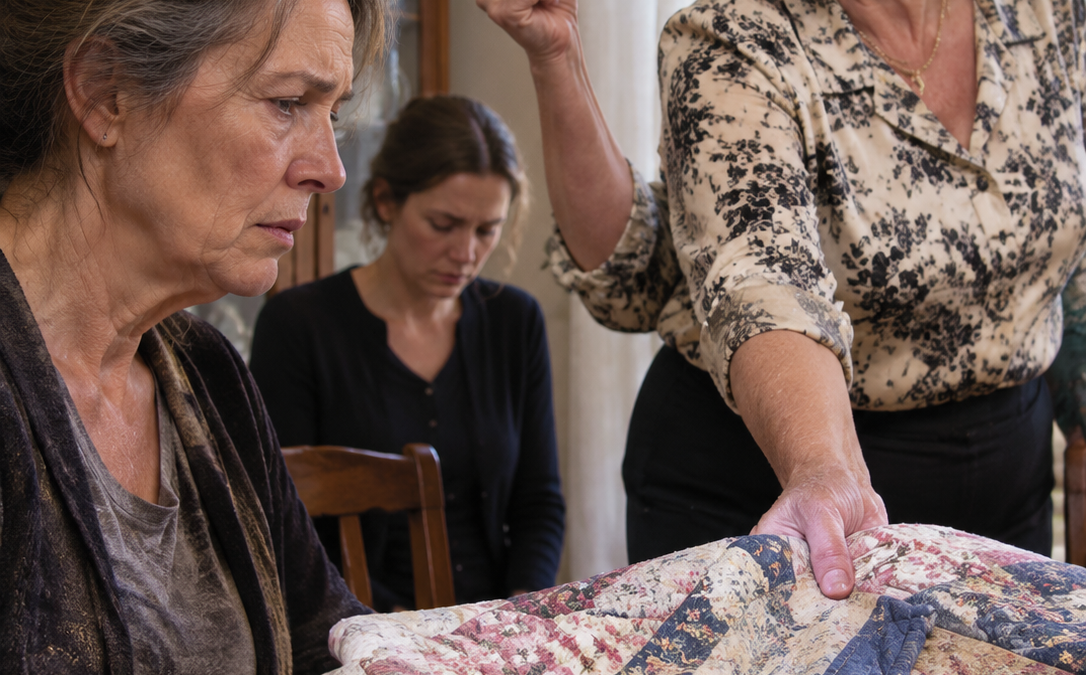
At 2:10 p.m. on Saturday, April 12, five weeks after Mom died, my older sister, Sheila, shoved the quilt across the dining table and said, “Keep Mom’s ugly quilt, it’s all you’re getting.”
Fifteen relatives sat in Mom’s dining room.
At the far end of the table, Sheila held the paper deed in one hand.
The deed showed that Mom had owned the house since 1981.
The other paper that mattered had already been admitted by the clerk four days earlier: Mom’s typed 2019 will, leaving the house to Sheila and naming her executor.
Sheila held the deed up as if it settled everything by itself.
The quilt slid over the tablecloth and stopped against my wrist.
It was one of Mom’s old patchwork quilts, faded at the folds, with a blue border and a small crooked section near one corner.
I knew the fabric.
I had seen Mom work on it at her sewing machine, sometimes with her glasses low on her nose and a pin tucked between her lips.
“All right,” I said.
My niece Lindsey stood beside her mother.
She looked down at the floor.
I was used to keeping my voice even.
I drove a milk route and started most mornings at 3:40.
There was no advantage to getting worked up over a late delivery or a blocked loading dock.
I had learned to save my words for what needed saying.
That afternoon, I kept them to myself.
Molly reached across the table for the quilt.
She was nine, in third grade, and had been my daughter since I adopted her from foster care in August 2019.
Her fingers caught the blue edge.
Sheila looked at Molly.
“That kid isn’t even blood. She gets nothing of Mom’s.”
Molly’s hand stopped.
I watched her face change as she tried to understand why her grandmother’s quilt had become something she was not allowed to touch.
She had spent years beside Mom while Mom pieced fabric and threaded needles.
She knew which scraps came from old dresses and which ones Mom saved because the colors pleased her.
I could have answered Sheila.
There were fifteen relatives in that room, and every one of them had heard what she said.
I could have reminded her that Molly was my child, that Mom had loved her, and that a family was not measured by matching blood.
The words came to me in a rush, but I did not say them.
Molly was still holding the quilt.
I put my hand over hers.
“Come on,” I said.
I gathered the quilt from the table and folded it over my arm.
Molly walked beside me as I left the dining room.
Nobody stopped us.
I heard a chair scrape behind me, then the low murmur of relatives starting to talk again.
The humiliation stayed with me all the way home.
It was not only what Sheila had said about me.
Molly had heard that she did not belong, spoken in a room full of people who knew how much she loved her grandmother.
I had taken her out of the room before anyone could make it worse, but I could not take the sentence out of her ears.
I put the quilt in a storage tote in my bedroom closet.
It still smelled faintly of Mom’s house, the clean cotton and the lavender soap she kept in the linen drawer.
I could not make myself wash it.
I could not put it on a bed, either.
Mom had once told me, “That quilt stays on a bed.”
I remembered the exact way she said it, as if she were giving me an instruction about something ordinary.
For five months, the tote stayed in my closet.
I went on driving my route before dawn.
I made deliveries, paid bills, and got Molly to school.
Sheila handled the house as executor.
The clerk had accepted the 2019 will on April 8, and there was nothing I could do about that without a reason to challenge it.
I had no reason then.
I thought the matter was settled, however unfair it felt.
By September, the evenings had begun to cool.
Sunday, September 21, was the first night I needed a sweater inside the house.
Sheila came to my door just after supper to get Mom’s spare key.
The ring of house keys in her hand jingled when she shifted her grip.
She was dressed for going somewhere, her purse on her shoulder, her bright voice already in place.
“I need the spare,” she said.
I brought it to her.
The key had been in my keeping since Mom died.
Sheila held out her hand without stepping inside.
“Closing is Friday,” she said.
“Three hundred ten thousand dollars.”
“It’s a good price, and I don’t want anything held up.”
I looked at the keys hanging from her fingers.
“Friday?”
“September twenty-sixth.”
She gave the ring a small shake.
“The paperwork is done.”
“The house is under contract.”
“I just need the spare.”
Sheila said it as if she were reminding me to return a borrowed casserole dish.
She did not mention Mom.
She did not ask whether Molly was settled in school or whether I had been sleeping.
Her attention stayed on the key.
Behind me, Molly was sitting on the floor with the quilt spread across her legs.
I had taken it out of the tote earlier that evening because the room was cold.
Molly had been looking over the patchwork, tracing the lines with one finger.
She pinched a section near the blue border and worked at a loose-looking stitch with her thumbnail.
Molly pointed to the seam.
“Grandma didn’t sew this part.”
I leaned closer to the quilt.
“Show me.”
Molly lifted her eyes but kept her fingers on the seam.
“This stitch is different.”
Sheila glanced over.
The keys jingled again.
“Let her rip it,” she said.
“It’s a rag.”
I stood still.
The quilt was no longer folded away in the closet.
Molly had found something in it that I had not noticed, and Sheila had dismissed it without even coming closer.
“Don’t pull hard,” I told Molly.
“I won’t.”
Sheila held out her hand again, impatient now.
I set the spare key in her palm.
Picking up where the Facebook post left off
She closed her fingers around it, turned, and left.
The keys made a quick bright sound as she went down the steps.
The door shut.
Molly returned her attention to the seam.
She eased one more stitch loose, then slipped her fingers into the opening in the lining.
Something crackled softly beneath the fabric.
“What is that?” I asked.
She drew out a clear freezer bag.
Inside were folded pages, pressed flat and protected from the dust and the quilt batting.
Molly held the bag carefully by its edges.
I crouched beside her.
The first line on the top page was in Mom’s handwriting.
I knew the tall capital letters, the careful loops, and the way she crossed a letter with a short firm stroke.
I had seen that hand on birthday cards, grocery lists, and the notes she left beside the sewing machine.
For a few seconds, I could only look at the writing.
The paper had been hidden inside the quilt Mom had told me to keep on a bed.
Sheila had thrown that quilt across a table and sent it home with me as if it were worthless.
Then, five months later, she had stood in my doorway and called it a rag.
Molly watched my face.
“Is it Grandma’s?”
“Yes,” I said.
My voice sounded different.
I turned the bag so I could read the heading without taking the pages out.
The closing was five days away.
Whatever Mom had written, I needed to know what it said before Friday.
The words at the top were plain.
“Last Will of Lorene Gilbert, in my own hand.”
Chapter 2: The Two Pages Under the Seam
The freezer bag lay between my hands on the kitchen table, and Friday’s closing date kept running through my mind.
The house was under contract for $310,000, and Sheila had already collected the spare key.
The pages inside the bag were still folded together.
I eased them apart and laid them flat beneath the kitchen light.
The first page began with Mom’s name and the date: February 11, 2024.
Sunday.
The handwriting ran across the paper in the same steady lines I remembered from her birthday cards.
Mom stated that this document revoked her earlier wills.
Then she wrote that the house was to go to me.
I stopped with my finger beneath the sentence.
I had spent five months believing the house was Sheila’s because the clerk had admitted the 2019 will.
The new page said otherwise.
The next bequest was clear: Mom’s savings, $41,000, to Sheila.
I looked at that amount for a long time.
Sheila had told fifteen relatives that I was getting the quilt and nothing else.
Mom had left her money.
At the bottom of the second page, Mom had written one more sentence.
“Molly knows my stitches.”
I turned toward the living room.
Molly was getting ready for bed, humming to herself while she put her school things away.
She had no idea what was inside the quilt.
I carefully brought the pages together and smoothed them against the tabletop.
I did not want to damage the paper.
I slid them back into the freezer bag and set the bag beside my phone.
The family group text was still on my screen from the last time Sheila had sent a message.
I scrolled back through the conversation, searching Mom’s name and the dates around the will.
On Sunday, February 18, 2024, Sheila had written: Mom’s writing at the kitchen table again, hides it when I walk in.
I held the phone still.
That message had been sent one week after Mom dated the handwritten will.
Sheila had seen her writing.
She had noticed Mom hiding it.
I scrolled farther.
On Sunday, February 16, 2025, Sheila had sent another message: Wanda’s got Mom. I don’t do Tuesdays. Or any days.
I knew what those words meant.
I had been the one keeping Mom company and handling the days Sheila did not want.
Sheila had not been there every day.
She had said so herself, in a family conversation she probably thought nobody would ever use against her.
I put the phone down.
The will did not look like a mistake, and Sheila’s messages did not look like a misunderstanding.
But the clerk had already accepted the typed document.
I had four days before the house was supposed to close.
I could not afford to sit at my kitchen table hoping the paper would somehow speak for itself.
At 3:40 Monday morning, I put the freezer bag inside my work bag and started my milk route.
I kept the bag in the zipped compartment, away from the invoices and delivery slips.
At each stop, I followed the familiar routine.
The orders needed checking, the milk needed carrying, and the delivery slips needed marking.
The pages rode with me through the dark streets while the sky slowly turned gray.
I kept thinking about the $310,000 sale.
If the closing went through on Friday, Sheila could sell the house before anyone had decided whether Mom’s handwritten will was valid.
I finished my route and drove to a lender.
I asked to borrow $4,800 against my pickup.
The pickup was how I earned my living.
I used it before dawn, loaded it for work, and depended on it to bring me home.
The person handling the paperwork explained what I was signing.
I did not ask for a smaller amount.
I signed.
When I left, I had the money I needed to hire a lawyer and a debt tied to the truck I drove every morning.
I called Lois Bush from the parking lot.
She was an estates attorney in Roanoke.
I told the receptionist that my mother had died, that a handwritten will had turned up inside a quilt, and that the house was due to close Friday.
The receptionist asked whether I had the original.
“Yes.”
She put me on hold, then came back with an appointment.
Lois could see me before noon.
I reached her office with time to spare.
Lois was sixty-one, with a direct way of speaking that left little room for guessing.
She asked me to sit and tell her what had happened.
I started with the clerk’s order on April 8.
Then I told her about the quilt, the seam Molly had opened, and the pages inside the lining.
I showed her the will and the two group messages.
Lois read the handwritten pages without interrupting.
She looked at the date, the revocation, the house bequest, and the $41,000 left to Sheila.
Then she set the pages down.
“The clerk already admitted the 2019 will,” she said.
“I know.”
“And the deed still names your mother.”
I nodded.
“The deed from 1981?”
“Yes.”
“That paper proves your mother owned the house. It does not make Sheila the owner.”
I looked at the pages.
“Then the new will changes it?”
“Not by itself,” Lois said. “The clerk’s order is already in place. Only a court can change which will governs.”
I felt my shoulders tighten.
“The closing is Friday.”
“I heard you.”
“Can you stop it?”
Lois did not promise me anything.
She asked when I had found the pages, who had handled them, and whether I had taken them out of the bag before that morning.
I answered each question as carefully as I could.
She made notes, then explained that the original needed to be kept secure.
I told her I had borrowed the retainer against my pickup.
“How much?” she asked.
“Four thousand eight hundred.”
“That is my retainer,” she said. “It does not buy a guaranteed result.”
“I understand.”
She slid the agreement across the desk.
I read the amount, signed my name, and pushed it back to her.
Lois gathered the pages and placed them in a folder.
She carried the folder to the safe in her office.
I watched her lock it away.
The pickup was at risk, the closing was four days off, and the court had not yet heard a word from me.
But the original will was no longer in my closet.
Chapter 3: The Woman Who Knew Her Handwriting
Lois had the original will in her safe, but the 2019 will still governed Mom’s estate, and Sheila’s sale remained on schedule.
On Monday afternoon, Lois called me back into her office.
She had laid out two possible ways to challenge the clerk’s order from April 8.
“The first is an appeal,” she said. “You have until October 8. We can ask the court to hear it ahead of the ordinary docket, and you do not have to post a bond.”
I looked at the date on her desk calendar.
October 8 was close enough to make me nervous, but the appeal sounded like the only road that could reach the house before the sale became final.
“What is the other way?”
“A separate suit asking for a jury. We have up to a year, but it moves more slowly.”
I thought about Friday, September 26, and the $310,000 contract.
A slower case could leave Sheila with a completed sale while I was still waiting for a courtroom.
“Then we appeal,” I said.
Lois studied me for a moment.
“You understand that this makes the dispute public. Sheila will know you are challenging her appointment and the will she used.”
“She already knows what she did.”
“That isn’t quite the same thing.”
I glanced at the folder on her desk.
Inside it were copies of Mom’s two handwritten pages.
The original was locked away, but I could still see the lines in my mind, including the sentence about Molly knowing her stitches.
“I want the appeal,” I said. “File it.”
Lois explained that the court would need two disinterested people who could support the handwriting and signature.
They could not stand to inherit from the will or gain anything from the outcome.
I asked whether she knew anyone who could do that.
“I know the kind of witnesses we need,” she said. “You will have to help me find them.”
Peggy Stevenson came to mind before Lois finished the sentence.
Peggy was seventy-five and had been the church secretary for years.
She had read Mom’s prayer lists for thirty years, and she knew the shape of Mom’s writing as well as I did.
I called her from the parking lot.
I told her about the will and asked whether she would be willing to speak to the court about Mom’s handwriting.
Peggy did not rush to answer.
“Does Sheila get anything if you win?” she asked.
“Forty-one thousand dollars.”
“And you?”
“The house.”
“Then I don’t get anything from it,” Peggy said. “I’ll tell the truth.”
Lois also needed someone who could speak to Mom’s signature.
She contacted Walter Burke, a retired teller, and explained what the court would need.
Walter agreed to help.
He would receive nothing from the estate, either.
When Peggy came to Lois’s office, she brought her phone.
She had found a Facebook post Sheila had made on Sunday, February 23, 2025.
The post included a photograph of Mom’s birthday card.
Peggy turned the screen toward us.
Sheila’s caption read: “87, sharp as a tack, still the prettiest handwriting in Roanoke.”
I looked at the photograph.
Mom’s name was written inside the card in the same hand as the will.
The loops, the spacing, and the firm strokes were familiar.
Peggy tapped the screen once.
“That’s Lorene’s writing. I read her prayer lists for thirty years. I know it.”
Sheila had praised Mom’s handwriting just sixteen days before Mom died.
I thanked Peggy.
She tucked her phone away and sat quietly while Lois made a note for the file.
Walter’s agreement gave Lois the second witness she needed.
Neither Peggy nor Walter had money to gain from the result.
They were willing to tell the court what they knew.
The next few days passed slowly.
I kept working, and Lois prepared the papers.
She called when she needed a date or a detail checked.
I answered from the pickup between deliveries, sometimes with my notebook balanced on the steering wheel.
On Thursday, September 25, Lois filed the appeal and formally offered Mom’s handwritten will to the court.
She also recorded a lis pendens against the house.
She explained that it put the public on notice that the property was part of a court dispute.
The title company could not simply carry on as though the ownership question did not exist.
I asked whether that would stop Friday’s closing.
“It gives the title company the notice it needs,” Lois said. “They will have to deal with the pending case before they can complete the transfer.”
I thanked her and went back to my route.
Friday morning, September 26, I was between deliveries when my phone began ringing.
Sheila’s number flashed across the display.
I picked up.
“What have you done?” she shouted.
I pulled the pickup over before replying.
The milk crates shifted behind me as I stopped.
“I’m working, Sheila.”
I moved the phone a few inches from my head.
“They said there’s an appeal and something recorded against the property. You put a lis pendens on Mom’s house?”
“Yes.”
“You had no right.”
“Lois filed it.”
“You hired a lawyer to take my house away?”
“Mom wrote another will.”
Her voice rose another notch.
“That paper was hidden in a quilt. You expect people to believe it?”
“The court will decide.”
“The condo deal is going to fall apart. I put eighteen thousand dollars down. Do you understand what you’ve done?”
I did understand that she had money tied up in the lake condo.
I also understood that the house had not belonged to her simply because the clerk had accepted the older will.
“You knew Mom was writing,” I said.
“Don’t start.”
“You wrote that she was at the kitchen table hiding it when you walked in.”
“That was nothing. You twist everything.”
“You also wrote that I had Mom and you didn’t do Tuesdays. Or any days.”
She went quiet for half a second, then raised her voice again.
“You’re going to pay for this, Wanda.”
I looked through the windshield at the next delivery stop.
I had milk to unload and a route to finish.
“So what’s your next move?” I asked.
“You’ll find out.”
The call ended with Sheila still shouting.
I sat for a moment with the phone in my hand.
The sale was stopped, but Sheila had a condo deal depending on money she expected from the house.
She would not accept the delay quietly.
What would she do to get the sale back?
I put the phone in its holder, checked the next address on my route sheet, and started the pickup.
I had deliveries left to make.
I finished my route.
Chapter 4: The Offer in the Dairy Parking Lot
By the end of September, the closing had stopped, and our hearing was set for October 30.
Sheila did not take the news quietly.
She started calling relatives, telling them I had made up a will and dragged a child into it.
I learned about the calls through the family group text.
One message from Sheila read, “Wanda and that foster kid forged it.”
Another followed a few minutes later.
“October 30. Come watch her lose.”
I was standing in my kitchen when I saw it.
Molly was at the table doing her spelling homework. She had a pencil in one hand and her school folder open beside her.
I turned my phone facedown.
I did not want her reading something that would make her feel she had done something wrong.
But children hear things even when adults try to keep them away from trouble.
A few days later, Molly came home from school and put her backpack beside the kitchen chair.
She did not ask for a snack.
She stood there with her coat still buttoned.
“What happened?” I asked.
She looked at the floor.
“A kid in my class called me fake.”
I put down the dish towel.
“Who?”
“A cousin’s kid. He said Grandma’s house wasn’t mine because I’m not real family.”
I pulled out the chair beside me.
“Did he say anything else?”
“He said you made up the paper because you wanted the house.”
Molly picked at a loose thread on her sleeve.
“Am I fake, Mom?”
“No.”
I answered before she could look away.
“You’re my daughter. You were my daughter before Grandma died, and you’re my daughter now.”
She nodded, but she did not look convinced.
I sat with her until she finished telling me what had happened.
Then I helped her put away her school things.
That night, I checked the appeal papers Lois had given me.
The hearing date was printed clearly: October 30.
I had borrowed $4,800 against the pickup to pay Lois.
If we lost, that debt would still be mine.
The truck would still have to be paid for, whether the judge believed Mom’s handwriting or not.
And Molly would have to live with the story Sheila was telling about her.
I could not afford to pretend the risk was small.
At 3:15 a.m. one morning, I pulled into the dairy lot before continuing my route.
Sheila was waiting near the edge of the parking area.
I recognized her car before I saw her standing beside it.
She had a coat pulled around her and her purse tucked beneath one arm.
I got out but kept the pickup door open.
“What are you doing here?”
She walked toward me.
“We need to settle this.”
I looked at the clock on the dashboard.
“I have deliveries.”
“Then listen quickly.”
She lowered her voice.
“Twenty-five thousand dollars.”
I stared at her.
“What?”
“I’ll give you twenty-five thousand if you drop the appeal.”
She said the amount as though she were offering me a reasonable business arrangement.
I looked past her at the dark lot.
The milk deliveries would not wait for a family argument.
“You want me to walk away from Mom’s will?”
“I want this finished.”
“You have a hearing.”
“And you have a child who doesn’t need to be dragged through court.”
I closed the pickup door.
“She doesn’t need to be dragged anywhere.”
“Then take the money and stop.”
I thought about the $25,000.
It was more than five times what I had borrowed against my pickup.
It could have paid off the loan and left money for other things.
For a few seconds, I pictured what it would mean to take it.
No more legal bills.
No more family messages.
No more waiting to find out whether the judge believed Mom had written those pages.
But the money came with a condition.
I would have to abandon the document Mom had hidden in the quilt.
I would have to accept Sheila’s version of what happened.
And Molly would still remember being called fake.
“What happens to the house?” I asked.
“Sheila’s house stays where it is,” she replied. “You get your money. Everybody moves on.”
“It’s not your house.”
Her expression changed.
“You always did make things difficult.”
I shook my head.
“No deal.”
She stared at me.
“You’re turning down twenty-five thousand dollars?”
“Yes.”
“Then don’t come crying when you lose.”
I opened the pickup door again.
“I have work.”
Sheila stepped back.
I climbed in, started the engine, and pulled out of the lot.
My hands were cold on the steering wheel.
The $4,800 loan had not disappeared.
Neither had the possibility of losing.
But I had made my choice.
When I spoke to Lois later that morning, I told her about Sheila’s offer.
Lois asked whether Sheila had put anything in writing.
“No.”
“Then we’ll proceed with what we have.”
I asked her about Molly.
“Does she have to testify?”
“No,” Lois said. “The case can be presented without putting her on the stand.”
I looked toward the hallway, where Molly’s school shoes were lined up beside the door.
“Then she stays in school.”
“That’s fine,” Lois said. “Your daughter does not need to be a witness to prove her grandmother wrote a will.”
I thanked her.
The following weeks were uncomfortable.
Sheila kept telling relatives that I had invented the document.
Some stopped calling.
Others sent messages asking why I was putting the family through this.
I stopped answering those messages.
I had work before dawn, a daughter to get ready for school, and an appeal to prepare for.
I also knew that Sheila had invited the relatives herself.
She wanted the fifteen people who had watched her push the quilt across Mom’s dining table to watch me lose in court.
On Wednesday, October 29, the day before the hearing, I checked Molly’s school clothes and packed her lunch.
She had a regular school day ahead.
I wanted it to stay that way.
That evening, Lois called to confirm the arrangements for the next morning.
She went over the witnesses and the papers she would be presenting.
Peggy and Walter were prepared to testify.
The original will was secure.
I was about to hang up when Lois mentioned another call.
“Your niece Lindsey contacted my office today.”
I stopped.
“What did she want?”
“She asked to be put on the witness list.”
I sat down at the kitchen table.
“Lindsey?”
“Yes. She said, ‘Put me on your list.’”
“Did she tell you why?”
“No.”
I looked toward the living room.
Lindsey had been standing beside Sheila on quilt day.
She had looked down when her mother insulted Molly.
I remembered her face, the way she had avoided looking at me while Sheila held up the deed.
“Did she say what she knows?” I asked.
“She wouldn’t discuss it over the phone. She only asked to be listed.”
I thanked Lois and ended the call.
I did not know what Lindsey intended to say.
She had spent months standing beside her mother.
Now, one day before the hearing, she wanted to stand in front of a judge.
Whose side was Lindsey on?
As I finished clearing the dishes, my phone lit up.
It was a message from Sheila.
“Bring the kid. Let her explain it under oath.”
Sheila’s message stayed on the screen while I gripped the phone.
Molly was nine years old.
She had school in the morning.
And Sheila still wanted to make her answer for something her grandmother had written.
Chapter 5: The Deed She Set on the Table
On Thursday, October 30, fifteen relatives filled the gallery of Roanoke City Circuit Court.
Sheila sat near the front, holding her purse in her lap.
She looked comfortable.
I had seen that expression before, at Mom’s dining table on April 12, when she pushed the quilt toward me and held up the deed.
Lindsey sat several rows behind her mother.
She had not spoken to me that morning.
I still did not know what she intended to tell the judge.
Lois sat beside me with the court papers arranged in front of her.
The original will had been brought from her safe.
The judge began by explaining that the appeal would be heard fresh. The question was whether Mom’s handwritten document should replace the 2019 will admitted on April 8.
Lois stood.
She read the heading first.
“Last Will of Lorene Gilbert, in my own hand.”
Then she read the date, February 11, 2024.
She continued through the two pages, including the sentence revoking Mom’s earlier wills.
The house went to me.
The $41,000 in savings went to Sheila.
At the bottom was Mom’s final sentence.
“Molly knows my stitches.”
I kept my eyes on the table.
I could picture Molly sitting on the floor with the quilt spread across her legs, carefully pulling one thread loose.
She had found the pages without knowing what they were.
Now those same pages were being read in a courtroom.
Lois called Peggy Stevenson.
Peggy walked to the witness stand with her handbag left behind on the bench.
She gave her name and explained that she had been the church secretary for thirty years.
She had read Mom’s handwritten prayer lists throughout those years.
Lois asked whether the writing on the will belonged to Lorene Gilbert.
“Yes,” Peggy said.
“How certain are you?”
“Very. I knew Lorene’s hand for thirty years. She wrote the same way on her prayer lists, her notes, and her cards.”
Lois showed her the pages.
Peggy identified the handwriting and explained the familiar shapes of the letters.
She did not embellish her answer.
When Sheila’s side had finished asking questions, Peggy returned to her seat.
Walter Burke was next.
He was a retired teller, and he had agreed to testify about Mom’s signature.
He examined the document and answered Lois’s questions about the signature.
He identified it as Lorene’s and confirmed that the signature belonged with the handwritten document.
Neither witness stood to receive a dollar from Mom’s estate.
Both had come because they knew what they knew.
Then Sheila was called.
She walked to the stand with her chin raised.
Lois began with the 2019 will.
“Did you tell relatives that your mother never wrote another will after 2019?”
Sheila answered without hesitation.
“Mom never wrote anything after 2019.”
Lois picked up a copy of the family group text.
She read Sheila’s message from Sunday, February 18, 2024.
“Mom’s writing at the kitchen table again, hides it when I walk in.”
Nobody in the gallery moved.
Lois placed the message with the other exhibits.
She asked Sheila whether she had sent it.
Sheila admitted that she had.
Lois moved to the handwriting.
“Did you claim this document was not your mother’s writing?”
Sheila shifted in her chair.
“That isn’t her hand. She couldn’t hold a pen.”
Lois held up the Facebook post from February 23, 2025.
The photograph showed Mom’s birthday card.
Below it was Sheila’s own caption.
“87, sharp as a tack, still the prettiest handwriting in Roanoke.”
Lois read the words aloud.
Then she asked Sheila whether she had written the post.
“Yes.”
“Was your mother sharp as a tack when you posted it?”
Sheila looked toward the judge.
“She was fine that day.”
Lois moved to the last statement.
Sheila had told relatives that she had cared for Mom every day for six years.
Lois presented the family group text dated February 16, 2025.
She read the message.
“Wanda’s got Mom. I don’t do Tuesdays. Or any days.”
Sheila’s face tightened.
“I was talking about something else.”
Lois set the phone printout down.
Sheila had made the statements herself.
The dates were on the documents.
Then Lois asked about the circumstances surrounding the handwritten will.
“She was confused by then. She didn’t know what day it was,” Sheila said.
The judge looked down at the papers.
Lois asked whether Sheila had any evidence that Mom was confused when she wrote the document.
Sheila did not give a clear answer.
Then she added, “That child had the quilt for five months. Anyone could have sewn that.”
Lois picked up the Facebook post again.
She reread the words, “sharp as a tack.”
Then she called me.
I walked to the stand and took the oath.
Lois asked about April 12, the day Sheila distributed Mom’s belongings in the dining room.
I described the fifteen relatives, the paper deed in Sheila’s hand, and the quilt she pushed across the table.
I told the judge what Sheila had said.
“Let her rip it. It’s a rag.”
I explained that Molly had been sitting on the floor with the quilt on September 21.
She had noticed a stitch that did not look like her grandmother’s work.
She carefully opened the seam and found the freezer bag inside the lining.
Lois asked whether I had altered the quilt or placed anything inside it.
“No.”
I explained that I had kept it in a tote in my closet since quilt day.
When Lois finished, I returned to my seat.
Then she called Lindsey.
My niece stood up slowly.
She passed her mother on the way to the witness stand.
Sheila turned to watch her.
Lindsey took the oath and gave her name.
Lois asked whether she had ever searched Lorene’s belongings for a newer will.
Lindsey looked toward the judge.
“Yes.”
“Who asked you to search?”
“My mother.”
Sheila’s hand tightened around her purse.
Lois asked what Sheila had told her.
Lindsey’s voice was quiet, but the courtroom was still.
“Mom sent me to search Grandma’s desk. She said, ‘Find it before Wanda does.’”
The relatives began turning toward Sheila.
One cousin leaned forward.
An aunt covered her mouth.
Lindsey kept her eyes on the judge.
Lois asked whether she had searched the desk.
“Yes.”
“Did you find the handwritten will?”
“No.”
“Did you tell your mother that?”
“Yes.”
Sheila stared at her daughter.
Lindsey did not look back.
I remembered her looking down on quilt day while Molly stood beside me.
Now she was telling the judge what her mother had asked her to do before that quilt ever came into my hands.
The judge took time to review the papers and testimony.
When the ruling came, everyone in the gallery sat still.
The judge admitted Mom’s February 11, 2024, handwritten will.
The April 8 order admitting the 2019 will was set aside.
The newer will revoked the older one.
The house belonged to me under Mom’s final instructions, and Sheila was entitled to the $41,000 savings.
The judge directed Sheila to surrender the 1981 deed and the house keys.
Sheila opened her purse.
Her fingers moved inside for several seconds before she pulled out the papers and the key ring.
She walked to the counsel table.
In front of all fifteen relatives, she placed the deed down first.
Then she set the keys beside it.
I looked at her.
“Forty-one thousand dollars, Sheila. It’s all you’re getting.”
She did not answer.
The judge finished the order.
Lois gathered her papers.
I stayed where I was for a moment, looking at the deed and the keys lying on the table.
What was left of Sheila’s plans and of this family?
The fifteen relatives watched without speaking.
I reached across the table and picked up the keys.
Chapter 6: The Check That Paid Sheila Off
The keys felt heavier than they should have when I carried them out of Roanoke City Circuit Court.
Mom’s February 11, 2024, will had been admitted, and the April 8 order was set aside.
I was now responsible for carrying out the instructions Mom had written by hand.
Lois explained the next steps in her office.
I had to qualify as executor under the newer will before I could handle the estate.
She helped me complete the paperwork and explained what needed to be filed.
I signed where she directed.
When the process was finished, I had the authority to administer Mom’s estate under the 2024 will.
The house was mine.
The $41,000 in savings belonged to Sheila.
I asked Lois how long I had to distribute the money.
“We can get the payment prepared once the funds are available,” she said. “Keep the documentation.”
I nodded.
I did not want Sheila claiming I had kept anything that belonged to her.
There was another piece of news Lois had heard about.
The seller of Sheila’s lake condo was keeping the $18,000 earnest money.
Sheila had put that money down expecting the house sale to provide what she needed for the rest of the purchase.
When the title company stopped the closing, her plans fell apart.
The seller was not returning the deposit.
I thought about the morning Sheila had waited for me at the dairy lot.
She had offered me $25,000 to walk away.
Now she had lost $18,000 of her own money.
I did not feel pleased about it.
I had a house to take care of and a daughter who had spent months hearing that she was not real family.
The following week, I arranged for the $41,000 payment.
I obtained a certified check for the exact amount and sent it to Sheila by certified mail.
I kept the receipt and the mailing record with the estate papers.
Mom had left Sheila that money.
I was going to make sure she received every dollar.
A few days later, Sheila called.
I was at home when her name appeared on my phone.
I considered letting it ring, but I answered.
“We need to talk,” she said.
Her voice sounded different from the one she had used at the dairy lot.
She was not shouting.
“About what?”
“About everything. The house. The hearing. Lindsey.”
I stood beside the kitchen counter.
“The check is on its way.”
“That’s not what I’m talking about, Wanda.”
I waited.
“I think we should sit down somewhere. Just the two of us.”
I looked at the estate folder on the table.
For months, Sheila had spoken to me through accusations, threats, and demands.
She had called Molly fake.
She had told relatives I forged Mom’s will.
She had offered money to make me abandon it.
Now she wanted a private conversation.
“Lois has your paperwork.”
“I’m your sister.”
“I know.”
“You can’t just keep hiding behind that lawyer.”
I did not answer.
After a short pause, the line went quiet.
I set the phone beside the estate folder and returned to the paperwork.
There was nothing else I needed to say.
Thanksgiving came on Thursday, November 27.
I had spent the previous afternoon cleaning Mom’s dining room and getting the table ready.
It was the same room where Sheila had pushed the quilt toward me in April.
I had not forgotten the fifteen relatives sitting around that table.
I had not forgotten Lindsey looking down.
This time, nine relatives came to Thanksgiving dinner.
Some had called ahead.
Others arrived with dishes and small containers of food.
I did not ask anyone to explain why they had changed their minds about visiting.
I set out plates and made room for everyone.
Molly helped me put napkins beside the silverware.
She was quieter than usual when the doorbell rang, but she greeted the relatives who came inside.
One aunt approached her before dinner.
She bent slightly so she could speak to Molly without making her look up.
“I owe you an apology,” she said.
Molly held the napkins against her chest.
“For what?”
“For not speaking up when your grandmother’s quilt was thrown at you. I heard what was said, and I should have told your aunt she was wrong.”
Molly looked toward me.
The aunt continued.
“You belong in this family, sweetheart. I should have said that when you needed to hear it.”
Molly nodded.
“Thank you.”
The aunt touched her shoulder gently, then went to put her dish on the counter.
I had heard the apology.
I did not need to add anything to it.
Lindsey arrived later.
She came alone.
She stood in the doorway holding a covered dish and looked toward the dining room.
“Hi, Aunt Wanda.”
“Hi, Lindsey.”
She stepped inside and set the dish on the counter.
She was not wearing the same expression she had worn on quilt day.
She looked tired.
I did not ask about Sheila.
Lindsey had already told the judge what her mother had asked her to do.
She had taken the stand and spoken the words that changed the hearing.
I knew that could not have been easy.
“Thank you for coming,” I said.
She nodded.
“I’m glad you let me.”
I showed her where she could sit.
She did not ask whether Sheila had been invited.
I did not offer an explanation.
Dinner went on without anyone making a speech about the court case.
People talked about school, work, the cold weather, and the food.
Molly helped carry dishes to the kitchen.
At one point, she laughed at something one of the cousins said.
I looked across the table and saw Lindsey watching her.
When our eyes met, Lindsey lowered hers briefly.
I wondered whether she was remembering the afternoon in April.
I was, but I did not bring it up.
After dinner, the relatives began collecting their coats.
The aunt who had apologized hugged Molly before leaving.
Lindsey stayed until the others had gone.
She helped me carry two empty dishes into the kitchen.
“Are you doing all right?” she asked.
“I’m managing.”
She nodded.
“Grandma would have wanted you to have the house.”
I put a dish beside the sink.
“I think she wanted what she wrote.”
Lindsey looked toward the dining room.
“I should have said something sooner.”
I did not tell her she was forgiven.
I did not tell her she wasn’t.
She had made her choice in court, and I knew what it had cost her to do that in front of the family.
When Lindsey left, I locked the front door.
The house was quiet again.
Molly was in the dining room, looking at the quilt.
The freezer bag and the two pages were no longer inside the lining.
The seam Molly had opened still lay loose along the edge.
I had placed the quilt in a clean tote after the hearing, but I had not tried to repair it.
I was afraid of making the wrong stitch.
Molly ran one finger along the opening.
“Mom?”
“What is it?”
She looked toward the hallway.
“Grandma’s sewing basket. Do you still have it?”
I nodded.
“It’s in the closet.”
Molly looked back at the quilt.
“Can we get it?”
I followed her gaze to the crooked seam.
Then I went to the closet and opened the door.
“What will we do with the quilt?” I asked.
Molly looked up at me.
“I want Grandma’s sewing basket.”
Chapter 7: The Seam Molly Sewed Shut
On Saturday, January 24, 2026, the first snow began falling over Roanoke.
I came off my milk route to Lorene’s house, now ours, with cold hands and more deliveries waiting after I went back out.
The house had begun to feel like home.
Molly’s school things sat beside the kitchen door, and her coat hung next to mine.
The spare key hung on Molly’s hook, low enough for her to reach.
Sheila no longer had a key.
The keys she surrendered in court stayed with me, but I had put the spare where Molly could find it.
We had moved into Mom’s house after the court finished its work.
A few boxes remained upstairs, but the rooms we used were settled.
I kept my work clothes near the back door so I could leave before the street woke.
The quilt had stayed folded in its tote since Thanksgiving.
The seam Molly had opened was still loose.
We had removed the freezer bag and Mom’s pages, and the will was part of the estate record.
Nothing was hidden in the lining anymore.
I set my work bag on a kitchen chair and took the copy of Mom’s will from the folder Lois had given me.
At the bottom of the second page, Mom had written, “Molly knows my stitches.”
I reread that sentence.
Molly came in carrying the sewing basket.
She had asked for it on Thanksgiving night, and I had taken it from the closet.
The little basket had belonged to Mom.
“Can we do it now?” she asked.
I looked at the quilt.
“If you’re ready.”
She set the basket on Lorene’s bed and lifted the lid.
Inside were spools of thread, a small pair of scissors, and needles tucked into a folded piece of cloth.
Molly touched the things carefully.
I spread the quilt across the bed.
Its blue border was faded, and the patches had softened from years of washing.
I recognized scraps from Mom’s old dresses.
Molly found the opening along the lining.
“That’s where it was,” she said.
“Yes.”
She ran a finger along the place where the freezer bag had been.
“It’s empty now.”
“It’s empty.”
She glanced at the folded pages on the dresser.
“Grandma’s writing is safe?”
“Lois has the original in the estate papers. We have our copy.”
Molly nodded.
I pulled a chair close, but she shook her head.
“I can do it.”
I moved the chair back.
She chose a needle and a spool of thread that matched the faded blue lining.
Her fingers worked at the end of the thread.
She missed the eye once, stopped, then tried again.
This time, the thread slipped through.
“I got it.”
“I see that.”
She pulled enough thread through and tied a small knot.
Then she brought the two sides of the opening together.
I remembered Mom sitting on this same bed, sorting fabric across her lap.
She never hurried a stitch.
If a piece did not lie right, she took it out and began again.
Molly leaned over the quilt.
Her first stitch was small.
She passed the needle through one side, then the other, pulling the thread until the edges met.
She repeated the movement, leaving just enough space between stitches to keep the lining flat.
I sat beside her.
Outside, snow gathered along the window ledge.
Molly worked slowly, checking that the fabric had not folded underneath.
When the thread tightened, she eased it instead of pulling hard.
The opening grew shorter.
I thought about April 12, when Sheila shoved this same quilt across Mom’s dining table.
Fifteen relatives watched me gather it into my arms and walk Molly out.
Sheila held the deed and kept the house keys.
She told me the quilt was all I was getting.
Now the deed and keys were no longer in her hands.
The house was ours, and Molly was sitting on her grandmother’s bed, using her grandmother’s sewing basket.
She had found the pages that changed everything.
When she reached the end of the opening, she tied off the thread and examined her work.
“Is it closed?” I asked.
“Almost.”
She found a small gap near the edge and closed it with another neat stitch.
Then she studied the seam.
I expected her to put the needle away.
Instead, she took another length of thread and made one large crooked stitch near the blue border.
It leaned to one side and crossed the smaller stitches at an angle.
“That’s different,” I said.
“I know.”
“Was that on purpose?”
Molly nodded.
“Grandma’s stitches are little. I wanted one of mine to look different.”
She held up the quilt to see the whole seam.
“Now it’s mine, too.”
I touched the edge of the fabric.
“Looks good.”
Molly put the needle back in the basket, gathered the loose thread, and closed the lid.
The opening was gone.
The place where the pages had been hidden was closed with small, careful stitches and one crooked one Molly had made herself.
She picked up the quilt by its blue border.
“Help me?”
I took the other side.
Together, we spread it across Lorene’s bed.
Molly smoothed the corners and stepped back.
The crooked stitch showed near the edge.
She climbed onto the mattress and pulled the quilt over the bed until it covered the old sheets.
“That’s where Grandma wanted it,” she said.
I looked at the pillow and the familiar patches beneath the window.
“Yes,” I said.
“That’s where it belongs.”
The lamp beside the bed was still on.
Molly returned the sewing basket to the dresser.
I checked that the needle was safely inside and closed the lid.
Then I turned off the lamp.
I left for my route.
THE END







