The Fundraiser Chair Put My Piano Up for Auction Before Sixty Parents—Then His Own Signature Changed The Room
Complete story · 10 chapters · about 45 minutes · ending included
Chapter 1: The Ribbon On My Piano
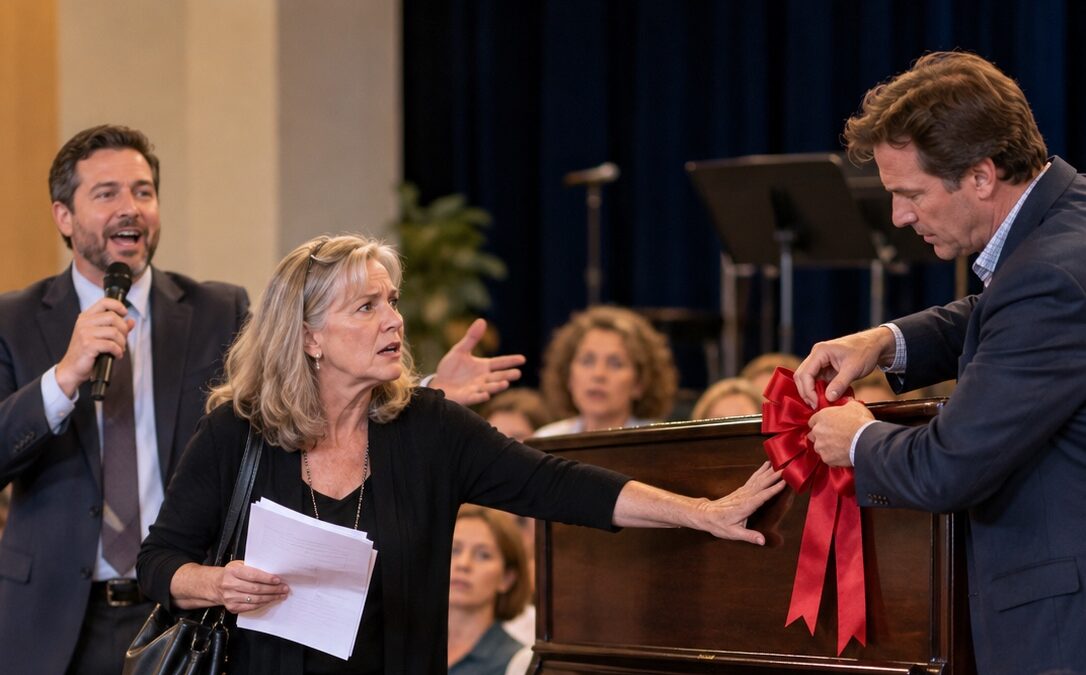
The red auction ribbon brushed the polished side of my piano while Ernest Keene tied it around the music stand.
For a second, I thought he had picked up the wrong ribbon.
Then he tightened the knot.
I stood three steps away in the auditorium of the community arts center where I had taught for twenty-six years. Sixty parents filled the folding chairs. Students waited with sheet music in their laps. My upright piano stood under the stage lights, exactly where it had stood for recitals since I loaned it to the center in May.
My retirement concert was supposed to be simple.
Students would play. I would play my final solo. Parents would say goodbye.
Later, I would arrange to have my piano returned home.
That had always been the agreement.
I had loaned it to the center on May 4.
I had never donated it.
“Ernest, what are you doing?”
He stepped back from the ribbon.
“Getting the auction display ready.”
“My piano isn’t an auction item.”
He looked at me as if I were objecting to the placement of a chair.
“You’re retiring, Suzanne.”
“That doesn’t change who owns it.”
A few parents in the front row began watching us.
Peter McBride stood near the microphone with auction papers tucked under one arm. He was volunteering as the announcer that evening because his daughter had been one of my students.
Ernest lowered his voice, though several people could still hear him.
“Retirement means letting people with a future use your things.”
I stared at him.
I was fifty-eight.
Apparently Ernest had decided my future had already expired.
Before I could answer, Peter tapped the microphone.
“Before our next student performs, we have something special to recognize tonight.”
My stomach tightened.
Peter smiled toward the parents.
“As many of you know, Suzanne is retiring after decades of teaching here. Tonight we’re celebrating everything she’s given this center.”
Parents applauded.
Usually that sound embarrassed me in a pleasant way.
This time, I wanted it to stop.
Peter gestured toward my upright.
“And we have one very special retirement donation included in tonight’s fundraising catalog.”
The applause changed.
Heads turned toward the piano.
Peter continued.
“Suzanne’s piano has been listed as an auction item for the center’s next season.”
No bid had been invited.
Nobody had raised a hand.
No money had changed hands.
But donation had already been said in front of sixty parents.
I walked straight to the piano.
Ernest moved half a step toward me.
“Suzanne, don’t make this awkward.”
“You already did.”
I placed my hand over the closed fallboard above the keys.
I knew that instrument better than anything else in the room. I knew the faint scratch near middle C. I knew how the bench creaked if someone sat too far left.
And I knew its serial number.
684271.
It was on my purchase invoice at home, my insurance paperwork, and the signed loan agreement in my bag.
Peter lowered the microphone when he saw my face.
“Suzanne?”
“That piano is on loan.”
The room quieted.
Ernest shook his head.
“We can discuss the paperwork after the guests leave.”
“No.”
I picked up my handbag from beside the front-row chair and opened the inner pocket.
Parents turned toward me.
That hurt more than Ernest’s smug expression.
This was supposed to be my farewell concert. My students had practiced for weeks. I had wanted their families to remember their children playing, not their teacher arguing over whether she had given away a $9,600 piano.
But staying quiet would let Ernest’s version become the truth.
I pulled out the folded agreement.
“This is the signed loan agreement. Ernest signed it with me on May fourth. It says I own the piano and can request its return.”
Peter’s microphone dropped to his side.
Ernest’s jaw tightened.
Eileen Cannon came down the side aisle before Ernest could answer.
She had been moving between the auditorium and lobby all evening, keeping the student performances on schedule.
She looked at me, then at the red ribbon.
“What happened?”
Peter answered.
“I announced the piano as Suzanne’s retirement donation. It’s in the catalog.”
“It isn’t a donation,” I said.
Ernest folded his arms.
“We can straighten out the terminology later.”
Eileen looked at the paper in my hand.
“May I see the agreement?”
I gave it to her.
She opened it immediately.
That was how Eileen handled questions. She read the exact words before answering.
Her finger moved down the page.
She stopped at the paragraph confirming my ownership, then the provision allowing me to request return.
Then she reached the clause stating that the center had no right to sell, pledge, donate, or otherwise transfer the piano.
She looked at Ernest.
“This says loan.”
“That was the original arrangement,” he said.
“The original arrangement is still the arrangement,” I said.
Eileen checked the page once more.
“Yes.”
Ernest shifted beside us.
“I was working from the fundraising materials.”
I pointed toward the ribbon.
“Then somebody put false information into those materials.”
Eileen turned to Peter.
“Have any bids been invited?”
“No.”
“Any payments?”
“No. I only announced the item.”
Eileen walked to the microphone.
“The piano lot is withdrawn pending verification. There will be no bidding on that item tonight.”
A murmur moved through the audience.
My ownership was protected for the moment, but my retirement concert had become a public disagreement.
I had made the choice to object.
Now sixty parents knew there was something wrong.
Eileen continued.
“We have a signed loan agreement that must be checked against the event records. The scheduled student performances will continue while I verify the listing.”
Peter took the microphone again and called the next student forward.
A young pianist approached the upright with her music clasped against her chest. She looked from the ribbon to me.
“Am I still supposed to play?”
“Yes,” I said. “Absolutely.”
She sat at the bench.
I stepped away so she could begin.
That mattered to me.
Whatever Ernest had done, I wasn’t going to turn the students’ concert into an argument that swallowed the whole evening.
As the student played, Eileen stood beside me and reopened the agreement.
She pointed to the return section.
“Five business days after a received written request. The center arranges insured movers and gets a signed receipt.”
“Yes.”
“And Ernest signed this?”
“Yes.”
Ernest answered too.
“I did.”
Eileen looked at him.
“Then Suzanne’s ownership isn’t in dispute under this document.”
He frowned.
“The catalog says donation.”
“That is what I’m checking.”
She motioned to an authorized staff member near the auditorium door.
“Please bring me the current event folder from the office. I want the staging records and the final auction materials.”
The staff member left.
The student finished her piece, and the parents applauded.
Picking up where the Facebook post left off
Another student came forward.
The concert kept moving around us.
Eileen handed the agreement back to me.
“Keep this with you.”
“I will.”
Ernest exhaled sharply.
“We could have handled this privately.”
I looked at the ribbon tied to my piano.
“You listed it publicly.”
His eyes moved away from mine.
Peter stood near the microphone between performances, no longer wearing the cheerful expression he’d started the evening with.
He leaned toward me.
“I thought you’d changed your mind about giving it.”
“Why?”
“I saw the catalog.”
“Who told the catalog it was a donation?”
Peter hesitated.
“I don’t know.”
Eileen heard him.
She looked toward the office door, waiting for the event folder.
Then she faced Ernest.
“I need to determine who authorized that listing.”
Ernest started to answer.
Eileen raised one hand.
“Not in front of the students.”
She looked at Peter.
“You announced from the catalog, so I need you with us.”
Then she turned to me.
“Suzanne, please come too.”
The next student began playing as Eileen led Ernest, Peter and me toward the side door.
The lot had been stopped before a single bid.
The signed agreement said exactly what I knew it said.
My piano was a loan.
What we did not know yet was who had decided to call it a donation.
Eileen opened the side door and motioned for the three of us to follow her.
Chapter 2: The Number Under The Lid
Eileen closed the backstage door behind us, but Ernest kept talking as if the signed agreement had settled nothing.
“Suzanne was always going to leave something to the center,” he said. “Everyone understood the piano was the retirement donation.”
I looked at him.
“Everyone except the person who owns it.”
Peter stood near a stack of music stands, still holding the microphone he had carried offstage. Through the wall, I could hear the next student playing. The sound was softer back there, but steady.
Eileen held out her hand.
“Suzanne, may I see the loan again?”
I gave it to her.
Ernest sighed.
“We are making this much bigger than it needs to be.”
I pointed to the bottom of the agreement.
“That is your signature.”
He glanced at it.
“I know what I signed.”
“Then stop calling me a donor.”
His mouth tightened.
He looked toward Eileen.
“Let the concert finish. Let the guests leave. Suzanne and I can sit down afterward and work this out quietly.”
That was exactly the kind of ending I would have preferred before he tied a ribbon to my piano in front of sixty parents.
A quiet room.
Four chairs.
No audience.
No students wondering why their teacher was arguing beside the instrument they had practiced on.
But Ernest had already made the claim in public.
If I agreed to wait until everyone went home, the parents would leave with his version in their heads.
I shook my head.
“No. You announced a donation that never happened. We verify it now.”
Ernest looked irritated.
“You really want to do this during your retirement concert?”
“I wanted to have a retirement concert. You put my piano in an auction.”
Eileen folded the agreement once and handed it back.
“We are checking the records during the scheduled performances. The lot is already withdrawn. Nobody is stopping the program.”
She opened the backstage door.
“Let’s verify the instrument.”
We returned to the side of the auditorium while another student played.
The red ribbon was still tied around the music stand.
Eileen waited until the student finished, then walked with me to the upright.
“Show me where the serial is.”
I lifted the lid carefully and pointed.
Eileen leaned closer.
“Six eight four two seven one.”
“Yes.”
I opened the loan to the instrument description.
She read the number there.
“684271.”
The two matched.
There was no second piano to confuse with mine.
No similar instrument from a storage room.
No question about which upright the agreement covered.
Peter came down the aisle carrying a copy of the final fundraising catalog.
“I found one at the registration table,” he said.
Eileen took it.
“Show us the listing.”
He turned several pages and stopped.
I moved beside her.
There was my piano.
The description named the upright as a retirement donation from Suzanne Nash.
Below it was the serial number.
For a few seconds, nobody spoke.
I did not need another document to prove ownership. The loan had already done that.
What the catalog proved was different.
This was not a vague sentence about “a piano.”
It identified my exact instrument.
Eileen tapped the printed number.
“Same serial as the piano.”
“And the loan,” I said.
Peter nodded.
Ernest leaned in, then stepped back.
“The printer must have changed the wording.”
Eileen looked at him.
“What wording did you send?”
“I don’t remember the exact phrasing.”
“You approved the catalog.”
“I approved the fundraiser package. That doesn’t mean I wrote every line.”
I watched him carefully.
Five minutes earlier, he had said everyone understood I was donating the piano.
Now the problem was supposedly a printer changing words.
Peter shifted the catalog under his arm.
“I sent the final materials to the printer.”
Ernest turned toward him.
“Then you know how these things happen. Files get reformatted. Descriptions get cleaned up.”
Peter frowned.
“I didn’t write the lot descriptions.”
“I didn’t say you did.”
Eileen raised her hand before either man continued.
“Peter, when you sent this file, was there an approval chain?”
“Yes.”
“Email?”
“Yes.”
“Did Ernest approve the final catalog before it went out?”
Peter hesitated.
“I believe so.”
Ernest gave him a sharp look.
“You believe so?”
Peter straightened.
“I handled a lot of event messages this week.”
Eileen kept her voice even.
“I’m not asking you to remember from memory. I’m asking you to find the record.”
Another student began playing behind us.
I looked at the catalog again.
My name.
My piano.
My serial number.
Donation.
The word sat beside facts that were all correct except the one fact that mattered most.
I had never given it away.
Ernest moved closer to me.
“Suzanne, this is exactly why I wanted to talk after the concert. If the printer made a mistake, we fix the printer’s mistake.”
“You were calling me a donor before we looked at the catalog.”
“I was relying on the catalog.”
“You signed the loan.”
He looked away.
Eileen handed the catalog back to Peter.
“Find the final version you sent and the message approving it.”
Peter pulled out his phone.
He stepped toward the wall to get out of the path of students moving on and offstage.
I watched his thumb move through his email.
He searched once, frowned, then typed again.
Ernest said, “This is unnecessary.”
Eileen did not look at him.
“It is necessary because you blamed the printer.”
Peter scrolled.
The student onstage reached the last page of her piece.
Then Peter stopped moving.
His eyes stayed on the phone.
“I found it.”
Eileen turned.
“The printer message?”
Peter shook his head.
“No. Ernest’s.”
He looked up at us.
“His approval email from this afternoon.”
Chapter 3: The Email Peter Kept
Peter held his phone where Eileen and I could both see it.
Ernest stayed a few feet away.
“Open the email,” Eileen said.
Peter tapped the message he had found.
I leaned closer.
I was not going to let him summarize it for me. Five minutes earlier, Peter had announced my piano as a donation because he had trusted the catalog. Now I wanted to see exactly what Ernest had approved.
The message was from Ernest that afternoon.
Peter opened it.
The text was brief. Ernest told Peter the attached final catalog was approved for the evening’s fundraiser materials.
Peter glanced at me.
“That’s the approval I remembered.”
“Open the attachment,” I said.
He did.
The final catalog loaded on his screen.
Peter scrolled until he reached the piano listing.
My name appeared first.
Suzanne Nash.
Then the description identifying my upright as a retirement donation.
Then the serial number.
It was the same wording in the printed catalog Peter had brought from the registration table.
I looked at Ernest.
“The printer didn’t add it.”
He folded his arms.
“You don’t know what happened after that file was sent.”
Peter looked down at his phone.
“This attachment is the version I sent.”
Ernest’s expression hardened.
“Files can still get changed.”
Eileen stepped beside Peter.
“Can you preserve the email exactly as it is?”
“Yes.”
“Do that now.”
Peter forwarded a copy to his own event records and saved the message with its attachment intact.
Watching him do it made me uncomfortable in a way I had not expected.
Peter had been smiling when he announced my supposed donation.
He had wanted the evening to go well. His daughter had studied at the center, and he had volunteered because he cared about the students.
Now he was preserving a record that showed the announcement he had made came from a catalog Ernest had actually approved.
Peter had been wrong in front of sixty parents.
Protecting the email meant protecting proof of that mistake too.
He did it anyway.
“I want a paper copy,” Eileen said. “Not instead of the electronic one. In addition to it.”
Peter nodded.
“I can print from the office.”
The next student had begun playing, so Eileen told an authorized staff member near the side aisle that we would be in the office briefly.
We crossed the hall without interrupting the performance.
The office printer sat behind Eileen’s desk.
Peter connected to it from his phone and printed the email first.
Then he printed the attached catalog pages showing the piano listing.
The machine pushed out the sheets one by one.
Peter picked them up and placed them flat on the desk.
Eileen read the email before touching the catalog.
I stood beside her and read it too.
Ernest’s approval referred to the attachment as the final catalog.
There was no instruction asking the printer to change the piano description.
No correction.
No warning that my instrument was merely on loan.
Peter turned to the listing.
The wording matched the distributed catalog exactly.
My name.
Retirement donation.
Serial 684271.
I looked toward Ernest.
“You approved this version.”
“I approved a catalog,” he said. “That doesn’t mean I selected your piano.”
I stared at him.
He had moved from one explanation to another so quickly that I had to keep track of them.
First, everyone supposedly knew I was donating the piano.
Then the printer had supposedly changed the wording.
Now that the approved attachment matched the printed catalog, Ernest was separating approval from selection.
Eileen apparently noticed the same progression.
“You approved a final catalog containing Suzanne’s specific piano and its serial number,” she said.
“That doesn’t mean I chose the inventory.”
“Who did?”
Ernest spread his hands.
“There were volunteers handling staging. Items were being moved around all afternoon.”
Peter looked at the printed email.
“There’s something else here.”
Eileen turned toward him.
“What?”
Peter pointed to a line near the bottom of Ernest’s message.
I moved beside him.
The email referred to the staging worksheet used for the current auction setup.
I did not know what was on that worksheet.
I had never seen it.
That distinction mattered to me.
I already knew Ernest had approved the catalog. I did not yet know who had taken my borrowed piano from the center’s records and assigned it to the auction.
Eileen read the reference carefully.
“Is that worksheet normally kept with the event folder?”
“Yes,” Peter said. “The staging paperwork goes back to the office folder after setup.”
Ernest shook his head.
“You’re treating routine paperwork like it’s a confession.”
“No one called it that,” Eileen said.
Her voice stayed calm.
“We’re verifying who selected Suzanne’s piano for this event.”
“I already told you I didn’t.”
Eileen looked toward the authorized staff member who had come to the office doorway.
“The current event folder was requested earlier. Please locate the staging worksheet referenced in this email and bring the folder to me when you find it.”
The staff member nodded and went back toward the records area.
Ernest glanced toward the door.
“We have students performing while we’re digging through paperwork.”
“The students are performing on schedule,” Eileen said. “The piano lot is withdrawn. We are using that time to verify the records.”
Peter gathered his printed email and catalog pages.
He did not offer them to Ernest.
Instead, he held them against his chest and looked at me.
“I should have checked before I announced it.”
I did not tell him it was fine.
It wasn’t.
But he had opened the email in front of me, preserved it, and printed the exact approval instead of protecting himself with a vague memory.
That counted for something.
I looked through the office doorway toward the auditorium.
The music continued.
My farewell concert was still happening while four adults tried to determine how my piano had become an auction lot without my permission.
Eileen returned to the printed email.
“Peter, read me the worksheet reference.”
He lowered the pages and found the line.
Then he read the identifying information aloud.
It named the current staging worksheet for Friday, October 30, 2026.
The same day Ernest had tied a red ribbon to my piano.
Chapter 4: The Chair Who Bargained
The approval email was printed and preserved, the piano lot was stopped, and an authorized staff member was searching for the October 30 staging worksheet.
Ernest still wanted to negotiate.
He waited until Peter stepped toward the office printer to straighten his pages.
Then he moved closer to me.
“Suzanne, there is a way to finish tonight without turning this into something ugly.”
I looked at him.
“It became ugly when you called my piano a donation.”
“I’m trying to fix that.”
“How?”
He glanced at Eileen before answering.
“We could announce that you reconsidered. Retirement is emotional. People would understand that you decided you wanted the piano back after all.”
I stared at him.
He was offering me a version of events in which I had donated my piano, watched him put it up for auction, then changed my mind in front of sixty parents.
The signed loan disappeared from that story.
So did his approved catalog.
“I never gave it away,” I said.
“I know what the paperwork says.”
“The paperwork says what happened.”
Ernest pressed his lips together.
“Let me finish.”
I folded my arms.
He lowered his voice.
“We could give you an honorary plaque from the center. Something recognizing your twenty-six years of teaching and your support of the program. We make tonight about appreciation instead of an argument.”
I had received plenty of thank-you cards over the years.
A plaque might have been kind if it had been offered for the right reason.
This one had a price attached.
All I had to do was accept blame for changing my mind.
“No.”
“Suzanne.”
“No plaque. And nobody tells those parents I withdrew a gift.”
His face tightened.
“I’m offering you a graceful way out.”
“I don’t need a way out. My name is on a loan.”
Eileen stepped closer.
“Ernest, stop.”
He turned toward her.
“I’m trying to keep this from damaging the center.”
“So am I,” she said. “That means the correction has to be accurate.”
I looked at Eileen.
“Then say the piano was never donated.”
“I will.”
She paused before continuing.
“But if we make a full correction tonight, it cannot sound as though Ernest acted completely outside the center while everyone else did everything correctly.”
I waited.
Eileen glanced at the printed catalog.
“I accepted his certification of the catalog without checking this instrument against the loan records. The center distributed the catalog. Peter announced from it. My oversight belongs in the correction too.”
I had expected her to defend the center.
Instead, she was putting her own mistake beside Ernest’s.
“That is fine with me,” I said. “As long as nobody says I changed my mind about a donation.”
“They won’t.”
Ernest shook his head.
“You’re both making a public correction before we even know what happened with staging.”
“We know enough to correct the donation claim,” Eileen said. “Suzanne owns the piano under the signed loan.”
The next performance ended in the auditorium, followed by applause.
I could hear Peter announcing another student.
The concert was still moving.
I looked toward the doorway.
For months, I had imagined leaving the center quietly after retirement. I had even rehearsed polite ways to ask for my piano back so nobody would feel that I was taking something from the students.
Ernest had cured me of that hesitation.
I opened my handbag and found a pen.
Eileen watched me.
“What are you doing?”
“Requesting its return.”
Ernest frowned.
“Tonight?”
“Yes.”
I turned over one of the blank sheets Peter had left near the printer.
Eileen pulled a clean page from the office supply tray instead.
“Use this.”
I wrote the date first.
October 30, 2026.
Then I wrote a direct request for the return of my upright piano, serial 684271, under the May 4 loan agreement.
No speech.
No accusation.
Just the request the contract allowed me to make.
I signed my name and handed it to Eileen.
She read the page from top to bottom.
“Received tonight, Friday, October thirtieth,” she said.
She wrote the acknowledgment beneath my request and signed as director.
“The agreement gives us five business days after receipt.”
I counted them automatically.
Monday.
Tuesday.
Wednesday.
Thursday.
Friday.
Eileen did the same.
“Delivery deadline is Friday, November sixth.”
“Yes.”
“The center will arrange insured movers and obtain a signed receipt.”
“That is what the agreement says.”
“And that is what we will do.”
Ernest looked from the paper to me.
“You’re really taking it out of the center?”
“I’m requesting the return of something I own.”
“The students use that piano.”
“I know.”
That was the part that hurt.
I had loaned it because students used it.
I had wanted the center to have a good instrument without spending money it needed elsewhere.
Now the same generosity was being used as an argument for why I should leave it after someone tried to auction it.
Eileen made a copy of my written request.
She gave one back to me and kept the acknowledged original with the event records she was assembling.
Peter returned from the auditorium entrance.
“The next student is on. We have a few minutes before intermission.”
Eileen nodded.
“Good.”
Footsteps sounded in the hallway.
The authorized staff member appeared carrying a thick event folder.
“I found it.”
Ernest turned toward the door.
The staff member handed the folder directly to Eileen.
“Current event file. The staging paperwork is inside.”
Eileen accepted it but did not open it.
Peter looked at the folder.
I looked at Ernest.
His denial from a few minutes earlier came back clearly.
He had approved the catalog, he said, but he had not personally selected my piano.
The answer might now be sitting inside Eileen’s hands.
She looked at me.
“We can review this before intermission.”
I nodded toward the folder.
“Open it now.”
Chapter 5: The Page He Signed
Eileen set the event folder on her desk and opened it.
I moved beside her before Ernest could say anything.
Until then, I knew three things for certain. I owned the piano. Ernest had signed the loan. And that afternoon, he had approved a final catalog calling my exact instrument a retirement donation.
What I had not seen was the record showing who had put it into the auction in the first place.
Eileen turned past the event schedule and volunteer assignments.
“There,” Peter said.
A worksheet was clipped behind the inventory pages.
Eileen lifted it out.
I read the date first.
Friday, October 30, 2026.
That afternoon.
Then I found the piano row.
Serial: 684271.
Owner: Suzanne Nash.
Status: BORROWED.
Destination: AUCTION LOT.
I put one finger beside the word BORROWED.
“He knew.”
Ernest stepped closer.
“That information is imported from the asset register.”
“I can see that.”
“It doesn’t mean I entered it.”
Eileen kept reading.
The worksheet had a section for the person reviewing the listed owner and status before assigning each item to its event destination.
Beside my piano’s row was the destination AUCTION LOT.
Then came the review box.
Ernest Keene’s signature was inside it.
Peter leaned over the desk.
“That’s yours.”
Ernest looked at the page.
“It’s a routine sign-off.”
Eileen answered before I could.
“Yes. A routine owner-and-status review.”
She pointed to the row.
“The record identifies Suzanne as the owner.”
Her finger moved to the next field.
“It identifies the instrument as borrowed.”
Then to the destination.
“And it sends serial 684271 to the auction lot.”
Ernest’s jaw tightened.
“I signed a whole worksheet. I didn’t personally choose every item on it.”
I looked at him.
“You said you never selected my piano for this auction.”
“I didn’t sit there and invent the inventory.”
“That wasn’t what you said.”
Eileen lifted the worksheet and checked the identifying number again.
“684271.”
She looked at me.
“Your loan copy.”
I took it from my bag and opened to the instrument description.
Eileen compared the numbers.
“Same serial.”
She had already checked the number on the piano itself earlier.
The instrument, the loan and the worksheet all pointed to the same upright.
Mine.
Peter was still holding his printed copy of Ernest’s approval email and the attached catalog pages.
Eileen placed those beside the staging worksheet.
Three records sat together.
The loan said I owned the piano and the center could not sell it.
The final catalog Ernest approved called it a donation.
The current staging worksheet showed that the center’s own asset information still listed me as owner and the piano as BORROWED when Ernest signed the review sending it to AUCTION LOT.
I had spent most of the evening trying to work out whether somebody had misunderstood something.
The worksheet answered a different question.
Ernest had not merely approved a bad description after someone else put my piano in the fundraiser.
His signature was on the current record that assigned this exact borrowed instrument to the auction.
Eileen looked at him.
“Your denial doesn’t match this worksheet.”
Ernest’s face reddened.
“I reviewed a staging sheet. That isn’t the same as personally dragging the piano into an auction.”
“Nobody said you moved it physically,” Eileen said.
“You’re splitting hairs.”
“No. I’m stating what the record shows.”
She tapped the destination field.
“You signed the owner-and-status review beside a current selection assigning Suzanne Nash’s borrowed piano, serial 684271, to AUCTION LOT.”
Ernest looked toward the hallway.
From the auditorium came a burst of applause.
The student performances had reached the scheduled intermission.
Peter checked the time.
“We’re at the break.”
Eileen looked at me.
“This is the point when we need to correct the announcement.”
My first instinct was still to wish none of this had happened in front of parents.
Before the concert, I had wanted my retirement to end quietly. I had planned to thank families, play my solo and leave without making anyone uncomfortable.
That option was gone.
A quiet settlement now would leave sixty people remembering that I had donated my piano and then demanded it back.
If we corrected the record, they would also hear that the center had failed to check its own loan file before distributing the catalog.
Eileen had already told me she would include that part.
I looked at the three documents.
“Say exactly what we know.”
She nodded.
“The lot was withdrawn before bidding. You own the piano under the signed loan. Ernest approved the final catalog that called it a donation. The center failed to verify that wording against the loan record.”
“And the worksheet?”
“We address what it shows.”
Ernest stepped forward.
“This is getting ridiculous.”
I turned toward him.
“What part?”
“You’ve got your piano. Nobody bought it. Nobody even bid.”
“That doesn’t make the announcement true.”
Peter looked down at his printed email.
He had been the person at the microphone when sixty parents heard that I had given away my piano.
Now his own preserved copy showed where that wording had come from.
Eileen glanced at him.
“Peter, you made the original announcement. Are you willing to help correct it?”
He rubbed one thumb along the edge of the paper.
For a moment, he said nothing.
I could hear parents talking in the auditorium during intermission. Chairs scraped against the floor. Students moved through the aisles.
The same people who had heard Peter praise my supposed donation were still there.
Peter finally looked at me.
“I announced something I hadn’t checked.”
“Yes.”
He nodded once.
“Then I should be part of correcting it.”
Eileen gathered the event folder and the staging worksheet.
I kept my loan.
Peter kept his printed approval email, exactly as he had since printing it.
Nobody passed records around or changed custody.
Eileen looked at me one last time.
“Are you authorizing the correction now?”
I thought about the plaque Ernest had offered.
A quiet explanation after the guests left.
A version of the evening where I supposedly changed my mind.
Then I looked through the office doorway toward the auditorium.
“Yes,” I said. “Correct it now.”
Peter straightened the printed email in his hands.
Intermission had begun.
He walked back toward the auditorium and carried Ernest’s approval email with him to the microphone.
Chapter 6: The Parents Still Seated
Peter returned to the microphone with Ernest’s printed approval email in his hand.
Eileen carried the event folder and the current staging worksheet. I kept my signed loan agreement with me.
The same sixty parents were still in the auditorium.
Some had stood during intermission, but when Eileen stepped beside Peter, people began returning to their chairs.
She waited until the room settled.
“I need to correct something that was announced before the student performances continued,” she said.
I stood beside the piano.
The red auction ribbon was still tied to the music stand.
Eileen looked toward it.
“Earlier tonight, this piano was described as Suzanne Nash’s retirement donation and an auction item. That description was incorrect.”
Several parents turned toward me.
“The lot was withdrawn before any bidding,” Eileen continued. “There were zero bids, no payment and no transfer. We have now reviewed the signed agreement covering this specific instrument.”
She paused.
“Suzanne Nash is the owner. The piano is here under a loan agreement.”
A murmur moved through the chairs.
Eileen did not soften what came next.
“The center should have checked that agreement before distributing the auction catalog. That check was missed.”
She was naming her own oversight in the same room where Ernest’s conduct was being questioned.
I appreciated that more than I could say.
Ernest stepped forward.
“Suzanne donated that piano.”
My hand tightened around the loan.
Eileen turned toward him.
“We just reviewed the agreement.”
“And I’m telling you what everyone understood.”
I opened the document.
“No, Ernest. I’m telling them what you signed.”
I looked down at the signature page.
“Your name is here. Ernest Keene.”
He said nothing.
I moved to the clause Eileen and I had already checked.
“This agreement says I retain ownership. It also says the center has no right to sell, pledge, donate or otherwise transfer the piano.”
A woman in the second row leaned toward the person beside her.
Ernest looked toward the audience.
“That document was signed in May. The catalog was prepared much later.”
“That doesn’t turn a loan into a gift,” I said.
His expression hardened.
Then he changed explanations.
“The printer added donation after I approved it.”
Peter looked at him.
I saw the discomfort on Peter’s face before he stepped closer to the microphone.
He had been the person who announced the supposed donation.
Now he had to tell those same parents that the record he preserved contradicted Ernest.
Peter lifted the printed email.
“I have Ernest’s approval message from this afternoon.”
Ernest shook his head.
“Peter, you don’t know what happened at the printer.”
Peter kept going.
“The email approves the attached final catalog.”
He read the relevant approval language from the message.
Then he turned to the attached catalog pages he had printed in Eileen’s office.
“The attachment describes Suzanne Nash’s upright piano, serial 684271, as her retirement donation.”
He lowered the sheets slightly.
“That wording matches the catalog distributed here tonight.”
The room became very still.
Peter looked at the parents.
“I announced from that catalog. I should have checked before I repeated the description.”
Ernest stepped toward him.
“You’re making an administrative mistake sound deliberate.”
Peter moved back half a step but kept the papers.
“I’m reading what you approved.”
Ernest turned to me.
“I meant the proceeds to honor your teaching.”
There was his next version.
Not a printer error.
An honor.
I looked at the ribbon on my piano.
“You don’t honor my teaching by selling something you don’t own.”
A few parents nodded.
Ernest’s face reddened.
“The center needs funds for next season. You know that.”
“I know what I loaned.”
Eileen stepped between us before the exchange could continue.
“The issue tonight is not whether fundraising is worthwhile. The issue is whether this piano was authorized for sale.”
Ernest spread his hands.
“I never selected Suzanne’s piano for this auction.”
Peter looked immediately at Eileen.
So did I.
That was the denial we had been waiting to test.
The loan proved ownership.
The email proved Ernest approved the final catalog carrying the donation wording.
But the record in Eileen’s hands addressed something else.
Who had assigned this particular borrowed instrument to the auction that afternoon.
Eileen placed the event folder on a small table beside the microphone.
She kept one hand on the original staging worksheet.
Ernest noticed it.
“You’re going to read internal paperwork to the entire room now?”
“I’m going to correct the public statement with the records we checked during the performances.”
“You already corrected ownership.”
“And you just denied selecting the piano.”
He looked around at the parents.
“This is routine paperwork. People sign sheets all day during an event.”
Eileen nodded.
“It is a routine staging worksheet.”
Ernest seemed relieved for half a second.
Then Eileen continued.
“That is why it matters. It records the current auction setup.”
She opened the worksheet where she had kept it inside the event folder.
I remained beside the piano with my loan.
Peter remained beside the microphone with his printed email.
No document changed hands.
Eileen looked down at the current sheet.
The parents watched her.
I could see Peter’s daughter sitting with the other students near the front. My own students had been waiting all evening for music, not this.
But the public claim had been made here.
The correction had to happen here too.
Ernest pointed toward the folder.
“That sheet still doesn’t prove I chose Suzanne’s instrument.”
Eileen did not answer immediately.
She found the piano row.
Then she looked toward the audience.
“This staging worksheet is dated Friday, October 30, 2026.”
Ernest stopped moving.
Eileen lowered her eyes to the next field.
“And the selected piano on this current worksheet is serial 684271.”
Chapter 7: The Signature Beside The Number
Eileen kept her finger beside serial 684271.
Ernest had just denied selecting my piano for the auction.
The current worksheet said otherwise.
Eileen looked at the parents.
“The imported owner field for this instrument says Suzanne Nash.”
She moved to the next column.
“The status says BORROWED.”
Then she read the destination.
“AUCTION LOT.”
Ernest shifted beside the microphone.
“As I said, that information was imported. I didn’t type Suzanne’s name or the status.”
“No one said you did,” Eileen replied.
She pointed lower on the row.
“This is the owner-and-status review box.”
Peter leaned toward the worksheet without touching it.
Eileen continued.
“Ernest Keene signed this review after the owner and borrowed status were displayed beside the selection.”
She looked directly at him.
“This current record shows you approved assigning serial 684271 to the auction lot while it was identified as Suzanne’s borrowed property.”
Parents began whispering.
Ernest shook his head.
“I thought retiring meant you wouldn’t need it anymore.”
I stared at him.
That sentence told me more than his earlier excuses had.
He had seen my name.
He had seen BORROWED.
And somewhere between those words and AUCTION LOT, he had decided my retirement gave him permission to make the choice for me.
“I didn’t say I wouldn’t need it,” I said.
“You were leaving the center.”
“I was retiring from teaching here.”
He looked toward the parents.
“The piano has been here for months. Students depend on it.”
Peter stepped toward the microphone.
“I need to correct what I said earlier.”
Ernest turned.
“Peter, Eileen has already explained the paperwork.”
Peter ignored him.
He faced the same parents who had heard his cheerful announcement at the beginning of the evening.
“I told you Suzanne donated this piano. I was wrong.”
He held up his printed copy of Ernest’s approval email.
“I announced what was in the catalog without checking whether the center owned the instrument.”
His voice was less polished than it had been earlier.
That made me trust it more.
Peter looked toward me and then back at the audience.
“She didn’t take back a gift. We advertised something we never owned.”
Nobody applauded.
I was glad they didn’t.
This was not a victory speech.
It was a correction.
Eileen stepped back to the microphone.
“The piano listing will be corrected in the center’s printed and online event materials. Suzanne Nash will be identified as the owner, and the donation description will be removed.”
She closed the event folder.
“Her written return request was received tonight. Under the signed loan agreement, the center will arrange insured movers and return the piano within five business days, by Friday, November sixth.”
I had wanted that promise privately once.
Now I needed sixty people to hear it because sixty people had heard the false version first.
Ernest looked at me.
“We could still find a way to keep the piano here.”
“No.”
“Suzanne, think about the students.”
“I have spent twenty-six years thinking about students.”
His mouth tightened.
“You’re making this personal.”
“It is my piano.”
I stepped closer to him.
The ribbon still rested against the music stand behind me.
I had spent the evening listening to him describe my property as a donation, blame a printer, offer me a plaque, deny choosing the instrument and finally explain that retirement meant I should not need it anymore.
I did not raise my voice.
“You signed for a loan. You never bought my silence.”
Ernest said nothing.
Neither did I.
I turned toward the upright.
The red ribbon had been tied around the music stand for less than an evening, but I already hated the sight of it.
I loosened the knot myself.
The fabric slid free.
I folded it once and set it on the nearby table.
Then I lowered the music stand into the position I used for my own playing.
Peter checked the program.
My final solo had been scheduled after intermission.
Despite everything that had happened, it was still my turn.
Eileen stepped away from the microphone.
“We’ll continue the concert.”
Parents settled into their chairs.
I sat at the bench.
For years, this had been the part I understood.
Keys.
Pedals.
Tempo.
A room waiting for the first note.
My hands were not perfectly steady when I placed them above the keyboard.
I was angry.
I was embarrassed that my farewell had become an argument about ownership.
I was also tired of Ernest taking up space in an evening that had belonged to my students long before he tied that ribbon.
So I looked at the music and began.
The first phrase came out softer than I intended.
By the next line, my hands settled.
I knew every measure.
I had practiced the piece in the same room after lessons ended, often with backpacks still sitting against the wall and pencils left on music stands.
The piano sounded exactly like itself.
Not an auction lot.
Not a retirement donation.
Mine.
I reached the last page and played the final chord.
For a second, the room stayed quiet while the sound faded.
Then the parents stood.
I saw mothers and fathers who had sat through years of beginner recitals, missed notes and nervous children. Peter stood too.
The students rose with them.
Their applause was for my teaching.
That was the farewell I had wanted.
I stood from the bench and faced them.
My eyes burned, but I smiled and thanked them.
When the applause finally settled, Eileen moved the program forward. There were still closing remarks to make and students to congratulate.
My piano remained where it had been all evening.
It would stay there until the center arranged the insured return.
That promise was now part of the record too.
Near the end of the concert, I noticed Peter gathering the auction materials from the table.
The bid sheets for my piano were still blank.
No names.
No amounts.
No bids had ever been taken.
Peter stacked those unused sheets together.
Then he picked up the red ribbon I had removed.
He looked at it for a moment before placing it beside the unused bid sheets and walking away.
Chapter 8: The Chair Without Inventory
By the time I left the arts center that Friday night, the auction ribbon was off my piano and the parents had heard the correction.
But the piano was still there.
So was Ernest’s fundraising-chair appointment.
The public argument had ended. The administrative part had not.
Eileen called me after she finished securing the event records.
“I’ve disabled Ernest’s access to the auction inventory,” she said.
I sat at my kitchen table with my copy of the loan in front of me.
“Can you do that without the board?”
“The board delegated event control and inventory arrangements to me as director. His appointment itself is their decision.”
“So this is temporary?”
“Pending their review, yes.”
I appreciated the precision.
After an evening full of Ernest treating assumptions like facts, I wanted every consequence described exactly as it was.
Eileen told me she was sending the board copies of the three records we had checked.
My signed May 4 loan.
Ernest’s approval email with the final catalog attached.
The October 30 staging worksheet showing my name, serial 684271, status BORROWED and destination AUCTION LOT beside his signed review.
Then she added, “I’m including my own failure to verify the catalog against the loan file.”
“You don’t have to make this only about you.”
“I’m not.”
Her tone stayed matter-of-fact.
“Ernest certified the catalog. I trusted that certification without checking it. The board needs the complete sequence.”
That was Eileen.
She was not offering Ernest up as the only person who had made a mistake just because his conduct was worse.
She was giving the board the records and letting them decide what those records meant for his appointment.
I knew that probably made the meeting harder for her.
She did it anyway.
The board reviewed the matter under the authority it already had over the fundraising-chair position.
I did not attend.
I was retiring from teaching, not applying for a seat at their table.
Eileen told me the result afterward.
“The board removed Ernest from the fundraising-chair appointment.”
I sat quietly for a moment.
“Effective now?”
“Yes.”
“And documented?”
“Yes. It’s in the board decision.”
Ernest had been an unpaid fundraising chair. Losing the appointment did not cost him a salary because there had never been one.
The center did not pretend it had convicted him of anything.
He still had his livelihood outside the arts center.
What he lost was the authority he had actually held there.
For me, that was enough.
I did not need a punishment invented to make the ending feel bigger.
I needed him unable to repeat the same decision with someone else’s property.
Later, Ernest contacted me.
His request was shorter than the plaque offer had been.
He wanted me to agree that the whole incident could be described as a printer’s error that had been corrected before bidding.
I called him back.
“No.”
“Suzanne, the catalog did go through a printer.”
“The printer didn’t sign my loan.”
He was quiet.
“The printer also didn’t sign the staging worksheet.”
“The wording was the problem.”
“The selection was a problem too.”
He exhaled.
“You already have your correction.”
“Yes. And I’m not replacing it with something false.”
I could hear his frustration.
“You want this following me.”
“I want the record to say what happened.”
He did not answer.
I ended the call without discussing it further.
A few hours later, Eileen contacted me again, this time about the part I cared about most.
The piano.
“I’ve booked insured professional movers for Friday, November sixth.”
That date was exactly five business days after my written request had been received on October 30.
“What time?”
She gave me the scheduled delivery window.
“And they have the serial number?”
“Yes. 684271.”
“Insurance confirmed?”
“Yes. I’ll send you the evidence with the appointment confirmation.”
I wrote the information down.
“Will someone from the center be there?”
“I will.”
That surprised me.
“You don’t have to come yourself.”
“I signed the acknowledgment of your return request. I want to see the delivery completed and sign the receipt with you.”
For the first time since the concert, I pictured the upright somewhere other than under the arts-center lights.
My ground-floor room.
My own wall.
My bench where I put it.
No ribbon.
No catalog.
I stopped myself before turning that picture into certainty.
The instrument had not been delivered yet.
Until it was inside my house and we had checked it, the return was still a promise.
Eileen seemed to understand that.
“I’ll send everything in writing,” she said.
“Thank you.”
Before we ended the call, she told me the center’s printed and online auction materials had been corrected to remove the donation description and identify the piano accurately.
That mattered.
But the people in the auditorium were only part of the audience Ernest’s catalog had reached.
The event had a mailing list.
Parents who could not attend had received fundraising information too.
The next day, Peter called me.
His voice was more careful than the cheerful announcer voice I had heard before the concert.
“I’ve been thinking about the correction.”
“So have I.”
“I helped send the original event materials.”
I waited.
He continued.
“The parents in the room heard us correct it. The mailing list didn’t.”
“No.”
“I still have the exact correction Eileen gave at intermission, and I have my printed approval record.”
I knew where he was going.
Peter had already admitted publicly that he announced something he had not checked.
Now he was offering to carry that correction beyond the people who had watched him do it.
“I don’t want to add anything,” he said. “No accusations. No guesses. Just the same factual correction about ownership, the withdrawn lot and the catalog error.”
That was the only version I would approve.
Peter paused.
“Will you give me permission to circulate it to the event mailing list?”
Chapter 9: The Program Peter Reprinted
“Send the correction,” I told Peter.
He had asked permission to circulate the same facts the sixty parents heard at the concert to everyone on the event mailing list.
I wanted one condition.
“Use what Eileen confirmed. Don’t add anything about crimes, fraud, or what you think Ernest intended.”
“I won’t.”
“The facts are enough.”
Peter sent me the wording before distributing it.
The message identified me as the owner of upright piano serial 684271 under the signed loan agreement. It stated that the piano had been incorrectly described as a retirement donation, that the auction lot had been withdrawn before bidding, and that no sale or transfer had occurred.
No insults.
No speculation.
No attempt to turn the correction into something the records could not support.
“That’s accurate,” I told him.
He sent it to the event mailing list.
That mattered to me.
The false description had traveled beyond the auditorium. Now the correction had followed it.
Peter later told me several parents wanted the center to require clear owner consent before future gifts or auction items were advertised.
By then, I was standing in my ground-floor room with a cardboard box at my feet.
I had a piano coming home.
The wall where I wanted it was partly blocked by a bookcase, an extra chair and years of teaching materials I had carried home and never sorted.
I started with the chair.
Then I moved stacks of music into boxes.
Eileen’s email arrived while I was kneeling beside a pile of recital programs.
It contained the professional mover’s confirmation, insurance evidence and the scheduled November 6 delivery time. The center would pay the contracted moving expense under the loan agreement.
I checked enough to make sure the appointment was insured, scheduled for Friday and connected to serial 684271.
Then I went back to clearing the room.
I no longer needed to study every piece of moving paperwork as if another hidden auction might appear inside it.
The important thing was that the return was becoming concrete.
I moved the bookcase to the opposite wall.
Behind it were two framed recital photographs I had forgotten were there.
I wiped the dust from one frame and set both pictures aside.
For months, my piano had occupied a place at the arts center where students could walk up to it between lessons.
Bringing it home meant changing that.
I knew children had used it.
I knew some of them would miss it.
That did not make the center entitled to keep it.
My phone rang while I was deciding where to put a stack of beginner music books.
Eileen was calling.
“I wanted to make sure you received the moving confirmation.”
“I did.”
“Good. There’s something else I need to ask.”
I sat on the arm of the chair I had been trying to move out of the room.
“The center would still like access to a piano for student programs,” she said. “If we prepared a new loan agreement with stronger controls, would you consider lending yours again?”
I looked at the empty section of wall I had spent the afternoon clearing.
“No.”
Eileen did not argue.
“All right.”
“I don’t want another loan agreement.”
“I understand.”
That was the entire discussion.
She accepted my answer the way Ernest never had.
After we hung up, I carried the extra chair into another room.
By late afternoon, the path from my front door to the piano space was clear.
I stood where the bench would go and tried to picture the upright against the wall.
It felt strange preparing a room around an instrument that had not arrived yet.
But I had spent twenty-six years arranging spaces for other people’s lessons.
This time, I was making room for something of my own.
Peter called before dinner.
“The correction is out.”
“Any problems?”
“No. People asked questions, but I stuck to what we verified.”
“Good.”
He paused.
“My daughter saw the message.”
I smiled.
“What did she say?”
“She wanted to know whether taking the piano home means she’ll never get to play it again.”
I looked toward the cleared wall.
That question reached me differently than Eileen’s request had.
The center wanted another loan.
Peter’s daughter wanted to visit a piano she knew.
One would place my instrument back into an institution.
The other was a child asking whether she could sit at my bench someday.
“Tell her the piano isn’t disappearing,” I said.
Peter laughed softly.
“She’ll be relieved.”
Then he became more careful.
“Would it be all right if I brought her by after the delivery? Just for a visit.”
I thought about the difference between those two requests.
One asked me to surrender control again.
The other started by asking permission.
“Yes,” I said. “After it’s home.”
“We’ll wait until you tell us when.”
That evening, I finished clearing the last shelf from the wall.
I put my original loan agreement and the return paperwork together in a folder on the kitchen table.
The room was ready.
There was still a practical question I could not answer by rearranging furniture.
The upright remained at the arts center.
The return deadline was Friday, November 6.
Until serial 684271 crossed my doorway, the space I had made was only an empty space.
On Thursday evening, I was carrying the last box of teaching materials out of the room when my phone rang.
The moving company verified the ground-floor access and the instrument description.
Then the representative confirmed the appointment.
Friday, November 6.
The movers were coming.
Chapter 10: The Bench I Chose
On Friday, November 6, I heard the moving truck before I saw it.
I was standing in the ground-floor room I had cleared for the piano, looking at the empty wall where it would go.
For a week, that space had felt temporary.
By noon, it would not be.
The insured movers arrived within the confirmed delivery window. Eileen came a few minutes later with the center’s copy of the return paperwork in a folder.
She stepped inside and looked at the cleared path from my front door to the room.
“You were ready.”
“I’ve been ready since Thursday.”
The movers brought the upright inside slowly.
I stayed out of their way until the instrument was positioned against the wall.
Then I walked straight to it.
I did not touch the keys first.
I checked the serial.
684271.
I looked at Eileen.
“Same piano.”
She checked the number against the paperwork.
“684271.”
One of the movers waited while we examined the case.
I checked the top, sides, legs and pedals.
There were no new cracks or obvious damage from the move.
The small scratch near middle C was still there.
I knew that scratch.
Seeing it made the room feel less empty.
Eileen ran her hand along one side of the case without moving the instrument.
“Anything concerning?”
“No.”
The mover asked me to confirm that the piano had been delivered to the correct room and that I had inspected it.
“Yes.”
Eileen opened the delivery receipt.
The document identified the upright by serial number and recorded the completed return.
I signed first.
Eileen signed for the center.
The mover added the delivery confirmation.
Then Eileen handed me my copy.
“Return completed Friday, November sixth.”
I looked at the paper.
Five business days after my written request.
Exactly what the loan required.
“Thank you for following through.”
“You shouldn’t have had to fight over whether we would.”
I did not answer that.
The piano was home.
That was what mattered now.
The movers finished packing their equipment and left.
For several minutes, Eileen and I stood in the room without saying much.
The upright looked larger in my house than it had at the arts center.
At the center, it had been surrounded by music stands, folding chairs, students and recital programs.
Here, it occupied one wall and changed the whole room.
Eileen glanced at the instrument.
“I know you already answered this, but I want to make sure nothing has changed. You don’t want another loan agreement.”
“No.”
She nodded.
“All right.”
There was no sales pitch.
No suggestion that stronger paperwork would make me reconsider.
She simply accepted the answer.
“I’ve scheduled a tuner for later,” I said. “I want the piano to settle after the move first.”
“That makes sense.”
I put the delivery receipt in the folder with my original loan agreement.
For months, that loan had explained why the piano was at the center.
Now the receipt explained why it was not.
Eileen gathered her things and left a few minutes later.
After she was gone, I made coffee and sat in the room without playing.
I had spent so much time thinking about getting the piano back that I had not thought much about what the first afternoon with it would feel like.
It was quieter than I expected.
No parents.
No students waiting for lessons.
No fundraiser chair deciding what retirement should mean.
Just my house and an upright piano against the wall.
That evening, Peter came by with his daughter.
I had told him they could visit after delivery, and he had waited until I confirmed the piano was safely inside.
His daughter stopped in the doorway.
“It looks different here.”
“It sounds different in a house too.”
Peter smiled.
“She asked me three times whether she was allowed to touch it.”
His daughter gave him an embarrassed look.
“I only asked twice.”
I laughed.
“Well, asking is a good place to start.”
She stepped closer but kept her hands to herself.
That small thing mattered more to me than Peter probably realized.
Peter looked toward the instrument.
“Everything went okay?”
“The movers were on time. Eileen and I checked the serial and condition. We signed the receipt.”
“So it’s officially home.”
“Yes.”
He nodded.
“Good.”
There was no need to discuss Ernest.
No need to replay the auditorium.
Peter had corrected his announcement, circulated the accurate correction and brought his daughter to my house only after asking permission.
Those actions were enough for that evening.
His daughter looked at the bench.
“Are you going to keep teaching?”
“Not at the center.”
“Ever?”
I smiled.
“I haven’t decided what retirement looks like yet.”
Peter leaned against the doorframe.
“That seems fair.”
I looked at the piano.
A week earlier, Ernest had treated my retirement as permission to decide I no longer needed it.
Now the instrument was sitting in the room I had prepared for it, returned under the same agreement he had signed.
I rested one hand on the top.
“Retiring from the job didn’t mean giving away everything I loved.”
Peter’s daughter looked from me to the bench.
I moved toward it.
“Come sit.”
She hesitated.
“With you?”
“Yes.”
She sat carefully on one side.
I took the other.
Peter stayed near the doorway instead of crowding us.
I placed my hands in my lap.
The piano had just been moved, and I had already scheduled the tuning for after it settled.
I was not interested in pretending everything was perfect immediately.
Still, there were a few quiet notes we could share.
The girl looked at the closed fallboard.
Then at me.
She did not reach for it.
She waited.
I thought about the red ribbon Ernest had tied there without asking.
The catalog.
The auction listing.
The assumption that retirement meant surrender.
All of that had started with someone deciding my permission was unnecessary.
This ended differently.
I leaned forward and lifted the fallboard myself.
The keys appeared beneath my hands.
The girl stayed still beside me.
She waited for my nod.
THE END







