My Brother’s Wife Put Mom on a Cot Beside the Dryer and Kept Her $1,900 Pension—Then Mom Stood Up at Her Party
Complete story · 10 chapters · about 52 minutes · ending included
Chapter 1 · Chapter 2 · Chapter 3 · Chapter 4 · Chapter 5 · Chapter 6 · Chapter 7 · Chapter 8 · Chapter 9 · Chapter 10
Chapter 1: The Cot Beside the Dryer
At 9:40 p.m. Friday, Raylene finished a transfer on her phone, slid Mom’s $1,900 pension stub underneath it, and said, “She sleeps fine out there, it’s warmer than the porch.”
I stood in the kitchen doorway with Mom’s navy party dress hanging over my arm.
“Where is Mom?”
Raylene looked up. She was my brother Kenny’s wife, and she’d been living in Mom’s house long enough to act as if every decision belonged to her.
“Joni, honey, I just told you. She’s out there.”
Kenny sat in the living room watching television. He didn’t get up.
I’d driven two hours from Lubbock to Amarillo with the dress because Mom’s birthday party was coming up on February 14. I owned an alterations shop and had promised to make sure the dress fit properly. Before leaving Lubbock, I’d called the house. Raylene answered and told me Mom was napping.
I believed her.
I set the dress across a kitchen chair and glanced at the pension stub beneath Raylene’s phone.
“Is that Mom’s check?”
Raylene put her hand over the phone.
“It’s her pension, Joni. I handle the household money.”
I walked past.
The laundry room door stood open at the end of the hallway. I expected to find Mom in her bedroom. Instead, I saw a folding cot beside the dryer.
Mom was asleep on it.
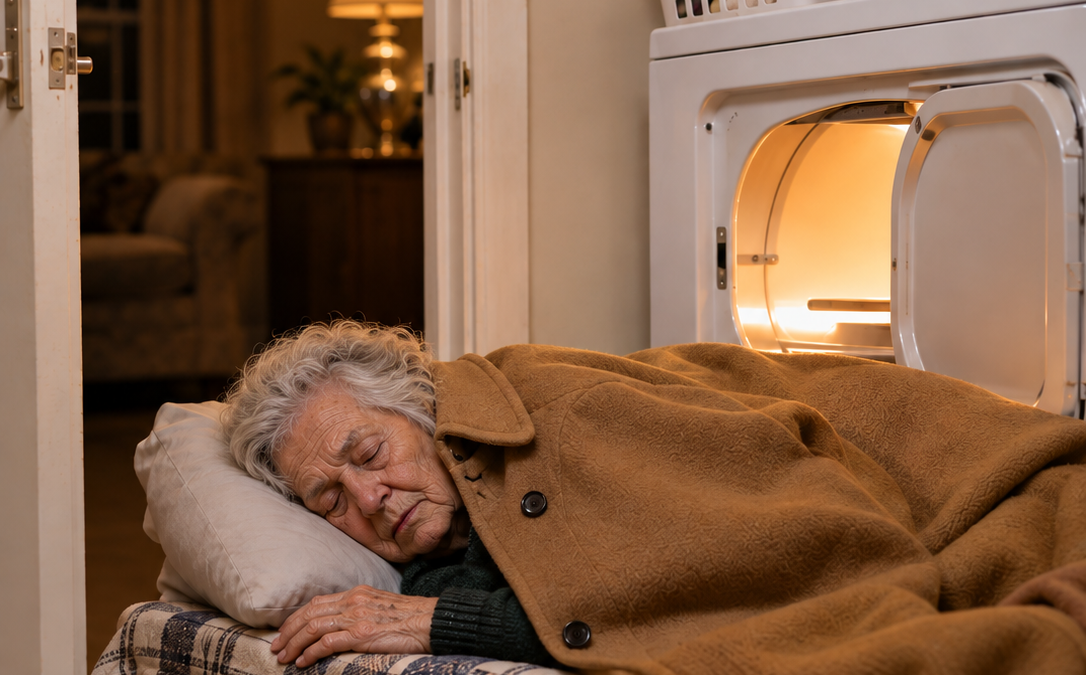
Her camel coat covered her body like a blanket. One arm rested outside it, her fingers curled toward her palm. The dryer was running empty, its door open so the heat could escape into the room.
I stopped moving.
There wasn’t a proper pillow beneath Mom’s head. The cot sat close to the dryer, with barely enough room to walk between them.
I looked at the metal rail. Stenciled across it were the words Prairie Hill Baptist — Fellowship Hall.
I turned toward Raylene.
“Why is Mom sleeping on a church cot?”
Raylene leaned against the doorway.
“She turned eighty-four right there Thursday. Said it was cozy.”
I looked back at Mom. Her hair was flattened against the thin pillow. The camel coat had slipped from one shoulder, exposing the skin above her nightshirt.
Mom had managed a school cafeteria for years. She knew how to stretch a meal and help a child without embarrassing anyone.
She also owned this house. Her bedroom was just down the hallway.
I walked closer to the cot.
“Mom?”
She didn’t wake.
I touched the edge of her coat, careful not to startle her.
“How long has she been sleeping here?”
Raylene folded her arms.
“She’s comfortable.”
“That’s not what I asked.”
“Joni, we have a system. Kenny and I take care of things. You come up here once in a while and decide you know everything.”
I turned toward my brother.
“Kenny.”
He appeared at the laundry room entrance, holding the remote control.
“What?”
“Get her quilt.”
Raylene answered before he could.
“That’s our bedspread now.”
I looked at her.
“What do you mean, your bedspread?”
“We needed another one upstairs.”
I waited for Kenny to say something. He glanced at the floor.
“Ray handles it.”
That was the answer he’d used for years. Ray handled the bills, Mom’s needs, and every decision Kenny didn’t want to make.
Mom was asleep less than three feet away. I didn’t want a shouting match over her head.
I opened my overnight bag and pulled out my sleeping bag.
Raylene watched me unfold it.
“What are you doing?”
“Sleeping.”
“There’s no room in here.”
“There’s enough floor.”
I moved a laundry basket against the cabinet and unrolled the sleeping bag beside Mom’s cot. The concrete floor was cold, and the narrow space left little room to stretch my legs.
I’d planned to stay in a motel. Instead, I put my pillow on the laundry floor.
Kenny stood at the doorway.
“Joni, you don’t have to stay here.”
“I know.”
“You could get some rest somewhere else.”
I looked at Mom.
“So could she.”
Kenny didn’t answer.
Raylene turned toward the kitchen, shaking her head.
I settled onto my sleeping bag and looked over the space around Mom’s cot. I wanted her to be able to stand without tripping over my things if she needed the bathroom.
Then I noticed something on the cabinet.
A small white camera sat near the detergent bottles. It was pointed toward the cot. A blue light glowed on its front.
I looked at it for several seconds.
“What’s that camera for?”
Raylene glanced back.
“To look after Mom.”
“Does she know it’s there?”
“Of course she does. I put it up so we can keep an eye on her.”
I looked from the camera to Mom. Raylene sounded almost proud of the arrangement.
I didn’t argue. I couldn’t tell what the camera could see or when it had been put there. I only knew someone had decided Mom needed to be watched while she slept on a church cot in her own laundry room.
For a while, the only sound was the dryer turning.
I took off my shoes and folded my sweater beneath my head. My tape measure was still hanging around my neck, so I slipped it into my bag.
The navy dress remained on the kitchen chair. I’d imagined fitting it on Mom in front of her bedroom mirror while she complained that I was making too much fuss.
Now I wasn’t sure when I’d see that room.
I watched Mom’s face. Her breathing was steady, but she shifted whenever the dryer made a louder sound.
“Mom?”
Picking up where the Facebook post left off
She opened her eyes. For a few seconds, she looked toward the dryer before turning her head.
“Joni Lynn?”
“I’m here.”
“What are you doing here so late?”
“I brought your dress.”
She looked toward the hallway.
“Your brother said you weren’t coming until next week.”
“I came early.”
“You drove all that way?”
“Two hours isn’t that far.”
She gave me a tired look.
“You always did think you could fix everything with a needle.”
I smiled a little.
“Not everything.”
She tried to sit up. I helped move the camel coat away from the cot rail so she wouldn’t get tangled in it.
“Are you cold?” I asked.
She pulled the coat closer.
“Sometimes.”
I looked at the dryer door.
“Does Raylene leave that running all night?”
Mom looked toward the hallway, then back at me.
“She says it’s cheaper this way.”
I kept my voice low.
“Do you want to come with me tonight?”
Mom placed one hand on the metal rail.
“It’s my house, Joni Lynn. I’m staying.”
Her voice was quiet, but the words were firm.
I nodded.
“All right.”
I wasn’t going to drag her out of her own house after she’d told me what she wanted. I could stay on the floor. In the morning, we’d talk about the dress.
I pulled the camel coat back over her shoulder.
“Try to sleep, Mom.”
She closed her eyes.
I remained beside her until she settled. Then I returned to my sleeping bag.
A few minutes later, Raylene came through carrying Mom’s tablet. She set it on top of the dryer beside the charging cord.
“Don’t leave things lying around,” she said, looking at me.
I glanced at the tablet.
“Is that Mom’s?”
“Yes. She never remembers where she puts it.”
Raylene plugged in the charger, checked the screen, and left the laundry room.
I heard her footsteps cross the kitchen. The television continued playing in the living room. A bedroom door closed upstairs.
I lay on my side, facing Mom.
The camera’s blue light remained on.
I thought about what Raylene had said. She’d installed it to look after Mom. Yet she had left Mom sleeping on a church cot, with an empty dryer running beside her.
What had that camera been recording?
I shifted on the sleeping bag and tried to get comfortable. The floor pressed against my hip. Mom’s coat had slipped down again, so I reached over and pulled it back over her shoulder.
The tablet sat dark beside the charging cord. Mom used it for video calls, and I assumed it needed charging.
I checked the clock on my phone.
12:46 a.m.
The dryer kept turning. I could hear Kenny’s television through the wall, though the volume had dropped. Mom slept with one hand curled near her chin.
I closed my eyes.
At 1:12 a.m., a rectangle of light appeared on the dryer.
I opened my eyes and lifted my head.
Mom’s tablet had lit up.
A notification filled the screen:
“Laundry Cam — storage 97% full — 211 clips.”
I sat up.
Two hundred and eleven clips.
I looked at the small white camera on the cabinet. Its blue light was still glowing.
Chapter 2: The Clips on Mom’s Tablet
At 6:10 Saturday morning, I was still sitting on the laundry floor when Mom opened her eyes and found me looking at her tablet.
The notification from 1:12 was still on the screen. Two hundred and eleven clips. Ninety-seven percent of the storage was full.
“Mom, do you know what this camera records?”
She looked toward the cabinet.
“Raylene said it was there to watch me.”
“Have you ever seen the recordings?”
Mom shook her head.
I turned the tablet so she could see the screen.
“Would you let me look?”
She pulled the camel coat closer around her shoulders. For a few seconds, she didn’t answer. Then she reached for the tablet.
“Passcode is 0204.”
“Your birthday?”
“February fourth. I don’t forget that one.”
I entered the numbers.
The camera app opened. A small account panel appeared beneath the device name.
Owner: Wilma Purcell.
Shared viewer: Raylene.
I stared at those two lines.
“Mom, this camera belongs to you.”
She looked at the screen.
“I didn’t know that.”
“Raylene has access, but you’re the owner.”
Mom rubbed her thumb along the tablet’s edge.
“She told me she needed it to keep an eye on things.”
I understood why Mom hadn’t opened the app before. Raylene took the tablet to charge every night and had filed the camera app under a folder labeled Settings — don’t touch. Mom used the tablet for calls, and whenever I spoke to her, Raylene usually held it.
I had never thought to ask who controlled the camera.
“Do you want to see what’s on it?” I asked.
Mom looked at the list of dates.
“I suppose I should.”
I selected June 28, 2026.
The recording opened with the laundry room empty. The camera’s view included the dryer, the cabinet, and the space where Mom’s cot now stood.
Then Kenny walked into the frame carrying the folded cot.
I recognized his shirt.
He opened the metal legs and positioned the cot beside the dryer. Raylene came into view behind him. She pointed toward the wall, then toward the space beside the machine.
Kenny moved the cot where she indicated.
Raylene stood there watching while my brother finished setting it up.
I felt my stomach tighten.
“That’s Kenny,” Mom said.
“I know.”
She watched him test the cot with one hand before leaving the room.
Raylene remained for a few seconds, looking at the arrangement. Then she walked out, too.
I stopped the recording.
Mom’s eyes stayed on the screen.
“That was June?”
“June twenty-eighth.”
She nodded slowly.
I didn’t ask whether she remembered that night. I didn’t want to make her explain something the camera had already shown us.
I selected February 4.
The date appeared above the next recording. The time stamp read 11:48 p.m.
Mom was on the cot, wearing her nightshirt. Her camel coat covered her legs, but her shoulders were shaking. She pulled the coat closer and rubbed her hands together.
Raylene entered the room.
She glanced at Mom, then toward the dryer.
“Happy birthday. Dryer’s on.”
She walked away.
Mom kept shaking.
I looked at the calendar date on the tablet.
February 4.
My mother’s eighty-fourth birthday.
The night she’d turned eighty-four, she’d spent her birthday on a folding church cot beside the dryer.
I looked at Mom. Her mouth had tightened, and her eyes were fixed on the screen.
“Do you want me to stop?”
“No.”
Her answer was barely above a whisper.
I let the recording finish.
There were more dates in the list. I didn’t open them. One clip at a time was enough.
I selected December 18.
The dryer room appeared again. Mom was sitting on the cot, wrapped in the camel coat. A small portable heater stood near the wall.
Raylene entered and walked straight to it.
She bent down and pulled the plug from the outlet.
“Forty dollars a month, Wilma. The dryer’s free.”
She carried the heater out.
Mom remained on the cot, looking toward the doorway. The dryer continued turning.
I paused the clip.
For a moment, I couldn’t find anything to say.
I owned an alterations shop. I spent my days measuring people, pinning fabric, and making adjustments so clothes would fit comfortably. I knew how to notice a small change in someone’s body.
At Thanksgiving, Mom’s waist had measured thirty-one inches.
I remembered how loosely her nightshirt had hung when I’d found her the night before.
I closed the video.
Mom reached for the edge of her camel coat.
“She said the heater cost too much.”
I turned toward her.
“Mom, you own this house.”
“Raylene says Kenny pays the bills.”
“Your pension comes every month.”
Mom looked down.
“I don’t know where it goes.”
I thought about the $1,900 stub I’d seen beneath Raylene’s phone. I thought about the transfer she had been finishing when I walked through the kitchen.
I wanted to ask more, but Mom had already watched enough.
I put my hand over hers.
“We’ll figure it out.”
At 7:05 a.m., Raylene walked into the laundry room.
She was dressed, with her phone in one hand and a mug in the other. Her eyes went straight to the tablet.
“What are you doing?”
I didn’t answer immediately.
Mom sat up against the cot rail.
“Looking at my camera.”
Raylene set down her mug.
“Give me that.”
She reached for the tablet, but Mom pulled it closer.
“It’s mine,” Mom said.
Raylene looked at me.
“Joni, you have no business going through things you don’t understand.”
I stood up, my knees stiff from sleeping on the floor.
“It’s registered to Mom.”
Raylene took out her phone and opened the camera app. She tapped through the account screen, then tried to remove the recordings.
A message appeared.
She tried again.
Her expression changed.
“Why won’t this let me delete them?”
I pointed toward the tablet.
“Because Mom owns the account.”
Raylene stared at her phone, then at Mom.
“You went into the settings?”
Mom didn’t answer.
Raylene tapped the screen several more times. Nothing changed. Her access allowed her to view the recordings, but she couldn’t delete the owner’s saved clips.
She lowered her phone and looked at me.
Then she reached over the cabinet, grabbed the camera’s power cord, and yanked the plug from the outlet.
The blue light went dark.
“That’s enough.”
Mom flinched.
Raylene turned toward me.
“Kenny has her power of attorney. You have a sewing kit.”
I looked at her.
“That doesn’t make this right.”
“You don’t understand how things work in this house.”
“I understand where Mom sleeps.”
Raylene picked up her mug.
“You’ve been here less than twelve hours, and you’re already causing trouble.”
I didn’t move.
She looked at Mom.
“Do you know what happens when you make people think you can’t manage your own affairs?”
Mom’s fingers tightened around the camel coat.
Raylene walked out, leaving the tablet on the cot.
I sat beside Mom again.
The camera was unplugged, but the recordings were still on her tablet. Two hundred and eleven clips, saved under her name.
I looked at the date list.
“Mom, you don’t have to stay here if you don’t want to.”
She stared at the dark camera.
“I don’t want to lose my house.”
“You own it. Nobody gets to make that decision for you.”
Before she could answer, Raylene returned to the doorway.
She had put down her mug. Her voice was calm now, which made me more uneasy than when she’d been shouting.
“Bell Street has a bed open,” she said.
Mom looked up.
Raylene glanced at Kenny, who had appeared behind her.
“Kenny signs Monday.”
Chapter 3: The Tape Measure at Urgent Care
Mom didn’t answer Raylene’s threat.
She sat on the cot with the tablet in her lap, her camel coat pulled around her shoulders. Kenny stood behind his wife, looking as if he wanted somebody else to decide what happened next.
I waited.
Finally, Mom looked at me.
“Can I go with you for a few nights?”
“Yes.”
I helped her put on the camel coat. She held the tablet against her chest and looked around the laundry room.
“Do you need anything else?” I asked.
She shook her head.
Mom walked past the dryer and through the kitchen. Raylene stood near the counter.
“Where are you going?”
“Joni’s,” Mom said.
“For how long?”
“A few nights.”
Raylene looked at Kenny.
“Your mother can’t just leave whenever she feels like it.”
Mom stopped near the front door.
“It’s my house. I can go where I want.”
Kenny didn’t say anything.
I opened the door, and Mom stepped outside. I followed with her tablet.
I had no plan beyond getting her somewhere warm and making sure she was safe. The recordings showed what had happened, but I wanted a medical professional to examine her and document anything that needed attention.
My first stop was urgent care.
The waiting room was quiet when we arrived. Mom sat beside me with the camel coat folded over her lap. I gave the receptionist her information and explained that she’d been sleeping on a folding cot beside a running dryer.
The clinician examined her feet and legs. The patches on her feet were identified as chilblains. There was also a bruise consistent with the metal cot rail.
“How long have you been sleeping there?” the clinician asked.
Mom looked down at her hands.
“Several months.”
I stayed quiet. I wanted her to answer in her own words.
The clinician documented the findings and gave us a note. I put it carefully in my bag.
Outside, Mom walked slowly toward the car. I held the passenger door open.
“Does it hurt?” I asked.
“My feet bother me.”
“Did you tell them everything?”
“Enough.”
I didn’t push.
At Thanksgiving, I’d measured Mom’s waist at thirty-one inches while helping her with her clothes. I still had my tape measure around my neck. Before we left the parking lot, I asked if she’d let me check her measurement again.
She nodded.
I took the tape and measured carefully.
Twenty-eight inches.
I checked the position and measured once more.
Still twenty-eight.
Three inches smaller than at Thanksgiving.
Mom watched me fold the tape.
“Did I get smaller?”
“Three inches around your waist.”
She looked through the windshield.
“I haven’t been eating much.”
I rested my hand on the steering wheel.
“Are you hungry now?”
“A little.”
We stopped for something to eat before going to the motel. Mom ate slowly. I didn’t ask her to finish anything or make her explain why she’d been eating less.
The motel room had two beds and a small table near the window. Mom chose the bed closest to the bathroom. She placed her tablet on the table and hung the camel coat over the back of a chair.
I set the urgent-care note beside the tablet.
“Mom, I want to look at one more recording.”
She looked at the screen.
“Which one?”
“October fourteenth.”
I opened the camera app and selected the date.
The recording showed the laundry room. Mom was on the cot, and the camera had a clear view of the doorway.
Raylene appeared holding her phone. She stood near the entrance, talking to someone. At first, I couldn’t make out every word. Then her voice became clear.
“Her pension pays our truck note. The cot was free from church.”
I stopped the recording.
October 14, 2026. Wednesday.
I looked at Mom.
“Did you know?”
She shook her head.
“I thought Kenny paid for the truck.”
“Do you remember getting your pension every month?”
“Yes. It comes on the first.”
“Do you ever see the money?”
Mom looked down.
“Raylene says she takes care of everything.”
I thought about the $1,900 pension stub I’d seen beneath Raylene’s phone the night before. She’d been finishing a transfer when I walked into the kitchen.
Now I knew what she had been saying about that money when she thought nobody was listening.
The camera had recorded Kenny bringing the cot into the laundry room. It had recorded Raylene unplugging the heater. It had even recorded Mom’s eighty-fourth birthday.
I picked up my phone.
“What are you doing?” Mom asked.
“Making a report.”
I searched for the Texas Abuse Hotline number and called.
When someone answered, I explained that I was reporting suspected abuse and financial exploitation involving my eighty-four-year-old mother.
The person on the line asked me to describe what had happened.
I gave Mom’s name and age. I explained that she owned her home but had been sleeping on a church cot beside a dryer. I described the chilblains, the bruise from the cot rail, and the conditions in the laundry room.
Then I gave the recording dates.
June 28, when Kenny brought the cot into the room.
October 14, when Raylene said Mom’s pension paid their truck note.
December 18, when Raylene unplugged the heater.
February 4, when Mom spent her eighty-fourth birthday on the cot.
I explained that the camera belonged to Mom and that the recordings were saved on her tablet. I also described Kenny’s power of attorney and Raylene’s threat to have him sign Mom into Bell Street.
The person asked several questions. I answered as accurately as I could, using the dates on the recordings and the medical note from urgent care.
When the call ended, I put my phone down.
Mom had listened without interrupting.
“Did you tell them about Kenny?”
“Yes.”
She looked at the tablet.
“He’s my son, Joni.”
“I know.”
I understood what reporting meant. Kenny wasn’t a stranger who had wandered into Mom’s life. He was my brother, the person she’d trusted to act for her under the power of attorney.
But he’d carried that cot into her house. And he’d signed whatever Raylene put in front of him.
The report was no longer something I could keep inside the family. I’d given the state the dates, the recordings, and the medical findings. Someone would have to look at what had happened.
Mom picked up the urgent-care note and placed it beside the tablet.
“Can Kenny stop us from doing something?”
I looked at her.
“He has your power of attorney. Raylene says he can sign for you.”
Mom rubbed the corner of the paper.
“Can I take it back?”
“I think we need to ask the credit union what paperwork is required.”
She looked toward the window. The camel coat hung over the chair, its collar folded inward.
For several minutes, she sat quietly. Then she reached for the tablet and placed it in her lap.
“Monday we go to my credit union. Bring the tablet.”
Chapter 4: The Woman at the Credit Union
Mom sat beside me in the credit union lobby Monday morning with her camel coat folded over her lap and the tablet tucked inside her purse.
She had asked about her pension several times over the years. Kenny always told her the money went toward household expenses. Raylene said she kept the books, and Mom had never seen a complete statement.
Now she wanted to see one.
At the front desk, I gave our names. A few minutes later, Leticia Alvarez came out to meet us. She was a credit union officer who spoke plainly and didn’t waste time pretending paperwork was simpler than it was.
“Wilma, what can I help you with?”
“I want to see where my pension goes.”
Leticia led us to a small office and brought up Mom’s account.
“Your pension is $1,900,” she said. “It arrives on the first of each month.”
Mom nodded.
“That’s what I was told.”
Leticia turned the monitor slightly so Mom could see it.
“Would you like a printed statement?”
“Yes, please.”
The printer started behind Leticia’s desk.
She placed the pages in front of Mom and pointed to the first transaction.
July 1, 2026. Deposit: $1,900.
Below it was a transfer dated the same day.
Recipient: K & R Purcell joint.
Memo: W care.
The next page showed August. Then September, October, November, December, January, and February.
Every pension deposit had been followed by a transfer of the full $1,900 to the same joint account.
Eight deposits. Eight transfers.
Leticia added the amounts on her calculator.
“$15,200 total.”
Mom kept her finger on the last line.
“That’s my money?”
“Yes, Wilma.”
“All of it?”
“All eight pension deposits went to that joint account.”
Mom looked at me.
I’d seen the pension stub beneath Raylene’s phone, and I’d heard her say the money paid their truck note. But seeing the transfers printed in black ink was different.
Mom had been living beside a dryer while her entire pension went into an account shared by Kenny and Raylene.
“What does W care mean?” Mom asked.
“That’s the memo attached to the transfers,” Leticia replied. “Whoever entered them used that description.”
Mom moved the statement closer to herself.
“Raylene said it was for my care.”
Leticia didn’t offer an opinion.
“These are the transactions recorded on your account.”
Mom folded her hands on the table.
“Can we stop it?”
“Yes. We can review the power of attorney and the access connected to your account.”
Mom looked at me.
“That’s why we came.”
At 9:30, Leticia brought out the paperwork. She explained that Kenny’s power of attorney and the additional card Raylene carried were separate matters.
“Canceling the card will stop anyone from using it,” she said. “The power of attorney requires a separate revocation.”
Mom listened carefully.
“Will Kenny still be able to act for me?”
“Until the revocation is properly signed and delivered, his authority remains in place.”
Mom looked down at the table.
“Kenny is my son.”
“I understand,” Leticia said. “You’re entitled to decide who handles your affairs.”
Leticia prepared the revocation document and reviewed it with Mom. She pointed out the signature line, which remained blank.
“Take your time. When you’re ready to sign, I’ll make sure the paperwork is properly witnessed and notarized.”
Mom picked up the document and examined the page.
“Can I do it Sunday?”
“Of course. I’ll be available.”
Mom folded the unsigned revocation and placed it in her purse.
Then she looked at Leticia.
“Kenny can watch me sign it.”
Leticia nodded.
Mom took out the credit union statement again.
“Now, the card.”
Leticia checked the additional card attached to Mom’s account.
“This is the card issued to Raylene?”
Mom nodded.
“She carries it.”
“Would you like us to cancel it?”
Mom looked at the printed statement.
“Yes.”
Leticia entered the cancellation and confirmed that the card could no longer be used.
Mom put the unsigned revocation back into her purse, next to the tablet.
On the drive back to the motel, she held the statement in her lap.
“Eight months,” she said.
“Yes.”
“Fifteen thousand two hundred dollars.”
I kept my eyes on the road.
“That’s what the statement shows.”
She folded the pages carefully and put them away.
“I want my bedroom back.”
I reached over and touched her hand.
“We’ll work on that.”
Tuesday morning, an email from the church prayer chain appeared in my inbox.
Raylene had sent it.
The subject line asked everyone to pray for Mom.
The message said:
Pray for our Wilma, confused, taken from us by her daughter.
I read the sentence while standing beside the motel’s little coffee machine.
Confused.
Mom had recognized every transaction on the statement. She had the revocation papers ready, but the signature line was still blank. She had decided when and where she would sign them.
Yet Raylene was telling people that I had taken Mom away because she didn’t know what was happening.
I showed Mom the email.
She read it without speaking.
“She sent that to the church?”
“Yes.”
Mom put the phone down.
“People will believe her.”
“Some might.”
Mom looked toward the camel coat hanging on the chair.
“I don’t want them thinking I don’t know my own mind.”
I didn’t tell her to ignore it. I knew what it meant to have someone describe you to other people before you had a chance to speak for yourself.
Wednesday morning, I opened the June 28 camera recording on the tablet.
I paused it at the frame where Kenny was unfolding the cot. The metal rail was clearly visible, including the stencil identifying Prairie Hill Baptist Fellowship Hall.
I took a picture of the screen and sent it to Floyd Coker.
Floyd was a deacon at Prairie Hill. He handled the hall’s storage equipment and usually carried a clipboard when people borrowed anything.
I wrote:
Floyd, can you tell me whether this cot belongs to the church?
He called a few minutes later.
“Joni, where did you get that picture?”
“It’s from Mom’s camera. Kenny brought the cot into her laundry room.”
Floyd was quiet.
“That looks like one of ours.”
“Can you check?”
“I’ll look at the sign-out sheet.”
I waited with the phone beside me.
About twenty minutes later, a message arrived. Floyd had photographed the entry on his clipboard.
The date was June 26, 2026, a Friday.
The handwriting was Raylene’s.
The entry read:
R. Purcell — 1 cot — guest weekend — back 6/29.
I enlarged the photograph.
“One cot,” I said aloud.
Mom came over to look.
“That’s the one Kenny brought home?”
“Yes. Floyd says it belongs to the church.”
She traced the words with one finger without touching the screen.
“Guest weekend.”
“That’s what Raylene wrote.”
Mom looked at the date again.
June 26. Friday.
The cot had been borrowed for a weekend and was supposed to go back on Monday, June 29. Instead, Mom had slept on it for months.
I saved Floyd’s photograph beside the camera recordings and the credit union statement.
“Does Floyd know why we need it?” Mom asked.
“He knows the cot was in your laundry room. I haven’t told him everything.”
Mom nodded.
I put the tablet back on the table.
The evidence was no longer limited to what the camera had recorded. The church had a written record showing that Raylene had borrowed the cot for a single weekend.
I wondered what Raylene would do when she learned we had found it.
My phone buzzed that evening.
A text from Raylene appeared on the screen.
“Bell Street tour Thursday 10. Kenny signs. Don’t embarrass him at the party.”
I showed Mom.
She read the message, then placed my phone on the table.
“She’s still planning to send me away,” she said.
I looked at the unsigned revocation in her purse.
“She can’t use your card anymore. Kenny still has his authority until you sign.”
Mom picked up the tablet and checked that it was charging.
“Thursday is tomorrow,” she said.
“Yes.”
She looked at me.
“And Sunday is my party.”
She touched the edge of her purse where the unsigned revocation was waiting.
Chapter 5: The Navy Dress Hemmed to the Floor
Thursday morning, a caseworker from Adult Protective Services came to the motel to meet Mom.
She introduced herself, asked if Mom was comfortable speaking with her, and pulled a chair up beside the little table where we’d spread the credit union statement and the tablet.
Mom kept her camel coat folded over the back of her chair.
The caseworker asked about the laundry room, the cot, the heater, and how long Mom had been sleeping there. She examined the urgent-care note and asked whether Mom had somewhere safe to stay.
“I’m with my daughter,” Mom said.
The caseworker nodded.
“Would you be comfortable meeting me again?”
Mom looked at the tablet.
“Sunday is my birthday party at Prairie Hill Baptist. Sixty people are coming.”
“I understand.”
“I want you to come there. The fellowship hall. One-thirty.”
The caseworker paused.
“You’d prefer to meet at the church?”
“Yes. I want people to see that I can speak for myself.”
The caseworker agreed to meet her at the fellowship hall at 1:30 p.m. Sunday.
After she left, I glanced at the clock. Raylene’s Bell Street tour was scheduled for ten.
“Do you want to go?” I asked.
Mom shook her head.
“No.”
“Are you sure?”
“Joni, I already have a house.”
She picked up the unsigned revocation Leticia had prepared and put it back in her purse.
We stayed at the motel.
Raylene called twice that morning. Mom didn’t answer either call. I didn’t answer for her.
By Thursday afternoon, Mom had made up her mind about Sunday.
“I want to use the television at the fellowship hall,” she said.
I looked up from the tablet.
“For what?”
“My pictures.”
She meant the camera recordings.
“You want Floyd to play them?”
“Yes.”
Mom rested her hands on the table.
“People have heard Raylene’s story. They’ve heard that I’m confused and that you took me away. I want them to see what happened.”
I understood what she was asking.
The church had received Raylene’s prayer-chain email. Sixty people were expected at the birthday party. Some would probably arrive believing Mom needed someone else to speak for her.
“You know she might get angry,” I said.
“I know.”
“And Kenny might not cooperate.”
Mom looked at the unsigned revocation in her purse.
“Then he’ll have to watch me sign it.”
I sat down across from her.
“You want Kenny there when you sign?”
“Yes. He’s been signing things for me. He can watch me sign this one.”
I understood. She didn’t want the decision made quietly in an office where Kenny could later claim he hadn’t known. She wanted him to see her sign away his authority herself.
I called Floyd.
He listened while I explained Mom’s plan. He already knew the cot had been borrowed for a weekend, and he’d seen the photograph of the sign-out sheet.
“She wants me to put her recordings on the hall television?” he asked.
“Yes. She wants to show her own pictures.”
There was a pause.
“I’ll bring the TV cart out before the party.”
“Thank you, Floyd.”
“Tell Wilma I’ll be there.”
Mom wanted Leticia there, too.
I called the credit union and spoke with her. I explained that Mom wanted to sign the power of attorney revocation in front of Kenny during the party.
“She still has the unsigned document I prepared,” Leticia said.
“Yes.”
“I’ll bring my notary stamp. She can sign in front of me, and I’ll complete the notarization.”
I handed the phone to Mom.
“Leticia, I want Kenny to watch me sign.”
“That’s your decision, Wilma. I’ll be there.”
Mom thanked her and returned the phone to me.
There was still a risk we couldn’t control. Raylene carried the card attached to Mom’s account, and the credit union had cancelled it on Monday. Raylene didn’t know that yet.
The cake cost $480, and she expected payment at the party.
If she tried to use the card before Mom had a chance to speak, the situation could become ugly before we were ready.
I told Mom.
“She might try the card early.”
Mom looked at me.
“Then she’ll find out.”
That afternoon, a group text from Raylene appeared on my phone.
It included the arrangements for Sunday.
Sixty coming. Cake is $480, due at the party. I’ll say a few words.
I showed Mom.
She read the message and handed my phone back.
“She’s planning a speech.”
“Looks that way.”
“She can say what she wants.”
I wasn’t sure Mom understood how uncomfortable it might be to stand in front of sixty people while Raylene described her as confused. But Mom had made her choice.
I took the navy dress from its garment bag.
We had stayed at the motel longer than I expected, and I wanted to finish the alterations before Sunday. I spread the dress carefully across the bed and checked the hem.
Mom stood barefoot on the carpet while I pinned the fabric.
“Turn a little,” I said.
She turned.
I checked the length from the waist to the floor and adjusted the pins. The dress needed a little work, but the navy fabric was still in good shape.
“How long do you want it?” I asked.
Mom looked down at the hem.
“To the floor. I’ll be standing.”
I looked up at her.
“All right.”
I finished the hem with the sewing kit I kept in my alterations bag. Mom sat nearby with her tablet, checking that the recordings were still saved.
Every so often, she looked toward the dress.
When I finished, I held it up for her to inspect.
She ran her fingers over the hem.
“That’s right.”
I hung it carefully over the back of the closet door.
Saturday passed with a few calls and messages. Floyd confirmed the television would be ready. Leticia confirmed she would bring her notary stamp. The caseworker had confirmed the Sunday meeting at 1:30.
Mom kept the tablet close and the unsigned revocation in her purse.
She didn’t ask me to change the plan.
Sunday morning, February 14, I helped Mom get dressed.
She put on the navy dress and buttoned it herself. I adjusted the collar and checked the hem one last time.
The camel coat stayed at the motel.
Mom looked at herself in the mirror.
“Do I look all right?”
“You look lovely.”
She straightened the front of the dress.
“Then let’s go.”
We reached Prairie Hill Baptist fellowship hall before the party began. Raylene had arranged the tables, and the cake was being brought to the serving area. The room was set for sixty guests.
Floyd was near the television cart, checking the connections.
Leticia had arrived with her notary stamp and a folder. The caseworker had confirmed she would come at 1:30.
Mom greeted both of them.
“Thank you for coming.”
Floyd nodded toward the tablet.
“I’ll be ready when you are.”
Mom didn’t hand it over yet.
She looked across the room. Raylene was speaking with someone near the cake table, smiling and gesturing toward the decorations.
Kenny stood a few feet away.
I watched Mom take in the room. Her fingers touched the side of her purse, where the unsigned revocation was waiting.
At 12:20 p.m., Mom walked over to Floyd.
She took the tablet from her purse and placed it in his hands.
“Plug this in when I raise my hand.”
Chapter 6: The Toast in the Fellowship Hall
At 12:30 p.m. Sunday, February 14, Raylene stood at the microphone in Prairie Hill Baptist fellowship hall, welcoming sixty guests to Mom’s eighty-fourth birthday party.
She had arranged the tables, chosen the decorations, and placed the birthday cake near the serving counter. People from church moved between the tables, greeting one another and looking toward the cake.
Mom sat near the front in her navy dress. I’d hemmed it to the floor, just as she’d asked. Her back was straight, and her hands rested in her lap.
Floyd stood beside the television cart along the wall. Mom’s tablet was connected, but the screen remained dark.
Leticia sat a few chairs away from me with her folder on her lap.
Raylene lifted the microphone.
“Thank you all for coming. Wilma has been such a blessing to our family, and we’re grateful we can celebrate her today.”
People smiled and nodded.
Raylene looked toward Mom.
“Mom has the best room in our house. We spoil her rotten. We never let her be cold a single night.”
A few guests applauded.
I looked at Mom.
She didn’t move.
Raylene continued talking about family, church, and how much work went into caring for an elderly parent. She thanked the people who had helped arrange the party and mentioned the birthday cake.
Then she stepped away from the microphone.
I watched her walk toward the cake table.
The cake had cost $480, and Raylene had told everyone in the group text that payment was due at the party. She opened her purse and took out the card she carried for Mom’s account.
The cake vendor waited while Raylene handed it over.
A moment later, the vendor returned the card.
“I’m sorry. It didn’t go through.”
Raylene frowned.
“Try it again.”
The vendor ran the card a second time.
The machine gave the same response.
DECLINED.
Raylene looked around before lowering her voice.
“Bank glitch, honey.”
She took the card back and slipped it into her purse.
The vendor didn’t argue. She simply waited for another form of payment.
Raylene stepped away from the table and looked toward the guests. Her smile had tightened.
I knew what had happened.
Leticia had cancelled that card on Monday. The account no longer allowed Raylene to use it.
Raylene returned to her place near the microphone.
“Everything is fine,” she told the vendor. “I’ll take care of it.”
Mom watched her.
Then she looked toward Floyd.
She raised her hand.
Floyd reached for the tablet and connected the picture to the television.
The screen changed.
The laundry room appeared before sixty guests.
June 28, 2026.
Kenny walked into the camera’s view carrying a folded metal cot. He opened the legs and positioned it beside the dryer. Raylene entered behind him and pointed toward the wall.
Kenny moved the cot where she indicated.
The recording continued long enough for everyone to see the arrangement.
Someone near the back stopped talking.
A woman at the next table leaned forward.
Raylene turned toward the television.
“What is this?”
Mom kept her hand raised until the recording ended.
Floyd moved to the next clip.
February 4, 2027.
The timestamp showed 11:48 p.m.
Mom was lying on the cot, shaking beneath her camel coat. The dryer was running beside her.
Raylene entered the room.
“Happy birthday. Dryer’s on.”
Then she walked away.
The recording continued with Mom alone on the cot.
I heard a chair move behind me.
One of the women near the front covered her mouth. Another guest looked from the screen to Mom, then back again.
Raylene hurried toward the television cart.
“Those are old. She had a cold and wanted to be by the dryer.”
Nobody answered her.
She turned toward the room, raising her voice.
“That was a temporary arrangement. You people don’t know what goes on in a family.”
Mom lowered her hand.
Raylene looked at her.
“Wilma, you know we take care of you.”
Mom didn’t answer.
Raylene faced the guests again, apparently hoping she could return to the story she’d started at the microphone.
“She sleeps fine out there, it’s warmer than the porch.”
I looked at her.
She had repeated the exact words she’d used when I arrived at the house nine days earlier.
This time, sixty people had heard them.
Floyd didn’t stop the presentation.
He selected December 18.
The laundry room appeared again. Mom sat on the cot wearing her nightshirt, with the camel coat covering her legs. A small portable heater stood near the wall.
Raylene walked into the frame.
She bent down and pulled the plug from the outlet.
“Forty dollars a month, Wilma. The dryer’s free.”
She carried the heater away.
Mom remained on the cot.
The dryer continued turning.
Nobody applauded. Nobody moved toward the cake.
I looked at my mother. Her face was pale, but she hadn’t turned away from the screen.
Raylene stepped closer to the television.
“Turn that off.”
Floyd kept one hand near the tablet.
“Wilma asked me to play her pictures.”
“Those aren’t pictures. Those are private recordings.”
Mom spoke from her chair.
“It’s my camera, Raylene.”
Raylene turned sharply.
“You don’t understand what you’re doing.”
Mom’s hands rested on the arms of her chair.
“I understand.”
Kenny stood near the end of a table. He had been quiet throughout the presentation. His eyes stayed on the television, especially when the recording showed him carrying the cot into the laundry room.
I wanted him to say something.
He didn’t.
Raylene looked around the room, searching the faces of people who had come to celebrate Mom. A few guests lowered their eyes. Others continued watching her.
The television went dark.
Floyd disconnected the tablet and set it carefully on the cart.
For several seconds, nobody spoke.
Mom looked at Raylene.
“You told them I had the best room in your house.”
Raylene gripped the microphone.
“I was trying to make this a nice birthday.”
Mom didn’t answer.
I could see the cake vendor waiting near the counter. The $480 still hadn’t been paid, and the card Raylene had carried for months was useless.
Raylene placed the microphone on its stand.
Then Floyd stood up.
He had his clipboard in one hand.
“That’s the church’s cot.”
Chapter 7: The Cot That Was Due Back in June
Raylene looked at Floyd’s clipboard as if she could make it disappear by refusing to acknowledge it.
“She asked for that cot. She likes it firm.”
Floyd held the clipboard against his chest.
“That’s not what my records say.”
He opened the sheet and turned it toward the guests.
“I have the sign-out entry right here. June twenty-sixth, 2026. It says, ‘R. Purcell, one cot, guest weekend, back six twenty-nine.'”
He paused.
“That’s a Friday. The cot was due back Monday.”
A woman near the front table leaned toward the person beside her.
Raylene shook her head.
“That was just paperwork. We had permission to keep it.”
Floyd looked at the sheet again.
“I didn’t give permission for it to become somebody’s bed.”
Raylene turned toward the room.
“You’re all making this sound worse than it was. Wilma had a perfectly good arrangement. She didn’t complain.”
Mom sat quietly in her navy dress.
Raylene raised her voice.
“Every dime of her pension goes to her care.”
I turned toward Floyd, who was standing beside the television cart.
“Could you reconnect Mom’s tablet?”
Raylene looked at me.
“Put that away, Joni.”
Floyd set his clipboard on the cart and picked up the tablet. He reconnected it to the television while I opened the October 14 recording.
The laundry room appeared on the screen. Raylene stood in the doorway, talking on her phone.
“Her pension pays our truck note. The cot was free from church.”
The recording ended.
I placed the printed credit union statement on the table beside the cake.
“Eight deposits. Eight transfers. Nineteen hundred dollars each. Fifteen thousand two hundred dollars went into the K & R Purcell joint account.”
I turned the pages so the guests could see the transaction descriptions.
Every transfer carried the memo W care.
Raylene stared at the statement.
“That doesn’t tell the whole story.”
“It tells where the money went.”
“We had expenses.”
“Then why was Mom sleeping beside the dryer?”
Raylene looked toward Kenny.
He was standing near the end of a table, his hands resting against the back of a chair.
She turned back to the room.
“Kenny signs everything. I just keep the books.”
Her words came quickly. She seemed to expect him to agree, as he had so many times before.
But Kenny didn’t sit down.
He pulled the chair away from the table and stood.
“I carried that cot in.”
Raylene turned toward him.
“Kenny.”
He looked at the television, then at the clipboard in Floyd’s hands.
“Ray said a weekend. I signed what she typed.”
The room remained quiet.
Kenny rubbed one hand over his face.
“I didn’t ask why it was still there. I didn’t check on Mom. I let Ray handle it.”
Raylene stepped toward him.
“You’re not going to stand here and blame me.”
“I’m telling them what I did.”
He looked at Mom.
“I carried it in, Mom. I’m sorry.”
Mom didn’t answer immediately. She kept her hands folded in her lap.
Kenny looked at his wife again.
“You told me it was for the weekend.”
Raylene shook her head.
“Not now.”
He moved closer to her.
“Give me Mom’s card.”
She pulled her purse against her side.
“What?”
“The card you carry for her account.”
“That’s none of your business.”
“It’s Mom’s card.”
Raylene held the purse shut, but Kenny reached toward it. After a brief struggle over the clasp, he found the card and pulled it out.
He looked at the name printed on the front.
Then he walked toward Mom.
Mom held out her hand, and Kenny gave her the card. I took it from her.
The card had already been cancelled at the credit union on Monday. Raylene had tried using it at the cake table and received two declines.
I took my small sewing shears from the alterations kit I’d brought for the navy dress.
I placed the card on the table and closed the blades once through its middle.
The card separated into two halves.
Raylene watched without speaking.
I put the pieces beside the credit union statement.
Leticia stood up from her chair and opened her folder.
“Wilma, I have the revocation you asked me to prepare.”
Mom nodded.
“Bring it here, please.”
Leticia placed the unsigned document on the table. Mom pulled out a chair and sat down. Kenny stood across from her, close enough to see the papers.
Leticia explained that she needed to verify Mom’s identity before completing the notarization.
“Wilma, may I see your identification?”
Mom opened her purse and handed over her ID.
Leticia checked the photograph, compared the identifying information, and returned it to her.
“Thank you. I need to confirm that you’re signing this document willingly and that you understand what it does.”
“I understand. Kenny has been my agent under the power of attorney. I’m revoking that authority.”
Leticia nodded.
“Are you signing this by your own choice?”
“Yes.”
Mom took the pen.
I watched her hand move across the signature line. She wrote her name carefully, without rushing.
Wilma Purcell.
Leticia completed the notarial certificate and applied her notary stamp. She checked the finished document, then made a copy for Kenny.
She also opened her journal and recorded the notarization.
Leticia handed the original back to Mom.
Mom took the original and put it safely inside her folder.
Then she held Kenny’s copy out to him.
“This is for you.”
He accepted it.
Mom looked directly at him.
“You’re not my agent anymore, Kenneth.”
He lowered his eyes.
“I understand, Mom.”
I watched him stand there with the paper in his hand. For years, he’d been able to avoid difficult decisions by letting Raylene make them. Now he had to acknowledge that his mother had personally ended his authority.
Raylene moved toward the table.
“You can’t do this to our family.”
Mom turned toward her.
“I just did.”
Raylene looked around the room. The guests who had applauded her toast were no longer smiling. One woman folded her hands in front of her. Another quietly moved her chair away from the table.
The cake remained untouched.
The vendor was still waiting for payment. The card Raylene had expected to use lay in two pieces beside the statement.
Kenny stood near Mom, holding the revocation.
I wondered where Raylene would sleep tonight.
She had spent months deciding where Mom would sleep. Now she was looking around a room full of people who had seen what she’d done.
Mom stepped closer to the television cart. Floyd had disconnected the tablet, and he was holding it carefully against his clipboard.
Raylene picked up her purse.
Mom looked at her.
“You told everybody you were looking after me. You told them I had the best room in your house.”
Raylene said nothing.
Mom’s voice remained level.
“You hung that camera, Raylene. It never once lied.”
Raylene stood beside the table, clutching her purse.
At 1:30 p.m., the fellowship hall doors opened.
The Adult Protective Services caseworker Mom had invited walked into the room.
She looked toward Raylene.
“Raylene Purcell?”
Chapter 8: The Copy for the County Clerk
The caseworker stood near the fellowship hall doors, looking directly at Raylene.
“Raylene Purcell?”
Raylene tightened her grip on her purse.
“Yes. What is this about?”
“I’m with Adult Protective Services. I’d like to speak with you about the report involving Wilma.”
Raylene glanced toward Mom, then at the guests who were still gathered around the tables.
“Right now?”
“If you’re willing, I’d like to ask you a few questions privately.”
Raylene looked at Kenny. He was still holding his copy of the revocation. He didn’t move to help her.
The caseworker took Raylene to a smaller room off the hallway. Mom stayed near the television cart with Floyd and Leticia while the interview took place.
I could see the caseworker asking questions through the open doorway. Raylene answered with quick movements of her hands. At one point, she shook her head and leaned back in her chair.
Mom didn’t try to listen.
She was looking at the navy dress she’d worn for her birthday, smoothing the fabric over her knees.
After the interview, the caseworker returned.
“Wilma, I’d like to see the house and the laundry room where you were sleeping. Would you be comfortable taking me there?”
“Yes.”
“I’d also like to document what I find.”
Mom picked up her purse.
“Then let’s go.”
I drove Mom home while the caseworker followed separately. Kenny and Raylene were already there when we arrived.
The caseworker introduced herself again and explained that she needed to walk through the laundry room.
Mom led the way.
The folding cot was still beside the dryer. Its metal rail carried the Prairie Hill Baptist stencil, and the empty space beside it showed where the portable heater had stood.
The caseworker examined the room without rushing.
“Is this where you slept?”
“Yes.”
“How long?”
“Since last summer.”
The caseworker looked at the dryer.
“Was this running while you slept?”
“Most nights.”
Mom pointed toward the wall.
“Raylene kept the door open because she said the heat would reach me.”
The caseworker wrote something in her notebook.
She asked about the camel coat Mom had used as a blanket and the heater that had been removed. Mom described what happened without adding anything.
I stood near the doorway, watching the caseworker inspect the cot rail.
She asked Mom whether she had been able to use her own bedroom during those months.
“No.”
“Did you choose to sleep here?”
Mom looked at the metal frame.
“No. I wanted my bed.”
The caseworker recorded her answer.
She also asked about the bruise and the chilblains documented at urgent care. Mom showed her the medical note I’d brought.
When the inspection was finished, the caseworker thanked Mom and explained that the information would be included in the ongoing investigation.
Mom nodded.
“Thank you for coming.”
The caseworker left with her notes.
Raylene remained in the kitchen, arms folded.
Mom looked at her but said nothing.
Monday morning, February 15, Mom and I went to the Potter County Clerk’s office.
She carried her copy of the revocation, the credit union statement, and her identification in a folder. The tablet was in her purse.
At the counter, she handed over the notarized document.
“I need to file this.”
The clerk examined the paperwork, checked the notary stamp, and processed the filing. Mom waited while the clerk entered the information and returned her copy with the filing details.
She put it carefully back into her folder.
“That’s taken care of,” she said.
I nodded.
She had signed the revocation in front of Kenny and sixty witnesses. Leticia had checked her identification and notarized the document. Kenny had received his copy at the party.
Now Mom had filed her own copy with the county.
On the drive home, she looked out the passenger window.
“I want to be finished with all this.”
“I know.”
“But they still live in my house.”
I didn’t have an answer for that.
When we arrived, Kenny was sitting at the kitchen table. Raylene stood near the counter.
Mom placed her folder on the table.
“I want you both to listen.”
Raylene crossed her arms.
“What now?”
Mom looked at Kenny first.
“Out by the twenty-eighth.”
Raylene stared at her.
“You’re putting your own son out of his house?”
Mom’s expression didn’t change.
“This is my house.”
“We’ve lived here for years.”
“And I’ve spent months sleeping beside the dryer.”
Raylene opened her mouth, but Mom continued.
“I want my bedroom back. I want my things where they belong. You have until February twenty-eighth to move.”
Kenny pulled out a chair.
“Mom, can we talk about this?”
“We’re talking.”
He looked down at the table.
“I know I owe you an apology.”
“You owe me more than that.”
Mom opened the folder and placed the credit union statement in front of him.
“Fifteen thousand two hundred dollars.”
Kenny nodded.
“I know.”
“I want that money repaid.”
He reached for a sheet of paper and asked for a pen. I found one in the kitchen drawer.
Kenny wrote that he acknowledged the $15,200 taken from Mom’s pension and agreed to repay the full amount.
He included the first payment of $5,000, due Friday, February 19, by cashier’s check. The remaining $10,200 would be paid in monthly installments of $400 on the first of each month.
He signed his name.
Mom read the agreement carefully.
“You’re agreeing to all of this?”
“Yes.”
She took the paper and put it in her folder.
Raylene shook her head.
“You can’t expect us to pay all that and move out at the same time.”
Mom looked at her.
“I didn’t spend your money.”
Raylene turned away.
I knew what this decision cost Mom. Kenny had grown up in this house. He had lived here for years, and she was now telling him that he could no longer stay.
But she didn’t change the date.
February 19, Friday, Kenny arrived alone.
He carried a bank envelope and placed it on the kitchen table.
“Here’s the cashier’s check.”
Mom opened the envelope and examined it.
Five thousand dollars.
She checked the amount and the name on the check before placing it beside the signed repayment agreement.
“That’s the first payment,” Kenny said.
Mom nodded.
“There’s still ten thousand two hundred dollars.”
“I know. I’ll make the monthly payments.”
“Four hundred on the first.”
“Yes, Mom.”
She put the check away with her papers.
Kenny stayed for a few minutes, but he didn’t ask her to change the agreement or let him continue handling her money.
When he left, Mom stood at the kitchen window and watched him walk to his vehicle.
The following days were spent packing. Boxes appeared near the front door, and Raylene began sorting through the things she and Kenny had brought into the house.
The deadline was approaching.
I wondered where they would go. Raylene hadn’t mentioned her family, and Kenny hadn’t told Mom about another place.
On Saturday evening, I returned to help Mom sort a few things in the bedroom.
Raylene was packing a small box in the kitchen. Kenny stood near the hallway, looking at the calendar.
She turned toward him.
“Where are we supposed to live?”
Kenny looked at the date marked February 28.
“Not here.”
Chapter 9: The Deacons Who Carried It Home
On Sunday, February 21, the pastor called Mom.
I was at her kitchen table when the phone rang. She answered, listened for a moment, and then put the call on speaker.
“Wilma, I owe you an apology,” the pastor said. “I should never have allowed that prayer email to go out without checking what was happening.”
Mom looked at the phone.
“Raylene said I was confused.”
“I know. I’ve spoken with her, and I’ve also spoken with the people who attended your birthday party. What we saw and heard that afternoon was not what she described in her email.”
Mom rubbed the edge of the table with her thumb.
“People read it.”
“Yes, ma’am. And I should have corrected it sooner.”
The pastor went on to explain that Raylene would no longer serve as the church’s hospitality chair.
He didn’t make a long announcement or offer excuses. He said the decision had been made, and the church would find someone else to handle the responsibilities.
Mom thanked him and ended the call.
I watched her put the phone down.
“Does that make you feel better?” I asked.
“It makes it right that he called.”
She stood and walked toward the laundry room.
The folding cot was still beside the dryer. The deacons had arranged to collect it that morning, and a church van was parked outside.
Floyd came in with two other deacons.
“Morning, Wilma.”
“Morning, Floyd.”
He looked toward the cot.
“We came to take this back where it belongs.”
Mom stepped aside.
The men folded the cot and carried it through the hallway. I watched them load it into the church van.
Floyd checked the metal rail before closing the doors.
“Should’ve been back a long time ago,” he said.
Mom stood on the porch.
“Yes, it should have.”
The van pulled away.
For months, that cot had occupied the space beside the dryer. Now there was an empty patch of floor where its legs had stood.
Mom looked through the open laundry room door.
“That room looks bigger.”
“It does.”
She went back inside.
Raylene and Kenny were still packing. Boxes had begun collecting near the front door, and some of the kitchen shelves were empty.
Neither of them mentioned the pastor’s call.
I didn’t ask Raylene about losing her church position. She knew what had happened at the party, and she had heard the recordings herself.
The move was scheduled for February 28.
That Sunday, I came over early to help Mom keep track of what belonged to her and what the couple was taking. She didn’t want anything removed from her bedroom.
“Those are my things,” she said when Raylene picked up a folded blanket.
Raylene put it back.
“I know.”
Mom didn’t argue further.
On February 28, Kenny and Raylene loaded their remaining belongings into the truck. They were moving to Raylene’s sister’s house in Dumas.
Kenny carried the last box outside while Raylene checked the kitchen cabinets.
I stood beside Mom near the front door.
“Do you have everything?” I asked her.
“My purse. My papers. My tablet.”
She looked down the hallway.
“And my room.”
Kenny came back inside.
“Mom, we’re leaving.”
Mom nodded.
“All right.”
He seemed to expect something more. Perhaps a blessing, perhaps an invitation to return whenever he wanted.
Mom didn’t give him either.
He walked out and closed the door behind him.
I watched the truck pull away.
The house became quiet. No television playing in the living room. No footsteps moving between the kitchen and the bedroom. No dryer running to heat a room where Mom had been sleeping.
Raylene and Kenny were gone.
In March, Raylene sold the truck.
I learned about it from Kenny during a phone call. He didn’t offer details, and I didn’t ask what the sale brought or where the money went. The truck had been part of the pension payments Raylene had described on camera. Now it was gone.
Kenny continued making the agreed payments.
Mom kept the cashier’s check for $5,000 with the signed repayment agreement. She also kept the credit union statement showing the original eight transfers.
She didn’t give Kenny access to her account again.
A few days later, Kenny called and asked whether he could visit.
“Alone?” Mom asked.
“Yes.”
She looked at me.
I nodded.
“Sunday afternoon,” she told him.
He arrived by himself.
He sat at the kitchen table while Mom poured coffee. I stayed in the room, working on a small alteration for a customer.
Kenny looked older than he had at the birthday party. He kept his hands around the coffee cup and didn’t seem to know where to begin.
“How are you feeling, Mom?”
“I’m doing all right.”
“Are you sleeping better?”
“Much better.”
He looked toward the hallway.
“Your room looks the same.”
“It is my room.”
He nodded.
For a while, they talked about ordinary things. He asked about her meals and whether the house was warm enough. Mom asked whether he was working and how things were going in Dumas.
Then Kenny looked at her purse on the counter.
“Mom, I know I made mistakes. I shouldn’t have signed everything Ray put in front of me.”
Mom set down her cup.
“No, you shouldn’t have.”
“I want you to know I’m sorry.”
She looked at him for a long moment.
“I believe you know you did wrong, Kenny.”
He lowered his eyes.
“I’d like you to trust me again.”
Mom folded her hands.
“Forgiving you isn’t handing you my checkbook.”
Kenny looked up.
“I wasn’t asking for that.”
“Good. Because you won’t have it.”
He nodded slowly.
I returned my attention to the fabric in my lap. Mom hadn’t raised her voice, and Kenny hadn’t argued.
He stayed a little longer, then stood and carried his cup to the sink.
“Can I come back next Sunday?”
“You can visit,” Mom said.
He gave her a small nod and left.
That evening, I helped Mom prepare her bedroom for the night.
Her quilt had been kept upstairs, where Raylene and Kenny had used it as their bedspread. Mom had retrieved it after they moved out.
She handed it to me while I straightened the sheets.
I shook it open and spread it across her bed. The familiar stitching fell into place, and I tucked the edges beneath the mattress.
Mom stood beside the doorway, watching.
“Is that straight?” I asked.
She looked at the foot of the bed.
“Pull that corner a little.”
I adjusted it.
She ran her hand across the quilt, then turned down the covers.
I placed her pillow at the head of the bed and moved her slippers beside the nightstand.
Mom sat on the mattress and pressed one hand against it.
“That’s better,” she said.
I switched off the bedroom light.
For the first night in months, Mom climbed into her own bed, under her own quilt.
Chapter 10: The Coat on the Closet Door
By Mother’s Day, May 9, 2027, Mom was sleeping in her own bedroom again. She had kept the camel coat close even after getting her room back, until I took it home to Lubbock a few weeks earlier.
She had used that coat as a blanket on the laundry-room cot for months. The lining had worn thin around the shoulders, and the inside seams had begun to separate.
I owned an alterations shop, and spring was one of my busiest seasons. Graduation dresses, wedding hems, formal alterations, and last-minute repairs filled my work schedule. There were evenings when I stayed long after closing to finish my customers’ orders.
But I wanted to do something with that coat.
I removed the worn lining and replaced it with soft red flannel. I reinforced the seams around the pockets and carefully finished the edges so nothing would scratch Mom’s neck.
It took several evenings.
I could have used those hours on paying customers. Instead, I kept the coat on my worktable until every seam was finished.
On Sunday morning, I carried it into Mom’s house.
I found Mom at the kitchen counter, pouring herself a cup of coffee.
“Happy Mother’s Day,” I said.
She turned around.
“Well, look who came to visit.”
I held up the coat.
Mom stopped moving.
“Is that mine?”
“Yes.”
She came closer and touched the sleeve.
I turned back the front so she could see the new lining.
The red flannel showed along the inside, warm and soft against the camel-colored fabric.
“I put in a new lining,” I said. “The old one was getting pretty thin.”
Mom ran her fingers along the seam.
“You did all this?”
“I had some time at the shop.”
I kept the hours to myself. She didn’t need to feel that she’d taken something away from my customers.
She held the coat against herself.
“Red flannel.”
“I thought you’d like it.”
She turned the sleeve over and examined the stitching. She had spent years working with cafeteria aprons and uniforms, and she knew a good seam when she saw one.
“You did a nice job, Joni Lynn.”
“Thank you.”
She folded the coat over her arm and carried it toward her bedroom.
Through the kitchen window, I could see Kenny mowing the lawn.
He had arrived earlier that morning and started along the front edge of the yard. The grass had grown enough to need cutting, and he was working in straight lines from one side to the other.
He had come alone.
Since March, Kenny had been paying Mom $400 on the first of each month toward the $15,200 he owed her. The first payment had followed the $5,000 cashier’s check he’d brought in February.
March first. April first. May first.
Three payments of $400.
That left $9,000.
Mom kept the repayment agreement and marked each payment against the balance. She didn’t need Kenny to remind her what he owed, and he hadn’t asked her to forget it.
The lawn mower stopped.
Kenny pushed it toward the side of the house and wiped his forehead with his sleeve.
Mom came out onto the porch carrying a glass of iced tea.
“Here,” she said.
Kenny took it.
“Thanks, Mom.”
She stood beside the porch railing while he drank.
“Grass was getting long,” he said.
“I noticed.”
He looked toward the front yard.
“I’ll finish the back after this.”
Mom nodded.
There was no argument between them. Kenny hadn’t asked for money, access to her account, or any change to their agreement. He had come to mow the lawn, and Mom had brought him something cold to drink.
I watched them from the doorway.
Kenny was still her son. Mom hadn’t stopped loving him, even after learning what his signature had allowed. But she hadn’t given him her checkbook again, either.
The payments continued, and the agreement remained in her folder.
When Kenny finished his tea, Mom took the empty glass.
“There’s more inside if you want it.”
“Maybe later.”
He returned to the mower.
Mom came back into the house and set the glass in the sink. Then she walked down the hallway toward her bedroom.
I followed with the camel coat.
Her room looked the way I remembered it from before everything happened. The bed was made, the dresser stood against the wall, and her clothes were back in the closet.
The quilt was folded neatly at the foot of the bed.
Mom took the coat from me and held it up, looking at the red flannel lining.
“Where should I put this?” she asked.
“Wherever you want.”
She opened the closet door.
There was a hook attached to the inside of the closet door, near its edge. She lifted the camel coat onto it and adjusted the shoulders until it hung straight.
I watched her smooth the new lining once more.
The coat had spent months covering her on a folding cot beside the dryer. Now it hung inside the closet of her own bedroom.
Mom closed the closet door halfway, then walked back to the bed.
She lifted the quilt, straightened the top sheet, and turned down the covers.
“That’s better,” she said.
I stood near the doorway while she switched off the bedside lamp.
Mom climbed into her own bed and pulled the quilt over her legs.
THE END







