My Cousin Dangled Grandpa’s Lake House Keys and Laughed at My 400 Beehives—Then 38 Orchard Owners Asked My Quiet Son One Question
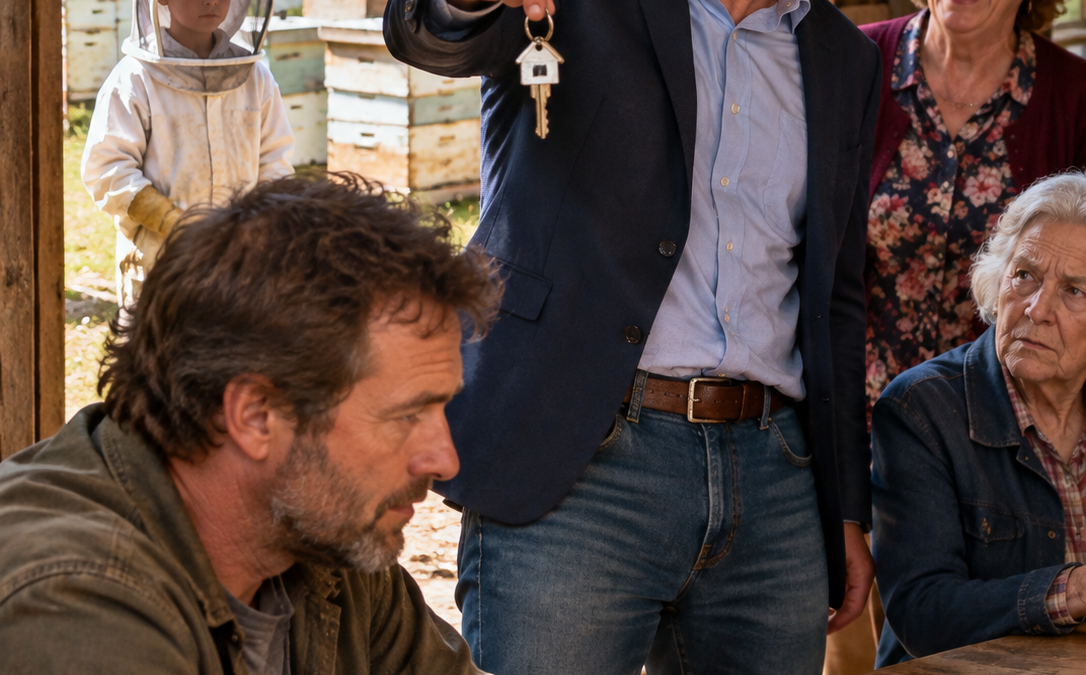
Complete story · 10 chapters · about 49 minutes · ending included
Chapter 1 · Chapter 2 · Chapter 3 · Chapter 4 · Chapter 5 · Chapter 6 · Chapter 7 · Chapter 8 · Chapter 9 · Chapter 10
Chapter 1: The Keys My Cousin Dangled
At 1:15 p.m., fifty relatives laughed as Trent Snyder swung the lake-house keys.
Marlene had just read, “Roses Lake house, $410,000, to Trent.”
“Four hundred boxes of bugs. Who’s gonna run them, Neil, your kid?”
I looked past my cousin, through the open shed doors.
Jake stood outside in Grandpa’s cut-down veil, small enough that the mesh nearly brushed his shoulders.
“Looks like it,” I said.
Trent laughed harder.
The lunch was being held in Orville’s shed, the same place he’d kept his tools and honey equipment for as long as I could remember.
The doors stood open to the yard.
Even with the tables set up and relatives talking over paper plates, I could smell the warm wood and the faint sweetness that clung to the honey house.
My name is Neil Stewart.
I was forty-four, a welder, and Orville’s grandson.
For six years, I’d spent more time managing his pills and doctors than talking about bees.
I took him to appointments when I could, sorted his prescriptions, and checked that he had what he needed before I went to my shift.
I hadn’t expected a thing from his will.
Orville had been eighty-eight when he died on Sunday, March 1.
His daughter, Marlene, had arranged the lunch for Saturday, March 7.
She stood at the end of the long table with a folder in her hands, trying to keep the pages from catching in the draft coming through the doors.
Marlene was Trent’s mother and Orville’s personal representative.
She had the careful, tired look of somebody who’d spent the week answering calls and finding papers.
After reading the lake-house bequest, she’d continued with the next line.
“My bees, honey house and all in it, to my grandson Neil Stewart.”
I heard the words, but I didn’t move.
The bees were four hundred hives spread across the yard and the rented ground around it.
The honey house was the low building behind the shed.
Orville had owned the lake house and the bees.
The hive yard was on the rented land of Roberta Pierce, where he’d rented space for his colonies.
I knew how to keep a welder running.
I knew how to make a grocery list and get Jake to school on time.
I didn’t know how to manage four hundred hives.
Trent was forty-seven, my cousin, and a sales manager at an orchard-equipment dealership.
He liked an audience.
He liked it more when the audience was family.
He gave the keys another swing.
A few people looked toward Jake, then away.
I could have told Trent to put the keys down.
I might have asked why he seemed so pleased with the house he’d inherited.
Instead, I kept my eyes on my son.
Jake was eleven.
He’d been quiet through the will reading, standing near the open doors in the veil Orville had cut down for him.
He held his hands close to his sides so the mesh wouldn’t catch on anything.
I didn’t raise my voice or give Trent anything else to work with.
The laughter had already happened.
I couldn’t take it back from Jake, and I couldn’t make the room behave as if it hadn’t heard the joke.
I could only keep my face still and stay where my son could see me.
Marlene lowered the folder.
She had asked relatives to record short memories for a memorial video, and her phone rested beside the last place setting.
She turned it toward Trent when he stepped forward.
He leaned in with the easy confidence he used when customers came into the dealership.
“I never saw a dime from those bugs. I’ve never opened one of those boxes in my life.”
He said it clearly, looking at the phone.
Then he reached into the things that had belonged to Orville and picked up a rusted hive tool.
The metal was dark around the hook, worn smooth where a hand had held it over years of work.
Trent tossed it onto the table.
It struck the wood with a hard little clatter.
A couple of relatives glanced down.
Nobody reached for it.
I knew the tool.
I’d seen it in Orville’s hand, tucked into his belt or laid beside a frame while he worked.
I didn’t know what all the marks and scratches meant.
I only knew it had been used, and that Trent had thrown it as if it were junk.
I reached for it, but didn’t pick it up yet.
Outside, Jake moved along the first row of hives.
He stopped at each box and knocked gently on the wood.
He leaned close to the lids and spoke to the bees in a low voice, the way Orville had done.
I couldn’t hear the words through the open doors.
I could see Jake’s head tilt toward each hive before he moved to the next one.
He wasn’t playing.
He was making his way down the row carefully, one box at a time.
Trent noticed him.
He pointed the lake-house keys through the doorway and laughed.
The relatives followed his gesture.
Some smiled.
A few kept eating.
Jake didn’t look back.
He knocked on the next hive and spoke to it.
The lunch broke up in pieces.
People carried plates to the trash cans and drifted toward their cars.
Marlene collected the folder and the phone.
Picking up where the Facebook post left off
Before she left, she signed me a one-page assignment: bees, honey house and all in it, papers and claims included.
I stayed near the table while Jake finished the row, then came back through the doors with the veil pushed up.
He didn’t ask what Trent had said.
He looked at the hive tool.
“That’s Grandpa’s,” he said.
“I know.”
I picked it up.
A little rust came away on my thumb.
I wiped it against my jeans and held it by the handle.
Trent was already outside.
I saw him near his truck, the lake-house keys hanging from one hand.
He waited until I came over, then glanced back toward the shed to make sure nobody was close enough to hear.
His grin was gone.
“I’ll give you eight thousand cash for the hives,” he said.
I looked at him.
“All four hundred?”
“The hives. The whole lot. Eight thousand. You can be done with them.”
A minute earlier, he’d called them boxes of bugs in front of fifty relatives.
Now he spoke as if he were making a sensible offer on equipment he knew how to price.
“Why?” I asked.
Trent’s eyes moved to the hive tool in my hand.
“You don’t know what you’re taking on, Cuz. Four hundred hives need work. Feed, hauling, timing. You have a boy and a job.”
He said it like he was doing me a favor by reminding me.
“Eight thousand cash,” he repeated.
“I need an answer by Monday at noon.”
I didn’t tell him yes.
I didn’t tell him no.
I didn’t ask why he wanted something he’d just mocked.
The deadline sat between us, and I could hear Jake moving around inside the shed.
Trent put the keys back on his belt.
“Think about it.”
He climbed into his truck and shut the door.
I stood beside the gravel drive until he pulled away.
The rusted hive tool rested against my palm.
I tucked it into my jacket pocket.
On the ride home, Jake sat quietly beside me.
He had folded the veil and placed it across his knees.
I wanted to ask him what Grandpa had taught him, but the question seemed too large for the space between us.
I also carried Trent’s offer home in my head, along with the Monday deadline.
Eight thousand dollars was a lot of money.
It was also a decision about four hundred living colonies I didn’t know how to manage.
At home, Jake took the folded veil to his room.
I put the hive tool on the kitchen counter and washed the rust from my thumb.
We ate without talking much about the lunch.
Afterward, Jake got ready for bed while I thought about Trent’s deadline.
I still had no idea why my cousin wanted those hives so badly.
At bedtime, I stopped beside Jake’s door.
He was awake, looking toward the ceiling.
“Everything okay?” I asked.
Jake turned his head toward me.
“Monday the phone starts. Grandpa said.”
Chapter 2: The Phone on Grandpa’s Wall
At 6:02 a.m. Monday, March 9, the kitchen phone rang.
I was still thinking about Trent’s eight-thousand-dollar offer when I picked it up.
“Same rows as last year?” a man asked.
I looked through the kitchen window toward the hive yard.
“I don’t know,” I said.
There was a pause.
The man cleared his throat and asked whether Orville had left instructions.
“I don’t know that either.”
He thanked me, but his voice had changed before he hung up.
I stood with the receiver in my hand, listening to the empty line.
Jake came into the kitchen while I was putting the phone back.
“Was that one of Grandpa’s growers?” he asked.
“I guess.”
He nodded as if that answered something.
I had spent six years keeping track of Orville’s pills and doctors’ appointments.
I knew which doctor wanted a call before a refill and which bottle had to stay cold.
The bees were different.
I knew they needed attention, but I thought of them as Grandpa’s hobby.
A large, expensive hobby that had somehow landed in my lap.
Trent’s offer had sounded practical when he made it beside his truck.
Eight thousand dollars would give me room to make decisions without four hundred hives waiting outside.
I called the welding shop and told them I wouldn’t be in.
My foreman asked if I was sick.
“No. I have something to handle.”
He said he’d mark me off the shift.
I knew I was giving up a day’s work, but the phone rang again before I could reconsider.
The second caller asked whether the bees would be placed in the same orchard blocks.
I told him I didn’t know.
He waited a little longer than the first man had.
Then he asked if I could check with somebody.
I said I would, though I had no idea who to call.
I found an old welding invoice in the drawer beside the refrigerator.
I turned it over and wrote the date at the top.
Each time the phone rang, I made a mark.
By eight, the marks had filled the first half of the page.
The questions changed slightly, but they kept coming back to the rows.
Was the north side staying where it had been?
Would the pear blocks get the same placement?
Had Orville changed anything before he died?
I answered each one honestly.
“I don’t know.”
The callers didn’t argue.
That made it harder.
They went quiet, then asked another question, or thanked me and hung up.
Each silence seemed longer than the one before.
At 8:37, Jake came back from his room with a bowl of cereal.
The phone rang while he was sitting at the table.
I reached for it.
“That’s one of Grandpa’s growers,” Jake said.
I glanced at him.
“How do you know?”
Jake pointed toward the phone.
I picked up before he could explain.
“Neil?” a man’s voice said.
“Speaking.”
“I’m one of the growers. I wanted to ask about the same rows we used last spring.”
Jake lowered his eyes to his cereal.
I gave the answer I’d been giving all morning.
“I don’t know.”
The man didn’t hang up right away.
“Your granddad usually had that settled by now,” he said.
“I understand.”
“I’ll wait to hear.”
The call ended.
I looked at Jake, but he was eating again.
I didn’t ask how he’d known.
The phone rang so often that I stopped trying to do anything else.
I kept the invoice beside the receiver and marked every call.
Some growers asked about one block.
Others asked about two or three.
A few only wanted to know whether they should expect the same arrangement as last year.
I couldn’t give any of them an answer.
At 10:16, Trent’s text came through.
“$8,000 ends at noon, Cuz.”
I set the phone beside the invoice.
The offer was still there, and I could still take it.
I pictured the cash in an envelope, the feed bills I didn’t understand, and the four hundred hives.
Then the kitchen phone rang again.
A caller asked if the cherry placement was staying the same.
“I don’t know,” I said.
He went quiet.
I watched the clock move toward eleven.
Trent sent no second message.
I didn’t answer the first one.
At eleven-thirty, I counted the marks on the invoice.
There were twenty-six.
The callers weren’t asking whether I planned to keep bees.
They were asking where their bees would go, and when.
I still thought there had to be a simple explanation.
Maybe Orville had promised to put the hives in certain places.
Maybe each orchard owner wanted the same service he’d received before.
I didn’t understand why they were all calling on one Monday.
At noon, I was standing by the kitchen counter when the clock changed.
Trent’s deadline passed.
I hadn’t sent him a message or called him.
The eight thousand dollars was gone unless he chose to make the offer again.
The phone kept ringing.
By early afternoon, I had thirty-seven marks on the invoice.
I had also lost the shift at the shop.
The money mattered. So did the hours.
I could already picture the bills waiting on the counter at home.
Still, every time somebody asked me about the rows, I gave the same answer.
“I don’t know.”
At 4:40 p.m., the kitchen phone rang again.
I checked the invoice before I picked up.
Thirty-seven marks.
“Neil,” a woman said. “It’s Roberta Pierce.”
I knew Roberta.
She owned an orchard, and her land held Orville’s hive yard.
She was also treasurer of the growers’ pool.
I’d seen her at the honey house and around the yard.
“Hello, Roberta.”
“Have you been answering calls all day?”
I looked at the invoice.
“Yes.”
“How many?”
I counted the marks once more.
“Thirty-eight, counting yours.”
She didn’t speak right away.
I could hear a faint outdoor sound on her end, then the click of something being set down.
“Did they ask you about the rows?”
“Most of them.”
“And what did you tell them?”
“That I don’t know.”
Roberta waited.
I was getting used to the pauses, but hers felt different.
“You do know what we pay him?”
I looked toward the yard.
The hives sat in their rows beyond the kitchen window.
I had inherited them, but I hadn’t inherited the answers.
“No,” I said. “I don’t.”
“Then come see me tomorrow morning,” Roberta said. “Seven o’clock.”
I looked at the clock.
“Tomorrow?”
“Seven. I’ll show you what you need to see.”
I glanced at the invoice, crowded with thirty-eight marks.
“All right,” I said. “I’ll be there.”
Chapter 3: The Woman Who Writes the Check
At seven Tuesday morning, I met Roberta Pierce beside the hive yard.
She wore a work jacket and carried a small notebook.
“You got my message,” she said.
“I did. You said I’d understand those calls.”
Roberta looked toward the rows.
“How many hives did your grandfather leave you?”
“Four hundred.”
“And how many orchards called yesterday?”
“Thirty-eight.”
She nodded.
“Your grandfather placed bees for thirty-eight orchards. Cherry, pear, and apple.”
“I figured they paid him something for the work.”
“They paid him $155 per hive.”
I looked at her.
“Each?”
“Each.”
She wrote the numbers in her notebook.
“Four hundred hives. A hundred fifty-five dollars apiece.”
I did the multiplication.
“Sixty-two thousand?”
“Sixty-two thousand dollars. One check every Bee Night. Every spring.”
I looked back at the boxes.
I’d spent Monday wondering whether eight thousand dollars was enough to get rid of them.
Now Roberta was telling me they earned sixty-two thousand.
“Why didn’t Grandpa ever tell me?”
“You’d have to ask him.”
She closed her notebook.
Then she looked toward the house.
“Your boy rode along every April.”
I turned toward her.
“Jake?”
“Every April. Orville brought him out with him.”
I remembered those spring nights when Grandpa had taken Jake along.
I’d been working swing shift and thought the rides were mostly something to keep the boy busy.
I hadn’t asked what happened out there.
Roberta pointed toward the neighboring orchard.
“There’s something else you need to understand. Your grandfather didn’t put bees wherever somebody wanted them.”
“Why not?”
“Spray dates. Every grower has them. The bees have to be placed around those schedules.”
I looked across the property line.
“Can’t the growers tell me when they’re spraying?”
“They can tell you about their own orchards. They don’t know what the neighbors are doing.”
She picked up a small stone and moved it between two rows of dirt.
“Put a hive here while the orchard next door is spraying, and those bees can be dead within a week.”
I looked at the hives.
“Four hundred colonies?”
“That’s right. Each grower knows his own rows. Nobody knows all thirty-eight properties, all their dates, and the order Orville used.”
“Except Grandpa.”
“Except Orville.”
I looked down the length of the yard.
“Did he ever show you?”
Roberta shook her head.
“He handled the placements. I handled the growers’ pool and the check.”
“Could you tell me the order?”
“No.”
She didn’t soften the answer.
“Your grandfather kept that part in his own hands.”
I thanked her and walked back toward the honey house.
The old door opened with a familiar scrape.
Inside, I found the workbench, frames, containers, and tools arranged where Orville had kept them.
A green ledger sat on the bench.
I pulled it closer and opened the cover.
The pages were filled with pencil marks, circles, short strokes, and numbers.
I turned several pages.
There were no instructions I could follow.
I knew how to read a welding diagram. I could look at measurements and understand what needed cutting.
These marks meant nothing to me.
I couldn’t tell which described a row, which described a date, or what order they belonged in.
I closed the book.
Then I opened it again, hoping another page might make sense.
It didn’t.
The colonies still needed feed, whether I understood the ledger or not.
I drove into town and bought what they needed.
The money came from my savings.
I had $1,900 put away from extra welding work and years of keeping expenses down.
I’d meant to save it for emergencies.
I carried the supplies back and set them near the honey house.
The receipt went into my wallet.
My savings were smaller, and I still couldn’t answer a grower’s question about placement.
When I returned to the yard, Trent’s truck was coming up the drive.
He parked near the honey house.
“Busy morning, Cuz?”
I didn’t answer.
He glanced at the supplies.
“Buying feed already?”
“Bees need it.”
Trent walked closer.
“Listen, I’ve been thinking about what I offered you.”
“The eight thousand?”
He nodded.
“That was before I understood how much work this would be.”
He paused.
“I’ll give you twenty-five thousand.”
I stared at him.
“Cash?”
“Cash. For the whole operation. The hives, everything.”
Twenty-five thousand dollars.
I’d never held that much money in my hands.
My savings were less than two thousand, and I’d already spent some trying to keep the colonies fed.
Trent watched my face.
“You could get back to welding and spend time with your boy. Nobody would blame you.”
I looked at the boxes behind him.
“Boxes of bugs went up fast.”
Trent stopped smiling.
For a few seconds, neither of us spoke.
Then he looked toward the honey house.
“You’ve been talking to Roberta.”
“She’s a grower.”
“She’s always had opinions.”
I waited.
He shifted his weight.
“Twenty-five thousand is a fair offer, Neil.”
I thought about the thirty-eight calls and the sixty-two thousand dollars Roberta had written in her notebook.
The green ledger was still sitting on the workbench.
I couldn’t read it, and I couldn’t place a single hive without risking the colonies.
Yet Trent had raised his offer from eight thousand to twenty-five thousand in three days.
I hadn’t told him what Roberta had said.
“How did you come up with twenty-five?” I asked.
He shrugged.
“Business, Cuz.”
He waited for my answer.
I looked at the honey-house door.
I had turned down a shift, spent my savings, and inherited a business I didn’t know how to operate.
Twenty-five thousand would have been more money than I’d ever had saved.
But the bees earned sixty-two thousand every spring.
“No,” I said.
Trent’s expression tightened.
“You sure about that?”
“I’m sure.”
He looked toward the rows, then climbed into his truck.
I watched him drive away.
Inside the honey house, I opened the green ledger once more.
The pencil marks still made no sense.
I set the book down and looked at the calendar beside the workbench.
March 28 was marked for Bee Night.
I picked up a pencil and circled the date.
I had said no to twenty-five thousand dollars.
I had four hundred hives, less than $1,900 in savings, and a book I couldn’t read.
Trent knew what those bees were worth.
I still didn’t know how he knew.
Chapter 4: The Slips in the Back Pocket
On Thursday morning, March 12, I found the honey-house hasp cut.
The padlock was still hanging from the latch, but the metal holding it had been sliced through.
I stopped at the doorway and looked inside.
The green ledger was still on the workbench.
The frames, containers, and tools were where I’d left them. Nothing appeared to be missing.
I didn’t touch anything until I called for a deputy.
He came out, looked at the cut hasp, and asked what had been taken.
“Nothing that I can see.”
“Anybody have permission to be in here?”
“No.”
He wrote down the damage and asked when I’d last checked the building.
I told him.
He logged the incident and left me with the cut metal and a question I couldn’t answer.
Before I finished cleaning up, my phone buzzed.
It was Trent.
The message contained a photograph of a ledger page.
Behind the page, I could see a feed-store calendar turned to March.
The date February 20 was written at the top of the photographed page.
Under the picture, Trent had written:
“Got his book too, Cuz.”
I looked toward the workbench.
My green ledger was still inside the honey house.
I checked the photograph against the page in front of me.
The pencil marks matched.
Trent had a picture of Grandpa’s writing, and the calendar behind it showed when he’d taken the photograph.
I saved the message.
I didn’t call him.
The deputy had logged the cut hasp, and I wanted that record kept separate from whatever Trent was trying to tell me.
By Friday, the first letters from the dealership had reached the growers.
Roberta called me after she’d heard from several of them.
“Trent’s sending out letters,” she said.
“What does he say?”
“He says he worked beside Orville twenty years. He says he knows every block.”
I spread the old welding invoice across the kitchen table.
The same growers who had asked me about placement were now receiving letters from my cousin.
I asked Roberta to read the exact wording.
She did.
“I worked beside Orville twenty years. I know every block.”
I looked at the welding invoice beside me.
Trent had told Marlene’s phone at the funeral lunch that he’d never opened one of Orville’s boxes.
Now he was telling the growers he knew every block.
The letters included a way to book placements through the dealership.
Nineteen growers mailed Trent booking fees of $600 each.
That was $11,400.
They had listened to me say I didn’t know, and Trent had offered them somebody who claimed he did.
I couldn’t blame them for wanting their orchards covered.
I also couldn’t promise them anything.
When Roberta finished explaining, I asked whether she wanted me to call the growers.
“What would you tell them?” she asked.
“That I have the bees.”
“And can you tell them where to put them?”
I looked at the invoice.
“No.”
“Then don’t make promises you can’t keep.”
I didn’t like hearing it, but she was right.
I had four hundred hives and no usable placement order.
The following week, my foreman called me at home.
He told me my hours were being cut.
I asked how many shifts I’d lose.
“It’s what I can give you right now,” he said.
I didn’t argue.
I’d already missed work on Monday, and now my paycheck was going to be smaller.
The feed bills still needed paying.
I checked my savings and thought about the $1,900 I’d started with.
I’d spent money keeping the bees alive, and I had no idea how long I could keep doing it.
That afternoon, I went back to the honey house.
The green ledger was still on the bench.
I picked it up to move it out of the way while I cleared a space for the feed supplies.
Something inside the back cover shifted.
I opened the back pocket.
There were folded slips tucked inside.
I pulled them out and spread them across the bench.
Twenty-three slips.
Each carried Trent’s signature.
The same words appeared on them:
“Rec’d, bee money.”
I looked at the dates.
They ran from 2011 through 2025.
I started adding the amounts.
Then I checked the total.
$118,400.
I sat down on the bench.
The cousin who had laughed at four hundred boxes of bugs had signed twenty-three receipts for bee money.
He’d told fifty relatives he never saw a dime.
The slips said something else.
I put them back in order and counted them again.
Twenty-three.
One hundred eighteen thousand, four hundred dollars.
I took photographs of the slips and returned them to the ledger’s back pocket.
I wasn’t going to leave them on a workbench where somebody could take them.
Then I called Marlene.
I asked her to send me the memorial video from the funeral lunch.
She sent the recording, and I saved it on my phone.
Trent’s voice was clear.
“I never saw a dime from those bugs.”
I listened to the clip once.
The signed slips were in Grandpa’s book.
Trent’s words were in Marlene’s recording.
His photograph of the February 20 page was in my messages.
I had evidence that he was lying.
I still couldn’t tell a grower where to put a single hive.
On Thursday, March 19, I called Roberta.
I told her about the slips and the total.
She listened without interrupting.
When I finished, she asked one question.
“Can you place the bees?”
“No.”
“Then keep the slips.”
“What am I supposed to do with them?”
“They decide at Bee Night, not by phone.”
I looked at the calendar.
March 28 was circled in pencil.
The growers would meet on March 28 at the Grange hall.
I wanted to call Trent and ask how long he’d been taking money from Grandpa.
I wanted to call the nineteen growers and tell them what their booking fees had bought.
But I didn’t.
I kept the slips in the ledger and the video on my phone.
The evidence could wait until the people who paid for the bees were in the room.
The next afternoon, Trent came to my house.
I opened the door and found him standing on the porch.
He looked past me toward the kitchen.
“Getting ready for the twenty-eighth?”
I didn’t answer.
He stepped closer to the doorway.
“You’ve got those papers now, don’t you?”
I kept one hand on the door.
“Which papers?”
He gave me a tight smile.
“Don’t play dumb with me, Cuz.”
I said nothing.
Trent glanced at the house, then back at me.
“You’ll stand up with a welding rod and a kid.”
He let the words sit between us.
Then he stepped off the porch and walked toward his truck.
I watched him leave.
Bee Night was eight days away, and I still couldn’t read Grandpa’s book.
Chapter 5: The Boy Who Read to the Bees
At 2 a.m. on Saturday, March 21, Jake’s bed was empty.
Six days earlier, I’d told him the bees might starve if I couldn’t figure out Grandpa’s book.
I hadn’t meant for him to hear.
I’d been standing in the kitchen with the feed receipt in one hand and the green ledger on the counter.
I thought Jake was in his room.
Now his blanket was folded back, and his bedroom was empty.
I checked the bathroom and the kitchen before noticing the back door wasn’t fully closed.
I grabbed my jacket and went outside.
A small red light moved between the hive rows.
I followed it toward the honey house.
Jake stood beside the ninth row, wearing Orville’s cut-down veil.
A red flashlight rested in his hand.
The green ledger was open against the top of a feed container.
He lifted one lid, checked inside, then lowered it carefully.
His lips moved as he looked at the pencil marks.
I stopped several feet away.
“Jake?”
He turned quickly.
The flashlight moved across my jacket before he pointed it down.
“What are you doing out here?”
“Checking the feed.”
“At two in the morning?”
He looked at the open book.
“Grandpa used to come out.”
I walked closer.
The ledger was open to a page I hadn’t been able to understand.
Jake moved the flashlight over a series of marks.
He read something under his breath.
I looked at the page, then at him.
“You can read that?”
“Since I was six. Row nine’s light.”
I stared at him.
“What does that mean?”
“Row nine needs more feed. The mark is different.”
He pointed to a pencil stroke near the edge of the page.
I leaned closer.
It looked exactly like the other marks to me.
“Who taught you?”
“Grandpa.”
Jake adjusted the veil around his face.
“He taught me Saturdays. One mark a week.”
I looked at the ledger.
For years, I’d thought Jake was simply riding along with Orville during the spring.
I’d seen them leave together and come back after dark.
I’d assumed Grandpa was giving him something to do while he worked.
I hadn’t understood that those trips were lessons.
“How long have you been doing this?”
“Since I was six.”
He lifted another feed lid and checked it.
“Grandpa said I had to learn the marks before I could help.”
I looked at my son.
He was eleven now.
I’d spent days turning pages, trying to find words that weren’t there.
Jake had been reading them for years.
“Why didn’t you tell me?”
Jake kept his eyes on the book.
“Grandpa said it stayed shut until the bees needed it.”
I didn’t have an answer.
He closed the ledger and put the flashlight beside it.
I helped him finish checking the feed before we went inside.
I didn’t tell him he should have stayed in bed.
I wanted to know what else he could read.
The next morning, I brought the green ledger to the kitchen table.
Jake sat across from me.
I opened it to one of the pages and pointed to a group of marks.
“Can you show me what these mean?”
He studied the page.
“That’s the north side. The next mark is where they go after the cherry bloom.”
He moved his finger down the page.
I couldn’t follow the sequence, but he didn’t hesitate.
I remembered Roberta saying nobody knew all thirty-eight orchards and their spray dates.
I reached for the phone.
“Can you read something for Roberta?”
Jake looked up.
“What?”
“Her orchard. Block 14.”
He nodded.
I dialed Roberta’s number and put the phone on speaker.
She answered after a few rings.
“Neil?”
“It’s me. I’ve got Jake here.”
“All right.”
“I want him to read something from Grandpa’s book.”
There was a pause.
“Go ahead.”
Jake pulled the ledger closer.
He studied the marks and began reading.
“Block 14. North row. The truck stays clear of the west gate. Your husband’s truck was parked beside the north row when Grandpa checked the frames.”
Roberta didn’t answer immediately.
Then she asked, “Who told you about my husband’s truck in the north row?”
Jake looked at me.
I picked up the phone.
“That’s what he read.”
Roberta’s voice changed.
“Orville showed him that?”
“He says Grandpa taught him the marks.”
She was quiet for a moment.
“Put him back on.”
I handed Jake the phone.
Roberta asked him another question about the page.
He answered without hesitation.
She thanked him and told him she’d see us at Bee Night.
When the call ended, I sat looking at the ledger.
The book wasn’t unreadable.
It was unreadable to me.
Jake had the knowledge Orville had spent years giving him, one Saturday at a time.
I felt proud of him.
I also felt afraid.
Bee Night was March 28, seven days away.
Thirty-eight growers would be there, along with twelve relatives.
Fifty people would be watching.
Trent would be there too.
He had already told growers he knew every block.
He had collected nineteen booking fees of $600 each.
And he had threatened me on my own porch.
Jake could read the book, but that didn’t mean he could stand in front of fifty people and explain it.
At school, he barely answered questions in class.
If a teacher called on him, he’d give the shortest answer he could and look back down at his work.
I couldn’t ask him to carry a room full of adults just because his grandfather had taught him something valuable.
That evening, I sat with him at the kitchen table.
The ledger rested between us.
“Roberta believes you,” I said.
Jake nodded.
“Do you understand what happens at Bee Night?”
“Grandpa’s growers meet.”
“Fifty people will be there.”
He looked at the book.
“Trent too?”
“Yes.”
Jake didn’t say anything.
I rested my hand on the closed cover.
“I need you to understand something. You don’t have to do this.”
He looked up.
“If you don’t want to read in front of them, we won’t.”
“What about the bees?”
“I’ll figure something out.”
“But you don’t know the marks.”
“No. I don’t.”
He looked down again.
I leaned forward.
“One look at me and we walk out. Bees or no bees.”
Jake ran his finger along the edge of the ledger.
I didn’t ask him to promise anything.
I didn’t tell him his grandfather would have wanted it.
The choice had to belong to him.
The next two days passed without another conversation about Bee Night.
I kept working with the feed and the hives.
My reduced hours at the welding shop left me more time in the yard, but not more answers.
Jake went to school and came home as usual.
He didn’t bring up Trent.
He didn’t ask me whether I’d changed my mind.
On Monday, March 23, I came into the kitchen and found Jake packing the green ledger himself.
He had placed it carefully inside a bag and checked that the cover wasn’t bent.
I stopped in the doorway.
“You ready?”
He adjusted the bag.
“I’ll read the book.”
I watched him.
“Are you sure?”
He looked toward the front window.
“I won’t look at Trent.”
Then he picked up the bag and carried it to the door.
Chapter 6: The Page My Cousin Couldn’t Read
By seven o’clock Saturday, March 28, the Grange hall was full.
Thirty-eight growers had come, along with twelve relatives. Fifty people sat facing the front, where Lyle Briggs stood beside the microphone.
Lyle was Trent’s boss at the orchard-equipment dealership. He was also one of the growers who depended on Orville’s bees.
I sat near the aisle with Jake beside me.
The green ledger was in a bag at Jake’s feet.
He hadn’t said much on the drive over. He kept one hand on the bag, as if he wanted to make sure the book was still there.
Across the room, Trent stood with a printed trucking quote from Yakima.
He looked comfortable.
He’d spent the previous two weeks sending letters to growers, telling them he knew every block. Nineteen of them had mailed him $600 booking fees.
He had something I didn’t.
Their confidence.
Lyle called the meeting to order and asked the growers to hear the arrangements for the coming spring.
Trent stepped forward.
He held up the Yakima trucking quote.
“I’ve got transportation lined up,” he said. “We can handle the placements without making this complicated.”
A few people nodded.
I recognized several of the growers who had called me on March 9.
They had asked whether the bees would go to the same rows as last year.
I’d told them I didn’t know.
Trent had given them an answer, even if it wasn’t one he could support.
He put the quote down and faced the room.
“I worked beside Orville twenty years. I know every block.”
I watched the growers.
Some leaned forward. Others looked toward Lyle.
Trent had said the same thing in his letters, but hearing it in the hall made it sound official.
He was standing beside his boss, holding a transportation quote, with nineteen booking fees behind him.
I had a welding job with fewer hours than before and four hundred hives I couldn’t place.
Lyle looked toward me.
“Neil, you wanted time to address the group.”
I stood.
My legs felt stiff from sitting, but my voice worked.
“I have something I’d like everybody to hear.”
Trent lowered his paper.
“What is it, Cuz?”
I didn’t answer him.
I turned toward Roberta, who sat near the front.
“Would you play the video?”
She nodded.
I handed her my phone.
She walked to the microphone and brought up the recording Marlene had made at the funeral lunch.
The room settled.
The picture showed Trent standing beside the table in Orville’s shed.
His voice came through the hall.
“I’ve never opened one of those boxes in my life.”
Nobody moved.
The recording ended.
Roberta handed my phone back.
I looked at Trent.
He had stopped holding the trucking quote so confidently.
One of the growers near the front turned toward him.
Another looked down at the table.
Lyle shifted beside the microphone.
Trent cleared his throat.
“That was a funeral lunch,” he said. “People say things at those gatherings. It doesn’t explain the operation.”
I kept my phone in my hand.
“I didn’t say it did.”
He looked at me.
“Then what are we doing here?”
I waited until he faced the room again.
Trent reached into his folder and raised a printed page.
“Orville handed me his book last Christmas.”
He held the page high enough for the growers to see.
“This is from his records. I have a copy. I know what he was doing.”
I recognized the photograph.
It was the same page he’d sent me on March 12.
The feed-store calendar behind it had been turned to March.
The date at the top of the page was February 20.
Trent held the paper as if it settled the question.
Roberta stood.
“Then read Block 14.”
Trent looked at her.
“What?”
“Block 14,” she repeated. “Read it.”
He glanced down at the printout.
Nobody spoke.
Roberta stayed on her feet.
“You say Orville gave you the book last Christmas. You say you know every block. Read Block 14.”
Trent moved the paper closer to his face.
He looked at the marks.
Then he turned it slightly, as if a different angle might help.
“I know the placements,” he said.
“Then read them.”
His face had begun to shine.
He set the paper on the table, picked it up again, and looked toward Lyle.
“This isn’t a school test.”
“No,” Roberta said. “It’s about the bees.”
I could hear somebody shifting a chair near the back.
Trent wiped his forehead with the back of his hand.
“Orville’s hand went bad at the end. Nobody could read that.”
Roberta didn’t sit down.
“You just said he handed you the book last Christmas.”
Trent’s mouth tightened.
“He wasn’t writing clearly by then.”
“Then how do you know what the page says?”
He didn’t answer.
I looked around the hall.
The growers had come because they needed their orchards pollinated.
They had paid Orville for years, and now they were being asked to trust Trent with the same work.
Some of them had already sent him money.
I could see the concern on their faces.
I had the signed slips in the green ledger.
Twenty-three slips, each carrying Trent’s signature.
Together, they totaled $118,400.
I had the photograph he’d sent me.
I had his words from the memorial video.
But none of those things could tell the growers where to put their bees.
The book could.
And Trent couldn’t read it.
Lyle looked from Trent to Roberta.
“Is there somebody here who can explain the placements?”
Roberta turned toward me.
I felt the room waiting.
I could have reached down and pulled the ledger from Jake’s bag.
I could have told them what he’d shown me about Block 14.
I could have announced that my eleven-year-old son had been learning Orville’s marks since he was six.
But I had promised Jake something.
One look at me and we would walk out.
Bees or no bees.
I turned my head toward him.
Jake was sitting straight in his chair, his hands resting on the bag.
He wasn’t looking at Trent.
He was looking at me.
I didn’t nod.
I didn’t tell him to stand.
I didn’t reach for his shoulder or remind him what we’d practiced.
The room waited for an answer.
Trent stood beside the microphone with his unreadable page.
Roberta remained standing.
I kept my hands at my sides.
Then Jake pushed his chair back and stood.
Chapter 7: The Boy Who Answered the Room
Jake stood beside his chair, with fifty people watching him.
Trent still held the printed page.
“What are you going to do, son?” he asked.
Jake didn’t answer him.
He opened the green ledger and laid it open across the tabletop.
Then he looked down at the marks.
“Block 14,” he said.
Roberta moved closer.
Jake began reading.
He named the north row, the west gate, and the placement that followed the neighboring orchard’s spray schedule.
He didn’t rush.
He turned the page and continued with the next set of marks.
A man near the front stood up.
“That’s my row.”
Jake looked toward him and nodded.
Another grower rose.
“That’s mine too.”
A woman near the aisle pointed toward the ledger.
“He’s got the pear blocks right.”
One by one, growers began standing.
“That’s my row.”
“That’s ours.”
“He’s got the north side.”
I watched their faces change as Jake moved through the pages.
These were people who had spent Monday, March 9, calling a forty-four-year-old welder who couldn’t answer a single question.
Now my eleven-year-old son was giving them the answers they’d expected from Orville.
Jake turned another page.
Trent shifted his weight.
“Anybody can memorize a few names,” he said.
Jake didn’t look up.
He reached for the printed page Trent had brought and held it beside the ledger.
“This one says February twentieth.”
Trent looked at him.
Jake traced the date with his finger.
“February twentieth.”
I stepped forward.
“That’s the page Trent sent me on March twelfth.”
I brought up Trent’s message on my phone.
The photograph showed the ledger page, with the feed-store calendar behind it.
I enlarged the picture and turned the screen toward the people nearest me.
The calendar was clearly set to March.
“Trent says Orville handed him this book last Christmas,” I said. “But he sent me this photograph on March twelfth.”
A few growers leaned closer.
The page was dated February 20.
The calendar behind it showed March.
Trent lowered his printed copy.
“That doesn’t prove anything.”
I put my phone away.
“Then let’s talk about the slips.”
I turned to the green ledger Jake had already laid open on the table.
I opened its back pocket and took out the twenty-three signed slips.
I placed them on the table.
Trent stared at them.
“These were inside Grandpa’s book,” I said.
I arranged the papers so the signatures could be seen.
“Twenty-three slips. Every one signed by Trent Snyder. Every one marked, ‘Rec’d, bee money.’”
A grower near the front leaned forward.
I read the total from the ledger page.
“The total is $118,400.”
The room grew quiet.
Trent shook his head.
“That was family money. It had nothing to do with bees.”
I looked at him.
“You signed the receipts.”
“Orville helped me with things. We were family.”
“You told Marlene’s camera you never saw a dime from those bugs.”
Trent’s jaw tightened.
He looked toward his mother.
Marlene had been sitting near the front, her hands folded in her lap.
She hadn’t spoken during the reading.
Now she pushed her chair back and stood.
“You called me March twelfth and asked what the marks meant, Trent.”
He turned toward her.
“Mom.”
“You called me and asked what your grandfather had written.”
Marlene’s voice was steady.
“You didn’t know what those marks meant. You wanted me to explain them.”
Trent shook his head.
“You’re getting this wrong.”
“I know the date because I remember the call.”
She looked at the slips.
“I knew about the money, too.”
Nobody moved.
Marlene had spent the funeral lunch laughing when Trent laughed.
She’d held the folder and read the will while he swung the lake-house keys.
Now she stood in front of the family and contradicted her own son.
Trent looked around the room.
He had started the evening with a trucking quote, nineteen booking fees, and a claim that he knew every block.
He no longer had an answer for the page.
He reached toward the table, but I moved the slips closer to myself.
“Marlene signed those over to me with the book,” I said.
Trent pulled his hand back.
Then he took the lake-house keys from his belt.
He swung them toward me.
“The lake house for the boxes. Tonight.”
The keys flashed under the hall lights.
“Four hundred and ten thousand dollars, Neil. You give me the bees, and the house is yours.”
I looked at the keys.
The house was worth far more than anything I’d ever owned.
For a few seconds, I thought about what that kind of money could mean for Jake and me.
A place of our own.
No rent.
No more worrying about whether the next smaller paycheck would cover the bills.
But Trent was offering me a house in exchange for the very thing he’d spent the evening pretending he understood.
I didn’t reach for the keys.
Roberta walked past Trent and me.
She stopped at the front table, where the growers’ agreement lay open.
Her finger rested on one line.
“Placed by Orville Stewart or a person he has trained.”
She looked at the room, then at Jake.
“That’s what the agreement says.”
Trent lowered the keys slightly.
Roberta picked up the pooled check from the table.
It was made out for $62,000.
She walked over and placed it in my hand.
“Thirty-eight orchards,” she said. “Four hundred hives. One spring check.”
I looked at the check.
The same amount she’d told me about beside the yard on Tuesday morning.
For days, I’d been trying to figure out how to keep the bees alive without understanding Grandpa’s book.
Now the growers had watched Jake read it.
Roberta hadn’t handed me the money because I was Orville’s grandson.
She’d handed it to me because the agreement allowed the work to continue through somebody Orville had trained.
I looked at Trent’s keys, still hanging in the air between us.
He had offered me a $410,000 house for the bees.
I left the offer unanswered.
“You asked who’d run them, Trent. He’s eleven.”
Jake stood beside the ledger.
He didn’t smile.
He simply turned another page and waited for the next grower to ask about his row.
I looked around the room.
The growers had accepted what Jake could read.
Marlene had stopped protecting Trent.
Roberta had put the spring check in my hand.
Trent still had the lake-house keys, but the swap he’d offered had gone nowhere.
What did he still have?
Lyle Briggs had been quiet through the entire exchange.
He stepped away from the microphone and picked up his hat from the front table.
Then he looked directly at Trent.
“Come outside with me, Trent.”
Trent glanced at the growers.
Lyle held the door open.
“Now.”
Chapter 8: The Key Off the Ring
Lyle Briggs didn’t wait until we were outside the Grange hall to speak.
He stopped Trent beside the company truck in the parking lot.
The growers had followed us out and gathered on the steps.
I stood near the entrance with Jake and the green ledger.
Lyle held his hat in one hand.
“You put my letterhead on this.”
Trent looked toward the people watching.
“I was arranging transportation.”
“You sent letters using my dealership’s name. You told growers you knew every block.”
“I worked with Orville for twenty years.”
Lyle shook his head.
“You couldn’t read one page.”
Trent glanced toward me.
I didn’t say anything.
Lyle pointed at the company truck.
“Give me the keys.”
Trent looked down at the ring attached to his belt.
For a moment, he didn’t move.
Then he started working the truck key off the ring.
It caught against the other keys.
He pulled harder until it came free.
The key slipped from his fingers and hit the pavement.
It landed near Lyle’s shoes.
Nobody laughed.
Trent bent down, picked it up, and handed it over.
Lyle took it without another word.
The company truck was no longer Trent’s to drive.
I looked toward the steps.
Marlene stood apart from the other relatives.
She had watched her son lose the truck key without moving toward him.
Trent turned in her direction.
“Mom?”
She didn’t answer.
She walked to her car.
I watched her get inside, start the engine, and pull out of the lot.
She drove away alone.
Trent stayed beside the truck, holding the lake-house keys.
Lyle turned back toward the hall.
The growers began moving toward their own vehicles.
Trent stood in the gravel while the crowd thinned.
He looked down at the lake keys in his palm.
Then he started walking toward the highway.
He didn’t ask anybody for a ride.
I watched until he was farther down the road.
Jake stood beside me, holding the bag with Grandpa’s ledger.
“Are we going home?” he asked.
“Yes.”
He adjusted the strap on his shoulder.
We left the parking lot together.
On Sunday, I checked the hives and made a list of what needed attention.
The $62,000 check from Roberta was still waiting to be deposited.
I had feed to buy, equipment to maintain, and more work ahead than I could manage alone.
At least now I knew the bees had a place in the coming spring.
On Monday, March 30, the growers came with receipts.
They brought a lawyer’s letter too.
The nineteen growers who had paid Trent booking fees of $600 each wanted their money back.
I wasn’t at the meeting where the first papers were presented, but Roberta called me afterward and told me what happened.
Trent had to face the receipts one at a time.
Each grower had proof of payment.
The lawyer’s letter explained what they were demanding.
Trent didn’t argue that the money had never been collected.
He wrote checks.
Nineteen checks.
Six hundred dollars apiece.
The total came to $11,400.
Roberta told me he kept his head down while he wrote them.
The growers waited until every check was accounted for.
Nobody left without knowing whether the money was being returned.
Later that day, Lyle called.
He told me Trent was no longer employed at the dealership.
There wasn’t much else to say.
Lyle had taken back the company truck, and now he’d taken away the job.
I thanked him for letting me know.
Then I went to the bank.
The $62,000 pooled check was in my jacket pocket.
I stood at the counter and deposited it.
The teller gave me the receipt, and I put it with the other papers I was keeping for the bee operation.
For weeks, I’d been looking at feed costs and wondering how long my savings would last.
Now I could pay for what the colonies needed without taking the money out of the little I had left.
I drove to the feed store and paid for the supplies.
I also arranged for two haulers to help with the coming placements.
I couldn’t move four hundred hives by myself.
The haulers knew the work, and I could use the extra hands while Jake handled the order from the ledger.
We discussed the equipment and the timing.
I made sure they understood that the placements had to follow Orville’s marks.
I wasn’t going to guess and risk losing colonies because I wanted to save a few hours.
When I got home, Jake was at the kitchen table with the green ledger open.
He was following one of the pages with his finger.
“Did you get the feed?” he asked.
“I did.”
“And the haulers?”
“Two of them. They’ll help us.”
He nodded and went back to the page.
I put the bank receipt in the drawer with the feed bills.
The operation finally had money coming in, and I had people to help move the hives.
But Trent’s signature was still on twenty-three slips in Grandpa’s ledger.
Those slips totaled $118,400.
Returning the nineteen booking fees had cost him $11,400.
Losing the truck and his job had cost him something else.
I wondered what the twenty-three slips would cost him once somebody looked at them together.
That evening, my phone rang.
I was in the kitchen when I saw Trent’s name.
For a moment, I considered letting it go to voicemail.
Then I answered.
“Neil.”
His voice sounded rough.
“Cuz.”
I waited.
He didn’t ask about the bees or the money from the growers.
He went straight to the slips.
“Those slips, Cuz. Pick a lawyer. I’ll sign.”
I leaned against the counter.
“What are you offering to sign?”
“The papers for the money. All twenty-three.”
I looked toward the drawer where I’d put the bank receipt.
“You mean the $118,400?”
“Yes.”
His voice was hoarse, and he spoke more slowly than usual.
“Pick a lawyer. I’ll sign.”
I didn’t promise him anything.
I didn’t tell him the matter was settled.
I looked toward the green ledger on the kitchen table.
For weeks, Trent had tried to buy the bees, claim the placements, and make the growers believe he knew Orville’s work.
Now he was asking me to bring the slips to a lawyer.
“All right,” I said. “We’ll do it properly.”
He was quiet.
Then he said, “Just get the papers ready.”
The call ended.
I remained by the counter, considering what his offer meant before telling Jake.
The next step wouldn’t happen in the Grange hall or beside the hives.
It would happen in a lawyer’s office, with all twenty-three slips laid out where Trent couldn’t pretend he hadn’t signed them.
Chapter 9: The Page Grandpa Left for Me
Trent arrived at my lawyer’s office on Tuesday morning with the growers’ receipts waiting on the desk.
He didn’t bring the lake-house keys this time.
He brought the papers my lawyer had prepared.
The twenty-three slips were spread across the desk, each bearing Trent’s signature and the words “Rec’d, bee money.”
My lawyer explained the private repayment terms. Trent would acknowledge the full $118,400 and sign an agreement to repay the money.
There was no courtroom and no public argument.
The growers had receipts of their own. Trent knew what would happen if they took those papers further.
He picked up the pen.
“You want all of it?” he asked.
“All twenty-three,” I said.
He glanced at me.
“I know what they add up to.”
He turned back to the papers and began signing.
I watched his hand move from one page to the next.
The same hand that had swung the lake keys at the funeral lunch was now putting his name beneath the money he’d taken.
When he finished, he pushed the papers across the desk.
“I’ll have to sell the lake.”
I didn’t answer.
The house at Roses Lake had been left to him, worth $410,000.
It was the thing he’d held over my head from the beginning.
Now it was the thing he would have to give up to meet the obligation he’d signed.
My lawyer collected the papers.
Trent stood, straightened his jacket, and left.
I stayed long enough to make sure the signed agreement was in order.
Then I took my copy home.
Marlene came to see me afterward.
She stood near the kitchen door while Jake was in his room.
“I should have told you,” she said.
I waited.
“About the slips. I knew Trent had been taking money from Orville.”
I looked at her.
“How long?”
“Long enough.”
She adjusted the strap of her purse against her shoulder.
“I knew there were payments. I didn’t know all the amounts until I saw what you brought out at the Grange.”
“You knew he was getting money from Grandpa.”
“Yes.”
She didn’t offer an excuse.
At the funeral lunch, she’d watched Trent laugh at my son.
She’d read the will while he held the keys.
She’d also known there was money changing hands, and she’d let me believe the bees were only a burden Orville had left behind.
“Why didn’t you tell me?” I asked.
“I thought I was keeping him out of trouble.”
I looked toward the back window.
The hive yard was visible beyond the house.
“You let me walk into this without knowing what I was taking on.”
“I know.”
She looked down.
“I’d like to see the bees sometime. If that’s all right.”
I didn’t tell her everything was forgiven.
I didn’t tell her she could come whenever she wanted.
“Come see the bees sometime. Not yet.”
Marlene nodded.
She didn’t argue.
After she left, Jake came into the kitchen carrying the green ledger.
He set it down and opened it near the back.
“There’s something I didn’t read at the Grange,” he said.
I pulled out a chair.
“What is it?”
“Grandpa’s last entry.”
He turned to a page near the end.
The date at the top was February 20, 2026.
I’d seen that date on Trent’s photograph, but I hadn’t known what the rest of the page said.
Jake placed his finger beneath the first line.
“House to Trent. He’ll sell it by fall. Bees to Neil, for the boy who asked me why.”
I looked at him.
“Read the next part.”
Jake moved his finger down.
“If I’d told Neil, Trent would’ve been at his door first.”
I sat quietly while Jake kept his finger on the page.
Orville had known.
He’d known Trent wanted the bees, and he’d known what might happen if I learned about the money and the placements before he was gone.
For six years, I’d handled his pills, his doctors, and the ordinary things that came with caring for an old man.
I had thought those spring rides with Jake were simply time Grandpa spent with his great-grandson.
But Orville had been teaching him.
One mark at a time.
He’d left the house to Trent because he expected Trent to sell it.
He’d left the bees to me, but the knowledge to the boy who had asked questions.
I looked at Jake.
“Why didn’t you read this at the Grange?”
“You were already showing them the slips. I thought they needed the other pages first.”
He closed the book.
I had spent weeks trying to understand what Orville had written.
My son had been carrying the answers since he was six.
I knew how to weld steel and repair equipment.
I could build a frame from measurements and make a broken joint hold.
But could I learn what Jake knew without making him carry the whole operation alone?
I wasn’t going to ask him to teach me everything in one night.
I had a truck to prepare.
The two haulers were booked for April 2.
We needed a rack that would hold the equipment securely and keep the tools from shifting during the overnight move.
I went out to the work area and started measuring the steel.
Jake brought the ledger and stood nearby.
I cut the pieces, checked the angles, and set the first section in place.
He watched me work.
When I struck the arc, sparks scattered across the dark concrete.
The welding light caught the edge of his face and the green cover of the book.
I finished one joint, checked it, and moved to the next.
The rack was ready before the haulers arrived.
By June, the Roses Lake house was listed for sale.
The listing went up, and relatives began hearing about it.
At a family supper, nobody saved Trent a chair.
Nobody called to ask where he was sitting or whether he was coming.
I didn’t know where he ate that evening.
I only knew the house was on the market, just as Orville had written in his ledger.
Chapter 10: The Tool He Threw on the Table
At 11:40 p.m. on Thursday, April 2, the flatbed was backed up beside the first row of hives.
The two haulers were ready.
I stood at the forklift controls, checking the space between the pallets and the truck bed. Jake sat in the cab with Grandpa’s green ledger open across his knees.
A red flashlight illuminated the page.
“What’s next?” I called.
Jake checked the marks.
“Cherry block. North side first. Then the west drop.”
One of the haulers looked toward me.
“Your boy sure about that?”
“He’s sure.”
Jake pressed the radio button.
“Dad, take the next four from row nine.”
I raised the forks and eased them beneath the first stack.
The machine moved more slowly than I wanted. Jake’s voice came through the radio before I could ask for the next placement.
“Easy. Those go together.”
I lowered the load onto the flatbed.
The haulers secured the boxes while I backed the forklift away.
For weeks, I’d looked at Grandpa’s ledger and seen nothing but pencil marks.
Now each mark told us where a colony belonged.
The difference was Jake.
We worked through the night.
The haulers handled the loading and transport, while I operated the forklift and checked the equipment. Jake called the drops from the cab.
He didn’t guess.
If a mark wasn’t clear, he stopped and studied it.
I waited.
That was harder than it sounds for a man who’d spent most of his working life trying to finish a job on time.
But I wasn’t going to hurry him into a mistake.
The growers had paid for four hundred hives to be placed properly.
Thirty-eight orchards depended on the work Orville had done for years.
The spring check was $62,000, based on $155 per hive.
I’d deposited that check, bought the feed, and hired the help.
The money was no longer a number in Roberta’s notebook.
It was paying for the work happening around me.
By three in the morning, my shoulders ached from operating the forklift.
The haulers were tired too.
We stopped briefly to check the load and secure a strap that had loosened.
Jake climbed down from the cab.
“Everything okay?” he asked.
“Fine. You?”
He nodded and returned to the ledger.
I watched him shine the red light over the marks.
He was eleven years old, and he was the person keeping the night’s work in order.
I thought about the funeral lunch on March 7.
Fifty relatives had laughed when Trent asked who would run four hundred boxes of bugs.
I’d answered, “Looks like it.”
At the time, I hadn’t known what that answer would cost.
I’d been forty-four, with a welding job, a son, and $1,900 in savings.
I’d thought Orville had left me a hobby I could sell for eight thousand dollars.
Instead, he’d left me a business worth $62,000 every spring and a responsibility I couldn’t manage without learning from my boy.
Trent had inherited the $410,000 lake house.
He’d tried to trade it for the bees, then signed repayment papers for the $118,400 on his twenty-three slips.
The house would go on the market in June.
The nineteen growers had received their $11,400 in booking-fee refunds.
The company truck and Trent’s job were gone.
I didn’t need to think about any of that while Jake was calling placements.
We had work to finish.
Near dawn, the last of the first cherry placements was completed.
The haulers checked their equipment.
I lowered the forklift forks and shut down the engine.
My hands were stiff.
The yard was beginning to turn gray beyond the rows.
Roberta’s truck pulled in just as the first light reached the tops of the trees.
She climbed out carrying two cups of coffee.
She put them on the flatbed’s tailgate.
“Figured you might need these.”
I took one.
“Thank you.”
She looked toward Jake, who was still checking the ledger.
“He got you through it?”
“He did.”
Roberta nodded.
She didn’t make a speech or ask me to explain what had happened overnight.
She stood beside the truck and watched the morning light spread across the orchard.
Jake finished his notes and closed the book.
Then he went to the first hive.
He was wearing Orville’s cut-down veil.
The mesh came down around his shoulders, and he checked that it was secure before reaching for the lid.
I recognized the tool he carried.
It was the rusted hive tool Trent had tossed onto the table at the funeral lunch.
I’d pocketed it rather than argue with my cousin.
For weeks, it had sat with the ledger and the other equipment.
Now Jake held it in his gloved hand.
He slid the hooked end beneath the hive cover and worked it loose.
The lid lifted.
A few bees moved across the frames.
Then more rose into the morning light.
Jake stayed steady, watching the colony.
Roberta stood beside me with her coffee.
I didn’t reach for the tool or tell him how to handle it.
He knew what he was doing.
The man who’d called them boxes of bugs had thrown away a tool that now opened the first hive of the season.
Jake finished checking the frames and lowered the lid.
He stepped back and lifted the veil.
“That’s the first one,” he said.
I nodded.
“Looks good.”
He returned to the flatbed and picked up the green ledger.
The book had traveled through the funeral lunch, the cut hasp, Trent’s photograph, and the Grange hall.
It had held twenty-three slips showing $118,400 in payments.
It had also carried the marks that thirty-eight growers needed somebody to understand.
Jake opened it to a fresh section.
“Dad, come here.”
I put down my coffee and walked over.
He took the pencil from the book.
“Grandpa started with one mark when he taught me.”
I looked at the page.
“Show me.”
Jake held out my hand, palm upward.
With the pencil, he drew a small mark against my skin.
He explained where it belonged and what it told him about the row.
I watched his hand move.
Then he gave me the pencil.
I turned to the ledger.
The first line waited for me.
I knew how to hold a welding torch, how to measure steel, and how to make a joint strong enough to carry a load.
I had no trouble admitting I was slow at this.
I looked at the mark on my palm and copied it into the row.
The pencil moved carefully across the paper.
I finished and looked at Jake.
He checked what I’d written.
He didn’t correct me.
He waited while I held the pencil over the page.
The first mark was mine now, too.
THE END







