My Sister Left My 7-Year-Old on Her Porch at 31 Degrees Holding the Pie She Baked—Then 200 People Watched Her Try to Make One
Complete story · 7 chapters · about 34 minutes · ending included
Chapter 1 · Chapter 2 · Chapter 3 · Chapter 4 · Chapter 5 · Chapter 6 · Chapter 7
Chapter 1: The Door That Closed on the Pie
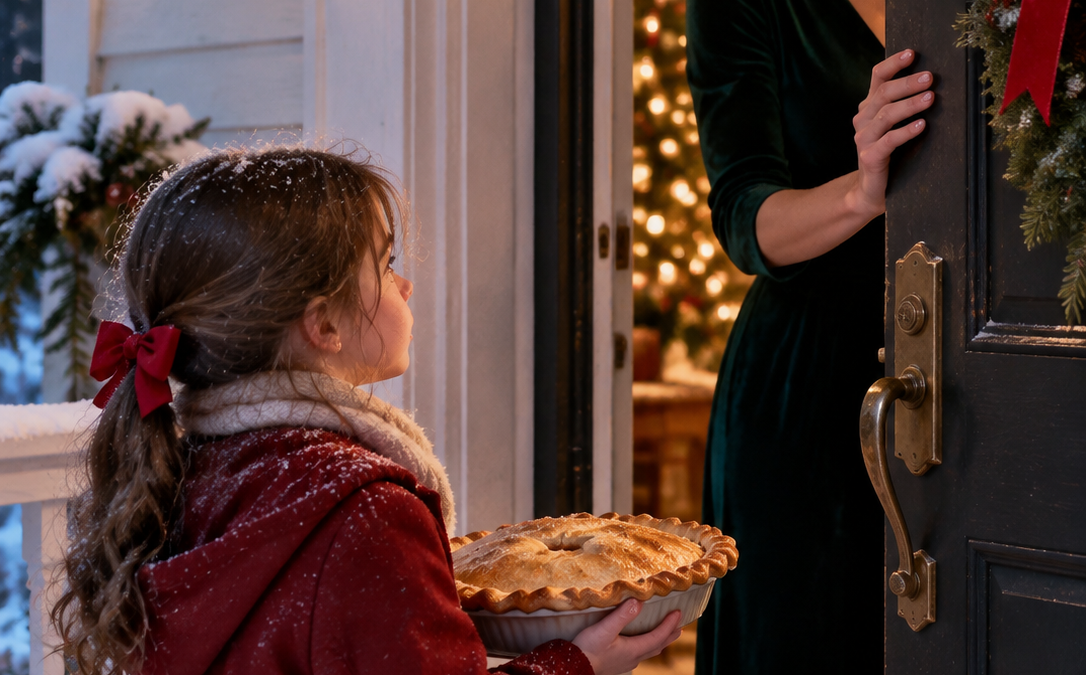
At 5:41 p.m. on Christmas Eve, my sister looked at the seven-fold edge of my seven-year-old daughter’s pie, then at June, and said, “June’s a charity I’ve carried for six years. Family eats inside.”
Shelby stood alone in the doorway. The relatives stayed inside at the table.
Shelby smiled as she said it.
Then she shut the door.
That was the part June saw.
I was carrying six shop boxes around the side of the house toward the garage.
Shelby had asked me to leave them there, away from the dinner traffic.
I heard the front door close, but I didn’t see it happen.
I set the boxes inside the garage, stacked them against the wall, and went back toward the side passage.
At 5:58, I rounded the house and found June standing on the porch with the pie held in both hands.
The porch thermometer read 31 degrees.
Her coat was buttoned.
Her fingers weren’t covered.
I looked at the front door.
Through the narrow glass, I could see movement in the entryway and warm light from the dining room.
Twenty-two relatives had been invited.
I knew most of them would already be there.
“Did she say anything else?” I asked.
June shook her head.
She was careful with answers.
She didn’t want to make a problem bigger by adding words that hadn’t been said.
“Did she look at you?”
“She looked at the pie first.”
I glanced at the crust.
June had pinched the edge into seven small folds, just as she’d planned.
The folds were even.
She had worked slowly at our kitchen table, checking each one with her thumb.
“She said family eats inside,” June added.
“I’m waiting.”
I took off my gloves.
My name is Wade Hartley.
I was thirty-nine, and June was my daughter.
My sister Shelby owned the Ostrom Pie Shop, and Christmas Eve dinner at her house had been a family tradition long before June was born.
I had expected to come in quietly, stay out of the way, and leave without anyone asking where I’d been.
That was how things had worked for a long time.
Shelby liked the room arranged around her, and I had learned not to interrupt the picture.
But June was standing outside in the cold with a pie she had made for the table.
“Bring it,” I said.
She shifted the pie toward me, but I shook my head.
“You carry it.”
Her hands tightened under the plate.
I opened the front door for her and followed her inside.
The house was crowded.
Coats covered the bench by the entry.
Conversations overlapped from the dining room, and somebody laughed near the kitchen.
Picking up where the Facebook post left off
The smell of roast meat and warm bread reached the hall.
Shelby stood beside the dining table in a dark green dress.
She was talking to Glenda Dunn, who had one hand resting on the back of a chair.
“People come from all over for the shop’s pie,” Glenda was saying.
“You have the best one in Spokane.”
Shelby tipped her head with the modest smile she used when somebody praised her in front of company.
Then she saw June.
Her smile held, but her eyes moved to the pie.
I walked past her.
June stayed close to my side, carrying the plate carefully so it wouldn’t tilt.
Nobody stopped us.
A few relatives turned.
Others kept talking.
Our mother, Lorna, sat near the end of the table.
She had a napkin across her lap and her eyes lowered to her plate.
She didn’t look up when June came in.
I found an open place near the center and set June’s pie on the table.
The crust edge faced the room.
June stood beside me.
She looked at the place settings, then at the pie, as if she were waiting for someone to tell her where it belonged.
I took the key ring from my pocket.
There were several keys on it, worn from years of use.
I worked one free and laid it beside the pie.
“I won’t be in tonight.”
The room didn’t go silent all at once.
One conversation stopped, then another.
A fork touched a plate.
Glenda looked from the key to my face.
Shelby had gone still.
Her eyes dropped to the key.
The color left her cheeks, and the smile disappeared.
She stepped away from Glenda and came after me as I moved toward the hall.
“Wade.”
I kept walking.
She caught up before I reached the entry.
Her voice dropped low enough that the relatives at the table couldn’t hear.
“It’s sixteen by six, Wade.”
I looked at her.
She was no longer smiling.
I didn’t answer.
June was behind me, still holding her hands together where the plate had been.
I could see the red marks the cold had left across her fingers.
Shelby glanced toward the dining room.
She was measuring who had heard, who was watching, and what she could still say without making it worse.
I opened the front door.
“Wade, don’t do this tonight,” she said.
I stepped onto the porch.
June followed, and I waited until she had her coat zipped before walking down the steps with her.
I didn’t take the boxes from the garage.
I didn’t go back for my gloves.
The driveway was lit by a yellow porch lamp.
A thin crust of snow lay along the edges where the shovel hadn’t reached.
I could hear the relatives talking again inside, though the front door had shut behind us.
Shelby came out without a coat.
“Get back in the house,” she said.
“No.”
Her eyes narrowed.
“You made a scene.”
“June brought a pie.”
“She knows better than to come in with that.”
I looked at her.
“She’s seven.”
“She should have waited until I was ready.”
“She was waiting.”
Shelby folded her arms.
She had always been good at making a small movement look like the end of a discussion.
I had spent six years believing the arrangement between us would hold if I kept my head down.
I had kept my part quiet.
I had trusted what Shelby told me six years earlier.
I had trusted that June’s place in the family would be safe, even if nobody talked about it at dinner.
Now the key was on Shelby’s table beside the pie, where twenty-two relatives could see it.
Our mother still had not come to the door.
Shelby looked toward the house, then back at me.
“You know what happens if you walk away.”
I did know.
Mom’s rent was six hundred forty dollars a month.
Shelby paid it.
I had never liked the arrangement, but I had accepted it while I believed I was keeping something for June.
Shelby took one step closer.
“January third,” she said.
“Be back by then, or Mom’s rent is your problem.”
I put my hand on June’s shoulder and led her toward the car.
Chapter 2
At midnight, June and I sat at our own kitchen table with the pie Shelby had refused.
It was cold by then, but the crust still held.
June turned the plate until the folded edge faced her.
“One, two, three,” she counted, touching each fold with the tip of her finger.
She went all the way to seven, then started the little rhyme on Tess’s card.
“Seven folds around the pie, keep the butter tucked inside.”
She smiled at the last word.
“Mom always said it that way,” she told me.
I nodded.
June had asked why Aunt Shelby wouldn’t let the pie inside.
I had told her the truth I could manage.
“Shelby didn’t want Glenda to recognize the crust.”
“Because Glenda knows the shop pies?”
“Yes.”
June looked down at her plate.
“It’s Mom’s crust.”
“It is.”
She cut a small piece and ate it without asking for anything else.
I sat across from her and thought about the key I’d left at Shelby’s house.
The key was still there, beside June’s pie.
For six years, I had made sure Shelby never had to explain why.
Tess died on November 14, 2019. She was thirty-four. June was one.
After the funeral, I went through the days by keeping the hours straight.
I worked the night shift at a wholesale bakery, six in the evening until two in the morning.
I came home, checked on June, and left again at 2:40.
At three, I let myself into Shelby’s kitchen through the back door.
I stayed until 5:30.
Sixteen pies each morning, five nights a week.
Shelby sold them for thirty-eight dollars apiece.
She paid me nothing.
The crust was Tess’s recipe. She had taught me the folds, the cold butter, and the pressure to use along the rim.
She had written the steps on a card and added the rhyme for June.
After Tess died, Shelby said the shop couldn’t afford to lose the recipe.
She also said she couldn’t keep the business going alone.
On December 9, 2019, Shelby took a sheet of paper and put her promise in writing.
“Half of this shop is June’s.”
She signed her name beneath it.
I kept that note in my kitchen drawer.
I believed her.
Shelby had kept June the first winter after Tess died, when I was working nights and raising a one-year-old alone.
She made sure June had somebody when I couldn’t be there.
I thought the baking was how I paid back some of that care while keeping Tess’s promise alive.
The arrangement became a routine.
I knew which back step creaked and which kitchen light Shelby left on.
I knew how long the butter could sit before the dough softened.
I knew how many pies fit on each rack.
Shelby sent the instructions by text, even when I was already standing in her kitchen.
One message from her stayed near the top of the thread.
“16 by 6. Back door. Nobody sees you.”
It was short enough to look like a schedule.
It was the whole arrangement in one line.
At midnight, I didn’t need to search for the message.
I opened our family chat instead.
Shelby had posted while the dinner was still going.
“June wanted to stay out and watch the snow.”
Under the message was a video.
The time stamp in the corner read 5:49 p.m.
Shelby had aimed the phone toward the dining room windows.
Inside, relatives were laughing around the table.
Glenda was visible near the end, still smiling.
Behind the glass, June stood on the porch with her pie.
She knocked once.
Then again.
The people inside kept laughing.
Shelby had filmed long enough to show June waiting, but not long enough to show me coming around the house.
I watched the clip without moving.
June was beside me, finishing her piece.
I didn’t let her watch it.
I saved the video to my phone, then saved a copy somewhere Shelby couldn’t reach.
I didn’t answer the family chat.
The next morning, someone knocked at our duplex door.
June was in the kitchen, finishing breakfast.
I opened the door and found Shelby standing on the step.
“June’s a charity I’ve carried for six years. Family eats inside.”
She said it plainly, as if repeating a fact everyone had already agreed on.
June stopped moving behind me.
Shelby looked past my shoulder.
“You need to be back in my kitchen at three tonight.”
I didn’t answer.
She waited a moment, then said, “January third is coming. You know what happens if you leave me short.”
I closed the door.
I heard her shoes cross the porch and go down the steps.
My phone lit up on the counter.
The Twelfth Night Christmas Market had posted its baker announcement.
January 3, at the convention center. Two hundred seats.
Shelby would bake live, from scratch.
Her caption said, “I roll every crust myself at 3 a.m.”
I read the announcement while June stood at the kitchen table.
She was smoothing the corner of a paper with her palm.
“Are we going to the market?” she asked.
I looked at the date again.
January third.
Shelby had built the whole announcement around the one thing she had never done in public.
For six years, I had made sixteen pies in her kitchen before dawn.
She had sold them under her name, taken the money, and let people believe her hands made every crust.
I knew what the dough felt like when it was right.
I knew how it behaved when the butter warmed too soon.
I knew the difference between a crust that could be patched and one that had to be thrown away.
Shelby could measure the flour.
She could cut the butter.
She could press the dough together and turn it over on the counter.
But she had never finished a crust.
Not once.
Chapter 3
On December 26, at ten in the morning, I went back to the Ostrom Pie Shop for Tess’s recipe tin.
The day manager was unlocking the front door when I arrived. He knew me, so I told him what I needed.
“It’s in the office,” he said. “Come on.”
I followed him past the counter and the racks where the pies cooled. The shop was quiet after Christmas, with only the refrigerator motors running and a delivery list clipped beside the register.
I had spent six years coming through the back door before dawn. In daylight, the place looked smaller.
The day manager opened the office and let me take the tin from the shelf. Tess’s handwriting was still taped across the lid.
I reached for it, then noticed the clipboard beside it.
The top sheet was Shelby’s holiday market application, dated November 12, 2025. Her signature sat at the bottom.
Under business ownership, she had written: “sole owner, sole baker.”
I stopped with my hand on the tin.
The next section listed annual production: 4,160 pies. The sales figure beside it was $158,080.
I knew where those numbers came from.
Sixteen pies a night, five nights a week. Eighty a week. Fifty-two weeks made 4,160.
At thirty-eight dollars apiece, the total came to $158,080.
I had made every one of them.
The application didn’t mention me.
It didn’t mention June.
It didn’t mention the promise Shelby had put in writing six years earlier.
I took out my phone and photographed every page, including the signature. The day manager was checking a delivery sheet and didn’t ask what I was doing.
I put Tess’s tin under my arm and left the clipboard where it was.
At home, June was still asleep upstairs. The duplex felt too quiet without her counting something at the kitchen table.
I set the tin beside the sink and opened the drawer where I kept Shelby’s note.
The paper had been folded into quarters. Shelby’s handwriting crossed the middle.
“Half of this shop is June’s.”
Her name was underneath.
I had kept it because I believed it meant what it said.
I had also believed the shop barely broke even. Every January, Shelby showed me a loss sheet and talked about rent, flour, repairs, and bills. She said the shop survived because we kept the costs down.
I had never asked to see the books.
I had never asked why the pies sold for thirty-eight dollars if there was so little left.
Now I had a signed application saying Shelby owned the whole shop and made every pie herself.
I sat down and opened the old message thread on my phone.
The texts went back to 2019. I found the one I remembered, sent after Tess’s funeral.
“Bring Tess’s crust card. I’ll say it’s Grandma’s.”
I looked at the date.
December 2019.
Shelby had planned the story before the first Christmas without Tess.
The next time I had been in the shop, the menu board above the counter carried the same claim in larger letters:
“It’s my grandmother’s recipe.”
Customers had stood beneath those words and bought pies made from Tess’s card.
I had watched Shelby take the money.
I called her.
She answered on the fourth ring.
“What?”
“I saw the market application.”
A pause.
“You went into my office?”
“I went for Tess’s tin.”
“You had no right to go through my papers.”
“You signed it. Sole owner, sole baker.”
“That’s what the application required.”
“It asked who made the pies.”
“I own the shop, Wade.”
“You know who made them.”
She gave a short laugh.
“Your little note doesn’t make you an owner.”
“It says half the shop is June’s.”
“That note’s a napkin.”
I looked at the paper on my kitchen table.
“You signed it.”
“I was trying to help you after Tess died. You needed somewhere to go.”
“I worked for you.”
“You offered.”
“I made sixteen pies a night.”
“And I gave you a place to make them.”
Then her voice changed.
“I’m done paying Mom’s rent.”
I stood up.
“She’s got rent due.”
“Then you can pay it.”
“It’s six hundred forty dollars.”
“I know exactly how much it is.”
She ended the call.
I stayed beside the table with the phone in my hand. I could hear the refrigerator start and stop.
A little later, Mom called.
Her voice was thin before she even said hello.
“Shelby told me she isn’t paying January.”
“I know.”
“Wade, please. You have to go back.”
I rubbed my thumb over the crease in Shelby’s note.
“Mom, she filed that application saying she made every pie.”
“I know you made them.”
“You knew?”
There was a pause.
“I knew you went over there at night.”
“For six years.”
“I didn’t want trouble between you.”
“She says June is a charity.”
Mom began to cry.
“I can’t lose the apartment, Wade. I don’t have another place.”
I looked at the application photographs on my phone. The signature was clear. The numbers were clear. So was the line that erased me.
“I’ll figure out the rent,” I said.
“Then go back tonight. Please. Just until the market is over.”
I could picture her sitting at her table, looking down at her hands the way she had looked down at her plate on Christmas Eve.
Shelby had made the choice simple for her.
Keep the rent, or stand with me.
“I won’t go back,” I said.
Mom didn’t answer.
I let her stay on the line until she was ready to hang up.
Then I put Tess’s recipe tin on the counter and placed Shelby’s note beside it. I had one signed promise and one signed application.
Could a handwritten note beat a signed application?
I didn’t know.
I knew I couldn’t settle it by returning to Shelby’s kitchen at three in the morning.
I found Sonya Keller’s number.
Sonya had been Tess’s college roommate. She was an attorney, and she had always asked what could be shown before she asked what anybody believed.
When she answered, I told her about the note, the application, the texts, and the rent.
She let me finish.
“Do you still have the original note?”
“Yes.”
“The messages?”
“Yes.”
“And the application?”
“I photographed every page.”
“Good,” she said. “Bring me every paper she ever signed.”
Chapter 4
Sonya put January 5 on her calendar and turned the page toward me.
“That is when the letter goes out,” she said.
We were sitting in her office with Tess’s recipe tin, Shelby’s handwritten note, and the photographs of the market application.
The original note lay inside a clear folder.
Sonya had examined the signature and the date.
She hadn’t promised me anything.
“Wade, I need you to understand something,” she said. “We don’t ambush her onstage. We don’t make claims we can’t prove. We don’t say anything you can’t show.”
I nodded.
“What if the note doesn’t hold up?”
“Then June gets nothing from the shop.”
She said it without softening the answer.
I looked at the paper again.
“Half of this shop is June’s.”
Sonya closed the folder.
“I know what it says. I also know what Shelby signed on November twelfth.”
The market was January 3.
The letter would go out two days afterward.
Sonya wasn’t going to change that schedule because Shelby had announced a performance.
“She may still come around,” Sonya said. “Don’t give her anything she can use against you.”
I gathered the papers.
“I won’t.”
The first person I needed to help was my mother.
Shelby had stopped paying Lorna’s rent after our December 26 phone call.
The amount was $640.
I had my own bills, June’s school expenses, and the money I needed for groceries.
Paying Mom’s rent meant giving up money I had set aside for the month.
I wrote the check anyway.
I took it to the rental office and made sure the payment was credited to Lorna’s account.
I didn’t tell Shelby.
I called Mom afterward.
“Your rent is covered for January.”
She was quiet.
“Did Shelby change her mind?”
“No. I paid it.”
“Oh, Wade.”
She sounded relieved, but she didn’t sound happy.
I understood.
Shelby had been paying that rent for six years, and Mom knew what it cost to disagree with her.
I didn’t ask Mom to take my side.
I only told her the rent was handled.
By the end of December, Shelby had another problem.
Sixty-four preorders had been accepted for the shop.
The customers expected pies, and the dates were getting close.
I drove past the shop one afternoon and saw a handwritten notice taped inside the front window.
The orders were still listed on the counter.
Shelby stood behind the glass, working a batch of dough.
I parked across the street.
She pressed the dough flat, lifted one edge, and tried to bring it together.
The surface split.
She pushed the pieces back toward the middle.
Another crack opened along the side.
I knew that dough.
It was too warm, and she’d worked it too long.
She scraped the broken pieces together and started again.
A customer came through the front door.
Shelby covered the dough with a towel and went to serve him.
I stayed in the car until she disappeared behind the counter.
Then I drove home.
I didn’t feel pleased watching her struggle.
I remembered the six years I had spent making those pies before sunrise.
I also remembered June standing outside with one of them.
I wasn’t going back.
On January 2, I checked the lock twice before bed.
June had already asked whether the market had a place for children.
I showed her the ticket for the children’s table Sonya had arranged.
She held it carefully by the corners.
“Can I go?”
“You can.”
“Even if Aunt Shelby is there?”
I pulled out a chair and sat beside her.
“Yes.”
June went to the kitchen drawer and brought out Tess’s recipe card.
The edges had softened from years of handling.
She placed it beside the ticket.
“I want to take Mom’s card.”
I looked at the handwriting.
“You can bring it.”
“Will you come with me?”
“I’ll be there.”
She put the ticket and card together in a small envelope.
Then she carried them to her room.
At eleven that night, someone knocked at our duplex door.
I opened it and found Shelby standing on the top step.
She held a small white envelope.
She looked tired.
Her hair was pulled back, and she kept glancing toward the street.
“Can I come in?”
“No.”
She looked past me into the hallway.
“Wade, I need one batch.”
I waited.
She held out the envelope.
“Five hundred dollars. You mix one batch, sixteen pies. I’ll handle everything else.”
I looked at the envelope but didn’t take it.
“The side door,” she continued. “Same hours. Nobody sees you.”
“You want me back in your kitchen.”
“I need the orders filled.”
“You have sixty-four.”
“I know how many I have.”
Her voice sharpened, then dropped again.
“Just one batch. You don’t have to stay.”
I looked at the envelope.
Five hundred dollars was more than I had been paid for any single night in six years.
It would have helped replace the money I’d used for Mom’s rent.
It would have covered several weeks of groceries.
It would also have put me back behind Shelby’s kitchen door, doing the work she claimed to do herself.
I reached for the envelope.
Shelby pushed it toward me, thinking I had agreed.
I took it by the edge and placed it back in her hand.
“No.”
She stared at me.
“You’re going to let the shop go under over this?”
“Those are your orders.”
“You know how to do it.”
“Yes.”
“You know what happens if I can’t fill them.”
I looked at her.
“You should have thought about that before you signed the application.”
Her fingers tightened around the envelope.
She studied my face, waiting for me to change my mind.
Then she looked toward the hallway.
“June going to the market?”
“Yes.”
“Good.”
I didn’t like the way she said it.
Shelby stepped down one stair.
“Bring June. Let 200 people see who needs who.”
She turned and walked toward her car.
I watched until the headlights disappeared at the end of the street.
Then I closed the door.
June came out of her bedroom holding the little envelope with Tess’s card and her ticket.
“Was that Aunt Shelby?”
“Yes.”
“Does she want us to come?”
I looked at the card in her hands.
“She does now.”
June tucked it safely into her pocket.
On the kitchen counter, my phone showed January 3 on the market announcement.
Two hundred seats.
Shelby had promised everyone a live demonstration of her own baking.
Sonya would sit with June and me at the children’s table.
The letter would go out January 5.
For the next two days, Shelby would have to stand in front of those people without the person who had made her pies for six years.
I checked the clock.
Then I turned off the kitchen light.
Chapter 5
At two o’clock on January 3, Shelby stood before two hundred people and announced, “I roll every crust myself at 3 a.m.”
I sat with June and Sonya near the Kids’ Table at the Twelfth Night Christmas Market.
The convention center had two hundred seats arranged around a low demonstration stage.
Shelby wore her dark green apron, with a Featured Baker ribbon pinned near the shoulder.
Glenda Dunn stood beside her holding a microphone.
A row of sealed ingredients sat on the counter.
Glenda explained that everything would be opened in front of the audience. The demonstration was supposed to show how a genuine Ostrom pie was made, from the first measure of flour to the finished crust.
Shelby smiled toward the seats.
She looked comfortable.
I knew that smile. I’d seen it when customers praised pies I had made hours earlier.
Glenda handed her the microphone.
“Shelby, tell everyone what makes your crust special.”
Shelby touched the sealed flour container.
“My grandmother taught me. It’s been our family recipe for generations. I make every crust myself, before sunrise.”
A few people applauded.
I kept my hands on my knees.
Sonya had told me not to ambush Shelby. I had promised not to say anything I couldn’t prove.
For eleven minutes, Shelby measured, mixed, and worked the butter into the flour.
Then she tried to bring the dough together.
The butter had softened too much.
She pressed the mixture with her fingers, but it wouldn’t hold. A crack opened across the middle.
She pushed the pieces together.
The edge broke when she lifted it.
She tried again, adding a little flour, but the dough tore in another place.
Glenda leaned closer.
“Would you like another minute?”
“I’m fine,” Shelby said.
She laughed, looking toward the audience.
Then she spotted June.
“My niece loves to help!”
June looked at me.
Shelby held out a hand toward the stool beside the counter.
“Come on, sweetheart. Show everyone those little hands.”
I leaned toward my daughter.
“Your call.”
June looked at the torn dough, then at Tess’s recipe card tucked inside her small envelope.
“Can I use Mom’s card?”
I nodded.
She climbed onto the stool.
Shelby moved aside, apparently relieved to have somebody else touching the dough.
June opened the card and placed it where she could see the writing.
She didn’t rush.
She checked the butter, brought the pieces together, and pressed the dough gently.
Then she began making the folds around the edge.
“One,” she said.
The room grew quieter.
“Two. Three.”
Her small fingers moved carefully around the crust.
“Four. Five. Six. Seven.”
The seven folds were even.
The crust held.
Glenda leaned over the counter to inspect it.
“Who taught you to do that?”
June looked up at the microphone.
“My mom’s card. My dad makes them at night at Aunt Shelby’s.”
I watched Shelby’s expression change.
She stepped forward and gave a little laugh.
“She’s seven. Kids make things up.”
June lowered her eyes toward the counter.
I stood.
I didn’t raise my voice or walk toward the stage.
I took my phone from my pocket.
“Glenda, may I show you something?”
Glenda looked at Shelby, then at me.
“What do you have?”
“Two messages from Shelby.”
I opened the first one.
“16 by 6. Back door. Nobody sees you.”
A few people turned toward Shelby.
I moved to the second message.
“Bring Tess’s crust card. I’ll say it’s Grandma’s.”
I held the phone where Glenda could see the dates and Shelby’s name.
“That was December 2019,” I said.
Glenda lowered the microphone slightly.
“Do you have anything showing what happened on Christmas Eve?”
“I do.”
I opened the video Shelby had posted at 5:49 p.m.
I turned the screen toward Glenda.
The video showed the dining room through the window.
Twenty-two relatives were laughing around Shelby’s table.
Behind the glass, June stood outside holding her pie.
She knocked.
Nobody opened the door.
I stopped the video.
Glenda looked at June, then at Shelby.
“Is that your niece?”
Shelby reached for the microphone.
“She wanted to stay out and watch the snow.”
“She was holding the pie she made,” I said.
Shelby shook her head.
“You’re making this into something it isn’t.”
Then she looked toward the audience.
“He offered. I gave a grieving man somewhere to go.”
I had heard that explanation before.
I had never heard her say it in front of the people who bought her pies.
A chair moved in the third row.
My mother stood.
Lorna had kept her hands folded in her lap until then.
She looked directly at Shelby.
“I’ve watched him leave at 2:40 every night for six years. Shelby, stop.”
Mom’s voice wasn’t loud.
The microphone wasn’t hers, but the people nearby heard her.
Shelby stared at her.
“Mom, sit down.”
Lorna didn’t move.
I looked at her hands.
They were trembling.
I knew what standing there could cost her. Shelby had paid her $640 rent every month until I took over.
Mom knew what she was risking.
She stayed on her feet.
Glenda took the application from the folder on the counter.
She looked at the ownership section.
“November twelfth,” she said. “You signed this yourself?”
Shelby didn’t answer.
Glenda read the words aloud.
“’Sole owner, sole baker.’”
She turned to the vendor agreement.
The market’s rule was clear. Goods presented under a vendor’s name had to be made by the signer’s own hands.
Glenda looked at the torn dough, then at June’s finished crust.
“Shelby, you signed an agreement saying these products were your own work.”
“I own the shop.”
“That isn’t what I’m asking.”
Shelby glanced toward the audience.
“Wade did some work. He offered to help.”
Glenda folded the application closed.
“You represented yourself as the baker.”
She reached for the ribbon pinned to Shelby’s apron.
The Featured Baker ribbon came free in her hand.
Shelby looked down at the empty spot where it had been.
Behind the stage, two workers began lowering the large Ostrom Pie Shop banner.
The top edge came down first.
Shelby watched it descend.
Nobody applauded.
Glenda returned to the microphone.
“The booth is void under the vendor agreement. We will not continue this demonstration.”
Shelby stepped away from the counter.
June was still on the stool.
I walked up and offered my hand.
She climbed down and took it.
I looked at Shelby.
“You told her family eats inside. She’s done waiting outside.”
I led June away from the stage.
Sonya walked beside us, carrying the folder with the photographs of the application.
Behind us, the stage workers finished taking down the banner.
The two hundred seats were still full.
Shelby remained beside the counter, with the torn dough and the empty place on her apron.
Sonya stopped before we reached the exit.
“I have something for Shelby,” she said.
She took a sealed envelope from her folder.
The letter had been scheduled for January 5.
Sonya had decided the public demonstration made waiting unnecessary.
She crossed the short distance to Shelby and held it out.
“Shelby Ostrom?”
Shelby looked at the envelope.
“What’s that?”
“My letter. I’m representing Wade and June.”
Shelby took it.
Sonya didn’t explain anything further.
I watched Shelby turn the envelope over in her hands.
The market had already voided her booth.
Her ribbon was gone, and her banner was coming down.
Now she had a letter from an attorney about the promise she had signed six years earlier.
June squeezed my hand.
“Dad, can we go home?”
“Yes.”
She tucked Tess’s recipe card safely into her pocket.
I walked out with my daughter while Shelby stood beneath the empty space where her banner had been.
By Monday, sixty-four customers would still be waiting for their pies.
Chapter 6
By nine o’clock Monday morning, customers were lined up along the block outside Ostrom Pie Shop.
I drove past after dropping June at school.
Shelby stood behind the counter, counting out thirty-eight dollars at a time.
A customer held out a receipt.
Shelby opened the register, removed the money, and placed it in the customer’s hand.
The next person stepped forward.
There were sixty-four preorders to account for, and the customers wanted their money back.
I parked across the street long enough to watch Shelby handle the line.
She wasn’t wearing her Featured Baker ribbon.
The market had voided her booth, and the announcement had spread farther than the shop’s regular customers.
Some people recognized her from the demonstration.
Others had heard what happened from relatives who attended.
Shelby kept counting.
I didn’t go inside.
On Friday, the Ostrom Pie Shop sign came down.
I saw the empty mounting brackets when I passed the building.
The windows were still covered with advertisements, but the name above the door was gone.
That afternoon, somebody climbed the stairs to our duplex.
I heard the careful steps before the knock.
When I opened the door, Mom stood there holding her Bible against her chest.
She looked tired.
“Can I come in?”
I stepped aside.
She climbed the last step and entered slowly.
I pulled out a chair at the kitchen table.
Mom sat down and placed the Bible in front of her.
She ran her fingers along its worn cover.
“I should have told you something years ago.”
I waited.
She opened the Bible near the middle and removed a folded piece of paper.
It was a copy of a cashier’s check.
The amount was $12,000.
The payee was Shelby.
I looked at the date, then at Mom.
“Where did you get this?”
“Tess gave it to your sister.”
I kept looking at the copy.
“Why do you have it?”
“I kept the copy in case something happened. Tess wanted a record.”
She looked down at the Bible.
“I kept it here.”
I had spent six years thinking Shelby had built the shop herself, with the recipe and whatever money she could put together.
Tess had given her twelve thousand dollars.
Mom knew about it.
“Why didn’t you tell me?”
Her fingers tightened around the Bible.
“I took her rent money. I should have told you.”
I understood what she meant.
Shelby had paid Mom’s $640 rent every month while I worked in her kitchen without wages.
Mom had known I was making the pies.
She had accepted the money and kept quiet.
“Did you know about the note?”
“Yes.”
“Did you know Shelby filed that application?”
Mom shook her head.
“I knew about the baking. I knew what Tess had given her. I didn’t know about that paper.”
I sat across from her.
She looked like she wanted me to tell her it was all right.
I couldn’t.
I moved the check copy away from the edge of the table and gave her a chair at my side instead of asking her to leave.
“Sonya needs this,” I said.
Mom nodded.
“Will you give it to her?”
“Yes.”
She closed the Bible.
I took the copy and put it with the other papers.
Mom stayed for a little while.
We didn’t discuss forgiveness.
On January 23, Shelby and I sat across from each other in a conference room.
Sonya was beside me.
Shelby had an attorney with her.
The original handwritten note was on the table, along with the market application, the messages, and the copy of Tess’s cashier’s check.
Shelby still disputed the note.
She didn’t agree that June owned half the shop.
Sonya had explained the risks before we arrived.
If we pursued everything through a court fight, June might end up with nothing.
Shelby had a signed application claiming sole ownership.
We had her handwritten promise and evidence of what had happened behind the shop doors.
There was no guarantee how a court would treat it.
I had spent enough time watching June wait for other people to decide where she belonged.
I wanted something secure for her.
Shelby’s attorney reviewed the settlement.
Sonya checked the amount and the payment terms.
Shelby sat with a pen in front of her.
“Fifty-eight thousand?” she asked.
“Fifty-eight thousand dollars to June’s college plan,” Sonya answered.
Shelby looked at me.
“You’re willing to walk away from the rest?”
I glanced at the note.
“I’m willing to settle.”
She looked down and signed.
The agreement provided $58,000 for June’s college plan.
Shelby sold the shop lease to pay it.
There was no courtroom and no public speech.
Just the papers, the signatures, and the money set aside for my daughter.
When we left the conference room, Sonya carried the signed agreement.
I carried Tess’s recipe tin.
For six years, I’d carried sixteen pies through Shelby’s back door.
Now I could take Tess’s card home without asking permission.
By Easter, the family had divided more than I expected.
Fourteen of the twenty-two relatives told Shelby they wouldn’t come to her table.
I saw the replies in the family chat.
Some gave reasons.
Others simply declined.
I didn’t answer anybody.
Mom came to our duplex that Sunday, but she didn’t bring up the empty shop.
We ate at home.
June asked whether she could make another pie for the next family dinner.
I told her she could make one whenever she wanted.
A few days later, Glenda called.
She had heard that Shelby had sold the lease.
“The holiday market has space for a baker,” she said. “I’d like to offer you a stall under your own name.”
I looked at Tess’s tin on the kitchen counter.
“Under my name?”
“Your name on the application. Your work on the table.”
I thanked her and hung up.
That afternoon, June came with me to look at a small counter in the Garland District.
There was a display case, a work surface, and a front window facing the sidewalk.
June stood behind the empty counter.
“Your pies could go here,” she said.
I could picture them there.
Not Shelby’s pies.
Mine.
The next morning, I gave notice at the wholesale bakery.
My supervisor looked at me across the loading table.
“You have another job?”
“I have a counter to open.”
He wished me luck.
Later that day, I went back to the Garland District and signed the lease.
I wrote Wade Hartley on the line.
When I brought the copy home, June set it beside Tess’s recipe tin.
“What’s the shop going to be called?”
I looked at Tess’s handwriting through the open lid.
“Tess’s,” I said.
Chapter 7
Tess’s opened in the Garland District in April, and I had learned how to sleep at night again.
The counter wasn’t large, but the front window faced the sidewalk, and the display case held pies I had made with my own hands.
The name above the door was simple.
Tess’s.
I opened early, worked through the afternoon, and went home before dark. For six years, I had measured my days around somebody else’s kitchen and somebody else’s orders.
Now I locked my own door.
June liked helping before school when she could. She checked the pies in the display case and counted the folded edges through the glass.
I kept Tess’s recipe tin beneath the counter.
One morning, June asked me to show her the card again.
I took it out and turned it over.
The front had the seven-fold rhyme she knew by heart. The back had a sentence Tess had written in smaller letters.
I hadn’t noticed it before.
“What’s that say, Daddy?”
I brought the card closer and read it aloud.
“Cold butter, warm hands, whoever comes next.”
June traced the words with one finger.
“That’s Mom’s writing.”
“Yes.”
“Who comes next?”
“Whoever wants to learn.”
She nodded and handed the card back.
I returned it to the tin, but I left the lid open while we worked.
The first few weeks after the counter opened were busy enough to keep me from thinking about Shelby.
Glenda had helped me get the counter ready, and customers who remembered the market demonstration began coming in.
Some asked about the old shop.
I answered only what they needed to know.
The pies were thirty-eight dollars.
The money went into my register.
My name went on the receipts.
One afternoon, Shelby walked through the front door.
I recognized her before she reached the counter.
She looked thinner than she had at the market. Her coat hung loosely, and her hair was pulled back without the careful arrangement she used to wear at the shop.
She looked at the sign above the window.
Then she looked at me.
“Wade.”
I wiped my hands on a towel.
“Shelby.”
She studied the display case.
“You’re doing well.”
“I’m working.”
She nodded toward the pies.
“Those look like Tess’s.”
“They are.”
She moved closer to the counter.
“I wanted to come in and talk.”
I waited.
Her eyes moved toward the recipe tin beneath the counter.
“I know things got bad. I shouldn’t have said some of what I said. I thought we could maybe…”
She stopped.
I didn’t finish the sentence for her.
Shelby looked down at the pies.
“Could I get one?”
I took a box from the shelf.
“Which one?”
She pointed to the pie nearest the register.
I lifted it into the box and rang up thirty-eight dollars.
She paid.
I placed the receipt inside the bag.
Shelby held the handles and looked at me.
“You can buy a pie. That’s all of it.”
Her mouth tightened.
She nodded once, picked up the box, and walked out.
I watched the door close.
Then I returned to the counter and helped the next customer.
I didn’t call Shelby that evening.
I didn’t ask Mom to explain what Shelby had said afterward.
The boundary stayed where I had put it.
On May 10, 2026, the thermometer outside our duplex read 58 degrees.
It was Mother’s Day.
June had cleared a space at our kitchen table and brought out the rolling pin.
She was making a crust from Tess’s card.
Her elbows were close to her sides, and she kept checking the thickness as she rolled.
“One, two, three,” she counted while pressing the edge.
I stood beside the counter, cutting butter into small pieces.
June had grown more confident with the folds.
She no longer needed to check every step, though she still liked counting aloud.
“Daddy?”
“Yeah?”
“Why didn’t you put your name on Aunt Shelby’s pies?”
I set the knife down.
For a moment, I watched her fingers bring the dough together.
“I thought keeping the shop going was more important.”
“But you made them.”
“Yes.”
“And she sold them.”
“Yes.”
June pressed another fold into the crust.
“Was it wrong to want your name on them?”
I pulled out the chair beside her.
“No. Wanting your name on your work isn’t greed.”
She looked at me.
“Mom’s name is on the card.”
“It is.”
“And yours is on the shop.”
“That’s right.”
June seemed satisfied with that answer.
She returned to her crust.
I finished cutting the butter and put the bowl beside her.
The pie would go in the oven after lunch.
We had no guests expected, and nobody had to approve what went on our table.
Later that afternoon, someone came up the stairs.
I heard footsteps, then the soft scrape of a dish against the porch railing.
June looked toward the door.
“Someone’s here.”
I dried my hands.
Through the front window, I saw Mom standing on the porch with a covered dish.
Lorna had one hand beneath the dish and the other resting against the railing.
She looked at the door.
Then she looked down at the dish.
She had eaten with us at Easter, after the truth about Tess’s check came out, but neither of us had mentioned it.
Now she stood looking down at the covered dish, unsure whether she was still welcome after what she’d confessed.
I stayed where I was.
Mom had brought Tess’s check copy out of her Bible and admitted what she had taken from Shelby.
She had also asked me to return to that kitchen when she feared losing her rent.
I had paid the rent myself.
We had spoken since then, but neither of us had pretended those years hadn’t happened.
June wiped her hands on a kitchen towel.
A little flour remained along her wrists.
She looked at me.
I didn’t tell her what to do.
Mom finally raised her hand and knocked.
June crossed the kitchen.
She reached the door and opened it.
For a second, she looked at Grandma Lorna and the covered dish.
Then she smiled.
“Family eats inside.”
June stepped back and held the door open.
Mom looked at her, then at me.
She carried the dish across the threshold.
June took her free hand and led her toward the kitchen.
I moved the rolling pin away from the empty place at the table.
Mom set down the dish.
June brought over the pie.
We sat at our own table and ate.
THE END







