My Sister Sent My 9-Year-Old Grandson To Eat Thanksgiving Dinner In Her Garage In Front Of 26 Guests—Then Her Boss Picked Up His Plate
Complete story · 7 chapters · about 31 minutes · ending included
Chapter 1 · Chapter 2 · Chapter 3 · Chapter 4 · Chapter 5 · Chapter 6 · Chapter 7
Chapter 1: The Table Already Set
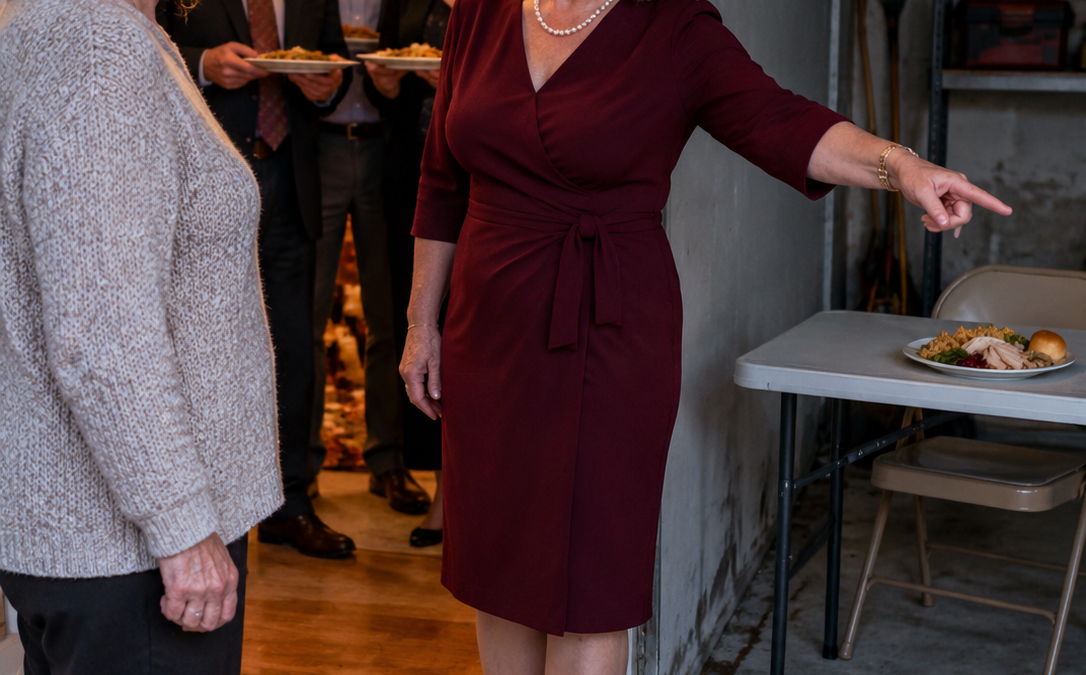
At 2:40 p.m. on Thanksgiving, my sister steered my nine-year-old grandson past the sunroom with his plate and said, “Charity cases sit out there, Lou.”
I looked at the garage door, then at the six children already gathered around the sunroom table.
Sam had been expecting to sit with them.
He held his plate in both hands and waited for me to answer.
“He’ll need a fork.”
I kept my voice level.
If I shouted, twenty adults and six children would turn toward Sam.
He would have to stand there while they watched his grandmother fight with his aunt.
I wasn’t going to make him carry that, too.
Christine opened the door to the garage.
She was still wearing the bright smile she used when she welcomed people into the branch where she worked.
She guided Sam through the doorway as if she were showing him to a special seat.
I followed them.
A card table stood against the wall.
There was one chair.
The garage thermometer read 41 degrees.
Outside, the Duluth afternoon had settled at 19, and the cold had followed us in around the edges of the door.
Sam set his plate down.
He didn’t ask why there was only one chair.
He pulled it out and sat.
I went back into the kitchen for a fork.
The guests had a clear view through the open doorway.
Twenty adults filled the dining room and the space near the sunroom arch.
The six children sat together at their table.
Conversations had stopped.
Nobody seemed to know where to look, so most of them looked at Sam.
I picked up a fork from the drawer and carried it out.
“He’ll need a fork,” I said again, more quietly this time, and put it beside his plate.
Sam looked up at me.
I touched his shoulder once, then turned back toward the house.
I wanted to take him out of there.
I also wanted to keep the room from making him the reason the afternoon became uncomfortable.
Those were two different things, and I had to manage them in the right order.
Christine stood near the arch, close enough for the guests to hear her.
“Lou washes heads for free on her day off and calls it a business,” she said.
A few people shifted.
Someone lowered a glass.
Steve, Christine’s husband, looked down at his shoes.
I knew what Christine wanted the room to see: me in my work clothes, with my hands rough from shampoo and hot water, and her in the middle of her own house, hosting people who mattered to her.
She was a branch manager at Zenith Members Credit Union and was serving as acting vice president.
Picking up where the Facebook post left off
The permanent position came with a raise of $31,500.
Her boss, the credit union’s CEO, had been invited for Thanksgiving.
His name was Mr. Nordin, and his opinion would help decide whether she got the job.
A chair at the dining table had been left open for him.
I went back to the garage and stood beside Sam.
The fork lay next to his plate.
He was trying to cut a piece of food with the edge of it, carefully, without letting anything slide off.
“Are you cold?” I asked.
“A little.”
“I can get your coat.”
He shook his head, then glanced toward the house.
His voice dropped.
“It’s okay, Grandma. Aunt Christine says I talk too much.”
He kept his eyes on his plate when he said it.
The fork stayed in his hand, but he had stopped eating.
I crouched beside the chair.
Sam was nine, in fourth grade, and he had a way of saying exactly what he had heard without dressing it up.
He wasn’t asking me to explain his aunt.
He was telling me why he thought he belonged out here.
I wanted to go inside and ask Christine to repeat those words in front of the people she was trying to impress.
I wanted to tell Steve to stop staring at the floor.
I wanted to walk into the dining room, take the empty chair meant for Mr. Nordin, and ask why my grandson had been given one chair in a cold garage.
But Sam was watching me.
He had already been made to feel that his voice was the problem.
I wasn’t going to turn the whole room toward him again.
I brushed a crumb from beside his plate.
“I hear you,” I said.
He nodded and picked up his fork.
I had brought the pies because Christine had asked me to handle dessert.
I had brought Sam because I thought Thanksgiving meant he would have a place with the other children.
I was a hairdresser, fifty-nine years old, and the person raising my late daughter’s boy.
I knew how to keep my hands steady when somebody was unhappy with what they saw in the mirror.
I had not expected to need that same steadiness at my sister’s Thanksgiving table.
The garage door stayed open.
Through it, I could see the bright room and the backs of the guests.
Nobody came out to ask Sam what he wanted to eat.
Nobody offered to move another chair.
I looked at the one place Christine had made for him.
A card table, one chair, one plate.
It was enough to feed him, if feeding a child was all that mattered.
Who sets a table in a garage before the guests arrive?
I was taking Sam home.
I would get his coat, gather the things I had brought, and leave before the meal reached the adult table.
The thought came plainly, without a plan for what I would say to Christine.
I only knew I wasn’t going to make him sit here through dinner.
Then I noticed the napkin.
It was folded neatly beside the place where his plate rested.
The tabletop had been wiped clean, not hurriedly cleared, but cleaned all the way to the edges.
The single chair had been placed squarely in front of it.
Someone had prepared this table before we arrived.
Chapter 2: The Chart On The Fridge
I went back to the garage and told Sam we were leaving.
He slid off the chair, holding his plate until I took it.
I set it back on the card table and walked him toward the house.
The cold had already worked through his sleeves.
My Buick was parked down the steep street, where I had left it.
Eleven cars had boxed it in, bumper to bumper along the curb.
There was no space to back out, and no clear way around them.
I could have asked the guests to move their cars.
I could have gone inside and announced that my grandson was leaving.
Instead, I looked at the street and checked the distance home.
Six miles.
At 19 degrees, that was too far to walk with Sam.
I opened the ride app on my phone and requested a car.
The earliest pickup was fifty minutes away.
I accepted it.
Sam stood beside me in the mudroom, rubbing his hands together.
“Can I get my coat?” he asked.
“That’s what I’m getting.”
I left him just inside the mudroom, where I could see him through the open doorway.
Then I went into the kitchen.
Christine was standing beside the refrigerator with Tina Rand and several guests.
Tina was the head of human resources at Zenith Members Credit Union.
She also ran the committee that would decide who got the permanent vice president position.
Christine’s voice had changed.
She put on the cheerful, welcoming tone she knew how to use when she needed everyone on her side.
“He asked to eat out there. He’s shy,” she said.
Tina glanced toward the garage.
Christine followed her eyes and smiled.
“I’ve carried those two for three years. It’s in my statement. I signed it.”
Christine picked up a serving spoon.
“I’ve never missed a month for Mom.”
She said it as if she were correcting a small mistake.
I stood near the kitchen doorway with Sam’s coat in my hands.
I could have answered her.
I could have told Tina that Christine had refused to pay for Sam’s dentist.
I could have told the guests that I had been covering Christine’s half of Mom’s room.
But Sam was still close enough to hear us.
I wasn’t going to make him stand there while the adults discussed whether he was a burden.
Christine turned toward me.
“Lou, can you bring the pies in when you’re ready?”
I didn’t answer.
I took Sam’s coat back to the mudroom.
The refrigerator stood beside the doorway, covered with family photographs, appointment cards, and the paper calendar Christine used to keep track of the house.
A seating chart was held beneath a magnet.
I noticed it because my grandson’s name was written near the bottom.
I stepped closer.
The handwriting was Christine’s.
Sam — garage. He talks.
I stayed still for a second.
The single chair, the clean tabletop, the folded napkin.
They had not been put there because the house was crowded.
Christine had written down where Sam would sit before Thanksgiving.
She had made a place for him in the garage and given herself a reason.
I raised my phone and captured the chart in a picture.
I made sure the words were clear.
Then I put the phone away and picked up Sam’s coat.
My screen lit again as I reached the mudroom.
I opened the messages from Christine.
The first one I saw was dated August 14.
“Can’t do Sam’s dentist. Don’t ask again.”
I remembered the appointment and the bill.
I remembered arranging it without asking her again.
Below that were seven texts about Mom’s room, covering the months from April through October.
The amount I had paid in Christine’s place was $8,050.
Mom’s Social Security left a monthly gap of $2,300 at Lakewalk House.
Christine and I were supposed to cover $1,150 apiece.
I had paid my own half and hers.
My savings had fallen to $1,900.
The October 1 message sat among the others.
“Cover my half of Mom again? I’ll square up at Christmas.”
I looked at the coat in my hands.
Then I locked my phone.
I had not answered Christine’s messages.
I wasn’t going to answer her claims in front of the guests, either.
Sam put on his coat while I held it open.
“Are we going now?” he asked.
“As soon as the car gets here.”
He looked toward the garage.
“Do I have to finish my food?”
“No.”
He nodded and stayed beside me.
The ride was fifty minutes out.
I had no choice but to wait, and Christine had no reason to hurry.
From the mudroom, I could hear the dining room filling with conversation again.
A chair scraped across the floor.
Someone laughed.
Christine’s voice rose above the others, warm and practiced.
I kept Sam beside me and watched the clock.
At 3:15 p.m., the doorbell rang.
Christine hurried toward the front hall.
“Mr. Nordin!”
I looked past her.
The man at the door was the one I knew as Doug.
For a second, the room around him seemed to disappear.
I had seen him at Mary Kessel’s house on Mondays, usually near the kitchen doorway.
Mary had kept her own name.
I had known her as Mary, and him as Doug.
He had been there when I arrived at ten in the morning, and sometimes when I left.
I had spent 157 Mondays at that kitchen sink, washing Mary’s hair on my day off.
February 3, 2020, was the first.
January 30, 2023, was the last.
I never charged her.
Mary died on February 19, 2023.
I had not seen Doug since then.
Now Christine was welcoming him into her house as Mr. Nordin, the CEO whose approval could give her the vice president job.
What was Mary’s husband doing at Christine’s table?
Christine reached for his coat.
Doug’s attention had already moved past her.
He looked at me.
Then his eyes dropped to my hands.
My fingers were dry, and the skin around my nails had split in two places.
I wiped one palm against my skirt.
Christine was still talking to him.
She was telling him how glad she was that he had come.
Doug kept looking at my hands.
I stepped into the hall to give him room to take off his coat.
He followed a moment later, leaving Christine with the guests.
We stood across the hall from the kitchen, close to the row of coats.
His voice was low enough that Christine couldn’t hear.
“Mondays.”
Chapter 3: The Calendar Page In His Wallet
“Mondays,” Doug said.
I stood between the coats and the kitchen doorway, holding Sam’s coat against my arm.
He kept his voice low. “You remember me.”
“I remember Mary.”
His face changed a little at her name.
He glanced toward the dining room, where Christine was telling somebody where to put a serving dish.
“I need to explain why I came,” he said.
“You’re Christine’s boss. She invited you.”
“She has invited me before.”
He paused, looking down at the floorboards.
“For six years, I said no.”
I waited.
“I didn’t want to come to her house. I never accepted the invitations. This year, I had already decided to decline again.”
He reached inside his jacket and took out his phone.
“Then I got an email on November 3. It said, ‘My sister Lou Mattson is doing the pies.’”
I looked at him.
“That was enough?”
“That was enough.”
He put the phone away.
“I came for you.”
The words were quiet, but I felt them settle between us.
I looked toward the kitchen.
Christine was still smiling at her guests, making sure everyone saw the man she had finally brought through her front door.
Doug reached into his wallet.
“I’ve had something with me since Mary died,” he said.
He took out a folded piece of paper, worn soft along its creases.
He opened it carefully, using both hands.
It was a page from Mary’s kitchen calendar.
Her handwriting was small and familiar.
Lou, 10:00. Won’t take a dime.
I knew the way she made her L.
The way the numbers leaned forward.
I had seen that writing on grocery lists and notes she left beside the sink.
For a moment, I could smell her kitchen again.
The warm water running, the clean towels stacked by the counter, the little dish where she kept wrapped butterscotch candies.
Doug held the page between us.
“She wrote that after one of your Mondays,” he said.
“I found it in the kitchen calendar after she died. I put it in my wallet.”
I didn’t reach for it.
“She talked about you,” he continued.
“She said you never took anything. Not money, not a gift, not even gas money.”
“I was glad to do it.”
“I know. That’s what she told me.”
He folded the page along its old creases, then opened it once more.
“Mary made me promise something near the end. She said I had to thank you where you couldn’t hand it back.”
I looked at the paper.
I remembered sending Doug’s thank-you check back in 2023.
I had written a short note and returned it.
I hadn’t known what else to do with money for something I had never considered a job.
“She knew you’d send it back,” he said.
“That sounds like Mary.”
“She said you would.”
His thumb rested along the edge of the calendar page.
“I should have found you sooner. I didn’t know your last name. Mary kept hers, and I knew you only as Lou. Then Christine’s email gave me the connection.”
I nodded.
It explained why he had looked at my hands when he came through the door.
He hadn’t been trying to place a stranger.
He had recognized the hands that had washed his wife’s hair.
From the dining room came a burst of laughter.
Doug glanced toward it, then back at me.
“How is the boy?” he asked.
“The one Mary used to keep butterscotch for?”
I tightened my hold on Sam’s coat.
“He’s eating in the garage.”
Doug went still.
His eyes moved toward the door that led to the garage.
The folded calendar page remained between his fingers.
“Christine put him out there?”
“He has a plate and a chair.”
“Lou.”
“Please.”
He looked at me, waiting.
I could see what he was thinking.
He was the CEO. Christine wanted his approval.
If he walked into that garage and saw Sam sitting alone, she would have to answer for it.
He could stop the dinner with one sentence.
He could make the room look at what Christine had done.
But I had spent years making sure Mary never felt she owed me for washing her hair.
I wasn’t going to turn her kindness into a weapon now.
“Mary wasn’t a favor,” I said.
“Don’t spend her on me. Eat your dinner.”
Doug lowered the page.
“I didn’t come here to make you owe me.”
“I know.”
“I came because I wanted to thank you.”
“And you have.”
He looked down at the calendar page again.
Then he folded it and slipped it back into his wallet.
I wanted him to stay in the house and eat.
I wanted him to have the afternoon he had come for, even if it wasn’t the afternoon Christine had planned.
I also knew what I was giving up.
He was the one person in that house whose words could have stopped Christine without my having to answer her in front of Sam.
I was sending him back to the dining room while my grandson waited in the garage.
Doug put his wallet away.
“Are you leaving?” he asked.
“My ride is coming.”
He nodded, but his eyes stayed on me.
I checked my phone.
The car was still on its way.
Thirty-one minutes remained.
I could hear Christine calling from the kitchen, asking whether Mr. Nordin was ready for dinner.
Doug turned toward the dining room.
I took Sam’s coat in both hands.
How long could Doug keep eating while a boy sat alone in the garage?
I didn’t wait for an answer.
I carried Sam’s coat through the mudroom and opened the garage door.
He was still at the card table, his plate in front of him and his fork resting beside it.
I held out his coat.
“Come on,” I said. “We’ll wait together.”
Chapter 4: The Boy Who Talks
Sam had put his coat beside him on the card table.
I sat in the only chair and checked my phone.
The ride was still coming, and the garage remained cold.
From inside the house, I could hear Christine moving between the kitchen and dining room.
Sam picked at the edge of his paper napkin.
“Grandma?”
“I’m listening.”
“Can I tell you something Aunt Christine asked me?”
I turned toward him.
“Sure.”
“It was in October. She asked what you write on the first of every month.”
I looked at his face.
“What did you tell her?”
“I said Lakewalk, two times.”
He said it plainly, as if he were giving me the answer to a school question.
I waited for him to explain.
“She asked why you wrote it two times. I told her you write Lakewalk on two checks. One for your part and one for her part.”
I looked down at the table.
Sam had not known he was revealing anything private.
He knew where I went on the first of each month. He had seen me prepare the payments, put the checks in their envelopes, and make sure Mom’s room was covered.
He knew I wrote Lakewalk twice.
Christine knew exactly what that meant.
The seating chart came back to me.
Sam — garage. He talks.
She hadn’t sent him away because he was shy.
She had sent him away because he knew who paid for Mom’s room.
“Did she say anything else?” I asked.
Sam shook his head.
“She just said I talked too much.”
I rubbed my thumb along the seam of his coat.
“You didn’t do anything wrong.”
He looked at me.
“Okay.”
I wanted to ask why he hadn’t told me earlier, but I already knew the answer.
He was nine.
He had probably thought the conversation was ordinary until Christine put him in the garage.
The door behind us opened.
Christine stood in the doorway, looking first at Sam and then at me.
She had seen Doug and me talking in the mudroom.
I knew from the way she held her mouth that she had not liked it.
“Can I talk to you?” she asked.
I stayed in my chair.
“Say it here.”
Christine stepped just inside the garage.
She kept her voice low enough that the guests in the dining room wouldn’t hear.
“One word to him about Mom’s bill and my half stops.”
I looked at her.
She didn’t have to explain who she meant.
Doug was inside.
He had asked about Sam, and Christine knew he was paying attention.
She was afraid I would tell him who actually paid for Mom’s room.
I glanced at the phone in my hand.
My savings had $1,900 left.
The monthly gap at Lakewalk House was $2,300.
Christine and I were supposed to pay $1,150 each.
If she stopped paying her half, I would have to cover another $1,150 every month.
My $1,900 would last less than two months.
After that, Mom would have to move.
I could picture her asking me why her room was changing.
I could picture the bags, the paperwork, the conversations about where she would go next.
Christine knew those numbers.
She knew I couldn’t cover her share indefinitely.
“You understand me?” she asked.
“Yes.”
Her eyes narrowed.
I wasn’t agreeing to keep her secret.
I was acknowledging that I understood what she could take away from Mom.
“I won’t bring it up,” I said.
Christine looked toward the house.
“And if he asks?”
I put my phone in my pocket.
“I won’t lie.”
For a moment, she didn’t answer.
Then she straightened her sweater.
“Fine.”
She went back inside and pulled the door almost shut behind her.
Sam watched her leave.
“Is Grandma’s room going to be okay?”
I turned toward him.
“I’m taking care of it.”
That was the only answer I could give him.
I wasn’t going to make a nine-year-old worry about the balance in my savings account.
I also wasn’t going to promise him something I couldn’t guarantee.
A few seconds later, I heard voices through the partly closed door.
Doug was speaking.
“Where’s the boy?”
Christine answered in the same cheerful tone she had used when welcoming him.
“He asked to eat out there. He’s shy.”
There was a short pause.
Then Doug said, “I see.”
I sat very still.
He knew Sam was in the garage.
He had asked about him, and Christine had supplied an answer.
I couldn’t hear anything else clearly.
A dish moved across a counter.
Someone asked where the serving spoons were.
Then Christine tapped a glass.
The sharp sound carried through the doorway.
“Everyone, let’s get the plates to the table,” she called.
The guests began moving.
Chairs scraped, and footsteps crossed the kitchen floor.
Christine’s voice rose again.
“Mr. Nordin, we’d be honored if you’d say grace before we eat.”
I looked at Sam.
He was watching the doorway.
“Are we still leaving?” he asked.
“Yes.”
“Do I have to go inside?”
I glanced at the pies waiting on the counter.
Christine had asked me to bring them.
They were the reason I had come to her house in the first place, and they were still sitting where I had left them.
“I’ll bring the pies in,” I said. “You stay here.”
He nodded.
I picked up his coat and laid it across the chair beside him.
The ride was still on its way.
I had decided not to tell Doug about the payments.
I had also decided not to protect Christine with a lie.
Those two decisions left me with very little room to move.
I went into the kitchen and collected the pies.
Christine stood near the dining room arch, arranging the last serving dishes.
She looked at the plates, then at me.
“Bring those in, Lou.”
I carried the pies toward the table.
Twenty adults were finding their places.
The six children were already seated in the sunroom.
Doug stood near the head of the dining table.
His chair was waiting.
Christine had arranged the room so he could see the family gathered around him.
I stopped at the arch with the pies in my hands.
Christine moved nearer, keeping her voice beneath the room’s conversation.
Her smile stayed in place.
“Stand there, smile, then go back to your table.”
Chapter 5: The Man Who Picked Up His Plate
At 3:45 p.m., Christine stood at the head of the dining table with her glass raised.
The room had settled into place.
Twenty adults sat around the dining room table and nearby chairs.
Six children were gathered at the sunroom table.
Doug stood beside his place, waiting.
Christine smiled at the guests.
“Family is what matters,” she said. “I’ve carried those two for three years.”
Her eyes moved toward me at the arch.
I held the pies against my waist and kept my face still.
Then Christine turned to Doug.
“Mr. Nordin, would you say grace?”
Doug looked at the plate in front of him.
He picked it up.
Then he stood.
“I’ll say it where the boy’s sitting.”
Christine’s smile tightened.
“It was a joke. Kids love a fort.”
Nobody laughed.
Doug didn’t answer her.
He started toward the garage, carrying his plate in one hand.
Christine stayed beside the table.
“Steve,” she said, in a voice that was meant to sound ordinary.
Steve had been standing near the kitchen doorway.
He looked at his shoes, then at the refrigerator.
He walked over and took the seating chart from beneath the magnet.
“I set that table up Tuesday, Christine. ‘He talks.’ That’s your writing.”
He held the paper where the guests could see it.
Christine reached for it, but Steve didn’t hand it to her.
“I put the chair there,” he said. “You told me where.”
His voice was quiet.
He didn’t look at her.
I watched him hold the chart with both hands.
He had helped make the garage ready, and now he was showing the room what he had helped prepare.
Doug stopped near the doorway.
He reached into his wallet and took out the folded page I had seen in the mudroom.
“Mary wrote this,” he said.
He opened it carefully.
The paper trembled slightly in his fingers, but his voice did not.
“Lou, 10:00. Won’t take a dime.”
He looked around the room.
“For 157 Mondays, Lou came to our house at ten in the morning. She washed my wife’s hair. She never charged us.”
No one moved.
“Mary asked me to thank her where she couldn’t hand it back.”
I looked at the pies in my arms.
I had asked Doug not to spend Mary on me.
He had done it anyway, in front of everyone.
He folded the page and put it away.
Then he walked through the garage door.
Tina Rand was the first person to move after him.
She lifted her plate from the table and followed.
A chair scraped behind her.
Then another.
The guests began leaving their places.
The adults came through the kitchen and the garage doorway.
The six children left the sunroom table with their plates and followed the grown-ups.
Twenty-six guests crossed into the garage.
The card table Christine had prepared for one child now stood among them.
Sam was still beside it, his coat on the chair.
He looked up as Doug came in.
Doug stood beside the table, still holding his plate.
Tina stood near the doorway, watching the room fill.
Christine remained at the dining room arch.
The places where her guests had been sitting were empty.
She held her glass in one hand.
“I’ve never missed a month for Mom,” she said.
Her voice had lost its hostess brightness.
Tina looked from Christine to me.
“Lou, is that true?”
I set the pies on the counter beside the arch.
I took out my phone.
Christine’s eyes dropped to it.
I opened the August 14 message.
“Can’t do Sam’s dentist. Don’t ask again.”
I read it aloud.
Then I opened the October 1 message.
“Cover my half of Mom again? I’ll square up at Christmas.”
I read that one too.
Nobody spoke.
Christine set her glass down.
“I was going to square up at Christmas. That’s family business.”
Tina kept her eyes on her.
“Your form says, ‘For three years I have personally supported my sister and her grandson.’”
Christine’s mouth opened, then closed.
She looked toward the garage, where her guests were standing around the card table.
I stood across the empty chairs from her.
“Charity cases sit out there, Christine. Bring your plate.”
She didn’t move.
I looked at the dining room table.
The places had been set for a family meal, with a special seat waiting for the man Christine wanted to impress.
Now the plates were in the garage.
What would happen Monday to a statement she had signed?
My phone still showed the ride on its way.
I opened the app and canceled it.
I wasn’t leaving Sam alone in the garage while the rest of the family ate.
I carried my phone back through the doorway.
Doug moved toward the card table.
He set his plate down beside Sam’s place.
Then he looked toward Tina.
“On Monday, I’ll disclose my connection to Lou in writing and recuse myself from the committee.”
Tina nodded once.
“I’ll handle the file.”
Doug placed his hands beside his plate.
Sam sat down.
I took the chair beside him.
Doug bowed his head.
And in the garage, with twenty-six guests gathered around a table meant for one child, he began to say grace.
Chapter 6: The Line She Signed
On Monday, December 1, Doug sent his disclosure to the credit union in writing.
He identified his connection to me through Mary and stated that he was recusing himself from the promotion committee.
He didn’t ask me to approve the wording.
He didn’t mention the dinner as a reason for his decision.
Tina called me that afternoon.
“I need to separate what happened at Thanksgiving from the statement Christine signed,” she said. “The dinner itself isn’t a committee matter. The signed statement is.”
I sat in the little office behind my salon’s waiting area, with the day’s appointment book open in front of me.
Tina explained that Christine’s October 6 form said, “For three years I have personally supported my sister and her grandson.”
The form included a line attesting that the information was true and complete.
“I’m asking Christine to document the basis for that statement,” Tina said. “I’m asking you to confirm or deny it.”
I looked through the glass at the two chairs by the front window.
“I can tell you what happened,” I said.
“That’s all I’m asking.”
After we hung up, I put my phone beside the appointment book.
I knew what the answer would cost.
Mom’s room still needed its monthly payment. My savings had $1,900 left, and Christine had already warned me what would happen if I spoke about her half.
I could keep quiet and protect the arrangement for another month.
But Tina had asked me a direct question, and I had promised myself I wouldn’t lie if someone asked.
The next afternoon, December 2, Christine came into the salon carrying an envelope.
She waited until my last customer had left.
Then she placed a check on the counter.
It was for $8,050.
I knew the amount without adding it up. Seven months of her half of Mom’s room, from April through October.
“Write that I helped,” she said. “Then it’s yours.”
I looked at the check.
She had written it out before coming in. The date, the amount, her signature. All I had to do was give her the sentence she wanted.
“What do you want me to write?”
“That I supported you and Sam. That I paid my share. That the statement was accurate.”
She spoke softly, as if we were discussing a customer who had complained about a haircut.
“I can’t write that.”
Her fingers rested on the envelope.
“Lou, it’s eight thousand dollars.”
“I know how much it is.”
“You need that money.”
I did. My savings would not cover Mom’s room for long if Christine stopped paying. I could see the numbers without opening my banking app.
Christine pushed the check closer.
“You don’t have to make this difficult.”
I put my hand on the paper and slid it back across the counter.
“Take it with you.”
She stared at me.
“You’d rather let Mom suffer?”
“I’d rather not sign something that isn’t true.”
Christine gathered the envelope.
She didn’t apologize. She didn’t ask what I intended to tell Tina.
She left through the front door, and the bell above it gave its usual small ring.
I waited until she was gone before I picked up my phone.
I sent Tina the screenshots of Christine’s August 14 message about Sam’s dentist and the October 1 message asking me to cover her half of Mom’s room.
I included the seven messages about the payments, with the dates visible.
Then I put the phone down.
I had turned away $8,050.
If Christine stopped paying, Mom’s bill could land on me in full. I couldn’t make that risk smaller by pretending the check had bought a different past.
On Thursday, December 4, Tina called again.
The committee had finished reviewing the signed statement.
Christine was disqualified from consideration for the permanent vice president position because the statement she signed was false.
The dinner, Tina said, had not been part of the decision.
Christine would keep her branch manager job.
The runner-up would receive the vice president position.
I thanked Tina before disconnecting.
I remained behind the salon counter, holding my phone and looking at the appointment book.
I had expected a decision. I hadn’t expected it to feel so quiet.
Christine had wanted the promotion and the $31,500 raise that came with it.
She would not get either.
But she still had a job, and Mom still had a room that needed paying for.
That afternoon, Steve came to the salon.
He was carrying a plain envelope.
He didn’t look toward the chairs or the mirrors. He came straight to the counter and put the envelope down.
“I heard what happened,” he said.
I waited.
He took out a check made out to me for $8,050.
It was his check, not Christine’s.
“I know this doesn’t change what she said,” he told me. “It doesn’t make the dinner right, either.”
I looked at the amount.
“Steve, you don’t have to do this.”
“I do.”
He didn’t try to explain Christine’s choices or ask me to soften what I had told Tina.
He said he had arranged an automatic payment for Christine’s $1,150 share of Mom’s room each month going forward.
He showed me the confirmation on his phone.
The payment would go out on the first of each month.
I looked at the check again.
“Why?” I asked.
“Because Mom needs her room paid for.”
That was all he said.
I accepted the envelope.
He nodded once and left.
The check didn’t erase the seven months I had covered. It didn’t change what Christine had said about Sam or what she had written on the chart.
But it meant Mom’s next payment would not depend on whether Christine felt like sending it.
Is anything left between sisters?
By Monday, December 8, I had the check in my purse and went to the credit union to deposit it.
The lobby was busy enough that I had to wait behind two people.
While I stood near the counter, I saw Christine come out of the acting vice president’s office.
She was carrying her plant in both arms.
She held it carefully, keeping the pot level as she crossed the lobby.
No one stopped her.
I watched her pass the reception desk and continue toward the other side of the building.
Then I stepped up to deposit Steve’s check.
Chapter 7: The Sink She Couldn’t Hand Back
By Christmas, Christine had received three yes replies out of the forty invitations she sent for the Ostbys’ open house.
I heard about the number from Steve.
He didn’t make a joke about it. He told me while I was checking on Mom at Lakewalk House, where Christine had come to visit.
My sister looked different without the acting vice president’s office behind her.
She still wore her nice clothes and kept her hair in place. Her smile, though, didn’t come as easily.
Mom was resting in her room when Christine approached me in the hallway.
“Can we start over?” she asked.
I looked at her.
She lowered her voice.
“I know Thanksgiving went badly. I know you’re still angry. But we’re sisters, Lou.”
I thought about Sam’s plate, the single chair, and the folded napkin on that garage table.
I thought about the seating chart Christine had written herself.
Then I thought about the seven months I’d paid her share of Mom’s room while she told people she’d carried us for three years.
“Visit Mom whenever you like,” I said. “You don’t seat my grandson again.”
Christine looked past me toward Mom’s door.
“So that’s it?”
“You can see Mom.”
“And Sam?”
“No.”
She pressed her lips together.
I didn’t add anything else.
She had a place in Mom’s life as long as Mom wanted her there. She didn’t have an automatic place in Sam’s.
Christine went into Mom’s room.
I stayed in the hallway until I heard them talking.
That was the arrangement I could live with.
A little later, Steve came to my salon.
He didn’t call ahead or ask whether I had time.
He carried the card table through the front door and set it against the wall near the back room.
I looked at it.
The same table.
The one from the garage.
Steve brushed his hands against his trousers.
“I thought you might have a use for it,” he said.
I ran my palm along the edge.
The tabletop was still clean, though one corner had a small scratch.
“You brought it all this way?”
He nodded.
“I didn’t want it sitting in that garage anymore.”
I looked at him.
He had been there when Christine sent Sam outside. He had helped prepare the table. At Thanksgiving, he had taken the chart off the refrigerator and told the guests who had set it up.
I hadn’t asked him to do any of that.
“Thank you, Steve.”
He nodded again.
Then he left.
I kept the table.
For a while, it stood against the wall in the back room. I didn’t know what to put on it, and I wasn’t ready to use it as a work surface.
It had been prepared for one child who was supposed to stay quiet.
I wanted it to mean something else before I put it to use.
Months later, Doug came to the salon with an idea.
He asked about the back room and measured the available space.
I watched him examine the plumbing and the wall where a shampoo sink could be installed.
“What are you planning?” I asked.
“A place where you can keep doing what you did for Mary.”
I looked at him.
He didn’t make a speech.
He arranged to have a shampoo sink bolted into my back room in Mary’s name.
When the work was finished, I stood beside it and ran my hand along the edge.
It was a proper shampoo sink, fixed in place and connected to the plumbing.
I thought about Mary sitting in her kitchen while I washed her hair.
I remembered the towels, the warm water, and her little dish of butterscotch.
I had returned Doug’s check after she died because I hadn’t wanted payment for those Mondays.
This was different.
There was no envelope I could put it back into. No check I could mail to his house.
The sink was bolted down.
Doug had found a way to thank me that I couldn’t simply send away.
I accepted it.
June 8, 2026, was a Monday.
My regular day off.
A woman wearing a chemo scarf came into the salon that morning.
She looked at the new sink in the back room and asked whether I could wash her hair.
“Of course,” I said.
I helped her settle into the chair and adjusted the neck rest.
She touched the edge of her scarf before removing it.
I didn’t ask her to explain anything.
I folded a towel around her shoulders and turned on the water.
“Is it warm enough?” I asked.
She nodded.
“That’s good.”
I began wetting her hair carefully.
The sink worked well. The water ran where it was supposed to, and I could support her head without asking her to hold it at an uncomfortable angle.
When I finished, I told her there was no charge.
She looked at me.
“Are you sure?”
“Yes.”
She thanked me and stayed seated while I reached for a clean towel.
I dried her hair gently, then helped her sit upright.
The old card table stood in the back room, a few feet from the new sink.
Sam had been the one to decide what should go on it.
He had taken a piece of card stock and written in large, careful letters:
Sam. He talks.
He had placed it where anyone sitting at the table could see.
I hadn’t corrected the wording.
That Monday, Doug arrived carrying sandwiches in a paper bag.
He also brought a small package of butterscotch candies.
He put the food on the card table and pulled out a chair.
“Lunch,” he said.
Sam was already there.
He had been telling Doug about something that happened at school, using his hands to show how far apart two desks were.
Doug listened while he opened the sandwiches.
The woman at the sink had settled back into the chair again.
I adjusted her towel and checked that the water temperature was comfortable.
Doug handed Sam a sandwich.
Sam took it without stopping his story.
“And then the teacher said I had to explain it,” he continued.
Doug looked at him.
“What happened next?”
Sam leaned forward.
He had another part to tell, and he didn’t have to shorten it for anyone.
I turned on the water and began rinsing the woman’s hair.
The old card table stood beside the sink, with Sam’s card propped against its edge.
Doug sat on one side.
Sam sat on the other, talking through his lunch.
I rinsed the woman’s hair while Sam talked and Doug asked what happened next.
THE END







