While I visited my first grandchild in London, my son-in-law arranged to sell my Ohio house—and told my daughter I had already agreed.
Chapter 1 of 7
“She needs a spare bedroom, not her own house.”
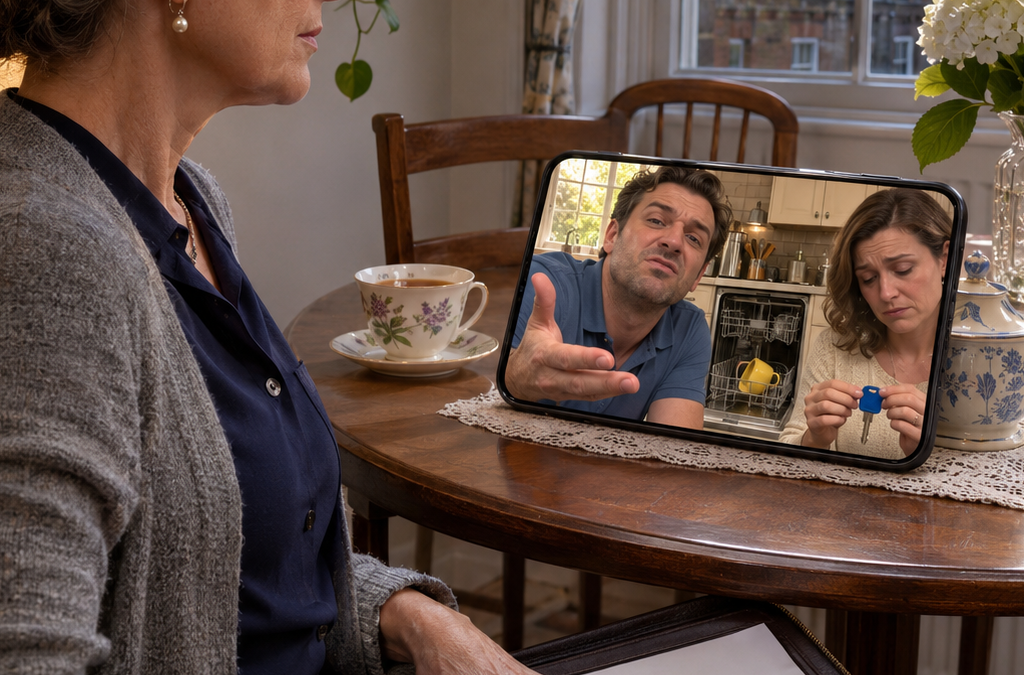
Grant said it to Claire, though I was on the screen. She sat beside him in their Columbus kitchen, turning my duplicate house key between her fingers. Its blue sleeve caught against her wedding ring.
I waited for her to look up.
Beside me, Owen stirred in his travel cot. My first grandchild was ten weeks old, and I had been watching his fist slowly escape his blanket.
“Who gave permission to list my house?” I asked.
Grant leaned toward the camera. “Evelyn, we’ve discussed this.”
“Who gave permission?”
“You said the stairs were getting old. You said keeping up a whole house for one person didn’t make sense.”
“I said cleaning the upstairs bathroom was a nuisance.”
“It was more than that.”
“Then tell me when I said sell it.”
Claire stopped turning the key. Behind her, their dishwasher stood open, a yellow mug tipped sideways on the rack.
It was Tuesday, September 1. My phone showed 8:14 p.m. in London, 3:14 back in Columbus, Ohio. Five hours between us, and Grant still managed to sound as though he were standing in my kitchen.
“We have a good buyer,” he said. “People who actually want to live there. This isn’t some investor.”
“I live there.”
“Mom,” Claire said.
She rubbed the key’s rubber sleeve with her thumb. I had given her that duplicate to check the empty house.
“What?” I asked.
“We knew you’d get upset if we started with all the details.”
“You haven’t started with any details.”
Grant reached across her for something beyond the screen. “Let’s keep our voices down. You’re right beside the baby.”
Owen had settled again. I moved my chair farther from his cot anyway.
“Tell me what you’ve done,” I said.
“We’ve handled the difficult part. You won’t have strangers calling you or people tracking through while you’re home.”
I set the phone against Ben’s sugar bowl. He kept sugar packets from takeout orders in it, though he drank his coffee black. There were enough packets to supply a diner.
My travel folder lay beneath the table, tucked into my canvas bag. I pulled it out and opened it across my knees.
Between my return itinerary and insurance information were two pages bearing my signature. The corner had curled during the flight. I flattened it with my thumbnail.
“Claire, did you know the house was listed?”
Her eyes moved toward Grant.
“Don’t look at him. I asked you.”
“Yes,” she said.
“For how long?”
“Mom, can we please talk about what happens next?”
Grant nodded. “That’s what I’ve been trying to do.”
My hands stayed flat on the folder. At sixty-six, I had learned to let an unanswered question sit. Thirty years behind a public-library circulation desk had given me practice with people explaining everything except why they had my property.
On my lap lay my written POA revocation.
Before knee surgery on March 12, 2025, I had signed a durable financial power of attorney naming Grant so he could handle things during recovery. On August 6, recovered and managing my own affairs, I had signed the two-page revocation ending that authority.
He was still talking.
“Having you closer would help everybody. Claire wouldn’t have to worry about you being alone.”
“Claire lives across town. I’ve been alone in that house for years.”
“And it’s becoming a lot.”
“For whom?”
“For you, Evelyn.”
I looked at the two pages instead of his face. My signature sat beneath the date, exactly where I remembered writing it.
“Is this about your knee?” Claire asked.
“My knee got me through two airports.”
“Nobody said you couldn’t walk.”
“Then stop making plans as if I can’t get through my front door.”
The document’s footer read R-17. Behind it was Nora Ellis’s short delivery confirmation, received before I left: “47 / R-17 / 2 pages.”
Nora had obtained a signed receipt for the packet at Grant’s scheduled document-service appointment. I had filed her confirmation with my travel papers on August 8, then gone back to deciding which shoes would survive London rain.
Grant lifted his coffee.
“You’ve been generous with your time,” he said. “Nobody’s disputing that. But eventually we need something more workable.”
“My time?”
“We’re trying to take some responsibilities off you.”
“When Claire needed someone to watch the neighbor’s little boy during that schedule change, my house wasn’t too much responsibility.”
Claire pressed her lips together.
“I asked you for help,” she said. “I didn’t make you.”
“I know. I said yes.”
“That was different.”
“And when you needed me to wait for the cabinet delivery?”
Grant lowered his cup. “Come on, Evelyn.”
“I sat in your driveway because the crew hadn’t arrived. I chose to do that, too.”
“We appreciated it.”
“Then ask me things. Don’t tell each other I already agreed.”
From the hallway, Ben appeared carrying a clean bottle. He stopped when he saw the folder on my lap.
“All right?” he mouthed.
I shook my head once. He set the bottle beside Owen’s cot and stayed near the doorway.
Claire pulled her chair closer to the screen.
“We talked about making the downstairs room comfortable,” she said. “You liked the window.”
“I liked the window.”
“You said you could picture your chair there.”
“For a visit, Claire. I could picture it at a beach rental, too.”
Grant rubbed his forehead. “Nobody’s trying to put you out.”
“You just told my daughter I didn’t need my house.”
“That came out wrong.”
“She heard it.”
Claire looked down again. The key vanished inside her closed hand.
I wanted her to say she should have called me. Even a clumsy sentence would have helped. Instead, she asked whether Ben was there.
“He is,” I said. “But you’re speaking to me.”
Grant shifted in his chair.
“We should probably pick this up when you’re less tired.”
“I’m not tired. Send me the name of whoever is handling this sale.”
“We can go through it together.”
“Send me the actual contact.”
“Mom, Grant has all that.”
“Then he can give it to you. You can forward it.”
I closed the folder around the revocation, leaving my finger between the pages. Whatever Grant thought those papers contained, I wasn’t going to settle it while Claire watched him for answers.
“I want the paperwork,” I said. “The same paperwork everybody else has.”
Grant glanced offscreen.
“There’s an email,” Claire said.
“Claire, we ought to explain the schedule first.”
“She asked for it.”
Her voice was small, but she reached for her phone. I heard her tapping.
My own phone buzzed against the sugar bowl.
The forwarded message came from Buckeye Home Title. Dana Brooks’s name appeared beneath a September 11 closing appointment. I opened the attached purchase agreement and enlarged the signature page.
The price was $340,000.
I scrolled down once more. Under seller’s signature, on a contract I had never seen, were the words “Grant Mercer, attorney-in-fact.”
Chapter 2 of 7
“The contract is real, Mrs. Hale. Your house has not transferred.”
Dana Brooks spoke without trying to soften either sentence. It was Wednesday, September 2, and I had called Buckeye Home Title as soon as their Columbus office opened.
“I’m looking at ‘Grant Mercer, attorney-in-fact,’” I said. “That’s my son-in-law. I didn’t tell him to sell.”
“I’ve noted that. We received the agreement and his power-of-attorney copy last Thursday. Our authority review isn’t complete.”
“Has anything been put in his name?”
“No. You’re still the owner.”
I wrote that on the back of a grocery receipt. Dana confirmed that no deed had been recorded.
At Ben’s kitchen table, I pressed the pen hard enough to dent the paper beneath it.
“I ended his authority before I left Ohio.”
“Please send me the signed document. Include a written statement that you object to this sale.”
“I have the original here.”
“A clear scan will do for review. Keep your original.”
Ben found a scanning app on my phone, then left me to it. The first picture caught my thumb. The second cut off the bottom edge.
On the third try, both pages lay square inside the screen.
I attached them to an email and wrote three sentences. I owned 214 Willow Lane. I had not authorized its sale. I objected to anyone signing or transferring it for me.
Dana called after opening the attachments.
“I’m placing this transaction on review hold. We won’t proceed while we examine the authority issue.”
“So it’s stopped?”
“The closing is on hold. The purchase agreement still needs to be addressed.”
I looked at Grant’s old authorization beside my folder.
“That paper did include real estate,” I said. “I remember asking about that before surgery.”
“It allowed transactions for your benefit. It didn’t authorize him to give himself your money.”
“Can I just tell everyone his copy is worthless?”
“Send the notice. Keep the records. Tearing up his copy wouldn’t erase the agreement the buyers signed.”
I slid the old copy under the folder.
Afterward, I notified my bank through its secure message system and called to confirm where the revocation belonged. By afternoon, an acknowledgment appeared in my inbox. I saved it beside Dana’s message.
Neither message said anything about Claire.
Her call came while I was eating toast over a plate. Ben had bought thick-cut marmalade with enough peel to require chewing. I had scraped most of mine into a small orange heap.
“Grant wants me to explain what we were trying to do,” Claire said.
“Is he there?”
“He’s getting ready for work.”
“Then tell me what you did.”
She let out an irritated breath.
“Mom, if we honored the arrangement, everything would be simpler. One house to check on. You wouldn’t be arranging rides or worrying about repairs.”
“Whose arrangement?”
“The one we thought—”
“You thought. I didn’t agree.”
In the background, Grant said something I couldn’t catch.
Claire moved the phone. “He says you wouldn’t have to give up your things.”
“Did you let anybody into my house?”
“We needed photographs.”
I put the toast down.
“When?”
“August 18.”
“Who came?”
“Susan Reed. The agent. And the photographer.”
“You used my key.”
“Yes.”
“Did either one ask whether I knew?”
“Susan said Grant had explained everything.”
“And you let that stand?”
“He told me you’d talked.”
“You have my number.”
“I know your number, Mom.”
“Then why didn’t you call it?”
Her breath scraped against the microphone.
“Because every time Grant suggests anything, we end up having this argument.”
“We hadn’t had this argument. I didn’t know there was a sale.”
“I meant about him helping. About you thinking he’s taking over.”
I pushed the orange peel around with my knife.
“You didn’t want an inconvenient conversation,” I said. “That didn’t give you my permission.”
“I wasn’t trying to hurt you.”
“Did you stand there while they photographed my bedroom?”
She didn’t answer.
“Claire?”
“I was there.”
From another room, Owen gave a short, indignant cry. Ben murmured to him, then started walking the hallway. I listened to his footsteps while my daughter stayed on the line.
“I have to call Susan,” I said.
“Can you please let Grant talk to her first?”
“No.”
I ended the call before she could hand him the phone.
Susan answered on her second ring. When I gave my name, she began with the closing date.
“I know the date,” I said. “I’m calling because I didn’t approve this sale.”
Her papers rustled.
“Grant supplied the power of attorney.”
“He also had someone let you into my house without asking me.”
“Your daughter met us there.”
“Yes. She’s told me.”
Susan paused, then asked for my email address and direct phone number.
“I’ll correct the contact file. You should have been included.”
“Please send me what you used to advertise it.”
“I’ve taken the listing out of active marketing while title reviews this. I’ll send the photographs.”
They arrived before I finished washing my plate.
My front porch looked scrubbed and strangely wide. Someone had moved the umbrella stand out of the hallway. The kitchen photograph showed my dish towel folded over the oven handle, its scorched corner turned inward.
I clicked through to the bedroom pictures.
One frame had caught more than the photographer intended. The cedar chest stood tilted near the doorway, headed toward the open space they had cleared for staging.
Claire was carrying one end.
Chapter 3 of 7
“The photographer took that on August 18,” Claire said. “The chest is still inside. We put it near the hall.”
I held the phone beside the photograph on Ben’s laptop.
“You carried it.”
“He needed the bedroom to look bigger.”
“Did you open it?”
“No.”
“Why didn’t you call me?”
“I told you. I didn’t want another fight about Grant.”
“So you moved my things instead.”
She made a small noise, almost an answer.
“Don’t move another item,” I said. “Leave the chest where it is for now.”
“It’s in the way.”
“Then walk around it.”
She hung up after saying she had to get back to work. I enlarged the photograph until her face blurred. Her hands remained clear beneath the cedar chest’s brass handle.
On Thursday, September 3, Grant sent an email to Susan and the buyers. He copied Claire and me.
The subject was “Family arrangements—Willow Lane.”
“Evelyn has become uncomfortable with the transition,” he wrote. “This follows a settled family plan that everyone has organized around.”
Farther down, he said he was confident we could “work through her concerns” before closing.
I read it twice. Then I deleted the reply I had started.
My second version was shorter.
“I did not authorize this sale. I have notified Buckeye Home Title that I object and supplied my signed revocation. Please contact me directly about my house. I will speak for myself.”
I replied to everyone once.
Daniel Price answered that afternoon.
“Mrs. Hale, we don’t want to get between family members. We need to know whether we should book movers. Grant says this is being worked out.”
I called the number beneath his name.
“My wife has boxes stacked around her desk,” he said. “She works in medical billing. She can barely get to her chair.”
“I’m sorry you’ve been put in this position.”
“Are you selling the house?”
“No.”
He exhaled close to the phone.
“All right. That’s different from what we were told.”
“Yes.”
“We need something clear from title. We can’t keep making plans because your son-in-law says it’s fine.”
“I’ve given Dana my answer. Please ask her about the contract.”
He thanked me, though his voice had gone flat.
Afterward, I sat beside Owen while Ben folded laundry. One tiny sock had attached itself to the fastening on a bib.
“Even his clothes need supervision,” Ben said.
I pulled it free and laid it with its mate. Then I told Ben I needed to go home early.
He stopped folding.
“When?”
“Monday.”
“Labor Day?”
“I can still fly on Labor Day.”
“I know. I meant—yeah. Let’s look.”
Grant called while Ben opened the airline website.
“An early return will crowd everything, Evelyn. We’re trying to get preparations settled.”
“What preparations?”
“The house. The closing. Claire’s already stretched.”
“I’ll be staying at my house.”
“That’s exactly what I’m talking about.”
Ben turned the laptop toward me. I pointed to the September 7 flight.
Grant kept going. “And I can’t collect you at the airport if you change the date. I offered for the twenty-first.”
“I’ll get a ride.”
“You don’t need to spend money making a point.”
I reached for my credit card.
The flight change cost $760. Ben checked the itinerary with me before I confirmed it. I booked a paid ride for another $68, entering my own address as the destination.
Grant had already ended the call.
I saved both receipts. Ben offered to make dinner, then stood holding the same unfolded shirt.
“Dad would’ve driven around the airport three times rather than pay for parking,” he said.
“He would’ve blamed the signs.”
Ben laughed once. I folded the shirt for him.
On Friday, September 4, I called Nora Ellis’s document-service office. I had known her long enough to recognize the scrape of her chair before she answered.
“Evelyn. Are you still in London?”
“Until Monday. I need to ask about Grant’s appointment.”
“The August seventh delivery?”
“Yes. Do you still have his receipt?”
“I have the original signed acknowledgment in my file.”
I found a pen.
“And the record you made that day?”
“My journal entry, too. Forty-seven. I keep that voluntarily with my service records.”
“What does it say about the packet?”
“R-17, two pages.”
I wrote her words beneath the airline confirmation number.
“Can you send those records to me?”
“Send a written request identifying the appointment and exactly what you need. I can arrange a limited copy for you and the title company next week.”
“Not everything in your journal.”
“Just the relevant entry. I won’t disclose other clients’ information.”
I emailed the request before leaving the table. Nora confirmed receipt and said she would retain the originals.
Late that evening, Claire called. Behind her, a drawer opened and shut.
“He keeps saying it has to happen,” she said.
“The sale?”
“Yes. Even after your email.”
“Claire, I’m coming home Monday.”
“I know. Ben told me.”
Paper crackled near her phone.
“There’s something in our renovation folder. I’m sending it. I don’t know if—just look at it.”
“Tell me what I’m looking for.”
“I have to go.”
A PDF arrived with no message beneath it. I opened it at the kitchen table, beside my cooling cup.
The first page carried Grant Mercer’s name. Lower down, a personal-loan payoff schedule showed $43,260 due November 2.
Chapter 4 of 7
Grant alone had borrowed $42,000 on August 3. The lender had withheld a $1,250 fee, leaving $40,750 deposited for him to spend.
Claire answered my call Saturday morning.
“The kitchen and the roof,” she said. “That’s where it went.”
“All of it?”
“The receipts are in what I sent.”
I opened the attachments beneath the loan document. Cabinets. Roofing materials. Labor.
“Did he tell you I was paying this?”
“He said once we had everybody settled, the money wouldn’t be a problem.”
“Did he say my money?”
“He talked about the house money.”
I had never promised to repay his loan.
“Claire, that money would be mine.”
“I know.”
“Did you know when he borrowed it?”
She didn’t answer. I could hear a faucet running.
“I knew there was a loan,” she said finally. “I didn’t know he was counting on your house until he started talking about November.”
I put the receipts back behind the loan schedule. Their new kitchen had already been installed. My house was supposed to pay for it.
On Monday, September 7, my paid driver lifted my suitcase onto the curb outside 214 Willow Lane.
“Want me to take that up?” he asked.
“I’ve got it. Thank you.”
I pulled it along the walk myself. One wheel caught in the familiar crack near the steps, and I tipped it free.
Inside my front door, the house smelled closed up. The cedar chest stood near the hall, where Claire had said it was. I had to turn my suitcase sideways to get past.
I left it standing there.
No one from the title office called on Labor Day. I ate scrambled eggs from a soup bowl and set my documents on the dining table.
Tuesday morning, Dana called with Laura Kent, the company’s Ohio real-estate counsel.
“I’ve reviewed the power of attorney and your revocation,” Laura said. “Also the purchase agreement and the notice you sent.”
“Then you’ve seen that I’m the owner.”
“Yes. Dana checked the recorded deed. You’re the only owner.”
“Does Grant still think he can sign?”
“We’re sending him your actual revocation now,” Dana said. “He needs to respond to the document, not somebody’s description of it.”
I watched her email arrive. Grant’s address appeared above mine. The attachment was the same two pages I had carried across the Atlantic.
My phone rang eleven minutes later.
“You revoked the whole thing?” Grant asked.
“Yes.”
“Evelyn, you could have told me.”
“I had it delivered to you.”
“I didn’t get a revocation.”
“You received a packet from Nora.”
“Travel paperwork. That’s what I understood that appointment was about.”
I pulled my chair closer to the table.
“Did you open it?”
“I had other things going on.”
“Did you open it, Grant?”
“No. But that’s not the point. You can’t put something in routine papers and expect—when was this supposedly effective?”
“The date is on it.”
“The buyers’ agreement was August twenty-first. I signed that before anybody told me you were pulling this.”
“I’m telling you now.”
“That doesn’t erase what already happened.”
He sounded less certain when he asked whether anything had been mailed. Then he returned to the appointment.
“A receipt for some packet doesn’t settle this,” he said. “I was there for administrative paperwork. I wasn’t sitting down to review legal changes.”
“You had two pages to read.”
“And now two people have arranged their lives around a signed contract.”
He waited. I kept my hand on the document.
“I’m not selling my house,” I said.
After he hung up, I called Dana back and told her what he had said. Laura joined us again.
“We need the delivery history checked,” Laura said. “His argument about the earlier contract is separate from whether we can close now.”
“Does Nora decide whether he was notified?”
“No. She can tell us what she delivered and authenticate her records. She doesn’t decide contract liability.”
Dana asked whether Nora had answered my written request.
“She confirmed she has the original acknowledgment and the relevant journal entry.”
“Please authorize the limited copies for our file,” Dana said. “We’ll review them before Friday.”
I sent Nora an email naming Dana and Laura. Nora replied that she would supply the requested records Wednesday.
Later, Dana sent me the draft settlement statement. I followed the figures with a ruler: $340,000 at the top, a proposed $20,400 commission, and $1,600 in other seller charges.
There was still no signature of mine anywhere.
When I asked whether Grant could insist they finish, Laura answered briefly.
“We won’t insure a disputed deed without satisfactory authority. We have your revocation and your refusal. An argument about the old agreement doesn’t require this company to fund it.”
Dana confirmed the appointment: September 11 at 10:00 a.m., Buckeye Home Title in Columbus.
She listed everyone attending: Grant, Claire, the Prices, Susan, Nora, Laura, and me.
“This is an authority-review meeting,” she said. “We need a definite answer about whether anyone can sign and whether the sale must be canceled. Everyone will be told that.”
“Please put that in the email.”
“I will.”
That evening, I found my good reading glasses beneath an armchair cushion. I had blamed their disappearance on the airline until I remembered wearing them there before my trip.
I put them beside Friday’s appointment notice.
My phone lit up with a text from Daniel Price.
“Grant just called us. He says the power-of-attorney issue won’t matter because you’ll be there Friday to sign the deed yourself.”
Chapter 5 of 7
“I’ll attend to protect my ownership,” I texted Daniel. “I will not sign the deed. Grant didn’t ask me.”
Then I called Dana.
“Please tell them plainly,” I said. “They’re still being promised a house.”
“I’m sending everyone a notice. No valid transfer is assured. Friday is a review meeting, not a promise of closing.”
Daniel replied after her email arrived.
“We’ll come. We need an answer, and our deposit released if this can’t happen.”
On Wednesday, Nora supplied the requested receipt and journal extract. Dana confirmed that Laura had reviewed the limited copies and that Nora would bring the original acknowledgment Friday.
I placed my original revocation beside the old delivery confirmation. Then I closed the folder.
Thursday, September 10, Claire arrived at 214 Willow Lane carrying a roll of packing labels. She used the duplicate key before I reached the door.
“You could knock,” I said.
She stopped with one foot inside.
“I wasn’t sure you’d hear.”
“I heard the key.”
Her purse slid off her shoulder. She caught it against the doorframe.
“I brought these in case we needed to sort things.”
“We don’t.”
“Just so nothing gets mixed up.”
She pulled a label loose while looking toward the cedar chest. It still stood near the hall, where she had helped move it.
“Don’t put that on there.”
Her hand stopped above the lid.
“It peels off.”
“Put it back on the roll.”
She pressed the label against its backing. One corner stuck to her finger.
“Grant thought if we separated what you wanted upstairs—”
“I’m not choosing what fits in your spare room.”
“You could keep more than you think.”
“Claire. Look where you’re standing.”
She looked at the floor.
“At my house,” I said. “With labels.”
“I was trying to help.”
“Help me do what?”
She worked the sticky corner off her finger.
On the kitchen counter sat a paper bag from the grocery store. I had bought the oatmeal cookies Claire liked, the ones she always claimed were too dry while taking another.
I folded the bag shut.
“Call him,” I said.
“Mom—”
“Put him on speaker. I’m not having you carry this back differently.”
Grant answered with traffic noise behind him.
“Hey, sweetheart. Everything okay?”
“She doesn’t want labels on anything.”
“I told you we weren’t packing today.”
“You told her to sort things,” I said.
A turn signal clicked through the phone.
“Evelyn, we could make this much simpler. Sign Friday. Let the Prices get on with their move. We can discuss the family money afterward.”
“What family money?”
“The arrangements. What you need, what stays available. There’s no reason to settle every detail in that office.”
“You want my signature first.”
“I want to avoid making innocent people lose out.”
“I spoke to Daniel. I know they have boxes waiting.”
“Then you know this affects more than us.”
“Yes. Because you promised them my house.”
Claire leaned against the counter, still holding the labels.
“You could help them,” Grant said.
“I can be sorry they’re stuck without selling.”
“Can we separate the property transaction from the family disagreement?”
“That doesn’t make my signature voluntary. It just puts the argument after you’ve got it.”
“I haven’t got anything.”
“Then stop promising it.”
The turn signal stopped.
“Claire, could you take me off speaker?”
“No,” I said. “You can call her later.”
Claire’s thumb hovered over the screen. Grant ended the call first.
She put the phone facedown.
“Their apartment notice is already in,” she said.
“I know.”
“They might have to pay for storage.”
“I know that, too.”
“You sound like it doesn’t matter.”
I pulled out a kitchen chair.
“It matters. I didn’t make their plans, Claire.”
She stayed standing.
“I’m taking these home,” she said, lifting the labels.
“Good.”
She put the duplicate key in her purse. I watched her zip it closed.
After she left, I moved the cedar chest back into my bedroom. I used folded towels beneath its feet and took my time.
Friday morning, I carried my folder into Buckeye Home Title.
I was not there to sign away my house.
Daniel and Megan sat together beneath a framed photograph of downtown Columbus. Megan held a moving-company folder with blank inventory sheets sticking out.
“Mrs. Hale?” she asked.
“Evelyn.”
She nodded but didn’t offer her hand. I sat across from them.
Susan arrived carrying a listing sheet she had removed from her display folder. She folded it inward when she saw me.
Claire came with Grant. Her purse zipper was open, and the blue sleeve of my duplicate key showed beside her phone.
Grant stayed standing.
“She agreed before the trip.”
Megan looked up.
“Downsizing,” he continued. “Being closer to us. My job was to carry that out. We’ve gotten tangled up in paperwork.”
“No,” I said. “I didn’t agree to this sale.”
“Evelyn, we’ve had the conversation.”
“You’ve told them your version. They’ve heard mine.”
Dana opened the inner door. Laura and Nora were already inside the conference room.
“Everyone can come in,” Dana said.
Grant handed her a printout.
“I emailed this, too. It should clear up the signing arrangement.”
Dana read it, then checked her inbox on the conference-room computer. She turned the printout toward me.
Grant’s fresh instruction asked her to use his August agency authority. Beside my name, he had written “present as witness only.”
Chapter 6 of 7
“Before anyone signs,” Dana said, placing Grant’s instruction on the table, “who is proposing to execute the deed?”
“I am,” Grant said. “Under the authority I used in August.”
“I’m not authorizing him,” I said. “And I’m not signing as seller.”
Grant rested his forearms on the table.
“We agreed before London. I signed the buyers’ contract while I was authorized. That shouldn’t disappear because we’re having a disagreement now.”
I opened my folder and laid down my August 6 revocation.
“You signed August twenty-first,” I said. “You’re saying the packet ending your authority never reached you before that.”
“I’m saying I wasn’t given notice of this change.”
“You told me you didn’t receive it.”
“Whatever was mailed wasn’t reliable. There was also routine paperwork at Nora’s office. A general packet receipt doesn’t prove legal notice.”
Nora kept her hands beside her file.
Grant turned toward the Prices.
“They have a signed agreement. They shouldn’t lose the house over an administrative dispute.”
Megan held the moving folder against her knees. Daniel watched Grant without answering.
“Evelyn can sign herself,” Grant continued. “That clears up the authority question. We can handle everything else afterward.”
“No,” I said.
“You won’t even consider—”
“No. I won’t sign.”
I turned my original so its footer faced the others. Then I placed the copy of Nora’s retained receipt beside it.
“R-17,” I said, pointing to my document. “Nora, would you read the enclosure reference on his receipt?”
Grant reached toward the copy, then stopped.
Nora adjusted her glasses.
“Enclosure R-17. Two pages.”
“And the date and time?”
“The acknowledgment was August 7, 2026. My journal entry records 4:26 p.m.”
“Before his contract,” I said.
“Yes.”
Grant looked at Nora’s file.
“You kept that?”
“I retained the original acknowledgment. This is the copy supplied for review.”
“People sign receipts all day.”
“I watched you acknowledge your signature,” Nora said. “I personally handed you the identified two-page packet.”
I moved the receipt closer to my revocation. The same code sat on both pages.
“And entry forty-seven?” I asked.
“Made at the appointment. It links that enclosure to the delivery and acknowledgment.”
“That doesn’t prove I read every page,” Grant said.
“No,” Nora replied. “It doesn’t.”
He spread his hands toward Dana.
“Exactly.”
“Are you still saying the packet was never delivered?” Dana asked.
Grant looked down at his instruction.
“I’m saying I didn’t know what she was doing.”
“That’s a different answer,” Dana said.
Nora closed her file halfway.
“I can authenticate my records, his acknowledgment, and my delivery. I’m not deciding what legal effect any of that has.”
Laura pulled the purchase agreement toward her.
“I reviewed the Ohio power of attorney, its limits, the revocation, and the notice history. Also this agreement.”
“So you agree the contract predates actual notice,” Grant said.
“No. Your factual claim of nondelivery isn’t supported. We’re not deciding every possible claim arising from the contract.”
She turned to Dana.
“Do not accept a deed under his claimed authority. Do not fund this closing.”
Dana put her hand on the draft settlement statement.
“Mr. Mercer, you acknowledged this packet before signing their contract. We also have the owner’s revocation now. Buckeye Home Title refuses the deed and will not release the $318,000 payout.”
Grant stared at the figures beneath her hand.
“Even apart from the earlier notice dispute,” Dana continued, “Mrs. Hale’s current refusal prevents this company from completing the proposed closing.”
“That was supposed to settle everything,” he said.
His chair scraped backward. He stood with one hand still on the table.
“Claire. Tell them what we planned.”
She had her purse open on her lap.
“Tell them about the downstairs room,” he said. “About not having to run across town every time something needs fixing.”
“You haven’t fixed anything at my house,” I said.
“I’m talking about going forward.”
Claire pulled out the duplicate key. Its blue sleeve had a gray mark along one edge.
“I let them in,” she said.
Grant glanced at Susan.
“Everybody knows you met the photographer.”
“I mean I let them in without asking Mom.”
“You believed we had an agreement.”
“I didn’t call her.”
He sat down again, but only on the edge of his chair.
“We can talk about that at home.”
“I’m not packing her things,” Claire said. “Or moving the chest again.”
Megan slid the unused inventory sheets inside her folder. One corner bent, and she smoothed it against her knee.
I gathered my original pages.
“You can ask to visit. You cannot decide I’m leaving.”
Grant reached for his printout. Dana kept the company’s copy.
“Five minutes in the hallway, Evelyn. Without everybody watching.”
“No. If you need to contact me, send it separately, in writing.”
Claire looked toward me.
“You can call me yourself,” I told her. “Later.”
She borrowed Dana’s pen and asked for paper. Her first line came out crooked. She finished, signed it, and handed it across: she did not own my house and did not authorize anyone to clear it.
Then she placed the duplicate blue-sleeved key in my palm.
Daniel set his moving folder on the table.
“What happens to our $5,000 deposit?”
Chapter 7 of 7
On Friday, September 18, Dana sent the executed cancellation and deposit-release instructions. The Prices had exercised the seller-authority contingency. Their $5,000 went back to them, and I received a written release from the purchase agreement.
No deed had been accepted or recorded. No purchase money had been wired.
I printed my copy and checked every page before putting it away.
Daniel sent one final text.
“Deposit is back. We’re looking elsewhere.”
“I hope you find a good place,” I wrote.
He didn’t answer. He had houses to look at.
Susan confirmed that my listing was withdrawn. The proposed commission and estimated seller charges stayed on a draft statement in a canceled file. I took her sign out of the front window and left it on the porch for collection.
By supper, it was gone.
Claire called that Sunday.
“Can I come over?”
“Not today.”
“Okay. Is there another day?”
“I’ll let you know.”
She stayed on the line a moment.
“I told Susan I wouldn’t meet anyone at your house again. Or arrange anything.”
“Good.”
“I should’ve said that before.”
I held the receiver against my ear, watching a squirrel dig in the planter outside.
“Yes,” I said.
She didn’t ask me to make her feel better.
During October, we spoke a few times. She asked about Ben and Owen. I told her Owen had begun grabbing Ben’s glasses during their video calls.
“Ben used to grab yours,” she said.
“He broke a pair.”
“I remember the tape.”
“You remember laughing.”
A little laugh escaped her then. I let mine come, too.
Other calls were harder. Once she started, “Grant thinks we should—” and stopped herself.
“What do you want to ask?” I said.
She asked whether she could visit the following week. I said I wasn’t ready.
On Monday, November 2, Grant’s payoff came due.
His email arrived that morning with the lender’s notice attached. The amount remained $43,260.
He asked me to contribute toward it.
“The improvements were made with the whole family’s future in mind,” he wrote. “Any help would reduce the pressure on our household.”
I read it at my kitchen table. Through the doorway, I could see the cedar chest back beneath my bedroom window.
My reply took less time than opening his attachment.
“I will not contribute to your loan. Please make arrangements with your lender.”
I saved the exchange. There was no second request.
Claire called that evening, but she didn’t ask me for money.
“I’ve started opening our household mail myself,” she said. “Not just the things he puts on the counter for me.”
“Have you found anything else?”
“No. I checked. I’ve got the bills and the statements together now.”
Her voice sounded tired. I could hear a drawer closing.
“I used to just ask him if everything was handled,” she said.
I moved my cup away from the edge of the table.
“Are you asking me to look at it?”
“No. I’m telling you what I’m doing.”
On November 16, she forwarded the completed repayment modification.
Grant had paid $18,000 from his own savings. The lender had approved repayment terms for the remaining $25,260, still his personal obligation.
“He signed it,” Claire wrote. “This is settled with the lender. You don’t need to do anything.”
I checked the figures against the payoff amount, then closed the attachment.
At our next call, I told her not to send more household financial papers.
“I needed to see that the loan was handled,” I said. “I don’t need to manage it.”
“I wasn’t trying to make you.”
“I know. Let’s keep it that way.”
By December, I had sorted the papers from the sale into one folder. The canceled agreement, my revocation, Nora’s limited records, and the bank’s acknowledgment went into the filing cabinet.
Grant had no keys and no financial authority. I kept both house keys in my own drawer.
On Friday, December 4, Claire sent $828. Her message identified the $760 flight change and the $68 ride.
“I helped cause your early return,” she wrote. “You shouldn’t have had to pay for it.”
I checked that the payment had arrived and sent back a receipt acknowledgment.
“Thank you. I received it.”
That night, we arranged a visit for Saturday, December 12.
“Two o’clock?” she asked.
“Yes. Just you.”
“Okay.”
“And Claire, there won’t be another key.”
“I know.”
“No financial papers. If you want something from me, ask me yourself. Don’t bring me a promise Grant made.”
“I won’t.”
“I’m not asking you to leave your husband.”
“I didn’t think—”
“I’m saying it anyway.”
She was quiet long enough that I checked the phone.
“Are we ever going to be all right?” she asked.
“We can have tea Saturday.”
“All right,” she said. “Two.”
On Saturday morning, I dusted the cedar chest. One brass handle still sat slightly crooked from being moved. I tightened its screw with the little screwdriver I kept in the kitchen drawer.
Claire had suggested over the phone that it might look nice downstairs.
“I like it here,” I had told her.
That was where it stayed.
I put out two cups and sliced a lemon. I wanted black tea, the loose kind that left a few leaves in the bottom despite the strainer. Claire could have sugar if she wanted it.
At two, her car stopped outside.
I was on the porch bringing in an empty planter. I had locked the door behind me, my own blue-sleeved key in my coat pocket.
Claire came up the walk carrying nothing.
“Hi, Mom.”
“Hello.”
She stopped below the porch steps.
“Shall I take that?”
I handed her the planter. She set it beside the door, then waited.
“Come in,” I said.
I turned the blue key and let the kettle sing.







