Seven months pregnant, I sat in our kitchen while my husband demanded my share of the house to cover a company debt he claimed exceeded everything we owned.
Chapter 1 of 7
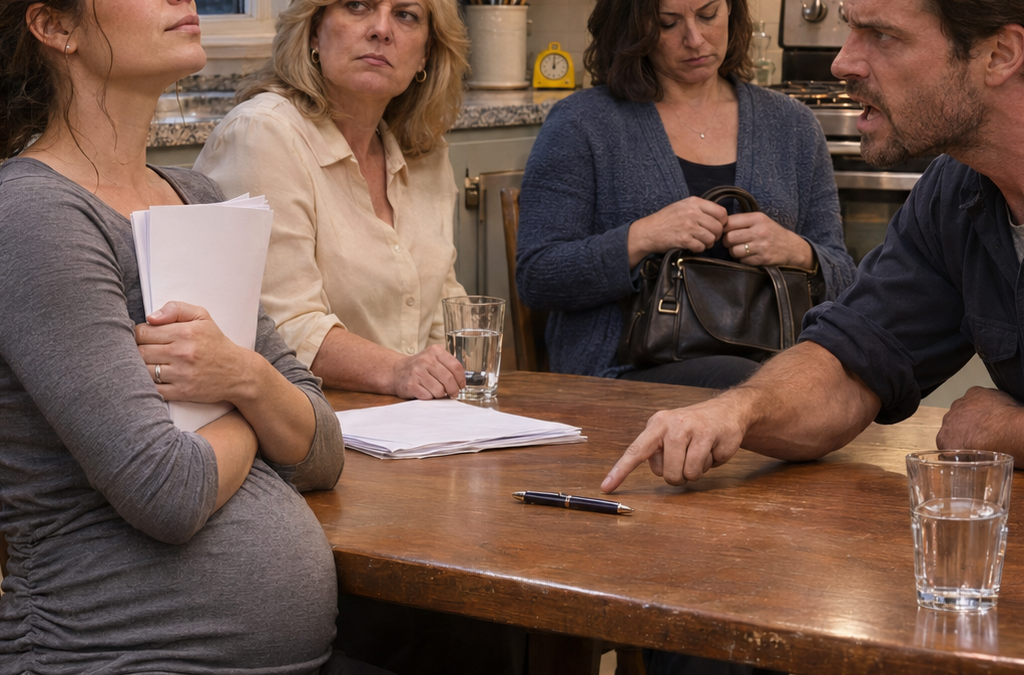
The stove clock read 6:10 p.m. Daniel pushed a pen across the table.
“You couldn’t afford this kitchen without me.”
His sister, Beth, straightened the straps of her purse. I watched her fingers work the buckle, waiting for her to look up.
She didn’t.
Paula Kent, Daniel’s accountant, moved her water glass off the settlement proposal.
“Let’s keep this practical, Emily.”
It was Monday, April 6. I was thirty-two weeks pregnant, and my left shoe no longer fit by dinner. I had loosened its laces under the table before they arrived.
“What happens to the house?” I asked.
“The proposal covers that,” Daniel said.
“I’m asking you.”
“You transfer your interest. I handle the obligation.”
The cabinet behind him still had a rough spot beneath its bottom hinge. I had sanded those doors on newspapers spread across this floor. Daniel had promised to finish that corner.
I touched a pale groove in the table.
“And I leave with what?”
Paula tapped a line. “Four thousand dollars.”
“Where would I put a crib?”
“Em, we can’t solve every detail tonight,” Daniel said.
He still wore his Northline Cabinets work shirt. There was sawdust caught inside the pocket seam. Once, I would have brushed it away before washing it.
Paula turned another page toward me.
“The company obligation is a hundred eighty thousand. That exceeds the equity and available household cash.”
“Our house is worth four hundred forty thousand,” I said.
“And we owe three hundred twenty,” Daniel said. “Value isn’t cash.”
“I know what a mortgage is.”
“Then you know why this has to be handled.”
Our six thousand dollars in household cash had already been divided by agreement. Three thousand each. Mine sat in an account I checked before buying anything, even toothpaste.
The yellow mechanical timer stood beside the stove. I had bought it for $8.99 during the renovation because Daniel kept borrowing my phone with flour on his hands.
I had paid for the paint from savings, too. He had called it our kitchen then.
“You’re keeping the business,” I said.
“I’m keeping the thing that pays for everything.”
“Some of those invoices got balanced right here.”
“And I appreciated your help.”
He said it quickly, already reaching for the pen. I remembered matching delivery slips after midnight while he slept upstairs. There had been no paycheck for those evenings.
“I’m not signing tonight.”
Beth finally moved. She drew her purse onto her lap.
“Maybe everybody could have dinner first.”
“No,” Daniel said. “We need to finish.”
“I’m keeping this copy,” I said.
“You should read it,” Paula answered. “That’s why we brought it.”
I carried the pages upstairs while Daniel walked Paula to her car. From the bedroom, I texted Luke Bennett, the former employee who used to leave reconciliations clipped beside my calculator.
Do you remember a company loan involving Daniel? They say he owes Northline $180,000.
His reply came while Beth’s car was still in the driveway.
I have my month-end statement. Let me get it.
Then a photograph appeared.
Across the top, above Daniel’s name, it read: DUE TO SHAREHOLDER.
The statement was dated February 28, 2026. Beside the balance stood $180,000.
A second sheet was clipped behind it, its lower section folded upward. I could see March 12 and Daniel’s initials, D.M., near the edge. Luke had photographed the packet on a scratched wooden desk.
I enlarged the heading until the letters blurred.
Downstairs, Daniel called, “You want the rest of this chicken?”
“No.”
“You need to eat.”
I shut the bedroom door without answering.
The bed was covered with washed baby clothes. I moved a little striped sleeper onto my knee and compared the photograph with the pages Daniel had left.
His March 24 disclosure packet was in the nightstand. I had kept the envelope because I didn’t know which parts mattered.
On his signed schedule, the same amount appeared as a debt to Northline.
I called Luke.
“Sorry,” I said when he answered. “I know you don’t work there anymore.”
“That doesn’t change what I worked on.”
“Could the heading mean something different? From Daniel’s side, I mean?”
“Tell me exactly what they’re saying.”
“That he owes the company. That I should give up the house because of it.”
Luke paused. I heard a chair scrape.
“Emily, the shareholder balance on that statement was money the company owed Daniel. He was the lender. You’ve got the direction backward—or somebody’s given it to you backward.”
I put my thumb beside the words DUE TO.
“So this was money coming to him?”
“As of February twenty-eighth, yes.”
“Then why does his paperwork say he owes it?”
“I can tell you what I reconciled. I can’t tell you why he put that down.”
I set the striped sleeper beside the proposal. Four thousand dollars to walk away, against a debt that Luke said faced the other direction.
“Do you still have those pages?” I asked.
“Yes.”
“Please keep them.”
“They’re staying right here.”
A floorboard creaked outside the door. I ended the call and set my phone facedown.
Daniel came in carrying a plate with chicken and three baby carrots.
“You’re worn out,” he said.
“I said I’d read it.”
“I heard you. We can finish tomorrow.”
He set the plate on the dresser, between diaper cream and a stack of folded towels.
“Paula didn’t have to come over after work.”
“She’s your accountant.”
“She knows the business.”
“She isn’t mine.”
He rubbed the back of his neck.
“Every dollar I’ve earned has gone into this family or that shop. You think I want to be dealing with this now?”
I looked at the pen sticking out of his shirt pocket.
“I’m getting advice before I sign anything.”
“Fine. Have somebody explain it. Just don’t turn this into months of fighting.”
He left the door open behind him.
I ate one carrot because it was there. Then I searched for the attorney whose name I had saved when I filed for divorce in March.
Sarah Brooks had a Sacramento office and an appointment request form. I typed with my plate balanced on my knees.
Pending divorce. Pregnant. Proposed settlement involving house and disputed company debt. Need independent review.
My phone rang several minutes later. Her office had a cancellation at 9:30 the next morning.
“Yes,” I said. “I can be there.”
I wrote Tuesday, April 7, on the back of an envelope. Under it, I wrote the time.
Beth had texted while I was upstairs.
Call me if you need anything.
I stared at her message. I could picture her purse straps lined up neatly in her lap. I put the phone down without asking her to explain my husband to me.
Instead, I gathered the proposal and the served disclosure packet into a grocery bag. I added a notebook, then took it out and checked the pages for old shopping lists.
Downstairs, Daniel turned on the television.
I opened Luke’s photograph once more. Behind the February statement, the folded sheet still showed its date and Daniel’s initials.
A new message arrived from Luke.
“The payment instructions name Daniel’s Chase account ending 4418.”
Chapter 2 of 7
At 9:30 Tuesday morning, I spread Daniel’s papers across Sarah Brooks’s desk.
“There’s no Chase account here,” I said. “I checked twice.”
Sarah followed my finger down the schedule, then looked at Luke’s message.
“Account ending 4418,” she read. “You’ve never received a statement?”
“I didn’t know it existed.”
Her office overlooked a Sacramento parking lot. Someone below kept trying to fit a pickup into a compact space.
Sarah pulled a legal pad closer.
“This gives us somewhere specific to look. It doesn’t tell us what’s there.”
“But the company owed him.”
“According to this February statement, yes. Money owed isn’t proof of money collected.”
She set my phone beside Daniel’s signed schedule.
“I’ll request the loan records and this account’s statements. We’ll give the required notice and subpoena Chase. I want the records from the bank.”
“Should I ask Daniel?”
“You can. I’m not going to depend on his answer.”
I smoothed the grocery bag across my knees. One handle had torn on the way inside.
“Luke said he was allowed to keep his copies.”
“Can he show me that?”
I called him from Sarah’s desk. He answered with a cough and asked whether speakerphone was on.
“My lawyer’s here,” I said. “Sarah Brooks.”
“Good. I’ve got my departure checklist. March twentieth. Daniel signed it.”
“What does it allow you to retain?” Sarah asked.
“Reconciliations bearing my name. There’s a line for it. I asked because I didn’t want somebody coming back later saying I’d taken things.”
He sent a photograph while we waited.
Sarah read it without speaking. Then she asked him to preserve the complete packet, including the folded attachment and the checklist.
“I can bring copies this morning,” he said. “I’m already coming into town.”
He arrived while I was finishing Sarah’s intake form. His windbreaker zipper had caught halfway up.
“I’m not staying,” he said. “Just these.”
The copied pages still showed the clip’s dark shadow. I lifted the February statement and found the attachment beneath it, folded exactly as it had been in his photograph.
March 12. D.M.
I pressed the fold flat with two fingers, then let it spring back.
“Keep everything together,” Sarah said. “I’ll arrange to review and obtain the original packet.”
Luke nodded. He didn’t ask what Daniel had offered me.
After he left, Sarah separated the papers I had brought from home.
“The FL-140, income form, and asset schedule are his disclosure packet,” she said. “Those are served on you, not automatically filed with the court; this FL-141 separately records service.”
“Could he just decide not to give me the rest?”
“Preliminary disclosure isn’t optional. We’ll ask for what’s missing.”
I looked at the photograph again.
“Does this let me stay in the house?”
“You still own your share. You haven’t signed it away.”
“I mean after. Can this let me keep it?”
“Emily, this page doesn’t decide who keeps the house. It doesn’t establish collection or settle the property division.”
I pulled my checkbook out.
The $2,500 retainer left five hundred dollars from my allocated three thousand. I checked the amount twice before signing.
Sarah handed me a receipt.
“Keep that for your records.”
I folded it into my wallet, behind my appointment card.
Beth came over Wednesday carrying a bowl covered with a dinner plate. She had made chicken casserole with cornflakes on top, the way Daniel liked it.
“He asked you to come,” I said.
She adjusted the plate.
“He’s worried.”
“About what?”
“How much this is going to cost. Two lawyers sending things back and forth.”
I cleared a spot on the counter.
“Did he tell you about the account?”
“He said there are business details I wouldn’t understand.”
“Did he tell you about it?”
“No.”
She opened the silverware drawer, then closed it without taking anything.
“Em, there’s a baby coming. I hate thinking about her money going into a fight.”
I peeled a damp cornflake from the bowl’s rim.
“Then help me get accurate numbers.”
“I’m not his accountant.”
“Neither am I. Apparently.”
Beth glanced toward the stairs.
“Could you two sit down without Paula? Just family?”
“We already sat down. You were here.”
“I know.”
Her hand stayed on the drawer knob.
“I need accurate numbers before I give anything up,” I said. “That includes money someone says belongs to the baby.”
On Thursday, Beth drove me to my maternity appointment. I accepted because bending behind the steering wheel had become miserable.
She moved her passenger seat back before I reached the car.
“Enough room?”
“Yes. Thank you.”
At a red light, I asked whether Daniel had mentioned Chase again.
“I haven’t talked to him today.”
She turned the fan toward me.
At the clinic, she held my coat while I stepped onto the scale. Later, she stopped at the curb so I wouldn’t have to cross the lot.
I thanked her again. I didn’t invite her inside.
Friday, April 10, I stopped for groceries. Milk, eggs, apples, bread, chicken, and a few things I had stopped writing down because we always needed them.
My phone lit up beside the card reader. It was 5:06 p.m.
Daniel had written: I’ve stopped replenishing the grocery card while we’re paying lawyers. Use your own money.
The reader beeped. I kept my card against it another second.
The cashier turned the screen toward me: the $63.18 transaction had been declined.
Chapter 3 of 7
“Could you take off the sparkling lemonade?” I asked.
The cashier lifted the bottle from the bag without commenting. I paid the rest with my debit card, using money left after Sarah’s retainer.
In the parking lot, I checked the balance before starting the car. Then I put Daniel’s message in the folder on my phone beside his proposal.
On Monday, April 13, another offer arrived by email: $10,000 in relocation money if I signed by April 17 at 5:00 p.m.
Daniel came into the kitchen while I was reading it.
“That gives you enough to get situated,” he said.
“Situated where?”
“A rental. Somewhere nearby.”
I turned the phone toward him. “This still says I give up my interest in the house.”
“Yes, Emily. It’s a settlement.”
The dishwasher had stopped draining that morning. Two inches of cloudy water sat beneath the bottom rack. Daniel opened it, looked inside, and shut it again.
“We can’t afford two households,” he said. “We’re barely keeping this one going.”
“Then how does making me move fix that?”
“Ten thousand is cheaper than dragging everything out. Separate groceries, separate utilities—there isn’t enough.”
I rested my hand beneath my belly. The baby had pressed herself into a hard lump on one side.
“You’re pricing movers and a deposit against a debt nobody has backed up.”
“Paula gave you the numbers.”
“She gave me a number.”
“Five o’clock Friday,” he said. “I need an answer by then.”
“I’ll read it with Sarah.”
He picked up his keys. “You do that.”
On Tuesday, I toured a one-bedroom apartment over a garage in Sacramento. The owner met me beside a row of plastic garbage cans.
“Watch that second step,” she said. “It’s a little taller.”
The living room smelled faintly of fresh paint. Someone had painted over a screw above the window.
I stood in the bedroom doorway and measured the wall with my eyes. A crib might fit beside a narrow bed, if the closet door stayed half closed.
“Do you have a move-in date?” the owner asked.
“Not yet.”
“I’d need the application, income documentation, and deposit before holding it.”
“Of course.”
She gave me a printed sheet. I folded it small enough for my purse.
At the bottom of the stairs, she offered her hand. I used the railing instead.
Sarah read Daniel’s offer Wednesday afternoon. I set the rental sheet beside it.
“Can we get the bank records before Friday?” I asked.
“I wouldn’t count on it.”
“What if they show nothing?”
“Then we work with what they show.”
She slid the offer back toward me.
“You can accept this, try another proposal, or continue seeking the records. I can’t promise the discovery will finish on his schedule.”
“If I let it expire, can he make me leave?”
“His deadline doesn’t remove your ownership.”
I rubbed a thumbnail over the rental sheet until a strip of ink wore off.
“I can’t sign a lease with five hundred dollars and a maybe.”
“No.”
“And I can’t sign away the house because he gave me until Friday.”
Sarah waited.
“Keep going,” I said. “Get the records.”
Friday afternoon, I stayed home. I washed the stove knobs in a cereal bowl because the dishwasher still wasn’t working.
At 4:52, Daniel texted: Have you decided?
I wrote: I’m not accepting the offer.
He didn’t answer until after five.
Then all financial communication goes through counsel.
He paid the mortgage. The confirmation still came to the email address we both used for house notices. But when I asked whether he could cover a plumber, he sent back Sarah’s office number.
I called a repair service, heard the visit charge, and hung up. For now, I washed dishes by hand.
Beth came over the following week with the baby blanket I had left at her house. She had offered to help when my fingers started going numb at night.
One corner was finished. The rest trailed loose yarn inside a grocery bag.
“I couldn’t get the edge right,” she said.
“It’s fine.”
“I kept pulling it out.”
I lifted the blanket. There was a row where her stitches suddenly grew tight.
“Looks like you got mad here.”
She let out a small laugh. “Probably watching the news.”
For a moment, we stood beside the sink looking at the same crooked row.
Then she said, “Daniel thinks you’re putting the company at risk.”
I laid the blanket across a chair.
“By asking where the money went?”
“He says there are people depending on him.”
“I know there are.”
“I’m just telling you what he said.”
“Then tell him I’m not asking him to close the shop. I’m asking him to explain his papers.”
Beth folded the empty bag into a square.
“Would you talk to him?”
“He asked for financial messages to go through the lawyers.”
“Right,” she said. “He did say that.”
She left the bag beside the blanket.
On Thursday, April 23, Luke called while I was matching baby socks. I had six white ones and no two alike.
“Have you got a minute?” he asked.
I pushed the socks aside.
“Yes.”
“I got an email from Paula. There’s another February statement attached.”
“Another copy?”
“No. A replacement.”
I reached for my notebook. The pen had rolled beneath the bed, so I got down awkwardly and pulled it out.
“What changed?”
“Listen to the heading,” Luke said. “‘DUE FROM SHAREHOLDER.’ Paula’s asked me to sign it.”
Chapter 4 of 7
“She called it a template correction,” Luke said.
It was Monday, April 27. He sat beside me in Sarah’s office, holding the original packet across his knees.
“My reconciliation had Daniel as the lender. This replacement turns him into the borrower.”
“Have you signed anything?” Sarah asked.
“No. I didn’t process it that way. I’m not certifying that I did.”
He handed her Paula’s printed email, then the clipped pages. The folded attachment caught on his sleeve. He freed it carefully.
Sarah laid the March 20 departure checklist beside the packet.
“This is everything you were authorized to retain?”
“Everything relevant to this balance. I didn’t bring customer files or anything like that.”
“Nobody asked you to,” I said.
“I know.”
He rubbed his palms against his pants. His old Northline key ring still held his car key. The company logo had worn almost smooth.
Sarah went to copy the email. Luke watched her office door.
“I worked there a long time,” he said.
“You don’t have to tell me about our marriage.”
“I wouldn’t know what to tell you.”
“Could you testify about what you actually processed?”
He looked down at the packet.
“Yes. That much I can do.”
When Sarah returned, he asked whether Daniel would receive everything.
“The relevant documents, yes,” she said. “And your name as a witness. We’re not keeping this from him.”
Luke nodded, although his hands stayed flat against his knees.
After he left, Sarah arranged three pages across her desk: the original statement, Daniel’s account schedule, and Paula’s request.
“We’re keeping this narrow,” she said. “The loan, the missing Chase account, and the records connecting them.”
“Will the judge ask Chase?”
“The bank will answer the subpoena. I’m asking the court to require the related records Daniel hasn’t supplied.”
“And then?”
“Then we see what they establish.”
She wrote a short list while I shifted in the chair. My daughter had found a place beneath my ribs and seemed determined to renovate it.
“Sorry,” I said.
“You can stand.”
I stood for the rest of the meeting, holding the chair back.
At home that week, I sorted the kitchen drawer into things I would need and things I could leave. We had four pizza cutters. Three didn’t turn.
I put the working one back.
Daniel found me there on Monday, May 4, after his lawyer had received Luke’s documents and Sarah’s discovery papers. He held his phone out, but I didn’t take it.
“You called Luke?”
“Yes.”
“After he got laid off.”
“I called him because he handled the reconciliations.”
“Em. Come on. The man’s angry. He lost his job.”
Daniel pulled out the chair across from me. I moved my water glass away from its edge.
“He’s reading an old internal report like it’s the whole business,” he said. “There’s a reason Paula handles the accounting.”
“Luke signed that reconciliation when he worked there.”
“He reconciled payments. He didn’t decide what the money was for.”
“And you signed permission for him to keep it.”
“That was a departure checklist.”
“March twentieth. His signed reconciliations were specifically included.”
Daniel looked at my folder.
“So now you’ve got him digging through company papers.”
“He brought the papers you let him keep.”
“You don’t know what he’s leaving out.”
“Then provide the records Sarah asked for.”
He leaned back. One chair leg scraped the tile.
“That balance is a disputed business item. It isn’t a pile of money you can just pull apart.”
“Then let the records show that.”
“You really want him testifying?”
“I want him answering questions about his work.”
Daniel stood, leaving the chair in the walkway.
“Fine. Your lawyer can talk to mine.”
I waited until he left before moving it back. Bending over the chair had become harder than arguing from it.
The discovery hearing on Friday, May 8, took less time than finding parking. At nine a.m., Sarah was already beside me with the requested record categories marked on one page.
The judge ordered targeted production of the relevant account and company records. Our property evidentiary hearing was reserved for September 18, at 9:00 a.m., in Sacramento County Superior Court.
September looked far away on Sarah’s calendar. I put one finger beneath the date.
“Will I need to be there all day?”
“Plan on it. Both of you, both lawyers, and the witnesses. Paula and Luke. We’ll confirm anyone else.”
I wrote the date in my notebook. By then, the baby would be several months old.
Outside, Daniel waited near the steps while his lawyer finished a call. His work boots left dusty half circles on the concrete.
“I’m protecting the business that’s going to support our daughter,” he said.
“Then give Sarah the actual obligations.”
“You think keeping payroll going is optional?”
“I’ll address real bills. I’m not agreeing to your accounting.”
He glanced at Sarah, standing a few feet away.
“We could have handled this at home.”
I tucked the notebook into my bag.
“We tried that.”
That evening, I sat on the bed with my shoes off, studying the September date. I had written it too close to the edge. The last digit curled onto the cardboard backing.
I started a list underneath: transportation, childcare, documents.
Daniel hadn’t mentioned Beth outside court. Her name wasn’t on the list Sarah and I had discussed. I was reaching for my phone to ask Sarah about witnesses when his message arrived.
“Beth will testify that you knew the money had to go back.”
Chapter 5 of 7
“I heard him say the company might need cash again,” Beth told me. “That’s what I heard.”
I held the phone against my ear and stopped writing.
“Did you hear me agree to owe it?”
“No. But, Emily, I don’t know everything you two discussed.”
“Neither do I, apparently.”
“Please don’t ask me to call him a liar.”
“I’m asking what you heard.”
She repeated it, more quietly. Future needs. Something Daniel might have to put back into the business.
I crossed Beth’s name off my list of people to call. Then I wrote it again.
Lily was born Wednesday, May 27, before I had finished washing her smallest clothes.
At the Sacramento hospital, a nurse helped me settle her against my shoulder. Her cheek was warm and slightly sticky. I kept checking the space around her nose.
“She can breathe,” the nurse said.
“I keep looking.”
“You’ll do that awhile.”
Daniel arrived with a package of plain white burp cloths. He put them beside the water pitcher, then stood with his hands hanging open.
“Can I?”
I nodded toward the chair.
“Sit first.”
He lowered himself carefully. I passed Lily over with the nurse beside us.
For several minutes, he only watched her. One tiny hand rested against his shirt button.
“She looks mad at me,” he said.
“She looks like she got woken up.”
His laugh came out unevenly. I almost laughed with him.
We had agreed on Lily Hale before the birth. Seeing her name on the hospital card, I traced the letters with one finger.
Daniel rubbed his thumb over her blanket.
“We could still make this work, Em.”
I looked at him.
“Being her parents?”
“All of it. You and me. Being home.”
A cart rattled past the door. He waited until it was gone.
“If we could get the proposal settled, we wouldn’t have this hanging over us.”
I reached for my water. The straw had slipped below the lid.
“Don’t do that here.”
“I’m saying I want us to be a family.”
“Then hold her. She’s right there.”
He looked down at Lily, then back at me.
“You know what I mean.”
“Yes. Send anything about the settlement to Sarah.”
He shifted in the chair. Lily wrinkled her forehead.
“I’m not bargaining over seeing her,” I said. “You can come tomorrow afternoon, like we discussed.”
“I wasn’t—”
“You can come. The papers are separate.”
He stayed until she needed feeding. Before leaving, he opened the burp cloth package and stacked them within my reach.
On Friday, June 12, Sarah called while Lily slept across my lap. I had a towel beneath her because she had defeated every burp cloth in the house.
“The certified Chase records came in,” Sarah said. “The March 12 deposit is there.”
I looked toward my folder on the dresser.
“The same money?”
“The same principal. We’ve checked the source records, too. Both sides agree the original advance came from earnings during the marriage.”
“So he can’t say it was all his?”
“That source isn’t disputed. And we’re counting one asset, Emily. The loan balance and the money received aren’t two separate amounts.”
Lily made a small grinding noise in her sleep. I waited before answering.
“After the hearing, could I sign a lease?”
“We’ll need to see the order and payment dates first.”
“I don’t want to give someone a deposit and then have nothing left.”
“Then don’t commit yet. Bring me anything you’re considering.”
By July 10, both lawyers had the February statement, its attached receipt, the relevant bank records, and Luke’s departure authorization. Paula’s replacement request was included, too.
Sarah showed me the exhibit list while Lily slept in her carrier.
“He has all these?” I asked.
“His lawyer has the same set.”
Even the attachment had been copied flat. Nothing remained tucked behind its fold.
“Then why are we still going?”
“Because he disputes what follows from them.”
I put Lily’s loose sock into my purse. Somehow, I had come in with two socks and packed only one foot.
On September 11, Beth called to confirm she would attend.
“I’m on his list,” she said.
“I know.”
“He thinks I can explain what he was trying to do.”
“Just answer accurately.”
“I don’t want to make things worse.”
I picked dried milk from the seam of Lily’s sleeve.
“Neither did I.”
Beth stayed on the line another moment.
“I’ll be there.”
At nine a.m. on Friday, September 18, Sarah and I sat inside the Sacramento County Superior Court family courtroom. I had left Lily with the sitter after feeding her, with more instructions than either of us needed.
Judge Karen Ortiz took the bench. The witnesses waited outside until called.
Beth testified first. She described Daniel talking about possible company needs, then hesitated when his lawyer asked about my agreement.
“I didn’t hear Emily agree to anything,” she said.
Afterward, she took a seat in the gallery.
Luke identified his reconciliation and the records he had retained. Paula followed him, describing the balance as an accounting treatment that needed to reflect the company’s continuing needs.
Sarah wrote two words on her pad and underlined them.
When Daniel testified, his lawyer asked the court to adopt the debt-based division in his proposal.
I pressed my palms flat against my knees.
Sarah stood.
“Emily never signed that proposal, correct?”
“Correct.”
“And you’re asking to offset this amount against the property available for division?”
“It had a business purpose,” Daniel said.
“What obligation required you to return it?”
Daniel turned toward Judge Ortiz.
“It was a standing reserve. I run a shop with employees, not just numbers on a page.”
He pulled his microphone closer.
“Every dollar was committed to Friday payroll.”
Chapter 6 of 7
“Answer the question,” Judge Ortiz said. “What document obligates you to return the money?”
Daniel moved the microphone again.
“There isn’t one separate agreement. Keeping that reserve available is how the company survives. My proposal reflected that burden.”
Sarah asked to recall me, then Luke, on that point. Daniel’s lawyer objected to repeating testimony. Judge Ortiz allowed the limited questions.
At the witness stand, I opened my copy of the admitted February statement.
“This says ‘DUE TO SHAREHOLDER.’ The company owed Daniel $180,000.”
I placed it beside his March 24 schedule on the document viewer.
“Here, the same amount is listed as his debt to the company. He served this after the payment.”
During follow-up questions, Daniel’s lawyer described the heading as an internal reporting convention.
“That was my point,” Daniel said from his chair. “A company report doesn’t tell you whether money is actually available.”
Judge Ortiz directed him to wait.
I unfolded the attachment beneath the statement.
“This is the repayment receipt.”
The crease crossed the lower fields. I flattened it with my palm.
When Luke returned to the stand, Sarah directed him to the completed-transfer entry.
“March twelfth, at 10:14 a.m.,” he said. “I reconciled the transfer. Daniel acknowledged receipt. Those are his initials.”
“Was it conditional?”
“No. I closed the loan balance.”
“Any requirement that he return it for payroll?”
“None in the transaction I processed.”
Sarah identified the certified Chase records already admitted. They traced that same principal into Daniel’s account ending 4418, where it remained. Nobody disputed the marital source.
Beth was recalled for one clarification.
“Did Daniel tell you whether the company had repaid him?” Sarah asked.
Beth looked toward her brother.
“You told me they paid you back, Daniel.”
His lawyer shifted forward.
Beth turned back toward Sarah.
“Later, he said the shop might need cash again. That wasn’t Emily agreeing to owe it.”
When excused, she chose a gallery seat across the aisle from Daniel.
Judge Ortiz checked the exhibits before looking up.
“This was a completed repayment, not an uncertain receivable. A possible future contribution to the company does not establish the personal debt disclosed here.”
Daniel’s hands stopped moving.
“I reject the proposed debt-based division. Mr. Mercer must serve corrected disclosure reflecting the receipt and account accurately.”
She turned toward his lawyer.
“Under Family Code section 1101(g), the supported fifty-percent award requires your client to pay her $90,000 by October 19. This is one asset, counted once. Attorney’s fees will be determined after itemized review.”
I wrote October 19 on my pad. The pen caught and tore the paper.
Daniel stood as soon as we were allowed to leave. He swept his papers together too quickly, trapping a divider sideways. His lawyer put a hand over the folder and said something I couldn’t hear.
Paula approached him near the courtroom door.
“Let’s talk somewhere private,” she said.
He pulled the divider free. Several pages slid against his leg.
Beth bent to retrieve one. He took it before she could straighten.
“Outside,” he told her. “You can explain what that was.”
She held her purse against her coat.
“I answered what she asked.”
“You made it sound like—Beth, come outside.”
“No. I’m going home.”
He stared at her. She walked past him without checking whether he followed.
I stayed beside Sarah while she packed her file. My copy of the receipt had folded itself halfway closed again. I tucked it between the other exhibits.
“Do I need to do anything today?” I asked.
“Keep your copies. I’ll handle the order.”
Daniel came back toward us. Paula stopped a few feet behind him.
“Emily. Can we have five minutes without everybody?”
Sarah looked at me.
“About Lily?” I asked.
“About how this is supposed to work now.”
“Send the financial questions in writing.”
“You’ve heard what taking that much out could do.”
His lawyer called his name from the door.
I held my folder against my ribs.
“Our daughter’s home will not be built on my invented debt.”
He glanced toward Paula, then back at me.
“I’m still her father.”
“Yes. Her visits aren’t being negotiated here. Neither is the award.”
He opened his mouth, but I stepped beside Sarah. We left before he found another way to ask.
Outside, I checked the sitter’s message. Lily had finished her bottle and fallen asleep holding the corner of a washcloth.
I enlarged the photograph until her face filled the screen.
Sarah waited while I answered.
“How are you getting home?” she asked.
“My car’s in the garage.”
“Call me before signing anything substantial.”
“I will.”
In the car, I ate the crackers I had packed that morning. Most had broken beneath my folder. I poured the crumbs into my palm rather than scatter them over the seat.
Then I opened the townhouse listing I had saved weeks earlier.
It was still advertised. Two bedrooms, a small kitchen, laundry hookups. I had looked longest at the photograph of the second bedroom’s empty closet.
The leasing agent answered on the fourth ring.
“I called before,” I said. “About the November opening. Is that still possible?”
“The current tenant confirmed an October thirty-first departure this morning.”
I put the cracker wrapper down.
“And the rent?”
“Two thousand fifty monthly. We can offer November first occupancy, subject to the application and lease.”
“Could you send me the terms?”
“Certainly. What’s your email?”
I spelled my name and watched the garage exit while she typed.
A minute later, the lease offer arrived: November 1 occupancy, $2,050 monthly.
Chapter 7 of 7
The lease offered twelve months beginning November 1, at $2,050 a month. I read it at the kitchen table, with Lily asleep against my shoulder.
I sent Sarah the terms and checked the deposit and payment schedule. Then I wrote $24,600 on a clean notebook page: twelve months of rent, set aside before anything else.
I wasn’t going to gamble on refinancing the house. Daniel and I still owned it together, but we had agreed in writing to sell. The sale would bridge the move; I would sign the lease once the court payment cleared.
Under the rent reserve, I listed childcare, utilities, groceries, and moving costs. The money stopped looking enormous before I reached the bottom.
Lily woke and caught a fistful of my hair.
“Yes,” I told her. “Your expenses are on here.”
On Friday, October 2, Sarah’s message arrived while I was calling movers.
Corrected disclosure served. Receipt and Chase account now accurately listed. I have the service record.
I read it standing beside a stack of flattened boxes. Then the mover came back on the line and asked how many stairs.
“One flight at this end,” I said. “None at the other.”
For the first time, I could answer that question.
I packed during Lily’s naps, which made every box a surprise. One held measuring cups, winter socks, and half a package of printer paper. I wrote KITCHEN MOSTLY on the side.
Daniel came for his agreed visits. We exchanged feeding times and clean clothes at the door.
Once, he looked past me at the boxes.
“You’ve got somewhere, then?”
“I’m arranging it.”
“What’s the rent?”
“Financial questions in writing.”
He shifted Lily’s bag onto his shoulder.
“I was asking.”
“I know.”
He sent a message later about dividing the remaining household things. I answered after Lily went to sleep. We used a list.
On October 9, Judge Ortiz ordered the documented $8,400 attorney’s-fee payment. Sarah called with the amount while I was scraping dried cereal from a spoon.
“That includes your initial retainer,” she said. “It isn’t eighty-four hundred on top of what you already advanced.”
“Please send me the accounting.”
“Of course.”
I wanted every payment to have a place now. I kept Sarah’s bill beside the moving estimate, held together with a plain black clip.
Monday, October 19, I checked my separate account before breakfast. The $90,000 payment had cleared.
I set the phone beside Lily’s bowl and wiped oatmeal off its case. Then I checked again.
The balance stayed.
I called the leasing agent, confirmed the payment instructions, and signed the twelve-month lease. After sending the required funds, I booked the movers.
That afternoon, I transferred $24,600 into separate savings. I named it RENT RESERVE, in capitals, so I wouldn’t have to persuade myself each month to leave it alone.
I didn’t buy new furniture. I ordered outlet covers and measured the space where Lily’s crib would go.
The separate fee payment reached Sarah’s trust account on October 23. Her accounting showed the $2,500 retainer and my other advanced payments credited against the total, with reimbursement where due. Nothing was charged twice.
I filed the statement, then put the folder in a box marked RECORDS. It no longer traveled from room to room with me.
The house sale closed Friday, October 30, for $442,000.
I followed the closing statement with a ruler. The mortgage payoff was $318,000. Selling and closing costs were $28,000, leaving $96,000.
Daniel received $48,000. I received $48,000.
His share went to him without an argument from me. My share went into an account he couldn’t use to decide where I slept.
At the final walkthrough, I checked the cabinet beneath the sink for cleaning supplies. The rough patch under the hinge caught my sleeve.
I freed the fabric and closed the door.
Beth came on moving day. She carried one box from her car to the townhouse and stopped inside the kitchen.
“I found this behind the bags you left for me,” she said.
She opened the flaps. The yellow timer lay on top of two folded dish towels. I had packed it with things she’d offered to hold.
“Thanks.”
She put it on the counter but kept her hand beside it.
“That night in April,” she said. “When he said you couldn’t afford the kitchen.”
I waited.
“I should have said something. I sat there fussing with my purse. You kept looking at me.”
I pulled a strip of tape from my thumb.
“Yes.”
“I’m sorry I left you sitting there by yourself.”
Outside, the movers lowered the truck ramp. Metal clattered against pavement.
“I can use help with this box,” I said.
Beth nodded.
We unpacked the mugs. I told her which cupboard, and she put them there without rearranging them afterward.
When she left, she asked whether she could visit another afternoon.
“Text first,” I said.
“I will.”
I had resumed paid contract bookkeeping that autumn, at $28 an hour. Initially, I worked about twenty-four hours a week, around scheduled childcare and Lily’s sleep.
The first invoice I sent took me too long. I checked my own name three times before pressing send.
Payment arrived the following week. I marked it received and went back to matching somebody else’s receipts.
By November, Daniel’s messages stayed mostly with pickup times, bottles, and whether Lily had slept. Financial matters remained in writing. I stopped reading every notification the instant it appeared.
The townhouse had a heater that clicked before starting and a kitchen drawer that needed lifting as it closed. I learned both sounds.
On Saturday, November 14, Lily watched from her bouncer while I mixed bread dough. At nearly five months, she considered the wooden spoon worth reaching for.
“This one’s occupied,” I told her.
I gave her a clean spoon and covered the bowl. Flour dusted the counter near the window.
The timer sat by the sink. I moved it closer to the bowl, where I could see it from the table.
I turned the yellow timer toward the rising dough.







