The HOA president called my late husband’s ramp illegal at a planning hearing; he didn’t know what I had kept for our granddaughter’s home.
Chapter 1 of 7
At 6:00 p.m., Mark Collins stood beside a map of Alder Glen, facing the county officials.
“The illegal ramp at fourteen Alder Lane complicates a consistent approach to pedestrian access.”
“My husband needed that ramp,” I said. “Your board approved it.”
“Your loss doesn’t make you an exception to our rules.”
His voice carried through the microphone. Mine hadn’t needed one.
“I’m sorry, I just—”
I straightened the handouts he’d left crooked on the table. Thirty-one years behind a public-school office counter, and I still fixed other people’s piles while they scolded me.
I had treated every demand like a misunderstanding I could tidy up.
Mark waited until I finished.
“Ruth, nobody wants this to become more difficult. But if the community’s requirements no longer suit you, selling may be worth considering. Someone comfortable with those requirements could be very happy there.”
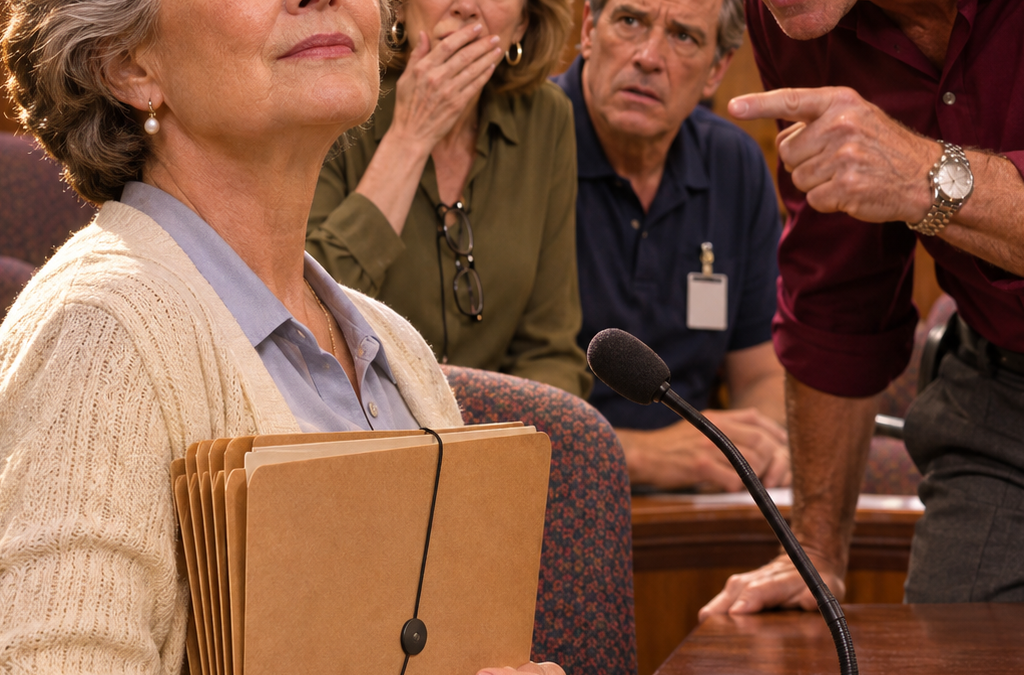
Nancy Brooks sat beside him, her reading glasses hanging against her blouse. She watched the county planner’s screen. Tom Reed sat behind them, still wearing his hospital identification badge.
Neither looked at me.
“This is a Durham County planning hearing,” the chair said. “Please keep your comments connected to the proposed pedestrian-access changes.”
“That’s precisely my concern,” Mark said. “We need a consistent approach.”
The plain expanding folder on my lap had come from my old school office. Its elastic had stretched loose. Inside was the complete January new-owner packet, behind the county notice and correspondence I’d brought tonight.
I had brought something from January, though I wasn’t sure anyone would look at it.
“The house is mine,” I said. “Fourteen Alder Lane. My granddaughter lives there with me.”
“We have your address, ma’am,” the chair said.
“I know. He keeps talking about it like it’s an empty lot.”
For him, this was a planning hearing; our granddaughter’s home was just an address on his map.
Mark lowered his voice.
“I’m discussing a structure, Ruth. Nobody is questioning your family.”
“You just suggested we leave.”
“I suggested an option.”
“I paid forty-eight hundred dollars for that ramp. Your board approved it before it went in. And my eighty-five-dollar dues are current.”
“The dues aren’t the issue.”
“They’re always part of the notices.”
“The architectural requirement is the issue,” he said. “We’ve followed the same process we would for any owner.”
Nancy’s glasses rested crookedly against one button. I kept looking at them instead of her face.
David and I had bought the house on January 5. He’d wanted the smaller bedroom for Ellie because its window faced the maple. She’d wanted the bigger one because, she said, her stuffed animals had space requirements.
She was nine. We let her win.
Her guardianship had been settled by a court order in 2024. She was ours to get to school, feed, and remind about socks.
From Alder Lane, she could walk to school with a friend instead of spending mornings in the car. David had studied that route before we bought the place.
He died on January 23. His illness hadn’t surprised us, but the empty bedroom still did.
The brass house key he’d first used rested in my cardigan pocket. I touched its worn edge once.
Mark had included a one-page acknowledgment in his handouts. There was a signature line beneath a sentence calling my ramp unauthorized.
“You can acknowledge receipt without agreeing to everything,” he said.
“This says I acknowledge the violation.”
“It gives us a place to begin discussing resolution.”
“Then it can say I received your papers.”
“We can discuss wording afterward.”
“I won’t sign that.”
Tom finally looked at me. He looked tired, rather than angry, which somehow hurt more.
Mark addressed the chair.
“The adopted board minutes are included. We’d prefer not to consume public time with an internal matter.”
“You brought it here,” I said.
The chair glanced at the clock. I could hear the ventilation above us.
Mark’s handout lay open to the January meeting. He had already told these people what it said.
I opened the January folder and slid the first page toward him.
My copy had DRAFT stamped across the top. Under January 8, beside the permanent ramp request for 14 Alder Lane, Nancy had typed APPROVED.
The handout distributed tonight said DEFERRED.
Both pages described the same meeting and the same address.
“This came in my original packet,” I said. “Nancy brought it to our house on January twelfth. Before the installer finished.”
Mark read without bending closer.
“That’s a draft, Ruth.”
“Yes. It says so.”
“Drafts sometimes contain errors. The board adopted the corrected minutes in February.”
I looked from APPROVED to DEFERRED. There were altered minutes between us, but one page carried a stamp he could point to.
“Nancy wrote this,” I said.
“I haven’t disputed who prepared the draft.”
“Then why did we get it?”
“New-owner materials were delivered before the correction. We explained that at your violation hearing.”
Nancy stared at the pages. Tom watched Mark.
Behind my draft were the installer information and the county staff’s January 6 response. Farther back lay Winter Access Attachment C, signed by Mark on January 9. There were addresses, snow instructions, a small “P” beside mine, and service-route number “2.”
The packet still smelled faintly of the drawer where I’d stored it.
“The county said the design presented no permitting obstacle,” I said.
The planner leaned toward the microphone.
“That correspondence addressed county requirements only.”
“I know. I’m showing what I received.”
Mark nodded.
“Those are separate matters. That’s been part of the confusion.”
I had been answering letters since February. Every answer seemed to leave me owing another answer.
Then the screen beside my folder flashed.
My phone lit up: ALDER GLEN HOA—FINAL BALANCE. I touched the notice.
The amount was $18,600.
Below it, the ledger listed $100 a day for 186 days, February 27 through August 31. The board had capped the disputed balance yesterday while pursuing collection and removal.
I read the total twice. My readily available savings were $11,400. That number stayed in my head, where nobody else could see it.
“Is there something else?” the chair asked.
“The association just sent me its final balance.”
“Ruth,” Mark said, “that notice isn’t a county matter.”
“No. But you called my ramp illegal here.”
The chair turned toward him.
“This hearing cannot determine whether an owner violated private covenants. We can address the public planning proposal. We cannot cancel association charges or decide which minutes are accurate.”
“Then please put that on the record,” I said.
“The hearing is recorded.”
“I’d like it clear that you haven’t decided against me.”
“We haven’t decided your private dispute at all.”
Mark nodded again.
“That distinction is helpful. Our presentation concerns consistent pedestrian access, not a request for county enforcement.”
Nancy leaned toward the microphone.
“The packet she received—”
Mark turned toward her.
He didn’t interrupt. He only looked.
Nancy’s next breath came through the microphone. Then she sat back.
I waited. She watched the edge of the table.
“Did you want to finish?” I asked.
The chair waited too.
“Nothing about the planning proposal,” Nancy said.
Behind me, someone unwrapped a cough drop. The small crackling sound went on far too long.
I left both versions of the minutes open. Mark’s signature sheet remained unsigned.
“We’ll move to the next public item,” the chair said.
My phone showed another email, this one from HOA counsel. The association had authorized a civil action to collect the balance.
They would also seek a court order requiring removal of my ramp.
Chapter 2 of 7
On Thursday, September 3, I read the lawyer’s email beside my untouched breakfast. The association wanted a money judgment and a mandatory injunction requiring me to remove the ramp.
It was a demand to sue, not permission to tear anything down. No judge had ordered me to do anything yet. Still, refusing Mark’s signature sheet hadn’t stopped the notices or the collection process.
Ellie had left a cereal spoon balanced across her bowl. David used to call that her bridge inspection. I ate standing up and left the spoon where it was.
When the county office opened, I called the number on my January correspondence.
“The letter says there was no permitting obstacle,” I told the planner. “Does that help me with these charges?”
“It addresses county requirements. We can’t cancel private association fines.”
“And Tuesday night? Nothing was decided about my ramp?”
“Nothing about your covenant dispute.”
“Has the county called it illegal?”
“No, ma’am.”
I wrote that last answer on my breakfast envelope. It was smaller than what I needed, but it was an answer.
Mark’s neighborhood update appeared before school started.
“Ruth is considering a transition,” it said. “Please respect the family’s privacy and avoid discussing these matters with Ellie. We’re working toward a resolution consistent with our community standards.”
By the time I walked Ellie to meet her school friend, the adults had done their discussing.
“Are you moving?” the friend asked. “My mom said you might.”
Ellie looked at me.
“No moving plans,” I said.
“But are we?”
“Come here a second.”
Her friend waited farther along the sidewalk. Ellie’s backpack had slipped low enough to bump her legs.
“Did you tell somebody we’re leaving?”
“No.”
“Then why did they say it?”
“An adult posted something he shouldn’t have.”
“Can you make him take it back?”
“I’m going to ask.”
She wanted another answer. I could see her waiting for it.
“You’ll sleep in your bed tonight,” I said. “I’ll be here after school.”
“Okay.”
She went to her friend without waving.
I didn’t answer the neighborhood post. I went to Nancy’s house with the January packet.
She opened the door halfway, then let me in.
“Is this the packet you brought us?” I asked.
“Yes.”
“The whole thing?”
“That looks like what I delivered.”
“You don’t have to guess.”
“I’m not guessing, Ruth. January twelfth. You were waiting for the installer.”
Her kitchen table held a grocery circular and an ordinary spiral notebook. She said it was the one she used at meetings.
“May I see?”
She opened it to January. There were dates, names, unfinished sentences. A grocery list occupied the bottom corner of another page.
“So you kept notes.”
“I always do. I can’t type minutes from memory.”
“Then tell me why approved became deferred.”
Her phone sounded on the counter. She looked toward it before answering.
“You should ask the board for its records.”
“I’m asking you.”
“I know.”
“Was that Mark?”
“Yes.”
“Do you have to answer him before you answer me?”
Nancy’s eyes stayed on the phone.
“I owe the association twenty-one hundred sixty dollars.”
I said nothing.
“I’ve been paying a hundred eighty a month. There’s an extension I need. The board hasn’t decided.”
“I didn’t come here to ask about your bills.”
“I know you didn’t.”
She closed the notebook.
“I prepared that draft,” she said. “I delivered your packet. I can tell you that.”
“And the change?”
“Please, Ruth.”
I left before she had to ask again.
From home, I called Mark.
“Ellie heard she was moving.”
“I specifically asked people not to involve her.”
“You told twenty households I’m considering leaving.”
“I said a transition. I was trying to spare your family embarrassment while we work this out.”
“There isn’t a move to announce. Correct it.”
“I can clarify that you haven’t made a decision.”
“That still says I’m deciding.”
“Ruth, people saw what happened Tuesday. They have questions.”
“Then tell them you don’t know my plans.”
He paused.
“I’ll revise the post.”
At lunchtime, I called Laura Bennett, a Durham civil attorney. Her office arranged a short phone consultation that afternoon.
She let me explain the hearing, then stopped me when I began reading the county letter.
“The county can’t settle this one,” she said.
“They told me.”
“Good. Tell me about the two versions of the minutes.”
I described APPROVED on my draft and DEFERRED on the adopted copy.
“His says adopted,” I said. “Mine says draft.”
“Adopted minutes are evidence. They aren’t beyond challenge.”
“So mine counts?”
“It can. I need to see everything.”
She asked for the declaration and bylaws too: the neighborhood’s restrictions and the rules for running the board.
“Can you ask them to cancel it?”
“I can advise you once I review the papers. But if they file a lawsuit, we have to answer that lawsuit. Calling planning again won’t do it.”
I gave her my email address twice because I transposed two letters the first time.
Ellie came home and did her spelling at the kitchen table. She asked whether “neighbor” had an extra vowel just to annoy people.
“Probably,” I said.
At 4:40 p.m., a process server knocked.
He asked for Ruth Miller. I told him that was me, and he handed me the complaint.
Ellie’s pencil stopped behind me.
“School papers?” she asked.
“No, honey.”
The first page named me personally. The association had filed the case on September 2 in Durham County Superior Court.
I read past the demand for $18,600 to the relief requested below it.
They wanted my ramp removed within thirty days after judgment.
Chapter 3 of 7
On Tuesday, September 8, Laura laid the served complaint beside my calendar.
“The thirty days for removing the ramp would start after a judgment,” she said. “Your time to answer runs from service. Different clocks.”
“So nobody can come onto the property?”
“This doesn’t authorize that. But we need to answer before your response deadline.”
She counted from September 3 and marked the calendar.
“I’ll have our answer filed well before then.”
“And ask them to leave the ramp?”
“Yes. We’ll bring counterclaims. Ask the court to decide your approval stands and stop enforcement against it.”
I had brought the county letter again. It stayed inside my purse.
Laura’s engagement letter listed a $2,400 retainer. Her rate was $300 an hour. The retainer would count toward the bill, but it wasn’t a price for finishing everything.
“How far does this get me?”
“Through the first work. I can’t promise a total yet.”
My bank balance had been $11,400 that morning. After the payment, it would be $9,000.
I signed.
Laura gave me the receipt and waited while I read it.
“I used to catch missing signatures for a living,” I said.
“You caught this one.”
It was a small kindness. I needed it more than I wanted to.
At home, I crossed the weekend trip off the kitchen calendar. Ellie and I had planned two nights away, with a hotel pool she’d already asked about twice.
She noticed before she took off her backpack.
“Why’d you cross that out?”
“We’re putting it off.”
“Till when?”
“I don’t have a new date.”
She looked at the calendar, then at the lawyer’s envelope.
“Because of the ramp?”
“I have bills to sort out. That’s my job.”
“I don’t need the pool.”
“Oh, I need the pool. You think I bought this bathing suit for nothing?”
That got half a laugh.
“We’ll do something here,” I said. “You don’t need to fix the budget.”
“Can we still get pizza?”
“Yes.”
“From the place with the square pieces?”
“Even from there.”
She went upstairs. I left the canceled dates visible instead of turning the calendar page.
Mark’s explanation arrived by email that afternoon. It began, “Dear Ruth,” and ended with an offer to discuss “a practical resolution.”
Between those lines, he said directors had a duty to collect assessed obligations uniformly. Making an exception for one household would transfer its burden to everyone else.
He copied the other directors.
I read it beside the receipt for my regular $85 dues. That payment had cleared. It had never been late.
I started an answer explaining that again, then stopped. Laura had asked me to forward correspondence rather than argue by email.
I sent it to her.
Later, she called about an offer from HOA counsel.
“They’ll accept installments,” she said. “There’s an agreement attached.”
“How much a month?”
“Read the acknowledgment first.”
I opened the document. The payment terms came after a statement that my ramp had never received permanent architectural approval.
For months, I’d wanted a number I could manage. Now there was a schedule, with spaces for dates and my signature.
“They still want it removed?” I asked.
“The agreement doesn’t give you approval to keep it.”
“So I could make payments and still have to take it out.”
“Yes.”
I read the acknowledgment again. There was my address, followed by their version of January.
I would not sign that admission.
“Tell them no,” I said.
“To the agreement?”
“To saying it wasn’t approved. Keep sending the ordinary dues. I’m not refusing those.”
“You’ll keep paying those yourself. This offer concerns the disputed balance.”
“Right. Sorry.”
“Ruth, refusing doesn’t make the case disappear. They can still seek the money and removal. We have to defend it.”
“And your bill keeps going.”
“Yes.”
The refrigerator started its uneven rattle. David had said it needed leveling. I’d kept forgetting until the kitchen was quiet.
“Go ahead,” I said. “Answer them. File what we need.”
That evening, Tom came by with a school envelope addressed to Ellie. It had been delivered to his house by mistake.
“Figured she might need it tomorrow,” he said.
“Thank you.”
He stayed on the porch.
“I saw Mark’s email.”
“I figured you would.”
“He asked counsel to find a payment arrangement.”
“I saw that too.”
Tom looked toward the ramp.
“I trusted the board record, Ruth. When he said Nancy’s draft had shorthand in it, that sounded reasonable.”
“She wrote approved.”
“I know what you’re saying.”
“No. You know what he said.”
He rubbed his lips together. From upstairs, Ellie called to ask where her clean shorts were.
“Dryer,” I called back.
Tom waited until her footsteps moved away.
“Couldn’t you settle this quietly? Before everybody spends more money?”
He sounded like he was asking me to turn down a television.
“The ramp was approved,” I said. “I won’t pay to call that untrue.”
He stayed another moment, then went home.
During the following days, Laura requested the association’s source records. I checked my email between laundry and school pickup, expecting another bill.
She called once to confirm when Nancy had delivered my packet.
“January twelfth,” I said.
“Was it already assembled?”
“Yes. Everything together.”
“Keep it that way.”
I left it in the expanding folder. My old office habits could manage that much.
Her message arrived while Ellie was finishing homework.
“Their January production is missing Attachment C. Bring every page you received.”
Chapter 4 of 7
On Tuesday, September 22, I brought Laura every page Nancy had delivered in January. Attachment C was still between the winter instructions and the installer information.
Laura went through the packet in order.
“Nancy Brooks brought this to your house?”
“January twelfth. The ramp wasn’t finished yet.”
“Did you add anything?”
“The county correspondence is in front. Everything behind that came from her.”
“And you’ve kept the delivered copies?”
“Yes.”
She scanned the pages, including the backs. I had spent years reminding teachers that the second side counted.
“Our answer and counterclaims were filed yesterday,” she said. “These go into the document exchange today.”
“So their lawyer gets all of it?”
“All of it.”
I watched the scanner light pass beneath the draft minutes.
“What exactly are we asking the judge to do?”
“Say the approval stands. Stop them from enforcing these fines.”
“And the money I’m spending here?”
“We’re requesting reasonable attorney fees if you prevail. The judge decides.”
“I’d like to stop paying people to read about my porch.”
“I’ll put that more formally.”
It was the first time I’d laughed in her office.
By that afternoon, HOA counsel had received the copies. Nancy called before dinner.
“Mark wants to know who else kept January materials.”
“What did you tell him?”
“That I don’t inventory people’s filing cabinets.”
“That sounds unlike you.”
“It sounded unlike me when I said it.”
She didn’t laugh.
“He asked whether you had the whole packet or just the draft. Then he asked who assembled it. Who saw it before delivery.”
“You did.”
“Yes.”
“Did he say something was missing?”
“No. He wanted dates. Exact dates.”
I could hear a television behind her, loud enough to fill the pauses.
“Has he called you?” she asked.
“No.”
“He said questions should go through counsel now.”
“That’s what Laura told me too.”
“Well. There’s one thing they agree on.”
After we hung up, I opened my old email to check January 12. There was Nancy’s delivery message, between an appliance warranty and a school lunch notice. I forwarded it to Laura.
I didn’t write an explanation. She had asked for records.
Nancy came over the next evening. Ellie was at the kitchen table, drawing a horse with six legs.
“Those are motion lines,” Ellie told her.
“I wasn’t going to ask,” Nancy said.
“You looked like you were.”
Nancy managed a laugh. Ellie carried her drawing upstairs to make the horse less fast.
Once she was gone, Nancy showed me Mark’s message.
“Please stay with the adopted record as you review counsel’s questions. Consistency will help avoid further confusion.”
The next paragraph mentioned her repayment extension. The board would consider it soon, and he needed updated information about her circumstances.
“Same message?” I asked.
“Yes.”
“Did he say he’d turn it down?”
“No.”
She sounded almost protective of him. Then she read it again.
“He can recommend against it,” she said. “Tom usually listens.”
“Can he change what you owe by himself?”
“No. I still have my agreement. A hundred eighty a month.”
“But you need more time.”
“Yes.”
She sat opposite me. I had known Nancy as someone who carried spare reading glasses. Now she needed permission to pay a bill more slowly.
“I could ask Laura whether—”
I stopped. Nancy waited.
“Whether what?”
“I was about to offer to fix something I can’t fix.”
“I’m not asking you for money.”
“I know.”
“I just wanted you to know why this is hard.”
Upstairs, Ellie dropped something that rolled across the floor. Nancy looked toward the ceiling.
“Is she all right?”
“She’s nine. Things fall.”
“I meant with all this.”
“She has questions. I answer what I can.”
I could have told her about the canceled trip. Or the school friend asking whether we were moving. The words were ready.
Instead, I said, “Your account is between you and the board. I can’t make a deal about it.”
“I haven’t asked you to.”
“No. You haven’t.”
She stayed awhile, talking about nothing either of us needed answered. She made no promise about court.
Over the next several weeks, Laura sent short updates. The association’s files had matching copies of the January materials. Nancy’s notebook was included with the other records. Laura sent our documents onward and asked me to preserve the originals.
The balance remained capped at $18,600. Counsel agreed there would be no additional fines while we waited for a decision.
“Does that stop the case?” I asked.
“No. It stops the number growing.”
I wrote that beside the balance.
The scheduling call came while I was sorting Ellie’s outgrown clothes.
“Tuesday, November 10, 9:00 a.m.,” Laura said. “Durham County Superior Court.”
I wrote it on the kitchen calendar.
“That soon?”
“We both agreed to ask for an expedited trial. The court has a date.”
“Who’ll be there?”
“You and me. Mark and HOA counsel. Nancy and Tom are expected to testify. Judge Susan Grant will hear it without a jury.”
“Do I talk?”
“We’ll prepare you. Answer what you’re asked.”
“I used to tell children that.”
“It works for adults occasionally.”
After the call, I stood by the calendar. November had looked empty before I wrote on it.
My phone sounded again. Nancy had forwarded a new email from Mark.
“Is this something I’m supposed to sign?” she had written above it.
The attachment was a proposed witness statement. Below the signature line, the email requested its return by 5:00 p.m.
I read the sentence prepared in Nancy’s voice.
“I remember the January approval as temporary.”
Chapter 5 of 7
Nancy called Monday, November 9, while Ellie was hunting for her other sneaker.
“I sent that statement back unsigned,” she said.
“The one he wanted by five?”
“Yes. That wasn’t my recollection. I told him I couldn’t sign it.”
“What did he say?”
“He thanked me for reviewing it.”
I waited.
“I’m coming tomorrow, Ruth. I’ll answer truthfully.”
From the hallway, Ellie announced that somebody had put her sneaker under a boot.
“That somebody might have been you,” I called.
Nancy stayed on the line until Ellie stopped arguing.
“Does Laura know?” I asked.
“Yes. She’s already told their lawyer what I’ll be asked about.”
“The notebook too?”
“The documents, all of it.”
Nothing would arrive tomorrow tucked inside somebody’s coat. Both lawyers had the January papers and knew who had handled them.
“I’ll see you there,” Nancy said.
She didn’t tell me not to worry.
That morning, Ellie’s class presented short reports about North Carolina animals. She had chosen the opossum and objected to every picture that made it look mean.
Her poster leaned sideways on the easel. She read each fact with her chin raised.
“They eat ticks,” she finished. “So you should probably leave them alone.”
The teacher thanked her. Ellie added, “Even if you don’t like their face.”
That earned the largest laugh of the morning.
Afterward, a parent beside the classroom door asked whether we had found another place.
“Another place?” I said.
“For the move. I thought—oh, maybe I’m mixing people up.”
Ellie stood close enough that her sleeve brushed mine.
“We haven’t planned a move,” I said. “We live on Alder Lane.”
“I’m sorry. Somebody mentioned it.”
“I know. It’s been going around.”
The parent asked Ellie about her poster. Ellie explained the difference between playing dead and taking a nap, apparently an important distinction.
Before I left, she asked, “Can I put this on my bedroom door?”
“Provided I can still find the door.”
“The whole poster, Grandma.”
“Then yes.”
She went back inside carrying it against her chest.
At Laura’s office that afternoon, I practiced finding pages without pulling apart the entire file.
“January draft,” she said.
I found it.
“Adopted minutes.”
I found those too, then the county correspondence, the invoice, and the remaining January materials. My copies matched the numbered exhibits she would use.
“You don’t have to memorize the numbers,” Laura said.
“I’d rather know where things are.”
“Fine. Just don’t answer before the question ends.”
“What if he says something wrong?”
“Your lawyer can object. You answer the question you’re asked.”
“I keep wanting to explain why we bought the house.”
“You can explain when that’s the question.”
“I’m sorry. I just need—”
“Ruth. You don’t have to apologize for needing your house.”
I looked down at the invoice until the print settled.
Laura asked where I would park and reminded me to allow time for security. She would meet me outside the courtroom before nine.
“Eat breakfast,” she said.
“That’s your trial advice?”
“It’s part of it.”
Mark’s statement reached my email before I left her office. It carried the names of thirteen owners.
They said they had relied on the ramp being temporary. They supported a board that maintained stable expectations and consistent neighborhood standards.
Tom Reed had signed.
I read his name twice.
For years, people had called Mark when insurance language confused them or a contractor failed to return a call. He answered promptly. He remembered which owners worked nights. Now thirteen signatures sat beneath his account of our ramp.
Laura read the statement.
“Do I answer it?” I asked.
“No. We have a copy.”
“Tom knew what my draft said.”
“He can still be asked what he remembers.”
I drove home with the statement unread on my phone the rest of the way.
Tuesday morning, I reached the courthouse early. The waiting area smelled of damp coats and floor cleaner.
Nancy sat beside Tom while the lawyers discussed where everyone should wait. He asked whether she had parked in the deck. She said yes. They sounded like neighbors waiting for a restaurant table.
Then Nancy asked, “The conference room at noon. Can all the owners get in?”
HOA counsel looked over.
“It’s reserved for the board meeting. Owners may attend.”
“And it’s on an accessible floor?”
“Yes.”
Nancy and Tom had issued the officer-selection notice on October 26. It named this courthouse, the reserved conference room, and noon. I had kept that notice with the others.
Mark stood near the wall.
“It will proceed as noticed,” he said. “All three directors participate. I have my vote like anyone else.”
Nobody argued.
Several owners had gathered nearby. Mark turned toward them, speaking quietly enough that people leaned closer.
“The family received a temporary courtesy during a difficult period,” he said. “The draft didn’t accurately capture that limitation. When we adopted the minutes, we corrected it.”
An owner asked whether the first paper had said approved.
“It did,” Mark said. “That’s why the correction was necessary. I appreciate that Ruth relied on what she received. But other owners relied on the understanding that this wasn’t permanent.”
Tom watched him. Nancy looked toward the courtroom doors.
Laura came to stand beside me.
HOA counsel handed her the final witness order. She read it, then let me see.
Beneath Mark Collins was Nancy Brooks, listed to corroborate the adopted record.
Nancy’s name was printed there without her signature.
Chapter 6 of 7
At 9:00 a.m. on Tuesday, November 10, I placed the original beside his at the exhibit table. Mark was under oath, explaining the two pages to Judge Susan Grant.
“Nancy prepared the draft,” he said. “She also attended when we adopted the corrected record. The draft omitted the temporary condition.”
“You’re not disputing that Mrs. Miller received it?” Judge Grant asked.
“No. But delivery doesn’t turn an inaccurate draft into a final decision.”
Laura stayed seated. The judge looked at both versions for several seconds.
When it was my turn, Laura asked what I had received on January 12. I identified the packet, the draft, and the signed winter attachment.
“Did you rely on those materials before installation?”
“Yes. We wouldn’t have spent forty-eight hundred dollars without approval.”
HOA counsel asked whether I had attended the February adoption meeting.
“No.”
“So you can’t tell us what was said there.”
“No. I can tell you what they gave us before we built it.”
On Laura’s follow-up, I looked toward the attachment.
“May I explain the question I have about that page?”
“Go ahead,” Judge Grant said.
“If it was temporary, why did his January ninth attachment put our ramp with the permanently approved installations? Why is there a P beside our address?”
HOA counsel rose.
“Mrs. Miller didn’t prepare that document.”
“We’ll hear from the people who did,” the judge said.
Mark returned to the stand.
“The P denotes plowing priority,” he said. “Winter service planning isn’t architectural approval. We needed safe access while Mr. Miller was using the ramp.”
“And the draft?” Judge Grant asked.
“Still a draft. Our adopted minutes preserve the actual condition. I appreciate that Mrs. Miller remembers it differently.”
He sounded patient. Several owners behind him nodded.
Judge Grant looked at the attachment again.
“Who established these notations?”
“Nancy maintained the sheet under board direction.”
HOA counsel called Nancy Brooks.
She confirmed that she had prepared the draft and attended the February meeting.
“Did you vote to adopt the corrected minutes?” counsel asked.
“Yes.”
“Because the draft needed correction?”
“Because Mark said I’d missed a condition. I trusted him then.”
“Your notes weren’t a verbatim transcript.”
“No.”
Laura stood.
“What did P mean on Attachment C?”
“Permanent approval.”
“Who told you to enter it?”
“Mark. After the county clearance, after our January eighth meeting.”
“Did the county give the association’s approval?”
“No. We did. The three directors.”
She sounded like the bookkeeper I knew, checking an entry twice.
“Is that Mr. Collins’s signature?”
“Yes. I watched him sign. The board’s copy matches the one I delivered.”
“What does the two beside fourteen Alder Lane mean?”
“The service route. Plowing used numbers. P wasn’t a plowing instruction.”
Judge Grant asked to hear from Mark again.
“If P means plowing priority, why does the sheet also contain a numbered service route?”
“The categories could overlap,” he said. “A route tells the contractor where to go. Priority tells him which properties need attention first.”
“Did you instruct Ms. Brooks to use P for permanent approval?”
“I don’t recall using those words.”
Judge Grant looked down at the exhibits.
“Your explanation doesn’t account for her direct recollection of your instructions. The separate route numbers support her account. Your signed classification also predates the February correction.”
Mark waited, facing her.
“I find this ramp received permanent approval. The $18,600 assessment is void and unenforceable. The association’s request for an injunction requiring removal is denied.”
Behind me, someone exhaled through their nose.
Judge Grant turned to the fee affidavit.
“Twenty-four hours at three hundred dollars. Counsel, any further objection?”
HOA counsel said the objection rested on whether I should prevail.
“The documented $7,200 is reasonable. Fees are awarded to Mrs. Miller against the association. Written judgment will follow.”
I had come prepared to explain more. Laura whispered, “You can stop now.”
After adjournment, Mark had the thirteen-owner statement with him. He approached Tom near the courtroom door.
“Before noon, I hope you’ll reconsider. People signed because they want continuity.”
Tom looked at the names.
“I signed because I believed your account.”
“The court weighed it differently.”
“Yes,” Tom said. “It did.”
Nancy crossed to the vacant chair beside me.
“I let you sit there alone in September.”
I held David’s brass key inside my pocket. Its teeth pressed against my palm.
“You did,” I said.
She stayed beside me.
Mark approached us.
“Ruth, perhaps we could speak privately. Find wording everyone can live with.”
“My family doesn’t need your permission to stay.”
“I’m talking about moving forward.”
“Then use the court’s wording. I’m not making a private compromise.”
Nancy walked beside me directly into the reserved conference room. At noon, Tom opened the separately noticed board meeting. The owners from court filled the chairs along the wall.
“Officer selection,” Tom said.
Nancy’s voice caught once.
“I move to replace Mark as president and select Tom.”
“I vote no,” Mark said. “This decision will cost the association continuity.”
“Nancy?” Tom asked.
“Yes.”
Tom looked at Mark.
“I vote yes. Two to one. The motion carries. Mark Collins is removed as president.”
Mark pushed the agenda away. For a moment, the president’s meeting binder remained in front of him.
Then he surrendered it to Tom.
Laura met me by the conference-room door with the clerk’s filing notice. Written judgment was scheduled for November 17. I checked the payment line myself.
The HOA’s $7,200 was due December 1.
Chapter 7 of 7
On Tuesday, December 1, Laura emailed to say the HOA’s $7,200 payment had arrived. Her receipt confirmed that the fee obligation was satisfied by the judgment deadline.
Attached was an accounting, with my $2,400 retainer credited toward the total. The payment covered the legal expense. There was no extra money for the months spent opening envelopes at the sink.
“Anything else I need to pay?” I asked when she called.
“No outstanding balance on my bill.”
“And theirs?”
“Check the updated owner statement I sent.”
The disputed fine balance was zero. My ordinary dues remained current.
I printed that page.
Judge Grant’s written judgment had been entered November 17. The association’s enforcement file now showed the removal demand withdrawn. Laura told me to keep those documents with the judgment.
“I can do that,” I said.
“I suspected you could.”
The payment had come from the HOA operating account. Every lot, including mine, helped fund that account. At the next budget discussion, there would be less money available because the association had pursued this case.
Still, I put Laura’s receipt in the folder without apologizing for it.
We had kept the house. I could leave that sentence alone now, without following it with everything that might still happen.
Ellie found the printed account statement beside the toaster.
“Is that another ramp paper?”
“The last bill says we don’t owe the fine.”
“Can you put it somewhere else?”
“Where?”
“Anywhere that isn’t breakfast.”
I filed it before making her toast.
The membership meeting took place Tuesday, December 15. The notice had arrived properly, with the recall and replacement election listed. I read it once and put the date on the calendar.
Eighteen of Alder Glen’s twenty owners cast ballots.
I sat near the back. Mark wore the same navy jacket he had worn in court. He greeted people by name and asked one owner about a roof repair.
When the ballots were counted, Tom read the result.
“Fifteen to three. The recall passes.”
Mark remained seated while Tom announced that his remaining director seat was vacant. Then the members elected a replacement.
I gave no speech. Nobody asked me to.
One owner caught my eye across the chairs and nodded. Another studied the meeting notice. People who had signed Mark’s statement still had to live down the street from me.
After adjournment, Nancy waited by the door.
“May I walk with you?”
“Yes.”
Outside, we went slowly toward the parking lot. She didn’t begin with another apology. She asked whether Ellie had finished her opossum report.
“It’s on her bedroom door,” I said. “You can hardly find the knob.”
“She was very firm about those animals.”
“She’s firm about most things.”
Nancy laughed, then stopped when we reached my car.
“I won’t ask you to say we’re all right.”
“We aren’t there.”
“I know.”
“I can walk with you, though.”
She stood beside me another moment before heading to her own car.
Later that week, the reconstituted board approved her repayment extension. Nancy told me they had requested updated income information and applied the same criteria used for other owners.
“I’m still paying the hundred eighty a month,” she said. “They’ve given me more time.”
“That should help.”
“It will.”
I hadn’t written in support or called Tom. Her account had gone through the board without either of us having to promise anything in return.
She began waving when we passed each other. Some days I waved first.
Mark’s message arrived a few days before Christmas. It was brief.
He wanted my support for a neighborhood statement calling the dispute a mutual misunderstanding. He said that would help everyone move forward.
I wrote three sentences.
“I won’t support that statement. The judgment and meeting records can stand as written. Please send all future HOA business through the management address.”
I read my reply once before sending it. There was no greeting I needed to soften, no explanation of what I had meant.
He didn’t write again.
On Saturday, December 26, Ellie went to her school friend’s house to finish assembling a cart for a school project. They had been given permission to work together over the break.
She had spent the morning making cardboard labels. Our house rule was that scissors stayed at the table, which she considered an unnecessary restriction on progress.
Before she left, I found one label stuck to my slipper.
“Is this part of the project?”
“No. That one’s bad.”
“Then why does my foot say ‘front’?”
“So you know which way to go.”
By midafternoon, I had stopped finding scraps under the table. I was putting away the broom when I heard wheels on the sidewalk.
Ellie came around the bend pulling a little cart, its cardboard sides crowded with labels. One wheel squeaked every turn.
“Grandma! Come see!”
For months, I had answered that voice with a finger to my lips. Or I had hurried her inside before a neighbor could ask another question.
That afternoon, I called back.
“I’m coming.”
From the doorway, I watched her guide the cart toward the ramp. She leaned forward as the wheels reached the slope.
“Need help?”
“No. Don’t pull it sideways. The tape’s still thinking about sticking.”
“Take your time.”
She stopped halfway up to check a cardboard corner. Across the street, someone was carrying bags from a car. I stayed where I was.
Ellie reached the landing and looked through the glass.
“Where can I put it?”
I stepped outside and pulled the door closed behind me. The latch caught.
“By the front window,” I said.
“It’s kind of big.”
“We’ll move the plant.”
“Can I leave it there until school?”
“Yes.”
She crouched to lift a trailing label away from the wheel. Inside, the afternoon light reached the spot I had chosen.
I turned my brass key and let Ellie in.







