My brother threatened my granddaughter’s ramp over $8,000 at our town diner; he had no idea what I had already sent.
Chapter 1 of 7
“Pay the $8,000, sis, or stop bringing her here.”
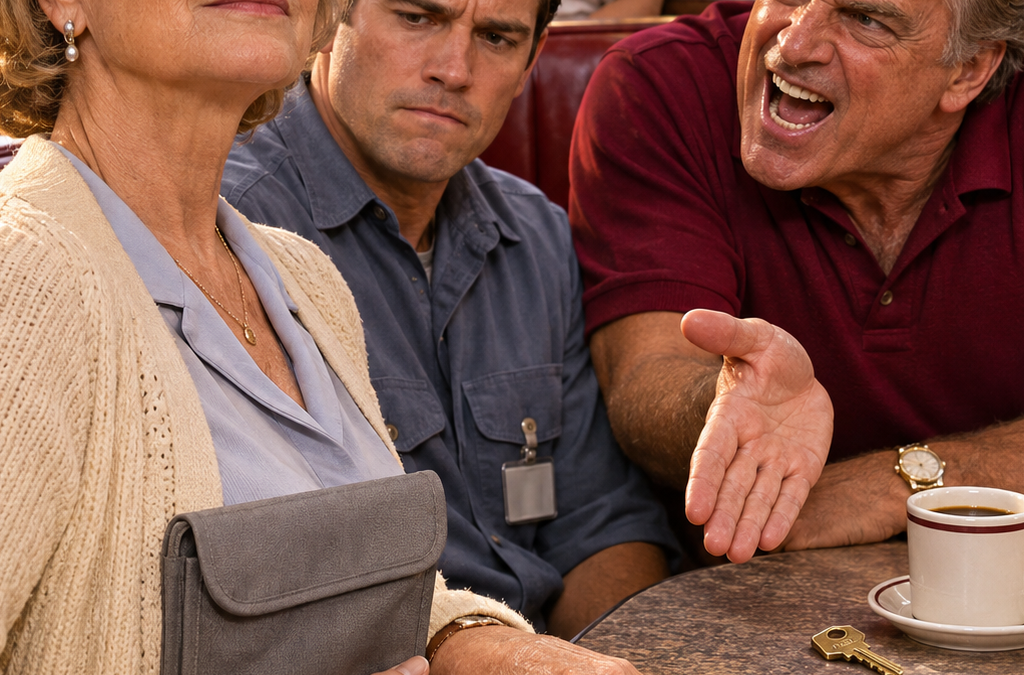
The clock above the grill read 12:20 p.m. Ben sat beside me with his work badge still clipped to his shirt. He looked at his lunch instead of his uncle.
Mark’s brass spare key to my house rested beside his cup. Across the aisle, the association’s treasurer and secretary had stopped eating.
“You wanted lunch,” I said.
“I wanted us to settle this somewhere comfortable.”
“With an audience?”
“They have to approve the arrangements, Diane. I can’t do everything myself.”
My thin gray document wallet lay against my purse. I had brought it because Mark had said we could clear things up.
He spoke toward Ben now.
“Your mother gets upset when I explain it. Maybe you can help.”
Ben’s jaw moved once. No words came out.
I reached for my checkbook automatically, then closed it before finding a blank check. I had paid for peace until everyone expected the payment.
Mark saw it.
“You don’t have to cover it all today. We can work out dates.”
“I wasn’t asking for installments.”
“The contractor needs an answer. Removal, then the path repair. One job instead of dragging this through summer.”
“The ramp stays.”
The treasurer leaned toward our table. “The common path serves everybody.”
“So does the drainage,” I said. “It was flooding before my ramp.”
“That’s what the work would address,” Mark said. “We’re trying to deal with both things together.”
He sounded patient now. That was worse than the first sentence. Ben had missed years of those conversations; I had heard them since we were children.
“Being family did not make my front door yours.”
Mark glanced toward the neighboring booth.
“Nobody’s taking your house, honey.”
“Then stop deciding who can come through its door.”
“Ben, tell her what you told me. About worrying.”
My son’s face reddened above his collar.
“I worry about a lot of things.”
“Exactly. And Lily shouldn’t be caught in the middle while the adults sort out a safety concern.”
“Then leave her out of your demand,” I said.
“I’m suggesting temporary removal. Nobody said forever.”
“You said stop bringing her.”
“Until it’s safe. Come on, Diane.”
A waitress approached with the coffee pot, saw our faces, and kept walking. My sandwich had a toothpick through it with a red cellophane fringe. I couldn’t imagine swallowing a bite.
Mark continued before Ben could speak.
“You could go to their place on Fridays. Or meet somewhere accessible.”
“Her dominoes are at my house.”
“We can buy another set.”
“She likes mine.”
Lily called the double-six tile the refrigerator because it looked crowded inside. Last Friday she had accused it of cheating. I could still hear her laugh.
Mark spoke more softly.
“You’re making a visit depend on one particular entrance.”
“It’s my home. The finished ramp was approved.”
“There are still concerns about the path.”
“Then fix the path.”
The secretary joined in. “We’d hoped to avoid making this a neighborhood dispute.”
“You came to my lunch.”
“Mark asked us to be available.”
Ben finally looked up.
“Could we just eat first?”
Mark gave him a small, sympathetic nod.
“I’d like that. But your mom needs to say whether she’ll cooperate.”
“Cooperate with what?” I asked. “Paying to tear out what you approved?”
“With getting the work scheduled. Before we have to send this back to the board.”
The diner owner had been standing near the register. Now he approached our table.
“Everything all right here?”
“Family business,” Mark said pleasantly. “Sorry we got a little loud.”
“He brought this to lunch,” I said.
The folded demand was already beside my plate. The owner asked if he could see it.
Mark answered before I did.
“It’s a safety matter. There’s an estimate attached.”
I told the owner he could read it. Mark began explaining the common path again, but the man wasn’t listening.
Frank stopped with the folded page in his hand.
“Did the city really tell you to do this?”
The police heading showed above his thumb.
Mark sat straighter. “I reported a possible obstruction. We can’t ignore those.”
Frank Doyle owned Mill Street Diner in Newark, Ohio. He knew my brother as both a customer and a police lieutenant.
“That’s different from the city telling her to pay,” Frank said.
“The payment goes to Brookside Commons,” Mark replied. “It says that right there.”
“Yes,” I said. “It’s an association request wearing a police heading. It isn’t a city order.”
The secretary looked down at his plate. Susan Price, the treasurer, said the estimate was legitimate.
“I didn’t say the contractor wasn’t real,” I told her.
By then, the Ohio Civil Rights Commission already had my state complaint packet. I had sent it Wednesday with the approval and Mark’s demand, and authorized referral of the police material.
Mark didn’t know. The electronic acknowledgment was in my wallet, and I hadn’t come to announce it.
I was sixty-eight, retired from rehabilitation nursing. I still kept dated photographs and instructions the way I’d kept discharge records. That habit had left me with copies when I needed them.
Frank remained beside us.
“Do you need anything, Diane?”
“No. Thank you.”
Mark waited until he stepped away.
“I wish you hadn’t dragged Frank into it.”
“You brought the paper.”
“I brought a way to settle this.”
Beside me, Ben’s phone vibrated against the booth seat. His expression changed as he read.
“What?” Mark asked.
Ben pushed back his chair and stared at his phone.
“You told them I’d agreed to move her visits?”
Susan frowned. “We understood there was a family arrangement.”
“There isn’t.”
Mark’s voice stayed low.
“You said you wanted to keep things manageable.”
“I didn’t say that.”
“You called me because you were worried about your mother.”
I turned toward Ben. “What did you tell him?”
“Mom—”
“What did you tell him?”
“That you weren’t sleeping. That you kept checking the mail.”
Mark tried to interrupt, but Ben kept talking.
“I thought he could back off a little.”
“And?” I asked.
Ben stared at the message.
“I said you might give in.”
My son was forty years old. There was gray in his beard I hadn’t noticed before.
“You told him I might pay?”
“I thought if he knew how scared you were—”
“He’d stop?”
Ben didn’t answer.
Carter was my late husband’s surname; Hayes was the name Mark and I had grown up with. My son had trusted the uncle who still walked into my kitchen without knocking.
Susan said, “Then we need to correct the wording.”
“Yes,” I said. “You do.”
Mark looked at Ben.
“We can clear up a misunderstanding without making accusations.”
I pulled the approval copy, the ordinary June 4 delivery receipt, and the finished-ramp photographs back into my wallet. Ben had taken the pictures after completing the final adjustment.
Alan Webb, the secretary, spoke across the aisle.
“The board still has to deal with the property issue.”
“Then send me what the board actually decides,” I said. “Don’t put words in my family’s mouths.”
Ben’s phone vibrated again.
He read the new message aloud, stumbling over the last part.
“Please collect Lily’s belongings from Diane’s porch by 6:00 p.m. today, per the family’s agreement to relocate visits.”
Nobody at that table had asked Lily’s mother. Nobody had asked me.
“Her things aren’t on the porch,” I said.
Mark started, “Diane, that’s only—”
“Her dominoes stay in my kitchen.”
Chapter 2 of 7
“I didn’t collect anything, Mom. I never went near your porch.”
It was Monday, June 15. Ben had called before leaving for his appliance-service dispatch job. I had been awake long enough to burn toast.
“Did you tell him to send that message?”
“No. I told him you were scared. That you might pay.”
“You said that at lunch.”
“There were other calls.”
I waited. The toaster clicked behind me, empty now.
“He asked how you were doing. I said you weren’t sleeping. That you worried people would think you’d caused trouble.”
“You let me tell you those things, then called him?”
“I thought he’d listen if it came from me.”
“He listened fine.”
“Mom, I was trying to keep you from getting dragged through something.”
My plate had two black slices and an untouched square of butter.
“My private worries aren’t yours to pass along anymore.”
“Okay.”
“I need more than okay.”
“I won’t call him about you.”
In the background, Lily asked who was on the phone. Then she was there, breathing close to the receiver.
“Grandma, are we doing Friday dominoes?”
“I want to.”
“Can we do it at your house?”
“The ramp’s still here, sweetheart. I’m working on keeping it that way.”
“Dad said there might be people.”
Ben came back on. “I don’t want her there if somebody shows up.”
“Who?”
“I don’t know. That’s the problem.”
“So you’re canceling?”
“This Friday. Just this one.”
I could hear Lily asking him what I had said.
“Tell her I love her,” I said.
“You can tell her.”
“I’d rather you explain your part first.”
By noon, I was outside a legal-aid referral office in Newark, Ohio. Rachel Brooks met me there, an attorney whose name the office had given me. We sat on a bench beside a planter full of cigarette ends.
She read the approval once.
“This covers the completed ramp shown in these pictures,” she said. “But having permission, and owning your house, won’t stop them from filing an enforcement claim.”
“So I could be right and still have to answer it.”
“Yes.”
She didn’t soften that. I liked her a little for it.
The contractor estimate rested between us. Under removal, it listed $2,500. Common-path restoration was $5,500.
“Eight thousand total,” Rachel said. “Payable to the HOA?”
“That’s what he wants. Not the police.”
“Have you paid any of it?”
“No.”
“Good. Don’t agree to anything before I’ve read the rest.”
I looked again at the path description. It ran behind the row of mailboxes, where rainwater sat long after the street dried.
“I complained about that before the ramp went in.”
“Do you have the complaint?”
“An email. There was water over my shoes getting the mail.”
“Send me that too.”
That restoration line had looked like another contractor charge at lunch. Here, away from Mark’s voice, I could picture the stretch of broken path it described.
“He’s charging me for the puddle.”
“We need to separate what they’re claiming from what happened.”
“I know where it is.”
“I believe you. I still need the email.”
I went home with her number and a short list. There was no promise that somebody would fix this by Friday.
At 4:40 p.m., Mark’s message appeared in the neighborhood group.
“Diane’s family supports a temporary access change while the safety concerns are resolved. Please don’t pressure her with questions or conflicting advice. We all want her comfortable at home.”
Below it, Susan thanked him for keeping everyone informed.
A woman from two houses down called within minutes.
“Diane, honey, nobody’s mad at you.”
“Why would they be?”
“Well, these things get confusing. Maybe let Ben handle the arrangements.”
“There aren’t any arrangements.”
“Oh. Mark seemed to think—”
“I read what Mark thinks.”
She got off the phone quickly.
Later, a neighbor stopped at the end of my driveway. He stayed on the sidewalk while I stood near the ramp.
“Sometimes it’s easier to let them do the work,” he said.
“This is the work. It’s already done.”
“Well. You’ve always known your own mind.”
He said it like a complaint.
I went inside and wrote three paragraphs to the group. I listed the approval, the old drainage problem, the lunch, and what Ben had actually said. Then I called Rachel.
“Do I send all this?”
“What do you need corrected right now?”
“That my family agreed.”
“Then correct that.”
I deleted most of it.
“My family has not agreed to move Lily’s visits. I have not agreed to remove the ramp. Please contact me directly about my home.”
Rachel told me to save Mark’s message with its time and the replies.
“Will the state complaint stop this?” I asked.
“I can’t promise that.”
“And the police paper?”
“That has to be reviewed separately. I can help with your housing problem. I can’t promise what happens to his job.”
After supper, Ben forwarded another email.
“Thought you should see this,” he wrote.
It was the agenda for the next HOA board meeting. Beneath the meeting information, my lot was listed for discussion and authorization of an enforcement demand.
The proposed charge made me read the line twice.
My lot. Sole responsibility. $5,500 for common-path restoration.
Chapter 3 of 7
“Five thousand five hundred dollars for common-path restoration,” I read. “Behind the mailboxes. That’s where I reported the standing water.”
Susan sat across from me at the HOA office. It was Thursday, June 18. Through the window, I could see the path’s low spot, dark from yesterday’s rain.
“This is a proposed allocation,” she said. “It isn’t a judgment against you.”
“Then why does the agenda make it all mine?”
She showed me the contractor’s estimate. I had seen those numbers enough times to know them without looking.
“The alternative is two hundred fifty dollars from each of thirty-two homes.”
“Including yours.”
“Yes, Diane. Including mine.”
“And Mark’s.”
“Everyone’s.”
A little refrigerator hummed under the office counter. Someone had taped a note above it: Please stop putting empty doughnut boxes back.
“Why not discuss that?” I asked.
“We did.”
“With the neighbors?”
“With the board.”
Mark came through the open doorway carrying an envelope.
“We’re trying to avoid another assessment,” he said. “People budget around what we tell them.”
“You told them there wouldn’t be one.”
“I said we expected to cover our expenses.”
Susan looked at him. “You said no additional charges this year.”
Mark paused beside her chair.
“That was the expectation. If we reverse ourselves now, people will question every number we give them.”
“So you’d rather send the whole bill to me.”
“The ramp and the path need to be addressed together.”
“The water was there first.”
“We’re not going to settle that by repeating ourselves.”
He gave me the envelope.
“This sets out what the board is prepared to offer.”
The letter gave me until June 25 at 5:00 p.m. to accept removal and restoration at my expense. Otherwise, the association could file a lawsuit to enforce its rules.
There was an agreement attached. Halfway down, it called my ramp unauthorized.
“You want me to sign that?”
“It allows the work to proceed without a lawsuit.”
“You approved it.”
“Diane, there are concerns about what’s there now.”
“The same ramp.”
“We disagree. That’s why we’ve put a proposal in writing.”
Susan watched me read the rest. There was no city heading this time, but the threat still reached my house.
“Rachel needs to see this,” I said.
“Of course,” Mark said. “Have her contact us before the deadline.”
“I’m not signing something that calls it unauthorized.”
“You don’t have to sign today.”
“I’m not asking for another day.”
His voice stayed level. “Then we may need a court to resolve it.”
I kept the letter. Leaving it behind wouldn’t keep them from filing anything.
Outside, I stood beside my car until my knees felt steady. I had owned that house outright for years. Now I was calculating how much it might cost to defend a ramp I had already paid for.
Ben met me later in a rehabilitation-clinic waiting area in Newark. Lily was finishing her appointment. Her jacket lay across his lap, one sleeve turned inside out.
“How’d it go?” he asked.
“They gave me a deadline.”
“Uncle Mark said there’d be a letter.”
“When?”
“This morning. He called.”
“About me?”
“He asked if I could help keep things from getting worse.”
A television above us showed a cooking segment with the sound off. Someone was trying to rescue a collapsed cake.
Ben looked toward the hallway.
“Could you wait on the complaint?”
“It’s already sent.”
“I mean, ask them to hold it. Until Rachel talks to him.”
“Why?”
“Because he’ll make every call about this. Every visit. If I ask him anything, he’ll think I’m collecting something for you.”
“Then don’t ask him anything.”
“It isn’t that simple.”
“It wasn’t simple when you told him I might pay.”
“I know. I’m trying to fix that.”
“By asking me to stop?”
He rubbed his heel against a loose edge of carpet.
“I don’t want Lily hearing people argue about where she goes.”
“Neither do I. But I’m not dropping this so he’ll be pleasant.”
“I didn’t say drop it.”
“You asked me to put it aside while he keeps going.”
Ben looked down at the jacket. “Can we talk later?”
“Yes.”
He didn’t ask whether I needed anything. When Lily came out, he said they had to get going. She waved and asked if I had saved her place at the kitchen table.
“Always,” I said.
After they left, I checked my email before driving home.
The state intake acknowledgment had arrived. My housing complaint remained with the Ohio Civil Rights Commission. The police material I had authorized them to refer had reached Newark’s public-safety administration.
I read that part again. It named another office, beyond the board and my brother’s calls.
At 3:18 p.m., my phone rang in the clinic parking lot.
“Mrs. Carter? Laura Bennett, city personnel. Is this a good time?”
I shut off the car radio.
“Yes.”
“We received the material you authorized the state to forward. I’d like to interview you Monday, June twenty-second. Nine-thirty?”
“I can be there.”
“Bring your retained copies, please.”
“Has anyone looked at the police part?”
“That’s what we’re reviewing.”
“His letter made it sound like somebody had already found a problem.”
“I have a June eighth dispatch entry,” she said.
“So someone went out?”
“There’s no responding officer listed.”
Chapter 4 of 7
At 9:30 a.m. on Monday, June 22, Laura Bennett asked me to identify the letter.
We sat in a city office in Newark, Ohio. The copier outside her door made a grinding noise after every third page.
“That’s the one I received,” I said. “With the contractor estimate.”
“And this is your retained copy?”
“Yes.”
She had the dispatch record beside it.
“On June eighth, at 10:14 a.m., your brother reported a possible access obstruction. Dispatch logged his concern. Nobody went out to inspect it.”
“Then who decided it had to come down?”
“I haven’t found a city removal order.”
“His letter said a city safety response was required.”
“I see that. Did he tell you an officer had inspected?”
“He talked like that part was settled.”
“What words do you remember?”
I gave her the diner sentence. It sounded uglier in that little office, without dishes clattering around it.
“Pay the eight thousand, sis, or stop bringing her here.”
Laura waited while I finished.
“My son canceled the next Friday visit. He was afraid somebody official would show up while Lily was there.”
“Did anyone?”
“No. But she didn’t come.”
Laura looked at the demand again.
“The housing complaint stays with the state commission. We’re reviewing his conduct as a city employee.”
“Can he still send the association after me?”
“That’s separate from what I’m investigating.”
I had brought everything she requested. None of it could give me back that Friday.
Before I left, she asked whether Mark had contacted me about the referral.
“He doesn’t know about it.”
“He’ll receive formal notice of the investigation.”
“Today?”
“Yes.”
By supper, my brother had called.
For once, he didn’t start with “sis.”
“I received notice from personnel,” he said. “They say this came through your state housing complaint.”
“Yes.”
“You could have told me you’d filed.”
“You could have talked to me without the police heading.”
“I’d like us to keep those issues separate.”
“That would have helped before.”
He paused long enough that I could hear his television.
“I’m not disputing that you received written approval,” he said. “The question is whether the ramp remained as approved.”
“It’s still there.”
“Ben told me he moved it.”
“Then talk to Ben.”
“I will. My concern was access and drainage. I requested a safety review in good faith.”
“Your letter requested money.”
“Payable to the association, Diane. I never asked you to pay the police.”
“No. You used their paper to ask.”
He didn’t argue about the heading. He returned to the ramp.
“If there’s a concern, temporary removal gives everyone room to resolve it.”
“And Lily waits somewhere else.”
“I’m trying to prevent this from becoming permanent.”
That evening, my supper was a baked potato with a hard center. I kept eating around it while the kitchen clock clicked.
Two days later, Mark called with an offer.
“I can get the immediate collection deadline withdrawn,” he said. “We pause the money while the ramp is temporarily removed.”
“Until when?”
“Until we have an agreed solution.”
“Who agrees?”
“You, the board, whoever needs to review the access.”
“And my complaint?”
“We’d need you to withdraw it. There’s no point negotiating while that’s running alongside us.”
“So the deadline goes away if the ramp goes away.”
“Temporarily.”
“And I stop asking anyone else to look.”
“You’d still have Rachel.”
I pictured Lily waiting at the bottom of my steps while adults discussed an agreed solution.
“No.”
“Diane, I’m offering to take the pressure off.”
“Send anything else through Rachel.”
He said he would. There was no raised voice I could point to afterward.
By Thursday, July 2, Laura had authenticated the demand and the dispatch entry. She called to check one last detail about how I had received the letter.
“So it wasn’t a city order,” I said.
“Correct. It wasn’t authorized as one.”
“Then that part’s finished?”
“The investigation isn’t finished.”
She told me Mark had submitted a written response. He said the approval concerned an earlier configuration, and Ben’s account gave him reason to request a fresh safety review.
“Can he just say that?”
“He can give his account. We have to examine it.”
I wanted her to sound certain. Instead, she asked whether I had anything else to add.
“Nothing that changes what I told you.”
“All right.”
On July 9, Rachel called after the public-safety director, Daniel Ross, issued his disciplinary decision.
“He’s acted,” she said.
I sat down on the edge of my bed.
“Mark?”
“Yes. He had notice and a chance to respond.”
The next day, she called again. Mark had appealed. He and the city had agreed to hold the ordered action until the commission ruled.
“So nothing changes yet?”
“Not yet.”
The notice set the public hearing for July 23, at 10:00 a.m., in Newark’s municipal hearing room. The Civil Service Commission would hear Mark’s appeal, with Mark, a city representative, Ben, and me there.
“Ben’s coming?” I asked.
“He needs to know what’s being said about his work.”
Then Mark’s witness list arrived.
He had named Ben as his installation witness, to explain an alleged change after approval. Attached was a private message from my son to my brother.
“I moved the ramp.”
Chapter 5 of 7
“I moved it while we were putting it together,” Ben said. “June first. Before it was finished.”
It was Thursday, July 16. We were in Rachel’s office, with my son’s message lying between us.
“What did you move?” she asked.
“The ramp assembly. To line it up. Then I made the final adjustment and took the pictures.”
“Anything moved after that?”
“No.”
“Are you certain?”
“Yes. I did the work.”
I watched him answer her without looking at me.
“Why didn’t you tell Mark that?” I asked.
“I thought he knew.”
“Did you tell him?”
“Not those words.”
Rachel waited. Outside her office, someone was arguing with a printer.
Ben looked at me then.
“I didn’t know he was going to use the message like this.”
“You knew he was asking about my ramp.”
“He said people were complaining.”
“So you gave him something else to talk about.”
“I was trying to explain.”
“Then explain it at the hearing.”
He glanced toward Rachel. “Am I supposed to take Mom’s side?”
“No,” I said. “You’re supposed to correct your own words. Under oath.”
His face went red.
“I can do that.”
Rachel asked him to walk through the installation again. This time he started with the parts laid out and ended with the photographs. She stopped him whenever he said “probably.”
When she finished, Ben stayed bent forward in his chair.
“He knows those people,” he said.
“Who?” I asked.
“The neighbors. The board. I thought he could keep them off you.”
“By telling them I was ready to give in?”
“I thought if he knew you were having a hard time, he’d handle it quietly.”
“He did handle it quietly. Until lunch.”
“I know.”
“You kept calling him.”
“He kept asking. And I kept thinking the next conversation would clear it up.”
Rachel’s desk fan rattled against its wire guard. Ben had always hated rattles; even now, his eyes kept going toward it.
“You can come to my house as my son,” I said. “You can’t negotiate it away for me.”
“I wasn’t trying to give away your house.”
“My front door. My visits. What comes off the porch. You don’t get to offer those either.”
“Okay.”
This time he stayed with my eyes when he said it.
Rachel explained what had already gone to the hearing parties. The city records, demand, approvals, photographs, and routine delivery receipt were among the exhibits. Mark had copies, and the witness topics had been exchanged.
“He gets to see everything?” I asked.
“Yes. He gets to answer it.”
“And ask Ben questions?”
“Yes.”
Ben looked at the personnel sheet in the hearing materials.
“Ninety-four thousand four hundred,” he said.
“That’s the stipulated lieutenant base pay,” Rachel said.
“And $83,200 for sergeant.”
The first figure, $94,400, sat above the second in a plain table. Both excluded overtime and benefits.
“He’s going to blame me,” Ben said.
Rachel answered before I could.
“The director ordered the demotion. Your uncle appealed the next day. The city and your uncle agreed to delay it until the commission rules.”
“So they could change it?”
“Yes.”
“Can you talk to them?”
“I’m your mother’s housing attorney. I don’t decide this appeal.”
“And the state?”
“Doesn’t decide police employment.”
Ben leaned back. He looked tired enough to sleep in that uncomfortable chair.
I wanted him to say he would tell the truth even if Mark blamed him. Instead, he asked what time to arrive.
“Before ten,” Rachel said.
A week later, on Thursday, July 23, I entered Newark’s municipal hearing room with my gray wallet under my arm.
The clock showed a few minutes before 10:00 a.m. Susan and Alan sat directly behind Mark. He wore a suit rather than his uniform, and he rose when Susan arrived at his row.
I chose a seat across the aisle.
Ben came in behind me, stopped, then sat near the back. There were empty seats beside both Mark and me.
My brother turned toward his allies.
“The city misunderstood a good-faith safety referral,” he said. “That’s what today is for. Getting the facts straight.”
Susan nodded. Alan asked something I couldn’t hear.
“No,” Mark told him gently. “The association’s matter is separate.”
He sounded like the person they had come to support.
Ben stared toward the front. His work badge was gone, but he still wore the same kind of shirt he wore on dispatch days. He had dressed as himself.
Ellen Foster, the commission chair, called the hearing to order. The other commissioners settled beside her. Daniel Ross sat with the city’s representative; Laura Bennett had the city records nearby.
The chair described the appeal and asked whether the parties had the exhibits.
They did.
When Mark spoke, he kept his voice even.
“I accept that the letter could have been clearer,” he said. “The money was requested for association work. My concern as an officer was whether access had become obstructed after the installation changed.”
The chair asked what he knew about that change.
“My nephew told me he moved the ramp. I believed the approval concerned the earlier configuration.”
Ben’s knee bounced against his chair.
Mark continued, “I had no confirmation that the finished ramp was the approved one.”
Chair Foster turned toward me.
“Mrs. Carter, what specifically made this demand something other than an ordinary safety concern? Please answer his claim.”
Chapter 6 of 7
“He had confirmation,” I said. My voice sounded thin in the public disciplinary appeal. “The June fourth delivery concerned the finished ramp, not an earlier version.”
I placed my retained receipt beside the completed-ramp approval.
“He says he didn’t know. I want you to ask who looked at what Ben delivered.”
Mark’s representative leaned toward him. Mark listened, then addressed the chair.
“My initials acknowledge receipt. They don’t establish that I reviewed every enclosure.”
Chair Foster looked at the receipt.
“And your nephew’s message?”
“He told me he moved the ramp. That raised a separate concern about its configuration. An officer shouldn’t disregard a possible access hazard because an association previously approved a plan.”
He sounded reasonable. Alan nodded behind him.
“The payment was for association work,” Mark continued. “I accept that the letter blurred those roles. That doesn’t make the underlying concern dishonest.”
Chair Foster turned toward the city’s representative.
“Does this receipt alone establish that he knowingly misrepresented the situation?”
“No. It establishes delivery.”
“Not personal review.”
“Correct. But we have testimony concerning that delivery.”
I could hear the ventilation through the ceiling grille.
My brother sat comfortably again. Across the aisle, Ben had stopped bouncing his knee.
I looked back at him.
“What did you hand him, and what did he open?”
Chair Foster asked Ben to come forward. After he was sworn, she repeated my question.
“The approval and the photographs,” he said. “With the receipt attached.”
“What happened?”
“He opened it. Looked at the approval, then the pictures.”
“Looked briefly?”
“No. He compared them. Asked whether the pictures showed everything finished.”
“What did you say?”
“That they did.”
Ben’s voice caught. He started again.
“They showed the final adjustment. I told him we were done.”
Chair Foster checked the exhibit.
“June fourth, at 8:12 a.m.?”
“Yes. That’s when he initialed it. After he looked.”
Mark waited for permission to speak.
“Ben, you also told me you moved the ramp.”
“I did.”
“That was your description, not mine.”
“During assembly. June first.”
“You didn’t put that date in your message.”
“No. I should have.”
Mark’s representative asked whether Ben could be mistaken about the sequence.
“No,” Ben said. “I made the adjustment, finished the assembly, and took those photographs. Nothing moved afterward.”
“Why didn’t you clarify this earlier?”
Ben looked toward his uncle.
“I kept thinking he’d sort it out.”
“Sort what out?”
“The neighbors. Mom being scared. I told him things she told me privately.”
His shirt collar had folded under on one side. Usually I would have whispered for him to fix it.
“I thought he could keep people from blaming her,” Ben said. “Then I didn’t want to admit I’d helped him do it.”
Laura testified next. Chair Foster asked whether the dispatch record showed any inspection after the completed-ramp photographs.
“No.”
“Any newly observed physical change?”
“No. The entry records Lieutenant Hayes’s reported concern. No officer attended, and no city removal order followed.”
Mark’s representative asked whether that proved there was no hazard.
“It proves no officer verified one,” Laura said.
Chair Foster turned to Mark.
“Can you identify a physical change after the installation shown in the material you reviewed?”
“The drainage remained a concern. Water collected along the common path.”
“Did that condition begin after the ramp?”
“I can’t give you an exact starting date.”
“The maintenance report predates it. Do you dispute that?”
“No. But an existing condition can still require attention.”
“Yes,” she said. “It can. It did not authorize you to present a known approved installation as subject to a city removal requirement.”
Mark started to answer.
She let him.
“I was trying to get a genuine safety issue reviewed.”
“Your letter went beyond requesting review. It represented city authority you did not have.”
The commissioners conferred quietly. I watched Mark’s face while we waited.
Chair Foster called for their votes on sustaining Director Ross’s order. Each commissioner answered aloud.
Then she faced my brother.
“The commission sustains the demotion from lieutenant to sergeant. Under the parties’ agreement, the reduction takes effect immediately.”
She referred to the personnel schedule.
“The base-pay difference is eleven thousand two hundred dollars annually.”
An $11,200 annual pay cut. Mark’s mouth opened, then closed. Alan looked toward the exit.
“This decision concerns employment,” Chair Foster added. “It does not decide the housing dispute.”
After adjournment, Mark rose.
“When does payroll implement this?” he asked the city representative.
“Personnel will process it with today as the effective date.”
“The current pay period?”
“They’ll provide the calculation.”
Susan closed the HOA estimate folder. She didn’t follow Mark when he stepped away.
Ben crossed the room and sat beside me.
“I should’ve said it sooner,” he said.
“Yes.”
He stayed there.
Mark approached us before we left.
“Diane, we still need a practical arrangement about the house.”
“You don’t get to make my home conditional.”
“I meant communication.”
“In writing. Anything about my home goes through Rachel.”
His eyes moved toward Ben, who said nothing.
“And I want my spare key back.”
Mark took the brass key from his pocket. I accepted it without thanking him.
Outside, Ben asked whether I wanted company for supper.
“Not tonight.”
“Can I call tomorrow?”
“Yes.”
He didn’t ask me to reassure him about his uncle.
We were still outside the municipal building when Susan’s message arrived. The attachment was a proposed withdrawal of the $8,000 demand, marked for consideration at the August 6 board vote.
I forwarded it to Rachel before opening it.
Susan’s last line asked for my response before the vote.
Chapter 7 of 7
On Thursday, August 6, Rachel called me into her office before the board meeting.
“They’ve signed,” she said. “Susan brought it over this morning.”
The agreement lay open on her desk. My name was spelled correctly. So was the association’s.
“No payment on the withdrawn demand,” Rachel said. “The existing approved ramp stays. You aren’t accepting responsibility for the earlier drainage problem.”
“And if they decide next spring they don’t like it?”
“They’ve confirmed the accommodation for this ramp. Keep following the ordinary maintenance requirements. Call me if they try this again.”
I read it myself, slowly. Rachel waited through the whole thing.
There was no sentence calling my ramp unauthorized. No promise to move Lily’s visits. The line where I would sign had room for my name and nothing else.
“This resolves the housing complaint on these terms,” Rachel said. “I’ll send the signed agreement to the state.”
“So that part’s done.”
“Once you sign, yes.”
I signed Diane Carter.
Outside, the afternoon heat came up through my shoes. I stood on the sidewalk and called Ben.
“The ramp stays.”
He let out a breath I could hear over traffic.
“Can I tell Lily?”
“Yes. Just that. She doesn’t need the rest.”
There was no damages check afterward. My legal bills totaled $1,650, paid from money I had meant to leave alone. The employment ruling stayed separate, and the settlement went into my gray wallet.
That evening, I walked down the ramp to get my mail. I didn’t test it or take another photograph. I just got the mail.
On Thursday, September 3, Susan emailed the membership vote.
Under the association’s governing documents, the members had voted 24–8 to remove Mark as president.
I hadn’t attended. I had spent the meeting hour getting a haircut, listening to the woman beside me explain why her tomatoes refused to ripen.
Susan’s email ended with the name of the person handling association correspondence until the officers were settled.
I saved it and went back to folding towels.
Ben called later.
“Did you see?”
“Yes.”
“You okay?”
“I’m folding the fitted sheet.”
“So, no.”
I laughed before I could help it.
That was the first conversation we’d had about Mark in months that ended easily.
Later in September, Rachel received confirmation that his first full payroll that month reflected his sergeant classification. She called because I had asked to know when the order was actually carried out.
“It has been,” she said.
A week later, Ben mentioned having lunch with his uncle.
“He’s upset about the schedule. His change request has to go through his lieutenant now.”
I waited for the part where I was supposed to help.
Ben said, “Anyway, would Sunday afternoon work for fixing that bathroom fan?”
“Yes. After two.”
He came after two. He asked before taking the cover off, although I’d already asked him to fix it.
“You don’t need permission for every screw,” I said.
“Trying to find the middle here.”
“Well, don’t elect yourself bathroom president.”
He grinned up at me from the step stool.
Trust came back in little things I could check.
In August, he asked whether he could bring Lily half an hour early. In September, he told me about a school event before changing Friday plans. When I sent him a worried message after a bad night’s sleep, he called me instead of calling Mark.
Once, I asked him outright.
“Did you send that to anybody?”
“No.”
He didn’t sound offended. He knew why I asked.
In October, a neighbor stopped me near the mailboxes.
“Ben cleared something up for us,” she said. “About your family agreeing to move the visits.”
“We never did.”
“That’s what he told us.”
She looked toward the path, then back at me.
“I should’ve asked you.”
“Yes,” I said. “You should have.”
We talked about the weather after that. It was awkward, but she stayed.
Ben never brought me a report of everyone he had corrected. I heard it in passing, from people who stopped explaining my own circumstances to me.
Mark wrote once in November.
“Would you be comfortable with me dropping by occasionally again? I’d like us to have some ordinary family contact.”
I left the message until the next morning.
Then I answered.
“You may ask to visit, and I’ll tell you whether it works. No unannounced visits or entry. Anything about the house or association stays in writing through Rachel.”
I read it twice before sending it.
Mark replied, “Understood.”
He didn’t come by.
Ben still saw him sometimes. I didn’t ask him to stop. I asked him not to carry messages between us, and he didn’t.
By December, the gray wallet lived in the file drawer instead of beside my purse. The settlement was inside, along with the paid legal invoice. I knew where it was without checking every morning.
Lily came on Fridays again. Some weeks she beat me quickly. Other weeks she demanded a rematch before taking off her coat.
I never told her what keeping those afternoons had cost.
On Friday, December 18, I stepped outside to cut a few evergreen sprigs from the shrub by the garage. I wanted them for the chipped pitcher on the kitchen table.
I had locked the front door out of habit. The returned brass key was in my coat pocket, on my own ring now.
At 4:15 p.m., Ben’s car pulled into the driveway.
He got Lily’s chair out, then waited while she settled herself. Her hat had slipped over one eyebrow.
“Grandma,” she called, “who picks first today?”
“We’ll work it out.”
“That means you want to.”
“It means I’m cold.”
Ben came up behind her carrying her overnight bag.
“Is this still okay?” he asked.
“Yes. Supper’s at six.”
Lily reached the top of the ramp and stopped beside me.
“I think I should pick first,” she said. “Because I got here.”
The evergreen sprigs scratched my wrist. Through the window, I could see her domino box waiting on the kitchen table.
I turned the brass key and let her in.







