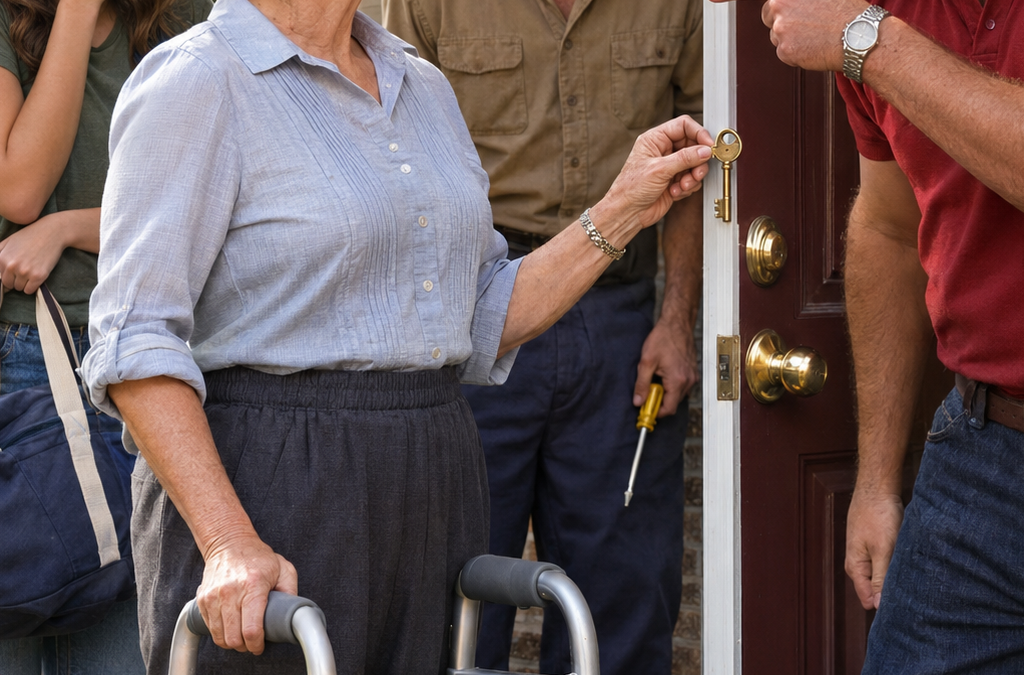
The locksmith asked whose authorization to follow while my son changed my front-door locks and my granddaughter held my overnight bag.
Chapter 1 of 7
It was 2:10 p.m. on Monday, May 4, 2026. I leaned against my walker on the porch of my Fort Worth home.
“Daniel, tell him to stop,” I said.
My son stood inside the doorway, blocking the cooler air.
“You need assisted living, Mom—not my house.”
Emily looked down at the navy canvas bag. At nineteen, she was taller than I was, but she looked small beside her father.
The locksmith lowered his screwdriver.
“I’m Ben Lewis, ma’am. Your son hired me. I’ve replaced the knob cylinder, but I haven’t finished the deadbolt.”
“I live here,” I said. “I’ve been having my hip replaced.”
“Mom, you’ve been in rehab.”
“Since April 20. That wasn’t a move.”
Daniel held several envelopes against his chest. He was forty-four, with gray appearing along his temples. Before surgery, I had worried he looked tired.
Now I watched him straighten those envelopes like he was preparing a presentation.
“Electric. Water. Internet,” he said. “I’ve kept everything running while you were gone.”
“And I appreciate that. Let me inside.”
“You can’t manage those steps alone.”
“Emily helped me up them.”
Emily shifted the bag to her other hand. She had brought me home from rehabilitation, carrying my discharge instructions beside her community-college books.
“Emily,” I said, “please tell your father I came home to recover.”
Her fingers closed around the canvas handles. She didn’t answer.
Ben put his screwdriver into his tool bag.
“I’m stopping here,” he said. “You two need to get this settled before I do any more work.”
Daniel pocketed the new keys.
I took out my old brass key. It entered the knob, but it wouldn’t turn.
“Give me the new one,” I said.
“We need to talk about what happens next.”
“We can talk at the kitchen table.”
He stayed in the doorway.
Beside my walker sat the blue geranium pot with its chipped rim. The soil had pulled away from the edge. Before I retired from managing a public-school cafeteria, I had watered that pot before every early shift.
I had bought this house for $94,000 in 1998. In 2021, I had made the last mortgage payment at that kitchen table.
Daniel had moved in after his divorce. Temporary shelter, we had called it.
“Did you water the geranium?” I asked.
He glanced at the pot. “That’s what you’re worried about?”
It was easier to ask about a plant than ask why he wouldn’t let me sit down.
My hands hurt from pressing against the walker. I had undergone surgery on April 16. The therapist had taught me how to turn without twisting my hip, but nobody had practiced this with me.
Ruth Parker appeared on the neighboring porch.
“Helen? Do you need a chair?”
“I need somewhere to sit.”
She came across immediately, leaving her own door open.
“My guest room is ready,” she said. “You remember the wide bathroom doorway.”
Daniel stepped backward, as if her offer had solved everything.
“There. Ruth can help you until we work this out.”
I looked directly at him.
“I’m leaving this porch because I need to sit down. That’s all.”
Then I turned my walker toward Ruth’s house. Emily carried my bag behind us.
Ruth’s guest room smelled of clean cotton. She put a firm chair near the bed while Emily set my bag within reach.
“Would you stay a minute?” I asked Emily.
Her phone rang. Daniel’s name filled the screen.
“He wants me back,” she said.
“You can tell him you’re sitting with me.”
She watched the ringing phone, then shook her head.
After she left, I unzipped the bag and found the green folder marked “HOUSE.” I had packed it before surgery with my insurance information and emergency numbers.
I opened it across my lap.
The deed recorded on Wednesday, June 15, 2022, named the grantee: Helen Brooks, Trustee of the Helen Brooks Revocable Trust dated June 15, 2022. I had actually transferred the house into the trust, not merely listed it on a worksheet.
Underneath lay the signed trust instrument. I was its living settlor and acting trustee.
I was still the trustee.
My hip operation had changed how I climbed stairs. It hadn’t put Daniel in charge of my house.
Ruth brought water and stopped beside the chair.
“Is that what I think it is?”
“The house records.”
“Can they get you back inside?”
“Not by themselves.”
I looked toward her window. From there, I could see one corner of my porch.
The folder was useful. It couldn’t turn the new lock.
A yellow tab marked January 12 separated two attached pages. Daniel had signed the temporary-occupancy acknowledgment at my kitchen table that Monday, before he moved in.
His signature slanted upward on page two. Beside the utilities paragraph was a blue check he had made himself.
I smoothed the corner and put both pages back beneath the tab.
“Do you want me to call him?” Ruth asked.
“No.”
“I could at least get your other clothes.”
“Tomorrow, maybe. I don’t want you arguing on my porch.”
She pulled another chair close without asking anything else. Ruth was sixty-six, a retired librarian, and better than most people at letting someone finish thinking.
“I thought he might have lunch ready,” I said.
She looked at the bag beside my feet.
“Did you eat before you left rehab?”
“Toast.”
“Then I’ll make eggs.”
In her kitchen, I followed my discharge instructions and took my medication with food. Ruth moved a plate toward me without cutting anything up.
That small courtesy nearly undid me.
“Scrambled enough?” she asked.
“They’re fine.”
“Pepper’s on your right.”
I reached for it myself.
Afterward, she helped me settle my leg as the therapist had shown me. I could hear a lawn mower somewhere down the block. Ordinary Monday sounds came through her open kitchen window.
I kept expecting my phone to ring with an apology.
Instead, I checked my bank balance. I had $18,400 in available savings. That money had been meant for recovery, groceries, and whatever repair came next.
I could pay for help. I could also pay for advice.
I wrote “attorney” on Ruth’s grocery pad, then stopped. I disliked seeing that word beside my son’s name.
Ruth glanced at the pad.
“You don’t have to decide everything tonight.”
“I have to decide whether I’m going to ask his permission to come home.”
“What did you decide?”
“I’m not.”
She nodded and went back to rinsing our plates.
Near evening, I called Emily. She didn’t answer, so I left a short message.
“Thank you for carrying my bag. Let me know you got home safely.”
I didn’t ask her to explain her father. I wanted to ask why she had looked away, but I could still see how tightly she had held those handles.
At 6:40 p.m., my phone lit up.
Daniel had sent a photograph of my bedroom. The quilt was pulled straight, and my reading glasses remained on the nightstand.
An assisted-living brochure lay centered on my pillow. Beneath the photograph, he had written, “Pick one by Friday.”
Chapter 2 of 7
On Tuesday morning, May 5, I answered Daniel’s photograph.
“I haven’t chosen either facility. I won’t authorize a move. I intend to return home.”
Ruth set her telephone beside my breakfast plate.
“Call the attorney before your shower,” she said. “Then you won’t spend the whole shower practicing what to say.”
She helped me find Laura Bennett’s office number. I made the call myself.
Afterward, Ruth laid clean towels within reach of the shower bench. Her bathroom had room for my walker, but everything faced the wrong direction.
I reached left for soap that sat on my right. The unfamiliar faucet needed more pressure than mine.
“Need anything?” Ruth called through the door.
“A minute.”
I managed the washcloth and handheld spray. Getting dry took longer. By the time I pulled on clean underwear, I needed to sit again.
At home, I knew where every handhold was. Here, I had to plan each movement.
Ruth knocked lightly.
“Your coffee’s getting cold.”
“I’m coming.”
She didn’t offer to dress me. I was grateful enough that I couldn’t say it.
Laura arrived that afternoon carrying a work bag and wearing flat shoes. She asked before moving a kitchen chair to make room for my walker.
“Tell me what you want first,” she said.
“To recover in my own house.”
“And Daniel?”
“I want him to leave. I didn’t want that yesterday morning.”
She waited while I moved my water glass.
“I understand,” she said.
I gave her the green folder. With my permission, she compared the deed with the operative trust pages, keeping them beside each other.
“The recorded deed conveys the house to you as trustee,” she said. “These trust provisions confirm your acting authority; your surgery didn’t transfer it.”
She ordered a certified recorded-deed copy from the Tarrant County Clerk while we sat there.
“Public recording establishes the recorded conveyance,” she said. “Having this folder—or losing it—doesn’t change that.”
“Can I hire someone to open my door?”
“Daniel has established a residence there. We need to terminate his permission and use the possession process, rather than change locks on him.”
“He changed them on me.”
“I know. I don’t want his conduct deciding yours.”
Outside the window, Ruth’s sprinkler clicked across her lawn. I could see water landing near the fence between our houses.
“How much can you manage for legal work?” Laura asked.
I told her about my savings and set aside $3,200. She explained that her practice would bill against the work performed, then let me read the engagement agreement.
I signed at Ruth’s table, beside a bowl of bananas.
Emily arrived after Laura left. She carried clean clothes folded inside a grocery bag.
“Your soft pants,” she said. “And the shirts without buttons.”
“Thank you.”
She placed them on the empty chair but kept hold of the bag.
“Dad thinks assisted living would make everything less stressful.”
“For whom?”
“For everybody, I guess.”
“Do you believe that’s what I need?”
She picked at a loose paper handle.
“Or are you afraid to disagree with him?”
“Grandma, please.”
“I’m asking because those are different things.”
Her phone rang before she answered. She looked at the screen.
“It’s Dad.”
“You can take it outside.”
She shook her head and pressed the speaker button.
“I brought her clothes,” she said.
“Good. Did you explain what we talked about?”
“I said you thought it would be less stressful.”
“Tell her she left willingly. Ruth offered, and she went. You were standing there.”
I watched Emily’s face.
“She went because she needed to sit down,” Emily said.
“Don’t start changing things. I’ve got that $600 set aside for your college expenses. If you’re going to help make me the bad guy, don’t count on it.”
Emily lowered the phone toward the table.
“I have to go,” she said.
“Then come over here.”
She ended the call. I had heard only those words, but they were enough.
“He promised that before any of this,” she said.
“I’m sorry.”
“I wasn’t asking you for it.”
“I know.”
She finally let go of the grocery bag.
“I’m not going to buy your testimony,” I said. “And I won’t ask you to choose a parent.”
“What am I supposed to do?”
“Tell the truth about what you saw. You’re allowed to love him.”
She rubbed a crease from my folded shirt.
“I should go home.”
I wanted her to stay for supper. Instead, I thanked her for the clothes.
On Wednesday, May 6, Laura brought the written termination for my approval. It ended Daniel’s temporary occupancy effective June 5.
“That gives him the agreed thirty days,” she said.
I read his name twice before authorizing service.
Later, Laura confirmed that Daniel had been personally served. A duplicate had gone by certified mail.
I put my phone down and practiced the exercises from rehabilitation. Ruth counted while I raised my leg, then lost her place when her kitchen timer rang.
We started the count again.
Daniel’s response came while we were eating supper.
He sent a total first: $684.12 for electric, water, and internet during my recovery.
Then came another message.
“You want notices? Fine. We need to settle the house.”
I left the phone beside my plate until it buzzed again.
“Friday, May 8. Noon. Bring a pen.”
Attached was a transfer-of-house form with a blank waiting for my signature.
Chapter 3 of 7
“I’ll review the actual receipts,” I texted Daniel. “I won’t sign away the house.”
I chose a neighborhood café for Friday, May 8, at noon. Ruth drove me and took a table near the counter.
“You want me beside you?” she asked.
“Nearby is enough.”
Daniel was already seated when we arrived. He moved his jacket from the opposite chair but left me to maneuver my walker around it.
“You could’ve just come home to talk,” he said.
“With what key?”
He opened a large envelope instead of answering.
Electric, water, and internet statements went onto the table. Beside them, he placed the form he had downloaded from the internet.
He had filled in our names.
“Everything’s here,” he said. “I’m not asking you to trust my memory.”
I moved the proposed conveyance away from the receipts.
“What dates do these cover?”
“When you were having surgery and afterward.”
“Show me the payments.”
He pushed his phone across the table. The receipts matched withdrawals from his account. I checked each amount against the statements while a server brought water.
“Anything to eat?” she asked.
“Coffee and toast,” I said.
Daniel shook his head.
When she left, he tapped the form.
“You’re looking at the wrong part.”
“I’m looking at what you paid.”
“Exactly. I kept the place going when you couldn’t.”
“I asked you to handle the bills while I recovered.”
“And I did. Somebody had to.”
I set down his phone.
“Yes. You did.”
He leaned back, watching me as though that settled the rest.
“I’ve finally got my hours back,” he said. “I’m getting ahead again. You want me to throw that away on another apartment?”
“I want to live in my home.”
“You have somewhere to stay.”
“For now.”
“Do you know what a deposit costs? Before you even buy groceries, they want all that money.”
His fingers pressed the edge of the form flat.
“I can’t start over every time somebody decides I’m in the way.”
I remembered helping him carry his boxes inside in January. He had looked relieved that afternoon. I had been relieved, too, believing I could make one hard stretch easier.
“You weren’t in the way,” I said. “You were staying temporarily.”
“I paid when you couldn’t. That ought to count for something.”
“It counts as money I owe you. It doesn’t make the house yours.”
He looked toward Ruth. She was stirring her coffee, close enough to hear if either of us raised our voices.
“So I get reimbursed and put out.”
“You get reimbursed for these bills. We’re not exchanging my house for them.”
The total was $684.12. I opened my banking app and entered the amount.
For a moment, I left my thumb above the confirmation button. Legal bills were coming. I still needed help recovering, and every unexpected expense came from the same savings.
I entered “household utilities only” in the reference field and completed the transfer.
Daniel’s phone sounded against the tabletop.
“There,” I said. “The documented utilities are repaid.”
He checked the screen.
“You could’ve done that without dragging me here.”
“You asked me to bring a pen.”
“I still need your signature.”
“No.”
He slid the form closer. I left it where it stopped.
“Give me a key, Daniel.”
“We haven’t settled anything.”
“You’ve received the reimbursement.”
“And you’re still trying to make me leave.”
The server brought my toast. I wrapped it in a napkin and reached for my walker.
“Sit down, Mom. We’re talking.”
“I’m finished with this meeting.”
Ruth rose when she saw me stand. Daniel gathered his papers, keeping the transfer form on top.
Outside, Ruth opened the car door and waited while I lowered myself onto the seat.
“Did you eat?” she asked.
I held up the wrapped toast.
“Apparently, I ordered takeout.”
She took it while I lifted my leg inside.
At her kitchen table, I printed the transfer confirmation and opened the green folder. The January 12 original slid halfway out beneath its yellow tab.
Page two caught against my wrist. Daniel’s signature was there, with the same blue check beside the utilities paragraph.
I eased both attached pages back into place and filed the bank confirmation behind them.
That afternoon, Emily brought my cardigan. It was the gray one I kept over my kitchen chair.
“I thought you’d want this.”
I put it on before she sat down.
“Your house is colder than mine,” I told Ruth.
“My thermostat has survived years of complaints.”
Emily almost laughed. Then she rubbed her palms against her jeans.
“Dad keeps telling relatives you chose to leave.”
“Have they asked you?”
“Some have. He says you agreed Ruth’s place was better.”
“What did you tell them?”
“That I carried your bag.”
She looked at me.
“It sounds like I’m helping him when I don’t say the rest.”
“You can say I needed somewhere to sit after he refused me entry.”
“He’ll say I’m taking your side.”
“I’m asking for the truth, Emily. You don’t have to report everything he says.”
“I don’t want every visit to be about him.”
“Neither do I.”
Ruth brought another cup to the table. Emily stayed until she needed to leave for work.
On Tuesday, May 12, Laura sent Daniel a short possession demand. She enclosed the certified recorded deed and the relevant trust identification pages.
I kept my copy in the green folder, then cleared space beside Ruth’s firm chair for my exercises.
I had just positioned my feet when my phone sounded.
Daniel’s message filled the screen.
“You put it in a trust? You never told me that.”
Chapter 4 of 7
Daniel called Wednesday morning, May 13, before I finished breakfast.
“That trust paperwork doesn’t matter,” he said. “You’d already promised the house to me.”
“The enclosure Laura sent is how you learned about the trust.”
“Yes, Mom. I read it. You can’t change what you told me.”
“I haven’t transferred the house to you.”
“You said I’d always have a home.”
“You did have a home. With me.”
Ruth stood at the sink, rinsing strawberries. I watched her set the colander down carefully.
“Come over this afternoon,” Daniel said. “Without Ruth. We can settle this ourselves.”
“I’m not making another private bargain.”
“So now everything goes through your lawyer?”
“The request for you to leave does.”
He ended the call before I could say goodbye.
I had heard him frightened about rent at the café. Now he was turning an offer of shelter into a promise I hadn’t made.
When I told Laura, she let me finish before answering.
“We’re seeking possession under his signed temporary permission,” she said. “A claimed inheritance or disputed family conversation doesn’t erase that agreement; we aren’t asking Justice Court to decide a complicated title lawsuit.”
“Will I have to sit there while he says I gave it away?”
“You’ll have a chance to answer.”
I wrote down his words while I still remembered them. Then I put the notebook aside and finished my cold toast.
That afternoon, Daniel sent a proposal.
He would stop claiming the house if I signed something giving him the permanent right to live there. I could remain at Ruth’s or choose a facility.
I read it twice.
He had stopped arguing about utility bills. Now he wanted me to create the right he said he already had.
I called him.
“Ruth’s guest room isn’t my permanent address.”
“You’re comfortable there.”
“Ruth offered me help. She didn’t offer to take over housing me.”
“I’m offering a compromise.”
“You stay permanently, and I stay away?”
“You could visit.”
I looked at the walker beside my chair.
“No, Daniel.”
“You won’t even consider it?”
“I have considered it. My answer is no.”
Afterward, Ruth found me trying to carry my empty plate and move the walker together.
“Hand me the plate,” she said.
“I can manage.”
“I know. You can also hand me a plate.”
I did, then followed her into the kitchen.
Over the next weeks, we practiced her porch steps after breakfast. Ruth stood nearby while I placed each foot as my therapist had instructed.
“Don’t watch me,” she said. “Watch the step.”
“I’m checking whether you look worried.”
“I look like somebody whose coffee’s cooling.”
By the end of May, I could manage them without her hand hovering near my elbow. I still needed the railing.
Across the narrow stretch between our houses, my geranium had opened its first flowers. I noticed them from Ruth’s driveway after the brightest cluster had already begun to fade.
I had missed the first blooms.
“Want me to bring the pot over?” Ruth asked.
“Leave it where it belongs.”
She stayed beside me until I turned back toward her porch.
Emily began taking the bus with me when I felt strong enough. We chose a short trip first, with a bench near the stop and no hurry.
“I can ask Dad to drive,” she said.
“I’d rather learn this.”
She showed me where to stand and waited while I counted out my fare. Her own came from her grocery wages.
On the ride back, she held a small bag of peaches between her shoes. We talked about which ones would soften by morning.
For twenty minutes, neither of us mentioned Daniel.
Friday, June 5, passed without him surrendering the house.
I watched a delivery truck stop outside my porch and caught myself expecting boxes to come out. The driver carried a package to the door and left.
Daniel stayed.
On Monday, June 8, I was working through my exercises when Laura called. The separate three-day written notice to vacate had been properly delivered, with a duplicate sent by certified mail.
I finished the next repetition before putting my foot down.
“Has he answered?”
“Not to me.”
I kept paying what needed paying. No utilities were cut off, and none of his belongings were moved.
On Friday, June 12, Laura filed the possession case for me as trustee. That evening, Ruth asked whether I wanted supper at the table or on a tray.
“The table,” I said.
She put two bowls there, and we ate while rain tapped against the window.
By Tuesday, June 16, citation had been served. Laura confirmed the hearing: Thursday, June 25, at 9:00 a.m., before Judge Anita Collins in Tarrant County Justice Court.
“You and Daniel will both be there,” she said. “I’ll be beside you. We’ll bring the witnesses who can speak to what they actually observed.”
I asked Ruth whether she would come.
“Of course.”
“You’ll miss your morning walk.”
“I know another retired woman who could use one afterward.”
I put the hearing information on Ruth’s calendar with her permission. My handwriting crowded the little square.
At 4:18 p.m., someone knocked at the side door.
Emily stood outside, still wearing her grocery-store shoes. She held her phone out before stepping over the threshold.
“Dad sent this.”
The message read, “Tell the judge you heard her give it to me.”
I looked up from the screen.
“What do you remember?”
“The January papers,” she said.
She remained in Ruth’s doorway, gripping the phone.
“I was there when he signed.”
Chapter 5 of 7
“I was there when he signed.”
Emily repeated it as Ruth invited her inside.
“January 12,” she added. “At your kitchen table. I sat near the window while Dad read both pages.”
Ruth pulled out a chair for her.
“What do you remember him doing?” I asked.
“He checked the paragraph about utilities. Then he signed. You put the papers together afterward.”
“Tell Laura what you remember.”
“Do you want me to write something?”
“She can tell you what she needs. You don’t need to make it sound better.”
Emily laid her phone facedown.
“I could have said something on the porch.”
“Yes,” I said. “You could have.”
She picked at the edge of her grocery-store name tag.
“I thought if I disagreed with him, he wouldn’t want me around anymore.”
I waited.
“And the $600 mattered. I know that sounds awful.”
“It sounds like money you were counting on.”
“It wasn’t just money.”
“I know.”
Ruth brought her a glass of water. Emily stayed long enough to drink it, then called Laura herself.
By Wednesday, June 24, Emily had agreed to come to court. She arrived for dinner carrying peaches and a loaf of bread.
“Those peaches need another day,” Ruth said.
“I picked the hardest ones again?”
“You’ve got a talent.”
Emily laughed and helped set the table. I folded napkins while Ruth checked the chicken.
We ate chicken, rice, and green beans. For a while, Emily told us about a customer who returned an empty milk carton.
“Did he get his money back?” Ruth asked.
“He did. I think he practiced his complaint on the bus.”
Then Emily set down her fork.
“What if Dad asks whether I love him?”
“You don’t have to deny loving your father.”
“What if he asks why I’m doing this to him?”
“You’re answering questions about something you witnessed.”
“Can you ask me some? So I don’t mess it up?”
“I don’t want us rehearsing an account that makes me look good.”
“That’s not what I meant.”
“I know. But you can disagree with him and still love him. You can disagree with me, too.”
She looked across the table.
“I didn’t like being asked to explain him when I came over.”
I put my fork down.
“You were right to tell me.”
“I still wanted to come.”
“I still wanted you here.”
Ruth passed the green beans. Emily took another spoonful, and we finished dinner without discussing testimony.
Afterward, she washed while I dried the lighter dishes. She handed me Ruth’s yellow cup, handle first.
“Breakfast when you get home?” she asked.
“I’d like that.”
“Your kitchen this time.”
“Yes.”
After Emily left, I cleared a place at Ruth’s table for the green folder marked “HOUSE.”
I put the original January packet beneath its yellow tab. Behind it went the certified deed, trust authority pages, notices, service proofs, and reimbursement confirmation.
Laura had already checked our hearing set. She called while I was closing the folder.
“Do you have both original January pages?” she asked.
“Attached together, just as I kept them.”
“Bring those. I have the copies.”
I placed my old brass key beside the folder. It still had the familiar worn spot beneath my thumb.
Ruth dried the table where my water glass had stood.
“What are you thinking?”
“That I want an actual departure date.”
“You deserve one.”
“I don’t want him hauling boxes down the steps at midnight.”
“You don’t have to make it harder for him.”
“I don’t have to let him stay, either.”
She left the dish towel beside the sink and sat with me.
On Thursday, June 25, we reached the courthouse early. By 8:45 a.m., Emily sat beside me outside the courtroom, with Ruth on my other side.
Daniel stopped in front of us.
“Emily. Come sit with me.”
“I’m staying here.”
“I can still help with that $600.”
She pressed her palms against her knees.
“I’m not trading where I sit for money.”
“I’m your father.”
“I know.”
He looked at me.
“You couldn’t leave her out of it?”
“She saw the signing, Daniel.”
“You’ve had weeks to tell her what she saw.”
Emily started to answer. I kept my hands on the folder and let her.
“I remember being there,” she said.
Daniel turned toward the people waiting along the wall. Several had looked up from their phones.
“My mother gave me that home,” he said. “Now outsiders have frightened her into taking it back.”
Ruth straightened beside me.
“She came to my house because you wouldn’t let her inside hers.”
“You weren’t part of our conversations.”
“I was there when she needed a chair.”
Daniel faced me again.
“Tell them you didn’t say I’d always have a home.”
“We’ll answer the judge’s questions inside.”
“Of course. Now you won’t talk to me.”
“I met you. I answered your calls. I’m here.”
Laura approached and stopped beside my chair. She didn’t interrupt.
Daniel looked at the green folder on my lap.
“You brought all of it?”
“I brought the originals.”
He moved away from us and stood near the courtroom door. Emily stayed seated, her shoulder touching mine.
I opened the folder and took out the two attached January pages. The edges had softened from being handled, but Daniel’s signature remained clear.
A court officer opened the door.
“Helen Brooks, Trustee, versus Daniel Miller.”
I rose with the original packet in my hands. Daniel walked to the defendant’s table while I carried it inside.
Chapter 6 of 7
“This was my gift,” Daniel told Judge Collins at 9:00 a.m. “I paid the bills, and she told me I’d always have a home.”
Emily and Ruth sat behind me. Laura sat beside me, leaving the January original within my reach.
Judge Collins looked toward Daniel.
“Explain what you mean by a gift.”
“She gave me the house. Now she’s recovering from surgery, and people have convinced her she made a mistake.”
When it was my turn to testify, I stood with the two pages.
“May I give you the original?”
The judge directed me to hand it forward. I identified the signed acknowledgment and Daniel’s signature.
“He accepted temporary occupancy on January 12,” I said. “Before my April operation. Before anyone could blame this on confusion during recovery.”
Daniel leaned toward the table.
“That signature’s mine. But she’s making the paperwork mean something else.”
“What did it mean?” Judge Collins asked.
“That I wouldn’t leave her with unpaid bills. She wanted things written down. I agreed.”
He glanced toward Emily.
“Then I paid everything while she was gone. That completed what we talked about.”
I waited until the judge turned back to me.
“Please read the paragraph beside the blue check on page two,” I said.
She lowered her eyes to it. I had seen that mark every time I opened the folder.
“Paying utilities or household costs purchases no ownership interest,” I read. “Daniel put that check there himself.”
“That was before I covered her recovery,” he said.
“The paragraph doesn’t exclude those months,” I answered.
Judge Collins asked him to wait while she read the page.
Laura placed the utility receipts and my reimbursement confirmation with the exhibits. I confirmed the $684.12 payment.
“He paid those bills,” I said. “I repaid him on May 8.”
“That doesn’t undo a promise,” Daniel said. “She can’t send money and decide we never had an agreement.”
When Emily was called and sworn, she kept her hands together in front of her.
“Were you present on January 12?” Laura asked.
“Yes. At Grandma’s kitchen table.”
“What did you see?”
“Dad read both pages. He checked that paragraph in blue and signed.”
Daniel shifted in his chair.
“Emily, you don’t know what your grandmother and I discussed before that.”
“No,” she said. “I’m telling them what I saw.”
Under his questions, she gave the same answer. She had watched him read, check, and sign.
Judge Collins looked directly at Daniel.
“Do you have a deed or any other conveyance document signed by your mother?”
“No. It was between us. She said I’d always have a home.”
“I heard your account,” the judge said. “I’m asking whether there was a conveyance document.”
“There wasn’t.”
Laura referred her to the certified deed and trust pages already admitted. Judge Collins compared them with the January agreement, then examined the notices and delivery proofs.
I watched her turn each page. Daniel kept rubbing a finger over the edge of his table.
The deed and trust established my authority. His temporary-occupancy agreement and the completed notices supplied the basis for possession without a separate title trial.
Judge Collins set down her pen.
“The court awards possession to Helen Brooks in her capacity as trustee.”
Daniel pushed back from the table.
“So I’m supposed to be out today?”
I looked at Laura, then addressed the judge myself.
“I’m willing to give him thirty days to surrender. A definite date.”
Judge Collins asked whether we could agree on July 25 at 5:00 p.m. I said yes.
Daniel looked at me.
“You’d really make me move?”
“Yes.”
He glanced toward Emily, who remained in her seat.
Finally, he said, “I’ll take the thirty days.”
The judge confirmed my agreement not to seek enforcement before the deadline. She recorded surrender by July 25, 2026, at 5:00 p.m., in the judgment.
Daniel had lost possession of the $310,000 house. The extra thirty days gave him time to move; they gave him no right to stay afterward.
Ruth heard it. Emily heard it. Daniel sat with both hands flat on the table.
As we gathered our things, he stood abruptly and reached toward Emily.
“Do you understand what you’ve done?”
She moved beside me without taking his hand.
“I told the truth, Dad.”
“You could have talked to me first.”
“You told me what to say.”
He dropped his arm. Laura waited while I placed the January pages back beneath their yellow tab.
“Mom,” he said, “tell her this didn’t have to happen.”
I closed the folder.
“You can be my son without holding my house hostage.”
His face changed, but he stayed where he was.
“I’ll need a spare key,” he said. “For emergencies.”
“No. You won’t keep a key.”
“What if you fall?”
“I’ll arrange my help.”
Ruth walked beside me toward the door. Emily followed with Laura, leaving Daniel to collect his papers.
Outside the courtroom, I sat on a bench while Laura finished speaking with me. The folder rested on my lap, its corners pressing into my palms.
Emily asked whether I wanted water. I said yes.
At 10:14 a.m., while she was opening the bottle, Daniel’s text arrived.
I replied that both keys had to be surrendered when he vacated. Above my answer, despite the possession ruling, his threat remained: “I’m taking the house keys with me.”
Chapter 7 of 7
I would not accept Daniel’s spare-key condition. I would not answer it by locking him out before the agreed deadline, either.
Laura confirmed the surrender arrangements in writing. July 25 at 5:00 p.m. remained the deadline; replacement cylinders would wait until he had surrendered the house.
I saved her message, then put my phone away.
Ruth was cutting a peach at her kitchen counter.
“Want half?”
“Yes,” I said. “The soft half.”
“They’re both soft. Emily finally picked good ones.”
We ate them over plates, catching the juice with our fingers.
On Friday, July 10, Daniel called about an apartment.
“I signed the lease,” he said. “Eleven twenty-five a month. Another eleven twenty-five for the deposit.”
“Have you paid?”
“Yes. I couldn’t hold it without paying.”
His lease and receipt arrived on my phone while we talked. The move-in total was $2,250.
“I need you to cover that,” he said. “You’re the reason I’m moving.”
“I’m not paying your apartment expenses.”
“You’ve got savings.”
“For my expenses.”
He waited, as though I might offer a smaller amount.
“I’m not asking you to buy the place,” he said.
“I understand what you’re asking. My answer is no.”
I didn’t offer money in exchange for an apology. I didn’t ask him to admit what he had done. He had signed a lease and paid for his own housing.
After the call, I put the receipt away and practiced my steps.
On Friday, July 24, Ruth walked beside me to my porch. Daniel had propped the door open while he carried out his final boxes.
The blue geranium pot stood where I had left it. Several dry leaves lay against the chipped rim.
I resisted the urge to begin tidying.
Daniel came down the hall with a box against his chest.
“That’s the last one.”
“Check the closets,” I said.
“I checked.”
Ruth stayed near the doorway while he carried it to his vehicle. I stood inside my house without reaching for a chair.
At 4:00 p.m., Daniel returned to the porch and held out both exterior-door keys.
I opened my hand.
He dropped them into my palm, one warm from his pocket.
“You’re really doing this,” he said.
“The keys, Daniel. Is that both?”
“Yes.”
I closed my fingers around them.
He looked past me toward the kitchen, then walked away. I stayed on the porch until he drove off.
Laura confirmed the voluntary surrender in writing after I called her. No officer came to remove him. By Saturday’s 5:00 p.m. deadline, he had already been gone a day.
He did call about one forgotten carton.
It held items from the upper hall cupboard. We arranged one pickup, with Ruth present.
Daniel reached for the carton, then looked toward the spare room.
“I could leave some other things here until I get settled.”
“No. This is a pickup, not storage.”
“I’m talking about a couple of boxes.”
“You’ll need to make room at your apartment.”
Ruth stood beside the carton without filling the pause. Daniel lifted it and left. I closed the door behind him.
On Monday, July 27, I came home with Ruth.
A locksmith changed the cylinders after the surrender. I tested the new brass key twice, then threaded it onto my old blue fabric loop.
Inside, the house smelled closed up. Daniel had moved a chair and left a pale rectangle where his things had covered the kitchen counter.
Ruth opened the curtains while I checked the bathroom.
My towel bar was still where my hand expected it.
I had arranged fifteen hours with a local recovery aide at $30 an hour, costing $450. We divided the hours around bathing, meals, and the household tasks that still tired me.
The aide followed my rehabilitation instructions. She asked where I wanted things rather than choosing for me.
“Beside the stove,” I told her when she held up my kettle.
Ruth made lunch while I put my clothes into my own drawers. Later, I emptied the navy overnight bag and folded it onto the closet shelf.
“I should wash your guest-room sheets,” I told her.
“They’re already washed.”
“Then let me buy supper.”
“That,” she said, “I’ll allow.”
On Monday, August 3, the utility-account confirmation arrived. I sat at my kitchen table and checked the household payments myself.
Electric. Water. Internet.
I entered the due dates on my calendar. Daniel’s receipts remained filed with the reimbursement confirmation. There was nothing left for us to settle about those bills.
He still sent messages that assumed an immediate answer.
Once, he wrote that he was nearby and might stop in. I told him visits required an invitation and advance agreement.
He called that formal.
I left the arrangement unchanged.
Emily came when work and classes allowed. She paid her own bus fares from her grocery wages. The promised $600 never arrived, and I didn’t turn our visits into discussions about replacing it.
Sometimes she mentioned her father. Sometimes we talked only about school, groceries, or whether my tomatoes needed another day.
I agreed to a scheduled fifteen-minute call with Daniel. The first was set for Sunday, September 6, at 3:00 p.m.
He had no key and no standing invitation.
That Sunday morning, Emily arrived with bread for toast.
I was watering the blue geranium pot. I poured slowly around the stems, watching the water soak into soil I had loosened myself.
“Eggs?” she asked.
“In the refrigerator.”
“Pepper on your right?”
“Where it belongs.”
She grinned and went inside.
I left the porch door open while we ate. Nobody stood in it deciding whether I could pass.
After breakfast, Emily washed the skillet. I carried our cups to the sink, then went back to the porch door with the new brass key on its familiar blue loop.
I hung my key beside the blue geranium pot.







