My cousin put a SOLD tag on my mother’s sewing machine at the town craft exhibition, claiming I had surrendered it when I moved above a laundromat.
Chapter 1 of 7
It was 11:20 Friday morning, October 16. Claire Sutton stood behind her booth, smoothing a linen runner beneath the machine.
“I loaned you that,” I said.
“Heirlooms belong in real homes, not above laundromats.”
My brother, David, turned toward a display of wooden ornaments. He lifted one by its ribbon and studied the price.
I waited for him to put it down.
He was forty-three, six years younger than me. I had hemmed his wedding pants on that machine. He knew the sound it made when the bobbin needed winding.
“David?”
He glanced at Claire. “Can we talk somewhere else?”
The tag hung from the machine’s black neck. SOLD appeared in thick red letters above $2,400.
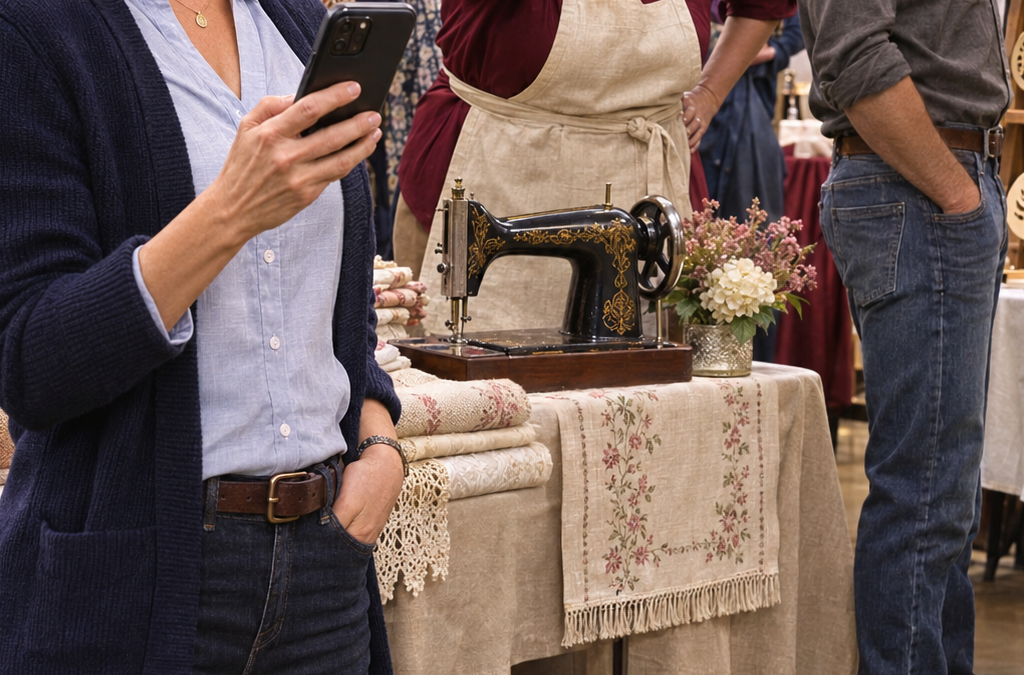
Beside the base, the familiar brass identification plate caught the overhead light. Claire had polished the black enamel and gold decoration. The walnut carrying case sat open underneath, its attachments tucked into their fitted compartment.
I had oiled that machine for Mom when her fingers became stiff. Together, we had eased wedding satin beneath its presser foot, keeping every stitch straight.
Now Claire had arranged dried lavender beside it.
“Take the tag off,” I said.
“That belongs to the exhibition,” Claire answered. “They handle checkout.”
“Then get someone who can stop the sale.”
A woman holding a canvas tote stepped closer. “Is there a problem with the machine?”
“No mechanical problem,” Claire said quickly.
“It wasn’t hers to sell,” I said.
The woman looked between us. “I’m Paula Grant. I bought it this morning.”
Her pleasure had already drained away. I recognized the careful way she held her receipt, keeping it flat between both hands.
“I’m Nora Reed. It’s my machine.”
“Claire said it was a family piece.”
“It is. That doesn’t mean everyone in the family owns it.”
Claire moved around the table, placing herself beside Paula.
“Nora had to leave her house in August,” she said. “There wasn’t room for everything. I made sure things were cared for.”
“I rented an apartment. I didn’t surrender my belongings.”
“You told me you were simplifying.”
“I told you I couldn’t keep paying for storage.”
David set the ornament down without looking at me.
Behind Paula, a checkout notice stood beside a basket of vendor cards. Purchases went through central checkout. Payments remained held until authorized release.
Paula followed my eyes.
“I paid where they told me to,” she said.
“I believe you.”
I kept my hands away from the machine. I wouldn’t wrestle it across a booth while Claire described me to strangers.
A staff member wearing an exhibition badge approached. I gave her my name and asked her to stop any release while the director heard the dispute.
“Are you taking it now?” she asked.
“No. I want this documented before anything moves.”
I photographed the tag, the machine, and the open walnut case. Claire folded her arms.
“You could have called me first.”
“You could have asked before putting a price on it.”
The staff member wrote down my number and gave me the director’s name: Linda Hayes.
I stepped into the aisle and opened the household folder on my phone. There, between my lease and an appliance warranty, was the photograph I wanted.
Mom’s signed receipt.
On January 10, I had paid her $325 for her favorite machine. Ruth Reed had written my name as purchaser and signed her own beneath the price. I had told her to keep using it as long as she wanted.
She had laughed at my insistence on paying.
“Then I’ll write it down properly,” she had said.
By noon, I was upstairs in my apartment, pulling the blue household envelope from a drawer. The laundromat dryers rumbled beneath my feet.
The original receipt had softened along an old fold. A narrow lower strip turned under the paper; Mom’s tiny blue writing continued below the crease. I left it folded and laid it beside my phone.
Her handwriting troubled me more than the SOLD tag.
She had died on February 12, at seventy-four. Eight months later, I could still picture her pressing the pen too hard, leaving dents in the paper underneath.
Mom had owned two nearly identical machines. On January 24, she had given the second one to Claire. Nobody disputed that gift. I had helped Claire carry it out.
Claire had a machine from our family already.
She had asked to borrow mine because she wanted two displayed together at the Bellbrook Makers Exhibition. I remembered her describing the arrangement: matching machines, embroidered runners, a little history of women sewing at home.
I opened our September 12 messages.
“Could I borrow yours for October 16–18?” she had asked.
“For display only,” I had written. “It isn’t for sale.”
“Of course. Just the three days.”
Yesterday, Thursday, she had sent another message.
“I’ll bring your machine back Sunday after the show.”
I read that sentence twice. Then I copied the director’s number from the card in my pocket.
Before I could call, David rang.
“Where did you go?”
“Home.”
“Claire thought you were still outside.”
“She has my number.”
He didn’t answer that.
“Did you hear what she said to me?” I asked.
“About the apartment?”
“Yes.”
“She shouldn’t have said it like that.”
“How should she have said it?”
“Nora, I’m trying to help.”
“Then tell her I loaned it to her.”
He exhaled close to the receiver. I could hear exhibition announcements behind him.
“I didn’t see the messages.”
“You watched her borrow the carrying case from my car.”
“I remember.”
“Then start there.”
He said he needed to get back. I ended the call before I could ask him to choose me again.
The apartment cost $925 a month. My share of the divorce sale had been $8,200, and moving had already taken a piece of it. I had measured every corner before bringing my worktable upstairs.
There was room for the machine. There had always been room.
I called Linda Hayes and left a short message. I gave her Claire’s booth location, my number, and the words “loaned for display.” I asked her to keep the machine from leaving while she reviewed what had happened.
Then I sent the photographs she requested by text, along with the complete borrowing exchange.
I wanted to call an aunt, someone who remembered Mom buying both machines. My thumb hovered over the family contacts.
Instead, I set the phone beside the envelope.
I had spent the morning asking my brother to say what he knew. I couldn’t spend the afternoon collecting relatives willing to believe me.
At 2:10, Linda’s reply appeared. I sat on the edge of my work chair to read it.
“Paula Grant’s full $2,400 has already cleared into the exhibition’s payment escrow.”
Chapter 2 of 7
Linda called before I could answer her message.
“The $2,400 is still held here,” she said. “Claire hasn’t received it. I won’t authorize release of the money or the machine while I check your complaint.”
“Is it still at her booth?”
“Yes. The display is intact. Please don’t try to remove anything yourself.”
“I already told your staff I wouldn’t.”
“I appreciate that. I’ll need time to speak with both women.”
Both women meant Claire and Paula. I had made the complaint, but I couldn’t make everyone stop their afternoon for it.
I asked Linda to call if anything changed.
David called next.
“Claire asked me to talk to you,” he said.
“About returning my machine?”
“About how this is being handled.”
I pushed the blue envelope farther from the edge of my worktable.
“Go ahead.”
“She stored things while you were dealing with the house. She says she never charged you, never complained.”
“She kept two boxes for three weeks. I thanked her.”
“She feels like you’re making her look dishonest after she helped.”
“Did she ask you to say that?”
“She’s upset, Nora.”
“So am I. You didn’t call to tell her that.”
A truck passed beneath my window. David waited until it had gone.
“Could you settle it without involving the exhibition? She’s got customers there.”
“She involved the exhibition when she sold my property.”
“She thinks you’re forgetting who showed up when things were bad.”
I pressed my palm against the table. There was a nick near the edge where my old cutting shears had fallen.
“I accepted help, David. I didn’t trade her everything she touched.”
“Nobody’s saying everything.”
“Then she can return this one thing.”
He offered to meet us both after closing. He wanted us somewhere private, where Claire wouldn’t have to explain the tag.
“I’m not buying peace by leaving my machine behind,” I said.
“You make it sound like I’m against you.”
“You’re carrying her request. What did you carry back from me?”
He didn’t have an answer ready.
“I have an appointment,” I said. “I need to go.”
At 3:00, I sat across from Helen Brooks in her Bellbrook office. She had fitted me between appointments for a short consultation.
I set my phone on her desk. She read the borrowing exchange, then asked what I wanted.
“My machine back without a fight in the aisle.”
“Have you been told she claims it was a gift?”
“She says moving meant I surrendered it.”
Helen nodded once.
“You can report a suspected taking and give the officer your evidence. A report records your allegation; police won’t decide a contested gift just because you ask them to.”
“Will reporting it make things worse?”
“It may upset your cousin. That isn’t the same question as whether your account is accurate.”
I looked at the invoice beside her keyboard.
“Should I ask them to arrest her?”
“Tell them what happened and what you need. Don’t choose an outcome you don’t actually want.”
I paid $175 with my debit card. Outside, I checked the balance before putting the card away.
That money had been meant for groceries and a little room between bills. I folded Helen’s invoice into the envelope anyway.
At 4:20, Officer Mark Ellis took my account. He asked when Claire had received the machine and when I had discovered the sale.
“Friday morning,” I said. “Today. The loan was display only.”
I handed him my phone with the complete exchange open.
He read without interrupting. Then he asked whether Claire had offered to return it.
“She promised yesterday that she would bring it back Sunday. Today she told a buyer it was hers to sell.”
“What are you asking us to do?”
“Document it. Help me get it back peacefully if she agrees.”
He wrote that down. I was grateful he didn’t ask why I had trusted her.
When he gave me the report number, I copied it into my phone. He kept my contact information for follow-up. Nothing about leaving the desk felt like getting my machine back.
I returned to the exhibition and found Linda near the registration counter. From there, I could see Claire wrapping a linen napkin around a cardboard square.
Linda brought out the agreement Claire had signed.
“These provisions cover property offered without authority and sales completed outside our checkout,” she said, pointing. “Either can cost a vendor future bookings.”
A confirmation attached behind it listed six holiday-market spaces, each prepaid at $60.
November 7, 14, 21, and 28. December 5 and 12.
I knew how carefully Claire planned holiday inventory. She bought ribbon in summer and counted table space before ordering anything bulky.
“She’ll say I’m trying to ruin those,” I said.
“Your complaint concerns the machine. Her bookings are my responsibility.”
Across the aisle, Claire spotted me beside Linda. She stopped wrapping the napkin.
For a moment, I wanted to cross over and explain that I hadn’t come for her holiday income. Then I remembered how much explaining I had already done.
Linda’s phone sounded at 5:05. She read the incoming message, then looked toward Claire’s booth.
“What is it?” I asked.
“A release request from your cousin.”
“For Sunday?”
Linda turned the screen toward me.
Claire was asking permission for Paula to collect the machine at 10:30 a.m. Saturday, instead of after Sunday’s closing.
Chapter 3 of 7
At 9:40 Saturday morning, Linda called to say she had refused Claire’s early-release request.
“Paula won’t be collecting at 10:30,” she said. “I’ve flagged the sale as disputed.”
“Where’s the machine?”
“At Claire’s booth. Staff know it must stay there.”
I thanked her, then checked the time against my appointment book. I had moved a customer’s trouser fitting to Monday. She had agreed, but she needed them before a work trip.
I couldn’t keep rearranging paid work around Claire.
When I reached the exhibition, Claire was speaking with two nearby exhibitors. One held a roll of price stickers. The other had bought alterations from me.
“Since the divorce, ordinary decisions have become difficult for her,” Claire said. “I’d rather give her some room than discuss everything she’s been through.”
The woman with the stickers saw me first. Her hand stopped halfway to a display shelf.
Claire turned.
“Nora. I was just explaining why we need a little patience.”
The alterations customer looked down at a stack of tea towels.
“I’m here about my machine,” I said.
“Of course you are.”
Claire’s voice was gentle enough to make mine sound sharp. I looked toward the black machine beneath its tag. It stood exactly where I had left it.
I had not abandoned it.
David came around the end of the aisle carrying coffee.
“Linda’s handling it,” he said. “Why don’t you let her?”
“Because people are being told I can’t manage ordinary decisions.”
“She’s trying to explain why you’re upset.”
“Repeating Claire’s account isn’t neutrality.”
He lowered the coffee cup.
“I didn’t repeat anything.”
“You just explained her explanation to me.”
The woman who had brought me alterations moved behind her display. I wanted to tell her that her jacket had been ready early, every seam finished. Instead, I stood with my hands at my sides.
David glanced after her.
“You’re making this harder than it needs to be.”
“For whom?”
He rubbed the cardboard sleeve around his cup. I walked away before he could offer another place to talk privately.
Paula found me near the demonstration tables.
“I was supposed to pick it up this morning,” she said.
“I know.”
“I arranged help getting it home. Now I’m told the whole purchase is frozen.”
“I’m sorry you’ve been inconvenienced.”
“Are you planning to make a scene? Because I don’t want to be stranded between two cousins.”
Her tote bag was tucked tightly under her arm. She looked more irritated than frightened, which seemed fair.
“I’m trying to keep you from being stuck with a disputed machine,” I said.
“Claire says you’re having second thoughts.”
“I never agreed to sell it.”
Paula watched my face.
“I paid what she asked.”
“You did everything the exhibition required. Please keep any payment inside their system while Linda sorts this out.”
“Is there another payment you think I should worry about?”
“I’m asking you not to settle anything separately with Claire. I can’t tell you what she might propose.”
She nodded without promising.
Claire approached before I could say more.
“Paula, I’m sorry about this delay. Nora and I need a few minutes.”
“I’d like to hear it,” Paula said.
Claire adjusted the cuff of her blouse.
“All right. Nora, I’ve made commitments based on this sale. Paula expected a machine, and I ordered holiday stock expecting the proceeds.”
“You ordered stock before you had permission to sell mine?”
“I understood we had settled what was staying in the family and what could move on.”
“You asked to borrow it.”
“I’ve spent months keeping things safe while everyone else had more urgent concerns. At some point, I had to make practical decisions.”
“About your inventory,” I said. “Not my belongings.”
Claire looked toward Paula, then back at me.
“I can’t simply tell suppliers that a family misunderstanding has changed my budget.”
“I can’t pay that budget with my machine.”
“I’m asking you to consider the consequences for somebody besides yourself.”
For a moment, I saw the holiday ribbon she kept sorted by color. I knew those orders mattered to her. Then I remembered checking my balance outside Helen’s office.
“My work matters too,” I said. “I moved a fitting to be here.”
Claire pressed her lips together.
“Then perhaps we should stop discussing this in the aisle.”
Paula held out her hand.
“You mentioned messages yesterday, Nora. May I see them?”
I opened the September exchange and passed her my phone. The receipt stayed where it was; Paula needed to read what Claire had agreed to do.
She scrolled up to the date, then down through both sides of the conversation.
“For display only,” she read.
Claire leaned closer. “There were other family conversations.”
Paula kept reading.
“And Thursday you said you’d bring it back Sunday.”
“Yes,” Claire said. “I expected to speak with Nora before then.”
“Before selling it?”
“Before completing arrangements.”
Paula returned my phone.
“Why wasn’t any of this mentioned when I paid?”
“I didn’t believe there was a problem,” Claire said.
Paula looked at the SOLD tag across the aisle.
“I’m going to speak with Linda.”
Claire reached toward her elbow but stopped before touching her. Paula walked past.
I gave Paula my number before she reached registration. Then I went outside, where I could hear traffic instead of Claire explaining me.
At 12:15, my phone lit up with Paula’s name. She had forwarded a message Claire had just sent.
“We can cancel the exhibition purchase and avoid further delays. I’ll deliver the machine to you privately this evening for $2,200 cash.”
Chapter 4 of 7
“I’m not paying her cash,” Paula told me when I called. “I’ve sent the offer to Linda.”
“Thank you.”
“I want my purchase left where it is until this gets settled. I don’t want a delivery tonight.”
She sounded brisk now. Claire had lost the benefit of Paula’s uncertainty.
Inside, Linda stood behind registration with Paula’s forwarded message open on her phone.
“I’ll address this offer with Claire,” she said. “Separately from your disagreement about the machine.”
“Does Claire know Paula sent it?”
“She will when I speak to her.”
I looked down the aisle. Claire was arranging embroidered pillowcases, measuring the gaps between stacks with her fingers. A shopper asked a question, and she leaned forward with her usual attentive expression.
I had watched her sell things for years. She remembered colors people liked, asked after their children, saved matching pieces beneath the table.
I waited until the shopper left.
“Paula isn’t accepting your offer,” I said.
Claire set a pillowcase down.
“I heard.”
“You need to stop offering delivery.”
“I was trying to spare her another wasted trip.”
“She asked to leave it with Linda.”
“Then that’s what we’ll do.”
Claire glanced at the machine, then at me.
“I’ve been thinking about what you said. About buying Aunt Ruth’s machine.”
I hadn’t told her about the receipt. I had told her, more than once, that I had paid Mom for it.
“What about it?”
“She had two, Nora. You may be remembering the other machine.”
“I know she had two.”
“They were almost identical. You were helping clear her things, then dealing with the house. I’m not saying you’re making anything up.”
“I helped carry yours out in January.”
“Yes. And I’ve cared for it ever since. That’s why I know how easily someone could confuse them.”
A woman paused beside the booth. Claire offered her a vendor card, and I stepped away before our conversation became another attraction.
I stayed near the demonstration area until the woman had gone. My phone showed 2:30 when I returned.
“Look at this,” I said.
I opened the photograph of Mom’s folded receipt and held the screen toward Claire.
She reached for the phone. I kept hold of it, then felt foolish for being afraid she might take that too.
“January tenth,” she said.
“Yes.”
Her finger hovered above Mom’s signature.
“That’s Aunt Ruth’s writing.”
“She named me as the purchaser.”
“I can see that.”
“For $325.”
Claire studied the photograph longer. Her expression softened at the uneven line beneath Mom’s name.
“She always pressed so hard,” she said.
I nearly answered. We could have spent ten minutes remembering Mom’s grocery lists and birthday cards. I kept the phone facing her.
“This isn’t a memory I got confused.”
“I believe you bought one,” Claire said. “That doesn’t tell me which one she meant.”
“She knew which one she was selling me.”
“And you let her keep both at the house.”
“I let her keep using mine.”
“Of course you did. I would have done the same.”
The receipt stayed on the screen between us. I had expected recognition of Mom’s handwriting to settle more than it had.
My name and a date weren’t going to end Claire’s objection. She accepted both and still reached a different conclusion.
“You should bring the paper itself,” she said.
“I intend to.”
“Then perhaps we can sort this out without more people getting involved.”
“Paula is already involved.”
Claire began straightening the pillowcases again.
I stepped back into the aisle and called Ellis. He returned my call while I was sitting on a bench near the entrance.
“She recognizes the receipt,” I told him. “She says it’s for a different machine.”
“Can you bring the original?”
“Yes.”
“And keep the complete messages available, with the dates.”
“I have them.”
“I can document what each of you says and supervise a voluntary return,” he said. “I can’t award ownership at a meeting.”
“What if she won’t return it?”
“Then we record where things stand. I’m trying to help you have this conversation without anyone grabbing the property.”
“I haven’t touched it.”
“I understand.”
Through the entrance doors, I could see David beside a display of birdhouses. I wondered whether Claire had called him again.
Ellis asked whether I would meet at the exhibition. I said yes.
At 4:00, Linda called me to the side demonstration table. Its padded surface had been cleared except for a pincushion someone had forgotten.
“Sunday at one,” she said. “October eighteenth. Here.”
“Who’s coming?”
“You, Claire, Paula, David, and me. Officer Ellis is available for the follow-up.”
I pulled the pincushion away from the edge.
“Has David agreed?”
“He has.”
I wanted to ask what Claire had told him. Instead, I put the pincushion in the center.
“All right. I want them hearing the same conversation.”
“Bring what you need,” Linda said. “I’ll make sure we have room.”
I left David by the birdhouses. He raised a hand when he saw me, but I kept walking toward the exit.
At 4:35, Linda sent a photograph.
It showed Sunday’s donor board, propped beside registration. Beneath a heading thanking contributors, one line credited the vintage sewing machine to Nora Reed.
Linda’s message followed: “Claire submitted your name as the donor.”
Chapter 5 of 7
At 10:00 Sunday morning, Linda pressed an opaque label over my name on the donor board. She smoothed its corners, then stepped aside.
The blank patch was wider than the line beneath it.
“I won’t have a disputed donation listed as fact,” she said.
“I never donated anything.”
“I understand. The entry stays covered.”
Claire stood behind registration with a cardboard box against her hip.
“It was meant as an acknowledgment,” she said. “Nora contributed something important to the display.”
“Then you could have thanked me for lending it.”
Linda capped the marker she had used to cross out the duplicate entry on her desk.
“Neither version will be displayed,” she said.
Claire shifted the box and walked toward her booth.
I had brought the blue envelope in my zipped work bag. Inside were the original receipt and my report number. The narrow strip beneath Mom’s handwriting remained folded under.
My phone held the complete exchanges. I had charged it overnight, then checked the battery twice before leaving.
“Do you need anything until one?” Linda asked.
“A place where I’m not blocking customers.”
She pointed toward a bench near the demonstration area.
I sat with my bag between my shoes. People carried paper cups past me. Somewhere behind the booths, someone tested a microphone.
Claire came over without her box.
“I don’t want us spending another day arguing about what happened in September.”
“Neither do I.”
“I agreed to display it. We both know that.”
“Then bring it back.”
“That was the original arrangement,” she said. “We spoke afterward.”
“When?”
“After you’d settled into the apartment. You said you wanted fewer things weighing on you.”
“I said I was tired of moving boxes.”
“You told me to find someone who would appreciate the machine.”
“I told you that about a bag of upholstery scraps.”
Claire pulled out the other end of the bench but didn’t sit.
“I’m not confusing fabric with a machine, Nora.”
“Neither am I.”
“People change their minds after making arrangements. That doesn’t make the earlier messages false.”
I held the strap of my bag.
“Are you calling this a later verbal gift?”
“I’m saying you trusted me to place it with a collector. I acted on that.”
“I didn’t give you that permission.”
She pushed the chair back beneath the nearby table.
“Then we’ll explain it at one.”
She left me there with the new version. Now she could agree that she had borrowed it and still claim the right to sell.
David arrived before noon. I saw Claire intercept him near the coffee stand.
She touched his sleeve and guided him toward the end of a booth. I stood to get water from the dispenser behind them.
“Your mother’s things shouldn’t become another divorce dispute,” Claire said.
David glanced toward me. Claire followed his glance, then lowered her voice.
When I returned to the bench, he came over alone.
“Could we go outside for a minute?”
“We can talk here.”
He sat beside me, leaving room for my bag.
“She wants you to confirm that everyone understood I was letting it go,” I said.
“She thinks that’s what you meant.”
“What did you tell her?”
“That I’d talk to you.”
“You’ve done plenty of that.”
He looked down at his work boots.
“Could we settle this as a family before the meeting? Maybe she gives it back, and you both stop pursuing the rest.”
“What rest?”
“The complaints. The things being said.”
“I asked for my machine back Friday.”
“I know.”
“And now I’m supposed to bargain for it?”
“I’m trying to get you out of this.”
“I need you to describe only what you actually witnessed.”
He rubbed his hands together.
“You talk to me like I’m one of the people trying to hurt you.”
I turned toward him. He had driven over the night I moved, carrying my worktable upstairs while I held the door. For weeks afterward, he had called about ordinary things: his furnace filter, a bad sandwich, a game he’d missed.
I wanted those calls back.
“You’re my brother,” I said. “That’s why I keep expecting more.”
“Maybe I don’t know how to fix this.”
“Then don’t promise her you can.”
He stood, waited a moment, and walked toward the entrance. I let him go without calling him back.
Paula arrived carrying her checkout confirmation in a clear folder. She stopped beside my bench.
“I brought the payment record,” she said.
“Thank you for coming.”
“I’d rather finish this today.”
“So would I.”
Linda brought the signed vendor agreement to the side demonstration table. Ellis joined her for the report follow-up, his notebook held against his palm.
He nodded to me.
“You have the original?”
“In my bag.”
“All right. We’ll give everyone a chance to speak.”
Claire approached with David behind her. She looked at Paula first.
“I’m sorry this has taken so much of your weekend. David can confirm the later arrangement.”
David stopped beside a chair. His hand rested on its back.
Linda checked her watch.
“We’ll begin at one.”
At 12:50, David touched my elbow.
“Over here a second.”
I followed him toward the bench. He kept his voice low.
“She told Linda I heard you give her the machine.”
“What did you hear?”
“Nothing. I wasn’t there.”
He looked back toward Claire.
“She’s named me as the witness to a gift I never witnessed.”
Chapter 6 of 7
At 1:00 p.m., I pointed to the side demonstration table.
“Put it between us.”
David lifted the machine from Claire’s booth. Claire followed with its walnut case and attachments, setting them beside it.
“Nora surrendered it when she moved,” Claire said. “We discussed placing it with a collector afterward. David can confirm that.”
“I wasn’t there,” he said.
Claire turned toward him.
“I thought you understood what we’d agreed.”
“I can’t confirm a gift I never witnessed.”
Paula pulled her chair closer. Linda remained standing beside the signed vendor agreement.
Claire sat down, smoothing her skirt.
“Then I misunderstood David. But I was there while Nora was sorting her belongings. I thought she wanted me to handle what she couldn’t keep.”
I put my phone on the table and opened the September exchange.
“This was after I moved. Read what you asked.”
Claire looked down.
“I know what I asked.”
“Please read my answer.”
“For display only,” she said. “It isn’t for sale.”
I scrolled through her acceptance, then opened Thursday’s conversation.
“And this?”
“I said I would bring it back.”
“Do you dispute sending either exchange?” Ellis asked.
“No.”
“If I’d surrendered it, why were you bringing it back Sunday?” I asked.
Claire leaned forward.
“Because I expected us to talk before it went anywhere. I should have done that first.”
“You sold it Friday morning.”
“The exhibition hadn’t released it. There was still time to settle matters.”
Paula laid her checkout confirmation beside my phone.
“My money was already committed.”
“I understand that,” Claire said. “I was trying to put it with someone who would appreciate it.”
I took the receipt from my envelope.
Claire looked at Mom’s signature.
“That proves you bought a machine. Aunt Ruth had two. You could have paid for the other one.”
The objection sounded reasonable when she said it calmly. Both machines had black enamel and gold decoration. I had carried both through Mom’s kitchen.
I laid the original flat, then opened the narrow strip beneath the old fold.
Mom’s small blue writing continued below the price. There was the identifier she had written down.
“Paula, would you read the brass plate?”
Paula bent toward the base. Ellis stepped closer without touching the machine.
“K184276,” Paula read.
I put my finger beneath Mom’s writing.
“K184276,” I said. “January 10. Nora Reed. Paid $325.”
Paula looked from the plate to the paper.
“The same number.”
Claire reached across the table. I held the receipt where she could see it.
“Let me look.”
I moved my finger. She bent over the lower strip, then looked at the machine.
“Aunt Ruth wrote that?”
“It’s on the original. You recognized her writing yesterday.”
Claire sat back. Her hands settled on her knees.
Linda turned toward her.
“Do you have permission to sell this identified machine?”
“I believed I was carrying out a family understanding.”
“Do you have Nora’s permission?”
Claire looked at me.
“I kept things safe when you had nowhere to put them.”
“I’m asking for this one back.”
She reached for the walnut case and turned its handle toward me.
“I borrowed it for the exhibition,” she said. “You can take it now.”
Ellis looked at each of us.
“You’re both agreeing to the return?”
“Yes,” I said.
Claire nodded, then said, “Yes.”
He noted the agreement and the identifier in his notebook. David opened the case while I checked the attachments.
Linda placed the vendor agreement in front of Claire.
“Under these signed terms, I’m voiding the $2,400 sale and authorizing Paula’s full escrow refund. You offered property without authority and attempted an off-platform sale. Your six confirmed holiday reservations are canceled. You’ve lost six holiday booths.”
Claire pushed her chair back and stood. Her hand went to the vendor badge pinned against her blouse.
“All six? Linda, I’ve already made the stock.”
“The cancellation covers all six bookings.”
“Those markets are most of my winter business.”
Linda kept the agreement on the table. Paula gathered her payment record, leaving Claire’s appeal unanswered.
Claire turned toward David.
“Will you explain? You know how much I’ve done for this family.”
He held the case open while I lowered the machine into it.
“I should have defended Nora on Friday,” he said. “I heard what you said about her home.”
“I was worried about where everything would end up.”
“You could have asked me if I had room,” I said.
Claire’s hand dropped from her badge.
“Are we going to lose our family over this?”
“You may visit me. You may not take from me.”
She looked toward the closed case.
“No more loans,” I said. “No storing my things. If we visit, we leave each other’s belongings alone.”
David fastened both latches.
“Can I carry it?” he asked me.
“Yes.”
He carried the machine through the exhibition aisle. I walked beside him with the receipt inside my zipped bag. Behind us, Claire remained at the table with Linda.
Outside, David waited while I unlocked my car. He set the case on the back seat and steadied it while I secured it.
“I should have said something sooner,” he said.
“Yes.”
He stepped back, giving me room to close the door. It was 1:35 when my phone sounded.
Claire had sent a message.
“For the sake of family peace, please sign a statement saying there was never an ownership dispute.”
Chapter 7 of 7
“I’ll confirm that you returned the machine,” I wrote to Claire. “I won’t sign a statement saying there was never an ownership dispute. Please keep any remaining requests in writing.”
I read it once before sending. David stood beside my car, waiting to see whether I needed help upstairs.
“Claire?” he asked.
“Yes. I’ve answered her.”
He put his hands in his jacket pockets.
“Do you want me to talk to her?”
“No. Please don’t carry messages between us.”
He nodded. I drove home with the walnut case secured behind me.
Upstairs, I set it beside my worktable. The apartment looked as it had that morning: measuring tape over a chair, customer trousers hanging from the door, a lamp angled toward unfinished work.
I opened both latches and checked the machine again. Then I closed the case. I had a fitting on Monday, and I needed to finish the trousers.
On Wednesday, October 21, Paula sent a short message.
“The full $2,400 refund posted to my card today. Thank you for keeping me informed. I hope you enjoy having your mother’s machine home.”
I thanked her for reading the messages and staying for the meeting. She wished me well. We left it there.
I deleted the draft I had started explaining more about Mom. Paula had spent enough of her weekend inside our family.
On Friday, October 23, Linda sent confirmation that Claire’s $360 reservation fees had been returned. The six holiday bookings remained canceled.
Claire’s name would no longer appear on the vendor lists for those dates. The spaces she had counted on were gone, though her reservation money was back.
I replied, “Thank you for following through.”
That afternoon, Ellis called about the report.
“I’ve added the recovery to a supplemental report,” he said. “It records that Claire agreed to return the machine and that you received it.”
“All the attachments were there too.”
“I’ll include that.”
No charges had been filed. He offered no prediction about charges, and I didn’t ask for one. Before we hung up, I checked that I had the same report number saved.
Claire wrote that evening.
“I would like to settle the consultation expense. Send me the paid invoice.”
There was no apology attached. There was also no request that I change what had happened.
I sent Helen’s $175 invoice.
Claire answered the next morning.
“I still wish you had spoken to me before spending money on an attorney.”
I rested my phone against the edge of the table. I could have reminded her how many times I had asked for the machine.
Instead, I wrote, “Are you offering to reimburse this expense without conditions?”
“Yes.”
We kept the agreement narrow. It named the consultation expense, the amount, and her voluntary payment. It said nothing about withdrawing my report or denying the dispute.
On October 30, Claire signed it and paid $175. The payment cleared that day.
“Received,” I wrote.
I filed the invoice and agreement in the blue envelope. There were no more forms waiting for my signature.
David called before coming over.
“Would Sunday afternoon be all right?” he asked. “Just for a short visit.”
“I can give you half an hour.”
“Okay.”
He arrived without a box to store or anything from Claire. At the door, he waited for me to step aside.
I offered him the chair beside the worktable. He looked at the machine, now out of its case.
“You found a good spot.”
“I’m still deciding.”
He sat with his elbows on his knees.
“Friday, when she said that about the laundromat, I looked at the ornaments.”
“I saw.”
“I figured if I didn’t get involved, she might stop. Then I asked you to go somewhere else.”
“You made me the person who needed moving.”
“Yes,” he said. “I did.”
I picked a loose thread from my sleeve. He let me take my time.
“I appreciated you carrying it,” I said. “That didn’t take care of Friday.”
“I know.”
“And I don’t want reports about what Claire says.”
“I won’t bring them.”
We talked about his work for a few minutes. When my half hour was nearly gone, I stood. He stood too.
At the door, he asked, “Can I call next week?”
“You can ask.”
He nodded without trying to turn it into a promise.
On Saturday, November 7, the first holiday market opened without Claire as a vendor. I knew the date from Linda’s confirmation, but I didn’t go. I had a customer collecting her trousers and another bringing a coat with a torn lining.
By Sunday, November 8, I had settled on the place beside the apartment window. Afternoon light reached the machine there without falling directly into my eyes.
The curtain fabric had waited in a bag since before the exhibition. I had chosen a plain warm cream, something that would soften the window without shutting out the street.
I spread it across my worktable and checked the measurements. Below me, the laundromat dryers hummed through their cycles. Someone opened the downstairs door, and the little bell sounded beneath the floorboards.
I pinned the first hem and held the panel against the window. It cleared the sill. From the sidewalk, nobody would see the crooked stack of alteration boxes beneath my table.
One corner hung lower than the other.
“Oh, that won’t do,” I said.
I laid it down, removed two pins, and measured again. Mom would have caught it before I stood up.
I could almost hear her asking whether I planned to blame the window.
I adjusted the fold, pressed it flat, and carried the panel to the machine. The familiar metal felt cool beneath my fingers. I threaded the needle and pulled the tails toward the back.
Outside, a car passed with its radio playing. I switched on my lamp and eased the curtain hem beneath the presser foot.
I checked the edge once more, then turned the handwheel toward me.
Lamplight settled on the brass plate as I lowered the needle.







