My wife called me a babysitter at my mother’s 65th birthday and announced our son was moving; she didn’t know what I had kept.
Chapter 1 of 7
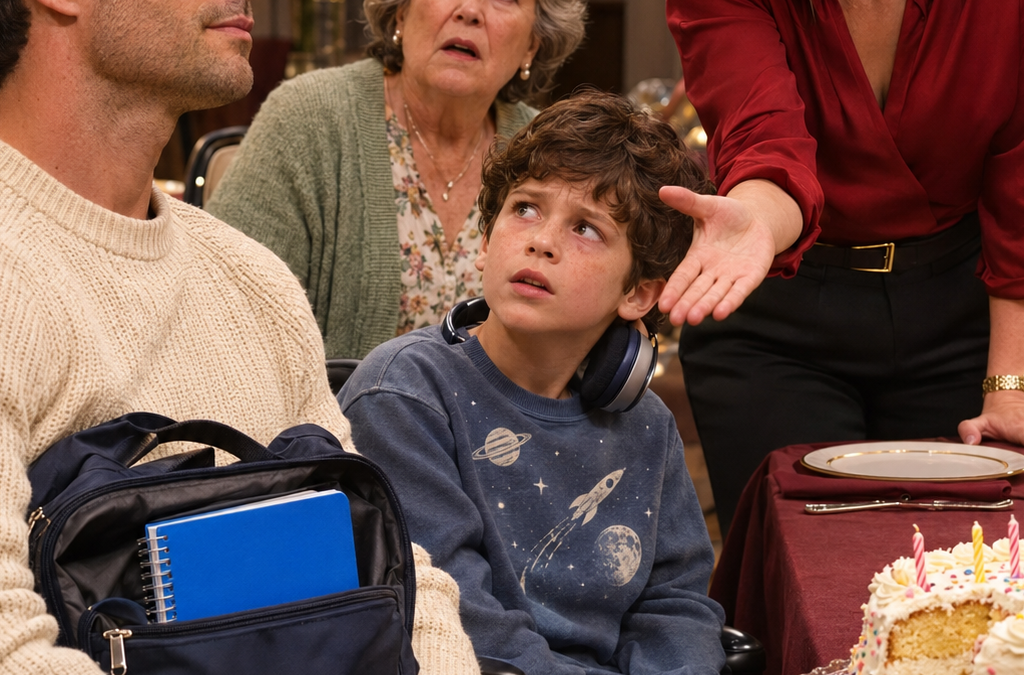
Owen sat beside me in his wheelchair, one headphone off. I was packing his travel kit beneath the faded astronaut zipper pull.
Rachel stood across the birthday table.
“You push his chair; my family provides his future.”
The zipper caught on a washcloth. Around us, relatives stared at cake crumbs and paper plates.
“His room at my parents’ house is ready,” she continued. “That needs to be his home base.”
Owen’s cartoon kept playing through the headphone against his neck.
“Are my space-comic pages moving, too?”
“Nobody’s moving you tonight,” I told him.
“The ones drying on the counter. Don’t stack them.”
“I won’t.”
Then I looked at Rachel.
“When were you going to discuss this with me?”
“That’s what I’m doing.”
“You said his room was ready.”
“Because we’ve been getting things ready. There’s space there. Help. I can take the promotion without wondering whether everything’s hanging by a thread.”
My mother’s birthday cake had a corner missing before we’d sung. She always tested the frosting, as though the bakery might change its recipe just to disappoint her.
Now she sat behind it without eating her piece.
Rachel looked toward her parents.
“The offer is $169,000. I can’t keep acting like this isn’t important.”
“It is important,” I said. “That doesn’t tell me why he’s moving.”
“Because I need a place where I’m still his mother when I come home.”
“You’re his mother here.”
“And I miss dinner, and you’ve already done everything. I get a report.”
Owen lowered the volume on his tablet. He left the headphone off.
“We can talk after cake,” I said.
“We keep saying later. Then later comes, and you tell me he’s tired.”
“He is tired.”
“He can hear us,” she said.
“I know.”
Her untouched dinner plate sat near my elbow. I picked it up automatically, ready to pack the food she’d forgotten again. Then I put it back in front of her.
I had made every changed plan look effortless.
Rachel glanced at the plate.
“Please don’t turn this into whether I ate.”
“I’m not.”
“Then hear what I’m saying. We spend about $6,400 a month. That doesn’t stop because you’re home now.”
“I know what we spend.”
“And my parents can help without every change becoming a crisis.”
Her mother leaned forward.
“The new room is practical. There’s room beside the bed. We checked.”
“But he has a room.”
“We’re trying to make things easier, honey.”
“For whom?”
“For everybody. You, too.”
Rachel stood closer to Owen.
“You liked the room, didn’t you?”
“The ceiling stars were good,” he said. “One was on the smoke alarm.”
“We’ll fix that.”
“Don’t ask him to settle this,” I said.
“I asked whether he liked the room.”
She looked around the table.
“Mom? You’ve seen how much there is to manage.”
My mother’s mouth opened, then closed. Rachel’s father watched Owen’s tablet. Neither answered.
The refrigerator hummed behind the serving counter.
“Being family did not make me replaceable.”
Rachel’s cheeks colored.
“Nobody said replaceable.”
“I’m not agreeing to move him.”
“You’d still see him. You could come over while I’m away.”
“Come over?”
“You know what I mean.”
“No. I don’t think you’ve heard what that sounds like.”
Her mother started to speak, but Rachel continued.
“I can’t turn this down and resent everybody afterward. I need us to make a plan that works.”
“Then make it with me.”
“We’ve talked about needing help.”
“Help isn’t the same as a new address.”
A blue spiral notebook showed through the open pocket of my bag. Rachel’s phone buzzed beside her plate.
“Fine,” she said. “Let’s stop guessing. This should be the final offer.”
Her mother said, “Read it. We can work around the details.”
Rachel started reading, still standing over Owen and me.
Rachel stopped with her phone above the table.
She read the screen again and said, “Two weekends, too?”
Her mother leaned toward her.
“What?”
“Travel. Two weekends each month, starting in June.”
Owen had resumed his cartoon, but he hadn’t put the headphone back on.
Rachel read farther down the promotion email.
“That’s why a family network matters. There would be people there. He wouldn’t have to wonder who was coming.”
“We need to talk about the actual days,” I said.
“We will.”
“Before anybody tells him where he lives.”
My mother finally spoke.
“Would anybody like coffee?”
Nobody answered. Linda stayed seated beneath the community room’s paper birthday banner. Outside, February darkness pressed against the windows in New Haven, Connecticut.
The blue notebook was my therapy ledger. I kept it beside appointment cards and school notices, writing while dinner heated or Owen finished brushing his teeth.
I’d been a payroll clerk. Dates and little boxes were a habit.
January held twelve therapy appointments. Harbor Access receipts were tucked in back among ordinary expenses: $84, billed to the family account. One dated January 19 read “Driver: D. Mercer” and “return only.”
My phone held the messages about changed pickups. I hadn’t deleted those, either.
Rachel glanced at the bag.
“Can we leave without making this uglier?”
“I was packing before you started.”
Owen looked up.
“Can I have the corner with the blue frosting?”
“Yes,” my mother said, too quickly. “Of course you can.”
Rachel’s mother began describing breakfast at their house.
“We should tell him what tomorrow looks like,” Rachel interrupted.
“Rachel,” I said. “I already told you—”
Her father started reading a work alert.
He lowered his untouched cake fork and asked, “Rachel, you booked this for tomorrow?”
“It’s a ride, Dad. I wanted it available.”
Daniel squinted at his phone.
“Six-forty in the morning?”
“That gives us time before school.”
He read another part aloud.
“Residence change.”
Owen’s cartoon stopped.
I crouched beside his chair.
“We’re going home now. You can finish that episode in the car.”
“Did Grandma save the blue part?”
“She’s wrapping it.”
Rachel followed us toward the community room’s accessible entrance.
“Don’t make the booking sound like an ambush. I was trying to avoid scrambling.”
“We’re not doing this over his head.”
“Then when?”
“When he isn’t listening.”
Outside, cold air lifted the edge of Owen’s blanket. He drove down the ramp while I walked beside him. At the family vehicle, I helped him transfer using our usual count.
Once he was settled, I checked his seat belt and secured the chair.
Rachel waited beside the passenger door.
“My parents can handle mornings.”
“Tomorrow he gets up at our apartment. Breakfast, backpack, his usual ride to school.”
“You’re deciding now, too.”
“I’m keeping his routine.”
“And where am I supposed to fit?”
“We need a parenting arrangement we can both be held to. I’m going to get help with that.”
Behind her, Carol held the cake container. Daniel stood in the doorway.
I’d spoken privately with Amy Collins on January 22. I had no promise about what would happen. I had questions, a retainer receipt, and somewhere to call.
Rachel stepped away from the door.
“Fine. We’ll talk tomorrow.”
Inside the car, Owen asked whether blue frosting would stain his tongue until school.
“Probably until college,” I said.
He checked himself in the dark window.
My phone buzzed before I started the engine. The family group showed a new message from Rachel, stamped 7:12 p.m.
“Matt has agreed to Monday.”
Chapter 2 of 7
On Monday, February 2, I answered the family message before Owen woke.
“I did not agree.”
Daniel replied that he had canceled the van booking. At 6:40 a.m., nobody came to move our son.
Owen ate breakfast at our apartment and complained about a sock seam. Then he left for his usual school. Nothing I had signed, or anyone had ordered, guaranteed the same routine next week.
At the door, he stopped his chair.
“My drawing.”
“The one on the counter?”
“For Mom. With the green planet.”
“You can give it to her later.”
“What if it gets spaghetti on it?”
That had happened once. Apparently, I was never getting past it.
I found a clean folder for the drawing. Owen had put Rachel in a rocket with an enormous windshield.
“She needs to see where she’s going,” he explained.
After his school ride left, I sent her a photograph.
“He made this for you. I’ll make sure you get it.”
Her reply came a few minutes later.
“Please don’t make it sound like I’m going away.”
I read my message again. Then I went back upstairs.
My mother called while I was folding laundry.
“Carol called me.”
“About yesterday?”
“She says they’re both worried you need relief.”
“Did they ask what I need?”
“Matt, I’m asking.”
A small shirt lay across my knee. Owen had outgrown it without my noticing.
“I need people to stop telling him he’s moving.”
“Could you try it for a month?”
I left the shirt where it was.
“Mom.”
“Just to see. You could rest. Get back to work, maybe.”
“And then what happens when I want him home?”
“I don’t know.”
“She said I could visit while she’s away. You heard that.”
“I heard a lot of things.”
“You didn’t say anything.”
There was a pause long enough for me to hear her television.
“I wanted to get through my birthday,” she said.
“I wanted that, too.”
“Carol says you’ve been struggling.”
“I’ve been doing the mornings, school, appointments. That isn’t the same thing.”
“You never said it was too much.”
“No. I kept saying I had it.”
She asked whether I needed anything from the store. I said no, although we were nearly out of milk.
At Owen’s appointment that afternoon, Claire Watkins asked him which exercise he wanted first.
“The easy one.”
“You said that last time.”
“And you didn’t listen last time.”
“I listened. I just didn’t agree.”
He laughed and chose the bench.
I helped with the transfer the way she had taught us. Claire corrected my position, then asked Owen whether his foot felt settled.
“Now it does,” he said. “Dad was crooked.”
“Dad gets crooked,” I said.
While Owen worked, I asked Claire about the clinic’s records.
“We keep attendance and treatment notes,” she said. “What do you need?”
“There’s a disagreement about where he should live.”
She waited.
“Do the notes say who comes with him?”
“When that’s relevant to the session, yes.”
I wanted her to keep talking. Instead, she watched Owen finish his count.
“You remember me being here, though.”
“Yes, Matt. I remember working with you on transfers.”
“Would you tell someone that?”
“I can describe what happened here. I can’t tell you which parent should have custody.”
Owen looked between us.
“Can you tell Dad I did twelve?”
“I certainly can.”
“Twelve,” he told me. “You only counted ten.”
“I stand corrected.”
On Wednesday, while Owen was at school, I met Amy Collins. Her office window faced a brick wall, and somebody nearby was reheating soup.
I had brought the blue notebook. It looked smaller on her desk than it did beside my kitchen calendar.
“Does keeping all this change anything?” I asked.
“We’ll review it alongside the other records.”
“So it doesn’t stop her.”
“It isn’t an order.”
I told her about the promotion and my mother’s phone call.
“Does earning more let her decide?”
“Money doesn’t make a fit parent disposable, and a court decides disputed parenting arrangements—not a family vote.”
She asked what I wanted Owen’s ordinary week to look like.
“School nights at our apartment. He knows the bathroom setup. His school things are there.”
“And Rachel?”
“Weekends with her. Enough time that she isn’t just stopping by.”
“What can you actually manage?”
We worked through transportation and school mornings. I wanted a plan I could carry out when I was tired, too.
That evening, Rachel came for Owen’s drawing. He explained the rocket’s windshield while she crouched beside him.
“I get the best seat,” she said.
“You’re driving.”
“Then I definitely need it.”
Later, out of his hearing, I told her my proposal.
“You’d have real weekends together,” I said. “I’d handle school nights.”
“My parents can handle school mornings.”
“I’m offering a schedule.”
“So am I.”
She left with the drawing held flat against her coat.
On Friday, February 6, the filed request arrived. Rachel had filed for legal separation the day before and asked for custody orders.
I read it at the kitchen table while Owen was at school. Her proposal described her parents’ help, their house, and the coverage they could provide during her travel.
I called Amy.
“She’s asking for the move anyway.”
“Yes. We need to answer it.”
I read the proposed weekday arrangement again. Carol and Daniel’s address was listed as Owen’s school-night home.
Chapter 3 of 7
On Friday, March 6, Owen’s school-night home was still our apartment. The temporary order entered Thursday gave Rachel eight monthly overnights: Friday and Saturday of the first four weekends.
Her request was for Owen to live with her, not for her parents to become his guardians. The final decision was still ahead.
Rachel arrived that evening with a printed calendar.
“I marked mine in green,” she told Owen.
“Space slime green?”
“Regular green.”
“Missed opportunity.”
He checked the squares, then looked at me.
“The comic store thing is tomorrow.”
“I know.”
We’d planned to watch an artist draw space creatures. I’d told him before the hearing that we would go.
“Can Mom take me?”
Rachel bent toward the calendar.
“We’re making your planet cake tomorrow. Remember?”
“Oh. Right.”
He wanted both. I couldn’t fix that by standing in the doorway.
“Tell me which planet you pick,” I said.
After they left, the apartment refrigerator clicked on. I had the whole evening and no idea what to do first.
Rachel’s financial papers lay beside my copy of the order. Her salary was $148,000 before the promotion. Her proposal described her parents’ accessible house and reliable family support.
When we spoke Sunday, she stayed on that ground.
“The rent is $1,850, Matt. That comes every month.”
“I’ve paid bills before.”
“With money I’m earning now. I’m not saying that to hurt you.”
“I know where the money comes from.”
“Then please stop treating the house as an insult. It’s a place we can sustain.”
“It’s also a different weekday for him.”
“That’s what we’re trying to settle.”
I had no answer that made our bank balance larger.
The $4,000 retainer I’d paid Amy in January was already gone from our joint savings. I’d disclosed it, but I kept opening the transaction anyway. Our emergency cushion had started at $24,000.
My mother found me checking it when she came over.
“You should tell them,” she said.
“Tell who?”
“The family. Write down what you do. Every appointment, every morning she’s away.”
“I’m not posting a list.”
“She’s telling her version.”
“And Owen’s grandmother will forward mine to somebody else.”
Linda sat across from me.
“I should have said something at dinner.”
“Yes.”
“I can say something now.”
“Then call me. Ask how I’m doing. Don’t make a scoreboard.”
She stayed for lunch. Neither of us mentioned the family chat again.
Owen came home Sunday with a photograph of a cake covered in crushed cookies.
“Mercury,” he said. “Mom said craters were easier than rings.”
“That was sound engineering.”
“The inside was lemon. Space can be lemon.”
He talked through the baking, including how Rachel had dropped an eggshell into the batter. I listened until he finished. Then we found another drawing event for a weekend without a green square.
Daniel called later that week.
“She’s worried about money,” he said.
“I’ve heard.”
“When you say you don’t know how long you can keep this up—”
“When did I say that to her?”
“You said it to me.”
I remembered. He’d called after a long school day. I’d been talking about waiting for appointments.
“Did you tell her that?”
“I’m trying to keep everybody talking.”
“What else have you repeated?”
“Nothing bad, Matt.”
“That wasn’t what I asked.”
He paused.
“You said you were looking for work.”
“She knows that.”
“And that your mother might help.”
I leaned back against the kitchen counter.
“That was a private conversation.”
“She’s my daughter.”
“I know. So let’s keep our calls about Owen’s rides and visits.”
“You don’t want me seeing him?”
“I didn’t say that. He’s expecting you Sunday.”
Daniel arrived Sunday. Owen showed him the cake photograph and explained why Pluto deserved its own cake. I left them to argue about it.
On Monday, April 6, I started remote bookkeeping, twelve hours a week at $24 an hour. The work fit while Owen was at school.
My first morning, I spent twenty minutes finding a duplicate invoice. For once, a mistake came with an invoice number and a way to fix it.
The weekly gross was $288. I wrote that into my budget, then left the other numbers alone.
Rachel called that afternoon.
“I’m glad you found something.”
“Thanks.”
“Does it change your availability?”
“Only during school. I’m still doing pickup.”
“Okay. I needed to check.”
I wanted her congratulations without the question attached. She probably wanted a schedule without another unknown.
By Friday, April 17, I had an evening planned with my mother. We’d bought tickets weeks earlier and arranged dinner first. Owen was ready for Rachel’s overnight before school, reminding me twice about his pajamas.
Rachel collected him that afternoon. I finished work and changed my shirt.
At 4:47 p.m., her message arrived.
“New assignment came through. I have to leave tonight. Can you collect Owen? I can’t do the overnight.”
I called her.
“He’s at my parents’,” she said. “I’m sorry. This wasn’t on the schedule.”
“Does he know?”
“Not yet.”
“I’ll get him.”
My mother answered on the second ring.
“We’ll go another time,” she said.
At the Mercer house, Owen asked whether we were still having dinner out.
“We’ll get something on the way home.”
His overnight things came back with him; the bag was still zipped.
Before starting the car, I checked the time on Rachel’s message again.
4:47 p.m.
Chapter 4 of 7
On Thursday, June 4, Amy asked what I wanted changed in the weekend schedule.
I’d collected Owen that April evening without an argument. Rachel called him the next morning, and he told her about the enormous dinner roll he’d eaten.
Other weekends had changed afterward. By June, I wanted fewer plans Owen packed for and didn’t get.
“The weekends she can actually use,” I said. “That’s what I’m asking for.”
“Not fewer because she took the promotion?”
“No. If she’s home, I want him with her.”
Amy’s office smelled like coffee left on a warmer. I had missed two bookkeeping hours for the appointment and would make them up before school pickup.
She described the revised request in a few lines.
“Check the transportation times,” she said.
I checked those first.
That afternoon, the evidence exchange went to Rachel’s attorney: copies of the blue notebook, Harbor Access receipts, our pickup messages, and the proposed witness list. Rachel would see the whole collection now.
I had spent the previous evening checking the copies against the originals. Owen had been at the kitchen table drawing a robot that needed municipal parking.
“Why does he get three spaces?” I’d asked.
“Dad. Look at his feet.”
Now the notebook was back beside the school calendar.
Rachel called before dinner.
“How long have you been keeping this?”
“The notebook? Since before February.”
“I can see that.”
“Then what are you asking?”
“Did you write things down while I was telling you I needed help?”
“I wrote down changes so I could keep track.”
“There are months here, Matt.”
“Yes.”
She didn’t dispute a date. I could hear pages moving.
“Claire is on the list?”
“She can talk about appointments.”
“And my father.”
“The rides are in there.”
“I know. I’m reading them.”
Owen called from the other room, asking whether the robot could park on the moon.
“I need to go,” I said.
“Of course.”
“Rachel.”
“No, go. I’m not asking you to leave him waiting.”
The next morning, her message appeared in the family group.
“I’m concerned that Owen’s private care is becoming a case against me. I want him to have both parents, not one parent controlling the information.”
My mother called before I finished reading the replies.
“Should I explain?”
“No.”
“She makes it sound like you’re hiding him.”
“I’m not putting his appointments in the chat.”
“What can I say?”
“Ask her how he’s doing. Ask me, too.”
I sent Rachel the school newsletter and the ordinary summary from Owen’s latest appointment. Then I called her.
“You’ll keep getting those,” I said.
“I should be able to speak to the school myself.”
“You can. You’re on their contact list.”
“I’m talking about feeling included.”
“What would help?”
“A call before everything’s already decided.”
“Okay. For decisions, yes. His next appointment is on the shared calendar.”
“I have the calendar.”
We stayed on the line a moment longer.
“Did he finish the robot?” she asked.
“He’s disputing a parking ticket.”
She laughed once, despite herself.
At the school art display on June 11, Owen directed us past a row of paper flowers.
“Mine’s down here. They hung it too high first.”
His moon city filled most of the page. Silver buildings stood on thick supports, connected by ramps.
Rachel leaned closer.
“You gave the library a landing pad.”
“For late books,” he said.
“That seems expensive.”
“Late fees.”
My mother laughed. She had come straight from the store and still wore her raincoat.
Rachel studied the smaller buildings.
“This would look good in your room at Grandma’s. We found a lamp shaped like Saturn.”
“Does it have real rings?”
“Lamp rings.”
“I like that room.”
“I know you do.”
He looked at me.
“Can Dad still read the comic on school nights?”
Rachel stayed beside the drawing.
“We’d work out reading.”
“But he does the robot voice.”
“You could call him.”
“Every chapter?”
“We haven’t worked all that out,” I said.
Owen frowned at the drawing’s label.
“They spelled Bennett right this time.”
He drove toward the next display, where a classmate had made a cardboard volcano. Rachel followed him to ask about the lava.
My mother remained beside me.
“He likes the room,” she said quietly.
“Yeah.”
“He’s still asking where you’ll be.”
Across the hallway, Owen told Rachel that moon volcanoes were different. She listened with her head bent toward his.
“Will you need me there?” my mother asked.
“At court?”
She nodded.
“I’d like that.”
“Tell me when.”
On Friday, June 12, Amy called with the trial date.
“Thursday, October 1. Nine in the morning. New Haven Superior Court.”
I repeated it while checking Owen’s school calendar.
Both attorneys and both parents would be there. Claire and Daniel were being notified as witnesses, too.
“Keep the morning clear,” Amy said. “We’ll meet before then.”
October looked far away on the calendar. I still had to decide what to make for dinner.
At 6:18 p.m., Rachel sent her revised plan. Her promotion had begun, and the schedule now included the travel weekends.
Under weekday arrangements, she had named Daniel “weekday transport and care contact.”
I read the line twice. It covered school mornings, afternoon pickups, and the time before Rachel returned.
Daniel’s message arrived while I was still on that page.
“I agreed to help with rides. She hasn’t shown me this page.”
Chapter 5 of 7
On Thursday, September 24, Daniel called before I left for his house.
“I’ll tell them the truth about my work,” he said.
“That’s what I’m asking.”
“I know. You told me to call the lawyers.”
Back in June, I’d sent him to both attorneys instead of answering his questions myself. His driving work and any promise of weekday care were separate things he needed to discuss with them.
The exhibits had already been exchanged. Rachel knew he was a proposed witness.
“Owen coming?” he asked.
“He’s drawing with my mother at the library.”
“Good. Better we talk without him.”
That much, at least, everybody had agreed on.
At the Mercer house, Carol had made chicken salad sandwiches. She still cut off the crusts, although Owen preferred them.
“He says the middle needs a handle,” I told her.
“That boy argues about bread.”
She almost laughed. Then Rachel came downstairs.
“Thanks for coming,” she said. “I’d rather solve some of this here.”
We had arranged to discuss the proposed school routine. I’d brought questions about mornings and pickup times, nothing from the evidence exchange.
Rachel sat across from me.
“He’s settled into third grade. He’s getting older. We should be looking forward.”
“I am.”
“He likes this neighborhood. There’s a boy down the street trading space comics with him.”
“He told me.”
“And he helped choose everything in his room. It isn’t somewhere we’re just putting him.”
“I know he likes it here.”
She paused, as though she’d expected a different answer.
“Then can we start there?”
“We can start with Monday morning. Who’s here?”
“Mom and Dad.”
“At what time?”
Carol answered.
“I’m up early. I can have breakfast ready. He likes my scrambled eggs.”
“He does,” I said. “Who helps him get ready?”
“We’d do it together,” Rachel said.
“When you’re traveling.”
“Then my parents. That’s the point of having more than one person.”
Daniel stayed near the kitchen doorway.
Carol looked toward him.
“Well, the rides would be your department.”
“And before the ride?” I asked. “Getting dressed, bathroom, transfer?”
“We’ve helped him before,” Carol said.
“I’m asking about every school morning.”
Rachel’s voice stayed even.
“Matt, nobody’s pretending there won’t be details to work out.”
“Those are the details.”
“We can learn a routine. You learned it.”
“Yes. I did.”
Carol’s eyes stayed on Daniel.
“I can do lunches. Afternoons, certainly. I’m usually here.”
“And evenings?” I asked.
“We’d have to compare calendars,” she said.
Rachel brought out a printed weekly chart. Different colors marked school, therapy, meals, and bedtime.
“I did compare them.”
Under the weekday blocks, her parents appeared together. Rachel’s name returned in the evening rows when she wasn’t away.
“This household has already been carrying weekday care,” she said. “We’re making that support consistent, in one place.”
Daniel looked at the chart.
“Rachel—”
“Dad, I’m not saying you do everything. I’m saying we have people.”
“I heard you.”
She turned back to me.
“You shouldn’t have to be the only person who knows how a Tuesday works.”
“I’d like help with Tuesdays.”
“Then why does every offer feel like something you have to defend against?”
“Because this one changes where he lives.”
“He would still have you. He’d also have a houseful of people instead of one exhausted parent.”
I said nothing at all.
Carol began talking about dinner times. Rachel joined her, naming the evenings she expected to be home. Daniel went into the hall, and I followed when he asked if I wanted coffee.
“I don’t need coffee,” I said.
“Neither do I.”
From the dining room, Rachel said something about keeping the same bedtime.
Daniel spoke quietly.
“I used to say, ‘we handled it.’”
I waited.
“When she called. When something hadn’t worked out. I hated giving her another problem.”
“What did you tell her you’d agreed to?”
“That’s what I need to clear up.”
“With her.”
“Yes.”
He looked toward the dining room.
“She’d be worried, and I’d want her to finish her day. So I made it sound easier.”
“I did that, too.”
“I know.”
“Don’t make it easier now.”
He didn’t answer before the doorbell rang.
My mother came in alone. Owen was back at my apartment with the sitter I’d arranged. He’d finished drawing and wanted pizza.
“He asked whether committee meetings always took this long,” she said.
“What committee?”
“He says that’s what adults have when nobody gets pizza.”
Carol offered her a sandwich.
Linda sat beside me.
Rachel waited until she was settled.
“We were talking about how much he enjoys being here.”
“I know he does,” my mother said.
“I don’t want that dismissed.”
“I’m not dismissing it.”
“He has a future here.”
“He has school tomorrow, too,” Linda said. “Matt asked who’s getting him ready.”
Rachel looked toward her father.
“We can answer that. Can’t we?”
Daniel remained standing.
“We need to talk about what I actually agreed to.”
The chart stayed between us through the rest of the visit. We left without agreement.
On Friday, September 25, Amy confirmed that both attorneys knew Daniel would testify about his transportation work. She asked me to keep any conversation with him about Owen’s immediate needs, not his testimony.
That evening, after Owen finished his homework, Daniel’s text arrived.
“I told her I would answer every question. She asked me not to describe the return trips.”
Chapter 6 of 7
“I called it the weekday handoff because nobody was leaving Owen without help.”
Rachel spoke from the witness stand that Thursday, October 1. The New Haven courtroom clock showed a few minutes past nine.
Before we went in, Daniel had stopped me outside.
“I told her no. I’ll tell the judge who rode with me and who took care of Owen afterward.”
Now he waited outside until called. I sat beside Amy. Linda and Carol listened behind us. Owen was at school.
“I paid for accessible transportation,” Rachel continued. “My father drove. My mother was available. Bringing that support into their house seemed more stable than arranging it from separate places.”
Scott asked about the canceled pickups.
“Yes, I canceled some,” she said. “I don’t dispute the messages. But Matt describes those changes as if the care stopped when I couldn’t come.”
“What happened instead?”
“We used the people and services we had. That’s what I’m proposing we continue.”
Judge Price looked toward her.
“Were these arrangements made before your cancellations?”
“Some were made afterward. I’m not claiming every day went smoothly.”
Her answer stayed with me while I waited to testify. She sounded reasonable. We had paid for help. Daniel had come.
Then Amy asked me what happened on those journeys.
“We went home.”
“Who went home?”
“Owen and me. Together.”
The January 19 receipt was already admitted. I picked it out of the exhibit copies in front of me.
“This one. The destination was our apartment. It wasn’t a transfer to his grandparents.”
“Who remained with Owen?”
“I did. In the van, then at home.”
Scott stood for his questions.
“You’re not suggesting his grandfather provided no help?”
“No. We needed the ride.”
“And Rachel’s earnings helped pay for it?”
“Yes.”
“So her account of a family support network isn’t false.”
“The ride happened. I’m asking that it not be counted as somebody else taking over his care.”
Claire testified next. She described attendance and the transfers she had practiced with Owen and me. His treatment material stayed with the exhibits; nobody passed it along the family row.
“Are you recommending a residential parent?” Scott asked.
“No. I’m describing our appointments.”
“Could another adult learn those transfers?”
“Yes, with instruction and practice.”
Her answer was fair. I was glad Owen hadn’t heard me need someone to say I’d been there.
When Rachel returned to the stand, she acknowledged the destination.
“Coming back to the apartment doesn’t erase what I arranged,” she said. “The same support can operate from my parents’ house. I’m trying to make it less scattered.”
Judge Price asked, “Who has agreed to provide the weekday care while you travel?”
“My parents. That was my understanding.”
Daniel came in when the clerk called him. He looked toward Rachel before taking the oath.
Amy asked him to identify the driver on January 19.
“D. Mercer. That’s me.”
“And the service notation?”
“‘Return only.’ I picked them up after therapy and drove them home. Matt and Owen.”
“Was that a transfer into your care?”
“No. Matt rode with him. He was the accompanying adult.”
Judge Price leaned forward.
“Who accepted responsibility for Owen when the trip ended?”
“Matt. I helped them get home. I didn’t stay and take over.”
Amy asked about the dated messages beside that receipt.
“Rachel couldn’t make the pickup,” Daniel said. “Matt booked the return. That’s what those messages are about.”
“Was January 19 different from the other five January return rides?”
“Not that way. Matt came with Owen on all six.”
Scott asked whether Daniel had reassured his daughter that the family had handled those days.
“Yes,” Daniel said. “I said, ‘we handled it.’”
“Could she reasonably have taken that as confirmation of family care?”
“Yes. I let her.”
Rachel looked down.
Daniel continued, slower now.
“I wanted her to finish work without worrying. I left out how much Matt was still doing.”
Judge Price asked, “Have you agreed to the standing weekday responsibilities in her proposal?”
“No. Occasional driving, yes. Not getting him ready every morning and caring for him until she gets back.”
After arguments, Judge Price addressed Rachel again.
“Is there another confirmed weekday caregiver I haven’t heard from?”
“No,” Rachel said. “But we can work out what’s missing.”
“Transport you arranged is not weekday care your father agreed to provide.”
Rachel’s lips parted, but the judge continued.
“Owen’s primary residence will remain with his father. I’m granting Mr. Bennett primary physical residence. Joint legal custody remains.”
She looked between us.
“Ms. Mercer will have the first and third weekends, Friday at six until Sunday at six, and Wednesday dinner contact. That gives Owen scheduled time consistent with the availability established here.”
It was approximately 11:35. In front of both families, Rachel lost four monthly overnights.
She stood with her unused weekly chart gripped against her skirt. Scott quietly touched her sleeve, and she sat again.
“Four nights,” she said.
He bent toward her, answering too softly for me to hear.
Carol asked whether Wednesday dinner included homework. Amy said we would check the written instructions. Even then, there was homework to arrange.
Daniel had been permitted to remain after being excused. He crossed to the chair beside mine. Linda moved hers closer.
“I should’ve told her,” he said.
I couldn’t answer that yet.
Rachel came over after speaking with Scott.
“Could we leave tomorrow alone? Start the new weekends after that?”
Tomorrow was the first Friday in October.
“We’ll use the schedule,” I said.
“She’ll still be his mother,” Carol said.
“He needs both parents. He will not lose his home.”
Rachel looked at me, then toward the doors.
I checked the exchange instructions with Amy: six o’clock, my apartment, Sunday return at six. Beneath my chair, Owen’s travel bag showed its faded astronaut zipper pull. I’d forgotten to take it out after school drop-off.
Rachel came back before I left.
“I have the spare transport sling. I’ll bring it Friday.”
She waited until I looked up.
“Six o’clock at your place?”
Chapter 7 of 7
Rachel arrived at 6:00 p.m. on Friday, October 2, with the spare transport sling folded over her arm.
“This one’s clean,” she said.
I checked the label, then passed it back with Owen’s overnight things.
“He ate at four. The school folder’s in the side pocket. Nothing new from therapy.”
“Mom, the captain doesn’t know the moon is fake.”
Owen had been waiting beside the door with his unfinished comic across his knees.
Rachel bent to see it.
“Should I know that yet?”
“You can know. He can’t.”
“Okay. I won’t tell him.”
He showed her the panel where he’d drawn a seam across the moon. She asked why the captain hadn’t noticed.
“Bad windshield,” Owen said.
I held the door while they went out. Rachel reminded him to keep his page clear of the wheels. He reminded her that he knew.
Neither of us mentioned court.
When he came home Sunday at six, he brought the comic and a shirt with tomato sauce on it.
“Mom says that part might be permanent.”
“We’ll give it a shot.”
“She already did.”
“Then we’ll admire the color.”
On Thursday, October 15, the separate support determination came through. Amy called while I was between bookkeeping assignments.
“The order is $1,420 a month,” she said.
“Starting when?”
She gave me the payment details and sent the written order. The amount came from the financial information we’d submitted. I read the due dates twice.
“That’s separate from the parenting schedule,” she added.
“I know.”
I put it in the budget beside rent, groceries, and transportation. Then I called about an invoice that had been entered twice.
The order didn’t settle every expense of raising Owen. It gave me an amount I could plan around and a due date I didn’t have to negotiate.
The first full payment arrived November 1. The next arrived December 1. Both were $1,420.
I stopped checking the account every morning.
In November, Rachel sent a request for an extra Sunday overnight after one of her weekends.
“I could take him straight to school Monday. I’d like another evening.”
Owen had spent that week rehearsing for a classroom presentation. His poster was drying on our counter, and he wanted to practice with the little pointer he’d made.
I answered in writing.
“Not this Sunday. He wants to rehearse here, and we have his school things ready. We can look at another date.”
Her reply came after dinner.
“Okay. Please send a picture of the poster.”
I did. On Sunday, he came home at six and rehearsed until I could have given the presentation myself.
“Don’t say it with me,” he complained.
“Sorry.”
“You’re ruining the suspense.”
“It’s the solar system. I know some of the ending.”
He made me sit farther away.
Rachel withdrew the weekday-care chart from her proposal. In the shared calendar, her work trips began appearing outside the first and third weekends.
Once, she called before accepting a travel change.
“I’m keeping Friday clear. The flight they wanted would get me in too late.”
“Okay.”
“I told them I needed the earlier one.”
I checked the school calendar while we spoke. There was no bag to unpack, no call I had to make afterward.
“Six as usual, then,” I said.
Daniel still drove occasionally. When he did, he asked where we needed to go and when.
He called one Saturday about visiting Owen.
“He’s with Rachel this weekend,” I said.
“Right. I’ll ask her.”
Later, on one of my weekends, he came over to help Owen assemble a cardboard rover. He asked me before bringing it.
They put one wheel on backward. Owen insisted that Daniel leave it long enough to test.
“For science,” he said.
Daniel looked at me.
“He gets that from somebody.”
“Don’t bring me into your engineering trouble.”
I stayed in the kitchen until they called for help.
My bookkeeping work remained twelve hours a week. I still earned $288 gross when I worked all twelve. There were weeks when an unexpected school closure meant finishing after Owen went to bed.
I wasn’t buying a house. I was paying rent, tracking the bills, and learning which client always forgot to attach receipts.
My mother began coming over without asking what had gone wrong.
Sometimes nothing had.
One afternoon, she stayed through a whole grocery delivery, arguing with me about whether I’d ordered too many onions. Owen kept count from the table.
“Grandma has said onions nine times.”
“Because your father bought nine onions.”
“That’s ten.”
She stayed for dinner. Nobody needed rescuing before dessert.
By Sunday, December 27, the holiday visits had happened without a string of correction messages. Owen had spent happy time with Rachel, Carol, and Daniel. He’d returned with a new comic and several detailed complaints about a board game his grandfather refused to read the directions for.
That morning, Rachel called to ask whether he’d found the missing game piece.
“In my sleeve,” Owen told her.
“How did it get there?”
“Secret tunnel.”
He promised to show her his newest drawing on their next call.
After lunch, I asked where he wanted to go.
“Library. Space-comic shelf.”
“You haven’t finished the one Mom gave you.”
“I’m allowed to plan ahead.”
Fair enough. I checked the afternoon hours, then looked for my coat.
“Leave that one out,” he said.
His drawing showed a space station with a crooked garden.
“For Mom?”
“Yeah. Don’t file it. I need to explain the carrots.”
I left it flat on the table, away from my coffee.
At the apartment doorway, we went through the usual list. Library card, comic to return, water, what he needed in the travel bag.
“I can do the zipper,” he said.
“I know.”
“You’re standing like you’re going to help.”
I moved back beside the coat hooks.
Outside our door, someone was carrying groceries upstairs. A car horn sounded on the street. We had time before the library closed, and Owen wanted the corner of the washcloth tucked in first.
“Wait,” he said.
I waited while he caught the faded astronaut zipper pull.
Owen zipped the astronaut into place.







