My daughter-in-law told our doctor I couldn’t live alone in my $310,000 home; she didn’t know what I’d done before refusing her.
Chapter 1 of 7
“Grandpa needs supervision, not three bedrooms.”
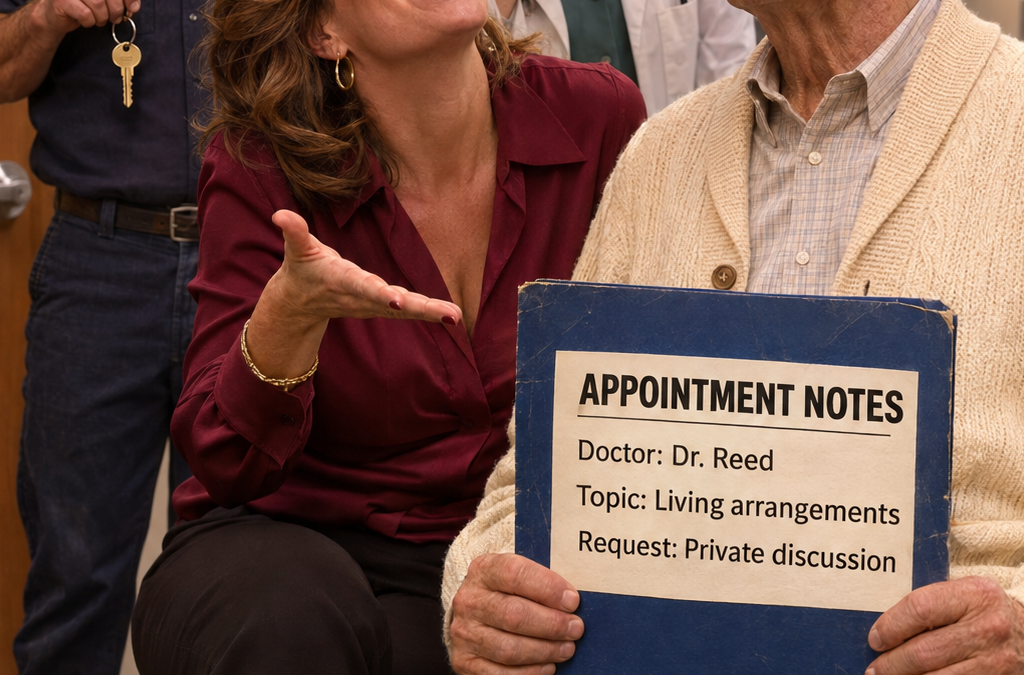
Emma held my hand against the examination table’s paper cover. It was 9:10 a.m. Claire sat nearest Dr. Reed, while my son stood beside the door. My old brass house key hung on his ring.
“I’m sitting right here,” I said.
“I know, honey. That’s why we’re having this conversation together.”
“You’re having it over me.”
Claire looked at Emma before answering. “We nearly lost you. Nobody wants another phone call like that.”
“I was sick. I’m still getting my legs back.”
“And who would notice if you got sick again?”
Dr. Reed moved her chair away from the computer.
“Let him answer.”
“I would call,” I said. “Sooner than I did.”
“You said that last time,” Claire said.
There wasn’t a last time like that. There had been smaller things, though. A missed callback. Groceries left too long in the car. I couldn’t honestly pretend I had become easier to worry about.
“I made a mistake waiting,” I said.
Emma’s grip loosened a little.
Claire leaned forward. “We have a chance to arrange something safer. One household. Someone there at night. I’d like your support, Doctor.”
“Support for what, specifically?”
“A shared move. And using the house to make that possible.”
“The house isn’t an extra,” I said. “It’s where I live.”
“Of course. But keeping it empty afterward wouldn’t help anyone.”
“After what?”
“After we get you settled.”
My hand started toward the pocket where I kept my checkbook. Then it stopped.
I had paid before asking until they stopped expecting questions.
I had done one thing before I said no, but I didn’t know whether it would be enough.
Claire watched my face.
“The $18,000 would cover the transition. We’d account for everything. This isn’t me asking for spending money.”
“I already answered you.”
“I’m asking you to think about the whole family.”
My son studied the floor beside his work boots.
“Do you have anything to say?” I asked him.
He looked up. “We’re trying to keep everybody together, Dad.”
“Then talk to me.”
“I am.”
“No. You’re standing by the door.”
Emma’s sneaker squeaked against the stool. “Grandpa, Mom means somebody could hear you if you fell.”
“I know what she means.”
“Then why are you mad at her?”
That hurt worse than Claire’s line about the bedrooms. Emma had come straight from class, still carrying a canvas bag with a broken zipper.
“Because hearing me fall isn’t the same as hearing me now.”
Claire’s voice stayed gentle. “She’s nineteen. She shouldn’t have to wonder whether you’re alone and frightened.”
“I wasn’t frightened until people started planning where I’d sleep.”
“Please don’t put that on her.”
Dr. Reed interrupted. “Emma didn’t make this plan. Let’s leave her out of that part.”
Claire nodded, accepting the correction.
“Then consider my husband. His hours have been cut. We need some stability before our lease ends. I can help him and his father under one roof.”
“And my house supplies the roof?”
“It supplies choices.”
“Yours.”
“Ours, if you’d participate.”
The examination paper scratched beneath my knees. I had worn my good trousers, and the seam pressed into a tender patch behind one knee.
Dr. Reed asked whether I was still itching.
“Yes. Mostly at night.”
“We’ll look at that too.”
Claire turned back to her. “What I need today is something explaining why living together would be medically sensible. Without that, everything looks like a family disagreement.”
“It is a family disagreement,” I said.
“There are medical concerns.”
“Then treat those.”
“Frankly, you’ve been refusing help.”
“I’m refusing a move. You drove me here. I thanked you.”
She looked toward my son, but he offered nothing.
“I’m not asking you to stop being his doctor,” I told Dr. Reed. “I’m asking you not to recommend a house I haven’t chosen.”
Claire began, “We’re family—”
“Being family didn’t make my answer smaller.”
Nobody answered that. Outside, a cart rattled past the examination room.
“Could I speak to my doctor alone?”
Claire’s lips parted. Then she stood.
“Of course. We’ll be right outside.”
After they left, the worn blue folder rested across my knees. Dr. Reed asked permission to look. I said yes, and she reached the first sheet.
Dr. Reed stopped with her pen above the page.
“You saw someone before the hospital?”
“Yes. Before I refused the loan, too.”
I had arranged an independent assessment with Dr. Alan Foster in Fresno, California. This was Monday, April 13; the appointments had been in March. I hadn’t told Claire.
At the second visit, after lunch, the appendix listed a follow-up worksheet beside the appointment time, 2:10 p.m. The folder also held a pulse entry and my medication log: hydroxyzine, 10 mg at 9:00 p.m.
“May I read all of it?” Dr. Reed asked.
“Yes. Just not with them standing over us.”
She read while I watched a crooked poster about walking shoes.
“I still need to examine you today,” she said.
“That’s what I came for.”
Afterward, she asked whether I wanted the others back.
“For the budget. Not this.”
My son, David Bennett, came in behind Claire. He had taken her surname when they married in 2004; Emma carried it too.
Claire brought out her household budget.
“This explains the timing,” she said. “I’m not asking anyone to decide everything this morning.”
“There’s an attachment I haven’t seen,” Dr. Reed said.
“It’s the practical part. People need dates before they can hold anything.”
The doctor reached the next page.
Dr. Reed stopped turning the attachment.
“Why is a $2,400 reservation attached to this?”
The moving reservation required payment Friday, April 17. Claire proposed paying from her savings, then recovering the cost through the shared relocation allocation. The terms said she would lose it if she canceled.
“You haven’t agreed on a move,” Dr. Reed said.
“We’d lose the opening if I waited.”
“I won’t recommend relocation without separating his wishes from what’s convenient for everyone else.”
Claire’s face reddened, but her voice remained level.
“I understand how that looks. But I take time off for these visits. I handle the calls when prescriptions aren’t ready. Sometimes I’m on hold during my lunch.”
“I know you do,” I said.
“And someone still has to do it tomorrow.”
“I’m not saying you haven’t helped.”
“Then please don’t make it sound like I wandered in wanting your furniture.”
Emma looked from her mother to me.
“Would I still have my room at Grandpa’s?”
Claire answered quickly. “You’d have a fresh start with all of us.”
“My room has the little bathroom.”
“And we’d find something that worked.”
Emma stared at the budget. “He keeps the ugly blanket there because I like it.”
“It’s an excellent blanket,” I said. “Your grandmother just didn’t understand orange.”
Emma laughed once, then looked embarrassed.
“I will accept help,” I said. “I haven’t agreed to sell.”
David shifted beside the door.
“We can talk at home,” he said.
“My home,” I said. “And yes, we can talk.”
By approximately 10:05, we were leaving the clinic. My legs felt unsteady after sitting so long, and I accepted Emma’s arm.
A woman I didn’t know approached near the exit.
“Frank Miller?”
“Yes.”
She identified herself as a process server and personally handed me papers. Claire stood beside David without speaking.
The first page bore Claire’s name as petitioner. Behind it were a valuation and a record identifying me as the house’s owner.
I read the request twice beneath the clinic’s exit sign.
She was asking permission to sell my house.
The requested $18,000 was for the petitioner’s household relocation.
Chapter 2 of 7
“‘$18,000 toward the petitioner’s household relocation,’” Rachel Hayes read. “That’s what she’s asking for. She doesn’t have permission.”
It was Tuesday, April 14. Her office overlooked a parking lot in Fresno, California.
“So the house is still mine?”
“Yours alone. Unsold.” She looked across the desk. “What do you want, Mr. Miller?”
Nobody had started there yesterday.
“To stay home. Get better. Have somebody check on me without picking out my next address.”
“Who would you accept help from?”
“Depends on the help.”
“Fair enough.”
I had brought the papers served at the clinic and the earlier packet. The hospital bracelet had left a pale strip on my wrist.
Hayes asked about April 3.
“I had a stomach illness. Got dehydrated. By the time they admitted me, I couldn’t keep things straight.”
“Bills?”
“I couldn’t have managed them. I asked where my wife was.”
Hayes waited.
“She died in September.”
“I’m sorry.”
“I don’t remember asking. My son told me afterward.”
“And the emergency order was April 6?”
“Yes. The day I came home.”
“The judge waived advance notice for good cause while you were acutely confused. Someone served you April 8?”
“A man at my door. Then Maria Lopez, the court investigator, came that day. Explained my rights. Asked whether I wanted a lawyer.”
“And here you are.”
“What exactly can Claire do?”
“The temporary order lets her manage that checking account for insurance, utilities, actual medical bills, and your specified allowances until May 4. It gives her no power to sell your house, choose where you live, or touch your separate savings.”
“She paid the insurance.”
“That needed paying.”
“I know. I’m not trying to make that wrong.”
“You don’t have to.”
I wanted help, not a replacement.
I gave her the blue folder, including the complete assessment and appendix.
“Please keep everything together.”
“I will. I’ll disclose the complete copy with your response to the general petition.”
“Will it stop this?”
“I’ll represent you. I can’t promise the result.”
She checked the report’s date.
“The hospitalization came afterward. We have to address that.”
“I’m better than I was.”
“Tell me what’s still difficult, too.”
That question took longer. Stairs tired me. Some mornings I sat down halfway through dressing. I hated admitting how often I checked whether the phone was charged.
Hayes wrote those things down along with everything else.
*
Emma had a bookstore break that afternoon. Claire had brought her lunch, and I met them at a small table outside.
Emma’s sandwich had potato chips inside it. She had done that since grade school, then complained when they scratched her mouth.
“Still dangerous food,” I said.
“It’s texture, Grandpa.”
Claire smiled, but her lunch remained unopened.
“How was your appointment?”
“With my lawyer?”
“Yes, honey. With your lawyer.”
“We talked.”
“I hope she knows we’re trying to keep the family together. Our lease ends June 30. We can’t leave everything until the last week.”
Emma looked at me. “Mom said you offered the house so everybody could have enough space.”
“I didn’t offer to sell it.”
Her chewing stopped.
Claire answered before she could. “You said there was no reason we should struggle while you had all that room.”
“I offered Sunday dinners. And you staying a few nights when the power was out.”
“We’ve discussed more than that.”
“You asked. I didn’t agree.”
Emma stared at the sandwich.
“Then where would your stuff go?”
“I don’t have an answer. It wasn’t my plan.”
Claire’s voice stayed low. “There would be room for what matters. We’re not throwing his life away.”
“I didn’t say you were,” Emma said.
“You sound upset with me.”
“I’m asking where his stuff goes.”
Her break alarm sounded. She ignored it until I told her to get back inside.
“You don’t have to settle this,” I said.
“But I thought—”
“I know. Go clock in.”
Claire watched her leave.
“She doesn’t need this stress.”
“Then don’t tell her I offered.”
*
David drove me home. Before we left, Claire spoke through his open window.
“Would you talk with him about agreeing voluntarily? We could stop putting everyone through this.”
“I’ll talk to him,” he said.
For most of the drive, he discussed traffic.
Inside my house, he stood near the hallway while I sat down. Walking from the driveway had worn me out.
“The move would solve several problems, Dad.”
“Whose problems?”
“All of ours.”
“Name mine.”
“You’d have someone there.”
“And yours?”
He looked toward the kitchen.
“Work’s been thin. You know that.”
“I do.”
“Claire’s carrying a lot.”
“So tell me you need help. Don’t tell Emma I offered my house.”
“I didn’t tell her that.”
“Did you correct it?”
He said nothing.
“David.”
“I’m trying to get us through June.”
He left without answering anything about my house.
*
After supper, I opened my bank account on the computer. The allowance was there, but the controls remained. Saying no hadn’t changed those.
The kitchen faucet had been leaking for weeks. An unnamed contractor’s estimate was beside the keyboard; I had put off the repair through the hospital stay.
I scheduled the $600 transfer from checking. It was my faucet, my bill, my money. I expected a delay, perhaps a call.
Wednesday morning, April 15, I was eating toast when the bank notification arrived at 9:12 a.m.
The $600 repair transfer had been canceled at Claire Bennett’s instruction.
Chapter 3 of 7
“Repairs aren’t on the list, honey,” Claire told me. “Insurance, utilities, medical bills. The allowance. I can’t approve something the judge didn’t include.”
“The faucet won’t wait for a hearing.”
“I know. But I can’t change the order.”
By Thursday, April 16, the leak had soaked through another dishcloth. I called the contractor myself.
“The transfer didn’t go through,” I said.
“I saw. You still want the work?”
“Yes. Could I pay you in installments?”
He asked how much I could manage. I explained that I received personal money weekly, then stopped before explaining why.
“I can work with that,” he said. “But I can’t buy the parts and hold tomorrow’s slot.”
“When could you come?”
“Let’s get the first payment settled. Then I’ll check my calendar.”
I had taught public school for forty-one years. Now I was explaining my allowance to a man who only wanted to fix a faucet.
“Fine,” I said. “Thank you.”
After the call, I ate lunch beside a plastic tub catching drips. The bread bag said twelve servings. Whoever counted those had never made a decent sandwich.
Emma came by between class and work. She stayed standing near the kitchen table.
“Dad said you got mad about the repair.”
“Did he say whether he offered to fix it?”
“He’s working today.”
“I’m glad.”
She glanced toward the sink. Then she showed me her phone.
Claire had sent a message to the family group. It began with an apology for not keeping everyone updated.
Dad wanted us together before this became so complicated. We’re trying to honor that while making sure his bills are handled safely. He recently tried to pay the homeowner’s insurance twice, even after I explained it had been paid. Please be patient if you hear a different version from him.
Below it, someone had written, You’re doing so much.
Emma watched me read.
“I didn’t try to pay it twice,” I said.
“Was there another bill?”
“There were two copies. I asked why.”
“Mom said you kept asking.”
“I asked again. She answered something about coverage, and I was asking about the papers.”
“So you didn’t send anything?”
“No second check. No second payment.”
She read the message again.
“That makes it sound like she stopped you.”
“Yes.”
“I can tell them.”
“You can say what I told you. You don’t have to argue with anybody.”
She called her father before leaving. I could hear his voice, though not every word.
“Dad, he says he asked about copies.”
A pause followed.
“No, I’m not calling Mom a liar.”
Another pause. Emma looked toward the sink.
“Okay. But people already read it.”
When she hung up, she stayed near the doorway.
“He says not to inflame things.”
“Does he think correcting it would?”
“He said Mom’s exhausted.”
I said nothing at all.
David arrived later with a printed relocation budget. His work shirt smelled faintly of attic dust.
“Claire needs this back,” he said.
“What is it?”
“Same numbers you’ve seen. She wants everyone clear.”
The top paragraph described shared housing as a plan I had proposed. Underneath were places for our signatures.
“I didn’t propose it.”
“The budget isn’t a contract, Dad.”
“Then change that sentence.”
“It’s how she remembers the conversation.”
“How do you remember it?”
He looked down the hallway.
“We talked about helping each other.”
“That isn’t what it says.”
“She’s trying to show this wasn’t something she dreamed up while you were in the hospital.”
“But I didn’t suggest selling my house.”
“You don’t have to sign the sale part.”
“There’s only one signature line.”
He read it again.
“Could you at least think about the larger place?”
“I have. I’m not signing this.”
For a moment, he seemed ready to sit down. Instead, he remained beside the table.
“I need to get this back to her.”
“Then take it back.”
He left with the signature line empty. Before his truck started, I heard him talking on the phone.
“He wouldn’t sign.”
He stayed in the driveway until the call ended.
That afternoon, Rachel Hayes called. Claire’s lawyer, Peter Grant, had contacted her about the assessment.
“His position is that it came before your hospitalization,” she said. “He says the behavior they’re concerned about came afterward.”
“So they’re saying it doesn’t count?”
“They’re saying it doesn’t answer everything.”
I looked at the tub beneath the faucet. It needed emptying again.
“I was sick afterward. I’m not arguing that.”
“We’ll need to address what happened afterward, too.”
“Can you ask them to stop telling people I offered the house?”
“I can raise it with Grant. I can’t make your family take back a message.”
On Friday, April 17, Claire sent me a separate message. She had paid the $2,400 moving reservation from her own savings.
I know nothing is approved yet. I believe we can still put a workable plan before the judge. Waiting would have lost the booking. I’m not asking you to reimburse me today.
I read that last word twice.
Later, Hayes called about a new sworn declaration Grant had sent her. I asked her to read the allegation aloud.
“Beginning April 9, after his hydroxyzine prescription was renewed, he could no longer distinguish an unpaid insurance bill from one already paid.”
Chapter 4 of 7
“I remember asking about the two copies,” I told Hayes. “I don’t remember every word.”
It was Monday, April 20. She had Claire’s declaration open beside my response.
“Were you tired that evening?”
“Yes. I’d been home from the hospital three days.”
“Did you ask the same question more than once?”
“I think so. She kept telling me the insurance was paid.”
“And you were asking why there were two papers?”
“Yes. But don’t write that I remember every sentence. I don’t.”
“We won’t.”
“I want the whole chronology in there. Even the parts that aren’t flattering.”
Hayes turned her screen so I could see the attachments. The complete assessment, appendix, prescription records, and my response were addressed to Peter Grant.
“Everything?” I asked.
“Everything you gave me.”
She clicked Send. The message disappeared into the sent folder.
“Dr. Foster has agreed to testify,” she said. “He’ll identify his report and answer questions about his work.”
“Claire’s lawyer’s questions too?”
“Yes.”
I watched the screen a little longer. Claire could read it now. So could her lawyer.
“Does being able to handle money mean being able to handle everything?” I asked.
“No. Financial capacity concerns particular tasks. Trouble with one task doesn’t automatically settle another.”
“And this report?”
“It’s evidence. It doesn’t decide the case.”
That afternoon Claire called me.
“You could have told us you were seeing someone, honey.”
“I wanted to choose him myself.”
“I’m glad you asked for help. Truly. I wish you’d let us know.”
“I’m telling you now.”
“Yes. But this was before you got so sick.”
“I know when I went.”
“I’m not arguing about that. An earlier picture can’t tell us everything about how you’re doing after the hospital. Or after they put you back on the prescription.”
Her voice sounded worn rather than angry. I could hear a microwave beeping behind her.
“Then we’ll talk about what happened afterward too,” I said.
“I hope you’ll let the doctor do that.”
“I will.”
She stayed on the line another moment.
“Did you eat?”
“Yes.”
“What?”
“Chicken.”
It had been chicken and three crackers, standing at the counter. I didn’t give her the crackers.
Maria Lopez came Tuesday, April 21. She asked whether the kitchen table would work.
“The chair nearest the stove wobbles,” I said.
“I’ll take the other one.”
“Everybody does.”
She asked how I kept track of spending. I showed her my grocery receipt and the cash remaining from Friday’s personal money. The checking account still wasn’t mine to manage freely.
I read the receipt, counted what remained, and wrote the amount in my notebook. Then I noticed I had copied one digit incorrectly.
I crossed it out.
“Does that happen often?” she asked.
“Writing a number wrong?”
“Having to correct one.”
“I taught children for forty-one years. I allowed corrections.”
“I’m not grading you, Mr. Miller.”
“It feels close.”
She waited while the refrigerator motor rattled through its usual complaint.
“I do make mistakes,” I said. “I don’t have a count.”
“What helps you catch them?”
“Checking twice. Keeping the receipt. Reading when I’m not half asleep.”
“What help would you agree to at home?”
“Bank alerts. A large-print calendar. Mine has squares made for people with no appointments.”
She smiled at that.
“Anything involving another person?”
“Weekly calls. Somebody asking how I am without turning every answer into a reason to move me.”
“Who could make those calls?”
“Emma, if she wants. My son. I’d need to ask them.”
“And what would you refuse?”
“Someone choosing my home because theirs costs more.”
Lopez wrote that down.
“The court has to consider less restrictive arrangements,” she said. “Specific help, rather than handing someone broad control.”
“Will you recommend that?”
“I’ll report what I observed and what we discussed. The judge decides.”
Before she left, she asked about the leaking faucet. I told her the repair was delayed while I arranged payments.
I disliked having that in her notes. I told her anyway.
Hayes called later that week to go over the hearing.
“Monday, May 4, at 9:00 a.m. Probate department, Fresno County Superior Court.”
I repeated it while I wrote.
“Claire has to prove the need for the general conservatorship by clear and convincing evidence,” she said.
“So I don’t have to prove I never forget anything?”
“No.”
She confirmed that Foster and Lopez would attend. Claire and Grant would be there, along with David and Emma.
“Your family will hear the testimony,” she said.
“They’ve heard plenty about me already.”
“We can still discuss an agreement.”
“One where I keep my house?”
“Only terms you accept.”
“Then keep preparing for court. I want to be there when people answer.”
On Friday, April 24, Hayes asked me to come in. Grant had sent a written offer after talking with Claire.
“She’s offering to withdraw the broader petition,” Hayes said.
I read far enough to find the condition.
“She still wants the move.”
“Yes. Voluntarily agreed.”
“Does the judge want my answer by this date?”
“No. It’s her settlement deadline. You aren’t ordered to accept it.”
The paper described a shared household, shared support, and a relocation budget. My house appeared as the way to pay for it.
I went back to the paragraph about withdrawal. Hayes waited across the desk.
Claire would withdraw the broader petition if I signed the shared-relocation agreement by May 1 at 5:00 p.m.
Chapter 5 of 7
“Tell her I won’t sign the shared-relocation agreement,” I told Hayes. “I’ll go to the hearing.”
It was Friday, May 1. She asked whether I wanted more time.
“No. Please send my answer.”
“The account restrictions stay in place until the judge addresses them.”
“I know.”
My $2,940 pension deposit had arrived that morning. So had the scheduled $200 allowance. There was more money in checking, but I still couldn’t decide how to use it.
Dr. Foster joined us at Hayes’s office in Fresno that afternoon. He recognized me before I introduced myself again.
“You don’t have to practice being a good patient,” he said.
“I wasn’t planning to.”
“That helps.”
He would answer questions about his complete work, he said, including questions from Grant.
“Even if he asks something you don’t like?” I asked.
“He’s entitled to ask. I’ll answer what I can.”
Hayes explained the likely witness order in one sentence, with Grant presenting Claire’s case before she called Foster and Lopez.
Then she asked, “What are you afraid to say aloud?”
“That I want David there.”
“He plans to attend.”
“I mean beside me. Or—no. Just there, even if he doesn’t say anything.”
I still wanted my son there.
Foster didn’t offer advice about that. Hayes waited until I could talk about Monday again.
Emma met me in the hallway afterward. She had driven me and was late for nothing, which she kept reminding me.
“Dad’s outside,” she said.
“Did you ask him to come?”
“He asked when we’d be finished.”
She looked back toward the office door.
“Grandpa, the things you told him. About the move solving his problems.”
“What about them?”
“He tells Mom.”
“I heard him on the phone once.”
“It’s more than that. He tells her what you say when she’s not there. He thinks if she knows what’s upsetting you, she can get you to agree.”
I could hear a copier running behind the receptionist’s desk.
“Did he tell you that?”
“He says somebody has to keep everybody talking.”
“Thank you for telling me.”
“Please don’t say I made him sound awful.”
“You told me what happened.”
David waited under the narrow shade beside the building. His truck was parked across two faded lines.
“Emma said you wanted to talk,” he said.
“I want you to stop reporting my conversations to Claire.”
“She’s my wife, Dad.”
“I’m not asking you to hide your life. I’m asking you not to carry mine back for discussion.”
“She asks how you’re doing.”
“And you tell her how to get around my answer?”
“That isn’t what I’m doing.”
“Then what is it?”
He watched a car back out near his truck.
“I thought if we could get past the arguing, you might see the good in it.”
“I’ve heard the good.”
“My hours aren’t coming back like I hoped. That rental would give us room. You wouldn’t be alone. I wanted it to work.”
“I know you did.”
He looked at me then.
“I wasn’t trying to hurt you.”
“Will you say in court that I didn’t offer to sell?”
“Dad, I don’t know what they’re going to ask.”
“Will you?”
“I can’t promise how Monday goes.”
“Then don’t speak for me before Monday, either. If Claire wants an answer, she can ask me. So can her lawyer.”
He started to answer, then stopped.
“Can I still call?”
“Yes, David. You can call.”
Claire called before Emma drove me home. I agreed to meet her downstairs, where she had parked.
“I heard you declined,” she said.
“Yes.”
“Could you hear me out without deciding I’m only thinking about the rent?”
“Go ahead.”
“The bigger place has room for you to shut a door. We wouldn’t be sitting on top of you. There’d be somebody to eat with.”
She sounded tired. One of her earrings was missing.
“I’d drive you to appointments. Get groceries when you didn’t feel up to it. You could have people over. And at night, when everybody goes home—except we wouldn’t go home. We’d already be there.”
“I know you’d do those things.”
“I’d arrange my hours around it. That’s a commitment, too.”
“Yes.”
“Then why does it keep sounding like there’s nothing here for you?”
“There is something for me. Company. Rides. I’d like some of that.”
“Then—”
“I don’t want the rest. I don’t want to give up my house to get it.”
She looked toward Emma’s car.
“I can’t promise this exact arrangement will be available later.”
“I’m not asking you to hold it.”
At home, I heated soup in Mary’s smallest saucepan. Its loose lid chattered whenever the soup boiled, announcing dinner more reliably than I did.
At 5:00 p.m., the offer expired.
I ate while it cooled. Monday was still coming.
At the Fresno County Superior Court on Monday, May 4, I arrived before nine. Hayes stood outside the probate courtroom. Emma was beside her, wearing shoes I hadn’t seen before.
David came down the hall from Claire and Grant.
“This was just submitted,” he said. “I thought you should see it before we go in.”
He handed me a copy of Claire’s proposed order.
I found her name beside the request for a continuing conservator. Farther down, the requested personal allowance appeared.
I asked Hayes, “This isn’t just until the move?”
“No. That’s what she’s asking to continue.”
Under Claire’s financial control, I would receive $200 a week.
Chapter 6 of 7
The contested hearing began at 9:00 a.m. on Monday, May 4.
Grant stood before Judge Linda Warren in the Fresno County Superior Court.
“We request continuing financial conservatorship, a $200 weekly allowance, and approval of the proposed $310,000 sale.”
Claire affirmed her testimony under oath.
“Since the hospital, he’s had trouble with bills. Living together would let me catch those problems.”
“Even though he objects?” Judge Warren asked.
“Yes. I wish he didn’t. But wishing won’t keep him safe.”
When my turn came, I said I had needed help during the illness.
“I couldn’t have paid anything then. I’m not disputing that.”
“What are you disputing?” Hayes asked.
“They’re treating the earlier appointments like all I did was remember words. There was a bill.”
Hayes requested permission for me to bring my complete report to the exhibit stand. Grant confirmed he had received it.
The judge permitted it.
When Dr. Foster took the stand, he identified the report and appendix as his work. I asked permission to address him.
“Briefly,” Judge Warren said.
“Would you explain the follow-up worksheet? Doctor, did I need help deciding whether that bill was already paid?”
“No. You weren’t prompted.”
Grant rose.
“An exercise before an acute illness doesn’t necessarily tell us whether someone can manage bills afterward.”
“That concerns me too,” Judge Warren said. “And the renewed prescription. Doctor, does this address either?”
Foster looked toward her.
“On March 24, at 2:10 p.m., Mr. Miller completed a practical duplicate-invoice exercise. He had an invoice, its duplicate, and an ordinary paid receipt among the materials.”
“Did you tell him where to look?”
“No. He found the receipt, checked it against the invoices, and withheld a duplicate payment.”
Grant stepped closer.
“In your office. Before his delirium.”
“Yes.”
“And before the prescription was renewed.”
“Before renewal, but during the original course.”
Judge Warren leaned forward.
“The same medication exposure?”
“The records show hydroxyzine, ten milligrams at nine each night, beginning March 23. The follow-up occurred the next afternoon. The April prescription renewed that same regimen.”
“So the earlier work wasn’t simply memory questions without medication?”
“Correct. But matching prescribed doses doesn’t guarantee identical effects. Illness, sleep, and recovery matter.”
“Could he have deteriorated afterward?” Grant asked.
“Yes. His acute delirium was real. Earlier success alone cannot establish his present functioning.”
Claire looked toward the judge. “That’s my concern. I wasn’t there in March. I was there when he kept asking.”
“And the repeated question deserves consideration,” Foster said. “It doesn’t establish that this prescription newly made him unable to handle bills.”
Maria Lopez testified about her April 21 visit. She described my receipt, cash, and notebook, including the number I corrected.
“He could explain his spending and identify an error. He also identified support he would accept.”
“Which support?” the judge asked.
“Bank alerts, a larger calendar, weekly calls. Those are workable less restrictive options.”
Hayes referred to Dr. Reed’s disclosed recovery records. They documented the illness and follow-up concerns, but no established progressive diagnosis.
Judge Warren returned to Claire’s signed budget.
“Your household would receive $18,000 toward relocation?”
“Yes. Nothing has been transferred.”
“Why should this particular housing plan replace support in his existing home?”
“Because I can reliably help every day. Calls don’t tell you whether somebody’s eaten.”
David asked to speak. When permitted, he rose and was sworn.
“We didn’t really offer him the other choices,” he said.
Claire watched him.
“I told people he wanted us together. I left out that he didn’t want to sell. And I repeated things he told me privately so Claire could persuade him.”
Grant asked, “Did you believe living together would help him?”
“Yes. It would help us, too. I kept leaving that part out.”
Judge Warren looked back toward Claire.
“Do you have anything further?”
“I still think daily help is safer.”
“I accept that you believe that,” the judge said. “But that doesn’t establish the need for financial conservatorship.”
She reviewed her notes before continuing.
“The chronology warrants scrutiny. It does not establish the claimed medication-specific loss. The functional comparison and current observations don’t support incapacity by clear and convincing evidence. A relocation plan benefiting the household cannot substitute for that showing.”
Claire sat upright.
“The temporary financial authority is terminated effective today, and the general petition is denied.”
That ended her authority over my $18,640 account—the amount it had held when she was appointed.
“The proposed sale is denied.”
Claire stood with her budget gathered against her coat.
“David, let’s go.”
He remained beside his chair.
“David?”
“I need a minute.”
“We can talk in the truck.”
“I need to talk to Dad.”
Emma came beside me. Her new shoes had rubbed one heel raw; she stood with that foot crooked, pretending it didn’t hurt.
David crossed over. He removed the old brass house key from his ring and set it before me.
“I kept calling it peace because you paid for it.”
I looked at the worn teeth. He’d needed it for errands while I was hospitalized. I had never asked when he planned to return it.
“Are you asking me to say it’s all right?” I asked.
“No.”
“Because it isn’t.”
“I know.”
Claire waited near the aisle. David glanced toward her but stayed.
“You can visit. You can’t decide for me.”
“Should I call first?”
“Yes.”
I took the key. I didn’t offer him a hug, and he didn’t reach for one. Emma stayed close enough that our sleeves touched.
Claire said she would wait outside.
David unlocked his phone and handed it to me.
“Please put what happened in the same family group. Under my name. They need the correction from me.”
Chapter 7 of 7
I typed two sentences on David’s phone, then let him read them.
“The petition was denied. Dad did not agree to sell.”
“Send that,” I said.
He sent it under his own name. Before we left the courthouse, a notice appeared that Claire had left the family group.
David watched the screen.
“You don’t need to follow her out of there,” I said.
“I wasn’t going to.”
I gave him back the phone. Emma asked whether I wanted a ride home, and I said yes.
That afternoon, I slept for nearly two hours with my shoes on.
On Wednesday, May 6, the bank called. They had processed the certified termination order. Claire’s access was removed, and I could use my checking account without the temporary restrictions.
I logged in while the bank employee stayed on the line.
“Do you see the payment options?” she asked.
“Yes.”
“Anything else I can help with?”
“No, thank you.”
I stayed at the computer after she hung up. Then I called the contractor and arranged the faucet repair.
“What day would you like to make the payment?” he asked.
“Friday.”
“Works for me.”
He didn’t congratulate me or ask what had changed. We discussed the parts, his schedule, and whether he could park in the driveway.
By the next week, I could leave a dry dishcloth beside the sink.
On Monday, May 18, Claire filed her closing accounting. Hayes went through it with me.
There had been $2,258 in authorized expenses and allowances, one $2,940 pension deposit, and $19,322 remaining.
“So it’s all there?” I asked.
“The balance is accounted for. No unauthorized withdrawals appear.”
Claire had paid my insurance and utility bills. I had received the four allowances. She hadn’t taken the relocation money or charged me for the reservation.
I read the figures again. They were ordinary bills, properly paid.
“Can we be finished with this part?” I asked.
“Yes,” Hayes said.
On Friday, May 22, Claire canceled the moving reservation. She lost the $2,400 she had paid from her own savings, under the terms we had seen at the clinic.
David told me that evening.
“She’s upset.”
“I expect she is.”
“I’m not asking you to cover it.”
“Good.”
He sounded as though he had another sentence ready. He let it go.
That same day, I paid Hayes’s final invoice: $4,750, from my separate savings. Between that and the evaluation, saying no had been expensive.
I checked the amount twice before sending it.
David called several times in June before I agreed to a visit. We talked about his work, the weather, and a loose fence board he noticed while driving past.
“I could come fix that,” he said.
“Not this week.”
“All right.”
He didn’t arrive anyway.
Later that month, he called and stayed quiet after I answered.
“Dad, I need to apologize.”
“I’m listening.”
“I told people you wanted something you’d refused. I told Claire things you said privately because I wanted her to get you on board.”
I waited.
“I needed the move to work for us. I kept treating your answer like a problem we could solve.”
There was traffic behind him. He was calling from somewhere outside.
“Are you going to tell me she pushed you?”
“No. I did those things.”
“You can come Sunday,” I said. “Half an hour. I get tired.”
“Okay.”
“Call before you leave.”
He did. When he arrived, he rang the bell and waited.
We sat on the porch. He asked about the fence, and I told him I had arranged it. He nodded, though the answer plainly cost him some effort.
At the end of June, he and Claire moved when their old lease ended. I didn’t pay toward it.
Through July, David kept calling before visits. Sometimes I said yes. Sometimes I had plans, or wanted an afternoon without company.
He stopped asking who my mail was from. Anything financial stayed between me and the people I chose to consult.
Claire contacted me directly about family gatherings. Her messages were brief, usually practical.
Would Sunday afternoon work for a birthday dinner?
I could answer without agreeing to anything beyond dinner. She had no access to my accounts, and I didn’t ask David to carry my replies.
We managed a few meals together. We weren’t comfortable yet.
By October, Emma made her own arrangements.
“I’m off Saturday,” she told me. “I can come around eleven.”
“You don’t have homework?”
“I have homework every day. It doesn’t get to eat lunch with you.”
She had stopped asking whether her mother thought a visit was a good idea. Sometimes she stayed an hour. Sometimes she brought a book and occupied the couch until her shift.
On Saturday, October 10, we went shopping for lunch in Fresno. I wanted turkey sandwiches. Emma wanted a tomato that tasted like something.
“You can’t tell by staring at it,” I said.
“I’m assessing.”
“You’re blocking a woman who needs onions.”
She moved, apologizing, and chose two tomatoes.
Walking back from the store, she slowed to my pace.
“Do you ever worry about being alone?”
“Yes.”
“Even now?”
“Especially when I wake up feeling lousy.”
“What do you do?”
“Call someone. Before I decide to wait it out.”
She watched the sidewalk.
“I use the calendar. The bank sends alerts. Your dad calls every week, and so do you.”
“You don’t always say when you’re tired.”
“I’m tired now.”
“We can stop.”
“There’s a bench ahead.”
We sat a few minutes. She told me about a customer who wanted a refund on a book because he disliked the ending.
“Did he finish it?”
“That was his argument.”
At my house, Emma carried the bread. I carried the grocery bag, with the tomatoes protected on top.
The porch needed sweeping. I could do it after lunch, or leave it until tomorrow.
She waited beside me while I found the old brass key.
I turned the brass key and let us in.







