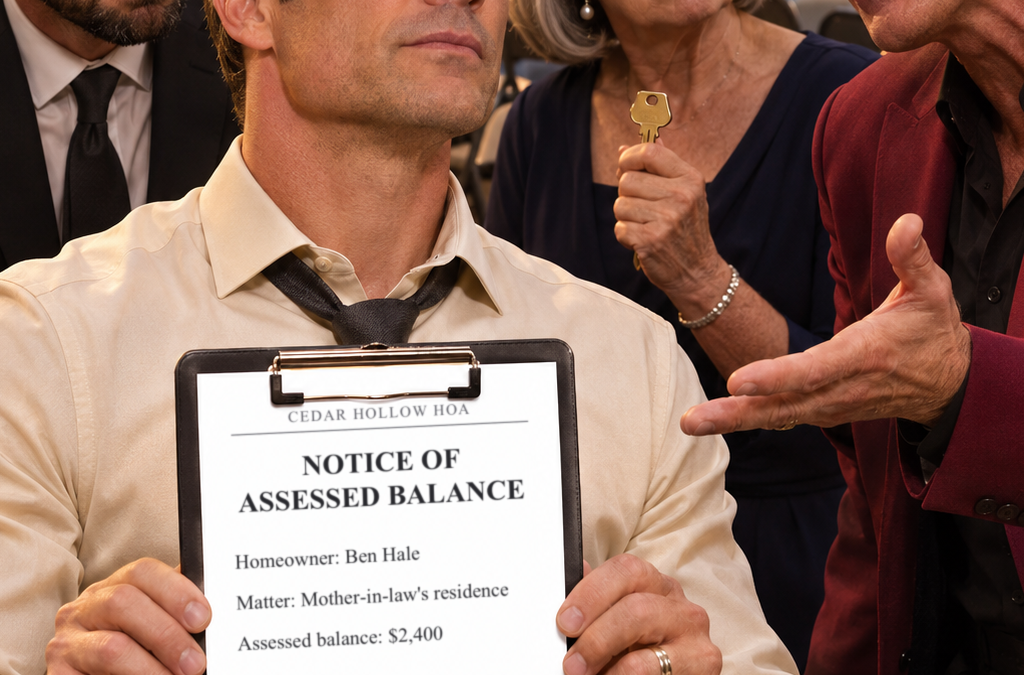
After my wife’s funeral, our HOA handed me a $2,400 fine for housing her mother; its developer president had no idea what I had kept.
Chapter 1 of 7
At 2:40 that Saturday, April 11, Grant placed a sealed envelope beside Anna’s funeral program. Carol and the children were clearing our rented clubhouse reception room.
“The same rule applies to every household,” he said, glancing toward arriving homeowners. “This isn’t subsidized family housing.”
“Her funeral was this morning.”
“I know, Ben. I waited until your guests had left.”
My brother, Matt, stood beside me in his funeral suit.
“What rule?”
“Your mother-in-law’s residence. The assessed balance is twenty-four hundred dollars.”
“She watches my children during my VA appointments.”
“I’m not questioning whether she helps.”
Across the room, my son tried fitting a casserole lid onto the wrong dish. Nobody had told him to stop cleaning.
Grant continued, quieter now. “We have the open board meeting at three. We can discuss arrangements before people sit down.”
“Arrangements for what?”
“First, register her as a temporary guest.”
“She lives with us.”
“That’s the issue we need to resolve.”
Matt’s shoulder brushed mine. He still hadn’t said anything.
I reached for the checkbook in my inside pocket, then left it closed. I had paid for peace until everyone expected the receipt.
Grant watched.
“A departure date would let us establish an end point,” he said. “It doesn’t have to be today.”
Carol stopped beside the trash bag.
“An end point,” she repeated.
“I’m trying to give your family some flexibility.”
“My daughter was buried today.”
“I’m sorry. Truly. But this matter was already pending.”
Two homeowners came through the door carrying travel mugs. One looked at the flowers, then at Grant.
“The hearing already happened?” the man asked.
“Yes,” Grant said. “The household received notice.”
The man nodded, as if that settled which one of us was being unreasonable.
Grant turned back to me. “A departure commitment would help. Then we can discuss resolving the balance.”
“You want me to sign that she’s leaving.”
“A reasonable date.”
“No.”
“Ben, refusing to discuss compliance leaves the board very little—”
“I’m discussing it. I’m not signing that.”
My daughter had stopped folding the paper tablecloth. She watched us from beneath the crooked ribbon on her dress.
Grant noticed her and lowered his voice again.
“We can’t make a household exception because the circumstances are difficult.”
“My children weren’t an exception to family.”
Carol came closer. The brass spare key Anna had cut for her rested in her palm.
“Don’t,” I said.
“I could stay somewhere else for a few days.”
“You’re staying home.”
“I don’t want them hearing—”
“I know.”
She closed her fingers around the key.
Her open tote held a calendar, the children’s drawings, and a cream sleeve with a welcome sheet inside. A blue crayon had melted against the lining. Our son blamed every ruined crayon on the sun, even in January.
Grant waited until she stepped back.
“You can dispute the policy separately,” he said. “Today, I need you to acknowledge the amount.”
“As received, or as owed?”
“As an assessed balance.”
“That wasn’t my question.”
“It’s not a new charge I’m inventing here. The board acted.”
The woman with the travel mug looked toward Matt.
“Are you on the board too?”
“No,” he said.
That was his first word.
Grant pointed out the chairs being set in rows. “Other owners are entitled to their meeting. We shouldn’t turn this into a funeral discussion.”
“You brought it to the funeral.”
“The reception ended ten minutes ago.”
My daughter flinched when the trash bag snapped open across the room. Carol went to her, leaving me beside the program with Anna’s picture.
I wrote a request on the blank back of a leftover reception sheet. I asked for review, the account history, and a record of what Grant had demanded.
“You can submit that privately,” he said.
“You handed it to me here.”
“Ben, this will become part of the association’s records.”
“That’s where I want it.”
Grant read the bottom of my written request.
His pen stopped above the sign-in book. “You want this in the homeowners’ minutes?”
“Yes.”
“Your household situation, in front of the neighborhood?”
“The demand you made. Put that in.”
Behind him, another chair scraped into place.
We had moved into Cedar Hollow in Apex, North Carolina, in January. Anna died Monday, less than three months after we carried the first boxes inside.
Carol had moved into our guest room during Anna’s illness. Now Lily, ten, watched every adult who approached a door. Jake, seven, had asked that morning whether Grandma needed to pack.
“Do you have the notice from February?” Grant asked.
“At home.”
“And the hearing decision?”
“I have the packet you just gave me.”
“The rules are online.”
My plain blue closing packet was in the bag we had brought with the family papers. I consulted the original bylaws supplied before our purchase.
Army logistics had taught me to keep the version I received.
The clause required “owner approval” for new restrictions on resident relatives.
“This is the copy I was given,” I said.
Grant looked toward the folder without reaching for it.
“Send the relevant page with your request.”
“I will.”
Beth, the board secretary, had opened the portal on her laptop. Grant’s last two unsold houses were listed there too, in a sales banner: $640,000 combined. He had mentioned his $410,000 construction note, due June 30, often enough that even Matt knew the date.
“Can you print his balance?” Grant asked her.
Beth frowned.
“What?” I asked.
“The total is right.”
“Then what are you looking at?”
Grant stepped closer to her screen.
Beth looked back at the screen, her hand still moving.
Then she stopped moving the mouse. “It’s still adding a hundred dollars a day.”
“Prospective charges,” Grant said. “That isn’t the assessed balance.”
“Print both,” I said.
“We’ll review the account.”
“I need the ledger. And a written pause while you review it.”
“I can’t promise a board decision standing here.”
“Then put the request before the board at three.”
Beth looked at Grant. “I can attach it.”
“Fine,” he said. “Attach it. We’ll take it up.”
I checked the clock. The meeting was minutes away, and my children were still close enough to hear every word.
“Carol, could you take them down to the other end?”
Lily looked up. “Are we leaving?”
“After I finish this part.”
“Are you coming?”
“Yes. I’m staying in this room.”
Carol led them toward the windows, past the remaining trays of sandwiches. Jake carried the dish with the wrong lid, determined to finish his job.
Grant watched them go.
“You could have handled this through the portal.”
“I could have done a lot of things this month.”
He didn’t answer that.
Beth asked, “Do you want to speak during the meeting?”
“Yes. I’m requesting review of the policy and the fine.”
“I’ll note it.”
“And I’m still paying my regular dues.”
Grant nodded. “Those remain due.”
“I know. I’m not withholding everything because we disagree about this.”
One of the homeowners sat down. The other remained near Grant, reading the meeting agenda over his shoulder.
Matt finally spoke beside me.
“Ben.”
“Give me a minute.”
“I need to show you something.”
“Then show me.”
His phone was already lit. He held it low between us, angled away from the people gathering for the meeting.
Across the room, Lily pressed close to Carol’s side. Jake was asking where the casserole belonged.
Matt’s screen showed a message from Grant.
“Price a move-out renovation for Ben’s house. Contingent estimate only.”
Chapter 2 of 7
“He asked for a price. You never agreed to anything,” Matt said Monday morning. “I didn’t tell him you had.”
I was standing in our kitchen, still wearing yesterday’s shirt.
“But you priced it?”
“No. I looked at the message. That’s all.”
“Why didn’t you say that Saturday?”
“I need the work, Ben. I kept thinking I could talk to him afterward.”
“You had time to stand there.”
“I know.”
Grant’s email arrived before Matt hung up. Mercer Homes offered $285,000 for my house, with the offer expiring Friday, April 17, at 5:00 p.m.
I had paid $318,000 in January. That left a $33,000 difference before selling costs.
Matt stayed on the line while I read.
“Did you know about this?”
“No.”
“He’s offering to buy it.”
“You don’t have to sell.”
“I know that.”
“I’m just saying—”
“Then say it to him sometime.”
He stayed quiet until I ended the call.
Dana Cole’s office occupied two rooms above a tax preparer in Apex, North Carolina. The stairwell smelled like wet carpet. Someone downstairs was laughing hard enough to cough.
I paid her $650 for the consultation and document review. That money had been the cushion between our checking balance and whatever broke next.
She asked what I needed first.
“To keep Carol home without watching that balance climb every day.”
“And after that?”
“I want the charge gone.”
“All right. Start with what they sent you.”
She read the notice, the hearing decision, and the ledger. Then she compared my archived copy with the current portal page.
“These aren’t the same,” she said.
“I saw that.”
“I want the record showing how they adopted this version.”
“He keeps saying it’s already been decided.”
“The original requires owner approval for a new restriction on resident relatives. I’ll ask for the vote record.”
“Does that stop the fine?”
“It gives us something to challenge. It doesn’t erase your account today.”
Outside her window, a truck kept backing up, its warning beeping through our conversation.
“Can he just stay president?” I asked. “Even if people want him out?”
“There are forty-eight lots. The homeowners control the board, with no remaining appointment rights for the developer.”
“So we ask him to leave?”
“You use the member-meeting process in these documents. Enough owners have to request it, then enough have to participate.”
“And you run that?”
“No. The members do.”
She asked about Carol’s room, her move-in, and whether she maintained another home. She checked the policy’s definitions and asked what care I needed during VA appointments.
“I don’t need someone watching me all day,” I said.
“That wasn’t my question.”
“She watches the kids. Sometimes I can’t drive afterward. Sometimes the appointment runs long.”
“We can look at an accommodation request. Being a veteran doesn’t automatically settle this.”
“I wasn’t asking for a medal.”
“I know. I need the actual needs, not a label.”
She also checked the notice and hearing dates. We had received the February notice. By the hearing, Anna was in the hospital, and I had stopped opening the portal.
“I should’ve looked,” I said.
“You’re here now. I’ll request the records and a pause on additional charges.”
“Could they take the house?”
“Nothing here means you lose your house overnight. Don’t ignore future notices.”
That was the first reassurance all morning I could use.
At home, Carol had reheated leftover spaghetti in a skillet. Anna used to insist that made it a new meal. Jake called it spaghetti twice.
There were four plates on the table. I kept looking at the empty place beyond mine.
After the children went upstairs, Carol asked about Dana.
“She’s requesting records.”
“How much?”
“I paid her.”
“That wasn’t—”
“I know what you asked.”
Carol looked toward the stairs. “I could find a room nearby. Still come over.”
I had a local childcare quote open on my phone: $1,800 a month for the coverage we needed.
“That doesn’t cover rides when appointments run late,” I said. “And they don’t have a spot ready.”
“You could change shifts.”
“Then who’s here before school?”
“We’d figure it out.”
“I’m already late getting home some days.”
She had barely eaten.
“I don’t want the children hearing that I’m causing this.”
“You aren’t.”
“I know that. I need you to know I know.”
My phone rang before I found an answer.
Grant sounded pleasant, almost tired.
“Ben, I wanted to make sure you received the offer. It gives you another option.”
“I received it.”
“No obligation. You could move closer to family.”
“My family’s here.”
“Of course. I only meant somewhere with fewer household restrictions.”
“I’m not accepting a loss on the house to resolve a charge I’m challenging.”
“The purchase and the account are separate matters.”
“Then keep them separate.”
“I will. The deadline remains Friday.”
Dana forwarded the written pause later that afternoon. No additional fines would be assessed while the challenge was pending. The disputed balance stayed at $2,400.
Her records request also brought an inventory and agreement copies: Mercer Homes received $700 monthly for management and owed a $12,600 annual landscaping contribution. I saved them with the rest.
Carol called upstairs for the children to bring down their lunch boxes.
Then another email arrived, addressed to the owners. Grant’s subject line read “Household Registration Update.” He promised to discuss registration concerns at a neighborhood gathering.
In the message, he named my address as “a continuing adult-guest exception.”
Chapter 3 of 7
The neighbor canceled Lily’s playdate before breakfast Thursday.
“Maybe once things settle down,” she said. “Has your mother-in-law actually been ordered to leave?”
Lily stood beside me, holding the sweatshirt she had picked for the visit.
“No,” I said. “She hasn’t.”
“Well, that email sounded pretty definite. We’d rather stay out of it.”
After I hung up, Lily asked, “Did Grandma do something wrong?”
“No.”
“Then why are they sending her away?”
“They aren’t. There’s an argument about a rule. Adults are handling it.”
“Are you handling it?”
“Yes.”
She stayed beside me until I added, “Grandma’s staying here.”
Jake had sorted his cereal by shape. He called the broken pieces casualties, a word I wished I hadn’t taught him.
“Can Grandma still come to my school thing?” he asked.
“Yes. Eat the casualties.”
He ate one, watching me.
Grant called while the children were getting dressed. I went into the laundry room, though the dryer made it hard to hear.
“Ben, I’ve had questions from other owners.”
“So have my children.”
“That’s exactly what I hoped to avoid.”
“You put my address in the email.”
“The registration issue was already being discussed. Other households completed the guest paperwork. They’re entitled to consistent treatment.”
“Carol isn’t visiting.”
“I know that’s your position. I’m trying to close the matter without more household details circulating.”
“What are you asking for?”
“A departure date. Once we have that, I can tell owners the registration issue is resolved.”
“Nothing about our household has changed.”
“Then I can’t describe it as resolved.”
Through the laundry room doorway, I saw Carol in the hall. She was wearing her coat.
“Send anything else in writing,” I said.
“Of course. And the purchase offer remains open until tomorrow.”
“I received it.”
Carol’s overnight bag sat beside the front door.
“Where are you going?”
“Just somewhere nearby.”
“Where?”
“I haven’t called yet.”
She had packed before finding a place to sleep.
“Carol.”
“I heard Lily. She shouldn’t have to defend me to her friends.”
“She isn’t defending you. She’s scared.”
“I could give everybody a little room.”
My appointment reminder lit up on the phone: 9:20 a.m., Thursday, April 16. I was supposed to leave while Carol got the children through their morning.
Lily came downstairs and saw the bag.
“You said,” she told me.
“Grandma’s not leaving.”
Carol’s face changed. “Honey, I was only going for—”
“Don’t say a few days,” Lily said.
I stayed with her on the stairs. Carol took Jake to finish getting ready. By the time both children were on the bus, I couldn’t reach the VA clinic in time.
I called anyway.
“I missed it,” I told the scheduler. “I’m sorry. I need another appointment.”
She checked for an opening. There wasn’t one she could offer that morning.
When I came back inside, Carol was still in her coat.
“You missed because of me.”
“I missed because we had a bad morning.”
“I can’t keep costing you things.”
“Please don’t make me argue with you too.”
Her mouth stayed open a moment.
I sat on the bottom stair. “That came out wrong.”
“No. I heard you.”
“I need you here. The kids need you here. Can we leave the bag alone?”
“All right.”
She stayed.
Afterward, I called Dana.
“I want to start the petition.”
“Twelve owner signatures to request the meeting,” she said. “Use the owner roster. Ask for removal and replacement elections.”
“Can I tell them about the fine?”
“Yes. Keep it factual.”
“People are already talking.”
“They may still say no.”
“I know.”
I made calls from the kitchen table. Then I went door to door with the petition and a copy of the roster.
At the first house, I nearly said I was sorry for bothering them. Instead, I asked whether they had a few minutes to discuss the board.
One owner signed after hearing about Carol. Another wanted to read everything first.
Mary Ellis asked, “Are you asking us to cancel your bill?”
“I’m asking for a meeting where we can choose the board.”
“And your bill?”
“I’m still challenging it.”
She read the petition before signing.
By evening, nineteen owners had answered a call or opened a door. Reachable didn’t mean willing.
Luis Perez listened from his porch.
“If they got the policy wrong, they ought to fix it,” he said. “Removing everybody is another question.”
“They’re asking my family to act on it now.”
“I hear you. Grant also gets the drains cleared when they back up. Somebody has to do that work.”
Another homeowner said, “A mistake isn’t the same as trying to hurt you.”
I couldn’t give him a signature for that distinction. I left without his.
Matt called while I was checking names against the roster.
“I’ve got an $18,600 bid sitting with Mercer,” he said. “That would catch me up.”
“Is he giving you the job?”
“He hasn’t decided.”
“Then it’s a bid.”
“Easy for you to say.”
“No, it isn’t.”
He let out a breath.
“I’m not asking you to throw away work,” I said. “Stop passing along things about my family. What I’m doing. Who’s here.”
“He asks how you’re holding up.”
“Tell him to ask me.”
“Sometimes it’s just conversation, Ben.”
“Then leave us out of it.”
“I’ll try.”
I waited for something firmer. He asked how the kids were instead.
Late that night, I was still awake with the unsigned petition pages beside me.
Matt’s text arrived.
“I sent Grant the photo.”
Chapter 4 of 7
“It was the inventory page,” Matt said Tuesday morning. “From your blue folder. The original bylaws were listed on it.”
“Why did you photograph that?”
“He asked what records you were working from.”
“So you showed him.”
“I didn’t send the documents.”
“You sent him a list.”
“Yeah.”
It was April 21. I was in the parking lot at work, already late going inside.
“Did you think I wouldn’t find out?”
“I’m telling you now.”
“You told me Thursday that you sent something. You’re telling me what it was now.”
He didn’t argue with that.
Dana’s email arrived before lunch. Her records correspondence included the original page I had supplied. Between that and Matt’s photograph, Grant knew what I had kept.
He called that afternoon.
“Ben, I’ve looked at the version your attorney sent.”
“Okay.”
“The January revision was intended as an administrative clarification of adult-guest registration. We may need to explain that more clearly.”
“It changed what families could do.”
“That’s part of what we’ll review Thursday. I’d like to find a resolution without putting your household through another public discussion.”
“Send me the proposal.”
“I’d rather discuss it after the board reviews everything.”
“Then Thursday.”
At home, Jake had drawn a floor plan for a school assignment. His version of our three-bedroom house included a room marked “Grandma’s snacks.”
Carol said it was the most accurate room on the page.
“Where’s my room?” I asked.
He pointed to a narrow box beside the bathroom.
“That’s a closet.”
“You’re mostly at work.”
Carol laughed, then looked at me to see whether I had.
I had. A little.
Dana called Wednesday with the change record. The upload was there. A homeowner vote wasn’t.
“They can’t make their own upload into a member vote,” she said.
“So tell them to take it back.”
“I have. They may offer to settle your account.”
“And leave the page there?”
“That’s something to ask.”
I looked at Jake’s drawing on the refrigerator. He had given Carol’s room two windows.
“I’m still gathering signatures.”
“You can pursue both.”
“He’ll want me to stop.”
“You don’t have to agree.”
Thursday’s review took place at the Cedar Hollow clubhouse in Apex, North Carolina. Dana came with me. Grant sat between Owen Blake and Beth Crane.
Beth asked whether I wanted the account discussion kept out of open session.
“For today, yes,” I said.
Grant began without the portal screen he had relied on before.
“We’ve discussed a practical resolution. The board would withdraw collection of the assessed balance if you register Carol as a temporary guest and withdraw the governance complaint.”
“Withdraw collection,” I repeated. “Does the charge disappear?”
“We would document the resolution.”
Dana spoke before he could continue. “Canceled, or held?”
“We can work on the wording,” Grant said.
“What happens next month?” I asked.
“We wouldn’t expect another issue if the registration is current.”
“But she’d still be temporary.”
“That’s the category available.”
“She lives in our guest room. She doesn’t have another place she’s visiting from.”
“We’re trying to give you relief, Ben.”
“I’d be asking permission again next month.”
Grant paused.
“Replacing the board won’t make these questions disappear,” he said. “Someone still has to manage the neighborhood. We can correct an administrative problem without starting over.”
“Then correct the rule.”
“We don’t agree that it needs the change you’re requesting.”
Beth looked down at the agenda.
I said, “Then I’m not withdrawing the petition.”
Owen spoke for the first time. “The assessed balance remains pending.”
“And the pause?” Dana asked.
“Continues,” Grant said.
The balance stayed at $2,400. I left without signing.
By Friday, April 24, we had nineteen signatures checked against the owner roster. We needed twelve.
Mary Ellis had called back two people who forgot their lot information. Luis Perez brought over a signed page after work. Nancy Brooks checked her own entry twice.
“I spent thirty years fixing other people’s forms,” she told me. “I’m not being the reason this comes back.”
The notice went out for Saturday, May 9, at 10:00 a.m., at the clubhouse. All three directors were named for removal consideration.
The agenda separated that vote from elections for any vacant seats. Afterward, if replacements were elected, an organizational board session could consider my account.
The notice invited homeowners and listed counsel and the nominated replacements.
I read the account item twice.
“People will hear the balance again,” I told Dana.
“Only if you consent to discussing your account publicly. You can keep that part separate.”
“They’ve already heard his version.”
“That isn’t the same as your permission.”
I sat with that for a moment.
“Leave it on.”
Matt called after he received a copy from me.
“Can I vote?”
“You don’t own a lot here.”
“I’m your brother.”
“That doesn’t give you a vote.”
“I know. I meant—could I stand in for you?”
“I’ll be there.”
“Yeah. Okay.”
He asked whether I wanted him to come anyway.
“I’m not keeping you out,” I said.
That evening, Lily wanted to know why I was checking my email during her spelling practice.
“I’m waiting for something about the meeting.”
“Can you wait after ‘neighbor’?”
I put the phone facedown.
She spelled it wrong. I nearly let it go, then asked her to try again.
At 8:12 p.m., Grant’s owner-wide email arrived.
“Mercer Homes’ $12,600 annual landscaping contribution will not automatically continue under a replacement board.”
Chapter 5 of 7
“The agreement runs through December 31, 2026,” Dana said. “Changing directors doesn’t end this year’s contribution.”
It was Saturday, May 2. We were at the clubhouse in Apex, North Carolina, with homeowners who had come carrying Grant’s email.
Luis asked, “And next year?”
“He can decline to renew.”
“So our dues could go up.”
“They could,” I said.
A woman near the windows looked at me. “By how much?”
“I don’t have a budget for next year. I won’t give you a number I made up.”
She leaned back. She had signed my petition, but she didn’t look pleased.
Grant stood near the coffee urn.
“This is why continuity matters,” he said. “An independent review is available without replacing the people who handle the accounts and contractors.”
Mary Ellis answered from the front row. “A review would be a start.”
“I agree, Mary. We don’t need to dismantle the board to get one.”
Nobody interrupted him. I had spent weeks thinking about getting people into this room. Now they were here, and several were nodding at him.
He looked toward me.
“Ben has raised concerns that deserve review. But residents should separate those concerns from the work that keeps this neighborhood running.”
“Can you give us a date for the review?” Mary asked.
“We can discuss scope at the next board meeting.”
“That’s what I’d like reviewed too,” she said. “How things get decided.”
Grant nodded without promising anything.
Ruth Warren had agreed to organize credentials and ballot counting. Her reading glasses hung from a cord that kept catching on her blouse.
Grant addressed her. “We need votes verified against actual ownership. Attendance alone doesn’t qualify someone.”
“That’s what I’m checking,” Ruth said.
“Family members can’t simply vote for an owner.”
“No,” she said. “They can’t.”
Carol sat beside me. She had come because I asked, though she kept her coat on.
“I wasn’t planning to,” she said.
Grant turned toward her. “I’m speaking generally, Carol.”
“I heard you.”
I wanted to answer him. Carol’s look stopped me.
Ruth continued. “One vote per lot. I’ll have two tellers who aren’t candidates. Each director gets a separate removal row. Any replacement election will be separate.”
A man asked whether signing the petition had already counted as a vote.
“No,” Ruth said. “It requested the meeting. You still have to vote.”
“Even if we’ve changed our minds?”
“Yes.”
That answer cost me more than I wanted it to.
Afterward, I found Mary with Luis and Nancy Brooks near the empty refreshment table.
“You’re still willing to stand?” I asked.
Mary nodded. “Provided people know I’m retired from payroll, not an expert in everything.”
“I can deal with service calls,” Luis said. “I can’t settle everybody’s fence argument.”
Nancy looked at me. “And we can’t promise you a result on your account before we’ve reviewed it.”
“I’m not asking you to.”
“You should hear it anyway.”
I did.
Mary said their first proposed task would be an independent review of the governing documents.
“With somebody we pay,” she added. “Dana doesn’t owe the neighborhood free work because you hired her.”
Dana, passing behind us, said, “Correct.”
Luis laughed once. It helped.
At home, Jake had arranged crackers across a plate in a way he called dinner nachos. Carol had put cheese on them and refused to call it cooking.
“Restaurant’s out of forks,” she told me.
For a few minutes, we ate over the sink and talked about nothing that required a vote.
Later, Carol brought out the family papers she had carried to the reception. The cream sleeve was tucked between her calendar and Lily’s drawings.
“Do you want this with the others?”
“Yes.”
She took the signed sheet out far enough to check that it was there. I included the original with my meeting materials.
Lily watched from the hallway.
“Do we have to go to that room again?”
“No. You and Jake can stay with Grandma.”
“Are you going alone?”
“Dana will be there. Some neighbors too.”
She looked at Carol. “You’re staying here?”
“All morning, honey.”
Lily went upstairs without asking again.
During the week, two owners called to ask whether I would accept a private settlement and cancel the meeting.
“The meeting belongs to the owners now,” I told them.
One said he hadn’t wanted all this.
I hadn’t either. I still asked him to come.
On Saturday, May 9, I reached the clubhouse before 10:00. Ruth was checking owners at the entrance. The two tellers sat apart from the candidates.
Grant was already seated with Owen and Beth. Matt stood beside their table.
His carpentry bid folder lay next to Grant. I recognized the corner Matt had repaired with blue tape. Inside was his unsigned $18,600 proposal.
He saw me looking and glanced away.
Ruth checked the last arrivals, then announced that forty-six of forty-eight lot votes were credentialed.
People settled into chairs. I could hear someone outside trying twice to lock a car.
Grant spoke before the meeting began.
“I hope we can keep this proportionate. A correctable registration error isn’t grounds to remove experienced directors. We can address the paperwork and keep the neighborhood operating.”
A homeowner behind me murmured, “That’s fair.”
Matt looked from Grant to my meeting materials. Then he came around the table.
He lifted his bid folder from beside Grant and brought it to the chair within reach of mine. Grant followed him with his eyes.
Matt sat close enough that I could hear him without leaning over.
“I delivered that letter myself.”
Chapter 6 of 7
Before our neighbors, at 10:00 a.m., Grant said the board hadn’t changed who could live in my house.
“We corrected adult-guest paperwork. If that classification needs adjusting, we can adjust it.”
Matt leaned toward me.
“January 9,” he said. “I delivered his original welcome letter at closing. He signed it January 8.”
Ruth called for my presentation.
I placed the original bylaw page beside the current page.
“When did the owners approve making resident parents into guests?”
Grant looked at the pages.
“There wasn’t a fresh owner vote. We believed we were clarifying an existing category.”
“This one requires owner approval.”
“That’s why an outside review makes sense. If we made an error, we can correct it. You don’t need to replace three experienced directors to accomplish that.”
A man behind me said, “Why not get the review first?”
Several people nodded.
Grant continued. “There are contracts, collections, maintenance calls. Those responsibilities don’t pause while a new board learns them.”
Ruth looked toward him.
“Had you previously described a resident parent as a permitted permanent occupant?”
“Our sales materials discussed family living generally. They were always subject to the governing documents.”
The man behind me leaned back. Mary watched Grant without speaking.
I brought out the signed welcome letter.
“This was addressed to us.”
Grant waited.
I read, “Your mother may make the guest room her permanent home. Our bylaws require an owner vote before that family arrangement can be restricted.”
Someone near the windows asked me to read it again.
I did.
“Personal correspondence still doesn’t replace the governing documents,” Grant said.
“I’m not asking it to. You wrote that you needed a vote.”
Matt stood beside his chair.
“Anna and Ben had asked about Carol moving in later. Specifically. Grant asked me to deliver his answer with the closing materials.”
“Matt, you weren’t responsible for interpreting—”
“No. I delivered it. That’s what I’m telling them.”
Ruth addressed Grant.
“Was that answer about this family’s proposed arrangement?”
“Yes. But the later registration process—”
“You described her as a permanent resident, then charged her as a guest.”
Grant paused before answering.
“I’m asking the members to retain the board pending independent review. We can suspend enforcement and resolve the discrepancy without disrupting management.”
Ruth looked across the chairs.
“The removal questions were noticed. They’re going to the members.”
The tellers distributed ballots with three separate removal rows. People bent over their choices. Nobody asked me what to mark.
Across the aisle, a woman covered her ballot with the meeting notice.
The counting took long enough for the clubhouse refrigerator to cycle off twice. One teller read each row; the other checked it. They reversed jobs and counted again.
Matt crossed the room when they asked for an observing witness.
“He isn’t an owner,” Owen said.
“Witness only,” Ruth said. “He hasn’t voted.”
Matt signed beneath the tellers’ signatures. Ruth checked each total against the forty-six participating lot votes.
“The members have removed Grant Mercer, Owen Blake, and Beth Crane, each by 37–9. All three board seats are vacant.”
Beth left the board table first. She sat in an empty chair near the back, still wearing her name badge.
Grant spoke to the man who had suggested waiting for review. The man nodded once, then turned toward the election tellers.
Matt retrieved his bid folder from our chairs and brought it over to Grant. The proposal was still open where he had checked his figures that morning.
Grant closed it and returned it.
“We’ll address contracting separately.”
Matt came back carrying the folder against his leg.
“I wanted him to think I was reliable,” he told me.
I watched Beth staring toward the windows.
“You could’ve been reliable with me.”
“Yeah.”
He didn’t ask whether we were okay.
Fresh ballots went out for the vacant seats. Mary, Luis, and Nancy stood where everyone could see them while Ruth asked for other nominations.
There were none.
One homeowner asked Mary whether she would keep paying the landscaper.
“The agreement stays in place,” she said. “Next year still needs a budget.”
The tellers counted again. Ruth checked the signed election sheet: 38–8 for each replacement. Mary, Luis, and Nancy took the vacant chairs.
Carol arrived with the children as Ruth finished certifying the election. Jake had a sticker stuck to his shirt backward. Lily stayed close to Carol.
“Can we sit here?” Carol whispered.
“Yes.”
Her brass key rested beside my papers when the new board opened its already-noticed organizational session.
Nancy moved to cancel the challenged balance and stop any further charges under that provision. Luis seconded.
Mary asked for discussion.
Nancy said, “I reviewed both versions and the account. I support cancellation.”
“So do I,” Luis said.
Mary called the vote.
“Yes,” Nancy said.
“Yes,” Luis said.
“Yes,” Mary said.
She looked toward me.
“The $2,400 fine is canceled, 3–0. No further charges will be assessed under the challenged provision.”
Carol’s shoulders dropped. Jake whispered, “Can we get lunch now?”
“Soon,” she said, almost laughing.
Grant approached while the children were looking out the window.
“Ben, perhaps we should meet privately. Repair the relationship before this becomes permanent.”
“My family won’t need your permission to stay.”
I collected Carol’s key from beside the papers and returned it to her.
“No private meeting.”
Outside, Lily asked whether we could eat somewhere with fries. Carol said she had never heard such a difficult lunch order.
We were still beside the clubhouse when her phone rang at 12:26 p.m. She listened, then looked toward me.
Carol covered the phone. “They can see you Tuesday at 8:40.”
Chapter 7 of 7
I accepted the appointment while Carol was still on the phone outside the clubhouse. On Tuesday, May 12, I reached the VA clinic before 8:40 a.m.
Carol was home with the children. Before I left, Jake had asked her to settle an argument about whether socks had a left and right.
“Only after you’ve worn a hole in one,” she told him.
At the clinic, the receptionist asked whether I could stay if the provider ran behind.
“Yes,” I said.
I didn’t call home to check. Carol knew where the bus stopped. She knew Lily sometimes forgot breakfast when she was worried. I could sit in that chair until someone called my name.
The written account correction had arrived Monday, May 11. My statement showed $0 due on the challenged fine. The balance was gone from the portal too.
I still owed the regular dues. Dana’s paid invoice stayed in my records. There wasn’t a check coming to replace what the dispute had cost us.
I slept through most of Tuesday afternoon.
When I woke, Carol said Matt had called.
“About the job?”
“He wanted to tell you himself.”
I called him from the back porch.
“Mercer gave it to somebody else,” he said. “The eighteen-six bid.”
“I’m sorry.”
“Don’t be. I mean—hell. I wanted it.”
“I know you did.”
He was parked somewhere. A turn signal clicked through the phone until he noticed and shut it off.
“Did Grant say why?”
“Said they went another direction. He didn’t owe me the job.”
“No.”
“I kept thinking if he saw me as somebody reliable, I’d get more work. So I let him talk. Kept my mouth shut when I should’ve—”
“I was standing next to you, Matt.”
“I know.”
There were things I could have said that would have kept him awake. I had rehearsed several while lying awake myself.
Instead, I asked, “What happens with your business?”
“I call people. Finish what I’ve got. Bid on something else.”
“All right.”
“Could I come by Sunday?”
“For a visit. The kids would like that.”
“And you?”
“I’m still mad.”
“Yeah.”
“Our papers don’t go anywhere. Pictures, messages, anything. And conversations in this house aren’t updates for somebody you want work from.”
“They won’t be.”
“If somebody asks about us, send them to me.”
“Okay.”
He came Sunday. He stayed for dinner and helped Jake with a model that had too many tiny pieces. I didn’t ask him to look at the loose trim in the hallway.
He was my brother. That was enough work for one visit.
On June 1, the replacement board sent Mercer Homes the required thirty-day notice ending its management agreement.
Mary’s email was brief. There would be a new contact for maintenance requests. Regular payments would continue on the same schedule.
The termination took effect July 1. Mercer Homes lost its $700 monthly management income.
At the next open meeting, Luis spent more time discussing a drainage estimate than anyone spent discussing Grant. Two estimates had come back; he wanted a third.
I stayed until the end.
The board republished the unaltered resident-relative provision. Any proposed occupancy change would go to the owners through the member process. There was a date on the calendar for owners to discuss proposals, rather than another replacement page appearing online.
Nobody promised there would never be new rules.
For now, I could open our account without checking whether Carol’s room had generated another charge.
Next year’s landscaping support remained unfinished business. Mercer’s current contribution ran through December, and the budget still needed an answer after that.
When someone asked whether dues would stay the same, Mary said, “We don’t know yet.”
I liked hearing an answer stop where the facts stopped.
Grant remained someone I occasionally passed in Cedar Hollow. Once, he nodded from beside a sales sign. I nodded back and kept driving.
Matt found other work, though he stopped telling me every promising bid was practically his. Some Sundays he came over. Some weeks we only spoke long enough to arrange one.
I didn’t give him access to the family files again.
By summer, our calendar held work shifts, school things, and grief counseling. I went even when I had nothing I wanted to say. The children went too.
Lily could talk through a whole session and refuse to speak in the car afterward. Jake asked once whether being sad in July counted if the funeral had been in April.
The counselor told him it counted.
At home, Anna’s name still interrupted ordinary moments. I bought the wrong toothpaste and stood in the grocery aisle remembering which one she hated. Lily wanted a school picture moved, then cried because its old place looked empty.
We moved it back.
Carol had mornings when she stayed in her room until the children left. I quit knocking to ask if she was all right.
Instead, I asked whether she wanted company.
Sometimes she said no.
One evening, Jake appeared in the hallway while I was sorting clean laundry.
“Can Grandma keep her room?”
“Yes.”
“Even when school starts again?”
“Yes, buddy.”
“What if she gets a bigger bed?”
“We’ll measure.”
He considered that, then asked whether measuring meant using the tape that snapped back.
“With help,” I said.
He went to find Carol. From her room, I heard him explaining that they needed measurements before making any decisions.
On Saturday, August 15, I was home while Carol took the children out. More than four months had passed since the funeral.
There were still reception dishes we hadn’t returned. I called their owners that morning instead of moving them to another shelf.
Carol phoned on the way back.
“We have peaches,” she said.
“For lunch?”
“The children seem to think so.”
“Ask them what else.”
In the background, Lily wanted grilled cheese. Jake wanted breakfast.
“Eggs and toast?” Carol asked.
“Both,” I said. “We’ve got enough.”
I wasn’t planning the afternoon around who might question the number of people at our table. I left the plates where the children could reach them.
Their car stopped outside. Lily came up the walk arguing that peaches went with everything. Jake carried the bag against his shirt.
Through the window, I saw Carol reach the porch with her own key, the brass one Anna had made for her.
Carol turned her key, and the children ran inside.







