My sister promised my beach house to her children at Thanksgiving and handed me her overdue bills; she had no idea what I had kept.
Chapter 1 of 7
“An aunt’s job is helping actual parents get ahead.”
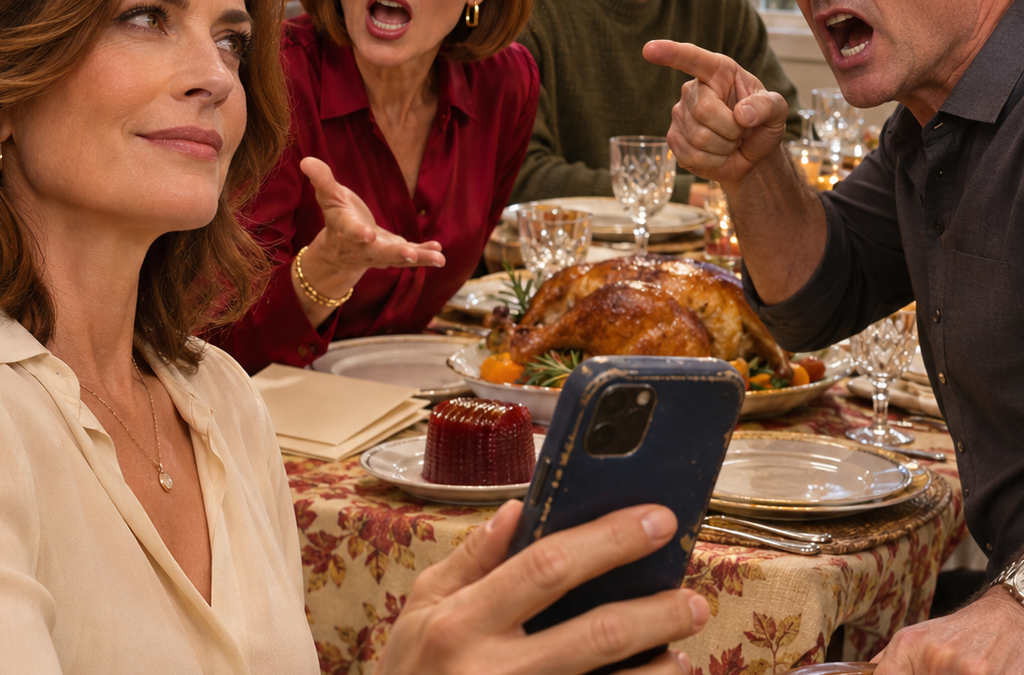
Rachel said it beside the turkey, as though she were explaining gravy.
It was 5:40 p.m. Through the dining-room windows, the Galveston beach had turned gray.
“What did you just say?” I asked.
“The kids should have this place someday. You don’t have a real family to leave it to.”
Her daughter looked down at her plate.
“I have a family,” I said. “Apparently they’re eating my dinner.”
“Oh, Dana. You know what I mean.”
I alone owned the house and paid for it.
Rachel nodded toward the folded notices beside my plate. “Those need taking care of, too. The dental office keeps calling during work.”
The overdue bills totaled $1,286. One had a red box around the amount due.
My fingers closed around them before I answered. Then I put them back beside her plate.
That was how these things usually started: she brought paper, and I carried it home.
“What are you doing?” she asked.
“Leaving your bills with you.”
“I’m asking for help.”
“You just announced what happens to my house when I die.”
“Good Lord. Nobody’s wishing you dead.”
Mark leaned forward. “The kids heard you say this was their second home. You can’t blame them for believing you.”
“I don’t blame them.”
Evan sat beside him, his wallet sticking out of his pocket. When he shifted, I could see the edge of his extra Visa card.
He caught me looking. He said nothing.
“They’ve built memories here,” Mark continued. “You want them thinking that doesn’t count?”
“It counts. It doesn’t make the house theirs.”
Rachel’s daughter asked, “Are we in trouble?”
“No, honey,” I said. “You haven’t done anything.”
Rachel answered before the girl could look up. “Of course you haven’t. Your aunt’s just having a difficult evening.”
My mother watched me across the sweet potatoes.
“Maybe eat a little,” she said. “Everything’s getting cold.”
Rachel had brought canned cranberry sauce and insisted we leave it shaped like the can. It sat untouched between us, still wearing its ridges.
“I’d like to finish what we’re talking about,” I said.
“We’re talking about security,” Rachel said. “For children. That’s all.”
“No. You’re making plans for something I haven’t offered.”
She glanced toward Mark.
“Well, we do need to settle next summer. His vacation requests go in early.”
“Settle what?”
“We’ll want July here. Most of it, probably. The kids can bring friends.”
“Most of July?”
“You work from anywhere. We have schedules.”
“I have schedules, too.”
“Then tell us which weekend you need,” Mark said. “We can work around a weekend.”
Outside, wind drove sand against the bottom porch step. Nobody looked toward it.
“A weekend,” I repeated.
“You don’t even like coming when it’s crowded,” Rachel said. “And honestly, ordering breakfast tomorrow? There’s food right here. Pancakes out are an unnecessary indulgence.”
“I offered to take everyone.”
“We could use that money for things that matter.”
My mother said my name in the same low voice she used in church.
I kept looking at Rachel. “Being family didn’t make my life the spare one.”
“Spare? Is that really what you think we’re saying?”
“Your summer gets reserved. Mine gets fitted around it.”
“We’re trying to plan something nice.”
“Then ask me. Don’t assign me a weekend.”
Mark’s jaw moved as though he had food left to chew.
Rachel looked toward the children again. “I wish you wouldn’t make this ugly in front of them.”
“I didn’t announce an inheritance over turkey.”
“You could have spoken to me privately.”
“You’re sitting right here.”
My older phone was in my hand, its navy case scuffed white along one corner. A notification covered part of the screen.
I had kept one message I would normally have deleted.
Mark could see the newest notification from where he sat.
He started reading it a second time, then pushed his chair back.
“You already told them they could see the house?”
Beth, my agent, had asked whether she could bring prospective buyers through Friday.
“Yes,” I said. “She asked about a viewing. I said yes.”
Rachel’s chair squeaked against the floor. “Buyers?”
“I asked her last Thursday to prepare a sale.”
“You decided that without telling us?”
“I decided I didn’t want to keep doing this.”
The house meant driving down from Houston for leaks, repair appointments, and weekends spent waiting. I owned an insurance brokerage; I already had one place that needed me constantly.
“I want my weekends back,” I said.
“You could have asked us to help more,” Mark said.
I looked down at my screen. My account reminders were still there: primary account holder on the phone plan and Visa, named insured and payer on the borrowed Camry’s insurance.
Below a prescription reminder and an office calendar alert sat a saved-message entry: November 12, 6:18 p.m.
Rachel couldn’t see those screens.
“There’s work attached to keeping a place,” I said. “I don’t want it anymore.”
Rachel looked toward our mother. “Can you believe this?”
“It’s her house,” Mom said, so softly Rachel talked over her.
“After all the summers we’ve organized around being here.”
“I haven’t accepted an offer. It’s a viewing.”
Mark gave a thin, reassuring smile. “Okay. Let’s not turn a viewing into a disaster. Selling could help everybody.”
“I’m selling because I want to sell.”
“Right. And we’d all have a little breathing room.”
His own phone buzzed beside his plate. He glanced down, still smiling.
Mark’s smile started disappearing as he read his screen.
“Why is she asking whether the forty thousand is final?”
Rachel looked at him sharply.
“Who’s asking?” I said.
“The townhouse agent.”
“What did you tell her?”
He read aloud instead. “‘Can you confirm whether the forty thousand from your sister-in-law is final? The seller needs a clear answer.’”
My mother looked from him to me.
Rachel said, “We were going to tell you about that after dinner.”
“Tell me what?”
“The place we’re looking at. Nothing’s settled.”
“Then why is an agent asking about my money?”
“Because you mentioned helping,” Mark said.
“I mentioned that I might give you money after a sale.”
“And we were grateful,” Rachel said. “We are grateful. Nobody’s saying otherwise.”
“The proposed gift is still undecided.”
She stopped looking at me.
“Mom, you heard her talk about it. You know we wouldn’t just invent this.”
Carol’s mouth pinched. She had barely touched her turkey.
“I heard you say you wanted to help them, Dana.”
“I said I might.”
“Your sister has a lot on her shoulders.”
“So do I.”
Rachel spoke gently now. “We’re not asking you to carry everything. Just don’t pull away the one thing that could get us caught up.”
“There isn’t an approved gift to pull away.”
“But you’d still have plenty left.”
I could hear the refrigerator motor in the kitchen. Evan’s dinner sat nearly untouched.
“I am not paying those bills,” I said. “And I’m not making a declaration about who gets my house when I die.”
Rachel blinked hard. “We didn’t expect Thanksgiving to turn into this.”
“Neither did I.”
Mark looked at his screen again.
“How far have you gone with this?” I asked.
He slid his screen toward me. “I’ve already put your forty thousand into our townhouse offer.”
Chapter 2 of 7
At nine Friday morning, Rachel was waiting on the beach-house porch with the townhouse listing.
“It’s $200,000,” she said. “We have eight thousand for the other costs. Your forty would be the down payment.”
It was November 27. Mark stood beside the porch railing, still wearing yesterday’s sweater.
“I haven’t signed a gift authorization,” I said. “Or agreed to buy anything.”
Rachel showed me the seller’s response beneath the listing. They were willing to wait for verified funding until December 14.
“They’re giving us time,” she said. “They didn’t have to.”
“That doesn’t make the money available.”
“You said after you sold.”
“I said I might give you $40,000 after a sale, subject to my final authorization in writing. That wasn’t pledged money, payment for work, or something a buyer would owe you.”
Mark looked toward the water.
“We told the agent it was family help,” he said. “We weren’t trying to involve your buyer.”
“Then you need to correct what you told her.”
Rachel’s hair kept blowing across her mouth. She stopped trying to move it.
“There are two bedrooms upstairs,” she said. “Chloe could paint hers. She keeps asking whether she can paint at the rental.”
I said nothing.
“And Evan could stay while he finishes school. We wouldn’t have to worry every time the lease comes up.”
Mom appeared in the doorway behind her. She wore her shoes but still had my old guest robe over her clothes.
“Mom,” Rachel said, “tell her. You know what that would do for us.”
Carol looked tired. At seventy-three, she still hated being asked to choose while everyone watched.
“Your father and I rented until you were little,” she said. “I remember being afraid to hang pictures.”
“Mom.”
“You’ve been fortunate, Dana. Having your business. A place in Houston and this one.”
Rachel’s eyes stayed on me.
“I know the kids would like it,” I said.
“Then help us get there.”
“I’m not approving the down payment.”
Mark turned away from the railing. “Are we supposed to tell them today?”
“That’s between you and them. Please don’t tell them I took their house.”
Rachel’s face changed at that.
“Nobody said you did.”
“Then we can leave that out.”
Through the open door, I could see the breakfast dishes. Chloe had arranged the leftover rolls in the toaster slots sideways. One had burned black along its middle.
Yesterday I would have worried about whether she’d eaten enough.
I had paid for so many emergencies that I’d taught them to bring me more.
“I have information for you,” I said. “About the accounts and the car.”
Rachel glanced at Mark. “What information?”
I had made brief calls that morning, checking access and the steps I would need. The carrier confirmed that the devices were paid off. The card issuer confirmed I could remove authorized users without closing my account.
My insurer had told me to call again after the Camry came back.
I gave Rachel a sheet with the dates written plainly.
“Your Visa access ends December 1. Yours, Mark’s, and Evan’s.”
Mark read over her shoulder.
“The phone lines need to move to your own account by December 2,” I continued. “I’ll give you the account information and transfer PIN. You can keep your numbers.”
“You’re cutting off the kids’ phones?”
“I’m giving you what you need to transfer them.”
“And the car?” Mark asked.
“Back December 3. Bring it to my Houston office by eleven-thirty. The driver changes happen after it’s returned.”
Rachel looked down at the page again.
“I schedule patients,” she said. “I can’t just stop going to work.”
“You have several days to arrange transportation.”
“Several days over Thanksgiving weekend.”
“I’ll keep the coverage in place while you still have the car.”
Mark said, “Let me see that.”
Rachel let him read it without handing it over.
Mom went back inside. The screen door caught on the swollen frame, then banged shut.
“You could have talked to us first,” Rachel said.
“I’m talking to you now.”
“With dates already picked.”
“Yes.”
She watched me, waiting for the part where I softened it. I watched a gull drag a crust across the neighbor’s driveway.
Beth arrived that afternoon with Laura Bennett, a retired hospital administrator interested in the house. Laura had walking shoes dusted with sand and asked whether she should leave them outside.
“The mat’s fine,” I told her.
Rachel was in the living room beside an open tote.
“We’re still gathering our things,” she said.
“Take your time,” I said. “Beth can start downstairs.”
“I’d rather nobody went through the bedrooms yet.”
Beth waited for me to answer.
“This is a viewing I approved,” I said. “We’ll give you space to pack, but it’s going ahead.”
Rachel’s lips pressed together. She collected Chloe’s sweatshirt from the couch.
Laura asked Beth about the windows, and they moved toward the kitchen. Their voices carried back, ordinary questions about storm shutters and afternoon sun.
Mark carried the tote outside. Rachel stayed near the hallway.
“Does she know we spend summers here?”
“She knows it’s my vacation house.”
Rachel followed her husband without answering.
I was upstairs when the family-group notification arrived. I recognized cousins’ names beneath Rachel’s before I read what she’d sent.
“Dana agreed to forty thousand. Please ask her why she’s backing out now.”
Chapter 3 of 7
My mother came to my Houston office Monday morning and told my employee I was breaking a promise.
“She agreed to help her sister buy a home,” Carol said. “Now Rachel doesn’t know what to tell the seller.”
My employee stood beside reception with a customer’s renewal packet. Behind her, the printer kept feeding out pages.
“Come into my office, Mom.”
“I tried calling you yesterday.”
“I was home. I chose not to discuss it.”
Mom followed me past the little refrigerator where nobody admitted owning the oldest yogurt. Usually she made a joke about conducting an inspection. That morning, she barely looked at it.
It was November 30. I had renewals due, two unanswered client calls, and my mother standing between me and my desk.
“She told the family you agreed,” Mom said.
“I saw.”
“Then why would she say it?”
“You’ll have to ask her.”
“She wouldn’t put herself in this position for nothing.”
Through the doorway, I heard my employee answering the business line. Her voice had become very careful.
“Mom, you can’t bring this into my office.”
“I thought if we spoke face-to-face—”
“We have. I need to work now.”
Her eyes moved toward the framed license behind my desk.
“I don’t like seeing you girls this way.”
“Neither do I.”
She waited, but I didn’t give her anything to carry back.
After she left, my employee asked whether I wanted the waiting client call transferred.
“Yes. And I’m sorry you heard that.”
“It’s okay.”
It wasn’t her job to say that, either.
Rachel called during lunch.
“Mom says you wouldn’t even talk.”
“I talked. I wouldn’t keep arguing.”
“We’ve spent weeks looking at places based on what you told us.”
“I didn’t approve the money.”
“You keep saying approve like we’re applying for a loan. This was a conversation between sisters.”
“And I told my sister I hadn’t decided.”
“The seller’s agent knows about you now, Dana. Mark has to answer her.”
“He needs to give her the correct answer.”
“Could you at least sign something saying the money will come after closing? We don’t need it today.”
“That would turn it into a commitment.”
“It would keep us from looking ridiculous.”
I had a sandwich open on my desk. Mustard had soaked through one corner of the bread.
“Rachel, putting it in your budget wasn’t my decision. I’m not signing an approval now and pretending I gave it earlier.”
For a few seconds, I heard the television at her end.
“So we should just tell them we can’t do it.”
“Tell them what you can actually pay.”
She ended the call without saying goodbye.
Beth arrived that afternoon with Laura’s offer. We went through it in my office while the reception printer finally rested.
“It’s $620,000,” she said. “Cash. Closing December 14.”
“Does she want the furniture?”
“Only what’s listed. She isn’t trying to buy your towels.”
“The good ones or the ones everybody uses to wipe off beach chairs?”
“She didn’t specify towel grades.”
I laughed, harder than the joke deserved.
Beth waited while I read. Laura wanted the house I had shown her, at a price I was willing to accept. Nobody was asking me to explain why I deserved the money.
I signed the acceptance.
For a few minutes, I could picture a Saturday without a drive to Galveston. No repair appointment tucked between errands. I could leave a weekend open without checking the weather down there.
Then Beth read a new email.
“Mark sent me something,” she said.
“What kind of something?”
“A request for compensation. He copied Bayfront Title.”
The message described property checks, minor repairs, and time spent keeping the house usable.
“He’s asking for forty thousand?” I said.
“Yes.”
“He was calling it a gift this morning.”
Beth looked at me. “Were there jobs you agreed to pay him for?”
“No.”
Mark had checked the house after bad weather when they were already nearby. He had replaced a toilet flapper and fixed a loose gate latch. Once, he’d waited for an air-conditioning technician because I couldn’t leave Houston.
Those things had helped. I’d thanked him. Sometimes I’d bought dinner.
“I never hired him to manage it,” I said. “We never discussed wages or giving him part of the house.”
“Send me that in an email. Briefly.”
“He did some of the things he’s listing.”
“Then say that, too.”
Late that afternoon, Evan waited beside the Camry in the office parking lot. He still wore his grocery-store shirt.
“Dad wants to know where to bring it Thursday.”
“Visitor parking. Eleven-thirty. Reception can call me.”
“He’ll be at work. I can bring it.”
“That’s fine.”
He looked toward the street.
“Mom keeps saying you—” He stopped. “She gets ahead of herself.”
I waited.
“I remember her leaving you a message. After you talked about maybe selling and helping them.”
“I kept it.”
“Yeah.”
A delivery truck blocked the driveway. Evan watched it back out, though he had nowhere to go yet.
“When does the buyer sign?”
“December 14, if everything stays on schedule.”
“Okay. I was just wondering.”
I thought he was working out the car return around his classes.
Before I left the office, an email arrived from Ruth Ellis at Bayfront Title. She had forwarded Mark’s proposed payment instruction.
There was no signature from me. Still, it was in the closing file now, addressed to people preparing my sale.
His request was one sentence.
“Please include Rachel Carter as a $40,000 recipient from seller proceeds.”
Chapter 4 of 7
Ruth called before I started work Tuesday, December 1.
“Mark’s proposed recipient isn’t approved,” she said. “Did you authorize that payment?”
“No.”
“Then it stays out of your disbursement instructions. I’ll tell him.”
At nine, I called Visa and removed Rachel, Mark, and Evan as authorized users. The representative read their names back and confirmed my own account would remain open.
The balance was still $2,310. I scheduled the payment for Friday.
At 9:22, Rachel called.
“Did you do something to the card?”
“Yes. I removed the authorized users this morning.”
“I’m trying to order something. It keeps saying declined.”
“The access ended today.”
“I thought we were still talking about that.”
“I gave you the dates Friday.”
“You gave us a sheet, Dana. You didn’t ask whether any of it would work.”
Outside my office, someone laughed at the copier. It had printed a client’s boat application on pink paper again. We kept meaning to move the pink paper.
“You had the information,” I said. “The phone transfer is next. I sent the account number and PIN.”
“You should have called before you actually did it.”
“That wouldn’t have changed the date.”
“So we don’t even get a conversation.”
“We’re having one.”
“No. You’re telling me what’s already happened.”
I said nothing at all.
“What about Evan? Did you at least tell him?”
“His access ended, too. It was on the same sheet.”
“He’s in school.”
“He also had notice.”
Her voice moved away from the call.
“Evan, do you have Beth’s email? The one she used about the house?”
“Rachel, why do you need Beth?”
“I’d rather have everyone working from the same information.”
She ended the call before I could ask what information she meant.
I went back to a renewal quote. Three times, I read the same sentence about a roof deductible.
That afternoon, Beth called.
“Rachel asked me to explain the family’s position to Laura.”
“What position?”
“She and Mark say the support wasn’t just support. They say you had an arrangement because they helped with the property.”
“Did she say I agreed to pay them?”
“She wants Mark to explain it.”
“Then have him put it in writing.”
“He already has.”
Beth forwarded his email. He described checking the house, being available for repairs, and organizing family visits while I worked in Houston. Those ordinary favors now appeared beneath a heading about a long-running family property arrangement.
“He wants me to pass it along,” Beth said.
“Do you have to?”
“Not as a sales pitch. But he’s asking to speak to my buyer, and I’m not going to pretend it hasn’t happened.”
“Please copy me on anything you send.”
“I will.”
On Wednesday, December 2, Rachel used the information I had supplied to move all four phone lines to an account she would pay for. The carrier sent a transfer confirmation. The devices were paid off, and nobody lost a number.
Rachel sent one message afterward.
“Phones are moved.”
I answered, “Thank you for confirming.”
I nearly added a question about Chloe’s week. I left it out. I didn’t want her mother reading it as an invitation to reopen the bill.
The next morning, Evan brought the Camry to my Houston office at 11:30. Reception called me when he arrived.
“Everything’s out of it,” he said. “Dad checked.”
“Thanks for bringing it.”
“My ride’s outside.”
“Okay. Get there safely.”
There was no argument. He left, and the car stayed.
At noon, my insurer confirmed that the Carters had been removed as permitted drivers. My coverage on the Camry remained in place.
I had appointments all afternoon. Between them, Beth called again.
“Mark asked me to convey a settlement proposal.”
“He already sent a payment request.”
“He’s calling this an ownership settlement now. Forty thousand, so the sale can go forward peacefully.”
I could hear traffic through her end of the call.
“Does Laura think she’s supposed to pay it?”
“He says it should come from your proceeds.”
“That doesn’t answer what she thinks.”
“No,” Beth said. “It doesn’t.”
Ruth joined us a few minutes later.
“Can you tell Laura they aren’t owners?” I asked.
“I can tell her you’re the sole recorded owner and there’s no recorded Carter interest in our search.”
“And this claim?”
“I can’t award them an interest or settle a family dispute. I need the proper signatures and authorized payment instructions.”
“Mine.”
“For your proceeds, yes. But Laura has questions before she funds.”
My next client was waiting. Through the glass beside my door, I could see his rain jacket dripping onto the carpet.
“What do we do?” I asked.
“Have the discussion together,” Ruth said. “No more messages passed through Beth.”
We confirmed Monday, December 14, at ten, at Bayfront Title’s Galveston office. Laura would attend with me, Ruth, Beth, Rachel, and Mark.
“Evan may be driving them,” Ruth added. “Are you comfortable with him staying?”
“Yes.”
I wanted him to hear what was said without getting a version afterward. I still wished he wouldn’t have to.
After my last appointment, Beth sent confirmation of the meeting. I read it twice, checking who was included.
Then Laura forwarded Mark’s latest message with a question of her own.
“Mark has told me he owns part of your house. What exactly am I being asked to buy?”
Chapter 5 of 7
“I’m buying your house, Dana. I’m not buying a family settlement.”
Laura said that when I called about Mark’s message.
“I won’t increase my price or quietly pay someone on the side,” she continued. “But I need to hear what they’re claiming before my money goes anywhere.”
“I want you to hear it with me there.”
“Then let’s do that.”
At 9:40 Monday morning, December 14, I arrived at Bayfront Title’s Galveston office. Beth was already there. Beyond the reception windows, a delivery driver was arguing with a cart that kept rolling toward the curb.
“Everyone’s here,” Beth said.
“Even Laura?”
“She came early.”
For two weeks, the sale had moved through searches, questions, and ordinary preparation. Now I could hear my sister’s voice through the conference-room doorway.
Rachel was thanking someone for making time.
Beth walked in beside me with the sale contract. Ruth sat at the head of the table, the proposed closing statement beside her title file.
My account records were in my bag. I still had the original message I had saved.
Rachel sat beside Mark, with Evan on his other side. Laura had chosen a chair across from them.
“Dana,” Rachel said. “The traffic wasn’t too bad?”
“No.”
“We took the causeway early. You never know.”
Evan watched the delivery driver through the window.
Ruth looked at me. “You’re still comfortable having everyone here for the opening discussion?”
“Yes. Laura wants the payment request addressed. So do I.”
“We’ll discuss that first. Then the closing documents.”
Rachel’s folder had labeled dividers. Nothing stuck out crookedly. She had dressed for work, although it was her day off.
“Thank you,” she told Ruth. “We know this isn’t how you expected to spend your morning.”
“I need to know what you’re requesting.”
“We’d like everyone to hear the background,” Rachel said.
Mark nodded. “The emails probably made it sound more abrupt than it was.”
Laura’s coat hung over her chair. She still wore the same walking shoes she’d worn to view the house.
“I’d appreciate a plain explanation,” she said.
Rachel looked at her.
“We’ve shared the place for years. Holidays, summers. When Dana couldn’t get down here, sometimes we could. We weren’t keeping score every time.”
“That’s fair,” I said. “We weren’t.”
Mark continued before Rachel answered.
“I checked after storms. Fixed the gate latch. Little plumbing things. I waited on the air-conditioning guy when she had clients.”
“You did.”
“And I wasn’t sending invoices. You don’t invoice your wife’s sister for every trip.”
“No,” I said. “You didn’t.”
Rachel’s eyes moved briefly toward the wall clock.
“Dana’s always been generous with the kids,” she said. “We’re not pretending she hasn’t. But there was cooperation. It wasn’t just us showing up with beach towels.”
Beth remained beside me. Ruth let Rachel finish.
“Were you regularly responsible for the property?” Laura asked Mark.
“When something came up, she knew she could call.”
“I also hired people,” I said. “Most of the upkeep was handled that way.”
“Sure,” Mark said. “I’m not saying I replaced the roof.”
It was a reasonable answer. That made sitting across from him harder.
I remembered thanking him for waiting on that technician. I had been grateful. There hadn’t been a second conversation about what my gratitude would cost.
Laura looked toward Ruth, then back at me.
“Would a smaller settlement avoid trouble later? I’m asking, Dana. I haven’t agreed to anything.”
Rachel leaned forward slightly.
“We don’t want trouble either.”
“Occasional help didn’t create an agreement to sell them part of my house,” I said.
Mark looked at Rachel.
“I’m not denying he helped,” I added. “I’m saying I didn’t agree to that.”
Ruth spoke before either of them answered.
“Let’s keep this to the request you want considered today.”
Rachel checked the clock again.
“We have a deadline,” she said. “The townhouse seller will only wait until five.”
“Today?” Laura asked.
“Yes. We need verified funding for the forty thousand by then.”
“The seller agreed to wait,” Mark said. “They’ve been decent about it. But they have other people interested.”
Rachel’s folder was open to the seller’s written response. Her eyes kept returning to it.
“We have eight thousand ourselves,” she said. “We’ve saved that. We’re not asking Dana to cover everything.”
Evan’s wallet rested against his knee. He drew the disabled Visa partway out, then pushed it back. He hadn’t looked directly at me since I came in.
“Did you drive them?” I asked him.
“Yeah.”
“Thanks.”
He nodded toward the window.
Rachel turned to Laura. “Could I explain one thing to you afterward? Just about the timing. I don’t want to take up—”
“Please say it here,” I said.
“I only meant the seller’s situation.”
“Then everyone can hear it.”
Laura nodded. “I’d prefer that, too.”
For a moment, Rachel looked toward the empty chairs near the door.
“All right.”
The office coffee smelled burned. At home, Rachel used to call that church-basement roast. I almost remembered the joke aloud.
Ruth glanced at the clock. It was almost ten.
“What else do you want us to consider?” she asked.
Mark said, “We wrote down the work and what we discussed.”
The page he brought forward had no signature from me. I recognized some of the repairs listed beneath the heading, but I had never seen this version of their request.
Mark turned the work summary toward Laura. Its first line read, “November 8—oral buyout agreed: $40,000.”
Chapter 6 of 7
“Before you sign,” Rachel said, “please hear what happened November 8.”
The clock above Ruth showed ten.
“That Sunday, we agreed forty thousand would settle our part in the house. After years of helping, we finally talked about what was fair.”
She faced Laura. “Please don’t release your money until that’s addressed.”
Ruth asked, “Do you have a deed, recorded lien, court order, or agreement Dana signed? Any payment instruction she authorized?”
“No recorded document,” Mark said. “It was a family conversation. Families don’t always write things down.”
“I didn’t make that agreement,” I said.
“Her bank records show she paid bills,” he continued. “They don’t tell you what we agreed those payments were for.”
Laura looked at me. “Could we discuss a settlement before proceeding? I don’t want this following the house.”
My mouth had gone dry. Across the table, Rachel waited.
“Rachel described the forty thousand herself,” I said. “After the conversation she’s calling an agreement.”
I placed my older phone between us, its scuffed navy case against the conference table, and played the saved voicemail.
“Hey, Dana. Thanks again for covering the phones and the car insurance. And the Visa stuff. Those gifts have helped with the kids more than you know.”
Rachel spoke during a gap in the recording.
“They did. Nobody’s denying that. Gifts for the kids were separate from what we later worked out about the house.”
“When was this left?” Ruth asked. “And can we hear the rest?”
“November 12. Six eighteen p.m. Four days after that Sunday.”
Rachel looked at the screen.
Her recorded voice continued.
“And that forty thousand—I told Mark maybe wasn’t yes. Thank you for even considering it. Anyway, call when you’re done with work. No rush. Bye.”
The recording ended.
The original message and its date were still there. Ruth leaned close enough to read them.
Evan stood. His chair scraped as he moved it beside mine.
“Mom told me the next day, too,” he said. “Not to count on the down payment yet.”
“Evan,” Rachel said. “We were trying not to get your hopes up.”
“You said she hadn’t decided.”
He put his extra card beside me.
“I told Mom about the viewing. And when you were signing. I wanted the townhouse thing to work.”
He looked at me then.
“I should’ve said something at dinner.”
Ruth turned to Mark. “What authorizes us to pay Rachel today?”
“The agreement we described,” he said. “I can’t give you a signature we never asked for.”
“That is a request for your sister’s money, not an authorized closing instruction.”
Rachel’s lips parted, but Ruth continued.
“Dana is the sole recorded seller. Our file shows no recognized additional payee, and she hasn’t authorized you. There will be no $40,000 payout from this closing.”
Laura watched Rachel for a moment.
Then she faced Ruth. “I’ll proceed with the original $620,000 purchase. No side settlement.”
Mark reached across for his work summary. Ruth told him she would keep a copy in the file.
Rachel was watching me now.
“Could we have five minutes alone? Before this goes any further?”
“No.”
“Dana, I’m asking as your sister.”
“You can be my family without spending my future.”
“We don’t need everybody here for a family conversation.”
“We needed everybody here when you asked for my money.”
Evan remained beside me. His parents had an empty chair between them and the wall.
Mark looked at him. “We still need a ride.”
“I know, Dad.”
Ruth asked whether I was ready to review the closing statement.
“Yes.”
She went through the seller charges with me. I checked the amount coming to me and the account designated to receive it. Rachel’s name was absent from the payment instructions.
“Is this what you authorize?” Ruth asked.
“It is.”
I signed the closing statement, then the conveyance where Ruth indicated. My signature looked like mine again, untidy at the end.
Laura reviewed her own documents before signing. She stopped once to ask about when she could arrange delivery of a refrigerator.
“The kitchen one stays,” Beth said.
“I know. This is a garage refrigerator. Apparently retirement requires two kinds of mustard.”
I laughed once. It came out rough, but Laura laughed with me.
Rachel stared at her folder.
When Laura finished, Ruth asked, “May we release your purchase funds under these instructions?”
“Yes,” Laura said. “You have my approval.”
Ruth checked the completed signatures and confirmed that the funding requirements were satisfied. Then she sent the release instruction to escrow.
At 11:15, she confirmed the transaction had funded.
Beth told Laura she would coordinate possession. Laura thanked me for answering her questions, and I told her I hoped she enjoyed the house.
I didn’t offer another explanation.
Rachel waited until Laura had left.
“What am I supposed to tell Chloe?”
“That the townhouse didn’t work out,” I said. “She didn’t do anything wrong.”
“She already picked a paint color.”
I could picture the girl standing in a hardware aisle, carrying little squares home.
“I’m sorry she’ll be disappointed.”
Rachel waited for more. There wasn’t more I could give her.
Outside, Beth walked with me toward the parking lot. Behind us, Rachel asked Mark whether he had contacted the townhouse agent again.
I stopped beneath the office awning to say goodbye to Evan.
“Can I call you?” he asked.
“Yes.”
“Just me. I mean—”
“I know.”
Rachel came through the door before he finished. At 11:42 a.m., the townhouse agent’s reply reached her.
She read it aloud. “The seller will not extend beyond five today.”
Chapter 7 of 7
At 5:06 p.m. Monday, December 14, Rachel called.
“The seller accepted another offer.”
I was back at my Houston condominium, still wearing the clothes I’d worn to closing.
“The agent just confirmed it,” she said. “Six minutes. They couldn’t give us six more minutes.”
Neither of us said what six minutes would have changed.
“Are the kids with you?” I asked.
“Chloe’s in her room. We’re home.”
Home was their rental. Their furniture was still there, their dishes in the cabinets. They had lost the townhouse they wanted, not the place where they slept.
“I have to tell her,” Rachel said.
“Yes.”
“You don’t have to sound like that.”
“Like what?”
She didn’t answer. In the background, Mark asked whether the agent had put it in writing.
“I need to go,” she said.
“All right.”
Afterward, I ate toast because cooking seemed like another appointment. My kitchen window reflected the overhead light and a woman chewing without much interest.
The confirmation from closing was in my email. My authorized $590,000 net proceeds had arrived according to the completed closing statement.
I read the confirmation, then answered a client who needed help adding a vehicle.
Work still waited. So did the laundry I’d left in the dryer.
On Friday, December 18, Rachel sent a message.
“The carrier confirms everything’s transferred. Can you cover the $168 monthly bill just until we settle?”
I answered once.
“The transfer includes responsibility for payment. I won’t be resuming it.”
She didn’t reply.
That evening, I opened the closet where I kept spare sheets. I had brought the last of my beach-house linens home before closing. There wasn’t room for all of them.
I kept what I needed. The rest went into a donation bag.
For years, I had bought enough for everyone who might come.
Mom called the following week while I was folding laundry.
“Rachel’s having a hard time,” she said.
“I know.”
“She said the phone bill came at a bad moment.”
“Mom, I’m not discussing her bills with you.”
“I’m only telling you. She didn’t ask me to—”
“Then let’s talk about something else.”
Mom paused. I could hear her television, turned low.
“Your sister has never been good at asking.”
“She asked me.”
“Well, perhaps if you helped with this one—”
“I’m going to hang up now. We can talk another day.”
“Dana.”
“Good night, Mom.”
My hands stayed buried in a warm towel after the call ended. I hated that she had heard me hang up. I hated how badly I wanted to call back and make her comfortable.
I finished folding.
When she called again, she asked about a customer whose roof claim had finally been paid. Later, she told me about a grocery-store cashier who remembered her from the school office.
She stopped carrying Rachel’s requests to me. We had other things to say, although we sometimes took a while finding them.
On Monday, January 4, 2027, Evan met me for lunch near my office.
He arrived early and stood when I came in.
“You don’t have to do that,” I said.
“Yeah. Sorry.”
“Or apologize for standing.”
He sat down, looking embarrassed.
For a few minutes, we discussed his classes. He described a professor who posted assignments in three different places, then complained when students missed one.
Eventually, I asked about transportation.
“Mom and Dad bought a used car,” he said. “Out of the eight thousand they saved. They’re keeping the rest for bills.”
“One car?”
“For now. Dad drops Mom off when their hours work. I take the bus to school.”
“Is that working?”
“Mostly. I leave earlier.”
He told me Mark had worked out their household budget at the kitchen table. Rachel had written down the phone bill, groceries, rent, and transportation costs.
“Dad kept forgetting detergent,” Evan said. “Mom put it in all caps.”
I could picture her doing that.
Their expenses had become figures they had to fit into their own income. I didn’t ask to see the budget or offer to cover what didn’t fit.
The Visa balance had been paid on December 4. I never sent them a bill for purchases I had allowed.
When lunch ended, Evan hesitated beside the table.
“I didn’t come to tell you all that so you’d help.”
“I asked.”
“I know. I just wanted you to know.”
“Okay.”
He looked relieved, but we weren’t easy together yet.
We met again later that month. Then once in February.
Sometimes I bought dinner because I had invited him. Sometimes he arrived with enough time to talk about school before we ordered.
Once, he mentioned being short on grocery-store hours, then stopped mid-sentence.
“You can tell me about your week,” I said.
“Even that?”
“Yes.”
He finished the story. Neither of us turned it into a request.
There was no replacement card, no account access, no arrangement waiting beneath those meals. He learned that he could complain about a bad shift and still leave with only leftovers.
Rachel and Mark remained polite from a distance. Mark sent an insurance question and thanked me for answering. Rachel told me Chloe’s school performance had gone well. I asked her to tell Chloe I was glad.
Nobody apologized in a way that repaired everything. We kept speaking anyway, less often.
On Saturday, March 6, 2027, I drove to Galveston without a repair appointment.
By 8:15 a.m., I had finished walking along the beach. Sand rubbed inside one shoe. I stopped outside a café to shake it out before taking an outdoor table.
I had no towels to wash afterward, no shutters to check.
The server brought coffee and asked whether I wanted a menu.
“Yes, please.”
A couple nearby debated whether to split breakfast. Farther down the sidewalk, a dog refused to walk past a dropped biscuit.
I could stay another hour. I could drive home after breakfast.
The pancake listing caught my eye. Rachel had objected to breakfast out at Thanksgiving. This morning, I was hungry, and they came with warm syrup.
My older phone was still in its scuffed navy case. I brought it out without opening the messages or checking whether anybody needed a bill paid.
The server came back.
I set my phone beside my coffee and ordered pancakes.







