My banker son promised party guests a $95,000 remodel of my lake house as its new owner; he didn’t know what I had kept.
Chapter 1 of 7
“We’ll borrow against the house,” David told Noah. “Open up Grandpa’s fishing room. Make it somewhere everybody can watch a game.”
“Where will Grandpa sit?”
“He won’t remember which room was his anyway.”
Noah looked down. He said nothing.
I stood inside the doorway, leaning against the frame. At 11:15 a.m. that Friday, July 17, my approved visit home had become somebody else’s housewarming.
David saw me and came over.
“Dad. You made it.”
“My house is still near Celina, Ohio. I found it.”
He laughed for the relatives behind him. Nobody joined in quickly enough.
“You know what I mean. How was the ride?”
“What was that about my room?”
“We’re talking possibilities. Come sit down.”
My ordinary wooden armchair stood in the hall, outside the room where I used it. Someone had draped a shopping bag over its back.
“The dining chairs are easier for lunch,” David said.
“For whom?”
He glanced at the relatives gathered around the table. “Let’s get you settled first.”
I chose the chair nearest the doorway. My left foot dragged against a rug somebody had folded back badly. Noah flattened it with his sneaker before I reached it.
“Thanks,” I told him.
He nodded without looking up.
The table smelled of pulled pork and vinegar slaw. David had ordered the sweet rolls I liked, but somebody had sliced them sideways, making little bread hinges. My wife used to call that an engineering failure.
“The caterer came up a little short,” David said. “Delivery wasn’t included in the estimate.”
My right hand went straight to my wallet.
For years, David’s emergencies had become my responsibility before he finished describing them. Tires, a broken furnace, a deposit needed by Monday.
I put the wallet away.
“You ordered it,” I said.
“Of course. I wasn’t asking.”
He had been watching my pocket.
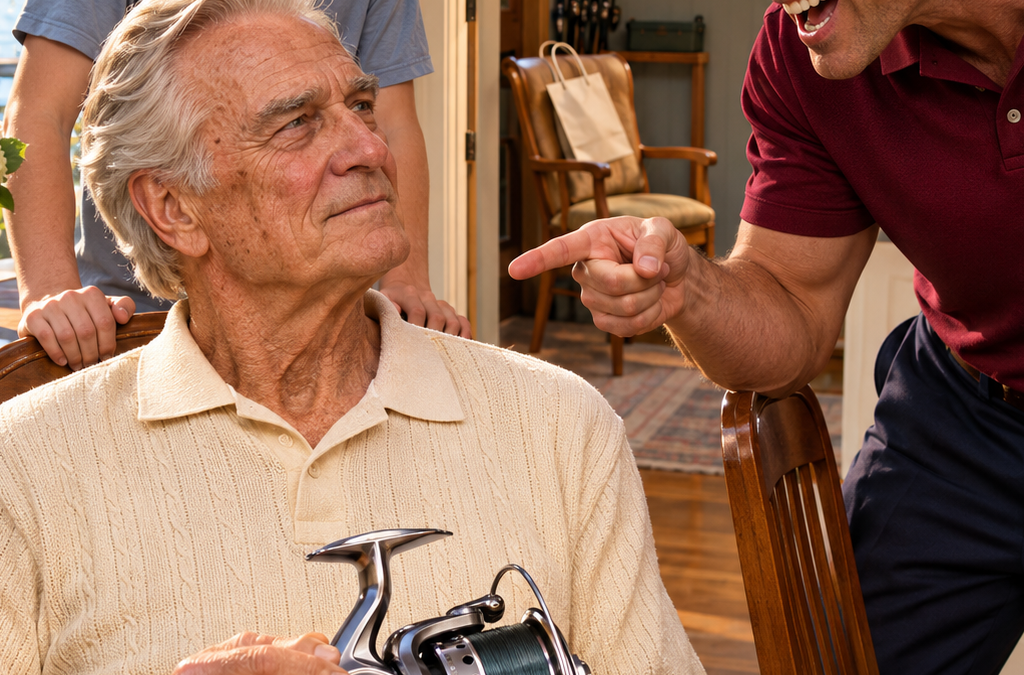
Noah came from the hall with my fishing reel. He held it out without making a presentation of it.
“Thought you’d want this.”
I rested it against my weak palm. The handle pressed into the same spot it always had.
David turned toward the table.
“This is why we’re doing the work. Wider openings, less clutter. Dad shouldn’t have to fight his own house.”
“Then move the bag off my chair.”
“We will.”
An older relative said, “He’s trying to keep the place in the family.”
“It’s already in the family,” I said.
David pulled out the chair beside me.
“Dad, nobody’s putting you out. You’ll always have a place here.”
“I have a place here now.”
“Right. That’s what I’m saying.”
He wasn’t. A cousin nodded at him anyway.
David rested his forearms on the table. His bank voice came out, the patient one he used when somebody disputed a fee.
“There are details you don’t need to carry while you’re recovering. Let me handle those.”
“Being helped did not mean being replaced.”
“Who said replaced?”
“You called yourself the new owner.”
He waited until a relative stopped talking near the kitchen.
“I’m taking responsibility for the house. That’s the point.”
“I’m not authorizing anything at this party.”
“Lunch isn’t a signing appointment.”
“Then stop serving it with an announcement.”
Noah stayed beside the empty chair. David looked at him.
“Get your grandfather some water, buddy.”
“I can ask for water,” I said. “He asked you a question about where I’d sit.”
“The layout isn’t finished.”
“Then leave my room alone.”
David’s jaw shifted. He turned toward the laptop at the table’s far end.
“We have a preliminary connection. You can hear everything yourself.”
“Good. And at the final one, she can ask me.”
“Dad—”
“Me. Not you answering for me.”
He clicked into the call. The relatives drifted closer, paper plates still in their hands.
A woman appeared on the laptop. David introduced her as Karen, the title officer.
“Just checking the connection before this afternoon,” she said.
“I’m Frank,” I told her. “I want to speak for myself.”
“Yes, Mr. Bennett. Are you comfortable participating here?”
“I am.”
David leaned toward the camera.
“He’s visiting from rehabilitation. We weren’t certain he’d be up to it.”
“I’m sitting right here.”
Karen looked down. David started explaining that arrangements had been made while my return was uncertain.
Karen stopped reading the screen.
“Why does this say you can’t be contacted?”
The closing attendance sheet had marked me unavailable during rehabilitation.
“Who put that down?” I asked.
David answered before Karen could.
“The scheduling information was entered before your home visit was approved.”
“My phone worked before yesterday.”
“It wasn’t meant that way, Dad.”
Karen looked back at the camera. “I’ll correct the attendance information. Please give me the number you want used.”
I said it myself. David stayed beside the laptop while she read it back.
My phone lit up before the call ended. Ellen Price had answered the request I’d sent Tuesday. She was the notary who had visited me at rehabilitation.
Her message included the specific notary journal entry I had requested. The description read “Gift authorization.”
I read those two words again.
The paper I remembered signing was permission for repairs. I had a front-side picture of it on my phone, with the repair heading plain enough to read.
“What is it?” David asked.
“A response I was waiting for.”
“From whom?”
“I’ll read it first.”
Karen said she would reconnect later. David ended the call, then remained standing close enough to see my screen.
I opened the short rehabilitation clip Noah had shared with me.
“Noah, do you still have the original? The whole recording?”
He came around my chair. David asked whether anybody wanted coffee.
“The one from that morning,” I said.
Noah stared at my phone, then looked toward his father.
“Grandpa, that’s the long version.”
“Do you have it?”
“I think it’s in my backup. This one’s just what I sent you.”
He had filmed my grip practice with my permission. He’d brought the reel to rehabilitation because squeezing a rolled washcloth bored me stiff.
That morning had included lukewarm oatmeal, a therapist searching for a missing gait belt, and Ellen asking permission to scan both sides of the signed paper on her tablet. David had stayed beside the bed.
“Will you look?” I asked Noah.
“Yeah.”
“Later is fine. Don’t delete anything.”
“I won’t.”
David came back without coffee.
“Dad’s getting tired,” he told the relatives. “There’s been a lot coming at him.”
My left hand was tired. It lay open on my thigh, and I couldn’t quite straighten two fingers.
“I can tell them when I need a rest.”
“Of course you can.”
“You could ask.”
“Would you like to lie down?”
“No.”
He stood there a moment, waiting for me to soften it.
“I’d like lunch,” I said.
One of the relatives passed a plate toward David. She hesitated, then brought it around to me instead.
“Slaw?”
“A little. Thank you.”
Conversation started again near the kitchen, quieter than before. Nobody asked about paint colors now.
David sat opposite me.
“We’ve got people coming this afternoon. I’d rather not spend the whole day clearing up misunderstandings.”
“Then tell them it’s my house.”
“They know whose house it’s been.”
“Whose house it is.”
His laptop chimed. He looked at the screen, and his shoulders dropped.
“There. That’s what we were waiting for.”
He turned it slightly toward the relatives, bringing them close again. I stayed at the table with my phone beside my plate.
David read the new lender notification aloud.
“The ninety-five thousand is in escrow.”
Chapter 2 of 7
At noon, my phone rang with Grace Turner’s name. I asked David to leave the porch door open and went outside.
The party voices followed me through the screen.
“Is the money really there?” I asked.
“Yes. I confirmed it with the lender, not David’s bank.”
“Then what can he do with it?”
“Nothing yet. It’s the lender’s money, held for a closing. The transfer, mortgage, and title coverage have to meet their conditions first.”
“So nobody’s been paid.”
“Not from that escrow.”
I sat on the porch bench. Through the screen, someone asked where we kept the mustard. David answered as if he had bought every jar in the house.
“Tell me about what I signed in January,” I said.
“I have the complete document. Your January authority expressly allowed David to make gifts to himself, and your stroke didn’t automatically end it.”
“I thought that was for when I couldn’t get to the bank.”
“It covered more than that.”
I watched a wasp investigate an old screw hole in the railing.
“Did I really give him that much?”
“Yes, Frank.”
She didn’t soften it. I had hired her a week earlier because I needed somebody who wouldn’t.
“I told him no in front of everybody.”
“I know.”
“Apparently that wasn’t enough.”
“I need the closing package before I tell you what your objection does here.”
Inside, David said, “He’s right out here. He’s fine.”
Then the screen door scraped across the porch boards.
“Dad, everybody’s asking if you need anything.”
“I’m talking to Grace.”
“I can wait.”
He stayed in the doorway.
“Stay on,” I told her.
David looked toward the phone, then back at me.
“Your cousin changed her work schedule to come. People have been figuring out rides, meals, getting you here when you’re ready.”
“I didn’t ask anybody to miss work.”
“They want to help. We’re trying to keep you close.”
“Close to what?”
“To us, Dad.”
Behind him, a relative laughed too loudly at something I couldn’t hear.
He lowered his voice.
“You shouldn’t have to worry about gutters and insurance and whether a contractor shows up. That was the whole idea.”
“Then you could have arranged gutter cleaning.”
“It’s bigger than gutters.”
“It certainly got bigger.”
He looked through the screen before answering.
“I’ve put my own money into getting this started. Deposits. People holding dates.”
“How much of this did you settle before telling me?”
“Nothing was going to leave you without a place.”
“That wasn’t my question.”
“The loan is ready now. If we lose this window, I don’t know what happens to the schedule.”
There it was, under all the talk about keeping me nearby. His contractor’s calendar. His deposits. The money waiting across town.
“My recovery isn’t your property deadline,” I said. “Tell everybody that, please.”
“Nobody’s rushing your recovery.”
“You just brought me a list of people waiting on it.”
For a moment, all I heard was the refrigerator door opening inside.
David glanced at my phone again.
“Grace, I hope you have the complete January document.”
“I do,” she said.
“Good. That should clear up some concerns.”
“I’m requesting the rest of the file.”
“Of course. We’ve supplied what they asked for.”
He went inside before she answered.
I waited until his footsteps passed the kitchen.
“Get everything,” I told her. “Whatever they’re actually using to do this.”
“I’ve asked for it.”
“And don’t offer them a payment to make this easier.”
“Were you planning to?”
“I’ve done it before.”
“I’m not offering your money.”
My left shoulder had begun to ache from holding myself upright. I leaned against the bench back. The porch smelled of warm screen wire and lake water.
Grace said, “They have the front-side image of your June repair authorization.”
“The same picture I have?”
“It appears to be. Karen needs to verify that document, too. She can’t work from either man’s recollection.”
“Mine or his.”
“Yes.”
I stayed on the bench after we finished. Our screen door had always needed a lift before it would latch. I had taught generations of kids to hang doors square, then spent years ignoring my own.
Noah came out and caught it before it banged.
“Dad said you wanted some quiet.”
“Did he?”
“He said to check.”
“You can sit.”
He remained standing beside the bench.
“I knew there was paperwork,” he said.
“What paperwork?”
“About the house. I didn’t read it.”
“Did you know he was calling himself the owner?”
Noah looked through the screen.
“He said not to get you upset with complicated details. While you were still—while you were getting better.”
My tongue caught against a rough tooth. I kept pressing it there.
“You could have told me.”
“I thought he was handling it.”
“So did I.”
He turned toward the yard.
“Do you want me to tell him you’re mad?”
“You don’t need to carry messages between us.”
“I wasn’t trying to—”
“I know. But don’t take that job.”
He stayed a little longer, then went inside. I didn’t call him back.
By 12:45, Grace had called again. A closing-system notice had reached her and me.
“It lists David twice,” she said.
I read the names on my screen. Proposed recipient: David Cole. Attorney-in-fact for Frank Bennett: David Cole.
Beneath them, the deed status said “already executed.”
Then I saw the date.
“Executed July 15, 2026.”
Chapter 3 of 7
“He signed it Wednesday?” I asked.
“As your agent,” Grace said. “It’s still undelivered in escrow, held on conditions. It hasn’t been recorded.”
My phone showed 12:45 p.m. Inside, someone was asking David whether the work would start next week.
“So he signed before I got here.”
“Yes.”
“And telling him no today doesn’t stop it?”
“It doesn’t settle whether he had authority when he signed.”
I could hear David answering the question about next week. He sounded certain enough for both of us.
“Stay available,” I told Grace.
“I will.”
I went inside. The floor felt cooler through my shoes than the porch boards had. David stood near the dining table, talking to a cousin.
“You signed a deed on Wednesday,” I said.
The cousin found somewhere else to look.
“Yes,” David said. “The proposed deed. That’s in the file.”
“While I was at rehabilitation.”
“You didn’t need to travel for me to sign as your agent.”
“You could have called.”
“I was handling the transaction under the authority you gave me.”
“The invitation said lunch.”
“It is lunch. The verification is this afternoon.”
He spoke quietly. Two relatives near the sink stopped scraping their plates.
“You told them you were the owner,” I said.
“I was describing what we’re completing.”
“That leaves quite a bit out.”
“Dad, I’m not saying every step is finished. I’m saying the signing already happened. The lender has arranged funding. The contractor has dates reserved.”
“You’ve arranged a lot without me.”
“I didn’t need another signature from you for that deed.”
My left knee had begun to wobble. I stood with my hip against the end of the table, unwilling to cross the room yet.
David continued, “If you’re asking to change direction now, that has to be dealt with against what’s already been signed. It isn’t just canceling an appointment.”
“I’m asking what you did.”
“And I’m telling you.”
He sounded like a man explaining an overdraft to somebody who wouldn’t read the statement.
“The plans are here, too,” he said. “Would you like to see what the contractor is actually pricing?”
“Yes.”
The rendering filled his laptop screen. Pale walls, a wide opening, a couch long enough to seat six. A television covered the wall where I kept tackle supplies.
Across the bottom, it said MEDIA ROOM.
“That’s my fishing room.”
“The proposed layout, yes.”
“Where’s the door?”
“That opening gets widened.”
“I can see that. Where does it close?”
“It doesn’t. That’s part of improving the circulation.”
My wooden chair stood in the hall behind him. The shopping bag still hung over its back. In the rendering, that corner held a tall speaker.
“Did you measure while I was gone?”
“The contractor needed dimensions.”
“Did he ask where I wanted things?”
“He worked from the scope I gave him.”
There was no place in that picture for a man who wanted the door shut.
A relative leaned nearer the screen.
“Those couches are hard to get out of,” she said.
David answered without looking away from me. “The furniture isn’t ordered.”
My left palm slipped against the table edge. I couldn’t hold my fingers firm enough to help myself stand straight.
Noah noticed from the kitchen doorway.
“Grandpa?”
“I need to sit.”
David stepped aside at once.
“Of course. Noah could take you back early. You’ve had a full morning, and we can call you from here.”
“I’m resting here.”
“The ride won’t get easier if you wear yourself out.”
“Then I’ll stop standing.”
Noah cleared a dining chair nearest the wall. I sat before anybody could offer another destination.
For several seconds, I watched a strip of sunlight cross my shoe. My hand lay useless against my leg. I needed the rest, however much I disliked David being right about that.
“Water?” Noah asked.
“Yes, please.”
David started explaining the rendering to the relative who had questioned the couch. I called Grace again.
“I want his authority ended,” I said.
“I’ll prepare a revocation to stop him acting for you going forward,” she said. “That won’t, by itself, answer whether Wednesday’s deed was authorized.”
“All right. I still want it.”
“I heard you.”
“And I want to speak to Karen.”
Her return call came after one o’clock. David remained close enough to hear my side.
“Mr. Bennett,” Karen said, “what would you like me to check?”
“All the instructions I gave for this property. Not just the January paper.”
“Yes.”
“The June document, too. I want you to get confirmation directly, not from my son or me remembering it.”
“I haven’t approved coverage,” she said. “I need direct confirmation of that document before I can finish my review.”
David spoke toward my phone.
“Karen, the existing authority and executed deed are both in your file.”
“They are.”
“So this is still a review of the closing package.”
“Yes, David. I’m checking what I can insure.”
I kept the phone near me.
“Please call me if you need an answer from me.”
“I will, Mr. Bennett.”
By 1:40, the pulled pork had cooled in its foil pan. Someone had put the serving spoon in the slaw, where its handle stood upright like a fence post.
David was talking about moving lunch leftovers into the refrigerator when my phone chimed.
It was Ellen.
“David’s office wants me to certify the entry as gift approval.”
Chapter 4 of 7
At 1:45 p.m., Ellen called.
“I can confirm you signed before me,” she said. “I can confirm my records. I cannot certify that the description in my journal authorized a gift.”
“How did that description get there?”
“It was entered when the appointment was booked, before I saw the final paper. I should have corrected it.”
“Did you tell David’s office that?”
“Yes. They asked for a statement. They’ll get what I can actually say.”
In the kitchen, David was telling someone there would be plenty of parking once the contractor finished.
I remembered Ellen at rehabilitation, scanning a receipt and signed pages while somebody changed the pillowcase behind me. She had asked permission each time. I’d been more interested in whether lunch included potatoes.
“Do you still have what you scanned?”
“I retain source files securely when the client agrees. You did.”
“Please retrieve mine.”
“I can do that.”
“And send it directly to Karen. Be there when she looks at it.”
“I’ll need your permission to discuss it with her.”
“You have it. Tell me what you need in writing.”
She explained where to send the request. I typed slowly with my right thumb, stopping when I left out a word.
The message took longer than I liked. Ellen waited.
After we hung up, Noah appeared beside the table.
“Do you need your charger?”
“Yes. Bedroom outlet, by the window.”
He came back with it plugged into an extension cord.
“The outlet here’s loose,” he said.
“Always has been.”
“You should fix it.”
“I’m making a list.”
He almost smiled. Then David called him into the kitchen.
By two o’clock, the lunch guests had begun finding reasons to stay. One cousin offered to wash the foil pans. Another asked whether anybody wanted to play cards.
David told them the afternoon call would clear things up.
Karen called a little later. I asked her to include David, and he came to the table.
“Mr. Bennett requested Ellen’s journal entry and the associated source material,” she told him. “I’m arranging direct verification with her.”
David looked at me before answering.
“The journal description is a clerical error. I’ve said that to Ellen’s office.”
“I’ll hear her explanation directly.”
“Certainly. But underwriting should consider the documents themselves. A booking description isn’t an instrument.”
“Then let’s look at the documents,” I said.
He paused.
“That’s what I’m asking for, Dad.”
“Good.”
I didn’t offer him an argument about the label. He waited a moment, then addressed Karen again.
“You have the January authority and the executed deed. Please keep those in the review.”
“They’re in the file.”
“Thank you.”
His voice stayed pleasant. Across the table, a cousin watched us over the rim of a paper cup.
I asked Karen, “If you can’t approve this, who stops the money?”
“I do. I’m the authorized title and escrow officer on this file. Without coverage, this lender’s release condition isn’t met.”
“So you can keep it from going out.”
“Yes.”
David leaned closer to the phone.
“But you’re not making an ownership ruling.”
“No. I’m deciding whether we can insure and fund this closing. I’m not deciding criminal guilt or a contested ownership case.”
“Then nobody has to give my house back,” I said.
“Your house hasn’t left your ownership, Mr. Bennett.”
A relative near the doorway looked toward David. He kept his attention on the call.
“Let’s finish the review,” he said.
Afterward, I called Grace. My left leg had gone stiff beneath the table, and I stretched it into the empty space beside me.
“Ellen’s getting her retained file,” I said. “Karen will hear from her directly.”
“That’s the right request.”
“Will you be there?”
“On your phone.”
“Can you tell me how this ends?”
“No. I haven’t reviewed what Ellen is retrieving.”
I stared at the kitchen clock. Its second hand clicked louder than I remembered.
“I taught kids to read every step before cutting.”
“Frank.”
“I signed what my son brought me.”
“Stay with what we can check today.”
I asked for the four o’clock verification at the dining table. Karen and Ellen would be on video. Grace would stay on my phone. I wanted David and Noah there.
“And the relatives?” Grace asked.
“They heard him announce it. They can hear the questions, if they want to stay.”
“You’re consenting to your documents being discussed in front of them?”
“Yes.”
Karen confirmed the arrangement. David agreed to the family watching.
“No reason to send everybody away now,” he said.
Noah stood against the kitchen doorway while the relatives agreed to stay. He said he would stay, too.
At 2:47 p.m., Karen forwarded a new instruction from the lender.
David’s phone sounded almost with mine. He stopped midway through reassuring a cousin about the construction schedule.
“Is that new?” he asked Karen.
“Yes. It’s in writing now.”
He read without speaking. Then he went toward the porch, already calling his contractor.
The cousin asked me whether four o’clock still mattered.
“It does,” I said.
Karen asked me to confirm I had received the instruction. I read it again before answering. The numbers were clear enough without anyone explaining them.
Unless the package was verified and insurable by 4:30 p.m., the settlement company had to return all $95,000.
Chapter 5 of 7
At 3:10 p.m., David stood just inside the porch door, still talking to his contractor.
“Hold the schedule through four-thirty. That’s all I’m asking.”
He listened, watching the relatives near the kitchen.
“Yes, I know the crew needs an answer. You’ll have one.”
When he hung up, he called everyone toward the dining area.
“Let’s get together before the call. We’ve spent half the day scattered around.”
A cousin asked whether she should bring in the folding chairs.
“Please. Everybody ought to have a seat.”
I was still in the dining chair against the wall. Two people settled between me and the laptop before Noah spoke.
“Grandpa can’t see from there.”
“We’ll turn the screen,” David said.
Noah asked the cousin beside me to move down. She did, apologizing, though she hadn’t put me there.
“I’m fine with people sitting,” I told her. “I’d just like to be one of them.”
She gave a small laugh. David didn’t.
Someone had found the plastic champagne glasses from an old New Year’s package. They came in two pieces, and nobody could make the bases stay on. A relative suggested drinking from the bottle to save assembly time.
David smiled at that.
“There we go. We can still enjoy ourselves.”
He waited until everyone had stopped moving.
“Dad entrusted me with handling the house before the complications from his stroke. We’ve had questions today, and that’s fine. This afternoon’s verification is a formality so everybody can be comfortable moving forward.”
“Karen hasn’t called it that,” I said.
“I’m talking about getting the family together, Dad.”
“You said verification.”
“We’ll let her do her job.”
A cousin who had been gathering purses stopped near the door.
“Should we stay for this?”
“If you’d like,” David said. “We’re not hiding anything.”
They looked at me.
“You heard the announcement at lunch,” I said. “You can hear the answers. I agree to the relevant papers being discussed here.”
David nodded as though I had endorsed the whole afternoon.
My phone was beside the laptop, beyond my easy reach. I brought it back beside my chair. Grace’s message said she was available whenever I called.
Karen sent a connection check a few minutes later. David opened it.
“Can you hear us?”
“Yes,” she said. “I’ll leave you while I finish preparing.”
“Karen,” I said, before he could end it.
“Yes, Mr. Bennett?”
“Ask me your questions, too. Don’t only ask my agent.”
“I will.”
“Grace will be on my phone.”
“That’s fine.”
David said, “You have everything we supplied?”
“The January document and the front-side June image are in the file. Ellen is retrieving her retained source record.”
A relative interrupted to ask whether the laptop needed an extension cord.
“It’s plugged in,” David said. “We’re set.”
Karen left the connection. David started explaining where everyone should sit when she returned.
Noah leaned close enough that only I could hear him.
“Can I talk to you?”
“Here?”
“Just—quietly.”
David had gone to the kitchen for the drinks. The relatives were arguing about which glasses had usable bases.
Noah stayed beside my chair.
“Tuesday, when you asked Ellen for the papers. I told Dad.”
I watched the kitchen doorway.
“What did you tell him?”
“That you were looking for something. About what you signed.”
“Did he ask you to find out?”
“No. I told him. I thought he could explain it before you got upset.”
“You let him know what I was doing.”
“Yeah.”
My left foot had slipped partly out of my shoe. I worked it back in while he waited.
“I’m sorry,” he said.
“I wish you’d asked me first.”
“I know.”
“I’m not sure you did.”
He looked toward the crowded table.
“I do now.”
I said nothing for a while. He stayed.
Finally, I asked, “Did you find your recording?”
“It’s in the backup. The original one.”
“Can you get it onto your phone?”
“Yes.”
“Then you can choose what you do now.”
He nodded, but I didn’t tell him everything was all right. He pulled a chair beside mine and started the export.
“Don’t play it yet,” I said.
“I won’t.”
By 3:45, the glasses held ginger ale. David had decided a toast would help.
He stood near the laptop, where everyone could see him.
“I thought Dad should go first.”
“No, thank you.”
“Just a few words. You could tell everybody this keeps the house together. Takes the maintenance off you, gives us a way to protect the place—”
“Is that what you want me to say?”
“It’s what we’ve been trying to accomplish.”
“You can say what you want. I’ll speak for myself.”
One relative lowered her glass before drinking.
David continued in a quieter voice.
“I was offering you the first toast.”
“And an account of why I’m giving you my house.”
“Nobody needs a speech.”
“Then say plainly whether you’re receiving it as a gift.”
He glanced toward the laptop.
“The proposed transfer is a gift, yes.”
“Thank you.”
No one asked me to toast after that.
Noah’s screen still showed the export moving. David asked him to help with the drinks.
“I’m doing something for Grandpa.”
“There are people waiting.”
“I’ll help in a minute.”
At 3:59, Karen’s connection opened. Ellen appeared in another window. I called Grace and heard her answer.
Beside me, the export finished: seven minutes, eighteen seconds.
Noah turned his phone so I could see the completed file.
“Seven minutes, eighteen seconds.”
Chapter 6 of 7
“Before you release it, I need David to answer one question.”
The laptop clock read 4:00 p.m. Noah’s complete grip-practice recording was ready on his phone. He left it beside me, the playback control facing my right hand.
Karen looked into her camera.
“Go ahead, Mr. Bennett.”
“David, are you saying I authorized you to give yourself this house?”
“Yes, Dad. The January power expressly allowed that. That’s what I used to sign.”
“How did that survive the later authorization for this same house?”
He answered without looking away.
“June was a repair work order. It told me what work to arrange. That’s separate from the authority to transfer ownership.”
Ellen’s face remained in the other window.
“The journal description was wrong,” David continued. “We agree on that. But a mistaken label doesn’t change January. Neither does Dad being uncomfortable today with something validly signed Wednesday.”
Karen paused.
“A repair instruction alone wouldn’t necessarily withdraw the earlier authority. Ellen, does the signed document address that?”
“I’ve sent you my complete retained scan. Directly, through your secure link.”
David watched the screen.
“Both sides?” Karen asked.
“Yes. Scanned at the appointment, with Mr. Bennett’s permission.”
The refrigerator motor stopped. From the kitchen came the faint drip of our faucet.
Karen opened the image for everyone to see. The first side looked like the picture on my phone. Then she moved to the reverse.
“Would you enlarge that?” I asked.
She did.
I read it aloud, slowly enough to keep my words straight.
“For this property, this authorization replaces all earlier grants of authority. Repairs only. No gift or transfer.”
A cousin leaned forward. David remained seated.
“That was on the signed document?” Karen asked Ellen.
“Yes. This is the complete scan I retained. The front supplied to your file was incomplete.”
“And the journal?”
“My booking description was wrong. I left the original entry intact and explained the error. The document says what it says.”
David spoke before Karen could ask anything else.
“I treated that as the scope of the repair arrangement.”
I set my fishing reel beside Noah’s phone. It had been against my thigh, below the table.
“Please listen,” I said.
I started the recording myself and moved ahead to the conversation beside my rehabilitation bed.
Onscreen, my fingers struggled around the reel. Noah’s voice asked whether I wanted him to stop filming.
“Keep going,” my recorded voice said. “Might get good at it.”
Then David spoke from beside the bed.
“This one replaces what I can do with the house, Dad. Repairs only now. It’s not permission to give it to me.”
“Or anybody,” I said onscreen.
“Right. No transfer.”
I stopped playback. My face on the little screen looked tired and badly shaved.
Karen addressed Noah.
“You made this recording?”
“Yes. Grandpa said I could. That’s the original from my backup, all seven minutes, eighteen seconds.”
He glanced at David.
“I also told Dad on Tuesday that Grandpa was asking for papers. I shouldn’t have passed that on.”
David said, “Noah, this isn’t about—”
“I’m answering her.”
Karen waited, then turned back to David.
“Do you have any later signed grant restoring gift authority?”
“No later document. I relied on January and understood June as governing the repair work.”
“The later signed restriction replaces that authority for this property.”
She looked toward another screen. David began to speak, but she continued.
“I’m selecting the coverage decline now.”
A confirmation box appeared in the shared file window. She read it, selected the confirmation, and the status changed.
“I am declining coverage for this transfer. That blocks the $95,000 renovation funding.”
The cousin nearest David put her untouched ginger ale on the table.
Karen continued, “I’m marking the linked escrow non-disbursable under the lender’s instructions.”
David rose and reached toward the laptop.
“Wait. Can we postpone instead?”
“Please leave the connection open,” Karen said.
He stopped with his arm over the table.
“I’m asking for time to resolve it.”
“This package cannot fund. A new authorized transaction would have to be submitted and reviewed.”
“Dad could sign directly.”
“No,” I said.
“We could keep the repairs separate, then. Leave me enough access to manage the payments.”
“No replacement gift. No keeping you on my accounts.”
“Those are different things.”
“I’m saying no to both.”
His arm dropped. He looked toward my phone.
“Grace, there are commitments here.”
“You can send them to me,” she said.
A relative who had asked David every construction question since lunch turned toward me.
“Frank, do you want us to take these extra chairs out?”
“After the call. Thank you.”
Noah crossed the room. David shifted aside, apparently expecting him to come closer.
Instead, Noah went into the hall. He removed the shopping bag from my wooden armchair and carried the chair back into the fishing room. Its legs made a small scrape as he settled it beside the window.
“Here?” he asked me.
“Yes. That’s where I use it.”
David watched from the table.
“I was trying to make this manageable.”
“My house wasn’t an advance on your inheritance.”
He looked at the relatives, then back at me.
“I’ve spent real money.”
I left that unanswered.
By 4:18, Karen had confirmed the file status and ended the verification. Ellen disconnected. Grace stayed on my phone while the relatives gathered their things.
Someone had abandoned a plate with one pickle slice and six toothpicks. Nobody had eaten the pickle. I stared at it while David stood near the porch, typing.
At 4:23 p.m., my phone sounded.
His message arrived with the subject “Reimbursement demand: $18,400.”
Chapter 7 of 7
The $18,400 demand listed deposits, scheduling charges, and preliminary work. Grace stayed on the phone while I read it.
“He signed those contracts himself,” she said. “Did you authorize them?”
“No.”
“Then that’s our answer. His demand isn’t a judgment.”
“I could pay and stop hearing about it.”
“You could pay and still hear about it.”
Through the porch screen, I could see David standing beside his car. He was waiting for me to call him back.
“I’m not paying,” I said.
“All right. I’ll review the attachments and send a written rejection.”
“Say why. Don’t just tell him I’m upset.”
“I’ll say you didn’t authorize his commitments and reject his claim that you owe them.”
David’s car stayed there another few minutes. I didn’t go outside.
On Monday, July 20, at 9:20 a.m., the settlement company confirmed that the undisbursed $95,000 had been returned to the lender.
I called Karen rather than asking Grace to call for me.
“All of it?” I asked.
“All of it. Nothing went to David or a contractor.”
“And the deed?”
“It was never released or recorded. The closing is closed.”
“Thank you for answering me.”
“You were entitled to an answer, Mr. Bennett.”
That afternoon, I signed the written revocation before a notary. My left arm tired against the edge of the desk, but I finished my own signature.
Grace sent the notice to David, both my banks, the lender, and the settlement company. She recorded it, too, because the January authority had been recorded.
Over the next few days, she confirmed delivery. I kept asking whether David had received his copy.
“He has it,” she told me. “You don’t need to call and explain it.”
“I wasn’t going to explain.”
She waited.
“I was going to ask whether he’d read it.”
“Leave that alone, Frank.”
I did.
By Friday, July 24, both banks had confirmed that David’s agent access was disabled. I called each bank myself and asked the same question.
“He can’t act for me anymore?”
“That access has been removed, Mr. Bennett.”
I wrote down the names of the people who answered. The second bank put me on hold long enough to hear the same piano piece twice.
That day, Grace sent her rejection of the reimbursement demand. She had reviewed the contracts and invoices. David had committed his own money under agreements he signed; I had not authorized those commitments or agreed to reimburse him.
No court had ordered me to pay him.
When he called that evening, I let it go to voicemail.
His message began, “Dad, we ought to be able to work this out ourselves.”
I saved it. I didn’t return the call.
Noah visited during the weeks that followed. At first, he stayed near the doorway, asking whether I needed anything carried.
“Sit down,” I told him once. “You’re making me feel like a bus stop.”
He sat.
Some visits were awkward. He talked about school, then stopped whenever my phone sounded.
One afternoon, he said, “Dad asked how your walking was.”
“What did you tell him?”
“That I’d ask you what I could say.”
I watched him for a moment.
“You can tell him I’m working on it.”
“Anything else?”
“No.”
“Okay.”
He didn’t ask again that day.
Later, he asked before sending a picture of me to a relative. Another time, he told David to call me directly about a visit. He mentioned it afterward without asking for credit.
I began leaving my phone beside him again when I went to the bathroom.
On Friday, August 14, Grace received David’s contractor cancellation accounting. Of his $18,400, the contractor returned $12,200 and retained $6,200 under the cancellation terms David had signed.
David accepted those figures.
“Is there anything for me to answer?” I asked.
“No,” Grace said. “No bill to you. No agreement for you to sign.”
I slept badly that night anyway. Six thousand two hundred dollars was a lot of money. For years, a loss like that would have brought him to my kitchen table.
In the morning, I ate breakfast without calling the bank.
I invited David for one hour on Friday, September 18. I gave him the beginning and ending times myself.
He arrived without a folder. That helped more than I wanted it to.
We sat in the kitchen. He asked about therapy and whether I was keeping up with the exercises.
“Mostly.”
“You always hated homework.”
“I assigned plenty.”
He laughed, then looked toward the window.
After a while, he said, “I didn’t think we’d end up like this.”
“I didn’t either.”
“I was putting money into the place.”
“I know you were.”
He waited for more. I had nothing else to add.
Near the end, he asked whether he should leave a number for repairs.
“I can call someone.”
“I could still help with—”
“Visiting is what I invited you for.”
He nodded. It took him a moment.
When the hour was up, he stood. I walked him to the door. I gave him no key, no account information, and no promise about who would own the house someday.
“Call before you come again,” I said.
“I will.”
On Friday, December 18, Noah sat near the lake-facing window in my fishing room. I was in the wooden chair he had returned, working a length of line through my fingers.
Outside, the water looked gray beneath the winter sky.
“You want me to do that part?” he asked.
“Give me a minute.”
The fishing reel rested against my left palm. The grip practice at rehabilitation hadn’t made that hand quick again. Two fingers still wanted to curl when I needed them open.
Noah waited while I loosened them.
For lunch, he had made tomato soup and grilled cheese, burning one corner of each sandwich.
“Consistent work,” I’d told him.
Now a little orange stain marked his sweatshirt cuff.
“You missed your mouth,” I said.
He inspected it. “That was earlier.”
“Good. I’d hate to think it was spreading.”
He laughed and went back to watching the line.
I got it seated where I wanted it. My hand needed a rest, so we watched a gull settle on the water.
Then I tried the handle.
I turned the reel handle one more time.







