My son refused me a bed with my eight-year-old granddaughter watching; he had no idea the $469,200 house he lived in was mine.
Chapter 1 of 7
“Stop making yourself our problem.”
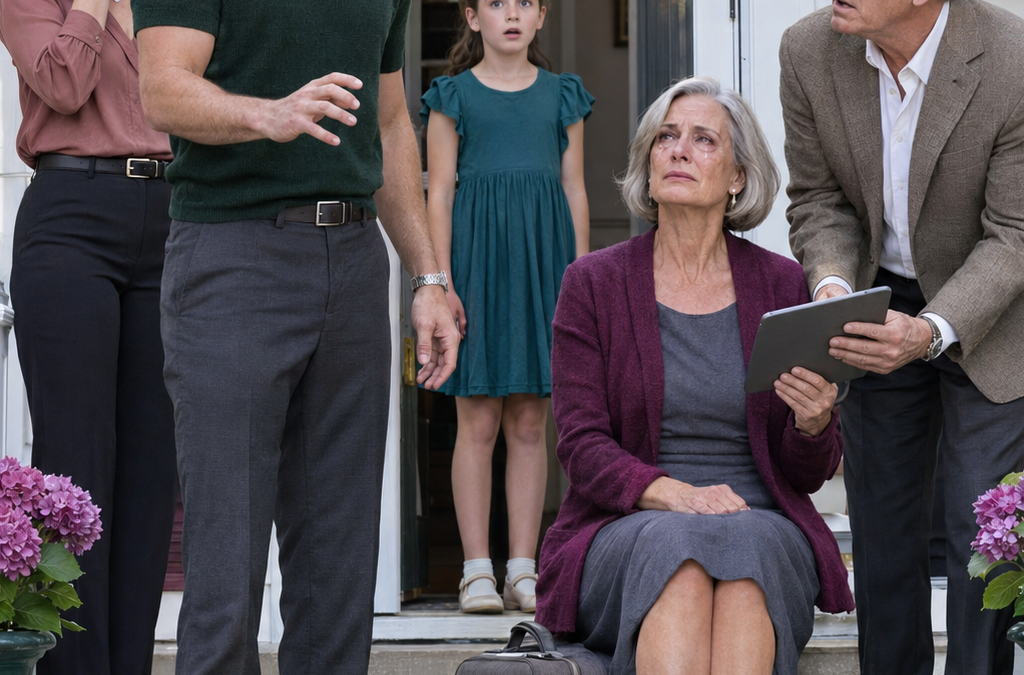
Daniel stood across the doorway while I sat on the doorstep. My suitcase and discharge papers were beside me. After six nights in the hospital with pneumonia, standing still wore me out.
Emma, eight, peered around her father.
“Grandma, I can bring you a pillow.”
“Go back inside,” he told her.
My brother Robert stayed by the porch rail. He had driven me there for the short recovery stay we had arranged. Now he looked past Daniel, waiting for somebody else to settle it.
I felt my face burn.
My name is Linda Brooks. I’m sixty-six. I had been widowed for three years and retired for four. Before that, I coordinated employee benefits, helping other people understand what they had paid for.
This was Columbus, Ohio, where I had let my son’s family live rent-free for six years. They had paid me exactly $0 in rent. For four years, I had also used $1,350 of my monthly retirement income to help with their household expenses.
Two years earlier, I had paid $4,800 for Emma’s dental treatment. Daniel had called me crying that day. I remembered how quickly I had told him not to worry.
The house was in my name alone.
Nobody had ever asked what my permission to live there actually meant. I had said, “Make it your family’s home,” and Daniel had heard a gift. When he started calling it his place, I avoided an uncomfortable correction.
I lifted my older tablet from my lap. Daniel handled some transactions with my retirement insurer, but none of that money belonged to him.
I was humiliated. I had helped this family without making them beg, and now I was sitting outside.
His wife came up behind him.
“We aren’t your nurses.”
“The hospital said I could manage with someone nearby,” I said.
She looked at my discharge papers without coming closer. We had discussed this before I left the hospital. I wasn’t arriving unannounced, asking them to change their lives forever.
“Take your things away,” Daniel said.
I had expected irritation about the inconvenience. I had even prepared to be cheerful through it. I hadn’t prepared for him to speak as though I had tried sneaking into a stranger’s house.
“Find somewhere else.”
It hurt that my brother said nothing. He had heard the arrangements himself. Still, he remained beside the rail, looking down toward the driveway.
My daughter-in-law noticed my eyes filling.
“Don’t start crying here.”
I was ashamed of crying in front of them. That embarrassed me almost as much as the tears. I was sick, tired, and trying to understand why an agreed visit had become something disgraceful.
“You need to leave,” she added.
Daniel glanced back into the house.
“We’ve got enough going on.”
On Sundays, he used to ask me to make the baked spaghetti with the browned corners. He claimed the middle was for people without ambition. I had laughed at that silly line for years.
Remembering it there made me feel terribly lonely.
I nearly said I was sorry. The words were ready before I knew what I was apologizing for. Usually, I offered money next, and everyone became easier to get along with.
“I’ll arrange it,” I said.
I didn’t owe an apology for needing a bed.
The tablet was familiar territory. I had used it for benefits questions before retirement and for insurer calls afterward. Daniel knew that, but he seemed to think I was searching for somewhere to stay.
He even smiled when I opened the insurer’s call service.
“Good. Handle it.”
Robert came close enough to hold the tablet steady while I answered the representative’s identity questions. My voice sounded thin, but I knew every answer.
“I understand there’s a withdrawal waiting,” I told her. “Please don’t release it until you’ve spoken to me.”
Daniel stepped toward us.
“Mom, leave that alone.”
The representative said she could pause the pending request for owner review. She asked me to confirm that was what I wanted.
“Yes.”
“Ma’am, that individual request is now on hold.”
My son stopped smiling when his transfer was put on hold.
“That’s household business,” he said. “You’re making a mess.”
The representative asked who else could hear the conversation. I told her my son, his wife, and my brother were nearby. I wanted them to hear me.
She explained that the hold applied to the pending withdrawal. It did not erase every arrangement already on the account. Someone from the senior service team would follow up with me about what happened next.
Daniel leaned closer, suddenly using a different voice.
“I’ve been helping her with this. She’s just out of the hospital.”
“I’m speaking with the owner,” the woman said.
I was angry now. He had refused to help me recover, then offered my illness as a reason to speak over me.
I asked the woman how much he had requested.
“Twenty-four thousand dollars.”
For a moment, I wondered whether I had heard her correctly. I had known he was handling something with the insurer. I had not known the amount.
Daniel answered before I could.
“It’s for work on the house.”
His wife watched him instead of me. Robert shifted beside us but said nothing about the money.
“Ask her to explain it,” I told him.
“I don’t know the details, Linda.”
He said my name gently, as though that made his refusal easier. I wanted him to ask Daniel why I was hearing this on the porch.
The representative repeated the amount and waited.
Daniel’s voice rose. “She’s been helping us for years. This isn’t some surprise.”
He looked straight at me.
“Tell her it’s fine.”
The insurer asked whether I had approved the $24,000.
“No,” I said. “I haven’t approved it. Please keep it on hold.”
Daniel started talking again, but the representative asked to hear my answer without interruption. I repeated it. She confirmed that the money had not been paid out and that the request would remain paused for review.
I asked her to contact me directly for the follow-up. After she explained how that would happen, I ended the call.
I felt frightened once it was over. Saying no had been brief. I knew living with his reaction would take longer.
“You can’t just cut us off,” Daniel said.
“I need somewhere to recover.”
Robert finally answered that. The hospital had given us information about a supervised recovery residence if the family arrangement fell through. He could drive me there, he said. There was no need for me to keep sitting outside.
I used the contact information with my discharge papers. They had a place available and staff who could help while I recovered. I explained my pneumonia, what I could manage, and what the hospital had told me to watch for.
The cost was $175 a night. Fourteen nights would be $2,450.
I said I would pay it.
That hurt too. I could afford safe care, but I had wanted my family to want me there. Paying a stranger did not make that part easier.
Robert carried my suitcase toward his car. He hadn’t challenged Daniel or explained his own silence. Still, I needed the ride, and I let him help me stand.
Behind me, Daniel said, “We need that withdrawal sorted out.”
I turned toward him. His wife stepped into the doorway beside him, looking alarmed now.
“He already paid the contractor’s deposit.”
Chapter 2 of 7
By morning, Daniel had explained the contractor’s deposit in a message. He had paid it himself for work he had ordered. Now he wanted me to cover the balance.
I read his message from my bed at the recovery residence. He hadn’t asked whether I had slept or needed anything.
“Don’t leave me stuck with this,” he wrote.
I felt hurt, though I should have expected it. I had spent years answering his worries before mentioning my own. Even sick, I caught myself considering how quickly I could make his problem disappear.
Susan Price knocked before coming in. She was the nurse assigned to my recovery visits, and she waited until I said yes.
“How was the walk from the bathroom?”
“Longer coming back.”
“That happens. We’ll keep it short today.”
She asked about my breathing, then had me explain my medicines. I told her which one I was still finishing and how I followed the hospital’s instructions. When I paused to cough, she waited without answering for me.
“Any worries about staying here?”
“The price,” I said. “A hundred seventy-five a night. Fourteen nights is twenty-four hundred fifty dollars.”
“Is that more than you expected?”
“No. It’s what I agreed to.”
Saying that made me sad. I had made a sensible arrangement, but I still wished I were waking up near my granddaughter.
Susan asked whom I wanted included when we discussed my care.
My son’s name nearly came out automatically.
“Me first,” I said. “Please ask me before calling anyone.”
“All right.”
She didn’t look surprised or demand an explanation. That small courtesy nearly made me cry.
Breakfast included oatmeal thick enough to stand a spoon in. At home, I called that wallpaper paste and added enough milk to offend whoever had cooked it. Susan found some milk without treating me like a difficult patient.
I needed help, not a replacement.
Later, Karen Ellis called from the insurer. She introduced herself as a senior policy-service supervisor and checked my identity before discussing the account.
“I want to understand what my son can still do,” I told her.
“You own the annuity, Mrs. Brooks. Daniel acts under the financial power of attorney we accepted.”
I remembered signing it. Having someone available to handle money matters had seemed sensible after my husband died. I hadn’t expected that person to argue with me about my own decisions.
“Can I stop that arrangement?”
“You can revoke it in signed writing. We need to receive that notice before we stop relying on his authority.”
I asked her to explain what my porch call had accomplished.
“The twenty-four-thousand-dollar request remains paused for owner review,” she said. “But that pause hasn’t removed him as your agent. He can still submit instructions.”
“So I haven’t finished.”
“Correct. We’ll explain what we need from you.”
I was frightened by how close I had come to treating one call as enough. Karen didn’t rush me. I repeated the difference back to her, and she confirmed I understood.
I wrote down what she told me. Then I asked that follow-up calls come directly to me.
Daniel called before lunch.
“Did they fix it?”
“The request is still on hold.”
“Call them back.”
“I already spoke with the supervisor.”
“Then tell her to release it.”
I could hear household noise behind him. It hurt to recognize the ordinary life continuing in the house where I hadn’t been allowed to rest.
“I’m not promising that money, Daniel.”
“You’ve always helped with the house.”
“I know what I’ve paid.”
Years of silence had taught him to expect agreement. Whenever he pushed, I had found some way to soften my answer until it sounded like yes.
He asked when I would resume helping with household expenses.
“I’m paying for my recovery now. I’m not making another promise.”
“Let someone useful handle it.”
I ended the call after telling him I needed to rest. My face felt hot, and I hated that he could still make me feel foolish so quickly.
When Susan returned, I accepted help walking down the hall. I had wanted to prove I could manage alone. Instead, I told her when I needed to stop.
Robert visited that afternoon. He asked about the food and whether the bed was comfortable. I answered, waiting for him to mention the porch.
He talked about Daniel instead.
“He called me. Asked if I was getting any rest with all this driving.”
“That was considerate of him.”
Robert looked embarrassed.
“He said you shouldn’t turn a temporary illness into permanent dependence.”
“I arranged two weeks here.”
“I know.”
“And the stay at his house was supposed to be short.”
“He told me something different.”
I was angry enough that I had to wait before speaking. Robert had heard our arrangements, yet Daniel’s version had somehow counted more.
“What does he want you to do?”
“Help settle things.”
“Which things?”
“The company. The money.”
Robert glanced toward the hallway. I didn’t fill the pause for him.
“He asked me to back him.”
“About what?”
“He thinks they’ll listen if somebody else in the family explains.”
I felt cold despite the warm room. My brother had come to visit, and I had been glad to see him. Now I couldn’t tell whether he was checking on me or gathering an answer for Daniel.
“Robert. What did he ask you to say?”
“He wants me to tell them you can’t follow your bills.”
Chapter 3 of 7
“I haven’t seen you mixed up,” Robert said. “That’s what Daniel told me.”
“Then why repeat it?”
“I thought if everybody settled down, we could work this out.”
He looked tired, but I was tired too. I had spent six nights struggling to breathe. Now I had to defend my ability to understand a bill.
“Please stop passing along things you haven’t seen.”
Robert said he would. He didn’t apologize, and I didn’t thank him. I hated how much effort it took to ask my own brother for that little.
Two days later, Daniel sent a message to the family group. He described me as unreliable since the hospital. He said he was protecting me from costly mistakes.
“She needs someone checking her decisions,” he wrote.
I read it twice from my bed at the residence. These people had asked me about retirement plans and insurance for years. Now my son was telling them I couldn’t be trusted.
I felt humiliated. He had made my illness everybody’s business without explaining why I was recovering among strangers.
A cousin had promised to visit that afternoon. She planned to sit with me and take a short walk. I had been looking forward to conversation that wasn’t about my breathing.
Her message arrived shortly after Daniel’s.
“Maybe I should wait until things are settled.”
I called her. She sounded uncomfortable before I said anything.
“Nothing needs settling before you visit me.”
“I don’t want to get between you two.”
“You wouldn’t be.”
She said she would check back later. I told her all right because I couldn’t bear asking again.
The residence staff helped me with my afternoon walk instead. Their help was kind and included in what I was paying. Still, I was lonely, and the empty visiting hour hurt.
At lunch, I had requested mustard for the chicken salad. Daniel used to tease me for putting mustard in everything except coffee. I caught myself wondering whether he had eaten, then felt angry with myself.
Karen called while Susan was visiting. I told her the nurse was there and could hear my answers.
“Daniel sent us a loan statement supporting his request,” Karen said. “I wanted to clarify what it shows.”
“Whose loan?”
“His. The remaining principal is twenty-four thousand dollars, for renovations.”
“Does it put a debt against my house?”
“No. This is his personal loan. It isn’t secured by your house.”
I asked her to repeat the amount. It matched the withdrawal exactly.
That loan was Daniel’s.
The requested withdrawal would go into my own checking account, Karen explained. Daniel had described using it afterward to pay his lender.
I was angry that he had started this without asking me. He had submitted the withdrawal before I had agreed to pay anything.
“Has any money gone out?”
“No. The request remains on hold.”
That was what I needed to know. I thanked her and ended the call.
Susan had been waiting to check how I managed walking without getting breathless. I told her I needed a minute.
“I paid household expenses because I chose to,” I said. “That monthly help was a gift. I never told him I would take over a loan.”
She waited while I worked through it aloud.
“He borrowed the money. I didn’t agree to repay it. Those are different things.”
“Do you want to rest before we walk?”
“No. Just shorter today.”
I was grateful she let me finish without questioning every word. We walked slowly, and she stayed beside me when I needed to stop.
Daniel called later. This time he didn’t begin by asking about the insurer.
“You like the work we did, don’t you?”
“I haven’t discussed paying for it.”
“That’s not what I asked.”
He listed the improvements, then the weekends he had spent working. Some of that labor was real. I remembered him calling with sore knees, proud of what he had finished.
I listened without arguing about whether the work had been worthwhile. That wasn’t the question he needed me to answer.
“The work benefits the house,” he said. “You get that.”
“I understand.”
“Then don’t be ungrateful.”
That word hurt. I had housed his family for six years. He could still make me feel I hadn’t done enough.
“Work benefiting the house doesn’t mean I agreed to pay for it.”
“Fine. Keep saying that.”
He told me his next $680 loan payment was coming due. He said it as though I had sent him the bill myself.
I said nothing for a moment. I wanted to ask whether they could manage it. I knew that question would become another discussion about what I could afford.
“Call your lender, Daniel.”
He hung up.
I was frightened afterward. Refusing him no longer felt like one hard conversation. He had involved the family, and a visit I needed had disappeared.
For several minutes, I considered calling my cousin again. I wanted to explain everything until she believed me. But I was exhausted, and I still needed enough strength to get through supper.
I didn’t call Daniel back either. I let myself be upset without offering money to make it stop.
Before supper, his message arrived.
“I’m done paying the household expenses I cover unless you release the $24,000.”
Chapter 4 of 7
Protecting my house didn’t mean paying Daniel’s personal debt. I decided I would cover necessary owner expenses myself, without giving him money to distribute.
Then I called Anne Foster, an Ohio estate-planning lawyer I had chosen myself.
“I need to know what belongs to the house,” I told her. “And what belongs to my son.”
Anne checked the county ownership record before our meeting. She didn’t ask me to hunt through storage for an original deed while I was recovering.
“The recorded title names you alone,” she told me. “We’ll keep the property questions separate from his borrowing.”
I felt relieved, then embarrassed by the relief. I had spent years helping people understand benefits. With my own family, I had avoided questions because I feared the answers would hurt somebody.
Robert drove me to Anne’s office several days later. I could walk farther now, though the stretch from the parking lot still required a pause.
He waited without telling me to hurry.
Anne’s meeting room was small enough that Daniel couldn’t avoid sitting near me. He arrived in his work clothes, looking irritated until Anne introduced herself.
“Thanks for fitting us in,” he told her. “I’d like to get this cleared up.”
To me, he said, “You could’ve just called.”
I had called. I had also answered his calls, read his demands, and spent nights worrying about his anger. I was tired of being told the problem was my failure to explain.
Anne supplied him with a copy of the recorded deed.
“Linda Brooks is the sole owner of the Columbus property,” she said. “Its current estimated value is $469,200. There is no mortgage.”
Daniel read the page longer than I expected.
“She told us to make it our family’s home.”
“That was permission to live there,” Anne said. “It wasn’t a transfer of ownership.”
He looked at me then, waiting for me to soften what she had said.
“You can live somewhere without owning it.”
The words sounded blunt in my voice. I wished I had said them years earlier, before everyone had built plans around my silence.
Daniel stared at the copy again.
“All right. Your name’s on it.”
I felt sick with disappointment. Even now, he made it sound like a technical inconvenience.
He stopped arguing that the house was already his. Instead, he began listing what he had put into it: borrowed money, weekends, work after long shifts.
I remembered some of those evenings. Emma had called to show me the changes while Daniel talked from somewhere behind her.
“I know you worked hard,” I said.
“You said we were building something for our family.”
“I wanted you to have a home.”
“Keep your promise.”
It hurt because there had been a promise, just not the one he claimed. I had offered stability. I hadn’t offered every dollar I might need for the rest of my life.
Anne asked whether I had agreed to repay his renovation loan.
“No.”
Daniel turned toward her, his voice suddenly careful.
“Should someone who’s been this ill make abrupt decisions? I’m asking honestly.”
He hadn’t asked me once that morning how I was feeling. Hearing him offer concern to a stranger made me furious.
Anne answered without looking at me for permission.
“Linda retained me. I’m discussing her instructions with her.”
Daniel leaned back.
“Then explain what happens to us.”
“We’ll discuss your family’s stay separately,” I said. “I’m not approving the withdrawal.”
He looked toward Robert. My brother sat near the wall, uncomfortable and quiet.
For once, I didn’t wait for either man to make my answer easier.
Daniel left before we finished. He told Anne he appreciated her time. He told me I was making a mistake.
After he went, I was ashamed of how badly I wanted him to come back kinder.
Anne let me sit for a moment.
“To end the authority the insurer recognizes, you need signed written notice,” she said. “They must actually receive it.”
She went through the instructions with me, then let me read them myself. Robert waited while I checked each page and signed where required. When we left, he carried an envelope.
Outside, he asked whether I wanted lunch.
I said I wanted a grilled cheese cut straight across. Daniel always cut mine diagonally and claimed it tasted better. Robert said he had spent sixty-eight years unable to detect the difference.
I laughed, briefly. It felt strange and good to have an ordinary preference nobody challenged.
Back at the residence, I spoke with Karen about the conference. We settled on Friday at ten, at Daniel’s dining table, with Karen joining by video.
I didn’t like going back to that house. I agreed because I wanted to answer for myself with everyone hearing the same thing.
Daniel and Megan would be there, along with Robert. Susan would be available to describe what she had personally observed during my recovery. Emma would be at day camp.
“She doesn’t need any part of this,” I told Karen.
Anne would remain available for advice. She wasn’t going to speak in my place.
I felt frightened after the arrangements were made. There was no excuse left to postpone the conversation, and no reason to expect Daniel would accept it quietly.
Karen called again before supper.
Daniel had contacted her after receiving the conference details.
“He’s asked us to disregard any new instruction from you,” she said. “He says it’s the product of hospital medication.”
Chapter 5 of 7
“I can describe what I’ve seen,” Susan said. “That’s all I can do.”
She had come for my recovery visit, and I told her what Daniel had said about hospital medication.
“I haven’t done a court-ordered capacity evaluation,” she said. “You’ve explained your medicines accurately. You’ve made choices and told me why.”
She asked what I was still taking. I went through my current medicines and the hospital instructions. She checked my answers against her notes.
“I won’t guess about what happened before I met you,” she added.
“That’s fair.”
I was grateful she understood the difference between being fair and taking his side. I didn’t need her to declare that I had never made a mistake.
Being admitted to the hospital hadn’t handed my decisions to Daniel. Being weak hadn’t done that either. Still, I hated having to explain myself because he had said so.
Karen called later that morning. The preliminary service review was complete, she said, but she still needed to speak directly with me.
“We’ll verify your identity privately first. Then we’ll discuss your current wishes with everyone present.”
“Will Daniel be answering any of those questions?”
“No. Those answers need to come from you.”
I checked the arrangements again. Megan and Robert would be at the house. Susan would be available to join for questions about her visits. Emma would be at day camp.
Karen asked whether I was comfortable attending in person. I could have asked for another location.
“I’ll be there,” I said.
I was afraid of walking up that path again. I remembered sitting outside while my son told me to leave. But I wanted to be there, hearing exactly what he said.
Anne spoke with me afterward. She would be available for advice, but she wasn’t going to conduct the call.
“If you need a break, ask for one,” she said.
“I don’t want you answering for me.”
“I don’t intend to.”
That helped more than a promise that everything would turn out well. I would speak for myself.
Robert came to the residence that afternoon to confirm the ride. He stood near the doorway until I asked him to sit.
“Daniel called,” he said.
“Of course he did.”
“He says tomorrow ought to be simple. One withdrawal, get the loan settled, stop all this.”
I felt angry hearing my recovery reduced to an inconvenience around Daniel’s payment. Robert hadn’t said he agreed, but he hadn’t challenged it either.
“What did you tell him?”
“That I’m driving you.”
“Anything else?”
“He wanted to go over what I should say.”
Robert looked embarrassed. I waited.
“He wants me to say you asked him to take over.”
“I asked for help with some things. You know that.”
“I told him I wasn’t rehearsing a statement.”
It was more than he had said on the porch. It still left me wondering what he would do when Daniel was standing in front of him.
“Please don’t agree with him just to get us home sooner.”
Robert looked down.
“I heard you, Linda.”
The next morning, he drove me to the house. I could manage the walk from the driveway without his arm, though he stayed close.
I felt ashamed when I recognized the place where I had sat. I knew I had done nothing wrong. The shame was there anyway.
Megan let us in. She told me Emma was already at camp, then led us toward the dining room.
Daniel stood beside the table.
“Let’s keep this on track.”
Nobody asked whether I wanted to sit before we started discussing money.
The dining table still wobbled at one corner. For years, Daniel had warned anyone visiting not to lean there, then blamed the visitor when their drink shook. I almost heard Emma’s little imitation of him.
I missed her. I was relieved she wasn’t there.
Megan stayed near Daniel.
“We worked our budget around getting rid of that payment,” she said. “Six hundred eighty dollars every month. That’s a lot.”
“I know it is.”
“We can’t just find that somewhere else.”
Her worry was real. I could hear it without agreeing that my savings were the answer.
Daniel cut in.
“Mom knows what this does to our household.”
“If you mean Emma, leave—” I stopped and started again. “Leave her out of this.”
Megan glanced toward the hallway, though Emma wasn’t there.
“We’re talking about bills,” she said.
“Then talk about bills.”
My face felt hot. I wanted to comfort her, which frightened me almost as much as Daniel’s anger. Comfort had so often ended with me paying.
Robert remained standing near the far end of the table.
Daniel turned toward him.
“She asked me to handle the money when she got sick. That wasn’t supposed to change whenever she got upset.”
“You were already helping before I got sick,” I said.
“Don’t start picking at words.”
He said I had handed the financial decisions over permanently. Megan watched me, waiting. Robert looked toward Daniel.
I didn’t give them a speech. Karen wasn’t on the call yet, and I wouldn’t spend my strength arguing twice.
“We’ll discuss it when she joins.”
Daniel’s mouth hardened.
“Uncle Robert, you were there. You’ll have to tell her which one of us she should believe.”
I pulled out the chair beside mine and left it empty.
Daniel pointed toward Robert.
“Tell her you saw how confused she was.”
Chapter 6 of 7
“Tell them yourself,” Daniel said. “You handed it over when you got sick. You said I was handling things from then on.”
Karen had finished checking my identity privately. Now everyone was back within view of my tablet.
Robert remained near the far end of the table.
“I never saw her confused,” he said.
Daniel barely looked at him.
“Mom. Tell her.”
I felt embarrassed that he still expected obedience in front of everyone. Karen waited for me, and I was grateful she didn’t fill the pause.
“If I gave it away, why am I still its owner?”
Daniel looked toward the screen.
“I know she owns it. I’m talking about responsibility. She’s let me handle this for years.”
His voice had become reasonable, almost patient. I recognized the voice he used with people whose cooperation he needed.
“She’s always helped with household expenses,” he continued. “I made decisions based on that.”
Karen asked him whether I had approved this withdrawal.
“She knew we were doing renovations.”
“That isn’t what I asked.”
He looked at Megan, but she kept watching the screen.
I was angry. He remembered every payment I had made and treated each one as permission for the next.
Karen turned back to me.
“Mrs. Brooks, what do you want us to do now?”
“I revoke Daniel’s authority on my account. I don’t approve the $24,000 withdrawal.”
Daniel interrupted before she could answer.
“She’s just been hospitalized. People are putting things in her head.”
Karen asked what he had personally observed that concerned him.
“She’s making decisions she would never have made before.”
“She’s disagreeing with you,” Megan said, very quietly.
He turned toward her.
“She doesn’t understand what this does to us.”
That hurt. Even my ability to understand had become a question of whether I paid.
Susan joined when Karen asked for her observations. Her voice sounded the same as it did during our walks, practical and unhurried.
“Linda has explained her medicines accurately during my visits. She chose who could receive information about her care. She also explained the difference between household support she’d given and a loan she hadn’t agreed to repay.”
“Were you there when she borrowed it?” Daniel asked.
“No. I’m describing what I observed.”
Susan didn’t claim anything beyond that. I trusted her more for stopping there.
Karen asked me to explain my decision.
“Daniel’s loan payment is about $680 a month,” I said. “Paying his loan would help his budget. It would also take $24,000 from my retirement money. I haven’t agreed to that.”
My voice shook at the end. I was frightened, but I knew what I meant.
Daniel leaned toward the screen.
“She agreed privately. Before everybody got involved, she told me to go ahead.”
Robert stood. He crossed the dining room and sat in the chair beside mine.
“No, Daniel.”
“You weren’t there.”
“I was there when she said she wouldn’t approve it. And I was there afterward, at Anne’s office.”
Daniel stared at him. Robert spoke slowly, with none of the soothing language he had used at the residence.
“I watched Linda read the written revocation. She read it herself and signed it. Then I delivered it to the insurer.”
I felt relief so sharp it nearly hurt. He had done the errand, but until that moment I hadn’t known whether he would say it plainly here.
Karen confirmed that she had received the signed notice.
“We reviewed it before this conference,” she said. “Today I needed Linda’s direct verification. She has provided it.”
Daniel looked back at Robert.
“You carried that behind my back?”
“Linda asked me to deliver it.”
“You said she wasn’t following things.”
Robert’s face reddened.
“I repeated what you told me. I hadn’t seen it.”
He turned toward me.
“I should have said that sooner. And on the porch, I let him turn you away without challenging him. I’m sorry, Linda.”
I wanted to cry. I also wanted him to finish without having to comfort me.
Karen addressed Daniel.
“Your role was as her agent. Hospitalization didn’t transfer ownership or make that authority permanent. We have her signed instructions, and she has confirmed them herself.”
“But the request was already submitted.”
“It was paused, not paid.”
She waited until he stopped trying to speak over her.
“Daniel’s access to $187,400 ends now. The $24,000 request will not be paid.”
Daniel stood and reached toward the tablet. I kept it in front of me.
“Wait. You can’t finish this while she’s—”
“Don’t touch it,” I said.
Megan pulled back from him. She had been sitting close enough that their shoulders almost met. Now there was space between them.
I felt shaky and terribly tired. I had expected relief to feel better than this.
“Helping me never made my life yours,” I told him.
He stared at me as though I had said something cruel.
Robert asked whether I wanted to leave.
“My guest room is downstairs,” he said. “You can stay while you finish recovering. We’ll work out what help you need.”
I thanked him without pretending everything between us was repaired.
Daniel started again about the house. I stopped him.
“Future housing arrangements go through Anne. We’re not deciding that on this call.”
Karen confirmed that her decision concerned the account only. I thanked her and Susan, then ended the call myself. The tablet stayed with me.
Megan looked at Daniel, waiting. He said nothing about calling his lender or finding another way to pay.
She asked for Anne’s number. I gave it to her.
When Anne answered, Megan spoke without looking at either of us.
“Can you put a date in writing for us to leave?”
Chapter 7 of 7
Anne proposed an agreement that gave Daniel and Megan eight weeks to move. We discussed it through her, without reopening the question of my savings.
On July 6, we met at her office to sign.
“This is a voluntary surrender agreement,” Anne said. “You’re agreeing to return possession at the end of August.”
Megan read every page. Daniel looked mostly at the deadline.
“And she signs too?”
“Yes,” Anne said.
I signed after they did. I agreed to leave their belongings alone while they arranged their move. They agreed to leave the house.
I felt sad watching Megan check the departure date again. I had wanted that house to give Emma a steady childhood. Agreeing on an ending still hurt.
Outside Anne’s office, Daniel followed me toward Robert’s car.
“One payment,” he said. “Just cover this month.”
“The loan payment?”
“Six hundred eighty. We’ve got moving expenses now.”
I knew what he wanted me to say. I could almost hear my old answer, followed by his relieved voice and another month of avoiding the problem.
“You need to speak with your lender.”
“They don’t care that we’re moving.”
“I’m not paying it, Daniel.”
He walked away before I reached the car. His remaining $24,000 loan was still his responsibility. Refusing one more payment hadn’t made that easy for either of us.
Robert drove without asking what Daniel had wanted. I was grateful for that.
I had finished my stay at the recovery residence and moved into Robert’s ground-floor guest room. By then, I could shower without needing to rest afterward. Walking farther still took practice.
His help was practical. He drove me to follow-up visits and stopped asking whether I was sure whenever I wanted to do something myself.
One afternoon, I thanked him while we ate lunch.
“You made it easier to recover.”
“I’m glad you came.”
“I still remember you standing there on the porch.”
He looked at me.
“I know. I let Daniel explain away what I could see.”
There wasn’t much to add. I appreciated his help, and I was still hurt. He let both things stand without asking when I would forgive him.
As the weeks passed, I needed less help. I began doing my own laundry and taking longer walks. I stayed with Robert temporarily while Daniel’s family finished moving, but I was no longer waiting for somebody to tell me what I could manage.
Daniel communicated mostly through messages by then.
A question about leaving something behind became a complaint about the expense of renting. I answered the question and left the complaint alone. We did not return to discussing my account.
Near the end, he asked for more time.
“Another month would make this easier.”
“The agreed date stays.”
I felt cruel for several minutes after sending that. Then I remembered that I had already given them eight weeks.
They returned possession on the agreed day, eight weeks after signing. I waited until Megan confirmed they were out before going inside. I hadn’t changed the locks, moved their belongings, or inspected around them.
Daniel met us at the entrance.
“Sixteen hundred a month,” he said. “That’s what the rental costs.”
“I hope it works for you.”
He looked angry, but he didn’t ask me to pay it.
Megan gave me the keys. She seemed exhausted.
“Emma’s things are all out. I checked.”
“Thank you.”
I waited until they had driven away before walking through the house with Robert.
There were pale patches where furniture had stood and small scuffs along the hallway. The house needed cleaning. It also needed me to stop expecting every room to look as it had before six years of family living.
I cried in the empty sitting room.
Robert stayed nearby without trying to cheer me up. I was relieved to have my house back, and I missed the family I had imagined sharing it with.
After cleaning and getting settled, I found myself sleeping better. Nobody needed an answer about money before breakfast. I could rest without worrying that rest would be used against me.
A couple of weeks later, I met with Anne again.
This time we discussed what I wanted after my death. I revised my will to leave my remaining probate estate to Robert. Separately, I changed the named recipient on my existing $60,000 life-insurance policy to him.
“The will doesn’t change the insurance,” Anne reminded me.
“I’ve sent the separate form.”
I waited for the insurer’s confirmation before considering it finished.
Robert had known nothing about those decisions when he sat beside me at Daniel’s table. I had promised him no inheritance for speaking honestly, and he had asked for none.
Daniel still sent practical messages. He had no authority over my finances, and I gave him no new access.
When he wrote that Emma wanted everyone together for dinner, I answered him directly.
“If you want to discuss dinner, ask me yourself. Please don’t put that on her.”
We arranged Emma’s visits between adults, with clear pickup plans. She didn’t carry messages or hear arguments about the house. Sometimes Megan brought her. Sometimes Daniel did, staying at the door.
By four months after my discharge, an afternoon with Emma could simply be an afternoon.
She drew beside me in my sitting room while I waited for a garden-club video call. Our family had always called the same tall weed “volunteer landscaping.” Emma was drawing one with a prize ribbon.
“Would they know?” she asked.
“The garden club? Immediately.”
She laughed and added another ribbon.
My older tablet was beside me. Nobody was waiting to interrupt my answers or tell me which decision would make the family happier.
Emma asked whether she had to be on the call.
“No, honey. You can keep drawing.”
I felt happy then, plainly happy, without needing anybody else to agree with me.
Helping someone never meant owning the rest of their life.
I propped the tablet up and chose my own view.







