My mother’s stepson scraped my childhood height marks off her kitchen doorframe and said, “You weren’t her real daughter.”
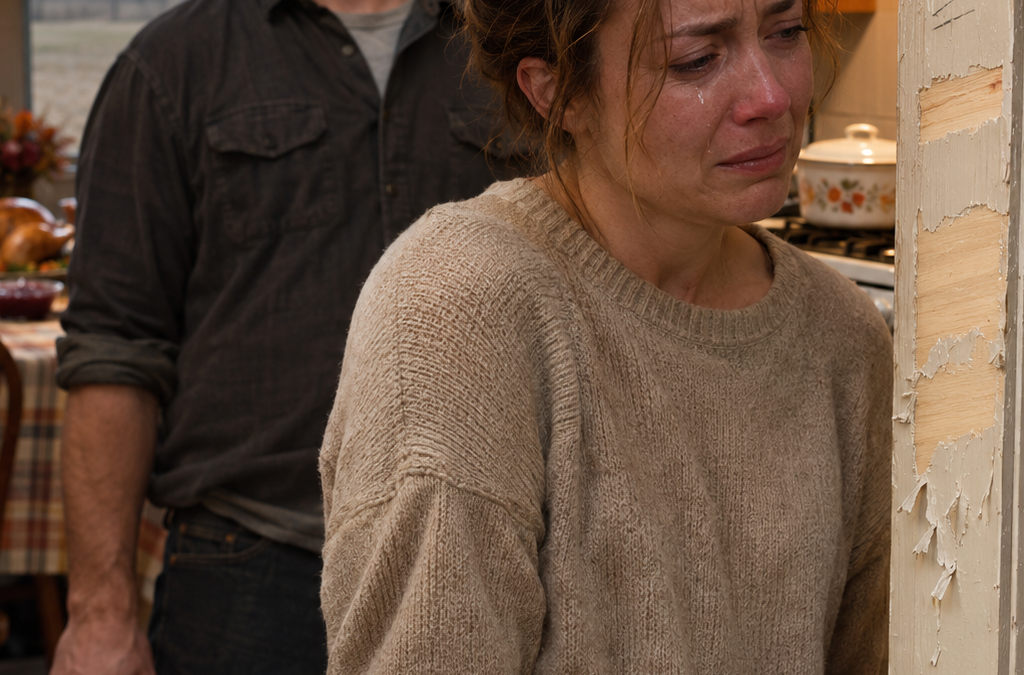
Chapter 1 of 7
“Please stop scraping, Mark. Those are mine.”
“Then you should have photographed them before.”
Mom had adopted me at six, before she married Mark’s father. Four years of unpaid caregiving had ended with her death. Now, on Thanksgiving, Mark Dawson was peeling away the pencil line she’d drawn above my head at twelve.
“Jenna, are you going to let him?”
Jenna looked away. Her phone was open for pictures of the household keepsakes relatives had permission to collect. Beside the refrigerator lay an unfamiliar worksheet with a picture of the house.
Susan Price, Mom’s sister, stood between me and the doorway.
“Let him get the kitchen cleaned up.”
“Those marks aren’t dirt, Susan. You know that.”
“Don’t make everybody choose sides today, Claire.”
The scraper caught another strip. Hearing Aunt Susan defend him hurt worse than watching it fall.
At thirty-four, I was still Claire Bennett, Ruth’s daughter. My medical-equipment repair job had shrunk to three paid days weekly while I cared for her.
Mom recorded a deed that made this my house when she died.
She’d told me before she died. The recorded paper wasn’t something I had seen yet.
Mark’s coat hung over the low chair where I’d sat during Mom’s bad nights. Its sleeve still carried her neat repair. On the stove sat the turkey casserole I’d brought, with crushed potato chips because this family complained about breadcrumbs.
Discarded wrapping had spread across the table. My fingers started gathering it before I caught myself.
I had made helping look like something I never needed thanked for.
Mom’s brass thimble lay on the counter. It had protected her working finger through years of alterations. I slipped it into my pocket.
Mark glanced toward the refrigerator, then stepped into my line of sight.
Beside the refrigerator lay a photograph of our house without its curtains.
Jenna had taken pictures here before. She used to film my repairs so Mark could follow the steps later. That had seemed sensible; he hated written instructions.
Through my pocket, I touched the thimble once. Mark scraped again, and the newest line vanished.
“My boxes were on the chair,” I said.
“They go beside the trash bags now.”
Two cardboard boxes held things from my old bedroom: school folders, books, a sweatshirt Mom had patched at the elbows. Mark had pushed them against the bags by the back door.
Susan nodded toward them.
“Take only what you were offered, Claire.”
“Mom gave me those things years ago.”
“You’ve got enough. Let the others finish.”
The relatives remained seated around the table. Nobody was here for a will reading. They had come to choose permitted keepsakes, and somehow Mark had made himself the person who decided what everyone could touch.
When I bent toward my boxes, his voice cracked across the kitchen.
“LEAVE THOSE BOXES WHERE I PUT THEM!”
My face burned. The scraper was still in his hand, pointed toward the floor like he had merely paused an ordinary chore.
“You’re erasing me while everyone watches, aren’t you?”
“You can take your little keepsake and leave.”
“All right. Leave my boxes alone.”
Susan moved aside without looking at me. Jenna’s phone had gone dark, but she kept staring at it.
And the casserole was still warm. That detail embarrassed me: how carefully I’d covered it so these people could eat before they went through Mom’s things.
Being useful hadn’t made me welcome.
There were scraps under my shoes and wrapping left on the table. For once, somebody else would have to clean them up.
Then I stepped onto the porch.
From there I could see the bare kitchen window. Mom had liked the curtains open while she worked, but she always closed them before supper.
Daniel Reed answered on the third ring. He was the attorney Mom had trusted with her house planning.
“Daniel, something’s happening here. Can we talk?”
“Yes. Has Mark mentioned a real estate agent?”
“No. Why would there be an agent?”
“One contacted me about papers Mark requested.”
“What papers?”
“Sale papers. She asked who could sign.”
The worksheet beside the refrigerator suddenly made sense. Until that call, I’d thought Mark was merely clearing rooms, making everything look less like Mom.
But he’d been preparing something larger while I brought dinner.
“Nothing’s signed that I’ve seen,” Daniel said. “I have something Ruth wanted you to receive.”
The following morning, we returned for the remaining collections. Mark was in the kitchen when Daniel arrived carrying Mom’s battered sewing case. The familiar cracked handle made my throat ache.
Mark stood in the doorway and asked what he wanted.
Daniel lifted the sewing case. “Your mother left something inside this.”
“That case goes to Claire,” Daniel said. “Ruth brought it to my office herself.”
Susan frowned. “Why couldn’t she just leave it here?”
“She worried Mark might intercept her belongings.”
Mark gave a short laugh. “It’s an old sewing box. Let her have it.”
The case had lived under Mom’s worktable for most of my childhood. Its corners were worn white, and the small tray inside still smelled faintly of machine oil.
Daniel set it before me. The lining had pulled loose along one side. A folded sheet rested under the lifted fabric.
Mom used to keep pattern pieces in there, the ones she wanted saved instead of thrown away with the scraps. This paper was heavier.
My name appeared beside the address.
Then came Mom’s name and the words describing the recorded transfer. My eyes kept returning to Claire Bennett, as if the letters might move while I wasn’t watching.
“More scraps for your collection,” Mark said.
Daniel didn’t answer him. He opened the folder he’d brought with the case.
“The bank supplied these during its property review.”
The first sheets concerned the house. Behind them were pages headed with Mark’s name and lists of work. Some entries sounded familiar before I understood why.
One mentioned the kitchen storm door. Another described preserving and packing kitchen items. Those were jobs I remembered doing, in rooms where Mark had watched me come and go.
“Why is his name on those?” I asked.
Daniel turned the page. Mark had billed for my work.
“The submissions say he completed these repairs and the packing himself,” Daniel said.
“Those are caretaker papers,” Mark said. “They’re nothing to do with her.”
My repair hours had cost me paid shifts. Seeing the work under his name made me angry in a way his insults hadn’t. He had let me do it, then sent somebody else a bill.
A knock came at the open kitchen door.
Nina Cole introduced herself as Cedar Bend Bank’s authorized estate officer. Daniel had arranged for her to join us. She wore a plain gray jacket and carried a folder much like his.
“The bank continued Mr. Dawson’s caretaker agreement,” she said. “I’m reviewing the property and the work records.”
Mark’s voice softened immediately.
“Of course. We’ve kept everything ready for you.”
He received $1,850 a month for that arrangement. Nobody had ever called what I did an arrangement.
Beth Turner, my cousin, moved her chair to make space. Eric Foster and Paul Harris remained at the table. Linda Grant stood near the stove, her permitted keepsakes still waiting to be packed.
They had all heard yesterday’s shouting. Seeing them here again made me feel exposed, with my bedroom boxes still beside the trash.
Nina asked for a place to spread out her papers. Beth cleared the end of the table, and Daniel moved beside her.
Mark passed close enough to speak without raising his voice.
“Keep quiet and stop making trouble for me.”
“Did you put my work on those pages?”
“Don’t start this in front of company.”
Nina looked up. He turned toward her with an accommodating expression.
“Anything you need, Ms. Cole. We’re happy to help.”
And there was the worksheet again, beside the refrigerator. Daniel identified it as a house-marketing worksheet and brought it to the table.
Nina studied the photograph, then the writing below it. Her finger stopped beside the words “owner approval.”
“Claire, did you give Mark permission to offer your home?”
Chapter 2 of 7
“I didn’t give him permission.”
Nina looked from me to Mark. “No sale has been approved. This worksheet is preparation only. There’s no signed listing or buyer contract here, and it gives you no authority to sell.”
“I was getting information,” Mark said. “Somebody has to think ahead.”
Daniel studied the paper I’d found beneath the lining of Mom’s sewing case. He compared its recording information with the Williamson County records on his laptop.
Nobody asked me to sit down. I pulled out a chair anyway.
“The recorded transfer operates outside the will,” Daniel told me. “This copy shows what Ruth recorded; finding it didn’t make the transfer happen.”
He requested a county-certified copy. Nina said the bank would obtain its own confirmation before finishing its review.
Mark watched them without asking a question. He still seemed to think this was something Daniel had brought for me to feel better.
Then Nina opened the will.
“The remaining estate goes to Mark, after debts and expenses,” she said.
“Remaining estate?” I asked. “Does it say anything about me?”
“You aren’t named in the will.”
I knew Mom had arranged the house separately. Still, hearing that sentence hurt. My name was missing from a place where I’d expected her to call me her daughter.
Once, near the end of her shop years, Mom had separated fabric into two piles. One was already promised to customers; the other was hers to use. She’d explained the difference twice while I complained that it all looked like the same cloth.
I understood separate piles. It didn’t stop me wanting my name on that page.
By Saturday, Daniel had the record details matched, though the certified copy hadn’t arrived. We met again in the kitchen to sort out what could happen while the bank checked its records.
Mark had left a fresh sheet at my place.
“It’s just permission for more photographs,” he said. “Don’t turn this into another fight.”
The sheet allowed an agent to photograph the inside of the house for marketing. There was a blank for my signature.
“Would you talk to her? She won’t listen to me.”
“No. I’m not signing that.”
“Pictures don’t sell a house by themselves.”
“Then you don’t need my signature.”
He looked toward Susan. “Would you talk to her? She won’t listen to me.”
Susan followed me into the small hall. She’d worked grocery aisles for years, and she still lowered her voice like an upset customer might overhear.
“You know what the family understood, Claire.”
“What did we understand?”
“That Mark would have something solid after all this. Ruth loved him.”
“I know she did.”
“He’s been living here eight months. You can’t pretend that means nothing.”
The scraped doorway was visible over her shoulder. I hated that I kept looking at it instead of her face.
“Eight months doesn’t mean he can offer the house for sale.”
“He moved his whole life here.”
“So did I, when I was six.”
Susan rubbed her forehead. “I’m asking you to be generous.”
She hadn’t asked what I needed. That hurt almost as much as her defending him the day before.
Back at the table, Mark pushed the photography sheet toward the empty chair.
Susan said, “She needs some time.”
“No,” I said. “I said no.”
Nina left the unsigned sheet where it was. She explained that my refusal didn’t end Mark and Jenna’s permission to live there, or the bank’s existing caretaker arrangement.
I wanted him out of that chair. Wanting it didn’t tell me how to make it happen.
Daniel said we would discuss the occupancy papers separately. Mark leaned back, looking pleased that there was still something I couldn’t simply take away.
Nina brought us back to the inventory.
“The house is estimated at $342,000. The estate has approximately $58,000 in cash before debts and expenses, and about $4,200 in household contents.”
“Then let everybody take what Mom promised them,” I said. “Let them finish.”
“We need to check those gifts against the inventory first.”
She wasn’t scolding, but I felt foolish. I’d resented Mark deciding what everyone could touch, then nearly given myself the same job.
“The house and the loose furniture are different.”
Nina said it plainly. The bank still had bills to pay and belongings to account for. I couldn’t give away estate possessions because they sat in my kitchen, or tell her to ignore debts Mom actually owed.
Mark seized on that.
“Exactly. She only visited. Jenna and I live with all of it.”
Jenna’s mouth opened.
“You—” she started.
Mark turned toward her. She stopped, then looked at me.
“Did you keep the repair messages, Claire?”
“Probably. Why?”
“I just wondered if you still had them.”
Her voice was barely above the refrigerator motor. I remembered answering messages during paid shifts, explaining which cupboard held the tools. Being called a visitor made those interruptions feel even smaller.
Mark said we were wasting the morning. Nina gathered the inventory sheets without agreeing.
By the time I got home, my jaw ached from holding back answers. There was laundry in my dryer and a work shirt I needed for my next shift. I stood beside it, too tired to fold anything.
Then my phone lit up with a message to the family group.
Mark had included everyone who’d been at the table.
“All disputed kitchen furniture is leaving tomorrow morning. I’ve hired a truck. The kitchen table goes on first.”
Chapter 3 of 7
“Does the kitchen table belong to the estate?” I asked Nina.
It was Sunday morning. Mark’s message was still on my phone.
“It’s on our inventory,” she said. “I’ll tell him nothing leaves until we’ve checked ownership and distribution.”
“I don’t want to fight him beside a truck.”
“You shouldn’t have to. I’ll contact him.”
Her message reached the family group before I left home. Mark was to preserve the estate’s household contents, not distribute them himself. The instruction covered the table and the other disputed furniture.
Mark answered with a complaint about the truck deposit. Then came a second message.
“I canceled it. Everybody can stop calling me now.”
Relief made me sit down. I’d pictured arriving too late and finding an empty patch where Mom’s table had stood.
By the time I reached the house, Mark had found another demand.
“You owe me for my wasted years here.”
He stood beside the table he’d threatened to remove. Jenna was near the sink, still wearing her coat.
“You moved in eight months ago,” I said.
“I was dealing with Ruth before that.”
“So was I.”
“You had your apartment. I moved my whole life.”
He spoke as though keeping an address elsewhere meant I’d slept there every night. I remembered driving home after dawn to shower before work. It hurt to hear those years reduced to where I kept my clothes.
Mark said he and Jenna had planned to relocate. He had counted on money from the house, and now everything was tied up.
“Then talk to Nina about what the estate can pay.”
“I’m talking to you. You want things your way, help us leave.”
He showed me a repayment statement on his phone. The balance was $28,000.
I read it twice, embarrassed by the urge to apologize for having seen it.
“That’s your debt, Mark.”
“It was manageable before all this.”
“Before Mom died?”
“Before you started holding everything up.”
He had roughly six weeks to fund the move he’d planned. The sale was supposed to clear the debt and leave him enough to start again. He explained it impatiently, as if the arithmetic established what I owed.
Jenna said, “We haven’t paid for the new place yet.”
“We will,” he told her. “Don’t confuse the issue.”
Then he looked back at me.
“I was the son who actually moved in.”
For a moment, I couldn’t answer. Mom had called me her daughter through every hospital visit, every bad night, every ordinary grocery trip. He could still make me feel like I needed proof.
“I’m not paying your debt,” I said.
“Then don’t complain about how long this takes.”
I had a paid repair shift that afternoon. There was nothing useful left to say, so I went.
At work, a portable suction unit waited on my bench. Its casing had a strip of tape reading “sounds like a lawn mower.” Usually, that would have made me laugh.
Instead, I checked my schedule and asked whether I could make up the hours I’d missed that week. I offered to take the next open bench shift.
Asking embarrassed me. Four years of reduced hours had made every interruption harder to absorb. Now Mom was gone, and I was still explaining why I hadn’t been available.
The suction unit needed a replacement seal. That was work I understood: find the fault, fit the part, test it again.
Mark called before I finished.
“Stop making me chase you over family business.”
“I’m at work.”
“We need an answer about moving expenses.”
“You have my answer.”
He started explaining the debt again. I could hear a television behind him, loud enough that he raised his voice over it.
“Put the request in writing.”
“You don’t need an email to act decent.”
“Anything about the property. Send it in writing.”
I ended the call when he started repeating himself. My hands stayed steady through the final test. I was angry, but I finished the job.
After my shift, I returned for the boxes still waiting by Mom’s back door. Jenna let me in.
Mark had gone out. Knowing that made the kitchen easier to enter, which saddened me more than I expected.
Jenna had put my boxes away from the trash bags.
“I didn’t open them,” she said.
“Do you know why the work pages have Mark’s name?”
“Thank you.”
For supper, she had made grilled cheese with mayonnaise on the outside. Mom used to call that cheating, then ask for hers the same way.
The familiar smell made me hungry. I resented being hungry there.
“Do you know why the work pages have Mark’s name?” I asked.
“He fills those out.”
“But you know I did those repairs.”
Jenna looked toward the front hall.
“I filmed them for him. You remember.”
“So he could follow the steps.”
“He wouldn’t read instructions. He said yours had too many words.”
She tried to laugh. It didn’t last.
“Why didn’t you say anything at the table?”
“He gets worse afterward,” she said. “When everyone’s gone.”
I believed she was frightened. I was also hurt. Both things sat between us while Mark’s car came up the drive.
He heard enough when he entered.
“Are you questioning her about my wages now?”
“I asked about the work submissions.”
“Same thing. You’re trying to take my income.”
Jenna stayed beside the sink.
Mark said caretaking meant arranging jobs, not doing every little task himself. He could ask somebody else to help. That didn’t mean he hadn’t earned his fee.
Later, at home, I asked Nina for the exact wording.
She sent the submitted page.
Directly above the storm-door repair entry, Mark had signed: “I did the work myself.”
Chapter 4 of 7
I had repaired the storm door. I remembered getting it square in the opening, then testing it until it closed without dragging.
Mark had signed his name directly above that work.
“That was me,” I told Daniel on the phone. “He knows it was me.”
“Your account matters,” Daniel said. “But he disputes it. Your memory alone won’t settle the invoice.”
“He’s saying he supervised.”
“Then Nina needs to hear what he claims he did.”
It hurt to need an answer to something Mark already knew. My knees had ached for two days after that repair. He’d asked whether I could hurry because the kitchen was getting cold.
On Monday, Daniel asked me to meet him at the house. The county-certified copy had arrived, and Nina had received the bank’s independent confirmation.
I parked behind Mark’s car. For a moment, I stayed there, looking at the kitchen window.
Mom used to stick a plastic fork into her porch fern to discourage squirrels. The fork was still there. She’d insisted it worked, despite considerable evidence from the squirrels.
I missed having something that ordinary to argue about.
Inside, Mark and Jenna sat at the kitchen table. Nina had joined Daniel, and Susan stood near the hall with her purse still over her shoulder.
Daniel waited until I sat down.
“The county record confirms that Ruth’s deed transferred this house to Claire when she died,” he said. “The house does not pass to Mark under the will.”
Mark looked at Nina.
“You’ve checked that yourselves?”
“Yes. The bank has confirmed it independently.”
“And there’s no mortgage or something that changes it?”
“No mortgage appears in our review.”
He stared at the copy in front of Daniel. Until then, he’d treated the paper like a request he could refuse.
Nina said the bank was removing the house from proposed estate-sale planning. She wasn’t issuing a court ruling; she was correcting what the bank had included in its own plans.
“So the will gives me what’s left,” Mark said. “But the biggest thing isn’t even in it.”
“That’s correct,” Nina said.
Susan looked at me as though I’d taken something off his plate.
I felt guilty for several seconds. Then I remembered that Mom had made this decision herself, before any of us sat at that table.
Mark turned toward me.
“She let you live here. She didn’t promise I’d pay your debt.”
“Then pay for my move.”
“No.”
“Ruth let us build a life here. You know that.”
“She let you live here. She didn’t promise I’d pay your debt.”
“You’re getting a whole house. Don’t act broke.”
My face grew hot. I had spent years arranging paid shifts around Mom’s needs. Now he was measuring what I owed him by what she had left me.
“I’m not giving you the house,” I said. “And I’m not paying $28,000 to make you leave.”
Jenna watched him, her lips pressed together. Susan started to speak, then stopped when Daniel opened the occupancy papers.
He had reviewed Mom’s written monthly permission. He explained the notice he was delivering for me and proposed putting the departure arrangements in writing.
Mark interrupted before he finished.
“You’re not changing locks while we’re out.”
“No,” Daniel said. “No locks are changing today. Your belongings stay where they are.”
I hated hearing how reasonable we had to be about his things. My own boxes had spent days beside the trash.
But I wanted this done without another fight at the back door. Daniel gave Mark the notice, and nobody went near his coat or the rooms he and Jenna used.
When Nina stepped into the hall to answer a call, Mark came close enough that only I could hear.
“You will pay before I carry anything out.”
“Send your answer to Daniel.”
“You can’t hide behind him forever, Claire.”
I stayed beside my chair. Daniel was still there, and I wasn’t going to follow Mark somewhere private to hear the rest.
When Nina returned, his voice changed.
“Ms. Cole, I’d appreciate some protection here. We have permission to occupy, and I’ve earned my wages.”
“Those are separate matters,” she said.
“I’ve kept the estate’s property safe.”
“That doesn’t answer the personal-work claims.”
Nina said she would hear both accounts before deciding anything about the caretaker agreement. Keeping the contents safe did not give him permission to claim repairs he hadn’t personally completed.
Mark said he had records. Nina asked him to send them.
I was relieved she hadn’t dismissed me. I was also tired of sitting across from him while he made my work sound uncertain.
Daniel suggested we gather everyone already involved rather than keep passing different accounts around the family.
We settled on Friday at ten, in the kitchen. It would be voluntary. Susan said she would come, and Jenna nodded when Nina asked her directly.
Beth, Eric, Paul, and Linda would be invited too. They had been included in Mark’s furniture message and had heard his account of the work. Daniel would stay with me; Nina would address the bank’s agreement.
At home, I answered their messages one at a time. Nobody needed to bring food. Nobody needed to choose keepsakes that morning.
For once, I wasn’t arranging a meal around a family problem.
That evening, Nina forwarded a new email from Mark. Susan and the cousins were copied.
“Photographic proof attached—please include the whole family.”
Chapter 5 of 7
The attached photographs showed hands, tools, and the lower half of the kitchen storm door. Every face was outside the picture.
I recognized the hinge I’d replaced. In another photograph, the door sat square in its frame, no longer dragging. A third showed the kitchen items I’d wrapped and packed after Mom died.
There was nothing in those tight little rectangles I could point to and call mine.
That embarrassed me. I knew the work, remembered doing it, and still enlarged each picture until it blurred.
Mark had copied everyone on his explanation. He’d arranged the repairs, provided access, and kept the household running. My help, he wrote, didn’t erase his responsibility.
By Thursday, he was saying it aloud.
“I supervised the work.”
We were in the kitchen. I’d come to collect the remaining repair messages Daniel had asked me to find. Mark had printed his photographs and spread them across the table.
“You said you did it yourself.”
“I got the jobs done. That’s what caretaking means.”
“Then tell Nina that tomorrow.”
“You’re wasting everybody’s time over how I worded something.”
He no longer talked about selling the house. Now he talked as if I’d stolen the meaning of his job.
I had wanted to sit down while I searched my messages. Instead, I stayed beside the counter, irritated with myself for letting him keep the whole table.
Susan arrived carrying a grocery bag of things she’d borrowed from Mom. She’d been asked to return them so the bank could finish checking the contents.
She found me in the hall before she left.
“Couldn’t you two settle this privately?”
“What would I be settling?”
“He’s embarrassed, Claire. Everybody’s seen those emails.”
“He sent them.”
“You could ask Nina to leave it alone.”
Susan’s voice had the tired patience she used when she thought I was being difficult. It hurt that she still expected me to make this easier for him.
“The bank paid him,” I said. “The work claims aren’t a family favor I can grant.”
“Ruth wouldn’t want all this upset.”
I wanted to ask which part Mom would have wanted. Instead, I told Susan the meeting was still happening.
“Please stay for it tomorrow. You’ve heard his account.”
She agreed without looking pleased.
Beth called while I was still there, asking whether she should drop off her list of keepsakes before work. I told her to bring it to the meeting and stay if she could.
“I’d rather you heard what’s said,” I told her.
Eric was already coming with his inventory notes. Paul had receipts for supplies he’d bought for Mom, and Linda had found messages about the things Mom had promised her. I spoke to each of them myself.
They weren’t strangers I’d gathered to take my side. They were already tangled in this, and I was tired of answering different versions of the same story.
That night, I laid out my work clothes for the shift after the meeting. Packing my lunch felt almost defiant. Whatever happened in that kitchen, I still needed to go earn my pay.
By morning, the table had been cleared.
Mom used to mend clothes there with the television on in the next room. She’d listen to game shows and answer questions nobody had asked her. Her best category was geography, though she called every large river “the Mississippi” before guessing again.
I almost smiled at that. Then I saw the chair where she’d sat, and sitting anywhere near it became hard.
Daniel arrived with the title confirmation in his folder. Nina brought the caretaker agreement and the two paid submissions. She also had copies of Mark’s photographs.
There wasn’t much ceremony. Nina asked where she could sit. Daniel asked whether I had what I needed.
“I think so.”
“Can I stay if he tells me to leave?”
It was a poor answer, but he accepted it.
Jenna came in carrying her phone. Mark was down the hall, talking loudly enough for us to hear him complain about missing a morning of work.
She stopped beside the empty chair near mine.
“Can I stay if he tells me to leave?”
The question made me sad, then angry. I remembered asking her to speak while he scraped the doorway.
“You can sit beside me.”
She sat before he came back. I didn’t ask what was on her phone or what she intended to say. She hadn’t promised me anything.
Susan took a place near Beth. Eric and Paul sat opposite Linda. These were people who’d eaten Mom’s food, borrowed her tools, and called when something needed fixing. Having them watch me struggle to belong here made me feel small again.
Mark came into the kitchen with another set of prints.
He addressed Susan and the cousins rather than Nina.
“You’ve all seen the pictures. I kept this place going.”
Beth glanced at the papers but said nothing.
“Claire helped with some jobs,” he continued. “Now she’s acting like I sat around doing nothing.”
“I haven’t said you did nothing,” I said.
“You’re trying to get me cut off. Same thing.”
Nina said she wanted everyone seated before they began. She hadn’t asked him about either submission yet.
Mark ignored the open chair for another moment. He told Paul that photographs were better than accusations. Then he told Susan he shouldn’t have to defend being paid for responsibility.
I was tired of hearing my work described as help. Still, I waited.
He finally sat and slid a printed photograph across the kitchen table.
“There. That’s my proof.”
At its edge was a sliver of my dark-blue sleeve.
Chapter 6 of 7
Mark claimed the work before our family.
Jenna sat beside me. Susan, Beth, Eric, Paul, and Linda faced the photographs spread across Mom’s kitchen table.
“Who repaired the storm door?” Nina asked.
Mark nodded toward his prints. “Those document work done under my responsibility.”
I placed my hand beside the photograph and pointed to the dark-blue sleeve.
“That’s my work shirt. Where’s the rest of the picture?”
“You helped. Nobody said you didn’t.”
“Why did you cut the person out?”
His eyes went to Jenna before he answered. That small glance hurt. He expected her to let him do this again.
“I kept the part showing the repair.”
Nina waited. Mark turned toward her.
“Claire assisted me. I supervised. Ruth hired me to be responsible, not spend every minute doing manual labor.”
Jenna’s chair shifted closer to mine.
“Can one family disagreement erase a contract?” he asked Nina. His voice was almost polite. “I’d like a fair answer.”
“I filmed it because you weren’t there,” Jenna said.
Mark stared at her.
“They were demonstrations,” she continued. “So you could do it yourself next time.”
“Don’t confuse everybody. You know what I mean.”
Jenna opened the original video on her phone.
“Let it run from the beginning,” I said. “Please.”
She did.
My own voice came out of the speaker, explaining where the storm door was catching. On the screen, I wore the shirt whose sleeve survived in Mark’s photograph.
Jenna said she had recorded it late in October. She remembered asking me to explain the hinge because Mark had said he could handle future repairs.
Nina leaned close enough to watch. Nobody asked Jenna to skip ahead.
Watching myself work was uncomfortable. I remembered being tired that day, but the video made it visible. My explanations came between stretches of work, with Jenna asking me to repeat things.
The recording followed me through the repair. I adjusted the hinge, squared the door, and rehung it. Jenna moved back when I tested the swing.
Then I recognized the angle.
“There,” I said. “That’s his photograph.”
Jenna paused it. Nina compared the printed crop with the screen. The position of the tool matched. So did my hands, the hinge, and the narrow strip of blue.
Outside Mark’s crop were my face and the rest of my body.
He had used a picture of me to prove I wasn’t the one who mattered. I felt humiliated all over again.
“You weren’t filming all day,” Mark told Jenna.
“I filmed the whole repair. You were out.”
Jenna let the recording finish, including my final test of the latch.
Then she opened the second video.
“This was after Ruth died,” she said. “The kitchen packing. Mark wanted it done a certain way, so I recorded Claire explaining it.”
That one showed me checking the kitchen storage, wrapping the fragile pieces, and packing them. Jenna’s questions were ordinary: which things needed extra padding, which boxes could be stacked.
“Where in either job did you do the work you signed for?”
There was a towel on the table that Mom had refused to throw away. In the video, I complained that it shed more lint than it caught.
I remembered that complaint. It seemed ridiculous to hear it now.
Nina found the second submitted image in the footage. Again, Mark’s crop excluded my face.
“Where in either job did you do the work you signed for?” she asked.
“Ruth let family fill in. She knew how we handled things.”
“Were you present for either job?”
“I was responsible for getting them done.”
Susan looked down at the table. Paul pushed his untouched coffee away. Linda watched Jenna, who kept the phone open.
Nina referred to the two submissions.
“You signed that you did these jobs yourself. These are the pictures you submitted.”
Mark started to answer, but she continued.
“The agreement allows termination for false work submissions. I’m ending your paid caretaker contract today.”
His chair struck the cabinet when he stood.
“Turn that thing off, Jenna. We’re finished here.”
She didn’t.
“And you can’t throw us out,” he told Nina.
“This is not an eviction,” Nina said. “Your occupancy is separate.”
Daniel spoke from beside me. “The notice and proposed move-out agreement still govern that discussion. The house isn’t an estate sale asset.”
I could barely feel my feet against the floor. For days, I’d wanted someone to believe me. Hearing the decision left me tired rather than ready to speak.
Jenna placed the keys in my hand.
“These are my copies,” she said. “I’m keeping only what I need until we leave, if that’s—”
“We’ll arrange access,” Daniel said. “Returning these doesn’t mean possession has been surrendered.”
Jenna stayed beside me.
Susan’s voice sounded thin.
“Claire, I shouldn’t have asked you to pay for his move.”
Mark turned on her. “Don’t start apologizing to her now.”
“I’m withdrawing the request,” she said. She didn’t look at him.
Beth offered to help me reclaim my old room after they had moved out under the agreement. She asked whether I wanted the walls painted.
“I don’t know yet.”
“That’s fine. You can decide later.”
That nearly made me cry. There was no job hidden in her offer, nothing I had to settle for somebody else first.
Eric turned Mark’s cropped photograph face down. Linda asked Nina where to send her inventory messages. Paul said he would leave his supply receipts with her.
Mark wanted to speak to me privately.
“No,” I said. “You don’t get to erase me and charge for my work.”
I wouldn’t pay him privately to leave. Nina’s decision about the caretaker work stood. Daniel would handle the notice and departure agreement with me.
My voice shook, but nobody asked me to make it easier on him.
As the relatives began leaving, Nina placed the two paid submissions together.
“The estate is requesting the $3,700 back.”
Chapter 7 of 7
Mark refused to return the $3,700.
“You don’t get to decide I worked for free,” he told Nina.
“The request concerns the two false submissions,” she said. “You’ll receive it in writing.”
She sent the submissions, payment records, and supporting material with the demand. Mark obtained his own advice. After that, the answers came through letters instead of angry calls to me.
The repayment became a civil negotiation. Nobody seized his money or announced a criminal verdict. Daniel told me when there was something I needed to know; otherwise, I went to work.
That felt strange at first. I kept checking my phone between repairs, expecting another problem I was supposed to solve.
On December 18, Mark signed the repayment settlement and returned $3,700 from his own funds. Nina sent confirmation that the estate had received it.
I read her message in the break room. My lunch had gone cold while I waited for a test cycle to finish.
For a moment, I wanted Mom to know he’d paid it back. Then I remembered there was nobody to call who could give me that particular comfort.
The money belonged to her estate, not to me. It wouldn’t replace my lost shifts or turn four years of care into wages.
Still, I was relieved. Mark hadn’t been allowed to keep those payments on his word alone.
The bank continued paying bills, checking expenses, and sorting the belongings. Mark remained entitled to whatever lawful remainder was his under the will. Nina hadn’t taken that away as punishment, and I hadn’t asked her to.
I bought the kitchen table from the estate at its recorded value. The bank documented it with the other household property.
I wanted the table. I also wanted nobody wondering later whether I’d simply helped myself.
The weeks before the move were awkward rather than dramatic. Daniel and Mark settled the departure terms in writing after the notice. I arranged visits to the house instead of arriving whenever anger sent me there.
Mark no longer received the caretaker fee. He and Jenna still lived there until their agreed departure.
Keeping those facts separate took patience I didn’t always have. Some nights, I resented paying rent on my apartment while he slept in my house.
But six weeks after the confrontation, they left voluntarily.
Daniel confirmed that they had surrendered possession under the agreement. Mark and Jenna returned all remaining key copies, and we walked through the rooms after their belongings were gone.
Mark stood by his car while Jenna checked the hall cupboard one last time.
“You got what you wanted,” he said.
“I’m not discussing this with you.”
He waited, perhaps expecting more. I went back inside.
The bedroom they had used smelled of carpet cleaner. There were pale rectangles where furniture had stood and a dent in the carpet beneath the bed.
I felt relief first. Grief followed when I reached Mom’s room.
For weeks, I’d concentrated on getting the house back. I hadn’t understood how empty it would feel once nobody stood between me and missing her.
After the surrender was confirmed, I had the locks changed. That evening, I carried in my work clothes and the boxes that had once stood beside the trash.
“You asked me to stop him. I looked away.”
Nobody told me where to put them.
Jenna called several days later. She asked whether we could talk, and I offered an afternoon visit.
She arrived without Mark and stayed near the kitchen doorway until I asked her to sit.
“I watched him scrape your height marks off,” she said. “You asked me to stop him. I looked away.”
I remembered her staring at that dark phone screen.
“And I knew you did those jobs,” she continued. “I let him put your work under his name. I should’ve spoken before you had to ask.”
“Yes,” I said. “You should have.”
She cried then. I didn’t tell her it was all right.
Her apology mattered, but it didn’t undo how alone I’d felt in that kitchen. I needed her to understand that without making me comfort her for it.
“Can I come again sometime?” she asked.
“If I invite you. During the day.”
She nodded.
“I won’t carry messages between you and Mark,” I said. “And I can’t offer either of you housing later.”
“I understand.”
We talked for a little while after that, carefully. When she left, I was glad she’d come and glad the visit was over.
Susan sent her apology in an ordinary message. She named what she’d done: defended Mark, pressured me for money, and treated my refusal as selfishness.
There was no request attached.
I answered once. I thanked her for apologizing and said I wasn’t ready for a visit. She accepted that without sending anyone else to persuade me.
At work, I settled into a stable schedule again. My supervisor stopped having to ask whether a family emergency would pull me away halfway through a shift.
I was still tired, but it was the kind of tired that followed a completed day.
At home, relatives called before coming over. Sometimes I said another day would be better. Nobody’s boxes waited in the hall for me to sort.
Four months after the confrontation, I spent a Sunday afternoon making curtains for the kitchen.
I chose yellow cotton with small white flowers. Mom would have checked whether I’d washed it first. I had, though I’d nearly forgotten until the fabric was already spread across the table.
The house in Georgetown, Texas, had finally begun to look occupied by me. My boots waited by the back door. A library book lay open on the low chair.
Lunch was leftover pizza, eaten cold because I liked it that way. There was no casserole to keep warm for anybody.
I measured the curtain hem twice. Then I left the fabric spread out while I made tea. I didn’t have to clear a place for someone else’s plans.
The scraped doorway was still visible from my chair. I hadn’t tried to redraw the marks. I remembered where Mom’s pencil had rested above my head, and I could bear looking now.
It still hurt. It no longer made me question whether I belonged there.
Family never required me to disappear.
I fitted Mom’s brass thimble over my finger and drew the fabric toward me. The hem needed a few hand stitches where the machine seam ended.
I pushed the needle through, one small stitch.







