My granddaughter’s groom dumped my Christmas dessert into the trash at his parents’ house, saying, “Nobody wants your cheap food.”
Chapter 1 of 7
“Luke, that was for everyone,” I said. “Why would you throw it away?”
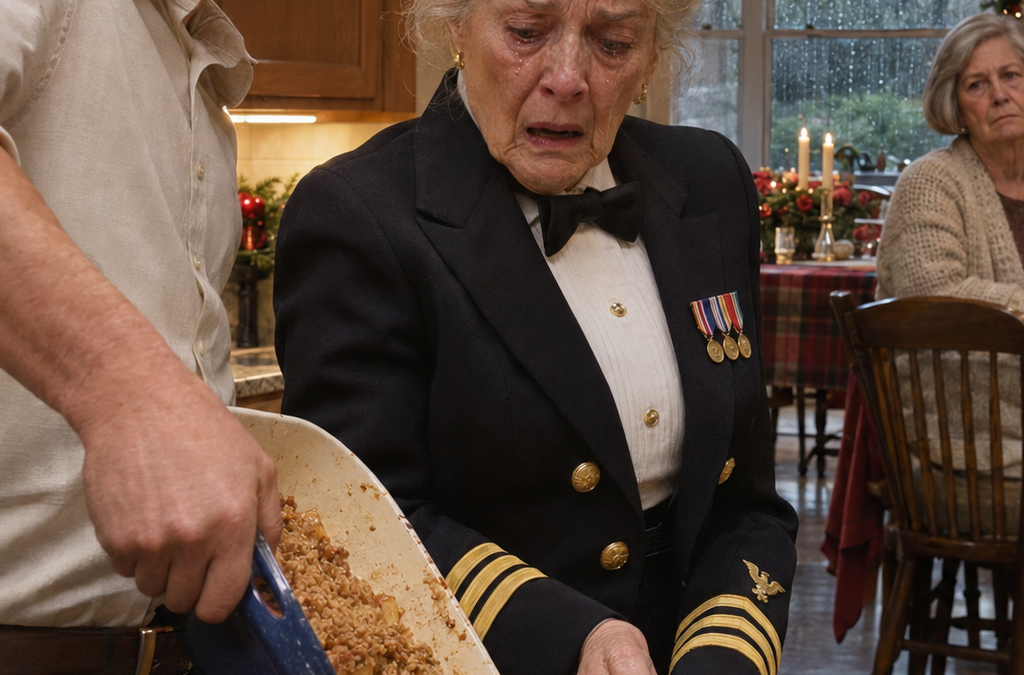
He scraped the last apple slices off the blue enamel serving tray. I stood beside the kitchen bin in my Navy dinner dress blue, still wearing my miniature medals from the veterans’ reception.
“Mom already bought something better,” he said.
Across the kitchen, my granddaughter Emma folded a napkin along its existing crease. At twenty-eight, she treated any disagreement like something she could smooth flat.
“Emma, are you going to say anything?”
“Please, Grandma. Let’s just sit down.”
Linda Dawson watched from the dining-room doorway. “Don’t make this uncomfortable for everybody.”
My sister Helen remained seated beside my empty chair. Near Linda’s plate sat a thick envelope that didn’t belong among our homemade Christmas place cards.
At seventy-two, I hadn’t expected to stand beside a garbage can defending an apple dessert. My name was Ruth Bennett, and I was a retired United States Navy captain.
My sister owned this house.
Helen Price was seventy, retired from managing commercial properties, and usually quicker to speak than I was. But that evening, she watched without saying a word.
This was Bellwood Academy’s guest house in Raleigh, North Carolina. The school rented it from Helen, and Linda worked there as its residential host.
Emma wore the green dress I’d altered when she was a bridesmaid. We’d made those crooked place cards together at my kitchen table. And the discarded apple crumble was Luke’s favorite, according to Emma.
The tray belonged to the academy; I’d borrowed it for the reception. My thumb steadied its chipped handle.
“You carried trays for the Navy,” Linda said. “You should understand presentation.”
An envelope beside Linda’s plate read, “24 guests.”
There were nowhere near twenty-four places at the table. Linda noticed where I was looking and moved closer to her chair.
“That dessert wasn’t suitable for my table,” she said. “Emma, take your grandmother into the other room.”
The humiliation made my face hot. Emma’s eyes went from my uniform to Luke, then down again.
“Is Emma supposed to apologize for bringing her grandmother?”
“You’re twisting everything,” Luke said. “Nobody asked for a speech.”
His mother had already decided where I belonged. Then he stepped between me and the dining room, close enough that I had to look up at him.
“TAKE IT OUTSIDE RIGHT NOW!”
He meant the tray. A little strip of baked apple still clung to its edge. Through the kitchen window, I could see rain shining on the back steps.
Helen’s chair creaked, but she stayed seated. Emma opened her mouth and closed it again.
“So you meant to throw away what I brought for everyone?”
“Yes. Stop making us explain it.”
“Fine.”
There was no reason to bake something else or make a joke for his benefit. I had done that before, covering an ugly moment with something useful until everyone could pretend it hadn’t happened.
I had mistaken keeping the peace for keeping my family.
Emma still held the folded napkin. When we’d made the place cards, she’d worried my handwriting might look uneven beside hers. We’d laughed then, and she’d asked me to do Luke’s because she liked my capital L.
But now she couldn’t look at me.
“Grandma, please don’t leave angry,” she said.
“I need a minute.”
The adjoining hall was cooler than the kitchen. From there, I could see Helen’s profile and the doorway Luke was blocking. My coat hung within reach, but I left it where it was.
I called David Hart.
Linda had mentioned that Bellwood’s principal would stop in after his own Christmas meal. David had been my student in a Navy supply-training course years earlier. We’d kept in occasional touch.
“Ruth? I’m almost there,” he said.
“I’m at the guest house.”
His voice changed. “Is Linda with you?”
“She’s in the dining room.”
“A customer contacted the school about wedding dinners sold at that address.”
The envelope’s handwritten number came back to me. Until then, I’d assumed it concerned another holiday gathering, perhaps one of Linda’s academy duties.
“I saw an envelope marked for twenty-four guests.”
“Leave it there. I’ll ask Linda about it.”
He ended the call without explaining further. I stayed in the hall, hurt by how carefully Emma was avoiding me, while Linda began talking about cutting the store-bought cake.
Then David appeared at the open front doorway, his coat wet across the shoulders. Linda turned toward him with a bright, welcoming expression. Beside the table, Helen’s chair scraped back.
Helen stood. “Linda, David needs to see that envelope.”
Those were my sister’s first words since the dessert went into the trash.
David looked past her and recognized me.
“Captain Bennett. I didn’t know you’d be here.”
Luke’s gaze flicked toward my sleeves. He’d seen the uniform when I arrived; apparently it meant something different when David said my name.
“Ruth is fine tonight,” I said.
David had been a serious young officer in my class in 1998. He was fifty-one now, but I remembered how he used to stay behind when an answer didn’t make sense.
“David, come in out of the rain,” Linda said. “We’ve saved you some cake.”
Her voice had softened so much that I glanced toward Emma. She’d noticed it too.
“In a minute,” he said. “May I look at that envelope?”
“It’s just some entertaining notes. There’s been a misunderstanding.”
Helen remained beside her chair. She didn’t reach for the envelope, and neither did David.
“Then let’s clear it up,” he said.
Linda gave a small laugh. “Surely this can wait until after Christmas dinner.”
I stayed near the hall. The dessert was still in the kitchen trash, and Luke hadn’t moved to let me pass.
Then Linda slid the envelope toward David. He read the front, then looked directly at her.
David touched the envelope. “This address appears on six paid bookings.”
Linda’s laugh stopped.
“That’s what I mean about a misunderstanding,” she said. “I welcome people. Families contribute toward food. You can’t turn every dinner into a business.”
“I’m asking about the bookings,” David said.
“Emma knows how much work goes into hosting here.”
Emma looked startled to be brought into it. “I’ve helped set up for Christmas.”
“And you’ve seen how generous we are.”
“That’s not what I said.”
The correction was small, almost swallowed. Still, I heard it. Luke stared at her until she looked down.
Nobody had offered me another chair. My legs ached from standing, and I hated that I was still waiting for Emma to come to me.
After another strained exchange, Mark Dawson came in from the back sitting room. Luke’s father stopped beside Linda. Carol Reed followed him; she was Linda’s sister and used her married surname.
Carol gave me a small smirk.
“Over dessert, Ruth? Really?”
“Ask Luke what happened,” I said.
“He told us.” Her smirk lingered. “It sounded like a long evening already.”
“Emma, would you get my coat?”
She moved before Luke could answer for her. I was grateful, though it hurt that fetching a coat was all she could manage.
Then Helen came toward the kitchen.
“I’ll keep the serving tray safe,” she said. “I know that little crescent chip. It goes back to the academy kitchen.”
She covered it for the trip home. I let her take it; my hands were cold.
Linda turned back to David. “You gave me permission to have people here for Christmas.”
“We’ll discuss what was arranged,” he said.
His phone lit up while Emma helped me into my coat. David read the message twice, then stopped Linda as she began speaking again.
“Megan Foster has forwarded another customer’s receipt.”
It showed a further $1,800 deposit for a dinner due on New Year’s Eve.
Chapter 2 of 7
David read from his phone while Emma stood beside me with my coat.
“Dinner for twenty-four at the Bellwood guest house on New Year’s Eve. Eighteen hundred paid to reserve the house and meal.”
Linda started to speak, but he continued.
“The customer says the dinner hasn’t happened. Please don’t promise anyone access while I check this.”
“It’s a holiday gathering, David.”
“That’s what I need to establish.”
Emma helped me through the doorway. She didn’t ask about the dessert, and I couldn’t bear to ask her why she’d watched it go into the trash.
By morning, she was at my house.
She still had her coat on when she sat at my kitchen table. Usually, she went straight to the refrigerator to see whether I’d bought the orange juice she liked.
“Linda asked me to talk to you.”
“About what?”
“She wants you to tell David it was a family misunderstanding.”
My kitchen still smelled of the oatmeal I’d scorched. I’d scraped off the good part and eaten it standing up, annoyed with myself for wasting breakfast on them too.
“What exactly did I misunderstand?”
Emma stared at the empty chair across from her.
“She says Luke’s family is upset. They think you’re trying to get her in trouble.”
That hurt more coming through Emma. Linda had sent the person I loved most to make me ashamed of objecting.
“David was already asking questions,” I said.
“I know. But she says I’m about to become part of their family, and this is making everybody wonder whether I want that.”
“Do you think I caused this?”
“No.” Her answer came quickly. Then she added, “I just need everybody to stop.”
I wanted that too. For years, I’d helped her stop things: overdue errands, worries about work, arguments she couldn’t finish. This time, stopping meant agreeing that nothing had happened.
I would not rewrite what happened.
Helen picked me up later for a brief visit to David’s school office. He’d asked us to come while he checked the guest-house arrangements. Emma stayed at my house, waiting for me.
The academy was closed for the holiday break. David’s office had an unwatered fern and a stack of student artwork waiting to be returned.
He had the house lease open beside Linda’s employment papers.
“Neither of you can remove Linda from her job or end their occupancy yourselves.”
The school employed Linda.
“Her salary is sixty-three thousand nine hundred,” he said. “The academy provides the family’s accommodation separately. Helen owns the building, but the school rents it and controls its use.”
Helen nodded. “I know what I signed.”
“Neither of you can remove Linda from her job or end their occupancy yourselves.”
“I’m not asking to,” I said.
I resented having to say it, although David hadn’t accused me. Since dinner, I’d been afraid every objection would sound like revenge.
He put a page beside Linda’s job description.
“This is the rule she accepted. No private paid events in school housing. The board had already delegated residential staffing decisions to me, including dismissal. I’m asking Linda for her explanation before deciding anything.”
Helen leaned back. “And the housing?”
“There’s a separate agreement covering that. I have the academy’s copy.”
He didn’t promise us an empty house. Helen didn’t ask for one.
“Megan contacted me two days before Christmas,” David said. “She asked whether these dinners were something the school offered.”
“So this didn’t begin with Ruth,” Helen said.
“No.”
That single word eased some shame I hadn’t realized I was carrying.
With Megan’s permission, David called her while we were there.
“Does this receipt show the full amount you paid Linda?”
“Yes. Twenty-four hundred dollars. I sent my payment record too.”
He asked her to confirm who received the money. Then he thanked her and ended the call.
“Customers are supplying their own receipts and payment records,” he told us. “They can cover unrelated purchases. These confirm payments. I’m still checking the account of what was provided.”
He hadn’t needed my rank, my interpretation, or Helen’s ownership to ask those questions.
Back home, Emma was sitting where I’d left her. Linda called before I’d taken off my coat.
“Can we put her on speaker?” Emma asked.
“All right.”
Linda skipped any greeting.
“You’ve made yourself very clear, Ruth. Apparently loyalty means nothing to you.”
“David was checking this before Christmas.”
“You called him from my hallway.”
“Yes, I did.”
Emma watched me with her hands tucked beneath her knees. I hated seeing her brace herself for an argument in my kitchen.
“Tell him we had a misunderstanding,” Linda said. “Let this girl have a family that wants her.”
“Don’t say that about Emma.”
“Then stop putting her in the middle.”
“I won’t call a paying customer a relative to protect a lie.”
Linda’s voice rose.
“I have eighteen thousand six hundred dollars on cards because of this wedding. I’ve welcomed people for years. I’ve earned a little help with the cost.”
Emma looked up. “You never told me that.”
“Because I didn’t want you worrying. And this is the thanks I get.”
After Linda hung up, Emma’s phone sounded again. This time it was Luke.
She opened a vendor email he’d forwarded. The outstanding balance under his arrangements was $9,600. Emma read the message beneath it twice, then showed me.
“Mom won’t pay the $9,600 unless your grandmother takes back her complaint.”
Chapter 3 of 7
“I could pay some of it back each month,” Emma told Luke over the phone the next morning. “But you need to leave Grandma out of this.”
She sat at my kitchen table, where his message had kept her late the night before.
“We’re not doing payments, Emma,” he said. “Get her apology on video. I’ll send it to Mom and Dad.”
“She didn’t make the complaint you keep talking about.”
“Then saying she overreacted shouldn’t be so hard.”
Emma looked at me. I hated that she was waiting for my answer.
“I won’t record an apology,” I said.
Luke heard me through the speaker. “Then somebody else can find the money.”
After he hung up, Emma stayed bent over her phone. Her hair hid most of her face.
“The balance is his,” she said. “I know that. But we planned this together.”
“I’m not paying the nine thousand six hundred either.”
She hadn’t asked. Saying it before she could made me feel cruel, though I knew what waiting would do.
For years, I’d made trouble disappear by paying for whatever needed fixing.
I couldn’t buy her a kinder marriage.
Emma rubbed her eyes. “Will you come with me? I need to talk to them without everybody sending messages.”
“Yes.”
She borrowed my bathroom mirror to straighten her hair. When she came back, she looked ready for work, except she’d missed a button on her coat.
The guest house smelled of Linda’s coffee when we arrived. Emma had rehearsed two sentences in the car about keeping wedding bills separate from family arguments. She forgot both when Linda opened the door.
“Emma, sweetheart. Come sit down.”
Linda’s expression changed when she saw me behind her.
“Ruth, wait here by the front hall.”
“I came with Emma.”
“And I’m speaking to Emma first.”
Emma paused, but Linda was already walking toward the sitting room. I followed far enough to hear.
“We’ve sacrificed a great deal for you two,” Linda told her. “Your happiness matters to me. You know that.”
“I didn’t ask you to put anything on your cards.”
“Oh, honey. That’s what parents do.”
It hurt to hear how gently she could speak. She’d chosen that voice for Emma and left me standing beside the coat closet.
“May I be part of this conversation?” I asked.
Linda turned. “Stop hovering, Ruth. You’ve caused enough trouble already.”
“Then we postpone. I’m not standing up there pretending we’re all fine.”
Luke was sitting beside the window. He didn’t get up when Emma entered. Linda directed her toward the seat beside him, but Emma stayed near the doorway.
“I want us to work out the wedding money ourselves,” she said. “Without making Grandma say anything.”
Luke looked past her at me.
“Then we postpone. I’m not standing up there pretending we’re all fine.”
Emma’s face changed. “We’ve already invited people.”
“You should’ve thought about that before bringing her here.”
“She gave me a ride.”
“You keep choosing her over the family you’re joining.”
I wanted to take Emma home immediately. Instead, I stayed where she could see me. She had asked for a chance to speak, and I wasn’t going to take that away too.
“This isn’t choosing,” she said. “Can we please talk about the bill?”
“There’s no wedding date until you fix this,” Luke said. “If you choose her, you’re walking away from us.”
Linda didn’t correct him. She told Emma there was still time to make things right.
Emma finally sat down. For a moment, I thought she might cry. Then she looked toward the hall.
“Grandma, can we let one thing go?”
“Which part do I have to pretend didn’t happen?”
Her mouth opened, but she gave me no answer.
Linda sighed loudly. Luke began explaining what Emma ought to say in the recording, as if we had agreed.
Emma stood again.
“I need to go.”
She left without waiting for anyone’s permission. Outside, she struggled with the passenger door before realizing it was still locked. I felt helpless watching her, and that feeling stayed with me all the way home.
In my kitchen, she apologized for asking.
“I just wanted him to stop.”
“I know.”
“I’m not ready to throw everything away.”
“You don’t have to decide everything today.”
She went back to her apartment soon afterward. I offered to drive her, but she wanted her own car. Before she left, she checked her phone again.
That afternoon, David called. All six customers had voluntarily supplied receipts and payment records: fourteen thousand four hundred dollars across four months.
“That confirms what they paid Linda,” he said. “I’m still checking where each dinner took place.”
He didn’t ask me to guess. I was grateful for that.
Helen came over afterward with split pea soup in an old margarine tub. She’d written the contents on the lid because, years earlier, I’d spread her leftover gravy on toast.
We ate without discussing the Dawsons for a few minutes. I needed that small break more than the soup.
Then Helen said David had asked her to attend the employment discussion as the owner.
“He’s sorting out who needs to be there,” she said. “I’ll let you know when he settles it.”
Before we could discuss rides, a message from Linda appeared on my phone. She had included Helen and David too.
“I’ve promised the house for twenty-four guests on New Year’s Eve. They’ve paid, and I’m letting them in. Your questions can wait.”
Chapter 4 of 7
David answered Linda’s message while Helen and I were still together.
“The academy hasn’t authorized that dinner,” he told her by phone. “You must not offer the house to customers while I check your account.”
Helen had called him after we read Linda’s promise to admit the guests. With his permission, she’d kept the call on speaker.
“Which school official gets to interfere with my holiday hospitality?” Linda asked.
“I do. I’ll come by tomorrow so we can discuss it.”
I was relieved he’d answered plainly. Linda had written as though promising strangers our agreement somehow supplied it.
The next morning, Helen drove us to the guest house. She had brought the papers David requested, and I’d brought nothing. For once, I hadn’t offered to supply lunch.
Linda let us in without a greeting. Luke stood near the dining table, still wearing slippers. He looked at Helen’s folder before looking at either of us.
“Emma isn’t here,” he said.
“I didn’t come to collect her,” I told him.
David arrived behind us. Linda’s expression changed before he’d finished closing the door.
“Coffee, David? There’s a fresh pot.”
“No, thank you. Let’s sit down.”
The table had been cleared of the Christmas place cards. I was glad I wouldn’t have to see Emma’s careful handwriting beside Luke’s name.
Linda remained at the head. Helen sat across from her, and I took the chair beside my sister.
David explained that he needed to confirm who controlled the house and what Linda had arranged. Linda interrupted before he finished.
“You have the school’s records. I don’t see why they’re here.”
Helen answered her.
“Because I own the house, Linda. The school rents it from me.”
Luke looked toward David, waiting for a correction. None came.
Helen Price was the owner.
David compared Helen’s recorded deed with the landlord’s name on the school’s lease. “They match. Helen owns it individually.”
Linda stared at my sister. Until then, she had treated Helen as another elderly relative who needed a chair.
“You never mentioned that,” Linda said.
“You never asked.”
Luke sat down. His slippers caught under the chair, and he jerked his feet free.
It hurt that ownership earned us the attention kindness hadn’t. Helen had sat at Linda’s table for years without asking anyone to thank her for the roof.
Linda recovered quickly.
“You leased it to the academy. You can’t just order us out because Ruth’s offended.”
“That’s right,” Helen said. “I haven’t ordered you out.”
“Then let David and me handle the school’s business.”
“You told me I could entertain here at Christmas. I asked you myself.”
“He asked me to come.”
Helen’s voice stayed level, but I knew she was angry. She’d used that same careful voice when we were girls and someone had broken something she’d saved to buy.
David brought the conversation back to the dinners. Linda leaned toward him, shutting the rest of us out.
“You told me I could entertain here at Christmas. I asked you myself.”
“You asked about having private holiday guests,” he said. “Did you tell me customers would pay?”
Linda talked about groceries, laundry, and the hours she spent making people comfortable. David let her finish, then repeated the question.
“No,” she said. “But people helping with costs isn’t what you’re making it sound like.”
He asked her to bring her records rather than settle it through an argument.
I understood why he needed that, although waiting was hard. Linda had already decided I was trying to destroy her life. Part of me wanted him to say something that would finally make her stop.
Instead, he listened. That was his job too.
Luke turned toward me.
“So you knew all along this was Helen’s?”
“Yes.”
“And you let us sit there looking stupid?”
“I was trying to get through dinner.”
Helen glanced at me. She knew how much that answer left out.
I told them I’d helped her buy the house seventeen years earlier, with a sixty-five-thousand-dollar gift from my Navy savings.
“She found it and did the work,” I said. “I wanted her to have it.”
Linda’s eyes moved between us.
“It was a gift,” I added. “I don’t own any part of this place.”
I remembered Helen calling me about the leaking upstairs bathroom after the purchase. She’d sounded delighted anyway. She used to call every repair “a little surprise,” until I asked whether the house ever sent flowers.
That memory made me miss being able to visit without defending myself.
David asked everyone to meet again Wednesday at four, at the guest-house dining table. Linda and Mark, Luke and Emma, Helen and I were to attend, along with anyone who could help establish what happened.
“Bring your explanation and the records you want me to consider,” he told Linda. “You’ll have time to go through them.”
Linda immediately named Carol. Her sister, she said, knew how often she’d opened the house to people without making a penny.
David said Carol could come.
Before we reached the front door, Linda was calling her. We heard her ask Carol to tell David what kind of host she’d been. She didn’t mention customers.
Outside, Helen asked whether I wanted lunch. I said yes, and she suggested a place where nobody knew us.
We were halfway through our sandwiches when my phone sounded. Carol had sent me a message.
“I introduced one of those paying customers to Linda myself.”
Chapter 5 of 7
“It was Megan Foster,” Carol told me when I called. “I introduced her to Linda. Obviously, I thought the school had approved it.”
“Did Linda tell you that?”
“She works there, Ruth. People don’t usually ask to see permission.”
Carol sounded embarrassed, but she wasn’t ready to be angry with her sister. She asked me not to make her regret answering.
“I’m not asking you to say anything except what happened.”
“Well, that ought to apply to everybody.”
She hung up before I could answer.
The following afternoon, Linda asked us to come to the guest house. She called it a family discussion, though David would be there to review the figures she’d gathered before the next day’s meeting.
Helen offered to go alone.
“No,” I said. “I’ll come.”
I dreaded another afternoon at that table. But Emma had texted that she would be there, and I didn’t want her surrounded by people explaining why she owed them.
Linda had arranged the chairs before we arrived. Emma sat beside Luke, with Mark at the head. Helen and I were directed to the far end.
Carol sat close to Linda. She greeted us without the smirk this time.
Linda had made ham biscuits, something Emma used to request for every family gathering. Emma had one on her plate, untouched. Luke was eating his third.
“Some of us remember enjoying ourselves here,” Linda said.
She looked toward Carol, who murmured that they’d had lovely holidays. Mark agreed. Nobody mentioned Christmas.
I felt humiliated sitting where Linda had put me. At my age, I still had to remind myself that being invited didn’t require accepting everything that followed.
David arrived while Mark was describing a birthday supper Linda had hosted for him. Linda immediately offered David the chair nearest hers.
“I’ve pulled together what you wanted,” she said. “Once you see the costs, I think this will look rather different.”
She had copied selected entries from her income and expense records. Groceries, cleaning, and meal preparation filled most of the pages.
David read them before speaking.
“I’ve confirmed the customer amounts directly. Those match the payments shown here.”
“Then you can see I wasn’t pocketing all that money.”
“The fourteen thousand four hundred is what came in,” he said. “It doesn’t tell me your profit.”
Linda looked pleased, as though he’d settled the whole question.
“But these expenses don’t establish where the meals happened,” he added.
She began explaining the price of beef. David let her finish, then asked whether she had included every dinner payment.
Linda said she had. He kept her copies to compare with the customer records.
I wasn’t asking anyone to take my word.
That helped me stay in my chair. Nobody needed to decide whether I was a nice grandmother or a difficult old woman before looking at what Linda had sold.
“That families get carried away. People help with food. You know how it works.”
Mark turned toward our end of the table.
“Ruth, there’s still time to save Linda’s good name. This doesn’t have to follow her around.”
“What are you asking me to say?”
“That families get carried away. People help with food. You know how it works.”
He sounded tired rather than angry. For a moment, I wanted to give him an easy answer. It hurt to realize he considered my account the thing that needed fixing.
“I won’t describe a paid wedding reception as an ordinary family supper.”
“So what do you want done to her?”
“I’m not choosing that, Mark.”
Linda interrupted before he could ask again.
“The academy never missed a scheduled guest service,” she said. “Not once. And no paying reception took place in these rooms.”
David looked up.
“That’s your explanation of the completed bookings?”
“Yes. We’ve had family here. People you’re calling customers have been in the house. That doesn’t mean they paid to eat here.”
Carol shifted beside her but said nothing.
I wanted to question Linda myself. Instead, I watched David write down her answer. He asked her to repeat the distinction, and she did.
Emma finally spoke.
“Does the wedding money have anything to do with Grandma’s complaint?”
Luke stopped eating.
“Don’t start this again,” he said.
Emma kept looking at Linda. “You told him you wouldn’t pay unless she took it back.”
Linda’s pleasant expression disappeared.
“Stop questioning the people paying for your future.”
Emma’s face flushed. Mine did too, with anger this time. Luke leaned toward her, saying something too low for me to hear.
She moved her chair away from his. Only a few inches, but the space stayed there.
David waited until she was settled before speaking.
“Megan would like to address your explanation in person tomorrow.”
Linda said Megan had always been welcome. Carol looked down at her plate.
We left soon afterward. Emma declined my offer of a ride, but she walked us to Helen’s car without Luke.
At home, David forwarded a message Megan had given him permission to share.
Megan would bring the originals.
“I’ll bring my original phone photographs, not the cropped pictures circulating online.”
Chapter 6 of 7
“Then answer in front of us,” I said.
Linda had asked David to speak privately before the meeting began. Now she sat back down, leaving Megan Foster standing beside an empty chair.
“Megan paid Linda twenty-four hundred dollars for a dinner for twenty-four,” David said. “She’s brought her phone. Linda, explain your position first.”
Megan sat. “It was my wedding dinner.”
David looked toward me. “Captain Bennett, can you see from there?”
I could. Helen sat beside me, and Emma was across the room beside Luke.
The blue enamel tray rested on my knees. Helen had brought it back so I could return it to the academy after we finished.
Linda looked at Megan rather than David.
“We had family meals here. The paid wedding dinners were served elsewhere.”
“And the photographs?” David asked.
“People took portraits here. We tried arrangements for advertising. Nobody paid for those pictures.”
She sounded almost patient. I hated how reasonable she could make it sound.
Megan opened a photograph and turned her phone toward us. The image was enlarged around two people seated together. At the edge, behind one shoulder, I saw blue enamel.
Near a handle was a pale crescent.
I looked down at the tray on my knees.
“Could you show us the whole picture?” I asked. “Without it enlarged?”
Megan reduced the image. The dining room opened around the couple: this window, this doorway, the built-in cupboard behind Linda’s chair.
The tray was carrying sliced meat between seated guests. Plates were partly full. A serving spoon lay beside potatoes.
“That’s this tray,” I said. “The chip by the handle.”
Linda glanced at my knees.
“A tray can travel, Ruth. That could be from another occasion.”
Megan moved her chair closer to David and swiped through the originals. I leaned forward with him.
There was the same couple before food arrived. Then full plates, then people eating, then Linda passing behind them with the tray. The same flowers stood on the table throughout.
“That’s my dinner,” Megan said. “We ate chicken, beef, potatoes, and green beans in here. I sat where Emma’s sitting.”
Emma looked at the chair beneath her.
Megan opened her payment record beside the receipt Linda had sent her.
“The twenty-four hundred bought that meal. We didn’t go anywhere else.”
I felt relief, then anger that she had to prove where she’d eaten her own wedding dinner.
Linda turned toward David.
“She may remember an arrangement differently. There were several conversations.”
“No,” Megan said. “I remember eating my wedding dinner.”
Carol had been staring at the photographs.
“I brought her here for the tasting,” she said.
Linda looked sharply at her sister. “Carol, let David finish.”
“I introduced Megan to you. We sat in this room.”
“Linda, did you ever tell me you were selling dinners in school housing?”
Carol stood and moved to the empty chair near Helen.
“I thought the school approved it,” she said. “You never told me otherwise.”
David left Megan’s phone between them.
“Linda, did you ever tell me you were selling dinners in school housing?”
“You gave me permission to entertain over the holidays.”
“Did you tell me people would pay?”
She looked toward Mark. He watched her but offered nothing.
“You knew how much hosting I did,” Linda said. “After all these years, surely that counts for something.”
David paused before answering. I was glad he wasn’t rushing, though my legs had begun to ache beneath the tray.
“My permission covered private guests, not customers. Your work rules prohibited private paid events. The customer records, your entries, and this account establish what happened here.”
He faced her directly.
“Linda, your $63,900 job ends today.”
Linda pushed back her chair so hard that Megan flinched.
“Any housing notice will be separate and in writing,” David added. “Nobody is being put out tonight.”
“Mark. Tell him he can’t do this.”
Mark didn’t rise. His face had gone gray around the mouth.
“Linda, I don’t know what you want me to—”
“Make him reconsider.”
David stayed seated. Megan drew her phone back toward herself. Nobody reached for Linda, and for the first time she seemed unsure whom to address.
Luke stood.
“Emma, get your things. We’re leaving.”
She stayed in her chair. I wanted to call her over, but I had spent too many days asking her to choose. This had to be hers.
“Emma. Don’t make this worse for Mom.”
She stood then, and my hands went cold against the tray. But she walked past him, across the room, and sat beside me.
“I’m not marrying you, Luke.”
He gave a short, disbelieving laugh.
“You’re upset. We’ll talk outside.”
“No. I’m not going outside with you.”
It hurt to see her crying, even then. She pressed her lips together, trying to keep them steady, and looked at him again.
“You wanted me to make Grandma apologize so your mother would pay your bill. I kept trying to find another explanation.”
“After everything we’ve done for you?”
“You don’t get to humiliate us and call it family,” I said.
Linda turned toward Emma.
“Honey, look at me. I’ve lost my job. You’re really going to do this to us today?”
Emma wiped her cheeks. She didn’t answer Linda.
“There’s room at your house, isn’t there?” she asked me.
“Yes. Of course there is.”
Her overnight bag was by the front door. She went to get it while Luke watched, his coat hanging open. I hadn’t noticed it when she arrived, and I wondered how long she’d sat beside him knowing she might need it.
“Can I stay with you tonight?”
“Yes.”
She placed her overnight bag beside my chair.
Chapter 7 of 7
Emma slept in my spare room that night. When I passed the doorway, she was curled toward the wall, her overnight bag open on the floor.
By morning, she was standing outside the bathroom.
“Can I borrow one of the good towels?”
“They’re all towels, Emma.”
“The blue ones used to be for company.”
“You qualify.”
She laughed a little, then made her own coffee. Mine was already poured. She didn’t ask me to call Luke or explain her decision to anyone.
That small consideration nearly made me cry.
At the kitchen table, she opened her phone and began listing the wedding arrangements she needed to cancel. I offered toast. She accepted that and nothing else.
“I need to do these calls myself,” she said.
“All right.”
“You can stay nearby, though.”
I sat with her through the first one.
Some deposits were gone. Other arrangements could be canceled without another payment. Emma asked each business what she had agreed to and wrote down the answers. She didn’t promise to cover Luke’s balance.
I was proud of her, but watching her cross things off hurt. She had spent months imagining that wedding.
When she stopped for lunch, I told her she could stay while she worked out where to live.
“A few weeks,” I said. “Then we’ll see where you are.”
“I’m not asking you to pay for an apartment.”
“I know.”
“And I’ll buy groceries.”
“You can start by finding coffee that doesn’t taste like this.”
She looked into her cup. “Grandma, this is yours.”
“I’m aware.”
The academy delivered Linda’s written housing notice separately after the employment decision. It gave the family sixty days under their accommodation agreement. Losing the job had not made their belongings disappear or turned them into trespassers.
Nobody changed the locks. Linda, Mark, and Luke kept access while they packed and arranged another place.
Helen stayed away unless the academy needed her there.
“I own the walls,” she told me. “That doesn’t make their cupboards mine to empty.”
I was relieved she understood without being reminded. I wanted distance from the Dawsons, not another fight at their doorway.
The New Year’s Eve dinner did not go ahead. David confirmed that the customer had been told the house was unavailable.
On January 15, 2027, Linda returned the $1,800 deposit. The customer confirmed receiving it, and David let us know that part was settled.
The six completed dinners remained a separate matter. Those customers had received meals; nobody announced that every payment must automatically be returned. David finished the school’s review without asking me to recommend any further consequence.
Linda did not get her job back.
Luke tried Emma again before she had finished canceling the wedding arrangements. She answered in my sitting room, with me nearby but out of his conversation.
“Just ask her,” he said loudly enough for me to hear. “David listens to your grandmother.”
“I’m not asking her to get your mother’s job back.”
“Grandma doesn’t run the school.”
“She could fix this if she wanted.”
Emma looked exhausted. She had come home from work and hadn’t yet taken off her shoes.
“I’m not asking her to get your mother’s job back.”
“So you’re fine with what happened to us?”
“No, Luke. I’m not fine. I’m still not asking.”
She ended the call herself. Afterward, she cried, and I stayed beside her without offering to speak to him.
It was hard not to take over. I had spent so long believing help meant doing whatever hurt for her.
On February 26, 2027, Linda, Mark, and Luke moved out and returned the accommodation keys voluntarily, before their notice expired.
Helen went with David to look through the house after they left. The rooms were empty of the family’s things. There had been no lockout, no belongings left on the lawn, and no need for a hearing.
She called me afterward.
“It needs cleaning,” she said. “Houses generally do.”
The academy kept its lease and its responsibility for using the house. Helen arranged repairs with David, as she would have before any of this.
I felt relieved when she told me the keys were back. Then I felt tired enough to sit down.
Carol called a little later that spring.
“I owe you an apology,” she said. “I laughed at you. You hadn’t done anything to me.”
“No, I hadn’t.”
“I’m sorry, Ruth.”
She didn’t add that Linda was under pressure or ask whether we could forget it. That made it easier to listen.
“Thank you for saying it.”
We spoke briefly about Helen, then said goodbye. We didn’t become close. An apology was welcome; I wasn’t ready to invite her into everything.
I kept my dealings with the Dawsons brief and civil. When Mark sent word of a family gathering, I declined without explaining myself.
I no longer went places where I had to accept contempt to keep my chair.
Over the following months, Emma found an apartment she could afford on her own. She compared rents after work and asked me to visit the one she liked.
I noticed the worn carpet. She noticed the sunlight.
“It’s mine to come home to,” she said.
She moved out with her clothes, her books, and groceries she insisted belonged to her. The first weekend, she called to ask how long chicken kept in the refrigerator.
After that, she visited without needing a place to sleep.
By early summer, she could mention the wedding without stopping halfway through a sentence. Sometimes she still missed Luke. I let her say that without reminding her why she’d left.
One warm evening, she came over for dinner and sat beside me afterward.
“Would you make that apple crumble again?” she asked. “The one we didn’t get to eat.”
“It’s already in the kitchen.”
Helen had helped me borrow the academy’s serving tray again, with permission. I brought the crumble out warm, its edges browned the way Emma liked.
She made room on the table and asked whether I wanted ice cream too.
Family wasn’t permission to make someone smaller.
I set the blue tray between us.







