At Dad’s memorial, my cousin threw my son’s painted stone into the cemetery trash and said, “Take your kid’s junk somewhere else.”
Chapter 1 of 7
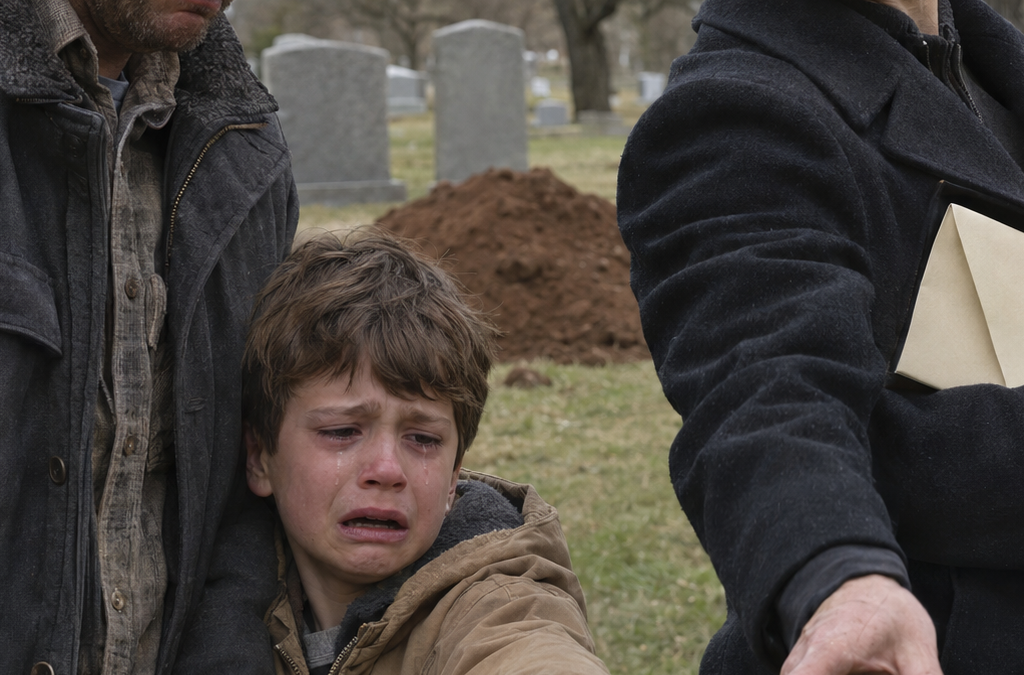
Noah stood beside me, his hand holding mine. He was eight. His free fingers closed around the space where his stone had been.
It was blue, with a small yellow fish. He’d painted it for Grandpa because they used to fish together.
“Are you really throwing away his goodbye?”
Tyler Bennett brushed past the question. “We’re trying to keep this looking decent.”
“Aunt Carol, you’re going to let him?”
Carol looked toward the cemetery road. “Please don’t start anything here, Evan.”
An envelope stuck out beneath Tyler’s arm. A photograph of Dad’s house showed through its open flap. Somebody had marked the porch in red.
Noah leaned against my leg. I kept my voice level because he was listening, but my face burned.
At thirty-eight, I’d learned how to get through most Bennett family gatherings without an argument. Being Evan Mercer meant answering the call, fixing what broke, and letting the small insults pass.
Dad had named me to receive his private legacy, a separate pool of bank savings.
That was all I knew. He hadn’t told me the amount, and I’d never seen the paper or the date on it. There’d always seemed to be another afternoon for that conversation.
He’d adopted me at seven. For thirty-one years, he’d been Dad.
During his last five years, my work boots rested beneath his wheelchair while I knelt to adjust the footrests. Noah’s drawings covered his refrigerator. The porch rail I’d replaced stayed steady beneath his hand.
I’d kept smoothing things over until they expected me to disappear.
Then Tyler shifted the envelope higher. Now I could see the red marking clearly.
Our front porch was circled on the envelope under his arm.
“The will doesn’t leave you anything,” Tyler said. “Stop making this whole thing about yourself.”
We were standing at Dad’s grave in Georgetown, Texas. The dirt was still bare. Nothing about the place looked ready for this conversation, least of all my son.
“Your dad wanted us to keep this simple,” Carol said.
She’d always been Aunt Carol, although she was Dad’s cousin. She knew how long Noah had worked on that fish. We’d sent her a picture before leaving home.
But her words hurt more than Tyler’s. She could have bent down and picked up the stone. Instead, she watched him explain why we shouldn’t have brought it.
“He left me what’s left after everything’s paid,” Tyler said. “You need to get that straight.”
I knew what Dad’s will said. Tyler had made sure of that before the memorial.
“We came to say goodbye,” I said.
“Then do that and leave the house alone.”
Noah looked up at me. The house was where Grandpa had kept frozen waffles and let him eat two before dinner. He hadn’t asked about money.
Tyler pointed toward the road. “I decide who comes around there now.”
“I’d like to get his stone first.”
“KEEP HIM AWAY FROM THAT HOUSE!”
Carol flinched. Noah pressed closer, and I hated that he’d heard it.
“You’re telling his grandson he can’t visit?”
“Yes. That includes both of you, Evan.”
“Then say it without using Dad.”
I stepped away with Noah before Tyler could answer. We stopped near the cemetery road, still within sight of the grave. His fingers hadn’t loosened around mine.
My phone showed Ruth Lawson’s number beneath the calls I’d made during Dad’s last week. Ruth was his estate lawyer. I called her once.
“Tyler’s got something about the house,” I said.
“He submitted a proposal for me to review.”
“With that photograph of the porch?”
“Yes. He asked that you not be copied.”
So that was why he’d kept the envelope close. Tyler had brought business with him while telling my son his goodbye was trash.
Ruth said she was nearby. She’d planned to find me after the memorial with something Dad had asked her to deliver.
“Stay there. I’ll come to you.”
I told Noah we were waiting for Ruth. He watched Carol beside the bin while Tyler spoke to her, his envelope tucked tight against his coat.
Then Ruth came up the path carrying a small cloth bag. Tyler straightened when he recognized her.
Ruth stepped beside the grave. “Tyler, who gave you permission to sell?”
Tyler’s voice softened. “I brought you an offer. That’s all.”
“You can bring one. You can’t promise a sale.”
“I haven’t signed the house away.”
“Good. Don’t tell anyone you can.”
Ruth didn’t raise her voice. She stood beside us, close enough that Noah stopped hiding behind my coat.
Then Carol moved toward the bin. Tyler turned his head, but she didn’t ask him anything. She reached inside and recovered the stone.
There was dirt across the yellow fish. She rubbed it against her coat and held it out to Noah.
“I should’ve picked it up sooner,” she said.
He accepted it without answering. I was grateful she’d done it, and still angry she’d waited.
Tyler looked at me. “You got the rock. There’s nothing else for you.”
Ruth placed Dad’s old pocket radio in my hand.
The case was worn smooth along one edge. Its little speaker had a dent I recognized. Something rattled inside as it settled against my palm.
“Your father wanted Evan to have this,” Ruth said.
Tyler looked down at the radio, then offered her the envelope. “Could you just look at the proposal?”
Ruth read the pages he supplied. Her eyes paused near the bottom, and she turned back to the first page.
I could see Dad’s house photograph between them. That circled porch had been waiting for somebody else’s agreement.
“The buyer promised you twelve more months inside Dad’s house?”
“It’s part of the offer,” Tyler said. “I need somewhere to live.”
Ruth kept reading.
“I paid for that roof,” he added. “Dad knew I needed some security. I didn’t move in there for a vacation.”
For the first time that afternoon, he sounded worried. He’d been living there fourteen months. I knew the roof repair had cost him money; I’d seen the work afterward.
But that didn’t explain why Noah’s stone had needed to go in the trash.
“The proposal will be reviewed for the estate,” Ruth said. “It isn’t accepted.”
“So don’t act like I’ve done something wrong.”
“I’m telling you where it stands.”
He looked to Carol, but she was watching Noah examine the fish for scratches.
I wanted to ask her why she’d stood there earlier. Noah was finally holding his goodbye again, though, and I couldn’t bear another argument over his head.
Dad’s radio was heavier than I remembered. He’d listened to baseball through it while peeling potatoes, leaving square corners on every one. Noah had called them Grandpa’s building blocks.
And the memory hurt. I’d been bracing for this day and still hadn’t understood how badly I’d want an ordinary afternoon back.
Ruth noticed me looking at the loose back panel.
“He used that compartment for things he wanted away from visitors,” she said. “He showed me once. It never shut properly.”
I tipped the radio toward me and heard the rattle again.
Tyler was talking about the roof, but I barely heard him. One corner of the back panel sat above its catch. I opened it, expecting a spare battery or one of Dad’s folded scraps of paper.
A safe-deposit key dropped into my palm, its attached tag marked 214.
Chapter 2 of 7
“The safe-deposit key fits the box,” Ruth told me. “It doesn’t give you the right to open it.”
Two weeks after the memorial, she identified 214 as Dad’s bank-box reference. Her court-issued letters were in place now, but the bank still needed its own checks completed before allowing access.
The key wasn’t permission.
That bothered me more than it should have. I’d carried it home feeling Dad had left me a way through something. Now I sat beside Ruth at the bank, waiting to be told what I could see.
Denise Brooks checked Ruth’s papers and my identification. She explained the access requirements without making either of us feel foolish.
“Ruth handles the box for the estate,” she said. “Your father’s account is a separate question.”
Inside were supporting savings records among Dad’s other papers. Ruth kept the contents together while Denise examined the account copies.
“These help us locate what we need,” Denise said. “We still verify against our own history.”
There was comfort in seeing Dad’s careful filing. At home, he’d kept takeout menus years after the restaurants closed. Apparently he’d been more sensible with the important things.
Denise asked what she could discuss with Ruth as the review went forward.
“Whatever she needs for the estate,” I said. “But nobody else in the family.”
She explained the limited permission before I signed it. I didn’t want Tyler learning my finances through somebody who thought keeping peace meant answering his questions.
That suspicion embarrassed me. A month earlier, I would have called it unkind.
Afterward, Ruth gave me a copy of Dad’s actual will. We sat in a small bank office, with the empty chair beside me where I kept expecting his coat to be.
“The house belongs to the estate,” she said. “After debts and expenses, what remains goes to Tyler. Your separate savings follow the name your father put on that account.”
I read the page twice. There was no mistake in it, no missing paragraph Ruth had overlooked.
Dad had chosen this.
Knowing he loved me didn’t make seeing the omission painless. I hated that it hurt, especially with those other records nearby.
“He could leave Tyler something,” I said. “I understand that.”
Ruth waited.
“I just wish he’d talked to me.”
“I wish he had, too.”
She didn’t try to turn his silence into a final lesson. I appreciated that.
“The house. Noah’s connection to it. I don’t know how to separate those.”
Ruth also reminded me that she represented the estate, not me. Before the week was out, I hired Amy Foster.
Her office in Georgetown overlooked a parking lot with one stubborn patch of shade. I arrived in my HVAC work shirt, worried about what another hour away from service calls would cost.
Amy asked what I wanted protected.
“The house. Noah’s connection to it. I don’t know how to separate those.”
“You may have to,” she said.
She let that sit before explaining the part I least wanted to hear. I couldn’t stop a proper sale just because I’d grown up there.
“Even if Tyler’s pushing it?”
“We can question his proposal. That doesn’t make the house yours.”
I was ashamed of how close I came to arguing. She hadn’t taken anything from me. She was telling me what grief couldn’t change.
Carol called that evening. She started by asking whether Noah had found any scratches on the yellow fish.
“He says it’s fine,” I told her.
“Good. I’ve been worrying.”
Then she moved to Tyler.
“He’s been there fourteen months, Evan. He’s scared of having to start over.”
I could hear him in the background. Carol hadn’t said he was with her.
“Tell him about the roof,” Tyler said. “Seven thousand four hundred dollars. That wasn’t pretend money.”
Carol went quiet.
Then Tyler spoke louder, plainly aiming for the phone. “That house is the only thing Dad actually put in writing for me.”
I let the unfairness of that pass. Dad’s will gave him what remained of the estate; it didn’t promise him the house forever.
Carol asked whether the bank had found much.
“Aunt Carol, I’m not discussing the account.”
“I’m only trying to understand what everyone needs.”
“Noah still wants you at his school lunch next month,” I said. “That hasn’t changed. But this part is private.”
She said she understood, though she sounded hurt. I wanted to spare her that feeling. For once, I didn’t rush to fix it.
The next afternoon, Ruth called about the proposal Tyler had supplied. The prospective buyer was Grant Ellis, a local small-business owner.
His offer was $305,000, with twelve extra months for Tyler to remain in the house.
“I saw that part at the cemetery,” I said. “Is it something you have to accept?”
“No. It needs review. Tyler’s signature can’t make it a sale.”
Until then, I’d thought he was mostly chasing quick money. Now I understood that the offer also kept a roof over him while he waited for his inheritance. He’d found an arrangement that suited him and treated my questions as a threat to it.
Later that week, Denise needed my signature on the remaining bank paperwork. I went after collecting Noah from school.
Outside, he stood beside me, wearing his backpack over both shoulders. He asked whether Grandpa had liked banks.
“About as much as dentist appointments.”
That earned half a smile.
My phone lit up with Carol’s name.
“He asked whether you had enough to interfere.”
Chapter 3 of 7
“He meant enough money to compete for the house,” Carol said. “Not just enough to hire somebody.”
Noah stood beside me outside the bank. I turned slightly away, though there wasn’t much he couldn’t hear.
“What did you tell him?”
“That you’d been to the bank. What you told me about going back.”
“So you forwarded my message.”
“He needs somewhere to live, Evan. I can’t stop worrying about that.”
I ended the call before I said anything Noah would have to carry home.
By the following week, Tyler had moved the argument into the family group.
His message filled most of my phone screen. He said I was turning Dad’s death into a property grab. Beneath it, he attached a cropped photograph of the will’s distribution page, with his name and the paragraph about what remained after expenses.
The page was real. I’d read the whole thing beside Ruth.
Then came his explanation: Dad had deliberately left me nothing, and now I was going around the family to get money that should stay with the house.
Dad’s will wasn’t a family tree.
Still, seeing those words beneath a page bearing Dad’s signature hurt. Tyler had taken one true thing and made it look like proof of everything else.
I typed a reply explaining the separate account. Then I erased it. My finances didn’t belong in a family argument, and Dad wasn’t there to answer for his choices.
But leaving it unanswered felt awful, too.
That afternoon, Noah and I went to collect a box Tyler had agreed to leave for us. We’d also arranged a few minutes on the porch. Noah wanted to see where Grandpa had marked his height against the doorframe.
The box waited behind the gate, labeled with our names. Tyler stood beside it.
“The porch isn’t happening,” he said.
“We agreed Noah could look at the marks.”
“You agreed. I said I’d see.”
Noah had worn the sneakers Dad bought him. He’d told me in the truck that maybe he was taller now.
“Five minutes, Tyler. We’re already here.”
“You don’t get to make my home your project.”
He pushed the box through the opening. I lifted it clear of the gate, and he closed the latch.
For years, I’d walked through there carrying groceries, replacement filters, whatever Dad needed. Standing outside with my son made me feel ashamed, though I hadn’t done anything wrong.
We went back to the truck. I didn’t ask again.
Inside the box were my old baseball glove, Noah’s spare sweatshirt, and the drawing that had hung on Dad’s refrigerator. Noah recognized it before I did.
He’d drawn Grandpa with enormous boots and almost no neck. Dad had said it was a fair likeness.
“Why’s my picture with stuff nobody wants?”
“Those are our things. We wanted them back.”
“Grandpa wanted it on the fridge.”
“Yes. He did.”
The paper had curled around one corner of the glove. Noah tried to flatten it against his knee.
I wanted to promise we’d put it back where it belonged. The words were right there, easy enough to say. But the house wasn’t mine, and he’d already had one promise taken away that afternoon.
“Grandpa loved that picture,” I told him. “Tyler packing it doesn’t change that.”
“Can we go now?”
“But keeping that proposal from being rushed through won’t prevent a proper sale later.”
We drove home with the box between his feet. He didn’t mention the height marks again.
At Amy’s office, I showed her the family message and told her about the gate.
She read it without commenting on Tyler’s manners.
“His account of the savings isn’t supported by this page,” she said. “But keeping that proposal from being rushed through won’t prevent a proper sale later.”
“I understand.”
“Do you?”
Her question annoyed me because I hadn’t wanted her to ask it. I was paying her for help, and some childish part of me wanted that to mean reassurance.
“I understand I can’t just tell everyone to leave it alone.”
“That’s right.”
I asked her to help me get Dad’s property records and an independent value for the house. I wanted something solid beneath the argument, something neither Tyler nor I could change by saying it louder.
Amy said she would coordinate with Ruth.
Carol called while I was parked outside my next service call. Through the windshield, I could see an upstairs window unit tilted badly in its frame.
“Tyler owes forty-six thousand dollars,” she said. “He’s trying to get clear of it.”
I shut off the truck.
“Did he ask you to tell me that?”
“He’s under pressure. That’s all I’m saying.”
For a moment, I remembered every time she’d explained somebody else’s behavior until mine became the problem. I was tired of being expected to understand more than anyone expected of him.
“His bills don’t make Dad’s estate his to arrange,” I said. “And they don’t excuse what he’s doing to Noah.”
“He shouldn’t have stopped the porch visit.”
“No. He shouldn’t have.”
She waited, perhaps for me to make that easier. I told her I had to get back to work.
Near the end of the afternoon, Ruth called. Tyler had sent her a written claim about the house.
“He says your father promised him permanent use,” she said.
I sat in the truck with the engine still off. That was a different claim from needing another year, and different again from wanting credit for the roof.
“Did he say anyone heard that promise?”
“Yes.”
Tyler’s written claim named Carol as his witness.
Chapter 4 of 7
“He promised Tyler breathing room while things got settled,” Carol said. “He didn’t promise him the house forever.”
“Then why did Tyler name you as his witness?”
“I don’t know what he wrote.”
Her voice dropped on that last part. Tyler was close enough to hear; I heard him asking who she was talking to.
Carol said she had to go.
I stayed on the phone after she hung up. She knew the difference between temporary shelter and a permanent home. Getting her to say it where it mattered was another question, and I was tired of having to wonder whether the truth would embarrass her.
Later that week, Amy met me at the Williamson County recording office. Martin Price brought out the certified property history Ruth had requested.
Dad’s name appeared on the deed. There was no later recorded transfer to Tyler.
“The recorded history shows your father held title when he died,” Martin said.
“Tyler’s been saying Dad already gave it to him.”
“That isn’t what these records show.”
Martin didn’t offer an opinion about Dad’s promises or the bank. He supplied the copies and explained which pages showed the ownership history.
Outside, Amy told me what that settled.
“It answers the recorded-transfer claim. It doesn’t decide how long Tyler can stay.”
“I know. I just wanted one thing he couldn’t change.”
She didn’t answer immediately. I was embarrassed by how much relief those few pages gave me.
Ruth arranged for me to be at the house during Owen Reed’s inspection. Tyler had described the place as needing major work, especially the heating system. Owen, the estate’s independent appraiser, wanted to see the condition for himself.
Tyler opened the door but stayed between me and the hallway.
“We’re here for the inspection,” I said.
“Then let him do his job.”
The house smelled like the lemon cleaner Dad used. For a second, I expected to hear him ask whether I’d eaten.
Owen asked about Tyler’s report that the furnace kept shutting down.
“It’s about shot,” Tyler said. “I’ve told everybody that.”
I worked on residential heating and air systems every day. The filter visible through the return grille was bowed inward and gray with dust.
“When was that changed?” I asked.
“That’s not the point. The heat quits.”
“A restricted filter can make it overheat and shut itself off.”
Owen photographed the return and asked Tyler about service records. I didn’t touch the unit or offer to fix it. This wasn’t a service call, and I didn’t want my opinion mistaken for the appraisal.
Dad used to write filter sizes on his grocery list between milk and bananas. He’d still call from the store to check whether the numbers went in the other order.
Remembering that hurt more than walking through the door had.
Owen noted the maintenance issue and continued through the house. He checked the rooms, the exterior, and the roof Tyler had paid to repair. He made his own judgment about what the condition meant.
His completed appraisal came back at $318,000.
“It affects the value of the terms. I have to consider all of them.”
At Ruth’s office, she explained how she would evaluate the proposals.
“Price and occupancy go together,” she said. “Grant’s $305,000 offer also leaves Tyler there another year. That isn’t the same as a market-price offer without that concession.”
“So the extra year costs the estate,” I said.
“It affects the value of the terms. I have to consider all of them.”
She wasn’t offering me a family discount. Oddly, that helped. I needed whatever happened next to survive more than Tyler’s anger.
Amy later asked for my permission to provide limited bank confirmation in the sale process. It would show that my available separate funds exceeded the appraised value. It wouldn’t open my account history to the family.
I authorized that disclosure.
Tyler called after receiving the materials.
“You had more than the whole house sitting there?”
“The confirmation says what Ruth needs to know.”
“You let my mother worry about you paying a lawyer.”
“I never asked Carol for money.”
He stopped talking. Until then, he’d treated the account like a small consolation Dad had left me. Now he understood that it was substantial, separate from the house, and beyond his control.
I felt exposed despite having agreed to the disclosure. A number I hadn’t even spoken had changed the way he talked to me.
“When did he do that?” Tyler asked.
“What?”
“Put your name on that money. When?”
I didn’t answer with anything about the records.
“Ask through Ruth.”
“You were there every day near the end. He depended on you.”
“He needed care.”
“Then show what he signed before all that.”
He wasn’t arguing about the will anymore.
Carol called afterward. Tyler wanted her to confirm that Dad had been confused about money near the end.
“He told me not to undermine him,” she said.
“Are you asking what you should say?”
“No. I just—he’s worried.”
“So am I, Aunt Carol.”
This time, she didn’t offer an explanation for him.
Amy confirmed the hearing would be Monday at 9:00 a.m., in Judge Helen Ward’s Georgetown courtroom. Ruth would attend for the estate. Amy would be beside me. Tyler and Carol had notice, and the bank and appraisal evidence would be available.
I arranged my service calls around it. Telling my dispatcher I needed the morning off was easier than explaining to Noah why another grown-up appointment concerned Grandpa’s house.
That evening, Tyler sent a message.
“Ask what he signed during his final winter.”
Chapter 5 of 7
During Dad’s final winter, I’d helped him bathe, checked his medicine, and driven him to appointments. I hadn’t helped him change who would receive his savings.
“I don’t remember signing anything like that,” I told Amy. “Or taking him anywhere to do it.”
“His accusation isn’t proof,” she said. “We need the bank’s history.”
Denise had already started retrieving the older records. She told me that searching the archive took longer than pulling up a current account screen.
I understood waiting for a part. Waiting while Tyler accused me of using Dad’s dependence was harder. At work, I caught myself reading a thermostat display without registering the numbers.
Outside Noah’s school, Carol waited near the fence. She’d asked to speak before pickup, when he wouldn’t be there.
“Does Tyler know you’re here?” I asked.
“No. He thinks I’m still at home.”
She looked ashamed, and I hated how quickly I wanted to reassure her.
“I’ve told him about our calls,” she said. “More than just the bank visit.”
“How much more?”
“When you hired Amy. When you said you wanted the records. I thought if he knew what was happening, he’d settle down.”
Instead, each conversation had given him somewhere else to press.
“You can care about him,” I said. “You can’t carry information between us anymore.”
“He asks, Evan. He keeps asking.”
“You’re allowed to tell him no.”
She watched the school doors. Noah had been reminding me all week that grandparents could attend the spring lunch. He still wanted her there. That made this hurt in a way Tyler’s messages didn’t.
“Ruth says I may need to answer questions,” Carol said.
“Then answer them.”
“He’ll say I’m choosing you.”
“You heard what Dad said. Tell that.”
The doors opened before she answered. Noah came out with his coat stuffed halfway into his backpack. He smiled when he saw her, and she looked relieved to have someone she could greet without explaining herself.
“The appraisal and the competing written terms will be before the court,”
At home, he announced that school spaghetti tasted like “wet shoelaces, but red.” I laughed harder than the joke deserved. He looked pleased with himself, and for a few minutes I could think about dinner.
The next afternoon, Amy and I met Ruth at her office. Carol came because Ruth wanted to clarify the housing promise Tyler had attributed to her.
Ruth kept the meeting brief.
“The appraisal and the competing written terms will be before the court,” she said. “Everyone has notice and time to respond.”
“And if he brings something new?” I asked.
“We address it. Nobody gets approval just by arriving with more paper.”
I wanted her to say we were nearly done. She hadn’t promised that, and I knew better than to ask.
Tyler arrived before Carol had said much. Ruth had invited him to discuss his position, though his expression suggested he’d expected to find her alone.
“I’m not fighting his adoption. I’m questioning that money.”
He spoke to Ruth, barely looking at me.
“Dad depended on him for everything at the end. Now there’s money outside the estate, and he wants the sale pushed through before anybody checks it.”
“The bank’s records are being checked,” Ruth said.
“Then the sale should wait.”
“You can put your concern in writing. It will be considered.”
Carol stared at the carpet. I wanted her to say what she’d said on the phone—that Dad had promised breathing room, not a permanent home. She didn’t.
Tyler followed me into the hallway afterward.
“Stop pretending you were the only one who helped.”
“I haven’t said that.”
“You sure let everybody think it.”
There were things I could have listed: nights in Dad’s bathroom, missed service calls, the way he’d apologized whenever he needed help getting up. Saying them there would have made his care sound like a bill.
“I’m asking the bank to check its records,” I said.
Tyler went back inside without answering. I stood there feeling dirty, as though I’d been caught wanting something I should have given up.
Later, I called Denise.
“Please verify what the bank actually kept,” I said. “Not just the copies from Dad’s box.”
“That’s what I’m doing.”
Separately, Amy sent me the permission for the financial information needed at the hearing. I read it, asked one question about who would receive it, and authorized it.
She handled getting the material where it belonged. That evening, I helped Noah study spelling words and missed “neighbor” twice when he tested me.
“You fix air conditioners,” he said kindly. “You don’t have to know everything.”
A few days later, Tyler filed his objection.
Attached was a photograph of a bank envelope addressed to Dad during his final winter. I recognized the address and the bank’s return label. It was genuine correspondence.
Tyler’s written explanation said he’d found it among household papers. He believed it showed recent activity connected to the savings and wanted the sale delayed until the bank explained it.
I could see why he trusted it. The envelope came from the right bank, during the period when Dad needed me most. But it showed nothing about who would receive the money.
Still, seeing it beside his accusation frightened me. I remembered sorting Dad’s mail at his kitchen table. Had I forgotten something ordinary that Tyler could make look ugly?
I forwarded the attachment to Denise.
That night, while Noah worked through his spelling words again, her message arrived.
“The winter envelope wasn’t a change of recipient. I have the bank’s history.”
Chapter 6 of 7
Before the probate judge, Tyler said the savings had been changed while Dad depended on me.
Denise Brooks answered his winter-envelope claim first.
“It was routine account correspondence,” she said. “It wasn’t a change of recipient.”
We’d begun at 9:00 a.m. in Georgetown, Texas. Noah was at school. Amy sat beside me; Ruth sat with the estate’s papers. Martin waited behind her, while Carol sat next to Tyler across the aisle.
I was grateful Noah couldn’t hear this. His spelling test would be the hardest thing anybody asked of him that morning.
Tyler leaned forward. “That doesn’t settle whose money it is. He can’t buy a house with money that belongs in the estate.”
“Then ask when Dad named me,” I said.
My voice came out louder than I’d intended.
Judge Ward looked toward me. Amy had told me to answer questions plainly. Now everybody was waiting, and I felt horribly exposed.
“Tell me what you know, Mr. Mercer.”
I identified the box reference in the evidence packet: 214.
“The key was inside Dad’s pocket radio. Ruth delivered it after the memorial. She arranged access to the box, and that’s where the supporting copy was found.”
Denise identified the copy, then the bank’s own record beside it.
“The controlling designation was made in 2014,” she said. “It remained unchanged for twelve years.”
Tyler looked down at his papers.
“The balance at death was $563,800, payable separately to Evan Mercer. The bank has confirmed payment.”
Dad had chosen me long before he needed help bathing. Long before those final winters Tyler wanted everybody to examine. Hearing that said aloud hurt, even as the accusation began to come apart.
Tyler asked for time to read the archived pages.
Judge Ward confirmed that everyone had received them, then allowed a brief recess. Tyler read while Carol waited beside him. Nobody hurried him.
Amy asked whether I needed anything.
“Breakfast, probably.”
“You picked a bad morning to skip it.”
Dad would have said the same thing, then offered me half a cold biscuit.
When we resumed, Tyler had a different question.
“No. We searched the retained account history. Evan remained the named recipient.”
“That copy in the box could’ve been replaced later. Or Dad expected that money to cover his bills. Evan handled those.”
Judge Ward turned to Denise.
“Does the bank have any later change of recipient?”
“No. We searched the retained account history. Evan remained the named recipient.”
“Are these funds controlled by the estate?”
“No. They were payable directly to him.”
Tyler stopped looking at me. He studied Ruth instead, as though she might still supply a different answer.
He raised the roof payment next.
“I put seventy-four hundred dollars into that house. Dad promised I could stay. You can’t just ignore what I spent.”
Martin identified the certified property history when Ruth called him forward. Dad had held recorded title at death. Nothing in the county’s recorded history showed a transfer to Tyler.
“But you weren’t there when he promised me,” Tyler said.
Martin agreed. He could speak to the records, not that conversation.
Carol stood from Tyler’s side.
He looked up sharply. “Mom, sit down. Ruth can answer this.”
She crossed the aisle instead. When called to answer under oath, she spoke slowly.
“He promised time to get settled, not the house.”
Tyler started to interrupt, but Judge Ward stopped him.
Carol explained that Dad had offered breathing room while things were settled. She’d never heard him promise permanent use.
“I carried information to Tyler, too,” she added. “About Evan’s calls. About the bank. I thought I was helping.”
I was still angry with her. That didn’t keep me from wanting her beside me.
When she was finished, she took the empty seat on my side.
Ruth presented the sale terms: $318,000 cash, with my buyer closing costs paid separately. Owen’s independent appraisal supported the price, and the bank confirmation established available funds. There was no additional year of free occupancy.
Judge Ward reviewed the written terms before speaking.
“I approve the estate’s sale to Evan Mercer on the submitted terms.”
Tyler stared at her.
“I also terminate Tyler Bennett’s occupancy permission, with forty-five days to surrender possession. His temporary right to free housing ends then. Permission to get settled was not a permanent right to remain.”
For a moment, I couldn’t make myself look toward him. I’d wanted the truth heard. I hadn’t expected relief to leave me feeling so tired.
Tyler stood.
“Mom, get your things. We’re leaving now.”
Carol stayed beside me.
Ruth told him the possession instructions would be sent to his address at the house, with a copy through the contact information he’d supplied.
He bent toward our row.
“Evan, we can work something out without all this. Let me keep a room. You won’t even notice.”
It hurt that he could still ask that after shutting Noah out at the gate.
“No. I’m not making a private arrangement.”
“After everything, you’re doing this to family?”
“You can call me family. You cannot decide where we belong.”
Carol remained seated. She didn’t ask me to soften it.
After Tyler left, I waited while Amy checked the order. My afternoon service calls were still on the schedule. Soon I’d have to collect Noah and explain what had happened without making him responsible for my relief.
Outside the courtroom, Amy placed the signed order in my hand.
The signed order gave Tyler until April 30 to surrender the house.
Chapter 7 of 7
On April 30, Tyler handed me all the house keys at the front door. The purchase had closed three weeks after the hearing, and the recorded deed was in my name.
I hadn’t changed the locks while he still had permission to stay. Now his truck sat loaded in the driveway, and the three-bedroom house behind him was nearly empty.
Nearly.
“My dresser’s still in the back bedroom,” he said. “And a couple boxes.”
“We agreed everything would be out today.”
“I’ve been moving all week, Evan. Give me a break.”
I was tired before I’d even stepped inside. I didn’t want our first day there to become another afternoon of arguing in a doorway.
“You can collect them Saturday. We’ll arrange a window in writing.”
“I’m getting the money from this place anyway. You can let me leave a few things.”
He glanced past me toward the street, where Noah waited in my truck.
“And I’ll need to come by sometimes.”
“One collection visit. After that, you need written permission before coming over.”
“You really want me asking to visit?”
“Yes.”
He waited for me to soften it. My face grew hot, but I left the answer alone.
Carol had told me he’d signed a lease for $1,650 a month and paid a $1,650 security deposit. He had somewhere to go. Paying for housing again was a real adjustment, but it wasn’t mine to prevent.
His truck pulled away before I brought Noah inside.
“Are we allowed in all the rooms now?” Noah asked.
“All of them.”
“Even if I don’t have a reason?”
“Looking around is a reason.”
He walked straight to the porch doorframe. The pencil marks were still there.
I stayed a few feet back while he checked them. I’d been afraid Tyler might paint over them, and seeing them untouched made me weak with relief.
“Grandpa made the seven crooked,” Noah said.
“He wasn’t much better at eights.”
Noah stood against the wood and stretched as tall as he could.
“Can you do the next one?”
I found a pencil in the box we’d brought.
The furniture collection happened as arranged. Tyler took the dresser and boxes, checked the back bedroom, and left. I sent confirmation afterward that nothing remained for storage.
He didn’t thank me. I hadn’t made thanks a condition.
Only after possession did I have the locks changed. Noah chose which bedroom he wanted, then changed his mind after discovering the other one had a better view of the driveway.
Moving took longer than I’d expected. I still had service calls, school pickup, and laundry that somehow doubled whenever I wasn’t looking.
The house had cost me $318,000, plus $4,200 in buyer closing costs. That left $241,600 of the original savings principal.
It was a cushion I’d never had before. I kept working. For the first time, though, a broken transmission or a slow month wouldn’t mean lying awake doing arithmetic.
I wished Dad had lived long enough to see how much that mattered.
Carol’s first visit came after she asked whether Sunday would work. She arrived when we’d agreed and left before Noah’s bedtime.
She brought no message from Tyler.
At first, I kept waiting for one. Whenever she started with “I wanted to ask,” my shoulders went stiff.
Mostly she wanted to know whether Noah needed a ride somewhere or whether she could come watch him at school. She accepted it when the answer was no.
Once, she told me Tyler had asked about the house.
“What did you say?”
“That he could ask you.”
“Did you tell him anything else?”
“No.”
It took more than that conversation for me to believe her. She seemed to understand. She didn’t cry or ask how long I planned to punish her.
When Noah invited her to work on a school project, she sat beside him and followed his instructions about where the glue belonged. She didn’t use the afternoon to ask for forgiveness.
I was grateful for that, even while parts of me stayed angry.
By winter, eleven months after Dad died, Ruth sent the final estate accounting. After the approved debts, expenses, and administration, Tyler received the $298,000 residue Dad’s will left him.
I read the notice at the kitchen table. There was no remaining sale question, no unfinished objection waiting behind it.
Tyler had received his inheritance. The house was ours. Ruth’s work was finished.
I saved the papers and went to collect Noah from school.
That Sunday evening, our kitchen table held a half-finished puzzle of a harbor. Noah had claimed every boat. Apparently I was better suited to sorting gray sky.
He wore pajamas under a sweatshirt and kept insisting he wasn’t tired. There was homework waiting in his backpack for morning, but it was finished. I’d checked twice because I still didn’t trust a quiet Sunday.
“Can we leave the game playing while we finish?”
Dad’s pocket radio sat on the counter.
It had come home with us and stayed packed while we moved. That evening, I’d found a place for it where we could hear it from the table.
Noah had seen a listing for a winter replay of a baseball game on a local station.
“Can we leave the game playing while we finish?” he asked.
“Sure.”
“Even if it gets loud?”
“We can turn it down.”
He bent over the puzzle again, satisfied. It was such an ordinary exchange that I nearly missed what it meant to me. He wasn’t watching my face to see whether he’d asked for too much.
I still missed Dad badly. Owning the house hadn’t changed that. Some evenings, hearing Noah laugh from the next room made me reach for my phone before I remembered.
But I could let his grandson make noise here. I could put our groceries in the refrigerator and leave tomorrow’s work boots by the door.
Being family never required making myself smaller.
Noah found the last piece of a little red tugboat and called me over. I told him I’d be right there.
I turned the radio on.







