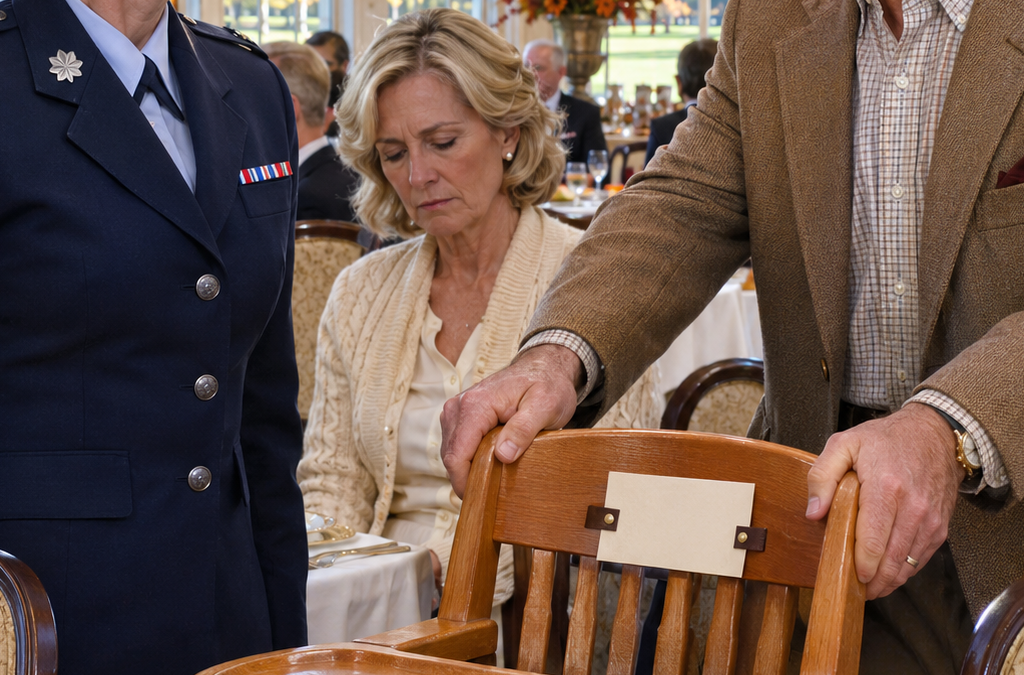
My stepfather strapped my name card to a high chair at Thanksgiving and said, “Sit there, screwup, and stop embarrassing this family.”
Chapter 1 of 7
I stood in my Air Force service dress, seven years into keeping a roof over his head.
“Are you really giving me the baby’s seat?”
Raymond Mercer straightened beside the empty chair. Behind him, the rented country-club room was full of family.
My mother, Linda, looked toward the windows. Anna stayed beside her, close enough that their sleeves touched.
“Just sit down and let Dad finish,” Kyle said.
A thin folder lay beside Raymond’s plate. Its cover showed a duplex with exposed plywood below the windows, a building Kyle had shown around before.
“Mom, are you going to let him do this?”
She looked down.
That hurt worse than the chair. Linda had saved me a place at every school concert she’d ever attended, but now she couldn’t look at me across a Thanksgiving table.
My name is Claire Bennett. I was thirty-seven, an Air Force major stationed at Wright-Patterson near Dayton, Ohio. I’d come straight from an official local appearance.
The trust I funded owned their entire house.
In my palm was a brass house key engraved Bennett, the one I’d received seven years earlier when I funded the purchase and Mom cried in the empty kitchen.
I’d arranged the ramp at the side entrance for her knees. The blue winter curtains I’d hung still framed her front windows.
And that morning, she’d sent a picture of them with her crooked holiday wreath.
Across the table, Raymond’s folder covered part of his bread plate. Kyle’s business name was printed beneath the photograph.
The house in Raymond’s folder wasn’t the house Mom lived in.
A week earlier, I’d stopped by while Mom was ending a video call with Dana Ellis at Oak Valley Bank. Mom had mentioned agreeing to have their residence check-in recorded, her phone still propped against the sugar bowl.
I hadn’t asked what she’d said.
There were plenty of things I hadn’t asked lately.
Raymond pushed the high chair into the gap between two adult seats. Its little tray hit the tablecloth, leaving nowhere for my knees even if I’d wanted to play along.
“You went away and left the helping to everybody else.”
His voice carried easily. He’d used that version for years: I’d escaped, and he’d stayed.
Apparently, deployments and duty stations counted as vacations if you didn’t ask anything about them.
I’d made keeping the peace look too much like agreeing.
Kyle leaned back beside the folder. “You always make everything about your job.”
I hadn’t mentioned my job.
My face burned anyway. Around us were familiar faces, people who’d eaten in Mom’s kitchen beneath those curtains. Nobody offered me an ordinary chair.
Then Raymond shoved the high chair farther forward.
“SIT WHERE I TOLD YOU!”
The shout reached the corridor.
“You want everyone watching me sit in that?”
“Yes. Maybe you’ll finally learn some respect.”
He waited with his chin raised while Anna stared at the table. Mom’s lips moved, but nothing came out.
“Then I won’t sit.”
I stepped around the high chair and left the room. Behind me, Raymond started explaining me to everyone again, his voice following me past the framed golf photographs.
The corridor smelled like coffee and warm rolls. I called Dana.
She answered from elsewhere in the club, where she was having her own Thanksgiving dinner and had already arranged to stop by for a brief residence discussion with Mom.
“I received Raymond’s request to sell Linda’s residence,” she said.
For a moment, I watched the dining-room doorway without blinking.
“What request to sell?”
“It came with Kyle’s proposal. Your regular housing payments are still arriving.”
Nothing about Mom’s curtains or her wreath had suggested she was leaving. That morning, she’d asked whether I wanted leftover turkey for sandwiches.
Dana said she would come over.
I waited outside our rented room until she appeared. Then we went back in together.
Raymond greeted her before she reached the table.
“We can discuss our business out in the hall.”
Dana stopped beside Mom’s chair. “Linda’s here. We can clarify the sale proposal.”
Raymond glanced toward the relatives, then back at Dana.
His voice became softer as he welcomed her.
The folder was still beside his plate.
Kyle sat up without touching his food.
Dana looked from its cover to him.
“Raymond, why is Kyle expecting money from Linda’s house?”
Kyle opened his mouth, but Raymond answered first. He said they’d agreed to keep the discussion within the immediate family.
Dana hadn’t raised her voice. She stood where everyone could hear her anyway.
“You asked me to stop here to discuss it with Linda,” she said. “There’s a proposal. There’s no approved sale.”
Raymond’s expression changed at that last part. He looked annoyed rather than surprised, as if Dana had corrected him over something too small to matter.
I stayed near the doorway. The high chair was still waiting in the gap.
Mom looked at the folder now.
Kyle began describing the duplex. One level for her, family nearby, no worrying about repairs. He spoke faster as he went, explaining that his business could finish it properly once the money was available.
The photograph showed unfinished windows.
Dana said the proposed offer covered six years of accommodation. It was an offer for the bank to consider, not a promise the bank had made.
“But Dad said the house would cover it,” Kyle said.
Raymond turned toward him.
His warning look came too late.
Mom pulled back from the table.
I could hear the heating vent overhead.
Dana named the payment Kyle had requested.
Kyle’s housing contract asks for ninety thousand dollars in advance.
For a few seconds, I couldn’t connect that number with the room around us. There was cranberry sauce beside Mom’s plate. She always ate it on a dinner roll and called that her Thanksgiving jelly sandwich.
And Kyle had come expecting her home to finance his building.
Raymond reached for the folder and held it toward me.
“Take this outside and quit making a scene.”
“No. You can carry your own folder.”
His arm stayed extended. I didn’t move toward him.
I was humiliated, still, but now I was frightened for Mom too. She’d been living inside conversations I hadn’t known were happening.
Raymond lowered the folder to his place.
He told Dana that Claire had misunderstood the family’s intentions. He used my name that way whenever he wanted an audience to think I wasn’t quite there.
Dana said she needed Linda’s answer, not a discussion across the table.
Mom looked toward Anna. My sister stayed beside her but didn’t speak. I wanted her to say one plain thing, even that she hadn’t known.
Instead, Mom spoke herself.
“He said there’d be a little kitchen.”
Kyle nodded immediately. He started describing cabinets, but she kept going.
“And somewhere for my sewing machine. I asked about that.”
Nobody had mentioned whether she wanted to leave. I could hear how carefully she was repeating the promises, trying to find something solid among them.
“Mom, did you ask to move?”
Raymond answered that she needed less to worry about.
I kept looking at her.
The country club had put a wreath on the inside of our door. From where I stood, its red ribbon hung directly above the high chair.
Linda finally looked at me.
“Raymond told me your house payments stop next month.”
Chapter 2 of 7
“There’s no payment cutoff, Linda,” Dana said. “Nothing is scheduled to stop next month.”
Mom looked at me, then at Raymond. He had the folder tucked against his plate again.
“Why didn’t you ask me?” I asked her.
“I was afraid you’d say it was true.”
That hurt. She’d worried about losing her home while sending me pictures of her holiday decorations. I’d answered those pictures with little hearts, never knowing what she needed to ask.
Raymond said he’d only meant that nobody could depend on my payments forever.
Dana told him that wasn’t what Linda had described. Then she asked Mom whether she wanted to continue discussing her housing in front of everyone.
Mom shook her head. Thanksgiving dinner resumed around us, badly.
The next morning, I called Mom from outside Oak Valley Bank. We’d agreed to talk alone before my visit with Dana.
Raymond answered her phone.
“She’s getting dressed. Tell me what you need.”
“I’ll call her later.”
He started telling me about Kyle’s plans, but I ended the call. Through the bank windows, I could see Dana waiting near her office. I’d come hoping to settle Mom’s fear, and I still couldn’t get her alone.
Dana brought me into a small room off the lobby. I kept my phone beside me in case Mom called back.
“Your payments are current,” she said. “I checked with servicing.”
She had also checked the purchase records and the deed. Oak Valley Bank held the house for the Bennett Residence Trust; neither Raymond nor I personally owned it.
My original contribution was there: fifty-seven thousand dollars toward the purchase. So were seven years of housing payments and a mortgage balance of approximately $194,800.
Seeing those numbers made me angry in a way the dinner hadn’t. Raymond had turned my continued help into a threat I’d supposedly made.
“So why does he keep talking like he can arrange all this?”
“He has a real household role,” Dana said. “That doesn’t include selling the house.”
She explained that Raymond could direct approved household bills up to $2,500 monthly from the $58,700 reserve. That permission was genuine, even though the money wasn’t his.
“I know. But if Linda independently wants to move, we have to consider it.”
I’d known he handled bills. Somewhere along the way, I’d stopped distinguishing between helping Mom and trusting him.
Dana said the bank remained responsible for the reserve. My contributions didn’t let me take it back, put Raymond out, or decide where Mom had to live.
“I don’t want to put her out.”
“I know. But if Linda independently wants to move, we have to consider it.”
There it was, the part I couldn’t fix by saying no. Mom could choose something I hated. I was frightened she’d agree just to stop being asked.
Dana let me read Kyle’s housing contract. It asked for $90,000 in advance for six years of accommodation in the duplex his business hoped to acquire and renovate.
The photograph looked worse close up. There was no finished entry beneath one doorway.
“Does he already owe someone that money?” I asked.
“I can’t speak to his business debts. The trust hasn’t signed this. We don’t owe him the advance.”
But that was where the sale money was meant to go. Kyle needed the payment to get the building bought and finished, not simply to welcome Mom into a home already waiting.
I pictured her sewing machine sitting in storage while somebody promised another week.
My phone stayed dark.
Dana said she would contact Mom directly. I left the bank with copies I’d requested, but no answer about what Mom actually wanted.
Anna called before I reached my car. She was nearby buying groceries and asked me to meet her outside the store.
She stood beside a cart with a loaf of cinnamon bread on top. Mom always froze half a loaf, then forgot which half she’d frozen. Usually Anna and I could laugh about that.
That morning, she barely greeted me.
“Raymond says you’re putting paperwork ahead of your mother.”
“Is that what you think?”
“He asked me to talk to her. She listens to me.”
Anna showed me his message. He wanted her to explain the advantages, keep Mom calm, and get her approval so they could move forward.
There was nothing asking Anna to find out whether Mom wanted to go.
I was disappointed in my sister, and tired of being careful with her. At dinner, she’d watched me stand beside that chair. Now she was delivering his complaint.
“What does Mom want?” I asked.
“She’s worried about everybody fighting.”
“That wasn’t my question.”
Anna looked toward the store entrance. She said somebody needed to keep talking to Mom, and she couldn’t do that if Raymond decided she was against him.
I understood her fear. I’d used almost the same excuse myself.
“Ask Mom without him answering.”
She said she would try. Then her phone lit up with Mom’s name, and her expression changed as she read.
I asked to see the reply. Anna held the screen against her coat.
“Those are her messages to me, Claire.”
It was a fair boundary in any ordinary argument. Standing there, though, I felt shut out again.
Then my phone buzzed. Raymond had sent a screenshot of his exchange with Anna to the family group.
Under it, he’d added a new message.
“Anna will explain the move to Linda tonight.”
Chapter 3 of 7
“She asked if saying no meant Raymond would stop helping her.”
Anna told me that Monday morning while I was getting ready for work. She hadn’t obtained Mom’s agreement to anything. Instead, Mom had asked who would drive her to appointments if Raymond got angry.
“What did you tell her?”
“That he wouldn’t do that.” Anna paused. “I don’t know if that’s true.”
She admitted she’d wanted Mom to stop worrying. I knew that impulse. We’d both learned to offer reassurance before checking whether there was anything behind it.
By the time I reached Mom’s house after work, Raymond had made the answer clear.
His overnight bag stood beside the front door. Mom sat on the couch with her shoes on, although she wasn’t going anywhere. Her knees bothered her after long drives, especially when she had to keep one bent beneath the dashboard.
“I can get to the grocery store,” she told me. “It’s the other side of Dayton that gets hard.”
She sounded embarrassed, as though her knees had caused all this. It hurt to hear her defending the small amount of help she needed.
Raymond came from the kitchen before I could sit beside her. He’d been calling relatives; Mom’s name and mine had carried down the hall.
“If you two run this house, you can do the work.”
He looked at me, then toward Mom.
“Arrange her appointments.”
Mom had a routine follow-up later that week. Raymond announced that he would stay with Kyle unless she supported the housing proposal. She could think about whether she wanted him around while she figured out her transportation.
His bag was packed carefully enough that I believed he’d go. I also knew that going for a few nights wouldn’t end his right to live there. Nobody was changing locks.
“Are you asking her to agree so you’ll keep driving?”
“I’m telling you I won’t be used anymore.”
Mom started explaining how much Raymond did. He bought groceries, carried laundry downstairs, remembered when the furnace filter needed changing. She listed each thing with her eyes on his bag.
I hated hearing her price out his company.
“We can arrange a ride,” I said. “You don’t have to settle the house question tonight.”
Raymond said I made everything sound easy because I could leave afterward. That landed where he meant it to. I had planned to go home, heat something up, and spend an evening answering nobody.
Instead, I called Anna from Mom’s kitchen. She could drive Mom to the appointment if I handled dinner that evening and checked whether Mom needed groceries. We agreed on one ride, not a whole new system we hadn’t thought through.
Mom’s refrigerator had three bowls of leftover mashed potatoes. She always claimed potatoes kept better divided up. None of us had ever found evidence for that.
I checked the milk and made a short grocery list anyway.
“I don’t want you girls fighting over who has to take me.”
“We’re working out Thursday, Mom.”
She nodded, but kept looking toward the hallway. She wanted Raymond to come back in and say he hadn’t meant it. I wanted that too, which made me angrier than the bag.
Before arriving, I’d arranged to meet Megan Price after work. I texted that I’d be late, then met her for sandwiches near the base while Anna called Mom.
Megan was thirty-nine, another major in my squadron at Wright-Patterson. She knew my work as a logistics readiness officer, including the unglamorous stretches when keeping things moving meant staying with a problem long after everyone else had gone home.
“You look worn out,” she said.
“There may be a family discussion later. Would you come with me?”
I told her about the ride, then the house proposal. Thanksgiving came last. Saying the part about the high chair out loud still made my face hot.
Megan didn’t laugh or ask why I hadn’t put Raymond in his place. She asked whether I’d eaten anything since lunch.
Half my sandwich disappeared before I answered.
“There may be a family discussion later. Would you come with me?”
She asked what I needed her to do. I said sit beside me and listen. I didn’t need anybody from command involved, and she wasn’t offering that.
She said she could do that. The plainness of it nearly made me cry.
My phone lit up before we finished. Mom wanted the groceries tonight. Raymond was still there, but he’d told her to ask me.
So I went back with milk, eggs, and the bread she liked. My quiet evening was gone. I resented that, then felt guilty for resenting a grocery run.
From the hallway, I heard Raymond finishing another call. He said he was protecting Linda from depending on a daughter who might disappear again.
He ended the call when he saw me.
“Stop teaching your mother to question everything I do.”
“She gets to answer for herself.”
He told me I hadn’t been there for the daily work. I didn’t argue that he’d done none. That would have been easier than admitting he’d helped her and was now using it against her.
Mom stayed in the kitchen while I brought in the groceries. Raymond’s bag remained by the door when I left.
Dana called as I reached my apartment. She said she needed to give everyone involved a direct ownership explanation before considering the relocation proposal. A piece of returned mail had made that necessary.
“Was something sent back?” I asked.
There had been a bank envelope addressed to me at Mom’s house. Raymond had written “not responsible—ask Linda” across it and returned it.
“Raymond returned your correspondence,” Dana said. “He demanded that all ownership questions go through Linda.”
Chapter 4 of 7
“Raymond can’t redirect our correspondence,” Dana told me the next morning. “I’m contacting you and Linda directly.”
She had corrected my mailing address and reached Mom on her own phone. Raymond would receive the same short explanation of the house arrangement, but he wouldn’t receive it on either of our behalf.
I asked whether Mom had understood why Dana was calling.
“She asked whether she needed to pack anything.”
That hurt. Mom was still trying to figure out how quickly her life might change while the rest of us argued about who could speak.
Dana had told her there was no approved move. Then she’d asked permission to send the explanation directly to everyone involved.
By the time I got to Mom’s house after work, the statement had arrived. Raymond had printed it. His overnight bag was gone from the hallway, though I couldn’t tell whether he’d unpacked it or moved it upstairs.
Mom was in the kitchen cutting the browned edges off toast. She’d done that for years, then eaten the edges herself while insisting she preferred the middle.
“Have you eaten?” she asked.
“Mom, it’s barely dinner.”
“That wasn’t what I asked.”
For a second, we sounded like ourselves. I accepted a piece of toast and stayed beside her until Raymond called from the dining room.
The bank’s statement lay in front of him. It was short enough to read without turning a page. He had read it already; now he started again with me standing there.
“This says you supplied the down payment.”
“Yes.”
“And the monthly money comes from you.”
“Yes.”
He looked back at the page. I’d imagined some satisfaction in watching him learn it all. Instead, I felt embarrassed that we were doing this with Mom listening from the kitchen.
Dana’s explanation left little room for the story he’d been telling. I’d funded the purchase. Oak Valley Bank held title as corporate trustee. For seven years, I’d supplied approximately $1,460 each month toward the mortgage, taxes, and insurance.
Raymond read that line twice.
He’d known I helped. He hadn’t understood that the arrangement he presented as his household stood on money I kept sending, even after he stopped asking much about my life.
“I kept this place running,” he said. “Money doesn’t carry groceries upstairs.”
“I didn’t say you hadn’t helped.”
“Your mother would have been alone here.”
There it was. He could accept the bank’s figures more easily than he could accept losing the role he’d claimed around every family table.
Mom came to the doorway with her toast. I hated that she looked ready to thank both of us until we stopped.
“You paid for a house, not your mother’s decisions.”
Raymond said it looking straight at me. He no longer called Mom the owner. He didn’t argue with the bank’s account of where the money came from.
“The bank can look at it. That’s what we asked.”
“Then let her make one without you.”
Mom looked down at her plate. Raymond turned toward her as though I’d asked her to choose between us.
He described Kyle’s proposal more carefully than he had at Thanksgiving. One level would mean fewer stairs. Family would be close. Six years paid ahead would spare Mom a monthly housing bill.
“He’s offering her somewhere we can manage,” Raymond said. “The bank can look at it. That’s what we asked.”
It was a better argument than pretending my payments were stopping. A finished apartment on one level could help Mom. Having somebody nearby mattered, too.
The trouble was the apartment wasn’t finished, and Kyle’s business didn’t own the duplex yet. Mom would be giving up a home she could already enter and sleep in.
“Where would she stay while he finishes it?” I asked.
Raymond said Kyle could explain the schedule at the bank. For once, he didn’t pretend the question was already answered.
That frightened me more than another insult would have. My contributions didn’t settle whether Mom wanted to leave. If she said yes, Dana would have to consider her answer.
“Can we please talk about this somewhere else?” Mom asked.
She meant the house. She wanted one evening when her dining room wasn’t where everyone came to argue over her future.
I told her I’d ask Dana.
Dana called us separately that evening before arranging a family conference at Oak Valley Bank’s Dayton office. Mom agreed to attend with Raymond. Anna and Kyle would be there, and I confirmed that Megan could come as my personal support.
“Friday at ten,” Dana said. “I’ll send everyone the same invitation.”
Raymond asked to bring a few adult relatives. He wanted people there who’d heard what happened at Thanksgiving, people who could see that he’d been trying to help.
Dana checked with Mom before adding them. Mom agreed. I wished she’d said no, but I didn’t tell Dana to overrule her.
Later, Raymond sent the family group a message saying everyone would finally hear the whole story.
I was tired enough to want to skip it. Then Mom called to ask whether I’d be there. I told her yes.
An additional attachment appeared beneath Dana’s invitation before I went to bed. Raymond had labeled it “joint consultation” and sent it to everyone attending.
His message said it would prevent confusion about the answer he and Linda had already given.
Raymond had attached a written summary claiming he’d been present for Mom’s entire consultation.
Chapter 5 of 7
Raymond’s summary said Mom had agreed to leave the house while he sat beside her. It also said he’d remained with her throughout the consultation and helped answer every housing question.
Anna called while I was reading it.
“She took a call by herself,” she said. “I was there that afternoon. Raymond was out in the garage.”
“Did you hear any of it?”
“No. She shut the kitchen door. I don’t know what she said.”
We couldn’t turn a closed door into an answer. Still, I read his summary again. He hadn’t left any room for a conversation he hadn’t heard.
By Thursday evening, he had printed copies for everyone at Mom’s house. Mine lay on the dining table beside Kyle’s duplex photograph.
“Let me pay for a hotel tonight,” Raymond said. “Somewhere nice. Sleep in tomorrow, have breakfast.”
I’d barely gotten my coat off. He stood between me and the kitchen, where Mom and Anna were talking.
He explained that Mom needed to “speak without pressure” at the bank. If I stayed away, she wouldn’t worry about hurting my feelings.
“You’re offering me a room so I’ll miss the meeting?”
“I’m offering you a break. Stop picking everything apart.”
I was angry enough to leave, which would have given him half of what he wanted. Instead, I told him I would attend and walked into the kitchen.
Mom had made chicken and noodles. She kept the noodles separate until serving because Raymond hated them soft, though hers usually sat long enough to become practically dumplings.
The familiar dinner smell made his hotel offer hurt more. I could come home, apparently, as long as I didn’t stay where decisions were made.
“Everybody’s getting hung up on the unfinished part,” Kyle said when we sat down. “We’re talking about six years with family nearby.”
“Where would I live while you finish it?”
He’d arranged his photograph and a page describing the proposed apartment where Mom could see them. Then he asked Anna to read the section about the single-level layout.
Anna read it without enthusiasm. Raymond nodded after each feature, as though the table were voting.
“Linda, that’s what you wanted, right?” Kyle asked. “No stairs. Your own kitchen. Space for sewing.”
“Where would I live while you finish it?”
Kyle looked toward Raymond. He said there were options, depending on when the purchase went through and how quickly the work moved.
Mom asked whether “options” meant staying somewhere else with her things packed. Kyle said nobody wanted to rush her, then reminded her that the advance payment would make the work possible.
I felt scared for her again. The description sounded comfortable until she asked where she would sleep.
Raymond said the bank meeting was the place for details. Mom ate a little more, and nobody asked her to approve the page again.
After dinner, Anna went looking for containers for the leftovers. Party supplies returned from the club had been stacked beside the pantry: serving trays, folded decorations, and a small bag of place cards.
Mine was still fastened to the strap Raymond had used on the high chair. Anna recognized it before I did.
“I should’ve taken this off there,” she said.
She unfastened the card and kept it with her bag. I didn’t ask what she planned to do with it. Seeing my name on it still embarrassed me, and I hated that the embarrassment belonged to me.
Mom found me in the kitchen while Raymond and Kyle discussed driving arrangements. Anna had gone upstairs to find Mom’s folder.
“I didn’t want him turning on me,” Mom said.
She was looking at the doorway. I waited until she looked back.
“At Thanksgiving. I knew it was cruel. I kept thinking if you sat down, we could get through dinner.”
It hurt to hear her say it so plainly. For days, I’d wanted an explanation that made her silence less deliberate.
“You wanted me to take it so dinner stayed pleasant.”
“Yes.” Her voice was faint. “I’m sorry.”
I believed she was sorry. I also remembered standing there while she studied the windows.
She asked whether I could keep things calm at the bank. I told her I would attend, and I wouldn’t interrupt her answer. But I wouldn’t spend another meeting making sure nobody felt uncomfortable.
Mom nodded without asking me to promise anything else.
The next morning, Megan met me outside Oak Valley Bank. She wore civilian clothes and had left enough room in her schedule that we wouldn’t have to watch the door.
I was grateful she didn’t ask whether I was ready. We went in together.
Dana met us near the conference room. She said the account balance, Raymond’s household authorization, the title record, Kyle’s proposal, and the original consultation files were available for the discussion.
Beyond her, the relatives Raymond had invited were settling around the long table. He stood at the threshold with Mom beside him, accepting their concerned greetings.
“Linda and I gave the bank our answer together.”
He said it easily. Mom was close enough to hear every word, but he looked past her toward the people he wanted to convince.
Megan stayed beside me as we entered. Across the table, Anna had kept a chair empty next to hers. She looked directly at me and moved her bag off it.
For once, there was a place waiting for me that I could actually use.
Dana sat at the head of the table. Raymond’s summary was already open on her screen.
Then Dana placed a second file on her screen labeled “Linda Mercer—private follow-up.”
Chapter 6 of 7
“Say it here,” I told Raymond. “What you told everybody outside.”
The file on Dana’s screen was a separate recording of her private follow-up with Mom. Nobody had heard it yet.
Megan moved my chair back into place after letting me pass. “Here you go, Major Bennett.”
Raymond glanced at her, then at me. His eyes lingered, but he returned to the relatives he’d invited.
“Linda chose the move herself. I gave the bank her answer.”
He acknowledged that I’d supplied the money for the house. He said that didn’t mean Mom should spend the rest of her life somewhere that no longer suited her.
Mom sat beside him with her coat still on. She’d always kept it on at appointments until somebody told her how long things would take.
My face was hot. Even here, I wanted her to contradict him before I had to ask.
“Your summary says you were there for every housing answer,” I said. “Dana has a private conversation.”
Raymond leaned forward. He said the extra call would have been routine, checking details after they’d already agreed. Mom worried about changes; everybody at the table knew that.
I looked toward Anna. She had left her chair to help Mom with her coat and remained behind her.
Raymond kept explaining. He’d driven Mom to appointments, listened when the stairs hurt her knees, and found a possible solution. Now we were treating her ordinary nerves as though they erased a decision.
“You don’t get to buy the right to answer for her.”
His words hurt because I agreed with that much. I couldn’t pay for Mom’s home and claim her answer. Neither could he earn it through groceries and rides.
Dana waited until he finished.
“Did Linda ever tell you she wanted this house sold?”
“She agreed to the family plan,” he said. “Don’t turn being nervous into changing her mind.”
He looked at Mom then, expecting help. She watched Dana instead.
I put my brass key on the table. Bennett was still readable along its worn edge. I remembered Mom crying in that empty kitchen, and how sure I’d been that the hard part was over.
“Will you play what Mom told you alone?”
Dana asked Mom whether she agreed to let everyone hear the recording. Mom said yes, then repeated it when Raymond started speaking over her.
I was frightened she’d withdraw the permission just to stop him looking at her that way. But she took off her coat and settled back.
Dana started the file. First came her voice asking permission to record. Mom agreed. Then Dana asked whether the housing proposal reflected what she wanted.
“I don’t want the house sold,” Mom’s recorded voice said. “I haven’t told Raymond he can promise we’re moving. I want to keep living here.”
Nobody needed the volume raised. Her voice sounded steadier than it had across the dinner table.
Dana stopped playback and identified the conversation as later that same day, after the joint discussion had ended.
Raymond stared at the screen. His summary lay in front of him, claiming there had been no conversation without him.
“I understood. I still didn’t want it. You weren’t there when I told Dana.”
I felt relieved, and sad that hearing my mother say what she wanted had become such an event.
“She didn’t understand what Kyle was offering,” Raymond said.
Mom answered before Dana could.
“I understood. I still didn’t want it. You weren’t there when I told Dana.”
Kyle began talking about the apartment’s separate entrance. Dana referred him to his own proposal: the business still had to acquire and finish the building. The advance would finance that work.
Mom said she didn’t want her belongings packed while she waited.
Anna came around the table and sat beside me. Her bag held the place card she’d removed the night before.
“I should’ve stood with you at Thanksgiving,” she said.
I nodded. It mattered that she’d said it where Raymond could hear.
Dana brought the discussion back to the bank’s decision. She rejected the sale under this proposal because Linda had not independently chosen relocation.
Then she addressed Raymond’s household role.
“Your authority to direct household payments ends immediately because you misrepresented Linda’s instructions. You no longer have control of $58,700 in household reserves.”
Raymond’s chair scraped backward.
Dana explained that the money would remain in the trust and the bank would administer household bills. It wasn’t coming to me.
He reached across for the printed confirmation she offered him. He read it standing, while Kyle closed the folder with the unfinished duplex on its cover.
“Anna, come back over here. This concerns your mother.”
My sister stayed beside me. Mom didn’t ask her to move.
I’d spent years trying to keep him from feeling challenged. Watching him wait for obedience, I felt ashamed of how often I’d supplied it.
“Mom’s home stays safe. My silence doesn’t come with it.”
Raymond lowered his voice and suggested we step outside, just the two of us. We could put Thanksgiving behind us. He said he hadn’t meant for any of this to get so ugly.
I told him I wouldn’t discuss it privately. Dana gave me my copy of the decision, and I left with Megan.
In the lobby, Mom caught up to ask whether I still had the container from her chicken and noodles. I did. She said there was no hurry, although she always said that before asking again.
Raymond followed us as his phone chimed. The club had emailed his $4,200 Thanksgiving invoice, with his signed booking attached.
He turned the screen toward me.
“Will you cover this?”
Chapter 7 of 7
“No, Raymond. I’m not paying for your party.”
He kept the screen turned toward me. Mom stood nearby with her coat over one arm, watching us.
“You ate the food. Your family was there.”
“You booked it. You signed for it.”
He waited, and I recognized what I usually did next. I would soften my answer, offer part, find some way to make refusing cost me money anyway.
This time, I left with Megan.
On December 18, Raymond accepted three payments of $1,400 on the $4,200 bill. He forwarded the club’s agreement to the family group, adding that he would handle it himself since nobody else would help.
I didn’t answer. Neither the bank nor I paid any of it. By the time the last installment cleared, I’d stopped checking whether he’d sent another complaint.
Less than two weeks later, Raymond signed a voluntary arrangement to leave Mom’s house within thirty days. He would stay at Kyle’s rented place and contribute $850 monthly toward rent.
Mom called after he signed. I was folding laundry, and I sat down with a warm towel across my knees.
“He says he can’t live somewhere he’s treated like a guest.”
“Do you want him to stay?”
She took long enough that I heard the dryer stop behind me.
“I don’t want him staying angry at me all day.”
That wasn’t quite an answer about her marriage. It was enough of an answer about the house. I was sad for her, even knowing his leaving might make daily life easier.
Nobody changed the locks or put his things outside. He kept using the kitchen and sleeping there while he packed. Mom said some evenings were almost ordinary; others, he complained through supper about everything Kyle’s apartment lacked.
Anna was there when he finally moved, and I came after work. Mom sat near the front window while Anna helped her sort the space Raymond had cleared in the hall closet.
“He took the good snow shovel,” Mom said.
Anna checked beside the door. “He took both.”
Mom laughed once, then covered her mouth. She looked embarrassed by the laugh, but Anna told her we could get another shovel.
I felt relieved he was gone. Then Mom began crying over the empty hooks, and I sat beside her without trying to improve the afternoon.
“I thought I’d be better at this,” she said.
“At what?”
“Knowing when somebody’s being unfair to me.”
We stayed until she wanted us to leave. Anna checked that Mom had her ride arranged for the next appointment. I brought dinner, but didn’t promise to bring it every night.
The bank kept handling the household bills. When Mom asked me what to do with a repair estimate, I helped her send it to Dana rather than approving it myself.
It would have been easy to become the person everyone had to ask. I didn’t want that job, and Mom didn’t need another person deciding everything for her.
Kyle’s duplex plan went no further with the trust. His unsigned offer stayed unsigned, and his business had to find its own money. There was no advance to recover.
He called me once about a smaller amount. He said it wouldn’t have to come from Mom’s housing money.
“I looked away when he put you beside that high chair.”
“I’m not financing your business, Kyle.”
He told me I was making it personal. I said I’d answered him, then ended the call. I was angry afterward, but I ate dinner without composing a message explaining myself.
Mom’s fuller apology came during a visit the following week. We were at her kitchen table, with no Raymond in the next room.
“I looked away when he put you beside that high chair.”
I waited. She knew I’d heard her first apology.
“I could have told him to stop. I wanted you to make it easy for me.”
“Yes,” I said. “You did.”
She cried, and I felt the old urge to tell her it was all right. Instead, I stayed where I was.
“I’m sorry, Claire. You don’t have to say anything.”
That helped more than I expected.
We began having short visits. Sometimes Anna joined us; sometimes Mom and I ate lunch alone. She didn’t bring Raymond’s complaints to the table, and I didn’t ask her to stop speaking to her husband.
Anna apologized again too, without explaining how difficult Raymond could make things. After that, she showed up when she said she would. I trusted those ordinary afternoons more than another promise.
Four months later, I drove over on a day off. Mom had asked whether I could help transplant her herbs before lunch.
Raymond used to call that wasting my time. He’d point out how far I’d driven, as though a visit needed enough heavy lifting to justify the gas.
I’d said yes because I wanted to spend an hour outside with her.
Mom waited beside the back steps in an old sweatshirt, with basil and parsley crowded into their starter pots. The mint had its own container. She’d once planted mint in the flower bed and spent years accusing it of having ambitions.
“You’re early,” she said.
“You told me before lunch.”
“Well, I haven’t decided when lunch is.”
We worked beside the ramp, where she could sit when her knees needed a rest. She talked about Anna’s week and a television show she’d given up watching halfway through.
I told her about a frustrating day at work. She listened without changing the subject, then asked a question I could actually answer.
It was such a small thing. I was happy enough that I had to look down at the soil for a moment.
When we finished, she went inside to wash up and check lunch. I stayed outside to rinse the dirt from the pots and let them drain.
There was no meeting waiting inside. No business proposal beside her plate. I could eat lunch, stay awhile, and leave when I was ready.
At the door, I found the brass key in my palm. Bennett was worn along the edge, but I could still read it.
Loving my mother didn’t require making myself smaller.
I turned my old key and went inside.







