My sister-in-law stacked my bedding on the porch after her father’s funeral, unaware this 56-year-old widow had the right to stay.
Chapter 1 of 7
“Pack faster. Nobody left you anything.”
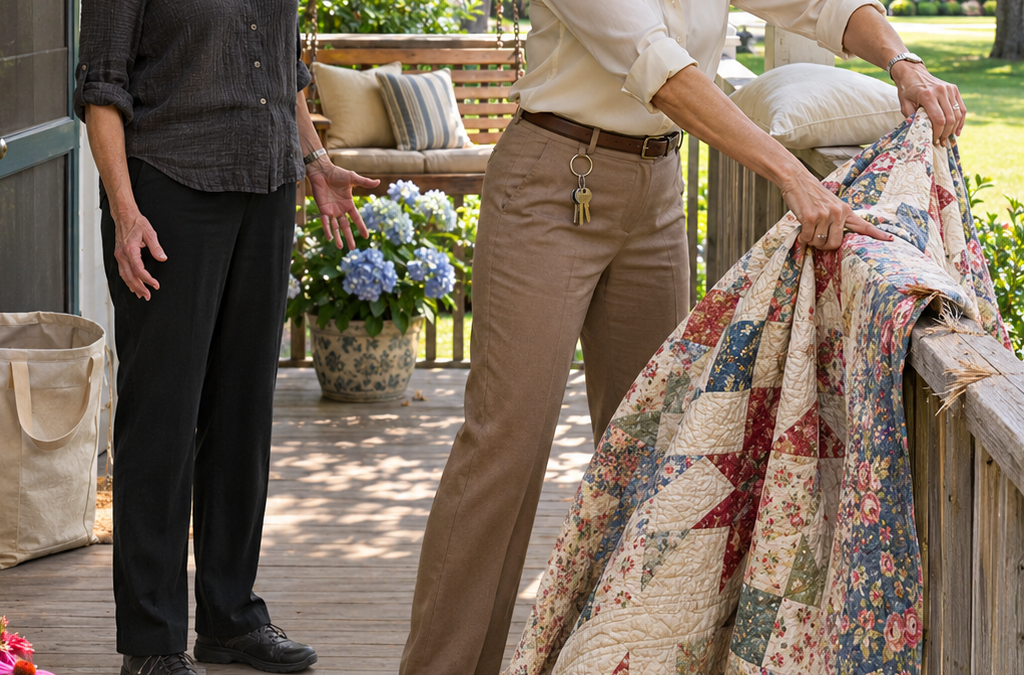
Karen Miller draped my quilt over the railing, catching one corner on a splinter.
“Why are my blankets out here?” I asked. “I’m still using that bed.”
She went inside for my pillow without answering me.
“Scott, are you going to watch this?”
Scott Davis looked toward the driveway. He’d come to help carry things after the funeral, but apparently nobody had asked whose things.
Paula Grant stood beside the screen door. “Don’t make Karen do everything herself.”
That hurt more than I expected from someone who’d eaten at my table for years.
Behind the porch swing, a metal sign showed its blank back. Karen’s keys hung from her belt, knocking against the doorframe whenever she passed.
Nobody answered me.
My name was Ellen Brooks. I’d kept Brooks when I married, and at fifty-six, I was apparently being sorted with the unwanted linens.
The trust owned this house, and it was my home for life.
I’d attended the signing twenty-four months earlier, sitting beside my father-in-law while he insisted I read every page instead of worrying about getting him home for lunch.
This house in Georgetown, Texas, wasn’t somewhere I’d drifted into.
His reading chair still stood on wooden risers I’d ordered to make getting up easier.
Upstairs, Karen’s guest bed had clean sheets because I’d washed them, while my late husband’s work shirt hung nearby with its sleeve repaired in mismatched blue thread.
I had made helping so automatic that they stopped seeing the person doing it.
Then Karen nudged the sign, exposing a strip of lettering.
A rental sign lay facedown beneath the porch swing.
“Your husband’s gone, Ellen. Stop acting like this is yours.”
Paula said it while Karen brought out my slippers and placed them beside the quilt.
My face burned.
The slippers had been under my bed. She’d gone into my room while I was washing funeral dishes.
Scott raised his phone where we could see it. Karen told him to get a record of the porch.
“Should I include the bag, too?” he asked.
“Take your things and GO!”
Karen’s shout carried across the yard. The canvas laundry bag sat empty beside the door.
“Are you putting me out against my wishes?”
“Yes. Take your bedding and leave.”
She waited for me to bend down, but I stayed upright.
“I’m not moving out. I’m only standing outside until David arrives.”
And I left every piece where she’d put it.
David Reed’s number was already in my phone. He’d arranged to bring something my father-in-law had left with him.
My voice shook when he answered. I told him where I was standing and what Karen had done.
“Stay there. I’ve seen her vacant-house proposal.”
For a moment, I couldn’t connect those words to this porch. My coffee cup was still beside the kitchen sink, and my clothes were upstairs.
David said Karen had submitted a plan to rent the whole house. It described the property as vacant.
He was already coming with the box.
So I waited beside the swing while Karen stayed in the doorway, watching me instead of retrieving my bedding. Scott lowered his phone.
The quilt slipped farther over the rail, and I wanted to rescue it, but collecting my things was exactly what Karen expected me to do next.
When David arrived, Karen stepped across his path.
“This is family business. You weren’t invited here.”
He said the delivery had been arranged before her father died.
Under his arm was a dented metal tackle box.
He stopped beside me, facing Karen.
“The bank received your proposal for a vacant house.”
Karen’s mouth opened, then closed again.
David placed the tackle box in my hands.
Its metal handle pressed into my fingers.
Scott moved away from the porch steps.
Paula looked directly at Karen this time.
“Karen, why did you tell the bank this home was empty?”
Karen said the bank understood what she meant. She spoke to David now, using a quieter voice than she’d used with me.
I sat on the swing with the box against my knees. The dent near its latch was familiar from fishing trips my husband had taken with his father.
The lid opened stiffly.
Beneath the removable tray lay a folded handwritten letter and an old savings passbook.
Seeing that familiar handwriting hurt. My father-in-law had labeled leftovers in the same cramped letters, always adding instructions to heat them properly.
David stood beside the swing, leaving room between us.
“He gave me this six months ago. He wanted that reference checked.”
He explained that the letter directed him to existing records. His office already had a copy, along with the delivery instructions.
My father-in-law hadn’t wanted a financial quarrel beside his bed. That was in the letter, too.
But I’d never known he expected one here.
The passbook’s last balance was zero. Beneath it ran a transfer reference, faint but readable.
Those numbers meant nothing to me yet.
Karen said it was an old closed account.
David didn’t argue or reach for it.
I turned back to the inside cover.
More handwriting ran along its lower edge.
Karen leaned forward before I could read it.
The note named a separate file.
Inside the empty passbook, my father-in-law had written Karen’s name.
“Dad’s will leaves you nothing,” Karen said. “I’m his daughter. You need to accept that.”
She spoke louder now, making sure Scott and Paula heard her.
“I’m not surrendering my home.”
Karen turned to David. “She knows I handle the property. Tell her.”
He asked her to send him the proposal she’d given the bank. He didn’t tell her she owned anything, and he didn’t tell me the note settled anything.
She sent it while standing over us.
Her confidence frightened me more than her shouting had. She behaved as though I was the last loose end before work could begin.
Then she started explaining the rental.
An empty house could earn money, she said. Leaving it occupied by one person made no sense when there were bills to pay.
By then, her father’s name felt hard to say. Arthur Miller had been dead little more than a week. She was already using his absence to settle who counted.
Daniel, my husband, had been gone four years. For seven years, I’d helped care for his father, including the years when Daniel could still help me.
Karen had lived away for nine.
Those years weren’t a bill I intended to present. They were why Arthur’s chair still faced the window and why his missing cough kept startling me.
Karen had talked before about her eighteen thousand dollars in debt. Now she said rent would let her catch up instead of falling farther behind.
I looked at my slippers.
She’d made room for that plan by carrying them outside.
Scott finally picked up the quilt to keep it from snagging further. He put the bedding in my canvas bag and carried it into the hall cupboard, where it would stay dry.
He didn’t take it upstairs.
David’s phone sounded. Karen said she’d sent the booking attachment too, as though that would explain everything.
He read it twice.
Then David turned his screen toward me: Karen had already accepted a $1,600 reservation payment.
Chapter 2 of 7
“It’s refundable,” David said. “The $1,600 holds a proposed rental pending bank approval. There’s no approved lease. Nobody’s moving in.”
Across the porch, Karen stretched a tape measure between the posts. She asked Paula whether photographs would look better without the swing.
My slippers were still beside the door. Hearing that nobody was moving in helped, but watching Karen measure around me made me feel sick.
“Then tell her to stop,” I said.
David said he could contact the bank. He couldn’t make its decisions, and neither could Karen.
She let the tape snap back.
The screen door closed behind me when I went inside. Walking upstairs felt strange, as though I needed permission to put weight on each tread.
Karen followed me to my bedroom. She stopped at the threshold while I checked the drawer where I kept my husband’s shirts.
“You’re making this harder than it needs to be.”
“How much were you planning to get?”
She said $3,200 a month, for twelve months. A house worth roughly $485,000 shouldn’t sit around doing nothing, she added.
I was standing in it. My clothes filled the closet, and the little fan beside my bed still clicked on every third turn.
“Your father left me the estate,” she said.
David had come upstairs behind her. “The will covers his probate property. It doesn’t control a house already held in a trust.”
Karen turned toward him, suddenly polite. She said she understood that the bank handled the property, but her father surely hadn’t meant for everything to remain frozen.
I hated how easily she changed her voice for him. With me, she didn’t bother.
That night, I slept under a spare blanket from my closet. My bedding remained in the hall cupboard where Scott had put it. I wasn’t ready to carry it upstairs myself.
By Monday, Karen had decided we needed to fix the family’s impression.
She caught Scott near the kitchen and told him honoring Arthur meant looking after his surviving child. She said “surviving” loudly enough for me to hear from the table.
Daniel had been her brother. She made his death sound like another reason I should step aside.
“Tell them we worked it out,” Karen said to me.
She wanted a message in the family group saying everyone had been upset and she was helping me find somewhere comfortable.
I refused.
For years, smoothing things over had saved everyone except me trouble. I’d explained missed visits, softened ugly remarks, and made excuses before anyone even asked.
Karen waited as though I needed another moment to find the right apology.
“Stop hiding behind Dad and let his daughter handle this.”
Scott went outside. I wished he’d stayed long enough to hear my answer.
“I’m not sending that message.”
Karen brought me a printed page instead. It said I had agreed to leave and that she would help with moving expenses. There was a line at the bottom for my signature.
She called it a way to avoid more confusion.
I read it twice because I was afraid of missing something. Then I told her I wouldn’t sign it. She left it on the table anyway.
Rachel Turner called that afternoon from Hill Country Community Bank. She introduced herself as the officer reviewing the house arrangements and asked whether I could speak privately.
I went to my bedroom and closed the door.
“No one has bank permission to remove you,” she said.
“Can I tell Karen she’s finished handling the house?”
Her plain voice steadied me. She said the review was open, but she couldn’t settle competing accounts about an empty house from a family argument alone.
I had not moved out.
I told her that directly, then explained where I’d slept and where Karen had put my things.
“Can I tell Karen she’s finished handling the house?”
“The bank appoints its property manager and can replace that person,” Rachel said. “That decision isn’t yours to make.”
I was disappointed enough that I said nothing for a moment. Karen still had keys. Refusing her demands hadn’t taken those away.
Rachel asked me to send the page Karen wanted signed, along with anything else I received about leaving. I photographed it without adding the angry explanation I wanted to write.
Downstairs, Karen had put frozen garlic bread in the toaster.
Our toaster had burned one edge of everything for years. Arthur used to call that side the outdoor finish. The smell made me miss him so suddenly that I had to sit down.
Paula was gone. Scott stood near the back door, looking at his phone.
“Did you tell her I never agreed?” I asked him.
He said Karen already knew what I meant. That wasn’t what I’d asked, and he knew it.
Before supper, Rachel called again. Karen had sent her a porch photograph and an account saying I had chosen to leave, then reconsidered.
My face grew hot. Even after everything, I’d expected Karen to be more careful with the bank.
“Please preserve what actually happened,” Rachel said. “You don’t need to trade accusations with her.”
I wrote down what I remembered, including the words I’d said about waiting for David. Then I left the unsigned page where Karen could see it.
My phone buzzed while I was putting clean clothes away.
In the family group, Karen had posted a photograph of me outside beside my slippers and canvas bag.
Her caption read, “Ellen leaving voluntarily. We’re helping her get settled.”
Chapter 3 of 7
The photograph left out who had carried my bedding downstairs. It also left out what I’d said about waiting for David. From Scott’s angle near the steps, I looked ready to leave.
Karen had cropped away most of the doorway where she’d stood ordering me out.
That photograph left me outside the story.
My thumb hovered over the family thread. Explaining every minute would have filled the screen, and Karen would have called that proof I was upset.
I sent one correction: “Karen carried my bedding outside. I refused to move out and stepped aside only to wait for David.”
Paula answered before anyone else did.
“Ellen, we all saw you standing there with your things.”
The things had become mine when they were evidence against me. When Karen carried them out, apparently they belonged to nobody.
I felt humiliated reading that thread alone in my bedroom. Downstairs, Karen was talking as though I’d already gone.
“She accepted help finding somewhere else,” she said into her phone. “Then she changed her mind.”
There was no hesitation. She had a version she liked now.
By Wednesday, she’d repeated it enough that I heard her shorten it to “the relocation misunderstanding.” With the bank, she sounded patient and helpful. With me, she said I was making everyone look bad.
Scott was at the side gate when I found him. He’d come to look at a loose hinge, a job he could finish without choosing anyone’s side.
“Did you send her that picture?”
He said he’d sent a still from his phone. Karen had asked for something showing the porch.
“You heard me refuse to leave.”
“I know you were upset.”
“That isn’t what I said.”
He looked past me toward the street. I’d known Scott for years, and I recognized his wish to be called away.
I asked what else his phone had captured. He said he hadn’t gone through everything and started talking about how quickly the argument had happened.
Being evaded by him hurt. Karen had never pretended to be fair, but Scott kept expecting credit for wishing things were different.
“I’m caught between people here, Ellen.”
“Then stop helping her tell it wrong.”
He said he hadn’t meant for the picture to become a whole family discussion. I didn’t tell him it was all right. The gate could stay crooked while he stood there feeling bad.
Inside, Karen had a vendor order open on her laptop. She announced that she’d booked rental staging, as though furniture arriving would settle where I belonged.
“Clear that bedroom. I’m not wasting this invoice.”
The order was for $1,250. Her name was on it, not mine. She’d signed for arranging the rooms and having photographs taken for the proposed rental.
“I won’t let a staging crew into my room unless Rachel approves.”
I read far enough to see that, then stepped back.
“Has Rachel approved anyone coming inside?”
Karen said she handled vendors. She said it slowly, the way people repeated instructions to someone they considered difficult.
“I won’t let a staging crew into my room unless Rachel approves.”
My voice shook at the end. I hated that she could hear it, but the answer stayed the same.
Karen said the appointment would have to wait while she sorted out my interference. No crew came. For the rest of that morning, though, every vehicle slowing outside made me look up.
Paula arrived carrying a grocery sack and walked through the screen door without knocking. She’d done that for years.
Arthur used to write “emergency peaches” on the canned fruit shelf. Paula had once brought him six cans, and he’d accused her of expecting a disaster.
Remembering that made her presence hurt more.
“You’re keeping this family from settling his affairs,” she told me.
I wanted to ask where she’d been during the nights he couldn’t sleep. Instead, I said she needed to ask before coming over.
She stared at me. “Since when do I need an invitation?”
“From now on. Please call and wait for an answer.”
Karen laughed from the kitchen, but Paula didn’t join her. She left the sack on the counter and went out.
David called later. He’d checked the recorded deed and sent Rachel the reference she needed. There was nothing dramatic in his voice, and I was grateful he didn’t ask me to feel reassured on command.
My grief-support appointment was that afternoon.
I’d missed the last one while arranging funeral food. This time, I’d already set out clean jeans and written down something I wanted to say about missing Daniel while caring for his dying father.
Then Karen’s keys sounded in the hall.
For a few minutes, I considered staying home to guard my bedroom. The thought exhausted me. She could still arrange vendors, and I couldn’t know what she’d decide to call routine work.
“I have an appointment,” I told her. “That isn’t permission to clear anything.”
Karen said she had better things to do than touch my clothes. I didn’t believe her, but I went.
At the group, I barely spoke. I kept picturing my bedroom door opening without me there, and I was angry that even this hour had become about Karen.
Back home, my room was untouched. Relief made me feel foolish, then angry again.
Rachel’s message arrived while I was checking the family thread. Karen had supplied another account, Rachel wrote, and she needed one point answered directly.
“Did you ever agree, even orally, that you voluntarily surrendered possession?”
Chapter 4 of 7
“No. I never agreed to give up my home.”
I typed that first, then described what I’d actually said: I wasn’t moving out. I was standing outside only until David arrived.
My answer looked small beneath Rachel’s question. Karen had needed only a photograph to make me explain myself again.
I called David and asked him to send his archived copy of my signed occupancy agreement. Rachel said she would compare it with the bank’s own signed records.
For once, I didn’t call Karen to ask why she’d done it. I already knew she wanted me gone.
By Friday, Rachel had arranged to come to the house. David came too. Karen waited on the porch, dressed as though she were meeting a client instead of explaining why my blankets had been outside.
“Would you like to sit here?” Karen asked Rachel, indicating the chair nearest the door.
Rachel chose the chair beside the steps. I sat on the swing, where I could see the hallway through the screen.
It embarrassed me that I still checked for my belongings whenever that door opened.
David remained near the railing. He’d told me before Rachel arrived that she would explain what the bank had verified. He was there to answer questions about his records, not decide between us.
“The bank holds title to this house as trustee,” Rachel said. “Ellen’s signed agreement gives her lifetime occupancy of the whole house. Arthur’s death did not end that right.”
Karen’s eyes moved from Rachel to me. She hadn’t looked at me that carefully since the porch incident.
She asked Rachel whether the agreement had any conditions. Rachel said it did, including ordinary care and personal use, but her review had found no event ending my right to live there.
“Then she can stay as long as she wants?”
“For her lifetime, under the agreement.”
I had known what I signed. Hearing someone say it while Karen listened still made my knees weak.
Karen leaned back. She didn’t mention the will or tell Rachel she was Arthur’s daughter. She watched the screen door for a moment, then tried a different question.
“She can choose to leave.”
“Yes,” Rachel said. “That’s different from being required to leave.”
“I said I wasn’t moving out. I said I was waiting for David.”
“She can choose to leave, and that is what she did.”
My relief lasted barely long enough to recognize it. Karen had stopped arguing that I had no home. Now she was saying I’d given it away.
I looked at David, then back at her. I didn’t want him answering this part for me.
“I said I wasn’t moving out. I said I was waiting for David.”
Karen said that was during the argument. Afterward, according to her, I’d accepted that leaving was the practical thing.
There hadn’t been an afterward like that. There had been my slippers beside the railing and Karen waiting for me to pick them up.
“You didn’t carry anything back upstairs,” she added.
“You put it outside. Scott put it in the cupboard.”
I hated having to account for blankets as though their location explained my intentions better than my words. Seven years in that house were being reduced to whether I’d picked up a bag.
Rachel asked whether I had taken another place, moved my clothes, or signed anything agreeing to leave. I answered no to each question.
Karen said people could agree without signing.
“That’s why I’m asking what happened,” Rachel said. “I’m not treating a photograph as the answer.”
Karen’s mouth closed. She was listening now, though she kept one foot pointed toward the door.
Rachel explained that Arthur’s handwritten note could point the bank toward records, but it couldn’t establish ownership or change signed terms. The old transfer reference required archived funding and management records that were still being assembled.
I asked whether those records could change what she’d just confirmed about my home. She said the signed occupancy arrangement already supported that confirmation; the remaining work concerned the wider account history and Karen’s actions.
“Can we stop calling it a vacant house, then?”
Rachel said she would tell Karen directly that the property could not be presented that way while I remained living there.
Karen stared past me toward the yard. I was angry enough to keep talking, to ask how she’d explained my clothes upstairs or my food in the refrigerator.
Instead, I let Rachel finish.
She wanted a meeting once the remaining records were ready. Everyone could attend voluntarily, and each person would have a chance to explain what they’d witnessed.
“Thursday at ten, here on the porch,” Rachel said.
David agreed. I said I would be there, which sounded ridiculous in my own home, but I wanted my answer heard.
Rachel asked Karen to invite Scott and Paula because they had been present. With the four of us already there, that would bring everyone together.
This wasn’t a court hearing or a gathering to distribute Arthur’s belongings. Rachel was reviewing the bank’s house arrangements and the conflicting accounts she’d received.
After they left, I went inside and made a sandwich. Arthur had always cut his diagonally, insisting straight cuts made lunch taste like work.
I cut mine straight. The small foolishness of it nearly made me cry.
Karen came into the kitchen while I was eating. She said Rachel hadn’t heard from everyone yet.
I didn’t answer. My phone sounded beside my plate with a message copied to Rachel and David.
Karen had supplied the witness Rachel had asked for.
“Scott heard Ellen agree to leave,” she wrote. “He can confirm it.”
Chapter 5 of 7
“I never heard you agree to move out,” Scott told me.
He stood just inside the screen door, looking at the message Karen had sent. I’d asked him over rather than spend another afternoon wondering what he would tell Rachel.
“But you let her use your picture like you had.”
He nodded. He’d sent Karen the still, he said, and hadn’t corrected her when she started calling it proof.
I wanted him to look more ashamed. That embarrassed me, wanting something from his face.
“What should I say to everybody?”
“The truth. I’m not writing it for you.”
He asked whether he should talk to Karen first. Even then, he wanted to get through this without making her angry.
I told him I wouldn’t protect him from that, either.
He stayed by the door a moment longer. Usually, I would have offered coffee by then, given him somewhere to sit, made his discomfort easier.
This time, he left without any.
By Wednesday evening, Karen had arranged for Paula and Scott to come over. She called it a chance to settle things before Rachel arrived the next morning.
I hadn’t invited Paula. When she appeared behind Karen in the hallway, carrying a bakery carton, I knew Karen remembered my boundary and had chosen to ignore it.
“Just hear this before you start arguing,” Karen said.
She led us onto the porch. I followed because I wanted to hear what she was promising in front of other people.
Paula offered me a cinnamon roll. I declined, though I hadn’t eaten supper.
Arthur had always eaten the soft middle first, leaving a ring he claimed was for later. Later usually meant after someone else washed the plate.
Remembering that small fraud made me miss him. I wanted one ordinary evening when nobody needed an answer from me.
“I’ll give you $600 toward a motel,” Karen said. “Somewhere nearby. You won’t have to go far.”
She had a printed note with her. Across the top were the words “temporary relocation.” Beneath them, it said I would stay elsewhere while she prepared the house.
There was no promise about when I could return.
Paula called it generous. Scott read the page without speaking.
Karen said this would let everyone cool down and give Rachel something settled instead of another argument. She made it sound like a kindness she’d thought up despite my behavior.
“No. I’m not taking the money or signing that.”
Karen’s face changed, but she kept her voice pleasant for Paula. She said I didn’t need to make a decision while upset.
I was tired of having every answer treated as a symptom.
When Paula went inside for plates, Karen followed me toward the doorway. Scott remained at the far end of the porch.
“Stop making trouble and take the offer,” she said quietly.
I told her my answer hadn’t changed. She looked at me with such open dislike that I almost stepped backward.
Her keys were still on her belt. Refusing her hadn’t taken away her ability to arrange vendors or act for the bank. Rachel had explained who could change that, and I couldn’t hurry her by wanting it badly enough.
David arrived with a thin envelope while Paula was cutting the rolls.
“These are your copies,” he told me.
“Ellen agreed to leave. I started arranging the house’s next use.”
Inside were the checked house records and my signed occupancy agreement. Rachel had what she needed to present the bank’s funding and management records herself.
I carried the envelope upstairs, then came back. I didn’t want to spend the evening studying pages that said I could live where I was already standing.
Karen waited until David was seated before returning to her version.
“Ellen agreed to leave. I started arranging the house’s next use.”
She said it calmly, looking toward Scott.
David asked whether she intended to tell Rachel that in the morning. Karen said yes. She understood that the bank owned the house, she added; she was explaining what Ellen had chosen.
Hearing my name used that way hurt. I was close enough that she could have looked at me.
“She stepped off the porch, Scott,” Paula said. “You remember that part.”
Scott said he remembered me outside.
Paula leaned toward him. She reminded him about the bag, the slippers, how upset everyone had been. Then she said people didn’t always use the exact words they meant during a funeral week.
Karen watched him. I watched the yard because I couldn’t bear to help him through his answer.
“You don’t have to answer for me,” I told him. “But don’t let her answer for you.”
He looked down. I gave him no promise that speaking now would erase the days he hadn’t.
David left after reminding us that Rachel wanted firsthand accounts. Paula gathered the bakery carton and said Karen could walk her to her car.
Karen told Scott they could talk later. He said he would stay a minute.
Their footsteps faded down the walk. From inside the house, I heard Karen moving around the kitchen, then a door closing farther down the hall.
I felt worn out enough to cry, but I didn’t want Scott mistaking tears for an invitation to comfort me.
He put his phone beside my chair. I looked at it, then at him.
“I never deleted the porch video.”
Chapter 6 of 7
The bank officer stood beside the porch steps while Scott started the recording.
On his phone, Karen came through the doorway carrying my pillow. My quilt already hung over the railing. He stopped it before anyone spoke.
“I made this,” he told Rachel. “That’s the beginning.”
Karen sat beside Paula, her keys clipped to her belt. David took the chair near the railing. I stayed on the swing.
“Ellen agreed to leave,” Karen told Rachel pleasantly. “I was organizing the vacant house afterward. That’s what I’ve been trying to explain.”
Seeing my pillow on that little screen embarrassed me all over again. Nobody had needed to touch it.
“If I agreed, why did you put my bedding outside before asking me?”
Karen looked at Rachel instead of me. She said I’d accepted the arrangement afterward. An argument beforehand didn’t erase that choice.
I opened the tackle box beside me and handed Rachel the empty passbook.
“Why did Arthur keep this if the money was gone?”
Rachel compared its transfer reference with the records she’d brought. David confirmed that Arthur’s handwritten instructions had directed him to those records and asked him to avoid a financial quarrel beside his bed.
The instructions hadn’t changed anything Arthur had signed.
“This account closed after $216,000 went into the residence trust,” Rachel said. “The reference matches our opening records. Zero here doesn’t mean the money disappeared.”
She showed me the matching numbers. The money had funded the arrangement already holding the house and protecting my home; it hadn’t been waiting for Arthur to die.
Then Rachel identified Karen’s separate management agreement.
For eighteen months, the bank had paid Karen $1,725 monthly from that same trust to coordinate care of the occupied property.
I looked at Karen’s keys. During those months, I’d been scheduling repairs around Arthur’s naps and staying home when someone needed to come inside.
It hurt that she’d let me believe we were simply helping him in different ways.
“You were getting paid?”
Karen said she’d handled work remotely. She’d never claimed she wasn’t, she added, though nobody had asked her before.
Rachel said the agreement covered property coordination, not ending my right to live there or approving a whole-house rental herself. That limited authority remained the bank’s to withdraw.
“I was doing the job after Ellen chose to leave,” Karen said. “I knew a rental needed approval. That’s why I submitted it.”
Rachel looked toward Scott.
“What established that she chose to leave?”
Scott started the original forty-one-second recording again. This time, he let it run.
My blankets appeared first, then my slippers. His own voice asked about including the bag. He hadn’t been an invisible bystander, and hearing that seemed to hurt him.
“Are you putting me out against my wishes?”
From the phone, Karen answered, “Yes. Take your bedding and leave.”
My recorded voice sounded thinner than I remembered.
“I’m not moving out. I’m only standing outside until David arrives.”
Karen continued ordering me to collect my things. The picture shook slightly before the clip ended.
Scott kept the phone facing Rachel. He said he’d recorded openly and had been there for every word.
“I sent the still Karen used. It made Ellen look like she was leaving. That wasn’t what happened.”
Paula stared at the phone. Karen told Scott the argument wasn’t the whole day.
He said there had been no later agreement in his hearing. I hadn’t told him I was leaving, either.
Rachel waited until he finished.
“A refusal followed by waiting for counsel is not voluntary surrender,” she said. “Ellen’s occupancy continues.”
Karen leaned forward, but Rachel wasn’t finished.
“I’m ending the paid management role you hold, including its $1,725 monthly allowance, effective now.”
She gave Karen the written notice. Her delegated vendor authority ended with the appointment, Rachel said, and she requested the management key set.
Karen stood so abruptly her chair scraped the boards.
“You’d turn on your own family over this, Scott?”
He looked at her, then crossed the porch to stand beside me.
“I should’ve said it when you put her things out.”
Karen dropped the keys onto Rachel’s folder. The sound made me flinch. I hated that she could still get that reaction from me.
Paula shifted her chair away from Karen’s, leaving a gap between them. She didn’t offer to explain what Karen had meant.
Scott asked whether my bedding was still in the hall cupboard. When I said yes, he went inside.
“So I’m supposed to ask permission to see my brother’s wife?”
For once, I didn’t follow to help him find something exactly where he’d left it.
He came back carrying the canvas bag, then turned toward the stairs. Through the open door, I watched him take it up to my room.
Karen remained standing.
“So I’m supposed to ask permission to see my brother’s wife?”
“You may visit by invitation. You may not manage my life.”
My voice wasn’t steady, but I didn’t correct it or soften what I’d said.
Rachel left written instructions for returning the $1,600 reservation payment and sending confirmation to the bank. David asked whether I wanted him to stay a little longer.
I said yes. I wanted company without having to make lunch for everyone.
Upstairs, Scott opened my bedroom door. I heard the bag settle onto the bed, and relief finally reached me. I would sleep under my own quilt that night.
Karen’s phone rang while she was still beside her chair. She answered, listened, then said the bank would have to handle it.
The staging vendor’s voice carried across the porch.
“The $1,250 order is still in your name, Karen.”
Chapter 7 of 7
“The bank never approved that order,” Rachel told Karen. “It won’t reimburse you.”
The staging company had already prepared the job under the terms Karen signed. She could discuss cancellation with the company, but whatever remained due was hers to pay. My name wasn’t on the order.
Karen ended the call without looking at me. She stayed somewhere else that night, leaving her clothes in the guest room.
After everyone left, I went upstairs and found my quilt spread across my bed. Scott had left the canvas bag beside it.
I sat down without turning on the light. Relief had come, but I still felt humiliated remembering my pillow on his phone.
“You don’t owe the staging company anything,” David said when he called the next morning.
I told him I understood. Then I asked him to say it again.
He did, without making me feel foolish. I was grateful enough that I cried after we hung up.
During the first week after the meeting, Karen returned the $1,600 reservation payment. She forwarded confirmation to Rachel, who let me know the applicant had received it.
Nobody had moved into the house. There was no tenant to put out, only a proposed rental that should never have described my home as empty.
“May I come get my things?” Karen wrote.
For several minutes, I considered answering that she could come whenever she liked. The words were familiar, and typing anything else felt rude.
Instead, I offered one afternoon when Scott could be there. I said she could collect her belongings, but she wouldn’t be staying overnight.
Her reply asked whether I really needed a witness.
“Scott will be here,” I wrote. “Let me know if that afternoon works.”
She accepted without another question. I didn’t add an apology to make the arrangement easier for her.
Before she came, I opened the guest-room curtains. Her suitcase stood beside the dresser where she’d left it, and I resisted the urge to pack it for her.
“You could’ve put this in bags,” Karen said when she arrived.
“I left your things alone.”
“You could still let her help with the house,”
Scott waited downstairs while she packed. I stayed in the kitchen, close enough to hear her crossing the landing, and hated how watchful I had become.
At the door, she asked whether I had a spare key she could borrow in case she forgot something. I told her she could send a message.
She said I was making everything awkward. There was no apology, but she carried her suitcase to the car without taking anything that wasn’t hers.
“You could still let her help with the house,” Scott said after she left.
I looked at him until he corrected himself. He said he meant carrying something heavy, if I ever needed it.
The suggestion hurt. Karen had only just stopped having authority over me, and already he was looking for a comfortable place to put her back.
Scott didn’t argue when I said no. He asked whether I wanted him to go, and I told him yes.
A few days later, he corrected the family thread himself. He wrote that Karen had carried my bedding outside, that I had refused to leave, and that the still he supplied had left out what happened.
“I should have corrected this immediately,” his message ended.
He didn’t ask me to approve it first. He also didn’t send a separate message afterward explaining how difficult it had been.
Paula replied that she had been wrong to call my departure voluntary. Later, she sent me a private apology for what she’d said about Daniel.
It hurt to read his name beneath hers. I thanked her for the apology and said I wasn’t ready for a visit.
Over the following weeks, Scott called before coming over. Sometimes I said yes. Sometimes I already had plans, and he accepted that without asking what they were.
“Would Saturday work for fixing the gate?” he asked once.
It did. He finished the hinge, tested it, and left without expecting lunch.
I thanked him for the repair. We weren’t back where we’d been, but I no longer dreaded seeing his car outside.
The bank appointed a new manager, who arranged maintenance and contacted me before sending anyone over. When a gutter needed repair, I chose a day I would be home.
On November 2, Karen paid the $1,250 staging invoice. Rachel confirmed that it was settled, and I stopped checking my messages for another demand about it.
“Arthur’s will is lodged,” David told me. “The ordinary estate is still being administered.”
I didn’t contest being left out. The house had already been placed in its separate arrangement, and my home hadn’t depended on being named in his will.
That knowledge didn’t make me miss him less. Some mornings, I still woke expecting to hear his chair creak downstairs.
I kept going to grief support. At one meeting, I talked about Daniel for most of my turn instead of explaining what Karen had done.
Afterward, I drove home without hurrying. There was nobody waiting for medication or asking why I’d been gone so long.
“I bought too much soup,” I told Scott on the phone that week. “You can stay for supper if you want.”
He checked that I meant it. I did.
We ate and talked about his work. When he started apologizing again, I told him I wanted to finish my soup while it was hot.
Three months after the porch incident, I sat beside the swing with pots of parsley, thyme, and chives.
I’d chosen herbs I liked. Arthur had hated parsley, and for years I’d picked it out before carrying him a plate.
The tackle box sat open beside me, holding seed packets instead of fishing gear and papers. Its dent was familiar now. I could look at it without waiting for another explanation.
Dirt worked beneath my nails as I pressed soil around the thyme. I was lonely that afternoon, but I was comfortable too, and surprised that both could be true.
A friend from grief support might come for supper later in the week. That evening, I planned to be alone, with the porch light left on until I wanted to go inside.
There was no message I needed to send before deciding.
Family did not require me to keep auditioning for a home.
I closed the tackle box and stayed.







