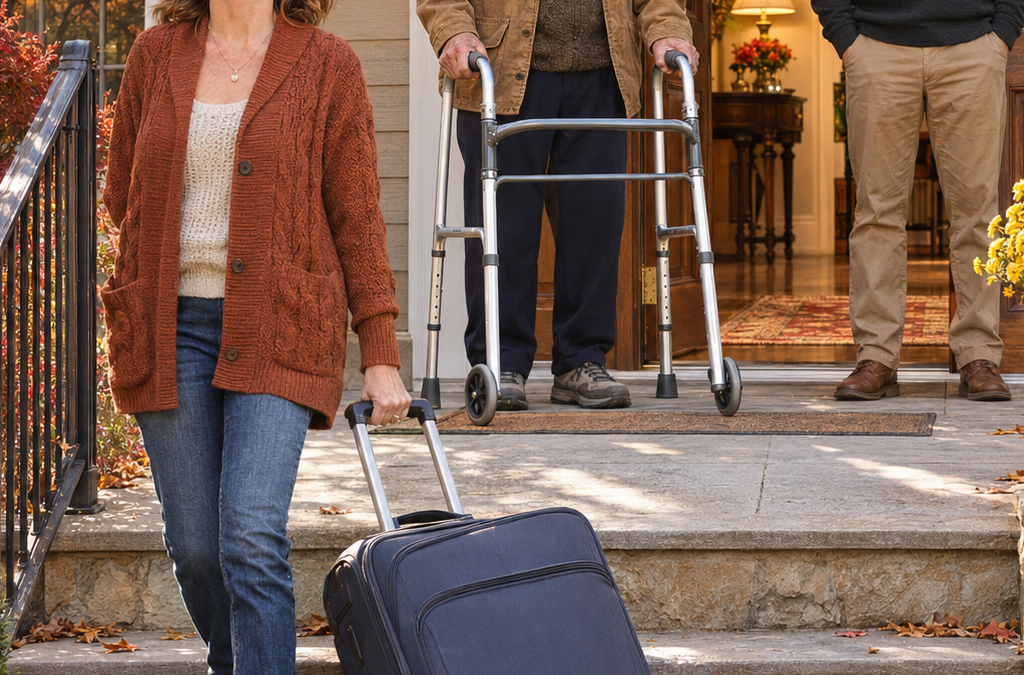
My daughter rolled my suitcase down my son’s front steps before Thanksgiving and said, “You’re his problem now, Dad.”
Chapter 1 of 7
“Are you really leaving me outside?” I asked.
Laura kept going while I balanced behind my walker. The suitcase bumped down all three steps.
“Eric, will you help me get inside?”
My son looked toward the driveway instead of me. Helen, my sister, stood beside the doorway, while Megan held a Thanksgiving serving dish against her apron.
“We don’t have a downstairs bed,” Megan said.
Laura pointed toward Eric. “He can work something out for you.”
Eric and Megan occupied the main and upper floors. Laura had the west wing. My recovery suite was below, with its own level entrance.
An unfamiliar parking pass hung near that entrance. Getting there meant following the sloping path around the house, and I couldn’t manage it alone four days after hip replacement.
At seventy, I knew the difference between discomfort and danger. Forty years fitting homes for people with limited mobility had taught me that.
George Bennett, retired accessibility contractor, stranded outside after four hospital nights.
It was my own house, and I paid my daughter to manage it.
Eleven years earlier, I had bought the place in Logan, Ohio. My children had gradually started calling it Eric’s place.
The low threshold downstairs was my work. So was the front handrail Megan requested after she slipped carrying groceries, the one she now stood behind without looking at me or offering any help.
An apple pie rode home between my feet in Laura’s car. Eric liked the middle almost raw. I always pretended that wasn’t a defect.
But nobody had brought it inside, and my fingers were beginning to ache around the walker grips.
A guest parking pass hung beside my recovery-room entrance.
Laura had talked lately about needing extra income because her bills were piling up. I had listened without imagining my recovery bed figured in her solution.
The dented brass key rested against my palm. Before surgery, I had checked it twice.
I remembered choosing that easy-turn lock, testing it with stiff fingers, making sure a person could manage it without pinching hard or twisting a sore wrist.
“Please open the lower door for me.”
Eric accepted the key, then put it in his pocket.
That hurt more than Laura’s words.
Megan held the serving dish closer. “You can’t expect Eric to do everything.”
Laura pushed the suitcase farther along the walk, leaving it beside the car she’d just brought me home in.
She’d managed the suitcase; front steps were apparently the end of her responsibility.
She told me to wait for Eric. She had cooking to finish, and I was holding everybody up.
“STOP MAKING THIS OUR PROBLEM!”
Helen flinched, but she stayed beside the doorway.
“You’re leaving me here without a safe bed?”
Laura faced me. “Yes, until your son sorts it out.”
I said all right. There was nowhere safe to step away, so I stayed behind the walker while Laura turned toward the warm house.
My phone was in my coat pocket. I called Diane Foster.
She worked at Lakeview Trust Bank and handled the house. Her property review had already been arranged before my discharge. She’d confirmed it while I was still in the hospital.
Now she answered from the road.
“A guest contacted me about your downstairs room.”
Diane said Laura had collected payment for a stay. The guest believed the room was an approved vacation rental and had questions about being asked to move.
My bed hadn’t been forgotten beneath laundry or Thanksgiving supplies. Laura had sold nights in it.
I told Diane where I was standing, and she said she was close.
By the time her car arrived, cold had worked through my trousers. Laura came back outside when she recognized it, smoothing her voice before Diane reached the walk.
Diane addressed me first and asked whether I needed to sit.
I said I needed a chair with arms.
“The downstairs suite was reserved for his recovery.”
Laura gave her a quick, practiced smile.
“The house is full. We’re handling it.”
Diane looked toward the lower entrance, then back at Laura.
Eric came closer but stopped below the landing.
Megan lowered the dish against her hip.
Laura’s smile faded as Diane faced her.
“Laura, who are the paying guests in George’s room?”
Laura said it was one booking, as if that answered everything. Then she added that family stayed downstairs all the time.
Diane asked Eric to bring a sturdy chair to the landing and retrieve my suitcase. He went inside for the chair first.
I hated needing an audience for that much help.
Diane waited until I was seated before explaining that the guest had voluntarily forwarded a welcome message Laura had sent with the room instructions.
Laura started to object. Diane said she wanted me to hear it.
The phone speaker sounded thin outdoors. My daughter’s voice was brighter than it had been in the car.
“Welcome. Your suite is ready, and the upstairs host will let you in.”
There were directions about parking and the separate entrance. Laura described the shower as spacious and easy to use.
I had measured that shower for a walker. The built-in seat was the right height for my bad hip.
Now it sounded like a selling point.
Laura moved toward Diane’s phone, then stopped.
The recording continued with directions for the heating.
Eric’s eyes stayed fixed on the landing boards.
Helen looked from the phone to my face.
I recognized the little laugh at the end.
My daughter’s voice promised strangers the room where I was supposed to recover.
For a few seconds, nobody offered me another explanation.
Then Laura said I had approved having people downstairs. She could put that in writing right now. A simple permission from me would keep this from becoming ridiculous.
“I’m not signing permission for something you already did.”
Her face reddened. She told Diane I was tired and had misunderstood how the house worked while I was gone.
“I understand where I’m sitting,” I said.
Diane didn’t argue about my medication or ask me to prove I understood. She asked about the discharge instructions, the height of a chair I could use, and whether I needed a bathroom without steps.
Those were questions I could answer.
And for the first time since Laura stopped the car, someone waited for the answers.
Diane called about accessible temporary lodging. She described a level entrance and enough bathroom space for my walker. Before asking me to agree, she repeated the available arrangement to me.
I said yes, though I was ashamed of how relieved I sounded.
Leaving would hurt. Staying outside to prove the place belonged to me would hurt worse.
Helen finally came out onto the landing. She held the walker steady as I prepared to stand, then stayed beside me instead of looking toward Laura for permission.
“I should’ve come out sooner,” she said.
I couldn’t answer her yet.
Eric returned with my suitcase and stood it beside the chair. Diane asked him to keep the route clear while she arranged transportation I could safely use. He nodded without meeting my eyes.
Laura remained by the open door, with heat escaping around her legs.
Then she announced that she had found my email. She said it proved she hadn’t made this up, and Diane needed to read it before she embarrassed anyone further.
Her thumbs moved across her phone. I stayed seated while Helen stood beside me.
Then Diane’s phone received Laura’s cropped email: “Go ahead with the room.”
Chapter 2 of 7
“Go ahead with the room,” I read from my phone. “That’s my reply. Read what she asked.”
The original conversation was still in my mailbox. Laura had sent pictures of the bathroom wall, asking whether the grab bars should go beside the shower seat or closer to the opening.
Before that wall was closed, I’d tested the backing myself. I remembered leaning my weight against it, with sawdust in my shoes.
Diane read the messages on my screen, then compared them with Laura’s cropped version.
“This is approval for bathroom work,” she said.
Laura looked at my phone without asking to hold it. Then she turned toward the doorway.
“Well, the room was finished. People have stayed there before.”
She no longer mentioned the email. It hurt to watch how easily she left that claim behind. I had spent several minutes finding the message while she stood somewhere warm.
Heat still reached only as far as the threshold. Megan remained just inside, with the serving dish on a hall table behind her. Helen stood beside my chair.
“You always said this place was for us,” Laura said. “Now you bring the bank here to insult me.”
Diane hadn’t raised her voice or called Laura anything. She had asked where I could sleep. Somehow that had become the insult.
Megan glanced toward the driveway. She said Diane’s car was where everyone coming up the road could see it.
“There was no reason to embarrass the whole family,” she added.
“I expected to recover downstairs,” I said. “Whatever I said about your future didn’t include selling nights in my room.”
Laura said I made it sound ugly. She had kept the place running while I was in the hospital.
Four nights. She spoke as though I had gone away for a season and left her with a failing farm.
I wanted to ask whether she had put my clothes somewhere safe. Instead, I asked for my discharge folder from the suitcase. I needed the medicine schedule, and I couldn’t keep bending toward things.
Eric brought the folder over. He had retrieved the suitcase from the walk, but now it stood beside my chair, beyond my reach.
“Will you come with me to the lodging?” I asked him.
He looked at Laura first. That small delay embarrassed me more than I wanted to admit.
“I can carry your bag out,” he said. “But if you’re going to keep after Laura about the money, I’m not coming along for that.”
I hadn’t asked him to sit through an argument. I needed help getting settled, finding my nightclothes, and putting things where I could reach them.
Helen said she could do those things. Eric stepped back toward the doorway.
Diane’s phone rang before I could answer my sister. She checked the screen and told me it was Jill Mason, the woman staying downstairs.
“Would you like to hear what she says?”
I said yes. Diane explained that I was beside her before putting the call on speaker.
Jill sounded cautious. She asked whether she had done something wrong by booking the suite. Laura watched Diane’s phone, her mouth pressed flat.
“I thought Laura was allowed to rent it,” Jill said. “She answered everything. I paid before I came.”
Diane told her we understood that. Then she asked whether Jill had somewhere else she could stay.
Jill said she didn’t have anything arranged. She would have to make calls and check what was available. Her voice grew strained as she explained that she couldn’t pay for another place while all her money was tied up here.
I knew that tone. Customers used it when an unexpected repair meant choosing which other bill could wait.
“Please don’t put her outside,” I said.
Laura looked at me then, almost impatiently, as though I had complicated another simple task.
Jill hadn’t known about my surgery or the bed waiting for me. She had paid for a room someone offered her. I was angry, but she wasn’t the person I was angry with.
“Nobody’s asking you to leave this minute,” Diane told her. “Let’s work out a departure you can agree to, and what you’re owed back.”
“He’s choosing bank people over his own children. You see that, don’t you?”
She asked Jill to send the reservation exchange and payment receipt. Jill agreed, then asked whether she should pack. Diane said she would call back before Jill made any arrangements.
After the call, Laura complained that everyone was making promises without asking her. Diane reminded her that I still needed somewhere safe that afternoon.
The cold had made my good leg stiff. I hated how much of the conversation I was spending thinking about a bathroom.
Laura turned to Helen. “He’s choosing bank people over his own children. You see that, don’t you?”
Helen looked down at me. For a moment, I expected her to suggest we all calm down, the way she had at family arguments for years.
“I’ll ride with George,” she said. “I’ll help him get settled.”
She didn’t challenge Laura. But she stayed beside my chair while Diane confirmed the transportation, and that mattered.
Eric moved my suitcase closer to where it would be loaded. Megan went inside to check the oven. Through the doorway, I could smell sweet potatoes baking under their brown-sugar crust.
Thanksgiving preparations kept going. My place to sleep was still being arranged.
Then Diane’s phone received Jill’s receipt. She showed it to me.
Jill had prepaid $2,600 for ten nights, overlapping my entire first week home.
Chapter 3 of 7
Jill could consider leaving early if her unused nights were refunded. That was the message Diane had left while I slept. She still needed somewhere to go, and no departure had been agreed.
I woke in the accessible lodging with my clean underwear on a shelf I couldn’t reach.
Helen had unpacked the night before. Neither of us had noticed the shelf was too low until I needed it. Bending that far wasn’t allowed.
“Laura, when can you come over?” I asked when she answered.
The bathroom was close enough. The chair had arms. Everything worked except the arrangement I’d trusted my children to keep.
Laura had promised rides, help dressing, and groceries during my first days home. Now she told me she couldn’t keep running back and forth.
“Tell Diane to leave my arrangements alone. Then we can talk.”
Her voice was flat. I sat on the bed in yesterday’s undershirt, looking at my clothes.
“I need help getting dressed. This isn’t about Diane.”
“It became about Diane when you called her.”
She said Eric had work and Megan couldn’t keep taking time away. I hadn’t asked either of them to miss work that morning. Laura was the one who had offered.
“Pay someone else if we’re suddenly so terrible.”
She ended the call before I could answer.
I was humiliated. After all those years helping strangers use their homes safely, I couldn’t reach a pair of underpants without making another call.
The lodging office helped me contact a home-care service. While I waited, I ate the banana Helen had left beside the bed. She had written “eat this” on its skin, as though I might mistake it for decoration.
That made me laugh once. Then I missed her.
“Keep the room for seven nights,” I told Diane when she called.
She confirmed the cost was $1,680, paid from my resources through the trust. I agreed and asked her to send the confirmation where I could read it.
“Megan sent this around. I thought you should see it.”
Having money meant I didn’t have to stay stranded. It didn’t make the room familiar, or make my daughter’s refusal hurt less.
A care worker helped me wash and dress that morning. We put my clothes on a chair where I could reach them. She asked before helping with each awkward task, which made accepting help easier.
Helen arrived afterward with soup and her phone.
“Megan sent this around. I thought you should see it.”
The message said Laura was exhausted and my medication had made me unreasonable. Megan wrote that everyone should stop encouraging a fight until I was myself again.
Helen watched me read it. “I didn’t answer for you.”
I was grateful for that, though seeing my family discuss me that way hurt. They could have called and asked how I was doing.
The soup smelled like chicken and too much celery, Helen’s usual ratio. I ate while she waited, grateful she didn’t tell me Megan meant well.
“Would you send Diane the discharge instructions?” I asked.
My folder was within reach now. The instructions described movement restrictions, follow-up care, and my planned return home. They didn’t tell anyone what to think of me.
I wanted Diane to have the plan Laura had received before she brought me back.
Helen sent photographs of the pages, then stayed while I called about assistance for the following morning. Asking for it a second time was easier.
By afternoon, Diane had spoken with Jill again.
“She sent the original welcome message directly,” Diane said. “She’s confirmed Laura sent it for this reservation.”
We listened over the phone. The directions matched what I’d heard outside. No name identified the person who would open the door, only “the upstairs host.”
I didn’t offer a name either. Hearing my shower described to a paying guest was bad enough without filling in what I didn’t know.
Laura called while Helen was washing the soup container.
“You’re collecting things against me now,” she said.
“I sent the instructions you already had.”
She said Diane wanted the booking history. Then she started explaining the money, talking quickly enough that I had trouble following.
Her debt was $18,600. She said bills had piled up, and being close by had cost her opportunities.
“I’ve been there for years, Dad. That ought to count.”
She had collected $6,240 for twenty-four nights, including Jill’s booking. Fourteen nights had already been rented before this stay.
I asked whether she had told the bank she was keeping the money. She said the bank didn’t deal with everything she dealt with.
“The salary isn’t enough for always being available.”
“You weren’t available when I needed my bed.”
She accused me of making one afternoon stand for everything she’d ever done. I remembered the appointments she had driven me to and the groceries she had carried. Those things had mattered. So did this.
When she hung up, I was sad enough that I couldn’t finish my lunch.
“I taught my children that my comfort could always wait,” I told Helen.
She didn’t hurry to disagree. We both knew how often I had offered the easier room, changed a plan, or said I could manage when I couldn’t.
Diane called again before Helen left. Laura had supplied the booking history along with her explanation of the money. Diane asked me to confirm when I’d sent my discharge schedule.
I found the sent message. Laura had replied that she’d be there to collect me.
The booking history placed Laura’s acceptance after she received my discharge schedule.
Chapter 4 of 7
Jill was leaving when Helen helped me along the level path to the suite. She had stayed six nights and found another place herself. Diane had put the departure and refund arrangement in writing.
“That welcome message was for my booking,” Jill told Diane. “Laura sent it after I paid.”
Diane thanked her. She had already explained to me that the booking dates ruled out a simple scheduling mistake. They didn’t establish who had opened the door.
Jill looked at my walker, then toward the room behind her. I hated that she seemed embarrassed to have slept there.
“You didn’t know,” I told her.
She said she hoped my recovery went well. Then she left, and Helen stayed close while I crossed the threshold.
The room smelled of lemon cleaner. The bed had a folded blanket across its foot, and a little basket on the dresser held cocoa packets. My recovery supplies weren’t where I’d left them.
“The bathroom things are in the closet,” Laura said behind us. “Nothing’s gone.”
My raised toilet seat sat on the closet floor beneath a package of spare sheets. The long-handled sponge and dressing aids were pushed behind it. Nobody had needed to throw anything away to make the room unusable for me.
Helen brought the supplies within reach while Diane checked that the chair was firm enough. I sat down, ashamed of how tired the short walk had made me.
Beside the cocoa basket was a list of nearby attractions. I had spent weeks planning how to reach my socks.
“We couldn’t leave all that medical stuff out for guests,” Laura said.
She sounded irritated that this needed explaining. The shower seat couldn’t be hidden, but everything else that suggested an old man lived there had been put away.
For years, I’d made rooms easier for people to use. Seeing my own equipment treated as clutter hurt more than the missing bed had.
Diane had brought working copies from the bank. She showed Laura the recorded deed and several pages from my trust, giving her time to read them.
Laura recognized the name on the deed. She had seen bank paperwork before, but now she followed the lines beneath it without looking away.
“The bank holds this house for George’s benefit; the bank owns nothing for itself,” Diane said. “The bank also employs you to manage it.”
Laura read the first page again. Then she looked at me.
“So this was never really going to be our place.”
She hadn’t asked a question. I remembered her saying that same thing cheerfully years before, when she chose paint for the west wing. Back then, I’d let it pass.
“I let you live here,” I said. “I didn’t give you my room.”
Laura turned back to the papers. She didn’t dispute what they said. Instead, she reminded Diane that relatives and friends had stayed downstairs before.
Dad had always approved guests, she said. Managing a house meant making decisions without asking about every towel.
Diane showed her the signed manager agreement. Laura’s salary was $31,800 a year. The agreement described the work the bank paid her to do and did not allow her to rent rooms for herself.
“Your job and your accommodation are separate agreements,” Diane said. “Your authority as manager doesn’t give you ownership, and a job decision doesn’t remove you from your rooms.”
Laura asked whether Diane was threatening her. Diane said she was explaining the documents Laura had signed.
“When did you decide this room could earn more than my comfort mattered?”
I watched my daughter read her own signature. There was no shouting now. She seemed to be measuring each answer before giving it, and I felt foolish remembering how readily I’d accepted hers.
Laura said she had supplied the booking records because she wasn’t hiding anything. Her bills hadn’t disappeared just because everyone had decided she was the problem.
The raised seat was beside Helen’s feet. I pointed toward it.
“When did you decide this room could earn more than my comfort mattered?”
Laura looked at the seat, then at me. “Everyone else has worked around you long enough, Dad.”
Helen stopped moving. I couldn’t find anything to say at first.
I remembered helping Laura move after her divorce, promising she wouldn’t have to solve everything that week. I hadn’t kept count of those days. Apparently, she had kept count of mine.
Diane said we needed to meet with everyone who had been involved in the recovery arrangements. She would hear what each person knew before making decisions.
Laura wanted to know why Eric and Megan had to attend. Diane said their part in the household arrangements needed to come from them.
“Put it in writing,” Laura said. “I don’t want anybody changing what this meeting is.”
Diane sent the appointment while we were there: Wednesday, November 25, at 4:30 p.m., in the house. George, Laura, Eric, Megan, Helen, and Diane were listed. It would be before the family’s early Thanksgiving supper.
Helen had already cooked for it. She always made enough stuffing to feed people who hadn’t been invited, then complained about finding containers.
For a moment, I wished the afternoon could still be about that.
Laura went upstairs without offering to help me leave. Helen stayed while Diane made sure my toilet seat and supplies were restored before we returned to the lodging.
I wasn’t ready to spend the night alone in the suite. That disappointed me, though nobody had promised that an empty room would fix everything.
At the lodging, Helen helped me settle into the chair by the window. Her phone sounded before she’d taken off her coat.
She read the screen, frowned, and brought it over.
Helen showed me Laura’s new message: “Bring the food. They’re coming to confirm I stay.”
Chapter 5 of 7
“Bring the food. They’re coming to confirm I stay,” Helen read aloud.
She stood beside my chair at the lodging, still wearing her coat. Laura had turned a meeting about what happened into an announcement that she’d been right.
“Come as my sister,” I said. “I don’t need you carrying messages for her.”
Helen looked at the screen again, then put her phone away. She said she’d bring supper because she’d cooked it, and she would sit where she pleased.
I was relieved, though I still dreaded going back. My leg ached from the morning’s outing. There were several hours left, and I spent too many of them rehearsing answers nobody had asked for yet.
By the time we reached the house, the food was already covered on the sideboard. Megan had brought Helen’s dishes in from the car while Eric helped me through the entrance.
The chair near the table had a firm seat and two solid arms. Helen had asked Eric to move it there before we arrived.
“That’s better than the dining chairs,” I told him.
He said he’d remembered the height I needed. I thanked him for that much.
The television remote lay between a stack of grocery coupons and Megan’s folded sweater. A football game played without sound. Nothing about the room looked prepared for an important decision, except that nobody had taken the lids off the food.
Helen’s cranberry relish was in the old glass bowl Eric called the punishment bowl. He’d disliked it since childhood and still checked whether she’d made anything else red.
Usually, I would have teased him. That afternoon, I was glad for something familiar to look at.
Diane arrived carrying the same working file she’d used downstairs. There was no briefcase full of surprises. Laura had already received the complete email and the welcome message Jill had forwarded.
At the table, Diane said she also had an employment letter and a separate housing notice. She left both inside the file while she asked where everyone would be comfortable sitting.
Laura offered her coffee, then offered to clear more space. Her voice had the pleasant lift she used with people whose approval mattered.
“Dad, don’t make another scene in front of everybody.”
She said it while Diane was taking off her coat. Megan started to agree, saying we’d all had enough upset.
Then Megan noticed my dressing aids and raised toilet seat in an open bag beside Helen. We’d brought them from the lodging so I could use the suite later if I needed to.
Her eyes stayed on the bag. She didn’t finish her sentence.
I felt humiliated again, with the things I needed sitting in full view. But I needed them here. I wasn’t going to pretend otherwise to make supper easier.
Eric stood near the television. He asked whether my room at the lodging had worked out.
“The room worked,” I said. “Carrying my suitcase afterward wasn’t the help I asked you for.”
He rubbed his mouth and looked toward the kitchen. I waited, hoping he’d answer without making me ask again.
Finally, he said he’d been trying to get through the afternoon.
So had I. I didn’t say it aloud. He hadn’t apologized, and I couldn’t turn that answer into one for him.
Laura asked Diane whether we could keep this short. The food would dry out if we left it covered too long.
Diane said everyone needed a chance to explain what they personally knew. She asked Laura to begin with the arrangements she’d expected when I came home.
“I thought Eric could put Dad up,” Laura said. “The guests were already settled downstairs. I couldn’t just throw them out.”
I had asked that Jill not be put outside. Hearing Laura use the guest’s position as her defense made me angry. Jill hadn’t arranged my discharge or promised to help me dress.
Laura continued before I answered. She said she’d managed the house for years without needing a meeting every time someone misunderstood something.
She looked around the table, including Megan and Eric in each sentence. There were meals, deliveries, repairs, bills. All of it would become harder if the bank pulled apart an arrangement that worked.
“What happened to me wasn’t working,” I said.
Laura sighed. She said I knew what she meant.
“Tell us what you saw or heard. George can tell us what he understood.”
I did know. She meant the house had continued running while I waited elsewhere for help. For once, I let her explain it without stepping in to soften how it sounded.
Diane asked Megan what she’d understood about my recovery arrangements. Megan said she’d expected Laura and Eric to handle them. She hadn’t checked where I would sleep.
Then she added that I’d seemed confused outside.
“Please speak for yourself,” Diane said. “Tell us what you saw or heard. George can tell us what he understood.”
Megan looked at me, then down at the table. She said she’d heard me ask for help getting inside.
That small correction hurt. It shouldn’t have taken this much effort to get my family to repeat what I’d actually said.
Helen moved her chair beside mine. Laura had left a place for her across the table, but Helen didn’t explain the change.
Laura watched her sit. Then she turned back to Diane and said we were treating a communication problem as though she’d deliberately left me without anywhere to go.
Diane asked what information she’d relied on.
For the first time that afternoon, Laura paused long enough for me to hear the refrigerator start in the kitchen. Eric stayed by the television.
Laura pointed at Eric. “He told me Dad wasn’t coming back.”
Chapter 6 of 7
Before anyone ate, I told them I had never postponed my return. Laura had driven me home exactly when we’d arranged.
“Eric said he could handle you upstairs,” she said. “I thought you had somewhere safe. I can’t know everything he tells you.”
Eric stayed near the television. Laura looked at him, then back at Diane, leaving him room to agree.
I remembered waiting outside while he looked toward the driveway. I was afraid he would let her answer for him again.
“Diane, please play the welcome message.”
She played it from her phone on the table. Laura’s cheerful voice offered parking instructions, described the suite, and promised that the upstairs host would let the guest inside.
Nobody needed to identify the voice. Laura listened with her lips pressed together until it ended.
“You had my return instructions before you accepted that booking,” I said. “You were promising away the only room I could use. Where exactly was I supposed to recover?”
Laura glanced toward the stairs. There wasn’t a bathroom I could safely reach up there. She knew that house as well as I did.
“That was the standard message I sent people,” she said. “Eric handled arrivals. He told me he had you covered.”
She turned toward him again. This time she waited.
The food sat covered behind her. I could smell Helen’s gravy, and I wished I were hungry. Hearing my daughter explain how she had accounted for me hurt more than hearing the recording.
Diane looked at Eric. “Did anyone tell Laura your father wasn’t coming home?”
He said no, quietly enough that Laura began talking over him. She said he wasn’t remembering what she’d asked.
Eric came away from the television.
“I opened the door. Laura told me when Jill was arriving.”
“No. I never told her that.”
Laura stared at him. He looked at me instead, though he had to try twice before he continued.
He said Laura had asked him to admit Jill while I was in the hospital. He had known I was coming home. Laura had told him they’d sort out my bed before then, and he’d accepted that.
“I’m the upstairs host,” he said. “I opened the door. Laura told me when Jill was arriving.”
I had wondered about that phrase without letting myself settle on him. Now he was standing there, admitting he had welcomed a stranger into the room he wouldn’t help me enter.
Laura rose before he reached my chair.
“Stop talking, Eric. You’re making this sound worse.”
She reached toward his sleeve. He pulled his arm away and said he wasn’t going to make me carry his part of it.
Then he crossed the last few feet and placed the brass key in my hand. He sat beside me, where he could no longer avoid my face by looking toward the television.
I closed my fingers around it. I was glad to have it back, and terribly sad that returning it required witnesses.
Helen said she should have spoken on the steps. She had been afraid of starting a fight, she told me, and had left me to ask for help alone.
Megan moved her place setting away from Laura’s side of the table. She didn’t offer another explanation about my medication.
Laura remained standing. She told Diane that Eric had admitted his involvement, so there was no reason to put everything on her.
Diane opened the file.
“Your $31,800 manager job ends now.”
Laura’s mouth opened, but Diane continued before she spoke. She was making that decision for Lakeview Trust Bank under its authority as Laura’s employer. The letter stated it in writing.
Laura read the first lines, then looked toward me. I hadn’t expected her to look so startled after everything we’d heard.
“This is separate,” Diane said, giving her the second document. “Your occupancy ends January 31. Ohio counsel has reviewed the notice. Until then, you retain possession and access to your accommodation. Nobody is putting you out tonight.”
Laura held one paper over the other. She asked whether Diane understood how much work replacing her would take.
Diane said the bank would arrange management. She didn’t ask Laura to recommend anyone.
“Dad, tell her to stop this.”
My daughter stood beside the supper we’d been meant to share, holding papers she couldn’t dismiss as a family misunderstanding. I wanted to make her less frightened. That old urge was still there.
“You don’t get to make my needs disappear anymore,” I said. “I’m not asking her to reverse it.”
Laura said I would regret letting strangers run the house. Then she told Eric to come with her.
He stayed seated. He said he would talk to her later, but he wasn’t leaving with her now.
Helen remained beside me while Diane asked about my care that evening. I told her I would return to the lodging. My paid assistance was arranged for the next morning, and Helen would help me settle in tonight.
Eric offered to come instead. I thanked him, but kept the plan I’d made. I wasn’t ready to depend on an offer made because everyone was watching.
That hurt to say. He nodded and didn’t argue.
Megan began uncovering the food. Nobody called us to the table. Laura stepped toward the hall, then stopped when her phone sounded.
She held it out toward Diane, saying that now the guest wanted money too. From my chair, I could read the request on the screen.
Laura was still holding both notices when Jill’s request appeared: $1,040 for four unused nights.
Chapter 7 of 7
On November 30, Diane confirmed that Jill had received her $1,040 refund from the trust. Laura sat across from me at the bank, reading the repayment agreement.
It called for six monthly installments of $1,040, totaling $6,240. That included reimbursing the refund the trust had advanced. Laura had agreed to the amount before we came.
“Couldn’t you call it an advance on my inheritance?”
She asked me instead of Diane. Her voice was quieter than it had been at the house, but she still expected me to fix this by choosing different words.
“No, Laura. Leave it as it is.”
She said I knew she didn’t have all the money anymore. I told her I understood why there were installments. My mouth was dry, and I wanted the meeting over.
Diane gave her time to read. Laura signed, asked for her copy, and left without offering to drive me home.
I had arranged my own ride. It hurt that I was relieved not to need hers.
“Your help is booked for tomorrow,” Diane told me. “Call if the arrangement isn’t working.”
After the seven reserved nights, I returned to the suite. My first evening there, I needed help getting my leg into bed. Being home didn’t make my hip ready.
The care worker put breakfast within reach before leaving. Physical therapy filled the following weeks with small, tiring work: standing correctly, walking farther, learning when to stop.
Some mornings I resented needing instruction. Then I remembered how often I’d told customers to use the help they’d paid for.
“I’m tired of being careful,” I told Helen one afternoon.
She had brought a library book and stayed while I practiced the exercises. She didn’t tell me how lucky I was. She said being careful looked exhausting, then waited while I finished.
I was grateful she could sit with me without trying to improve my mood.
Through December, Laura remained in the west wing. She received deliveries and took her belongings out whenever she wanted. The bank arranged repairs and other house work without involving her.
We crossed paths twice. Both times she asked about my hip. Both times I answered, and we left it there.
I missed talking to her about nothing. For years, she’d called to complain about grocery prices or describe an awful haircut. Now every conversation felt like work.
“I’m moving out next week,” she told me in January.
She had found somewhere else and arranged the move herself. She didn’t ask me to pay for it. I said I hoped everything went smoothly, which sounded inadequate but was true.
She left nearly two weeks before the end-of-January deadline. Diane confirmed that Laura had surrendered the accommodation in writing. There was no removal and no last fight on the lawn.
For a few days, I kept expecting to hear her in the hall. I missed my daughter even while I was glad she no longer managed my home.
“I let Jill in,” Eric said during a visit that winter. “I knew you were coming back. And I kept your key when you asked me for help.”
He had asked before coming downstairs. I was sitting at my kitchen table, with the afternoon’s exercise sheet beside my plate.
He didn’t mention Laura’s bills or tell me he’d been caught in the middle.
“I’m sorry, Dad. You needed me, and I left you there.”
“I’m saying a visit is a visit. I need care I can count on.”
I believed he was sorry. Hearing him name what he’d done mattered, though it brought back the humiliation of asking twice.
I told him he could visit again. I would still keep my paid help.
“Are you saying you don’t trust me?”
“I’m saying a visit is a visit. I need care I can count on.”
He looked hurt, and I let him be hurt. Later, when he promised to come on Saturday, he came on Saturday. I noticed without treating it as proof that everything was repaired.
Eric and Megan signed a written arrangement to remain upstairs for $950 a month, paid to the trust. They had no management authority or obligation to provide my care. Nothing in it promised an inheritance.
Megan apologized for telling people my medication had made me unreasonable. She corrected that account with the people she’d sent it to. I thanked her, but we weren’t suddenly comfortable together.
By spring, I could manage most days without hands-on help. I still moved slowly after sitting too long. The therapist’s exercises remained part of my mornings.
Laura’s payments arrived through the bank. She called occasionally, usually about ordinary things. We kept those conversations short when either of us started reaching for the old argument.
“I can’t talk about the house again tonight,” I told her once.
She said fine, sharply, then called the following week. I answered. That was where we were.
By the end of May, the sixth payment had cleared. Diane sent the confirmation, and I read it at my kitchen table. I was relieved the money was settled; I was sad it had needed settling.
I also met privately with an independent adviser about my future trust instructions. After taking time to consider them, I signed revised directions. There was no family reading afterward, and I didn’t use the changes to bargain for better behavior.
Eight months after the confrontation, I made supper in my suite.
Chicken thighs roasted above a pan of potatoes. I’d cut the carrots too thick, so they needed longer. Nobody else’s schedule required me to pretend the food was ready.
“Can I bring anything?” Eric had asked when I invited him.
“Bread. Come for supper, and I’ll need to rest afterward.”
He agreed without asking to stay longer. Helen was coming too. She had promised dessert and refused to identify it, which usually meant something had stuck to its pan.
Laura had called that morning. We talked about the heat and my walking. She wasn’t coming to supper, and neither of us made that another fight.
I checked the chicken and turned off the oven. The table had three places, with enough space beside my chair to stand comfortably.
Laura had once called meals down here inconvenient for the rental arrangements. Now the room smelled of dinner I wanted to eat.
Footsteps stopped outside the level entrance. I was pleasantly tired and glad they had waited for me to let them in.
Family did not make my needs optional.
I turned the brass key and opened my door.







