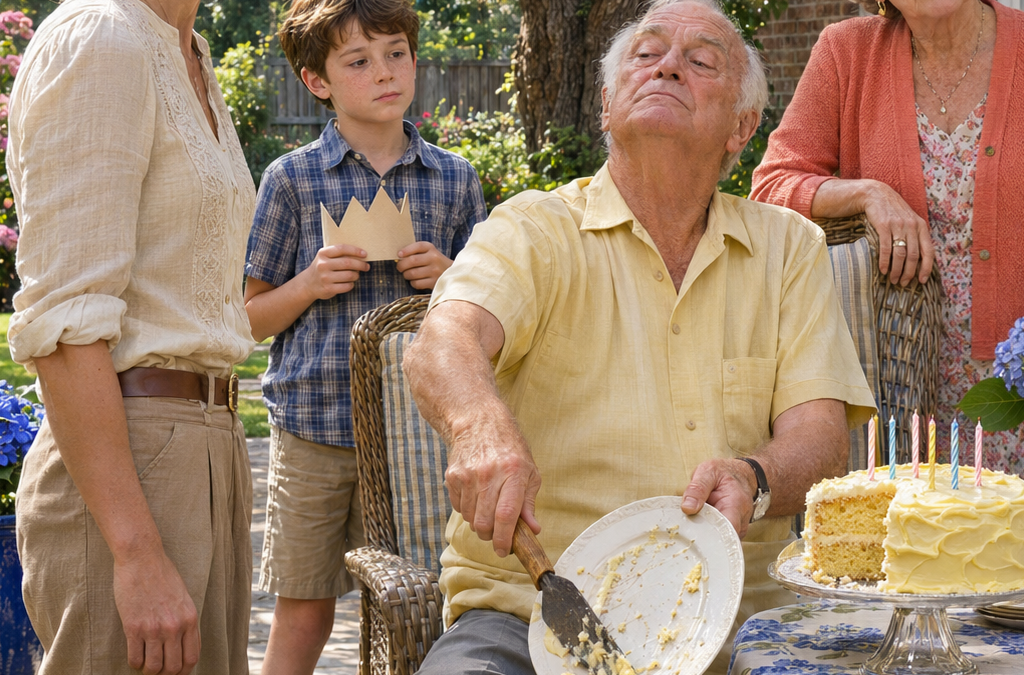
Dad scraped my cake into the compost at his seventy-fifth birthday party after I bought his failing garden center.
Chapter 1 of 7
“Cake’s for people who contributed.”
The lemon frosting caught on the edge of the compost pail. Dad scraped again.
“What did throwing my cake away accomplish?” I kept my voice level.
Robert Hayes stayed beside the cake table, holding the old wooden-handled server. My sister, Megan, kept filming her children beside him.
“Mom, are you going to say anything?”
Linda looked toward the unlit birthday candles instead, while Megan angled her phone around me to keep the grandchildren and their grandfather together in the picture she wanted.
That hurt more than losing the cake.
Beyond the patio, a magnetic Brooks Landscape panel leaned near the company truck. Dad’s spare truck key lay beside his birthday cards.
Nobody answered my question.
At thirty-seven, I was Emily Palmer, born Emily Hayes. I’d kept Palmer after my divorce.
I owned the company that had bought my parents’ garden center.
Cedar Run Nursery was nine years of early deliveries and summer payrolls, but here in Georgetown, Texas, my parents still called it my little plant business when people asked.
The pots of blue plumbago along their patio came from my growing beds. Ben’s favorite lemon frosting covered the birthday cake because I’d remembered him asking for it.
And Dad still had a paid founder role because I’d wanted him to stay involved.
My hand went toward the dirty plates automatically. Then I stopped.
I kept fixing things until they expected me to disappear afterward.
Ben, eight, stood beside the cake table, holding his homemade paper birthday crown. Mom stood beside Dad’s chair. At seventy-two, she still smoothed his napkin before meals.
Through the truck’s windshield, its ordinary dashboard camera showed beneath the mirror.
Megan’s company sign leaned against our delivery truck.
“Dad shouldn’t have to thank you for everything,” Megan said.
She was thirty-four and married now, with Brooks on her business cards. She said it while checking whether her video was still running.
Dad pulled the chair I’d been using closer to his end of the table. Then he told me to take the dirty dishes inside.
The empty plate was still in my hand, and for a moment I stood between the kitchen door and the chair while everyone waited for me to move.
“PUT THAT PLATE DOWN!”
Ben lowered the crown.
“So I can clean up, but I can’t sit here?”
“That’s exactly what I’m telling you.”
Megan finally lowered her phone. “Just let him have one peaceful birthday.”
My face burned. The children were watching, and that made it worse.
“All right.”
But I only stepped as far as the patio doorway. The kitchen stayed behind me.
Dana Price was inside replenishing the party supplies. She was Cedar Run’s operations director, and she’d organized this modest company-paid birthday gathering with my approval.
I called her instead of crossing the kitchen to find her.
Whatever she’d expected, it wasn’t the conversation we had. Her answer came clearly through the phone.
“Robert promised Megan our truck. Did you approve that?”
“No. I didn’t approve anything for Megan.”
Dana said she’d already warned Dad against directing workers or assigning vehicles. She’d told him plainly, and he had a written copy.
So the sign wasn’t merely something Megan had brought for a photograph.
I looked past the patio chairs at our truck, parked under Dad’s pecan tree with its company name still visible above the panel bearing my sister’s new business name.
Inside, Dana ended the call and came toward the door. Dad was gathering everyone for the photograph.
Dana stepped onto the patio before Megan raised her phone.
She caught the server before Dad set it down.
Its wooden handle was worn pale from years of washing.
Dana cut a fresh slice from the untouched tier.
She placed it before me and pulled out the chair.
Dad objected that they were trying to take a family picture.
“Emily arranged this party. She belongs beside the cake.”
Mom’s hand stopped halfway across Dad’s napkin.
His mouth stayed open, but no answer came.
Dana remained beside my chair, looking directly at him.
Dana faced Dad. “Now, about the truck you promised Megan—”
“It’s a birthday favor,” Megan said quickly. “He’s helping me get started.”
She said it to Dana, not to me. Her voice had become almost friendly.
Dad leaned back against the table. “Don’t turn this into some big thing.”
Dana didn’t raise her voice. She said the truck was needed for company deliveries, and nobody had approved lending it to Brooks Landscape.
Megan said the schedule had room.
I knew that schedule. I’d spent part of the previous evening checking the incoming fall orders against available loading space.
But she wasn’t looking at me.
She brought up something on her phone and held it toward Dana. At first I thought she meant to show a proposed delivery.
Then I saw the Brooks Landscape heading and a photograph of our truck.
Below it were pictures of planting beds, a project description, and a promise of a dedicated installation team. This wasn’t a request waiting for an answer.
“You’ve already put this out?” I asked.
“Dad said we could,” Megan answered. “People are expecting us.”
The shame I’d felt over the cake gave way to worry. Employees had bills. Customers had orders. Megan was treating their working days as something Dad could give her.
Dana asked her to leave the screen open.
Megan’s thumb stopped above the bottom of the page.
Dad shifted away from the edge of the table.
The page kept going beneath the truck photograph.
There were two workers pictured under the heading.
Then Dana read the length of the commitment.
Megan’s screen showed twelve weeks of our crew already promised.
Dad said Megan needed a decent start, not everybody picking her apart. She had a real chance this time, he added, as though I’d been standing in her way.
Dana put the worn-handled server into my hand so I could finish serving.
I remembered that handle from graduation cakes and anniversary cakes. I’d served everyone at those tables, too, then eaten whatever corner remained after the plates went around.
Helping had gradually become owing.
For once, I stayed in the chair.
Ava, five, reached for Ben’s paper crown, and he let her try it. It slipped over one eyebrow. She laughed, and Ben told her she needed a bigger head.
I laughed, too. It came out shakier than I wanted.
Megan put her phone facedown without showing Dana anything else. Dad told her they’d talk later, and Mom began asking who wanted cake.
I didn’t offer to make the truck schedule work.
Dad’s founder job paid him $54,600 a year. He had work he could do, a place at the garden center, and a reason to speak to customers who’d known him for decades.
What he wanted now was a way to keep Megan’s new business from failing. Two employees and a truck would do that without her having to hire a crew or arrange transportation.
I bought those services often enough to recognize the size of his favor. At ordinary outside rates, she was counting on roughly $28,800 of resources belonging to Cedar Run.
That frightened me more than Dad’s temper.
He watched me as though I was taking something from Megan by leaving it where it belonged.
Beside my plate, my phone lit up with a message from Ethan Cole, one of our delivery drivers.
“Robert changed my route after Dana said no.”
Chapter 2 of 7
“Robert sent us to Megan’s Oak Street job instead of the nursery delivery,” Ethan said. “Two guys, both still on the clock.”
The next morning, I stood with him in the garden-center loading area. A cart of unshipped shrubs sat behind us, their delivery tags damp from watering.
He explained that the workers had loaded for our customers before Dad changed the destination. They had spent paid hours at Megan’s project while our own work waited.
“Did anybody tell you that you’d be working for Brooks Landscape?” I asked.
Ethan said no. His time went onto the same company sheet as always. So did the other worker’s.
I was angry, but I didn’t want him carrying that anger home. He’d come in to explain a problem he hadn’t created.
“You’re not in trouble for telling me,” I said. “I need to know what happened.”
He looked toward the truck. At forty-two, Ethan had spent enough years making deliveries to know how quickly someone else’s instructions could become his mistake.
The loading area smelled of wet mulch and hot rubber. Usually, I liked being there before customers arrived. That morning, every waiting order looked like another promise we hadn’t kept.
“The camera runs when we’re loading, too,” Ethan said. “If the engine’s idling, it keeps recording.”
He pointed through the windshield at the unit beneath the mirror. It was ordinary delivery equipment, the same system we used when a damaged gate or disputed drop-off needed checking.
It recorded video and cab audio while the truck ran. Ethan knew that and was comfortable with his work conversations being recorded.
“Your father asked me to come talk to you,”
He had saved Friday’s file and kept the original card safe. Dana would preserve a company copy; he would hold the original until she collected it.
I thanked him without asking him to play it there.
The waiting shrubs needed shade, and a customer still needed an honest answer about delivery. Preserving what happened mattered. So did getting through the work Dad had interrupted.
“Your father asked me to come talk to you,” Mom said from the open loading gate.
Ethan excused himself to check the remaining order. Mom had brought breakfast tacos in the grocery bag she always reused until the handles stretched white.
Dad called anything with potatoes a full breakfast, even when it was mostly tortilla. Normally, Mom would have repeated that joke. Instead, she asked whether we could talk away from the workers.
I followed her toward the empty sales benches. I hated how quickly I still hoped she had come to apologize.
“Megan barely slept,” she said. “She’s trying so hard to make this work.”
I said our employees were trying to finish their own work. Mom answered that Dad hadn’t meant to cause trouble. He thought I could smooth things over with Dana.
Then she mentioned the children. They were excited about their mother’s business. Surely I didn’t want them watching her get embarrassed before she even started.
“Please don’t send Ben or Ava to ask me,” I said. “And don’t tell them I’m the reason.”
Mom looked offended. She said she would never use the children that way, then added that they noticed when the family wasn’t getting along.
I felt small again, standing beside benches I now had to keep stocked. My worry counted as stubbornness. Megan’s worry required everyone’s help.
I had put $420,000 of my savings into Cedar Run for this purchase. That money was now tied to inventory, equipment, and the chance to keep this place working.
“I won’t promise people we need for existing customers,” I said. “That’s what you can tell Dad.”
Mom said there must be some middle ground. I told her I could talk to Megan directly, without the children and without promises made for me.
She left the breakfast bag near the office. I was hungry, but I couldn’t eat yet.
Stopping another truck trip wouldn’t finish the missed work. It wouldn’t pay anyone twice for hours already spent, either. An apology couldn’t move those shrubs.
Megan arrived while I was checking the truck’s delivery rack. She came alone, carrying a slim folder, and asked whether Mom had found me.
“Dana already told you no, didn’t she?” I asked.
“She said the crew wasn’t available under her schedule.”
I waited. Megan looked toward the loading area, then admitted Dana had refused both the workers and the truck.
Her answer hurt. She had let me stand on that patio asking questions she already knew the answers to.
“Dad said he could arrange it,” she said. “He’s still the founder. I didn’t make that up.”
She insisted his role had to mean something. He knew the customers, knew the equipment, and had run the place longer than Dana had worked for us.
I asked how long she expected to use the crew. She confirmed twelve weeks, as though saying it calmly made the commitment smaller.
At outside rates, replacing those workers and the truck would cost approximately $28,800. Her estimate hadn’t included paying that amount because she had counted on Dad’s promise.
I could control Cedar Run’s resources. I couldn’t rewrite whatever Megan had promised her customer.
“You keep talking like I can just start over,” she said.
She opened the folder against the truck’s side. I recognized the project photographs from her phone, now printed beside a customer name: Karen Wells.
Megan turned over the customer confirmation. It showed Karen’s $18,000 deposit already received.
Chapter 3 of 7
“The deposit’s for my contract,” Megan said. “I know that. But if I hire everybody now, there goes what I was going to make.”
She kept the confirmation against the truck, with Karen’s payment showing. She had priced the job around workers she wouldn’t pay and a truck she wouldn’t rent.
“Cedar Run didn’t promise Karen anything,” I said. “You need to work this out with her.”
Megan stared at me. I felt cruel, even though I hadn’t taken her money or made her promise. I went back to checking the delivery rack.
By Monday morning, one of my regular wholesale customers was waiting outside the garden-center loading gate. His trailer was empty. His order should have been ready to roll aboard.
The shrubs were still scattered across two holding areas.
The crew Dad had redirected hadn’t finished pulling them before leaving for Megan’s project. Someone had marked the remaining work for later, and later had become a customer sitting in his truck.
“I’ve got a crew waiting at the other end,” he told me.
I apologized and gave him a realistic wait instead of saying we were almost done. Then I went to find the rest of his order.
The dwarf yaupons looked alike until I checked the tags. Half were reserved for another customer. I found the correct batch behind the larger containers and helped move them into loading rows.
I was furious. My shirt stuck to my back while a man who trusted us lost part of his morning.
We checked root balls, counted containers, and kept the damaged stock off his trailer. That was work my parents never asked about when they called Cedar Run my little business.
Once the order was ready, I called his office myself to explain the delay. He left without his usual joke about my plants riding more comfortably than he did.
“Emily is embarrassing Megan right before the launch,” Dad wrote in the family group.
The message arrived while I was checking the emptied holding area. He said people had already been told Brooks Landscape would have our help. We couldn’t make a public promise and then leave Megan standing there.
His next message acknowledged Dana’s refusal, then dismissed it. Family finished what family started.
“Our pickup wasn’t ready because the crew was at her job,”
I wanted to tell everyone about the waiting trailer. Instead, I put my phone away. I hated having to defend a working morning to people who hadn’t bothered to see it.
Dad was outside the shop when I came back, greeting a customer beneath the faded Hayes Garden Center sign. He waited until the customer walked away.
“Stop making your sister beg for ordinary help.”
“Our pickup wasn’t ready because the crew was at her job,” I said. “I just helped load it. I’m not sending a rescue crew.”
He looked past me toward the loading gate. He said I could rearrange things if I wanted to, and Megan couldn’t replace twelve weeks of help overnight.
Neither could we. The outside replacement cost was roughly $28,800 because trucks and working people cost money. Calling it ordinary help didn’t make it smaller.
“She put her name on that project,” he said. “You want her losing it before she’s started?”
I told him I needed to get back inside.
That hurt more than I expected. He had watched me build a business for nine years, yet the customer I’d kept waiting barely interested him.
In the office, Dana was reviewing the truck records beside the closing paperwork. She asked whether the delayed pickup had gone out, then noted what still needed checking.
She had confirmed that the truck belonged to Cedar Run under the purchase. She was also keeping Dad’s sale payment separate from his paid job. One didn’t settle questions about the other.
“I’ve asked Robert to explain why the staff went there,” she said. “He needs a chance to answer.”
There was no decision yet. I was relieved she wasn’t asking me to settle it over lunch with my parents.
Dad came to the office doorway before I left. He told Dana the sale had been supposed to preserve his place at the garden center.
“You can’t turn the founder into a visitor.”
Dana said she was asking about instructions given to employees, not whether customers knew him. His answer went around her question.
He wanted the buyer to hear how she was treating him. Whoever owned Cedar Run, he said, would understand what his name still meant there.
I stood beside the doorway, embarrassed for him and angry with myself for caring. I had offered to talk about my work so many times. He was still waiting for somebody more important.
That evening, Mom called while I was scraping scorched rice from a pot. Our family always argued about whether the browned bottom was ruined or the best part. Dad only liked it when Mom made it.
“I’m standing beside your father at the launch,” she said.
I hadn’t asked her to choose a place. She said people would notice if she didn’t support him, especially with Megan being introduced.
I told her I would be there working. She answered that she hoped I wouldn’t make things harder.
After we hung up, I left dinner on the stove. I felt lonely in a way that being busy usually covered up.
Dana called before I ate. Dad had contacted her again about the scheduled event. This time, he wasn’t asking for another conversation outside the shop.
“Robert wants the purchase folder brought to the launch.”
Chapter 4 of 7
Dad’s request for the purchase folder brought us into the garden-center office the next morning. He sat across from Dana, still wearing his Hayes Garden Center shirt.
“He believes the sale gave him continuing authority,” Dana told me. “I asked him to review the records here before the launch.”
The folder lay open between them. Dad had brought his own copy, folded back at the page where his signature appeared.
He said he remembered what he’d signed. What he wanted was someone willing to explain why Megan was being treated like a stranger.
I sat in the remaining chair. I was tired of hearing my sister’s name offered as an answer to questions about our employees.
“The signed purchase agreement shows Cedar Run bought the business,” Dana said. “These company records show Emily is its sole owner.”
She indicated the operating agreement and membership ledger beside the closing papers. She had checked the originals, not searched for a name online.
Dad looked at me, then back at the folder. He asked whether she meant I managed the company.
I told him I owned all of it.
“You let me sell my business to you?”
“You sold it to Cedar Run. That’s my company.”
He stared at the name on the agreement. For once, he wasn’t looking past me toward somebody who might give him a different answer.
I had imagined this conversation before. In those versions, he asked what I’d built. Sitting across from his red face, I felt embarrassed for wanting that.
“I bought the garden center because I wanted you both safe.”
He said he and Mom hadn’t needed saving. His voice carried through the office door, and I wished he would lower it without my having to ask.
The business had been struggling when Cedar Run bought it. He knew that. We had all sat through the calls about unpaid bills, even if he barely remembered me being there.
“The price was $640,000, Dad. Business creditors got $390,000. You and Mom received the remaining $250,000.”
He said I was making it sound like charity.
It hadn’t been charity. Cedar Run had bought equipment, inventory, customer relationships, and a business I believed could keep working. Their house remained theirs, and the sale money was theirs.
I wasn’t asking for any of it back.
“You should have told me before I signed.”
“I offered to talk about Cedar Run.”
“You said you were busy with plants.”
I remembered the conversation differently. I had tried explaining our wholesale accounts over Sunday lunch. He had interrupted to ask Mom whether the chicken needed more salt.
At our house, Dad always salted chicken before tasting it. Mom used to call that his inspection process. Remembering it there made me unexpectedly sad.
“I would have handled this differently if I’d known.”
I asked him what he would have changed. He said we could have worked things out as a family instead of having Dana speak for a company.
He wanted the chance to have asked more of me. That hurt, though it wasn’t surprising.
Dana waited while he explained that his founder role had been part of the bargain. Customers expected to see him there. Megan had expected him to have some say.
“My management appointment gives me authority over operations and employment,” Dana said. “That includes Robert’s paid role.”
Dad answered that he wasn’t discussing his paycheck. He was discussing respect.
Dana said her review concerned instructions given after the warning, not what had happened at his birthday party. She still needed his account of those instructions.
I was relieved she kept the two separate. I didn’t want my humiliation over a plate of cake turned into an excuse to dismiss what happened to our work.
“What is Megan supposed to tell her first customer?”
“I didn’t agree to put Megan ahead of everybody waiting on us.”
There it was, finally. His voice had dropped, and he looked older than he had when he came in.
He said she couldn’t go back now and admit she didn’t have a crew. People remembered that kind of thing. One bad start could follow her for years.
I knew he was scared for her. I was scared for my employees, too, and for customers who had already paid us to deliver.
“I bought a business I thought could survive,” I said. “I didn’t agree to put Megan ahead of everybody waiting on us.”
He called that a cold way to talk about my sister.
I asked whether he wanted to finish this privately, with Mom and Megan there if necessary. I still wanted a conversation that didn’t require an audience.
“No. They need to hear what you’re doing.”
Dana reminded him that Saturday’s garden-center relaunch already included Megan’s introduction. The family would be there, along with customers and employees. She wasn’t adding a separate event.
The opening was set for 10:00 a.m. Dad wanted to speak then. Dana said there would be time for factual questions before any company endorsement.
Linda and Megan would attend with Dad. Dana, Ethan, and I would be there for Cedar Run.
I felt exposed, but I agreed to be present. I wouldn’t send somebody else to stand there while he talked about me.
Dad left without asking one question about the company I had spent nine years building.
Later, my phone showed a revised launch invitation from Megan. Beneath her business name, she had added: “Truck keys presented by Robert Hayes.”
Chapter 5 of 7
Megan’s sign stood beside the garden-center entrance, where every customer had to pass it.
Brooks Landscape appeared in green letters above the line she’d added to the invitation: “Truck keys presented by Robert Hayes.”
“Printing it doesn’t make it approved,” Dana told her. “The program stays. The truck assignment isn’t authorized.”
Megan said the sign had already been paid for. Dana left it there and went inside.
Customers browsed the fall shrubs while employees directed arrivals around the loading lane. Relatives gathered near the rows of chairs. Here in Georgetown, Texas, enough people knew Dad that half the greetings included an old garden-center story.
I felt embarrassed before anyone even looked at me. That sign made it seem as though we had settled something.
The day before, Dana had offered Dad a private opportunity to answer her questions. He’d told her Ethan had volunteered to help Megan. He denied giving any employee an order after her warning.
“He gave me his account,” Dana had explained. “He declined the private closing meeting. He still wants to speak here.”
Now she and Ethan were in the back office, finishing her review of the saved camera file. The door was shut. I stayed outside with the people arriving for what was supposed to be a business opening.
When Dana returned, she told me the review was complete. The original recording had been preserved, along with the company copy.
She didn’t tell me what decision she would make.
“Can we sit where we can see the truck?” Ben asked.
I led him and Ava to seats well away from the lane. From there, they could see it without being near anyone backing up or unloading.
Ava wanted to know whether a truck needed a ribbon to start. Ben explained that ribbons were for when grown-ups wanted pictures. I laughed before I could help it.
Their argument about which seat had the best view gave me a moment to breathe normally. I was glad they could still have an ordinary morning.
“Your father needs us behind him for the photograph,” Mom said.
She stood at the end of the row, dressed as carefully as she did for church. Dad was already beside the launch display, greeting relatives.
I told her I would stay with the children until the opening started.
She said Megan could watch them. She meant for me to leave that row and stand behind Dad, where the photograph would make us look in agreement.
“I’m not standing there, Mom.”
She looked toward the people waiting near him. Then she went without me.
I hated how much that small walk hurt. There was a chair beside mine, and I had hoped she would use it.
The cake waited on a covered table beyond the display. Employees had arranged nursery catalogs and trays of starter plants along the aisle. This place still had work to do after everyone went home.
“We could treat it as a referral credit,” Megan said.
She had come around the back of my chair instead of approaching Dana. For a moment, I didn’t understand what she meant.
She explained that Brooks Landscape would send plant orders to Cedar Run. The workers and truck could count against future referrals, rather than being called free help.
I asked whether she had priced the referrals or guaranteed any orders. She said that was impossible before her business got going.
I was angry, but mostly tired. She was offering me income she hadn’t earned to pay for work my employees hadn’t agreed to do.
“I haven’t evaluated that arrangement,” I said. “I’m not agreeing to it here.”
“There’s been an overreaction to a driver helping outside his usual route,”
Megan said there was no harm in letting Dad make the presentation while we worked out the details later. I told her there were no agreed details.
She glanced toward the sign, then went back to him.
For years, I’d said yes before I understood what a favor would cost. Saying no while people watched still made me feel mean.
“There’s been an overreaction to a driver helping outside his usual route,” Dad told the relatives nearest him.
His voice was easy, almost amused. He said Ethan knew the family and had wanted Megan to get a good start. A few people nodded.
Dad wasn’t pretending I didn’t own Cedar Run anymore. He was making what happened sound too small for an owner to question.
I walked toward the chairs near the display. Dad met me before I reached them, keeping his voice low enough that only I could hear.
“Keep your objections away from my family today.”
My family. I had heard him use those words with customers, meaning all of us. Standing there, I felt excluded in a way I couldn’t explain away.
I stayed where I was.
“We’ll take factual questions before any company endorsement,” Dana announced.
She spoke from beside the display screen. Dad answered with a pleasant nod, as though she had just reminded everyone where to park.
Ethan came down the aisle with the preserved file ready for the display. He checked with Dana, then waited beside the equipment.
Mom remained next to Dad. Megan stood on his other side. I sat in the front row, with the empty chair beside me and the children behind me.
No one had authorized a transfer. Dana had made that clear at the entrance.
Dad looked toward the truck, then toward the relatives watching him. Megan stepped closer.
He pressed the spare truck key into her hand.
Chapter 6 of 7
Dad took the launch microphone before Dana could finish her question.
She had asked who authorized the truck assignment. Megan stood beside him with the key.
“Ethan arranged some personal help for Megan,” Dad told the people facing him. “I haven’t given employees instructions since Dana spoke to me.”
A relative near the back nodded. Ethan stood beside the display, his face red.
I rose before anyone asked him to defend himself. I was afraid my voice would shake. It did, but people could hear me.
“Ethan had a scheduled Cedar Run delivery. You changed his route after Dana’s warning.”
Dad looked at me instead of Ethan. He said drivers had followed his routines for years. A favor entered on the wrong time sheet didn’t mean he had given a new order.
“You’re still upset about the cake, Emily. Don’t put that on everybody here.”
I felt humiliated again. He had found a way to make throwing away my food sound like a problem with me.
Behind me, Ben asked Mom what Dad meant. She told him they would talk later.
I stayed standing. The truck had carried our employees away from work customers were waiting for. Dad had just told those customers it was somebody else’s doing.
“Will you play the Friday stop from your dashboard camera?”
Ethan looked toward Dana, who nodded. He identified Cedar Run’s truck and explained that he had preserved the original recording. The display would play the company copy.
“That’s me in the cab,” he said. “I’m talking to Robert. This was the day after the warning.”
The screen showed the loading area from inside the windshield. Dad stood close enough to the open cab window that his voice came through clearly.
“Your route changed. Take Megan’s crew to Oak Street.”
I heard a chair shift behind me. On the recording, Ethan remained in the driver’s seat.
“Dana told us no outside work.”
“I heard her. Load it anyway.”
The recording continued without a break. Megan appeared beside the truck, checking the loaded plants and pointing toward the load before Ethan pulled away.
She was still beside Dad now, but she had stopped looking at the audience.
I was furious hearing how easily he had said it. He had understood Dana. He had counted on being obeyed anyway.
“That wasn’t an old routine,” I said. “And Megan knew Dana had refused. She told me herself.”
Dad sat down, then stood again as the image continued across the screen. He reached toward the display controls.
Dana stepped between him and the equipment. “Who gave that order after you were reminded?”
He stopped with his arm still out. Then he said Megan’s project would bring plant orders back to the garden center. Helping her secure work benefited the family business.
“You understood the limit and sent our people anyway.”
Dana’s voice stayed level. She said his founder agreement allowed the paid role to end if he directed employees or vehicles again after a warning. He had received that warning before this trip.
“You’re taking my job in front of these people?”
Dad glanced toward Mom. She was looking at the screen.
“I’m ending your $54,600 founder position today.”
He stared at Dana. His mouth moved before any words came out.
“You’re taking my job in front of these people?”
Dana said the decision ended his employment and pay going forward. His earned pay would be paid; the completed sale wasn’t being changed.
Then she asked Megan for the company key.
I felt sick with sadness, though I didn’t want Dana to take it back. Dad had wanted everyone here to hear his account. I had still hoped he would admit what he’d done before she had to answer it.
“Linda, get your things. We’re leaving right now.”
Mom stayed beside her chair. For a moment, I expected her to tell me to stop this.
Instead, she looked at Dad.
“I heard Dana warn you. I stayed quiet.”
She crossed the aisle without asking anyone to move. The empty chair beside me scraped the concrete as she sat down.
Her shoulder was close to mine. I couldn’t look at her yet. I had wanted her beside me so badly that having her there hurt, too.
Megan untied the ribbon from the key and returned it to Dana. No one took the photograph promised on her sign.
Dad pushed his chair back hard enough to catch its leg against the row behind him.
“Megan, come with us. You don’t need this.”
Her phone had begun buzzing. She read the screen, started typing, then stopped to read again. She told him she needed a minute. It was Karen.
He looked at me next, waiting.
“You can be my father without being my employer’s exception.”
I didn’t follow him toward the entrance. Behind us, Ava asked whether the cake was still for eating or only for pictures.
“For eating,” I told her.
I went to the cake table with both children. The old wooden-handled cake server lay beside the plates. I cut Ben a piece with lemon frosting and asked Ava which corner she wanted.
She chose the largest one. Ben told her corners weren’t supposed to be that big.
I was grateful for the argument. I could answer a question about cake.
Megan came to the table before I finished serving. She held her phone where I could read Karen’s new message.
“Without the crew and truck represented in your proposal, you can’t supply the project we agreed on. I’m canceling my order. Please return my $18,000 deposit.”
Chapter 7 of 7
Megan read Karen’s cancellation twice. The crew and truck had been part of the proposal, and Karen wanted her $18,000 back.
“I can’t return all of it today,” Megan said.
She wasn’t asking me, exactly. But she stood close enough that I knew how easily the next part could become mine.
“You’ll have to tell her what you can do.”
Megan went outside to call. By the time the children finished their cake, she had proposed returning the deposit over eight weeks, using her own money and paid work. Karen accepted the schedule in writing afterward.
I didn’t speak to Karen. I didn’t offer money.
I felt guilty watching Megan leave with her phone against her ear. That feeling followed me home, but I left my checkbook where it was.
Dad’s earned pay went out on the next regular payroll. Nothing was taken from it. The money he and Mom had received from the sale remained theirs.
Dana told the staff that all work assignments went through operations. Dad couldn’t send anyone anywhere, and nobody needed to argue with him about it.
The next deliveries left with their orders complete.
I spent more time among the growing beds that week. Plants needed checking whether I felt ready to work or not. It was a relief to have questions I could answer by looking at roots.
“I’ve finished checking the actual cost,” Dana told me afterward.
She had matched the dispatch records with paid crew hours, fuel, and truck use. The unauthorized trip had cost Cedar Run $2,940.
Dad came into the office to review the figures. I was there for the beginning, standing near the doorway while Dana explained the total.
“Some of that work would’ve happened anyway,” he said.
Dana showed him which hours had gone to Megan’s job. She gave him a copy to review before asking him to agree to repayment.
He returned it signed a few days later. He would repay the amount in installments.
I felt sad seeing his name on that agreement. I wished he had been willing to protect the business before protecting it required this.
Afterward, I stopped checking for family messages every time my phone rang.
Some days I still checked twice. There wasn’t a clean break between the woman who always fixed things and the woman I was trying to become.
On November 13, Dad’s last payment cleared, completing the $2,940 repayment. That same week, Megan confirmed that Karen had received the full deposit refund.
“It’s all back with her,” Megan told me. “I sent the last part.”
She had postponed the larger launch. Brooks Landscape was taking smaller jobs she could equip and staff herself, with rentals included in her prices.
She didn’t thank me for refusing to help. I hadn’t expected her to.
We could talk about Ben’s school and Ava’s shoes without discussing business. That was enough for then. I was relieved, although I still chose my words carefully around her.
Mom came to my house alone that weekend. She asked before coming, which was new.
“I looked away when he threw your cake out.”
We sat at my kitchen table. She didn’t explain that Dad was tired or that birthdays made him difficult.
“I saw your face,” she said. “I looked at the candles anyway.”
I had wanted that admission for weeks. Hearing it hurt more than I had expected.
She said she’d also used the children to make Megan’s trouble harder for me to refuse. She had called it keeping the family together.
“I made you responsible for everybody being happy,” she said. “I’m sorry, Emily.”
I told her I wanted ordinary visits. Lunch, a walk, the children coming over. But she couldn’t bring requests from Dad, and there would be no jobs or company favors arranged through family conversations.
She asked whether that meant she couldn’t mention him.
“You can tell me how he is. You can’t ask for him.”
Mom nodded. She didn’t ask me to forgive him, or her, before she left.
“It has to stay separate from Cedar Run. Your old job isn’t reopening.”
I cried after she drove away. Then I heated some soup and ate at the table instead of standing over the sink.
Dad sent one message asking about returning to his old role. He said customers still asked for him and that enough time had passed.
I read it during lunch at the nursery.
“I’m willing to have family contact,” I answered. “It has to stay separate from Cedar Run. Your old job isn’t reopening.”
He replied that he didn’t know what we would talk about.
I didn’t have an answer ready. That hurt. I still wanted a father who might ask about my day and listen past the first sentence.
I missed the father I had kept expecting. Missing him didn’t make me call Dana about finding him another position.
Five weeks later, Mom brought Ben and Ava to my patio in Georgetown, Texas.
There was no occasion. I had baked a small cake because I wanted cake, and Mom had asked whether they could come over after lunch.
Ben inspected the frosting.
“Did you make enough for seconds?”
“Depends how much you call firsts.”
He considered that a serious problem. Ava said she wanted a piece with “no middle,” then tried explaining until Mom realized she meant an edge.
I laughed without worrying who might think I was being disrespectful. I felt happy, and a little surprised by how easy the afternoon was.
The old wooden-handled cake server had come home with me after the launch, washed among the serving things. I had left it in my kitchen drawer until that afternoon.
I cut a generous wedge for myself first and left it in place while I served the others. Mom asked Ben about school. Ava began eating the frosting off her edge piece.
Nobody measured mine or suggested I save it for someone else.
Being family didn’t make my place at the table conditional.
I slid the old server beneath my own slice.







