I support my son’s household, but his wife hid my mother’s walker behind the country club Christmas tree: “She can wait outside.”
Chapter 1 of 7
My daughter-in-law, Megan Hayes, folded the walker while Mom braced both hands against her chair.
“She can wait outside.”
“Why are you hiding her walker?” I asked.
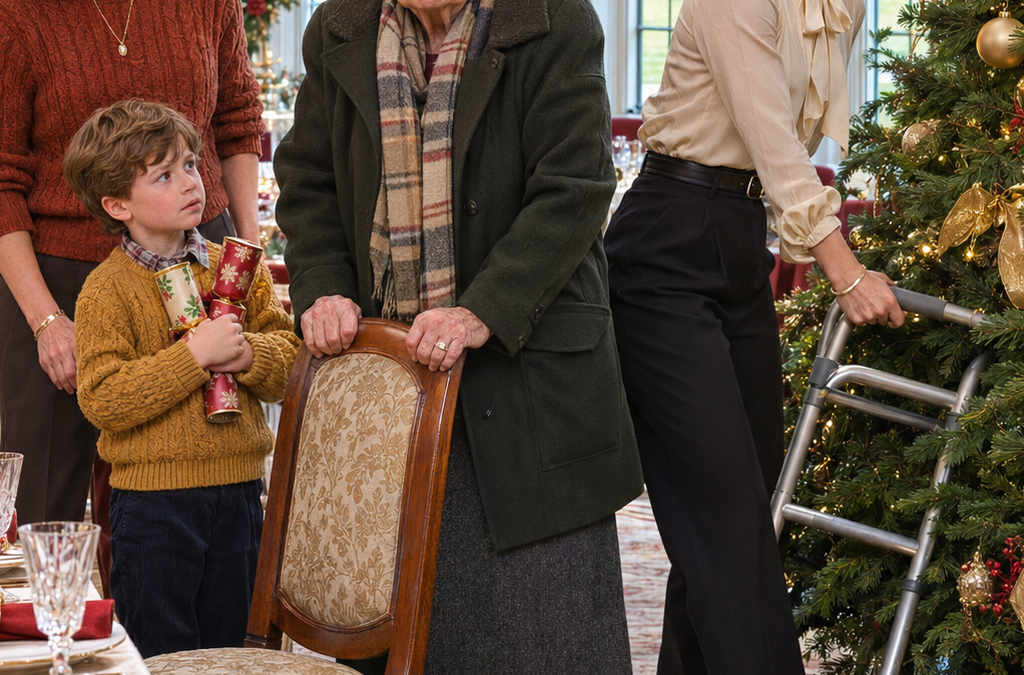
Megan pushed it behind the tree’s lower branches. My mother, Ruth Carter, watched from her chair, her knees bent beneath her skirt.
My six-year-old grandson, Owen Hayes, approached with two Christmas crackers held against his sweater, while his father studied the empty fireplace across the country club dining room.
“Ryan, are you going to let her do this?”
My son, Ryan Hayes, looked away.
“Your mother’s blocking the picture,” Megan said. “We need this corner clear.”
An envelope addressed to Mom lay beside Megan’s plate. Mom hadn’t even taken off her coat.
Those words hurt more than I wanted Ryan to see.
My name is Emily Carter. I’m forty-six, and I manage payroll for a regional plumbing company. I’m my son’s household’s sole provider.
Ryan thought I distributed help from some shared family cushion. He knew almost nothing about what those payments cost me.
For years, I had quietly covered the household expenses while he treated his sales commissions as spending money and thanked me as though I were passing along somebody else’s check.
His favorite chicken casserole had come from my car that evening. The crunchy onions traveled separately because he complained when they got soft.
Owen’s winter coat hung by the door. I’d repaired its torn lining over my lunch break.
And there was the $154,600 Ryan had borrowed from Mom.
That was Mom’s retirement money, and he promised to repay every dollar.
Megan slid Mom’s bank envelope beneath her Christmas place card.
Dad’s silver pocket recorder was already in my hand. Its worn black wrist loop caught against my cuff.
Mom wanted his Christmas greeting played after dinner. Since his death, hearing his voice sometimes helped her finish a difficult evening.
The display showed two stored tracks. I hadn’t pressed play.
At seventy-four, Mom needed help walking, not help understanding what was happening. She eased herself back down before her legs gave out.
“Move her coat, too. She’ll spoil the family photograph.”
Megan spoke to Ryan as though Mom couldn’t hear. Owen stopped beside me, still holding both crackers.
“You’re embarrassing us in front of everybody,” Ryan told me.
I had carried food through that doorway expecting an ordinary Christmas dinner, and now my mother was stranded beside a decorated tree while my son waited for me to cooperate.
I stayed beside her chair.
Ryan raised his voice.
“STOP MAKING THIS ABOUT HER!”
My face burned. Mom looked down at her knees.
“You’re keeping her walker until after your picture?”
Ryan said yes, until we were finished making a scene.
“Fine. Mom, I’ll be right beside you.”
Then I stepped toward our invited family friend, Linda Brooks. She managed Mom’s bank branch and had been talking with Mom before dinner.
“Linda, would you come over here with me?”
She came without asking me to explain across the room. Mom caught her eye and nodded toward the envelope.
Linda asked permission to discuss Ryan’s request with me. Mom gave it immediately.
Ryan had asked Mom to erase the whole loan, Linda told us quietly. He was already describing it to relatives as a gift.
His annual bonus had arrived, too.
I looked at Mom. She shook her head once.
Until then, I’d thought Megan was hiding the walker because it looked awkward in a photograph, but the envelope beside her plate made the evening feel uglier and much more deliberate.
But Linda was already moving toward the tree.
She checked the wheeled stand before carefully rolling it aside.
The folded walker appeared between the branches and the wall.
Ryan stepped forward, saying the tree was fine where it was.
Linda left a clear path from Mom’s chair.
“Ruth decides where she sits. She hasn’t forgiven your loan.”
Ryan’s mouth opened, but he didn’t answer.
Linda drew the letter from the envelope Mom indicated.
Megan’s hands stopped above Owen’s Christmas crackers.
Linda held Ryan’s forgiveness letter toward Mom, waiting for her answer.
“I never agreed to make it a gift,” Mom said.
Her voice sounded thin, but she didn’t hesitate. Ryan tried to interrupt, and she kept speaking until he stopped.
She had agreed to lend him money. She had expected him to put it back.
Linda explained that the proposed letter would wipe away the entire debt. It wasn’t asking Mom for more time.
And Ryan had brought it to dinner without telling her that.
Megan said this wasn’t the place for a money discussion. Mom looked at the envelope with her own name on it.
“You brought it here,” she said.
I was ashamed that my first impulse was still to soften that moment. Some part of me wanted to explain Megan’s behavior, settle everyone down, and get dinner started.
But Mom didn’t need me doing that again.
The recorder’s screen lit when my cuff brushed it. Two tracks appeared before the display dimmed.
Dad had openly recorded the loan conversation. Everyone there had known, and his voice on the first recording identified the money as Mom’s savings.
I left the recorder alone.
Mom asked Linda for the rest of the envelope. The country club’s name showed above another folded sheet.
Ryan said it was only their renewal notice.
Mom pulled the folded bill free.
Megan’s chair scraped hard against the floor.
Mom unfolded Ryan’s new club bill; Megan reached across the table.
Mom pulled it back before Megan could take it.
“I’m not signing your letter.”
Nobody answered her right away. Linda stayed close enough to help if asked, without reaching for Mom.
Mom got up using the chair arms, walked the short distance to her walker, and unfolded it herself. Then she chose the seat nearest the clear aisle.
Owen followed with the crackers. He put one beside her plate and brought the other to me.
“Can we do these now?”
Mom told him after dinner, when he could show her how. He seemed relieved to have a job that made sense.
Only then did I notice my younger brother, Paul Carter, sitting beyond Ryan. His untouched plate was in front of him.
He looked at me, then down at his food.
That hurt in a different way. He’d watched Mom struggle, too.
I had expected somebody else to speak before I needed to ask. Instead, Paul kept his eyes lowered while Linda helped straighten the chair Mom had chosen.
Ryan came around the table toward me. His voice dropped, though everyone nearby could still hear him.
“You’ll be responsible for what this does to my family.”
I looked past him at Owen, who was explaining the paper crown inside his cracker. He hadn’t heard his father.
“Leave him out of this,” I said.
Megan told Ryan not to bother arguing with me. She said I always needed to be in charge.
I stayed by Mom’s seat. For once, I didn’t offer to cover a bill or make an excuse that would let Ryan sit down looking innocent.
Mom kept the letter beside her plate, unsigned.
Then Ryan took out his phone. He typed while Megan watched over his shoulder, and a moment later my phone lit with a message to the family group.
“Grandma already forgave the whole loan. Ask her.”
Chapter 2 of 7
Mom read Ryan’s message on her own phone.
“I have not forgiven the loan,” she typed. “I never authorized you to tell anyone I did.”
She showed me before sending it, but she wasn’t asking permission.
“Will you come to the bank with me Monday?”
I said yes. My own reply was already half-written, asking everyone to settle down. I deleted it. Even now, I wanted to make my son’s behavior easier for everyone to swallow.
By Monday morning, nobody had answered Mom’s correction.
At the branch in Dublin, Ohio, Linda brought us into her office. Mom chose the chair with arms. I sat beside her, close enough to help her stand if she asked.
I was nervous about what we would learn. Mom had brought her papers in a grocery bag, the handles knotted so nothing would slip out.
“Ruth, are you comfortable discussing these accounts with Emily here?”
“Yes. I asked her to come.”
Linda checked Mom’s identification, then opened the papers Mom had brought. She addressed her questions to Mom, even when I knew the answer.
I almost supplied one anyway. Six years of solving Ryan’s problems had made me quick to speak.
Mom didn’t need that from me.
Linda examined the signed loan note. It showed that Ryan had borrowed $154,600 and agreed to repay it.
Then she compared Mom’s statements. Before the loan, Mom had $198,000 in savings; afterward, she had $43,400.
“Your regular deposits are still $2,350 a month?” Linda asked.
Mom confirmed they were. That covered her ordinary bills, with careful choices.
The missing retirement money was supposed to cover the years when careful choices wouldn’t be enough. Her house was paid for, but the furnace didn’t know that. Neither did the dentist.
I felt sick looking at the smaller balance. Mom had called that money her cushion, and I hadn’t asked how thin it had become.
Linda checked another record on her screen.
“The repayment reserve is in both your names, Ruth. Yours and Ryan’s. The $154,600 deposit is there.”
“Did he tell you why he wanted the letter signed?”
She showed Mom the signature record. Either owner could withdraw from the account, she explained, but I had no authority over it.
My name wasn’t on that account.
I moved my chair back a little so Mom could see the screen. Being her daughter didn’t make her money mine to manage.
“Did he tell you why he wanted the letter signed?” Linda asked.
Mom looked at the grocery bag between her shoes.
“He said they needed things settled to keep the household stable. For Owen. I thought he meant he needed more time.”
She had understood his words. She had trusted what he meant by them.
It hurt to hear how ashamed she was. She had supervised a school cafeteria for years, kept everyone fed, and balanced every grocery bill at home. Now she seemed embarrassed to ask a question.
“I should have told Emily,” she said.
Linda told her she could ask questions without apologizing. Then she gave Mom copies of her own account records.
We were still in the parking lot when Paul called.
He asked whether I had a minute. Mom could hear him through the car speaker, and I told him so.
“Ryan wants you to stop turning a misunderstanding into an attack.”
I waited for the rest. Paul said Ryan had called him twice that morning and wanted him to talk some sense into me.
“Did you ask him about Mom’s walker?”
Paul said he wasn’t there to argue about Saturday. He was only passing along what Ryan had said.
I was furious with him. He had found his voice when Ryan needed something, after watching Mom struggle without saying a word.
Mom told him we were going home. I ended the call.
At her kitchen table, she spread out the rest of the envelope from dinner. A page had been folded behind Ryan’s proposed letter.
It was his explanation of where the loan had gone.
He had listed $62,000 for club initiation and accumulated dues, $48,600 for travel, and $44,000 for revolving lifestyle debt. Beneath those amounts, he had asked her to consider the strain repayment would put on his family.
“Where’s the housing part?” I asked.
Mom read the page again.
“It isn’t here.”
She stayed bent over it long enough that I offered to turn on another light. She said she could see fine.
I believed her. I also knew she was crying, and I hated that she wanted to hide it from me.
He wanted her signature, not her opinion.
I made us lunch while she gathered the papers. Mom insisted on having tomato soup in a mug. She said bowls made a perfectly good grilled cheese harder to dunk.
For a few minutes, we ate without talking about Ryan.
Afterward, she took a small envelope from her purse. “Meals” was written across it in her square cafeteria handwriting.
She counted the bills, then put them back.
“I was going to ask if you wanted lunch out,” she said. “Another week, maybe.”
I felt ashamed that I hadn’t noticed her rationing little outings while I kept smoothing things over for my son.
Before I could answer, my phone lit up.
Paul had forwarded Ryan’s message.
“Tell Grandma she needs to sign the forgiveness letter before the club processes our $12,400 renewal.”
Chapter 3 of 7
“I won’t sign that letter,” Mom told Ryan. “Your club bill doesn’t change my answer.”
She called to tell me before I left for work. While we were still talking, Ryan sent me a message canceling my usual school pickup for Owen.
Megan would get him. There was no need for me to come.
I had Owen’s booster seat in my car and his library book beside my purse. He had left it at my house, worried he would owe the school a dollar.
“Is he sick?” I texted.
Ryan called instead of answering. He said Owen was fine, then asked whether I had talked to Grandma yet.
I told him I had. He let out an irritated breath.
“You could have a quiet Christmas with Owen. Stop winding Grandma up.”
He said it as though I had invented her answer. I reminded him that she could speak for herself, but he talked over me.
He wanted things pleasant for his son. If I kept making trouble, he couldn’t promise what the holiday would look like.
I was hurt, and embarrassed by how quickly I wanted to bargain. Owen and I always read in the car before leaving school. Sometimes he made me do the same page twice because my squirrel voice wasn’t right.
I didn’t go to the school. Ryan could change his child’s pickup arrangements. I wasn’t going to make Owen watch the adults argue beside the buses.
At work, I opened my banking app before opening payroll.
My usual $2,400 rent contribution wasn’t due yet. Sending it early might remind Ryan that I was helping, that I wasn’t against his household. I selected his name and entered the amount.
I stopped before I pressed send.
The screen stayed open until it went dark. I felt ashamed. Mom was defending her savings, and I was about to pay my son to be less angry with me.
Paying every problem had taught Ryan to bring every problem to me. I had done it gladly at first, then automatically, then with a resentment I never admitted.
“Don’t use Owen to collect a debt from me.”
Ryan sent that after I asked when I could see him next.
I read it twice. I hadn’t asked for money. I had asked whether Sunday afternoon would work, because Owen wanted to finish the cardboard garage we were building.
“Sad that holiday manners have turned into punishment for a young household.”
I typed that out, then erased it. There was no explanation long enough to make Ryan answer a different question.
By lunch, Megan had filled the family group with photographs.
Owen stood beside a gingerbread house, grinning around a missing tooth. In another picture, Ryan held him up to put a star on their tree. I had bought that tree six years earlier, when they said a real one cost too much.
“We’re trying to give our little family a happy Christmas,” Megan wrote. “Sad that holiday manners have turned into punishment for a young household.”
I enlarged Owen’s picture until the gingerbread roof disappeared. He had frosting on his eyebrow.
Being left out hurt. I wanted to ask whether he had remembered his spelling words, whether he liked the new classroom books. Instead, I put my phone away and went back to checking overtime.
“Your mother’s downstairs,” our receptionist told me.
Mom was in the lobby, still wearing her coat. She had taken a cab and looked annoyed when I asked why she hadn’t called me.
“You would’ve left work to get me. You’re working.”
I sat beside her. Through the glass doors, two of our plumbers were arguing about whose turn it was to buy gas.
Mom had brought my lunch container back. She said the lid was mine, too, despite what I might claim. In our family, returning a container with the wrong lid could remain a subject for years.
Then she asked whether Ryan had canceled my afternoon with Owen.
“Paul told me,” she said. “I’m not buying visits with my great-grandson. I need my retirement money.”
I told her I hadn’t asked her to change her mind.
“I know. I came because you might pay him yourself.”
That made me look at her. She knew me well enough to come across town before I did something foolish.
I admitted I had nearly sent the rent early. She didn’t scold me. She sat with me until I could go upstairs without crying.
Paul called near the end of the day. He wanted to know whether Mom had gotten home, then lingered instead of hanging up.
“He thinks you’re handing out what Dad left,” he said.
I asked who thought that, although I knew.
Ryan believed I managed some family pot of money, Paul explained. He had said I was getting possessive about money that was meant to help everybody.
I was furious. Paul had heard my son say that and apparently let him finish.
“What did you tell him?”
Paul said he hadn’t known what to tell him. I told him guessing was doing enough damage already.
Ryan called while I was driving home. He wanted me to fix this before Christmas. Otherwise, he would tell Mom she was choosing money over Owen.
I pulled into a grocery store parking lot. I told him to leave Owen out of the argument.
He hung up.
A few minutes later, Mom called and played the voice message Ryan had sent her.
“Tell Owen yourself why you’re breaking up his Christmas.”
Chapter 4 of 7
Mom answered Ryan’s voice message while I was still on the phone with her.
“I won’t apologize to Owen for asking you to keep a promise.”
She sent that back in her own voice. Then she asked Ryan to come over the next evening and talk to us without bringing his son into it.
I offered to bring dinner. She said she already had food.
“Come without a casserole, Emily. We’ll survive.”
By the time Ryan arrived, Mom and I had eaten. She had left his portion in the oven, an old habit neither of us mentioned.
He kept his coat on in her kitchen. I hated how relieved I felt that he had come at all.
“Are we doing this again?” he asked.
Mom told him to sit. He chose the chair across from her, leaving me at the end of the table.
She asked why he had told relatives she forgave the loan. Ryan said he had understood that she wanted to help his family. Mom reminded him that she had helped by lending him the money.
He looked toward me instead of answering her.
“You’ve been handing out Grandpa’s money. Stop acting like it’s yours.”
I stared at him. Paul had warned me what Ryan believed, but hearing it made me feel foolish. I had kept my sacrifices private and somehow expected him to understand them.
Dad had fixed appliances until his knees wouldn’t let him anymore. Ryan had known that man. I couldn’t understand where he thought all this spare money had come from.
“Every payment came from my wages.”
Ryan glanced at Mom, waiting for her to correct me. She didn’t.
I told him I had paid from my own earnings for six years. His rent contribution, the household bills I covered, the things he called about when a paycheck fell short—all of it came from my work.
He asked whether I meant the whole six years. I said yes.
For a moment, he looked younger. Then he leaned back and looked around Mom’s kitchen, as though the answer might be somewhere else.
“Why didn’t you tell me that before?”
I had told him I worked late. I had told him a purchase would have to wait. What I hadn’t said was that helping him meant putting off things for myself.
I felt exposed explaining it now. I wanted gratitude, and I was ashamed that I still wanted it from him.
Mom said he could have asked where the money came from. Ryan rubbed his face and stared at the table.
Then his voice changed.
“We built our whole life around what you offered.”
He said Megan had taken fewer hours because I had promised to help. They had chosen their place because the rent was manageable with my contribution. I couldn’t train them to rely on me and then act offended when they did.
Some of that was true. I had made every payment dependable, even when my own budget wasn’t.
“I made it too easy to count on me,” I said. “I know that.”
He started to answer, but I finished. I would give notice before changing my help. I wasn’t promising to support his household forever, and I wouldn’t keep paying to make his story about Mom’s loan easier to accept.
Ryan accused me of tying everything together. Mom said he had done that when he brought Owen into it.
She was tired. I could hear it in the pauses between her words, but she stayed at the table.
“I want Linda to hear what I want,” she said.
“Ruth, this needs to come from you. What do you want?”
Mom called the branch and asked whether Linda could speak with her. When Linda came on, Mom said Ryan and I were there and asked to use the speaker.
Linda agreed. Her voice sounded exactly as it had in her office.
She asked whether Mom wanted to discuss the account with both of us listening. Mom said yes.
“Ruth, this needs to come from you. What do you want?”
I stayed quiet. I was angry enough to answer quickly, which was another reason not to.
Mom said she wanted her money back and wanted the family to stop being told she had given it away. Linda asked whether she wanted to come in alone. Mom said no; she wanted the same people hearing the same conversation.
She named me, Ryan, Megan, and Paul.
“Friday at eleven,” Linda offered. “We can use the conference room.”
Mom accepted. She would invite everyone herself.
Ryan straightened in his chair. He thanked Linda for finding room for us and asked if he could bring something for her to look at. She said he could bring it, but Ruth would speak for herself.
He thanked her again.
After Mom ended the call, he turned toward me.
“You’d better listen when I bring my proof.”
He said Mom had forgiven him after the original conversation. There was something in writing, and he was tired of being treated like a liar.
I asked what writing. He said I could wait until Friday.
That hurt more than another shout would have. He knew how to be pleasant when he thought someone had authority. With me, he barely bothered.
Mom asked whether he wanted his dinner before leaving. He said Megan was waiting.
Later, at home, I received his message. It included a tightly cropped photograph of a handwritten birthday card.
Underneath it, Ryan had written, “Grandma put it in writing.”
Chapter 5 of 7
“You don’t owe me thanks.”
That was the sentence Ryan had photographed. Mom recognized her handwriting when I showed her my phone the next morning.
He had thanked her for watching Owen while he and Megan went out for his birthday. She had written back in his card, telling him she enjoyed having Owen over.
Ryan hadn’t invented the words. He had cropped away the birthday wishes and the part about Owen falling asleep during a movie.
I asked him to send the whole card. Instead, he sent another message to the family group.
“Grandma understood we weren’t keeping score. That included the loan.”
Mom read it at her kitchen table. I was furious, but she looked embarrassed. Her own kindness was being offered as evidence against her.
She said Owen had insisted he wasn’t sleepy that evening. Then he had fallen asleep with one shoe on and the other tucked beneath her cushion.
She had found it the next morning.
“I meant he didn’t have to thank me for babysitting,” she said. “He knew that.”
I believed her. I also understood why Ryan had chosen those particular words. Without the rest of the card, they let people supply whatever meaning made them comfortable.
Megan called Paul that afternoon. He called me afterward, sounding less certain than he had in the parking lot.
She wanted him to persuade Mom that calling the money a gift would preserve Owen’s home. She said the family needed someone reasonable to stop this.
“Did any of it actually go toward housing?” Paul had asked her.
For once, he had asked the question before calling me.
Megan hadn’t answered. Instead, she wanted to know whether he understood how upset Ryan was, and whether anyone cared what this was doing to their marriage.
I felt a little hope, hearing that Paul had pressed her. Then he asked whether we really needed the meeting.
I told him Mom had asked him to come. He said he would.
By the next morning, Mom had changed her blouse twice before I arrived. The first one was still on her bed.
She said she didn’t want to look as though she had dressed for a fight. I told her the blue one was fine, then stopped making suggestions.
She had enough people deciding how she should look and sound.
“Maybe we should just go home,” she said when we reached the bank.
I hadn’t turned off the car yet. Through the windshield, I could see Ryan and Megan walking toward the entrance together.
Mom watched them without waving.
She said she should have asked more questions before lending him the money. She should have known what those trips cost. She should have stopped believing every explanation just because he was her grandson.
It hurt to hear her blame herself. I wanted to march inside and make him listen, but she was the one sitting beside me, afraid of being embarrassed again.
“Do you want to leave?” I asked.
She looked at the entrance for a while. I left the engine running and waited.
Finally, she said, “I want to hear him say it.”
I asked whether she meant his claim about the card. She nodded, but there was more she wasn’t telling me yet.
She wanted to go inside.
Linda met us near the conference room. She asked Mom which chair would work best, then offered the one nearest the door, with room to get up comfortably.
Mom chose it. Nobody had to squeeze past her, and she didn’t have to cross the room to leave.
“Thank you for making time for us, Linda,” Ryan said.
His pleasant voice made me angry. He asked whether she wanted coffee before he sat down, then told me I was blocking Megan’s chair.
I moved without answering. Paul arrived behind us and chose a seat partway down the table.
“Ruth asked Emily, Ryan, Megan, and Paul to be here.”
Ryan brought out the original birthday card. The whole thing was there, including Mom’s birthday wishes. He put it where Linda could see it.
He said nobody disputed that the money had started as a loan. Families changed arrangements afterward. Grandma had understood that, even if other people now wanted to interfere.
I had never felt so tired of being called “other people” by my own son.
“Everyone will have a turn,” Linda said. “Ruth asked Emily, Ryan, Megan, and Paul to be here.”
She checked with Mom that these were the people she wanted hearing her financial decision. Mom said yes.
Linda didn’t interpret the card or ask Ryan to defend it yet. She stepped into her adjoining office to arrange lunch, leaving the door open behind her.
Ryan and Megan bent over his phone. Paul stared toward the windows.
Mom leaned close enough that only I could hear her. She said Ryan had called her again after our conversation in the kitchen. He had sounded frightened rather than angry, and that had been harder for her to resist.
I felt scared for her then. She had made it into the room, but she was still carrying whatever he had told her.
I asked what he had said.
“He told me paying me back would take Owen’s home.”
Chapter 6 of 7
“Then say it before everyone.”
I looked across the table at Ryan. Linda had returned from her office, and Mom was watching him.
He drew the birthday card closer. He said the loan had become a gift afterward, whatever the original papers said. Grandma had put her feelings in writing. Making him repay it now would put Owen’s home at risk.
“Tell them what you told me,” Mom said.
“I told you we can’t afford this, Grandma.”
Megan nodded beside him. Paul stayed in his chair near the windows.
I felt sick hearing Owen’s name again. Ryan had put his son between himself and every question we asked.
“The card was about babysitting,” I said. “Your promise was about this bonus.”
Ryan said those were separate conversations. Someone could promise repayment, then be told later that family mattered more. He looked toward Linda, making his voice quieter.
Then he turned back to me.
“Grandma mixes things together. You know she does.”
Mom’s face reddened. She had remembered every amount, every excuse, and which nights Owen needed his reading folder. Now Ryan wanted us to doubt her because her answer inconvenienced him.
I told him she wasn’t confused. He said I hadn’t been there for every conversation.
Mom pointed toward my open bag. Dad’s silver recorder lay inside, its worn black wrist loop visible against the lining.
“The second track. After your grandfather asked about the bonus.”
She looked directly at Ryan when she said it. Then she asked me to play that part.
“Would paying her back leave you short of housing money?”
I placed the recorder on the table and selected the second track. We had all known Dad was recording that day. He had announced it before anyone discussed the loan.
I was afraid of hearing his voice here. I wanted him in Mom’s kitchen, complaining that her coffee could strip paint, not in a bank room where our family needed proof.
Dad’s voice came through the small speaker.
“Would paying her back leave you short of housing money?”
Ryan answered, clear enough that nobody had to lean closer.
“The household bills are covered. When my bonus lands, Grandma gets all one hundred fifty-four thousand six hundred back.”
Mom had remembered the question exactly. I stopped the playback when she nodded.
Ryan stood so abruptly that Megan shifted away from him. He accused me of bringing the recorder to ambush him. I had probably spent the whole week planning how to make him look bad.
His voice carried into the hallway. Linda asked him to lower it.
“Sit down, Ryan. Ruth hasn’t finished.”
He remained standing. Mom told him she had never forgiven the loan, in the card or anywhere else. He had asked her to sign a letter precisely because she hadn’t.
Lunch arrived at the doorway. Linda accepted the tray without inviting anyone inside. Paul carried Mom’s plate to the side table, where it stayed untouched.
I was furious, but I let Mom finish. She said she wouldn’t keep proving she understood her own money.
Linda turned her screen toward Mom and asked what she wanted done with the joint reserve.
“Move all $154,600 into my savings. The account that’s only mine.”
Ryan said they needed to talk privately first. Mom said they had talked privately. That was how he had persuaded her not to ask questions.
Linda checked Mom’s identification against the account record and confirmed the destination with her. I stayed back while Mom answered.
The computer needed a moment. Ryan started speaking again, asking Mom to wait until he and Megan could work out another arrangement. She kept her eyes on Linda.
Then Linda completed the transfer.
“With your permission, Ruth, I’ll confirm it aloud.”
Mom said yes.
“The confirmation shows $154,600 transferred out of the joint reserve. It’s now credited to your sole savings account.”
Ryan reached for the birthday card. He held it between both hands, staring at the handwritten sentence as though Linda might ask to see it again.
Megan leaned forward. “Can you reverse that? He doesn’t agree to this.”
“His disagreement doesn’t cancel Ruth’s withdrawal rights,” Linda said.
She didn’t discuss the recording. She printed Mom’s confirmation and gave it directly to her.
I felt relieved, then sad enough that I couldn’t look at Ryan. I had wanted him to return the money willingly. Even now, that would have meant something to me.
Paul got up from beside the windows. He lifted Mom’s lunch plate, crossed the room, and pulled a chair beside her.
“I should have done this at Christmas,” he said. “I saw what was happening. I just sat there.”
Mom made room for him. She didn’t tell him it was all right.
He asked whether she wanted her sandwich cut. She said she could manage it, but he could open the mustard packet. She still hated getting it on her sleeve.
Ryan finally sat down. He asked me to put the money back into the reserve until things settled. Not all of it, necessarily. Enough that he and Megan could breathe.
I knew that request. Usually, I would already have been calculating what I could spare.
“I won’t finance another lie about this family.”
He said I was making a speech. I told him I wasn’t replacing the money.
Mom folded her confirmation and kept it with her own papers. She didn’t hand it to me for safekeeping.
Ryan pulled the club renewal material from his folder. He had brought the bill to show us how much they owed. Now he crossed through the renewal instruction and completed the attached resignation form.
Megan read it without speaking.
Ryan left his signed club resignation form beside my coat.
Chapter 7 of 7
Ryan submitted the resignation himself. He sent me the club’s acknowledgment without a message, and his membership ended January 15, 2027.
That meant he and Megan avoided the $12,400 renewal. Nobody expelled them. They decided not to buy another year.
I left his copy of the form with his other papers. For once, I didn’t offer to help him find a way to keep something he couldn’t afford.
The Monday after the bank meeting, I gave him written notice.
“I’ll contribute for thirty days,” I told him. “After that, the rent is yours.”
I wrote down the last payment and when my help would end. The $2,400 monthly contribution had become as dependable as my own paycheck. Ending it hurt, even though I knew I needed to.
Ryan read the notice while standing in my doorway.
“So you’re doing this right after taking Grandma’s side.”
I said the notice wasn’t an invitation to argue about her money. He and Megan were responsible for their lease. I was changing what I gave them, not telling them where to live.
He asked whether I expected them to move. I told him that was their decision.
“You really mean the whole amount?”
I said yes. He folded the notice and left with it.
For several evenings afterward, I checked my phone too often. I expected an emergency, an accusation, some problem that would make the decision feel cruel.
When the final support period ended, I made no further rent contribution. I was relieved, and ashamed of how relieved I felt.
Megan took additional hours at the real-estate office. Ryan canceled travel they hadn’t yet paid for. He told me these things during a short call, sounding as though I should apologize.
I listened without offering money. They stayed in their home.
Mom called to tell me she had rescheduled her hearing-aid appointment. She had postponed it twice while Ryan kept saying repayment was coming soon.
“Do you want company?” I asked.
“Company, yes. Someone answering for me, no.”
At the appointment, I sat beside her while she explained which sounds she missed. The television was easy enough to turn up. Owen talking toward a window was harder.
Afterward, she chose lunch at a place she liked.
She ordered what she wanted without checking the cheapest column first. I felt glad, then angry that a sandwich could show me how much she had been giving up.
The restored $154,600 stayed in her savings. She kept her statements herself. When she mentioned a purchase, I stopped treating it as something she needed to clear with me.
“I bought the better hearing aids,” she told me later.
“I saw you couldn’t get to your walker. I let you sit there.”
I said I hoped they helped. I didn’t ask what they cost.
Paul came over one afternoon while I was visiting. He had called ahead and asked Mom whether she would hear him out.
He stood near the kitchen doorway until she told him to sit.
“I stared at my plate,” he said. “I saw you couldn’t get to your walker. I let you sit there.”
He didn’t blame Ryan or say he hated arguments. He said he had waited for me to handle it because I usually did.
I was still angry with him. Hearing him admit that didn’t erase the sight of his lowered head across the Christmas table.
“I’m sorry, Mom. I should have gotten up.”
She accepted his apology. Then she told him she had needed her son beside her before Linda moved the tree.
Paul said he understood. Mom told him she hoped he did.
They talked about his work afterward. It was an ordinary conversation, but neither pretended the apology had repaired everything.
Ryan asked me for money once more, after my last rent contribution.
“It’s a smaller amount. Just this once.”
He called it an emergency. I let him finish, then said I couldn’t give it to him.
He asked whether I wanted to know how they were supposed to manage. I said I hoped they worked it out.
I was frightened he would stop Owen’s visits for good. After we hung up, I sat on my couch without turning on the television. I missed my grandson badly.
I didn’t call back with another offer.
Later, Ryan asked whether I still wanted Owen for an afternoon. He kept his voice flat, as though we were discussing a delivery.
“Yes. We need to agree on something first.”
I told him Owen wouldn’t carry requests for money between houses. He wouldn’t deliver apologies, either, or explain why adults weren’t getting along.
Ryan said he hadn’t asked him to do that. I said I wanted us both clear before the visits resumed.
“Fine. I’ll bring him over.”
Owen arrived carrying the cardboard garage we had never finished. One wall had collapsed in the car. He wanted to know whether we had enough tape.
We did.
Visits became regular again. Ryan handled arrangements himself. Megan was brief when we crossed paths, and I stopped trying to turn every exchange into a reconciliation.
I loved them. I was still hurt. Both things remained true.
Several months after the bank meeting, Owen and I went to Mom’s house for breakfast.
She had made biscuits, eggs, and the sausage gravy Dad always claimed needed more pepper. Owen split a biscuit with his fork, leaving a ragged hole in the middle.
“Mine’s a boat,” he said.
Mom told him it looked likely to sink. He filled it with gravy anyway.
I laughed before I expected to. For a little while, I hadn’t been watching anyone’s face for trouble.
Dad’s silver pocket recorder sat beside Mom’s place, the worn black wrist loop curled against it. She had brought it out before we arrived.
“Can we hear Great-Grandpa’s Christmas one?” Owen asked.
Mom said we could hear it after she got her coffee. Owen wanted to know whether Dad would say his name again. She told him to listen.
I watched her cross her own kitchen. She had chosen breakfast, bought the groceries, and invited us over because she wanted us there.
Family did not make my mother’s dignity negotiable.
There was still room for Ryan at her table. There was room for Megan, too, if they came without another price attached. Mom had said that herself.
Owen scooted his plate toward the chair nearest him, assuming she would sit there. Mom told him she wanted the one by the window this morning.
He moved his biscuit boat out of her way. She settled into the chair she had chosen and drew her coffee close.
Mom pressed play.







