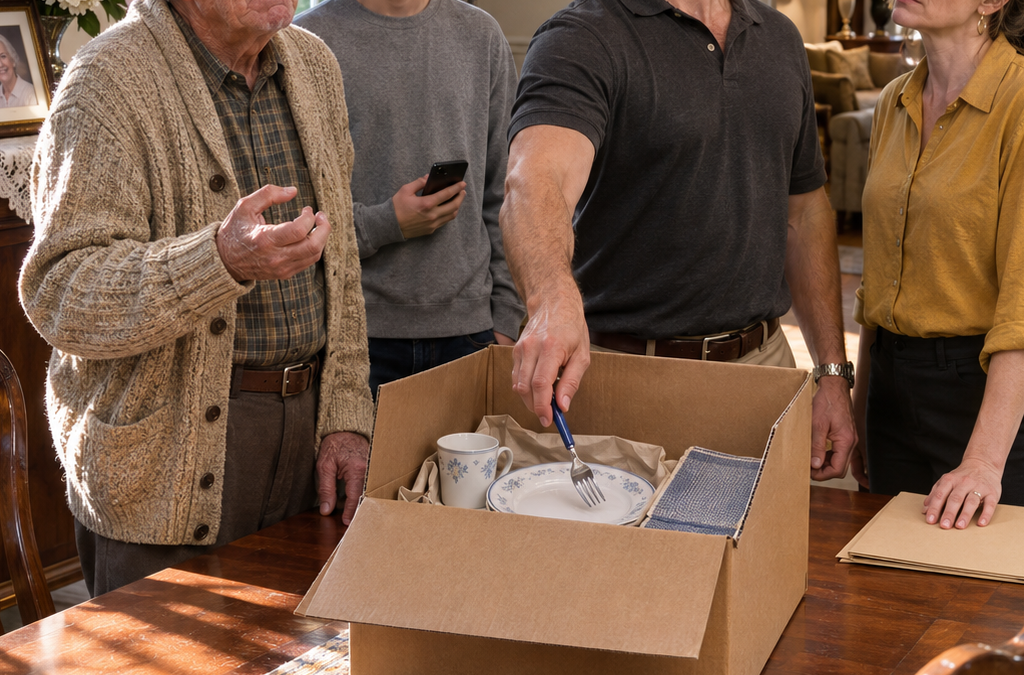
My son scraped my wife’s place setting into a moving box during our family house-sale meeting, though her funeral flowers were still fresh.
Chapter 1 of 7
“She’s gone. Stop setting two places.” My son, Mark Collins, pushed her cup against her plate.
The deed names me; I paid for my own house for twenty years.
“Why are you packing her things already?” I asked.
I stood in my old cardigan, holding her blue-handled dinner fork, while Mark pushed her plate and cup across the placemat and into his open moving box.
My younger sister, Linda Harper, looked down at the table.
“Linda, are you going to let him do this?”
My daughter-in-law, Claire Collins, opened a folder beside the empty chair. “We need this table clear for signatures.”
A photograph protruded from her folder. “Your bedroom photographs are already good enough.”
Those words made me look at the folder instead of the box.
My name is Thomas Bennett. I’m seventy-one, a retired building-maintenance supervisor in Dayton, Ohio.
Mark had taken Claire’s surname when they married in 2009. Changing his name hadn’t troubled me. Watching him pack his mother’s dishes did.
The porch rail outside their house was straight because I’d spent a Saturday replacing the rotten section, back when Mark still called me before calling anybody else.
And I’d brought chicken-and-broccoli casserole whenever their work schedules tangled. Claire picked around the broccoli. Mark ate straight from the dish.
Their son, my grandson Evan, still had his school photograph on my refrigerator.
I kept paying rather than making them hear no.
Evan, seventeen, stood beside the sideboard filming the funeral flowers. Then he lowered his phone toward the table.
The fork’s blue handle had worn pale where my wife’s thumb rested. She’d used it through decades of suppers, including casseroles she complained I made too dry.
Claire’s folder held a photograph of my bedroom, stripped of family pictures.
At first I couldn’t understand the bare dresser in that photograph. Our pictures were still upstairs.
Mark said keeping the house was wasting money. There were gutters, insurance, grass. He listed ordinary chores as if I’d never handled them.
“Take the room Claire found and let us finish.”
“I haven’t agreed to sell this house,” I said.
He swept the fork from my hand into the box.
I was humiliated, standing there with my fingers still curled around nothing.
And Linda watched the dishes instead of looking at me.
Mark had helped during the hospital stay, and I knew he was tired, but now he stood between me and my chair as though his tiredness settled everything.
“Stop MAKING THIS HARD!”
Claire said the room was clean and close by. She made leaving sound like an errand I was refusing to run.
“So the grocery runs depend on me agreeing to leave?”
“Yes. Tell them you’ll go, and we’ll keep helping.”
My groceries were nearly gone. They knew that.
“I’m not agreeing to leave.”
Then I stepped into the kitchen doorway. Evan stayed where he could see us both.
The refrigerator hummed behind me, and for a moment I wanted to open it and stand there doing an ordinary thing until everyone stopped watching me.
Instead, I called the man my wife had chosen to manage her separate savings, David Reed. He was already expected at our meeting, only minutes away.
David answered before I said much.
“Claire promised another family an empty house, Thomas. I’m almost there.”
I hadn’t known there was another family.
David wasn’t family, but my wife had put him over her separate savings. He appointed the family helpers and decided the children’s monthly support.
I’d expected a discussion about choices, not a deadline for getting me out.
Claire stayed beside the empty chair as David came through the open front door. Her hand rested on the folder, the pen across it.
David sat in that chair and drew Mark’s box toward him.
He lifted out my wife’s plate, cup, and placemat.
“We just cleared that place for a reason,” Mark said.
David put everything back without asking Claire, then laid the blue-handled fork beside the plate.
“Claire promised another family that Thomas would already be gone.”
I took back the fork and sat beside him.
David calmly asked who was expecting to use my bedroom.
Claire’s phone lit beside the open folder.
Mark’s face went red, and his arm shot across her.
Mark grabbed Claire’s phone before David could see the screen.
He kept his palm over its screen. David didn’t reach for it or raise his voice.
“Let me see what you promised them,” David said.
“It was exploratory. We were finding out whether anyone was interested.”
Claire’s voice sounded different with him there. She no longer told anybody what needed clearing.
Mark said people asked questions all the time. Nobody had sold anything. He kept repeating that last part, looking at Linda as if she should help him explain.
But I wasn’t thinking about a finished sale.
“You promised away my home while I was still sleeping in it.”
That hurt worse than having the plate shoved into the box. Claire had taken pictures of our bedroom and discussed when a stranger could move into it.
Linda said she’d thought we were only talking about making life easier.
I asked her whose life she meant. She didn’t answer.
David told Claire that discussing a possibility wasn’t permission to promise an empty house. He asked her to keep the messages.
Mark started to say his mother had wanted us working together.
Evan moved away from the sideboard.
He’d hardly spoken all afternoon. I’d mistaken that for wanting no part of us.
Now he came beside my chair.
His phone was held low against his shirt.
Mark stopped speaking when he noticed the screen.
Evan turned his phone toward me. The recording was still running.
I saw the little counter moving.
“You got all that?” I asked quietly.
He nodded. He’d started with the flowers because he wanted to remember them. Lowering the phone hadn’t stopped it.
David asked him to stop now, and Evan did. Nobody asked him to send anything. He kept the phone with its original video in his pocket.
I was grateful, though I hated that he’d needed to stand there recording his family.
The meeting didn’t break up. Mark remained across from me, his box now beside David’s chair, while Claire tried to return the conversation to the folder.
After a while, David brought out the original assistance agreement he kept with his meeting papers. Mark and Claire had signed it when he appointed them to coordinate help.
He identified it without reading it aloud.
My wife, Ruth, had wanted help available without every grocery trip becoming a family argument. She’d managed payroll for years. She liked arrangements people could understand before trouble started.
Mark pushed his proposed family budget toward me.
There was the figure he’d been circling around: $78,000 from selling my house, marked as money to go to him.
“It’s debt, Dad. We need to get it handled.”
I hadn’t known how much he owed. Seeing my house placed beside his debt made me ashamed of how carefully I’d been avoiding questions.
“We helped Mom. We’ve helped you,” he said. “Somebody has to organize what happens next.”
I remembered him driving to the hospital after work. That help had mattered. I couldn’t make it mean I’d agreed to this.
David said we weren’t signing anything that afternoon. He made no threat, and he didn’t announce what would happen next.
Claire looked at Mark, then took back her phone. She opened a screen and slid it across the table toward me.
It showed a room beginning the next day. Four nights, quoted at $680.
“You’ll be comfortable there,” she said.
I had never agreed to go.
Claire slid the four-night reservation closer.
Chapter 2 of 7
“Cancel it. You booked it in your name, Claire. I’m staying here.”
She canceled the room before leaving. The screen showed no charge, which seemed to disappoint her.
“You’ve embarrassed everybody who’s tried to help you.”
I stayed home that night. I slept badly, but I slept in my own bed.
By morning, I had discovered how much food people had brought after the funeral. There were three macaroni salads in the refrigerator. Ruth would have called that a committee failure.
I ate toast. I wasn’t ready to sort out which dishes needed returning.
The woman who knocked on my porch asked whether I was the owner. She looked past me, checking the house number.
“I’m the person Claire’s been talking to. Rachel Turner.”
The prospective purchaser was forty-nine, a dental hygienist, still wearing her work badge. She’d come because Claire’s answers had stopped making sense.
I asked her what answers she meant.
Rachel showed me a private advertisement on her phone. My house was listed for $485,000, with “immediate possession” beneath the photographs.
Then she showed me Claire’s message.
The bedroom would be empty. The owner had somewhere to stay. They could discuss moving arrangements after seeing the house.
I felt sick reading it. The porch beneath us was mine, and this stranger had been told I was leaving.
“Have you signed anything?” I asked.
She hadn’t. There was no contract, and she hadn’t paid a deposit. She had only asked questions and been encouraged to keep planning.
I invited her inside. None of this was her fault.
The bedroom photograph looked different on a full screen. I recognized the short bracket above the window, one I’d fitted after the curtain rod pulled loose.
I’d spent my working life noticing repairs. That little crooked patch was as familiar as my signature.
The photograph had been cropped just below Ruth’s dresser top. Her hairbrush, lotion, and framed pictures were outside its edges. A room we still used had been made to look vacant.
“Claire said you wanted something smaller,” Rachel said.
“I never offered this house for sale.”
She looked embarrassed, and I hated that she had to be. She offered to leave, but I asked her to stay long enough to hear me without anyone answering for me.
Mark arrived with Claire while we were talking. Linda came behind them. She’d expected to help me sort the food.
For a moment, Claire smiled at Rachel as though this were a showing.
Then Rachel asked why she’d been promised an empty bedroom.
Mark answered before Claire could. He said there had been confusion about how quickly things could happen.
“Linda, explain it to him. She’s already arranged her move.”
Rachel said she’d looked at moving companies, nothing more. Mark continued talking about the trouble she had gone to.
He wanted my sister to explain that I shouldn’t punish strangers because I was upset with family.
I was angry now. He had brought a stranger into our argument, then made her inconvenience my responsibility.
“I’m telling her the truth,” I said. “You can do that too.”
Linda said perhaps everybody should stop making plans for a few days. It was the sort of answer that let her avoid saying who had started them.
Rachel asked me directly whether she should keep considering the house. I told her no.
She said she would stop pursuing it and send me the advertisement and the original messages. Before she left, she apologized for coming to the door.
I told her I was glad she had.
David came by later with the trust papers and a current account summary. He had intended to explain those anyway. Now I had Rachel’s messages to show him.
Mark said nobody needed another meeting over an advertisement.
David read what Rachel had sent. The signed assistance agreement was among his papers, the same one he’d brought the day before.
“They coordinate help because I appointed them; that doesn’t let them sell your belongings or your house,” he told me. “I decide support from the trust under its terms, not according to how angry you are with them.”
I understood the distinction, although I didn’t like needing it explained. Telling Mark no hadn’t ended the arrangement that kept bringing him through my door.
Claire said she would correct Rachel’s misunderstanding. David told her to correct the advertisement too.
After he left, Linda began gathering the food containers. She asked whether I wanted her to come back and help with laundry.
Before I could answer, Claire asked her for the spare key.
“Just the photographs. We need to fix the confusion.”
“Are we really making every visit a fight now? Mark can’t keep doing this.”
I looked from Claire to my sister. Linda had kept that key for years, for ordinary emergencies and the times I locked myself out.
“You’re not staging rooms,” I said. “You’re not packing anything.”
Claire turned toward Linda instead of answering me.
“Are we really making every visit a fight now? Mark can’t keep doing this.”
It hurt to hear her make my refusal sound like cruelty. I stood beside my own table while they discussed how difficult I had become.
Linda said a key didn’t mean anybody was moving anything. Claire could come for an ordinary visit. We needed to stop treating each other like strangers.
“I said no, Linda.”
She looked tired and frightened of an argument she could have ended.
Then Linda placed my spare key in Claire’s palm.
Chapter 3 of 7
Claire was in our bedroom when I came upstairs, folding Ruth’s sweaters into an open storage carton. The top drawer of the dresser was empty.
She had used the spare key while I was in the basement.
“Put those back. I told you there would be no packing.”
She kept folding. These were only winter things, she said. Nobody needed sweaters in June.
Ruth’s gray cardigan lay on top. She’d worn it home from a hospital appointment, before the last stay. I was furious that Claire had decided I was finished seeing it.
Mark appeared in the doorway behind me. He’d been outside taking a call.
“You’re refusing work that somebody has to do, Dad.”
I told him nobody had to do it that morning. The clothes could stay where Ruth had left them.
He complained about the trips they’d made, the hours they’d lost. I knew those hours were real. I had spent most of them beside a hospital bed.
“Leave the box here, Claire. You don’t have permission to use that key. Call before you come.”
She said Linda had given it to her. I told her Linda didn’t live here.
Claire left the sweaters in the carton. She kept the key, but I told her again not to use it. Nothing left the bedroom with them.
Downstairs, Mark stopped beside the front door. He said they couldn’t keep coming over just to have everything turn into an argument.
“Then arrange your own rides and groceries. We’re done running ourselves into the ground.”
He’d promised a grocery trip and a ride to an appointment. I asked whether he meant those too. He said I’d heard him.
Mark said he would tell Linda they needed a break from caregiving. I stood at the front window until their car disappeared.
I wanted to call him back. That embarrassed me more than the argument.
Afterward, I put the clothes back badly. Ruth had fitted everything into neat rows. Mine bulged above the drawer until I started over.
It hurt to be learning her folding because somebody else had emptied her drawer.
I ordered $82 in groceries from my own checking account. I nearly removed the delivery charge by choosing pickup, then remembered why I was ordering.
The driver brought bananas greener than the ones I liked and a loaf flattened under the potatoes. I thanked him twice.
For lunch, I cooked two hot dogs. Ruth used to call that my bachelor banquet, even when we’d been married forty years. I ate both standing by the stove.
“You don’t have to prove you can do everything,” Linda told me when she called.
I hadn’t called her. Mark had already spoken to her, and she wanted me to understand how worn out he sounded.
I said I wasn’t proving anything. I needed food, so I’d bought food. She offered to speak to him, but I asked her not to.
I felt lonely after we hung up. Everyone seemed willing to discuss what I needed, but nobody liked hearing what I wanted.
An Ohio estate attorney’s office had an opening after a cancellation. I booked the consultation, then arranged a car service because I didn’t feel steady enough to drive.
The round trip cost $145. I looked at the amount for a while before confirming it.
I wore the same trousers I’d worn through Ruth’s hospital stay. One cuff was frayed. Changing seemed like more trouble than it was worth.
“Start with what happened in the bedroom,” the attorney, Susan Price, said.
“Bring me the current deed and whatever papers cover their appointment,”
I had expected her to ask about money first. Instead, I told her about the empty drawer and how Claire kept folding after I told her to stop.
Susan was fifty-four. She listened without telling me that clearing clothes helped some people grieve.
I was relieved by that. I didn’t want advice about accepting loss while I was still trying to keep people out of my dresser.
“Bring me the current deed and whatever papers cover their appointment,” she said. “I need to see what they actually say.”
I told her David kept the signed agreement. She asked for his contact information and my permission to speak with him.
She said she would check the records and documents before advising me further. I left with a short list, still wishing I hadn’t needed to go.
When I got home, Evan was on the porch. He’d walked over after school and noticed the grocery bags inside the door.
“You got somebody else to bring them?”
I explained the delivery and the car service. He asked whether I wanted help putting things away, and I said I did.
He didn’t mention his phone. We sorted cans and bread, and I let him reach the high shelf instead of pretending my shoulder was fine.
Linda called again after he left. I was tired enough to answer honestly when she asked where I’d been.
“A lawyer? Tom, does Mark know?”
I told her the attorney’s name was Susan Price. I’d only asked for advice. Linda said people got frightened when lawyers became involved.
I asked her to let me finish a day without smoothing things over. She said she understood, and I believed her.
That evening, my phone sounded with a message to the family group.
Mark accused me of paying strangers while expecting unpaid labor from my children. He said other people had jobs and bills, even if I refused to consider them.
I read it in my worn cardigan. I hadn’t told him where I’d gone.
Then another message appeared.
“You can pay Susan Price, but you expect us to work free?”
Chapter 4 of 7
“I told him,” Linda said. “I thought he’d calm down if he knew you were getting advice.”
She had called before breakfast. I was still looking at Mark’s message.
I asked whether she’d told him anything else. She said only that I’d hired Susan and paid for a car.
“You can visit me, Linda. But you can’t carry my private business back to Mark.”
She started explaining again. I stopped her, which I almost never did.
I felt betrayed, and I wanted her to hear that without making it smaller. I told her I wouldn’t be giving her updates about the consultation.
She said she understood. This time, I waited before believing her.
By the time Susan came to the house, she had checked the county records. At my request, Mark and Claire came to hear what she’d found.
I’d shaved badly and missed a patch beneath my jaw. I noticed it in the hall mirror, then left it alone.
Susan showed me copies of the recorded deed and mortgage release. My payment history showed what I’d paid; the recorded deed showed who owned the house.
“Thomas is the sole owner. The house never entered her trust.”
Mark looked at Claire. Until then, he’d been talking about managing his mother’s house, as though those words gave him somewhere to stand.
Susan explained that their assistance appointments gave them no ownership or authority to sell. She left the copies where I could read them.
“So we misunderstood that part,” Mark said. “But Dad told us to find somebody. Before the family meeting.”
Claire said they wouldn’t have taken photographs otherwise. She spoke carefully to Susan, nothing like the voice she’d used upstairs with Ruth’s sweaters.
I was angry at how easily the explanation changed. Mark hadn’t asked me whether I remembered giving permission. He had simply announced that I had.
“I never asked you to find a buyer.”
He said I’d told them the house was getting to be a lot. I had complained about cleaning the upstairs bathroom. That wasn’t the same conversation he was describing.
Ruth used to say that bathroom collected dust while we were looking at it. I’d grumbled about it for years without wanting to move.
Mark brought out a lender statement he’d folded into his budget papers. He wanted Susan to see why they had been pushing for a decision.
“The balance is $78,000. It’s due at the end of the month. We don’t have months to sit around.”
The statement named him and Claire. The debt was against their home, not mine.
He said they’d spent evenings helping Ruth, left work for appointments, and put things off in their own household. Now they needed a chance to get stable.
Some of that was true. I remembered their help, and it hurt to hear those hospital trips presented beside an amount I was supposed to provide.
Susan asked whether I had signed anything promising money. Mark said no, but families didn’t usually make fathers sign promises.
When Susan went into the kitchen to speak with David by phone, Mark followed me into the hall. Claire stayed at the table.
“Stop making me look dishonest in front of her.”
He kept his voice low. That made me feel smaller than if he’d shouted.
I told him I was answering questions about my own home. He said I knew what he meant, then went back before Susan returned.
David joined us later. Susan had my permission to review the trust papers and the appointment documents with him, and he brought what she’d requested.
They worked at the dining table while I sat nearby. I could hear the neighbor’s mower stopping and starting beyond the window.
“The appointments and the trust support come from different documents,” Susan told me. “I’m checking both.”
She asked David short questions. He showed her the relevant pages, including the trust’s terms for the existing household support. Neither told me what he ought to decide about Mark and Claire.
“Thomas, Mark, Claire, Linda, Evan, Susan, and me. Is everyone willing?”
I was relieved Susan was checking instead of guessing. Still, I hated sitting beside papers Ruth had understood while our son waited for an answer he could use.
Mark was polite with David. He said they welcomed a fair look at the work they’d done and wanted the earlier conversations considered too.
David said he wanted everyone who had been at the first meeting to have a chance to speak. Susan could attend as well, if I wanted her there.
“Sunday at two, here at Thomas’s dining table,” he proposed. “Thomas, Mark, Claire, Linda, Evan, Susan, and me. Is everyone willing?”
I agreed. Mark said he would bring his records of helping us. Claire nodded and said a complete account would clear things up.
Nobody asked Evan for anything. His video hadn’t been sent to Susan or David, and I hadn’t offered a description of it.
After they left, Linda came by with my clean laundry. She asked before coming inside. I appreciated the question, but I still didn’t want to discuss the papers with her.
“Mark just sent me what he thinks we should say,” she said.
She sounded embarrassed. For once, she didn’t soften it by telling me how worried he was.
Her phone was open to his message. She came beside my chair so I could read it without handing over anything of mine.
I felt sick when I reached the last line.
Linda showed me the words: “Dad requested the sale and later forgot.”
Chapter 5 of 7
“He wanted me to tell them you forgot,” Linda said.
She stood beside the dining table while David waited in the living room. The others were coming up the walk. I could hear Mark talking through the open window.
“I didn’t forget giving permission. I never gave it. Just tell them what you actually saw, Linda.”
She said she knew that now. But she chose the chair nearest the doorway, where she wouldn’t have to pass anyone to leave.
Claire came in wearing a yellow blouse and white pants. She looked ready for a family lunch, and she asked whether we should move the chairs around so everybody could see.
I told her the chairs were staying where they were. When she offered to clear my water glass and plate, I told her those were staying too.
“You always put out crackers, at least,” she said.
I’d usually fed people before difficult conversations. Even at work, I brought doughnuts when I needed the crew to hear bad news.
There was coffee in the kitchen. I hadn’t made lunch, and I felt awkward about it. I stayed in my chair anyway.
Mark arrived with printed pages showing the help they’d provided. Our grandson came behind him, still wearing his backpack.
Evan asked where I wanted him. I pointed to the chair on my other side, and he sat without looking at his father.
“We’ve written down what we could remember,” Mark told David. “There’s more than this.”
David said he would listen. He took the seat across from me, leaving the end of the table open for Susan.
Susan had brought the ownership papers she’d already verified. David had his original signed agreement and the trust papers. Nothing had arrived in a sealed envelope, and nobody stood to begin a hearing.
We were sitting at my dining table, with a chair leg that clicked against the floor whenever Mark shifted.
I was afraid of what he would say about me. I hated admitting that, even to myself, but I’d spent days reading his messages and wondering who believed them.
“Start wherever you think we need to start,” David said.
Mark began with hospital trips. He listed evenings, missed shifts, pharmacy stops, and calls made during his lunch break.
One entry reminded me of Ruth asking for clean pajamas. He’d driven over with them after I called the wrong person twice. I remembered how grateful I’d been.
David thanked him for making those trips. He didn’t dismiss the list or suggest the work had been easy.
Claire added the meals she’d brought and the appointments she’d helped schedule. Then she said they’d been treated like intruders for trying to carry on helping.
Those were separate things in my mind. I could appreciate a meal without agreeing to leave my bedroom.
“Nobody’s disputing that Dad owns the house,” Mark said. “We understand that. This was never about taking anything.”
Claire watched David as Mark spoke. Linda watched the pages in front of him.
Mark said the confusion had started when I asked them to explore my options. According to him, I’d been tired of the stairs and worried about managing alone.
I had complained about both. Hearing real complaints fitted into a conversation that hadn’t happened made me feel helpless for a moment.
Then he looked directly at me.
“You asked us to find someone.”
He said it plainly, as if repetition might eventually make it familiar. Claire nodded before he’d finished.
Mark explained that everything afterward had concerned how much time they could spare. They had jobs. They couldn’t keep promising errands indefinitely while I rejected every practical suggestion.
Susan asked whether he meant I had requested a buyer, rather than information about smaller homes. He said yes.
“Dad’s grieving. He remembers how it felt afterward instead of what we actually discussed.”
I felt humiliated. My son was describing my mind to people who were sitting close enough to ask me.
Susan turned toward me, but I spoke before she could frame another question.
“I can answer for myself.”
I told them I had never asked Mark to find a purchaser. I’d asked for help while Ruth was sick, and afterward I’d needed groceries and rides. That was what I remembered requesting.
Claire said nobody was calling me a liar. Mark added that people could misunderstand each other without being bad people.
“Evan, would you be willing to show us what your phone actually captured?”
Linda started to speak. She said my name, then stopped when Mark looked toward her.
She remained in her chair. I wished she’d finish, but I wasn’t going to supply her words.
Evan had his original phone with him. He hadn’t sent Mark a clip, a transcript, or a copy. It was still the device he’d brought to the first gathering.
“Evan, would you be willing to show us what your phone actually captured?”
He looked at me, then said yes. He placed it on the table within my reach without describing what was on it.
Mark glanced down at the phone. Claire asked whether we really needed to involve Evan in an adult disagreement.
He was already there. He’d been there when they talked over me, too.
Mark leaned across the table.
“Tell them what you told us, Dad. Repeat it. Tell everybody you asked us to find a buyer.”
I lifted Evan’s phone.
Chapter 6 of 7
“Say it here,” I told Mark. “What did I authorize?”
He looked at David before answering. He said I’d asked them to find a purchaser, and afterward they’d explained they couldn’t keep providing free help.
Claire nodded. I placed Ruth’s blue-handled fork beside my hand. I’d brought it from the kitchen when I got my water.
“You made the groceries depend on my agreeing to leave.”
Mark said a short family recording couldn’t show earlier conversations or what caregiving had cost them. He sounded irritated that I still needed this explained.
I was hurt, but I no longer wanted to make the conversation easier for him.
The file on Evan’s phone ran six minutes, eighteen seconds. I started it myself.
Funeral flowers filled the screen. Then the picture moved across the table toward us.
We heard the cup strike the plate. Ruth’s things disappeared into the box.
I watched Mark instead of watching myself. He stared at the phone.
“I haven’t agreed to sell this house,” my recorded voice said.
The picture lowered, but the sound continued. Mark ordered me to take the room Claire had found. His shout came through the small speaker, loud enough to make Linda flinch.
Then came my question about whether groceries depended on leaving. Claire’s answer followed: “Yes. Tell them you’ll go, and we’ll keep helping.”
My next refusal was clear too.
Evan confirmed that lowering the phone hadn’t stopped it. We listened through David’s arrival and the remaining conversation until the file ended.
David looked across the table.
“What did you make the grocery rides depend on?”
Mark said selling was the only practical way to pay for help. They couldn’t spend their lives running between two households.
Claire called it setting limits. I felt angry hearing that again, with her answer still fresh in my ears.
David opened their signed agreement. Both their signatures were beneath the paragraph he read.
“Managers shall not use promised household assistance to coerce Thomas Bennett to leave his home. Such conduct is grounds for immediate removal.”
He explained that Ruth’s trust tied this particular household allowance to remaining eligible managers. Susan confirmed she had checked that connection in the trust itself.
Nobody claimed the video proved every earlier conversation. It showed what they’d done after I refused.
Linda stood. She left her chair near Mark and came around to the empty seat beside me.
“I heard the threat. Thomas did not agree.”
She admitted she’d kept quiet because she wanted the argument over. She had given Claire the key and told Mark about Susan. She didn’t ask me to excuse it.
I was grateful she finally said it where he could hear. I still couldn’t look at her for long.
David kept the agreement open.
“Both your management appointments end immediately,” he said. “I am ending your $3,650 monthly allowance.”
Claire’s mouth opened. Mark shoved his chair back.
David said they’d used promised help to force a departure, exactly what they’d signed against doing. That ended their eligibility for this support. He wasn’t deciding any other future trust interest.
Mark reached across the table toward Evan’s phone. I kept it against my palm.
“Give me that. I want to hear it again.”
He stayed half out of his chair. Evan’s knee pressed against mine beneath the table, and I realized how frightened he must have been of this part.
I told Mark he could ask David about reviewing it later. He wasn’t taking the phone from me.
Claire asked who was supposed to cover their bills now.
David answered without raising his voice. Their debt didn’t authorize taking my home. He would send them his decision in writing, with the terms he had relied on.
Mark looked toward Susan, but she didn’t offer him a different answer.
“We’ve been getting that money for two years.”
David said he knew. The payments had continued while the appointments and eligibility continued.
I had never heard Mark sound so uncertain about money. Usually he told me an amount and waited while I figured out how to manage it.
I felt sad for him. I also knew what he’d wanted me to give up.
“You can visit when I invite you. You cannot manage me.”
Linda stayed beside me when Mark asked whether she was satisfied now. She said she wasn’t satisfied with any of it, but she wasn’t going to repeat his story.
Claire looked at the kitchen doorway. A stack of washed pie dishes waited there for their owners. She’d once teased Ruth for labeling everything, then brought home the wrong dish herself.
I remembered that afternoon and wished this one had been different.
“You can visit when I invite you. You cannot manage me.”
Mark said I’d made my choice. I told him I had.
Claire took the spare key from her bag and left it on the table. I hadn’t asked for it during this meeting. Seeing it there brought relief so sharp that my eyes watered.
She said she wasn’t coming back to be accused over every favor. I let that pass.
Evan asked whether he could stay a little longer. Mark told him to suit himself, then gathered his pages about hospital trips.
Those trips had happened. I wasn’t going to pretend otherwise. But he left with those pages, not permission to sell my house.
I returned Evan’s phone to him. He put it away without looking at his father.
Mark went out first. Claire paused at the doorway as my own phone sounded beside the water glass.
Rachel had sent a message.
“The advertisement for your house is still live.”
Chapter 7 of 7
Before Claire left the porch, I forwarded Susan’s ownership verification to the advertising site. I told Claire to withdraw the advertisement and send me confirmation.
“You’ve already made your point,” she said.
I told her the advertisement still offered my house. Two days after the review, the site removed it following her withdrawal request. Rachel received written confirmation that I had never agreed or contracted to sell.
“Thank you for telling me yourself,” Rachel wrote.
She hadn’t paid a deposit or given up another home. There was nothing to return except her messages, which I kept with Susan’s papers. No court had to decide who owned my house.
I was relieved when the page disappeared. Still, I checked it again the next morning before making breakfast.
The help took longer to arrange than removing the advertisement. I booked grocery deliveries and rides myself, then hired someone for the upstairs cleaning.
“Do you want us using the instructions your daughter-in-law left?” the cleaner asked.
Claire had called after I booked, offering directions about which rooms needed clearing. I told the cleaner to take instructions only from me. She crossed out the note and asked what I wanted done.
I wanted the bathroom cleaned. The bedroom drawers could stay closed.
David sent his written explanation to Mark and Claire, with copies for me. The ordinary trust account summary followed. I read both at the kitchen table, stopping when the words blurred.
“They’ve received the explanation and the records,” he told me.
He answered my questions without making me responsible for defending his decision. When the next month began, their usual household payment didn’t arrive.
I felt guilty about that for several days. Then a delivery driver asked where I wanted my groceries, and I realized how glad I was to answer a simple question.
Mark called before his loan came due. He didn’t mention managing anything this time.
“You could help without selling. You’ve got other money.”
“Will you give us the $78,000? I’m asking you straight.”
I told him no. He said the lender needed an answer, and I said he would have to give them his own.
He asked whether I understood what selling their place would mean. I did understand. I also knew I couldn’t bear having my bedroom packed around me again.
“You could help without selling. You’ve got other money.”
I refused that too. I didn’t offer a smaller amount or agree to sign for a loan. Afterward, I sat beside the telephone until I stopped expecting it to ring again.
I was sad. I missed the son who called about a furnace noise or asked whether I could look at a loose step.
His lender gave them a short written extension while they sold their house. Soon afterward, Mark listed it for $310,000. I learned that from him, not through Linda or Evan.
“Dad’s going to ask me to talk to you,” Evan said during a visit.
I told him he didn’t have to carry that conversation. If his father wanted to ask me something, he had my number.
Evan looked relieved, then asked whether we could watch the baseball game. We did. He kept the original video, but we didn’t play it again.
Linda called before every visit that summer. Sometimes I wanted company. Sometimes I told her another day would be better.
“Would you rather I didn’t come today?” she asked once.
I said yes, and she accepted it without arriving anyway. That small thing helped more than another apology would have.
When Mark asked her what I’d told Susan, Linda directed him to me. When he complained about me, she didn’t bring his complaints over afterward.
I was still hurt by what she’d done. Trust came back slowly, helped by all the ordinary chances she had to repeat it and didn’t.
Mark came twice by invitation, alone. We talked on the porch about work and the repairs he needed before selling. He asked before going inside to use the bathroom.
“Claire says you don’t want to see her.”
I said I wasn’t ready to invite her. He started to argue, then stopped.
Neither of them got a key or access to my accounts. I arranged my own help and paid my own bills. Their debt stayed out of my conversations with Evan.
On August 28, their sale closed for $310,000. Mark sent me the closing statement himself, with a message saying they had handled it.
Their proceeds paid the $78,000 balance, their $145,000 first mortgage, and $18,600 in sale expenses. They had $68,400 left.
“We didn’t walk away with nothing,” he said when we spoke.
I was glad he said it. They had made a hard choice, but it was theirs. David hadn’t ordered a sale, and I hadn’t signed away anything to prevent one.
Mark didn’t apologize during that call. I didn’t ask him to. We spoke for a few minutes about his move, and I ended the call when I was tired.
By early fall, I had invited Linda and Evan for Sunday supper. Only them. Nobody suggested adding two chairs to settle things.
“What should I bring?” Linda asked.
I told her bread. I was making salmon patties, boiled potatoes, and peas, because I wanted them.
Mark disliked salmon patties. For years I’d changed the menu when he came. This time I bought the small cans Ruth preferred and followed her scribbled directions.
I missed her terribly while I cooked. She would have said I’d made the patties too thick, then eaten the largest one.
“Did Grandma really like these?” Evan asked.
I told him she liked them cold the next morning, with mustard. He looked doubtful enough to make Linda laugh.
Nobody told me to stop talking about Ruth. I told them how she used to claim the leftovers before we’d finished supper.
I took her blue-handled fork from the drawer and set my own place. Then I chose the chair where the evening light reached the table.
Linda asked whether I wanted her beside me. I said I did. Evan sat across from us, hungry and impatient while I finished telling my story.
I felt comfortable there. I had chosen the food, invited the people, and stayed in my own home.
Being family did not give anyone the right to erase me.
I lifted her blue-handled fork and took the first bite.







