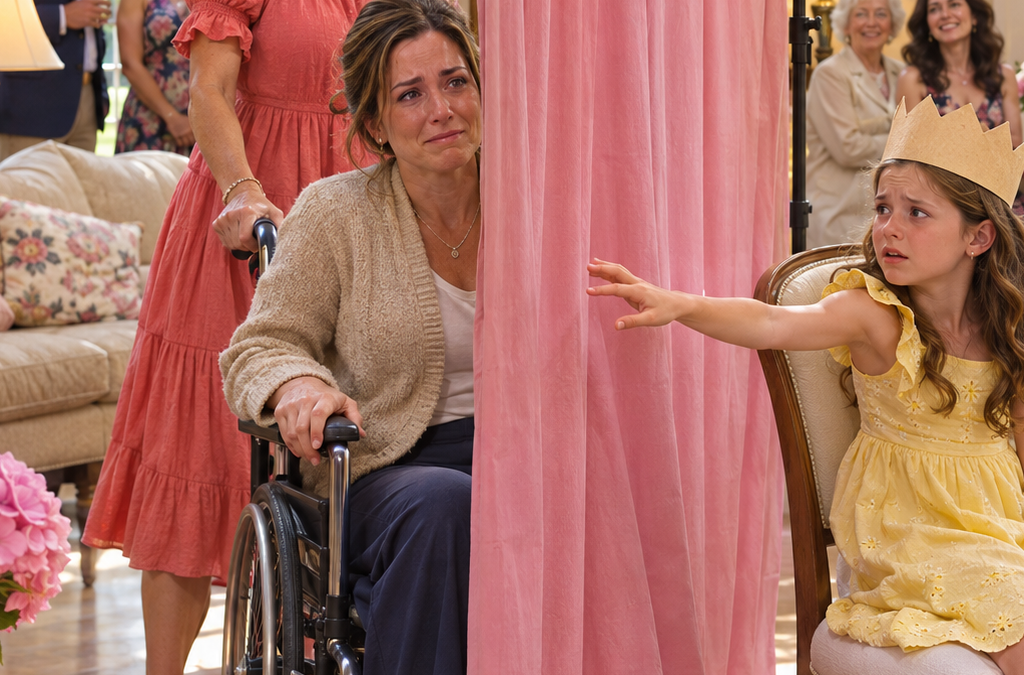
“Stay back there. You’re blocking the pictures.”—my sister said, rolling my wheelchair behind the birthday backdrop as our family gathered for cake.
Chapter 1 of 4
“Why are you moving me behind the curtain?” I asked.
My sister, Jessica Brooks, kept pushing while my daughter, Lily, reached backward from her birthday chair, her fingers stretching toward me beneath the pink fabric Jessica had ordered online.
Hip reconstruction had left me unable to stand safely for six weeks. Jessica knew that.
“Mark, are you really letting her hide me?”
My brother-in-law, Mark Brooks, looked toward the cake instead. Then he steadied the backdrop’s metal frame while Jessica rolled me past it.
“Let her finish the picture, Emily.”
Near his elbow lay the video camera he’d just returned. A folded napkin partly covered its screen.
Lily was turning eight. Six relatives were waiting for a picture, and I was apparently the thing delaying cake.
I’m Emily Carter. I’m forty-one, a single mother and an elementary-school media aide in Georgetown, Texas. I’m temporarily on medical leave.
Mom gave me the right to live there for life, and my sister signed that she knew.
Jessica owned Mom’s former house. That was different from deciding whether Lily and I could return to our home.
I knew what we’d signed, but I’d never needed the county copy. My family had mistaken that quiet trust for having nothing to say.
From my recovery chair, I’d cut every crooked letter for Lily’s birthday banner while she explained that eight deserved glitter because seven had been disappointingly plain.
I’d washed her favorite strawberries that morning. Before surgery, I’d repaired Mark’s family-video collection, rescuing clips he thought were lost.
I kept making things easy until nobody noticed what it cost.
Then the napkin slipped.
Grandma’s porch swing was missing from the camera’s little screen.
At first, I thought Mark had filmed from the wrong angle. He’d borrowed the camera to preserve views of Mom’s garden.
But I knew that porch.
Jessica moved Lily’s chair farther away from mine. Lily kept looking back instead of facing the relatives gathered near the couch.
The fabric brushed my knees as Jessica fastened its loose edge to the frame, closing the narrow opening where Lily had still been able to see my face.
I was humiliated, sitting beneath the banner I’d made.
“Stop making this about YOU!”
Jessica said it loudly enough that Lily flinched. Nobody had asked her to stop moving me.
Mark remained beside the frame. “We can move you back afterward, Emily.”
My daughter was watching him now, waiting for that to become an offer to move me back immediately.
“Are you keeping me hidden for my own daughter’s picture?”
Jessica looked straight at me through the remaining gap.
“Yes. Let us have one decent picture.”
Those words hurt more than the pushing.
For years, I’d helped Jessica arrange holidays around whatever bothered her. This time she wanted my daughter smiling while I sat out of sight.
“Then take it.”
I stopped reminding Lily to straighten her birthday crown. I stopped trying to make this look harmless for everyone watching.
And Jessica still couldn’t get her picture, because Lily wouldn’t turn around.
The camera screen glowed beyond the fabric. Mark had returned it with the playback screen open, and the image showed the empty space where Mom’s swing belonged.
“Lily, bring me Grandma’s camera, please.”
She brought it around the frame, and I pressed playback.
Mark crossed Mom’s porch onscreen. The picture steadied when he set the camera on the rail, with the swing and another man in view.
Ruth Bennett leaned closer and recognized him. Mom’s longtime friend worked in recording services at the Williamson County clerk’s office; she’d attended every birthday Mom hosted.
Ruth unhooked the backdrop before Jessica could stop her.
“Ruth, you’re ruining the whole picture,” Jessica protested.
“Her mother belongs beside her,” Ruth said.
Lily pulled her birthday chair beside my wheelchair. She settled the camera securely in my lap.
Onscreen, Mark and the other man lifted Mom’s swing.
“Jessica told David you weren’t coming home.”
Ruth was looking at me, not at the relatives waiting for cake.
Mark stepped toward my wheelchair.
Jessica’s smile disappeared.
Mark reached for Grandma’s camera before I could ask Ruth about David.
I turned the screen toward myself, away from Mark’s reaching fingers.
“David Miller bought the house,” Ruth told me.
I looked from the man carrying Mom’s swing onscreen to my sister beside the cake.
“You sold your mother’s house without telling me or Lily.”
Jessica gave the serving plate one last tap with the knife. Then her hand went still.
“Don’t start an argument at Lily’s party.”
“Then answer me, Jessica.”
She glanced at the relatives before saying she owned it. That was something Mom never finished.
Ruth stayed beside my chair. She didn’t dispute Jessica’s ownership or move aside for Mark.
Lily touched my sleeve and pointed out that Grandma’s older videos were still on the camera.
She’d seen the little pictures when Mark returned it. I told her we would keep them.
The recording kept playing beneath our voices. Mark told David to watch the porch step.
While I practiced getting safely out of bed, they had been emptying the place Lily and I called home.
Mark took the knife from Jessica, but the cake stayed untouched.
“Jessica told me you’d privately accepted a buyout.”
He sounded confused now, not irritated. I watched him look from me to her.
Mark lowered the knife beside the cake, his hand flat against the table.
Jessica swung toward him with her mouth open.
“Jessica, you told me Emily took the money.”
He hadn’t seen a payment. Jessica had told him there was an agreed payout connected to my surgery, and that I wanted the details kept private.
That was what he’d believed when he helped remove the swing.
“You don’t need every detail, Mark.”
“I needed that one,” he said.
I wanted to ask how long they’d been discussing my life without me. But Lily’s strawberries were warming beside an untouched birthday cake, and she was rubbing frosting from the edge of her plate with one finger.
“Lily hasn’t blown out her candles,” I said.
Jessica told us the cake would be dry if we waited much longer. It was such an ordinary complaint that I almost answered her ordinarily.
Instead, I asked Lily to make her wish.
Mark lit the candles. Jessica started the song, too loudly, and the relatives joined in from around the couch.
Lily stayed beside me.
Her birthday crown slipped over one eyebrow when she leaned forward. We’d taped it together at home, and she’d insisted the crooked point made it look more royal.
I held the edge clear of the candles.
She blew them out with one determined breath, then checked my face before she smiled. Seeing her do that hurt worse than being put behind the backdrop.
Mark served the cake without asking Jessica where each plate belonged. Ruth brought mine close enough that I could reach it.
Jessica said we could discuss everything later, once people weren’t upset.
I didn’t reassure her. I didn’t agree to move anywhere, either.
Lily ate the strawberries first, as she always did. For several minutes, she talked about whether her tongue had turned pink from the frosting.
I answered her and let the camera rest dark in my lap.
Then she leaned against my arm, careful of my hip.
“Aunt Jessica said I couldn’t come home with you.”
Chapter 2 of 4
“Aunt Jessica said wheelchairs couldn’t go where kids lived,” Lily told me at the dining table the next afternoon. “She said I’d get a permanent bedroom here. The yellow one.”
Jessica hadn’t asked which room Lily wanted. She’d told her I would be living somewhere children couldn’t stay.
I was angry enough to forget the six relatives in Jessica’s living room.
“My surgery didn’t end our family, honey. We’re going home together when I can move safely. You aren’t being sent away from me.”
Lily asked whether she should stop unpacking in the yellow room. I told her yes.
She stayed at the far end of the table with her drawing paper. Jessica kept colored pencils in an old gravy boat because, according to her, nobody in this house deserved homemade gravy.
Usually that made me laugh. That afternoon, I couldn’t.
“You’re making her anxious by refusing a practical solution,” Jessica said. “You can’t even carry her laundry. Who’s supposed to do everything?”
Mark sat beside her. The relatives who’d watched her hide me had come back because she wanted this settled.
“I needed help while I healed,” I said. “You told my child she was losing her mother. Those aren’t the same thing.”
Jessica looked toward Lily’s paper, then blamed me for discussing it where she could hear.
I lowered my voice. Lily already knew what Jessica had said. Making her wonder whether she’d caused trouble would only hurt her again.
“Why did you tell me she accepted $18,000?” Mark asked Jessica. “You said it was toward surgery. You said she’d agreed to leave the house.”
Jessica told him this wasn’t the time to bring up private money.
“No one offered me money,” I said. “I didn’t receive any.”
Mark watched me long enough that I felt ashamed for him. Yesterday he’d helped put me out of sight. Now he wanted me to help him understand why.
He said he’d helped remove the swing because he believed I approved the sale. He hadn’t seen anything I’d signed. When he asked about it, Jessica said I was embarrassed and wanted privacy.
“I drove Mom to appointments for six years,”
“You could have asked me,” I told him.
He said he should have. I wasn’t ready to make him feel better about that.
Jessica’s phone rang. David’s name appeared on the screen, and she let it ring until it stopped.
“I drove Mom to appointments for six years,” she said. “Six years, Emily. Now our foundation needs $58,000 in work, and somehow your plans still come first.”
The estimate was real. Mark had shown me the uneven floor near their back door before my surgery.
Jessica said Mom had given her the house, and she had every right to use what was left from selling it to protect this one.
“You always leave the hard part to me.”
It hurt because I had needed so much help lately. She knew exactly where to press.
I told her taking Lily during my hospital stay hadn’t given her permission to decide we would never live together again.
At the other end of the table, Lily asked whether roofs needed purple. I said ours could. She bent over her paper again.
Mark reported Ruth’s message without looking at Jessica. “The completed agreement is in the county’s public files under Emily Carter. Ruth said it was recorded.”
Jessica’s face changed. Until then, she’d spoken as though repeating herself would settle everything.
Her phone rang a second time. She ignored David again.
“That was a family draft,” she said. “If Mom filed it, fine. Emily moved out afterward. She wasn’t planning to keep using it.”
I reminded her that I’d left for surgery, with clothes packed for recovery. Lily’s books were still at home.
Jessica said Lily had been comfortable here until I started upsetting her. Mark stood, leaving the chair beside Jessica empty.
“Don’t use Lily to make this sound reasonable.”
He stayed standing near the doorway. He didn’t come beside me, but Jessica could no longer turn toward him and expect agreement.
I felt relieved, and hated how grateful I was for so little.
The third call came while Jessica was telling the relatives I’d misunderstood her. This time she answered. She listened, said she had never hidden anything, and ended the call without saying goodbye.
“He keeps bringing up the refund promise,” she said. “I signed it in case somebody still had a right to stay there that I hadn’t disclosed. This doesn’t count. It was a discarded draft.”
Nobody answered for her.
Then a message arrived. Jessica read it, her jaw working before she spoke.
She said David was bringing what she’d signed and wanted me there as the person still claiming the home. Mark and the relatives could hear it too. She agreed to the meeting, insisting I could finally put in writing that I’d moved on.
I was tired of hearing her describe a life I hadn’t chosen.
Jessica read David’s message aloud.
“Wednesday, your dining room. Emily and Ruth need to hear the promise you signed.”
Chapter 3 of 4
David put the sale contract between himself and Jessica at her dining table.
“Tell them again.”
He had come to settle the price he’d paid and hear from me. Mark stood near the doorway. The relatives who’d heard Jessica’s story occupied the other chairs.
“Of course, David. Emily moved out voluntarily,” Jessica said. “What Mom had us sign was an abandoned draft. We never meant it to keep going after she left.”
She sounded almost patient with him. I’d heard a different voice all week.
“You signed that it was final,” I said. “You knew I could live there for life. Why are you calling it a draft?”
Jessica turned toward me. Her patience ended there.
“You moved out. Stop pretending that means nothing.”
She acknowledged that her signature appeared on the county’s image. But filing something, she argued, couldn’t prove we still intended to live that way after I left.
I was furious that she kept turning my hospital stay into a choice. My wheelchair barely fit between her table and the wall.
Ruth brought out the certified copy I’d ordered through the county’s regular process.
“This is the completed text on file, naming Emily and matching the property,” she said. “I’m certifying the county copy, not deciding who owns the house.”
Jessica said that proved her point. Nobody had decided what my leaving meant.
I set Mom’s camera on the table and selected the older January clip. I told them to listen to what Jessica had called the arrangement before the sale money was involved.
Mark asked if he could play it. He crossed the room and sat beside me, leaving Jessica facing us.
Mark pressed play.
Mom’s kitchen appeared. She was behind the camera, asking whether the arrangement was final. Jessica sat where Mom usually peeled potatoes, beneath the cabinet door that never closed properly.
“Yes, Mom. It’s final. Emily stays for life, even if I sell.”
Hearing Mom’s voice hurt. I missed sitting in that kitchen while she complained that neither daughter could peel a potato without wasting half of it.
Jessica reached toward the camera. Mark kept it on the table.
“I helped take away the porch swing,” he said. “I won’t help hide another part of Emily’s home.”
Jessica told him he was making a show of himself. Then she said my move had made the arrangement unnecessary, whatever we’d intended back then.
“Did Emily sign anything giving it up?” David asked.
I said no.
“I’m keeping the house at the lower price. Emily stays. You owe me $63,900.”
He waited for Jessica. She mentioned the private understanding she’d described to Mark, but couldn’t produce anything I’d signed. Mark said the buyout story had come entirely from her.
“I did the caregiving,” Jessica said. “Emily, you know I did. That money was supposed to fix this house. You’ve seen the floor.”
I had. I also remembered how many appointments Jessica had driven Mom to. It hurt that she’d made those years into a reason Lily and I should lose our home.
“You promised this refund if the filed right existed and Emily hadn’t signed it away,” David said. “I’m keeping the house at the lower price. Emily stays. You owe me $63,900.”
Jessica asked whether he would wait until after the foundation work. He refused. She could return the money now or he would pursue the claim.
The money was still there. She hadn’t committed to the work.
Jessica called her bank and authorized the wire. Her voice became polite again while she answered their questions.
We waited through a return call and then longer for David’s confirmation. Outside, someone’s mower started and worked its way along the neighboring fence.
I was exhausted. Across the table, Jessica watched David’s phone as though he could make it show a different amount.
He checked the bank confirmation before addressing us.
“Jessica returned the full $63,900.”
Every dollar she’d received after the mortgage and selling expenses was gone.
Jessica stood so abruptly her chair struck the wall.
“Mark, get up. We’re leaving this discussion right now.”
He stayed beside me and said she could go without him. One relative asked me directly whether Lily’s things were still at home. For once, nobody waited for Jessica to answer first.
I said they were.
“I didn’t tell you because I expected to keep the money,” Jessica said. “There. Is that what you wanted? I thought you’d accept it once you were settled.”
I felt sick hearing how simple it had been for her. She’d pictured us somewhere else and treated that picture as permission.
“You don’t get to decide where my daughter belongs.”
Jessica said I was twisting what she meant. I didn’t argue about her meaning.
I told David that questions about the house needed to come directly to me. Then I told Jessica she would no longer manage my housing or speak privately to Lily about where we would live.
Mark asked whether I needed help getting home afterward. I said I did. I could accept that ride without pretending he hadn’t helped hide me.
David said there was one more thing I needed to see. Jessica had supplied an address for me when she sold the house.
He showed me Jessica’s own address beside my name, labeled “permanent home.”
Chapter 4 of 4
I gave David my own phone number and corrected the address before we left. Jessica’s house had been a temporary place to recover, not my permanent home. Writing it down hadn’t made her my representative.
“I’ll call you directly from now on,” David said. “You don’t need to send anything through your sister.”
When my surgeon cleared me to move safely on my own, Lily and I went home. David owned the house as an investment. I had the right to live there, and he wasn’t asking me to leave.
I cried that first evening. Lily’s library books were still beside her bed, beneath a shirt she’d rejected before my surgery.
“Can I leave these here?” she asked, holding up her sneakers. “Or do we still have to keep a bag packed?”
I told her she could unpack everything. Then I sat on her bed while she emptied the bag, including three socks that belonged to nobody we could identify.
Her backpack returned to its usual place by the kitchen doorway. I tripped over it once and complained, which made her grin.
For a while, she asked whether we would still be home after school. I answered every time. It hurt that she needed to check.
“Jessica wants me to explain about the foundation,” Mark told me during a call. “I told her she can speak for herself. I’m done carrying messages.”
The work hadn’t started. Without the sale money, they couldn’t commit to the estimate. Mark didn’t ask me to feel guilty about that.
A few weeks after the confrontation, he took a six-month apartment lease. He said he needed somewhere Jessica couldn’t answer every question for him.
He didn’t announce a divorce, and I didn’t ask him to predict one.
“I should have moved you back before anybody had to ask,” he said. “At the party. I keep thinking about standing there holding that frame.”
I told him I remembered it too. He stayed on the phone without explaining himself away.
After that, I let him visit separately. He asked me first, accepted no when I was tired, and never asked Lily to tell him he was good.
I felt safer with that than with another apology.
On November 18, Jessica paid the $2,400 we’d agreed on in writing. It covered the temporary lodging and accessible rides I’d documented. We had settled the amount between us; Ruth hadn’t imposed a penalty.
“Received,” I wrote back. “That covers the expenses we agreed on.”
I didn’t add that everything was fine. My thumb hovered over the screen out of habit, ready to soften the message, but I left it alone.
Jessica called later. I answered in the kitchen while Lily worked on homework elsewhere.
“Tell Lily the birthday thing was a misunderstanding,” she said. “She barely talks when I call now. You could help instead of letting her think I’m awful.”
I was angry, but I kept my voice low. My daughter had spent enough time listening to adults argue about what she had plainly seen.
“I won’t tell her she misunderstood,” I said. “You moved me behind the backdrop. You told her we couldn’t go home together. She doesn’t have to fix that for you.”
Jessica said I was making it impossible to be her aunt.
I told her visits required my invitation and my presence. She could ask how Lily’s day went. She could not discuss our housing, promise another bedroom, or make arrangements for us.
“Mark gets to come over, though. After what he did?”
“He asks me first,” I said. “And he hasn’t asked me to change Lily’s memory.”
“For next year. We need to find out how much frosting is too much.”
She ended the call. I was sad afterward. I still wanted a sister I could call without preparing myself, but wanting that didn’t make this conversation different.
By then, I no longer needed the wheelchair around the house. I still tired easily, and putting on shoes required more planning than I liked.
When an invitation came for another family gathering, I declined. Nothing was wrong with the afternoon we already had.
“Can we practice birthday cake?” Lily asked. “For next year. We need to find out how much frosting is too much.”
About ten weeks had passed since the dining-table meeting. We were home in Georgetown, Texas, with an ordinary afternoon free.
We used a box mix. Lily insisted we leave the frosting uneven so the experiment would be fair. She named the tallest lump Mount Toothache.
I laughed until my hip reminded me to sit down.
“Get Grandma’s camera,” she said. “We should film the results. But you have to be in it, too.”
I set the camera where it could see both chairs and checked the little screen. Lily waited beside the lopsided cake, leaving room for me.
Being family didn’t give anyone permission to make us disappear.
I pressed record and stayed beside my daughter.







