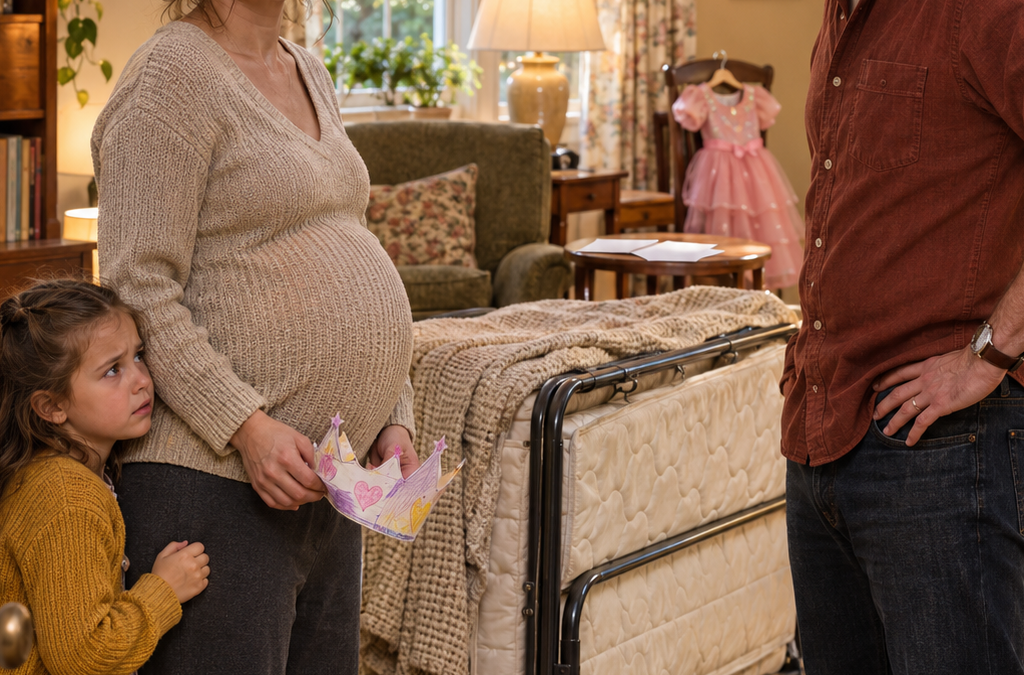
“Sign it, then you can lie down,” my husband said, folding away my sofa bed while I stood pregnant, holding our daughter’s unfinished birthday crown.
Chapter 1 of 4
“Are you really taking away my bed?” I asked.
My husband, Eric Dawson, shoved the mattress down into its frame. Our daughter, Mia, stood beside me, five years old until tomorrow, waiting for her crown fitting.
He pointed toward the agreement on the side table. “Sign it, then you can lie down.”
“Mom, are you going to let him do this?”
My mother, Susan Carter, looked down at her knees while Mia leaned against my leg, careful of the paper crown I had spent the afternoon cutting for her.
Eric’s father, Frank Dawson, answered instead. “You’ve made this harder than it needs to be.”
An unfamiliar envelope lay beside his tea.
Those words hurt more than Eric’s order. Mom knew how badly my back hurt.
My name is Rachel Carter. I’m thirty-two, and I live in Sacramento, California. At the time, I was twenty-eight weeks pregnant with our second child.
Our marriage produced $286,000 in our life savings.
I worked as a payroll coordinator and had helped reconcile payroll for Dawson Repair, but Eric assumed I had stopped following our savings when I stopped helping with his business.
He’d told me the savings were gone. I didn’t believe him.
Mia’s birthday dress hung over a chair, its torn hem repaired. Frank’s preferred tea was already steeped. The blanket on the sofa smelled of the detergent I’d used that morning.
And I’d done what I usually did: made everyone comfortable before asking for anything.
Beside Mia’s crown template sat an envelope labeled “Dad’s loan.”
Then Eric laid the proposed agreement across the cushion where I would have sat.
We had separated but still shared this rented house. The bedroom had become his; the foldout was where I slept. Nothing about refusing his terms made it less my home.
But he stood between me and the mattress, watching as I shifted my weight from one aching foot to the other while Mia waited with her birthday dress behind her.
The agreement was unsigned. He wanted my claim to the savings gone before he would let me rest.
“Just SIGN the damn thing!”
Mia pressed closer against me, and I hated that she had to hear it.
“You’re keeping my bed folded until I sign?”
“You can stand there all night if you want.”
Frank told me to quit making a scene. He sounded irritated, as if I’d delayed dinner instead of asked for somewhere to sleep.
“Then it stays unsigned.”
I stepped into the doorway with Mia beside me. We were still in the living room, still visible to everyone who had watched him fold my bed away.
And nobody offered me a chair.
The crown had bent where my fingers gripped it. I loosened them before the paper tore.
Tomorrow was supposed to belong to Mia. She wanted cat-shaped pancakes; mine always looked like potatoes with ears.
I called Eric’s aunt, Linda Brooks. She was already outside with the birthday decorations.
I told her Eric had folded my bed and wanted my signature.
“Eric says your savings were a debt to Frank.”
I asked if he’d told her the money belonged to Frank. She confirmed it. Until then, I hadn’t known his story.
Linda came through the doorway with her decorations and sewing pouch. Mia moved aside.
Linda set the decorations beside Mia’s dress and pulled the agreement off the cushion.
Eric stepped toward her. “This is my home.”
“Eric, I counted those savings with Rachel.”
His mouth stayed open. Behind him, Mom kept looking at her knees.
Linda unfolded the mattress and freed the blanket. Frank’s teacup struck its saucer.
The sewing pouch caught against the metal frame.
Frank went still, his fingers tight around the cup.
Linda’s brass storage key fell into my hand; Frank reached for it.
Linda blocked Frank’s hand with her forearm. I kept the key in my palm.
“You sent our savings to Frank, then told me we were broke.”
Eric shoved the crown template off the agreement without looking at me.
It slid beneath the side table, beside Mia’s waiting dress shoes.
“Dad was owed that money. You know that.”
“That doesn’t make Rachel broke,” Linda said.
Frank leaned toward her. “You need to stop interfering.”
He no longer sounded bored. His fingers stayed curled above his cup.
Linda told me the key opened her storage unit, number fourteen.
Her party supplies were there, along with books from Dawson Repair.
She’d been its bookkeeper, allowed to keep those boxes after the office clear-out.
She remembered packing the old handwritten ledger, but hadn’t checked lately.
Eric turned toward Mom before I could ask Linda anything else.
He said she knew how I’d been lately. She needed to tell Linda before I embarrassed everybody.
Mom reached for her phone, and I thought she was checking for a ride.
I’d bought her that pale blue case to find in her purse.
“Read what Rachel sent you,” Eric said.
Mom’s thumb stopped above the screen. He kept waiting.
Eric pointed at her phone.
Mom flinched, unlocked it, and looked straight at me.
“Eric, you promised Rachel would never see these messages,” Mom said.
She had forwarded him messages I’d sent about being exhausted during pregnancy. He’d said he wanted to help, to get the family to understand why I needed fewer chores.
Instead, he’d been telling relatives I couldn’t manage money.
The messages were mine. The meaning he’d given them wasn’t. A complaint about falling asleep after work had become a reason I shouldn’t be trusted with our savings.
I felt humiliated, standing there with my mother holding the words I’d sent when I needed her.
“Those were for you, Mom.”
She couldn’t answer me yet. Her eyes moved from my face to the screen, and Eric started explaining for her.
He said everyone was worried. He said I should be grateful somebody was paying attention.
“I’m not discussing my health as a bargain.”
I sat on the reopened bed. Mia climbed beside me, bringing the bent crown, and rested it across both our knees.
Nobody asked her to move.
Linda said I could look through her storage boxes and keep the key until I was finished. She wasn’t certain the book I needed had survived the clear-out, but I had her permission to check.
I accepted. There was no need to tell Eric anything else.
Then Mom lowered her phone, and for a moment I thought she might come sit beside us. I left space for her on the mattress.
Eric stepped between us. He took Susan’s phone and placed it on the unsigned agreement.
“Your mother already agreed to testify.”
Chapter 2 of 4
Four days later, I faced Mom and Eric in our living room. Frank sat beside Eric, and Linda stood near the doorway.
“I agreed to describe how tired you were,” Mom said. “I forwarded three private messages. He said the family would take over chores. I never said you couldn’t manage your life.”
Mia was in the kitchen with her headphones on, coloring beside the open doorway. Her birthday had happened as promised. Now she was drawing thank-you pictures, giving every person purple hair.
“Then tell the judge what she wrote,” Eric said. “That’s all I’m asking you to do.”
Mom looked toward the kitchen before answering. Linda moved where she could keep Mia in sight.
I felt exposed again. Those messages had been written after work, when even taking off my shoes felt difficult.
“Stop discussing my body like I’m not sitting here,” I said.
Eric told me nobody was discussing my body. We were discussing whether I could make sensible decisions. He sounded annoyed that I couldn’t understand the difference.
Mom watched him say it. This time, she didn’t look away.
I asked her whose comfort she had protected by staying quiet. She started to answer, then stopped when Eric leaned forward.
“Rachel wants money she’ll burn through before the baby comes,” he said. “She barely sleeps. She forgets things. I’m trying to keep a home for these kids.”
I had forgotten laundry in the washer once that week. He had brought it up twice already.
It hurt to hear ordinary exhaustion turned into a warning about me. I still got up for work. Mia still had clean clothes.
Eric had been talking about a $480,000 house, somewhere with a garage big enough for his repair equipment. He spoke about it as the children’s future, although he never asked what kind of home I wanted.
Now he said losing $143,000 would ruin that plan. He used “losing” for the half I might ordinarily receive.
“You asked me to help her rest, not help you corner her.”
“Being tired didn’t make my money yours.”
He gave a short laugh and told Mom this was what he dealt with. Frank nodded beside him.
Mom laid her phone facedown next to Eric.
“You asked me to help her rest, not help you corner her.”
Then she took the empty seat beside me. I had wanted her there so badly the other night. Now I kept my eyes on Mia’s purple-haired people through the doorway.
Mom offered us her spare room. She said we could stay while I figured things out, and Mia wouldn’t have to change schools.
I was relieved, but I wasn’t ready to thank her. She had given Eric words I could never take back from him.
“You don’t get to send him anything else,” I said. “Even if he says he’s worried. Ask me first.”
She said she understood. There was no excuse afterward, no reminder that she had meant well.
Eric turned to Frank and said Mom was getting carried away. Frank told her she was making a private disagreement worse.
Linda stayed near the kitchen. Mia held up a picture, and Linda nodded at it before turning back toward us.
“I remember the full $286,000,” I said. “I kept those totals for eight years. You don’t get to tell me there was nothing.”
Eric’s expression changed when I said the number. Until then, he had talked as though I knew only that we once had savings.
He stopped explaining what I might waste. Instead, he said Frank had supplied the money, and seeing a balance didn’t make it mine.
“Dad helped us when we needed it,” Eric said. “You don’t get to keep his money because you remember a number.”
Frank backed him immediately. He said the old office books had been thrown away anyway, as though that settled what I could remember.
I was furious at how easily they changed the story. Neither looked embarrassed.
My attorney, Anna Miller, had obtained the necessary bank records. The court would hear the disputed money issue.
“I may have to speak about what I remember,” Linda said.
Frank turned on her. “Stay out of my son’s marriage, Linda. You’ve done enough.”
She didn’t leave her place by the kitchen. Mom stayed beside me, too.
Eric’s hearing notice lay on the table. He had brought it into the room complaining about the expense, before Mom had even sat down.
It named Thursday, April 9, at Sacramento family court. Eric and I were expected there, along with Frank, Mom, and Linda.
He picked it up again when Linda mentioned speaking. His eyes moved farther down the page this time, past the part he had already complained about.
I felt afraid watching him read. Mom’s knee rested against mine, and she didn’t move it away.
Eric turned the hearing notice toward Linda. He looked at her, then turned it toward Frank.
“They’ve named Linda as a witness.”
Chapter 3 of 4
Eric repeated his story before both families in Sacramento family court. The returned money belonged to Frank, he said. I was confusing an account balance with ownership.
Linda sat beside Mom. Frank sat behind Eric, close enough to lean forward without leaving his chair.
Eric’s attorney, Brian Reed, questioned what Linda’s old bookkeeping knowledge could establish about recent transfers. That morning, with Linda’s permission, I had retrieved the old ledger from her storage archive and brought it with the brass key.
I was thirty-six weeks pregnant. Getting comfortable in the courtroom chair had become impossible.
“He told me the savings were gone,” I said. “But the whole $286,000 came back to his account after we separated. He still had it when he told me there was nothing.”
The records had come directly from the bank under subpoena. They showed the money leaving Eric’s account, passing through Frank’s, and returning a week later.
Eric watched me rather than the pages. I felt afraid, but I knew those totals. I had checked them through eight years of our marriage.
“Dad lent it back,” Eric said. “I paid what I owed him, and then he helped me again. Rachel doesn’t get my father’s money because it passed through my account.”
Brian called it a genuine ownership dispute. He said the transfers alone didn’t prove that Frank had no claim.
That was the explanation Eric had prepared. He wasn’t denying where the money sat anymore.
Judge David Hill looked toward him. “What did your father call that return when he recorded it?”
Eric turned toward Frank. His face had the same expectant look he used whenever his father could settle an argument.
I handed over the original book when the judge allowed me to identify it. Frank’s cramped numbers crowded against the margin.
“The January 19 entry,” I said. “He wrote that he returned the house reserve. He put both our initials there. Eric and Rachel.”
“But that’s shorthand. I wasn’t writing it for somebody to pick apart in court.”
The entry came after our separation. It described returned house savings, not a new advance from Frank.
I had been scared the book wouldn’t be there. Now I felt angry looking at those ordinary words. Frank had called it ours when he thought I would never read it.
Linda identified his handwriting from twelve years of keeping the business books. She knew his capital R and the way he squeezed an extra word above a line.
“That’s my book, yes,” Frank said. “But that’s shorthand. I wasn’t writing it for somebody to pick apart in court.”
The bank records already traced the reserve’s growth from our earnings. His book matched that history, even though it couldn’t answer every question by itself.
“Why would you call a new loan a return of our reserve?” I asked.
Frank pushed his chair back. He started telling Eric that Linda knew better than to bring old business books into this.
Judge Hill stopped him and told him to address the court.
Eric’s eyes stayed on his father. Frank hadn’t supplied the answer he needed. I felt relieved, though my back still hurt against the chair.
“The entry and the bank trail are enough to protect this money now,” Judge Hill said. “The final ownership and concealment questions still have to be decided.”
He ordered Eric to provide complete, renewed financial disclosure. Then he barred him from withdrawing or transferring any of the reserve on his own, effective immediately.
Eric had walked in with sole withdrawal access to $286,000. He no longer had it.
Anna Miller, my attorney, confirmed that the entered order would be transmitted to the bank. The money would stay intact while the remaining questions were heard.
“You’ve wrecked the house plan,” Eric told me, standing. “You know what this does to the kids. You couldn’t leave one thing alone.”
Brian told him to sit. Eric remained halfway out of his chair, looking past him at me.
“My rest was never yours to sell.”
I was shaking now. Saying it hadn’t made me comfortable. I wanted somewhere to lie down, and I wanted Mia nowhere near this conversation.
Mom stood beside Linda. “I won’t support that story you told about Rachel. She asked me for help because she was tired. You made it into something else.”
The judge called a recess. Chairs scraped behind us as Linda crossed to my side. Frank remained standing, his mouth partly open.
Eric reached toward Linda’s sleeve, then stopped before touching it. Brian told him again to sit down.
I told Eric that money discussions would go through our attorneys. Anything practical about Mia needed to stay in writing. He started to object, but I left with Mom and Linda.
Outside the courtroom, Mom asked whether I could manage a few more steps. She had moved her spare bed into the downstairs room, she explained, so I wouldn’t need the stairs.
For weeks, sleep had meant waiting until Eric finished making his point. I felt exhausted enough to cry at the thought of a bed already waiting.
“Your bed is downstairs now. Mia’s can go beside it.”
Chapter 4 of 4
At Mom’s house, I lay down while Mia read beside me. She skipped the longer words, then invented better ones when I couldn’t help.
“Grandma said you can lie down before dinner,” she told me. “I’ll read the rest. This dog has a job, but I don’t know what it is.”
I still expected someone to need an explanation. Mom came to the doorway, saw us settled, and went back to the kitchen.
She didn’t ask to inspect my messages. When Eric asked how I was doing, she told him to ask me.
I felt relieved, then embarrassed by how much that small change mattered. I slept through Mia’s version of the dog’s employment.
Four weeks later, Noah was born. Mom stayed with Mia, and Linda brought them both to meet him.
“He has your ears,” Mia announced. “Dad’s ears stick out more. Can I tell him that, or will he get mad?”
I told her she could tell her father about her brother. She didn’t need to manage his feelings.
Eric received practical updates about Noah’s feeding, appointments, and weight. I answered questions about the children, but left questions about my spending unanswered.
I was exhausted and happy. Sometimes both feelings arrived while I stood beside the washing machine, unable to remember whether I’d added soap.
“Did he sleep?” Mom would ask. When I said no, she took Noah after his feeding and told me breakfast would keep.
I didn’t forgive her all at once. I watched what she did with the chances I gave her.
Through the summer, Eric kept contesting the money. There were more records, more answers demanded, and another hearing before anything was final.
On August 13, the court found that Eric had deliberately concealed the reserve. Under California’s remedy for concealed marital assets, Judge Hill awarded me the entire $286,000 and ordered Eric to contribute $8,400 toward my attorney’s fees.
When the transfer reached my account, I checked the amount twice. The fee payment followed separately.
I felt safe enough to make plans, although I still woke worried. I kept working and began looking for a modest rental near Mia’s school.
“Tell Dad this was a misunderstanding,” Eric wrote. “He thinks you made him look dishonest. You know what he was trying to do.”
Four messages arrived, each asking me to give Frank a kinder explanation. None asked what their explanation had cost me.
I sent one response directing all financial matters to Anna Miller. I didn’t send a second.
Our parenting messages stayed written and covered schedules, health, and school. Eric still saw the children. I stopped using those exchanges to argue about our marriage.
“Can I send Linda this picture?” Mom asked one afternoon. Noah was asleep against my shoulder, and my shirt was stained. “Just Linda, nobody else.”
I said no. Mom put her phone away and asked whether I wanted lunch.
“The snowmen look like they’re yelling. Grandma made their mouths too big.”
That was how trust began coming back. She asked again on another day instead of deciding one refusal meant she could never ask.
Three months later, Noah was six months old, and we lived in a small rented home in Sacramento. Most of the recovered savings remained untouched.
The living room barely fit our sofa and Mia’s drawing table. I liked being able to see both children from the kitchen.
“I want the snowflakes, not the snowmen,” Mia said as we sorted winter decorations. “The snowmen look like they’re yelling. Grandma made their mouths too big.”
Noah napped in his crib down the hall. Mia had taped a sign nearby that read BABY WORKING, because sleeping was apparently his job.
I laughed, then felt tired enough to stop. A basket of clean laundry waited beside the sofa, half folded.
Mom was coming later with groceries. She had asked what we needed instead of buying what she thought we should eat.
“Can we finish the laundry after?” Mia asked. “You can sit while I pick. I know which box they’re in.”
I left the towels where they were and rested on my own sofa. Nobody needed my signature, an apology, or a reason.
It still hurt when I remembered standing beside that folded bed. I no longer had to stand there.
Nobody in a family should have to purchase permission to rest.
When Mia needed the decoration box, I got up to open our small storage cabinet. With Linda’s permission, I’d made the old brass key the pull on its replacement latch.
Linda’s storage lock had since been replaced. This key had one small job now, within Mia’s reach.
She waited beside me, considering the paper snowflakes and the loud-looking snowmen.
I lifted the brass key, and Mia chose the decorations.







