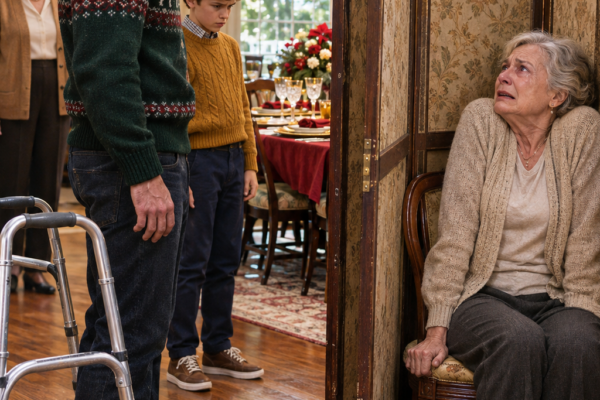
For 23 years I washed Mom’s ink screens for free and packed her orders at night after my diner shift, then scrubbed the sink before I went home. At her 60th birthday before 61 guests, she gave my brother the craft shop she’d promised me. “Waitresses can’t create anything.” I said, “I kept what I created.” 4 years later…
“Waitresses can’t create anything.”
My mother, Gloria, said it at her sixtieth birthday party.
She looked at my uniform shoes before she said it.
Sixty-one guests heard her in that rented hall in Decorah.
My aunt Linda studied her plate, her napkin folded twice.
Her daughter, Claire, stopped scraping frosting with her fork.
My brother turned the shop keys between his fingers.
I was Monica, and I was thirty-eight that year.
Four years later, Mom stopped behind an empty chair in a library meeting room, her coat still buttoned.
“Just tell her you made them for the shop,” Mom said, stopping behind the empty chair.
Evan stood beside her with a cardboard box against his good shirt, holding it carefully enough to keep its corners from brushing the table.
Across from me, Dana moved a water pitcher to make room.
Dana was forty-seven, with twelve years as an acquisitions director behind her, and she aligned the samples beside her notebook before looking up.
I kept my hands beside my own notebook, where everyone could see them.
Nobody had asked me to sign anything yet.
“We’ve already explained the family arrangement,” Mom said. “This should only take a minute.”
I had turned forty-two that year, and I had worked diner tables in Decorah for twenty-four years.
Beside my chair sat the blue folder I had prepared before leaving home.
I would come back to that folder, though Mom hadn’t asked what I had brought.
For the moment, she stayed behind the empty chair, waiting for me to make things easier.
That had been my place long before there were meeting rooms.
In 1999, when I was fifteen, my place was the shop sink.
Mom had just opened her craft shop then.
Twenty-seven years later, she still picked at her watchband whenever a question required an answer she didn’t want to give.
Back then, she wore that watch over a dusting of dried ink.
The shop occupied a narrow storefront with a stubborn back door.
Cards filled wooden racks near the front window.
Behind a curtain, ink screens leaned against the wall.
The sink stood beyond those, beneath a shelf of cleaning supplies.
I could see the sales counter through the curtain’s gap.
Customers couldn’t see much of me.
After school, I left my backpack under the worktable.
Mom usually had a list waiting beside the faucet.
Rinse screens.
Count envelopes.
Pack orders.
Clean up.
The last item meant more than the other three together.
Ink collected around the drain and underneath my fingernails.
I worked it loose while Mom counted the register.
She counted once and closed the drawer.
I counted everything twice, even then.
If an order needed six cards, I counted six going into the sleeve and six again through the clear plastic.
A missing card meant opening the package after the glue dried.
That was always my job, too.
Evan was twelve when the shop opened.
He sat near the counter doing homework while I washed.
Mom said the fumes bothered him.
Sometimes he held his shirt over his nose, watching me scrub.
His chore was carrying flattened boxes to the back door.
He left them leaning there for somebody else to take outside.
Years later, he spent twelve years working as a delivery clerk.
By our library meeting, he had also spent four as shop proprietor.
Even as a boy, he liked handling keys.
He would borrow Mom’s ring and turn it between his fingers, trying each key against his palm.
Mom called that taking an interest in the business.
When I memorized which ink washed out cold, she called it helping.
Ruth came on closing nights with a pencil and a calculator.
She was Mom’s cousin, not an employee anybody introduced that way.
She eventually retired after twenty-six years as a bookkeeper, but she kept helping Mom.
Receipts bothered her if their edges didn’t line up.
She straightened every stack before adding the figures.
Once, she moved a wet screen so her papers wouldn’t get splashed.
Then she put it back beside my elbow.
Nobody asked whether I had homework left.
Aunt Linda sometimes stopped after her school office closed.
She spent thirty years as a school secretary.
At the shop, she folded tissue paper as neatly as the napkins she folded at family meals.
Her daughter Claire sorted envelopes during school breaks.
Claire later became a dental assistant, accustomed to handing people what they needed before they asked.
At our family tables, she scraped frosting off cake.
At the shop, she scraped dried glue from her fingertips.
When Linda announced they needed to get home, Mom thanked them.
Their coats came off the hooks.
Their purses went over their shoulders.
I stayed at the sink.
Mom kept a little dish of price stickers beside the register.
One evening, I watched her mark a bundle $12.
I had trimmed its corners and wrapped its ribbon.
She turned it toward the window so the bow showed.
My wet reflection showed behind it in the dark glass.
That was how I appeared in the shop most evenings: behind something ready for sale.
At eighteen, I started waiting tables.
The diner paid me for hours I could write down.
I learned to balance plates along my forearm.
I learned which regulars wanted coffee before they sat.
After my shift, I changed aprons and went to Mom’s.
Sometimes I ate supper standing beside an open order box.
Mom slid the packing list away from my sandwich.
“Don’t get grease on that.”
I put the sandwich back in its paper.
By then, the work no longer needed explaining.
I knew where every sleeve, stamp, and spare roll belonged.
I could tell which screen needed another rinse by touch.
Mom locked the register and checked the front door.
Evan followed her, asking whether they could stop for food.
Ruth gathered her straightened receipts.
I heard their goodbyes through the curtain.
Then I scrubbed the basin until no color remained.
I shook the water from my fingers.
With my hands still wet, I switched off the shop light.
By nineteen, I kept my car money in a savings account.
The balance was $740 when Mom’s front window broke.
I had been looking at used cars on diner breaks.
I folded the listings small enough to fit my apron.
Most cost more than I had, but I kept looking.
A car meant getting home without waiting for somebody else’s shift.
It meant groceries without bags cutting into my fingers.
That spring, rain had soaked through my shoes twice.
Mom called while I was counting my tips at home.
She needed the window replaced before the shop reopened.
Her voice made it sound like a problem we shared.
I went over with the bank envelope in my purse.
Cardboard covered the glass, making the sales floor look closed.
Mom stood behind the register with the repair estimate.
She tapped its bottom edge against the counter.
“I’ll put it back when things pick up.”
I asked whether she meant after the next holiday orders.
She looked past me at the covered window.
I took the envelope out and counted the money twice.
There were bills I remembered earning from particular tables.
I pushed them across the counter in one flat stack.
Mom tucked the money under the estimate without counting it.
For a moment, I kept my palm on the envelope.
I told her I had nearly enough for a car.
Her thumbnail pressed into the crease of her watchband.
“You can walk a few more months,” she’d said.
Then she asked whether I could stay and sort sleeves.
I stayed until the stack reached the worktable’s edge.
Outside, I put the empty envelope back in my purse.
My walk home passed the diner and two car lots.
I stopped looking through the windshields that evening.
At home, I opened the notebook where I tracked tips.
I wrote the date, the window, and $740.
I used the word loan because that was what it was.
A week later, sunlight filled the shop again.
Mom arranged new cards where the cardboard had been.
She asked me to move a rack away from the glass.
I mentioned the money while we lifted opposite ends.
She told me sales hadn’t caught up with expenses yet.
The rack settled crooked, and I adjusted my end.
By summer, she wanted to wait until fall.
By fall, Christmas stock had to come first.
I stopped asking while customers were within hearing.
Eventually I asked only when we were alone.
Those chances usually came while I was cleaning.
Mom could leave a conversation before I could leave the sink.
I still walked to work when the weather allowed.
When it didn’t, I paid for rides from my tips.
I rebuilt my savings without crossing out the original entry.
Her window stayed clear through every season.
The $740 stayed on my page.
At twenty-eight, I gave the shop three weekends before Christmas.
Those were weekends after a full week of diner shifts.
Mom had taken orders for cards, tags, and boxed assortments.
She needed 312 packages ready for pickup or delivery.
I wrote that number at the top of the packing sheet.
It seemed manageable before I began checking the addresses.
Some orders needed matching envelopes; others needed ribbon or sleeves.
I made separate stacks so nothing could slide between them.
The first Saturday, I ate supper from a container beside the tape.
By the second weekend, paper cuts caught on my dishcloth.
On the third, I brought my cardigan for the back room.
Mom kept the front comfortable for customers.
Behind the curtain, cold came up through the floor.
Evan arrived to collect deliveries with his keys already out.
He was twenty-five and liked the part involving the car.
I arranged his boxes in the order of his stops.
He checked the addresses against my list, then lifted them.
Mom paid him before he left on the final run.
I saw her count bills into an envelope by the register.
She wrote his name across the front.
He put it in his jacket without opening it.
I looked back at the packages still waiting for labels.
Nobody had discussed an hourly rate with me.
Still, three weekends and 312 orders seemed hard to overlook.
I kept the packing sheet after the last box left.
Each line had my check mark beside it.
Mom said she had something for me before I went.
She handed me an envelope with my name on it.
I held it carefully because she had sealed the flap.
There was no weight to it beyond the paper.
Inside was a thank-you card from the shop rack.
Mom had written that she couldn’t have managed without me.
I checked behind the card before I could stop myself.
She watched from the register, one hand on the drawer.
I asked whether there was supposed to be anything else.
“We don’t need to pay each other. We’re family.”
Evan’s envelope had disappeared into his coat ten minutes earlier.
I put the card back without mentioning his name.
Mom asked me to rinse the screens before leaving.
The packed orders were gone, but the sink was full.
I washed each frame and stood it on its edge.
Then I cleaned the tape scraps off the worktable.
My packing sheet lay under the last empty sleeve.
I folded it and took it with the card.
At home, I set both beside my notebook.
I could count the packages and the weekends.
I had never agreed on a price for those hours.
The car money was different: she had borrowed it.
I wrote $740 outstanding beneath the old entry.
I did not turn every family evening into a bill.
That left plenty I couldn’t put in the total.
My first rule went on the next clean line.
Praise wasn’t payment, even when it came in an envelope.
I slid the card free and laid it beside the notebook.
Then I put the empty envelope behind the original loan entry.
I kept drawing on the backs of my grocery lists.
Most attempts stayed folded in my apron until laundry day.
Helen found one beside the diner register after breakfast.
It showed a spoon resting across a chipped cup.
She waited until I finished counting a customer’s change twice.
Then she asked whether I had meant the handle to bend.
I hadn’t, but I could see it now.
Helen had taught art for thirty-one years before retiring.
She labeled every cable she owned, including her lamp cord.
When she offered to help, I expected worksheets.
Instead, she put a spoon on my kitchen table.
“Draw the space underneath it first.”
I kept looking at the spoon instead of the paper.
She moved my pencil toward the small shadow beneath it.
We worked until the handle stopped looking broken.
After that, she came by when our schedules allowed.
She brought watercolor pans and made me supply the water.
I learned to leave white paper where light belonged.
Too much brushing turned the colors muddy.
Helen made me wait until each wash dried.
That was harder than washing screens or counting envelopes.
At the shop, finishing quickly meant another task.
At my table, stopping sometimes saved the whole drawing.
I practiced with things already lying around my apartment.
A bent clothespin gave me three evenings of trouble.
I drew its spring until the halves finally lined up.
Helen showed me a scanner at her house.
Every cord had a label facing out.
We scanned at 300 dpi for the intended print size.
Then we compared a printed proof with the original.
The first red came out too orange.
I adjusted the file, printed again, and checked in daylight.
It took four proofs before the bird looked right.
I saved the unchanged scan separately from my corrections.
Helen stood beside me until I named both files properly.
By then, I made twelve birthday cards each year.
They went to homebound customers from the diner.
I kept their birthdays in the back of my notebook.
Some could no longer manage the front steps alone.
I delivered their cards after work and stayed a little.
There was no price written beside those twelve names.
That was work I had chosen to give away.
The first drawing I sold was a different one.
A diner customer named Beth liked its crooked kitchen shelf.
Beth mended her coat cuffs with bright blue thread.
She paid $36 and asked me to sign the bottom.
I counted the bills twice after she left.
Then I wrote “drawing” beside the amount in my notebook.
It wasn’t a tip, and it wasn’t shop money.
In 2019, when I was thirty-five, Mom called me over.
Ruth was at the counter straightening a stack of receipts.
Christmas order forms lay beneath her calculator.
Mom wanted more evenings than I had been giving her.
I stood with my work shoes still on.
She said the shop would be mine when she stepped back.
I asked her whether she meant ownership, not more hours.
“You’ve earned it,” she’d said. “Keep helping me get through Christmas.”
Ruth looked up from the receipts.
Mom kept her eyes on me until I nodded.
I wrote the date down when I got home.
For weeks afterward, I fitted shop work around the diner.
I packed cards while my supper cooled in its container.
At home, I drew before washing my own dishes.
That November, my apartment radiator quit.
I wore my coat at the table until it was repaired.
The chipped enamel cup beside the sink held my pencils.
I emptied it, turned its damaged side toward me, and drew a cardinal perched along the rim.
The handle was uneven in the drawing because the handle itself was uneven.
After the heat came back, I painted mittens above the radiator.
Then I drew a wren tucked inside my clothespin basket.
I bought the pencils and paper from my own pay.
I dated the sketches before putting them away.
Mom saw the cardinal when she brought over packing supplies.
She lifted it by the corners and held it upright.
“That would sell on a card.”
I reached for it before she could stack anything on top.
She wanted files she could send to her printer.
This time, I didn’t bring the drawings to the shop.
I brought two copies of a short agreement instead.
Helen had helped me make a list of questions.
I checked sample agreements at the public library.
The finished page named the three drawings individually.
It let Mom’s shop print the images on cards and sell those cards at retail.
It did not transfer my originals or my copyrights.
Permission to license them to outside manufacturers was expressly excluded.
I read that part twice before taking it over.
Mom picked at her watchband while I explained the page.
“It’s cards, Monica. That’s all I’m asking for.”
“Then this covers what you need.”
Ruth moved her receipts so Mom had room to sign.
Mom signed both copies, then slid one toward me.
I put mine in my purse before discussing the files.
Preparing them would take more than pushing a scanner button.
Mom agreed to pay $180 for that separate job.
I asked her to write it down.
She wrote the amount and the task beneath her name on a separate sheet.
I kept that promise with my copy of the agreement.
Over two evenings, I cleaned dust from the scans.
I checked the edges, colors, and printed size.
Then I sent the files and asked her to confirm receipt.
Her reply said they had arrived.
The printer delivered the cards before Mom paid me.
I saw them in the front rack after my shift.
My cardinal sat above a neat row of price stickers.
When I asked about the $180, Mom kept arranging cards.
“You’ll get it when there’s something left.”
There was never anything left for that payment.
I added it beneath the window loan: $920 unpaid.
I left the donated birthday cards out of that total.
I left the evenings without agreed wages out, too.
My second rule went beneath the first.
Any wider use of my work needed my written permission.
At home, I laid the signed agreement beside the drawings, not in the shop’s filing cabinet.
The cards stayed in Mom’s racks through three more Christmases.
I kept washing screens after my diner shifts.
Sometimes I checked the shop window before going around back.
My cardinal was usually there, propped beside something wrapped in ribbon.
Mom turned sixty on October 8, 2022.
She wanted a party in a rented hall in Decorah.
Linda handled the invitations, folding her list around a pencil.
I took care of the cake and setting out food.
The week before, Mom showed me the shop’s transfer papers.
They lay inside a white envelope on the worktable.
I had come straight from the diner, carrying leftover soup.
She drew the pages out far enough to show me.
Then her hand covered the place where the names belonged.
I asked whether we should sit down with Ruth.
Mom said we could talk after her birthday.
She slid everything back before I put the soup down.
I went home thinking about shelves I might finally rearrange.
I wanted the packing supplies closer to the worktable.
I wanted a stool that didn’t catch my stockings.
Those were the changes I let myself consider first.
On her birthday, I worked the breakfast shift.
I carried plates until my wrists held their familiar ache.
Then I counted my tips twice and changed my apron.
There wasn’t time to go home before collecting the cake.
Yellow frosting roses crowded its corners beneath a clear lid.
I carried the box flat against my forearms to the car.
At the hall, Linda held the door with her hip.
Her napkins were already stacked beside the plates.
Claire stood at a folding table, separating forks.
She had come after work, her dental-office cardigan buttoned crookedly.
I put the cake where nobody would bump it.
Then I borrowed an apron and tied it over my clothes.
Mom arrived while I was arranging food on the tables.
She checked the paper banner before she checked the cake.
One corner sagged, so I climbed onto a chair.
Linda steadied the chair while I pressed the tape again.
Mom stepped back until the lettering looked straight.
By the time all sixty-one guests had settled, my coffee was cold.
I left it beside my purse and cardigan.
Evan moved among the tables with a punch cup.
He had bought a shirt for the occasion.
Mom kept touching his sleeve when people stopped beside them.
I thought she was pleased that he had dressed up.
I carried a platter past them toward the last table.
Ruth caught my elbow and moved her plate out of the way.
She had straightened the paper placemats in front of her.
When everyone had food, I stood beside the cake.
The knife needed wiping, and I found another napkin.
Mom called Evan up beneath the birthday banner.
He came holding his empty punch cup.
I expected her to thank him for coming early.
Instead, she lifted the brass keys from her purse.
“I’m giving him the shop,” she announced. “It’s time somebody took it somewhere.”
She laid the keys in his open hand.
Then she handed him the white transfer envelope.
It was the same one I had seen the previous week.
The signed papers were inside; the decision was already finished.
I kept the napkin wrapped around the cake knife.
Across the table, Linda looked down at her plate.
Claire stopped cutting cake with the side of her fork.
Her fork stayed pressed against a yellow frosting rose.
Mom rested her hand on Evan’s shoulder for a photograph.
Nobody had asked me to stand beside them.
“I thought we had an agreement,” I said.
Mom looked down at my uniform shoes.
There was dried coffee along one sole from breakfast.
I hadn’t noticed it when I carried in the cake.
“Waitresses can’t create anything.”
Her voice reached the tables nearest the coffee urn.
Ruth coughed there, one hand lifting toward her mouth.
Evan turned the brass keys over between his fingers.
He watched them instead of looking at me.
I could have named every order I had packed.
I could have told them about the front window.
The $740 had bought glass instead of my first car.
Another $180 remained unpaid for the files that filled her racks.
I could have asked Ruth to repeat what she had heard.
She had been standing there when Mom promised me the shop.
The words waited behind my teeth, crowded and useless.
My hand loosened around the napkin.
“I kept what I created.”
I said it without raising my voice.
Mom’s fingers moved from Evan’s sleeve to her watchband.
Claire set her fork down beside the unfinished cake.
Linda pressed the folded napkin against her knee.
I put the cake knife on the table.
Then I reached behind me for the apron strings.
One knot had pulled tight while I carried the platters.
I worked it loose with my thumbnail.
“Don’t make this unpleasant,” Mom said. “It’s my birthday.”
I brought the apron forward and folded its ties inside.
There was frosting near the pocket and a damp patch below it.
I folded that inward, too.
Evan shifted the envelope under his arm to hold the keys.
For a moment, his mouth opened.
Then Mom asked someone to take their picture.
I set the borrowed apron beside the cake knife.
My purse was still hooked over the chair.
I lifted my cardigan from its back without putting it on.
The hall door dragged against the floor when I pulled it.
I had to pull harder than I wanted.
Outside, the cake box had left a white mark on my sleeve.
I brushed at it beside the car.
Nobody came through the door behind me.
My account held $286, and the gas gauge showed a quarter tank.
I had an early diner shift the next morning.
I laid the cardigan on the passenger seat and sat behind the wheel, totaling $920 and twenty-three unpaid years without saying either number aloud.
The next morning, I spilled coffee into a saucer.
I replaced it before carrying breakfast to the table.
My hands settled once there was work to do.
At home, the rent notice waited beneath my door.
I read the new amount without taking off my shoes.
By November, I had moved above the hardware store.
The smaller apartment cost $115 less each month.
I carried the drawings upstairs before carrying the dishes.
My drawing table fit beside the stove.
When I cooked, I covered the paper against splatters.
There was room for one chair between table and bed.
The chair wobbled unless I folded cardboard beneath one leg.
I kept working breakfast shifts at the diner.
Mom sent her first packing request before Thanksgiving.
She needed help with orders, nothing about the birthday.
I read the message while standing beside my stove.
Then I turned the potatoes before they burned.
I didn’t go.
On Tuesdays, Helen came upstairs with her labeled cables.
She set the scanner where my supper plate usually sat.
I knew how to make a usable scan.
Now she taught me to clean files without damaging them.
We enlarged the images until stray dust looked like gravel.
She stopped me from erasing a deliberate pencil mark.
“That’s yours. Leave it.”
I saved the cleaned version under a different name.
Before she left, we checked both copies opened correctly.
I bought folders before replacing the wobbly chair.
The folders cost $8, and I kept the receipt.
Helen made me keep dated sketches and supply receipts.
I saved backups separately from the files I worked on.
One copy stayed at home; another stayed with Helen.
At the public library, I read the copyright instructions slowly.
I checked the requirements before choosing how to submit.
The registrations I filed cost $64 altogether.
That money came from tips saved in a kitchen jar.
I counted it twice before moving it into my account.
The certificates arrived addressed to me.
I laid them beside the original drawings and signed agreement.
Mom’s copy still allowed the shop to print retail cards.
Leaving her birthday hadn’t changed what I had signed.
I didn’t ask the shop to remove those cards.
I stopped doing everything that wasn’t on that page.
The first winter market cost $25 for a table.
Helen helped me carry a box upstairs afterward.
I had sold enough to cover the fee and supplies.
More important, three customers had taken my order slips.
One wanted invitations with her grandmother’s mixing bowl.
Another wanted illustrated recipe cards for her daughters.
I wrote the prices before picking up my pencils.
A $72 invitation job took longer than I expected.
I finished it, then recorded the hours for next time.
The recipe cards paid $96.
I bought the better chair after that payment cleared.
Missing birthdays hurt in ways packing boxes never had.
On Linda’s birthday, I dressed and sat on the bed.
My cardigan lay across my knees until it grew dark.
I mailed her card the following morning.
At Christmas, Claire sent a photograph from Mom’s kitchen.
The cake knife was beside a plate of cookies.
I looked at the picture longer than the message.
Then I put my phone facedown and washed my plate.
Mom kept asking whether I could spare an evening.
Evan sent photographs of unfinished orders without any greeting.
I stopped opening those messages during diner breaks.
Some mornings, I still checked before remembering not to.
By forty-two, I had paid off my car.
The final $214 payment left my account in August.
I printed the confirmation and put it with my papers.
Sundays no longer began with somebody else’s packing list.
That spring, I paid for six free drawing sessions.
They were for children of diner customers short on money.
The supplies cost $84, including paper thick enough for watercolor.
Helen helped me divide pencils into six labeled containers.
We used the library meeting room, with permission.
There were no shop orders waiting behind the children’s pictures.
I let them take every drawing home.
Ruth called on Thursday, October 8, 2026.
I was peeling potatoes for supper beside the running faucet.
At sixty-eight, she had retired but still helped Mom.
I could hear receipts shifting near her phone.
“Your mother has a publisher interested in those bird cards,” she said. “They’ve hit a snag with the rights.”
I put the peeler beside the sink.
Mom had offered the pictures for a wholesale product line.
The publisher wanted manufacturing and distribution beyond the shop.
Ruth had sent over the agreement from Mom’s files.
The publisher’s rights review had led back to me.
The copyright records carried my name, not the shop’s.
The agreement gave no permission to sublicense my work.
“She kept picking at that watchband,” Ruth said. “She thinks they just need you to confirm the drawing dates.”
I turned off the running faucet.
Ruth kept talking, her papers no longer moving.
She said Mom had decided on Evan before the birthday.
Before I collected the cake.
Before I climbed up to straighten the banner.
Ruth had known and hadn’t warned me.
She apologized without asking me to make her feel better.
Then she told me the shop owed $4,860 in arrears.
I set the peeled potato down with the others.
I didn’t offer money.
The publisher contacted me directly the next day.
Dana asked for copies of the records I held.
I sent the agreement, correspondence, and registration information.
I kept the originals at home.
We arranged to meet on October 16 at the library.
Mom and Evan would attend, too.
They thought I was helping straighten out missing shop paperwork.
That evening, I washed the remaining potatoes for supper.
Before answering anything else, I would pay for independent advice.
I shut the faucet, dried my hands, and budgeted $95 for a legal review.
The $95 bought a review of the proposed terms.
I wrote my questions down before the appointment.
Then I packed the blue folder for October 16.
The originals went between stiff sheets so nothing would bend.
At the library, Dana had set out four chairs.
Her attorney, Leah, joined us through the laptop.
Leah was forty-five and wore square glasses on a cord.
She asked to see the signed pages when everyone arrived.
I laid my notebook on the table and sat.
The folder rested upright beside my chair.
Mom came in with her coat buttoned to the neck.
Evan followed, carrying a cardboard box against his good shirt.
He angled it past the door without touching the frame.
Mom stopped behind the empty chair across from mine.
“Just tell her you made them for the shop,” Mom said, stopping behind the empty chair.
Dana moved the water pitcher away from Evan’s box.
I kept my hands beside my notebook.
Nobody had asked me to sign anything yet.
“We’ve already explained the family arrangement,” Mom said. “This should only take a minute.”
Dana indicated the chair, but Mom remained standing.
Evan looked at the laptop, then at the empty tabletop.
He seemed to be waiting for someone to clear space.
I moved neither my notebook nor my hands.
He lowered the box beside the pitcher.
Mom finally pulled out her chair and sat across from me.
She left her purse hanging from one shoulder.
“We brought samples,” he said. “The cardinal’s still our biggest seller. Mom figured you’d remember when you drew it.”
He lifted out a card and pushed it toward me.
Its price sticker covered the place where my initials belonged.
I recognized the uneven handle on the enamel cup.
I had drawn it from the cup beside my sink.
The printed red looked flatter under the library lights.
Evan rested two fingers on the sample’s upper edge.
I waited until he moved them before looking closer.
“That one was November,” I said. “The year the radiator in my apartment quit.”
Mom pressed her thumbnail into her watchband.
“We don’t need every little story,” she said. “Just tell her these belong with the shop.”
Dana set the sample beside her laptop.
Evan watched her hands, then looked toward mine.
Mom nudged the box farther across the table.
It stopped beside my notebook.
I left it there.
My hands flattened against the wood, one on either side.
Dana checked my name on her meeting notes.
She looked back at Mom before touching the laptop.
“Monica drew these, and only Monica can let us print them,” the publisher told Mom as she began turning her laptop toward my chair.
The screen showed my cardinal beside a proposed kitchen towel.
Below it were the mittens and the basket wren.
Each appeared beside products I had never supplied to the shop.
A separate document carried my name and home address.
Mom leaned forward before Dana finished turning the screen.
Her purse strap slipped from her shoulder to her elbow.
“She’s here to clear up the dates.”
Dana kept the screen facing me.
“The dates are part of it. Permission is the other part.”
I lifted the blue folder onto the table.
First came the cardinal, still on its original paper.
I placed the dated pencil sketch beside it.
The cup handle matched the sample, down to its awkward bend.
Then I laid out the mittens and the wren.
Evan moved his box back without being asked.
The registration records followed, along with receipts and correspondence.
I kept the signed agreement on top.
Leah asked me to hold each page toward the camera.
She compared them with the copies I had already sent.
Dana aligned the originals without touching their painted surfaces.
Mom reached toward the agreement, then stopped short of it.
“That was for my business.”
“For printing cards and selling them in your shop,” Leah said.
She asked me to turn to the permission paragraph.
I put my finger below it so the words stayed visible.
Leah read the limit on outside-manufacturer licensing.
Then she checked the signatures and the correspondence confirming delivery.
She wasn’t putting a price on anybody’s past conduct.
She was checking what this publisher could buy from whom.
Evan rubbed the edge of a card against his thumb.
He asked whether owning the shop changed any of that.
Leah said the transfer gave him no broader permission.
The brass keys were in his pocket.
He took them out and laid them beside the box.
Dana brought the offer back onto the screen.
The proposed advance was $6,000 against 8% net-sales royalties.
It was addressed to me, not the shop.
The terms included credit in my name.
Mom looked from the amount to the folder.
“You made them while you were helping me.”
I rested my hand beside the original cardinal.
“I kept what I created.”
The words came out at the same level as before.
This time, the papers lay where everyone could check them.
I asked Dana where my name would appear.
She showed me the proposed product credit and packaging line.
I asked how the royalty statements would identify deductions.
Leah pointed to the definition of net sales.
I wrote down the paragraph number for another review.
Nothing needed signing in that room.
Dana said the offer would remain with me while I considered it.
Mom pulled her purse into her lap.
She asked whether the shop could receive the advance instead.
Dana said the proposed license was with the artwork’s owner.
I put the drawings back between their protective sheets.
The signed retail agreement stayed on the table.
Evan looked at it before looking at me.
“Can we still sell the cards?”
I turned the agreement toward him and pointed to the unchanged permission.
Evan read the paragraph with his keys beside his hand.
Then he put the sample cards back in their box.
Mom waited while I closed the blue folder.
She left before I had buttoned my cardigan.
For three weeks, the offer stayed unsigned on my desk.
I read it after shifts, when my hands were clean.
My $95 review had left questions in the margins.
Dana answered them in writing, including the royalty deductions.
The license named the drawings and specified their permitted uses.
My originals and copyrights stayed mine.
On November 6, I signed the direct license.
The $6,000 was an advance against 8% net-sales royalties.
Royalties would first earn back that advance before additional payments came.
My name would appear on the products and packaging.
I checked its spelling before checking the amount again.
When the advance cleared, I counted it only once.
Then I opened the account another time to make sure.
I set money aside for taxes before buying anything.
The rest stayed in savings while I kept my shifts.
Mom had lost one wholesale negotiation, not her livelihood.
There was no publisher’s payment for the shop.
There was no credit naming her as the artist.
Evan still owned the business she had given him.
The brass keys still opened his front door.
He called the following week about the packaging.
He had spent $480 on boxes for the proposed wholesale line.
They carried the shop’s name where mine should have been.
Dana couldn’t use them under the signed license.
I listened while he described the stacks behind his counter.
I didn’t offer to cover the cost.
“That’s $480 gone,” he said.
I moved my notebook away from the stove.
“I didn’t order those boxes.”
He stopped explaining after that.
The shop’s $4,860 in arrears remained its own problem.
My license neither paid that debt nor added to it.
Ruth sent me copies of the old loan records.
She included Mom’s written promise for the file preparation.
The papers came straightened, their corners lined up precisely.
There was a note admitting she should have spoken sooner.
I kept the note, but didn’t answer it immediately.
Mom eventually agreed to repay the documented $920.
Ruth prepared a schedule of ten $92 payments.
Mom signed it at the shop counter.
She picked her watchband while I checked the dates.
She called it settling everything between us.
I crossed out those words before signing my copy.
The schedule covered the loan and the promised design payment.
It didn’t settle labor I had never priced.
Twenty-three years wouldn’t fit inside ten small payments.
But those payments would return money she had specifically owed.
I took no pleasure in watching her sign.
Her hand looked older against the counter than I remembered.
I wanted the money returned, not her frightened.
The first $92 arrived on the agreed date.
I wrote it beneath the old entries in my notebook.
Then I left the remaining balance where I could see it.
Mom asked whether I could stay and help pack.
I put my copy of the schedule into my purse.
“Send the job and the price in writing.”
She glanced toward the back curtain.
I went out through the front door.
After that, unpaid requests stopped receiving answers.
I answered messages about the repayment dates and little else.
Future shop work needed a written price before I started.
There were no emergency exceptions tucked between family greetings.
Evan sent photographs of the card racks one afternoon.
The price stickers had moved away from my initials.
Small labels identified me as the artist.
He had corrected the product descriptions, too.
His message contained no request beneath the pictures.
I thanked him for fixing them.
Linda came to the diner near the end of breakfast.
At sixty-six, she still folded her napkin before eating.
This time, she unfolded it and left it loose.
She apologized for looking down at her plate that day.
She didn’t blame the party or Mom’s birthday.
She said she should have come outside.
I wiped a drop of coffee from her saucer.
“You didn’t owe her that,” she said.
“Being family never entitled anyone to my labor.”
She nodded, her hands resting beside the unfolded napkin.
We talked about Claire until my next table needed coffee.
I began seeing Linda separately from the larger family gatherings.
Ruth and I met without shop papers between us.
Trust returned more slowly than either of them wanted.
I didn’t hurry it to make visiting easier.
By the tenth payment, the full $920 had come back.
I drew a line beneath the balance and wrote paid.
I didn’t erase the original dates.
Mom and I spoke occasionally, usually for a few minutes.
I no longer waited for her to praise the drawings.
One afternoon, I collected my copy of a shop receipt.
Evan was behind the curtain, washing ink screens.
His sleeves were rolled past his elbows.
A frame knocked against the basin as he turned it.
He looked toward the front when the door bell moved.
I lifted my hand, holding the receipt, and kept going.
The tap was still running when the door closed.
By then, I worked three diner shifts each week.
I still counted change twice.
Drawing filled the other weekdays without swallowing every evening.
My desk stood beside the kitchen window now.
The blue folder stayed in a drawer beneath it.
On Sunday, I washed my breakfast cup and set it down.
There were no packing lists beside the drying rack.
I sharpened two pencils while the coffee cooled.
Outside, a wren settled briefly on the window ledge.
I turned the paper, leaving room for its feet.
“Waitresses can’t create anything.” Mom had said it before 61 guests, four years earlier.
True. I couldn’t create everything.
My drawings built a life nobody else could give away.
THE END.
If a Facebook post brought you here and you read to the last line, please go back to that post, tap Like, and comment “Read it all”. It takes a few seconds, and it is how other readers find this story.