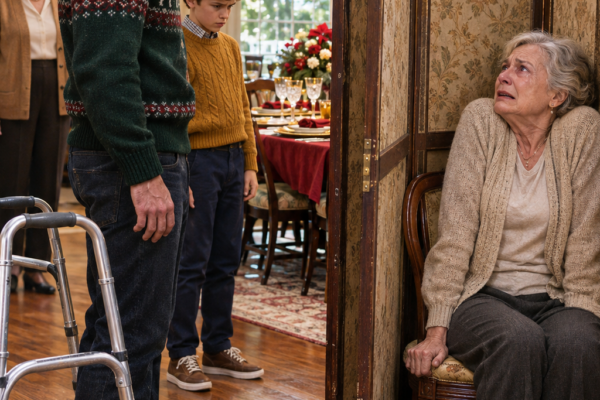
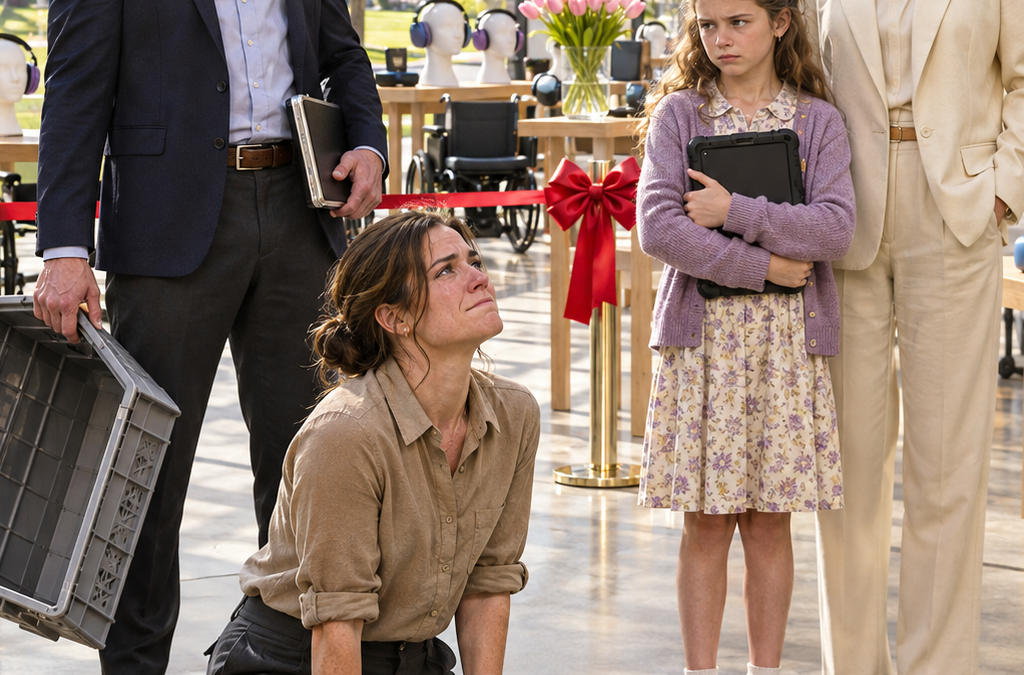
I built the app that helps my nine-year-old niece speak, but my brother made me kneel among headsets he dumped at our store opening.
Chapter 1 of 7
My older brother, Ryan Brooks, tipped my crate onto the floor.
“Clean that up. Nobody came for you.”
The headsets struck the concrete beside my shoes. Our relatives watched from behind the ribbon at our second shop in Round Rock, Texas, while Ryan stood over me with the presentation case.
“Do you really want me down here?” I asked.
He pointed at the equipment, and I knelt in my plain work shirt.
My niece, Sophie, stood beside her mother with her speaking tablet.
“Are you going to let him do this?” I asked my sister-in-law, Lauren.
Lauren looked away. “Please don’t spoil this for Sophie.”
Behind her, the demonstration screen listed Lauren beneath the word creator.
I hadn’t made that screen.
My name is Emma Carter. I’m thirty-four, and Carter is the name I kept after my marriage ended. Ryan and I were born Brooks.
I built the app his daughter uses to speak, and I’m the company’s majority owner.
My family knew I’d written the software but never asked who owned the business. Ryan assumed our aunt Diane’s early investment meant she controlled it.
So I did what I usually did when he made a mess.
I began collecting it.
The blue, foam-padded headset lay under my hand, the same one I’d worn while recording patient instructional prompts until Sophie stopped flinching at instructions delivered too quickly.
Those recordings helped her learn the app; her composed messages used ordinary text-to-speech.
Her favorite cheddar crackers were already in my work bag.
Our shops let families try communication tablets and get help setting them up.
Then I looked past Lauren again.
Lauren’s name was where mine belonged on the demonstration screen.
“Get those out of the photograph. Then coach Lauren from the side,” Ryan said.
Lauren’s launch jacket still had a loose thread at the shoulder. I’d clipped its matching thread before we left the house because she’d been worried it would show.
“Just help us get through today,” she said.
That hurt more than Ryan’s order.
My knee ached against the floor, and relatives who had asked me to fix their phones were studying the ribbon as though none of them could see me.
I started to rise.
“Get back down and FINISH!”
Sophie looked straight at her father.
“You’re making me clean while Lauren presents my work?”
“Yes, that’s what I’m telling you to do.”
“I heard you.”
I stood and moved to the edge of the demonstration area. The headsets stayed where they were.
But I didn’t leave the room.
This was a family celebration, not the public opening. No waiting customers needed saving from our embarrassment. Only relatives were there to watch Ryan decide where I belonged.
Lauren’s name remained on the display behind him. Beneath it was a photograph of her helping Sophie touch a button, cropped so my arm no longer appeared.
I photographed the screen.
“Why does that call you the creator?”
“Ryan’s replacing you with me. He said you’d agreed.”
For a moment, I couldn’t answer her.
Until then, I’d thought he wanted me out of the photograph. Lauren was describing a plan they’d discussed without ever asking me.
Across the room, our aunt Diane Miller stood beside the scissors, watching Lauren’s face and then mine while Ryan lifted his microphone and beckoned everyone toward the ribbon.
Diane had spent years running stores. Usually, she let Ryan finish his introduction.
This time, she stepped between him and Sophie.
The scissors approached the ribbon, then stopped.
Diane took the microphone from Ryan.
“She doesn’t need to do this now,” he said.
“Sophie asked to thank Emma. You told her no.”
Sophie came toward the place where I’d knelt.
Nobody prompted her or touched her tablet.
She opened a saved message with her thumb.
Ryan’s hand dropped, and Lauren’s smile stopped.
Sophie pressed the message Ryan had forbidden on her tablet.
“Aunt Emma made my talking app.”
Sophie’s tablet spoke into the microphone, and Ryan’s mouth tightened before he reached for it.
Diane kept the microphone beside Sophie, beyond his reaching hand.
“Don’t make her part of your scene,” Ryan told me.
“She chose her message,” I said, without moving toward him.
Sophie put her tablet in my hands while she adjusted her sleeve, then took it back herself.
Ryan turned toward the relatives gathered behind the ribbon, which still hadn’t been cut.
“Sophie needs a break,” he told them.
She stayed beside me, changing pages instead of asking to stop.
A paused thumbnail flashed past: Sophie much smaller, at the table during our first home demonstration.
It was the silent copy we’d shown relatives, and she passed it without pressing play.
Lauren stepped close and lowered her voice so I could hear her without the microphone.
“He told me you wanted out.”
I’d packed demonstration chargers that morning while Lauren had prepared to stand in my place.
“I never told you that.”
Lauren looked at Sophie, who was waiting for us to finish, then back at Ryan.
“He explained it differently,” she began, but her voice caught before she could finish explaining how.
She turned the demonstration screen away from us, no longer looking at me.
Ryan snapped its cover shut.
Lauren flinched, then turned to face him.
“You said Emma was abandoning Sophie.”
He stared at her, then looked at the relatives nearest the ribbon.
“This isn’t the place to discuss it,” he said.
Losing my place in Sophie’s life hurt more than being ordered onto the floor. Four months had passed without one of our usual afternoons together, and I’d believed the explanations Lauren sent.
Now abandonment was being said aloud, with Sophie close enough to hear it.
“I haven’t abandoned you,” I told her.
Sophie looked at me, then down at her tablet. I waited, but she didn’t choose a message. She didn’t owe any of us one.
Lauren stood beside the closed display.
“He was trying to help us,” she said.
Her eyes went toward Ryan as though he might still supply the version that made this all right.
Diane lowered the microphone.
“Three members choose senior leadership,” she told Ryan. “You can’t appoint Emma’s replacement by yourself.”
That was how we’d agreed to run the company from the beginning. It wasn’t a rule Diane had invented because she’d seen me crying; I hadn’t cried yet.
Ryan’s voice softened when he answered her.
“Diane, we can talk privately. There’s been a misunderstanding.”
She left the scissors on the table.
I’d put $148,000 of my savings into six years of work. Yet standing there, I kept thinking about the crackers in my bag and whether Sophie had been told I no longer wanted to see her.
The party came apart unevenly.
Relatives gathered their bags and made excuses about dinner. A few said goodbye to me without meeting my eyes. Lauren stayed near Sophie, and Ryan carried his presentation case toward the back of the shop.
Nobody cut the ribbon.
I was still inside when my phone lit with his name.
“Lauren will handle Sophie’s visits from now on.”
Chapter 2 of 7
“He told me to keep Sophie away until you thanked me publicly,” Lauren said. “She hasn’t said she doesn’t want you.”
She stood on my porch the next afternoon, wearing her launch jacket over a faded T-shirt. Ryan had promised her the position after telling her I’d privately approved it. She wanted me to understand that part before anything else.
I stayed beside the empty porch chair. I was relieved about Sophie, then ashamed of how grateful I felt for that single piece of news.
“Thanked you for what?” I asked. “Taking my place?”
Lauren said it wasn’t supposed to happen that way. She had imagined a photograph of all of us, something Sophie could keep. Her phone rang inside her jacket, and she let it stop.
Across the street, somebody was mowing the same narrow strip twice. I watched the mower turn while Lauren waited for me to help her finish explaining.
“Could you just say yesterday was a misunderstanding? You don’t have to apologize. Just say we got confused, and we can fix the presentation.”
Her jacket looked stiff and uncomfortable in the warmth. I’d seen her wear it proudly the day before. Now she kept pulling the sleeves past her wrists.
“When did I tell you I wanted you to replace me?”
She mentioned a dinner when I’d complained about being tired. Then she mentioned how much I hated posing for photographs. Neither occasion contained anything close to permission.
I remembered that dinner. I’d brought a casserole because their oven was broken. Ryan had eaten the browned corners before anyone sat down, then insisted the middle was the best part anyway.
Lauren’s phone rang again. She glanced at it without answering.
“You never asked me.”
She said Ryan had already worked it out with me. When I asked how long she’d been preparing, she looked toward her car. Three months, she finally said. She’d rehearsed the presentation for three months.
I felt humiliated all over again. I’d answered her questions about explaining the app, believing she wanted to help families understand it.
“He promised me $78,000,” she said. “A real salary, Emma. I’ve spent years arranging everything around what everybody else needs. He said this would finally be mine.”
I knew what she’d done for their household. I knew how often her plans disappeared beneath somebody else’s needs. Hearing her describe mine as the solution made me grip the porch railing.
Her phone rang a third time. She watched the call end, then said their mortgage payment was $2,400 a month.
Ryan had presented the job as security. His salary would stay, hers would be added, and they’d tell the same family story at both shops. Only Lauren would stand in the place where I’d been.
“So I would still build it,” I said. “And you’d explain to people that you made it? Did you practice that part too?”
She said she had practiced what Ryan gave her. She hadn’t thought through every word.
The phone rang again before I could answer. This time she pulled it out and kept it in her lap.
I was angry enough that I couldn’t have offered her a chair kindly. She sat anyway, on the edge, her knees together beneath the polished jacket.
Nothing in the company’s existing records had changed my interest. There was no approved position waiting for Lauren.
She asked whether she could at least tell Ryan we’d talked things through. I told her she could say we’d talked.
“He’s Sophie’s father,” she said. “He thinks he should decide how people see the company. It’s our daughter they ask about when we demonstrate it.”
The fifth call lit her phone. She let that one go too.
“Being her father doesn’t make you my author.”
Lauren stared at the porch steps. I hated having to say it to her. She’d watched me work through family dinners and miss whole conversations while fixing problems on my laptop.
When the phone rang again, she answered with it held between us. Those six calls had interrupted almost everything she’d tried to tell me.
“Don’t let her turn you against your family.”
Ryan’s voice carried clearly across the porch. Lauren told him she was still talking to me. He started to answer, but she ended the call.
She didn’t look pleased with herself. She looked frightened, and for a moment I wanted to make that easier. I knew that habit too well.
“I saw him tip the headsets,” she said. “I could have said something before you got down there. I wanted the photograph. I wanted us to get through it.”
“I won’t give you a statement saying this was fine,”
I let her words stay where she’d put them.
The mower stopped across the street. Somewhere nearby, a screen door banged. Lauren waited, then asked whether I’d at least stop calling it a replacement when I spoke to the family.
I hadn’t spoken to the family about it. She seemed surprised by that.
“I won’t give you a statement saying this was fine,” I said. “And I’m not thanking you so I can see Sophie. Don’t ask me for that again.”
It hurt to say Sophie’s name and still have no idea when I’d see her.
Lauren rose. She said maybe the title could change, maybe we could stand together next time. She was still trying to find a version of Ryan’s plan I would accept.
Her phone lit before she reached the steps. She read the screen, then turned it toward me.
Ryan had added fourteen relatives to a group called “Protect Sophie,” with a message accusing me of putting the business before his daughter.
Chapter 3 of 7
Ryan’s message said I’d threatened to abandon the app unless I controlled the opening. By the time I reached Diane’s house, relatives were sitting around her living room, waiting for me to explain myself.
Diane met me near the couch. She said Ryan had told her I’d stopped accepting invitations to see Sophie.
I’d been told Sophie didn’t want visitors.
“Thank you for having everybody, Diane,” Ryan said. “I didn’t know how else to get us talking. This has been hard on Lauren.”
He sat beside his wife on the couch. Diane had brought in dining chairs for everyone else. I recognized the relatives who had watched me kneel at the shop.
Diane’s house usually smelled of coffee she reheated until somebody complained. This time, the pot sat untouched beside a plate of her cheese toast. She still cut off the crusts, though we were all grown.
“Where did I say I’d abandon the app?” I asked. “Show me what you’re telling everyone, Ryan. I’d like to see it.”
He looked past me toward Diane, then back.
“You don’t have to put everything in writing.”
I stayed standing beside an empty chair. I was angry, but being watched made me feel guilty before I’d even answered him.
Lauren studied the plate on the coffee table. She’d greeted me when I came in. Since then, she hadn’t looked directly at me.
Ryan said he was trying to keep the family together. A few relatives nodded at that, cautiously, as though agreement might get us through the afternoon faster.
“A good aunt would take a smaller role,” he said. “Sophie needs people getting along. Just support Lauren and stop making this about credit.”
He made it sound small. Stand somewhere else. Say a few words. Keep working afterward.
I’d spent years answering family requests before I knew whether I had time. Hearing that used against me hurt. I finally sat because my legs felt unsteady, and I hated that he could probably see it.
“Four visits,” I said. “January, February, March, April. Lauren cancelled every one. Who decided that, Ryan? I kept asking when I could come.”
He said Sophie needed stability.
I remembered making room in my weekends, then leaving those afternoons empty after the messages arrived. Once, I’d stayed home anyway, hoping Lauren might say Sophie had changed her mind.
Diane leaned forward in her chair. “You told me Emma wouldn’t come. You said you’d both tried asking her.”
Ryan rubbed his jaw. He said there had been a lot going on and Diane hadn’t heard every conversation.
Nobody asked me about mine.
One relative started to speak, then looked at Ryan and stopped. Another said children sometimes needed space. I understood their hesitation. He was Sophie’s father; I was the aunt insisting I’d been kept away.
“I decide who spends time with my daughter.”
He said it directly to me. Lauren’s face reddened, but she stayed beside him.
I had no answer that would get me an afternoon with Sophie. That frightened me more than his accusation. He could keep saying no, and I would still have to go home without her.
“You can refuse a visit. I’m still not saying something false to earn one.”
“Yes,” I said. “You and Lauren decide visits. I won’t come over uninvited or pick her up behind your backs. I’m not bargaining for her.”
He glanced around, letting everyone hear that I’d acknowledged it.
I wanted to ask Diane to tell him to let me visit. The words nearly came out. But that would leave Sophie in the middle of another family argument about what I owed him.
“I also won’t call Lauren the creator,” I said. “You can refuse a visit. I’m still not saying something false to earn one.”
Lauren interrupted before Ryan answered. She said this was getting worse and we should stop for now.
Her voice had the same pleading sound it had at the opening. I knew who usually supplied the relief when she sounded that way. I would soften what I’d said, and Ryan would accept the softened version.
“Show them her replies, Lauren. Show them how cold she got when you tried to arrange things. They need to see what we’re dealing with.”
Lauren didn’t reach for her phone immediately. He turned toward her and repeated the request.
She opened our messages. Diane was nearest, and Lauren angled the screen so she could read it.
There was Lauren’s cancellation, telling me Sophie wasn’t up for a visit. Beneath it, I’d asked, Is she all right? Please tell her I love her.
Lauren read it longer than Diane did.
I felt embarrassed by how badly I wanted someone to defend me. The message was ordinary. I’d sent it from my kitchen without knowing I would ever need anyone else to see it.
“That’s enough,” Diane said. “I’m not hosting more accusations and calling them concern for Sophie. You brought us here with a story Emma says isn’t true.”
She looked at Ryan, not at the phone.
He rose so abruptly that the couch cushion shifted beneath Lauren. Several relatives straightened in their chairs, ready for the gathering to end without anyone having to say more.
“You’ve made the whole family choose, Emma.”
I stayed seated. I was tired of being blamed for what happened after I answered him.
Ryan told Lauren to come with him. She stood, still holding her phone, while he headed toward the doorway.
Before the same relatives, Lauren said, “I sent every cancellation.”
Chapter 4 of 7
“I cancelled because Ryan told me to,” Lauren said. “Then I told Sophie you were busy. She didn’t ask me to stop inviting you.”
She stood inside my kitchen two days after Diane’s gathering. I’d let her in, but we hadn’t settled anywhere. Her admission at Diane’s had been followed by a hurried departure, with Ryan waiting at the door.
Now she told me she’d kept something else from him: the first home demonstration recording, with its sound.
“He said to replace it with the presentation copy. I kept it.”
I stayed beside the counter. For months, I’d imagined Sophie turning away when Lauren mentioned my name. Knowing she’d been waiting for me hurt in a different way.
Lauren said the copy everyone had seen was silent. Ryan believed that was the only version she still had. She hadn’t corrected him.
“Why keep the other one?” I asked.
She looked toward the chair Sophie usually chose, the one nearest the pantry. Lauren had once joked that I stocked it like a convenience store run by a nine-year-old.
Sophie’s ridiculous cereal was still in there. I couldn’t bring myself to throw away a box with marshmallow planets.
“She wanted to show us that day,” Lauren said. “Usually we’d ask, and she’d go do something else. That time she brought the tablet over herself. I wanted the whole afternoon.”
She hadn’t saved it to prove anything. It was a family recording she loved, from when Sophie was small enough to need help climbing onto that chair.
I could understand that without feeling closer to her.
Lauren sat at the kitchen table. She said she wasn’t asking me to let her be called the creator anymore. Then she asked me not to destroy Ryan’s career.
Diane had told Ryan that I held sixty percent and that the three members—not the retail director—chose senior leadership.
He ran the shops; he didn’t own my work or choose my replacement.
“He thinks you’re going to take everything away,” Lauren said. “I know what he did. I’m not saying it was right. But he has worked there for years.”
I had worked beside him through those years. I remembered answering his questions from grocery aisles and fixing demonstration problems before my own dinner.
I was furious that she still needed reminding I had a job to lose, too.
Her phone kept lighting up beside her. She said Ryan had started messaging after Diane spoke to him. At first, he wanted to know exactly what Diane had said.
Then he wanted Lauren to explain why I deserved more say than the person running the shops.
“He sent Diane this,” Lauren said, reading from the screen. “‘I appreciate everything you’ve done for us. Please give me a chance to explain the work behind our growth.’”
To Lauren, his messages were different. Tell Emma to be reasonable. Don’t promise her anything. Find out what she wants.
By the eleventh message, he was telling her to come home.
Those eleven texts had arrived while she was trying to tell me what she’d done. When he called, she asked if I minded hearing him. I said I didn’t, and she put him on speaker.
“You don’t even like that part. Why are you fighting us for it?”
“Stop hiding behind Diane and act like family,” he said when Lauren told him I could hear. “You wrote it. Fine. Who got people through the doors?”
I looked at Lauren. She kept her eyes on the phone.
Ryan said the second shop hadn’t opened because I sat at a laptop. He’d handled stock, schedules, and demonstrations. People trusted him with their children. Lauren knew how to talk to families.
“The people building sales deserve to be out front,” he said. “You don’t even like that part. Why are you fighting us for it?”
“I’m not fighting you for your work. You put Lauren’s name on mine.”
He said I was missing his point. Then he told Lauren they needed to discuss this at home, without me listening. She said she would come home when we finished, and ended the call.
I felt tired enough to ask her to leave. Instead, I sat across from her.
“You need to correct what you said about me,” I told her. “What you said, Lauren. Not just tell everyone what Ryan made you do.”
She started to say she hadn’t made the group. I reminded her she had answered in it. She’d told relatives I was pulling away from Sophie and refusing to help.
Her face changed. She said she remembered.
I didn’t tell her it was all right.
Diane’s meeting notice had arrived earlier: Tuesday at six, at the second shop. It named me, Diane, Alan Price, Ryan, and Lauren. Alan was our other member, an early investor who knew the business without belonging to our family.
Ryan had already invited relatives to hear his presentation.
“I’ll come,” Lauren said. “And I can bring the recording. If Sophie’s comfortable coming, I’d like her with me. I don’t want her thinking everybody’s talking about her somewhere.”
I told her Sophie didn’t have to sit through an adult argument. Lauren agreed. Neither of us knew whether Sophie would want to stay, and I wasn’t going to decide that for her.
Lauren asked what would happen at the meeting. I said I couldn’t promise her anything.
Before leaving, she sent Ryan a message saying she would speak for herself there. She waited beside my kitchen doorway, watching for his answer.
His reply came before she reached the front door.
“Sophie stays home unless Lauren speaks first.”
Chapter 5 of 7
“You’ll still help Sophie. We both know that,” Ryan said. “You don’t need your name on a screen to do it.”
We stood beside the demonstration area at the second shop. He’d caught me before I’d reached the chairs, with Lauren and Sophie close enough to hear him.
Lauren said they’d agreed Sophie could come. Then she faced him.
“But I’m not speaking first because you made that a condition. She can leave this discussion whenever she wants. We agreed on that, too.”
Ryan looked toward the entrance instead of answering. Sophie stayed beside Lauren, using her tablet. I couldn’t see what she was composing, and I didn’t ask.
I felt sick hearing him count on my love for her. He sounded certain it would keep me working under whatever arrangement he chose.
His presentation case stood on the table where the scissors had been. The ribbon was gone. Our relatives had begun arriving, quieter than they’d been at the celebration.
Diane had called this meeting under our existing agreement to review leadership and staffing. Ryan had supplied the family audience; he’d told them they should hear what he’d done for the business.
“I can make this easier,” he said. “Thirty thousand dollars. You step away from the public part, thank Lauren, and tell everybody it was your choice.”
He said it almost casually. Across the shop, Lauren was helping Sophie find a place for her jacket. I wondered whether she’d heard this offer rehearsed at home.
“Whose money are you offering?”
He glanced toward Lauren, then lowered his voice. He said the business could manage it if I stopped making everything difficult.
Neither Diane nor Alan had approved such an offer. Ryan was describing company money as though he could promise it across a table.
“You hate interviews. You hate people asking the same questions,” he said. “Stay home and build. Let us handle the families. You’d still matter to Sophie.”
He knew I sometimes hid in the stockroom after a long demonstration. He also knew I came back when a family needed help.
I was angry that he’d turned being tired into wanting to disappear.
Above us, the shop’s air conditioner clicked on with a rattle. Ryan had once claimed he could fix that noise. Lauren had suggested he start with the kitchen drawer that only opened when nobody needed a fork.
I remembered laughing with them about it. Now I stood waiting for my brother to hear his own offer.
“I’m not taking it,” I said. “I’m not telling people I chose this. And I’m not thanking Lauren for replacing me.”
“Think about what you’re turning down,”
He said I was refusing a way out. I hadn’t asked for one.
Diane came in while he was still talking, followed by Alan. Ryan greeted Alan warmly and thanked him for making time. He hadn’t thanked me for coming.
Lauren greeted them from beside the chairs. Her own device was in her bag, with the old recording she’d said she would bring. She hadn’t mentioned it to Ryan in front of me.
“Think about what you’re turning down,” he said. “You could do the part you like without carrying everything we carry. That’s a good deal, Emma.”
He’d lowered his voice again. I could hear relatives greeting Diane behind him, asking where they should sit.
I had spent so long making his work easier that he thought he was offering me less work. I felt insulted, and worse, tired of explaining why.
Sophie chose a chair near mine. She settled with her tablet across her knees, then looked toward Lauren until her mother acknowledged her. Nobody told her whom to sit beside.
I sat down too. I didn’t reach for her or ask for a message.
By then, the three members were present. Diane asked whether we objected to relatives staying, and Alan and I said they could remain. Ryan watched the familiar faces settle into the rows.
Lauren’s application lay beside his case. He’d brought it as though there were only a few details left to arrange.
He stayed standing while the rest of us found seats. Lauren sat nearest the case, with a clear view of Sophie.
“We’ve worked this out,” Ryan announced. “Emma’s agreed to step aside. Lauren can take over the creative role, and we can get back to helping people.”
Lauren said nothing. She looked at me, then toward the relatives who had heard the same certainty at Diane’s house.
I hadn’t agreed beside the table. I hadn’t agreed anywhere. Yet here he was giving everyone permission to stop worrying about what I wanted.
I felt humiliated again, sitting there while he spoke for me. I’d already refused him, and he was counting on me to let it pass in public.
Lauren moved her chair away from the presentation case and into the space beside mine.
“Let Emma answer for herself.”
Ryan stared at the gap she’d left. One of our relatives leaned forward to see around him. Diane waited at the front, without beginning her questions.
“Come back over here, Lauren. We cannot afford this scene.”
She stayed beside me. I could see she was frightened; her face had gone red, and she kept looking at Sophie. But she didn’t move back.
Ryan said they’d talked about this at home. Lauren answered that she remembered what he’d told her.
Then she turned her chair toward me and said, “Ryan told me you’d work for nothing.”
Chapter 6 of 7
“Tell them again.”
Ryan looked at me, then at the relatives behind us.
“Emma chose to step aside. Lauren will take over creative leadership. We’ve already talked about keeping Emma involved.”
I said I hadn’t agreed to any of it.
Lauren stayed beside me. “You told me I wouldn’t have to build anything. Emma would maintain it, improve it, all from home. I’d have the title and salary.”
Sophie looked up from her tablet. Lauren reminded her she could stay or ask to leave with her. Sophie stayed seated.
I was furious, hearing my whole working life described as something Ryan had arranged for his wife.
“You call me a helper now,” I said. “Before you joined, you told people I built it. What changed?”
Ryan glanced at Alan before answering. He spoke more carefully with him watching.
Writing code, he said, wasn’t the same as making a business. He’d conceived what the shops could be, put money behind a ready-made product, and sold it.
“The founder thing was for you, Emma. Family. You needed that credit. I made this into something people could actually buy.”
Diane didn’t interrupt. Neither did Alan.
For a moment, I heard how convincing he could sound. Our relatives had seen him unlock shops and welcome families. Most had never seen me working.
“Lauren, may I have the original video?”
She opened it on her device and gave it to me. I started the playback myself.
The picture opened on their old kitchen table. Lauren had filmed our first demonstration openly, when Sophie was four. My younger face leaned into view as I asked Sophie whether she wanted to try another message.
Ryan came into the picture beside us. He looked toward Lauren’s camera.
“Emma built this before I joined. Lauren and I didn’t make it.”
His face stayed visible while he spoke. Nobody had to guess whose voice it was.
On the recording, Sophie chose one of my instructional prompts. She tried another button, then returned to my voice. I waited beside her, giving her time.
It hurt to hear how easily Ryan had credited me then.
Lauren had kept that whole afternoon. Only the copy passed around afterward had been silent.
Ryan watched until the recording ended. Then he looked toward the relatives.
“I was encouraging her for the camera. That doesn’t wipe out the stores. You’ve all seen what I do.”
Diane asked, “Did Emma agree to leave, and did we approve Lauren?”
I answered no. Lauren rose before Ryan could answer for her.
She laid her application in front of him.
“You claimed her work and promised away her job without asking any of us.”
“I never heard Emma agree. You told me she had. I’ve never built the app, and I’m withdrawing this. I shouldn’t have applied without asking her.”
She returned to the chair beside mine. I was relieved she’d finally said it without asking me to make it easier.
Diane faced Ryan.
“You claimed her work and promised away her job without asking any of us.”
She called for the three members’ votes on ending his retail-director role and employment. Under our agreement, two yes votes were enough.
Diane voted yes. Alan voted yes. I abstained.
Diane waited until Ryan looked at her.
“The vote ends your $103,500 director’s job, effective now.”
He stood so quickly that Sophie looked up.
Ryan struck the presentation case latch shut.
“Lauren, get up. We’re leaving. Bring Sophie with you.”
Lauren didn’t stand. She told him she would bring Sophie home after they finished there.
Alan asked him to leave the company case.
Ryan kept hold of it for a moment, staring at Alan. Then he released it on the table.
I felt shaky. I’d wanted him to stop speaking for me, but watching my brother lose his job still hurt. I kept my feet planted beneath my chair.
He looked past Diane toward the relatives, as though somebody there might object.
One relative who had watched me kneel at the opening moved a chair out of my way. Another asked whether I needed space by the table. Nobody got up to follow Ryan.
Diane said his earned wages would be paid. She didn’t bargain with him about staying.
This decision ended his job. It didn’t reach into his home or change who made decisions for Sophie.
Sophie had been composing while we talked. Now she pressed her message.
“Auntie made my words.”
I turned toward her. She watched me, her tablet resting across her knees.
“I’m glad I could help,” I said.
She went back to her screen. I didn’t ask her to repeat it for anyone else.
Ryan said I’d got what I wanted. He sounded tired now, but he was still blaming me.
I was sad enough that I almost started explaining again. I could feel the old habit pulling at me: make him understand, soften it, get everybody home without another argument.
“You don’t get to erase me to keep your place.”
That was all I said.
Lauren stayed beside me. She didn’t reach for my hand or ask whether we were all right.
I went to the demonstration shelf, where my blue headset had been stored since the opening, and took it back. Sophie kept her own tablet. Nobody asked her to surrender anything.
Ryan headed for the entrance without saying goodbye. Before he reached it, Diane told him the two company tablets and the presentation case had to be returned within three days.
Chapter 7 of 7
Three days later, Ryan returned the two company tablets and his presentation case. A staff member accepted them; his business access ended, and his earned pay was paid. Sophie’s personal tablet stayed with her, working exactly as before.
I wasn’t there when he came in. I’d arranged to be working at the other shop, and I felt relieved when nobody asked me to come over.
Lauren sent a short message afterward. Everything’s returned. I answered, Thank you, then went back to work.
For several evenings, I kept expecting another demand. My phone would light up, and I’d stop reading whatever was on my laptop. Usually, it was a delivery notice or Diane asking about something ordinary.
“I’m not asking you to check on him,” Diane told me. “I called because I wanted to hear how you were.”
I cried after that call. I hadn’t realized how badly I needed someone to ask without attaching a job.
Over the following six weeks, Lauren corrected the family group. She didn’t send me a draft to soften first.
“Emma never agreed to leave the company or give me credit for creating the app,” she wrote. “I said she was pulling away from Sophie. That wasn’t true. I cancelled the visits and told Sophie Emma was unavailable.”
She also said she was no longer seeking the creative role.
Some relatives apologized privately. Others answered Lauren with a heart or a brief acknowledgment. I was disappointed by how little a few could manage, but I didn’t chase them for more.
“I know writing that doesn’t fix it,” Lauren told me later. “I wanted you to know I said it where I helped spread it.”
“I read it,” I said. “Thank you for correcting it.”
She waited, perhaps hoping I’d say we could forget everything. I couldn’t. We could talk without being close again, and for a while that was what we did.
She stopped asking about work at KindredCue. I didn’t find her another position, and Ryan didn’t keep advising us unofficially. When a question came up about something he’d handled, we worked it out at the shop.
By the end of those six weeks, both parents agreed to two visits a month with Sophie.
We arranged them in a group exchange with all three adults. Lauren offered afternoons, I checked my availability, and Ryan confirmed. No one asked Sophie to carry an invitation or explain a cancellation.
“She needs to be home when we agree,” Ryan wrote. “I don’t want this turning into another thing where I’m the bad guy.”
“I’ll bring her home as arranged. If anything changes, I’ll tell both of you directly.”
I was afraid he would withdraw his agreement. I read my reply twice before sending it, then left it alone.
During that exchange, he asked whether a shop display still needed replacing. I told him we would keep that group for Sophie’s schedule. He sent nothing for a while, then confirmed the next visit.
He never gave me the apology I’d wanted. Sometimes he was stiff at the door, speaking mostly to Lauren. I stopped filling those few uncomfortable minutes with offers to help.
“Did you bring your bag?” I asked Sophie at the first pickup. “We can go whenever you’re ready.”
She checked it herself before coming with me. I was so happy to see her that I nearly started crying on their porch. Instead, I waited while she went back for the book she wanted.
At work, repair was less dramatic than the opening had been.
We held a small demonstration at the second shop. Diane introduced me as KindredCue’s creator and working product lead. I stood where families could see me, with the display showing my name.
“Emma will show you how it works,” Diane said. “Then there’s time to try things yourselves. You don’t need to keep up with anyone.”
One child spent a long time composing a sentence. His parent began to help, caught herself, and waited. I waited too.
When the message finally played, he asked whether we had anything about dinosaurs.
We did. His parent laughed, and I felt useful without feeling invisible.
“It isn’t management. Sixty-four thousand a year. He starts soon.”
With the other members’ approval, I hired another developer and supervised the work during working hours. We disagreed about a button’s placement, tried both versions, and asked users which they preferred.
I still worked hard. But when I closed my laptop at home, somebody else knew what needed doing next.
Roughly four months after Ryan left, Lauren called with news.
“He accepted a retail job,” she said. “It isn’t management. Sixty-four thousand a year. He starts soon.”
The $64,000 salary was a real reduction. I knew he would hate reporting to someone whose job he used to hold.
I felt sad for him. I also noticed that Lauren hadn’t asked me to change anything.
“I hope it goes well,” I said.
“So do I.”
That was the whole conversation about his new job. I hadn’t helped him get it, and nobody from our company contacted his employer.
On November 21, Sophie came to my kitchen under our regular schedule. The blue headset was on the table, beside the things we could use for a listening game.
She chose the game herself: ridiculous instructions, followed as badly as possible.
Her tablet told me to walk like a penguin carrying soup. I tried, and she laughed without making a sound, her shoulders shaking.
“That soup was imaginary,” I said. “You can’t mark me down for spilling it.”
She turned the speaker up for my next instruction.
“Just lower it enough that I can hear the kettle,” I told her. “We don’t need the neighbors helping me.”
She adjusted the volume, then began composing again.
I waited. There was nowhere else I needed to be, no broken demonstration I had to repair before I could have this afternoon.
I was happy in a way that still surprised me.
Family didn’t give anyone permission to erase me.
I moved my chair closer to the table.
Sophie finished her instruction. This time, I had to pretend the floor was pudding. I asked whether chocolate was acceptable, and she nodded before changing her mind and typing strawberry.
We had time for strawberry.
I set the blue headset beside her tablet.