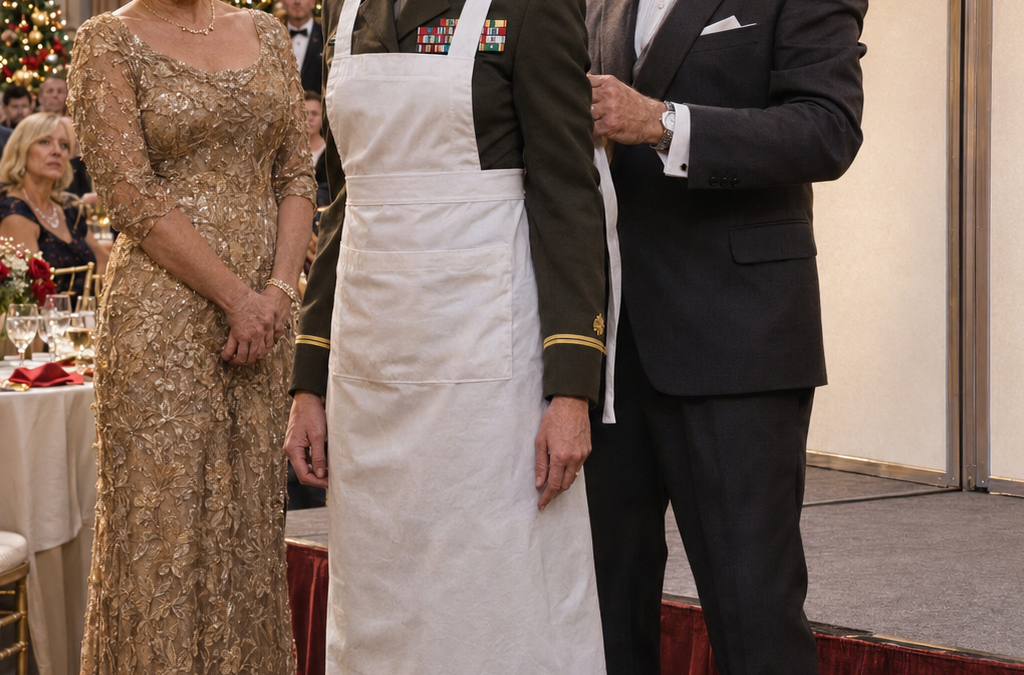
“Go make yourself useful downstairs,” my stepfather told me, fastening a laundry apron over my Army uniform at our family company’s Christmas gala.
Chapter 1 of 7
“Please take your hands off my uniform.” My stepfather, Richard Hayes, pulled the broad straps across my ribbons anyway.
My mother, Linda Hayes, watched from beside the low presentation platform, then looked down at the photograph cue sheet covering a cream-colored envelope near Richard’s place.
“Are you really going to watch him do this?”
She wouldn’t meet my eyes.
My stepbrother, Eric Hayes, smiled above his dinner plate. “We all worked before we got dinner. You can help for one evening.”
Richard finished fastening the full-length white hotel apron. “Go make yourself useful downstairs.”
My plain duty bag stood against my shoes. Richard kept his body between me and the platform steps.
He’d found a use for me.
I’m Nora Bennett. I’m thirty-seven, an Army major, and tonight’s service honoree.
My family rarely asked about my work, and I’d let their guesses stand. They knew I did logistics. Richard called that office work, usually with a little shrug.
That evening, I’d come straight from traveling to the Franklin House Hotel in Columbus, Ohio, with my mother’s favorite soft slippers tucked inside my bag beside my clothes.
She liked the kind without hard soles. During an earlier visit, I’d repaired Eric’s work jacket where the lining caught his thumb.
And when Linda spent a night in the hospital, I’d stayed beside her while Richard went home because he couldn’t sleep in chairs.
I kept making myself useful instead of making myself heard.
But standing there hurt more than I’d expected. Relatives watched me wearing hotel laundry clothes over the uniform I’d spent fifteen years earning.
Richard’s household envelope was already waiting beneath the photograph cue sheet.
He noticed me looking toward the platform and moved across my path again. Hayes Linen Service handled commercial laundry; he’d brought the apron as part of the evening’s display.
There was nothing shameful about that work. His employees worked hard, and I’d always respected them.
He was using their work to put me in my place.
Then Richard glanced toward the waiting tables, checking who could hear him, while Eric leaned back in his chair with the satisfied expression I remembered from childhood.
“You can EARN YOUR DINNER!”
A few relatives stopped talking. Linda’s lips parted, but she didn’t say my name.
“You want me working downstairs while everyone takes the photograph?”
“That’s exactly where I want you.”
I briefly gripped the apron’s lower edge. My fingers had gone cold against the heavy cotton.
“Then you’ve made yourself clear.”
So I stepped around him toward the ballroom’s quieter edge. I didn’t leave the event, and I left my bag beside the platform.
Linda stayed where she was.
The hotel served little pretzel rolls at these dinners. She always hid an extra in Richard’s bread basket because he complained that fancy dinners left him hungry.
That night, his basket already held three.
I could see the closed presentation backdrop beyond him. Its folded panels hid the display Janet had described when she invited me.
The award photograph was supposed to happen there. My mother had asked twice whether I’d be coming in uniform.
Now she was looking everywhere else.
I called the foundation’s executive director, Janet Collins. She was organizing the presentation across the same ballroom, close enough that I could see her phone light.
Her voice changed after she answered.
“Has Richard spoken to you? Richard promised your forty-three-thousand-dollar award toward his home loan.”
For a second, I heard only the ballroom music.
“He told you I agreed?”
“He told Paul you had.”
Paul Turner, the bank’s mortgage director, was there as an invited sponsor representative. Richard had greeted him warmly before telling me to go downstairs.
I stayed on the call until Janet ended it, watching my mother beside the platform while Richard leaned toward her and spoke too quietly for me to hear.
Then I returned to my bag.
Janet opened the illuminated backdrop around me.
The panels revealed my portrait and name.
Richard reached toward one panel. “She’s only here with our family.”
“Nora’s work is why we’re here tonight.”
The hotel’s automatic event camera flashed from its fixed stand.
The picture caught white straps crossing my ribbons.
Linda’s hand rose to her mouth.
Richard reached for Janet’s microphone when she turned toward my mother.
Janet kept the microphone, and I looked straight at Richard.
“You promised my award without asking me.”
His mouth tightened. The hand reaching for the microphone dropped.
Janet turned to Linda and asked about the description of my work in the event materials.
“I sent that,” Linda said. “I wanted people to know why Nora’s work matters.”
Richard started answering before Janet could ask her anything else.
“Linda showed me her offer to help.”
My knees weakened. I stayed standing beside the platform.
He had made my private offer to my mother sound like permission given to him.
Linda had been embarrassed when she asked about the house. I remembered choosing every word carefully, trying not to make her feel worse.
Now Richard was using those words while she stood beside him.
“She knows what she said,” he added.
I waited for Linda to tell him what she knew.
She looked at me, then lowered her eyes to her purse.
Eric stopped leaning back in his chair.
The pause lasted long enough for my mother to speak. I still wanted her to do it without being asked.
Instead, Linda brought out her phone.
Eric’s smile disappeared.
Linda whispered, “Eric has the message you sent me about the house.”
“Show me the entire exchange.”
Linda looked at Eric before she looked at the screen. That small delay embarrassed me almost as much as Richard’s shouting.
Eric moved beside her. “Come on, Mom. We can straighten this out over there.”
He nodded toward the connected seating alcove, away from Janet and the relatives nearest the platform.
“She can answer me here,” I said.
Richard turned to Janet with the voice he used for company customers.
“This is a family misunderstanding. Nora’s been traveling. We should let her eat before we make speeches.”
He hadn’t wanted me to eat a few minutes earlier. Janet glanced at the backdrop, then at me.
“We’ll wait on the posed award photograph,” she said. “Nora, there’s no need to rush.”
The automatic picture appeared on the event display. My portrait filled the backdrop behind me; the white straps were visible across my uniform.
I hated seeing myself that way.
Several relatives looked from the picture to Richard. He gave them a tight, impatient laugh, as though the camera had caught a harmless family joke.
Linda still hadn’t opened the exchange.
“Mom. All of it.”
Eric answered instead. “Nobody changed your words. You said you’d help them keep the house.”
“I’m asking my mother.”
He looked offended, which would have made me apologize on another night. I let him stay offended.
Linda’s screen lit between us. Eric watched it, and Richard watched Janet.
There were too many people waiting for the same answer.
“Who else has seen it?” I asked.
My mother’s eyes filled, but she didn’t try to touch me. I was grateful for that much.
“Eric sent it to eighteen people in the family.”
Chapter 2 of 7
In the connected seating alcove, my mother admitted she had forwarded the message herself.
“Richard said I was begging behind his back. I sent it to Eric because he could explain. Richard listens to him.”
“Why did helping you have to become proof I’d obey?”
Linda looked toward the ballroom instead of answering. From there, we could still see the presentation backdrop and the relatives gathered near it.
I had wanted her to say Eric had taken her phone. I was ashamed of how badly I still wanted an excuse for her.
“The family chat has eighteen people,” she said. “I didn’t think he’d send it there. I asked him to talk to his father.”
She opened the chat and held it between us. I leaned closer without taking the phone.
Above the cropped picture of my message, Eric had written, “Nora said she’d keep them in the house.”
My offer was there. The conversation that followed was gone.
“Where’s the part where you told me what was due? Where’s the forty-eight hundred dollars I sent you?”
Linda said that was in our private exchange, farther down. She sounded as though I had asked where to find an old recipe.
I felt humiliated again. People who had barely asked about my life were discussing what I owed.
A message from Richard appeared across the top of her screen. Linda read it, then swiped it away before opening our conversation.
My earlier words were still there: “I’ll help you keep the house. Tell me what’s due.”
Below them came her answer, my questions, and her thanks after the payment arrived. I remembered eating leftovers that week and being glad she could sleep.
“Can’t you let him explain it his way tonight?” she asked. “Then tomorrow, when he’s calmer, we can tell him what you meant.”
“You’re asking me to lie about my own words.”
She said she wasn’t asking me to lie, just to wait. Another message appeared before she finished.
Linda turned the screen toward herself.
The first two had come close together. She didn’t tell me what either said, and I didn’t ask. Watching her face, I knew she was already measuring how much angrier he might get.
That hurt. Even here, she was trying to get me back to him manageable.
Janet had confirmed that the award money belonged to Second Start Skills, the established training project, not my household. Its accepted purpose couldn’t be turned into a personal gift.
Linda knew the project. She had helped me assemble course materials at her kitchen table.
We used to call that table the annex. Richard complained whenever the stacks covered his usual place, even when three other chairs were empty.
“It’s been three years, Mom. Twenty-eight spouses have finished training. You helped put those packets together. What did you think this money was for?”
“I knew it was for the classes. I just thought there might be enough to—”
She stopped.
Enough to help them, too. I had heard that unfinished sentence in different forms for years.
Linda mentioned the participant who had called to say she had been hired. She remembered how the woman laughed because her first paycheck would arrive before her husband came home.
I remembered that call, too. My mother had been proud enough to tell the story twice over dinner.
“You knew what the work did,” I said. “You knew there were people waiting for the next classes.”
Her phone lit with Richard’s third message.
She didn’t open it this time. For a moment, I thought she might turn the phone off, but she kept watching the screen.
I was furious with her. It was easier when I could pretend she simply hadn’t understood.
“He said that payment meant you finally understood what you owed,” she said. “I told him you wanted to help me. He said it was the same thing.”
I stared at her.
Richard had married her when I was twelve. I had thanked him for school clothes, rides, groceries, and a bedroom door that closed.
By adulthood, I had learned to offer help before anyone could accuse me of forgetting.
“I was a kid in your house. That wasn’t a loan.”
Linda pressed her lips together. She said she knew, but she said it quietly enough that only I could hear.
I wanted to believe her. Her agreement had always been easier to get when Richard wasn’t listening.
The fourth message arrived.
“Will you stand beside me when I tell them the truth?”
This time, she let me read it.
“Bring her back before she embarrasses us.”
For a few seconds, neither of us spoke. Behind my mother, guests were returning to their tables. We had barely moved across the ballroom, yet she looked as though she needed permission to stay.
“Will you stand beside me when I tell them the truth?”
She looked toward Richard’s place. Then she asked whether we could avoid making it worse.
I felt terribly alone. I had asked for her presence, and she was still calculating his reaction.
Eric entered the alcove with his phone held outward.
“I’ve brought the family chat up on the ballroom display queue,” he said. “We’ll clear this up where everyone can hear.”
Linda started to say his name. He kept looking at me.
“Your message is next on the screen.”
Chapter 3 of 7
“Your message is next on the screen,” Eric repeated. “I wrote the caption. Dad said I could be the company’s next public spokesman if I could keep the family together.”
His preview showed a photograph of the house beneath my words: “I’ll help you keep the house.” He had cut off my question about what was due.
The caption read, “Nora promised to save their home. Now she’s walking away.”
My mother stood close enough to read it. She didn’t ask him to delete it.
“Show the whole exchange, Eric. Put up what Mom asked for and what I sent her afterward.”
He said nobody would read that much. The picture made the point.
I felt sick with embarrassment. He had chosen a photograph taken from the street, with my mother’s flower boxes beneath the front windows.
People in our family knew that house. They had eaten birthday cake there.
Richard joined us at the edge of the alcove. He looked at Eric’s preview and nodded, apparently satisfied with what his son had made of my private conversation.
“Tell them you’re letting your mother lose this,” he said. “She needs somewhere safe. You know what moving would do to her.”
“You have no permission to assign my project’s money. Putting her picture beside my words doesn’t give you permission.”
He glanced past me toward the tables. Several relatives had noticed him coming over and were watching us now.
I wanted to lower my voice. That old urge embarrassed me, too.
Eric had once asked me to check a company announcement before he sent it. I had spent part of a Sunday fixing sentences so he wouldn’t feel foolish in front of his father.
Now he had written one about me without asking a single question.
“You could have called me before sending it,” I told him. “You have my number. You could have asked what happened.”
He said he had talked to my mother. That was enough for him.
“I can’t leave here with everyone still arguing. We need an answer tonight.”
Linda looked down at her phone. I waited for her to say it hadn’t been enough, but Richard was already answering.
He said there was a deadline that evening. He had pledged something of his own, and he wasn’t going to let a family misunderstanding leave them stranded.
Paul was the invited mortgage director handling their existing repayment arrangement; he didn’t work for Janet.
“You don’t understand how close this is,” Richard said. “I can’t leave here with everyone still arguing. We need an answer tonight.”
I understood that he was frightened. I could hear it under the anger, and for a moment I wanted to make it stop.
Then Eric’s picture appeared on the ballroom display.
The house filled the screen where my award photograph had been. Below it, his accusation was large enough to read from the nearest tables.
One relative who had been smiling at me earlier turned away. Another leaned toward my mother, watching her as though I had already put her out on the street.
“That isn’t all she wrote,” Linda said.
I barely heard her over the music. Eric heard her, but he kept watching the display.
I felt humiliated. I had paid to help keep that house, and now people were looking at me as though I had taken it.
Richard caught sight of Janet approaching from the presentation area. He told Eric to clear the screen before she reached us.
The house disappeared. The event photograph returned.
He stepped toward the nearest relatives with his pleasant customer voice. He explained that Linda had been under terrible stress and he was trying to spare her another difficult move.
My mother stood beside him without agreeing aloud.
At company dinners, Richard usually told the story of how Linda labeled leftovers with everyone’s names. He always left out that he ate Eric’s anyway.
People liked that story. They were used to him making her sound cherished.
When they returned to their conversations, he turned back to me.
“Stop performing and come fix your mother’s home.”
“I haven’t performed anything. Eric put that up while I was asking him to show the truth.”
Richard said I was making this harder than it needed to be. Eric stayed beside him, close enough that I had to face both of them.
I was furious, but I also felt the pull of those watching tables.
I knew how quickly I could change their faces. I could offer money, let Richard announce we had worked it out, and hear everyone call me generous again.
I had done smaller versions of it for years.
This time, I said nothing about my savings.
Eric told me the caption could be corrected once we reached an agreement. Until then, he didn’t see what was wrong with leaving it in the family chat.
He wasn’t offering to tell the truth. He was offering to stop spreading his version if I paid.
My mother looked at him for a long moment. Then she turned toward Richard.
“Tell her what you kept.”
He told her to stop. His voice was sharp enough that Eric looked away from his phone.
Linda stayed where she was. I had never seen her look so scared while standing that still.
Richard said this wasn’t the place. She answered that he had chosen the place when he started talking about her home.
I waited, afraid she would retreat again.
“He still has the thirty-one thousand six hundred.”
Chapter 4 of 7
“That’s his own savings,” Linda said. “He told me it was gone after I got sick. Then I saw he still had all thirty-one thousand six hundred.”
Richard stared at her. She had left her phone on the small table beside us.
“He said he needed it for his future,” she added.
I waited for her to explain how long she had known. Instead, she looked toward the relatives beyond the alcove.
“You knew before you asked me to help again?”
She nodded. I felt foolish for all the evenings I had spent worrying about them.
Linda said she had tried to bring it up when they were alone. Richard always told her she didn’t understand what running a business required.
That explanation sounded familiar. At their house, understanding usually meant agreeing with him.
“I kept thinking he’d tell you himself,” she said. “Then I would have had to say I knew. I knew whose money he wanted to use instead.”
Richard took her phone from the table and set it facedown.
“Those savings are the only cushion your mother and I have.”
“Then you should have told her they existed.”
He looked at me as though I had interrupted a conversation between adults.
The tables nearby were filling again. Someone laughed near the ballroom doors, and I envied them their uncomplicated evening.
Richard lowered his voice. He said keeping money available was sensible, especially with employees depending on him.
I was angry that he expected me to admire his caution. My own savings apparently deserved none.
Linda didn’t reach for her phone. She watched it lying beside Richard, then turned to me.
“There’s another thing. He asked me to send in a suggestion about the classes. About having some of them at our house.”
She had been an authorized contact for Second Start Skills because she helped with materials and schedules. I had trusted her to answer ordinary questions when I was unavailable.
The project had always needed dependable space. Richard had found a real need and fitted his house into it.
“Did you tell them paying the house bill was part of it?”
Linda said he had described occasional workshops around the dining table. She thought she was offering a room, nothing more.
I pictured the table where she used to separate class packets from grocery coupons. Richard called every unfamiliar coupon a scam, then asked why she hadn’t saved one for his coffee.
I had liked working there with her. Now that memory hurt.
“Did you tell them paying the house bill was part of it?”
“No. Richard said he’d explain the costs. I thought we were just saying the room was available.”
Richard said the foundation could adjust things if it wanted. People held training in houses all the time.
Janet had received the proposed location change but had not approved it. The award supported training, not an unrestricted rescue of the recipients’ relatives.
The work had a purpose before Richard found a use for its money.
He had done more than make a promise over dinner. He had used my mother’s place in the project to make that promise look workable.
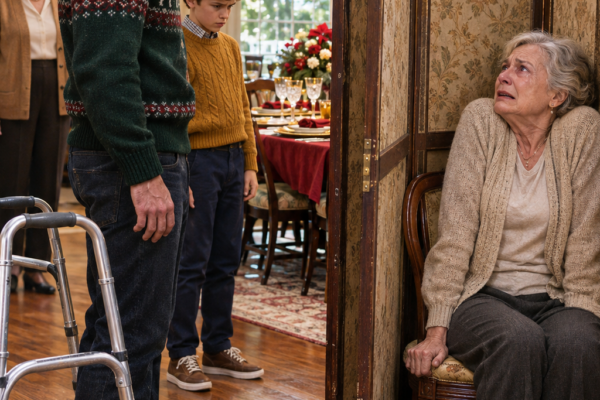
Linda stared at the carpet. I wanted to ask why she hadn’t called me, but I already knew how she would answer.
Richard had said it was fine.
“You do office work. You know budgets get moved around. Don’t act like this is impossible.”
“I’m a major, Richard. I never dropped out.”
His eyes went to the gold oak leaves on my shoulders. For once, he looked long enough to see them.
I had never told him I had left the Army. He had built that story from my quiet answers and stopped asking.
“She sent us the promotion news,” Linda said. “I showed you. You said it was another office title, and I let you say it.”
Richard asked when that was, as though the missing date might excuse him.
I felt embarrassed for wanting him to remember. I had been proud when I sent it.
“I’ve served for fifteen years. And the project was selected for its work. That happened without your company.”
That was all I gave him. I wasn’t going to recite my working life while he decided which parts counted.
He looked past me. Janet was approaching along the ballroom’s quieter edge.
His expression changed before she reached us.
“Well, congratulations, Nora. That’s quite an accomplishment. We’re proud of what you’ve done.”
Linda looked at him. I said nothing.
Janet stopped a few feet away, near enough to have heard. Richard asked pleasantly whether we were ready to finish the presentation.
When she turned toward the platform, he leaned closer.
“A decorated daughter helping families. That gives them a reason to make this work.”
He was still talking about the house.
I felt tired in a way travel hadn’t caused. Even after hearing me, he had found another way to use what I’d said.
Linda asked me to let her speak during the presentation. I searched her face, afraid she meant another request for patience.
She said she wanted to speak for herself this time.
“After this toast, we’ll go to the presentation microphone,” Janet told us. “Nora, Linda, Richard, Eric, and Paul. I’ll be there with you.”
Richard was already moving. Eric followed him toward the backdrop while Linda stayed beside me.
The toast ended with glasses raised across the ballroom. Janet reached the platform, but Richard took the microphone before she could begin.
He faced the relatives who had seen the photograph and Eric’s caption. He said we needed to settle our daughter’s promise.
Then he looked toward the sponsor tables.
“Paul, come tell everyone what you were promised.”
Chapter 5 of 7
“Eric will handle invitations from now on,” Richard told me, covering the microphone. “You won’t be welcome at our house unless you make this right.”
Paul reached the presentation area before I could answer.
“You told me Nora had agreed,” he said to Richard. “Do you both want your arrangement discussed here, in front of your guests?”
Richard said yes. Linda looked at me, then said, “Yes. You can discuss it here.”
Paul stayed beside the platform. He didn’t offer the announcement Richard seemed to expect.
I was hurt by how easily Richard had said it. My mother’s home, where I still knew which stair creaked, had become somewhere Eric could deny me entry.
Linda had heard him. She was looking at the floor near my shoes.
Richard lowered the microphone and leaned toward me. The relatives nearest us kept watching, though several pretended to study the presentation backdrop.
“Give us twelve thousand dollars from your savings,” he said. “I’ll leave the award alone. We can finish dinner like a family.”
There it was, a new price. He hadn’t asked what I could afford or what I needed for myself.
I thought of all the times I had driven to their house carrying something Linda needed. I had never stood outside wondering whether I had brought enough to get in.
“I’m not paying admission to my mother’s home.”
Richard looked toward Linda, waiting for her to correct me. She didn’t, but she didn’t look up either.
Eric stood at the platform’s edge with his phone. He had been included in deciding whether I could visit before I’d even known there was a decision.
I felt ashamed that part of me still wanted an invitation. I wanted Christmas breakfast with my mother without having to bargain for it.
At their house, she made cinnamon toast under the broiler. Richard always complained about the burned corners, then ate those pieces first.
I could miss that kitchen and still refuse him. Standing there, I had to remind myself.
Richard turned toward the watching tables. His voice became warmer, almost apologetic.
“We relied on a sincere offer from our daughter,” he said. “Now people are telling her to withdraw it. We’re trying to find a way through this.”
He said “our daughter” easily enough when guests were listening. A moment earlier, he had given Eric control of the door.
Janet came beside me with the event materials she had kept near the backdrop. She waited while Richard explained that he didn’t want an argument.
I was angry enough to interrupt, but Eric moved closer first. His cropped picture was open again, the house above my shortened message.
He angled his phone toward the display controls.
“Use the whole conversation,” Linda said.
She put her phone on the platform beside me. Her voice carried farther than it had in the alcove.
Eric stopped. He told her everyone had already seen the important part.
Linda stayed beside me while I opened our exchange. I could see the messages that came after my offer, including her thanks when the help arrived.
I didn’t read them aloud. Richard watched the screen from the other side of her.
He told Linda to come stand with him so Janet could finish setting up. There was room beside his chair.
My mother remained where she was.
“I’m not making a private deal with you. Stop asking me for money.”
That small refusal made me hopeful, and I hated how little it took. She had left me standing alone through much worse that evening.
Richard moved closer, lowering his voice again. He said we could still settle this without making everyone uncomfortable.
He meant the payment. He was waiting for me to name a smaller amount so we could begin negotiating.
“I’ll answer at the microphone,” I said. “I’m not making a private deal with you. Stop asking me for money.”
He glanced at the guests, then back at me. For once, having an audience seemed inconvenient to him.
Janet asked whether I wanted the discussion to continue. She said we could pause the presentation.
I wanted to sit down somewhere nobody knew me. I also knew Richard would keep explaining my refusal while I was gone.
“Yes,” I said. Then I turned to Linda. “Will you tell the part you know?”
She nodded before looking at Richard.
I didn’t ask her to promise anything else. I had spent enough of that evening helping her find words she could bear to say.
Paul waited a little apart from us. Richard tried to catch his eye, but Paul gave him no reassurance.
Richard looked at the materials beside Janet, then at my mother’s phone. His offer hadn’t worked, and nobody was helping him persuade me.
He asked whether the award really had to stay with the classes. Janet said its purpose hadn’t changed.
He looked back at me.
“That’s what you’re saying now. What was it when you told your mother you’d help?”
Linda lifted her head. She looked toward Janet’s materials, then opened her mouth, but Richard was already raising the microphone.
I felt afraid again. He had found a version he could tell without mentioning his demand for my savings or Eric’s invitations.
He faced the relatives and spoke into the microphone.
“She changed the rules after she promised us.”
Chapter 6 of 7
Richard claimed the microphone before anyone could answer him.
“She offered to save the house. Then this became project money, and suddenly she couldn’t help. We made plans based on what she told her mother.”
He faced the relatives, including the ones who had turned away from me when Eric’s caption appeared.
I was afraid of what they would believe. I was more afraid of letting him finish for me again.
“Major Bennett, would you like to answer?” Janet asked.
Eric’s hand dropped from the display controls.
I took the microphone from Richard. He released it reluctantly, looking toward Janet as though she had permitted something rude.
“Ask who was nominated before I sent that message.”
The microphone made my voice sound unfamiliar. I kept going anyway.
He was claiming the training purpose had come afterward. I asked Janet to establish whom the award had been intended for from the beginning.
“A nomination can change,” Richard said. “Linda offered the house for workshops. It could still help those same families.”
He pointed toward my mother. She had submitted the request; he expected her to confirm it.
Paul looked at him.
“Was this ever money Nora could give you?”
Richard started explaining what he had understood. Linda moved closer to me, leaving the space beside him empty.
“The original nomination was mine,” she said. “I sent it in April. Eight months ago.”
Janet found it among the materials already beside her. She showed the recipient line: Second Start Skills.
“That is the project named in our award notice,” she said.
My mother looked at Richard, then at the relatives.
“I nominated it because Nora had already built it. Because the classes worked. Not because we needed money.”
That hurt almost as much as it helped. She had known enough to write those words, then watched him tell everyone something else.
The submission came two months before my offer about the house. Richard looked down at the page, searching it while Linda stayed beside me.
I showed Janet the complete exchange on my mother’s phone. My offer led to Linda telling me what was due, then thanking me for the $4,800 I sent.
“That was the help I gave her,” I said. “There’s nothing about an award.”
Linda admitted she had forwarded the excerpt. Eric watched without offering to put the rest on the screen.
She also told them Richard had described occasional workshops, nothing about paying their overdue house bill.
I felt furious hearing how small he had made each separate request sound.
“I won’t trade my work for a place in this family.”
Janet confirmed the award would fund the accepted training plan for twenty-four spouses. Richard’s request did not change that.
Paul checked the time.
“It’s nine o’clock. No acceptable replacement funds have arrived. I’m applying the savings you pledged.”
His decision meant his $31,600 savings reserve would pay the debt Richard had tried to hand me.
“You pledged your savings. Nora never pledged this award.”
Paul completed the instruction through his work access. The amount remaining was still Richard and Linda’s responsibility.
Richard sat abruptly in the nearest chair, then rose again.
“Reverse it. We’re standing here trying to work this out.”
Paul told him the agreed payment had been made. He didn’t raise his voice or offer another negotiation.
Richard turned to Linda and jerked his head toward the tables. She stayed beside me.
For once, I didn’t feel responsible for getting them home calm.
Eric lowered his phone. He glanced toward the relatives who had seen his caption, but nobody asked him to explain it away.
Linda looked at the broad straps still crossing my uniform.
“May I take this off?”
I nodded.
She came behind me and untied the apron Richard had fastened. The relatives nearest the platform watched her lift the straps clear of my ribbons.
I let her help. I didn’t turn around and hug her.
My shoulders ached where I had held them rigid. I was relieved, but I was still angry with her.
Richard watched her fold the white fabric over her arm.
“You’d choose her over our home?”
“I’m choosing not to lie for you.”
He looked toward Eric, who had nothing ready to say.
At family dinners, Linda usually asked everyone whether they had enough before she sat down. That evening, nobody could tell her where to stand.
Janet asked whether I still wanted the award photograph.
I did. I wanted a picture of the work being recognized, without Richard deciding what belonged in it.
“Mom can stand beside me,” I said.
Linda asked if I was sure. I told her yes, for the photograph.
She understood the limit. She didn’t reach for me or ask whether we were all right.
“Could I call you tomorrow? Just call. I won’t ask for money.”
Richard moved toward the backdrop, then stopped when I stayed where I was. Janet directed the rescheduled picture with Linda beside me.
I felt sad looking at the empty space where I had once wanted him. I didn’t ask him to fill it.
Before we faced the camera, Linda leaned close enough that only I could hear.
“Could I call you tomorrow? Just call. I won’t ask for money.”
“Yes.”
It was all I could promise her that evening.
Paul asked both borrowers to remain long enough to hear the remaining balance. I told him that discussion was theirs, and stepped back toward Janet.
Richard was still watching me, waiting for the offer that usually came when things got uncomfortable.
Paul spoke quietly to them.
“That leaves two thousand four hundred.”
Richard looked toward me. I had already turned back to the photograph.
Chapter 7 of 7
On December 18, Richard paid the remaining $2,400 from his own income. Linda told me during a short call, without asking whether I could contribute.
Richard paid it himself. I hadn’t sent a cent.
I waited for the guilt afterward. It came while I was buying groceries, then passed without making me reach for my phone.
Nine weeks after the gala, they sold the house for $279,000. They had chosen to sell rather than keep struggling with payments they couldn’t manage.
After paying what they owed and the selling costs, they kept approximately $96,000. Their smaller rental cost $1,650 a month.
“Would you look at the lease with us?” Linda asked. “Richard wondered whether having your name on it might help.”
“I won’t sign or guarantee it, Mom. You need a place you can rent without me.”
They signed it themselves. I didn’t pay the deposit, and nobody went without a roof.
I was sad about the house. When Linda said the buyers wanted to keep her flower boxes, I cried after we hung up.
Eric sent two messages asking me to “put this behind us.” The first included an invitation to dinner, followed by a suggestion that I help everyone get settled.
“I’m willing to hear about dinner,” I answered once. “Future invitations can’t come with financial conditions. And you still haven’t corrected what you sent about me.”
He didn’t correct it. When his second message arrived, I left it unanswered.
Richard sent no apology. I didn’t call to ask for one.
Linda began calling without him on the line. At first, I could hear her checking whether he was nearby.
“You don’t have to whisper,” I told her. “But if he joins the call to ask for money, I’m hanging up.”
She said she understood. The next call lasted eleven minutes and concerned a difficult coworker and my drive home.
I felt relieved afterward. We had managed an ordinary conversation, and I hadn’t paid for it.
Before her first brief visit, I told her my private messages couldn’t be forwarded. If she wanted help, she had to ask plainly, without putting it inside an invitation.
“I watched him put that thing over your uniform,” she said. “You asked me to help, and I looked away. Then I gave Eric your message because it made things easier for me.”
We were standing outside after the visit. I had been ready to say goodbye.
“I’m sorry, Nora. You don’t have to tell me it’s all right.”
“It isn’t all right yet.”
She nodded. She didn’t cry until she reached her car, and she didn’t come back asking me to comfort her.
I still got angry about that evening. Sometimes her name on my phone brought back the sight of her watching Richard.
But she began asking before sharing anything about me. When I said a visit needed to end, she went home.
Over the following six months, the $43,000 supported the promised training for twenty-four spouses. I kept my Army work separate and attended the final skills demonstration on personal time.
One participant practiced explaining a gap in her work history. Another caught an inventory error, then laughed when she realized she had found it before anyone prompted her.
“Can I try that answer again?” one asked. “I sounded like I was apologizing for having children.”
She tried again. This time, she finished without looking down.
I was proud of them. Watching their work, I could finally think about the award without hearing Richard’s voice.
Six months after the gala, I was thirty-eight, and Linda came to my rented townhouse for breakfast.
I had washed the white laundry apron and kept it in a kitchen drawer. That morning, I tied it myself over a T-shirt and jeans, loose enough to be comfortable.
I used it when I wanted to. Some weekends it stayed in the drawer.
“You’re making pancakes?” Linda asked from the doorway.
“Unless you came here expecting something else.”
“No. Pancakes sound good. I brought blueberries.”
Richard used to say I “always made a mess” when I cooked breakfast. I had stopped volunteering after enough mornings spent scrubbing while he inspected the stove.
“Pass me the blueberries. You can rinse them, if you want.”
There was flour on my counter now. I wasn’t embarrassed by it.
I chose the music and left my phone facedown. Linda settled at my small table, looking around without suggesting what I ought to change.
“Do you want help with anything?”
“Pass me the blueberries. You can rinse them, if you want.”
She did. She didn’t take over the kitchen or ask why I had mixed the batter that way.
The first pancake folded under the spatula. I put it on my plate, where its torn edge wouldn’t bother anybody.
“That one looks like Ohio,” Linda said.
“Then I’ll charge extra for it.”
She laughed with her mouth still open in surprise. I laughed, too, and felt happy without immediately checking what might spoil it.
We talked about her new place. She could walk to the grocery store, though she was still learning which cabinet held the mugs.
She mentioned Richard once, saying he had taken over his own laundry. I let the subject pass without asking whether he was angry.
“I miss the old kitchen,” she admitted. “But I don’t miss being afraid every time the mail came.”
“Are you managing the rent?”
“Yes. We’re managing it ourselves. I wasn’t leading up to anything.”
“I know. I wanted to ask.”
That distinction still took practice. I could care about her answer without offering my savings.
Linda watched me finish the last pancakes. Then she asked whether she could come again sometime.
“Call first. Some weekends I’ll want to be alone.”
“All right. You can say no.”
I believed she was trying. That was enough for breakfast; I didn’t have to decide the rest of our lives across the table.
I turned off the stove and brought over the plate. There were dishes waiting, a little batter drying beside the bowl, and nowhere else I needed to be.
Linda waited until I had served myself before reaching for a pancake. I was hungry, and glad she had come.
Family stopped being a debt I had to keep paying.
I wiped my hands on the apron and sat down.