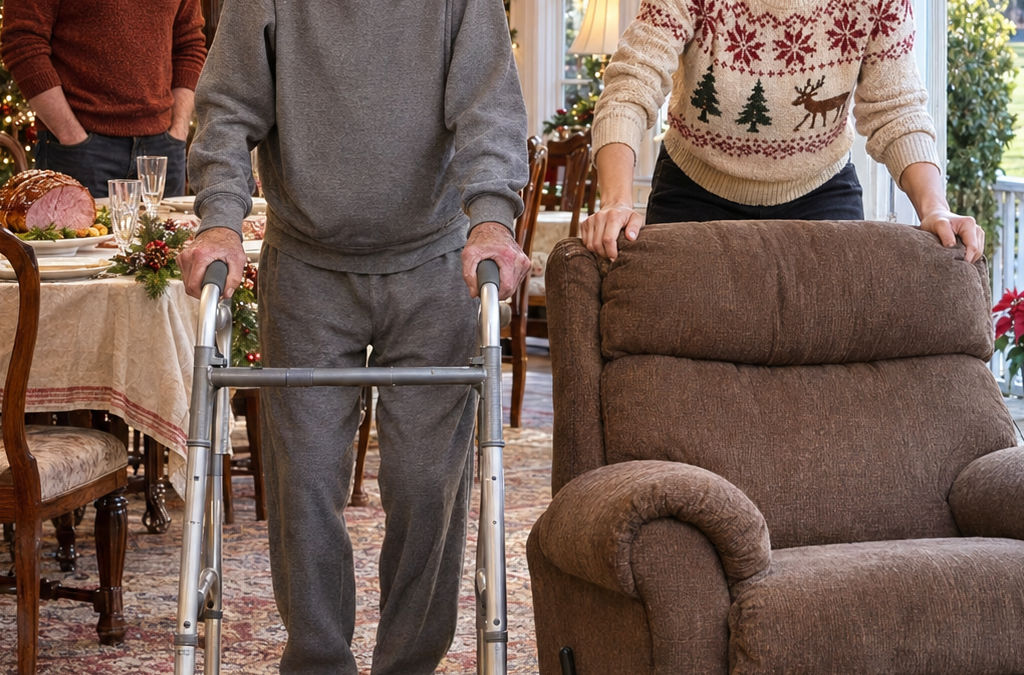
I’m 72, standing inside my own home with a hospital walker as my daughter-in-law rolls my recliner onto the porch during Christmas dinner.
Chapter 1 of 7
“You can rest outside.”
Brooke Ellis pushed my brown recovery recliner toward the open porch doors. Its front casters reached the porch, but the chair had not cleared the doorway, and I stood behind it gripping my hospital walker.
“I came home to recover here,” I said.
My son, Adam Bennett, stood beside the dining table in my San Antonio, Texas, home, staring at the plate in front of him.
“Are you really going to let her do this?”
Adam looked down.
His mother-in-law, Carol Ellis, held her glass raised for a Christmas toast while cold air slid around my ankles and the ham cooled beneath a silver cover.
Beyond the table, two unfamiliar towels rested on a luggage stand beside my bedroom doorway.
My name is Henry Bennett. I’m seventy-two, a retired Army colonel, and this house is mine.
My family knew almost nothing about my work. Adam’s mother and I separated when he was four, and he grew up mostly with her while my later assignments sounded like a civilian desk job.
Adam believed I had left the Army early. I never corrected him.
My late second wife knew the truth, but she had never needed to explain it for me.
The extra blanket I bought for Carol’s visits lay folded over a dining chair. Adam’s favorite pecan pie waited in the kitchen, baked with the filling he liked and the crust he always left behind.
When their grocery money ran short, I covered it without questions. Solving their problems had become my usual way of preserving peace, even when peace cost me more than money.
Brooke and Adam had signed a promise that their stay was temporary. Eight months later, I came home from pneumonia treatment wearing sweatpants, a sweatshirt, and the same old Army travel bag David had carried from my car.
Two unfamiliar towels waited outside my bedroom.
Brooke glanced toward them before looking back at me.
“This was supposed to be a visit,” she said. “We weren’t planning on you staying.”
Then she pushed the recliner another few inches. I had bought it for my late wife’s recovery, and its locking wheels had once made it easier to move her near the window.
“Brooke has already arranged everything here,” Carol said.
“Don’t make your recovery everyone’s problem.”
Those words hurt more than Brooke’s insults. Carol had slept in my guest room often enough to know which cupboard held her tea and which hallway floorboard creaked.
“You expect me to recover on the porch?”
“You can sit there until dinner is over.”
Brooke spoke as if I had interrupted a children’s game, and Adam kept his eyes on the pie fork beside his plate.
“STOP MAKING EVERYONE WAIT!”
I stepped back from the doorway instead of fighting her for the chair. A fall would have left me on the floor, and nobody at that table looked ready to catch me.
“All right,” I said.
My phone showed the voicemail Brooke had left after the hospital called about my discharge, and I held it while looking toward the porch where David Turner was unloading my belongings.
“Will you come inside, please?”
David was my longtime friend and former Army colleague. He had driven me home after treatment and was carrying my small travel bag toward the front steps when he answered.
“Carol just told me Brooke promised your bedroom to paying guests,” he said. “She said you permanently entered care.”
I couldn’t answer for a moment.
So that was the luggage stand. Someone expected strangers to unpack beside the bed where I had planned to sleep.
David entered the dining room while I stood beside my walker, and his expression changed when he saw Brooke still holding the chair against the threshold.
He caught its back before it rolled farther, then brought it around me and locked both casters.
“Please leave that where I put it,” Brooke said.
David kept moving.
“Henry was discharged home,” he said.
He steadied my walker while I lowered myself into the seat, and my legs shook from the short struggle more than I wanted anyone to notice.
Carol’s raised glass dropped toward the table.
“Brooke told Carol you weren’t coming home,” David said.
Brooke opened her mouth.
No words came.
Carol’s glass struck the table with a sharp knock.
Carol pointed at Adam. “Then why did your son tell me that?”
“Adam, you told Carol I was never coming home,” I said.
My son lifted his face, but he couldn’t hold my eyes.
He admitted telling her I was moving into care permanently.
“Did I ever tell you that?” I asked.
Adam shook his head and said I hadn’t. Brooke took her fingers off my chair.
“Adam, don’t start explaining things you don’t understand,” she said.
I stayed seated. My son had settled where I would live without asking me.
Brooke turned to David and asked why he was getting involved. Her voice had changed.
“I’m Henry’s friend and housing attorney. He invited me for Christmas dinner.”
David remained beside me. He didn’t tell anybody to leave.
Instead, he asked Adam to close the porch doors against the draft.
Adam started toward them, but Carol stopped him with a name: Megan Foster.
She was the traveling nurse Carol knew from her hospital days—the woman expecting my bedroom.
Adam checked his phone before reaching the doors.
Brooke reminded him dinner was getting cold. He kept reading.
His chair scraped backward as he moved away from the table.
He held his phone up toward Brooke.
The color drained from her face.
“Brooke, you promised them Dad would sign?”
“I told Megan he approved,” Brooke said. “You were supposed to talk to him afterward.”
“You said you could handle your father.”
I hated hearing myself discussed that way while sitting within reach of them. David had brought me home expecting a quiet Christmas evening, and I had expected my own bed.
“I haven’t approved any guests,” I said. “I want my own room.”
Brooke looked toward the hallway, then at Adam.
“The room’s already prepared.”
“It was prepared for me before I went to the hospital.”
She said the towels were harmless. Nobody answered her.
David asked whether I needed water before trying to walk again. I said yes, and Adam brought a glass from the kitchen without meeting my eyes.
And I opened Brooke’s voicemail again. This time, I deliberately saved it so it would not disappear among the hospital calls, while David watched without asking what it said.
Brooke watched us from her chair.
“Can we please eat before this gets any bigger?”
I wasn’t hungry anymore. The smell of ham had turned sour, and the Christmas music from the living room sounded too cheerful for the faces around my table.
Carol told Brooke she needed to explain the arrangement properly. Brooke said she had been trying, but everyone kept interrupting.
David remained beside me while Adam carried my old travel bag away from the hallway. I asked him to leave it inside, where I could see it.
Carol looked at the towels again.
Then she faced Brooke.
“I paid Brooke nine hundred dollars for Megan’s room.”
Chapter 2 of 7
Carol met me beside my bedroom doorway the following morning. She had come back for an answer, though I hadn’t agreed to give her one.
“The nine hundred dollars was my advance for Megan’s reservation,” she said. “I told her, ‘Henry invited you himself.’ She took my word for it.”
Megan had never spoken to me about staying. Carol had supplied the invitation herself.
I stood with my walker between us. I had slept badly, waking whenever someone passed my door. Now Carol blocked the hallway as though I owed her an explanation.
“You could let us settle this quietly.”
I asked what she meant by quietly. She glanced toward the kitchen, where Adam was scraping burnt toast into the trash. He had done that since he was a boy, convinced the bread underneath was still worth saving.
“For five months, Henry. Eighteen hundred a month for Megan and the other worker. They’d mostly be working or sleeping. You wouldn’t even have to entertain them.”
She made it sound like I had objected to setting another place at dinner.
I was angry, but tired enough that forming each question took effort. I wanted breakfast and a clean shirt. Instead, I was being asked to defend wanting my bed.
“Why didn’t you call me?”
Carol said Brooke had warned her against it. Hospital calls wore me out, apparently. Questions about the house would only upset me while I was sick.
She had accepted that explanation without hearing my voice once.
“I worked with Megan,” she said. “She knows me. I can’t go back now and tell her I didn’t know what I was talking about. You understand what that makes me look like.”
That hurt. I had bought groceries for her visits and made room whenever she needed it. She was worried about looking foolish to a former colleague.
Adam came out of the kitchen carrying his phone. He stopped several feet behind Carol, close enough to hear, far enough away to avoid joining us.
I asked Carol whether Brooke had told her where I was supposed to sleep.
She said there were other rooms. Her eyes moved past my shoulder into the bedroom, where my reading lamp was still beside the bed.
“Brooke owes eighteen thousand nine hundred dollars,” Carol said. “She told me herself. She’s afraid her father will find out she’s behind again. This money would give her some breathing room.”
I hadn’t known about the debt. I had known about short grocery weeks and a car repair. Those had always arrived as separate problems, each small enough to help with.
Carol seemed to think the number would change my answer.
I felt used. My shoulder ached from leaning on the walker, and I shifted my weight without taking my eyes off her.
“She’s kept this household going,” Carol continued. “They’ve lived here eight months. You can’t expect her to ask permission for every little thing.”
Giving away my bedroom wasn’t a little thing.
I asked whether living without rent meant Brooke could start collecting it from somebody else. Carol frowned and said I was making it sound ugly on purpose.
She knew they had moved in temporarily. Whether Brooke had told her anything more, I couldn’t tell.
Adam’s phone kept lighting up while she talked. By the sixth message, Carol turned and asked what was so urgent. He let her see the screen.
“Get him to stop telling people we lied.”
Carol read it aloud, then looked at me. I hadn’t called anyone. All I had done was answer questions at my own table.
Brooke appeared behind Adam. She wore the same sweatshirt she had worn after dinner, and she looked irritated rather than embarrassed.
“Stop dragging my mother into your complaints,” she said. “She came here to help you understand.”
“I didn’t. If she asks me, I’ll tell her the truth.”
Then she went into the kitchen. A cupboard shut harder than it needed to.
I was humiliated by how easily she spoke to me that way. Adam heard every word and stayed where he was.
Carol lowered her voice. She wanted me to tell Megan there had been a misunderstanding, then welcome her anyway. That would protect everybody, she said.
“I won’t tell her I invited her,” I said. “I didn’t. If she asks me, I’ll tell her the truth.”
Carol stared at me as though I had refused a favor she had already repaid.
David had confirmed in a brief call that the ownership record showed no transfer to Adam or Brooke.
I didn’t bring that into the hallway. Carol wasn’t asking who owned the house. She wanted me to make her story true because correcting it would embarrass her.
She said people would hear how I had treated them after all Brooke had done. She would call it ungrateful, and she wouldn’t pretend otherwise.
I had never felt so unwelcome at my own bedroom door. I asked her to move so I could get through.
“You’ll lose more than a quiet room over this, Henry. People remember who makes trouble in a family.”
I didn’t answer that. Adam moved aside first, though Carol was the one blocking me. Eventually she stepped back.
Before I could reach the kitchen, I asked whether Megan knew I had returned home. Carol said Brooke had spoken to her again after dinner.
I stopped. Nothing had been settled at that table. I had refused the arrangement plainly, with everyone listening.
Carol looked toward the kitchen before answering.
“Brooke told Megan she could arrive next week.”
Chapter 3 of 7
Brooke met me in the den beside a narrow daybed. My folded clothes sat on its end, with my undershirts stacked beneath the pants I wore to church.
“This is where you’ll sleep. Adam said it was fine.”
Adam stood at the edge of the room. I asked whether he had agreed to give away my bed, too. He looked toward Brooke instead of answering.
“He said you would do what helped us,” she said. “Megan’s still coming next week. I’m keeping the room ready.”
She had given Megan no keys, and nobody new had moved in. Still, she had carried my clothes down the hall while I was washing up.
I felt helpless seeing them there. Yesterday I had defended my right to sleep at home. Now I apparently needed to specify which part.
“Did you tell Megan I said no?” I asked. “Or are you still telling her I agreed?”
Brooke said Megan knew there had been a family discussion. That was all she needed to know until we worked it out.
Carol stood beside the daybed, inspecting it as though she might buy it. She pressed the mattress once and said it was enough for anybody recovering.
The den had no door. From the daybed, I could see the kitchen entrance and the television Adam watched after work.
“You’re acting like I put you in the garage,” Brooke said. “There’s a bed right here. Your room would be wasted while you’re mostly lying down.”
My bedroom held a proper bed, a door I could close, and the things I knew how to find in the dark. I wanted those ordinary comforts badly.
I told her I didn’t want people walking past while I dressed. She said I could dress in the bathroom.
I was embarrassed that Carol stayed to hear that answer. Neither woman seemed embarrassed for me.
“Dad keeps his socks in that top drawer,” Adam said. “Did you bring those?”
That was what he contributed. I almost laughed, though nothing about it was funny.
Brooke told him he could fetch them. He went down the hall, relieved to have something small to do.
The daybed had been mine for years. Adam and I used to watch baseball there, eating popcorn from a mixing bowl because neither of us wanted to wash two bowls.
I had never imagined lying there while someone else decided what happened behind my bedroom door.
“You never asked whether helping meant you could move me out of my bed,”
“You can’t keep saying this is temporary,” Brooke said. “I signed for a temporary stay before everything changed. Then you got sick, and somebody had to keep things running.”
I asked what she believed had changed between us. She talked about groceries, laundry, and answering hospital calls. Adam returned with my socks while she listed them.
I appreciated work done for me. I had thanked her for it. Hearing that work used to explain why I should surrender my room made me furious.
“You never asked whether helping meant you could move me out of my bed,” I said. “I never agreed to that.”
Carol said Brooke was trying to solve a difficult situation. Her eyes went to Adam, asking him to support her without saying his name.
He left my socks beside the other clothes. He said we could discuss everything once I was stronger.
Getting stronger had become the condition for being heard. Until then, they expected me to accept whatever was easiest for them.
I tried to lift the stack of clothes with one hand. The walker shifted, and I stopped. I couldn’t carry everything back safely, and I hated that they could see it.
“Leave those alone,” Brooke said. “You’ll fall, and then we’ll all have another problem.”
I let the clothes stay. That afternoon, I lay on the narrow mattress with my knees bent because the end frame pressed against my heels.
Adam turned the television down when I asked. Later, he turned it up again during a commercial and forgot.
I felt lonely with three people moving around the house. Every cupboard closing reminded me that I couldn’t shut a door of my own.
“Megan needs to hear from me,” I told Brooke when she came through. “Give her my number. I’m not approving this, and I won’t let her travel here expecting a room.”
Brooke said I was ruining an arrangement that could help everyone. I repeated the request until she sent my number.
When Megan called, I told her plainly that I hadn’t invited her or approved a stay. She said she wouldn’t come. I was sorry she had been drawn into it.
The following day, written thirty-day notices ending their permission to stay were served on both Adam and Brooke and also sent by certified mail. David kept proof that both had received them.
I was still in the den when Brooke came to find Adam. He stood near the television, reading his copy.
“So that’s what your father does when we disagree,” she said. “He gets somebody else to throw us out.”
I told her I had asked them to leave. She didn’t look at me.
It hurt to watch Adam study the page as though the decision might belong to someone outside this house. I had spent too long letting him avoid my face.
Brooke told him that siding with me would mean losing her. There would be no family dinners, no dropping by together, no pretending afterward that he hadn’t chosen.
He said her name, but nothing followed it.
She stepped close and struck her notice against his chest. He caught the paper before it fell.
Brooke left it in his hands.
“Choose who you’re living with.”
Chapter 4 of 7
Adam came into the den after the thirty days had run out. He still slept beside Brooke, and he wanted me to know that before he said anything else.
“I stayed with her. When she made me choose.”
I knew. I had heard them talking through the wall every night.
He sat on the daybed’s far end, leaving space between us. My walker stood within reach. I could walk farther now, but I still needed it when I first got up.
“Brooke asked me to tell Carol you didn’t want hospital visitors. I said it because I didn’t want another fight with her.”
He watched me then. I wished he had looked at me that carefully when I was trying to get home.
“You could have asked me,” I said.
He admitted that would have been easy. One call, one question. Instead, he had passed along the message and let Carol pass it farther.
I felt abandoned all over again. In the hospital, I had kept the visitor’s chair clear, even when a nurse suggested putting my bag there.
I had imagined Adam sitting down without his coat on. Staying awhile.
“I never said I didn’t want visitors.”
“No. You didn’t. Brooke didn’t want anyone asking you about the bedroom before she had it worked out.”
He said it without defending her, but he had helped her do it. While I waited for company, they had been deciding what I would accept afterward.
The den smelled of the frozen waffles Adam ate before work. He always cooked them twice because he liked the edges nearly burned. That morning, he had made two and eaten neither.
“She thought you’d already promised me the house,” he said. “She said you wouldn’t embarrass me in front of everybody by taking it back.”
I asked what there was to take back. He couldn’t name a conversation in which I had given him this house.
I had told him he could stay while they got themselves settled. I had never promised either of them a permanent home.
David had confirmed that the recorded ownership remained mine alone.
It hurt that my son had treated my reluctance to embarrass him as permission. I had covered for his mistakes before. He had apparently counted on it.
“He didn’t give it to us,” Adam said.
Brooke had appeared at the den entrance. I hadn’t heard her coming, and Adam’s answer stopped her before she could interrupt.
She looked from him to me.
“You said this would eventually be your place.”
Adam admitted he had assumed that. He hadn’t asked me, and I hadn’t said it.
Brooke stayed in the doorway, blocking most of the hall.
“I bought this house with what I earned,” I told her. “I retired from the Army as a colonel after thirty years. I didn’t leave early.”
Adam stared at me. His mother and I had separated when he was four. Later, when he described my work as a desk job, I had let it stand.
I could see him trying to fit those years together. Brooke looked toward the hallway, then back at me.
“Thirty years?” she asked.
I nodded. My late wife had known that whole part of my life. I felt sad explaining it to my son while his wife waited for an opening.
“Well, it’s your house. Nobody’s arguing about that now.”
Brooke’s voice rose before she finished. She said being the owner didn’t mean I could ignore what we had agreed after I became sick.
According to her, letting them stay had become an exchange. She would help me, and they would have a continuing place here.
“You don’t get to erase what I did.”
I hadn’t erased it. I remembered the laundry and the meals. I also remembered lying in the den because she wanted somebody else in my bed.
Adam’s phone rang with a return call from David. Brooke asked him to put it on speaker.
“David, I’m concerned Henry doesn’t understand what we arranged when he needed us. I want you to hear that we were helping him.”
David said he had heard her. He would speak with me later. The call ended there.
I was furious at how gently she could speak when she wanted somebody’s approval. She had never sounded concerned while telling me to dress in the bathroom.
Adam said he had another thing to admit. Whenever I spoke privately with him, he had been telling Brooke afterward.
“She asks what you said. I’ve been sending it. Even things you weren’t saying about her.”
“I’ll listen when you tell the truth in front of other people,”
Brooke told him married people didn’t keep secrets. He said he wouldn’t report my conversations anymore.
She demanded to know whether that meant he was hiding things already. He stayed seated.
I wanted to believe him, but wanting had cost me enough.
“I’ll listen when you tell the truth in front of other people,” I said. “I can’t use another promise made in here.”
He didn’t ask me to forgive him. For once, he let my answer stand.
The case was filed after the notice expired. Later, we learned the hearing would be Monday morning at the Bexar County Justice Court; Brooke’s parents would attend with the rest of us.
She had signed a limit she now wanted everyone to forget.
Before the hearing, Brooke called her father from the kitchen. Adam was getting water when she told him how things would go. I heard her voice, but not the words.
When she finished, Adam came into the den. He looked ashamed, and I was tired of learning why.
“She told Paul I’d swear you promised her a permanent home.”
Chapter 5 of 7
Brooke stood in front of my chair in the courthouse waiting alcove. She had brought her parents close enough that I couldn’t speak without including them.
Paul Ellis looked at Adam, who stood beside her.
“Brooke says you heard Henry promise her a permanent home. For looking after him. That’s why we came.”
“I’m not going to say that happened,” Adam said.
Carol looked toward Brooke. Nobody asked me what I had promised.
I had needed a rest after the walk from the entrance. David had found a chair with room for my walker, and Brooke had followed us there.
I felt cornered before we had even gone inside.
“You don’t have to make anyone a liar,” Brooke told Adam. “Your dad was sick. He forgot a conversation. Just tell them what we discussed.”
She kept looking at her parents as she spoke. This was an explanation she wanted them to take home.
Adam said he remembered discussions about helping me. He didn’t remember me offering them a permanent place to live.
Brooke answered that he was getting caught up in words.
I watched Paul. He had missed Christmas dinner because he was visiting his brother. Until now, he had heard about it from people who wanted him on their side.
“When did I say it?” I asked. “Tell me when.”
Brooke said it was during my hospital stay, after the worst had passed. We had talked about how much help I would need once I got out.
She sounded certain about the help. About my supposed promise, she could offer only that stretch of days.
I remembered being tired and grateful when somebody called. I also remembered wanting to go home. It hurt to hear my gratitude turned into something I owed her.
“I’m not debating my memory out here,” I said. “I asked you what I said. You keep telling me what you did.”
“Adam knows that. He was there when we talked about keeping things going.”
Paul frowned at that. Carol told him recovery had been difficult for everybody.
David asked whether the chair was comfortable enough. I said it was. He stayed beside me without joining the argument.
He had the signed agreement, proof the notice reached both of them, and the voicemail preserved from my phone. He also had Adam’s photograph of the chair at the Christmas porch threshold, taken to explain the argument to Paul. Everything had been shared as the court required; nothing was being sprung on Brooke.
“You said I could run the household,” Brooke told me. “Adam knows that. He was there when we talked about keeping things going.”
Running errands and deciding where I could sleep had become the same thing in her account.
I said I had welcomed help. That was all.
Brooke told Paul that Adam could explain it better. Adam stared at the empty chair beside mine, then crossed the alcove and sat down.
He placed his house key on his knee.
I wanted to reach for him. I was still angry enough that I stayed where I was.
For years, he had sat beside me at meals while letting Brooke answer my questions. This small change of seats mattered, but I was afraid to trust it too quickly.
“I’ve rented a room,” Adam said. “Twelve hundred a month. I’m not asking Dad to let me stay because I’m telling the truth.”
Brooke stared at him. Carol asked whether he had already paid for it. He said he had, and gave no explanation for keeping that from them.
I hadn’t known either.
Adam told me he understood that my spare bedrooms weren’t his backup plan. I said we could talk about visits another time.
It hurt that we needed to say those things in a courthouse. They still needed saying.
“You’re abandoning your wife for an audience.”
Brooke’s voice carried past the alcove. A man near the drinking fountain glanced over.
Carol told her to lower her voice. Brooke said she wasn’t shouting, then asked Adam whether he had planned this with me.
He said the room was his decision.
Paul studied my son as though he was finally hearing from him directly. He asked whether Brooke had known he was moving.
Adam said he had told her he needed somewhere else to live. She had said he was being dramatic.
That sounded familiar enough to make me sad.
David asked, “Henry, do you need a minute before we go in?”
I told him I could manage. My legs were tired, but I wanted to be there when people had to answer the same questions I had been asking at home.
Adam had brought a banana for breakfast and forgotten to peel off the grocery sticker. It clung to his coat sleeve now.
I nearly told him. His mother used to call those stickers his meal receipts. Remembering that ordinary joke made me miss how easy talking to him had once been.
“You can still explain this properly,” Brooke told him. “Nobody needs you to turn against anybody. Just say Dad wanted us there.”
Adam said I had wanted them there temporarily. Brooke looked away from him before he finished.
I was embarrassed for him, and for myself. Even here, she was counting on us to soften an answer until she could use it.
Paul asked his daughter whether she was sure Adam had heard the promise.
Brooke faced him instead of my son.
“Adam heard the promise. He’ll have to admit it.”
Chapter 6 of 7
Brooke’s sworn answer was that I had promised her a permanent home.
“He said we could stay for looking after him. He owns the house. I’m not disputing that. But Christmas was supposed to be a visit.”
Adam sat behind me with Carol and Paul nearby. He shook his head when the judge asked whether he had heard that promise. He would have his turn to explain.
I was angry enough that I worried my voice would fail. David offered me the hearing copy, and I recognized the three signatures.
Mine. Adam’s. Brooke’s.
“If I gave her control of the household, why did what she signed keep my bedroom out of it?”
Judge Linda Brooks asked me to identify the page. I did, pointing out my signature and Brooke’s beneath the terms we had accepted when they moved in.
Brooke acknowledged signing the temporary-occupancy agreement. She said it described what we intended before I became ill.
“Later, we talked about what he needed. That room was there so he could visit. Things changed when I started helping him.”
David asked, “Colonel Bennett, is that the agreement you retained?”
I said it was. Paul turned toward Carol, whose eyes stayed on me. Neither had heard David address me that way before.
The judge asked me to read the part about my room. Her attention remained on the page.
“Henry Bennett retains his bedroom and unrestricted residence in the home.”
I read it slowly. I felt ashamed remembering my folded clothes on the den bed. I had signed those words expecting my son and his wife to honor them.
Then I identified my phone and Brooke’s familiar voice in the saved message. I asked for it to be played.
“The nurse says you’re coming home tomorrow. We’ll keep your bedroom clear.”
That was the whole message. She had left it after the hospital conversation she now said had given her a permanent home.
Hearing her voice hurt. I remembered listening in the hospital and feeling relieved.
Brooke reached for her water, then set it down without drinking. She said knowing I was coming home didn’t erase the work she had done.
Judge Brooks asked, “Did he ever agree you could stay after he ended the arrangement?”
Adam stood when asked to answer.
“No. I told Carol he was staying in care because Brooke asked me to.”
He explained that he had heard no permanent promise. He had assumed I would accept what Brooke wanted and had avoided asking me directly.
When he came forward, he left his house key on the table beside me.
I also identified his photograph of my recliner crossing the porch threshold. The front wheels were outside. Seeing it again made me feel small, though I was sitting safely in court.
Brooke said the photograph left out the argument. The judge let her finish, then reviewed the signed terms and confirmation that both notices had reached them.
“The agreed thirty days passed before this case was filed,” Judge Brooks said. “The permission could be ended. The bedroom provision and your message do not support a later permanent right. I grant Mr. Bennett possession.”
Before her husband and both parents, Brooke had lost her rent-free home. The four-bedroom house had a fair monthly rent of $3,150. She had paid none of it.
Brooke pushed her chair back before anyone near her moved.
“Adam, get up. You’re leaving with me now.”
He remained beside my table. He said he would collect his things separately.
“What exactly did you tell me, Brooke? You said Adam heard him promise.”
Carol began saying his name, then stopped. When Brooke looked to her, she looked away.
I felt relieved, but my legs were trembling beneath the table. I still had to get home, and Brooke would still be there.
Paul waited until we were outside the hearing room before speaking.
“What exactly did you tell me, Brooke? You said Adam heard him promise.”
Brooke said Adam had changed his story to please me. Paul asked what story he had changed, since Adam had refused to support hers before we went inside.
Carol stood close enough to answer for her daughter. This time, she didn’t.
David told me the judgment wasn’t permission to change the locks that afternoon. I said I understood. I wanted my bedroom back badly, but I could wait for the house to be returned properly.
Brooke came alongside my walker.
“Let us stay until we get settled. We can use the den.”
She offered to stop discussing guests and help with meals. There had been no such offer when I had asked for privacy.
I felt tired rather than tempted. I told her I wasn’t agreeing to continued residence.
She asked whether I meant to shut them out of every holiday, too. Adam started to answer, but I wanted her to hear me.
“You can visit only when I invite you.”
She stared at him instead. He didn’t soften what I had said.
Near the exit, Adam asked whether I wanted him beside me or ahead with the car. I said beside me. He matched my pace without touching the walker.
At home, he always complained that I saved too many empty coffee cans. For a moment, I wanted to ask whether he needed some for his new room. I kept the question for another day.
Carol caught up before we reached the outer doors. She asked Brooke about returning Megan’s money.
Brooke looked toward Paul, then back at her mother.
“I already spent Megan’s nine hundred dollars.”
Chapter 7 of 7
Carol returned Megan’s nine hundred dollars the morning after the hearing. She told Brooke to repay her in three installments of three hundred dollars over the next three months.
“This isn’t Henry’s bill,” she said. “You took the money. You’ll pay it back.”
Brooke agreed to that in writing. It was between them, separate from anything the judge had decided.
Megan and her traveling companion found somewhere else to stay. Neither ever moved into my house, and I paid none of their expenses.
I was relieved that Megan could finally make plans without another promise being made in my name.
The weeks afterward were uncomfortable. Brooke avoided me unless she wanted something, and I still slept in the den. David kept me informed while the required waiting periods passed and the writ was issued.
I left their belongings alone. The locks stayed unchanged.
On March 2, 2027, Deputy Constable Luis Ramirez supervised their departure and returned possession of the house to me.
“Mr. Bennett, let them handle their things,” he said. “I’ll stay until we’re finished.”
I waited beside my walker while Brooke carried bags down the hall. Paul helped with the heavier boxes. Carol came behind them, checking cupboards without offering opinions about where I ought to live.
I felt nervous watching them leave. For weeks, I had wanted this morning. Now every trip through the doorway seemed to invite another argument.
“You could help with the first month,” Brooke told me. “After everything we spent keeping this place going.”
Her apartment cost $1,650 a month. The four-bedroom house she was leaving had cost her nothing.
“I’m not paying your rent,” I said. “And I won’t pay Adam’s.”
She looked toward my son, expecting him to object. He carried his own box outside.
Adam had already moved into his separate room at $1,200 a month. What remained here was mostly clothing and things he had never bothered unpacking.
Before leaving, he returned the key he had brought back for collecting his belongings.
“I’ve got everything,” he said. “If I missed anything, I’ll call. I won’t just come in.”
We could arrange visits, I told him. There would be no replacement key.
That hurt to say. I wanted a son who could come through my door easily. I didn’t yet have a son I could trust with that freedom.
Brooke stopped beside the deputy on her last trip.
“I still don’t agree with what happened here.”
He told her he understood she disagreed. He was there to carry out the order.
She left without saying goodbye to me. Paul followed her to the car, and Carol lingered near the porch.
Deputy Ramirez checked that the move was finished before leaving the house in my possession. I thanked him, then stayed inside while the cars pulled away.
I was exhausted. I hadn’t carried a single box.
Carol returned the following week, after calling first. I met her in the entryway rather than inviting her into the kitchen.
“I’m sorry I spoke for you,” she said. “I told Megan you wanted her here, then tried to make you say it was true.”
I let her finish. She said embarrassment had made her stubborn, but that didn’t excuse what she had done.
“No,” I said. “It didn’t.”
She didn’t ask me to reassure her. I appreciated that, though I wasn’t ready to welcome her as before.
There was no dinner afterward. She went home, and I went back to my room.
The first afternoon alone, I opened my bedroom curtains. Dust showed along the windowsill, and the bedspread had a crease where someone had folded it too neatly.
I felt sad before I felt comfortable. I had missed an ordinary room so badly.
My everyday clothes belonged within reach. I brought back a few shirts, then rested before carrying anything else. Later, Adam came at the time we had agreed and brought the remaining clothes from the den.
“Where do you want the socks?”
“In the drawer you knew they belonged in.”
He looked embarrassed. I hadn’t meant it as a joke, and he didn’t treat it as one.
He put them away, then asked whether I needed anything else. I said I wanted to lie down. He left without suggesting I should stay up because he had come over.
That small courtesy mattered. It didn’t erase Christmas.
Over the following months, Brooke completed the three payments to Carol. I heard about the last one in a brief call, not at a family gathering. Nobody asked me to contribute.
David remained my friend after the case ended. He called about my meals and the yard, and sometimes came over without bringing a single page for me to read.
By early summer, I could walk through the house without stopping to catch my breath. I still kept the walker handy on tired days. Help with cleaning and regular follow-up care made living alone manageable.
I was proud of that improvement. I had worked for it, slowly.
Adam visited one afternoon with peaches and sandwich bread. He had called ahead, and I had told him to come hungry.
He found the mustard jar upside down in a coffee mug.
“You still do this?”
“There’s another sandwich left in there.”
He laughed and scraped out enough to prove me right. We ate at the kitchen table while he told me about a customer who wanted a part for a car he couldn’t identify.
“Did you guess?”
“Want me to move it closer to the window?”
“No. I asked him to bring the car.”
I told him that sounded sensible. We finished lunch without discussing Brooke or the courthouse.
Later, he stopped beside my bedroom chair.
“Want me to move it closer to the window?”
“Leave it there. You can carry the plates out.”
He did. My recliner was already inside beside my own bedroom window, its wheels locked. Before he left, he asked when he could visit again.
We chose an afternoon the following week. He went home to his own address.
I felt peaceful after the door closed. There were dishes waiting, but I could wash them later. I released the chair’s brakes to shift it toward the light; I would lock them again before sitting.
Family didn’t require me to surrender my own front door.
I pulled my recliner into the afternoon sun.







